Introduction
JOHN A. DALL was born in May of 1846 in New Jersey, according to the 1900 Census. The 1920 Census indicates that he may have been three years older. Little is known of his early life, as he does not appear in the 1860 or 1850 Census. An “Adam Doll” whose age was about right is listed on both of those censuses in Waterford Township, but whether this is the same person is mere conjecture.
What is known of John A. Dall is that he enlisted as a private in the Union Army on August 13, 1862 and was enlisted into Company G., Twelfth New Jersey Volunteers, on September 4, 1862, for a term of three years. The Twelfth New Jersey mustered in at Woodbury, in Gloucester County. The regiment departed on September 7, 1862 and returned after the war ended. John Dall saw action at many major battles, including Chancellorsville, Gettysburg, The Wilderness, Spottsylvania Courthouse, Petersburg, and Cold Harbor, and Hatcher’s Run. Private Dall was wounded twice during his time in the Army, both wounds being the result of gunshots.
After mustering out of the Army on June 17, 1865 John Dall returned to the Woodbury area. He worked as a butcher in the late 1860s and 1870s. John Dall married Lizzie Tracy in 1869. At the time of the 1870 Census there were no children, but two were born in short order, John Heyward Dall in October of 1870 and Frank Collins Dall in September of 1872. The family moved to Camden shortly afterwards.
The 1874 Camden City Directory shows John Dall and family at 522 Division Street in South Camden. He engaged in the milk business. The 1878 City Directory shows the family at 806 South 5th Street. John Dall conducted a milk business a few doors away, at 818 South 5th Street. These were his locations and occupations through 1881, according to the City Directories and the 1880 Census.
During these years John Dall became active in political affairs and in veterans affairs. He applied for and received a Civil War invalid’s pension in July of 1879.
He was a charter member and one of the original officers of William B. Hatch Post No. 37, of the Grand Army of the Republic (G.A.R.), which was instituted and chartered in Camden November 25, 1879, with eighty-one members and the following named Post officers:
Post Commander, John E. Grubb; Senior Vice-Commander, Richard J. Robinson; Junior Vice-Commander, Daniel J. Fullen; Surgeon, Thomas G. Rowand, M.D.; Chaplain, John Quick; Officer of the Day, John A. Dall; Officer of the Guard, Edmund G. Jackson, Jr.; Quartermaster, Christopher J. Mines, Jr.; Adjutant, Benjamin J. Pierce; Sergeant-Major, William A. Tatem; Quartermaster-Sergeant, William B. E. Miller.
At the first meeting of the Post it was decided by a unanimous vote to name it in honor of the late Colonel William B. Hatch, of the Fourth Regiment.
The 1883 and 1885 Directories show that John Dall had moved to 456 Kaighn Avenue and worked as a butcher. Another son was born, Percy Chester Dall, in February of 1884. By the time the 1887 City Directory was compiled John Dall and family had moved to 1012 South 4th Street, and he had been appointed to the Camden Police Department. John Dall worked as a Camden policeman until 1893, when a political change in Camden resulted in a large number of Republican policemen being let go in order that their jobs be given to Democrats. John Dall opened a butcher’s shop at 1022 South 4th Street, which he ran with help from his oldest son. In 1895 John Dall was reinstated as a Camden police officer. His son ran the meat business for a year or so, before closing shop and taking a job as a machinist in Philadelphia. John Dall and Elizabeth Dall and their younger children lived at 1012 South 4th Street through 1898. The 1899 City Directory shows the family had moved to 933 Broadway, where they are listed through 1904. From 1905 through 1910 John Dall is listed in City Directories as 721 Broadway, working as a police officer. During the 1900s and 1910s son Frank Dall lived at home, and operated an art store nearby on Broadway. Sadly, son Chester Dall died in June of 1909 at the age of 25.
By the time the 1911 City Directory had been compiled, John Dall had retired. City Directories from 1911 through 1915 show John Dall with his wife Elizabeth, still living at 721 Broadway.
John and Elizabeth Dall seem to have parted ways in late 1915 or early 1916. Elizabeth Dall continued to live with her son Frank, while John Dall moved to 432 Pine Street, where he lived with a widow a few years younger than he, Mrs. Mary Kirkbride. He continued to stay active in veterans affairs, and was president of the Twelfth New Jersey Volunteers alumni organization in the late 1910s and early 1920s. John A. Dall was still working as a butcher when the census was taken in 1920. John A. Dall last appears in City Directories in 1923. It is probable that he passed away shortly after the 1923 City Directory was compiled.
Regimental History: New Jersey Twelfth Infantry
Three Years
Twelfth Infantry.
Colonels: Robert C. Johnson, J. Howard Willetts, John Willian;
Lieutenant Colonel: Thomas H. Davis, Richard S. Thompson
Majors: John T. Hill, Henry F. Chew, Edward M. Dubois.
This regiment was raised under the second call of the president for 300,000 men, Robert C. Johnson, of Salem, formerly major of the 4th regiment (3 months’ men), being commissioned as colonel early in July, 1862. Woodbury, Gloucester county, was selected as the rendezvous, and on July 25 the first detachment of troops, about 950 men, was mustered into the U. S. service. Many of the officers had already seen service in other regiments, but comparatively few of the men were familiar with military duties or requirements, though all entered cheerfully upon the work of preparing for the duties before them. On Sept. 7 the regiment left the state for Washington, but at Baltimore was diverted from its course by Gen. Wool, commanding that district, who ordered it to proceed to Ellicott City, the county seat of Howard county, Md., 15 miles from Baltimore on the line of the Baltimore & Ohio railroad.
At Chancellorsville, on May 3, 1863, the regiment received its first taste of actual warfare. It behaved with great gallantry, though the loss was severe, amounting to 179 in killed, wounded and missing. Although under arms during the two succeeding days and nights, it was not again engaged, and on the night of the 5th it recrossed the Rappahannock and proceeded to its old camp, having in its first battle lost over one-tenth of its men.
Soon after reaching the field at Gettysburg on July 2, Co. I was sent out on the skirmish line, but the combat not yet being opened, only two or three casualties were sustained. In the afternoon a house and barn standing about 200 yards west of the Emmitsburg road and nearly equidistant from either army having been occupied as a cover by the Confederate sharpshooters, Cos. B, H, E and G were sent out to dislodge them, which they did, capturing 6 commissioned officers and 80 men, but with considerable loss, Capt. Horsfall of Co. E, a brave officer, being killed, and Lieut. Eastwick wounded. During the fearful infantry contest of the following day the regiment was actively engaged, but only lost 5 or 6 men killed and 1 officer and 30 men wounded.
On Oct. 14, when near Auburn mills, some 2 miles east of Warrenton, the Confederate cavalry made an attack upon the corps of which the regiment was a part, evidently hoping to capture its train, but they were repulsed with loss and the corps continued its retreat toward Centerville, the point which Lee was straining every nerve to reach in advance of the Union troops.
In the engagement at Bristoe Station, which lasted for 3 or 4 hours, several men of the 12th were wounded, Lieut. Lowe, of Co. G, being among the number. In the skirmishes at Mine Run the regiment did not sustain any casualties, although under fire on several occasions. In the affair at Morton’s ford, some 10 men of the regiment were wounded, but only 1 fatally. At the battle of the Wilderness, although not engaged as a whole, the regiment suffered considerably, Lieut. John M. Fogg, of Co. H, being killed, while Lieut. Frank M. Riley, of Co. K, and several others were wounded. Two days later the regiment lost heavily, Lieut.-Col. Davis and Capts. Chew and Potter being among the wounded. In the magnificent assault at Spottsylvania, which resulted in the capture of over 3,000 prisoners and some 30 guns, the 12th again suffered severely, Lieut.-Col. Davis being instantly killed while bravely leading the regiment; Capt. H. M. Brooks and Lieut. E. P. Phipps were severely wounded and were obliged to quit the service in consequence. In the assault at Cold Harbor the loss of the regiment was severe, Capt. McCoomb, commanding the regiment, being mortally wounded by the explosion of a shell, which also killed or wounded several privates. Up to June 16 the total loss of the regiment in this memorable campaign had been some 250 killed, wounded or missing—a large proportion of the wounded being officers.
From this time forward the regiment was in position at various points on the line, and in July it participated in the movement and affair at Strawberry Plains and Deep Bottom, on the north side of the James. Thence, by a forced march, it returned to the Petersburg front, arriving in time to support the assault at the explosion of the mine, July 30, though not actually engaged. It participated in the second movement to Deep Bottom, charging the enemy’s picket line under Capts. Chew and Acton, and upon returning marched to the extreme left flank of the Army of the Potomac, whence it was marched to Reams’ station, on the Weldon railroad, where the 1st division of the corps had preceded it. In the severe action at the latter place Lieut.-Col. Thompson, commanding the regiment, was severely wounded and Lieuts. Rich and Stratton were killed.
After the action at Reams’ station the regiment was in various positions along the Petersburg front, Fort Hell on the Jerusalem plank road, Fort Morton, and at other points, until late in October, when it moved out and participated in the action known as the battle of the Boydton road, where it lost 4 killed and 9 wounded—including Capt. T. O. Slater.
In the winter of 1864–65 it took part in the various actions at Hatcher’s run, where in one instance it charged across the run, waist deep, and took the enemy’s works, upon which its color-bearer, Ellwood Griscom, was the first to plant the national colors. It was present in the movements of the army preceding the main assault on the Petersburg defenses; took part in the assault, under the command of Maj. Chew, and aided in the various actions during Lee’s retreat until his surrender. It returned, via Richmond, to Bailey’s crossroads, in front of Washington, where in June, 1865, the old battalion of the regiment was mustered out of service, and in July the remainder of the regiment. Its total strength was 1,899, and it lost, by resignation 14, by discharge 171, by promotion 56, by transfer 206, by death 261, by desertion 216, by dismissal 3, not accounted for 29, mustered out, 943.
Source: The Union Army, vol. 3
Gettysburg after battle report: Report of Maj. John T. Hill, Twelfth New Jersey Infantry.
Hdqrs. Twelfth Regt. New Jersey Volunteers,
July 16, 1863.Sir: I have the honor to report the action of the regiment I have the honor to command during the engagements of the 2d, 3d, and 4th instant to have been as follows:
At 5 p. m. on the 2d instant, four companies (B, H, E, and G) were detailed to take a large barn on our picket line, taken from us and held by the enemy. Under command of Capt. Jobes, Company G, they charged gallantly upon the building, surrounding it, and capturing 92 prisoners, including 7 commissioned officers; losing in the attack 2 officers and 40 men killed and wounded.
At 6 p. m. the same day the balance of my command moved to the front line, taking position behind a stone fence to the left of Kirby’s battery, remaining in this position until the afternoon of the 5th instant.
At 7.30 a. m. of the 3d instant, five companies (D, C, K, F, and A), under command of Capt. Thompson, Company K, again drove the enemy from the shelter of the barn, capturing a major and 1 man, relieving our lines from an annoying fire from the enemy’s sharpshooters posted therein.
At 4 p. m. of the 3d instant, the whole line became engaged in repulsing an attack in force made by the enemy, completely routing them, capturing prisoners estimated to number 500 men, and 2 colors.
We collected and turned in 751 small-arms, picked up in our immediate front.
(* Medals of honor awarded to Privates Mayberry and McCarren.)
Officers and men behaved with the greatest gallantry. I take pleasure in calling your attention to the meritorious conduct of Captain Thompson, Jobes, and Chew, Adjutant Franklin, Lieutenants McComb, Trimble, Acton, Phipps, Williams, Eastwick, and Dare, Sergeant-Major [Edward M.] Du Bois, and Color Sergeants [Charles E.] Cheeseman and [William H.] Griffin.
Our casualties were— Officers and men. K. W. M. T.
Commissioned officers … 2 4 … 6
Enlisted men … 21 75 11 107
Total* … 23 79 11 113
k=Killed. w=Wounded. m=Missing. t=Total.I am, colonel, very respectfully, your obedient servant,
JOHN T. HILL,
Maj., Comdg. Twelfth New Jersey Volunteers.
Col. Morris,
Comdg. Second Brig., Third Div., Second Army Corps.Source: Official Records: Series I. Vol. 27. Part I. Reports. Serial No. 43
Battles Fought:
Fought on 3 May 1863 at Chancellorsville, VA. Fought on 2 Jul 1863 at Gettysburg, PA. Fought on 3 Jul 1863 at Gettysburg, PA. Fought on 14 Oct 1863 at Bristoe Station, VA. Fought on 28 Nov 1863 at Mine Run, VA. Fought on 6 Feb 1864 at Morton’s Ford, VA. Fought on 4 May 1864 at Wilderness, VA. Fought on 5 May 1864 at Wilderness, VA. Fought on 6 May 1864 at Wilderness, VA. Fought on 8 May 1864 at Spotsylvania Court House, VA. Fought on 10 May 1864 at Spotsylvania Court House, VA. Fought on 12 May 1864 at Spotsylvania Court House, VA. Fought on 15 May 1864 at Spotsylvania Court House, VA. Fought on 18 May 1864 at Spotsylvania Court House, VA. Fought on 24 May 1864 at North Anna River, VA. Fought on 26 May 1864 at North Anna River, VA. Fought on 3 Jun 1864 at Cold Harbor, VA. Fought on 4 Jun 1864 at Cold Harbor, VA. Fought on 16 Jun 1864 at Petersburg, VA. Fought on 17 Jun 1864 at Petersburg, VA. Fought on 23 Jun 1864 at Petersburg, VA. Fought on 25 Jul 1864 at Deep Bottom, VA. Fought on 24 Aug 1864 at Reams’ Station, VA. Fought on 25 Aug 1864 at Reams’ Station, VA. Fought on 1 Oct 1864 at Petersburg, VA. Fought on 27 Oct 1864 at Boydton Plank Road, VA. Fought on 28 Feb 1865 at Dabney’s Mills, VA. Fought on 25 Mar 1865 at Hatcher’s Run, VA. Fought on 28 Mar 1865 at Hatcher’s Run, VA.
Civil War Pension Record
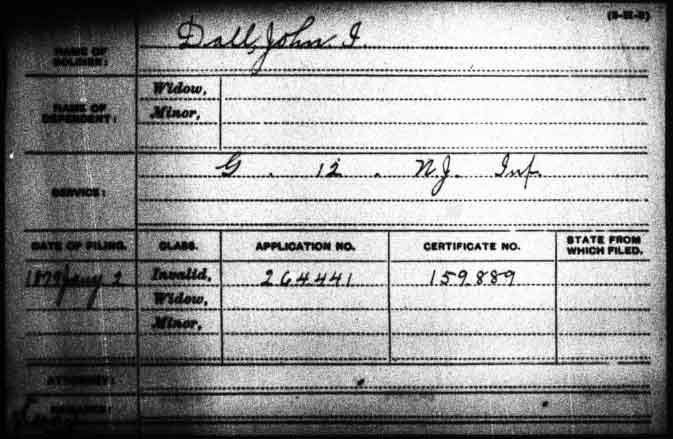
Civil War Pension Record: John A. Dall, Company G, 12th N.J. Infantry. Invalid pension filed July 1879, Application No. 264441, Certificate No. 159889.
Organized: William B. Hatch Post No. 37, G.A.R.
Philadelphia Inquirer —
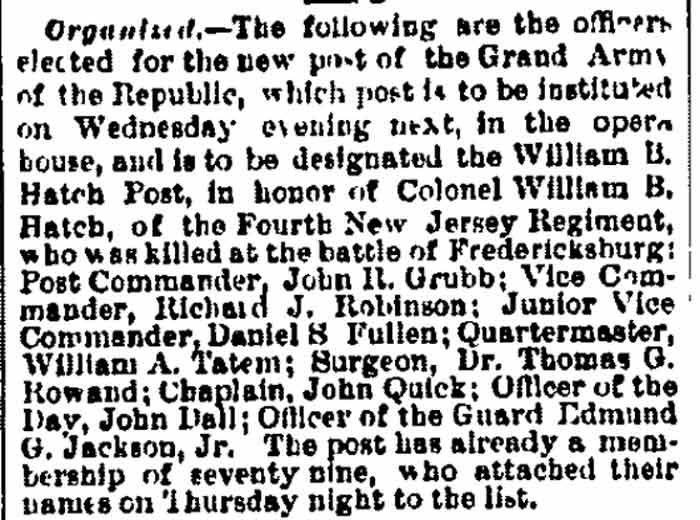
Organised.—The following are the officers elected for the new post of the Grand Army of the Republic, which post is to be instituted on Wednesday evening next, in the opera house, and is to be designated the William B. Hatch Post, in honor of Colonel William B. Hatch, of the Fourth New Jersey Regiment, who was killed at the battle of Fredericksburg: Post Commander, John H. Grubb; Vice Commander, Richard J. Robinson; Junior Vice Commander, Daniel S. Fullen; Quartermaster, William A. Tatem; Surgeon, Dr. Thomas G. Rowand; Chaplain, John Quick; Officer of the Day, John Dall; Officer of the Guard Edmund G. Jackson, Jr. The post has already a membership of seventy nine, who attached their names on Thursday night to the list.
Over the River.
Philadelphia Inquirer —
Military.
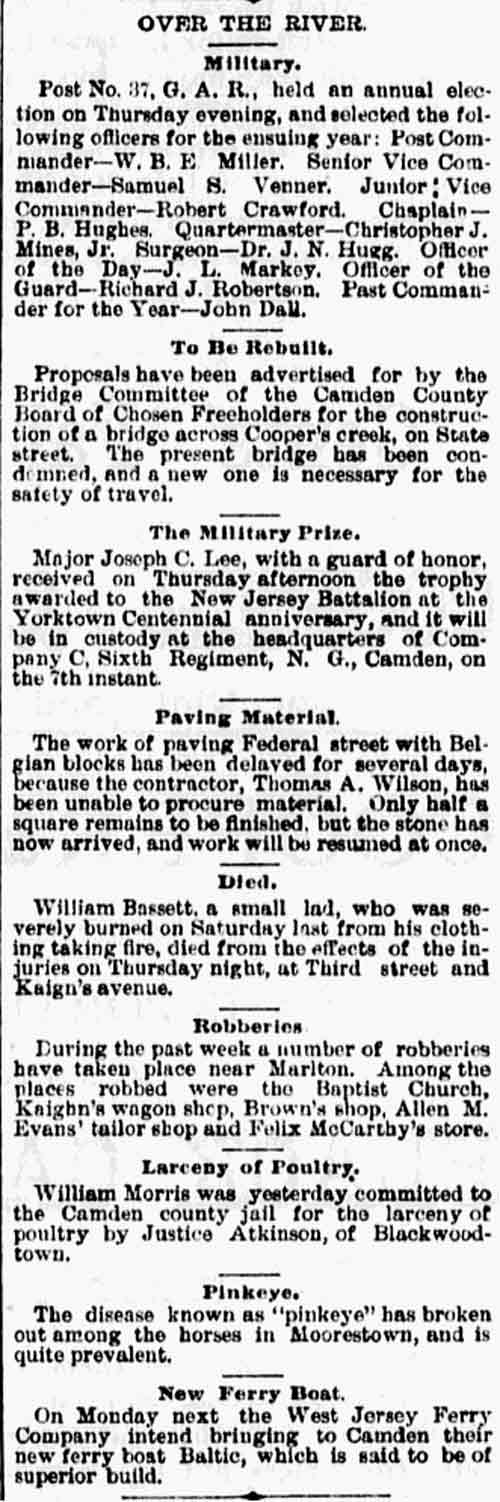
Post No. 37, G. A. R., held an annual election on Thursday evening, and selected the following officers for the ensuing year: Post Commander—W. B. E. Miller. Senior Vice Commander—Samuel S. Venner. Junior Vice Commander—Robert Crawford. Chaplain—P. B. Hughes. Quartermaster—Christopher J. Mines, Jr. Surgeon—Dr. J. N. Hugg. Officer of the Day—J. L. Markey. Officer of the Guard—Richard J. Robertson. Past Commander for the Year—John Dall.
To Be Rebuilt.
Proposals have been advertised for by the Bridge Committee of the Camden County Board of Chosen Freeholders for the construction of a bridge across Cooper’s creek, on State street. The present bridge has been condemned, and a new one is necessary for the safety of travel.
The Military Prize.
Major Joseph C. Lee, with a guard of honor, received on Thursday afternoon the trophy awarded to the New Jersey Battalion at the Yorktown Centennial anniversary, and it will be in custody at the headquarters of Company C, Sixth Regiment, N. G., Camden, on the 7th instant.
Paving Material.
The work of paving Federal street with Belgian blocks has been delayed for several days, because the contractor, Thomas A. Wilson, has been unable to procure material. Only half a square remains to be finished, but the stone has now arrived, and work will be resumed at once.
Died.
William Bassett, a small lad, who was severely burned on Saturday last from his clothing taking fire, died from the effects of the injuries on Thursday night, at Third street and Kaign’s avenue.
Robberies
During the past week a number of robberies have taken place near Marlton. Among the places robbed were the Baptist Church, Kaighn’s wagon shop, Brown’s shop, Allen M. Evans’ tailor shop and Felix McCarthy’s store.
Larceny of Poultry.
William Morris was yesterday committed to the Camden county jail for the larceny of poultry by Justice Atkinson, of Blackwoodtown.
Pinkeye.
The disease known as “pinkeye” has broken out among the horses in Moorestown, and is quite prevalent.
New Ferry Boat.
On Monday next the West Jersey Ferry Company intend bringing to Camden their new ferry boat Baltic, which is said to be of superior build.
History of Camden County, N.J. — William B. Hatch Post No. 37, G.A.R.
The following is derived from George Reeser Prowell’s History of Camden County, N.J., published in 1886.
WILLIAM B. HATCH POST No. 37, of Camden, was instituted and chartered November 25, 1879, with eighty-one members and the following named Post officers:
Post Commander, John E. Grubb; Senior Vice-Commander, Richard J. Robinson; Junior Vice-Commander, Daniel J. Fullen; Surgeon, Thomas G. Rowand, M.D.; Chaplain, John Quick; Officer of the Day, John A. Dall; Officer of the Guard, Edmund G. Jackson, Jr.; Quartermaster, Christopher J. Mines, Jr.; Adjutant, Benjamin J. Pierce; Sergeant-Major, William A. Tattern; Quartermaster-Sergeant, William B. E. Miller.
At the first meeting of the Post it was decided by a unanimous vote to name it in honor of the late Colonel William B. Hatch, of the Fourth Regiment. When Mrs. C. Hatch, the mother of the colonel was informed that the post had honored the memory of her son by naming it after him, she sent to the Post the following response:
Camden N. J., November 26th, 1879
John E. Grubb, Post Commander
Dear Sir,
It will afford me much pleasure to be identified with Post 37, G. A. E., named in honor of my son, William B. Hatch, by allowing me to present to the same its colors. The memory of my son is ever dear to me, and, while at the same moment I may have thought the sacrifice too great an affliction, yet I was consoled by the fact that I gave him up that this Union might be preserved. It was duty and patriotism that called him, and while I mourn him as a mother for a well-beloved son, yet I would not have stayed him, for the love of country and the upholding of this glorious Republic is what every mother should instill into her sons, as the purest and holiest spirit.Yours truly, C. Hatch
The following is a complete roster of this post for 1886:
Post Commander, Benjamin H. Connelly; Senior Vice-Commander, Adam C. Smith; Junior Vice-Commander, William Haegele; Surgeon, George Pfau; Chaplain, Samuel Gaul; Officer of the Day, Robert Crawford; Officer of the Guard, John D. Cooper; Quartermaster, Samuel J. Fenner; Adjutant, William B. Summers; Sergeant-Major, Stacy H. Bassett; Quartermaster-Sergeant, Otto K. Lockhart.
Comrades: Philip Achenbach, George L. Allchin, Isaac Albertson, Joseph Applegate, John W. Barclay, Martin M. Barney, Joseph Baxter, William W. Bennett, Charles L. Bennett, Henry Bickering, Abel Biddle, George K. Biddle, John Bieri, Robert M. Bingham, Socrates T. Bittle, George W. Bittle, Benjamin F. Blizzard, Joseph Borton, Frederick Bowers, Benjamin M. Braker, John Breyer, William H. Brians, Wm. J. Broadwater, William Broadwater, John Brown, Harris Brooks, William H. Brooks, Joseph F. Bryan, Joseph Buddew, J. Q. Burniston, George Burton, Frederick Buser, Thomas L. Bush, William Butcher, Isaac B. Buzby, Edward C. Cattell, Joseph Cameron, James H. Carey, William Carey, James Chadwick, James Chafey, George M. Chester, James D. Chester, Lewis L. Chew, Henry S. Chew, John W. Churn, Andrew B. Cline, Charles Clarke, Samuel J. Cook, Levi E. Cole, John J. Collins, John C. Cooper, John W. Cotner, Thomas L. Conly, Harvey M. Cox, Jason S. Cox, Harris Crane, Charles Cress, Joel G. Cross, O. C. Cunningham, John A. Dall, John Dalby, John H. Damon, Westley Dare, John E. Dawson, Adam T. Dawson, James L. Davis, William Davis, Amos R. Dease, Henry Deford, Lewis F. Derousse, Michael Devinney, Glendora Devo, John Digney, Joseph Dilks, William A. Dobbins, George W. Dunlap, Aaron B. Eacritt, John J. Early, Christopher Ebele, Godfrey Eisenhart, John Elberson, Charles Elwell, Charles Eminecker, John Esler, John H. Evans, Charles S. Fackler, James Fanington, James A. Farraday, John H. Farry, John Faughey, Wm. H. Fenlin, George G. Felton, George W. Ferguson, Charles W. Fish, Israel L. Fish, James Finnan, Samuel B. Fisher, Edward L. Fisher, Ephraim B. Fithian, Jacob T. Fisher, Edward Fitzer, Samuel Flock, Leonard Flor, John Fox, John S. Fox, H. H. Franks, Chas. B. Frazer, Thomas J. Francis, Samuel W. Gahan, Chas. H. Gale, James Galbraith, Thomas Garman, Harry Garren, John W. Garwood, Josiah Garrison, John B. Gaskill, Richard Gaunt, Wm. German, Christopher Getsinger, Christopher Gifney, Jacob Giffens, Albert Gilbert, James Gillen, Wm. Giffins, C. C. Greany, Charles Green, W. H. Griffin, Louis Grosskops, William Grindrod, John B. Grubb, Mark H. Guest, John Guice, Alfred Haines, Charles G. Haines, Japhet Haines, George F. Hammond, Charles Hall, Solon B. Hankinson, Samuel P. Hankinson, James Hanson, Charles Hannans, H. A. Hartranft, Mahlon E. Harden, William F. Harper, George W. Hayter, Samuel B. Harbeson, J. T. Hazleton, H. Heinman, James Henderson, William H. Heward, Franklin Hewitt, James T. Hemmingway, Charles Hewitt, Edward K. Hess, Samuel B. Hickman, George Higgens, Ephraim Hillman, C. M. Hoagland, Guadaloupe Holl, William A. Holland, Isaac K. Horner, Count D. G. Hogan, William H. Howard, Baxter Howe, Alien Hubbs, Charles G. Hunsinger, Presmel D. Hughes, I. N. Hugg, Sebastian Hummell, Edward Hutchinson, C. Innes, Alfred Ivins, Benjamin Ivins, E. G. Jackson Sr., E. G. Jackson Jr., Thomas Jameson, George Jauss, William P. Jenkins, James L. Johnson, Alfred Jones, B. F. Jones, William Joline, Charles Joseph, Charles Justice, C. H. Kain, E. E. Kates, Benjamin Kebler, Frank Kebler, Peter Keen, Henry N. Killian, J. W. Kinsey, C. H. Knowlton, Thomas W. Krips, Joseph H. Large, John E. Leake, John Lecroy, Charles Leonhart, George W. Locke, E. J. Long, Charles L. Lukens, J. H. Lupton, Valentine Machemer, Edward Macloskey, Edward A. Martin, William P. Marsh, John Mapes, William Mead, William Metcalf, E. A. Meyer, C. Meyers, George Meilor, C. A. Michener, William B. E. Miller, Jacob Miller, W. D. Miller, Samuel Mills, William W. Mines, Christopher J. Mines, George Molesbury, William. Moran, Edward More, Richard Morgan, John F. Moore, S. H. Moyer, Jacob L. Morton, John Muir, John J. Murphy, Isaac Murray, Charles Myers, W. H. McAllister, James McCracken, Edward C. McDowell, Hugh McGrogan, H. M. Mcllvaine, W. F. McKillip, W.J.McNeir, Lewis McPherson, E. McPherson, Jacob Naglee, William Naphas, Antonio Nosardi, Robert O’Keefe, John S. Owens, Robert Owens, Edward H. Pancoast, James Pancoast, Robert B. Patterson, William Patterson, E. W. Pease, John B. Pepper, Joel Perrine, John Peterson, D. E. Peugh, Frederick Phile, Samuel B. Pine, William M. Pine, Adon Powell, John Powell, John Portz, J. B. Prucelle, John Quick, S. E. Radcliffe, Isaac C. Randolph, James A. Regens, Philip Reilly, Charles P. Reynolds, Alexander Rhodes, Benjamin F. Richard, Andrew Ridgway, Benjamin Robbins, Edward C. Roberts, James Roberts, Richard J. Robinson, William B. Robertson, Isaac Rogers, John Rogers, William H. Rogers, Thomas G. Rowand, Sebastian Schaub, Maurice Schmidt, Christian K. Schallers, James Schofield, George W. Scott, John E. Scott, John M. Shemelia, Edward M. Siemers, John Simmons, Benjamin F. Shinn, Thomas Sheeran, James Shield, Charles Smith, George H. Smith, William W. Smith, Charles S. Small, Adolph Snow, W. Souder, Francis Senders, Robert Sparks, David C. Sprowl, Alfred L. Sparks, Abraham Springer, George W. Stewart, William L. Stevenson, Thomas G. Stephenson, Samuel R. Stockton, Thomas Stockton, Thomas H. Stone, Henry Strick, E. J. Strickland, Charles String, George F. Stull, George W. Swaney, Crosby Sweeten, William F. Tarr, William A. Tatem, Thomas S. Tanier, George Rudolph Tenner, Charles L. Test, Leonard Thomas, Benjamin Thomas, Henry C. Thomas, George F. Thorne, Wesley Thorn, Thomas W. Thornley, Alexander W. Titus, Joseph Tompkins, J. E. Troth, Isaac C. Toone, Samuel Tyier, Jacob M. Van Nest, Albert Vansciver, Joseph Wakeman, Theodore F. Walker, Charles Walton, George Walton, Joseph Welsh, David Watson, George W. Wentling, Edward West, Elmer M. West, George Weyman, Wilmer Whillden, James Whittaker, Samuel Wickward, Calvin T. Williams, George W. Williams, William H. Williams, John Williams, Samuel Winner, Amos P. Wilson, D.H. Wilson, G.A. Wilson, Richard Wilson, George Wispert, John W. Wood, Joseph Woodfield, Walter Wolfkill, E. W. Wolverton, Elijah Worthington, C. M. Wright, George B. Wright, Henry S. Wright, Wesley T. Wright, William Zane.
As of 1886, the Hatch Post met every Thursday evening in their own G. A. R. Hall, on Stevens Street, below Fifth Street. This same building had been used in the late 1870s as the original home of the congregation that formed the Tabernacle Baptist Church. The Hatch Post was affiliated with Hatch League No. 2, of the Loyal Ladies League, their auxiliary, which met at the Post Hall.
Franks Sworn in as Chief.
Camden Daily Courier —

THE NEW OFFICIAL AND SIX MEN TAKE THE OATH.
Ex-Chief Matlack Commends the Forty Patrolmen, Thanks Mayor Pratt for His Gentlemanly Conduct and Retires.
It is Chief Franks now. Mr. Matlack, the retiring chief turned over the police department to his successor shortly after noon. All the officers gathered at the hall, as this is the semi-monthly pay day. The six new men who were to take the places of the patrolmen who resigned, came in one at a time and were taken into the mayor’s private office, where behind the closed door they were sworn in by his honor. Chief-elect Franks was also sworn in privately.
All the Democratic officers then assembled in the mayor’s hearing room, at the request of retiring Chief Matlack and it was with evident feeling that he bade them farewell in an eloquent address. He said:
THE CHIEF’S ADDRESS.
“Gentlemen of the police department—The time has arrived for me to turn over the police department to my successor. During my term as chief I have formed acquaintanceships and friendships among you which have been a great pleasure to me, and which I hope to retain. Among us doring [sic] all that time there has been peace and harmony in the main. I am glad to say that no strifes or bickerings have occurred to mar our peace and good will. At times our actions have been criticised, and aspersions cast against us, but these were only the contingencies of our positions; we must learn to take the bitter with the sweet. No serious accidents or deaths have occurred among us, and for this we should be thankful to the Giver of all good things. We have made some mistakes no doubt—none of us are infallible—but let bygones be bygones, and endeavor to fulfill your duty always.
“There is one thing in particular that I wish to commend you for, and that is your gentlemanly and courteous conduct while I have been connected with the department, and your cheerfulness in obeying orders. For this you have my sincere thanks, and also my best wishes for your futures.”
THE DEPARTMENT TURNED OVER.
The chief closed his remarks to the men with a moral admonition. To Mayor Pratt he returned his thanks for the gentlemanly demeanor of his honor during their brief official association, and expressed the hope that his administration would be one of good government. Chief Matlack then formally delivered the department to his successor and said he trusted it would be more efficient than ever before.
The chief’s remarks were very brief and pointed. He said: “Gentlemen and members of the police department. I hope you will continue in the discharge of your duties as before. I expect obedience to the rules of the department, and the orders of his honor the mayor. Any disapproval or disobedience of orders will be deemed sufficient cause for removal.”
NEW PATROLMEN.
The following is the list of retiring officers and their successors, with their numbers: First ward—John Jacobs; successor, Alfred Summers, No. 5. Fourth ward—Simpson Long, successor, Samuel Lee, No. 17; Charles Peterson, successor, Charles O. Pedrick, No. 20. Sixth ward, Bowman Matlack, successor, Christopher Tenner, No. 29; John Fox, successor, John Dall, No. 30. Seventh ward, Harry Griffin, successor, C. H. Peters, No. 33.
The retiring officers delivered up their equipments. C. H. Peters, who was the first of the new men to be sworn in, had a bran new suit of blue and went on duty at once. John Dall was not present to be sworn in with the others.
From Jersey’s Soil
Philadelphia Inquirer —
Trouble Over the Death of a Spiritualist—A Young Man’s Sad Ending.
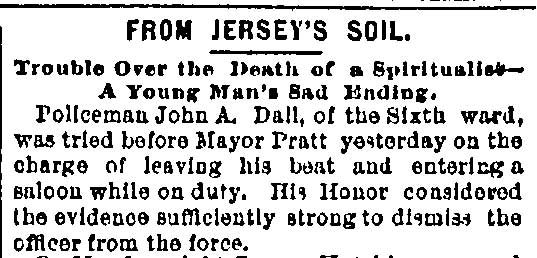
Policeman John A. Dall, of the Sixth ward, was tried before Mayor Pratt yesterday on the charge of leaving his beat and entering a saloon while on duty. His Honor considered the evidence sufficiently strong to dismiss the officer from the force.
From Jersey’s Shore
Philadelphia Inquirer —
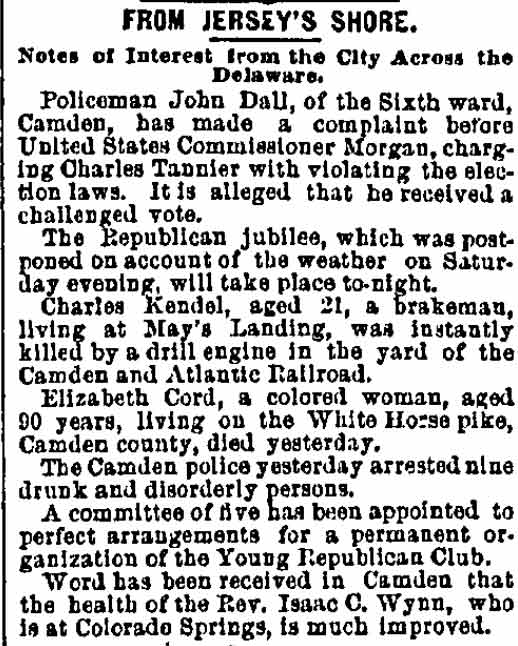
Notes of Interest from the City Across the Delaware.
Policeman John Dall, of the Sixth ward, Camden, has made a complaint before United States Commissioner Morgan, charging Charles Tannier with violating the election laws. It is alleged that he received a challenged vote.
The Republican Jubilee, which was postponed on account of the weather on Saturday evening, will take place to-night.
Charles Kendel, aged 21, a brakeman, living at May’s Landing, was instantly killed by a drill engine in the yard of the Camden and Atlantic Railroad.
Elizabeth Cord, a colored woman, aged 90 years, living on the White Horse pike, Camden county, died yesterday.
The Camden police yesterday arrested nine drunk and disorderly persons.
A committee of five has been appointed to perfect arrangements for a permanent organization of the Young Republican Club.
Word has been received in Camden that the health of the Rev. Isaac C. Wynn, who is at Colorado Springs, is much improved.
Sixth Ward Republican Conference
Philadelphia Inquirer —
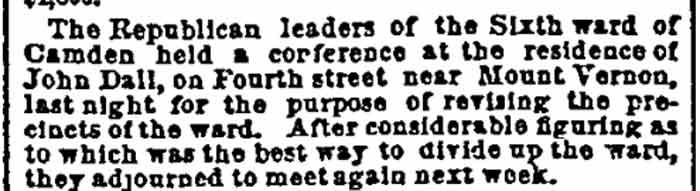
The Republican leaders of the Sixth ward of Camden held a conference at the residence of John Dall, on Fourth street near Mount Vernon, last night for the purpose of revising the precincts of the ward. After considerable figuring as to which was the best way to divide up the ward, they adjourned to meet again next week.
Gambling Arrests on Newton Avenue
Philadelphia Inquirer —
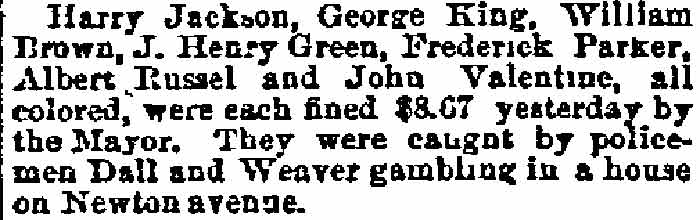
Harry Jackson, George King, William Brown, J. Henry Green, Frederick Parker, Albert Russel and John Valentine, all colored, were each fined $8.07 yesterday by the Mayor. They were caught by policemen Dall and Weaver gambling in a house on Newton avenue.
Policemen Shoved Off
Philadelphia Inquirer —
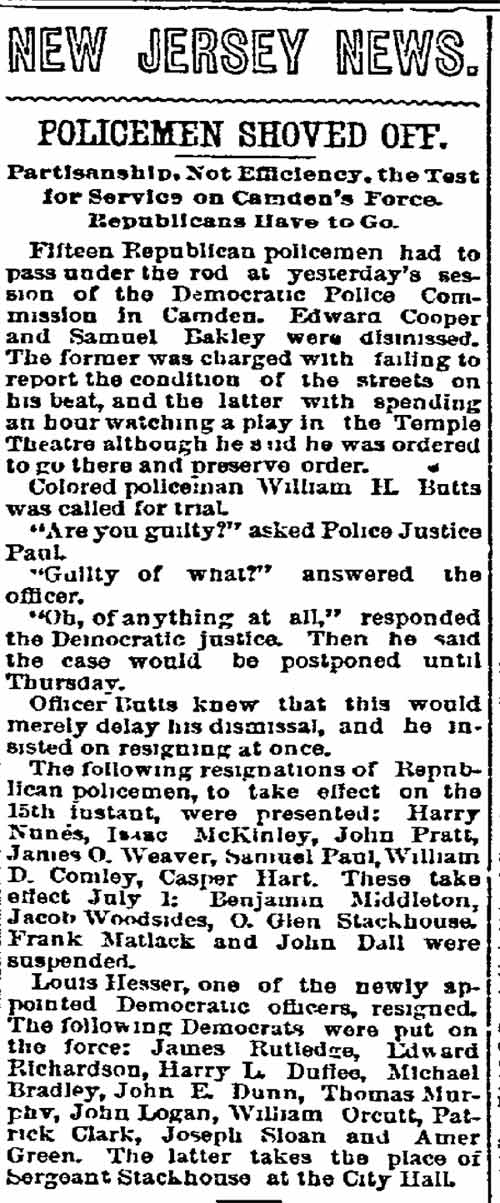
NEW JERSEY NEWS.
Partisanship, Not Efficiency, the Test for Service on Camden’s Force. Republicans Have to Go.
Fifteen Republican policemen had to pass under the rod at yesterday’s session of the Democratic Police Commission in Camden. Edward Cooper and Samuel Bakley were dismissed. The former was charged with failing to report the condition of the streets on his beat, and the latter with spending an hour watching a play in the Temple Theatre although he said he was ordered to go there and preserve order.
Colored policeman William H. Butts was called for trial.
“Are you guilty?” asked Police Justice Paul.
“Guilty of what?” answered the officer.
“Oh, of anything at all,” responded the Democratic justice. Then he said the case would be postponed until Thursday.
Officer Butts knew that this would merely delay his dismissal, and he insisted on resigning at once.
The following resignations of Republican policemen, to take effect on the 15th instant, were presented: Harry Nunes, Isaac McKinley, John Pratt, James O. Weaver, Samuel Paul, William D. Comley, Casper Hart. These take effect July 1: Benjamin Middleton, Jacob Woodsides, O. Glen Stackhouse. Frank Matlack and John Dall were suspended.
Louis Hesser, one of the newly appointed Democratic officers, resigned. The following Democrats were put on the force: James Rutledge, Edward Richardson, Harry L. Duffee, Michael Bradley, John E. Dunn, Thomas Murphy, John Logan, William Orcutt, Patrick Clark, Joseph Sloan and Amer Green. The latter takes the place of Sergeant Stackhouse at the City Hall.
He Announces the Names
Camden Daily Telegram —
The Mayor Appoints the New Force To-day.
MANY OLD OFFICERS TAKEN BACK.
Some Surprise Manifested at the Mayor’s Appointment of Dodd Instead of Jones—This Afternoon All the Names Will be Announced.
The Mayor stated this morning to the newspaper fraternity that he would not announce his nominations for the police department until four o’clock this afternoon. It was expected that these would be announced this morning and in consequence there were a number of applicants for appointment on the force early this morning at the City Hall, hoping that the lightning would strike them.
Yesterday afternoon the mayor in addition to his nomination of Chief Dodd and Lieutenants Foster and Pettit appointed Frank Matlack, Jacob Woodsides, Alfred Hayden and John Dall, all of the Sixth Ward. The above were policemen under Mayor Westcott, before the Democratic Police Commission took charge of the Department.
Patrolman Griffin, Democrat, tendered his resignation yesterday to Mayor Westcott, to take effect to-day.
The appointment of Chief Dodd was quite a surprise to the public in general, as it was thought that Captain Jones would be named for the position. Many believed such an appointment would be in very good form, as Captain Jones’ knowledge of men and his military training would have made him a chief par excellence. The Mayor, however, probably thought that as Mr. Dodd had been so unceremoniously kicked out by the Democrats, it was nothing more than justice to again offer him the position which he had filled in a creditable manner for a number of years.
APPOINTED ON THE FORCE.
Mayor Westcott this afternoon made the following appointments:
First Ward—William E Cromly, George Cable, Henry R. Curtis, O. Glen Stackhouse.
Second Ward—Lincoln James, John Pratt, Samuel Bakley, Benj Middleton.
Third Ward—William Selby, Albert Myers, Edward Hartman.
Fourth Ward—Caleb Williams, Richard Golden, William Schregler, Ralph Bond.
Fifth Ward—William Harvey, Harry Mines and Oscar Weaver.
Sixth Ward—Jacob Woodsides, Frank Matlack, Albert Hayden and John Dall.
Seventh Ward—Josiah Sage, Henry Peters, Charles Lederman, Wm. Butts.
Eighth Ward—Alexander Alcorn, Chas. Leightenberg, Ferdinand Laird
There was no appointments made for the Ninth ward.
Murder Ended a Barroom Brawl
Philadelphia Inquirer —
Ex-Policeman Daniel Lee, of Camden, Shot by Edward T. Melson.
Drink and “Fight” Talk
The Men Were Boon Companions, But They Quarreled, and One Shot the Other—The Hearing.
Ex-Policeman Daniel Lee, of 201 Sycamore street, Camden, was shot while standing at the bar in George Dillmore’s saloon, at Fourth street and Kaighn avenue, about 3 o’clock yesterday morning. The fatal shot was fired by Edward T. Melson, an oysterman, of 220 Mount Vernon street, who was placed under arrest and now occupies cell No. 35 in the county jail. The murder is said to be the result of an old grudge dating back to the time Lee and Melson were oystering together.
Several men were in the saloon drinking when Melson entered. He sang several songs. George Dillmore, Jr., who was tending bar, and George Emely, a motorman, testified at the hearing before Mayor Westcott yesterday that Melson made some remark to Lee which they did not hear, but which caused Lee to reply:
“I am better than any one in the Melson family.”
“I don’t know that you are,” answered Melson.
“We won’t talk about that now, let’s drop it and have another drink,” said Lee, in a pacifying tone, when he saw that Melson was getting angry.
The Fatal Quarrel.
“I ain’t going to leave you, Danny,” was the next remark made by Melson and then pulling out a 38-calibre revolver from his pocket he fired point blank at Lee before anyone realized his intentions. Lee staggered toward the door and fell. Melson turned the revolver toward George Emely and snapped the trigger. Then he placed the weapon under the ear of James Burrows and again pulled the trigger, but the cartridge did not explode. By this time young Dillmore had got out in front of the bar and knocked the revolver from Melson’s hand.
A police whistle was blown and Officers Dall and Painter answered the summons none too soon. Lee and Melson were put into a patrol wagon and taken to the Cooper Hospital. Lee died as he was being carried into the Hospital. Melson’s injuries were not of a serious nature and he was locked up in the City Hall. He made a statement to Assistant Prosecutor Carson that he had been assaulted by the men in the bar room and shot Lee in self-defense.
Witnesses Held.
The following were held in their own recognizance as witnesses: George Emely, George Dillmore, Jr., Eli Morgan, Charles Morgan, George Martin and James Burrows. They were examined privately by Mayor Westcott, and all told substantially the same story.
An autopsy, held by County Physician Jones, Coroner Lippincott and Dr. Hires, of the Cooper Hospital, showed that the bullet that killed Lee entered his left breast penetrating the lung and came out in the back. An inquest will be held Monday afternoon next.
On Trial for His Life
The North American —
Edward Melson Charged With the Murder of Ex-Policeman Lee.
Fired Before a Blow Was Struck
Testimony Tending to Show That the Shooting Was Not Done in Self Defence.
Edward Melson was placed on trial in the Camden County Court yesterday on a charge of killing Daniel Lee, an ex-policeman, in George Delmore’s saloon, at Fourth street and Kaighn avenue. The court-room was crowded. The jury was drawn with but little trouble.
In opening the case the States attorney said they would show that about 3 o’clock in the morning of December 12, while several persons were drinking and having a pleasant social time in Delmore’s saloon, the defendant, without provocation, drew a revolver and fired a bullet through ex-Policeman Lee’s heart.
One of the State’s chief witnesses, a man who was present when the fatal shot was fired, was George Emley, of 565 Walnut street. He knew both the deceased and the defendant. He said that he was in Delmore’s saloon nearly one hour when Melson came in. There were present Lee, Burrows, Martin, Charles Morgan and witness. Lee was in the saloon when the witness entered to the barroom. He said that Melson was requested to sing, which he did. There were some remarks made which the witness could not hear. Lee said, “Well, we will let that drop.” Melson replied, “Well, I will never leave you.”
Melson then backed off, pulled out a revolver, and shot Lee. Witness saw the shot fired, and saw Melson draw the revolver from his hip pocket. After Lee was shot he backed to the Kaighn avenue door, opened it, and fell to the floor. George Delmore, Jr., then knocked the revolver out of Melson’s hand. Burrows and the witness threw Melson down. Witness said that they had to wrestle with the defendant in order to get the pistol. Up to the time of the shooting there had not been a blow struck.
On cross-examination the witness said that Melson said, “Danny, it will do you no good to hit me.” Beyond this counsel for the defendant failed to shake his direct testimony.
Policemen Painter and Dall, who ran to the saloon and arrested Melson, testified that Lee made no resistance. The prisoner and his victim, who died a few minutes after the shooting, were taken to the City Hall together in a patrol wagon.
Lawyer Rex, in opening for the defence, said he would show that the killing of Daniel Lee was the result of a drunken brawl and not a case of premeditated murder. He would ask for a verdict of manslaughter, as the defendant thought that he had a perfect right to defend his life, knowing as he did the character of Lee.
He then called Melson to the stand. The latter said he resided at 220 Mt. Vernon street, and knew Lee. On the night of the tragedy he said he intended taking his wife to Mt. Royal, three miles below Woodbury, and he put the revolver in his pocket to protect himself. His wife afterwards changed her mind. Before going to Dilmore’s [sic] saloon he had several drinks. In the latter tavern he sang four songs. Lee asked him to have a glass of beer and then turned to him and said: “I don’t like you.” Then Lee said he could whip the whole Melson family. The crowd then surrounded the defendant and backed him to the wall. On the impulse of the moment he drew his pistol and the weapon went off. Melson said that he was afraid of Lee and the crowd that was there and they all appeared to be more intoxicated than he was. He tried to get out of the place before the revolver went off. Witness said that he was very much excited at the time. The case will be continued to-day.
Here’s Camden’s Finest, With Whiskers, in 1898
Camden Courier-Post —
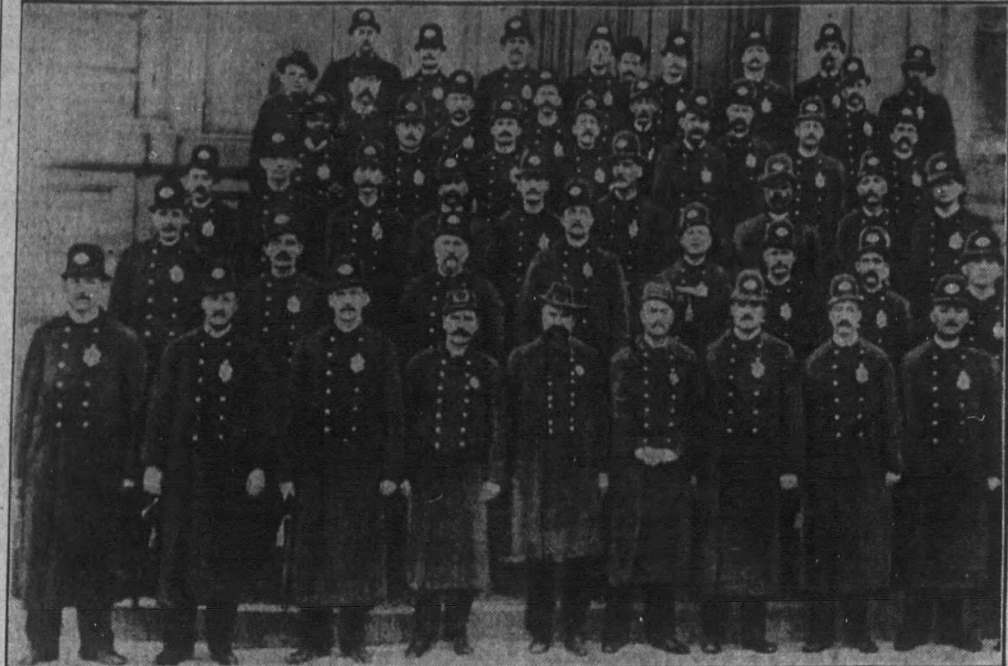
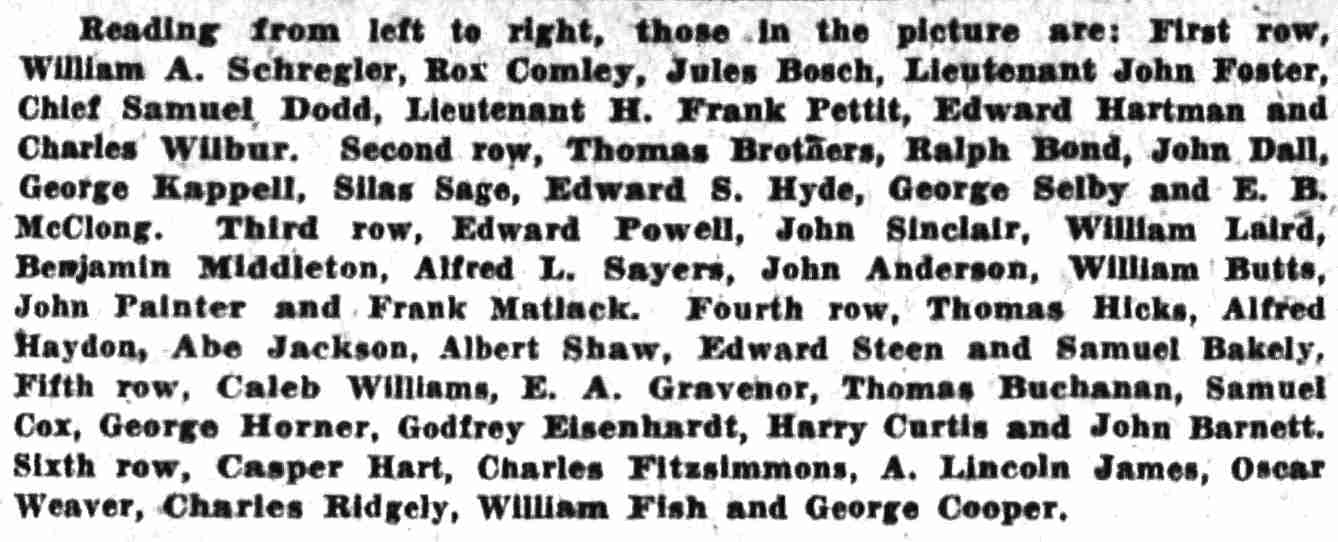
Reading from left to right, those in the picture are: First row, William A. Schregler, Rox Comley, Jules Bosch, Lieutenant John Foster, Chief Samuel Dodd, Lieutenant H. Frank Pettit, Edward Hartman and Charles Wilbur. Second row, Thomas Brothers, Ralph Bond, John Dall, George Kappell, Silas Sage, Edward S. Hyde, George Selby and E. B. McClong. Third row, Edward Powell, John Sinclair, William Laird, Benjamin Middleton, Alfred L. Sayers, John Anderson, William Butts, John Painter and Frank Matlack. Fourth row, Thomas Hicks, Alfred Haydon, Abe Jackson, Albert Shaw, Edward Steen and Samuel Bakely. Fifth row, Caleb Williams, E. A. Gravenor, Thomas Buchanan, Samuel Cox, George Horner, Godfrey Eisenhardt, Harry Curtis and John Barnett. Sixth row, Casper Hart, Charles Fitzsimmons, A. Lincoln James, Oscar Weaver, Charles Ridgely, William Fish and George Cooper.
Police Shake-Up in Camden
Philadelphia Inquirer —
A shake-up is promised among the Camden police and it is said that five of the bluecoats are scheduled for suspension, which means dismissal. Mayor Hatch yesterday called Policeman John Dall, of the Sixth ward, to his office and suspended him for dereliction of duty. It is said that Dall failed to make a pull on time. A Fourth ward policeman, who has been making himself obnoxious to the administration by talking too much in saloons, is slated to go, and there are three more from the up-town wards who will soon walk the plank.
Justice of the Peace Baldwin at Sixth Ward Republican Club
Philadelphia Inquirer —
Late Friday night Justice of the Peace Baldwin, of Camden, while engaged in a pinochle tournament at the Sixth Ward Republican Club, received a telephone message from Policeman John Dall that his private office was on fire. With several others the ‘squire, who was a volunteer fireman, ran to the office three squares distant to find a big automobile drawn up in front containing three well dressed couples. According to Policeman Dall after the ‘squire recovered his wind he married one of the couples and then pledged all those present to secrecy. Last night ‘Squire Baldwin said it was nobody’s business who he had married and if anyone wanted to know who he had married the fact could be learned after he filed the return in the City Clerk’s office.
Patrol Wagon Collision at Third and Kaighn Avenue
Philadelphia Inquirer —
Patrick Fitzpatrick, the chauffeur in charge of the automobile which collided with the downtown patrol wagon at Third and Kaighn avenue, Camden, Monday, was held in $200 bail by Recorder Stackhouse yesterday for a further hearing on September 11. In the collision Patrolman John Dall was badly injured and Patrolman William Harvey and Policeman Charles Fitzsimmons were jarred.
Fitzpatrick Fails to Appear
Philadelphia Inquirer —
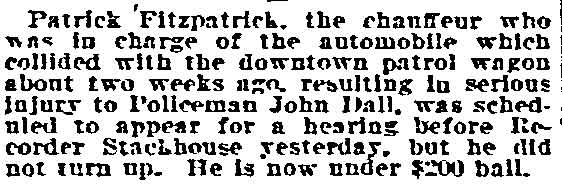
Patrick Fitzpatrick, the chauffeur who was in charge of the automobile which collided with the downtown patrol wagon about two weeks ago, resulting in serious injury to Policeman John Dall, was scheduled to appear for a hearing before Recorder Stackhouse yesterday, but he did not turn up. He is now under $200 bail.
Obituary: Chester A. Dall
Philadelphia Inquirer —
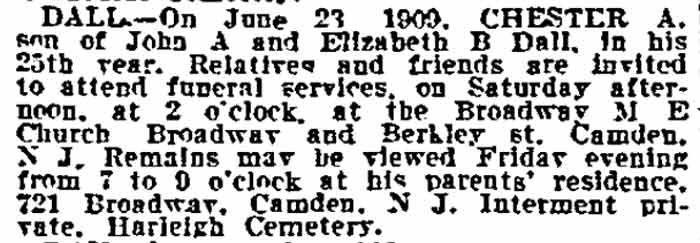
DALL—On June 23, 1909. CHESTER A., son of John A. and Elizabeth B. Dall, in his 25th year. Relatives and friends are invited to attend funeral services, on Saturday afternoon, at 2 o’clock, at the Broadway M. E. Church, Broadway and Berkley st., Camden, N. J. Remains may be viewed Friday evening from 7 to 9 o’clock at his parents’ residence, 721 Broadway, Camden, N. J. Interment private. Harleigh Cemetery.
Appendicitis Operation
Philadelphia Inquirer —

Stricken with appendicitis, John Dall, a pensioner of the Camden police, was operated on last night at the Homeopathic Hospital. Mr. Dall is 68 years old and resides at 723 Broadway. [Note: The address given in the article is in error; John Dall lived at 721 Broadway at the time.]
Twelfth Regiment to Meet at Pitman
Philadelphia Inquirer —
Special to The Inquirer.
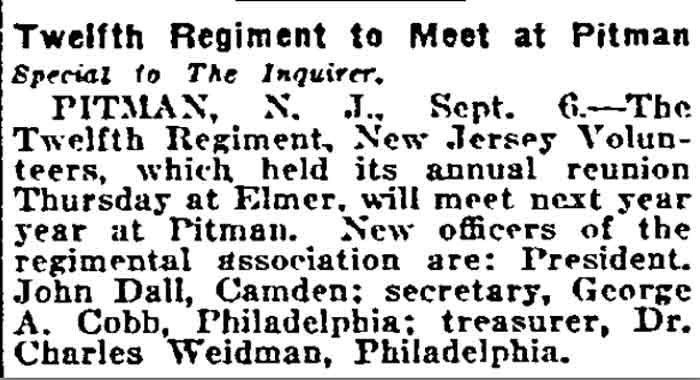
PITMAN, N. J., Sept. 6.—The Twelfth Regiment, New Jersey Volunteers, which held its annual reunion Thursday at Elmer, will meet next year at Pitman. New officers of the regimental association are: President, John Dall, Camden; secretary, George A. Cobb, Philadelphia; treasurer, Dr. Charles Weidman, Philadelphia.