Introduction
William Miles Butts is generally credited as being the first black man to serve as a member of the Camden Police Department. He was, in fact, the third to hold that honor, coming after, for reasons outlined below, John Wesley “Wes” Beckett and Isaac Major.
He was born in Deep Creek, Virginia in 1847, probably to Henry Butts and his wife, the former Manda Brice [most likely Amanda Brice — PMC], although there are sources that indicate that his parents were Azariah and Harriet Butts. On September 19, 1864 at Norfolk, Virginia he enlisted as Miles Butts in the Union army as a private and was assigned to Company B, 38th United States Colored Infantry Regiment, a regiment that saw action in Virginia during the war and later served on the Texas frontier. There was another “Miles Butts” with Company D in the same 38th United States Colored Infantry Regiment, and this I believe is the source of confusion as to his parentage and activities for a few years after he left the Army. More confusion occurs in later years due to typographical and transcription errors, such as the handwritten “W.M. Butts” becoming the typeset “M.H. Butts.” These and spelling errors in newspapers were not uncommon in William M. Butts’ lifetime.
The 38th United States Colored Troops regiment was composed of men from St. Mary’s County Maryland (both free Black tenant farmers and men who had escaped slavery) in combination with many Virginia men who had been liberated from slavery by the Union army. These two contingents constituted the 38th United States Colored Troops, which was organized in Virginia on January 23, 1864, and then subsequently served first at Norfolk and Portsmouth in the Department of Virginia and then served in North Carolina until June 1864, after which it was involved in operations against Petersburg and Richmond for the remainder of the war.
The regiment participated in engagements at Chaffin’s Farm (also known as the Battle of New Market Heights) on September 29–30, Deep Bottom on October 1 and Fair Oaks on October 27–28, 1864. Three members of the 38th, William H. Barnes, James H. Harris, and Edward Ratcliff, were awarded the Medal of Honor for their actions at Chaffin’s Farm. The unit then served in the trenches north of the James River until the fall of Richmond in April 1865. The 38th occupied Richmond on April 3, 1865, and continued duty in the Department of Virginia through the end of the war and into May.
The 38th was moved to Texas between May 24 and June 6, 1865, where it would stay for the rest of its service. The unit saw duty at various points along the Rio Grande in the southern portion of the state, including Brownsville and Brazos Santiago, as well as at Indianola and Galveston on the gulf coast. While in Texas, William Butts was promoted to Corporal on September 5, 1866. Corporal Butts was honorably discharged at Indianola, Texas on January 25, 1867. A William Butts married Belinda Burton in Portsmouth, Virginia on November 4, 1868. There is a William Butts living there in the 1870 Census. Whether or not this William Butts is the subject of this sketch is not known. What is known is that William Butts was living in Camden in the early 1870s.
William Butts does not appear to be listed in Camden’s city directories until 1878, however, a contemporary recalled working with William Butts at the Browning Dye Works for fifteen years prior to his appointment as a policeman. William Butts married Ellen “Lizzie” Smith at Macedonia A.M.E. Church on December 24, 1873 in Camden’s Fifth Ward.
It is probable that William and Lizzie Butts are the “James” and “Lizzie” listed at 423 Spruce Street in 1877, and William Butts may well be “M.H. Butts” who in 1878, is listed as a laborer at 336 Pine Street in that year’s City Directory. The 1879 edition lists William Butts, laborer, at 917 Locust Street. He and his wife were at 919 Locust Street when the Census was taken in 1880. In 1881 a William Butts, laborer is listed at 638 John Street, which was renamed as the 600 block of Locust Street not long afterwards. He was at 309 Division Street in 1884 and 228 Division Street in 1885, still working as a laborer. Late in 1886 or early in 1887 he moved to 707 Cherry Street in Camden’s Seventh Ward, where he lived into 1899. He was still at that address when the 1890 Veterans Census was enumerated. Sadly, Lizzie Butts died at 270 Division Street, from peritonitis most likely brought on by a burst appendix, on July 28, 1890.

Active in Masonic and in political affairs as a Republican, William Butts was elected as a delegate to the Camden County convention in October of 1882 from the Fifth Ward. After moving to the Seventh Ward, he was appointed to the police department in April of 1887. He is generally credited as being the first black policeman in Camden, but this is not quite the case. In the summer of 1886 Mayor Jesse Pratt declared his intention to appoint two black men to the Camden Police Department, one from the Seventh Ward and one from the Eighth. In 1886 he appointed John Wesley “Wes” Beckett from the Eighth Ward, who served for several years. In April of 1887 Mayor Pratt appointed William Butts, a loyal Republican and newly moved to the Seventh Ward to serve, as he was not aligned with either of the two factions of black Republicans seeking to secure the appointment, one favoring Isaac Major and the other constable George Castor.
William Butts initially declined the offer, and Isaac Major took the job. Continued political infighting between the two factions led to Major’s resignation from the police department in July of 1887. William Butts was again appointed, accepted the position, and made his first arrest on July 17, 1887.
William Butts served with honor and distinction until the late spring of 1893, when he and virtually every other Republican policeman was dismissed by the Democratic-controlled Police Commission. He was reappointed by Mayor John L. Westcott on March 30, 1894, after the New Jersey legislature and New Jersey Supreme Court ordered the Commission to disband. William Butts returned to the police department and served the City of Camden for another five years, until he was taken ill in the spring of 1899. He fell seriously ill in April of 1899 and married a dressmaker, the former Caroline Brooks Billups of 1218 South 8th Street, on May 15, 1899. William Miles Butts passed away at the South 8th Street address on July 27, 1899, survived only by his wife Caroline. Mrs. Caroline Butts appeared in city directories in Camden until 1943.
Besides police work, William Miles Butts was respected all through Camden for his activities in veterans, political, and Masonic affairs. He was a member of the William P. Robeson Post No. 51, G.A.R.; Progressive Lodge No. 32, F. & A.M.; Demolay Commandery No. 1, Knights Templar; the William J. Sewell, the Cooper B. Hatch, and the Seventh Ward Republican clubs.
William P. Robeson Post No. 51
George Reeser Prowell, History of Camden County, N.J., 1886
William P. Robeson Post No. 51, of Camden (the first post in New Jersey composed of colored soldiers), was instituted and organized June 28, 1881, with twenty-five charter members. It was named for General William P. Robeson Jr., who made his residence in Camden. General Robeson passed away a few weeks after the Post was organized.
The following is a complete roster of the Post at this date (1886): Past Commanders, W. Spencer Darr and W. A. Drake; Post Commander, Miles Bishop; Senior Vice, Charles Jones; Junior Vice, Ezekiel Jones; Surgeon, George Lodine; Chaplain, August Westcott; Adjutant, Charles Accoo; Officer of the Day Anthony Austin; Officer of the Guard, George Bishop; Quartermaster, John C. Richardson; Quartermaster-Sergeant, Joseph Rice; Sergeant-Major, George H. Watson.
The other members are James Wiltbanks, Nathaniel Ingram, William Ingram, William Butts, William Smith, Hezekiah Wrench, Benjamin Stewart, Elijah Hammitt, Charles Barnes, Shepherd Pitts, Charles Woolford, Elijah Pipinger, Thomas Ryan, George F. Johnson, and Charles Ford.
In 1886 the Post met at Lee’s Hall, on the corner of Broadway and Atlantic Avenue, and later met on Kaighn Avenue.
The William P. Robeson Post 51 of the Grand Army of the Republic was suspended in 1925.
The Primaries
Camden Daily Courier —
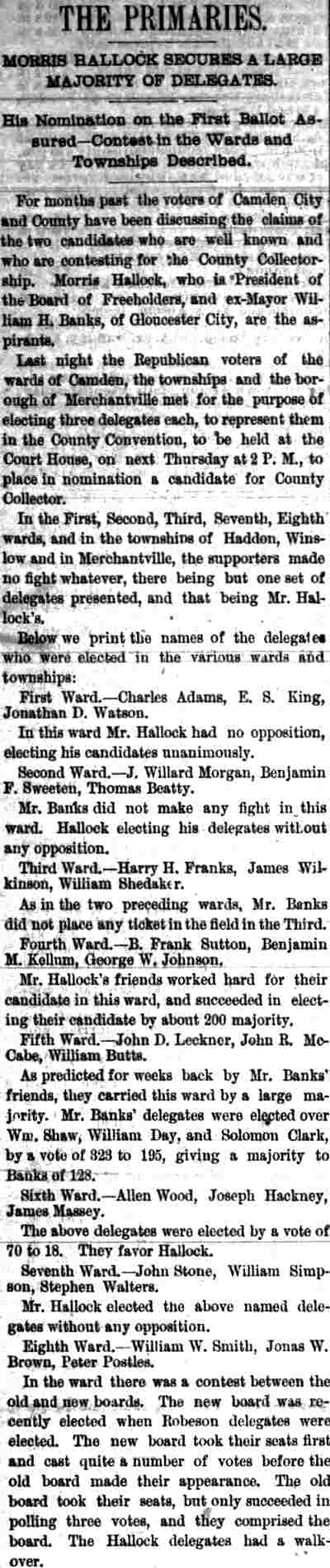
MORRIS HALLOCK SECURES A LARGE MAJORITY OF DELEGATES.
His Nomination on the First Ballot Assured—Contest in the Wards and Townships Described.
For months past the voters of Camden City and County have been discussing the claims of the two candidates who are well known and who are contesting for the County Collectorship. Morris Hallock, who is President of the Board of Freeholders, and ex-Mayor William H. Banks, of Gloucester City, are the aspirants.
Last night the Republican voters of the wards of Camden, the townships and the borough of Merchantville met for the purpose of electing three delegates each, to represent them in the County Convention, to be held at the Court House, on next Thursday at 2 P. M., to place in nomination a candidate for County Collector.
In the First, Second, Third, Seventh, Eighth wards, and in the townships of Haddon, Winslow and in Merchantville, the supporters made no fight whatever, there being but one set of delegates presented, and that being Mr. Hallock’s.
Below we print the names of the delegates who were elected in the various wards and townships:
First Ward.—Charles Adams, E. S. King, Jonathan D. Watson.
In this ward Mr. Hallock had no opposition, electing his candidates unanimously.
Second Ward.—J. Willard Morgan, Benjamin F. Sweeten, Thomas Beatty.
Mr. Banks did not make any fight in this ward. Hallock electing his delegates without any opposition.
Third Ward.—Harry H. Franks, James Wilkinson, William Shedaker.
As in the two preceding wards, Mr. Banks did not place any ticket in the field in the Third.
Fourth Ward.—B. Frank Sutton, Benjamin M. Kellum, George W. Johnson.
Mr. Hallock’s friends worked hard for their candidate in this ward, and succeeded in electing their candidate by about 200 majority.
Fifth Ward.—John D. Leckner, John R. McCabe, William Butts.
As predicted for weeks back by Mr. Banks’ friends, they carried this ward by a large majority. Mr. Banks’ delegates were elected over Wm. Shaw, William Day, and Solomon Clark, by a vote of 323 to 195, giving a majority to Banks of 128.
Sixth Ward.—Allen Wood, Joseph Hackney, James Massey.
The above delegates were elected by a vote of 70 to 18. They favor Hallock.
Seventh Ward.—John Stone, William Simpson, Stephen Walters.
Mr. Hallock elected the above named delegates without any opposition.
Eighth Ward.—William W. Smith, Jonas W. Brown, Peter Postles.
In the ward there was a contest between the old and new boards. The new board was recently elected when Robeson delegates were elected. The new board took their seats first and cast quite a number of votes before the old board made their appearance. The old board took their seats, but only succeeded in polling three votes, and they comprised the board. The Hallock delegates had a walk-over.
A Colored Association
Camden Daily Courier —
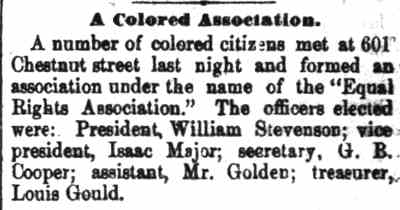
A number of colored citizens met at 601 Chestnut street last night and formed an association under the name of the “Equal Rights Association.” The officers elected were: President, William Stevenson; vice-president, Isaac Major; secretary, G. B. Cooper; assistant, Mr. Golden; treasurer, Louis Gould.
Castor Wants the Place
Camden Daily Courier —
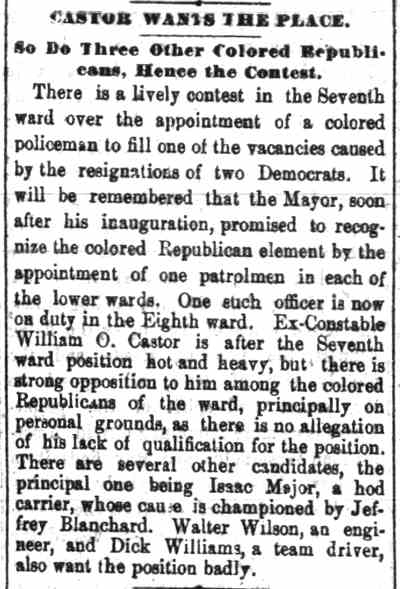
So Do Three Other Colored Republicans, Hence the Contest.
There is a lively contest in the Seventh ward over the appointment of a colored policeman to fill one of the vacancies caused by the resignations of two Democrats. It will be remembered that the Mayor, soon after his inauguration, promised to recognize the colored Republican element by the appointment of one patrolmen in each of the lower wards. One such officer is now on duty in the Eighth ward. Ex-Constable William O. Castor is after the Seventh ward position hot and heavy, but there is strong opposition to him among the colored Republicans of the ward, principally on personal grounds, as there is no allegation of his lack of qualification for the position. There are several other candidates, the principal one being Isaac Major, a hod carrier, whose cause is championed by Jeffrey Blanchard. Walter Wilson, an engineer, and Dick Williams, a team driver, also want the position badly.
Neither Faction Gets There
Camden Daily Courier —
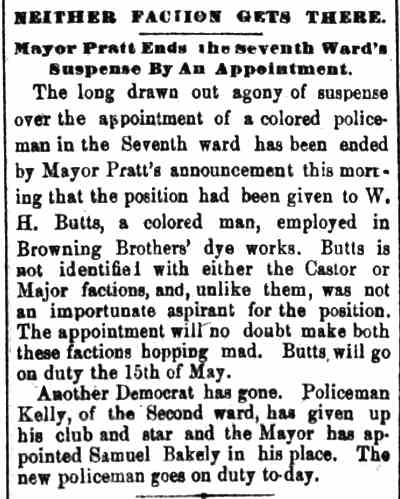
Mayor Pratt Ends the Seventh Ward’s Suspense By An Appointment.
The long drawn out agony of suspense over the appointment of a colored policeman in the Seventh ward has been ended by Mayor Pratt’s announcement this morning that the position had been given to W. H. Butts, a colored man, employed in Browning Brothers’ dye works. Butts is not identified with either the Castor or Major factions, and, unlike them, was not an importunate aspirant for the position. The appointment will no doubt make both these factions hopping mad. Butts will go on duty the 15th of May.
Another Democrat has gone. Policeman Kelly, of the Second ward, has given up his club and star and the Mayor has appointed Samuel Bakely in his place. The new policeman goes on duty to-day.
The Mayor’s Appointments
Camden Post —
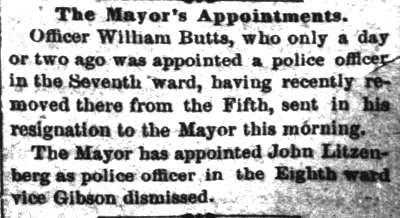
Officer William Butts, who only a day or two ago was appointed a police officer in the Seventh ward, having recently removed there from the Fifth, sent in his resignation to the Mayor this morning.
The Mayor has appointed John Litzenberg as police officer in the Eighth ward vice Gibson dismissed.
Mr. Butts Don’t Want It
Camden Daily Courier —
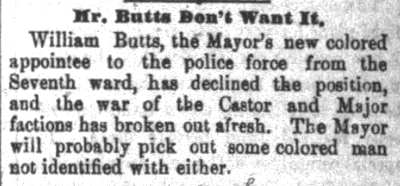
William Butts, the Mayor’s new colored appointee to the police force from the Seventh ward, has declined the position, and the war of the Castor and Major factions has broken out afresh. The Mayor will probably pick out some colored man not identified with either.
A Major Made a Policeman
Camden Daily Courier —
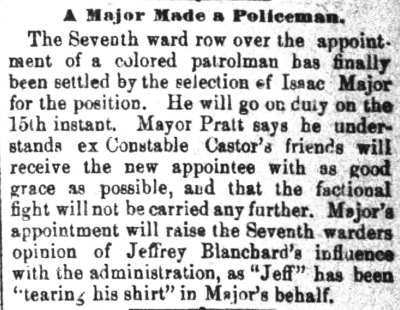
The Seventh ward row over the appointment of a colored patrolman has finally been settled by the selection of Isaac Major for the position. He will go on duty on the 15th instant. Mayor Pratt says he understands ex Constable Castor’s friends will receive the new appointee with as good grace as possible, and that the factional fight will not be carried any further. Major’s appointment will raise the Seventh warders opinion of Jeffrey Blanchard’s influence with the administration, as “Jeff” has been “tearing his shirt” in Major’s behalf.
Castor Says They’re Not Satisfied
Camden Daily Courier —
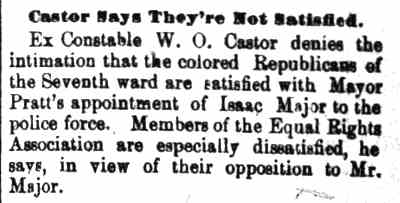
Ex Constable W. O. Castor denies the intimation that the colored Republicans of the Seventh ward are satisfied with Mayor Pratt’s appointment of Isaac Major to the police force. Members of the Equal Rights Association are especially dissatisfied, he says, in view of their opposition to Mr. Major.
The Day in Camden.
Philadelphia Inquirer —
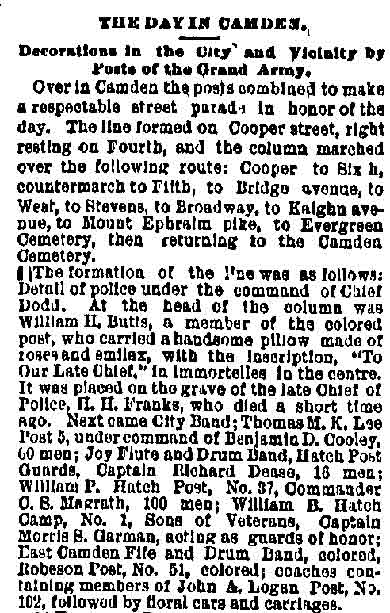
Decorations in the City and Vicinity by Posts of the Grand Army.
Over in Camden the posts combined to make a respectable street parade in honor of the day. The line formed on Cooper street, right resting on Fourth, and the column marched over the following route: Cooper to Sixth, countermarch to Fifth, to Bridge avenue, to West, to Stevens, to Broadway, to Kaighn avenue, to Mount Ephraim pike, to Evergreen Cemetery, then returning to the Camden Cemetery.
The formation of the line was as follows: Detail of police under the command of Chief Dodd. At the head of the column was William H. Butts, a member of the colored post, who carried a handsome pillow made of roses and smilax, with the inscription, “To Our Late Chief,” in immortelles in the centre. It was placed on the grave of the late Chief of Police, H. H. Franks, who died a short time ago. Next came City Band; Thomas M. K. Lee Post 5, under command of Benjamin D. Cooley, 60 men; Joy Flute and Drum Band, Hatch Post Guards, Captain Richard Dease, 16 men; William P. Hatch Post, No. 37, Commander C. S. Magrath, 100 men; William B. Hatch Camp, No. 1, Sons of Veterans, Captain Morris S. Garman, acting as guards of honor; East Camden Fife and Drum Band, colored, Robeson Post, No. 51, colored; coaches containing members of John A. Logan Post, No. 102, followed by floral cars and carriages.
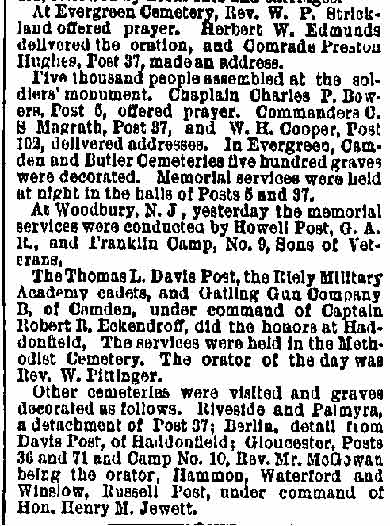
At Evergreen Cemetery, Rev. W. P. Strickland offered prayer. Herbert W. Edmunds delivered the oration, and Comrade Preston Hughes, Post 37, made an address.
Five thousand people assembled at the soldiers’ monument. Chaplain Charles P. Bowers, Post 6, offered prayer. Commanders C. S. Magrath, Post 37, and W. H. Cooper, Post 102, delivered addresses. In Evergreen, Camden and Butler Cemeteries five hundred graves were decorated. Memorial services were held at night in the halls of Posts 5 and 37.
At Woodbury, N. J., yesterday the memorial services were conducted by Howell Post, G. A. R., and Franklin Camp, No. 9, Sons of Veterans.
The Thomas L. Davis Post, the Riely Military Academy cadets, and Gatling Gun Company B, of Camden, under command of Captain Robert R. Eckendroff, did the honors at Haddonfield. The services were held in the Methodist Cemetery. The orator of the day was Rev. W. Pittinger.
Other cemeteries were visited and graves decorated as follows. Riverside and Palmyra, a detachment of Post 37; Berlin, detail from Davis Post, of Haddonfield; Gloucester, Posts 36 and 71 and Camp No. 10, Rev. Mr. McGowan being the orator; Hammon, Waterford and Winslow, Russell Post, under command of Hon. Henry M. Jewett.
Resignation Asked For
Camden Post —
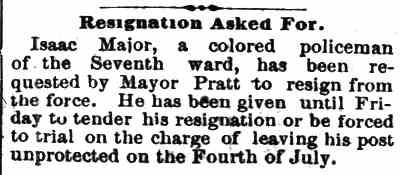
Isaac Major, a colored policeman of the Seventh ward, has been requested by Mayor Pratt to resign from the force. He has been given until Friday to tender his resignation or be forced to trial on the charge of leaving his post unprotected on the Fourth of July.
Isaac Major Resigns
Camden Daily Telegram —
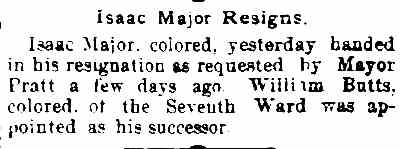
Isaac Major, colored, yesterday handed in his resignation as requested by Mayor Pratt a few days ago. William Butts, colored, of the Seventh Ward was appointed as his successor.
Butts Succeeds Major
Camden Daily Courier —
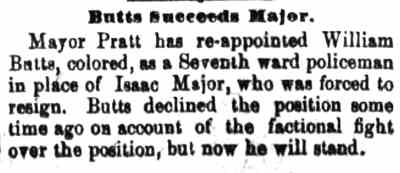
Mayor Pratt has re-appointed William Butts, colored, as a Seventh ward policeman in place of Isaac Major, who was forced to resign. Butts declined the position some time ago on account of the factional fight over the position, but now he will stand.
First Arrest
Camden Post —
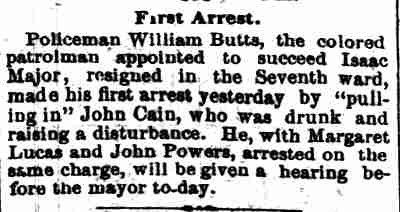
Policeman William Butts, the colored patrolman appointed to succeed Isaac Major, resigned in the Seventh ward, made his first arrest yesterday by “pulling in” John Cain, who was drunk and raising a disturbance. He, with Margaret Lucas and John Powers, arrested on the same charge, will be given a hearing before the mayor to-day.
Brief ‘Cross River Notes
Philadelphia Inquirer —
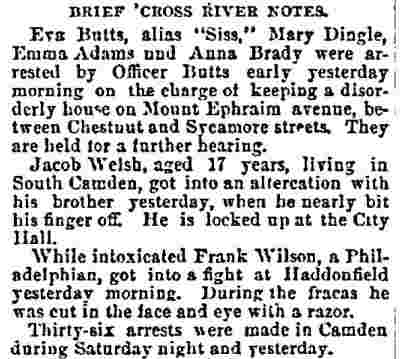
Eva Butts, alias “Siss,” Mary Dingle, Emma Adams and Anna Brady were arrested by Officer Butts early yesterday morning on the charge of keeping a disorderly house on Mount Ephraim avenue, between Chestnut and Sycamore streets. They are held for a further hearing.
Jacob Welsh, aged 17 years, living in South Camden, got into an altercation with his brother yesterday, when he nearly bit his finger off. He is locked up at the City Hall.
While intoxicated Frank Wilson, a Philadelphian, got into a fight at Haddonfield yesterday morning. During the fracas he was cut in the face and eye with a razor.
Thirty-six arrests were made in Camden during Saturday night and yesterday.
A Murderous Shot Fired From Ambush
Philadelphia Inquirer —

Another Crime Added to the Long List of New Jersey Tragedies.
A Quarrel Between Two Colored Youths Ends in a Killing
John Hill, in Revenge for Being Beaten, Lays in Wait and Slays Joseph Dotson—The Murderer and Several Witnesses in Jail.
A dark form crouched low among the bushes by the side of a path, another form outlined against the star-lit sky and moving up the path, a blinding flash, a cry, a fall, the sound of retreating footsteps, then silence.
This, in substance, is the story of a murder committed in Camden at an early hour Sunday morning. The story, as unfolded, shows that revenge prompted the killing and that the murder was premeditated and boasted of.
Both the victim and the murderer are young colored men. Joseph Dotson, who fell in the path with a bullet in his brain, was 19 years old, and lived at 789 Kaighn avenue. His slayer, John Hill, is but a year younger. He has no home, and of late has been living at a saloon and free-and-easy on Sycamore street above Seventh, kept by Reed & Derrickson.
Murdered for Revenge.
The murder grew out of a fight in Reed & Derrickson’s place. There is dancing in this place nearly every night in which the young colored people of the neighborhood take part. Fights are frequent occurrence.
Last Thursday night Dotson and a young colored man named James, alias “Babe” Evans were in the place and Dotson commenced a “buck” dance. Hill, who was acting as floor manager, told him he would have to get a female partner or leave the dancing floor. Dotson refused to do so, and from words they came to blows.
Hill got the worst of it in the fight and was severely beaten by Dotson and Evans. He swore to be revenged on them.
Said He Meant to Kill.
On Saturday night Hill showed a 32-calibre self-acting revolver to a girl named Laura Le Count, in Reed & Derrickson’s place, and said:
“I wasn’t ‘fixed’ the other night when Dotson jumped me, but I am now, and I’m goin’ to kill the —— ——.”
Dotson was in the place during the evening, but the men did not come together. Hill went out about 1 o’clock Sunday morning. He secreted himself among some bushes by the side of a path in an open lot bordering Sycamore street, a short distance above the saloon. He knew that his enemy would go home that way.
A Shot From the Bushes.
About half-past 1 o’clock Dotson came up the path in company with George Hanson. They were joking with each other, not thinking of danger. Hanson, who is the only eye witness of the tragedy, says Hill rose up from the bushes as Dotson came opposite him and fired full in his enemy’s face.
Hanson saw Dotson fall, and thinking he would be the next victim turned and ran for his life through the bushes.
His cries attracted the attention of colored Policeman Butts. The officer found Dotson lying unconscious in the path, with blood flowing from a bullet wound just over his left eye. A patrol wagon was summoned and the injured man was removed to the Cooper Hospital.
He did not regain consciousness and died within half an hour after being admitted. A subsequent post mortem examination showed that the bullet had passed entirely through the brain and lodged in the back of the skull.
Boasted of His Crime.
After firing the fatal shot the murderer returned to Reed & Derrickson’s place and coolly announced that he had shot Dotson. He boasted of what he had done in carrying out his threat to get square for being whipped by Dotson. He left the place soon afterward, just escaping Lieutenant Foster and Policeman Butts, who were hot on his trail.
Capture of the Murderer.
The murderer made no attempt to leave Camden. He kept under cover in the neighborhood until yesterday afternoon, when he ventured on the street and was picked up by Policeman Peters. He did not deny the shooting, but claimed that Dotson tried to draw a weapon first, and he “got the drop” and fired. The pistol could not be found.
The murderer, although young in years, has a bad reputation and has more than once drawn a pistol in a fight. Two years ago, while bathing in Cooper’s Creek with several small boys, one of the boys was drowned. His companions claimed that Hill held the boy under water until he was dead. The charge, however, was never pressed.
A Former Attempt to Kill.
About three weeks ago during a row in a saloon not far from the scene of the murder, Hill attempted to kill Daniel Hurley, a saloon-keeper, of Seventh and Mount Vernon streets. He fired three shots, one of which slightly wounded Hurley in the cheek.
The police arrested Hanson, who saw the murder, and Ida Fisher and James Evans, who witnessed the quarrel of Thursday night. They are held as witnesses for the inquest, which will be held in a few days by Coroner Jefferis.
Slashed With a Razor
Camden Post —
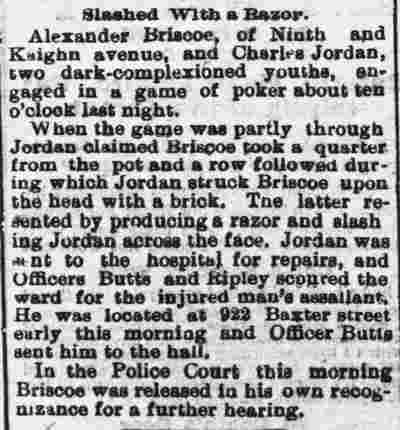
Alexander Briscoe, of Ninth and Kaighn avenue, and Charles Jordan, two dark-complexioned youths, engaged in a game of poker about ten o’clock last night.
When the game was partly through Jordan claimed Briscoe took a quarter from the pot and a row followed during which Jordan struck Briscoe upon the head with a brick. The latter resented by producing a razor and slashing Jordan across the face. Jordan was sent to the hospital for repairs, and Officers Butts and Ripley scoured the ward for the injured man’s assailant. He was located at 922 Baxter street early this morning and Officer Butts sent him to the hall.
In the Police Court this morning Briscoe was released in his own recognizance for a further hearing.
Police Guillotine at Work
Philadelphia Inquirer —
Police Guillotine at Work
Police Guillotine at Work.
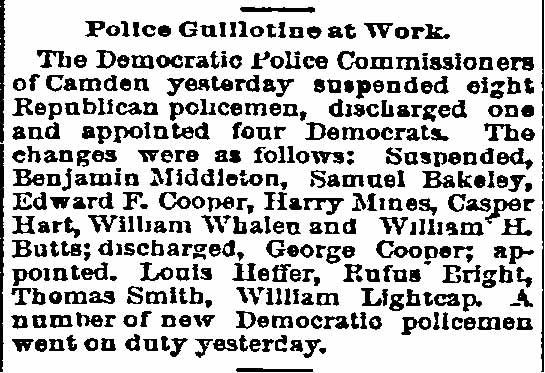
The Democratic Police Commissioners of Camden yesterday suspended eight Republican policemen, discharged one and appointed four Democrats. The changes were as follows: Suspended, Benjamin Middleton, Samuel Bakeley, Edward F. Cooper, Harry Mines, Casper Hart, William Whalen and William H. Butts; discharged, George Cooper; appointed, Louis Heffer, Rufus Bright, Thomas Smith, William Lightcap. A number of new Democratic policemen went on duty yesterday.
Policemen Shoved Off
Philadelphia Inquirer —
NEW JERSEY NEWS.
Partisanship, Not Efficiency, the Test for Service on Camden’s Force. Republicans Have to Go.
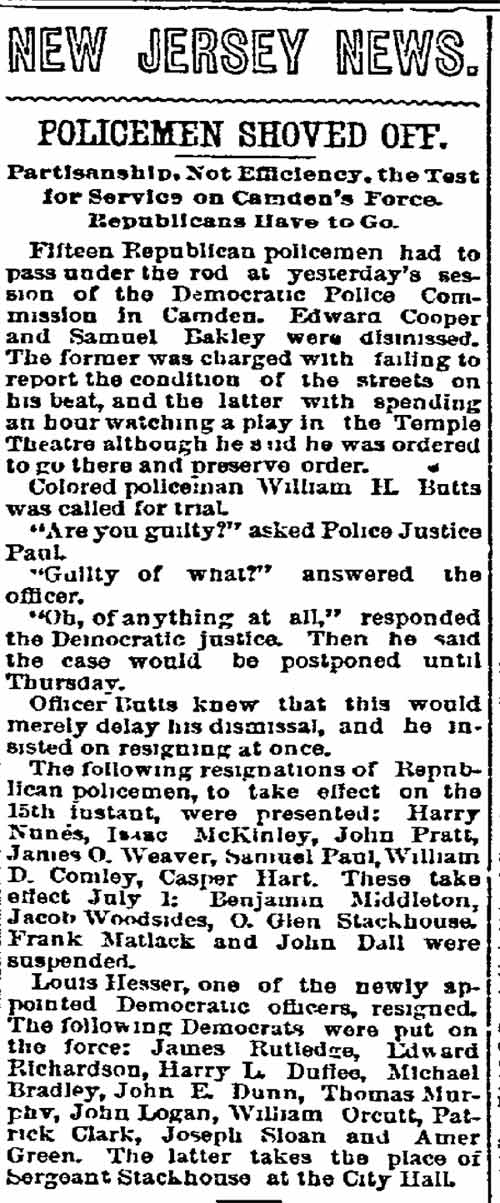
Fifteen Republican policemen had to pass under the rod at yesterday’s session of the Democratic Police Commission in Camden. Edward Cooper and Samuel Bakley were dismissed. The former was charged with failing to report the condition of the streets on his beat, and the latter with spending an hour watching a play in the Temple Theatre although he said he was ordered to go there and preserve order.
Colored policeman William H. Butts was called for trial.
“Are you guilty?” asked Police Justice Paul.
“Guilty of what?” answered the officer.
“Oh, of anything at all,” responded the Democratic justice. Then he said the case would be postponed until Thursday.
Officer Butts knew that this would merely delay his dismissal, and he insisted on resigning at once.
The following resignations of Republican policemen, to take effect on the 15th instant, were presented: Harry Nunes, Isaac McKinley, John Pratt, James O. Weaver, Samuel Paul, William D. Comley, Casper Hart. These take effect July 1: Benjamin Middleton, Jacob Woodsides, O. Glen Stackhouse. Frank Matlack and John Dall were suspended.
Louis Hesser, one of the newly appointed Democratic officers, resigned. The following Democrats were put on the force: James Rutledge, Edward Richardson, Harry L. Duffee, Michael Bradley, John E. Dunn, Thomas Murphy, John Logan, William Orcutt, Patrick Clark, Joseph Sloan and Amer Green. The latter takes the place of Sergeant Stackhouse at the City Hall.
He Announces the Names
Camden Daily Telegram —
The Mayor Appoints the New Force To-day.
MANY OLD OFFICERS TAKEN BACK.
Some Surprise Manifested at the Mayor’s Appointment of Dodd Instead of Jones—This Afternoon All the Names Will be Announced.
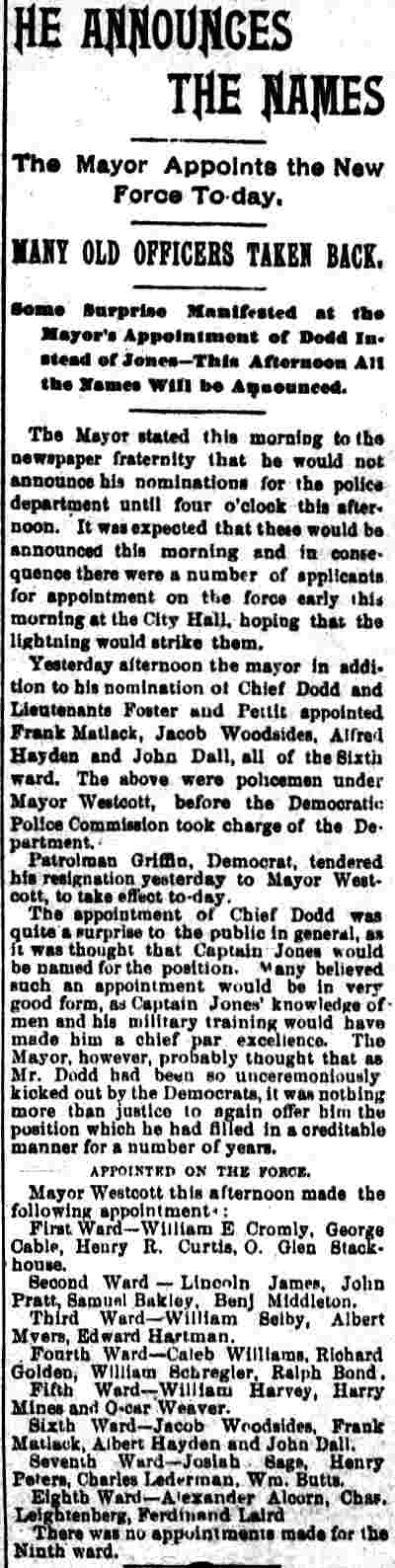
The Mayor stated this morning to the newspaper fraternity that he would not announce his nominations for the police department until four o’clock this afternoon. It was expected that these would be announced this morning and in consequence there were a number of applicants for appointment on the force early this morning at the City Hall, hoping that the lightning would strike them.
Yesterday afternoon the mayor in addition to his nomination of Chief Dodd and Lieutenants Foster and Pettit appointed Frank Matlack, Jacob Woodsides, Alfred Hayden and John Dall, all of the Sixth Ward. The above were policemen under Mayor Westcott, before the Democratic Police Commission took charge of the Department.
Patrolman Griffin, Democrat, tendered his resignation yesterday to Mayor Westcott, to take effect to-day.
The appointment of Chief Dodd was quite a surprise to the public in general, as it was thought that Captain Jones would be named for the position. Many believed such an appointment would be in very good form, as Captain Jones’ knowledge of men and his military training would have made him a chief par excellence. The Mayor, however, probably thought that as Mr. Dodd had been so unceremoniously kicked out by the Democrats, it was nothing more than justice to again offer him the position which he had filled in a creditable manner for a number of years.
APPOINTED ON THE FORCE.
Mayor Westcott this afternoon made the following appointments:
First Ward—William E Cromly, George Cable, Henry R. Curtis, O. Glen Stackhouse.
Second Ward—Lincoln James, John Pratt, Samuel Bakley, Benj Middleton.
Third Ward—William Selby, Albert Myers, Edward Hartman.
Fourth Ward—Caleb Williams, Richard Golden, William Schregler, Ralph Bond.
Fifth Ward—William Harvey, Harry Mines and Oscar Weaver.
Sixth Ward—Jacob Woodsides, Frank Matlack, Albert Hayden and John Dall.
Seventh Ward—Josiah Sage, Henry Peters, Charles Lederman, Wm. Butts.
Eighth Ward—Alexander Alcorn, Chas. Leightenberg, Ferdinand Laird
There was no appointments made for the Ninth ward.
Two Men Shot in a Race Riot in Camden
Philadelphia Inquirer —
Both Victims Are Colored and One Is Probably Fatally Wounded.
POLICE USED PISTOLS
They Were Fired at When They Tried to Arrest the Fighters. “Crap” Game Started the Trouble.
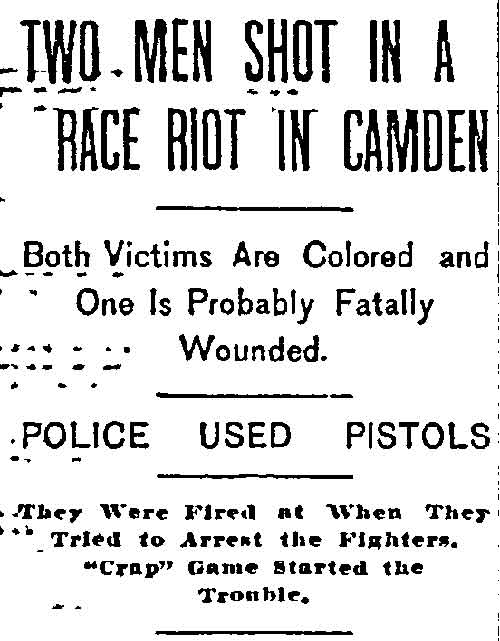
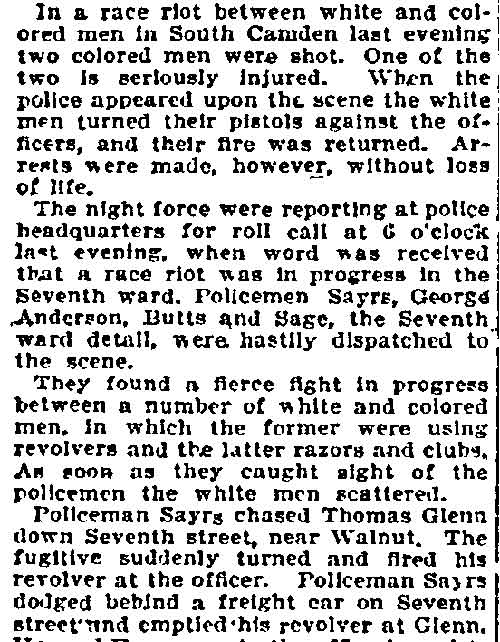
In a race riot between white and colored men in South Camden last evening two colored men were shot. One of the two is seriously injured. When the police appeared upon the scene the white men turned their pistols against the officers, and their fire was returned. Arrests were made, however, without loss of life.
The night force were reporting at police headquarters for roll call at 6 o’clock last evening, when word was received that a race riot was in progress in the Seventh ward. Policemen Sayrs, George Anderson, Butts and Sage, the Seventh ward detail, were hastily dispatched to the scene.
They found a fierce fight in progress between a number of white and colored men, in which the former were using revolvers and the latter razors and clubs. As soon as they caught sight of the policemen the white men scattered.
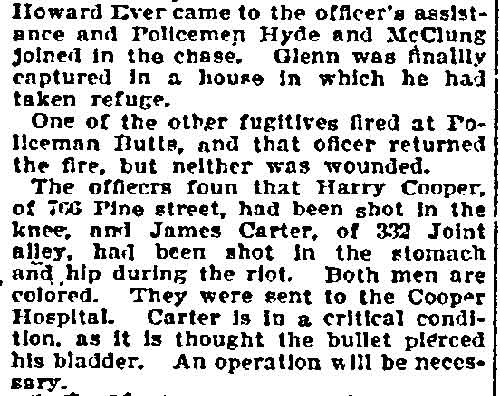
Policeman Sayrs chased Thomas Glenn down Seventh street, near Walnut. The fugitive suddenly turned and fired his revolver at the officer. Policeman Sayrs dodged behind a freight car on Seventh street and emptied his revolver at Glenn. Howard Ever came to the officer’s assistance and Policemen Hyde and McClung joined in the chase. Glenn was finally captured in a house in which he had taken refuge.
One of the other fugitives fired at Policeman Butts, and that officer returned the fire, but neither was wounded.
The officers foun [sic] that Harry Cooper, of 706 Pine street, had been shot in the knee, and James Carter, of 332 Joint alley, had been shot in the stomach and hip during the riot. Both men are colored. They were sent to the Cooper Hospital. Carter is in a critical condition, as it is thought the bullet pierced his bladder. An operation will be necessary.
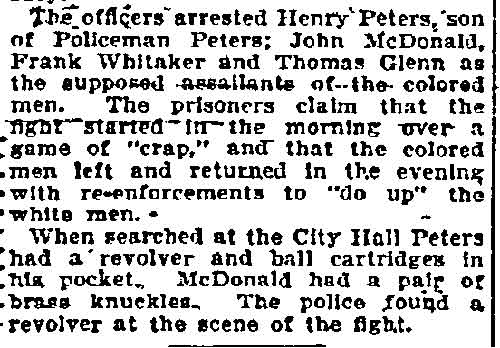
The officers arrested Henry Peters, son of Policeman Peters; John McDonald, Frank Whitaker and Thomas Glenn as the supposed assailants of the colored men. The prisoners claim that the fight started in the morning over a game of “crap,” and that the colored men left and returned in the evening with re-enforcements to “do up” the white men.
When searched at the City Hall Peters had a revolver and ball cartridges in his pocket. McDonald had a pair of brass knuckles. The police found a revolver at the scene of the fight.
Hot Time in the Flats
Camden Daily Telegram —
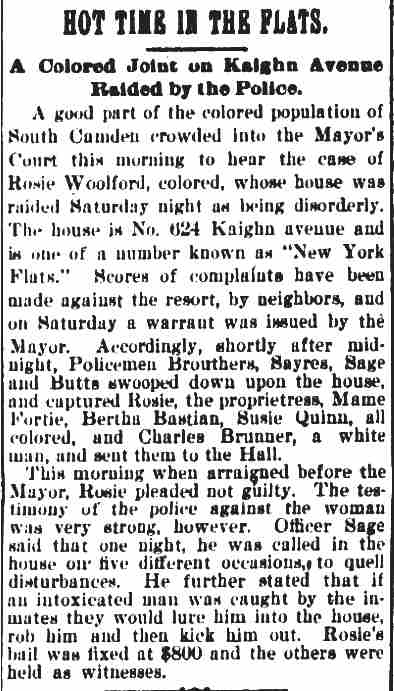
A Colored Joint on Kaighn Avenue Raided by the Police.
A good part of the colored population of South Camden crowded into the Mayor’s Court this morning to hear the case of Rosie Woolford, colored, whose house was raided Saturday night as being disorderly. The house is No. 624 Kaighn avenue and is one of a number known as “New York Flats.” Scores of complaints have been made against the resort, by neighbors, and on Saturday a warrant was issued by the Mayor. Accordingly, shortly after midnight, Policemen Brouthers, Sayres, Sage and Butts swooped down upon the house, and captured Rosie, the proprietress, Mame Fortie, Bertha Bastian, Susie Quinn, all colored, and Charles Brunner, a white man, and sent them to the Hall.
This morning when arraigned before the Mayor, Rosie pleaded not guilty. The testimony of the police against the woman was very strong, however. Officer Sage said that one night, he was called in the house on five different occasions, to quell disturbances. He further stated that if an intoxicated man was caught by the inmates they would lure him into the house, rob him and then kick him out. Rosie’s bail was fixed at $800 and the others were held as witnesses.
A Youthful Disorderly
Camden Daily Telegram —
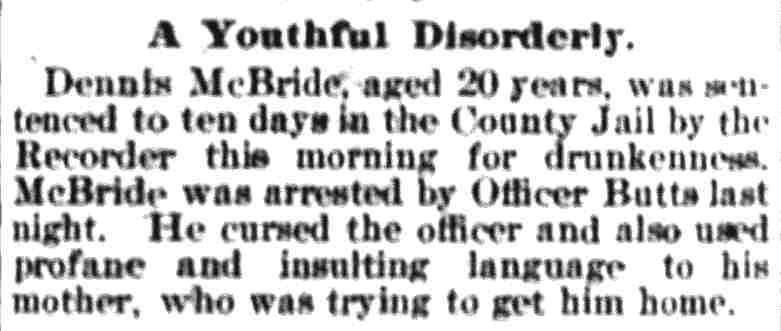
Dennis McBride, aged 20 years, was sentenced to ten days in the County Jail by the Recorder this morning for drunkenness. McBride was arrested by Officer Butts last night. He cursed the officer and also used profane and insulting language to his mother, who was trying to get him home.
Policemen on the Rack
Philadelphia Inquirer —
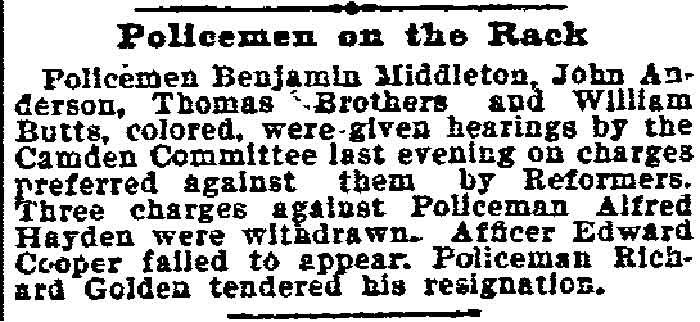
Policemen Benjamin Middleton, John Anderson, Thomas Brothers and William Butts, colored, were given hearings by the Camden Committee last evening on charges preferred against them by Reformers. Three charges against Policeman Alfred Hayden were withdrawn. Officer Edward Cooper failed to appear. Policeman Richard Golden tendered his resignation.
Here’s Camden’s Finest, With Whiskers, in 1898
Camden Courier-Post —
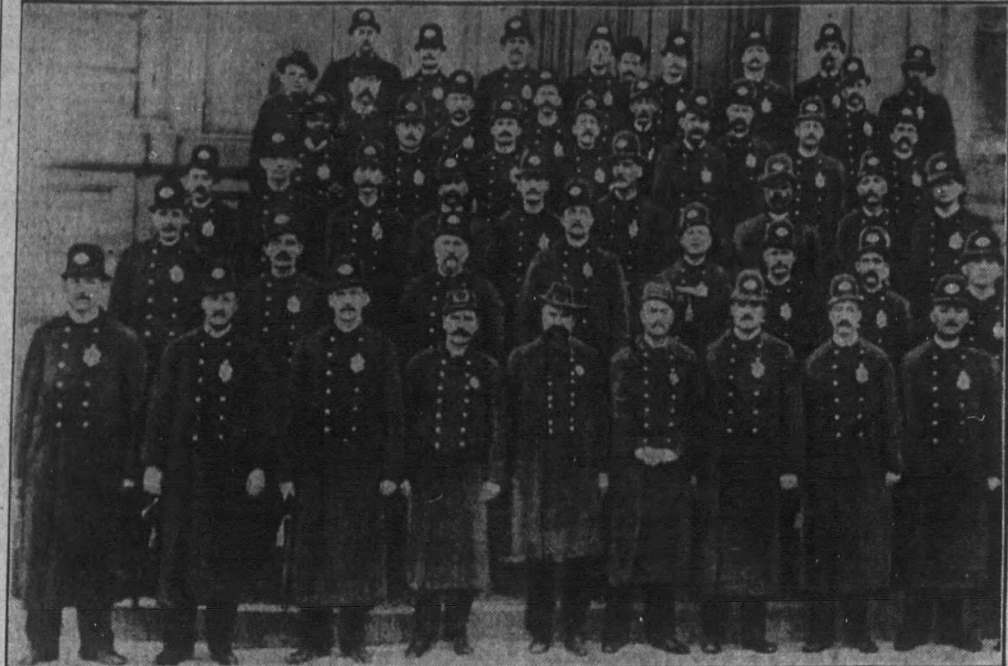
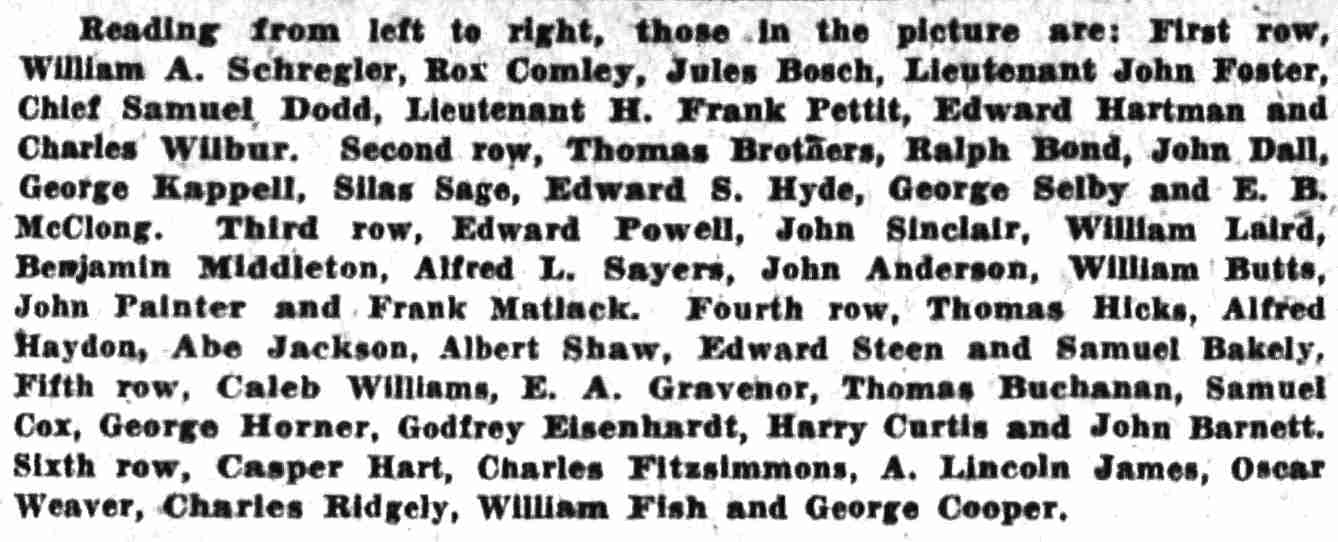
Reading from left to right, those in the picture are: First row, William A. Schregler, Rox Comley, Jules Bosch, Lieutenant John Foster, Chief Samuel Dodd, Lieutenant H. Frank Pettit, Edward Hartman and Charles Wilbur. Second row, Thomas Brothers, Ralph Bond, John Dall, George Kappell, Silas Sage, Edward S. Hyde, George Selby and E. B. McClong. Third row, Edward Powell, John Sinclair, William Laird, Benjamin Middleton, Alfred L. Sayers, John Anderson, William Butts, John Painter and Frank Matlack. Fourth row, Thomas Hicks, Alfred Haydon, Abe Jackson, Albert Shaw, Edward Steen and Samuel Bakely. Fifth row, Caleb Williams, E. A. Gravenor, Thomas Buchanan, Samuel Cox, George Horner, Godfrey Eisenhardt, Harry Curtis and John Barnett. Sixth row, Casper Hart, Charles Fitzsimmons, A. Lincoln James, Oscar Weaver, Charles Ridgely, William Fish and George Cooper.
To Repeat the Burlesque
Camden Daily Courier —
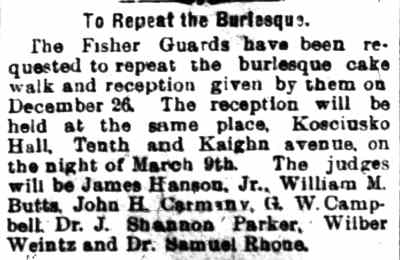
The Fisher Guards have been requested to repeat the burlesque cake walk and reception given by them on December 26. The reception will be held at the same place, Kosciusko Hall, Tenth and Kaighn avenue, on the night of March 9th. The judges will be James Hanson, Jr., William M. Butts, John H. Carmany, G. W. Campbell, Dr. J. Shannon Parker, Wilber Weintz and Dr. Samuel Rhone.
William M. Butts Club Adopts a Watchword
Camden Daily Courier —
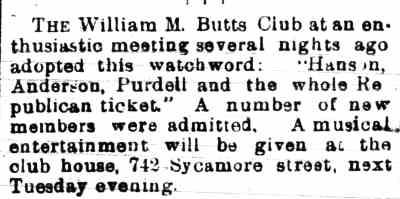
THE William M. Butts Club at an enthusiastic meeting several nights ago adopted this watchword: “Hanson, Anderson, Purdell and the whole Republican ticket.” A number of new members were admitted. A musical entertainment will be given at the club house, 742 Sycamore street, next Tuesday evening.
The Recorder’s Court
Camden Daily Courier —
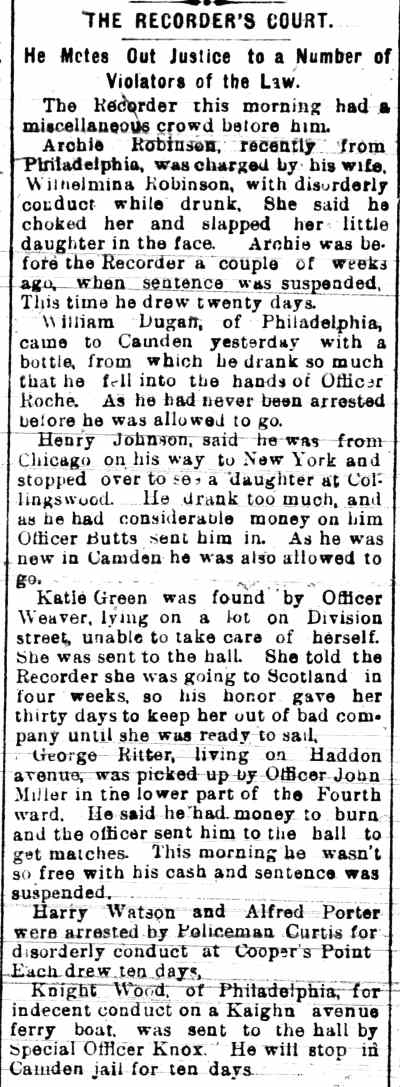
He Metes Out Justice to a Number of Violators of the Law.
The Recorder this morning had a miscellaneous crowd before him.
Archie Robinson, recently from Philadelphia, was charged by his wife, Wilhelmina Robinson, with disorderly conduct while drunk. She said he choked her and slapped her little daughter in the face. Archie was before the Recorder a couple of weeks ago, when sentence was suspended. This time he drew twenty days.
William Dugan, of Philadelphia, came to Camden yesterday with a bottle, from which he drank so much that he fell into the hands of Officer Roche [sic]. As he had never been arrested before he was allowed to go.
Henry Johnson, said he was from Chicago on his way to New York and stopped over to see a daughter at Collingswood. He drank too much, and as he had considerable money on him Officer Butts sent him in. As he was new in Camden he was also allowed to go.
Katie Green was found by Officer Weaver, lying on a lot on Division street, unable to take care of herself. She was sent to the hall. She told the Recorder she was going to Scotland in four weeks, so his honor gave her thirty days to keep her out of bad company until she was ready to sail.
George Ritter, living on Haddon avenue, was picked up by Officer John Miller in the lower part of the Fourth ward. He said he had money to burn and the officer sent him to the hall to get matches. This morning he wasn’t so free with his cash and sentence was suspended.
Harry Watson and Alfred Porter were arrested by Policeman Curtis for disorderly conduct at Cooper’s Point Each drew ten days.
Knight Wood, of Philadelphia, for indecent conduct on a Kaighn avenue ferry boat, was sent to the hall by Special Officer Knox. He will stop in Camden jail for ten days.
Policeman Butts Dead
Camden Post-Telegram —
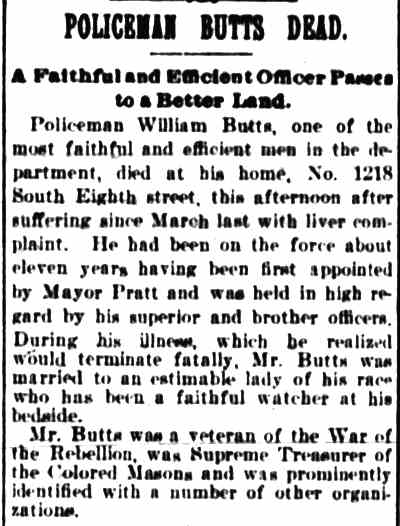
A Faithful and Efficient Officer Passes to a Better Land.
Policeman William Butts, one of the most faithful and efficient men in the department, died at his home, No. 1218 South Eighth street, this afternoon after suffering since March last with liver complaint. He had been on the force about eleven years having been first appointed by Mayor Pratt and was held in high regard by his superior and brother officers. During his illness, which he realized would terminate fatally, Mr. Butts was married to an estimable lady of his race who has been a faithful watcher at his bedside.
Mr. Butts was a veteran of the War of the Rebellion, was Supreme Treasurer of the Colored Masons and was prominently identified with a number of other organizations.
Policemen Butts Dead
Camden Daily Courier —
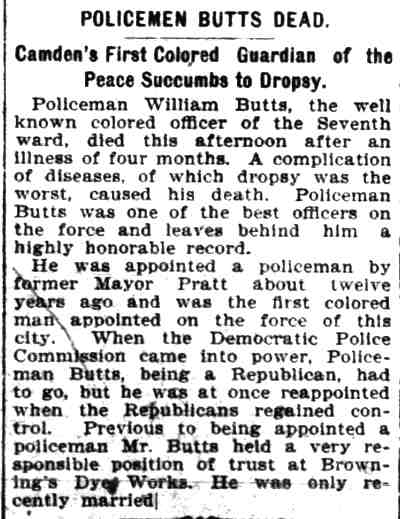
Camden’s First Colored Guardian of the Peace Succumbs to Dropsy.
Policeman William Butts, the well known colored officer of the Seventh ward, died this afternoon after an illness of four months. A complication of diseases, of which dropsy was the worst, caused his death. Policeman Butts was one of the best officers on the force and leaves behind him a highly honorable record.
He was appointed a policeman by former Mayor Pratt about twelve years ago and was the first colored man appointed on the force of this city. When the Democratic Police Commission came into power, Policeman Butts, being a Republican, had to go, but he was at once reappointed when the Republicans regained control. Previous to being appointed a policeman Mr. Butts held a very responsible position of trust at Browning’s Dye Works. He was only recently married.
Policeman Butts’ Obsequies
Camden Post-Telegram —
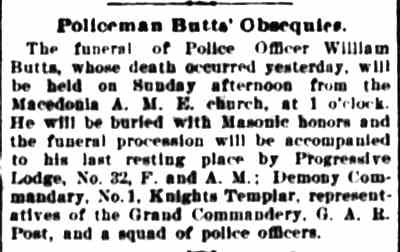
The funeral of Police Officer William Butts, whose death occurred yesterday, will be held on Sunday afternoon from the Macedonia A. M. E. church, at 1 o’clock. He will be buried with Masonic honors and the funeral procession will be accompanied to his last resting place by Progressive Lodge, No. 32, F. and A. M.; Demony Commandery, No. 1, Knights Templar, representatives of the Grand Commandery, G. A. R. Post, and a squad of police officers.
Funeral of William M. Butts
Camden Daily Courier —
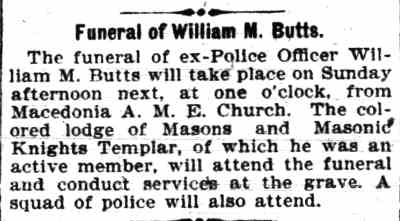
The funeral of ex-Police Officer William M. Butts will take place on Sunday afternoon next, at one o’clock, from Macedonia A. M. E. Church. The colored lodge of Masons and Masonic Knights Templar, of which he was an active member, will attend the funeral and conduct services at the grave. A squad of police will also attend.
Respect for Policeman Butts
Camden Post-Telegram —
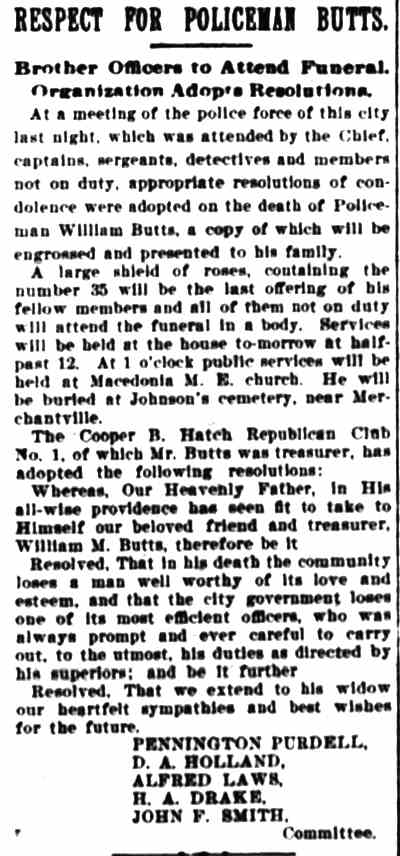
Brother Officers to Attend Funeral. Organization Adopts Resolutions.
At a meeting of the police force of this city last night, which was attended by the Chief, captains, sergeants, detectives and members not on duty, appropriate resolutions of condolence were adopted on the death of Policeman William Butts, a copy of which will be engrossed and presented to his family.
A large shield of roses, containing the number 35 will be the last offering of his fellow members and all of them not on duty will attend the funeral in a body. Services will be held at the house to-morrow at half-past 12. At 1 o’clock public services will be held at Macedonia M. E. church. He will be buried at Johnson’s cemetery, near Merchantville.
The Cooper B. Hatch Republican Club No. 1, of which Mr. Butts was treasurer, has adopted the following resolutions:
Whereas, Our Heavenly Father, in His all-wise providence has seen fit to take to Himself our beloved friend and treasurer, William M. Butts, therefore be it
Resolved, That in his death the community loses a man well worthy of its love and esteem, and that the city government loses one of its most efficient officers, who was always prompt and ever careful to carry out, to the utmost, his duties as directed by his superiors; and be it further
Resolved, That we extend to his widow our heartfelt sympathies and best wishes for the future.
Pennington Purdell, D. A. Holland, Alfred Laws, H. A. Drake, John F. Smith, Committee.
Policeman Butts’ Funeral
Camden Post-Telegram —
Church Was Crowded During the Services.
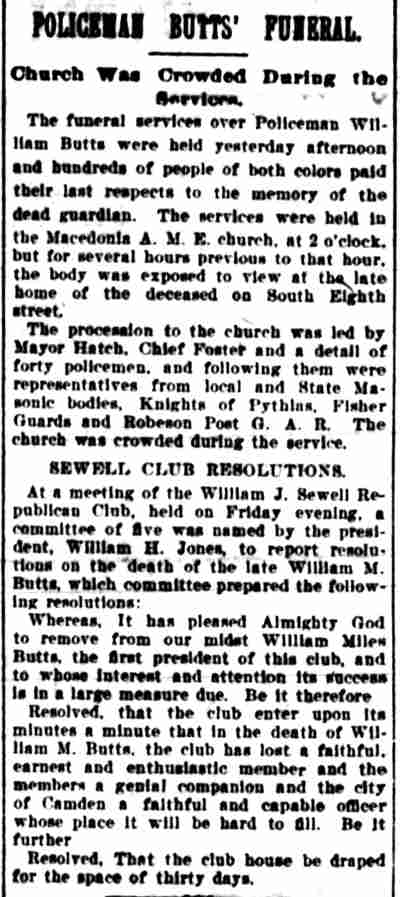
The funeral services over Policeman William Butts were held yesterday afternoon and hundreds of people of both colors paid their last respects to the memory of the dead guardian. The services were held in the Macedonia A. M. E. church, at 2 o’clock, but for several hours previous to that hour, the body was exposed to view at the late home of the deceased on South Eighth street.
The procession to the church was led by Mayor Hatch, Chief Foster and a detail of forty policemen, and following them were representatives from local and State Masonic bodies, Knights of Pythias, Fisher Guards and Robeson Post G. A. R. The church was crowded during the service.
SEWELL CLUB RESOLUTIONS.
At a meeting of the William J. Sewell Republican Club, held on Friday evening, a committee of five was named by the president, William H. Jones, to report resolutions on the death of the late William M. Butts, which committee prepared the following resolutions:
Whereas, It has pleased Almighty God to remove from our midst William Miles Butts, the first president of this club, and to whose interest and attention its success is in a large measure due. Be it therefore
Resolved, that the club enter upon its minutes a minute that in the death of William M. Butts, the club has lost a faithful, earnest and enthusiastic member and the members a genial companion and the city of Camden a faithful and capable officer, whose place it will be hard to fill. Be it further
Resolved, That the club house be draped for the space of thirty days.
Policeman Butts Buried
Camden Daily Courier —
Many Organizations Follow the Body to its Last Resting Place.
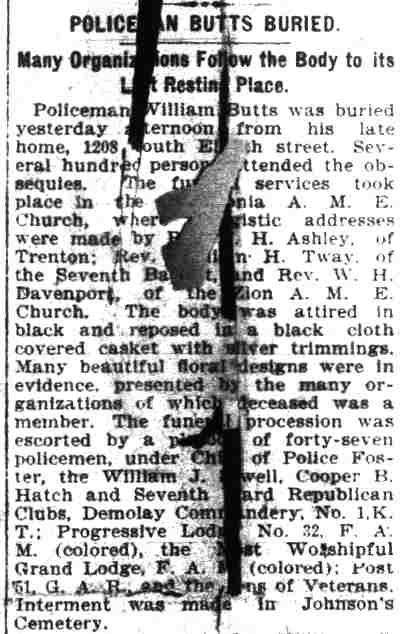
Policeman William Butts was buried yesterday afternoon from his late home, 1208 South Eighth street. Several hundred persons attended the obsequies. The funeral services took place in the Macedonia A. M. E. Church, where eulogistic addresses were made by Rev. H. Ashley, of Trenton; Rev. William H. Tway, of the Seventh Baptist, and Rev. W. H. Davenport, of the Zion A. M. E. Church. The body was attired in black and reposed in a black cloth covered casket with silver trimmings. Many beautiful floral designs were in evidence, presented by the many organizations of which deceased was a member. The funeral procession was escorted by a platoon of forty-seven policemen, under Chief of Police Foster, the William J. Sewell, Cooper B. Hatch and Seventh Ward Republican Clubs, Demolay Commandery, No. 1, K. T.; Progressive Lodge, No. 32, F. A. M. (colored); the Most Worshipful Grand Lodge, F. A. M. (colored); Post 51, G. A. R. and the Sons of Veterans. Interment was made in Johnson’s Cemetery.
At a meeting of the William J. Sewell Republican Club of Camden County, held on Friday evening, a committee of five was named by the president, William H. Jones, to report resolutions on the death of the late William M. Butts, which committee reported as follows:
“Whereas, It has pleased Almighty God to remove from our midst William Miles Butts, the first president of this club, and to whose interest and attention its success is, in a large measure due.
“Be it, therefore, resolved, that the club enter upon its minutes a minute that in the death of William M. Butts, the club has lost a faithful, earnest and enthusiastic member and the members, a genial companion and the City of Camden a faithful and capable officer whose place it will be hard to fill.
“Be it further resolved, That the club house be draped for the space of thirty days.”
Acknowledgment
Many thanks to Dr. James E. Johnson of Rowan University, who has done extensive research on William Miles Butts for his help in creating this web-page.