Introduction
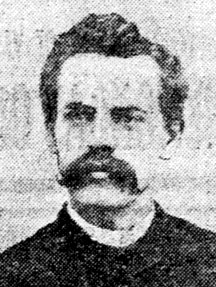
William D. Hart
WILLIAM D. HART served as a detective on the Camden Police Department in the 1900s. He had previously served as a constable and as a Justice of the Peace.
William D. Hart was born in New Jersey in June of 1858. Learning the cigar makers’ trade, he was living on Carman Street above Broadway when the 1878 City Directory was compiled. The 1880 Census shows him with his parents, Leonard and Sarah Hart, at 588 Carman Street. Also at home were younger siblings Byron and Addie. The 1882–1883 Directory gives an address of 4 Day Street, and tells that he worked as a cigar maker for H.H. Franks.
William D. Hart married Bessie Gilling in 1883. His wife Bessie bore a son, Harry Franks Hart, in 1884. The Directories show the Harts at 411 Federal Street from 1884 through at least mid-1888. Throughout this period William D. Hart worked as a cigar maker. He also became involved in local politics, and for his efforts was rewarded with the posts of Constable and Justice of the Peace, in which he served from 1888 through at least the beginning of 1891.
By the end of 1890 William D. Hart and family had moved to 508 Federal Street, where they would remain through most of the 1890s.
William D. Hart was working as a cigar maker in Philadelphia in 1898. He and wife Bessie were then living at 514 Berkley Street in South Camden. In 1899 he was appointed to the Camden Police Department as a detective. He was then living at 3 South 5th Street. When the Census was taken on June 1, 1900 William and Bessie Hart and their son Harry were living at 109 Broadway.
The 1906 City Directory gives his address as 412 South 5th Street. William and Bessie Hart were still residing at that address as late as 1914.
William D. Hart passed away prior to the January 6, 1920 census enumeration. His widow Bessie was still living at 412 South 5th Street. Her brother, Frederick William Gilling, lived with her.
William Drake Marwood Derrickson — William Hart
Philadelphia Inquirer —
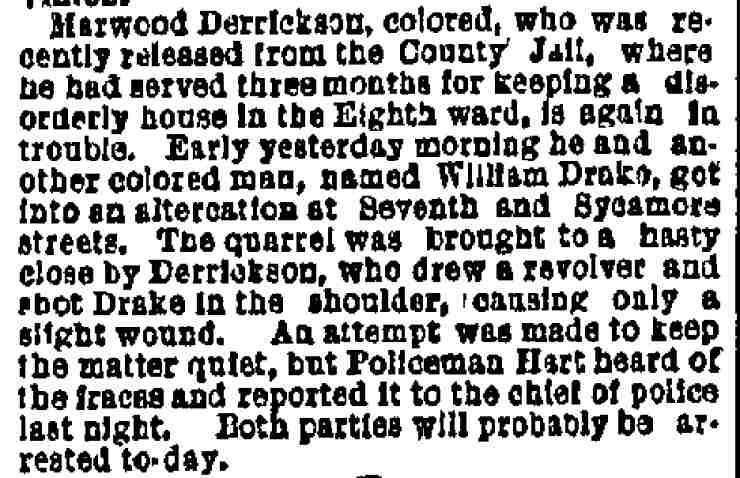
Marwood Derrickson, colored, who was recently released from the County Jail, where he had served three months for keeping a disorderly house in the Eighth ward, is again in trouble. Early yesterday morning he and another colored man, named William Drake, got into an altercation at Seventh and Sycamore streets. The quarrel was brought to a hasty close by Derrickson, who drew a revolver and shot Drake in the shoulder, causing only a slight wound. An attempt was made to keep the matter quiet, but Policeman Hart heard of the fracas and reported it to the chief of police last night. Both parties will probably be arrested to-day.
Camden Primaries
Philadelphia Inquirer —
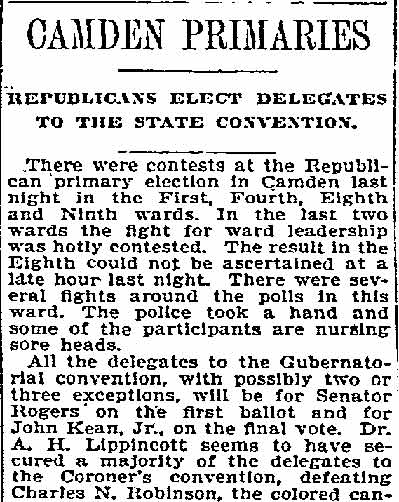
Republicans Elect Delegates to the State Convention.
There were contests at the Republican primary election in Camden last night in the First, Fourth, Eighth and Ninth wards. In the last two wards the fight for ward leadership was hotly contested. The result in the Eighth could not be ascertained at a late hour last night. There were several fights around the polls in this ward. The police took a hand and some of the participants are nursing sore heads.
All the delegates to the Gubernatorial convention, with possibly two or three exceptions, will be for Senator Rogers on the first ballot and for John Kean, Jr., on the final vote. Dr. A. H. Lippincott seems to have secured a majority of the delegates to the Coroner’s convention, defeating Charles N. Robinson, the colored candidate.
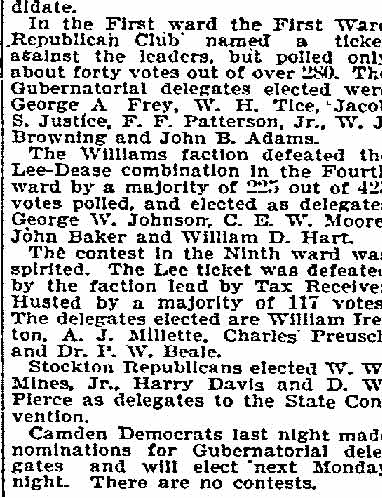
In the First ward the First Ward Republican Club named a ticket against the leaders, but polled only about forty votes out of over 280. The Gubernatorial delegates elected were George A Frey, W. H. Tice, Jacob S. Justice, F. F. Patterson, Jr., W. J. Browning and John B. Adams.
The Williams faction defeated the Lee-Dease combination in the Fourth ward by a majority of 225 out of 425 votes polled, and elected as delegates George W. Johnson, C. E. W. Moore, John Baker and William D. Hart.
The contest in the Ninth ward was spirited. The Lee ticket was defeated by the faction lead [sic] by Tax Receiver Husted by a majority of 117 votes. The delegates elected are William Ireton, A. J. Millette, Charles Preusch and Dr. P. W. Beale.
Stockton Republicans elected W. W. Mines, Jr., Harry Davis and D. W. Pierce as delegates to the State Convention.
Camden Democrats last night made nominations for Gubernatorial delegates and will elect next Monday night. There are no contests.
Camden’s New Chief of Police
Philadelphia Inquirer —
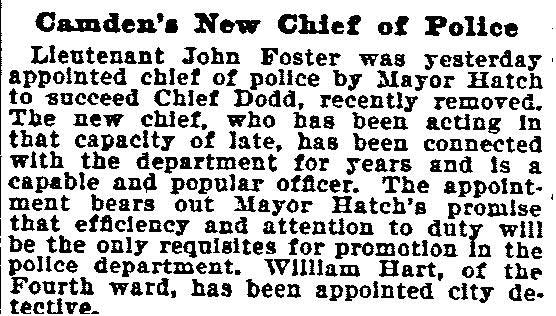
Lieutenant John Foster was yesterday appointed chief of police by Mayor Hatch to succeed Chief Dodd, recently removed. The new chief, who has been acting in that capacity of late, has been connected with the department for years and is a capable and popular officer. The appointment bears out Mayor Hatch’s promise that efficiency and attention to duty will be the only requisites for promotion in the police department. William Hart, of the Fourth ward, has been appointed city detective.
In Police Dragnet
Philadelphia Inquirer —
IN POLICE DRAGNET
Successful Raid on an Alleged Pool Room in Camden
SEVEN MEN CAPTURED
Keefer, Who Says He Spent His Employers’ Money in the Place, Identifies the Prisoners
The Camden police yesterday raided the alleged poolroom at 25 South Third street, where Walter H. Keefer, former manager of the Merchantville Light and Power Company, claims he lost $254 belonging to his employers. Seven men were captured in the raid, including W. Harry Getty and Charles Metz, who were committed in default of $1500 bail each as principals. The others were James Boone, of Fourth and Benson streets; George Armstrong, Charles Loriaux, George Smith and Victor Thompson. Each furnished $300 bail except Thompson, who was unable to get surety up to a late hour.
The police for months past have been trying to get evidence against this alleged poolroom. The place was so closely guarded that the officers could not get direct evidence that the law was being violated. The details of the raid and the successful manner in which it was carried out were made known at the hearing before Recorder Nowrey last evening. The defendants were represented by Lawyer John J. Crandall. Mayor Hatch, City Counsel Bleakly and Councilman Silvers, of the Third ward, were interested spectators. Before the prisoners were brought in Deputy Sheriff Hartshorn appeared with Walter H. Keefer, who was brought over from the county jail to identify the proprietors and employes of the alleged poolroom. The prisoners scowled at Keefer as they were brought into the hearing room.
City Detective Hart was the first witness. He said he swore out the warrant for the raid from information obtained from Keefer.
Keefer, the star witness, was next called. He pointed out Metz as the man who operated the “ticker,” collected the bets and paid the winnings. Keefer said he had played the races there on Monday last and on several other occasions. He stated that W. Harry Getty guarded the door and scrutinized every one who applied for admission.
Police Captain Boyle testified that he made the raid, assisted by City Detective Hart and Officers Painter, Shaw, Robert Miller and George Anderson. When they knocked Getty opened the front door just enough to peer out at them. A chair prevented the door from being opened wide. The warrant was read, but Getty refused to admit them. They then broke the chair and forced an entrance. Rushing up stairs they found the door to the third-story back room barred. They forced the door and found themselves in what appeared to be a furnished bedroom. Wires ran through a rear window, but there was no telegraph instrument or other evidence of a poolroom.
The men in the room were placed under arrest and a search was instituted for evidence. They found a man hiding in a closet and took him into custody. A locked box was found on the mantelpiece in the front room. Mrs. Getty claimed that it contained her jewelry. The officers finally found a key that opened the lock. The “jewelry” consisted of the missing telegraph “ticker.” Several about the New Orleans races and betting were seized.
Policeman Shaw said that Loriaux told him the wires were cut and the “ticker” carried over into the front room while the police were coming up the stairs. Officers Painter and Anderson gave corroborative testimony.
Charles Loriaux swore that he had been in the place only eight minutes when the police swooped down on it. He admitted telling Officer Shaw that the “ticker” was hustled out of the room when they heard the police trying to get in.
George Armstrong admitted having been in the pool room before.
“What did you go there for?” asked Recorder Nowrey.
“Do you wish me to incriminate myself?” asked Armstrong, after hesitating some time.
The Recorder did not press the question.
James Boone, who said he had resided at Fourth and Benson streets for the past twelve years, claimed that he went to the alleged pool room to hear the result of a handicap race at Lexington. He admitted being there before to get similar news.
George Smith swore that he went there to hear the results of horse races. He admitted that he had bought pools there before.
For several terms of court there has been an indictment hanging over Getty’s head on a charge of conducting a pool room at Seventeenth and Federal streets with George W. Sterling, but for some reason it has never been moved. Chief of Police Foster stated last evening that one of the reasons for the dismissal of Police Captain H. Frank Pettitt was that Getty’s place on South Third street was in his district and he failed to suppress it or secure evidence on which a raid could be made.
That there is war to the death between the police and the policy dealers was shown yesterday by a bold retaliatory move of Washington Ketline, who brought suit for damages against Policemen Henry Miller and Isaac Brown. The officers furnished $1500 bail each. Ketline was arrested by the officers a few days ago on the charge of engaging in policy selling.
Ketline placed some pieces of paper in his mouth that the officers supposed were policy slips. Because he refused to open his mouth, Ketline says, the policemen used him roughly. Ketline has already served a sentence for policy writing.
John Baxter — Jeremiah Ryan — William D. Hart
Philadelphia Inquirer —
Philadelphia Inquirer, November 22, 1899 — John Baxter — Jeremiah Ryan — Mary Ryan — South 26th Street — Washington Street — Cooper Hospital — E.A. Armstrong — James Brown — Harry Horton — Federal Street — 24th Street — Mrs. Lizzie Sullivan — Master Street — John Foster — William P. Walsh — Anna Baxter
William D. Hart — Arthur Stanley
Bridgeton Evening News —
The Camden police authorities were informed that a number of human bones had been found on the meadows near Fourth street and Atlantic avenue. Detective Hart and Captain of Police Stanley learned that the bones had been left in a building by a medical student.
The Paul Woodward Murder Case
Philadelphia Inquirer — to
On October 1, 1902 Paul Woodward murdered two young boys by giving them poison. Frank T. Lloyd, then Camden County prosecutor, was responsible for leading the investigation and prosecuting the case. William D. Hart was involved in the investigation, and arrested Woodward on October 4, 1902. He was indicted, tried, convicted of murder in the first degree, and on January 7, 1903 executed at the Camden County Jail.
Camden’s Mystery Is Still Unsolved
Philadelphia Inquirer —
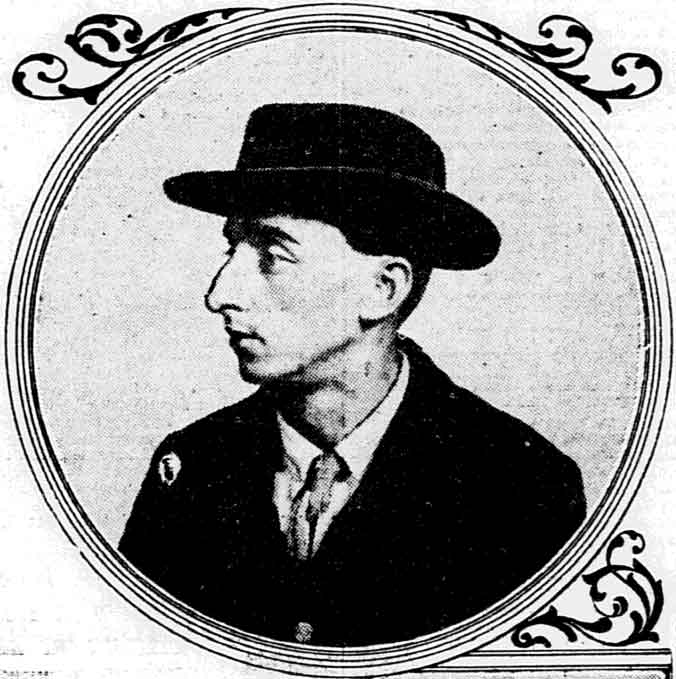
While Authorities Are at Work, Public Watch and Wait. Weaving a Net About Paul Woodward, the Young Suspect Now in Jail
Paul Woodward.
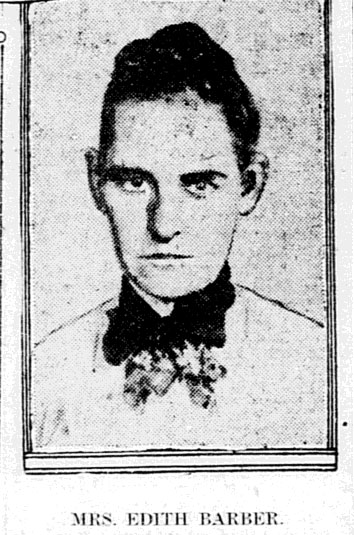
Mrs. Edith Barber.
It is now generally believed that the Camden county authorities have succeeded in establishing a clear case against young Paul Woodward, who is in the county jail, charged with the crime of taking away the lives of little John Coffin and Price Jennings. It was just a week ago yesterday when the boys went on their trip to Haddon Heights from which they were destined never to return alive.
Since the discovery of the bodies last Saturday partially hidden in rain-soaked weeds, the Prosecutor’s office, assisted by County Detectives Smith and Cherry and City Detectives Painter and Hart, have left no stone unturned.
No Confession
Prosecutor Lloyd yesterday reiterated his statement that Woodward had made no confession, but it is generally conceded as true that the accused youth did tell a story in which he makes some one else the principal criminal in the case.
Several incidents transpired yesterday that threw off the monotony of waiting for developments. Joseph Jennings, brother of one of the murdered boys, was taken to the cell in which Woodward is confined. He had no difficulty in recognizing the prisoner before. But as to whether he ever saw him in company with the dead lads he was not permitted to say.
Wild Rumor
There was much excitement about the Court House when it became rumored that Mrs. Edith Barber, the woman detained as a material witness against Woodward, had the small pox. To allay the alarm County Physician Jones called in representatives of the Board of Health, who concluded she had no sign of the disease.
After matters quieted somewhat the woman was taken into the Prosecutor’s office and questioned. When taken back to her cell she was crying and appeared to be almost unable to walk.
Woodward spent the day in his cell, smoking cigarettes as usual. He was visited in the morning by Lawyer Harry Scovel, who has not yet been engaged as counsel, as reported. Again in the afternoon Lawyer Scovel visited the youth in company with Woodward’s mother. At first Mrs. Woodward was denied admittance, but after waiting on the jail steps for nearly an hour she was permitted to go in and see her son. Lawyer Scovel and Mrs. Woodward were with the young man for a couple of hours.
Talked a Whole Lot
To all questions Lawyer Scovel said: “Woodward talked a whole lot, but I have nothing to say.”
He said he had not confessed to him. On the other hand Woodward had maintained his innocence.
When asked if Woodward could have a hearing if he demanded it Mr. Archer said he could. Asked if enough evidence was in hand to hold him, Mr. Archer said there was.
“On a simple assault charge?”
“No, sir, for the crime he is charged with—committing the murder of John Coffin,” replied Mr. Archer.
Coroner Litchfield said last night he would not set a date for the inquest before some time next week. Despite all reports to the contrary, Coroner Litchfield says Chemist George M. Beringer, who is analyzing the internal organs of the boys, will not complete the work before the end of the week.
Prosecutor Lloyd, who is still confined to his home with rheumatism, would make no statement last night, although admitting that the day’s work had not resulted in anything of material importance.
Unraveling the Camden Mystery
Philadelphia Inquirer —
Prosecutor Lloyd Declares That Woodward Is the Guilty Man
NO MORE ARRESTS LIKELY
Weaving Web Around Alleged Slayer of the Murdered Boys
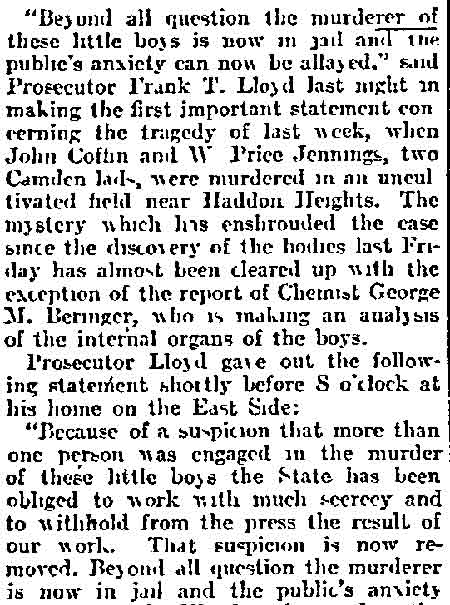
“Beyond all question the murderer of these little boys is now in jail and the public’s anxiety can now be allayed,” said Prosecutor Frank T. Lloyd last night in making the first important statement concerning the tragedy of last week, when John Coffin and W. Price Jennings, two Camden lads, were murdered in an uncultivated field near Haddon Heights. The mystery which has enshrouded the case since the discovery of the bodies last Friday has almost been cleared up with the exception of the report of Chemist George M. Beringer, who is making an analysis of the internal organs of the boys.
Prosecutor Lloyd gave out the following statement shortly before 8 o’clock at his home on the East Side:
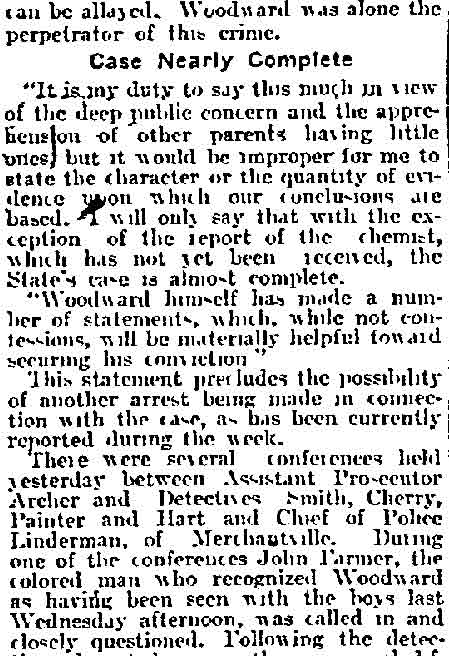
“Because of a suspicion that more than one person was engaged in the murder of these little boys the State has been obliged to work with much secrecy and to withhold from the press the result of our work. That suspicion is now removed. Beyond all question the murderer is now in jail and the public’s anxiety can be allayed. Woodward was alone the perpetrator of this crime.
Case Nearly Complete
“It is my duty to say this much in view of the deep public concern and the apprehension of other parents having little ones, but it would be improper for me to state the character or the quantity of evidence upon which our conclusions are based. I will only say that with the exception of the report of the chemist, which has not yet been received, the State’s case is almost complete.
“Woodward himself has made a number of statements, which, while not confessions, will be materially helpful toward securing his conviction.”
This statement precludes the possibility of another arrest being made in connection with the case, as has been currently reported during the week.
There were several conferences held yesterday between Assistant Prosecutor Archer and Detectives Smith, Cherry, Painter and Hart and Chief of Police Linderman, of Merchantville. During one of the conferences John Farmer, the colored man who recognized Woodward as having been seen with the boys last Wednesday afternoon, was called in and closely questioned. Following the detectives departed apparently on several different clues.
Detectives Hard at Work
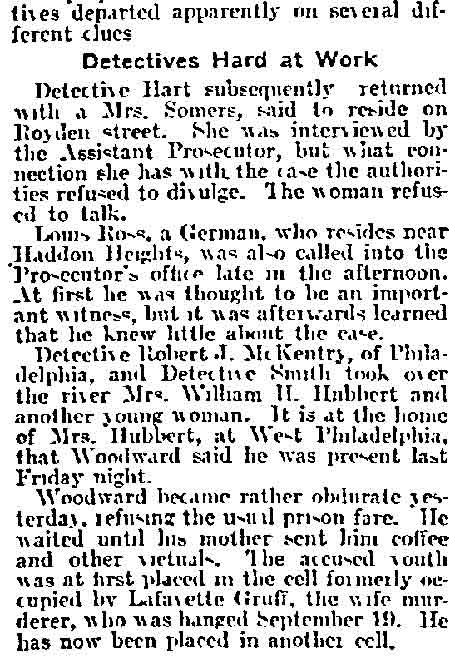
Detective Hart subsequently returned with a Mrs. Somers, said to reside on Royden street. She was interviewed by the Assistant Prosecutor, but what connection she has with the case the authorities refused to divulge. The woman refused to talk.
Louis Ross, a German, who resides near Haddon Heights, was also called into the Prosecutor’s office late in the afternoon. At first he was thought to be an important witness, but it was afterwards learned that he knew little about the case.
Detective Robert J. McKentry, of Philadelphia, and Detective Smith took over the river Mrs. William H. Hubbert and another young woman. It is at the home of Mrs. Hubbert, at West Philadelphia, that Woodward said he was present last Friday night.
Woodward became rather obdurate yesterday, refusing the usual prison fare. He waited until his mother sent him coffee and other victuals. The accused youth was at first placed in the cell formerly occupied by Lafayette Gruff, the wife murderer, who was hanged September 19. He has now been placed in another cell.
Woodward Has Knowledge of Camden Murder
Philadelphia Inquirer —
So Confessed to Officers, Who Searched New York at Prisoner’s Instance
NO HAND IN THE CRIME
But Said He Knew Name of the Man Who Committed Awful Deed
YOUTH’S STRENUOUS DAY
Taken to the Scene of the Tragedy and Closeted With the Prosecutor
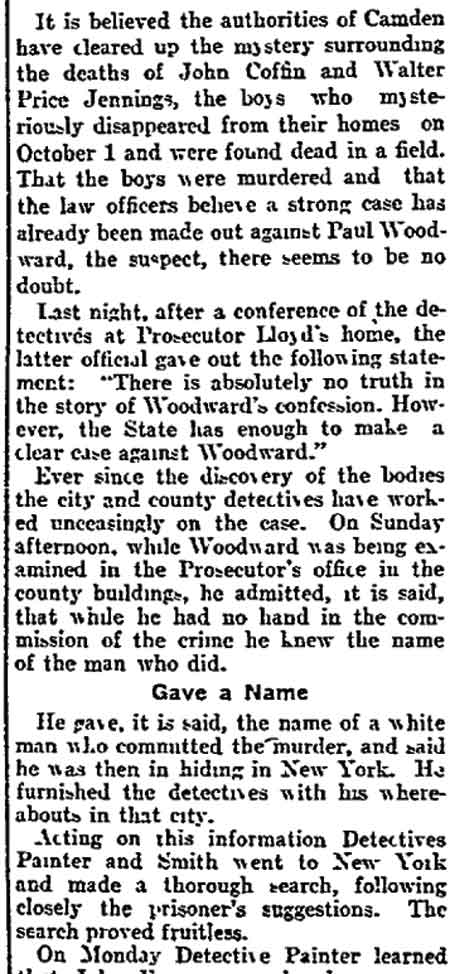
It is believed the authorities of Camden have cleared up the mystery surrounding the deaths of John Coffin and Walter Price Jennings, the boys who mysteriously disappeared from their homes on October 1 and were found dead in a field. That the boys were murdered and that the law officers believe a strong case has already been made out against Paul Woodward, the suspect, there seems to be no doubt.
Last night, after a conference of the detectives at Prosecutor Lloyd’s home, the latter official gave out the following statement: “There is absolutely no truth in the story of Woodward’s confession. However, the State has enough to make a clear case against Woodward.”
Ever since the discovery of the bodies the city and county detectives have worked unceasingly on the case. On Sunday afternoon, while Woodward was being examined in the Prosecutor’s office in the county buildings, he admitted, it is said, that while he had no hand in the commission of the crime he knew the name of the man who did.
Gave a Name
He gave, it is said, the name of a white man who committed the murder, and said he was then in hiding in New York. He furnished the detectives with his whereabouts in that city.
Acting on this information Detectives Painter and Smith went to New York and made a thorough search, following closely the prisoner’s suggestions. The search proved fruitless.
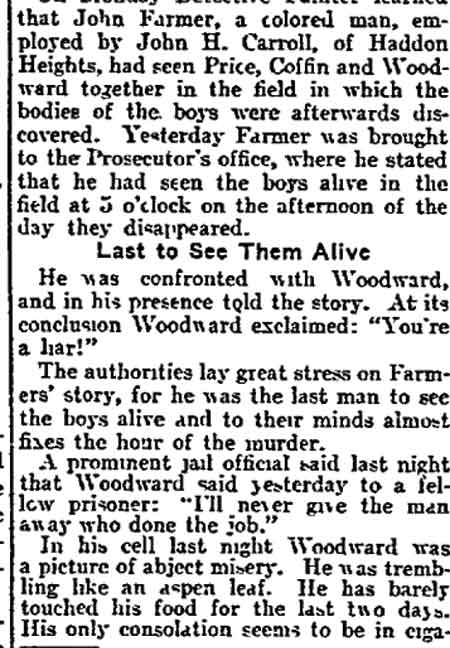
On Monday Detective Painter learned that John Farmer, a colored man, employed by John H. Carroll, of Haddon Heights, had seen Price, Coffin and Woodward together in the field in which the bodies of the boys were afterwards discovered. Yesterday Farmer was brought to the Prosecutor’s office, where he stated that he had seen the boys alive in the field at 5 o’clock on the afternoon of the day they disappeared.
Last to See Them Alive
He was confronted with Woodward, and in his presence told the story. At its conclusion Woodward exclaimed, “You’re a liar!”
The authorities lay great stress on Farmers’ story, for he was the last man to see the boys alive and to their minds almost fixes the hour of the murder.
A prominent jail official said last night that Woodward said yesterday to a fellow prisoner: “I’ll never give the man away who done the job.”
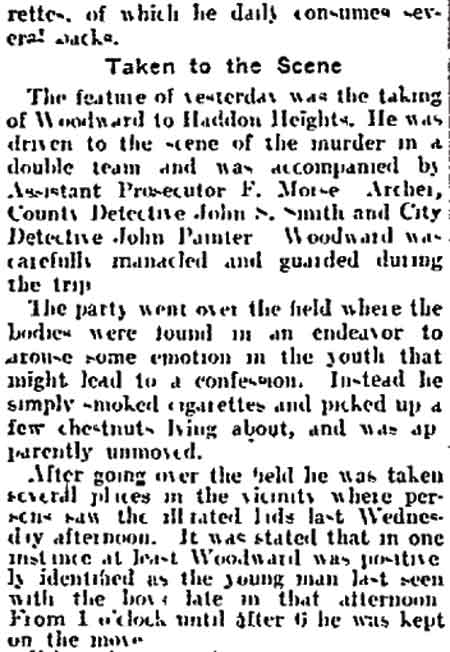
In his cell last night Woodward was a picture of abject misery. He was trembling like an aspen leaf. He has barely touched his food for the last two days. His only consolation seems to be in cigarettes, of which he daily consumes several packs.
Taken to the Scene
The feature of yesterday was the taking of Woodward to Haddon Heights. He was driven to the scene of the murder in a double team and was accompanied by Assistant Prosecutor F. Morse Archer, County Detective John S. Smith and City Detective John Painter. Woodward was carefully manacled and guarded during the trip.
The party went over the field where the bodies were found in an endeavor to arouse some emotion in the youth that might lead to a confession. Instead he simply smoked cigarettes and picked up a few chestnuts lying about, and was apparently unmoved.
After going over the field he was taken to several places in the vicinity where persons saw the ill-fated lads last Wednesday afternoon. It was stated that in one instance at least Woodward was positively identified as the young man last seen with the boys late in that afternoon. From 1 o’clock until after 6 he was kept on the move.
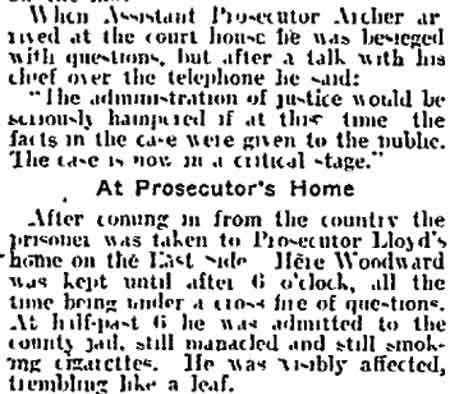
When Assistant Prosecutor Archer arrived at the court house he was besieged with questions, but after a talk with his chief over the telephone he said: “The administration of justice would be seriously hampered if at this time the facts in the case were given to the public. The case is now in a critical stage.”
At Prosecutor’s Home
After coming in from the country the prisoner was taken to Prosecutor Lloyd’s home on the East side. Here Woodward was kept until after 6 o’clock, all the time being under a cross fire of questions. At half-past 6 he was admitted to the county jail, still manacled and still smoking cigarettes. He was visibly affected, trembling like a leaf.
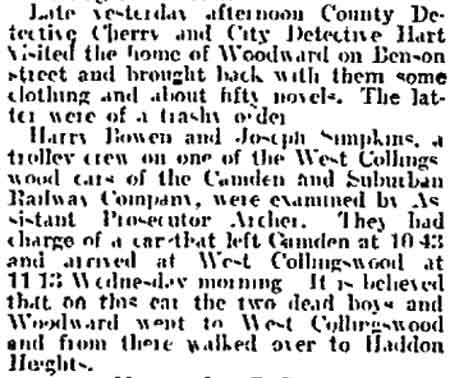
Late yesterday afternoon County Detective Cherry and City Detective Hart visited the home of Woodward on Benson street and brought back with them some clothing and about fifty novels. The latter were of a trashy order.
Harry Bowen and Joseph Simpkins, a trolley crew on one of the West Collingswood cars of the Camden and Suburban Railway Company, were examined by Assistant Prosecutor Archer. They had charge of a car that left Camden at 10 43 and arrived at West Collingswood at 11 13 Wednesday morning. It is believed that on this car the two dead boys and Woodward went to West Collingswood and from there walked over to Haddon Heights.
Money for Defense
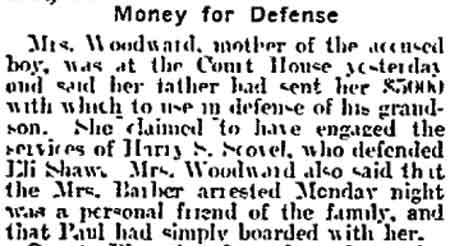
Mrs. Woodward, mother of the accused boy, was at the Court House yesterday and said her father had sent her $5000 with which to use in defense of his grandson. She claimed to have engaged the services of Harry S. Scovel, who defended Eli Shaw. Mrs. Woodward also said that the Mrs. Barber arrested Monday night was a personal friend of the family, and that Paul had simply boarded with her.
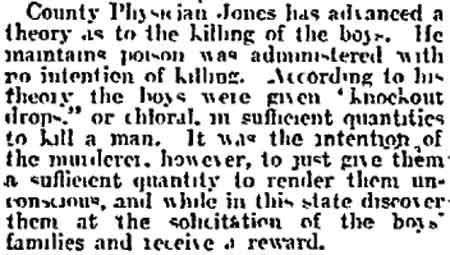
County Physician Jones has advanced a theory as to the killing of the boys. He maintains poison was administered with no intention of killing. According to his theory, the boys were given “knockout drops,” or chloral, in sufficient quantities to kill a man. It was the intention of the murderer, however, to just give them a sufficient quantity to render them unconscious, and while in this state discover them at the solicitation of the boys’ families and receive a reward.
Missing Camden Boys Murdered in a Field
Philadelphia Inquirer —
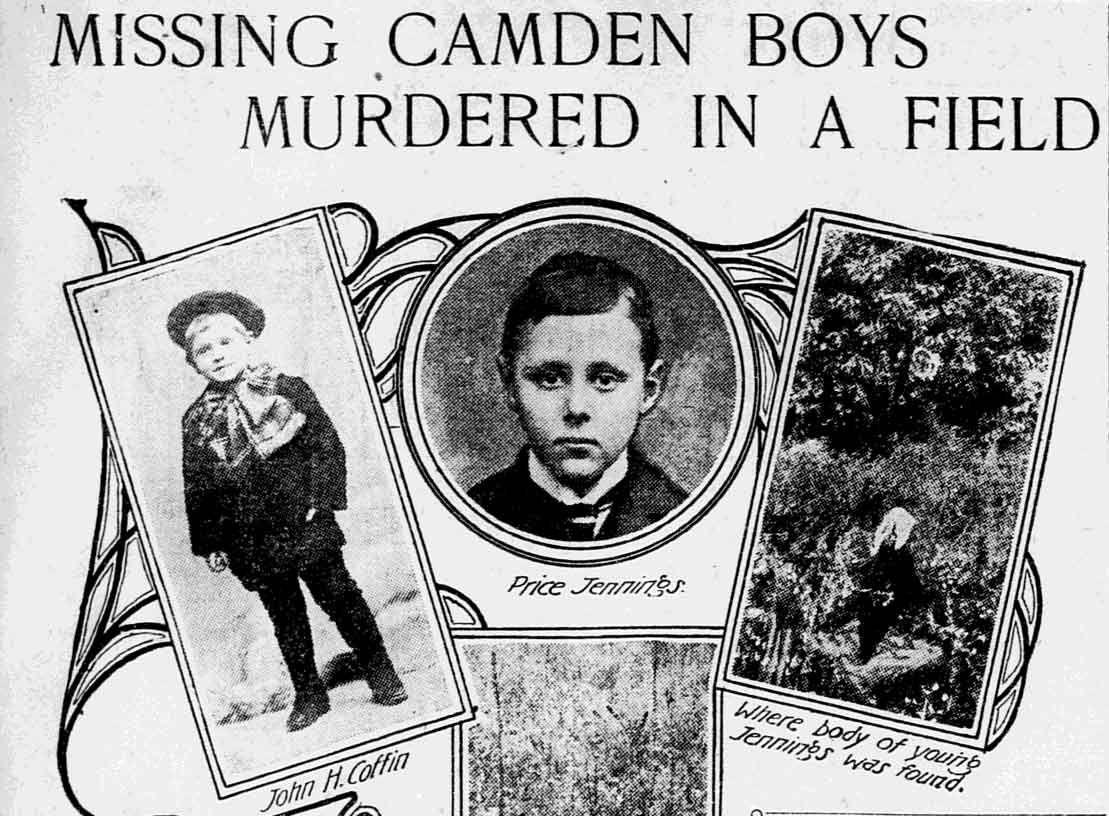
Young John Coffin and Price Jennings Believed to Have Been Poisoned—Companion Arrested and Committed to Jail
John H. Coffin
Price Jennings.
Where body of young Jennings was found.
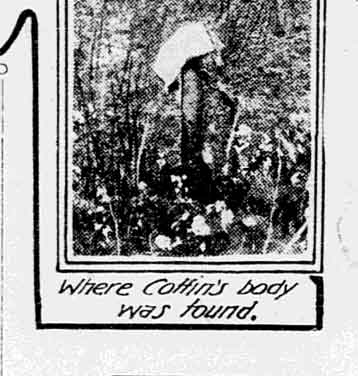
Where Coffin’s body was found.
The discovery of their bodies cold in death, the victims of an atrocious double murder, yesterday solved the mystery surrounding the disappearance from their homes in Camden on Wednesday of John H. Coffin, the 11-year-old son of William Coffin, division freight agent of the Pennsylvania Railroad, and Price Jennings, his chum and playmate, the 13-year old son of Josephus Jennings, leader of Jennings’ Third Regiment Band, of Camden.
Paul Woodward, 18 years old, a companion of both the boys, is charged with their murder and is locked up in the county jail awaiting the further action of the authorities. There are no evidences of external injuries and the only theory to which the police can attribute the cause of death is that the assassin of the boys administered poison to them, and it is along this line that County Physician Jones and Prosecutor Lloyd are conducting an investigation.
The details surrounding the atrocious crime makes it one the like of which has never been known in the criminal history of this section of the country. The youth of the boys, their heretofore relations of good companionship, and many other circumstances make of it an almost unparalleled crime, and while there is said to be every evidence of a motive for the murder, in the opinion of those who are in close touch with the case, it is an instance in which the work is that of a degenerate boy in whom all sense of right and wrong have long since been dead. Certain it is that the crime has stirred the people of Camden and vicinity to a feverish heat to which it has not been stirred since the days following the murder of Annie Leconey.
Found in a Field
The bodies of both the lads were found yesterday morning in a field near the Haddon Heights Station of the Reading Railroad on what is known as the Lippincott farm, about a quarter mile from Station Avenue. The body of young Jennings was found lying in a clump of bushes and less than forty yards away lay the remains of Coffin. Both bodies were stiff and in a state of decomposition. Coffin’s body was the first discovered, and it was not long after when that of his companion was found.
No sooner did the news of the discovery become known than the greatest excitement prevailed through the city of Camden and its suburbs. All sorts of rumors began to circulate, some of them hinting that the bodies were in a horribly mutilated condition and that the work was that of a negro. In a short time, however, whatever element of mystery there was about the case, so far as present indications go, was dissipated when the identification of the bodies was made and the arrest of young Woodward was accomplished soon afterwards.
Then the mystery began to clear somewhat. Both boys disappeared from their homes on Wednesday afternoon. When they failed to return that night the police were notified and a description of them was sent around the country adjacent to Camden and also to Philadelphia. Some persons said they had gone to Trenton to the fair, while others told of having seen them in the vicinity of Haddon Heights Station. Nothing came of these statements at the time, and meanwhile the boys failed to return home. Coffin’s father was of the opinion that the boys had been kidnapped, but this theory was not held by the police.
First Body Discovered
Late Friday night, Clarence Kreuson, whose home is at Haddon Heights, and a friend of his, Frank Johnson, who lives in this city, were returning from an afternoon of blackbird shooting. While crossing the field they came across the body of a boy. It was lying in the bushes, half concealed, and when they made a closer examination they discovered that life was extinct. In alarm Kreuson and his companion ran to the home of A. H. Wood, near-by, and communicated their intelligence. Wood immediately sent a telephone message to Coroner Litchfield in Camden, apprising him of the discovery. That official, through some misunderstanding, thought it was a man named Brown who had been talking to him. He hitched up his horse and drove to Haddon Heights, but was unable to locate the body. He was also unable to locate anyone named Brown. Further investigation was, therefore, postponed until yesterday morning, when the Coroner again visited the scene and found the body in the bushes.
From the clothing worn it was thought at first it might be Coffin’s, and after it had been brought to the Morgue, William Coffin, the lad’s father, was sent for. He was accompanied by Kingston Jennings, elder brother of the other missing boy. Mr. Coffin when nerved to look at the remains, exclaimed, “My God, it’s Price. Where is my boy. He must be found.” The identification was then made complete by the dead boy’s brother.
Meanwhile a number of persons had been going over the field where the body had been found in the search for clues that might lead to a discovery of the murderer of the boy, when one of them chanced across the remains of the other lad lying under a dead tree. This body was identified on the spot by Detective Curtis, of the Pennsylvania Railroad. The lad’s body was also taken to the Morgue and laid on a slab alongside of his chum.
Police at Work
The police in the interim had not been idle, and after scouring the vicinity of the place where the bodies had been found, came across Lillian Martin, the 15-year-old daughter of J. Wilson Martin, who conducts a “Cyclers’ Rest” at Collings avenue and the White Horse pike. She remembered having seen two boys answering the description of the dead lads in their place on Wednesday. They were accompanied by an older and a taller boy. Jennings seemed to have considerable money and purchased three pies and three bottles of soda water. After that they left the place and she never saw them again until she looked upon their bodies.
Prosecutor Frank Lloyd at once set to work, and Detective Hart was sent in search of young Woodward. Inquiry at his home, at 221 Benson street, brought the response that he was not at home. His mother learned what he was wanted for, and about 2 o’clock sent for Detective Hart and turned the boy over to him. She accompanied him to the Prosecutor’s office and, talking to the newspaper reporters, said that beyond being addicted to the use of cigarettes Paul was a good boy. She persisted that he could not have committed the crime as he was home all of Wednesday, Thursday and yesterday until the afternoon, when he went to Philadelphia to visit relatives. What the police are reported to view with importance is a statement that the mother is also alleged to have made to the effect that on Wednesday he had bothered her a great deal about money for a hat and shoes. While the authorities will make no admission, it is intimated that the motive they ascribe for the crime is robbery, and that the fact that Jennings had $10 when he disappeared was what led to his murder, and the murder of the other little fellow followed as a necessity for hiding the crime, as well as to get possession of a silver watch he is said to have had.
Identified Woodward
After young Woodward was taken into the Prosecutor’s office, besides the Prosecutor there were present Assistant Prosecutor F. Morse Archer, Court Stenographer Berry, Chief of Police Foster, of Camden; Chief of Police Linderman, of Merchantville, and Detectives Painter and Hart. In a few minutes Detective Cherry arrived with Lillian Martin. The latter had been cautioned not to say anything to anybody, either in or out of the room. She was inside for less than thirty seconds, and when she came out she is reported to have said that Woodward was the young man whom she had seen with the boys on Wednesday in her father’s place. She was taken back a second and a third time, and after the latter, it is said, she told the detectives that she was certain he was the person. She then left for her home, where she resisted all attempts to interview her.
In the meantime Recorder Stackhouse issued a commitment for Woodward on the oath of Detective Cherry, charging the young man with the murder of Coffin. Jennings’ name was not mentioned, as Coffin’s answered the same purpose.
While this was going on County Physician Jones was holding an autopsy in the basement of the jail, where the morgue is located. A personal examination showed that there were no external marks of violence, and in order to clinch the result of the autopsy he summoned from Philadelphia Professors Copeland and Rosenberger, of the Jefferson Hospital. Dr. Copeland performed the autopsy, and was at work until nearly 6 o’clock, when it was announced that no results other than that death was not due to external injuries, had been accomplished.
Prosecutor Lloyd said: “There was a double murder. Of that much we are certain. Death was not due to external injuries. What we suspect you will have to conjecture. The organs of both the boys have been sent to a chemist for examination. More than that I cannot say, except that we have arrested Paul Woodward on suspicion and that he is charged with the murder. The same man that killed one of the boys no doubt killed the other. All I ask now is that judgment be suspended for a few days, when I believe all will be cleared up.”
Woodward Visited Mr. Coffin
Mr. Coffin, whose home is at 305 North Third street, yesterday said: “It’s an awful blow that has come to me and I hardly know what to say. It does seem to me that Paul Woodward exerted an evil influence over my boy. I remember now that on Thursday he came to the house and wanted me to hire him to look for John. He then said that he thought he could find him.”
At the Woodward home it was stated that the mother and father of the boy had gone to Philadelphia. Charles May, a boarder, said there would be no trouble in proving that Paul was home all day of Wednesday, as well as the day following. He said that on each of those nights the boy had been in bed by 8 o’clock. This testimony, he said, would be corroborated by the boy’s mother, father, sister and himself. The only time Paul was out of the house, he said, was when he went several errands for his mother.
Late yesterday afternoon Coroner Litchfield empaneled the following jury: David Kaighn, George Leathwite, Isaac Toone, George J. Pechin, Elmer E. Cox and T. L. Bear. At 5 o’clock they viewed the remains, after which the bodies were sent to their respective homes. No date for the inquest has been fixed.
The stomach and other organs of both the youthful victims are in the possession of George M. Beringer, a druggist and chemist, at Fifth and Federal streets. Last night he said he had begun his examination, but it would take him probably a day or two more to complete his analysis.
Officers Traced Woodward’s Steps
Philadelphia Inquirer —
Camden Authorities Rest After Weaving What They Believe to Be Strong Chain of Evidence About the Alleged Youthful Murderer
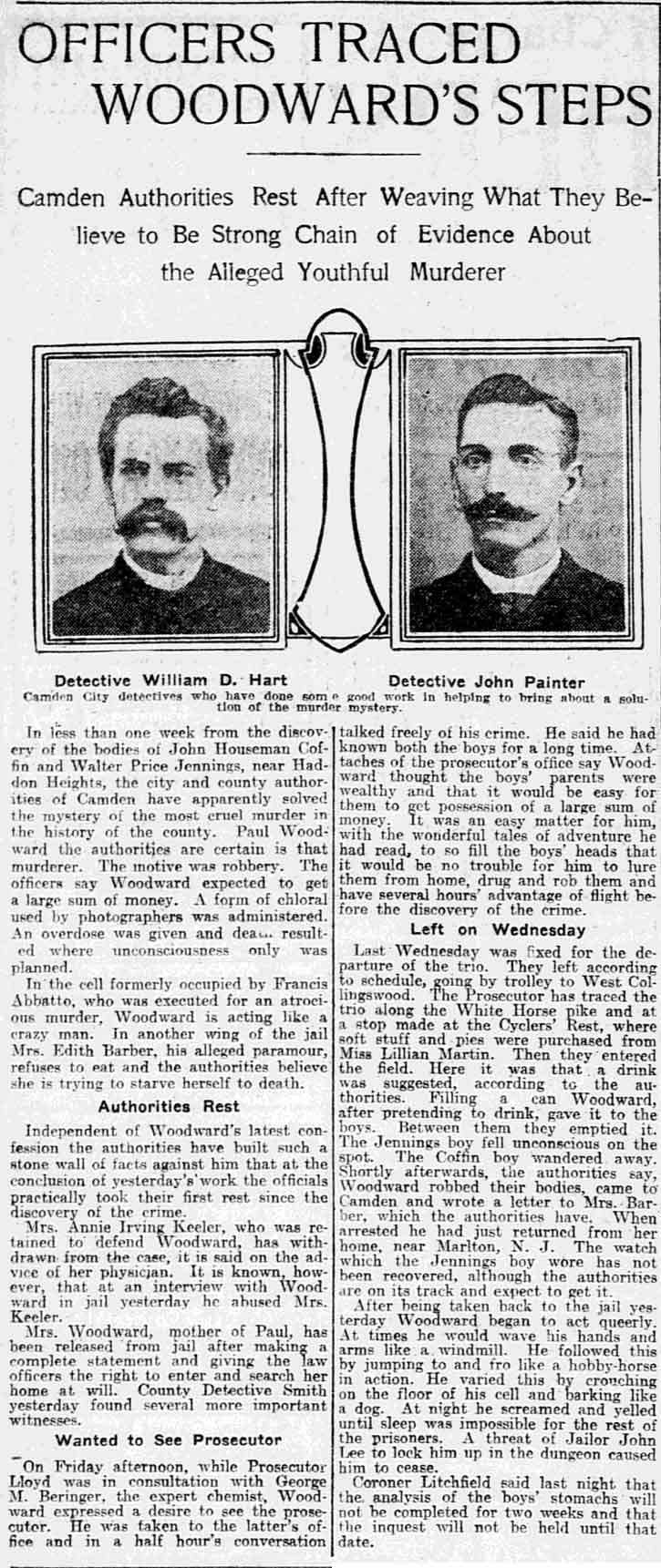
Detective William D. Hart
Detective John Painter
Camden City detectives who have done some good work in helping to bring about a solution of the murder mystery.
In less than one week from the discovery of the bodies of John Houseman Coffin and Walter Price Jennings, near Haddon Heights, the city and county authorities of Camden have apparently solved the mystery of the most cruel murder in the history of the county. Paul Woodward the authorities are certain is that murderer. The motive was robbery. The officers say Woodward expected to get a large sum of money. A form of chloral used by photographers was administered. An overdose was given and death resulted where unconsciousness only was planned.
In the cell formerly occupied by Francis Abbatto, who was executed for an atrocious murder, Woodward is acting like a crazy man. In another wing of the jail Mrs. Edith Barber, his alleged paramour, refuses to eat and the authorities believe she is trying to starve herself to death.
Authorities Rest
Independent of Woodward’s latest confession the authorities have built such a stone wall of facts against him that at the conclusion of yesterday’s work the officials practically took their first rest since the discovery of the crime.
Mrs. Annie Irving Keeler, who was retained to defend Woodward, has withdrawn from the case, it is said on the advice of her physician. It is known, however, that at an interview with Woodward in jail yesterday he abused Mrs. Keeler.
Mrs. Woodward, mother of Paul, has been released from jail after making a complete statement and giving the law officers the right to enter and search her home at will. County Detective Smith yesterday found several more important witnesses.
Wanted to See Prosecutor
On Friday afternoon, while Prosecutor Lloyd was in consultation with George M. Beringer, the expert chemist, Woodward expressed a desire to see the prosecutor. He was taken to the latter’s office and in a half hour’s conversation talked freely of his crime. He said he had known both the boys for a long time. Attaches of the prosecutor’s office say Woodward thought the boys’ parents were wealthy and that it would be easy for them to get possession of a large sum of money. It was an easy matter for him, with the wonderful tales of adventure he had read, to so fill the boys’ heads that it would be no trouble for him to lure them from home, drug and rob them and have several hours’ advantage of flight before the discovery of the crime.
Left on Wednesday
Last Wednesday was fixed for the departure of the trio. They left according to schedule, going by trolley to West Collingswood. The Prosecutor has traced the trio along the White Horse pike and at a stop made at the Cyclers’ Rest, where soft stuff and pies were purchased from Miss Lillian Martin. Then they entered the field. Here it was that a drink was suggested, according to the authorities. Filling a can Woodward, after pretending to drink, gave it to the boys. Between them they emptied it. The Jennings boy fell unconscious on the spot. The Coffin boy wandered away. Shortly afterwards, the authorities say, Woodward robbed their bodies, came to Camden and wrote a letter to Mrs. Barber, which the authorities have. When arrested he had just returned from her home, near Marlton, N. J. The watch which the Jennings boy wore has not been recovered, although the authorities are on its track and expect to get it.
After being taken back to the jail yesterday Woodward began to act queerly. At times he would wave his hands and arms like a windmill. He followed this by jumping to and fro like a hobby-horse in action. He varied this by crouching on the floor of his cell and barking like a dog. At night he screamed and yelled until sleep was impossible for the rest of the prisoners. A threat of Jailor John Lee to lock him up in the dungeon caused him to cease.
Coroner Litchfield said last night that the analysis of the boys’ stomachs will not be completed for two weeks and that the inquest will not be held until that date.
Another Case in Third Ward Riot
Camden Daily Courier —

Policeman Keaser and Ex-Policeman “Bob” Miller on Trial for Assault.
WAGNER JURY COULD NOT AGREE
In the Criminal Court this morning George V. Tucker, who was convicted of a charge of assault and battery, was sentenced by Judge Joline to pay a fine of $50 and costs and stand committed until the money is paid.
Henry J. Shuster pleaded guilty to a charge of embezzling $260.16 from King David Lodge, I. O. O. F., of which he was treasurer. Shuster served three months in the County Jail last spring on a similar charge. At that time he said he used the money to care for his wife, who was ill. It appears that he did use part of the money for this purpose, but that he squandered a large sum in poker playing.
Rev. Q. C. Davis, pastor of the Emmanuel Baptist church, testified that since Shuster has been out of jail he has led a correct life, and at the present time has a good position.
Prosecutor Lloyd made an appeal for clemency.
Judge Joline announced that he was not ready to decide the case and it went over.
POLICEMEN ON TRIAL.
The indictment against Policeman Albert Keaser and ex-Policeman Robert Miller, on charges of assault and battery on George Murray, was then moved. This is the second case to be tried as the outcome of the election riot, in the Third ward during the primary election last July. Considerable time was occopued [sic] in securing a jury.
After the jury was sworn Assistant Prosecutor Archer outlined the case, in which he said the two defendants at that time were policemen and the alleged assault took place at the polling place at Third and Beckett streets, and during the row, Robert Miller, struck George Murray several times with a blackjack. Keaser, it is alleged, assisted Miller in the assault.
The first witness called was George Murray, the complainant, who testified that while standing near the polling booth with some tickets “Bob” Miller, without any provocation, beat him with a blackjack. He said that Policeman Keaser and John Wagner came to Miller’s assistance. During the row, Policemen Hartman and Harry Miller came to his aid.
BEATEN WITH A BLACKJACK.
On cross-examination witness said he had no pistol or blackjack, but that Miller came up to him and deliberately struck witness with a blackjack. He denied that he said on the steps of the Third Ward Republican Club, in the presence of John Rodan, that if a certain —— would come along he would kill him.
William Laws, who testified in yesterday’s trial, gave corroborative testimony as to the blackjacking. He said that Murray did nothing to provoke the assault.
Spencer Moore, also gave corroborative testimony.
Policeman Harry Miller testified to seeing “Bob” Miller beating Murray with a blackjack while out in the middle of Beckett street. The witness said he surged in the crowd and struck at Keaser at the same time exclaiming:
“What are you trying to do, kill this man?”
The witness said he was thrown down, and was pulled up on his feet by Keaser, who grappled with him. He heard thre [sic] or four pistol shots.
The witness identified a blackjack, in the possession of Lawyer Rex, which he used on the night of the primaries.
Howard Roberts, a son of Assemblyman Roberts, also gave corroborative testimony.
DEFENSE OPENS.
At the afternoon session of the court the defense opened. Counsel said that the defendants were justified in using force to put Murray into subjection.
Policeman Toy testified that he saw the occurrence and thought that “Bob” Miller, was acting as a peacemaker. He saw Murray shoot off a revolver.
Daniel Ayres testified to seeing the riot and heard Murray say that he would get some one before the night was over. He saw Murray shoot off a revolver under a tree.
Ex-Policeman “Bob” Miller admitted that he struck Murray while attempting to arrest him. He also testified that he was knocked down and beaten and that some person had attempted to stab him. He exhibited his clothing which was soiled and cut.
Policeman Shaw testified that on July 28 he went to Third and Beckett streets and found George Murray in his home, where he was under arrest by Detective Hart. Witness recovered a revolver from the wife of Murray.
Mrs. Widener, who was a witness in the trial yesterday, gave the same line of evidence in this case.
CHEESEMAN SENTENCED.
At the noon recess Judge Joline imposed sentence on Thomas J. Cheeseman, the former secretary of Thomas Jefferson Council, No. 138, Jr. O. U. A. M., who was convicted of a charge of false pretenses on Thursday last. Before sentence was imposed Rev. J. R. Mason, pastor of the Kaighn Avenue M. E. church, and Rev. Robert Wesley Peach, pastor of the Second Presbyterian church, made appeals to the court for clemency in his case. Judge Joline sentenced Cheeseman to three months in the County Jail and a fine of $150 and costs.
After being out for seven hours without being able to agree on a verdict the jury in the case of Charles Wagner, tried yesterday on a charge of stabbing Policeman Harry Miller, at the time of the same election riot, were discharged at 10 o’clock last night.
Wealthy Camden Man’s Funeral
Philadelphia Inquirer —
The funeral of John Coates, one of Camden’s richest men, occurred yesterday from the residence of his son-in-law, Dr. O. B. Gross, 700 Market street. The services were conducted by Revs. R. A. Roderick and C. K. Binder. Interment was in Harleigh Cemetery.
Some time ago when Mr. Coates lived at 124 West street he went to the residence of City Detective Hart early in the morning and declared he had been robbed. The detective searched the house and in a trunk without a lid found $10,000 in bank notes, and interest-bearing securities amounting to over $100,000. After this incident Mr. Coates placed his wealth in the keeping of a trust company. He was the owner of a large number of houses.
Strenuous Camden Youth Is Jailed
Philadelphia Inquirer —
George Willingmire, who shot into a crowd of women and children Monday and performed other stunts that aroused the southern section of Camden, was arrested at Centerton, Burlington county, yesterday by Constable Gilbert. Detective Hart and Policeman William Harvey were at once sent to bring the youth to Camden.
When he appeared before Recorder Stackhouse he faced two charges of shooting Mrs. Helene Lotowski, aged 28 years, of 1219 South Tenth street, and Mrs. Caroline Zersch, aged 38 years, of 1270 Mechanic street, two of the six persons who received the contents of Willingmire’s gun when he fired into the crowd.
Willingmire claimed he shot a dog. He was committed to the county jail in default of $1500 bail.
No Clue to Bandits, But Suspects Spotted
Philadelphia Inquirer —
The Camden police have not the slightest clue as to the identity of the five men who early Saturday morning created a furor on the outskirts of the city by holding up a bridge tender, blowing up a safe and doing other acts that marked them as being desperadoes. The entire police force was at work yesterday, but the description given by Till and the officers who had the encounter with the emulators of the wild and woolly West was so meagre that there was practically nothing to work on.
Chief of Police John Foster said last night to an Inquirer reporter: “We have not learned anything that might lead to the arrest of the desperadoes. In the event of suspects being arrested it would be a difficult matter to connect them with the case, because no one seems to be in position to give a description. I am of the opinion that they are professionals from the manner in which they did their work.
Acquainted With Locality
“Another thing seems evident, and that is the robbers were acquainted with the locality in which they operated. They either were personally acquainted with East Camden or made it a point to get acquainted.
“This William Thallman, who is wanted in Burlington county, where the police believe him to be the head of a gang of thieves, may possibly know something about the Pavonia affair. From what I have learned he appears to be a desperate character, just one who would have the nerve to lead a gang of men to do the work of Saturday morning. Of course this is mere supposition, and it is impossible to say he is one of the men we are looking for. Another thing that might possibly connect him with the case would be his knowledge of East Camden, which is an important factor.”
Early yesterday morning a dispatch was received from Elizabeth in which it was stated that three suspicious characters had been arrested. According to the dispatch the trio were found in a box car that came from Camden. City Detectives John Painter and William Hart were at once sent to Elizabeth to take a look at the suspects. When they arrived they found the prisoners were boys and a brief line of questioning soon disposed of the theory that they had anything to do with the Camden affair. The detectives, who returned last night, said the boys were Philadelphians and had jumped a freight for a ride.
Special Officer Hare, of the Pennsylvania Railroad, noticed a group of men loitering about the Pavonia Station. Their actions were suspicious, and he took one into custody. The police were of the opinion that the prisoner might know something about the bandits, but he convinced them that he was in total ignorance of the thieves. He gave the name of D. Donovan, no home. He is still held by the police, but with no expectation of throwing any light on the identity of the men wanted so badly.
Perhaps no one had a better opportunity of giving a description of the men than Oscar Till, the bridgetender at the State street bridge, who, at the points of pistols held by two men, tied a mask over the face of a third. But even he cannot recall his midnight visitors sufficiently to furnish the police with anything to work on.
“I was too badly scared to know what they looked like,” he said. “When a couple of men are pressing cold steel to your temples, with a command to do a certain thing or die, you generally do the thing asked. I had no time to think about descriptions or anything else. The business I had to attend to was to tie the mask on the bandit, and I attended strictly to that business.”
Ralph Haines, the night operator at the tower, who was shot at repeatedly as he poked his head out of the window inquiring as to the cause of the explosion at the Pavonia station, was commended yesterday for his cool-headedness. After dodging bullets repeatedly, one of which came within an inch of his head, he dropped to the floor, crawled over to the “ticker” and asked the main office for help. Haines could see the men in silhouette but was too distant to recognize any characteristics that might lead to identifying them.
Last night numerous reports were received at Camden police headquarters of suspicious characters being seen in various parts of the city. A trolley car conductor reported at 10 o’clock that several men with dark lanterns were observed loitering about Haddon and Kaighn avenues. Sergeant Hyde, with a squad of officers, was sent to the locality, but the men had disappeared. Another report came from Fairview street near the ship yard at the lower end of the Eighth ward that suspicious-looking persons were hanging about the neighborhood, but no one could be found there when the officers arrived.
William D. Hart
Philadelphia Inquirer —
The bodies of two infants were found at Avon and Beckett streets, Camden, yesterday. The first, that of a girl, was uncovered from a pile of papers by William Bostick, a rag dealer, while an ash man found the other, a boy, in an ash barrel. The bodies were taken to the morgue and Police Captain Boyle and Detective Hart were detained to make an investigation.
May Have Jack-in-the-Box
Philadelphia Inquirer —
Supposed Visitor to Reader Home, in Camden, Arrested
Emil Steinhauer, aged 25 years, of 452 Henry street, Camden, was arrested by Detective Hart last night on a charge of being the man who startled the household of Dr. A. B. Reader, 1135 Kaighn’s avenue, Sunday, by suddenly appearing in different parts of the home.
All the explanation Steinhauer would make was that he was looking for a minister to go to a blind relative.
Mabel Andrews — William D. Hart
Philadelphia Inquirer —
Dressed in the height of style, Mabel Andrews, aged 16 years, daughter of Mr. and Mrs. Deniel Andrews, of Beach Haven, N. J., was arrested as she stepped from a train at the Pennsylvania Railroad terminal in Camden last night by Detective Hart. Mabel was on her way to see the sights of the city. She is being held as a runaway.
Say Bandit Hunt Points to Marine
Philadelphia Inquirer —
Camden Police Grow More Positive, Connecting Thallman With Hold-Up
Hat Found at Scene May Prove a Clue—State Sleuths Very Busy on the Case
The Camden police are growing more positive in their belief that William Thallman, who escaped from League Island Navy Yard and whose house at Riverside was found to be stocked with plunder, could throw some light on the recent hold-up at Pavonia.
According to the police, Thallman lived in Camden for several years under an assumed name. His home is said to have been luxuriously furnished and he seemed to be well supplied with money about the time several robberies were committed in North Philadelphia. He was caught looting a bulk window of a store and was convicted and sentenced to the Eastern Penitentiary inside of forty-eight hours.
City Detectives Hart and Painter were at work all day yesterday on clues that might lead to the detection of Thallman’s whereabouts, but little or nothing had resulted up to a late hour last night.
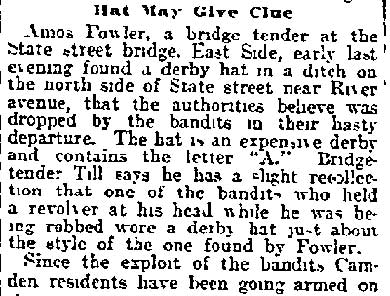
Hat May Give Clue
Amos Fowler, a bridge tender at the State street bridge, East Side, early last evening found a derby hat in a ditch on the north side of State street near River avenue, that the authorities believe was dropped by the bandits in their hasty departure. The hat is an expensive derby and contains the letter “A.” Bridgetender Till says he has a slight recollection that one of the bandits who held a revolver at his head while he was being robbed wore a derby hat just about the style of the one found by Fowler.
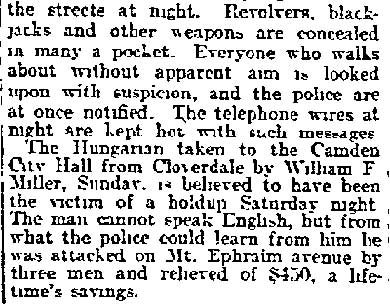
Since the exploit of the bandits Camden residents have been going armed on the streets at night. Revolvers, blackjacks and other weapons are concealed in many a pocket. Everyone who walks about without apparent aim is looked upon with suspicion, and the police are at once notified. The telephone wires at night are kept hot with such messages.
The Hungarian taken to the Camden City Hall from Cloverdale by William F. Miller, Sunday, is believed to have been the victim of a holdup Saturday night. The man cannot speak English, but from what the police could learn from him he was attacked on Mt. Ephraim avenue by three men and relieved of $450, a lifetime’s savings.
Philadelphia Inquirer
Philadelphia Inquirer —
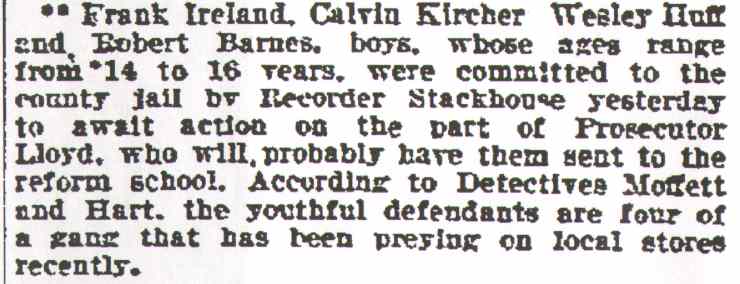
Frank Ireland, Calvin Kircher Wesley Huff and Robert Barnes, boys, whose ages range from 14 to 16 years, were committed to the county jail by Recorder Stackhouse yesterday to await action on the part of Prosecutor Lloyd, who will probably have them sent to the reform school. According to Detectives Moffett and Hart, the youthful defendants are four of a gang that has been preying on local stores recently.
William Pfrommer — William D. Hart
Philadelphia Inquirer —
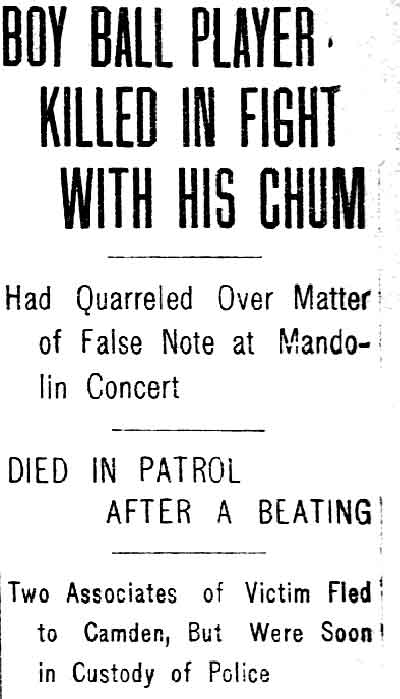
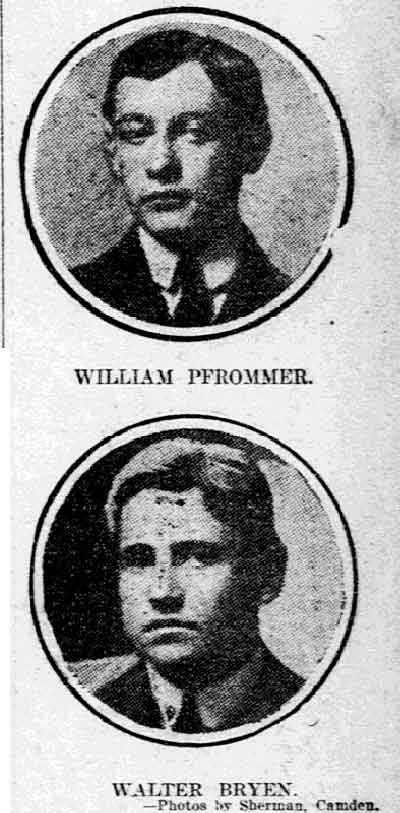
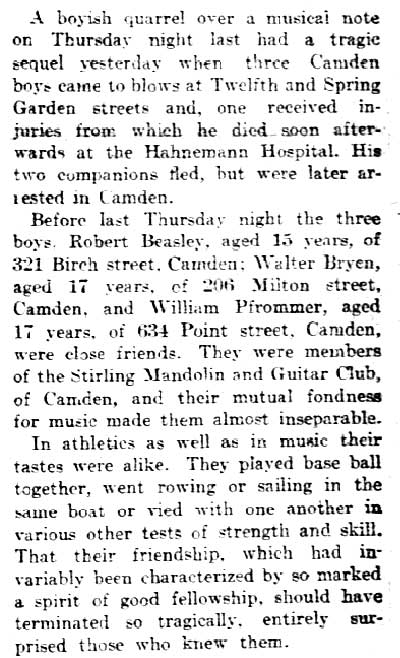
Boy Ball Player Killed in Fight With His Chum
Had Quarreled Over Matter of False Note at Mandolin Concert
DIED IN PATROL AFTER A BEATING
Two Associates of Victim Fled to Camden, But Were Soon in Custody of Police
WILLIAM PFROMMER. WALTER BRYEN. —Photos by Sherman, Camden.
A boyish quarrel over a musical note on Thursday night last had a tragic sequel yesterday when three Camden boys came to blows at Twelfth and Spring Garden streets and, one received injuries from which he died soon afterwards at the Hahnemann Hospital. His two companions fled, but were later arrested in Camden.
Before last Thursday night the three boys, Robert Beasley, aged 15 years, of 321 Birch street, Camden; Walter Bryen, aged 17 years, of 206 Milton street, Camden, and William Pfrommer, aged 17 years, of 634 Point street, Camden, were close friends. They were members of the Stirling Mandolin and Guitar Club, of Camden, and their mutual fondness for music made them almost inseparable.
In athletics as well as in music their tastes were alike. They played base ball together, went rowing or sailing in the same boat or vied with one another in various other tests of strength and skill. That their friendship, which had invariably been characterized by so marked a spirit of good fellowship, should have terminated so tragically, entirely surprised those who knew them.
Quarreled Over Note
The three boys were employed at the establishment of the Haines, Jones and Cadbury Company, dealers in plumbers’ materials, at 1136 Ridge avenue. Young Beasley, the one to lose his life, owed his position to Pfrommer, and yet it was with Pfrommer that he quarreled over what seemed to those who were present a most trivial matter. The Stirling Mandolin and Guitar Club took part in a musical entertainment in Camden on last Thursday night. Several times they received encores for the lively airs they played, and when they finally retired from the stage the thought of an impending quarrel was remote from their minds. As they prepared to leave a dispute arose abruptly between young Beasley and Pfrommer as to whether there had not been a false note played by one or the other while one of the airs was being rendered.
According to a statement made by Pfrommer to the police last night, young Beasley left him and the others in an angry frame of mind. Pfrommer says the boy evidently harbored resentment against him, for a mutual acquaintance brought him word on Friday night that Beasley was awaiting an opportunity to thrash him. For the first time since they had known one another the two boys worked side by side without a friendly glance or a kindly utterance directed toward each other.
First Rumors of Fight
But yesterday morning, according to Pfrommer, and his statement is corroborated by that of young Bryen, Beasley still showed no disposition to make peace with his former friend. Bryen’s sympathies were with Pfrommer in the matter.
Before noon, the hour at which the employes of the Haines, Jones and Cadberry [sic] Company quit work on Saturday, it had become circulated in the establishment that Beasley and Pfrommer were going to fight it out. Not long after the noon hour and while the employes of the establishment were still pouring into Ridge avenue, Beasley and Pfrommer came face to face at Twelfth street, Pfrommer claims that Beasley struck the first blow. They came to blows, however, and Beasley proved himself the better with his fists than his opponent. According to Bryen he watched the two boys battling until Pfrommer’s face was badly cut and one of his eyes closed. Then he says he interefered [sic], whereupon Beasley turned on him. While Pfrommer sat down upon a curb-stone to recover from his exertions and the effect of the blows he had received Beasley, fighting gamely, showered blows upon Bryen. But the latter was fresher and his opponent was almost exhausted. Suddenly a blow from one of Bryen’s fists sent young Beasley reeling backward. His head struck the ground and when it became apparent that he was unconscious Pfrommer and Bryen fled. Both say that they had no idea that his condition was serious.
It was at one o’clock that young Beasley fell to the ground. Two minutes later the police of the Tenth and Buttonwood streets station had set in motion machinery of the law that within half an hour gave warning to every police district in this city and to the Camden police of the escape of Pfrommer and Bryen and put detectives on their trail.
Died in Patrol Wagon
At two minutes after 1 o’clock Policeman William Devine rang for a patrol wagon that was to be young Beasley’s death bed. He died just as it reached the Hahnemann Hospital. In the meanwhile Lieutenant Ewing, Sergeant Austin and Special Policeman McClain had obtained a description of the fugitives, and before 1.30 o’clock House Sergeant Bisbing was flashing it, with a report of the tragedy, to the Electrical Bureau and the office of Superintendent of Police Taylor.
Before 2 o’clock Sergeant Auston [sic], Special Policeman McClain and detectives of the Central Office were on their way to Camden. With the co-operation of the Camden police and the aid of James McDonald, aged 15 years, of 1523 North Twenty-fourth street, and Theodore Forgeng, aged 15 years, of 1223 North Twenty-fifth street, who had witnessed the fatal fight, Pfrommer and Bryen were soon taken into custody. Each still wore the uniform of the Peerless Base Ball Club, of Camden, of which both were crack members. They had on this uniform when they came to blows with young Beasley.
From Bryen’s mother it was learned that he went to see a base ball game at River avenue and State street, East Camden. Detectives Moffett, Hart and Painter, of the Camden police, with Special Policeman McClain and the boys went there. Bryen is acquainted with Detective Moffett, and as soon as he saw the sleuth he surrendered himself. Bryen then took the policeman to the house of Pfrommer’s brother-in-law, at Twenty-ninth street and Garfield avenue, where Pfrommer was found.
After being told of Beasley’s death he expressed a willingness to go to headquarters and tell all he knew.
In the presence of the detectives, Sergeant Austin informed the boys they were charged with a serious offense, and that, while they did not have to talk, he would like them to make a statement as to just what had occurred, at the same time warning them what was said would be used against them. Both boys made statements which Sergeant Austin reduced to writing.
William D. Hart
Philadelphia Inquirer —

City Detective William Hart is seriously ill at his home, 412 South Fifth street. He is in a very weakened condition.
Stolen Trolley Wire Recovered
Philadelphia Inquirer —
Occupant of Boat House Where it Was Found Is Under Arrest
The Camden police yesterday recovered $325 worth of copper wire cut from the State street line of the Camden and Suburban trolley system in Camden several nights ago. The wire was found concealed in William Till’s boat house, on Cooper’s Creek, not far from the scene of the robbery. Till, who is a son of former Constable Joseph Till, was arrested, and held for a hearing. He declined to make any statement.
The police have learned that the wire was taken to the boat house by four men in a covered wagon. Other arrests are likely to be made soon.
More stolen goods were recovered by the police yesterday, when a number of tools were found in a boat house along the Delaware at Centreville. The tools were stolen from the Camden Manufacturing Company, at the foot of Jefferson street. Charles Stevenson, who had a key to the boat house, was taken into custody by Detective Hart.