John H. Vickers
JOHN H. VICKERS was born in September of 1863 in Pennsylvania to Henry W. and Sophia Vickers. His father was a printer, and John Vickers worked at this trade for several years prior to joining the Camden Fire Department. The Vickers family, which included a brother, Abram Vickers, was living in Egg Harbor Township in Atlantic County, New Jersey when the census was taken in 1880. John H. Vickers married Anna M. Jeffries in 1884. They were still living in Atlantic County when son Arthur Templeton Vickers was born in January of 1885.
By the time daughter Mary was born in November of 1890, the Vickers had moved to Camden County, settling at 18 Cleveland Avenue (most likely 2718 Cleveland Avenue after 1899) in what was then the town of Stockton. Stockton was united with Camden in 1899. John H. Vickers first appears in Camden’s City Directories in the 1890–1891 edition. He had gone into partnership with Andrew H. Strang and William T. Royda in a building and carpentry business, known as Strang, Vickers, and Royda. The partnership had broken up by the fall of 1890. John H. Vickers continued in that business into 1893. By the spring of 1893 the Vickers family had moved from Cleveland Avenue to 19 North 22nd Street in East Camden.
The 1894–1895 City Directory shows that John Vickers’ parents, Henry and Sophia, and brother Abram had come to Stockton. The entire Vickers clan lived at 41 Marlton Avenue, where Henry Vickers had a printing business. By 1896 the Vickers had moved to 16 North 21st Street, and the three adult males, Henry W. Vickers and sons John H. and Abram Vickers had gone to work for the Philadelphia Public Ledger newspaper.
When the 1900 Census was enumerated, the Vickers family still resided at 16 North 21st Street in East Camden. John H. Vickers’ occupation is listed in the census sheet as “Steryotyper.” By this time John H. and Anna Vickers had been blessed with five children, all of whom were living. At home were Arthur, Mary, Irene, Henry A., and Joseph H. Vickers. Another daughter, Ruth, was born in the early 1900s.
John H. Vickers was appointed to the Camden Fire Department on December 4, 1904. In December of 1908 Edward Weston and brother firefighter John Vickers were badly injured when their apparatus collided with a trolley car at 26th and Federal Streets.
By 1906 John H. Vickers and family were living at 15 North 21st Street. They were still at that address in 1910 when the Census was taken. Sadly, as was all too common in those times, by the time the Census was taken sons Henry and Joseph had died. Arthur Vickers, still unmarried, had studied dentistry and was preparing to go into practice. By the 1914 he had set up an office in the Courthouse Square building in downtown Camden.
In October of 1912 John H. Vickers’ tip to the Camden police resulted in the arrest of Harry Duffield, wanted for the robbery and murder of Karl Kellman at North 27th Street and Sherman Avenue.
The 1914 City Directory shows the Vickers family had moved to 24 North 30th Street. They had moved to 10 North 30th Street by the summer of 1918, and by January of 1920 John H. Vickers and family had moved to 202 North 27th Street. All four children were still living at home at the time.
John H. Vickers was promoted to Captain in 1924, serving with Engine Company 9 at the East Camden fire house at North 27th Street between Westfield Avenue and Federal Street, a short walk from his home. He was still serving with the Camden Fire Department when the 1927 City Directory was compiled. By the time the 1929 edition was being worked on, John H. Vickers had retired. The Census enumerated in April of 1930 shows John H. Vickers and his wife Anna were still living at 202 North 27th Street, with son Arthur, who had never married, and their divorced daughter, Irene Matlack. John H. Vickers died May 28, 1939 at the age of 75. He was buried at Arlington Cemetery in Pennsauken, New Jersey.
John H. Vickers had been a member of Grace Baptist Church at North 27th and Cramer Streets in East Camden, a stone’s throw from his home at 202 North 27th Street.
More Firemen for Camden
Philadelphia Inquirer —
Made Necessary by the Erection of a New Engine House
The Fire Committee of Camden City Council have appointed the following firemen: Charles Cook, James White, Harry Anderson, Samuel Sheer, Edward Finley, Martin Carrigan, Joseph Daly, Joseph Ernest, Seth Morrell, William Buzine, Charles Sturgis, Samuel T. Whitezell, Ephraim T. Davis, J. Oscar Till, J. H. Vickers, Frederick Morse, Rollo Jones and William Miller. Jones and Miller will go on duty at once, and the others on January 1, by which time it is expected the new fire house at Twelfth and Federal streets, will be completed.
The new men will be distributed among the older companies. The new company will be made up of experienced men from the other companies.
New Firemen Added to Camden's Force
Philadelphia Inquirer —
Spreading of the City’s Department Necessitates the Appointment of More Firemen
Camden City Council’s Fire Committee last night appointed additional firemen, the increased force being necessary by reason of the spreading of the department. The following are the new firemen: Charles Cook, First ward; James White and Harry Anderson, Second ward; Edward Finley, Third Ward; Martin Corrigan, Fourth ward; James Willis, Fifth ward; Harry Green, Sixth ward; Seth Monnell and Edward Buzine, Seventh ward; Charles Sturgis and William Miller, Eighth ward; Samuel Witzel, Ninth ward; Ephraim Davis, Tenth ward; J. O. Till, Eleventh ward; J. H. Vickers and Fred Morse, Twelfth ward.
Fire Engine Hit Trolley
Philadelphia Inquirer —
Foreman and Driver of Chemical Wagon Painfully Injured
Foreman Edward Weston and Driver John H. Vickers, of the East Camden Fire Company, were near to death yesterday, when the chemical engine on which they were riding crashed into a trolley car at Twenty-sixth and Federal streets. The apparatus was on its way to the residence of Thomas Lore, on East State street, in response to an alarm. An outbound Merchantville car had stopped to await the passing of the engine, but the rear wheels of the engine bound in the rails of the car track when Vickers endeavored to pull to one side, and he was unable to halt his team.
The engine struck the front of the car with terrific force, upsetting the apparatus and hurling both men to the street, where they lay senseless and bleeding. As far as doctors at Homeopathic Hospital have been able to discover, no bones were broken, but each of the victims has many lacerations and appears to be hurt internally. None of the passengers on the car was hurt, and the motorman saved himself by jumping. Both engine and car were badly damaged. Weston is 50 years old and lives at 3510 Federal street. Vickers is 45 and resides at 15 North Twenty-fourth street.
3 Are Hurt as Car Hit Fire Truck
Camden Post-Telegram —

Members of East Side Hook and Ladder Company Narrowly Escape Death in Collision This A. M.
TILLERMAN KELLY IS WORST INJURED
Three firemen of the East Camden fire house, located at Twenty-seventh street and Westfield avenue, had a marvelous escape from fatal injury about 8.15 o’clock this morning, when a big eight-wheeled trolley car of the New York and Trenton line smashed into hook and ladder truck No. 3 directly in front of the fire house.
Fortunately, however, no fatality resulted, the three victims of the crash escaping with cuts and bruises of the limbs, head and body. The firemen injured are as follows:
EDWARD KELLY, tillerman of truck; badly bruised and lacerated about the head and particularly the hips and back. He also sustained a severe internal shock. His back it is feared is sprained to the core.
FRANK MORSE, assistant driver of truck; bruised and cut on an elbow and side.
SCOTT FRANKLIN, driver of truck; light injuries of an arm.
Kelly and Morse had their injuries attended to by Dr. H. H. Sherk, whose office is in the immediate vicinity. Franklin’s wounds did not require medical treatment. Tillerman Kelly was the most seriously injured of the three firemen and after having his wounds dressed at Dr. Sherk’s office was taken to his home at 2823 Pleasant avenue in the ambulance.
The hook and ladder truck was struck by the trolley car just as the team was being taken into the fire house at Twenty-seventh street and Westfield avenue after morning practice.
It was one of the long, heavy and ponderous New York and Trenton trolleys that caused the damage. The car, according to witnesses, was coming into the city at a fast clip and smashed into the rear of the truck near the rear, as the driver of the fire apparatus was making desperate efforts to clear the tracks and get safely in the fire house.
The motorman of the car, however, was unable to stop the trolley in time to avert a collision and with a ripping crash the big eight-wheeler smashed into the rear of the fire truck, upsetting the apparatus and horses as if they were parts of a toy machine and sending the three members of the crew hurtling through the air with a violence that appeared to mean mortal injury to one of the unfortunate firemen at least.
He was Tillerman Edward Kelly, who was hurled into the front vestibule of the trolley car with a force that knocked him senseless. Morse and Franklin landed in the street dazed and sore, luckily managing to escape being caught beneath the overturned truck or getting entangled with the flying hoofs of the frantic horses which were prevented from running away in their frenzy by firemen rushing at their heads and holding them fast until their fright had abated.
The three firemen were also quickly cared for by their comrades, and the ambulance phoned for to take them to a hospital, but the injured men declined to go to any institution and were treated at the office of Dr. Sherk.
The hook and ladder truck was considerably damaged by the collision. The side of the apparatus at the point of collision with the trolley car was torn to splinters and one of the two long ladders had a big slice snapped off and ruined. The wrecked truck was sent to the shops for repairs and will be out of commission for a day or two.
The front vestibule of the trolley car was also badly smashed in the collision, the terrific and sudden jar, the roar of the crash and the jangling of broken glass causing an uproar of excitement among the many passengers, a number of whom leaped off the platforms almost before the trolley had recoiled from the shock of the terrific impact.
This is the second accident of a like nature during the past year to East Side firemen. Several months ago Fireman Eddie Weston and J. H. Vickers were thrown from their apparatus when the carriage attempted to turn out of the path of a trolley car near the Public Library. Weston is still unable to do duty having been confined in the Homeopathic Hospital for several months after the accident.
Trolley Hit Ladder Truck
Philadelphia Inquirer —
Three Camden Firemen Narrowly Escaped Being Killed
Three Camden firemen narrowly escaped death yesterday when a Camden and Trenton trolley car crashed into the hook and ladder of Truck Company No. 3. Edward Kelly, the tillerman, was badly injured about the head and back, while Frank Morse and Scott Franklin received lacerations. They were treated by Dr. H. H. Sherk.
It was just after morning practice, while the team was being taken back to the fire house, that the accident occurred. The driver attempted to cross Westfield avenue at Twenty-seventh street in front of the car. The motorman applied the brakes, but was unable to avert the collision. The apparatus was badly damaged, but the horses escaped injury.
Firemen's Mutual Benevolent Association
Philadelphia Inquirer —
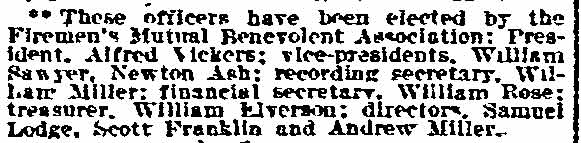
These officers have been elected by the Firemen’s Mutual Benevolent Association: President, Alfred Vickers; vice-presidents, William Sawyer, Newton Ash; recording secretary, William Miller; financial secretary, William Rose; treasurer, William Elverson; directors, Samuel Lodge, Scott Franklin and Andrew Miller.
Boy's Brutal Murderer Collapses at Hearing
Camden Post-Telegram —
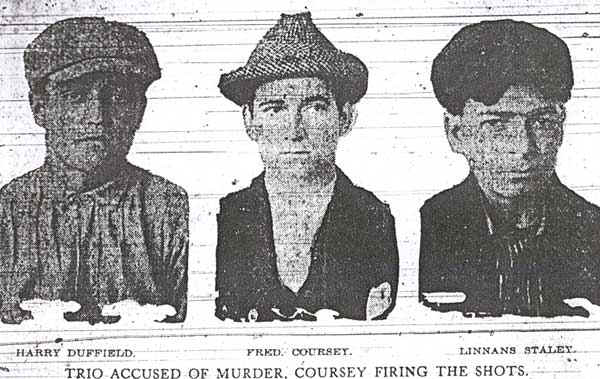
Trio Accused of Murder. Coursey Firing the Shots.
Coursey Breaks Down While Story of Cold-Blooded Killing of Karl Kellmann Is Told by Detective.
Two “Pals,” Too, Accused of Crime
Collapsing when arraigned in Police Court this morning before Recorder Stackhouse on the charge of killing Karl Kellmann, aged 18 years, of 2919 High street, at Twenty-seventh and Sherman streets, shortly before midnight Saturday, Fred Coursey, alias “Mexican Pete,” alias “Cowboy Pete,” aged 20 years, of 121 North Twenty-first street, who admits firing the fatal shots while committing robbery, and Harry Duffield, aged 21 years, of 407 North Forty-first street, who acknowledged masking his face with a handkerchief and being with Coursey, sobbed piteously, resting their heads on the railing of the dock, while John Painter, the veteran detective, was briefly reciting the story.
When Recorder Stackhouse asked what became of the young man who was shot and Painter replied that he died, Coursey and Duffield sobbed afresh, and when Recorder Stackhouse committed them without bail Policemen Frost and Kay had to help them.
Linnans Staley, aged 21 years, of 1819 Federal street, who confessed that he was in the robbery plot but later got scared and hid in the bushes, was scarcely able to stand, and when his mother broke down as he was committed as a principal he staggered and would have fallen but for Sergeant McClong.
Prosecutor Boyle announced this morning that the Grand Jury will be recalled for Thursday of this week and the case will be made the special order of the day.
Without the slightest clue to start with in the most brutal murder committed in recent years in Camden county, police and detectives under the personal direction of Chief Gravenor in two hours arrested two of the three prisoners and obtained their signatures to confessions and before sunrise the other was lodged behind the bars at the City Hall.
According to their statements to the police the prisoners while drinking on a lot near Twenty-first and Federal streets on Saturday night planned to go to a lone spot near Twenty-seventh and Sherman streets to hold someone up to get money and jewelry to buy more drink. Coursey had a 38-calibre cowboy pistol and Duffield used Coursey’s bandanna as a mask. Staley weakened before the spot selected was reached and at the time of the murder was hiding in a clump of weeds a short distance away.
The murdered boy was the son of Karl and Lulu D. Kellmann. He was a member of the Bible class of Grace Presbyterian Church, East Side, and active in church work.
Saturday night was the closing of a carnival given on High street between Twenty-seventh and Thirtieth streets. Karl was there and made several purchases. At one booth he bought a necktie, from another some ice cream and a box of candy and spent some time conversing with the young ladies connected with the church.
When it grew rather late he noticed that Misses Bertha and Bessie Skillen, of 815 North Thirty-fourth street, the latter a teacher in Grace Church Sunday-school, were without an escort and he volunteered to see them home. They accepted his invitation to be their escort. He saw them safely home and he was on his way back and had reached a point on the east side of Twenty-seventh street south of Sherman street and near the foot of the bridge that spans the Pennsylvania Railroad tracks when two men jumped out from behind a tree and as one commanded him to hold up his hands the other began to shoot.
The first shot struck him in the breast and turned him partially around. The next ploughed a hole through his neck, knocking him down, and the third went wide.
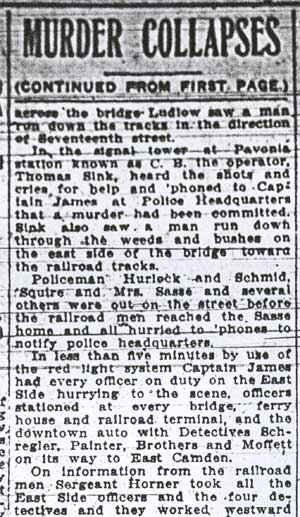
Screaming for help he tried to rise to his feet and was on his knees when Night Yardmaster Albert Ludlow and Brakeman Joseph Wittick, who were on the opposite side of the bridge, ran to his assistance. By the light of their lanterns they saw that he was seriously hurt and they took him to ‘Squire Sasse’s house nearby to await the arrival of the ambulance. As the railroaders sped across the bridge Ludlow saw a man run down the tracks in the direction of Seventeenth street.
In the signal tower at Pavonia station known as C. B. the operator, Thomas Sink, heard the shots and cries for help and ‘phoned to Captain James at Police Headquarters that a murder had been committed. Sink also saw a man run down through the weeds and bushes on the east side of the bridge toward the railroad tracks.
Policeman Hurlock and Schmid, ‘Squire and Mrs. Sasse and several others were out on the street before the railroad men reached the Sasse home and all hurried to ‘phones to notify police headquarters.
In less than five minutes by use of the red light system Captain James had every officer on duty on the East Side hurrying to the scene, officers stationed at every bridge, ferry house and railroad terminal, and the downtown auto with Detectives Schregler, Painter, Brothers and Moffett on its way to East Camden.
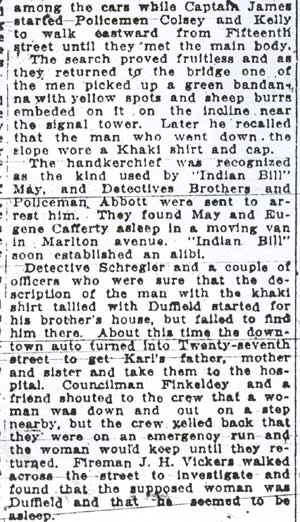
On information from the railroad men Sergeant Horner took all the East Side officers and the four detectives and they worked westward among the cars while Captain James started Policemen Colsey and Kelly to walk eastward from Fifteenth street until they met the main body.
The search proved fruitless and as they returned to the bridge one of the men picked up a green bandanna with yellow spots and sheep burrs embedded on it on the incline near the signal tower. Later he recalled that the man who went down the slope wore a Khaki shirt and cap.
The handkerchief was recognized as the kind used by “Indian Bill” May, and Detectives Brothers and Policeman Abbott were sent to arrest him. They found May and Eugene Cafferty asleep in a moving van in Marlton avenue. “Indian Bill” soon established an alibi.
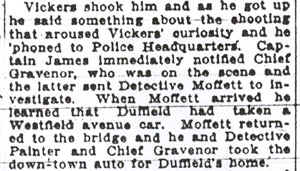
Detective Schregler and a couple of officers who were sure that the description of the man with the khaki shirt tallied with Duffield started for his brother’s house, but failed to find him there. About this time the downtown auto turned into Twenty-seventh street to get Karl’s father, mother and sister and take them to the hospital. Councilman Finkeldey and a friend shouted to the crew that a woman was down and out on a step nearby, but the crew yelled back that they were on an emergency run and the woman would keep until they returned. Fireman J. H. Vickers walked across the street to investigate and found that the supposed woman was Duffield and that he seemed to be asleep.
Vickers shook him and as he got up he said something about the shooting that aroused Vickers’ curiosity and he ‘phoned to Police Headquarters. Captain James immediately notified Chief Gravenor, who was on the scene and the latter sent Detective Moffett to investigate. When Moffett arrived he learned that Duffield had taken a Westfield avenue car. Moffett returned to the bridge and he and Detective Painter and Chief Gravenor took the down-town auto for Duffield’s home.
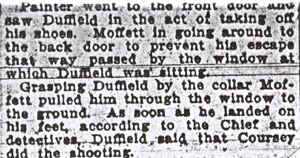
Painter went to the front door and saw Duffield in the act of taking off his shoes. Moffett in going around to the back door to prevent his escape that way passed by the window at which Duffield was sitting.
Grasping Duffield by the collar Moffett pulled him through the window to the ground. As soon as he landed on his feet, according to the Chief and detectives, Duffield said that Coursey did the shooting.
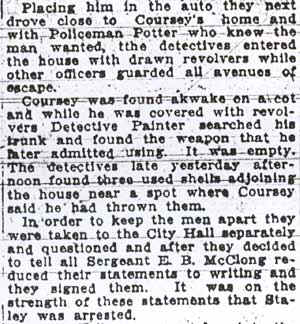
Placing him in the auto they next drove close to Coursey’s home and with Policeman Potter who knew the man wanted, the detectives entered the house with drawn revolvers while other officers guarded all avenues of escape.
Coursey was found awake on a cot and while he was covered with revolvers Detective Painter searched his trunk and found the weapon that he later admitted using. It was empty. The detectives late yesterday afternoon found three used shells adjoining the house near a spot where Coursey said he had thrown them.
In order to keep the men apart they were taken to the City Hall separately and questioned and after they decided to tell all Sergeant E. B. McClong reduced their statements to writing and they signed them. It was on the strength of these statements that Staley was arrested.
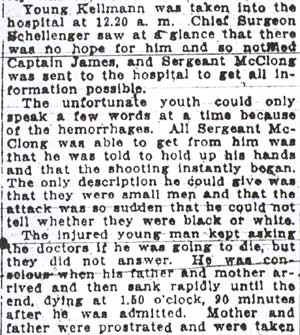
Young Kellmann was taken into the hospital at 12.20 a. m. Chief Surgeon Schellenger saw at a glance that there was no hope for him and so notified Captain James, and Sergeant McClong was sent to the hospital to get all information possible.
The unfortunate youth could only speak a few words at a time because of the hemorrhages. All Sergeant McClong was able to get from him was that he was told to hold up his hands and that the shooting instantly began. The only description he could give was that they were small men and that the attack was so sudden that he could not tell whether they were black or white.
The injured young man kept asking the doctors if he was going to die, but they did not answer. He was conscious when his father and mother arrived and then sank rapidly until the end, dying at 1.50 o’clock, 90 minutes after he was admitted. Mother and father were prostrated and were taken home by the up-town auto.
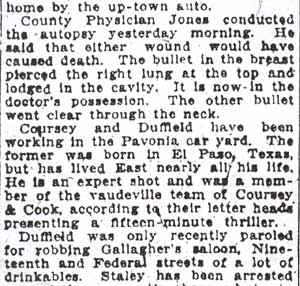
County Physician Jones conducted the autopsy yesterday morning. He said that either wound would have caused death. The bullet in the breast pierced the right lung at the top and lodged in the cavity. It is now in the doctor’s possession. The other bullet went clear through the neck.
Coursey and Duffield have been working in the Pavonia car yard. The former was born in El Paso, Texas, but has lived East nearly all his life. He is an expert shot and was a member of the vaudeville team of Coursey & Cook, according to their letter heads presenting a fifteen-minute thriller.
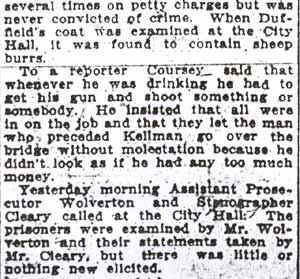
Duffield was only recently paroled for robbing Gallagher’s saloon, Nineteenth and Federal streets of a lot of drinkables. Staley has been arrested several times on petty charges but was never convicted of crime. When Duffield’s coat was examined at the City Hall, it was found to contain sheep burrs.
To a reporter Coursey said that whenever he was drinking he had to get his gun and shoot something or somebody. He insisted that all were in on the job and that they let the man who preceded Kellman go over the bridge without molestation because he didn’t look as if he had any too much money.
Yesterday morning Assistant Prosecutor Wolverton and Stenographer Cleary called at the City Hall. The prisoners were examined by Mr. Wolverton and their statements taken by Mr. Cleary, but there was little or nothing new elicited.
Henry W. Vickers — Death Notice
Philadelphia Inquirer —
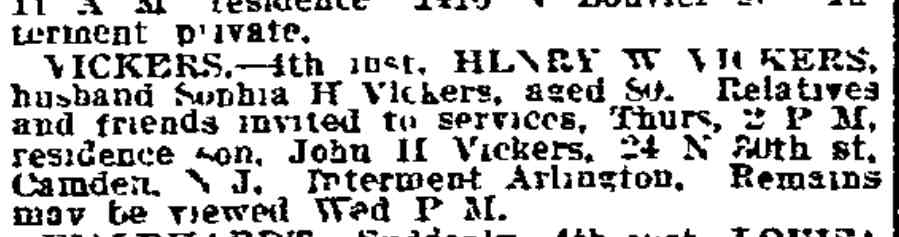
VICKERS.—4th inst. HENRY W. VICKERS, husband Sophia H. Vickers, aged 80. Relatives and friends invited to services, Thurs. 2 P.M., residence son, John H. Vickers, 24 N. 30th st., Camden, N.J. Interment Arlington. Remains may be viewed Wed P.M.
14 Firemen Win City Promotions
Camden Daily Courier —
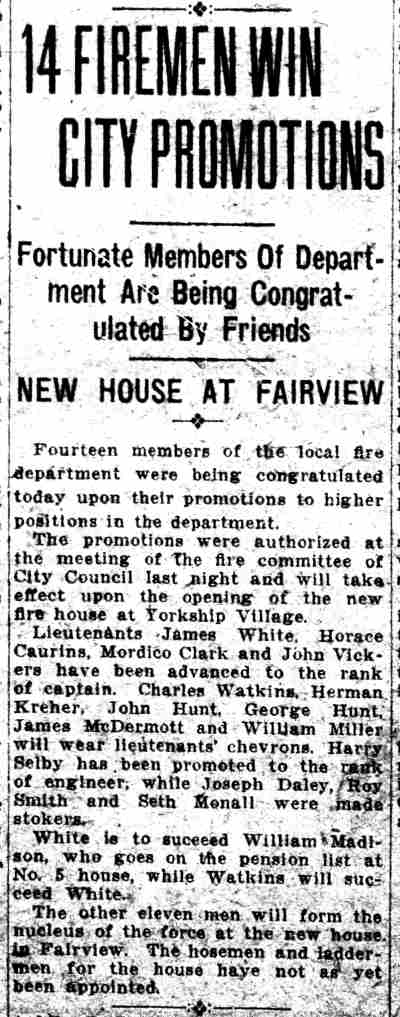
Fortunate Members Of Department Are Being Congratulated By Friends
NEW HOUSE AT FAIRVIEW
Fourteen members of the local fire department were being congratulated today upon their promotions to higher positions in the department.
The promotions were authorized at the meeting of the fire committee of City Council last night and will take effect upon the opening of the new fire house at Yorkship Village.
Lieutenants James White, Horace Cairns, Mordecai Clark and John Vickers have been advanced to the rank of captain. Charles Watkins, Herman Kreher, John Hunt, George Hunt, James McDermott and William Miller will wear lieutenants’ chevrons. Harry Selby has been promoted to the rank of engineer, while Joseph Daley, Roy Smith and Seth Monall were made stokers.
White is to succeed William Madison, who goes on the pension list at No. 5 house, while Watkins will succeed White.
The other eleven men will form the nucleus of the force at the new house in Fairview. The hosemen and laddermen for the house have not as yet been appointed.
3 Firemen Hurt in $75,000 Fire at Leather Plant
Camden Daily Courier —

3 FIREMEN HURT IN $75,000 FIRE AT LEATHER PLANT
Flames of Unknown Origin Wreck Upper Story of Keystone Factory
SMOKE BLOCKS BATTLE
Firm Loses Stock of Hides Valued at $50,000, One Fireman in Hospital
Three firemen were overcome with smoke when flames gutted the upper stories of the drying building of the Keystone Leather Company, Seventeenth and Carman streets, last night. The loss is estimated today at $75,000. The origin is unknown.
Captain J. J. Vickers, of the East Camden Company, was overcome by smoke, and revived by City Physician Lippincott. Fireman George Addison, of the same company, was dragged from the building by other firemen, and revived by the physician.
Nelson Andrews, fireman, of Engine Company No. 9, was in a serious condition when taken from the building. He was prostrated by smoke, and was rushed to Cooper Hospital, where he was reported as much improved today.
Smoke Blocks Traffic
Smoke was so dense that vehicular traffic on Federal street, two squares away, was blocked for nearly an hour.
The flames had gained a great deal of headway when discovered by a watchman. When the firemen arrived on the scene, they faced a hard task because of great volumes of smoke pouring from the building, in which was stored a large stock of hides.
It was one of the most stubborn fires the department has faced in years. The firemen were unable to locate the flames at first because of the smoke. Chief Carter sent in two more alarms after arriving on the scene.
After thirty minutes of battle the flames suddenly shot skyward, illuminating the heavens for miles. They leaped to the fourth floor, and through the roof. In a short time the roof collapsed, sending a great shower of sparks in all directions.
It was three hours before the first fire companies were able to leave the scene.
It was estimated today that the damage to the building will reach $25,000. The company lost about $50,000 in stock. A large stock of hides on the first two floors were ruined by tons of water.
The building is one of the first built by the company, and directly adjoins the main concrete plant at Seventeenth and Mickle streets.
Lieutenant W. Scott Franklin, of Engine Company, No. 1, fell from a one-story roof of an adjoining building while pulling up hose but fortunately escaped injury.
Hook & Ladder Company 3, Hose & Chemical Company 1 & Engine Company 9 — 1924
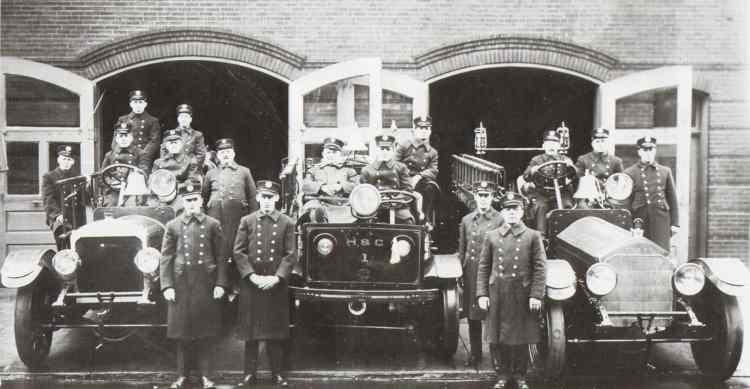
Hook & Ladder Company 3: Captain Joseph B. Ayres, FF Dave Humphries, Al Dukes, John Mulligan, Bill Mountney, Bill Hopkins. Hose & Chemical Company 1: Captain Charles H. Robinson, FF William E. “Pud” Jaeckel, George Townsend, Ken Naylor, Howard Gick. Engine Company 9: Captain John H. Vickers, FF Irv Lederman, Newton Ash, Joe Gentlesk, Al Palmer