Maurice DiNicola
Maurice DiNicola served as a patrolman and detective with the Camden Police Department in the 1920s and 1930s. In June 1928, he shot gangster John “Two Gun” Kelly after Kelly struck him and reached for a pistol. DiNicola later served as an acting detective before being transferred to the First Police District in 1935.
South Camden Mother Held for Beating Girl
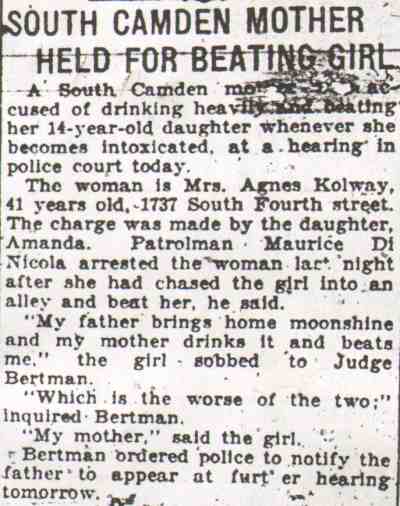
A South Camden mo[smudged] accused of drinking heavily and beating her 14-year-old daughter whenever she becomes intoxicated, at a hearing in police court today.
The woman is Mrs. Agnes Kolway, 41 years old, 1737 South Fourth street. The charge was made by the daughter, Amanda. Patrolman Maurice Di Nicola arrested the woman last night after she had chased the girl into an alley and beat her, he said.
“My father brings home moonshine and my mother drinks it and beats me,” the girl sobbed to Judge Bertman.
“Which is the worse of the two?” inquired Bertman.
“My mother,” said the girl.
Bertman ordered police to notify the father to appear at further hearing tomorrow.
Not checked against a scan. The following items on this page are transcribed from site copies or printed books whose scans are not in the scan mirror, or are captions for photographs with no printed text; their wording has not been verified against the printed page:
- Johnson Gets Ward's Job as Kobus Orders Cop Shakeup — Camden Courier-Post — August 31, 1935 (text-only; no scan of the article exists)
- Jobless Son Kills Jake Schiller Who Saves Boy's Wife From Gun — Camden Evening Courier — September 18, 1933 (story body is a site copy; only the portrait strip is scanned)
Distillery Is Raided, 9 Arrested, Barrels of Mash Confiscated
Camden Daily Courier —
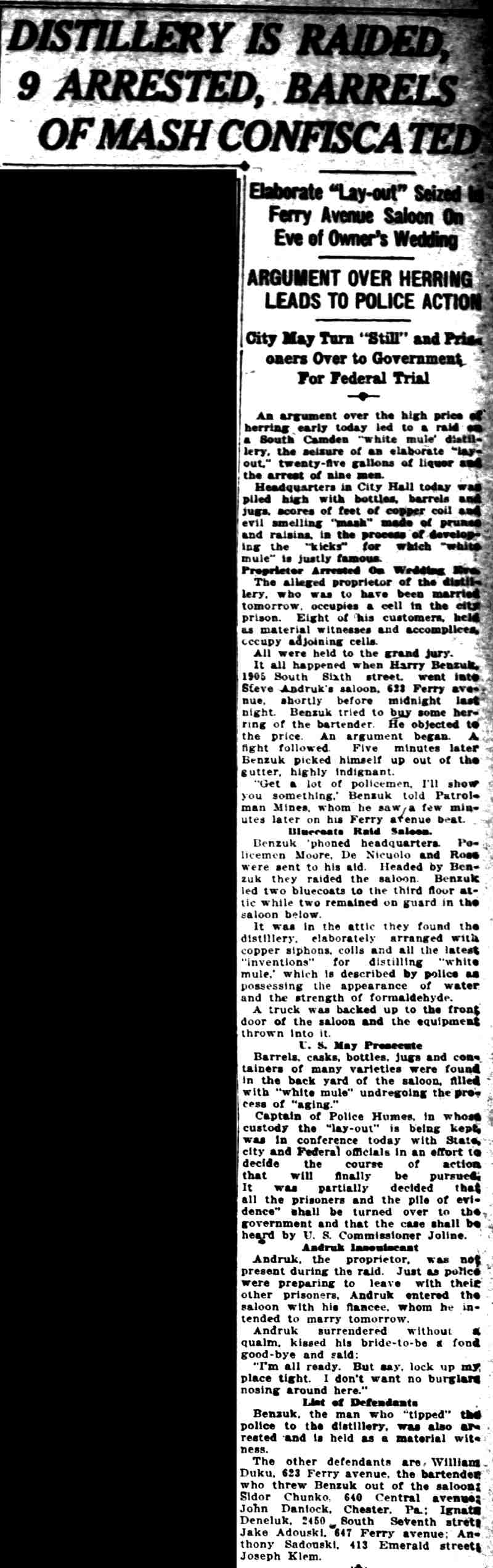
Elaborate “Lay-out” Seized at Ferry Avenue Saloon On Eve of Owner’s Wedding
ARGUMENT OVER HERRING LEADS TO POLICE ACTION
City May Turn “Still” and Prisoners Over to Government For Federal Trial
An argument over the high price of herring early today led to a raid on a South Camden “white mule” distillery, the seizure of an elaborate “lay-out,” twenty-five gallons of liquor and the arrest of nine men.
Headquarters in City Hall today was piled high with bottles, barrels and jugs, scores of feet of copper coil and evil smelling “mash” made of prunes and raisins, in the process of developing the “kicks” for which “white mule” is justly famous.
Proprietor Arrested On Wedding Eve
The alleged proprietor of the distillery, who was to have been married tomorrow, occupies a cell in the city prison. Eight of his customers, held as material witnesses and accomplices, occupy adjoining cells.
All were held to the grand jury.
It all happened when Harry Benzuk, 1905 South Sixth street, went into Steve Andruk’s saloon, 623 Ferry avenue, shortly before midnight last night. Benzuk tried to buy some herring of the bartender. He objected to the price. An argument began. A fight followed. Five minutes later Benzuk picked himself up out of the gutter, highly indignant.
“Get a lot of policemen, I’ll show you something.” Benzuk told Patrolman Mines, whom he saw a few minutes later on his Ferry avenue beat.
Bluecoats Raid Saloon
Benzuk ’phoned headquarters. Policemen Moore, De Nicuolo and Ross were sent to his aid. Headed by Benzuk they raided the saloon. Benzuk led two bluecoats to the third floor attic while two remained on guard in the saloon below.
It was in the attic they found the distillery, elaborately arranged with copper siphons, coils and all the latest “inventions” for distilling “white mule,” which is described by police as possessing the appearance of water and the strength of formaldehyde.
A truck was backed up to the front door of the saloon and the equipment thrown into it.
U. S. May Prosecute
Barrels, casks, bottles, jugs and containers of many varieties were found in the back yard of the saloon, filled with “white mule” undergoing the process of “aging.”
Captain of Police Humes, in whose custody the “lay-out” is being kept, was in conference today with State, city and Federal officials in an effort to decide the course of action that will finally be pursued. It was partially decided that all the prisoners and the pile of “evidence” shall be turned over to the government and that the case shall be heard by U. S. Commissioner Joline.
Andruk Innocent
Andruk, the proprietor, was not present during the raid. Just as police were preparing to leave with their other prisoners, Andruk entered the saloon with his fiancee, whom he intended to marry tomorrow.
Andruk surrendered without a qualm, kissed his bride-to-be a fond good-bye and said: “I’m all ready. But say, lock up my place tight. I don’t want no burglars nosing around here.”
List of Defendants
Benzuk, the man who “tipped” the police to the distillery, was also arrested and is held as a material witness.
The other defendants are: William Duku, 623 Ferry avenue, the bartender who threw Benzuk out of the saloon; Sidor Chunko, 640 Central avenue; John Danlock, Chester, Pa.; Ignatz Deneluk, 2450 South Seventh street; Jake Adouski, 647 Ferry avenue; Anthony Sadouski, 413 Emerald street; Joseph Klem.
‘2-Gun’ Kelly Shot by Cop He Felled
Camden Courier-Post —
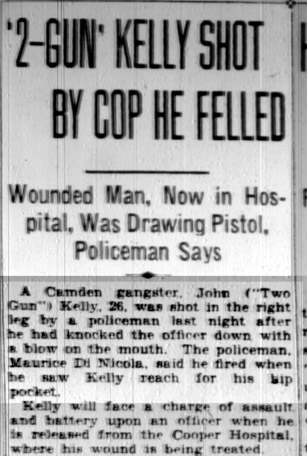
Wounded Man, Now in Hospital, Was Drawing Pistol, Policeman Says
A Camden gangster, John (“Two Gun”) Kelly, 26, was shot in the right leg by a policeman last night after he had knocked the officer down with a blow on the mouth. The policeman, Maurice Di Nicola, said he fired when he saw Kelly reach for his hip pocket.
Kelly will face a charge of assault and battery upon an officer when he is released from the Cooper Hospital, where his wound is being treated.
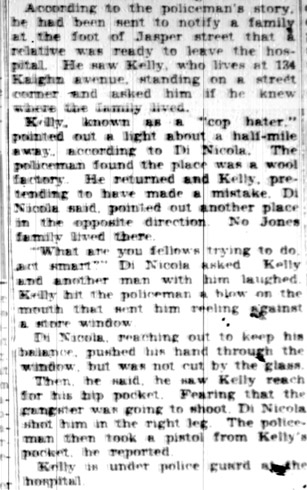
According to the policeman’s story, he had been sent to notify a family at the foot of Jasper street that a relative was ready to leave the hospital. He saw Kelly, who lives at 134 Kaighn avenue, standing on a street corner and asked him if he knew where the family lived.
Kelly, known as a “cop hater,” pointed out a light about a half-mile away, according to Di Nicola. The policeman found the place was a wool factory. He returned and Kelly, pretending to have made a mistake, Di Nicola said, pointed out another place in the opposite direction. No Jones family lived there.
“What are you fellows trying to do, act smart?” Di Nicola asked. Kelly and another man with him laughed. Kelly hit the policeman a blow on the mouth that sent him reeling against a store window. Di Nicola, reaching out to keep his balance, pushed his hand through the window, but was not cut by the glass. Then, he said, he saw Kelly reach for his hip pocket. Fearing that the gangster was going to shoot, Di Nicola shot him in the right leg. The policeman then took a pistol from Kelly’s pocket, he reported.
Kelly is under police guard at the hospital.
In Family Tragedy
Camden Evening Courier —
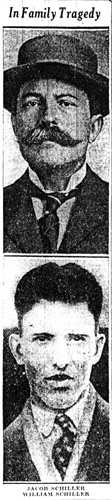
JACOB SCHILLER WILLIAM SCHILLER
Jobless Son Kills Jake Schiller Who Saves Boy’s Wife From Gun
Camden Evening Courier —
SLAYER CRAZED BY SEPARATION, RELATIVES SAY
Dazedly Insists He Had No Intention of Shooting Sire
ESTRANGED WIFE SEEN IN SUICIDE TRY
Slain Man Long Was Prominent Figure in Camden Politics
Jacob Schiller, 72, for 45 years a political figure here, is dead, shot by his own son.
The slayer, William Schiller, 30, a former summer policeman now unemployed, was held over today to the grand jury on a charge of murder. He made no comment whatever during his police court hearing.
A few hours later, young Schiller’s wife, Augusta, whom he had also tried to shoot, was found wandering through the city street, in a hysterical condition.
She had written a note which police believed showed intent to commit suicide, and had staggered dazedly through the streets last night. Both in her note and in her incoherent statements to detectives she declared she was to blame for the tragedy.
She said her father-in-law had tried to save her and was killed in the attempt.
The slaying occurred Saturday night at the elder Schiller’s home, 2420 Carman Street. It climaxed an estrangement between young Schiller and his wife, with “Jake” Schiller attempting to reconcile the couple.
Mrs. William Schiller, who had had her husband arrested several months ago, said she believed he had become mentally deranged, but Police Judge Pancoast was informed that an alienist had examined young Schiller in July and pronounced him sane.
Couple Separated
Young Schiller had been living with his father at the Carman Street address, while Mrs. Schiller has been residing with her parents, Mr. and Mrs. John I. Green, 409 North Thirty-seventh Street. The cause of the estrangement has not been revealed by police, but it is stated that young Schiller refused to consent to a reconciliation.
“Jake” Schiller was a Republican worker in the Twelfth ward for years, and was at the time of his death inspector of city street lights.
Were Alone at Home
The father and son were at home 9:00 p.m. Saturday night and apparently were quarreling when the young Mrs. Schiller, her brother-in-law and sister, Mr. and Mrs. William Miller and another sister, Mrs. Lottie Bennehler, reached the house.
“Don’t come in here,” the older Schiller shouted as they started to enter the front sun parlor. But Miller did enter and said young Schiller was clutching a revolver in his right hand. He declared he closed in on his brother-in-law and tried to wrench the revolver from him. Two shots rang out and the father fell to the floor.
Patrolman Joseph Keefe was standing at Twenty-fifth and Federal Streets when two boys ran up and told him there was a shooting at Twenty-fifth and Carman Street. He ran to the scene and said he reached there in time to see young Schiller shooting up the street at his wife.
Keefe said Schiller ran into the house when he saw him. Aided by Miller, Keefe overpowered Schiller and placed an iron claw on his right hand after disarming him.
Jacob Schiller Jr., another son, learning of the shooting, went to his father’s home and took him to Cooper Hospital in a passing automobile. As he was being taken into the hospital he failed to recognize City Detective Robert Ashenfelter and died five minutes later.
Expresses No Regret
Police Sergeant John Potter joined Keefe and Miller and they took young Schiller to police headquarters.
Keefe said the son expressed no regret at shooting his father.
At about 5 a.m. today, Policeman Keefe was patrolling his “beat” when he passed the Schiller home on Carman Street. He noticed the front door was standing open, and he went inside to investigate.
The officer saw a note on a smoking stand. Picking it up, he read:
“Dear Everybody:
“Please forgive me … You have all been so wonderful … But I couldn’t go on to see you all suffer for what is my fault … Lottie was right … He killed his father because of insane love for me … But he didn’t. I killed Pop and now am sending Bibs to jail for my weakness.
“Tell him I love him and ask my poor mother and dad to forgive me. I should have done this long ago and saved everyone all this suffering … I love Billy and I know he loves me but I am afraid he has been turned against me. But I forgive him for all.
“Gussie”
“Gussie” is Mrs. Schiller.
Finds ‘Gussie’ Hysterical
Keefe ran to Federal Street, but could not see Mrs. Schiller.
Meanwhile, Constable Dugan of the Twelfth Ward, saw Mrs. Schiller walking on Federal Street near the Cooper River. She was mumbling to herself and was in a hysterical condition, Dugan said.
Dugan telephoned police headquarters. City Detectives Rox Saponare and Maurice DeNicoli went out Federal Street and took her back with them to detective headquarters. There they sought to quiet her, but she continually sobbed.
“I want to take the blame—if I hadn’t gone to Pop’s home he would be living now.”
“Pop wanted to save me,” she said. “and he was shot. I can’t eat or sleep. I think I’m going crazy.”
Later, she was permitted to return to the home.
Young Schiller had been held in the city jail over the weekend. Today he was taken into police court. He wore no necktie and carried a raincoat over his arm. He was represented by counsel, C. Lawrence Gregorio, who said he had been retained “by friends” to act as attorney for the accused man.
City detective Benjamin Simon had signed the complaint in which he charged “on information received” that Schiller did feloniously and with malice aforethought shoot and kill his father.
The complaint was read to him and Gregorio told him not to say anything, as Judge Pancoast would enter a plea of “not guilty” in his behalf. This was done by the court and Schiller was then held without bail pending grand jury action. He was taken to the county jail.
Declared Sane
After the hearing, Mrs. Etta C. Pfrommer, acting overseer of the poor, told Judge Pancoast that on July 26, Dr. Harry Jarrett, Broadway and Cherry Street, well known alienist, had examined young Schiller and declared him sane. The examination was made on the request of Mrs. Schiller in police court on the previous day. At that time young Schiller had been released by the court in the custody of his father.
County Detective Chief Lawrence T. Doran, who was among the first to question young Schiller Saturday night, said the man did not seem repentant over what he had done. He said Schiller did not give authorities much information. According to Doran, young Schiller declared he had objected frequently to his father that he did not want his wife to come to their home.
“It doesn’t seem possible,” said young Mrs. Schiller some hours after the tragedy. “It seems as though it was only a dream. I don’t seem to remember anything.
“Poor Bill. He must have been crazy. He idolized his father. You can blame this all on the depression. He has been without work since they eliminated summer policemen two years ago. He has been worried as a result of being unable to obtain work. Just recently he started to drink.
“Bill intended to shoot me but his father tried to get the gun away from him and I believe it went off accidentally. Nothing could convince me that Bill would shoot his father in cold blood.
“I went to his father’s home last night to try to effect a reconciliation with my husband. He had been drinking.”
Registered as Sober
The police docket at headquarters shows Schiller registered as sober. The entry was not made until 2:15 a.m., and the shooting occurred shortly after 9:30 p.m.
Relatives said the father had attempted for months to patch up the marital difficulties of the couple.
Young Schiller had been living lately with his sister, Mrs. Bennehler, 2530 Bank Street and his wife with her parents at 409 North Thirty-seventh Street. He formerly lived at that address with his wife. He was appointed a summer policeman in 1929 and served until they were all dismissed two years ago.
Coroner Holl and Dr. Edward B. Rogers, county physician, yesterday performed an autopsy on the senior Schiller’s body and ascertained that death was due to an internal hemorrhage caused by a bullet wound of the upper portion of the abdomen. They said a .32-calibre revolver had been used in the shooting.
Camden Lodge of Elks will hold services tomorrow night at the Schiller home, at which time the body will be on view. The funeral will be private on Wednesday with burial in Evergreen Cemetery.
Judge Pancoast last night recalled that young Schiller was arrested two months ago after he had kept his wife a prisoner on a lot all night. At that time “Jake,” as he was affectionately known to his friends, tried to act as a mediator between his son and daughter-in-law.
The young Mrs. Schiller at that time told Pancoast she believed her husband was deranged and asked permission to have him examined by physicians she would name. Pancoast released young Schiller in the custody of his father. The police judge said the examination had apparently not been made as no commitment papers had been sent through his office.
Few political workers were better known than “Jake” Schiller. He was born in Philadelphia and was brought to Camden in early life by his parents, who conducted a saloon near Twenty-third and Federal Streets. East Camden was then the town of Stockton and the scene of Saturday night’s shooting was a farm. Schiller recalled to friends that he drove cows through a pasture on which his house now stands.
He was originally a Democrat but became a Republican through persuasion of the late U. S. Senator David Baird and remained a friend of the former leader for 40 years.
Schiller had been melancholy over the death of his wife on February 13 last, friends said.
When his son was arrested he remarked to Pancoast: “What is next?”
Figured in Shaw Case
None was more in the public eye 35 years ago in South Jersey than Schiller. It was then that he figured prominently in one phase of the locally celebrated Shaw murder trial.
It was during the second trial of Eli Shaw for the murder of his mother and grandmother, Mrs. Anna Shaw and Mrs. Emma Zane. They were found shot to death in September, 1897, in their bedroom of their home on Line Street near Third. Detective John Painter had found a revolver hidden in the chimney, one of several points in the circumstantial evidence that resulted in the indictment of Shaw. He was then a widely known young man about town and his arrest caused a big sensation. As time drew near for the trial feeling was intense, for there were adherents for and against the son and grandson, those arguments often grew bitter.
Henry Sidney Scovel, then one of the prominent criminal lawyers of Camden county, was retained to defend Shaw. Scovel was son of James Matlack Scovel, himself one of the leading barristers of this section. When the trial of Shaw was under way the city was astounded when it was charged Scovel had tampered with the jury. It was Schiller who made the charge.
The trial stopped abruptly. Scovel emphatically denied the story of Schiller and demanded vindication. An indictment for embracery was returned and at a trial, which had Camden on the tip toe of expectancy for days, it developed there was absolutely nothing to verify the charge, and Scovel was acquitted. He acted in two subsequent trials of Shaw, the second being a disagreement and the third acquittal for the son and grandson of the slain women.
Schiller, strangely enough, in later years became friendly with Scovel and when the latter was prosecutor from 1905 to 1912, “Jake,” as he was familiarly known, was usually to be found in the office at the courthouse. Scovel was then a white haired man of flowery speech and impressive personality who let bygones be bygones.
Long Excise Inspector
For more than 20 years Schiller was inspector of the Excise Commission in Camden. It was during the days when the principal object of the inspector apparently was to keep the saloonmen in line. He was considered pretty good at that job, by no means an unimportant one from the organization viewpoint. It was also during that period the city had its troubles enforcing the Sunday liquor laws. There were those who considered they had enough pull to keep their back or side doors open on the Sabbath to let in their regular thirsty trade. Some succeeded in getting by, but “Jake” had his own troubles in keeping the boys straight and sometimes causing their arrest, although that was not frequent by any means.
His reign as inspector, too, was in the halcyon days of free lunch and schooner beers. Saloonmen themselves were against the lunch idea eventually since it meant too much of a financial burden. Jake kept tabs on the recalcitrants so that the liquor dealers knew who was obeying the order and who was “cutting corners” to get some extra trade.
Schiller was virtually raised with the saloon trade since his father was one of the old time German beer garden owners here, having had a place at Fourth and Line Streets. That was in the days when that section was largely populated by the German, English and Irish families lately come from the motherlands. When he was a boy, Schiller entered the U. S. Navy and served several years. When he came out he went to the old Town of Stockton, now East Camden, where he opened a saloon on Federal Street near Twenty-fourth. At that period, some 45 years ago, Stockton seethed with politics and it was just as natural for a young man to get into the game as it was for a duck to swim. Jake at that period was a Democrat and during the battle in the middle 90’s when the West Jersey Traction and the Camden Horse Railway Company were fighting for the rail franchises in the town he was a candidate for council from the old Second Ward. The late Robert Lee was the Republican candidate and won out by the narrow margin of two votes. In later years Schiller became a Republican and was elected a constable.
Never Ran From Scrap
Throughout his career Schiller never quite forgot his training in the navy, particularly with reference to boxing or fighting at the drop of a hat. He was a scrapper in his early years and never ran from a fight. That was just as true in political battles, frequent then around the polls, as in purely personal matters. And Jake would battle for a friend just as readily as for any personal reason. He was usually in the thick of the political fracases of the years when it was the accepted thing to fight at the drop of a hat. But he also had lots of native wit which kept things interesting when he was a frequenter of the prosecutors’ office during the Scovel and Wolverton regimes. In late years, with the approach of age, he had tempered his propensity to get into an argument and liked nothing more than to tell of “the good old days” when he helped the elder Baird in his organization battles.
He made his last political stand for leadership of the Twelfth Ward in 1926 when he supported the candidacy of Sergeant Ray Smith against Commissioner Clay W. Reesman for ward committeeman. Schiller was supporting Congressman Charles A. Wolverton and the late Senator Joseph H. Forsyth in a campaign against former Congressman Francis F. Patterson and State Senator Albert S. Woodruff.
Reesman won and among the first to visit the hospital after learning of the shooting was the city commissioner. Reesman was his latest chief as lights inspector as he was attached to the highway department. Commissioner Frank B. Hanna also visited the hospital.
“In all the years I have known him he has always been an enthusiastic and loyal friend with a good heart for everybody in trouble,” Congressman Wolverton said when he learned of Schiller’s death.
Schiller was also a familiar figure at the Elks Club, where he was an ardent card player. But after the death of his wife he gave up this pastime, contenting himself with watching the games. He was also a frequent visitor among old friends at the courthouse.
Johnson Gets Ward’s Job as Kobus Orders Cop Shakeup
Camden Courier-Post —
Shaw Made Assistant in Place of Koerner
In a shakeup of Camden police officials yesterday afternoon Lieutenant Samuel E. Johnson was named acting chief of detectives by Commissioner Mary W. Kobus, director of public safety.
Lieutenant George A. Ward, who has been in charge of the detective bureau for a year, was transferred to take Johnson’s place in charge of headquarters.
Detective Louis Shaw was made assistant to Johnson, replacing Detective Sergeant Gus Koerner. Koerner was transferred to the Second District, for radio car and street duty. The new order became effective at 4:00 PM yesterday.
Police Chief Arthur Colsey announced the changes in the bureau after a two-hour conference with Commissioner Kobus yesterday afternoon.
Maurice Di Nicuolo, who has been an acting detective, was transferred to the First Police District, with former Acting Detective Clifford Del Rossi returning to his old post in the detective bureau.
In the only other transfer announced, Sergeant Harry Newton was switched from the First Police District to the Third, with Sergeant Edward Carroll going from the Third to the First.
Although no other changes were made public, it is believed yesterday’s are a forerunner of numerous shifts to be made today or early next week.
“These changes are being made for the good of the service,” Commissioner Kobus declared. “There will be other transfers of officers and men so that all the police may familiarize themselves with all the branches of the department.”
Lieutenant Johnson was appointed a policeman on January 1, 1910. After 10 years as a patrolman, he was promoted to a detective, where he made a splendid record. On November 28, 1928 he was made a sergeant, and again promoted on April 8, 1930, when he became a lieutenant.
Ward was appointed a policeman on August 2, 1917, promoted to detective January 1, 1927, sergeant November 14, 1928 and lieutenant on January 24, 1930.
Johnson was a detective sergeant when former Police Chief John W. Golden was head of that bureau, but later was transferred to police headquarters.
Ward has been in and out of the detective bureau several times. He served for a time as the commander of the First District and later was in charge of the police headquarters on the 12:00 midnight to 8:00 AM shift. He was a political lieutenant of former Public Safety Director David S. Rhone.
Two Tipsy Drivers Fined by Liberman
Camden Courier-Post —
TWO TIPSY DRIVERS FINED BY LIBERMAN
Judge Refuses Alibi Offered That One ’Drowned Grief’ in Friend’s Death
Two drunken drivers were given the alternative yesterday of Police Judge Lewis Liberman of paying fines of $200 or spending 90 days in jail.
They are Samuel Boykin, 42, of 514 Lawrence street, and George Kendig, 41, of 2332 Broadway.
Boykin was arrested Monday at Broadway and Federal streets by Patrolmen William Stibi and Gus Rhiem, after they noticed his driving in a zig-zag manner.
Boykin pleaded not guilty, but admitted having “taken a drink to drown my sorrow over the death of a friend.”
“There is no question in my mind that you were drunk,” Judge Liberman told him, “because I have personal knowledge of it. I saw you in my office shortly after your arrest.”
Kendig, who was arrested last Thursday after his car was in collision with another car, was first arraigned yesterday, but the hearing was postponed to permit police to make further investigation.
Yesterday Sergeant Walter Mattison and Patrolman Maurice DiNiculo testified they were on duty when Kendig was brought in to police headquarters and that he was under the influence of liquor. Kendig pleaded not guilty but admitted having had a “few glasses of wine.”
Both sentences carry with them automatic suspension of drivers’ licenses for one year.