Benjamin W. Courter
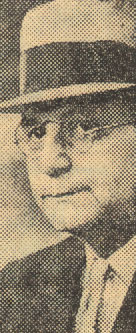
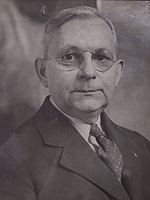
Benjamin W. Courter
BENJAMIN WILLIAM COURTER was born in Camden NJ on June 6, 1877 to John Dodd and Laura Braker Courter. Grandfather Benjamin Braker was well-known in Camden as a newspaperman and as a Justice of the Peace. Ben Courter’s early years were spent in Gloucester City NJ, where his father in 1880 was a grocer. John Dodd Courter would soon embark on a newspaper career that would last until his death in 1920. He wrote for several Philadelphia papers and last worked for the Daily Courier in Camden, and was noted as an outdoor columnist, as was his son.
After marrying Sarah “Sadie” Emily Emmerson in Camden on August 23, 1898, Benjamin Courter followed his father into journalism. Beginning his career in 1900, he covered news for several Philadelphia newspapers before working on the old Camden Post-Telegram, which merged with the Daily Courier to become the Courier-Post in 1926. In the words of grandson “Duke” Courter, “He continued the tradition and worked as an outdoor columnist with the Courier-Post for 34 years.”
By 1920, Benjamin W. Courter had purchased a home at 203 Evergreen Avenue in Woodlynne NJ.
Ben Courter also began writing about days gone by in Camden. When veteran reporter Charles Leo “Mack” McKeone died in December of 1927, his extremely popular “The Peppery Pot by Mack” died with him. Ben Courter was tapped to fill some extremely large shoes, which he did with the “Along Memory Lane” column and other articles.
Benjamin W. Courter died in harness, seated at his desk at the Courier-Post building in Camden on November 8, 1934. He had completed another column devoted to Camden’s history at home the night before, which was published on November 20.
He was survived by his wife and four children, Harold E., Marion E., Elmer R., and John D. Courter. John D. Courter and grandson Robert “Duke” Courter would also go on to long careers at the Courier-Post.
Photos
Ben Courter’s “Along Memory Lane” column header
‘Peppery Pot Mack’ Laid to Rest Today
Camden Courier-Post —
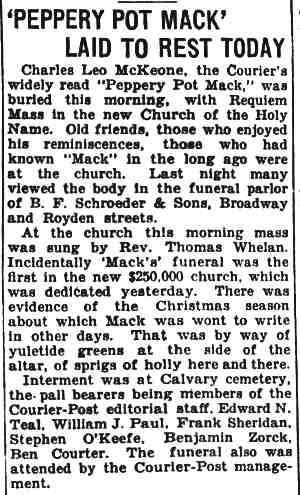
’Peppery Pot Mack’ Laid to Rest Today
Charles Leo McKeone, the Courier’s widely read “Peppery Pot Mack,” was buried this morning, with Requiem Mass in the new Church of the Holy Name. Old friends, those who enjoyed his reminiscences, those who had known “Mack” in the long ago were at the church. Last night many viewed the body in the funeral parlor of B. F. Schroeder & Sons, Broadway and Royden streets.
At the church this morning mass was sung by Rev. Thomas Whelan. Incidentally “Mack’s” funeral was the first in the new $250,000 church, which was dedicated yesterday. There was evidence of the Christmas season about which Mack was wont to write in other days. That was by way of yuletide greens at the side of the altar, of sprigs of holly here and there.
Interment was at Calvary cemetery, the pall bearers being members of the Courier-Post editorial staff. Edward N. Teal, William J. Paul, Frank Sheridan, Stephen O’Keefe, Benjamin Zorck, Ben Courter. The funeral also was attended by the Courier-Post management.
Along Memory Lane: The Sinking of the Maine
Camden Courier-Post —

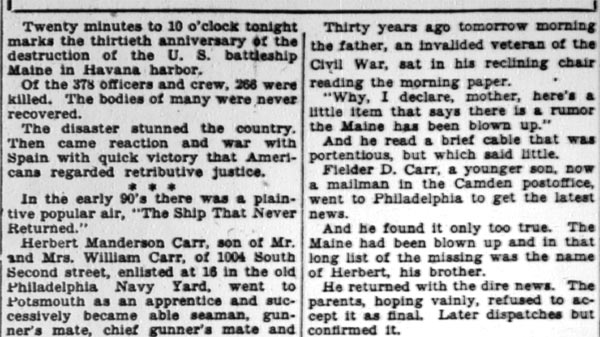
Twenty minutes to 10 o’clock tonight marks the thirtieth anniversary of the destruction of the U.S. battleship Maine in Havana harbor. Of the 375 officers and crew, 266 were killed. The bodies of many were never recovered.
The disaster stunned the country. Then came reaction and war with Spain with quick victory that Americans regarded retributive justice.
In the early 90’s there was a plaintive popular air, “The Ship That Never Returned.”
Mr. and Mrs. William Carr, of 1004 South Second street, enlisted at 16 in the old Philadelphia Navy Yard, went to Portsmouth as an apprentice and succeeded his father who was a chief gunner’s mate, chief gunner’s mate and gunner. He sailed with the famous White Squadron, visited ports on either side of the Atlantic, went over to Mare Island, made a wonder trip to the Orient.
And infrequently he returned on furlough to his widow, carefree, jauntily displaying his sealegs, proudly relating experiences in foreign ports, ever remembering the old folks at home with souvenirs.
“The Ship That Never Returned” and its melancholy burden ever made the mother apprehensive when he left on a new voyage, but there was always the tearful, deriving laughter, and even as he did when he left one morning in the midwinter of ‘97-98 after a party given in his honor, he was on board the gallant Maine and he was coming home, perhaps to stay, on February 14.
Thirty years ago tomorrow morning the father, an invalided veteran of the Civil War, sat in his reclining chair reading the morning paper.
“Why, I declare, mother, here’s a little item that says there is a rumor the Maine has been blown up.”
And he read a brief cable that was portentous, but which said little.
Fielder D. Carr, a younger son, now a lineman in the post office, went to Philadelphia to get the latest news.
And he found it only too true. The Maine had been blown up and in that long list of the missing was the name of Herbert, his brother.
He returned with the dire news. The parents, hoping vainly, refused to accept the verdict. Later inquiry confirmed it.
Nor was anything ever heard from Herbert, not even the satisfaction of his fate. Whether he survived or remained a mystery, although later, when Captain Sigsbee visited Cramps, the mother interviewed him and learned her boy had been sleeping just before where the full force of the blast had driven the steel hull of the battleship.
During the Spanish-American war, for a time, he was the hero of that conflict.
There was talk of rearing a memorial, but sometimes heroes are forgotten in the onrush of peace life. So Herbert was forgotten except in the memory of friends, acquaintances now rapidly dwindling.
Along Memory Lane: The Old One-Horse Dinkey
Camden Courier-Post —
Tinkle, tinkle! Clippety clip! Clippety clip! And the old one-horse dinkey ambled along South Second street years and years ago, the wheels frequently striking comparatively large spaces between the rails with bumps and bangs. The iron shod hoofs of the nag more frequently struck the big and little cobbles that decorated that thoroughfare, at night drawing many a spark as from flint and steel.
Doggone, we used to feel sorry for those poor old horses of the Camden Horse Railroad Company. They stood patiently enough around Second and Kaighn avenue for changing as the cars made round trips from Kaighn Point to Federal street—patient and docile and evidently without a bit of spunk left.
But the recent death of “Joe” Hackney recalls at least one old hoss that evidently concluded he was young and spruce and full of the pep of yesteryear. Hackney, long before he was in the oyster business, was a “horse car driver” on the old Second street dinkey line.
A herd of long horn steers were being driven from the Kaighn Point ferry to the old abbatoir at Sixth and Kaighn avenue one dismal night in the ‘90s. The fitful glare of gas lamps threw an uncertain light over the long lane of cobbles so that when Second street was reached one of the steers was invested with the spirit of adventure.
With a roar and a prodigious leap it left its fellows moving along to sinister fate. It bounded into Second street, clattered along and the few belated citizens yelled and shouted and scampered in terror.
Since it was about the midnight hour and Camden, then provincial enough, snugly tucked away in bed, it may be imagined the bellowing bull and the shouts of the frightened citizens developed enough commotion to bring a brigade of night-capped curious ones to the windows.
Yells of advice were given, but all from those safe inside. Those on the outside were not so certain. Since the steer became more frenzied with the increased racket, occasionally narrowly escaping a dodging wayfarer a posse was formed. And then appeared in the picture the game old hoss of the Second street car line with Hackney at the end of the reins.
Rifles, muskets, revolvers of all vintages were displayed by a dozen doughty Kaighn Point citizens who boarded the car and proceeded to chase the steer.
They stood at the doors on either end of the car, at every window while old faithful jogged along in quest of the fiery bovine. Up and down Second street Hackney drove his equine charge and the hoss seemed to take as much enjoyment out of it as the hunters. Not for a moment did he stop even with the load, even with the reverberation of guns and the shouts of the citizenry.
A dozen such trips along the cobbled way and finally, under a fusillade, the bovine expatriate from Texas was bowled over.
It sure was one exciting night and perhaps there are some old-timers who recall Hackney and that episode of the faithful old nag that was young again, just for a night.
Along Memory Lane: Traffic Islands on Cooper Street
Camden Courier-Post —
Harry Read, Camden’s leading milkman of long ago, former councilman and general all round good fellow, met Irving Buckle one day this week. They were looking over Cooper street, changing more in a week now than in a generation before the bridge came.
“Remember that sleigh ride I gave you over Cooper street 30 years ago?” inquired Read with a chuckle.
“You bet I do,” returned Buckle, former director of the Board of Freeholders and likewise a hail fellow well met in the days when fellowship really meant something. “I sure do, and I was darned near frozen!”
“But they were great old times at that,” returned Read.
And with these “traffic islands” planted in the middle of Camden’s erstwhile bon ton thoroughfare we wonder what the shades of such worthies as Cooper B. Hatch, David B. Kaighn, Samuel Davis and others of that coterie of 30 years agone must think o’ things.
Islands in Cooper street! Gadzooks! Winters do not seem what they used to be in spite of what the weather man might say. Of course, one might not expect to hear the joyous tinkle of the sleigh bell and the impatient whinny of the trotter in a day when gas buggies have relegated them to little else save memories. Still that would not stay Borean blasts laden with “the beautiful,” certainly scarce enough now compared to the period when Cooper street seemed covered the whole winter through.
And it was under that covering of glistening whiteness that Cooper Street was converted into an improvised speedway with the boys who had the fast steppers anxious to show their paces. Himself a lover of horseflesh, “Coop” Hatch saw to it that the amateur racers had free footing, for when he was mayor just before the dawn of the century he stationed cops at the intersections so that side street traffic would not interfere.
Thus with the stage all set one might find Read with his spick and span sorrel, Nellie Macklin, or “Dave” Kaighn with his Martin K., of “Esp” Ashton, “Stock” Woodward, Hatch or a few others making ’em step along with glistening, steel shod hoofs fairly ringing over the frozen surface.
And there was the quiet but determined urging of the fellows back of the flashing steeds while the many always interested in horses, as they now seem to be in gas engines, stood along the curb line excited as they might be at the Kentucky derby. There was plenty of quiet betting in those days, too, and argument ran high over the relative merits of the speed kings.
It was indeed a grand, a rare old sport of the times and many there are still in the flesh who recall those exciting brushes along old Cooper street, those who, likewise remember just jogging along with the one girl in the world, when the speeders were through.
Somehow with all the luxuriousness, the comfort, the power, the convenience, the thousand and one superior points over the old fashioned horse and sleigh, there still re-echoes that tinkle of the bells that come down through the years as beautiful music. There is the gay laughter of beaux and maidens, sometimes half frozen, trying to eke out an element of warmth by poking feet beneath the straw spread over the board floor. And the occasional upsets brought shrieks of laughter, not screams of dismay as now when a speeding machine crashes into a tree or turns turtle.
Cooper street certainly can never again present that picture of sleighs and racers and the type of young bloods of that period. The “traffic islands” make it all the more certain that it can be but a memory, a memory to be cherished by the “old timers.”
Along Memory Lane: William Harvey’s One-Man Raid
Camden Courier-Post —
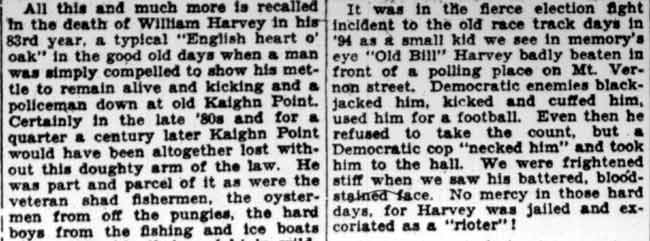
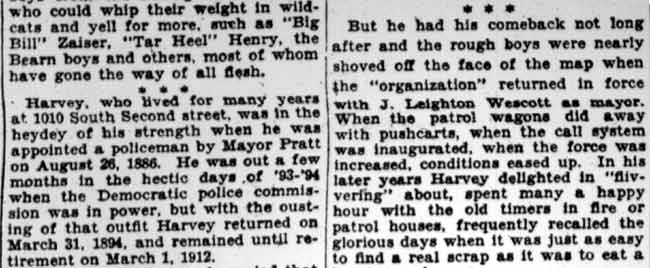
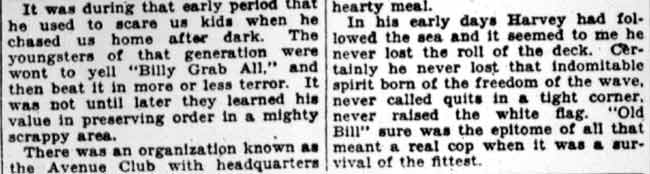
Along Memory Lane by Ben Courter. Names mentioned: William Harvey, Jesse Pratt, and J. Leighton Wescott.
Along Memory Lane: The Spite Wall
Camden Courier-Post —
“Wonder if they’re going to take down the spite wall?”
I have heard this query repeated half a dozen times since announcement has been made the old “mansion” of the late Dr. A.E. Street, southeast corner of Broadway and Stevens Street, is to be demolished to make way for a 12 story office structure. This razing is to be scheduled to begin within two weeks. The “spite wall” is on the extreme eastern boundary of the property plumb up against a 3 story apartment house built by the late George Holl.
Dr. Street, who died less than a decade ago, was one of Camden’s leading dentists. Son of “Father” Street, venerable superannuate of the New Jersey M.E. Conference. When the mansion was constructed, nearly two score years ago, it was indeed one of the show places along Broadway, for Dr. Street took particular pride in the architectural embellishments in the floral surroundings.
At the other end of the square, Broadway and Benson streets, Holl had erected his home. It was and is for that matter, a two-story brick with mansard roof and setting back from Benson Street. That side yard Holl likewise embellished with flowers of the season. It was the delight of anyone with half an eye to beauty from early spring to late fall. It started with great beds of tulips. It closed with chrysanthemums with alluring blossoms throughout the summer.
Street and Holl were regarded as among Camden’s most substantial citizens, one in the art of dentistry, the other as the builder of homes. They were fairly good friends until Holl built the block from Mickle Street to Stevens Street, since known under his name as the Holl Block. When Street built his then pretentious home, Charlie Curry informs me, he had an agreement with Holl that in the event of the then old circus lot being built up, it would not encroach on his view.
But when the building operation was about to begin Street saw that the dwellings and stores were going out to the usual building line. That would have cut off his view. He refused to permit that plan to go through and held Holl to his agreement, thus accounting for that block standing so far back from the curb line.
In the intervening years there was something of a truce, but warfare broke out anew when Holl in 1901 concluded to construct an apartment house just east of Street’s rear boundary. Apartment houses then in Camden were something of an innovation. Street didn’t like the idea and when he learned it was surely going up he took action.
He ordered the spite wall built.
There were expostulation, appeals, court action and other efforts to stay that wall, but Street, though a devout churchman and widely known for his charities, refuse to be, what he asserted, a victim of encroachment on his rights.
Thus he awarded the contract and one brought day a force of masons started the work. It created a local sensation, but the work went on apace and eventually the was finished as was the apartment house. Thus through all these years that solid bit if brickwork has stood within a couple of feet of the west side of the apartment, giving the lower part a prison-like effect. But as time went on it was quite forgotten and those who have resided in the apartment have taken the wall philosophically.
Those who knew Dr. Street were not surprised he took such drastic action. Though he was one of the pillars of the Broadway church, in fact I recall how he started the fund to rebuild the present great edifice at Broadway and Berkley Street by a $1,000 subscription, he was peppy as they make ‘em and refused to permit anyone to “walk over him.” He felt perfectly justified in building that wall.
So naturally the demolition of the “mansion” brings up that query
“Wonder if they’re going to take down the spite wall?”
Names mentioned: Rev. Abram K. Street — Dr. Abram Emory Street — Charlie Curry — Broadway M.E. Church — Stevens Building
Along Memory Lane: Old Eighth Street Swamp
Camden Courier-Post —
Old Eighth Street swamp is dwindling.
Not much is left only a small area of Eighth Street east of the Pennsy tracks and north of Van Hook Street.
Combination of civic-realty activity spelling the doom of the morass that once extended near the present eastern boundaries of the West Jersey Hospital.
It seems odd to those familiar with the acres of swampy wilderness of yesteryear to see the labor army pushing through streets where the frog chorus once sounded its dulcet strains, where the water moccasin once slithered through tussock and reed, where vagrant bobolinks and red-winged blackies stopped for tragic rest.
But it is a fact the cherished dream of many a South Camdenite of the long ago who hoped to see the day when the swamp would be but a memory.
Those new streets, actually extensions of connecting links of thoroughfares already long on the city map, are expected to result in the development of that area, bring something suggestive of a new community.
Long ago the swamp extended from the river to near Mt. Ephraim Avenue. It was called Eighth Street Swamp mainly for convenience because that street was one of the many cut off by the expanse of low ground.
Line Ditch was the feeder. The late Aaron Ward, one of Camden’s prominent contractors years ago, told me that barges loaded with brick were at one time floated up to where the Pennsy tracks now are located.
That stream, subject of many a malediction in later years when industrial progress had transformed into a semi-liquid abomination then was clean and clear as crystal.
It was fed by many a spring, and when the flood tide of the Delaware came in the water spread over the country sometimes forming a lake of many acres.
There were times when old Centerville seemed utterly isolated from Camden, when Ferry avenue, Broadway, and the railroad tracks were the only narrow causeways between the two sections.
Back toward Mt. Ephraim Avenue, then but a yellow gravelly ribbon stretching down to Mt. Ephraim and Blackwood, were the “bluffs,” relatively high ground usually covered by small growths. These have been graded, most of the material now resting as fill along the Crescent Boulevard.
No one man dreamed of filling in the swampy expanse. For a quarter of a century, the Board of Health discussed, re-discussed, and again discussed clearing up the morass. Abutting property owners when they could be found were cited to show cause why they didn’t fill their lowland.
And in more than one case the Board was told to take the land and so it if the city was so anxious. Eventually they were taken at their own invitation and the city did much filling and grading and built the $80,000 sewer that rid the section of Line Ditch.
Thus the Ditch disappeared. It was the first real step towards excavation, toward what is done today in the construction of streets, in grading to make way for homes, in creation of a community that will figuratively weld South Camden and its ancient rival Centerville, now the Eighth Ward.
Along Memory Lane: Fetters School and the Melting Pot
Camden Courier-Post —
It is not so many years ago, old timers say, since Fetters School at Third and Mount Vernon Street was considered large enough to accommodate youngsters for several generations. Now a six-room annex is to be built on the north side facing Walnut Street. Back in 1905 five rooms were added in the annex on Mount Vernon Street. With the new structure the school will contain 19 rooms, which would have thought far too large for a high school in the 90s, when Camden had its first experiment in that line. That was in the old Federal Street building later occupied by the Post-Telegram
Half a Century Ago
When Fetters School was built in 1875 it was considered about the last word as far as a school structure went. It was of stone, solidly constructed and furnished with gas, running water, and everything then regarded as thoroughly modern. The largest school downtown was the old Kaighn building on Newton Avenue, until the 1870s ample for the Kaighn Point area.
There were plenty of open lots when the Fetters School was built. Those days Camden was something of a struggling community with districts that had not yet lost their individuality. As a pupil in the early 90s in old Fetters I recall the section had many open spaces. Nothing remotely suggested the part-time classes was then necessary, certainly not thought of by Professor Horatio Draper, of blessed memory, who guided Camden’s educational system more than 30 years before he was displaced by the late Mayor Hatch at the close of the last century
The Melting Pot
Nothing had then been heard of a “melting pot” as applied to America and its schools. But around Kaighn Point even in the 80s there was the first evidence of a great influx of those from across the seas who were soon to follow the old families, who’s children were to enter that melting pot and become transformed into American citizens
The Fuhrmans, Auerbachs, Lichtensteins were among the first I recall. Many others followed; especially from the Russian Polish district where life was hard and oppression severe. Came the immigrant wave from South Italy whose descendants long since have taken possession of the district spreading from Third and Pine, once the stronghold of English, German, and Irish families. In a police census a quarter of a century ago it developed that the Fifth Ward could boast representatives from every nation on the face of the globe, even to a Finlander, some Turks with Japs and Chinese commonplace.
It was about the period when Miss Clara S. Burrough, long principal of the High School and now recovering from an operation in Cooper Hospital, was principal of Fetters that the big change came that the classes were composed largely of children of foreign parentage. Often they did not know a single world of English. Teachers had their problems and Miss Burrough will undoubtedly recall the great task involved in really making the “melting pot” down there in the old school at Third and Mount Vernon Street effective. But she and the valiant corps under here direction tackled it and by the time Miss Burrough was elevated to the principalship of Camden High, a very deserved promotion, by the way, the problem had been totally solved.
Hot Times in the Old Town
Incidentally Miss Burrough will likewise recall the hectic conditions in more ways than one for the period marked turmoil in the educational world hereabouts. “Old Drape” had been fired overnight by Hatch, indignation meetings were held, demands were made for his reinstatement but the Committee of Public Instruction, headed by the late C.S. Magrath, named by Hatch, naturally followed his direction. Martin Scheibner, a long, white-whiskered veteran of the Civil War, was named as Draper’s successor. But it was worse than handling a drove of wild horses. He venerable professor soon bowed out of the scene. It was not until the advent of Professor James E. Bryan that something like peace came. Bryan’s firm hand plus extraordinary ability and a determination not to surrender despite scholastic bedlam finally won.
But even yet, old friends of “Drape’s” who knew him in Fetters or in the makeshift “high school” have not forgotten the bitterness, have not forgiven the shabby way in which that fine Southern gentleman was treated. I recall him down at Fetters, sometimes with his setters on which he placed much store; often with a humorous story, which probably didn’t contribute to strict school discipline but which certainly left fragrant memories of days long ago.
Names mentioned: C.S. Magrath — Martin Scheibner — Fuhrman Family — Lichtenstein Family
William Leonard Hurley Dies at Hilton Head, S.C., Winter Estate
Camden Courier-Post (Evening Courier) —
HURLEY BASED SUCCESS IN LIFE AND IN BUSINESS ON SQUARE DEAL TO ALL
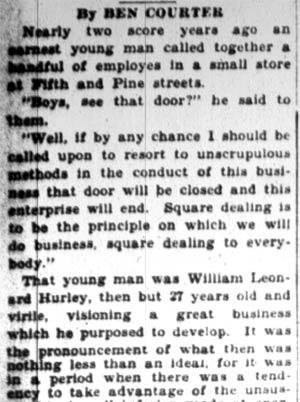

Named: Camden Courier-Post, Evening Courier, April 23, 1928. Names mentioned: Charles Leo McKeone, Dr. Wilson G. Bailey, Dr. Roland Haines, Alfred L. Sayers, Federal Street, Haddon Avenue, Mount Ephraim Avenue, Broadway, Line Street, West Street, Turner Hall, William Kairer, Theodore Lambert, George Leathwhite, Cooper B. Hatch, 27th Street, Federal Street, Pine Street, Stevens Street, and Hilton Head.
Along Memory Lane: The Waning of the Old Bike Days
Camden Courier-Post —
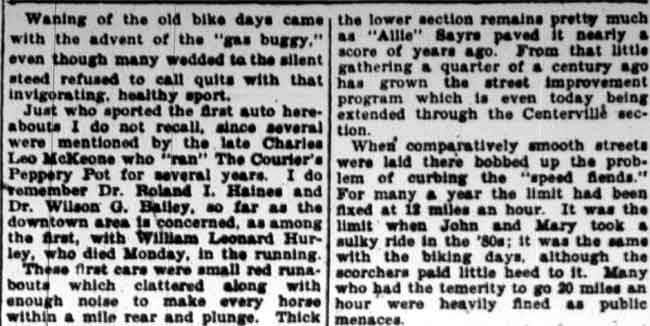
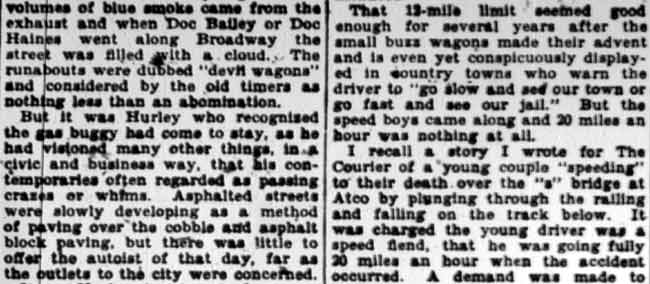
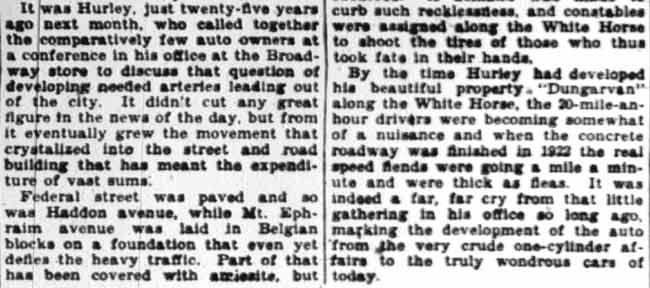
Along Memory Lane by Ben Courter. Names mentioned: Charles Leo McKeone, Dr. Wilson G. Bailey, Dr. Roland Haines, Alfred L. Sayers, Federal Street, Haddon Avenue, and Mount Ephraim Avenue.
THRONGS MOURN AS W.L. HURLEY IS LAID TO REST
Camden Courier-Post (Evening Courier) —
Thousands Pay Tribute To Merchant Prince at Home In Collingswood
SOLEMN REQUIEM MASS AT ST. JOHN’S CHURCH
Many Follow Funeral Cortege to Mausoleum in Calvary Cemetery
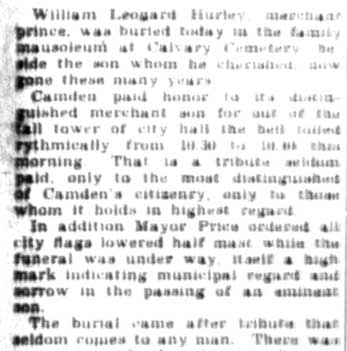
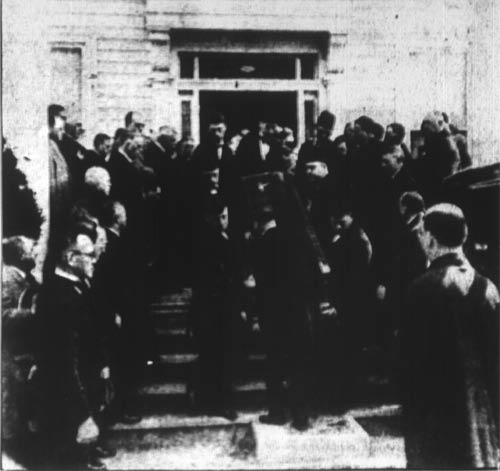
William Leonard Hurley, merchant prince, was buried today in the family mausoleum at Calvary Cemetery, beside the son whom he cherished, now gone these many years. Camden paid honor to its distinguished merchant son, for out of the tall tower of city hall the bell tolled rhythmically from 10:30 to 10:40 this morning. That is a tribute seldom paid, only to the most distinguished of Camden’s citizenry, only to those whom it holds in highest regard.
Along Memory Lane
Camden Courier-Post (Evening Courier) —
Named: Levi Farnham, Charles Leavitt, Joseph Nowrey, David Rose, William “Billy” Thompson, Will Paul, James Fitzgerald, and Charles Shuck.
Along Memory Lane — Camden's Police of 1880
Camden Courier-Post —
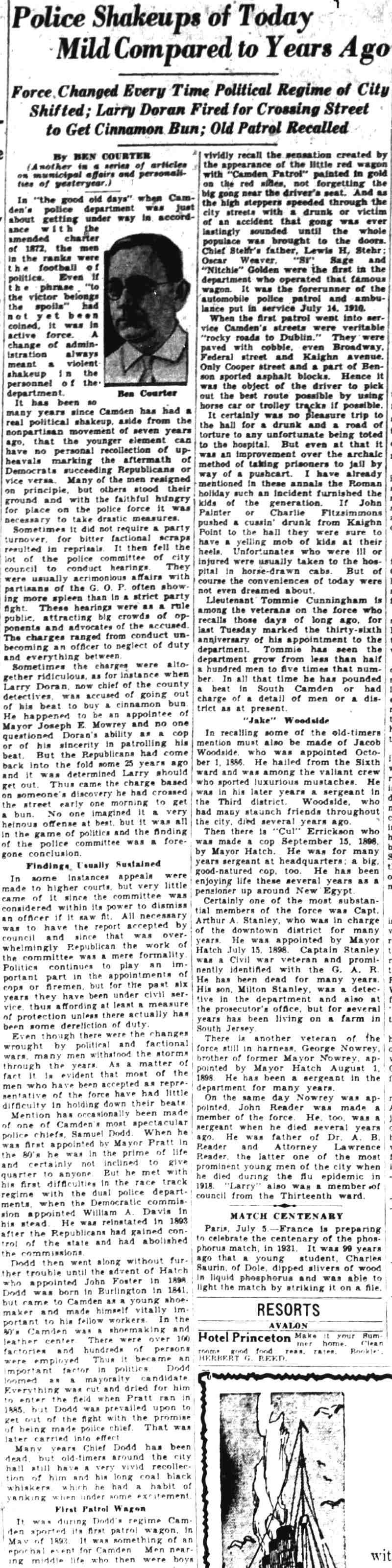
Named: Benjamin W. Courter, Lawrence Doran, Joseph Nowrey, Samuel Dodd, William H. Davis, Jesse Pratt, John Foster, Cooper B. Hatch, Lewis H. Stehr Sr., Richard Golden, Oscar Weaver, Josiah Sage, John Painter, Charles Fitzsimmons, Thomas Cunningham, Jake Woodside, Cullis Errickson, Arthur Stanley, Milton Stanley, George Nowrey, Dr. A.B. Reader, and Lawrence Reader.
Here's Camden's Finest, With Whiskers, in 1898
Camden Courier-Post —
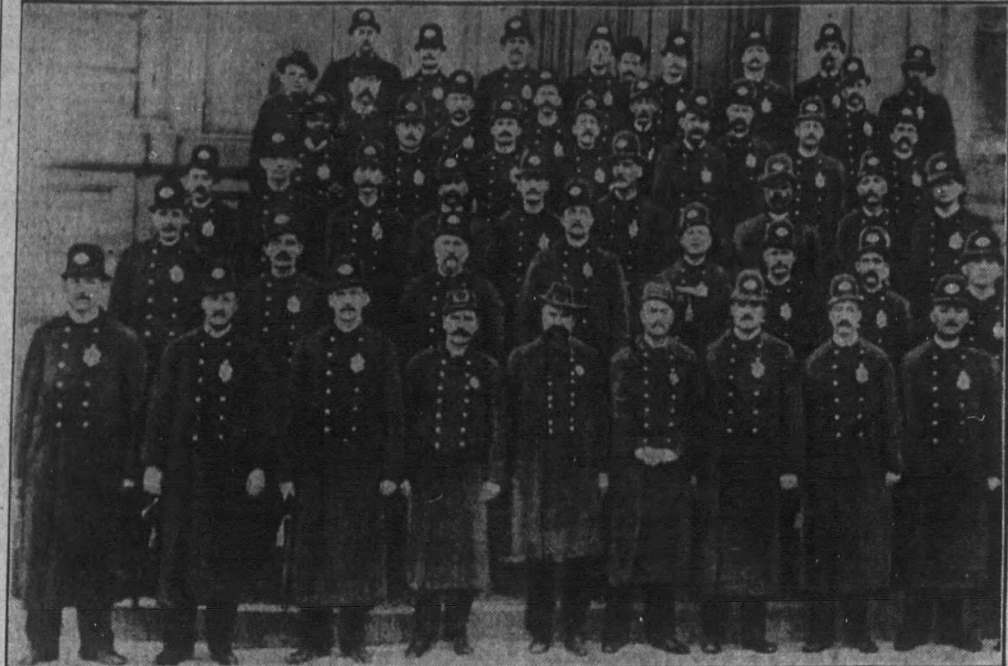
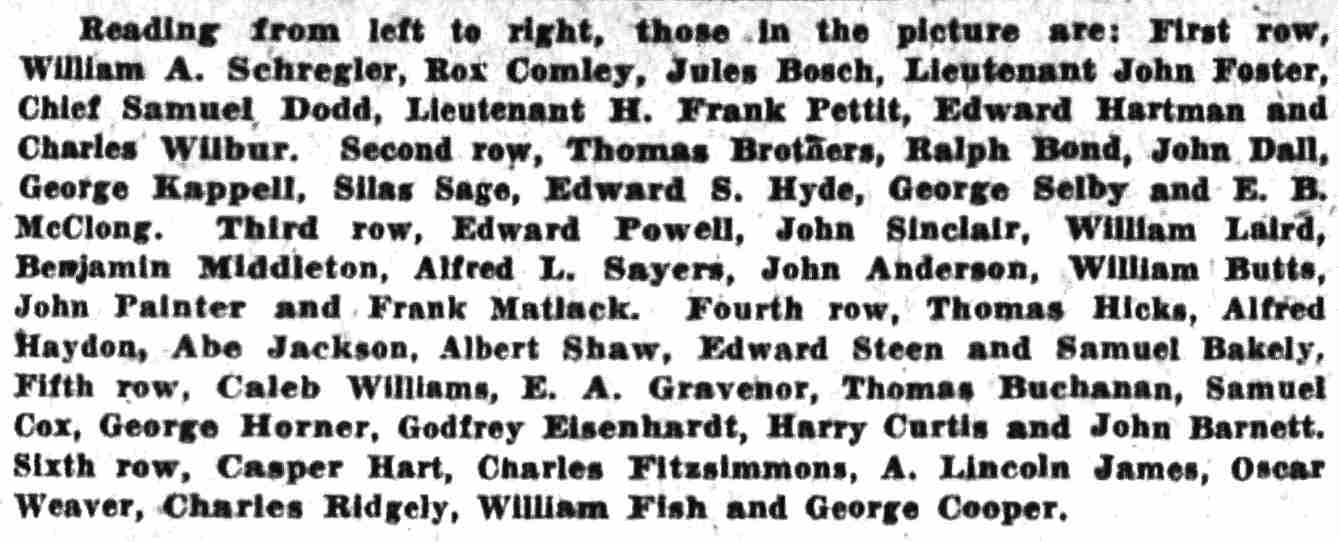
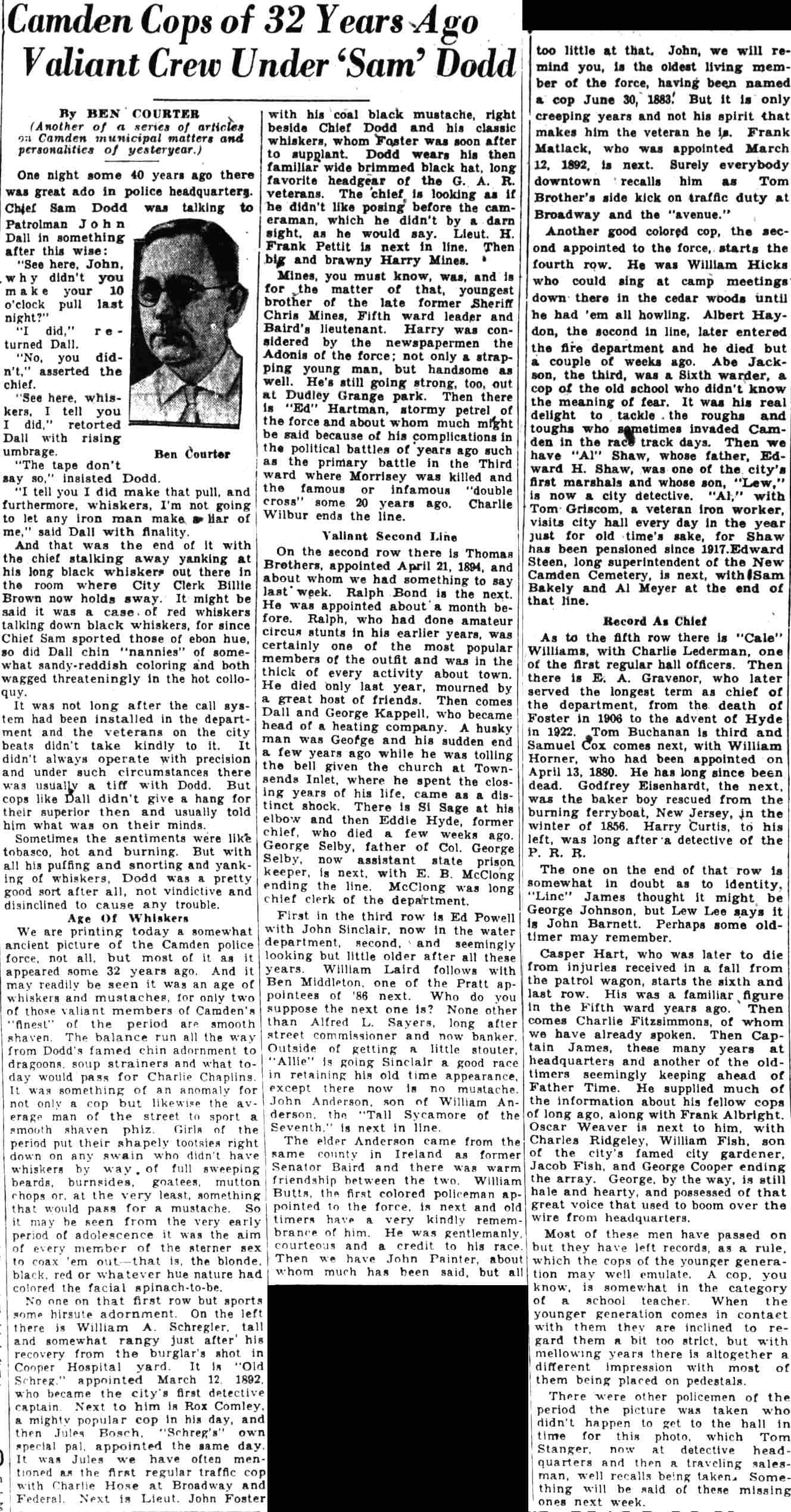
Here’s Camden’s Finest, With Whiskers, in 1898
Reading from left to right, those in the picture are: First row, William A. Schregler, William “Rex” Comley, Jules Bosch, Lieutenant John Foster, Chief Samuel Dodd, Lieutenant H. Frank Pettit, Edward Hartman and Charles Wilbur. Second row, Thomas Brothers, Ralph Bond, John Dall, George Kappell, Josiah Sage, Edward S. Hyde, George Selby and E. B. McClong. Third row, Edward Powell, John Sinclair, William Laird, Benjamin Middleton, Alfred L. Sayers, John Anderson, William Butts, John Painter and Frank Matlack. Fourth row, Thomas Hicks, Alfred Hayden, Abe Jackson, Albert Shaw, Edward Steen and Samuel Bakley. Fifth row, Caleb Williams, E. A. Gravenor, Thomas Buchanan, Samuel Cox, George Horner, Godfrey Eisenhardt, Harry Curtis and John Barnett. Sixth row, Casper Hart, Charles Fitzsimmons, A. Lincoln James, J. Oscar Weaver, Charles Ridgely, William Fish and George Cooper.
Four Prominent Physicians
Camden Courier-Post —
Reminiscences of Drs. Godfrey, Iszard, Davis and Gross, All Leaders of Their Profession in South Jersey
SINCE these annals of medical men in Camden county have appeared, other residents have occasionally asserted this or that physician, their family doctor half a century ago, has been forgotten,
“What’s the matter with Doc So-and-So?” they have asked, and they have usually added, “He was the best doctor in typhoid” or whatever ailment was probably cured in their own particular household. The particular physician’s victory over a malady which prolonged the life of some kin has evidently been handed down through the years as such an outstanding accomplishment that if monuments were in order it is unquestioned Camden would be liberally sprinkled with them. It likewise is certain that when family physicians were more the order of the day in lieu of the present tendency to develop specialists, the medical man’s clientele stuck to him through two or three generations and usually placed him on a figurative pedestal at least.
Doctor of 50 Years Ago
Fifty years ago one of the city’s leading physicians was Dr. E. L. B. Godfrey, whose office then was at 621 North Second Street. He was born in Cape May, February 2, 1850. After graduating at the Hightstown Institute, he took up the study of medicine with Dr. E. L. B. Wales, at Cape May.
Later he entered Jefferson College, graduating in 1875, serving his term as intern at the Rhode Island Hospital, Providence. He reached here the next year and immediately became one of the most active men of his profession, being on the surgical staff when Cooper Hospital was opened in 1887. He also was lecturer on fractures at the Medico-Chi Hospital in Philadelphia, was major and surgeon of the Sixth Regiment, National Guard, served as president of both the city and county societies and contributed authoritative papers to medical journals.
One of the early county physicians of Camden was Dr. William H. Iszard, a native of Gloucester County, where he was born in 1842. In 1862 he entered the service of the government as a medical cadet, being stationed at the hospital on Broad Street, Philadelphia, entering Jefferson College the following year. He was considerably hampered through ill health, but after much interruption graduated in 1870. He first located at Elmer, but soon afterward came here and opened an office at 411 North Fourth Street, where he practiced for many years. He was active in political work, being one of the first presidents of the Camden Republican Club, which long had its headquarters on Cooper Street above Third, and where many of the national figures in the party were occasional guests. He not only was welcome to any sick room but popular about town because of his affability and general all-around good fellowship. William H. Iszard, the realty man and prominent Elk, is a surviving son. Dr. Iszard died a couple of years ago in his eighties, mourned by many an old-timer.
Dr. H. H. Davis
Contemporary with him was Dr. Henry H. Davis, whose name is still identified with all that means health protection for Camden’s school children. For a generation he was either identified with the Board of Health as its president or the schools as chief medical officer. It was he who was largely responsible for rules guarding young pupils in public schools.
Prior to his activities not much attention was paid to ailing youngsters. If they had poor eyesight they were just as liable to be seated far from the blackboard, if their record put them in that position. Not much attention was paid to the cause of their backwardness and if they couldn’t see the figures the teacher placed on the board failure was laid to natural dumbness. Not much attention was paid to chronic sore throats, bad teeth or other imperfections, but when Dr. Davis was placed in full charge of the schools he changed all that and children who have passed through the classes in the past quarter of a century owe much to this veteran medical man whom fate ordained should be killed by an auto in his eightieth year. It was through his efforts clinics were established where poor eyesight might be corrected and other deficiencies looked after by the hospitals or dental men.
Dr. Davis was born at Crosswicks, August 16, 1848, and became a student of pharmacy in the office of Dr. Alexander Mecray in 1867, entering Jefferson College in the fall of that year. He graduated two years later, courses then being half of the present requirements, and began practice here. For many years he had his office at Third Street and Kaighn Avenue. Two young men whose preceptor he was, Dr. Harry Jarrett and Dr. Rowland I. Haines, afterwards ranked among Camden’s leading physicians. Dr. Davis was active in the county society, was a former coroner and for many years identified with many of the city’s activities.
Dr. Onan B. Gross
Arch Street at one time was among Camden’s leading residential thoroughfares, although in these days, with most of the old dwellings either gone or in a state of dilapidation that perhaps would be difficult to believe. Half a century ago some of the city’s best known professional men resided there, among them Dr. Onan B. Gross, who had his office at 407 Arch Street. In later years he was located at Seventh and Federal Streets.
Dr. Gross was a native of Ephrata, Pa., where he was born February 19, 1851. He entered Ephrata Academy but when he was 17 he was thrown on his own resources and apprenticed as a carpenter. He served his time and worked as a journeyman, but he sought a medical career. Through hard work and rigid economy he saved enough to enter the University of Pennsylvania in 1875, graduating three years later. His ability was recognized even then for he was assistant demonstrator in anatomy in the last two years of his course, the first time such an honor had been given one not yet a graduate. In the year of his graduation he received a prize for skill in dissection work.
Dr. Gross was county physician three years, president of the county society, a surgeon at Cooper Hospital, member of the board of managers of the City Dispensary and identified with the various medical groups of the period.
Along Memory Lane
Camden Courier-Post —
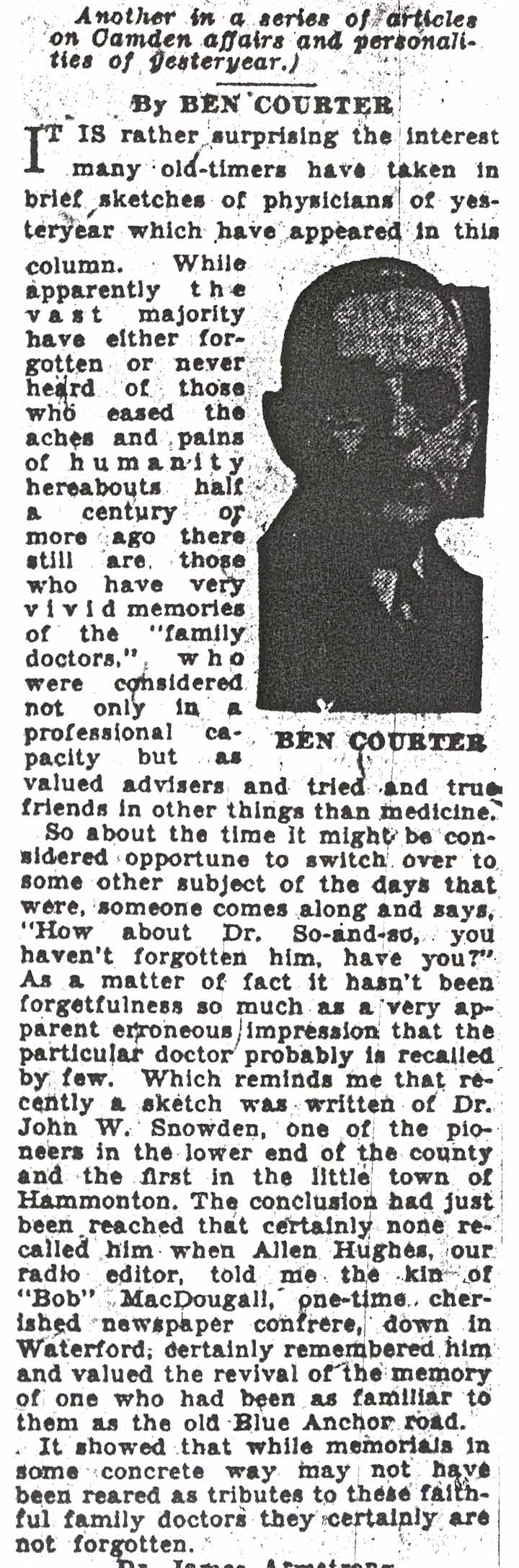
Named: Ben Courter, Dr. John W. Snowden, Dr. James Armstrong, Allen Hughes, Bob MacDougall, Market Street, and Dr. William G. Taylor.
Along Memory Lane
Camden Courier-Post —
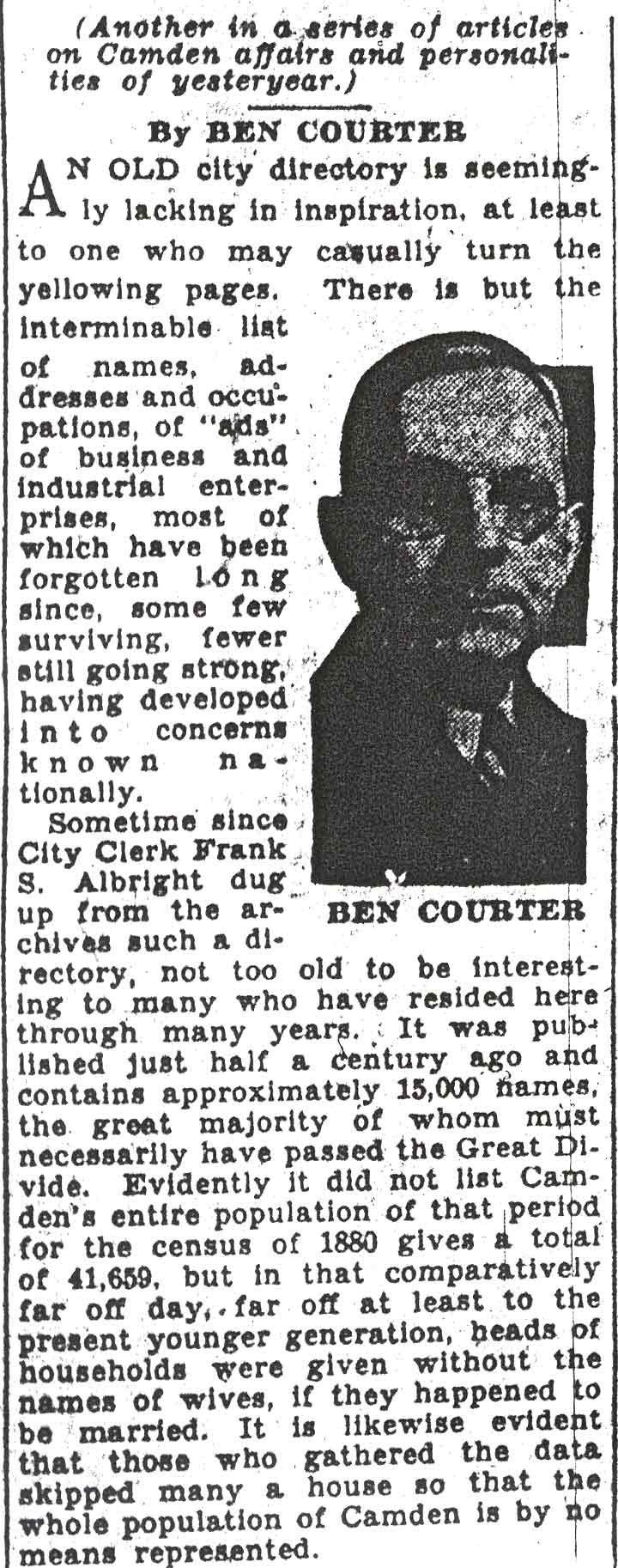
Named: Ben Courter, Frank S. Albright, Jesse W. Starr, Claudius W. Bradshaw, Benjamin F. Archer, Jesse Pratt, Fred Tarr, Joseph C. Nichols, Jacob Daubman, Joseph Bontemps, John J. Welsh, Frank F. Michellon, Richard C. Thompson, John D. Courter, D. Cooper Carman, Henry B. Wilson, Peter Voorhees, Colonel George G. Felton, and Kaighn’s Point Ferry Company.
Along Memory Lane
Camden Courier-Post —
FROM AN OLD DIRECTORY
The Young Syndicate
‘Coop’ Carman and Willard Morgan Led Movement for New Blood in G.O.P. Culminating in Bitter Battles of Race Track Days
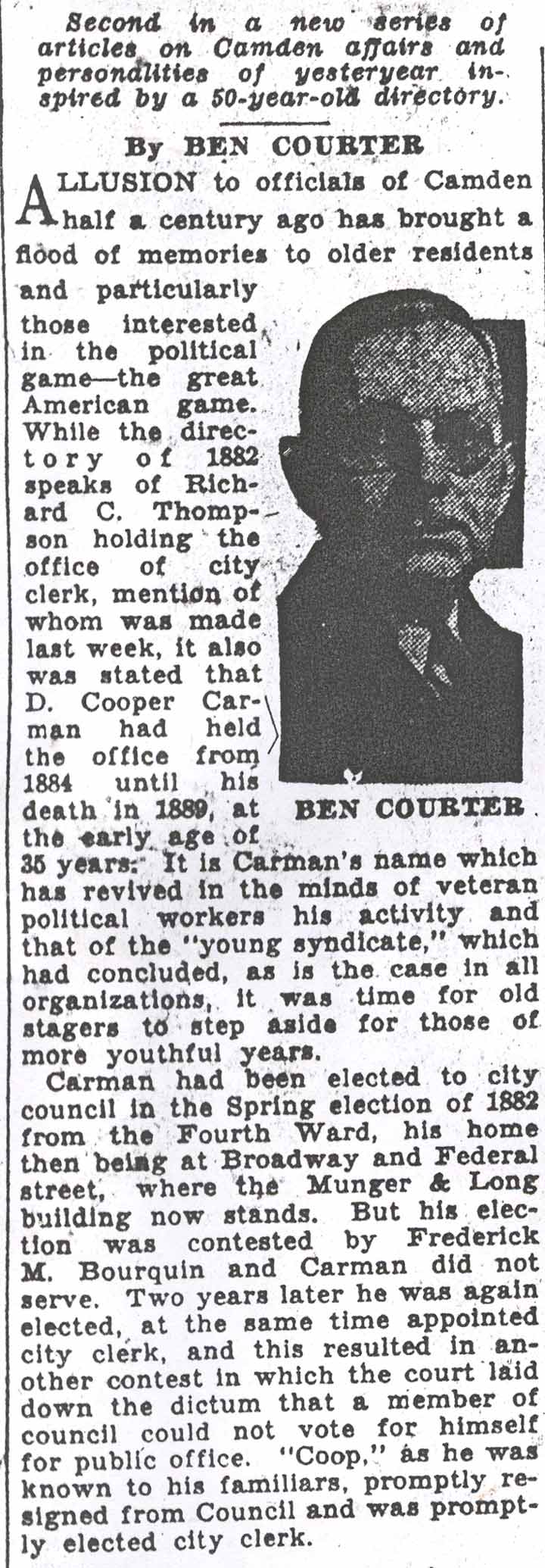
Second in a new series of articles on Camden affairs and personalities of yesteryear inspired by a 50-year-old directory.
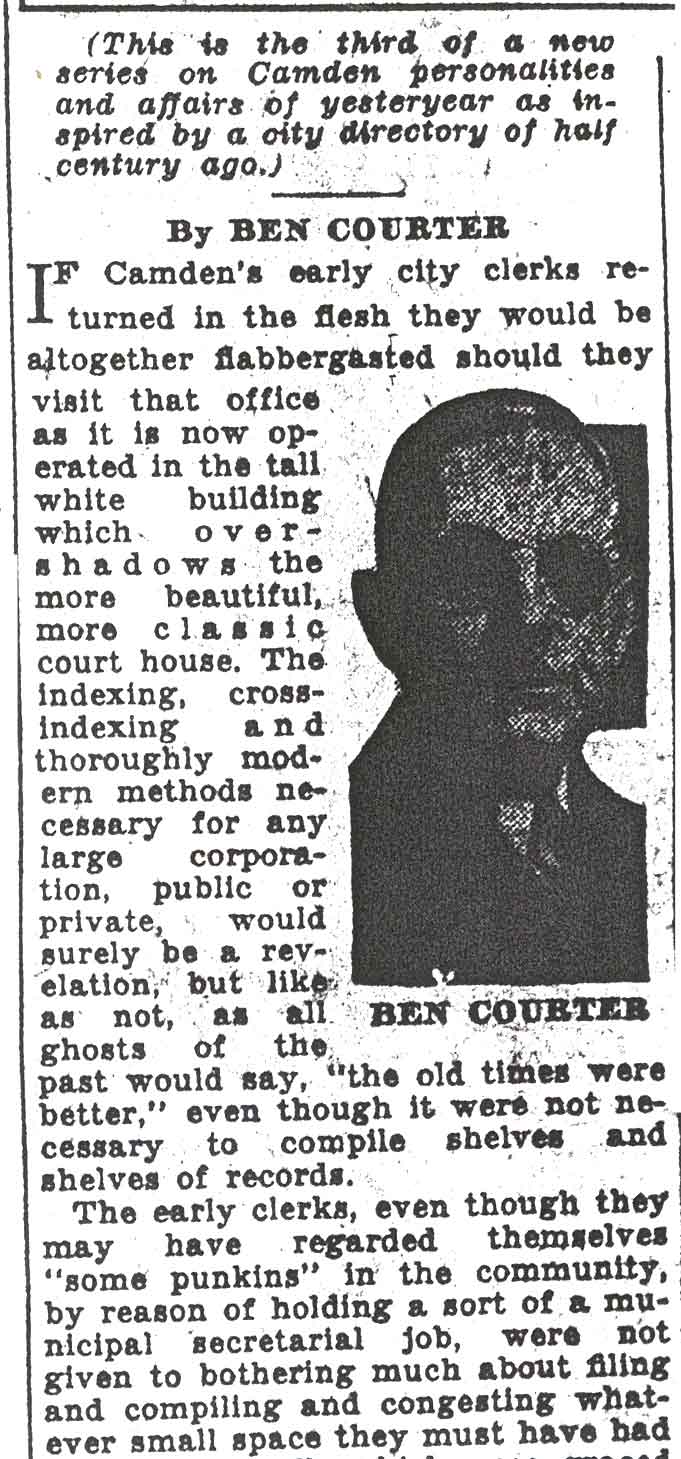
By BEN COURTER
Allusion to officials of Camden half a century ago has brought a flood of memories to older residents and particularly those interested in the political game—the great American game. While the directory of 1882 speaks of Richard C. Thompson holding the office of city clerk, mention of whom was made last week, it also was stated that D. Cooper Carman had held the office from 1884 until his death in 1889, at the early age of 35 years. It is Carman’s name which has revived in the minds of veteran political workers his activity and that of the “young syndicate,” which had concluded, as is the case in all organizations, it was time for old stagers to step aside for those of more youthful years.
Carman had been elected to city council in the Spring election of 1882 from the Fourth Ward, his home then being at Broadway and Federal street, where the Munger & Long building now stands. But his election was contested by Frederick M. Bourquin and Carman did not serve. Two years later he was again elected, at the same time appointed city clerk, and this resulted in another contest in which the court laid down the dictum that a member of council could not vote for himself for public office. “Coop,” as he was known to his familiars, promptly resigned from Council and was promptly elected city clerk.
The “Young Syndicate”
With Carman, as former City Clerk William D. Brown recalls, was associated J. Willard Morgan and Henry M. Snyder, something of a balance between the two.
That combination carried things along pretty much as they pleased for a time and as one of the developments Maurice A. Rogers, down in the Fifth Ward and a councilman, was taken up as a Senatorial candidate against Colonel George Pfeiffer, Jr., a decade later to be the builder of Camden’s artesian water plant. The colonel, long one of Camden’s most popular men, had defeated the Republicans as a result of the factional fight between Henry L. Bonsall, editor of the Post, and Thomas Dudley, famed consul to Liverpool during Civil War days. But with the “young syndicate” back of him, Rogers won the Senate seat in 1890, taking his office January 1, 1891.
But in the meanwhile Carman suddenly died at his mother’s home, at 11.10 on the night of September 11, 1889. At the time apoplexy was given as the cause. His sudden demise caused a profound shock and at his funeral four days later leaders in business and politics paid homage, with such men as Gen. William J. Sewell, Sinnickson Chew, Howard Carrow, Wilson Jenkins, E. A. Armstrong, B. M. Braker and many others attending. The bell in the old City Hall tower tolled as the cortege passed on the way to old Camden cemetery. And even yet, after these more than four decades, “Coop” Carman is quite vividly recalled by those who were then active on the political stage.
Carman’s Death Big Loss
Carman’s death was a big loss to the “young syndicate,” but it did not halt its activity. Since Rogers had won so easily in the 1890 election it was concluded there would be nothing to it when he was renominated for another two-year term. Rogers was by no means friendly to “Billy” Thompson’s race track, then in the heyday of its popularity with the sports of Gloucester City, a period when that community had all the earmarks of a wild and wooly western city, attractive to thousands of lovers of horseflesh, touts, gamblers and the usual hangers-on.
Thompson concluded it would be far better to have someone in the Senate from Camden county who would regard his interests with more favor than Rogers.
Thus he decided on Frederick A. Rex, his personal counsel, a very able young attorney, and a Republican. Since at that time the Democratic police commission was in control of the cops it was considered easy to get possession of the polls. As Brown recalls it, the rivals of Rogers planned a “zero hour” at which cops, at the crack of a pistol, were to descend on polls considered close at the primaries, frighten off the regular voters and corral enough to elect Rex.
Particular effort was to be made to sweep the Sixth Ward, where Thad Varney, elected city clerk to succeed Carman, was “boss,” and thus give him a political black eye. In Varney’s precinct in particular when the rumpus started “Brockie” Deno and “Al” Haydon, both widely known firemen now dead, grabbed the ballot box, lowered it down a chimney, fished it out when the racket was passed, went to Avis’ livery stable, and later to Varney’s home, where the votes were counted. In these sophisticated days such counting would unquestionably not be considered “according to Hoyle,” but then anything went just so the particular faction had its bag of tricks in effective operation. Anyhow, Rogers won the primaries, but there still was the general election to hurdle and Thompson was by no means beaten. He had plenty of money and many followers, some sincere, many just sycophants.
Repeaters Foiled
It was charged a scheme was on foot to bring repeaters from Philadelphia, not an unusual procedure in the political game of Camden years ago in either party. One of the “young syndicate’s” lieutenants learned the plot, told General Sewell, who sent the informant to Dave Martin, then Philadelphia’s political boss, who heard the story. The upshot was General Sewell himself saw Martin later, who was quite willing to aid Jersey’s G.O.P. leader, flooded Camden with sleuths from over the river and such close tabs were kept on the repeating army its efforts were halted from the very dawn of that very stirring election day. Rogers was elected, was made president of the Senate and for a time loomed so large on Jersey’s political horizon he had gubernatorial aspirations, but they never were realized.
Thus out of the old yellowed book
Frank Albright, city clerk of the present epoch, dug from the archives memories are revived of a very gallant young politician, “Coop” Carman, and some of the stirring incidents that make up Camden’s political history. The “young syndicate” was just one of the episodes, as the first “reform” outbreak in 1882, or the Committee of 100 scrap of 1897, or the Non-Partisan upheaval of ’23, but such never lose interest to those who have joined those movements with enthusiasm, even though they were often not altogether satisfied with what had been accomplished.
Along Memory Lane
Camden Courier-Post —
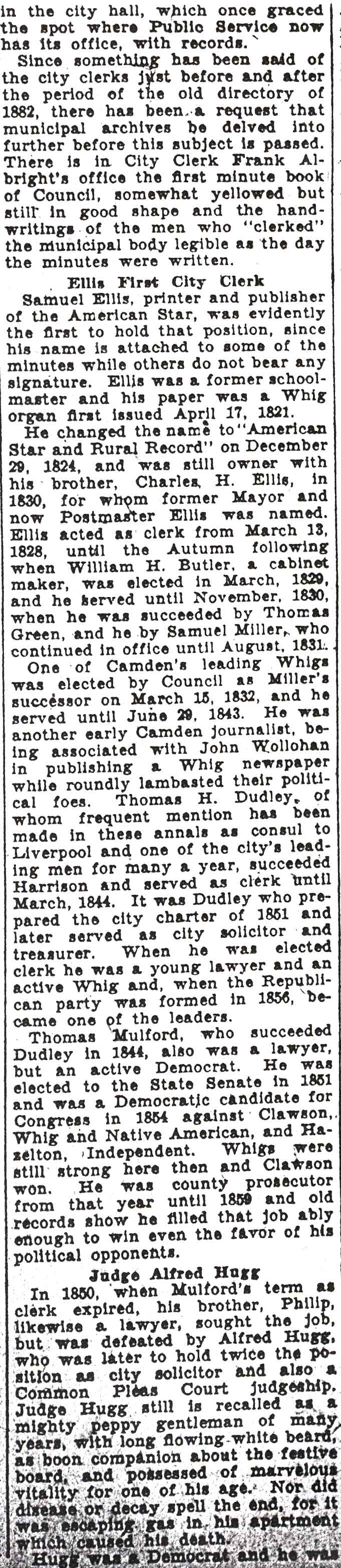
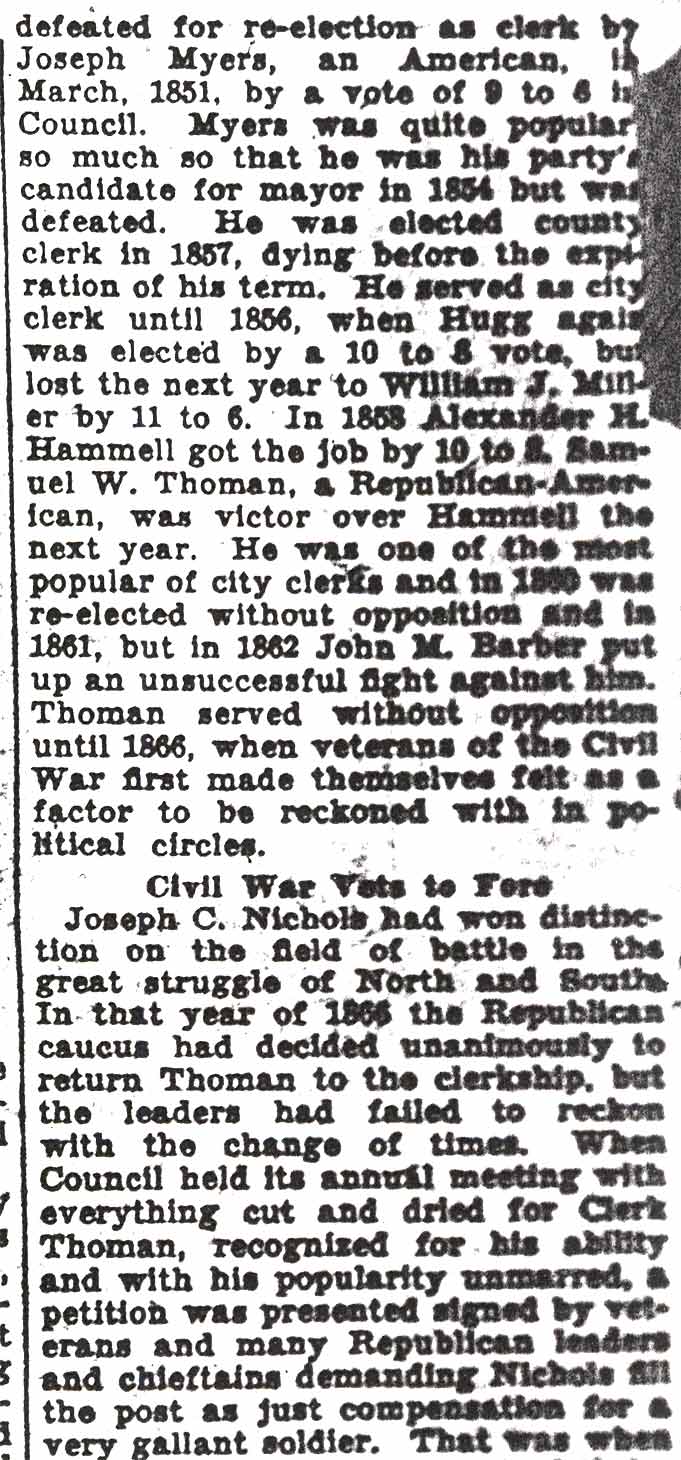
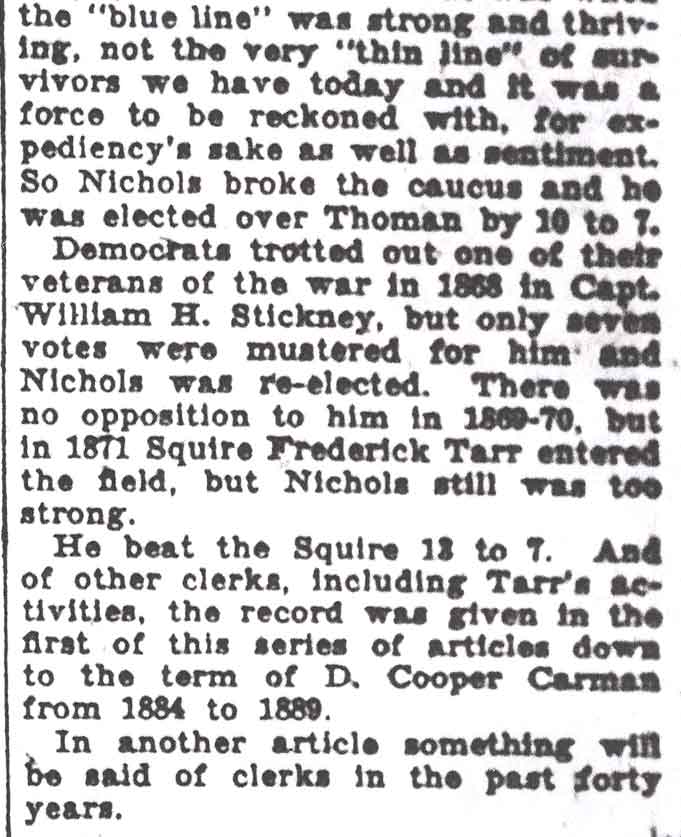
Named: Ben Courter, Frank S. Albright, Thomas Mulford, Philip Mulford, Alfred Hugg, Samuel Ellis, Charles H. Ellis I, William H. Butler, Thomas Green, Samuel Miller, John Wollohan, Thomas H. Dudley, Joseph Myers, William J. Miller, Alexander Hammell, Samuel W. Thoman, John M. Barber, Joseph C. Nichols, William H. Stickney, Frederick Tarr, and D. Cooper Carman.
Along Memory Lane — Robert A. Turner
Camden Courier-Post —
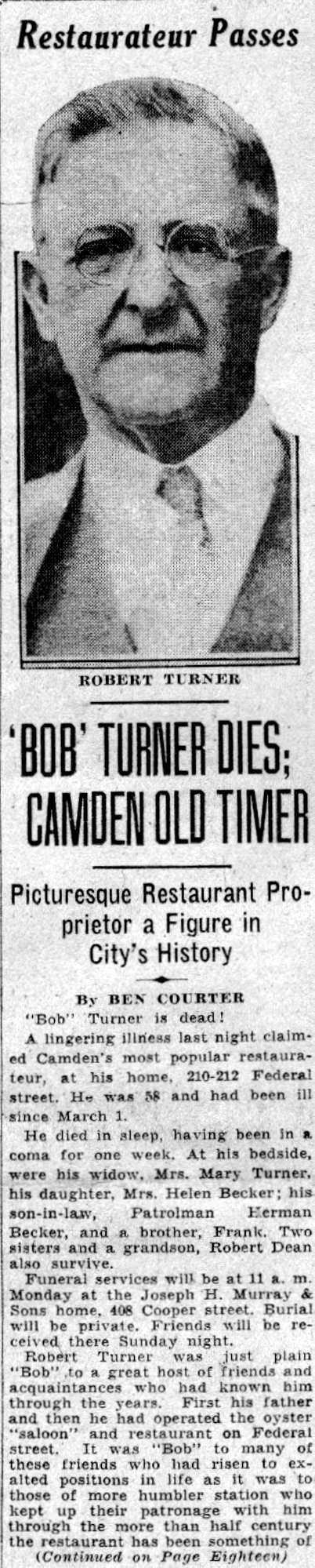
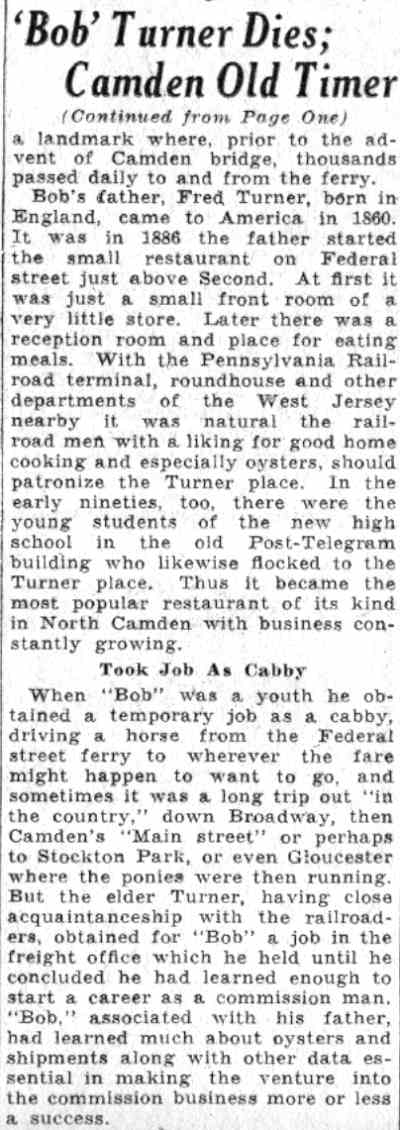
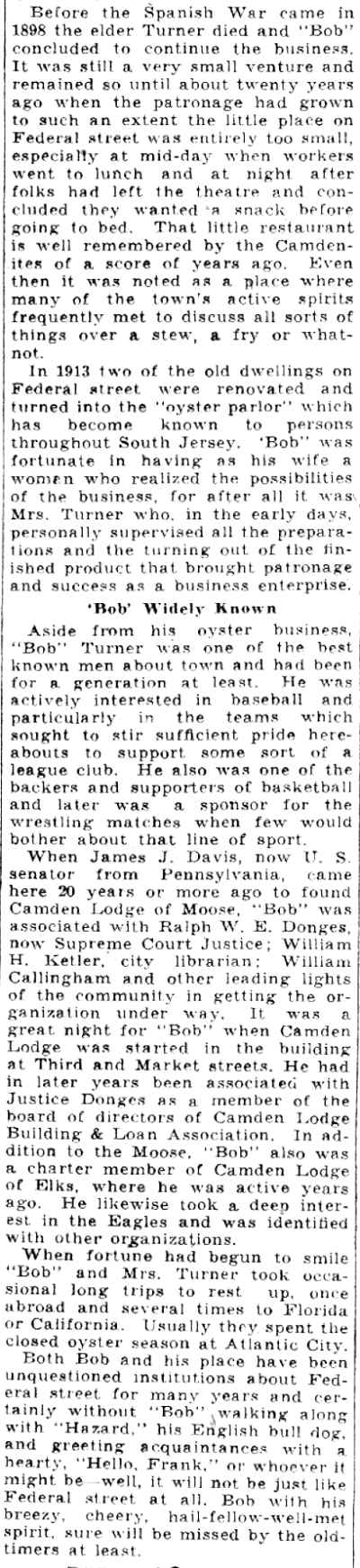
Named: Robert A. “Bob” Turner, Mary Turner, Helen Turner Becker, Herman Becker, Fred Turner, Frank Turner, Turner’s Oyster House, Federal Street, Camden Lodge of Moose No. 111, Camden Lodge No. 293 Benevolent Protective Order of Elks, Ralph W.E. Donges, William H. Ketler, and William Callingham.
Raid of McLaughlin's Flats
Camden Courier-Post —
Descent on Hangout of Hoboes and Routing of Tattered, Cussin’, Woozy Individuals Suggestive of Chasing Rats From Sewer
“McLAUGHLIN’S FLATS? Well, it’s a long time since I heard of ‘the flats’ and I doubt if a handful who now reside down around Third and Spruce streets recall them, at least as they used to be.”
NOTE: “McLaughlin’s Flats” were at 257–259 Spruce Street.
And Harry Kobus, grandson of Anthony Kobus who founded Camden’s oldest shoe store back in the 50’s, around Fourth and Spruce, was quite right. Harry is by no means yet in what may be called the “venerable class” and yet he has known old south Camden and that particular neighborhood even when “the flats” were blooming in all their glory. And as we talked about that notorious hangout for hoboes, tinkers, men and women who sought surcease from vain regrets in Gambrinus’ brew, which flourished in a malodorous way a quarter of a century ago, recollection was revived of one particularly sore spot when it came to the moral and temperance forces of Camden.
It likewise brought vividly to mind a visit with Captain Arthur Stanley and a squad of cops to “the flats” in an effective clean-up ordered by Mayor Ellis. It was one of those episodes suggestive of a Dickens narrative or of Burke and his Limehouse classics, one of which was done in the movies by Griffith. Originally “the flats” were conceived some 50 years ago with the idea of providing rooms or apartments for the middle class families down that way. There still resided along Pine, Spruce, Division and from Front to Broadway many of the families who had come from England, Ireland or Germany and they formed the bulwark of the old Middle Ward.
Down-and-Outers Hangout
A Jimmie McLaughlin [266 Spruce Street in 1872], I have been told, was the builder, but his plans did not seem to go through with all the success he had anticipated, whatever the case may have been “the flats” 40 years ago had become the rendezvous of the down and outers. There might be found David and Sarah Valliere who were known to the police as the king and queen of the hoboes, and they are recalled as frequenters of the police court when “Joe” Nowrey and Glen Stackhouse presided over that tribunal. It was difficult to discern anything even remotely suggestive of regal bearing on the part of these two whose main object in life seemed to be to find some liquid refreshment that likely transformed the flats for the time being into something of a palace, with minions joining in the celebration until there was the usual windup by way of a free for all and battered heads. These celebrators often made “the flats” a fearful place to visit, at least on the part of those who were unaware such a place existed in the city.
Incidentally, it was just opposite the flats, at the southeast corner of Third and Spruce streets, where Spence R. Darr [William Spenser Darr], a popular colored justice of the peace, was murdered in the early 80’s by a white man summoned for wife beating. The slayer blew out his own brains and thus saved the county the expense of trial. Darr was given one of the largest funerals South Camden ever witnessed with leading men, both white and colored, as honorary pallbearers. While that had nothing to do with the flats it was one of the stirring episodes of the now long ago which had bearing on the subsequent clean-up staged by Captain Stanley, a veteran of the Civil War and one of the most conscientious men who ever wore the uniform of the Camden police.
Raid by Stanley
It was a typically gray day in November, it is recalled, when Captain Stanley announced he was going to clean up the notorious flats and with the youthful enthusiasm of a young reporter I went along to see the fun. It seemed fun then, but in the mellowing years it reveals itself altogether tragic rather than humorous.
When the Captain and his squad arrived they found the two-story rambling structure fully occupied, mostly by the characters well known to the police as regulars. Never quite completed and innocent of any paint the boards were broken or rotted, many of the windows broken but in the small darkened rooms were the usually besotted individuals who seemed to regard it as home. When they found the cops were there to turn them out there was a temporary inclination to revolt with much muttering and much cussing, but they were yanked out bodily and as a rule their meager belongings were thrown after them as they wandered about in the stableyard below. There were some unfortunate children along with the horde, but Captain Stanley had been told to clean up “the flats” and he did it as might be expected of an old Civil War vet bent on obeying orders. It was much like a sewer being emptied of its rodent population, a smelly, disagreeable business but quite effective.
It was there that not only the Vallieres, but likewise Ellen Develin and her own Bill Dade had their hangout, the “boiled shirt” hero who was reputed to have been once wealthy, but who had fallen on evil fortune.
He always managed to have a white shirt and was something of a retainer of the Vallieres and shined especially one winter night at the city hall when he led a revolt against cleaning the snow from the sidewalks at the order of Superintendent James Brown, long since retired and now apparently chipper as ever in his 80’s down there in the Sixth ward. It was the man with the boiled shirt who led the hoboes out into the storm rather than work at the brooms and shovels to gain a night’s lodging in the fearsome tramp cellar at the city jail. And if anyone desired to see the dregs of humanity it was in that cellar where fights were frequent, sometimes knifings, the yells and curses taking Bill Schregler or Eddie Hyde or whoever might be on duty down into the shambles suggestive of a den of beasts rather than humans. And most of them were habitues of “the flats.”
After the raid, McLaughlin’s flats were relatively clean of their hobo tenants, at least for a time. Some disappeared from the picture entirely, others continued their periodic appearance in police court but with the coming of the war the Down-and-Out Club, as the newspapermen of the period dubbed it, evidently went the way of all flesh. So they and “the flats” have been forgotten.
When G.O.P. Battled G.O.P.
Camden Courier-Post —
Typical Convention Rumpus Stirred ‘Regular’ and ‘True’ Republicans as Gibbs and Morgan Were Nominated for Sheriff in ’81
Rival factions in the political conventions of long ago were more bitter toward one another than toward the common foe. So-called “rump” conventions were by no means exceptions. By “rump” was meant merely those who refused to play with the regulars and who set up the nominations, as did the Bull Moose on the national scale in the historic scrap of 1912 which resulted in the three-cornered battle of Wilson, Roosevelt and Taft, giving the Princeton professor the start that was to make him a world figure. Factions we still have, of course, and it is quite proper, since too much regularity often breeds party decay. But present-day political methods are certainly lacking in the spectacular rumpuses that stirred the rank and file in the period when delegates met and made their nominations.
In a recent article allusion was made to the Democratic convention of September 20, 1878, when Nathan T. Stratton, of Millville, was nominated for Congress by the Democrats in the midst of downright fisticuffs, when “liar” and “hypocrite” and worse was hurled about the hall.
Lest it may be assumed the party of Jefferson and Jackson only was given to such methods, it is fitting to give a picture on the other side of the political house. Dr. William H. Iszard’s inexhaustible scrap book, loaned me by his son, former Assemblyman Iszard, comes across with a copy of a tabloid political sheet, “The True Republican,” which gives a recital of a battle royal in the G.O.P. ranks which will be of interest to some old-timers I know are still about.
Rival Conventions
That was the convention to nominate a sheriff called at Gloucester City Hall on Saturday, October 8, 1881, where we find the redoubtable Colonel James Matlack Scovel once more a moving factor, but this time in the ranks of the “regular Republicans” or at least so they called themselves as opposed to the “rump” set up by a rival group. Christopher J. Mines, long Fifth Ward leader and later sheriff, apparently had been selected as temporary chairman with William A. Husted, who died last year well in his 70’s, as secretary. But when that part of the delegation marched up to city hall, like the famed king’s horses—they marched down again.
As a matter of fact, not much marching was done in the hall—for it was asserted by the “true Republicans” that when they essayed to enter the portals they found Colonel Scovel and Henry M. Jewett, father of Harry Jewett, a Camden newspaperman of the long ago and for years later Jersey editor of the Inquirer, in command. More, it was charged “people representing the worst elements of society” were on guard and presented a phalanx which even the huskies of the opposing force could not break. Mines was strong-armed by the minions of Scovel and Jewett and there was so much hooting and yelling and cussin’ that the “true” part of the outfit walked out, all 29 of them, over to Moss’ hall where they proceeded to carry on their convention to their own taste.
And all 29 of these valiant Republicans voted for Eli B. Morgan as their candidate for sheriff. You old timers will be interested in recalling these delegates who refused to kowtow to “Colonel Jim.” In the Third ward there was James M. Lane, Charles S. Cotting and George Martin; in the Fourth, Husted; the Sixth, C. C. Smith, Thad Varney, Charles A. Sawyer; in the Seventh, Stephen Walters, Charles Lederman, William Simpson; in Gloucester, John W. Wright, David Anderson, Frank Mills, Robert Lafferty, Richard Allen, Jesse Daisey, Samuel Wood; in Haddon, Charles M. Macready, Elwood J. Haines; in Delaware, William Brick, William Graff, Isaac Coles; in Merchantville, Matthias Homer, William Naylor; and in Center, James Davis, Garrett Patton and Gilbert Shaw.
Hot Statement
These “true Republicans” in a statement to the party rank and file, under the Algeresque title of “Now or Never,” scathingly said: “It becomes the duty of every Republican voter of Camden county, who has the future interest of the party at heart, to administer a severe and lasting rebuke to all candidates who employ the element and encourage the means that were used in controlling the Sheriff’s convention at City Hall, Gloucester City. It discounted anything within the memory of the oldest Democrat inhabitant. What with Col. Joseph Nichols urging the crowd to go elsewhere and nominate Gibbs, and the immaculate Billy Warner of the Fifth ward ordering them to burst the door in, coupled with the commanding voice of that great patriot and life-long Republican, James M. Scovel, alias Mountain Partridge, together with the curses and threats from John Furey, Jack Quigley, Pud Young, Bill Derr, ‘Tar Heel’ Jim Hayes, the able city solicitor, and a gang of Philadelphia roughs, a beautiful spectacle was presented.”
The “Gibbs” mentioned was Theodore B. Gibbs who long lived in the white mansion on the banks of Clementon lake and whose ancient grist mills ground the grain for farmers from miles around. None in the county was held in higher esteem and in later years most of the valiant 29 were among his closest friends, unnecessary proof the political animosities are, as a rule, not very enduring. Gibbs was nominated by the “regular” Convention which ousted the 29 and a mighty hot shrievalty campaign ended on November 10 with his election, in spite of the “now or never” demand of his opponents headed by Eli Morgan.
The latter was a real estate man, son of Randall Morgan, elected sheriff by a whisker over “Ham” Bitten in 1869, and brother of J. Willard Morgan, long a Republican chieftain. It was the elder Morgan who defeated Bitten, a rough and ready character nominated as a joke, by a narrow squeak.
In the shrievalty scrap of 1881, Gibbs received 5,381 and Morgan, 1,189. Angus Cameron, the Democratic candidate was given 4,450 votes. Nor did the “true” nominees for coroner fare any better. Sam Bennett, William Thompson and Alexander Powell being defeated by “Doc” John D. Leckner, Jacob Justice and William Duble.
But the “true” Republicans licked their wounds and most of them were ready to “yen their heads off” when Colonel Scovel in later campaigns made the welkin ring with his call from the rostrum to wallop the enemy. If you now come across any of the few actors of that period still in the flesh an allusion to that “spectacle” of half century ago will sure bring one big chuckle with the declaration “them was the days.”
Along Memory Lane
Camden Courier-Post —
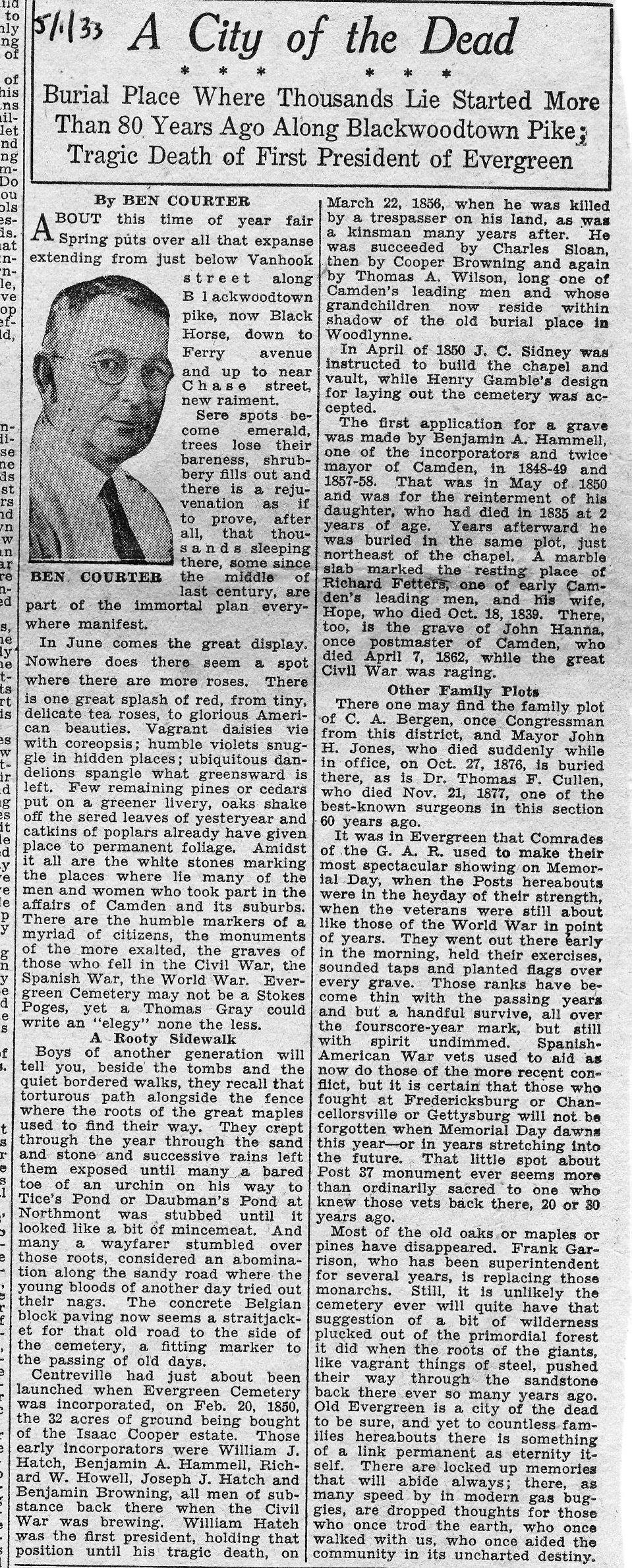
A City of the Dead
Burial Place Where Thousands Lie Started More Than 80 Years Ago Along Blackwoodtown Pike; Tragic Death of First President of Evergreen
BY BEN COURTER
About this time of year fair Spring puts over all that expanse extending from just below Vanhook street along Blackwoodtown pike, now Black Horse, down to Ferry avenue and up to near Chase street, new raiment.
Sere spots become emerald, trees lose their bareness, shrubbery fills out and there is a rejuvenation as if to prove, after all, that thousands sleeping there, some since the middle of last century, are part of the immortal plan everywhere manifest.
In June comes the great display. Nowhere does there seem a spot where there are more roses. There is one great splash of red, from tiny, delicate tea roses, to glorious American beauties. Vagrant daisies vie with coreopsis; humble violets snuggle in hidden places; ubiquitous dandelions spangle what greensward is left. Few remaining pines or cedars put on a greener livery, oaks shake off the sered leaves of yesteryear and catkins of poplars already have given place to permanent foliage. Amidst it all are the white stones marking the places where lie many of the men and women who took part in the affairs of Camden and its suburbs. There are the humble markers of a myriad of citizens, the monuments of the more exalted, the graves of those who fell in the Civil War, the Spanish War, the World War. Evergreen Cemetery may not be a Stokes Poges, yet a Thomas Gray could write an “elegy” none the less.
A Rooty Sidewalk
Boys of another generation will tell you, beside the tombs and the quiet bordered walks, they recall that torturous path alongside the fence where the roots of the great maples used to find their way. They crept through the year through the sand and stone and successive rains left them exposed until many a bared toe of an urchin on his way to Tice’s Pond or Daubman’s Pond at Northmont was stubbed until it looked like a bit of mincemeat. And many a wayfarer stumbled over those roots, considered an abomination along the sandy road where the young bloods of another day tried out their nags. The concrete Belgian block paving now seems a straitjacket for that old road to the side of the cemetery, a fitting marker to the passing of old days.
Centreville had just about been launched when Evergreen Cemetery was incorporated, on Feb. 20, 1850, the 32 acres of ground being bought of the Isaac Cooper estate. Those early incorporators were William J. Hatch, Benjamin A. Hammell, Richard W. Howell, Joseph J. Hatch and Benjamin Browning, all men of substance back there when the Civil War was brewing. William Hatch was the first president, holding that position until his tragic death, on March 22, 1856, when he was killed by a trespasser on his land, as was a kinsman many years after. He was succeeded by Charles Sloan, then by Cooper Browning and again by Thomas A. Wilson, long one of Camden’s leading men and whose grandchildren now reside within shadow of the old burial place in Woodlynne.
In April of 1850 J. C. Sidney was instructed to build the chapel and vault, while Henry Gamble’s design for laying out the cemetery was accepted.
The first application for a grave was made by Benjamin A. Hammell, one of the incorporators and twice mayor of Camden, in 1848–49 and 1857–58. That was in May of 1850 and was for the reinterment of his daughter, who had died in 1835 at 2 years of age. Years afterward he was buried in the same plot, just northeast of the chapel. A marble slab marked the resting place of Richard Fetters, one of early Camden’s leading men, and his wife, Hope, who died Oct. 18, 1839. There, too, is the grave of John Hanna, once postmaster of Camden, who died April 7, 1862, while the great Civil War was raging.
Other Family Plots
There one may find the family plot of C. A. Bergen, once Congressman from this district, and Mayor John H. Jones, who died suddenly while in office, on Oct. 27, 1876, is buried there, as is Dr. Thomas F. Cullen, who died Nov. 21, 1877, one of the best-known surgeons in this section 60 years ago.
It was in Evergreen that Comrades of the G. A. R. used to make their most spectacular showing on Memorial Day, when the Posts hereabouts were in the heyday of their strength, when the veterans were still about like those of the World War in point of years. They went out there early in the morning, held their exercises, sounded taps and planted flags over every grave. Those ranks have become thin with the passing years and but a handful survive, all over the fourscore-year mark, but still with spirit undimmed. Spanish-American War vets used to aid as now do those of the more recent conflict, but it is certain that those who fought at Fredericksburg or Chancellorsville or Gettysburg will not be forgotten when Memorial Day dawns this year—or in years stretching into the future. That little spot about Post 37 monument ever seems more than ordinarily sacred to one who knew those vets back there, 20 or 30 years ago.
Most of the old oaks or maples or pines have disappeared. Frank Garrison, who has been superintendent for several years, is replacing those monarchs. Still, it is unlikely the cemetery will quite have that suggestion of a bit of wilderness plucked out of the primordial forest it did when the roots of the giants, like vagrant things of steel, pushed their way through the sandstone back there ever so many years ago. Old Evergreen is a city of the dead to be sure, and yet to countless families hereabouts there is something of a link permanent as eternity itself. There are locked up memories that will abide always; there, as many speed by in modern gas buggies, are dropped thoughts for those who once trod the earth, who once walked with us, who once aided the community in its uncharted destiny.
Centreville's Schools
Camden Courier-Post —
Early Problem Was Getting the Youngsters In The Classrooms; Reminiscences of Professor C. K. Middleton
WHEN Centreville became a part of Camden in 1871, the progressive men of the city were struggling with the public school problem. It is now mainly one of finance, because of the so-called readjustment period which has hit civic and private activities. Then it was a question of “getting organized.” The city’s population was around 21,000, its children of school age being more than one-third. But that didn’t mean all were attending school.
Times were not so good and two years later was to come the now much-discussed “panic of 1873.” So, while there were approximately 8,000 children of school age, the board of education census shows there were 3,819 who were in the schools with 74 teachers to give them the rudiments of education.
It was likewise shown in a survey that the balance of the boys and girls were working in mills and factories, then a family economic necessity since the heads of families received very little for their work and every penny counted.
The child labor law was a long way off. Children in their early teens usually worked 10 hours a day and six days a week for the munificent sum of $2. Some apprentices didn’t get a cent, some as high as $1.50 a week and they thought they were fortunate in learning to be a machinist, a carpenter, a shoemaker or what not. Boys came home mighty weary, but with the energy of youth they refused to let that interfere with play at nights, in winter sledding and skating to get up 5 or 6 o’clock the next morning all set for another grind. The “good old days” weren’t so wonderful after all.
Early Schools Built
Centreville’s colored population was larger than the white. So a school for the youth of that race was provided on Ferry Avenue. The board of education, with David Rittenhouse president, and William Figner secretary, sought to look after the needs of the children and in 1875, by passage of a special act of the legislature, Camden was given authority to borrow $30,000 to build three schools. One of these was the John W. Mickle School, on Fillmore Street, the other two being the Isaac Mulford and Richard Fetters Schools, named after men prominent in Camden’s affairs for many years and factors in developing the public school system. The brown stone buildings were built by Mayberry E. Harden, one of the city’s leading contractors of the time, and a former member of the school board. The Mickle School in particular was a boon to Centreville.
The late Charles K. Middleton was one of the first principals. He is recalled in much later years as one of the “profs” of the first manual training and high school, when it was launched in 1891 at 125 Federal Street. Students called him “fossils” because he had a penchant for talking about the early periods of the earth’s history. Many of these same students long afterward realized what a fine teacher Middleton really was, what a thirst he developed in a relatively few thoughtful youths for things worthwhile. One may visualize him now, with what the present generation would call a “soup strainer” mustache, sitting on the edge of the desk and seemingly forgetful of his surroundings as he told of great monsters that once roamed the Jersey flats, of the glacial period and a lot of what seemed mighty dry material to a bunch of anxious kids ready to get out and romp.
When the Centennial year rolled around an impetus was given public education. Camden did its part by way of an exhibition that won prizes as well as much praise. James M. Cassady, then the board’s president, was active in many civic matters and one who wielded the best possible influence in ‘getting under way’ what had been called the new era.
C. K. Evered School
By 1877, when James R. Carson became president, Centreville had grown so that it was decided to build another school for the white children.
The C. K. Evered School was built on Ferry Avenue at Seventh. It was named after the son of Joseph G. Evered and brother of Carl Evered, now a widely-known realty man. Charles was ill but had taken a great interest in school affairs of Centreville. So they named the school for him and it became a memorial, since he died soon afterward. The elder Evered came here from Chicago, shortly after the great fire, was an expert jeweler and resided at 1711 Broadway.
At Ninth Street, the Charles Sumner School was built for colored children, providing much better accommodation than the little makeshift place that was torn down two years ago to make way for the recreation house and park which had been left uncompleted because of the lack of funds. A new Sumner School was reared north of Van Hook Street. It is one of the city’s most modern places of public instruction.
Annexes also were built at the Mickle School while for those in the extreme southern section, the “hill” district, there is the Henry B. Wilson School. That was named for the former postmaster, a Republican leader and a leading business man of Camden. He was father of Admiral Henry B. Wilson and Philip S. Wilson, banker.
So Centreville, as the Eighth Ward has gone along with the rest of the city in looking after children’s education, topped off with courses at the high school, a luxury their fathers and grandfathers never dreamed about. There are probably as many children in that district now as there were in the entire city of Camden when Centreville was annexed to the larger community 62 years ago.
Dr. William H. Pratt, son of Jesse Pratt, mayor from 1886 to 1892, was one of the boys in the early school days of Centreville. In addition to giving some sidelights on that period he says Merritt Beckett, appointed by his father, and not William Butts, was the first colored policeman on the Camden force. He was a tall, thin cop, a familiar figure in the late 90’s in that district.
Old Centreville Families
Camden Courier-Post —
Dr. Donges, Mills, Schepperkotter, Covely and Other Men Wrought Through Years to Bring Needed Improvements to District
WHEN a larger community annexes an adjoining district the newer area is generally regarded, for a time at least, as a step-child. Older residents of East Camden will bear out that truism when they recall how difficult it was to obtain improvements. Years before, Newton Township which became part of Camden, had had the same experience. Under such circumstances, it requires tireless energy on the part of leading men to get what their district needs. Demands often go unheeded unless the community is fortunate in having those of spirit who insist on street improvements, water extension, lighting facilities and schools. That was more in evidence half a century ago than now, of course, for Camden itself was little more than a large village.
Down in Centreville there were men who looked after the interests of their constituents, who slowly but surely obtained improvements and who insisted on being recognized by the powers that be. No one may think of old Centreville without thought of Dr. John W. Donges, whose value to not only that section but Camden at large, has been expatiated upon in these annals. He was not only a leading physician, with a practice extending into Camden, but a leader in many civic movements, and any article on that era would be incomplete without allusion again to the doctor whose services as a real family physician are part of the traditions of many old families.
Came Here In 1872
He came here in 1872 from Schuylkill County, Pennsylvania, when his health was affected by overwork through loyalty to his patients. He bought the drugstore at Ferry Avenue and Broadway, remaining there for many years. It was there Supreme Court Justice Ralph W. E. Donges spent his boyhood.
There, too, Dr. Clarence B. Donges and Attorney Raymond Donges were boys. Grant E. Kirk, clerk in his store, later becoming a physician and for several years a member of council and at one time being prominently boomed for mayor, married their sister. Dr. Donges was elected to council in 1878 on the Democratic ticket, itself an evidence of the high regard in which he was held, for the Eighth Ward generally was rock-ribbed Republican. Until the early part of this century he resided in his old place, but later went to Broadway and Clinton Streets. In later years, after he had retired, he was city assessor, “just to keep busy.” He died a few years ago, well in his 80s, mourned by a great host of Camdenites.
There was another widely known Centreville family of the old days, that of Samuel Mills, who had his own abattoir at Broadway and Jackson Street, where city-dressed meats were provided before the days of car refrigeration brought supplies from the great packing places in Chicago. His son, Charlie, was long a member of the Board of Education, while another, William, was a city councilman. Edward Mills, another son, was excise commissioner 35 years ago in the days when there was plenty of trouble with Sunday sellers.
Cornelius Schepperkotter was a factor in politics down that way, too, having a grocery store on Ferry Avenue at Ninth, later moving to the southwest corner when the Charles Sumner School was built. That school was torn down two years ago for the recreation center. Schepperkotter was a member of the old Board of Public Instruction in the late 90’s, named by Mayor Cooper B. Hatch. In later years and until his death, he was superintendent of Evergreen Cemetery. He was father of Mrs. Frank S. Albright, wife of City Clerk Albright.
Frank Covely
Shortly after the New York shipyard was opened, there moved to the “Hill” Frank D. L. Covely, who became a joiner and for years was foreman of the joiner shop. He was widely known as a secret society man and also as an effective campaign speaker for the G. O. P. He was a member of the Board of Education.
He sought to go to council, but that was at the time Kirk was a power in the ward. Covely laughingly used to tell of a meeting all set for him from which all save the colored folk were drawn away through strategy of his party opponents. But for ten years he was a member of the Board of Recreation Commissioners.
That movement owed much to his work. Nor did he forget his colored friends, for he had a playground established for them at Ferry Avenue and Phillips Street and the large one [Staley Park] at Seventh and Jefferson streets. Long afterward that was named for another city official, but Covely’s friends said it should have been for him, as a monument to his services for the boys and girls of Centreville. He died a few years ago at Bellmawr in his 70s, after a hectic experience as a chicken raiser at Port Norris.
There, too, was William Dorrell, superintendent of the old “Narrow Gauge” who was one of the leading spirits in the paving of Broadway, nearly 60 years ago the big issue of that section. He lived in a house along the railroad still standing, as the hospital and dispensary of the shipyard.
Mention has been made of the Ferrises, the Helmbolds, the Yeagers, of Squire James D. Chester and Squire F. Joseph Rouh. There was also William O. Thompson, the leading contractor down that way for many years and Theodore Tiedeken, who established the wagon works on Van Hook Street, Martin Ewe, who had the hotel at Broadway and Emerald, and down the street a bit James Croker, who operated Tammany Hall. Forty years ago there was one of the best young athletes of the city, Thomas Nicholas, now retired Camden fire chief. He was down in old No. 3 with Bill Rose, long a fire captain, Bill Miller, Al James, Sam Lodge, Gus Dold and John Ware.
Many of these old timers have passed on, but others are still in the flesh but scattered to all parts of the city but it may be said the survivors look back on the days that were down there in Centreville with an interest that does not dim with the passing years.
A False Alarm of Long Ago
Camden Courier-Post —
Spectacular Run of Firemen and Steeds in ’79 When First Alarm System Was Given Try-out
THERE were two alarms of fire Saturday evening, one at Fourth and Hamilton streets at 8:29 o’clock, and another at the West Jersey Ferry, an hour later. People in the vicinity of the first-named place turned out to look at the machines propelled at lightning speed by snorting equines, and wondered what it was all about; and some of them thought the wide-awake fire boys were beside themselves, as they asked, for the particular house, in the neighborhood of box 24 upon which, with steam up, their apparatus was able to put on the water. The firemen and people were quietly informed by a party that drove away in a barouche that it was a designed deception.
Under date of October 6, 1879, that was the introduction to a two-column story under a display headline. But it was, a single line—“False Alarms.”
Readers of the period must have been as much mystified as were the firemen and citizens mentioned in the article, for it was not until more than half a column had been devoted to that incident that the public was let into the great secret. It was a test of the first fire alarm system introduced into Camden.
Interest in that incident is revived by the city commissioners last week entering into a contract with that same concern to install in the new City Hall a system for somewhat more than $51,000. That first “system” cost the city $2,000 but it was a big sum then and just about 10 times more space was devoted to it in the old Post than in the Courier-Post last Thursday week.
Paid Department 10 Years Old
Camden’s paid fire department in 1879 was just 10 years old. It already was winning approval of even the recalcitrants, who had asserted back in 1869, that the old volunteer companies would certainly be missed; that the “professionals” would not have as much interest in putting out a fire as the boys who ran with the Perseverance, the Weccacoe and other organizations, usually bitter rivals. Not infrequently the volunteers battled over hooking up their hose while the fire burned, an event by no means outgrown since that occasionally happens even now, as files of the newspapers prove.
But on that Saturday night 54 years ago, it developed that those who drove away in the mysterious barouche were J. W. Morgan, Crawford Miller and F. P. Pfeiffer, fire commissioners of city council, along with R. S. Bender and Thomas Beatty. They were but carrying out orders to see that the system worked and it was John T. Bottomley who issued those orders. He was Camden’s big mill owner but more to the purpose in that particular incident, president of city Council. He had approved the fire alarm system but did not intend putting his O. K. on that $2,000 bill until he had seen it in practical operation.
So unknown to the firemen, and the citizens as well, it was determined to test that system by way of turning in the alarms. So an alarm was pulled at 8:29 and “Bart” Bonsall, son of Henry L. Bonsall, publisher of the Post, narrates, in just 15 seconds flat the bell was sounded at No. 1 Engine House at Fourth and Pine Streets. In two minutes hose cart No. 1 went bounding out with Driver George Hunt at the reins, followed by Ben Cavanaugh and his faithful nag “Jim” with cart No. 2. Then came Jake Kellum and William Davies with the engine No. 2 drawn by “Dolly” in 2:45. After that was engine No. 1 driven by Edmund Shaw and the horse “Alec,” coming along in 3 minutes and 5 seconds. It was explained Shaw was held up by the sandy roadway at Fourth and Line.
Spectacular Sight
Anyhow, it must have been a great sight for the old-time families who then resided along the Middle Ward streets as the racing steeds bounded over Fourth Street, then into Third over a mighty bumpy roadway.
But they arrived and vainly sought the blaze. It was while they were hunting that the barouche came along and the commissioners let them into the great secret. “Bart” doesn’t relate what the firemen said about the false alarm, but, like as not the heat of their expressions was a good substitution for the fire they failed to find.
The system was one of those nine-day wonders that had the town on its toes. Everybody listened for the alarms in those days, for when they were sent in the bells in the fire houses pealed the number of the box. The strokes could be heard surprisingly far. Since there were but 11 boxes it was not long before many knew just where the fire was located and made a bee line for the scene. Old volunteers, particularly, never quite lost their interest in fires and, whenever they heard the alarm, hot footed it to the scene of excitement.
That was all right when Camden was little more than a village, but as the community grew it became a serious proposition, since the racing citizens often interfered with the firemen. Thus about 30 years ago the fire bells were silenced. Now none know of an alarm coming in save the various houses and the Courier-Post which has a wire attached from headquarters bringing in the alarms so that reporters and cameramen may get on the scene quickly as possible.
Ordinarily, little thought is given to the need for instant and accurate sounding of an alarm made possible through the expert work of City Electrician Jim Howell and his aides. If it were not for that perfection and the speed with which firemen reach the scene the losses would be large. And the insurance companies would be around with a “pink slip” as they were some 20 years ago. That meant a 25 percent addition to fire rates. Camden’s motorized department plus the work of City Electrician John W. Kelly soon rid the city of that “slip.”
That system of long ago didn’t include the cops. Now it takes in both departments, as it has done since the days of Chief Samuel Dodd, back in the early 90’s.
On Keeping Chimneys Clean
Camden Courier-Post —
First Act of Camden City Council, Over Century Ago, Was to Cut Down Fire Hazard By Way of Ordinance for ‘Sweeps’
COMPARING Camden’s fire-fighting equipment of today with what the city had when it was incorporated, 103 years ago, the wonder is that some of the fires did not wipe out the tiny community. With their pumpers, chemicals and water mains, the average suburban town is protected like a metropolis when we consider the methods in vogue a century ago.
Fire ever has been man’s most implacable foe, and even yet it is merely a matter of degree—from barbarian ancestors and their rude thatched shacks, to modern skyscraper as to the terror it inspires. Camden, in the late 20s of the last century, was merely a clutter of tiny dwellings, only the more prosperous citizenry such as the Coopers and Kaighns having brick domiciles graced with attics.
It was thus in keeping with the times to have thought first for safety from the fire demon when City Council held its first session, April 11, 1828. That was by way of an ordinance directed against those inclined to be careless and let their chimneys collect through the years a great mass of soot. There were those who kept their chimneys clean as the proverbial whistle, first, so the fire would draw, and again to remove the fire hazard. But many, apparently, took pot luck and let things go with little thought of what might happen until it did—oft-times in the dead of night with long tongues of flames wiping out their humble domicile.
Wood Exclusively Used
Electricity was little more than the mysterious force Ben Franklin had toyed with over the Delaware. Coal still was to be brought from its carboniferous beds in Pennsylvania. It had not even been proposed as “stones that would burn and give heat.” Oil came from whales and such and was used sparingly on new fangled mysteries called machinery. So the thick clumps of trees hereabout were hewed down for heat in winter and to cook the meals. It was that constant use of wood that filled the chimneys with soot and soot evidently was most of the cause of fire.
When a fire started in Camden village it was a serious affair. If it wasn’t caught in the nick of time the house burned to the ground. So council passed its first ordinance to help the boys of old Perseverance in keeping down the fire record although in those days there were no records kept, of course. That first company, by the way, was on Second Street above Market, about where the National State Bank first built. The little frame shack was still there in the 70’s when the bank enlarged its building and tore it down, the company meanwhile having taken its quarters to Third Street.
But getting back to the ordinance of council, it required the thorough sweeping of every chimney at least once in three months. If a sweep tried the short cut to earning his money by burning out a chimney he was fined $1 because that method was declared to endanger surrounding property. The sweep was supposed to get into the chimney or at least sweep it in regulation fashion and not “cut corners,” as some persons have a habit of doing whether it’s sweeping chimneys or building a house.
That part of the ordinance is interesting for it provides “that if any person from or after the first day of May next, ensuing, shall burn his, her or their chimney, or suffer the same to burn or blaze out of the top thereof, unless the roof of the house thereof is covered with snow, or during the time of a storm of rain or snow, every such person shall forfeit and pay the sum of one dollar.” If a chimney should take fire the house owner was required to prove that it had been properly swept out within three months.
Further, it was provided if such a chimney burst into flame after it had been swept out the chimney sweep was to forfeit a dollar. That evidently was due to the determination of Laning, Cowperthwaite, Sloan and Lawrence, the city fathers, to make more and better chimney sweeps and to aid the Perseverance boys in staying the ravages of the flaming foe.
Outstanding Fireman
And if any of the boys of the present generation imagine they have the niftiest apparatus hereabouts, with all their compound engines, extension ladders and what not, they have nothing on Samuel D. Elfreth, who “ran” with old Perseverance so soon as he came to Camden, in 1824. Old annals relate he was always on the spot when “she” was needed, meaning the hand engine, and was regarded as the outstanding fireman of Camden. In 1882 my grandfather wrote in the Courier that Elfreth, although verging on 80, was then still one of the most active volunteer firemen in Camden. He then resided within the shadow of his beloved old company and was filled with reminiscences of the days when he ran with the boys. His son, Samuel (S. Elfreth), then was chief of the paid fire department as he was in later years until his death some 15 years ago. Charles F. Elfreth, a veteran attache of the city’s finance department, is a grandson of the first Elfreth, a nephew of the late chief.
Those old ordinances relative to keeping chimneys clean seem amusing now, but they were vitally important then. They were, in fact, the very beginning of the present day system of keeping down fire losses by way of every possible method in alarms, in equipment, in man efficiency. It is from such humble beginnings that have evolved the methods in battling blazes in skyscrapers, in extensive plants, in keeping tabs on the very last thing in conquering the foe ever ready, and seemingly willing, to raze the works of man.
Along Memory Lane
Camden Courier-Post —
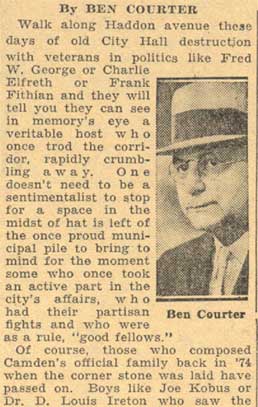
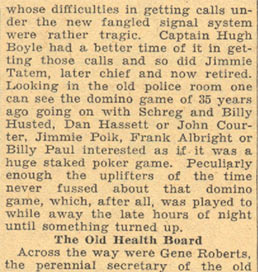
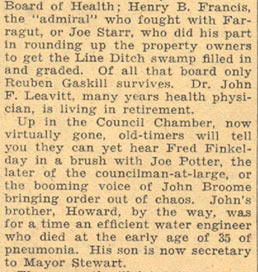
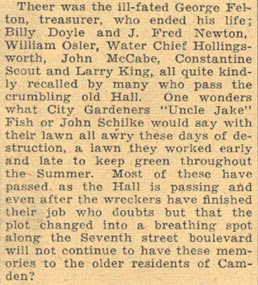
Some Old Hall Familiars
Crumbling City Building Brings to Mind Many Who Once Took Active Part in Affairs of Camden and Spirited Political Scraps.
By BEN COURTER.
Walk along Haddon avenue these days of old City Hall destruction with veterans in politics like Fred W. George or Charlie Elfreth or Frank Fithian and they will tell you they can see in memory’s eye a veritable host who once trod the corridor, rapidly crumbling away. One doesn’t need to be a sentimentalist to stop for a space in the midst of hat is left of the once proud municipal pile to bring to mind for the moment some who once took an active part in the city’s affairs, who had their partisan fights and who were as a rule, “good fellows.”
Of course, those who composed Camden’s official family back in ’74 when the corner stone was laid have passed on. Boys like Joe Kobus or Dr. D. Louis Ireton who saw the corner stone laying are now men well along life’s journey and they too have memories of the Hall through the many years. Mayor John H. Jones, as related in a previous article, died the year the Hall was started. He was succeeded by John Morgan who served a year. Then came James W. Ayres, Claudius W. Bradshaw, Jesse W. Pratt, J. Leighton Wescott and Cooper B. Hatch, all of whom have died. The surviving mayors who once held forth in the office at the southwest corner are Joseph E. Nowrey, Charles H. Ellis, Frank H. Vanhart, Victor King, General Winfield S. Price. With the advent of Mayor Roy Stewart quarters were taken in the great stone pile at Sixth and Market.
The City Clerks
Joseph C. Nicholls was city clerk when the Hall was started, succeeded by Joseph Bontemps, Fred W. Tarr, Frank F. Michellon, Richard C. Thompson, D. Cooper Carman, Thad P. Varney, Morris Odell and William D. Brown, all of whom have died. The survivors are Colonel Harry C. Kramer, now at Washington, Isaac V. Bradley, “Al” White and Frank S. Albright, the last of the clerks in the old building and now happily with us in the new structure.
But there were scores more who were familiar figures in the nearly two generations that have passed. One expects to see, for instance, Levi Farnham, city engineer for nearly two score years, come tramping out of the wrecked corridor to make his way to see how Farnham Park is progressing. There is sure to be memories of the hearty laugh of “Pete” Young, who was Varney’s assistant, and like as not there will be heard the gruff note from “old” Colonel Sam Hufty, “watchdog of the treasury for many a year and a job his father held before him. One can see, too, George A. Frey, long city treasurer who was quite rightfully proud when the experts, who made the survey in 1923, reported that of the more than $18,000,000 he handled every penny was accounted for.
And surely passing what is left of what used to be the police department one can hear the hearty laughs of “Bill” Schregler or Jules Bosch or the pestering gasps of poor old Cale Williams who had the asthma and whose difficulties in getting calls under the new fangled signal system were rather tragic. Captain Hugh Boyle had a better time of it in getting those calls and so did Jimmie Tatem, later chief and now retired. Looking in the old police room one can see the domino game of 35 years ago going on with Schreg and Billy Husted, Dan Hassett or John Courter, Jimmie Polk, Frank Albright or Billy Paul interested as if it was a huge staked poker game. Peculiarly enough the uplifters of the time never fussed about that domino game, which, after all, was played to while away the late hours of night until something turned up.
The Old Health Board
Across the way were Gene Roberts, the perennial secretary of the old Board of Health; Henry B. Francis, the “admiral” who fought with Farragut, or Joe Starr, who did his part in rounding up the property owners to get the Line Ditch swamp filled in and graded. Of all that board only Reuben Gaskill survives. Dr. John F. Leavitt, many years health physician, is living in retirement.
Up in the Council Chamber, now virtually gone, old-timers will tell you they can yet hear Fred Finkelday in a brush with Joe Potter, the later of the councilman-at-large, or the booming voice of John Broome bringing order out of chaos. John’s brother, Howard, by the way, was for a time an efficient water engineer who died at the early age of 35 of pneumonia. His son is now secretary to Mayor Stewart.
Theer was the ill-fated George Felton, treasurer, who ended his life; Billy Doyle and J. Fred Newton, William Osler, Water Chief Hollingsworth, John McCabe, Constantine Scout and Larry King, all quite kindly recalled by many who pass the crumbling old Hall. One wonders what City Gardeners “Uncle Jake” Fish or John Schilke would say with their lawn all awry these days of destruction, a lawn they worked early and late to keep green throughout the Summer. Most of these have passed as the Hall is passing and even after the wreckers have finished their job who doubts but that the plot changed into a breathing spot along the Seventh street boulevard will not continue to have these memories to the older residents of Camden?