Introduction
JOSEPH HARTLEY BOWEN was born in Port Elizabeth NJ on January 3, 1885. He was educated in the public schools of Glassboro NJ, his father being an educator there himself. After leaving school he took a job with the Camden National Bank in 1901 as a messenger. He eventually worked his way up to the paying teller’s desk. On November 3, 1909 he married, and at the time of the 1910 Census, was living in Collingswood NJ with his wife Florence. A son, J. Hartley Bowen Jr. was born in 1914.
J. Hartley Bowen left the Camden National Bank on July 1, 1917 to join the new Parkside Trust Company. On January 12, 1918 he was named secretary of the new bank, and soon afterwards the duties of treasurer were added to his work.
When the 1920 Census was enumerated, J. Hartley Bowen, his wife Florence and son J. Hartley Jr. were living at 300 South 5th Street, the corner of 5th and Stevens Streets, in Camden.
J. Hartley Bowen played a role in the fundraising drive that culminated in the building of the Walt Whitman Hotel at Broadway and Cooper streets in 1925. By 1930 he had moved to 307 Seventh Avenue in Haddon Heights NJ.
J. Hartley Bowen was engaged in the real estate business in Camden for many years, with offices at 431 Market Street. In the late 1940s he was still living in Haddon Heights, where he was serving as the president of the Borough Council. He was still living and working at the Haddon Heights and Camden addresses as late as the fall of 1959.
J. Hartley Bowen passed away in 1960. When the 1970 New Jersey Telephone Directory was compiled, his widow, Florence Bowen, still resided at 307 Seventh Avenue at the time. She died in 1971.
J. Hartley Bowen’s brother, Orlando Bowen, was also a well known figure in Camden banking and real estate circles. The brothers were president and secretary, respectively, of the Community Building & Loan Association in the 1920s.
South Jersey: A History 1624–1924
J. HARTLEY BOWEN—Filling various positions of trust, socially popular and prominent in fraternal circles, J. Hartley Bowen, of Camden, New Jersey, is a significant personality in his community. He was born in Port Elizabeth, New Jersey, January 3, 1885. He was educated in the public schools of Glassboro, New Jersey, and leaving school entered the Camden National Bank in 1901 as a messenger, and worked his way up to the paying teller’s desk. He left that institution July 1, 1917 to assist in the organization of the New Parkside Trust Company. On January 12, 1918 he was officially made secretary of this institution, and the duties of treasurer were added to his work. Mr. Bowen is very prominent in monetary enterprises, also being secretary of the Friendship Building and Loan Association, secretary of the American Building and Loan Association, treasurer of the Civic Building and Loan Association, president of the Community Building and Loan Association, and a director in the Northern Building and Loan Association.
Mr. Bowen has been highly honored by his fellow-citizens of Camden, having held the position of councilman from 1915 to 1923. In fraternal association he is a member of Camden Lodge, No. 293, of Elks; a member of Ionic Lodge, No. 94, Free and Accepted Masons, as well as of Excelsior Consistory, Crescent Temple, Tall Cedars of Lebanon, of which he is Past Grand Tall Cedar. His clubs are the Camden Club and the Rotary Club. Mr. Bowen and his family are members of the First Methodist Church, of which he has been trustee and is now chairman of the property committee.
He married, November 3, 1909, at Camden, Florence Kirkbride, who was born in that city. Her father, Josiah R. Kirkbride, is living at the age of eighty-three, and her mother is also living. Mr. and Mrs. Bowen have one child, J. Hartley Bowen, Jr., who was born December 26, 1914. Mr. Bowen’s father, Frank W. Bowen, is deceased, having died in 1914. He was an educator, having taught school for many years, and at the time of his death was principal of schools in Glassboro, New Jersey, and was the New Jersey representative of the D.C. Heath and Company, school book publishers. He was a member of Glassboro Lodge, No. 85, Free and Accepted Masons.
Report of the Condition of the Camden National Bank
Bank Directory —
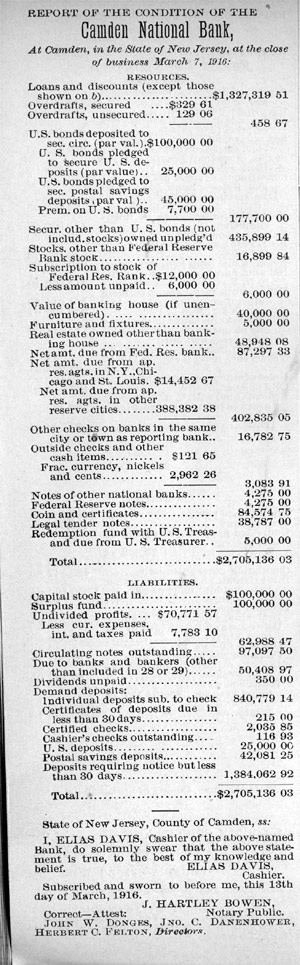
At Camden, in the State of New Jersey, at the close of business March 7, 1916:
RESOURCES.
Loans and discounts (except those shown on b)...... $1,327,319 51 Overdrafts, secured .....$329 61 Overdrafts, unsecured..... 129 06 458 67 U. S. bonds deposited to sec. circ. (par val.)...$100,000 00 U. S. bonds pledged to secure U. S. deposits (par value).... 25,000 00 U. S. bonds pledged to sec. postal savings deposits (par val.).... 45,000 00 Prem. on U. S. bonds 7,700 00 177,700 00 Secur. other than U. S. bonds (not includ. stocks) owned unpledg’d 435,899 14 Stocks, other than Federal Reserve Bank stock...... 16,899 84 Subscription to stock of Federal Res. Bank..$12,000 00 Less amount unpaid.... 6,000 00 6,000 00 Value of banking house (if unencumbered).....40,000 00 Furniture and fixtures..... 5,000 00 Real estate owned other than banking house 48,948 08 Net amt. due from Fed. Res. bank......87,297 33 Net amt. due from ap. res. agts. in N.Y., Chicago and St. Louis..$14,452 67 Net amt. due from ap. res. agts. in other reserve cities......388,382 38 402,835 05 Other checks on banks in the same city or town as reporting bank.... 16,782 75 Outside checks and other cash items......$121 65 Frac. currency, nickels and cents........ 2,962 26 3,083 91 Notes of other national banks...... 4,275 00 Federal Reserve notes...... 4,275 00 Coin and certificates...... 84,574 75 Legal tender notes...... 38,787 00 Redemption fund with U. S. Treasury and due from U. S. Treasurer.... 5,000 00 Total......$2,705,136 03
LIABILITIES.
Capital stock paid in...... $100,000 00 Surplus fund...... 100,000 00 Undivided profits.....$70,771 57 Less cur. expenses, int. and taxes paid 7,783 10 62,988 47 Circulating notes outstanding...... 97,097 50 Due to banks and bankers (other than included in 28 or 29)...... 50,408 97 Dividends unpaid...... 350 00 Demand deposits: Individual deposits sub. to check $840,779 14 Certificates of deposits due in less than 30 days...... 215 00 Certified checks...... 2,035 85 Cashier’s checks outstanding...... 116 93 U. S. deposits...... 25,000 00 Postal savings deposits...... 42,081 25 Deposits requiring notice but less than 30 days...... 1,384,062 92 Total......$2,705,136 03
State of New Jersey, County of Camden, ss: I, ELIAS DAVIS, Cashier of the above-named Bank, do solemnly swear that the above statement is true, to the best of my knowledge and belief. ELIAS DAVIS, Cashier. Subscribed and sworn to before me, this 13th day of March, 1916. J. HARTLEY BOWEN, Notary Public. Correct—Attest: JOHN W. DONGES, JNO. C. DANENHOWER, HERBERT C. FELTON, Directors.
Underworld Life Exposed as Hall Is Given Grilling
Camden Courier —
Denounced and flayed as a “moral degenerate,” Policeman Ira Hall was summarily dismissed by the police committee of City Council last night following the most sensational hearing in the history of that body.
Resignations of Detective George Murry and Policemen Tony Latorre and William Draper, also were accepted before the hearing adjourned. Councilman J. Hartley Bowen, who presided, declared that “on their face the resignations appeared as an admission from the men of their guilt.” None of the three who tendered their resignations were present at the hearing.
The four men have been charged by City Solicitor Bleakly with responsibility for “shocking” vice conditions found in recent investigations made by federal agents and city officials in the Third and Fifth wards.
Committee’s Resolution
Just before the close of the hearing, shortly after 10 o’clock, Councilman Enos Dellmuth, of the Ninth ward, introduced a resolution urging a continuation of the vice probe by city officials and requesting that Solicitor Bleakly present to Prosecutor Wolverton “all evidence of a criminal nature” against the four accused.
His resolution, which the committee unanimously adopted, follows:
“Resolved that the city solicitor present to the prosecutor of the pleas all evidence of a criminal nature against officers George Murry, Ira Hall, William Draper and Tony Latorre in order that indictments may be secured against said officers, if the evidence justifies the same, and so that the ends of justice may be furthered and the community protected against a repetition of the evil conditions brought to light in the investigation, as far as it has gone.
“And be it further resolved that the investigation of vice conditions in the city be continued by the officials in charge of the recent investigation.”
Among those who attended the hearing besides Solicitor Bleakly and [?] were Frank S. Van Hart, president of Council, Chief of Police Gravenor, Assistant Chief Hyde and members of the police committee, including Councilmen Bowen, Dellmuth, Von Nieda, Bantivoglio, Corea, Dobbins, Dudley, Kelly and Payne. Each member of the committee took a personal interest in the proceedings and [?] question after question at the defendant and witnesses.
Spectators Jam Room
Spectators, among whom were several women welfare workers, filled every bit of space in police court, where the hearing was conducted. Expressions of disgust could be seen on many faces as revelations of the depravity that exists in the tenderloin district were made. Husky policemen, who by virtue of their duties one would expect to be accustomed to stories of immoral practices, almost blushed when they heard the startling accusations.
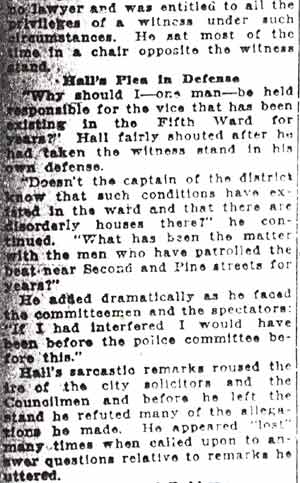
Hall seemed to have been assuming an attitude of defiance as indicated by accusations he directed at his superiors. He explained he had no lawyer and was entitled to all the privileges of a witness under such circumstances. He sat most of the time in a chair opposite the witness stand.
Hall’s Plea in Defense
“Why should I—one man—be held responsible for the vice that has been existing in the Fifth Ward for years?” Hall fairly shouted after he had taken the witness stand in his own defense.
“Doesn’t the captain of the district know that such conditions have existed in the ward and that there are disorderly houses there?” he continued. “What has been the matter with the men who have patrolled the beat near Second and Pine streets for years?”
He added dramatically as he faced the committeemen and the spectators: “If I had interfered I would have been before the police committee before this.”
Hall’s sarcastic remarks roused the ire of the city solicitors and the Councilmen and before he left the stand he refuted many of the allegations he made. He appeared “lost” many times when called upon to answer questions relative to remarks he uttered.
Acquitted of Robbery
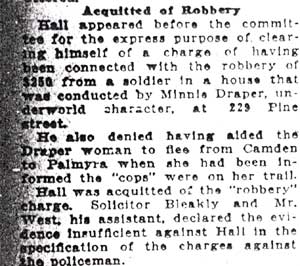
Hall appeared before the committee for the express purpose of clearing himself of a charge of having been connected with the robbery of $250 from a soldier in a house that was conducted by Minnie Draper, underworld character, at 229 Pine street.
He also denied having aided the Draper woman to flee from Camden to Palmyra when she had been informed the “cops” were on her trail.
Hall was acquitted of the “robbery” charge. Solicitor Bleakly and Mr. West, his assistant, declared the evidence insufficient against Hall in the specification of the charges against the policeman.
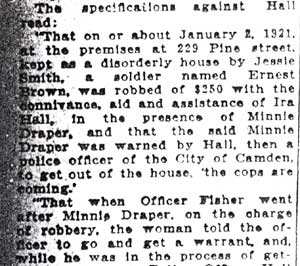
The specifications against Hall read:
“That on or about January 2, 1921, at the premises at 229 Pine street, kept as a disorderly house by Jessie Smith, a soldier named Ernest Brown, was robbed of $250 with the connivance, aid and assistance of Ira Hall, in the presence of Minnie Draper, and that the said Minnie Draper was warned by Hall, then a police officer of the City of Camden, to get out of the house, ‘the cops are coming.’
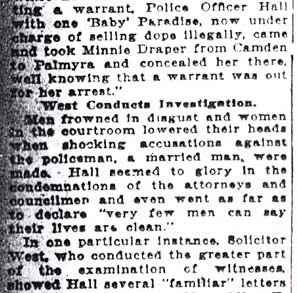
“That when Officer Fisher went after Minnie Draper, on the charge of robbery, the woman told the officer to go and get a warrant, and, while he was in the process of getting a warrant, Police Officer Hall with one ‘Baby’ Paradise, now under charge of selling dope illegally, came and took Minnie Draper from Camden to Palmyra and concealed her there, well knowing that a warrant was out for her arrest.”
West Conducts Investigation.
Men frowned in disgust and women in the courtroom lowered their heads when shocking accusations against the policeman, a married man, were made. Hall seemed to glory in the condemnations of the attorneys and councilmen and even went as far as to declare “very few men can say their lives are clean.”
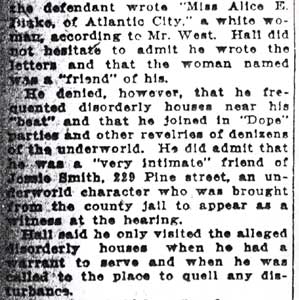
In one particular instance, Solicitor West, who conducted the greater part of the examination of witnesses, showed Hall several “familiar” letters the defendant wrote “Miss Alice E. [?]iske, of Atlantic City,” a white woman, according to Mr. West. Hall did not hesitate to admit he wrote the letters and that the woman named was a “friend” of his.
He denied, however, that he frequented disorderly houses near his “beat” and that he joined in “Dope” parties and other revelries of denizens of the underworld. He did admit that he was a “very intimate” friend of Jessie Smith, 229 Pine street, an underworld character who was brought from the county jail to appear as a witness at the hearing.
Hall said he only visited the alleged disorderly houses when he had a warrant to serve and when he was called to the place to quell any disturbance.
Smith Girl on Stand.
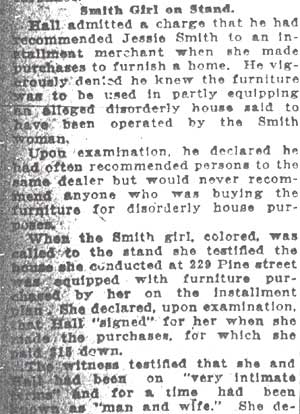
Hall admitted a charge that he had recommended Jessie Smith to an installment merchant when she made purchases to furnish a home. He vigorously denied he knew the furniture was to be used in partly equipping an alleged disorderly house said to have been operated by the Smith woman.
Upon examination, he declared he had often recommended persons to the same dealer but would never recommend anyone who was buying the furniture for disorderly house purposes.
When the Smith girl, colored, was called to the stand she testified the house she conducted at 229 Pine street was equipped with furniture purchased by her on the installment plan. She declared, upon examination, that Hall “signed” for her when she made the purchases, for which she paid $1[?] down.
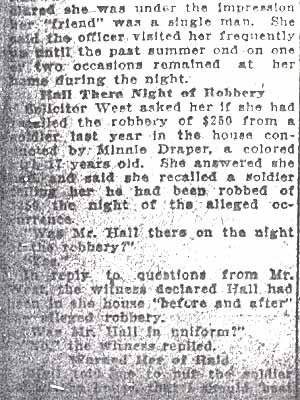
The witness testified that she and Hall had been on “very intimate terms” and for a time had been known as “man and wife.” She declared she was under the impression her “friend” was a single man. She said the officer visited her frequently up until the past summer and on one or two occasions remained at her home during the night.
Hall There Night of Robbery
Solicitor West asked her if she had [?]ailed the robbery of $250 from a soldier last year in the house conducted by Minnie Draper, a colored girl 17 years old. She answered she [?] and said she recalled a soldier telling her he had been robbed of $250 the night of the alleged occurrence.
“Was Mr. Hall there on the night of the robbery?”
“Yes.”
In reply to questions from Mr. West, the witness declared Hall had been in the house “before and after” the alleged robbery.
“Was Mr. Hall in uniform?”
“No,” the witness replied.
Warned Her of Raid
[?] told [?] to put the soldier [?] that I should beat it” as the place was about to be raided.
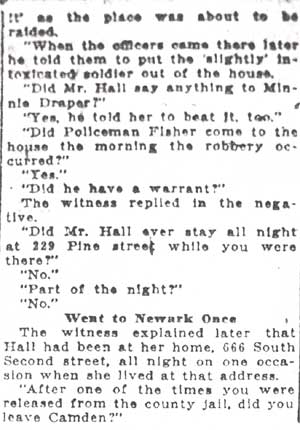
“When the officers came there later he told them to put the ‘slightly’ intoxicated soldier out of the house.
“Did Mr. Hall say anything to Minnie Draper?”
“Yes, he told her to beat it, too.”
“Did Policeman Fisher come to the house the morning the robbery occurred?”
“Yes.”
“Did he have a warrant?”
The witness replied in the negative.
“Did Mr. Hall ever stay all night at 229 Pine street while you were there?”
“No.”
“Part of the night?”
“No.”
Went to Newark Once
The witness explained later that Hall had been at her home, 666 South Second street, all night on one occasion when she lived at that address.
“After one of the times you were released from the county jail, did you leave Camden?”
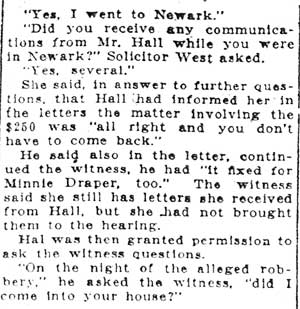
“Yes, I went to Newark.”
“Did you receive any communications from Mr. Hall while you were in Newark?” Solicitor West asked.
“Yes, several.”
She said, in answer to further questions, that Hall had informed her in the letters the matter involving the $250 was “all right and you don’t have to come back.”
He said also in the letter, continued the witness, he had “it fixed for Minnie Draper, too.” The witness said she still has letters she received from Hall, but she had not brought them to the hearing.
Hal [sic] was then granted permission to ask the witness questions.
“On the night of the alleged robbery,” he asked the witness, “did I come into your house?”
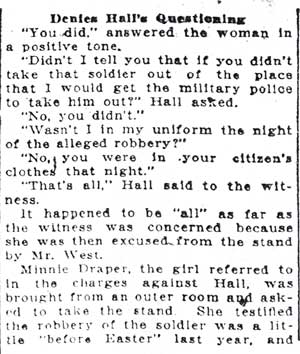
Denies Hall’s Questioning
“You did,” answered the woman in a positive tone.
“Didn’t I tell you that if you didn’t take that soldier out of the place that I would get the military police to take him out?” Hall asked.
“No, you didn’t.”
“Wasn’t I in my uniform the night of the alleged robbery?”
“No, you were in your citizen’s clothes that night.”
“That’s all,” Hall said to the witness.
It happened to be “all” as far as the witness was concerned because she was then excused from the stand by Mr. West.
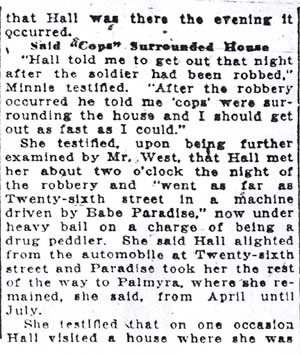
Minnie Draper, the girl referred to in the charges against Hall, was brought from an outer room and asked to take the stand. She testified the robbery of the soldier was a little “before Easter” last year, and that Hall was there the evening it occurred.
Said “Cops” Surrounded House
“Hall told me to get out that night after the soldier had been robbed,” Minnie testified. “After the robbery occurred he told me ‘cops’ were surrounding the house and I should get out as fast as I could.”
She testified, upon being further examined by Mr. West, that Hall met her about two o’clock the night of the robbery and “went as far as Twenty-sixth street in a machine driven by Babe Paradise,” now under heavy bail on a charge of being a drug peddler. She said Hall alighted from the automobile at Twenty-sixth street and Paradise took her the rest of the way to Palmyra, where she remained, she said, from April until July.
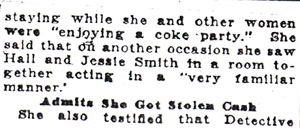
She testified that on one occasion Hall visited a house where she was staying while she and other women were “enjoying a coke party.” She said that on another occasion she saw Hall and Jessie Smith in a room together acting in a “very familiar manner.”
Admits She Got Stolen Cash
She also testified that Detective Murry was given $50 to “squash” the robbery case, which, it has been alleged, involved Hall, herself and the Smith woman.
“Did you get any of the $250 stolen from the soldier?” Mr. West asked the witness.
“Yes. I know I got my part,” she answered. “The remainder went to Jessie Smith, but I suppose Mr. Hall got his share.”
“Was Mr. Hall in uniform when he gave you the caution to get out of the house the night of the robbery?”
“No,” the woman answered.
B. & L. Makes Offer to End Foreclosure
Camden Courier-Post —
Wins Court Verdict But Agrees to Hold Mortgage if Costs Are Paid
Although the Community Building & Loan Association has won its legal battle to foreclose a mortgage it holds on the home of A. Edward Friedberg, 1126 Princess avenue, the latter may retain possession if he pays the cost of the legal proceedings.
Vice-Chancellor Leaming advised a decree against Friedberg when the building and loan association officers testified that the home owner had broken his agreement by persistently refusing to show his tax receipts for 1926.
According to J. Hartley Bowen, president of the association and his brother, Orlando Bowen, secretary, they loaned $3,000 on mortgage to Friedberg in 1922. The officers testified that Friedberg was not only to make regular payments, but agreed to show his tax receipts every December 31.
Despite the agreement, Friedberg did not show his receipts for 1926 taxes, the officers said. He refused to produce the receipts after they threatened him with foreclosure, they testified, and even after the proceedings were started.
Friedberg testified that he had lost his receipt and told the secretary. He didn’t think the showing of a duplicate was necessary, he said, but he obtained one. He said the first he knew foreclosure proceedings had been started, was when Orlando Bowen refused to take a check for his building and loan dues.
The home owner also declared he had $12,000 in bank and offered to pay off the entire mortgage. His offer was refused, he said, unless he would also pay the costs of the proceedings.
The court mildly rebuked the litigants.
“This is much ado about nothing,” the vice chancellor stated. “as the real root of this trouble is not the disposition of the house and mortgage, but the payment of about $30 costs. In order to uphold the dignity of the Chancery court, it was determined in the early English days that no case under 30 pounds, or $150, should be heard. Perhaps the dignity of the court has shrunk.”
“The mortgage agreement is so plain that no one could be mistaken about its terms. I can do nothing else but advise a decree of foreclosure.”
Orlando Bowen afterward revealed that the association will not foreclose if Friedberg will pay the costs of the search, filing of the proceedings and the trial.
Judge Boyle Rites Held After 600 Pay Tribute
Camden Courier-Post —
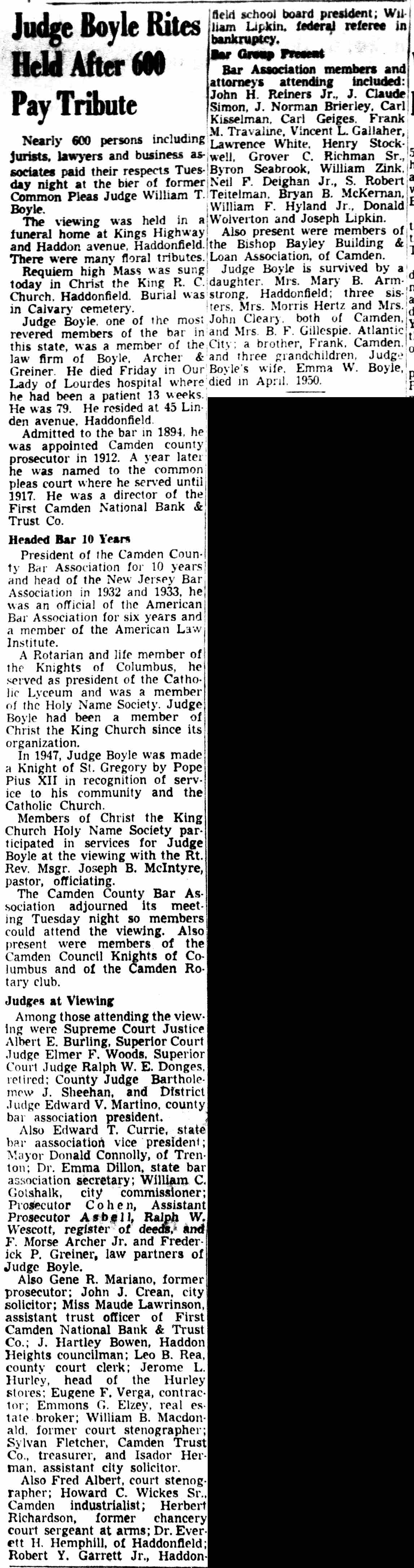
Judge Boyle Rites Held After 600 Pay Tribute
Nearly 600 persons including jurists, lawyers and business associates paid their respects Tuesday night at the bier of former Common Pleas Judge William T. Boyle.
The viewing was held in a funeral home at Kings Highway and Haddon avenue, Haddonfield. There were many floral tributes.
Requiem high Mass was sung today in Christ the King R. C. Church, Haddonfield. Burial was in Calvary cemetery.
Judge Boyle, one of the most revered members of the bar in this state, was a member of the law firm of Boyle, Archer & Greiner. He died Friday in Our Lady of Lourdes hospital where he had been a patient 13 weeks. He was 79. He resided at 45 Linden avenue, Haddonfield.
Admitted to the bar in 1894, he was appointed Camden county prosecutor in 1912. A year later he was named to the common pleas court where he served until 1917. He was a director of the First Camden National Bank & Trust Co.
Headed Bar 10 Years
President of the Camden County Bar Association for 10 years and head of the New Jersey Bar Association in 1932 and 1933, he was an official of the American Bar Association for six years and a member of the American Law Institute.
A Rotarian and life member of the Knights of Columbus, he served as president of the Catholic Lyceum and was a member of the Holy Name Society. Judge Boyle had been a member of Christ the King Church since its organization.
In 1947, Judge Boyle was made a Knight of St. Gregory by Pope Pius XII in recognition of service to his community and the Catholic Church.
Members of Christ the King Church Holy Name Society participated in services for Judge Boyle at the viewing with the Rt. Rev. Msgr. Joseph B. McIntyre, pastor, officiating.
The Camden County Bar Association adjourned its meeting Tuesday night so members could attend the viewing. Also present were members of the Camden Council Knights of Columbus and of the Camden Rotary club.
Judges at Viewing
Among those attending the viewing were Supreme Court Justice Albert E. Burling, Superior Court Judge Elmer F. Woods, Superior Court Judge Ralph W. E. Donges, retired; County Judge Bartholomew J. Sheehan, and District Judge Edward V. Martino, county bar association president.
Also Edward T. Currie, state bar association vice president; Mayor Donald Connolly, of Trenton; Dr. Emma Dillon, state bar association secretary; William C. Gotshalk, city commissioner; Prosecutor Cohen, Assistant Prosecutor Asbell, Ralph W. Wescott, register of deeds, and F. Morse Archer Jr. and Frederick P. Greiner, law partners of Judge Boyle.
Also Gene R. Mariano, former prosecutor; John J. Crean, city solicitor; Miss Maude Lawrinson, assistant trust officer of First Camden National Bank & Trust Co.; J. Hartley Bowen, Haddon Heights councilman; Leo B. Rea, county court clerk; Jerome L. Hurley, head of the Hurley Stores; Eugene F. Verga, contractor; Emmons G. Elzey, real estate broker; William B. Macdonald, former court stenographer; Sylvan Fletcher, Camden Trust Co., treasurer, and Isador Herman, assistant city solicitor.
Also Fred Albert, court stenographer; Howard C. Wickes Sr., Camden industrialist; Herbert Richardson, former chancery court sergeant at arms; Dr. Everett H. Hemphill, of Haddonfield; Robert Y. Garrett Jr., Haddonfield school board president; William Lipkin, federal referee in bankruptcy.
Bar Group Present
Bar Association members and attorneys attending included: John H. Reiners Jr., J. Claude Simon, J. Norman Brierley, Carl Kisselman, Carl Geiges, Frank M. Travaline, Vincent L. Gallaher, Lawrence White, Henry Stockwell, Grover C. Richman Sr., Byron Seabrook, William Zink, Neil F. Deighan Jr., S. Robert Teitelman, Bryan B. McKernan, William F. Hyland Jr., Donald Wolverton and Joseph Lipkin.
Also present were members of the Bishop Bayley Building & Loan Association, of Camden.
Judge Boyle is survived by a daughter, Mrs. Mary B. Armstrong, Haddonfield; three sisters, Mrs. Morris Hertz and Mrs. John Cleary, both of Camden, and Mrs. B. F. Gillespie, Atlantic City; a brother, Frank, Camden, and three grandchildren. Judge Boyle’s wife, Emma W. Boyle, died in April, 1950.
Council’s Police Hearing Tonight
Camden Courier —
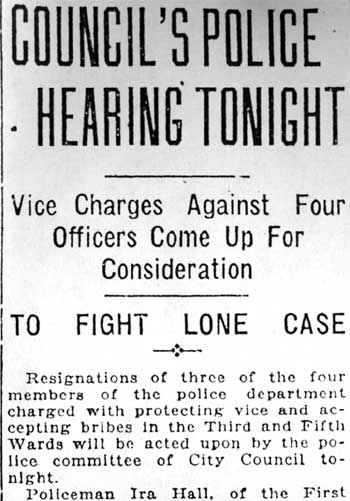
Vice Charges Against Four Officers Come Up For Consideration
TO FIGHT LONE CASE
Resignations of three of the four members of the police department charged with protecting vice and accepting bribes in the Third and Fifth Wards will be acted upon by the police committee of City Council tonight.
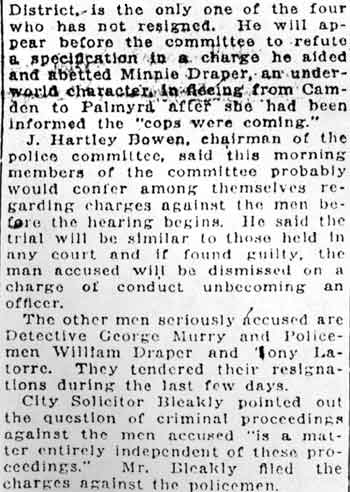
Policeman Ira Hall, of the First District, is the only one of the four who has not resigned. He will appear before the committee to refute a specification in a charge he aided and abetted Minnie Draper, an underworld character, in fleeing from Camden to Palmyra after she had been informed the “cops were coming.”
J. Hartley Bowen, chairman of the police committee, said this morning members of the committee probably would confer among themselves regarding charges against the men before the hearing begins. He said the trial will be similar to those held in any court and if found guilty, the man accused will be dismissed on a charge of conduct unbecoming an officer.
The other men seriously accused are Detective George Murry and Policemen William Draper and Tony Latorre. They tendered their resignations during the last few days.
City Solicitor Bleakly pointed out the question of criminal proceedings against the men accused “is a matter entirely independent of these proceedings.” Mr. Bleakly filed the charges against the policemen.
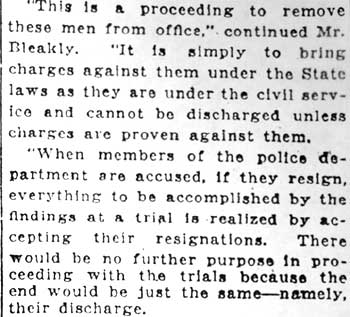
“This is a proceeding to remove these men from office,” continued Mr. Bleakly. “It is simply to bring charges against them under the State laws as they are under the civil service and cannot be discharged unless charges are proven against them.
“When members of the police department are accused, if they resign, everything to be accomplished by the findings at a trial is realized by accepting their resignations. There would be no further purpose in proceeding with the trials because the end would be just the same—namely, their discharge.
“It has been suggested that if instead of accepting the resignations the men be discharged to prevent them from ever applying again. But there is nothing in that point because the accused men, as I understand, are all past the age for reappointment. Besides, I am sure the present or a succeeding mayor would not reappoint them on the force.
“Whether these men are discharged or whether their resignations are accepted will not affect in any manner the question of any criminal complaint being based on any of these charges, because that is a matter entirely independent of these proceedings.”