Introduction
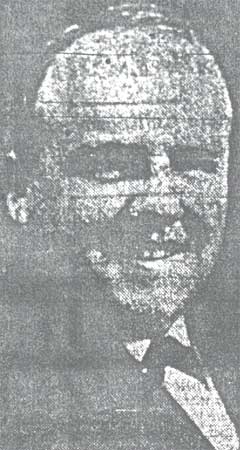
Enos B. Dellmuth
Enos Bowen Dellmuth was born on October 24, 1884 in New Jersey to Henry Dellmuth and his wife, the former Christina “Anna” Hahn, who were both born in Germany, and who met and married in the United States. By 1880 the Dellmuth family had taken up residence at 618 Front Street in Camden, where Henry Dellmuth operated a bakery. His maternal grandfather, John Daniel Hahn, briefly operated a saloon at 120 Market Street in the early 1880s. Henry Dellmuth passed away at the age of 44, around 1895. He left his family well off, and Enos Dellmuth completed his education.
Enos Dellmuth was married by 1908, when his wife Florence bore their eldest son, Carl Dellmuth. Four daughters followed: Ethel, Dorothy, Marian, and Mary. By 1920 the Dellmuth family had purchased a home at 426 Chambers Avenue in Camden. Enos Dellmuth was at that time a salesman for the C. Howard Hunt Pen Company on State Street in North Camden. He became the manager of the eastern division of the company by 1928.
Enos Dellmuth was active in the fraternal, political, and civic life of Camden in the 1910s and 1920s. He was a member of Trimble Lodge, No. 117 Free and Accepted Masons, the Camden Lodge 293 of the Elks, the Camden Shrine Club, and many other organizations. He was a charter member of the Camden Rotary Club. A Republican, he was a member of the Ninth Ward Republican Club, and served as President and Vice-President of that group.
The Dellmuth family had a summer home at Seaside Heights, NJ. In the summer of 1928 he had been called to serve as the foreman of the Camden County grand jury. On Friday, September 7, 1928 he was driving to Camden from Seaside Heights when he suffered a mini-stroke. Instead of seeking medical treatment, he continued to the courthouse, where he fulfilled his civic duty on the last day of the jury’s term. Shortly after the end of business, he complained of severe pains in his head, and was taken home by his fellow jurors. Doctors Wesley Barrett and Everett Schull diagnosed Mr. Dellmuth as suffering from a cerebral hemorrhage. Enos B. Dellmuth passed away on September 9, 1928.
Enos B. Dellmuth was buried at Harleigh Cemetery. He was survived by his wife and children, and an older sister, Mrs. Anna Dellmuth Hauser. More than 1000 people came to pay their respects at his funeral, which was held in his home. Among those who came were Congressman Charles A. Wolverton, State Senator Joseph Forsyth, Mayor Winfield S. Price, former mayor Frank S. Van Hart, and many other of his business, political, and fraternal contemporaries. Reverend Edwin Forrest Hann of Broadway Methodist Church officiated at his funeral.
The Dellmuth family remained on Chambers Avenue into the 1930s. Florence Dellmuth never remarried. She later lived in Collingswood, NJ, until her passing in February of 1981. Marian Dellmuth graduated from Camden High School in 1932. Carl Dellmuth graduated from Swarthmore University in Swarthmore, PA in 1931. He returned to Swarthmore in 1938, and worked for the school for many years as its alumni secretary. His office became the foundation of Swarthmore’s alumni relations, public relations, and development programs.
Prepare. Memorial Resolutions
Philadelphia Inquirer —
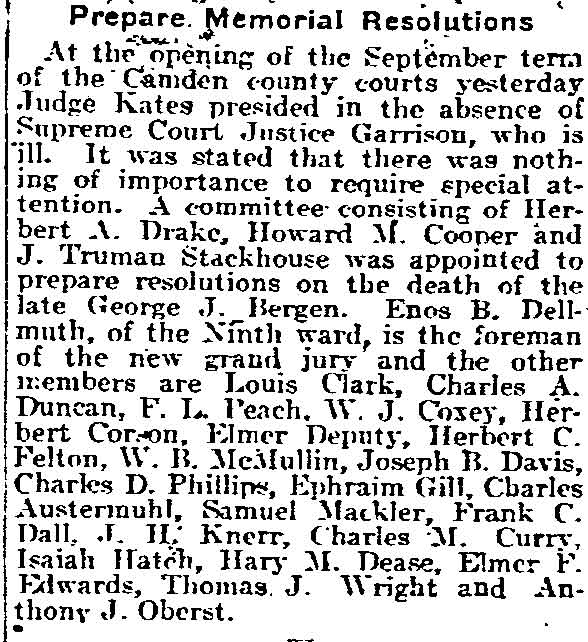
Prepare. Memorial Resolutions
At the opening of the September term of the Camden county courts yesterday Judge Kates presided in the absence of Supreme Court Justice Garrison, who is ill. It was stated that there was nothing of importance to require special attention. A committee consisting of Herbert A. Drake, Howard M. Cooper and J. Truman Stackhouse was appointed to prepare resolutions on the death of the late George J. Bergen. Enos B. Dellmuth, of the Ninth ward, is the foreman of the new grand jury and the other members are Louis Clark, Charles A. Duncan, F. L. Peach, W. J. Coxey, Herbert Corson, Elmer Deputy, Herbert C. Felton, W. B. McMullin, Joseph B. Davis, Charles D. Phillips, Ephraim Gill, Charles Austermuhl, Samuel Mackler, Frank C. Dall, J. H. Knerr, Charles M. Curry, Isaiah Hatch, Hary [sic] M. Dease, Elmer F. Edwards, Thomas J. Wright and Anthony J. Oberst.
Enos B. Dellmuth Dies from Stroke
Camden Courier-Post —
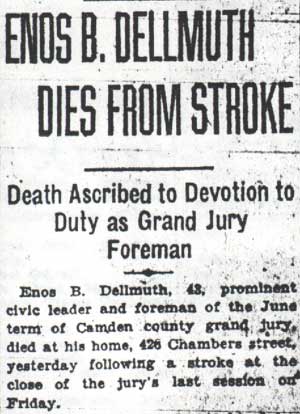
Death Ascribed to Devotion to Duty as Grand Jury Foreman
Enos B. Dellmuth, 43, prominent civic leader and foreman of the June term of Camden county grand jury, died at his home, 426 Chambers street, yesterday following a stroke at the close of the jury’s last session on Friday.
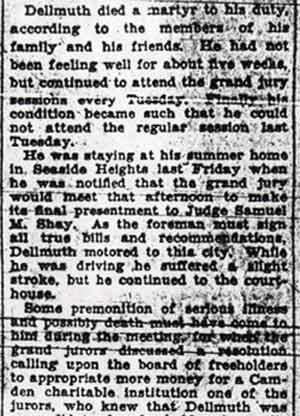
Dellmuth died a martyr to his duty, according to the members of his family and his friends. He had not been feeling well for about five weeks, but continued to attend the grand jury sessions every Tuesday. Finally his condition became such that he could not attend the regular session last Tuesday.
He was staying at his summer home in Seaside Heights last Friday when he was notified that the grand jury would meet that afternoon to make its final presentment to Judge Samuel M. Shay. As the foreman must sign all true bills and recommendations, Dellmuth motored to this city. While he was driving he suffered a slight stroke, but he continued to the courthouse.
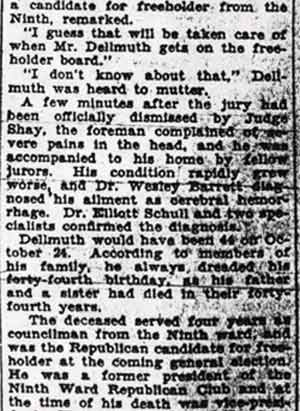
Some premonition of serious illness and possibly death must have come to him during the meeting, for while the grand jurors discussed a resolution calling upon the board of freeholders to appropriate more money for a Camden charitable institution one of the jurors, who knew that Dellmuth was a candidate for freeholder from the Ninth, remarked,
“I guess that will be taken care of when Mr. Dellmuth gets on the freeholder board.”
“I don’t know about that,” Dellmuth was heard to mutter.
A few minutes after the jury had been officially dismissed by Judge Shay, the foreman complained of severe pains in the head, and he was accompanied to his home by fellow jurors. His condition rapidly grew worse, and Dr. Wesley Barrett diagnosed his ailment as cerebral hemorrhage. Dr. Elliott Schull and two specialists confirmed the diagnosis.
Dellmuth would have been 44 on October 24. According to members of his family, he always dreaded his forty-fourth birthday, as his father and a sister had died in their forty-fourth years.
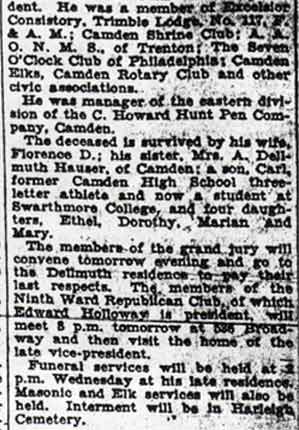
The deceased served four years as councilman from the Ninth ward, and was the Republican candidate for freeholder at the coming general election. He was a former president of the Ninth Ward Republican Club and at the time of his death was vice-president. He was a member of Excelsior Consistory, Trimble Lodge, No. 117, F. & A. M.; Camden Shrine Club; A. A. O. N. M. S., of Trenton; The Seven O’Clock Club of Philadelphia; Camden Elks, Camden Rotary Club and other civic associations.
He was manager of the eastern division of the C. Howard Hunt Pen Company, Camden.
The deceased is survived by his wife, Florence D.; his sister, Mrs. A. Dellmuth Hauser, of Camden; a son, Carl, former Camden High School three-letter athlete and now a student at Swarthmore College, and four daughters, Ethel, Dorothy, Marian and Mary.
The members of the grand jury will convene tomorrow evening and go to the Dellmuth residence to pay their last respects. The members of the Ninth Ward Republican Club, of which Edward Holloway is president, will meet 8 p.m. tomorrow at [?] Broadway and then visit the home of the late vice-president.
Funeral services will be held at 2 p.m. Wednesday at his late residence. Masonic and Elk services will also be held. Interment will be in Harleigh Cemetery.
Underworld Life Exposed as Hall Is Given Grilling
Camden Courier —
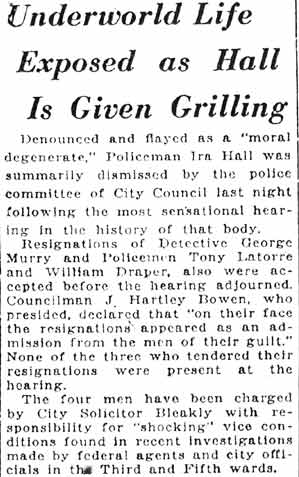
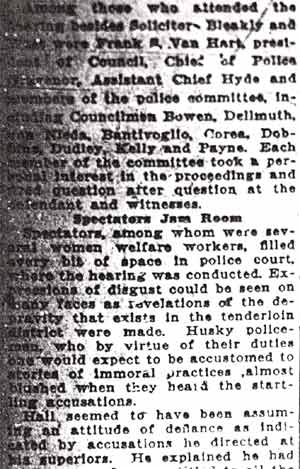
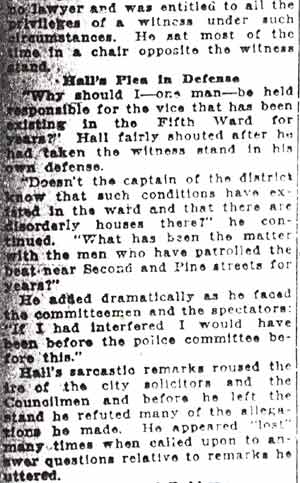
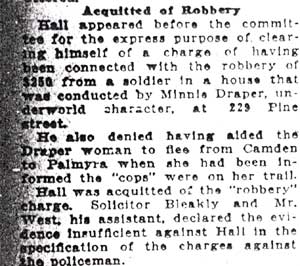
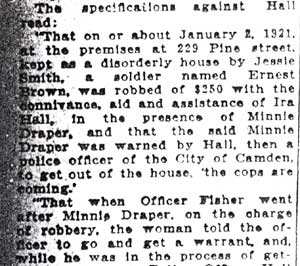
Denounced and flayed as a “moral degenerate,” Policeman Ira Hall was summarily dismissed by the police committee of City Council last night following the most sensational hearing in the history of that body.
Resignations of Detective George Murry and Policemen Tony Latorre and William Draper, also were accepted before the hearing adjourned. Councilman J. Hartley Bowen, who presided, declared that “on their face the resignations appeared as an admission from the men of their guilt.” None of the three who tendered their resignations were present at the hearing.
The four men have been charged by City Solicitor Bleakly with responsibility for “shocking” vice conditions found in recent investigations made by federal agents and city officials in the Third and Fifth wards.
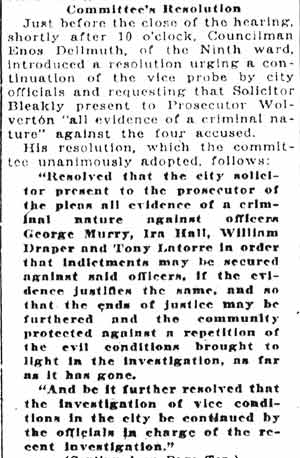
Committee’s Resolution
Just before the close of the hearing, shortly after 10 o’clock, Councilman Enos Dellmuth, of the Ninth ward, introduced a resolution urging a continuation of the vice probe by city officials and requesting that Solicitor Bleakly present to Prosecutor Wolverton “all evidence of a criminal nature” against the four accused.
His resolution, which the committee unanimously adopted, follows:
“Resolved that the city solicitor present to the prosecutor of the pleas all evidence of a criminal nature against officers George Murry, Ira Hall, William Draper and Tony Latorre in order that indictments may be secured against said officers, if the evidence justifies the same, and so that the ends of justice may be furthered and the community protected against a repetition of the evil conditions brought to light in the investigation, as far as it has gone.
“And be it further resolved that the investigation of vice conditions in the city be continued by the officials in charge of the recent investigation.”
Among those who attended the hearing besides Solicitor Bleakly and [?] were Frank S. Van Hart, president of Council, Chief of Police Gravenor, Assistant Chief Hyde and members of the police committee, including Councilmen Bowen, Dellmuth, Von Nieda, Bantivoglio, Corea, Dobbins, Dudley, Kelly and Payne. Each member of the committee took a personal interest in the proceedings and [?] question after question at the defendant and witnesses.
Spectators Jam Room
Spectators, among whom were several women welfare workers, filled every bit of space in police court, where the hearing was conducted. Expressions of disgust could be seen on many faces as revelations of the depravity that exists in the tenderloin district were made. Husky policemen, who by virtue of their duties one would expect to be accustomed to stories of immoral practices, almost blushed when they heard the startling accusations.
Hall seemed to have been assuming an attitude of defiance as indicated by accusations he directed at his superiors. He explained he had no lawyer and was entitled to all the privileges of a witness under such circumstances. He sat most of the time in a chair opposite the witness stand.
Hall’s Plea in Defense
“Why should I—one man—be held responsible for the vice that has been existing in the Fifth Ward for years?” Hall fairly shouted after he had taken the witness stand in his own defense.
“Doesn’t the captain of the district know that such conditions have existed in the ward and that there are disorderly houses there?” he continued. “What has been the matter with the men who have patrolled the beat near Second and Pine streets for years?”
He added dramatically as he faced the committeemen and the spectators: “If I had interfered I would have been before the police committee before this.”
Hall’s sarcastic remarks roused the ire of the city solicitors and the Councilmen and before he left the stand he refuted many of the allegations he made. He appeared “lost” many times when called upon to answer questions relative to remarks he uttered.
Acquitted of Robbery
Hall appeared before the committee for the express purpose of clearing himself of a charge of having been connected with the robbery of $250 from a soldier in a house that was conducted by Minnie Draper, underworld character, at 229 Pine street.
He also denied having aided the Draper woman to flee from Camden to Palmyra when she had been informed the “cops” were on her trail.
Hall was acquitted of the “robbery” charge. Solicitor Bleakly and Mr. West, his assistant, declared the evidence insufficient against Hall in the specification of the charges against the policeman.
The specifications against Hall read:
“That on or about January 2, 1921, at the premises at 229 Pine street, kept as a disorderly house by Jessie Smith, a soldier named Ernest Brown, was robbed of $250 with the connivance, aid and assistance of Ira Hall, in the presence of Minnie Draper, and that the said Minnie Draper was warned by Hall, then a police officer of the City of Camden, to get out of the house, ‘the cops are coming.’
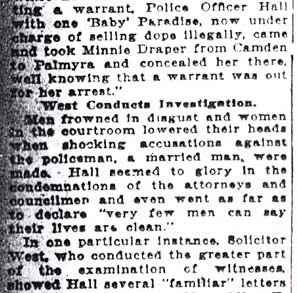
“That when Officer Fisher went after Minnie Draper, on the charge of robbery, the woman told the officer to go and get a warrant, and, while he was in the process of getting a warrant, Police Officer Hall with one ‘Baby’ Paradise, now under charge of selling dope illegally, came and took Minnie Draper from Camden to Palmyra and concealed her there, well knowing that a warrant was out for her arrest.”
West Conducts Investigation.
Men frowned in disgust and women in the courtroom lowered their heads when shocking accusations against the policeman, a married man, were made. Hall seemed to glory in the condemnations of the attorneys and councilmen and even went as far as to declare “very few men can say their lives are clean.”
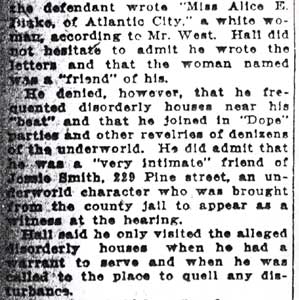
In one particular instance, Solicitor West, who conducted the greater part of the examination of witnesses, showed Hall several “familiar” letters the defendant wrote “Miss Alice E. [?]iske, of Atlantic City,” a white woman, according to Mr. West. Hall did not hesitate to admit he wrote the letters and that the woman named was a “friend” of his.
He denied, however, that he frequented disorderly houses near his “beat” and that he joined in “Dope” parties and other revelries of denizens of the underworld. He did admit that he was a “very intimate” friend of Jessie Smith, 229 Pine street, an underworld character who was brought from the county jail to appear as a witness at the hearing.
Hall said he only visited the alleged disorderly houses when he had a warrant to serve and when he was called to the place to quell any disturbance.
Smith Girl on Stand.
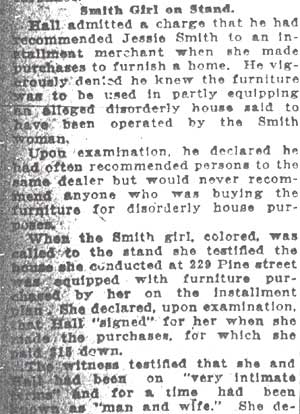
Hall admitted a charge that he had recommended Jessie Smith to an installment merchant when she made purchases to furnish a home. He vigorously denied he knew the furniture was to be used in partly equipping an alleged disorderly house said to have been operated by the Smith woman.
Upon examination, he declared he had often recommended persons to the same dealer but would never recommend anyone who was buying the furniture for disorderly house purposes.
When the Smith girl, colored, was called to the stand she testified the house she conducted at 229 Pine street was equipped with furniture purchased by her on the installment plan. She declared, upon examination, that Hall “signed” for her when she made the purchases, for which she paid $1[?] down.
The witness testified that she and Hall had been on “very intimate terms” and for a time had been known as “man and wife.” She declared she was under the impression her “friend” was a single man. She said the officer visited her frequently up until the past summer and on one or two occasions remained at her home during the night.
Hall There Night of Robbery
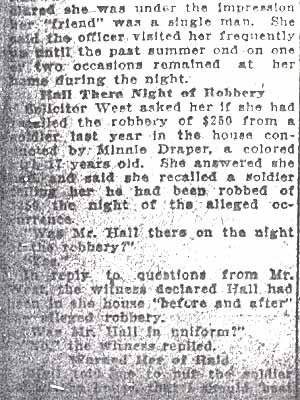
Solicitor West asked her if she had [?]ailed the robbery of $250 from a soldier last year in the house conducted by Minnie Draper, a colored girl 17 years old. She answered she [?] and said she recalled a soldier telling her he had been robbed of $250 the night of the alleged occurrence.
“Was Mr. Hall there on the night of the robbery?”
“Yes.”
In reply to questions from Mr. West, the witness declared Hall had been in the house “before and after” the alleged robbery.
“Was Mr. Hall in uniform?”
“No,” the witness replied.
Warned Her of Raid
[?] told [?] to put the soldier [?] that I should beat it” as the place was about to be raided.
“When the officers came there later he told them to put the ‘slightly’ intoxicated soldier out of the house.
“Did Mr. Hall say anything to Minnie Draper?”
“Yes, he told her to beat it, too.”
“Did Policeman Fisher come to the house the morning the robbery occurred?”
“Yes.”
“Did he have a warrant?”
The witness replied in the negative.
“Did Mr. Hall ever stay all night at 229 Pine street while you were there?”
“No.”
“Part of the night?”
“No.”
Went to Newark Once
The witness explained later that Hall had been at her home, 666 South Second street, all night on one occasion when she lived at that address.
“After one of the times you were released from the county jail, did you leave Camden?”
“Yes, I went to Newark.”
“Did you receive any communications from Mr. Hall while you were in Newark?” Solicitor West asked.
“Yes, several.”
She said, in answer to further questions, that Hall had informed her in the letters the matter involving the $250 was “all right and you don’t have to come back.”
He said also in the letter, continued the witness, he had “it fixed for Minnie Draper, too.” The witness said she still has letters she received from Hall, but she had not brought them to the hearing.
Hal [sic] was then granted permission to ask the witness questions.
“On the night of the alleged robbery,” he asked the witness, “did I come into your house?”
Denies Hall’s Questioning
“You did,” answered the woman in a positive tone.
“Didn’t I tell you that if you didn’t take that soldier out of the place that I would get the military police to take him out?” Hall asked.
“No, you didn’t.”
“Wasn’t I in my uniform the night of the alleged robbery?”
“No, you were in your citizen’s clothes that night.”
“That’s all,” Hall said to the witness.
It happened to be “all” as far as the witness was concerned because she was then excused from the stand by Mr. West.
Minnie Draper, the girl referred to in the charges against Hall, was brought from an outer room and asked to take the stand. She testified the robbery of the soldier was a little “before Easter” last year, and that Hall was there the evening it occurred.
Said “Cops” Surrounded House
“Hall told me to get out that night after the soldier had been robbed,” Minnie testified. “After the robbery occurred he told me ‘cops’ were surrounding the house and I should get out as fast as I could.”
She testified, upon being further examined by Mr. West, that Hall met her about two o’clock the night of the robbery and “went as far as Twenty-sixth street in a machine driven by Babe Paradise,” now under heavy bail on a charge of being a drug peddler. She said Hall alighted from the automobile at Twenty-sixth street and Paradise took her the rest of the way to Palmyra, where she remained, she said, from April until July.
She testified that on one occasion Hall visited a house where she was staying while she and other women were “enjoying a coke party.” She said that on another occasion she saw Hall and Jessie Smith in a room together acting in a “very familiar manner.”
Admits She Got Stolen Cash
She also testified that Detective Murry was given $50 to “squash” the robbery case, which, it has been alleged, involved Hall, herself and the Smith woman.
“Did you get any of the $250 stolen from the soldier?” Mr. West asked the witness.
“Yes. I know I got my part,” she answered. “The remainder went to Jessie Smith, but I suppose Mr. Hall got his share.”
“Was Mr. Hall in uniform when he gave you the caution to get out of the house the night of the robbery?”
“No,” the woman answered.
Many Pay Respects at Dellmuth Bier
Camden Courier-Post —
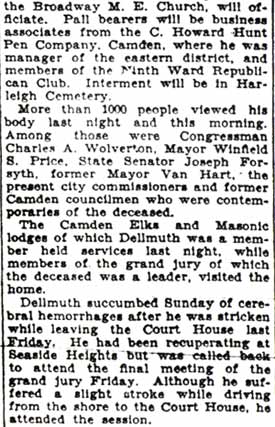
Services Over Former Councilman Held at Chambers Avenue Home
Scores of prominent Camden officials and former office holders will be among the mourners who will attend funeral services to be held this afternoon for Enos B. Dellmuth, former city councilman and foreman of the June term of Camden county grand jury.
Services will be held 2 p.m. at his late residence, 426 Chambers avenue. Rev. Edwin Forrest Hann, pastor of the Broadway M. E. Church, will officiate. Pall bearers will be business associates from the C. Howard Hunt Pen Company, Camden, where he was manager of the eastern district, and members of the Ninth Ward Republican Club. Interment will be in Harleigh Cemetery.
More than 1000 people viewed his body last night and this morning. Among those were Congressman Charles A. Wolverton, Mayor Winfield S. Price, State Senator Joseph Forsyth, former Mayor Van Hart, the present city commissioners and former Camden councilmen who were contemporaries of the deceased.
The Camden Elks and Masonic lodges of which Dellmuth was a member held services last night, while members of the grand jury of which the deceased was a leader, visited the home.
Dellmuth succumbed Sunday of cerebral hemorrhages after he was stricken while leaving the Court House last Friday. He had been recuperating at Seaside Heights but was called back to attend the final meeting of the grand jury Friday. Although he suffered a slight stroke while driving from the shore to the Court House, he attended the session.
Chambers Avenue, Looking North from Washington Street
circa 1900
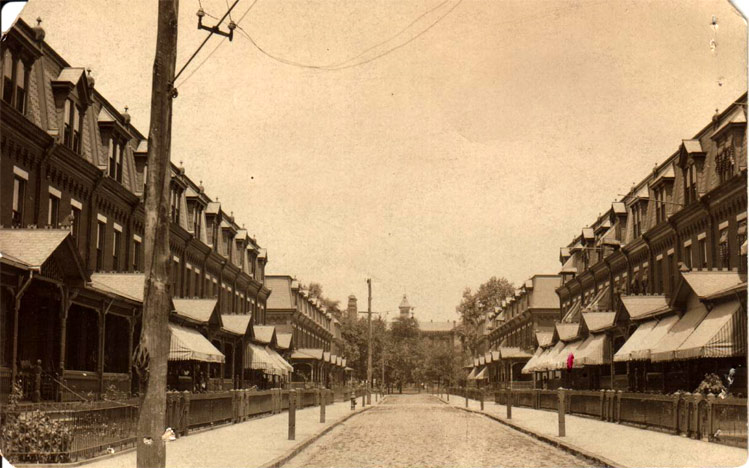
Chambers Street, looking north from Washington Street, around 1900. 426 Chambers is on the right side of the street, near the red mark.