Introduction
Professor Horatio T. Draper may well be considered the father of the modern Camden school system. After serving in the Civil War, he completed his education, and began working as a teacher in the late 1860s in Pennsylvania. He came to Camden in 1872, and immediately made an impact in the schools of the city.
Elected principal of all the schools in the Third District, which was made up of Camden’s 5th and 6th Wards, he also continued to teach evening courses. He was placed in charge of Camden’s Manual Training School, which became Camden Manual Training and High School at Haddon and Newton Avenues during the administration of Mayor Cooper B. Hatch at the turn of the century. In 1896 he was placed in charge of all of Camden’s public schools, and he oversaw the construction of the new high school during the first few years of his tenure, which appears to have lasted until 1906.
The Draper family lived at 582 Clinton Street in the late 1880s and early 1890s. They moved to 745 Wright Avenue in 1901, and the 1908 City Directory shows him as living at 719 Penn Street. Horatio Draper does not appear in the 1909 City Directory.
Horatio Draper and his wife Eleanore had two daughters, Anna and Agnes. Miss Agnes Draper began teaching in Camden’s public schools in 1909, and remained a teacher for over forty years. The Draper family were members of St. Paul’s Episcopal Church.
Biographical Review
Biographical Review — 1897
Professor Horatio Draper, supervisor of the public schools of Camden, N.J., and Principal of the Manual Training School, was born in Philadelphia, his parents being at the time on a visit to that city, whence, however, they shortly returned to their home in the South. By the death of both father and mother he was left an orphan in early childhood.
His youth was spent in Virginia, Baltimore, and Washington. In the Civil War he had some practical experience of a soldier’s life and duties. He obtained the greater part of his education in Washington and in Philadelphia, attending the grammar and high schools, and taking a special course in civil engineering under private tuition. Among his instructors were Professors Joseph Wilson, Kennedy, Haupt, Edmondson, Houston, De la Croix, and Hartshorne. After finishing his studies Mr. Draper worked as a draughtsman and book-keeper, and then began his career as a teacher, serving eight months at eight dollars per month in the Spring Garden Classical Academy for the privilege of learning how to teach. In this institution he taught Latin and the higher mathematics. He subsequently taught in the public schools of Montgomery County; in the Twenty-third Ward in Philadelphia one year; in Somerton eighteen months; in the Girard School, Twenty-sixth Ward, Philadelphia, eighteen months; and in 1872 he began his work as an educator in Camden, taking charge of the Central Avenue School in February. The first Principal of this school, he organized it, and left it in perfect condition for his successor. His next task was to reorganize the Liberty School; and in October, 1872, he took charge of the Kaighn Grammar School.
In 1883 the district principalship was established, and he was made Principal of the Third District (Fifth and Sixth Wards). This position he held seven years; and in the mean time, in the winter of 1877, he taught the artisans’ evening class in drawing and mathematics. In 1891 he was placed in charge of the Manual Training School, at the same time retaining his position as Principal of the Third District. Professor Draper himself organized the School of Manual Training. In 1892, under the recommendation of State Superintendent Poland, he was made Chairman of the Committee on Manual Training in the Columbus Exhibit Work, having charge of the exhibit of the State of New Jersey. At the Exposition Professor Draper’s school took one of the medals given for manual training, and received a certificate of award for mechanical and perspective draughting and carpentry and forging. The draughting exhibit was wholly the result of his teaching, as he had had charge of that department for three years. He himself received a diploma from the board of lady managers for his work in perfecting the exhibit. In 1894 he resigned the Third District principalship, being made supervising principal of manual training throughout the city, and removed to his present headquarters, 125 Federal Street; and in January, 1896, he was made supervisor of all school work in the city, at the same time retaining his position as Principal of the Manual Training School. In this school he teaches ten and a half hours per week. When he took charge there were forty-eight boy pupils in one building of four rooms. He now has a school of one hundred and sixty pupils of both sexes, and uses eight rooms in two three-story buildings. The pupils come from the grammar schools; and, in addition to receiving instruction in the high and manual course, they are trained here in normal methods of teaching.
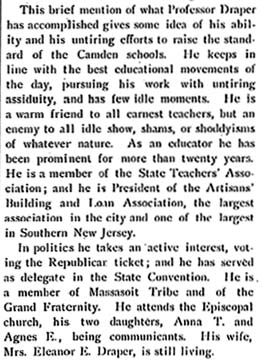
This brief mention of what Professor Draper has accomplished gives some idea of his ability and his untiring efforts to raise the standard of the Camden schools. He keeps in line with the best educational movements of the day, pursuing his work with untiring assiduity, and has few idle moments. He is a warm friend to all earnest teachers, but an enemy to all idle show, shams, or shoddyisms of whatever nature. As an educator he has been prominent for more than twenty years. He is a member of the State Teachers’ Association; and he is President of the Artisans’ Building and Loan Association, the largest association in the city and one of the largest in Southern New Jersey.
In politics he takes an active interest, voting the Republican ticket; and he has served as delegate in the State Convention. He is a member of Massasoit Tribe and of the Grand Fraternity. He attends the Episcopal church, his two daughters, Anna T. and Agnes E., being communicants. His wife, Mrs. Eleanor E. Draper, is still living.
Camden News
Philadelphia Inquirer —
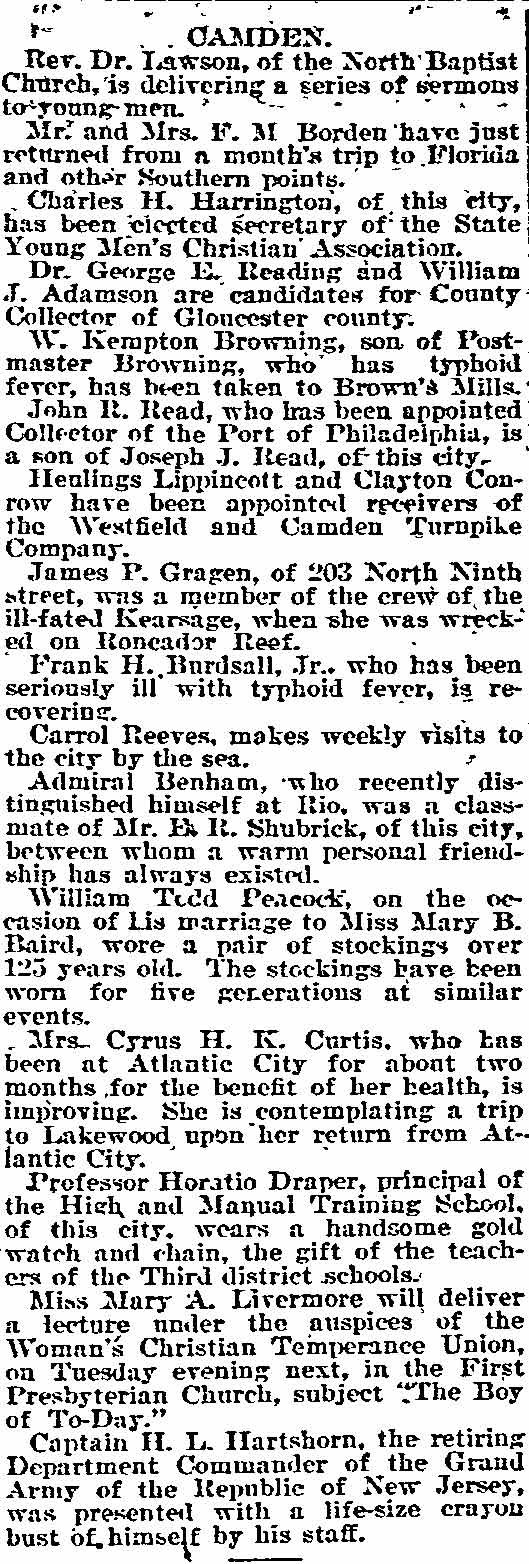
Professor Horatio Draper, principal of the High and Manual Training School of this city, wears a handsome gold watch and chain, the gift of the teachers of the Third district schools.
Along Memory Lane
Camden Courier-Post —
It is not so many years ago, old timers say, since Fetters School at Third and Mount Vernon Street was considered large enough to accommodate youngsters for several generations. Now a six-room annex is to be built on the north side facing Walnut Street. Back in 1905 five rooms were added in the annex on Mount Vernon Street. With the new structure the school will contain 19 rooms, which would have thought far too large for a high school in the 90s, when Camden had its first experiment in that line. That was in the old Federal Street building later occupied by the Post-Telegram.
Half a Century Ago
When Fetters School was built in 1875 it was considered about the last word as far as a school structure went. It was of stone, solidly constructed and furnished with gas, running water, and everything then regarded as thoroughly modern. The largest school downtown was the old Kaighn building on Newton Avenue, until the 1870s ample for the Kaighn Point area.
There were plenty of open lots when the Fetters School was built. Those days Camden was something of a struggling community with districts that had not yet lost their individuality. As a pupil in the early 90s in old Fetters I recall the section had many open spaces. Nothing remotely suggested the part-time classes was then necessary, certainly not thought of by Professor Horatio Draper, of blessed memory, who guided Camden’s educational system more than 30 years before he was displaced by the late Mayor Hatch at the close of the last century.
The Melting Pot
Nothing had then been heard of a “melting pot” as applied to America and its schools. But around Kaighn Point even in the 80s there was the first evidence of a great influx of those from across the seas who were soon to follow the old families, who’s children were to enter that melting pot and become transformed into American citizens.
The Fuhrmans, Auerbachs, Lichtensteins were among the first I recall. Many others followed; especially from the Russian Polish district where life was hard and oppression severe. Came the immigrant wave from South Italy whose descendants long since have taken possession of the district spreading from Third and Pine, once the stronghold of English, German, and Irish families. In a police census a quarter of a century ago it developed that the Fifth Ward could boast representatives from every nation on the face of the globe, even to a Finlander, some Turks with Japs and Chinese commonplace.
It was about the period when Miss Clara S. Burrough, long principal of the High School and now recovering from an operation in Cooper Hospital, was principal of Fetters that the big change came that the classes were composed largely of children of foreign parentage. Often they did not know a single word of English. Teachers had their problems and Miss Burrough will undoubtedly recall the great task involved in really making the “melting pot” down there in the old school at Third and Mount Vernon Street effective. But she and the valiant corps under her direction tackled it and by the time Miss Burrough was elevated to the principalship of Camden High, a very deserved promotion, by the way, the problem had been totally solved.
Hot Times in the Old Town
Incidentally Miss Burrough will likewise recall the hectic conditions in more ways than one for the period marked turmoil in the educational world hereabouts. “Old Drape” had been fired overnight by Hatch, indignation meetings were held, demands were made for his reinstatement but the Committee of Public Instruction, headed by the late C. S. Magrath, named by Hatch, naturally followed his direction. Martin Scheibner, a long, white-whiskered veteran of the Civil War, was named as Draper’s successor. But it was worse than handling a drove of wild horses. The venerable professor soon bowed out of the scene. It was not until the advent of Professor James E. Bryan that something like peace came. Bryan’s firm hand plus extraordinary ability and a determination not to surrender despite scholastic bedlam finally won.
But even yet, old friends of “Drape’s” who knew him in Fetters or in the makeshift “high school” have not forgotten the bitterness, have not forgiven the shabby way in which that fine Southern gentleman was treated. I recall him down at Fetters, sometimes with his setters on which he placed much store; often with a humorous story, which probably didn’t contribute to strict school discipline but which certainly left fragrant memories of days long ago.
C. S. Magrath — Martin Scheibner — Fuhrman Family — Lichtenstein Family