Introduction
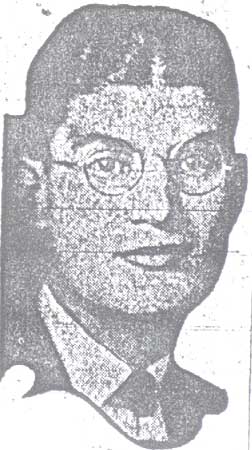
Samuel P. Orlando
SAMUEL P. ORLANDO was born in Italy on April 26, 1900 to Tony and Fortune Orlando. He came to America in 1909. When the Census was taken in 1910 the family lived in Bridgeton NJ where the elder Orlando and older brother Mike, then 18, worked as laborers at a glass factory. A daughter, Jennie, was also at home.
Samuel P. Orlando was living in Bridgeton NJ and attending Bridgeton High School when he registered for the draft in September of 1918. The family was still in Bridgeton in January of 1920, when the Census was enumerated. No one in the family had by then become US citizens.
After high school Samuel P. Orlando pursued a career in law. By 1926 Samuel Orlando had married. His wife Elsie was also a lawyer. The couple soon moved to Camden. When the 1930 Census was taken in April of that year, the Orlandos and daughter Letitia lived at 2613 Baird Boulevard in East Camden. By this time he had his own established law firm. One of his early hires as an associate was Frank M. Lario Sr. He was involved in local politics as a Democrat, and would serve as an alternate delegate to the 1932 Democratic National Convention. He would return as a full delegate to such conventions in 1936, 1940, 1948, and 1956.
Samuel P. Orlando was appointed Assistant Camden County prosecutor on September 6, 1928 by County Prosecutor Ethan P. Wescott, replacing Joseph Varbalow, who had resigned in order to concentrate on business interests. On September 18, 1928 as Eighth Ward political figure, Joseph “Mose” Flannery, who had ties to organized crime, was mortally wounded outside a saloon in the 100 block of Kaighn Avenue. This sparked an investigation on the part of Orlando into vice and police corruption in Camden.
By October of 1936 Samuel P. Orlando had succeeded Wescott as County Prosecutor. During Orlando’s tenure, several capital cases were prosecuted to conviction, including those of William John Stephan in 1936 and the Reverend Walter Dworecki in 1939. Samuel P. Orlando worked closely with long-time Camden County Chief of Detectives Lawrence Doran in cracking these and other cases.
Samuel P. Orlando maintained offices at 130 North Broadway, in the Wilson Building. He moved his practice to Haddonfield NJ sometime after 1959.
Samuel P. Orlando was a resident of Camden at the time of the 1930 census. By 1947 he had moved to a house at 111 Upland Way in Haddonfield, where he resided until his death in May of 1972.
World War I Draft Card
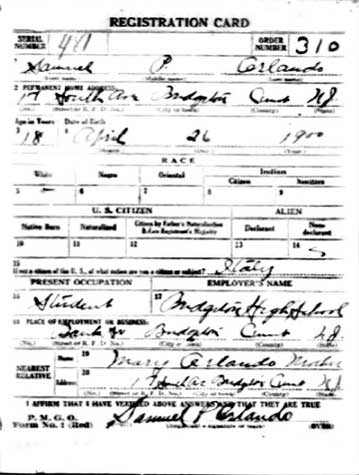
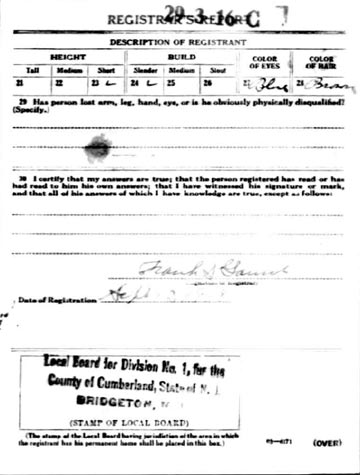
Samuel P. Orlando WWI draft registration card, 1918
Orlando Is Named to Varbalow’s Post
Camden Courier-Post —
ORLANDO IS NAMED TO VARBALOW’S POST
Assistant Prosecutor Resigns to Devote Entire Time to Private Business
Resignation of Joseph Varbalow as first assistant prosecutor of Camden county and appointment of Samuel P. Orlando as his successor was announced yesterday.
The unexpected shift was revealed by Acting Prosecutor Ethan P. Wescott as arrangements were being made to induct Orlando into office tomorrow, when the change will become effective. In acknowledging Varbalow’s resignation, which was made several days ago, Wescott paid tribute to him and accepted the resignation with regret. Pressure of business and demands of his private practice, Varbalow said, made his withdrawal from public office imperative.
In announcing the appointment of Orlando, the prosecutor explained his choice was fixed by Orlando’s rapid rise in his profession and his ability. At the same time, Wescott announced the new personnel of the prosecutor’s office would “work in complete harmony” and that with the induction of the new grand jury next Monday he expected a “period of activity.”
The appointment of Orlando will make no other change in the prosecutor’s office. Lawrence Gregorio, second assistant, will remain at that post. No definite term for Orlando is possible under present conditions due to failure of the Senate to confirm a new prosecutor when Wescott’s term expired last Spring. Judge Samuel M. Shay, of the Common Pleas Court and Judge Frank Neutze, of the District Court, were denied confirmation to the post when their names were submitted to Governor Moore.
Orlando Appointed Prosecutor’s Aide
Incumbents of the office are serving under jurisdiction of the attorney general. The new member of the staff was born in Italy. As a small boy, he came to America with his parents. They settled in Bridgeton in 1908. After his graduation from Bridgeton High school he entered Lehigh University. Later he matriculated at Dickinson School of Law, Carlisle, Pa., where he won his degree, passing the New Jersey State bar examination in 1924. He opened his Camden offices soon afterward.
He married Elsie di Renzo, a graduate of Dickinson college. She practiced law in Philadelphia while her husband was engaged in the same profession here. She retired from the law business about a year ago, when a son was born. Orlando is a member of Delta Theta Phi and Woolsack Honorary fraternity. He is secretary of the Camden County Democratic committee, an active member of the Allied Democratic Clubs of Camden county, City Athletic Club, Elks, Moose and a number of South Jersey Italian organizations. He won the Democratic nomination for the State Assembly in 1927 and led his ticket in the subsequent election.
Few of Camden’s younger members of the bar have made such rapid progress as Orlando in the past few years. He is an able public speaker and has been an active Democratic worker for several years.
Orlando’s acceptance of the appointment follows:
“Ethan Wescott has asked me to accept the post of assistant prosecutor, heretofore occupied by Mr. Varbalow. After having given the matter considerable thought and receiving expressions of my friends, I feel that I owe it to my party and to my numerous friends to accept.
“I do this very reluctantly, because recently I enlarged my offices and increased my organization. Of course, this new post will take considerable time. However, with the office organization that I have established here in my private practice, I feel that I can faithfully discharge my duties and serve my clientele. I trust that I will be able to serve my community faithfully.”
Babe Paradise Drug Case
Camden Courier-Post —
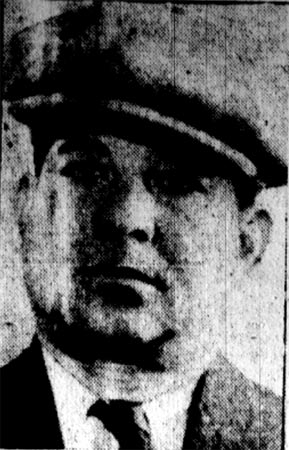
Declared to have confessed that he headed a narcotic “ring,” which conducted an organized business in the sale of drugs throughout South Jersey, Anthony “Babe” Paradise was to have been given a hearing in Police Court today. His attorney, Samuel Orlando, appeared in the court and waited for a time this morning. Later because he had business elsewhere, he asked and received a postponement of the case until tomorrow. Detectives say Paradise had confessed the sale of drugs, but the widely known Third Ward character now declares he is the victim of a “frame-up” and does not know the three men arrested with him.
City Athletic Club Dinner
Camden Courier-Post —
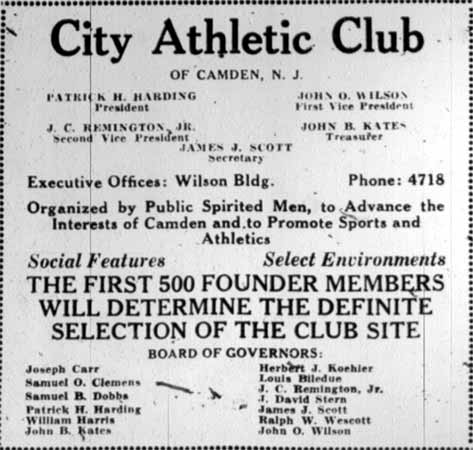
City Athletic Club of Camden, N. J. — Patrick H. Harding, President; John O. Wilson, First Vice President; J. C. Remington Jr., Second Vice President; John B. Kates, Treasurer; James J. Scott, Secretary. Executive Offices: Wilson Bldg. Organized by Public Spirited Men, to Advance the Interests of Camden and to Promote Sports and Athletics. The First 500 Founder Members Will Determine the Definite Selection of the Club Site.
Interpreters Idle
Camden Evening Courier —
Dismissed Man Sticks, New Appointee Reports, But There Is No Work For Either
There were two Italian interpreters in Judge Bernard Bertman’s court today — and no work for either.
Under advice of Samuel Orlando, his attorney, James Canzanese reported for work as usual, although he was removed from office by the Camden City Commission early in the week. Canzanese has announced he will appeal his dismissal to the state Civil Service Commission and has retained Orlando to represent him.
Cipriano Moles, named by the City Commission to replace Canzanese as the Italian interpreter in City Court, also reported for work this morning for the first time. There were no cases requiring the attention of either interpreter.
Gangster Shot During Melee in Sixth Ward
Camden Courier-Post —
Joseph Deven Held On Murder Charge After Death Boxer’s Brother; ‘Mose’ Flannery and 4 Others Held as Witnesses; Was Craps Game Says County Police
HOLDUP ATTEMPTED CITY COPS DECLARE
Victim of a shot fired in a melee, the exact cause of which remain undetermined, Joseph Cimini, 31 years old, was killed in the Sixth Ward Republican Club, 908 Broadway.
Cimini, declared by police to be a Philadelphia gangster, was killed before the eyes of two district detectives, Clarence Arthur and Clarence Bunker, who had been summoned to the club by warning that a fight was in progress.
Joseph Deven, 28 years old, known to his associates as “Polack Joe” and a colorful figure in Third Ward politics, fired the shot that killed Cimini.
Declaring that he had fired in self-defense, after Cimini struck him with the butt of a revolver, Deven was locked up without bail on a charge of murder.
Joseph ‘Mose’ Flannery, 26 years old, picturesque Eighth ward political worker, was held as a material witness. Detectives had seized Flannery who was to have precipitated the battle by brandishing a revolver just before Cimini was shot. The officers say that Flannery fled –after the shooting and was captured afterward at Broadway and Federal Street.
The name of the dead man was given as Joseph Gannon, but shortly before one o’clock this afternoon, he was identified as Joseph Cimini, 1301 Ellsworth Street, Philadelphia. The identification was made by a brother, William Cimini, a pugilist who has boxed in this city several times under the name of “Billy” Gannon.
Six Others Quizzed
Six other men who were present at the time of the shooting, or when the argument began, were questioned by city and county detectives.
They are Newton Blanchard, 30, 923 St. John Street, former Camden boxing referee and declared by some of the witnesses as the man who conducted the crap game at the club; Michael Dandrea, 26, 1067 Norris Street; Russell Sage, 26 years old, of 1102 Marion Street a taxicab driver who is said to have driven Gannon and Flannery to the club in his car; Maurice O’Brien, 27 years old, of 1429 Bradley Avenue, a former New Jersey State Trooper, Harry Trooper, Harry Waterhouse, 28 years old, whose address was given as the same as Sage’s; and Charles “Chick” Hunt, 27 years old, of 1218 Broadway, a former Camden boxer.
Blanchard and Dandrea were released after questioning and after each had made a statement to Chief of County Detective Lawrence T. Doran. The others were held with Flannery as material witness.
Differences of opinion between county and city detectives investigating the shooting were heightened during the afternoon. The county sleuths insisted upon the theory that the shooting had resulted from a feud between Flannery and Hunt, with Cimini taking the former’s side and Deven the latter and said that the heat of the argument had possibly been heightened by disagreement over a crap game.
The city police, on the other hand, declared that the entire affair was the result of an attempt by Flannery to hold up the other men. Deven’s statement to Chief Doran made no mention of a hold-up.
Building up a case against Flannery, the officers this afternoon lodged charges of attempted hold-up, carrying concealed deadly weapons, atrocious assault and battery and assault to kill against him. The two latter charges were made as the result of identification of Flannery as a participant in two recent robbery attempts. J.E. Feinstein, café proprietor of 508 Kaighn Avenue, declared that Flannery, Cimini, and Sage were thereof four men who held him up on New Year’s Day. He defied them and they left when he said, “Go ahead and shoot,” he asserted. Flannery was also identified, according to police, as the man who had beaten and attempted to rob Henry Mehrer, an Audubon policeman, and his two companions outside the Ringside Inn, on the Black Horse Pike, a fortnight ago. Mehrer and Feinstein were taken to police headquarters by County Detective Howard Smith, who is authority for the statement that they identified Flannery.
Cimini was shot shortly after 3:00 this morning and died almost instantly. Doctors at Cooper Hospital pronounced him dead on arrival. He had been shot just above the heart by a bullet from Deven’s gun.
Events preceding the shooting remain, to some extent clouded today. Chief Doran said he learned of an enmity existing between Flannery and Hunt. Deven appeared to have attempted to quiet “Mose,” the county detectives said. Cimini struck Deven and Deven fired.
Chief John Golden of the Camden city detective bureau stated, on the other hand, that the shooting had apparently followed an attempt to hold up the other men in the room. Golden based his view on the statements of Clarence Arthur, a city sleuth. According to Arthur, when he and Bunker appeared at the door of the room, Flannery and Cimini held revolvers and the other men in the room were standing with their hands upraised.
According to the story pieced together by county detectives from the statements of witnesses, a group of men had apparently gathered at the club for a crap game. Blanchard, it was stated, acts as the “stick man,” the term used in gambling parlance to designate the man who conducts a crap game.
City and County agree that Flannery and Cimini arrived together in Sage’s taxicab. Whether there was an argument, the result of an enmity between Flannery and Hunt, or whether the attempted hold-up theory is correct, remains to be learned by additional official investigation.
Chief Doran stated the witnesses had told him that words passed between Flannery and Hunt and that the former had gone downstairs. Returning he brandished a revolver.
Two Flee Place
It was at this point that Blanchard and Dandrea left the room and fled down the stairs. On the street, they encountered Detectives Arthur and Bunker, who were patrolling Broadway in a police automobile.
In describing the subsequent events today, Arthur declared that Blanchard had informed him that “two Philadelphia gunmen are up in the Sixth Ward Club holding up a bunch of fellows.”
The detectives did not immediately go to the club, but found Patrolman Frank Del Rossi and followed him up the stairs of the building.
“There were about fifteen men in the room,” Arthur asserted. “When we got to the door Flannery and Cimini had their guns out and apparently were about to search the others. The other men had their hands in the air.”
“When they saw us Flannery and Cimini threw their guns down and the others lowered their hands. I went up to Flannery and started to frisk him. Bunker went to another man, whom I don’t know, and started to frisk him.”
It was then he said that he heard the shot. Believing that it was Bunker who was shot, he released his hold on Flannery and swung around. As he did Flannery turned and fled downstairs, Arthur declared.
Bunker said he believed that it was Arthur who had been shot and he too released his grasp on the man he had been searching. The detectives turned in time to see Cimini fall.
“I did it! I shot him!” Deven is declared to have shouted, throwing his revolver on the table.
According to the story told by witnesses to the county detectives, however, Deven had stepped up to Flannery just before the shot was fired and had said “Mose, you can’t get away with this here.”
Flannery is said to have had a gun in his hand at the time.
As Deven spoke, the witnesses say, Cimini stepped behind him and struck him with the butt of a revolver. Just then detectives entered. Devin whirled and, drawing his gun, fired.
Cimini was placed in a police ambulance and taken to the hospital. After he had been pronounced dead his body was taken to the morgue, where it was awaiting identification today. Neatly dressed, Cimini is of Italian extraction. He has coal-black hair, brown eyes and a dark complexion. Coroner Charles T. Murray will perform a post-mortem examination, he said.
Flannery Captured
When he fled from the club, according to Arthur, Flannery jumped on a Public Service bus driven by David Smith, of 423 Haddon Avenue, which was passing at the time.
“Faster! Faster” he is declared to have urged Smith as the latter drove along Broadway in the direction of Federal Street.
At Federal Street and Broadway, Arthur and Bunker caught up to the bus and arrested Flannery as he descended from the vehicle.
“Why don’t you give me a chance to get to Philadelphia?” Arthur declares Flannery asked him. “I can get bail over there.”
Seek Written Statement
Chief Doran stated this afternoon that he was attempting to obtain a written statement from Flannery and would also seek to have Deven sign a statement regarding the shooting. During the morning, Flannery refused to talk while Devin, although admitting that he fired the shot, declared that he shot in self-defense. He made no reference to the hold-up attempt, according to the county detectives.
Cimini has a Philadelphia police record but, according to his pugilist brother, “was not bad but just wild.” He was recently arrested in Philadelphia after a fight with policemen.
“But he never held up or robbed anybody,” his brother declared this afternoon after identifying the body. “He got into a jam now and then. Yes, I know that he knew ‘Mose’ Flannery, but I never mixed with that crowd.”
It was reported at City Hall this afternoon that Samuel Orlando had been retained as attorney for Flannery and that Walter Keown, Camden county solicitor, would represent all the other men. The presence of Keown at detective headquarters, during which he had a conference with Captain Golden, seemed to lend credence to the latter report but neither rumor could be confirmed.
Flannery for years has figured in police cases and in political warfare in the Eighth Ward, where he was sometimes a lieutenant and sometimes an opponent of “Mikey” Brown, the Republican leader of the ward. Last March he was arrested and indicted on charges of atrocious assault and battery on his wife and her mother. At one time he was held as a suspect is a Philadelphia shooting but later was released.
The accused man, Deven, is a short, slim little man with an air of meek complaisance. He has been a taxicab driver and was last arrested on a charge of drunken driving. In May of 1926 he attempted suicide by shooting himself after he had failed to effect a reconciliation with his estranged wife. At that time, he shot himself but the bullet only grazed his chest.
Joe Deven, long a political power in the Third Ward, first flashed into citywide prominence in 1925, when he was employed by federal authorities as a deputy U.S. Marshal to guard the padlocked Poth brewery at Bulson Street, just off Broadway. At the time Deven was thus maintaining the sanctity of the Eighteenth Amendment, he was also operating a bootlegging establishment downtown and had been arrested once or twice for violating the Volstead Act.
The Courier at that time exposed this paradoxical situation, with the result that the U.S. Marshal summarily dismissed Deven. He keenly resented the political chicanery that had been used to put Deven in office. In explaining how Deven was appointed, the Marshal said that he had been recommended by “prominent Republican leaders” in Camden, chief among whom was William D. Sayrs, now a city commissioner but then a field agent in the office of the Internal Revenue Department.
Sought City Job
Not long after Deven’s dismissal as brewery guard, Sayrs and other Republican leaders made strenuous efforts to secure a city job for him under the Non-Partisan administration. They sought to exact a promise from The Courier that this newspaper would remain silent in the event Deven was appointed to a city position. No such promise was made and Deven remained jobless, politically at least.
Then came a humorous twist to the situation. Sayrs disagreed with some of the Organization leaders and, for a time, walked his own political footpath. Some of the leaders, fearful of what Sayrs might attempt politically, killed two birds with one stone by hiring Joe Deven to shadow Sayrs and to report to them the number of times he conferred with Non-Partisans. Thus, Joe had a job and Billy was watched.
Sayrs knew he was being shadowed by his old friend, and apparently he knew who had hired Deven to do the work, but he refused to take the situation seriously and chortled, frequently, when he would see his “Shadow” trailing about town.
In the last year, however, Deven has again been the particular political protégé of Commissioner Sayrs and also has won the friendship of many other political leaders. Nevertheless, he has not been, so far as can be determined, the recipient of any particular political patronage, though his political influence in the Third and Fifth Wards is said to have expanded rapidly under the new administration.
Dealer Denies Thieves Took Slot Machine
Camden Evening Courier —
Bertman Doubts His Story After He ‘Shifts’ Loot to Cigars — Is Liable to a Fine on Gambling Machine
Grand Jury Probe is Hinted by Judge — Reporter Takes Stand
Lewis Shectman changed his story in police court today and declared that it was only a box of cigars, not a gambling machine that was stolen from his store, 708 Broadway, yesterday by two bandits. Police Court judge Bernard Bertman characterized Schectman as a prevaricator.
Shectman denied statements published in the Evening Courier yesterday, in which he and his wife and daughter related in detail how two men had carried away a gambling machine in an automobile after losing $2 playing the machine.
William Gaffney, Evening Courier reporter, was called to the stand and repeated the facts published in yesterday’s paper.
“I cannot help but believe you are lying,” Bertman said to Schectman. At the same time Bertman intimated that he would recommend a further investigation of the matter by County Prosecutor Wescott before putting the evidence before a grand jury.
Denies Stealing ‘Cigars’
Schectman appeared in Court today against two men the police arrested in the case. The defendants are Walter S. Nowak, 22 years old, 442 Jackson Street and Martin Bertherlet, 25 years old, 1218 Pavonia Street. Each was held in $500 bail for the Grand Jury after Samuel P. Orlando, counsel for the two men, had waived a hearing.
Orlando, after the hearing today, stated that both men deny the charge of stealing the cigars. He would not comment on the case further, however.
Nowak was caught after a two-mile chase through the streets of Camden yesterday by Schectman and Frank Helm, 2909 Stevens Street, who offered his car as Shectman cried “Help! Robbers!” in front of his store.
Nowak was turned over to Patrolmen Nathan Petit and Edward Carroll of the Second District patrol crew.
Both Are Identified
Berherlat was arrested. Police said he called at headquarters yesterday afternoon and reported that his automobile had been stolen from Hyde Park, Second and Kaighn Avenue. Police said they doubted his story, investigated, and placed him under arrest today.
Both Novak and Bertherlat were identified as the two men who rushed from his store yesterday noon, by Shectman.
A stir was created in court when the Broadway store proprietor said he did not own a gambling machine, and said that the thieves had stolen a box of cigars.
When Shectman, answering a question put to him by Bertman, denied that he had been asked to “change the story” Gaffney was called to the witness stand.
Gaffney recited in detail an interview with Schectman yesterday shortly following the robbery. How Schectman had said that he had been robbed at a slot machine by two well-dressed bandits and how he had pursued them through the principal streets of South Camden — account of which was printed in detail in Friday’s Courier — was told by the witness.
Shectman Questioned
Questioning of Schectman by Bertman followed statements by Detective Louis Shaw and attorney Orlando.
Shaw, asked the nature of the case against Nowak and Bertherlat said that it was over the “larceny of cigars.”
Orlando said that he understood that the matter involved his clients with the theft of a slot machine from Shectman’s store. Orlando said that his clients denied stealing cigars.
Neither of the defendants were called to testify.
Following Gaffney’s testimony, Judge Bertman said that he was tempted to hold the complainant under bail.
Shectman then again tried to “explain” the alleged discrepancies in the interview Friday and the statements made in court this morning.
“I don’t want to talk with you” was Bertman’s answer to Shectman’s request for a “few minutes” with the judge.
Police today said that they had arrested Harry Simons, 44, of 1447 South 4th street “on suspicion” last night. After Shectman positively identified Nowak and Bertherlat, Simons was released.
An erroneous report of the license number found on the Flint touring car used by the men on their flight from Shectman’s store was made yesterday. The license number, police said, was C16209 and not C16207 as reported yesterday.
It was through the tracing of the license number and the report that Bertherlat’s car had been stolen, that the second arrest in the case was made this morning.
Police said they figured the car had been used in several south Camden robberies during the past month.
Under the law, had Shectman admitted to possession of the slot machine, he would have been subject to a fine.
Patrons, Patronesses Announced for First Military Ball
Camden Courier-Post —
Patrons and patronesses for the first military ball of the Camden Post No. 960, Veterans of Foreign Wars, to be held on Friday evening February 3 in the Elks auditorium, Seventh and Cooper Streets, are announced today.
The following prominent men and women are listed: Mrs. J.W. Connor, Miss C.M. Day, Mrs. J.H. Forsyth, Mrs. H.J. Goodyear, Miss B. Graham, Mrs. R.E. Green, Mrs. E.F. Haines, Mrs. J. Hood Jr., Mrs. W. Hurley, Mrs. J. Jarrell, Mrs. T. Keefe, Mrs. J.F. Kobus, Mrs. L. Liberman, Mrs. F.L. Lloyd, Mrs. M.A. Logan, Mrs. T.P. McConaghy, Mrs. F.F. Neutze, Mrs. L.K. Marr, Mrs. J.A. Pennington, Mrs. M.E. Ramsey, Mrs. E. Truax, Mrs. S.M. Shay, Mrs. W.J. Staats, Mrs. B.G. Tarburton, Mrs. R.W. Waddell, Mrs. E. Watson, Mrs. E.P. Wescott, Mrs. C.A. Wolverton.
David Baird Jr., William T. Boyle, Isaac Ferris, William Hurley, John Hood Jr., John Jarrell, Victor King, William J. Kraft, Thomas Keefe, Joseph F. Kobus, Hon. Edmund B. Leaming, Dr. A. Haines Lippincott, James H. Long, L.K. Marr, Dr. Thomas P. McConaghy, Hon. Frank F. Neutze, Samuel P. Orlando, Albert E. Simmons, Edwin Watson, Ethan P. Wescott.
Colanduno Guilty of Dope Peddling
Camden Courier-Post —
Jury Out Less Than Hour; ‘Babe Paradise’ Up Next Week
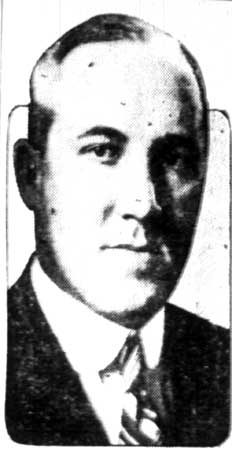
Trenton, Jan. 31 — The name of Judge Samuel M. Shay, of the Camden County Court of Common Pleas, has been handed to Governor Moore as the choice of the Camden Democratic organization for prosecutor, succeeding Ethan Wescott.
The name was submitted to Governor Moore last night by a delegation of Camden Democrats, headed by Edward J. Kelleher.
That Governor Moore will send the nomination to the State Senate appears certain, and it is not likely that any serious objection will be raised in that body, inasmuch as Judge Shay’s reputation is of the highest and he has been twice before confirmed for the judgeship by the Senate.
The choice of Judge Shay was a big surprise in state Democratic ranks, and started a flurry of speculation. If Judge Shay is appointed to the prosecutorship it will leave a vacancy on the bench of the Court of Common Pleas. Although the Camden Democrats are said to be a unit in supporting Shay and also on the other changes they contemplate, no definite word leaked out as to who will be Shay’s successor on the bench.
Judge Shay’s appointment as prosecutor, it was said by Camden Democrats who were here last night, mean drastic changes to the personnel of the Camden Prosecutor’s office. One of the rumors in effect is that District Court Judge Frank F. Neutze will be elevated to the County judgeship and that Prosecutor Wescott will succeed Neutze. It is also rumored that Judge Shay’s present post may go to either former Judge William T. Boyle or former Judge William C. French. Both Boyle and French formerly held the county judgeship position.
Another rumor is that Samuel P. Orlando will be named first assistant prosecutor and that either Francis G. Homan or Lawrence Gregorio, the incumbent will be named second assistant prosecutor.
The names of former Police Judge John T. Cleary and Assistant Prosecutor Joseph A. Varbalow also figure in the rumor. Cleary has been mentioned as first assistant prosecutor several times.
Headed by Assistant Prosecutor Lawrence Gregorio, County Detective Frank Cocchilaraley and Justice of the Peace Jack O’Grady, a delegation of Camden Democrats were scheduled to arrive in Trenton this afternoon for a conference with Governor Moore in the interest of Prosecutor Wescott.
O’Grady stated he will present letters from the Bricklayers and Ironworkers Unions urging the reappointment of Wescott. Cocchiaraley is heading a group of South Camden Italians who are also favoring the reappointment of Wescott.
Convicted by a Criminal Court jury of conspiracy and the possession and sale of narcotics, Joseph Colanduno, 29 years old, 431 Walnut Street, said by police to be a member of a powerful dope ring in Camden, will be sentenced by Judge Shay tomorrow morning.
The jury deliberated less than an hour before returning a verdict of guilty on seven indictments, marking the end of the first of a series of “dope” trials scheduled to be heard by Judge Shay. The most important hearing will be that of Anthony “Babe” Paradise, who has been indicted in eleven counts on narcotics charges, six of them true bills accusing Paradise and James Mucci with conspiracy to sell narcotic drugs. Another alleged member of the gang, Rocco DeCord, 221 Spruce Street, who recently pleaded guilty to six indictments and who turned state’s evidence at yesterday’s trial, will be sentenced later. Still another alleged “dope runner,” Alex Frumento, is being sought by police.
DeCord and three confessed addicts testified against Colanduno at the trial yesterday. DeCord said that he had been hired by the defendant and Frumento to sell small packages marked “H” and “C” to certain men who had been introduced to him. DeCord declared that he did not know what the packages contained, nor did he ever use dope.
The drug users, Nolan Clark, 28 years old who gave no address; George “Gyp” Haines, 29 years old, 527 Spruce Street, and Andrew Hill, 20 years, Locust Street and Kaighn Avenue, declared they had bought dope from Colanduno on various occasions.
Colanduno, who until last December operated the Primrose Inn at Barrington with Frumento as his partner, denied that he ever possessed drugs or hired DeCord. His arrest, he said, was a “frame-up” engineered by his “enemies.” His wife Hazel and his wife’s grandmother, Mrs. Laura Brakeman, who lives with Mrs. Colanduno, both testified that they never had seen DeCord or the three addicts buying drugs at the inn, as they declared on the witness stand.
James Gatti, 18 years old, of Philadelphia, who is serving a six-month term in the county jail for robbery, took the stand on Colanduno’s behalf. He testified that DeCord had told him in the jail that the confessed dope peddler’s statement implicating Colanduno had been forced from him by police.
Assistant Prosecutor Joseph A. Varbalow stated that the Paradise case probably would be disposed of next week with the return from Florida of Samuel P. Orlando, attorney for the alleged “Dope King of Camden.”
Found Wounded on Sidewalk at Kaighn Point
Camden Evening Courier —
Seals Lips as Police Seek to Learn Identity of Assailant
EIGHT UNDER ARREST IN SUSPECT ROUNDUP
Surgeons at Hospital Find Four Jagged Bullet Holes in Body
Victim of the gang feud—he denounced on his death bed, Joseph “Mose” Flannery, 26, picturesque Eighth ward political worker, was dying today in West Jersey Homeopathic Hospital.
Mortally wounded, his body riddled with bullets, Flannery was shot some time shortly before 4 a. m. today as he stood on the sidewalk outside a saloon at Front and Kaighn avenue.
Four or five men, grouped closely about the prone body of the political worker, hailed a truck which took Flannery to the hospital at 4.15.
Eight men had been arrested by police, seven charged with being a material witness, and the other being held at police headquarters “on suspicion.”
They were James L. Hawkins, 37, declared by police to be proprietor of the saloon at 101 Kaighn avenue; Walter Novak, 22, 442 Jackson street; Russell Sage, 25, of 407 Mechanic street; Joseph Novak, 34, of 508 Jackson street; Eugene Murphy, 51, of 101 Kaighn avenue; “Cuzzy” Scarduzio, 27, who gave police no home address, and Joseph Moll, 25, of 101 Kaighn avenue, all held as material witnesses; and Patrick Driscoll, 25, of 1225 South Third street, held “on suspicion.”
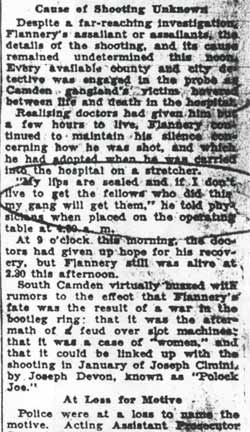
Cause of Shooting Unknown
Despite a far-reaching investigation, Flannery’s assailant or assailants, the details of the shooting, and its cause remained undetermined this noon. Every available county and city detective was engaged in the probe as Camden gangland’s victim hovered between life and death in the hospital.
Realizing doctors had given him but a few hours to live, Flannery continued to maintain his silence concerning how he was shot, and which he had adopted when he was carried into the hospital on a stretcher.
“My lips are sealed and if I don’t live to get the fellows who did this my gang will get them,” he told physicians when placed on the operating table at 4:30 a. m.
At 9 o’clock this morning, the doctors had given up hope for his recovery, but Flannery still was alive at 2.30 this afternoon.
South Camden virtually buzzed with rumors to the effect that Flannery’s fate was the result of a war in the bootleg ring; that it was the aftermath of a feud over slot machines; that it was a case of “women,” and that it could be linked up with the shooting in January of Joseph Cimini, by Joseph Devon, known as “Polack Joe.”
At Loss for Motive
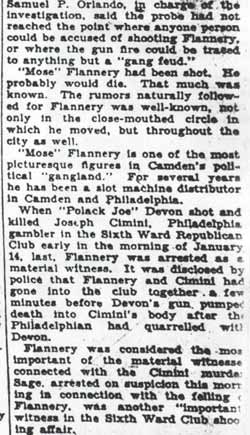
Police were at a loss to name the motive. Acting Assistant Prosecutor Samuel P. Orlando, in charge of the investigation, said the probe had not reached the point where anyone person could be accused of shooting Flannery, or where the gun fire could be traced to anything but a “gang feud.”
“Mose” Flannery had been shot. He probably would die. That much was known. The rumors naturally followed for Flannery was well-known, not only in the close-mouthed circle in which he moved, but throughout the city as well.
“Mose” Flannery is one of the most picturesque figures in Camden’s political “gangland.” For several years he has been a slot machine distributor in Camden and Philadelphia.
When “Polack Joe” Devon shot and killed Joseph Cimini, Philadelphia gambler in the Sixth Ward Republican Club early in the morning of January 14, last, Flannery was arrested as a material witness. It was disclosed by police that Flannery and Cimini had gone into the club together a few minutes before Devon’s gun pumped death into Cimini’s body after the Philadelphian had quarrelled with Devon.
Flannery was considered the most important of the material witnesses connected with the Cimini murder. Sage, arrested on suspicion this morning in connection with the felling of Flannery, was another “important” witness in the Sixth Ward Club shooting affair.
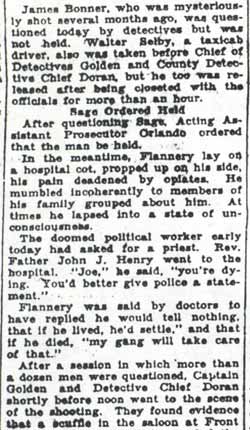
James Bonner, who was mysteriously shot several months ago, was questioned today by detectives but was not held. Walter Selby, a taxicab driver, also was taken before Chief of Detectives Golden and County Detective Chief Doran, but he too was released after being closeted with the officials for more than an hour.
Sage Ordered Held
After questioning Sage, Acting Assistant Prosecutor Orlando ordered that the man be held.
In the meantime, Flannery lay on a hospital cot, propped up on his side, his pain deadened by opiates. He mumbled incoherently to members of his family grouped about him. At times he lapsed into a state of unconsciousness.
The doomed political worker early today had asked for a priest. Rev. Father John J. Henry went to the hospital. “Joe,” he said, “you’re dying. You’d better give police a statement.”
Flannery was said by doctors to have replied he would tell nothing, that if he lived, “he’d settle,” and that if he died, “my gang will take care of that.”
After a session in which more than a dozen men were questioned, Captain Golden and Detective Chief Doran shortly before noon went to the scene of the shooting. They found evidence that a scuffle in the saloon at Front and Kaighn avenue had preceded the shooting.
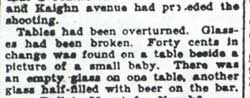
Tables had been overturned. Glasses had been broken. Forty cents in change was found on a table beside a picture of a small baby. There was an empty glass on one table, another glass half-filled with beer on the bar.
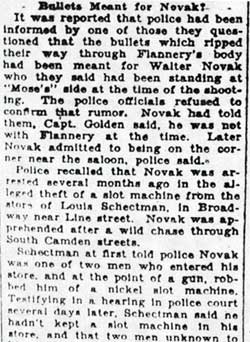
Bullets Meant for Novak?
It was reported that police had been informed by one of those they questioned that the bullets which ripped their way through Flannery’s body had been meant for Walter Novak who they said had been standing at “Mose’s” side at the time of the shooting. The police officials refused to confirm that rumor. Novak had told them, Capt. Golden said, he was not with Flannery at the time. Later Novak admitted to being on the corner near the saloon, police said.
Police recalled that Novak was arrested several months ago in the alleged theft of a slot machine from the store of Louis Schectman, in Broadway near Line street. Novak was apprehended after a wild chase through South Camden streets.
Schectman at first told police Novak was one of two men who entered his store, and at the point of a gun, robbed him of a nickel slot machine. Testifying in a hearing in police court several days later, Schectman said he hadn’t kept a slot machine in his store, and that two men unknown to him stole a box of cigars and escaped in an automobile.
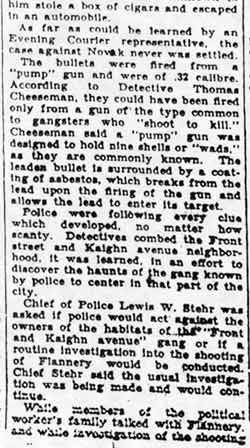
As far as could be learned by an Evening Courier representative, the case against Novak never was settled.
The bullets were fired from a “pump” gun and were of .32 calibre. According to Detective Thomas Cheeseman, they could have been fired only from a gun of the type common to gangsters who “shoot to kill.” Cheeseman said a “pump” gun was designed to hold nine shells or “wads,” as they are commonly known. The leaden bullet is surrounded by a coating of asbestos, which breaks from the lead upon the firing of the gun and allows the lead to enter its target.
Police were following every clue which developed, no matter how scanty. Detectives combed the Front street and Kaighn avenue neighborhood, it was learned, in an effort to discover the haunts of the gang known by police to center in that part of the city.
Chief of Police Lewis W. Stehr was asked if police would act against the owners of the habitats of the “Front and Kaighn avenue” gang or if a routine investigation into the shooting of Flannery would be conducted. Chief Stehr said the usual investigation was being made and would continue.
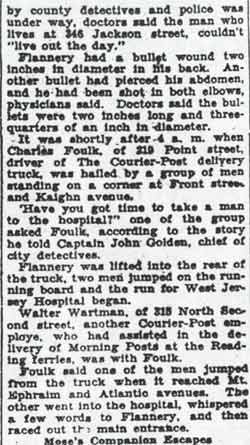
While members of the political worker’s family talked with Flannery, and while investigation of the shooting by county detectives and police was under way, doctors said the man who lives at 346 Jackson street, couldn’t “live out the day.”
Flannery had a bullet wound two inches in diameter in his back. Another bullet had pierced his abdomen, and he had been shot in both elbows, physicians said. Doctors said the bullets were two inches long and three-quarters of an inch in diameter.
It was shortly after 4 a. m. when Charles Foulk, of 219 Point street, driver of The Courier-Post delivery truck, was hailed by a group of men standing on a corner at Front street and Kaighn avenue.
“Have you got time to take a man to the hospital?” one of the group asked Foulk, according to the story he told Captain John Golden, chief of city detectives.
Flannery was lifted into the rear of the truck, two men jumped on the running board and the run for West Jersey Hospital began.
Walter Wartman, of 315 North Second street, another Courier-Post employe, who had assisted in the delivery of Morning Posts at the Reading Ferries, was with Foulk.
Foulk said one of the men jumped from the truck when it reached Mt. Ephraim and Atlantic avenues. The other went into the hospital, whispered a few words to Flannery, and then raced out the main entrance.
Mose’s Companion Escapes
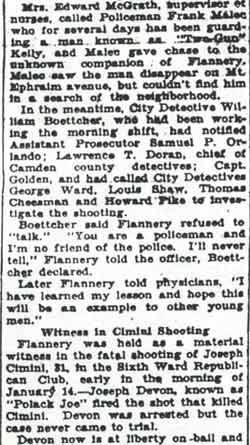
Mrs. Edward McGrath, supervisor of nurses, called Policeman Frank Malec who for several days has been guarding a man known as “Two-Gun” Kelly, and Malec gave chase to the unknown companion of Flannery. Malec saw the man disappear on Mt. Ephraim avenue, but couldn’t find him in a search of the neighborhood.
In the meantime, City Detective William Boettcher, who had been working the morning shift, had notified Assistant Prosecutor Samuel P. Orlando; Lawrence T. Doran, chief of Camden county detectives; Capt. Golden, and had called City Detectives George Ward, Louis Shaw, Thomas Cheesman [sic] and Howard Pike to investigate the shooting.
Boettcher said Flannery refused to “talk.” “You are a policeman and I’m no friend of the police. I’ll never tell,” Flannery told the officer, Boettcher declared.
Later Flannery told physicians, “I have learned my lesson and hope this will be an example to other young men.”
Witness in Cimini Shooting
Flannery was held as a material witness in the fatal shooting of Joseph Cimini, 31, in the Sixth Ward Republican Club, early in the morning of January 14.—Joseph Devon, known as “Polack Joe” fired the shot that killed Cimini. Devon was arrested but the case never came to trial.
Devon now is at liberty on bail and is under indictment for manslaughter in connection with Cimini’s death. Flannery also was released under bail.
While police continued their investigation, Flannery, still determined to refuse information to detectives and doctors, was surrounded by his wife, his 4-year-old son, his mother and father, and his 19-year-old brother James. Calling “Jim” to his side, Flannery, according to physicians, said, “I want you to promise me you’ll never get mixed up in these gang wars.” “Jim” promised, Detective Boettcher said.
Novak Under Suspicion
In their search for the “mysterious” companion of Flannery on the ride to the hospital, police pointed a suspicioning finger at Walter Novak who they had held “on suspicion.”
According to information given them by Foulk, the truck driver, Flannery, during the ride from Front and Kaighn avenue to the hospital, whispered, “Where are you taking me, Walt?” He was told the hospital was the truck’s destination, Foulk told police.
Detectives said Novak might have been the “Walt” to whom Flannery spoke. Novak said he was 22, was a “salesman” and lived at 442 Jackson street.
Taken by Strategy
Scarduzio’s arrest resulted from a piece of strategy on the part of Chief of County Detectives Doran. Doran with several members of his staff and city detectives were in the bar-room of the saloon at 101 Kaighn avenue when the telephone rang before noon.
Doran picked up the receiver and the party on the other end asked if Joseph Moll, son of former Policeman Frank Moll, was there.
Figuring that the persons might be some one who could help the authorities unravel the mystery, Doran answered:
“Yes, this is Joe Moll.”
“Well, I want to see you right away,” continued the other party.
“Will you come right down to 674 Fairview street. I want to see you,” finished the unidentified speaker who then hung up.
Doran with Captain of Detectives Golden hurried down to the address given and there found Scarduzio in the home of Garfield Del Duca.
Scarduzio, it is said, was more surprised to see the authorities than they were to find him as Chief Doran had been searching for “Cuzzie” for several hours.
He said he had nothing to do with the shooting of Flannery. Limping when the detectives escorted him from the house, Scarduzio was first taken to West Jersey Homeopathic Hospital to discover whether or not he was suffering from any bullet wounds in the legs.
Scarduzio Not Shot
Doctors later said Scarduzio had not been shot and the man who had been surprised at the Del Duca home was taken to police headquarters.
He “knew nothing about the shooting,” Scarduzio told Captain Golden and County Detective Chief Doran. There were stains, possibly bloodstains, on Scarduzio’s trousers, the police said. “Cuzzy,” as he is known in police circles, wore a clean white shirt, and that fact sent detectives from headquarters on another tangent in their investigation.
Scarduzio was asked where he had left a “bloody shirt” he was reported to have been wearing early today. According to police, he denied his shirt was bloody, and refused to give them any information.
City Detectives David Hunt, Samuel Johnson, and Walter Smith were dispatched on the “side” investigation.
Detective Thomas Cheesman [sic], of the city hall staff, also holds two warrants for the arrest of Scarduzio in connection with the holdup of a saloon in Gloucester several weeks ago and the theft of an automobile.
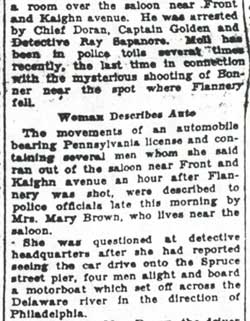
Moll was arrested while sleeping in a room over the saloon near Front and Kaighn avenue. He was arrested by Chief Doran, Captain Golden and Detective Ray Sapanore. Moll has been in police toils several times recently, the last time in connection with the mysterious shooting of Bonner near the spot where Flannery fell.
Woman Describes Auto
The movements of an automobile bearing Pennsylvania license and containing several men whom she said ran out of the saloon near Front and Kaighn avenue an hour after Flannery was shot, were described to police officials late this morning by Mrs. Mary Brown, who lives near the saloon.
She was questioned at detective headquarters after she had reported seeing the car drive onto the Spruce street pier, four men alight and board a motorboat which set off across the Delaware river in the direction of Philadelphia.
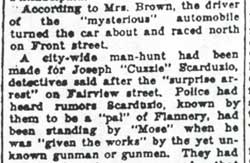
According to Mrs. Brown, the driver of the “mysterious” automobile turned the car about and raced north on Front street.
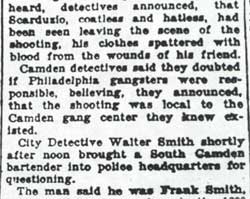
A city-wide man-hunt had been made for Joseph “Cuzzie” Scarduzio, detectives said after the “surprise arrest” on Fairview street. Police had heard rumors Scarduzio, known by them to be a “pal” of Flannery, had been standing by “Mose” when he was “given the works” by the yet unknown gunman or gunmen. They had heard, detectives announced, that Scarduzio, coatless and hatless, had been seen leaving the scene of the shooting, his clothes spattered with blood from the wounds of his friend.
Camden detectives said they doubted if Philadelphia gangsters were responsible, believing, they announced, that the shooting was local to the Camden gang center they knew existed.
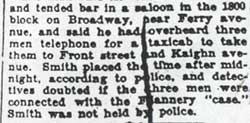
City Detective Walter Smith shortly after noon brought a South Camden bartender into police headquarters for questioning.
The man said he was Frank Smith, and tended bar in a saloon in the 1800 block on Broadway, near Ferry avenue, and said he had overheard three men telephone for a taxicab to take them to Front street and Kaighn avenue. Smith placed the time after midnight, according to police, and detectives doubted if the three men were connected with the Flannery “case.” Smith was not held by police.
Orlando Raids 35 Gambling Haunts in Slot Machine Drive
Camden Evening Courier —
The second blow within 24 hours at the slot-machine “racket” in Camden was to be made this afternoon in the grand jury rooms in Camden County Court House.
[illegible] with evidence secured in [illegible]ay’s surprise raid, Assistant Prosecutor Samuel P. Orlando was to ask the jury to inquire into the illegal operation of the machines in Camden saloons, cigar stores and cafes.
The grand jury convened at 1:30 p. m.
[illegible]teen of the “money” devices were seized, and as many proprietors of the places where they were found were summoned to appear before the jurors when county detectives and constables swooped down on 35 alleged gambling haunts.
A conference of Republican organization leaders was held this morning, at which the slot machine raids and the impending grand jury investigation were discussed. According to authentic reports, it was the opinion of the leaders that an intensive grand jury probe would be “bad politics.”
It was decided to bring pressure to bear upon Prosecutor Ethan P. Wescott to “call off” Assistant Prosecutor Orlando, who engineered the raids last night.
This afternoon, when the grand jury convened, both Wescott and Orlando went before the jury, in their closed session.
Orlando made it clear, in a statement, that he is not after “small fry” but intends to get the “higher-ups” in the slot machine “game” in Camden city and county.
“I am not going to give the proprietors of the slot machines time to exert their usual political pull, but I intend to have them before the grand jury immediately. I am going to find out, with the help and co-operation of the members of the jury, where they got their machines, how they arrive at their percentage and who is protecting them.
“I have been making a survey of Camden county, including the city, since I took office ten days ago,” he continued, “and I have considerable evidence. I believe that there are, conservatively, 500 slot machines in Camden county and that the income from each of them averages from $50 [illegible] a week. You can make your own multiplication. I believe nearly $[illegible],000 a week is split up, in various ways, from the slot machine racket in the city and county. That money, wherever it goes, is coming from many people who can ill afford to lose it. They need it to pay their butchers and grocers.”
Several Places ‘Tipped Off’
Although Orlando struck quickly, there were several places where the coming of his men had been “tipped off.” A few places, where the noise of machines had been heard for weeks by passersby were strangely silent last night when the county raiders got busy.
Orlando, co-operating with Prosecutor Wescott, will go before Judge Shay soon to ask for a court order to destroy all seized machines.
The raiders were led by Lawrence T. Doran, chief of county detectives. The party included County Detectives Wren, Smith, Cleary, Lyons and Cocherailly, and Constable Max Beals.
Five p. m. was set as the zero hour, and the raiders, two to an automobile, set out from the courthouse at 4:45 p. m. The raids were timed so as to be almost simultaneous.
The raiders walked into the suspected places. If no slot machine was in sight, they bought a cigar or a package of cigarettes and walked quietly out. If they saw a slot machine, they seized it.
Raiders Carried Subpenas
For the first time, the raiders carried subpenas, and where machines were seized, the proprietors were summoned to appear before the grand jury today.
They found no machines in saloons. Bartenders grinned at them when they went in, they reported. In several stores they were met with smiles, they said.
The places where machines were found were: 450 South Third street, store of D. Auletto, 200 Clinton street; Third and Mickle streets, Third and Stevens streets 106 South Second street, Eighth and Spruce streets, store of Earl Sanderson; 656 South Third street, store of Antonio Auduini; 530 South Third street, store of Frank Delgarzo; 452 South Third street, store of Peter Bernardo, and store of Betty Leopold, 215 Line street. In some places two machines were found. They ranged from penny to quarter affairs.
Gang War Figure
Camden Courier-Post —
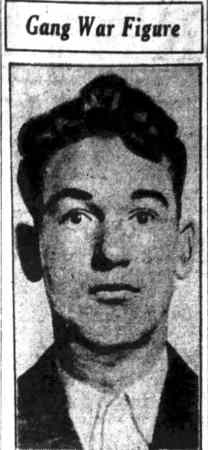
Gang War Figure
Action Delayed in Gang Shooting
Camden Courier-Post —

Shooting Witness
MRS. ROSE GIBBS
Who is held as material witness in shooting of Joseph Connors Sunday night near Broadway and Kaighn avenue.
Indictment of Doris in Flannery Murder Revealed After Arrest
Assistant Prosecutor Rocco Palese was prepared last night to go to the bottom of all charges against John Doris, brother of an executed Philadelphia bandit murderer, in an effort to determine whether to press for his immediate trial on indictments accusing him of the killing of Joseph (Mose) Flannery, or to seek other indictments first on charges of shooting Joseph Connors, at 6 a. m. Sunday.
The condition of Connors, a reputed Gloucester racketeer, remained the same last night in West Jersey Homeopathic Hospital, where doctors said the crisis was not yet passed. He has bullet wounds in the lung, abdomen and the hand, physicians saying it was too soon to predict whether he had a chance for recovery.
Doris Arraigned
Doris was arraigned before Police Judge Pancoast yesterday charged with shooting Connors near Broadway and Kaighn avenue, after a brawl which took them into two resorts and finally ended on the street outside. The judge held him for grand jury action on that charge, and was about to close the case when City Detective J. Wesley McGrath took the stand and revealed that Doris was wanted in the mysterious murder of “Mose” Flannery, Camden racketeer, seven months ago at Front street and Kaighn avenue. Pancoast promptly denied him bail.
Records at the prosecutor’s office disclosed Doris was indicted secretly by the grand jury two days after the killing of Flannery, September 20, 1928. The indictment was kept secret when it was learned Doris had disappeared and Judge Shay automatically ordered the indictment impounded against a fugitive.
Palese Studies Case
The Flannery case was placed before the grand jury by former Assistant Prosecutor Samuel P. Orlando, who left his notes with the indictment in the office when he relinquished his post to Palese.
“I will study the case tomorrow,” Palese said last night. “Until I do, and can learn the strength of the old case against Doris in the Flannery murder, I can’t say which charge I might take before a jury, provided, of course, that we can get an indictment in the Connors case against the youth.”
Connors, who is 28, lives at 135 North Broadway, Gloucester. He has been arrested twice, once in Gloucester for disorderly conduct in 1924, and later on a grand larceny charge, on which he was acquitted.
Doris is a brother of the late Frankie Doris, who with three other youths went to the electric chair for the murder of a policeman in the famous Olney Bank robbery in Philadelphia. The man held here was tried and acquitted of another murder charge in Philadelphia, at which time the trial judge predicted that he, too, would die in the chair.
A detainer warrant asking that Doris be held for the Philadelphia police was received by Chief County Detective Lawrence T. Doran, in the afternoon. According to the detainer, Doris is wanted in “the State of Pennsylvania” on charges of being a fugitive from justice; carrying concealed deadly weapons, and attempting to kill. No amplification of the charges is made in the warrant which was turned over to Warden Edward Powell of the county jail.
Doris pleaded not guilty to charges of atrocious assault and battery with intent to kill and carrying a concealed deadly weapon, before he was held for the grand jury.
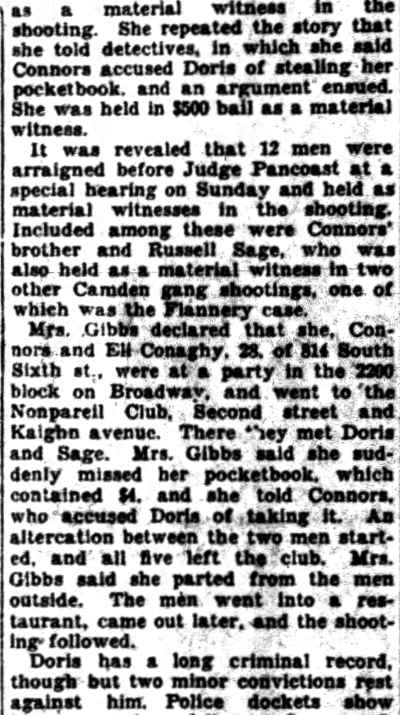
A few minutes before Doris was arraigned yesterday, Mrs. Rose Gibbs, 18, of 411 Henry street, was arraigned as a material witness in the shooting. She repeated the story that she told detectives, in which she said Connors accused Doris of stealing her pocketbook, and an argument ensued. She was held in $500 bail as a material witness.
It was revealed that 12 men were arraigned before Judge Pancoast at a special hearing on Sunday and held as material witnesses in the shooting. Included among these were Connors’ brother and Russell Sage, who was also held as a material witness in two other Camden gang shootings, one of which was the Flannery case.
Mrs. Gibbs declared that she, Connors and Eli Conaghy, 28, of 814 South Sixth st., were at a party in the 2200 block on Broadway, and went to the Nonpareil Club, Second street and Kaighn avenue. There they met Doris and Sage. Mrs. Gibbs said she suddenly missed her pocketbook, which contained $4, and she told Connors, who accused Doris of taking it. An altercation between the two men started, and all five left the club. Mrs. Gibbs said she parted from the men outside. The men went into a restaurant, came out later, and the shooting followed.
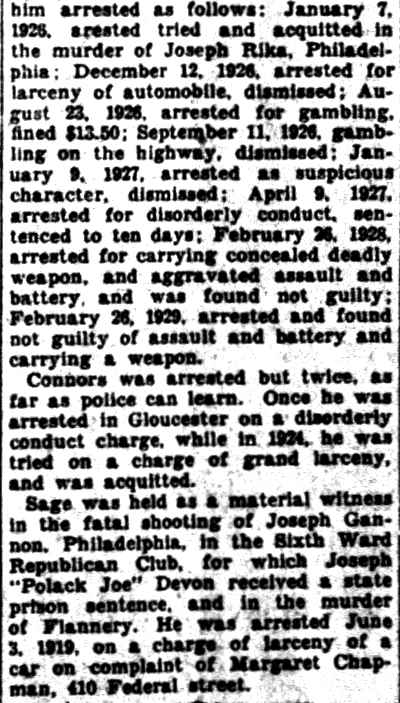
Doris has a long criminal record, though but two minor convictions rest against him. Police dockets show him arrested as follows: January 7, 1925, arrested tried and acquitted in the murder of Joseph Rika, Philadelphia; December 12, 1925, arrested for larceny of automobile, dismissed; August 23, 1926, arrested for gambling, fined $13.50; September 11, 1926, gambling on the highway, dismissed; January 9, 1927, arrested as suspicious character, dismissed; April 9, 1927, arrested for disorderly conduct, sentenced to ten days; February 26, 1928, arrested for carrying concealed deadly weapon, and aggravated assault and battery, and was found not guilty; February 26, 1929, arrested and found not guilty of assault and battery and carrying a weapon.
Connors was arrested but twice, as far as police can learn. Once he was arrested in Gloucester on a disorderly conduct charge, while in 1924, he was tried on a charge of grand larceny, and was acquitted.
Sage was held as a material witness in the fatal shooting of Joseph Gannon, Philadelphia, in the Sixth Ward Republican Club, for which Joseph “Polack Joe” Devon received a state prison sentence, and in the murder of Flannery. He was arrested June 3, 1919, on a charge of larceny of a car on complaint of Margaret Chapman, 410 Federal street.
3 Inn Proprietors Get Trials Delayed
Camden Courier-Post —
Baldwin Resents Shifting Cases for Million-Dollar Jury
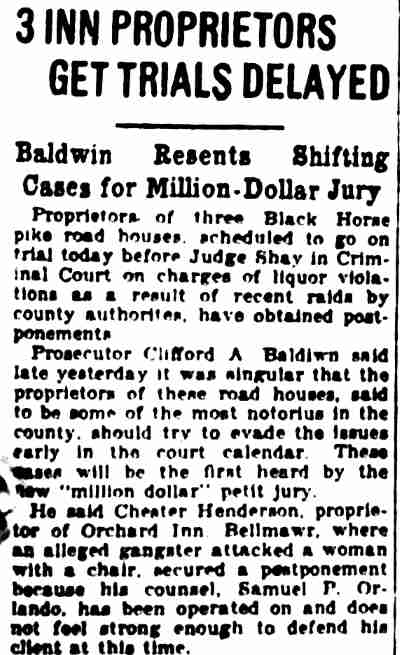
Proprietors of three Black Horse pike road houses, scheduled to go on trial today before Judge Samuel M. Shay in Criminal Court on charges of liquor violations as a result of recent raids by county authorities, have obtained postponements.
Prosecutor Clifford A. Baldwin said late yesterday it was singular that the proprietors of these road houses, said to be some of the most notorius [sic] in the county, should try to evade the issues early in the court calendar. These cases will be the first heard by the new “million dollar” petit jury.
He said Chester Henderson, proprietor of Orchard Inn, Bellmawr, where an alleged gangster attacked a woman with a chair, secured a postponement because his counsel, Samuel P. Orlando, has been operated on and does not feel strong enough to defend his client at this time.
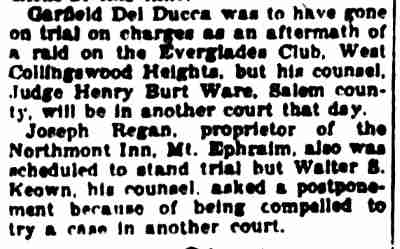
Garfield Del Ducca [sic] was to have gone on trial on charges as an aftermath of a raid on the Everglades Club, West Collingswood Heights, but his counsel, Judge Henry Burt Ware, Salem county, will be in another court that day.
Joseph Regan, proprietor of the Northmont Inn, Mt. Ephraim, also was scheduled to stand trial but Walter S. Keown, his counsel, asked a postponement because of being compelled to try a case in another court.
Holdup Victims to Scan Bandit Suspects Held in Terror Reign
Camden Courier-Post —
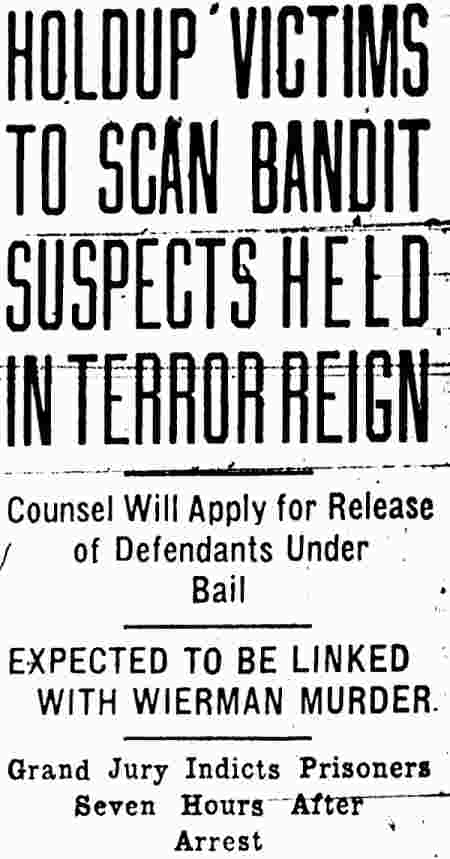
Counsel Will Apply for Release of Defendants Under Bail
EXPECTED TO BE LINKED WITH WIERMAN MURDER.
Grand Jury Indicts Prisoners Seven Hours After Arrest
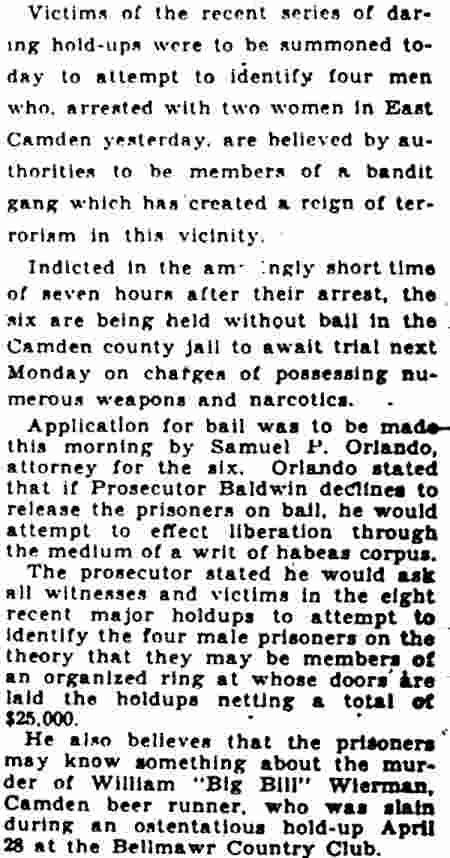
Victims of the recent series of daring hold-ups were to be summoned today to attempt to identify four men who, arrested with two women in East Camden yesterday, are believed by authorities to be members of a bandit gang which has created a reign of terrorism in this vicinity.
Indicted in the amazingly short time of seven hours after their arrest, the six are being held without bail in the Camden county jail to await trial next Monday on charges of possessing numerous weapons and narcotics.
Application for bail was to be made this morning by Samuel P. Orlando, attorney for the six. Orlando stated that if Prosecutor Baldwin declines to release the prisoners on bail, he would attempt to effect liberation through the medium of a writ of habeas corpus.
The prosecutor stated he would ask all witnesses and victims in the eight recent major holdups to attempt to identify the four male prisoners on the theory that they may be members of an organized ring at whose doors are laid the holdups netting a total of $25,000.
He also believes that the prisoners may know something about the murder of William “Big Bill” Wierman, Camden beer runner, who was slain during an ostentatious hold-up April 28 at the Bellmawr Country Club.
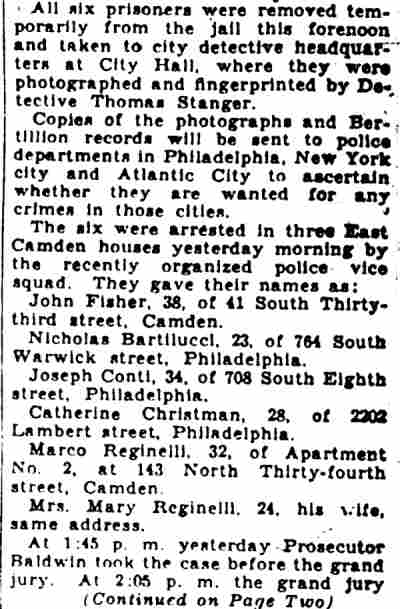
All six prisoners were removed temporarily from the jail this forenoon and taken to city detective headquarters at City Hall, where they were photographed and fingerprinted by Detective Thomas Stanger.
Copies of the photographs and Bertillon records will be sent to police departments in Philadelphia, New York city and Atlantic City to ascertain whether they are wanted for any crimes in those cities.
The six were arrested in three East Camden houses yesterday morning by the recently organized police vice squad. They gave their names as:
John Fisher, 38, of 41 South Thirty-third street, Camden.
Nicholas Bartilucci, 23, of 764 South Warwick street, Philadelphia.
Joseph Conti, 34, of 708 South Eighth street, Philadelphia.
Catherine Christman, 28, of 2202 Lambert street, Philadelphia.
Marco Reginelli, 32, of Apartment No. 2, at 143 North Thirty-fourth street, Camden.
Mrs. Mary Reginelli, 24, his wife, same address.
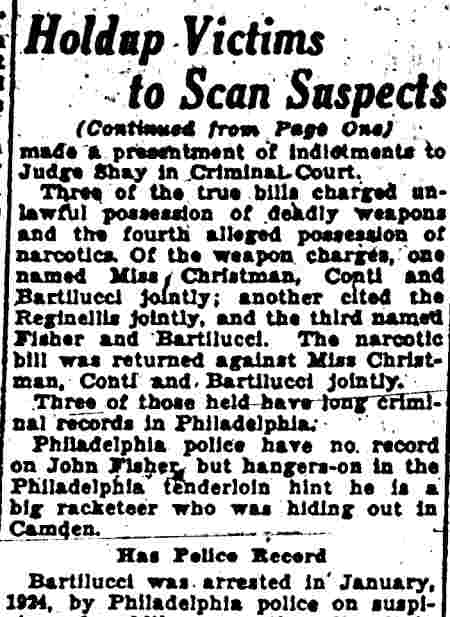
At 1:45 p. m. yesterday Prosecutor Baldwin took the case before the grand jury. At 2:05 p. m. the grand jury made a presentment of indictments to Judge Shay in Criminal Court.
Three of the true bills charged unlawful possession of deadly weapons and the fourth alleged possession of narcotics. Of the weapon charges, one named Miss Christman, Conti and Bartilucci jointly; another cited the Reginellis jointly, and the third named Fisher and Bartilucci. The narcotic bill was returned against Miss Christman, Conti and Bartilucci jointly.
Three of those held have long criminal records in Philadelphia.
Philadelphia police have no record on John Fisher, but hangers-on in the Philadelphia tenderloin hint he is a big racketeer who was hiding out in Camden.
Has Police Record
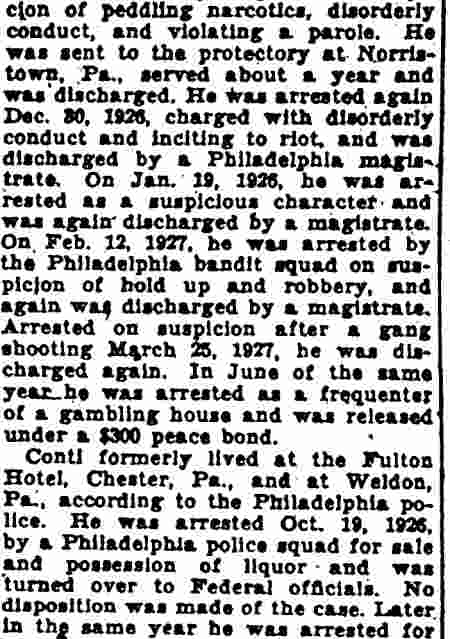
Bartilucci was arrested in January, 1924, by Philadelphia police on suspicion of peddling narcotics, disorderly conduct, and violating a parole. He was sent to the protectory at Norristown, Pa., served about a year and was discharged. He was arrested again Dec. 30, 1926, charged with disorderly conduct and inciting to riot, and was discharged by a Philadelphia magistrate. On Jan. 19, 1926, he was arrested as a suspicious character and was again discharged by a magistrate. On Feb. 12, 1927, he was arrested by the Philadelphia bandit squad on suspicion of hold up and robbery, and again was discharged by a magistrate. Arrested on suspicion after a gang shooting March 25, 1927, he was discharged again. In June of the same year he was arrested as a frequenter of a gambling house and was released under a $300 peace bond.
Conti formerly lived at the Fulton Hotel, Chester, Pa., and at Weldon, Pa., according to the Philadelphia police. He was arrested Oct. 19, 1926, by a Philadelphia police squad for sale and possession of liquor and was turned over to Federal officials. No disposition was made of the case. Later in the same year he was arrested for assault and battery by automobile.
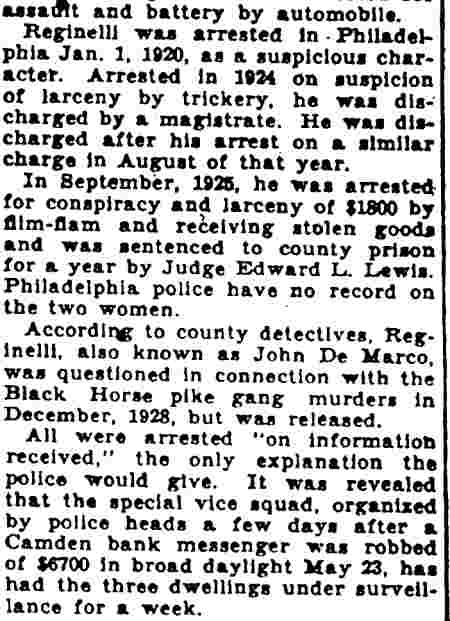
Reginelli was arrested in Philadelphia Jan. 1, 1920, as a suspicious character. Arrested in 1924 on suspicion of larceny by trickery, he was discharged by a magistrate. He was discharged after his arrest on a similar charge in August of that year.
In September, 1925, he was arrested for conspiracy and larceny of $1800 by film-flam and receiving stolen goods and was sentenced to county prison for a year by Judge Edward L. Lewis. Philadelphia police have no record on the two women.
According to county detectives, Reginelli, also known as John De Marco, was questioned in connection with the Black Horse pike gang murders in December, 1928, but was released.
All were arrested “on information received,” the only explanation the police would give. It was revealed that the special vice squad, organized by police heads a few days after a Camden bank messenger was robbed of $6700 in broad daylight May 23, has had the three dwellings under surveillance for a week.
Suspect in Holdup Identified at Trial
Camden Evening Courier —
Hotel Night Clerk Not Certain of 2 Others in Robbery
Positive identification was made of one of three bandit suspects who went on trial today in Criminal Court on charges of holding up and robbing the night clerk and elevator operator of the Hotel Camden on the morning of November 21.
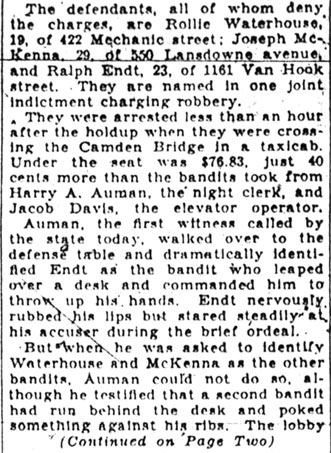
The defendants, all of whom deny the charges, are Rollie Waterhouse, 19, of 422 Mechanic street; Joseph McKenna, 29, of 550 Lansdowne avenue; and Ralph Endt, 23, of 1161 Van Hook street. They are named in one joint indictment charging robbery.
They were arrested less than an hour after the holdup when they were crossing the Camden Bridge in a taxicab. Under the seat was $76.83, just 40 cents more than the bandits took from Harry A. Auman, the night clerk, and Jacob Davis, the elevator operator.
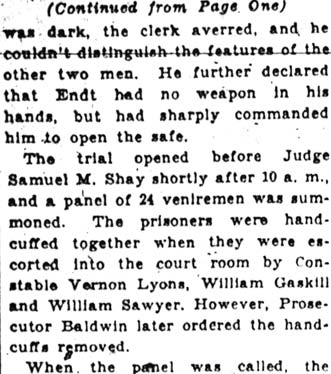
Auman, the first witness called by the state today, walked over to the defense table and dramatically identified Endt as the bandit who leaped over a desk and commanded him to throw up his hands. Endt nervously rubbed his lips but stared steadily at his accuser during the brief ordeal.
But when he was asked to identify Waterhouse and McKenna as the other bandits, Auman could not do so, although he testified that a second bandit had run behind the desk and poked something against his ribs. The lobby was dark, the clerk averred, and he couldn’t distinguish the features of the other two men. He further declared that Endt had no weapon in his hands, but had sharply commanded him to open the safe.
The trial opened before Judge Samuel M. Shay shortly after 10 a. m., and a panel of 24 veniremen was summoned. The prisoners were handcuffed together when they were escorted into the court room by Constable Vernon Lyons, William Gaskill and William Sawyer. However, Prosecutor Baldwin later ordered the handcuffs removed.
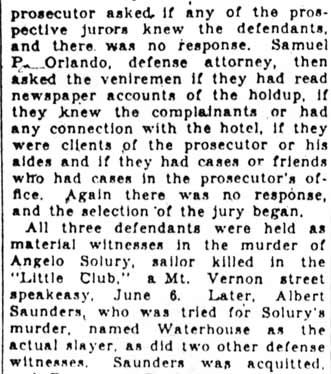
When the panel was called, the prosecutor asked if any of the prospective jurors knew the defendants, and there was no response. Samuel P. Orlando, defense attorney, then asked the veniremen if they had read newspaper accounts of the holdup, if they knew the complainants or had any connection with the hotel, if they were clients of the prosecutor or his aides and if they had cases or friends who had cases in the prosecutor’s office. Again there was no response, and the selection of the jury began.
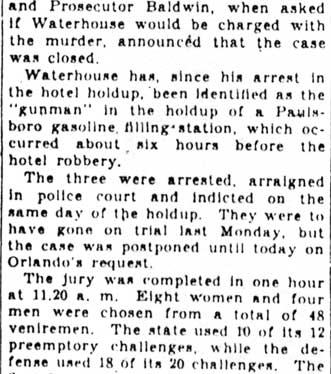
All three defendants were held as material witnesses in the murder of Angelo Solury, sailor killed in the “Little Club,” a Mt. Vernon street speakeasy, June 6. Later, Albert Saunders, who was tried for Solury’s murder, named Waterhouse as the actual slayer, as did two other defense witnesses. Saunders was acquitted. [sic] and Prosecutor Baldwin, when asked if Waterhouse would be charged with the murder, announced that the case was closed.
Waterhouse has, since his arrest in the hotel holdup, been identified as the “gunman” in the holdup of a Paulsboro gasoline filling station, which occurred about six hours before the hotel robbery.
The three were arrested, arraigned in police court and indicted on the same day of the holdup. They were to have gone on trial last Monday, but the case was postponed until today on Orlando’s request.
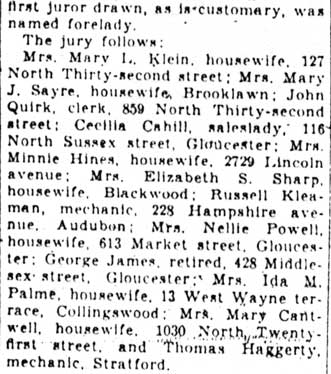
The jury was completed in one hour at 11.20 a. m. Eight women and four men were chosen from a total of 48 veniremen. The state used 10 of its 12 preemptory challenges, while the defense used 18 of its 20 challenges. The first juror drawn, as is customary, was named forelady.
The jury follows:
Mrs. Mary L. Klein, housewife, 127 North Thirty-second street; Mrs. Mary J. Sayre, housewife, Brooklawn; John Quirk, clerk, 859 North Thirty-second street; Cecilia Cahill, saleslady, 116 North Sussex street, Gloucester; Mrs. Minnie Hines, housewife, 2729 Lincoln avenue; Mrs. Elizabeth S. Sharp, housewife, Blackwood; Russell Kleaman, mechanic, 228 Hampshire avenue, Audubon; Mrs. Nellie Powell, housewife, 613 Market street, Gloucester; George James, retired, 428 Middlesex street, Gloucester; Mrs. Ida M. Palme, housewife, 13 West Wayne terrace, Collingswood; Mrs. Mary Cantwell, housewife, 1030 North Twenty-first street; and Thomas Haggerty, mechanic, Stratford.
Hotel Holdup Denied By 3 On Witness Stand
Camden Evening Courier —
Alleged Bandits Tell Jury They Were Gambling at Time of Robbery
Waterhouse in Clash With State’s Attorney
Defendant Says Money Found in Taxi Had Been Won in Gloucester
Three Camden men on trial on charges of holding up the night clerk and elevator operator of the Hotel Camden November 21, and robbing them of $67.43, went on the stand in their own defense today and made a complete denial.
They are Rollie Waterhouse, 19, of 422 Mechanic street; Joseph McKenna, 29, of 550 Lansdowne avenue; and Ralph Endt, 23, of 1161 Van Hook street. Under direct examination by their counsel, Samuel P. Orlando, and in cross examination by Prosecutor Baldwin, they presented an alibi in which they said they had been gambling in Gloucester at or about the time of the holdup.
Waterhouse and the prosecutor clashed while the former took the stand as the first defense witness. It was after Waterhouse had retraced his movements of the morning of the holdup that Prosecutor Baldwin started to delve further into Waterhouse’s affairs.
Under cross examination, Waterhouse admitted that he hasn’t worked for a year. He stated he lived with a sister.
“Where do you get the money with which to gamble?” asked Baldwin.
“From my brother.”
Then, after Waterhouse averred he had left Gloucester for Camden between 5 and 5.30 a.m., “just at dawn,” Baldwin asked him if he knew that on that particular morning the sun rose at 6.51 a.m.
“I don’t know anything about the sun rising,” replied Waterhouse. “It was just beginning to become daylight.”
Then Baldwin questioned him closely about a gambling den which Waterhouse said he had visited with McKenna and Endt early that morning.
He averred he did not know the name of the proprietor nor its exact address, except that it was on Jersey avenue between Seventh and Eighth streets, Gloucester. He didn’t know the names of any of the other men there, except there was an “Ed,” “Quirt” and “John.”
“Would you be willing to point out this house to the prosecutor if he went down there with you this afternoon?” asked Orlando.
“Yes.”
Refuses to Make Complaint
“If you showed it to me, would you be willing to sign a complaint against the proprietor?” pressed Baldwin.
“No. Why should I?” asked Waterhouse.
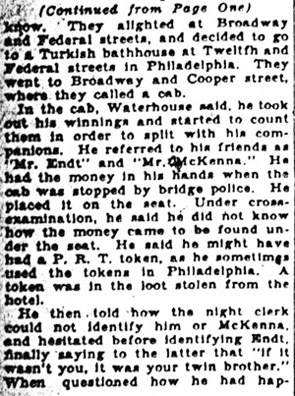
Waterhouse, in direct examination, testified that he and his two companions had gone to the private house in Gloucester and played dice. He said he won some money, and the three walked to Broadway at about 5.30 a.m., where they got a “hop” to Camden with a motorist whom they did not know. They alighted at Broadway and Federal streets, and decided to go to a Turkish bathhouse at Twelfth and Federal streets in Philadelphia. They went to Broadway and Cooper street, where they called a cab.
In the cab, Waterhouse said, he took out his winnings and started to count them in order to split with his companions. He referred to his friends as “Mr. Endt” and “Mr. McKenna.” He had the money in his hands when the cab was stopped by bridge police. He placed it on the seat. Under cross-examination, he said he did not know how the money came to be found under the seat. He said he might have had a P.R.T. token, as he sometimes used the tokens in Philadelphia. A token was in the loot stolen from the hotel.
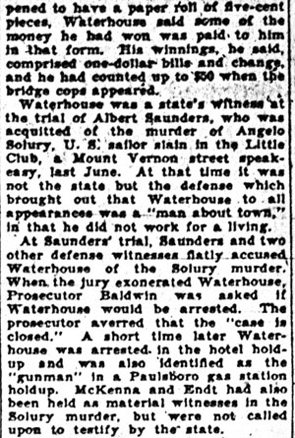
He then told how the night clerk could not identify him or McKenna, and hesitated before identifying Endt, finally saying to the latter that “if it wasn’t you, it was your twin brother.” When questioned how he had happened to have a paper roll of five-cent pieces, Waterhouse said some of the money he had won was paid to him in that form. His winnings, he said, comprised one-dollar bills and change, and he had counted up to $50 when the bridge cops appeared.
Waterhouse was a state’s witness at the trial of Albert Saunders, who was acquitted of the murder of Angelo Solury, U.S. sailor slain in the Little Club, a Mount Vernon street speakeasy, last June. At that time it was not the state but the defense which brought out that Waterhouse to all appearances was a “man about town,” in that he did not work for a living.
At Saunders’ trial, Saunders and two other defense witnesses flatly accused Waterhouse of the Solury murder. When the jury exonerated Waterhouse, Prosecutor Baldwin was asked if Waterhouse would be arrested. The prosecutor averred that the “case is closed.” A short time later Waterhouse was arrested in the hotel holdup and was also identified as the “gunman” in a Paulsboro gas station holdup. McKenna and Endt had also been held as material witnesses in the Solury murder, but were not called upon to testify by the state.
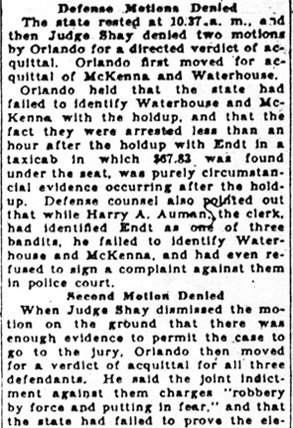
Defense Motions Denied
The state rested at 10.37 a.m., and then Judge Shay denied two motions by Orlando for a directed verdict of acquittal. Orlando first moved for acquittal of McKenna and Waterhouse.
Orlando held that the state had failed to identify Waterhouse and McKenna with the holdup, and that the fact they were arrested less than an hour after the holdup with Endt in a taxicab in which $67.83 was found under the seat, was purely circumstantial evidence occurring after the holdup. Defense counsel also pointed out that while Harry A. Auman, the clerk, had identified Endt as one of three bandits, he failed to identify Waterhouse and McKenna, and had even refused to sign a complaint against them in police court.
Second Motion Denied
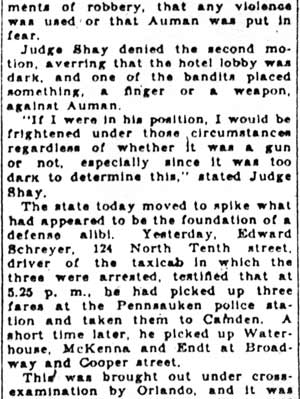
When Judge Shay dismissed the motion on the ground that there was enough evidence to permit the case to go to the jury, Orlando then moved for a verdict of acquittal for all three defendants. He said the joint indictment against them charges “robbery by force and putting in fear,” and that the state had failed to prove the elements of robbery, that any violence was used or that Auman was put in fear.
Judge Shay denied the second motion, averring that the hotel lobby was dark, and one of the bandits placed something, a finger or a weapon, against Auman.
“If I were in his position, I would be frightened under those circumstances regardless of whether it was a gun or not, especially since it was too dark to determine this,” stated Judge Shay.
The state today moved to spike what had appeared to be the foundation of a defense alibi. Yesterday, Edward Schreyer, 124 North Tenth street, driver of the taxicab in which the three were arrested, testified that at 5.25 p.m., he had picked up three fares at the Pennsauken police station and taken them to Camden. A short time later, he picked up Waterhouse, McKenna and Endt at Broadway and Cooper street.
This was brought out under cross-examination by Orlando, and it indicated the defense might contend that the money might have been placed under the seat by the previous fares.
Three Fares Called
Today the state called the three fares, James McGinnis, 1115 Federal street; Joseph Dent, 318 Taylor avenue, and his brother, Walter Dent. They averred they had been playing cards at a friend’s house the preceding night and were speeding on Crescent boulevard when their car overturned near Central Airport. They were either at Cooper Hospital or at the Pennsauken police headquarters between 1.30 a.m. and 5.25 a.m. They said they had not been playing for money and had little cash.
Two Pennsauken policemen, Fred Weyman and James Hoff, corroborated their testimony insofar as their whereabouts at the time of the holdup. Sergeant Michael Bachmayer, of the Camden Bridge police, the last state’s witness, described how two bridge cops chased Schreyer’s cab on the bridge and overtook it to arrest the three suspects.
Writ Asked to Free Waterhouse, Pals
Camden Evening Courier —
Attorneys Claim Trio Held Illegally at Woodbury in Holdup
By Staff Correspondent
Woodbury, Dec. 4.—Application for a writ of habeas corpus was made today to liberate Rollie Waterhouse, Ralph Endt and Joseph McKenna, who are being held in the Gloucester county jail without bail awaiting a further hearing on charges of holding up a Paulsboro gas station attendant.
Their attorney, Samuel P. Orlando, made application through an associate, Frank Lario, to Judge Austin H. Swackhamer here this morning for a writ, and it was made returnable Saturday morning. At the writ hearing Orlando will demand that the three be released. Failing that, he will ask that bail be fixed.
Following their acquittal Tuesday by a Criminal Court jury in Camden of charges of holding up two Hotel Camden employees, the three were brought here yesterday when arraigned before Police Recorder Edward H. Curtis. They were charged with holding up Thomas Riley, 59, of Ashland, attendant at the Lincoln Service Station, Paulsboro, on the evening of Nov. 20, and robbing him of $22.75.
No testimony was given at yesterday’s hearing, nor was Riley there. Recorder Curtis held them without bail for a further hearing Monday, when Riley would attend to accuse the men. He has already identified Waterhouse as the “gunman” of the bandit trio who robbed him, and an additional charge of carrying a concealed deadly weapon is lodged against Waterhouse.
In making application for the writ today Lario held that the confinement of the three men is illegal. This was based on several contentions: that no proof was offered against the men at the hearing, that the offense charged is bailable, that the men were not given the right of counsel and that they were not given the opportunity to face their accuser.
Waterhouse, 2 Pals Win Fight for Bail
Camden Evening Courier —
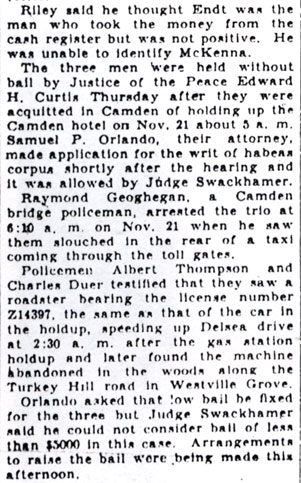
Writ to Release Three Bandit Suspects Issued in Woodbury Court
By Staff Correspondent
Woodbury, Dec. 6.—Bail of $5000 each was set for Rollie Waterhouse, Joseph McKenna and Ralph Endt by Judge Austin H. Swackhamer here today in granting their application for a writ of habeas corpus.
The three are held on charges of holding up a gasoline station on the Crown Point road near Paulsboro early on the morning of Nov. 21. Thomas Riley, the station attendant, about 65 years old, positively identified Waterhouse at the habeas corpus hearing as the man who held him up while two other men robbed the gas station of $67.43.
Riley said he thought Endt was the man who took the money from the cash register but was not positive. He was unable to identify McKenna.
The three men were held without bail by Justice of the Peace Edward H. Curtis Thursday after they were acquitted in Camden of holding up the Camden hotel on Nov. 21 about 5 a.m. Samuel P. Orlando, their attorney, made application for the writ of habeas corpus shortly after the hearing and it was allowed by Judge Swackhamer.
Raymond Geoghegan, a Camden bridge policeman, arrested the trio at 6:10 a.m. on Nov. 21 when he saw them slouched in the rear of a taxi coming through the toll gates.
Policemen Albert Thompson and Charles Duer testified that they saw a roadster bearing the license number Z14397, the same as that of the car in the holdup, speeding up Delsea drive at 2:30 a.m. after the gas station holdup and later found the machine abandoned in the woods along the Turkey Hill road in Westville Grove.
Orlando asked that low bail be fixed for the three but Judge Swackhamer said he could not consider bail of less than $5000 in this case. Arrangements to raise the bail were being made this afternoon.
Judge Shay to Speak at Moore Meet Here
Camden Courier-Post —
Judges Samuel M. Shay and Frank F. Neutze will be among the speakers at an A. Harry Moore rally to be held Friday night by Democratic clubs of the Eleventh Ward at Maennerchor Hall, Twenty-seventh Street below River avenue.
Other speakers will include Samuel P. Orlando and the three Democratic Assembly candidates, William French, Jr., Vincent DePaul Costello and Fred Stanton. A North Jersey orator also is expected.
Mrs. Lillian Pisko, Democratic county committeewoman, is general chairman of the rally, and is being assisted by Charles Goldy, county committeeman; Mrs. Helen Rush, former committeewoman, and John Hutchinson.
Mrs. Pisko and Goldy will open Moore headquarters for the Eleventh Ward today at 923 North Twenty-seventh Street.
7 Democratic Rallies in County Tonight
Camden Courier-Post —
Democratic speakers, urging suffrage in the interest of A. Harry Moore, gubernatorial candidate, and the local Democratic ticket, will invade seven political clubs in the city and county tonight.
County meetings, all at 8 p.m. and speakers are as follows:
First Ward Democratic Club, Gloucester, Mercer and Burlington streets, E. George Aaron, Firmin Michel and Marie V. Kelly.
Pennsauken Colored A. Harry Moore Club, Magnolia and Scovel avenues, Merchantville, Dr. Clement T. Branch, Eugene Aumaitre and Albert Melnik.
Lindenwold A. Harry Moore Club, Garden Lake fire hall, C. Lawrence Gregorio, Leon Rose, Joseph Varbalow and Mrs. Florence Melnik.
Glendora A. Harry Moore Club, fire hall, Mrs. Bertha Shippen Irving, Gene Mariano, Samuel P. Orlando and John Crean.
Somerdale Democratic Club, fire hall, Mrs. Emma E. Hyland, Edward L. Canning, Thomas Madden and John Delaney.
Fifth Ward Democratic Club, Fifth and Pine Streets, Samuel T. French, Rev. Robert A. Jackson, David L. Visor and Sabba Verdiglione.
Eighth Ward Democratic Club, 509 Ferry Avenue, Isaac Eason, Francis Homan, Charles Degnan and Judge Frank F. Neutze.
Democrats to Hold Meetings Tonight
Camden Courier-Post —
The campaign for A. Harry Moore, gubernatorial candidate, and local Democratic candidates, will be carried into six wards of the city and in seven communities of the county tonight.
All meetings and speakers are as follows:
Second Ward Democratic Club, 841 Market Street; Eugene Aumetre, John Crean, Vincent Gallagher, Leon H. Rose and Charles Woods.
Fourth Ward A. Harry Moore Club, 455 Berkley Street; Samuel T. French, Victor King, Thomas Madden, Leon H. Rose, Gene Mariano, Samuel P. Orlando and Rev. Robert H. Jackson.
Sixth Ward Democratic Club, Fourth and Walnut Street; Frank Connor, Albert Melnik and Thomas Madden.
Tenth Ward Democratic Club, Fifth and Vine Streets; Boyd Morrison, Joseph E. Nowrey, Charles Degnan and David L. Visor.
Seventh Ward A. Harry Moore Club, Seventh Street and Kaighn Avenue; Dr. Leroy Baxter, of Jersey City; Isaac Eason, Dr. Clement Branch, Rev. Robert H. Jackson, Mrs. Bertha Shippen Irving and Frank Suttill.
Eleventh Ward Democratic Club, 927 North Twenty-seventh street; Boyd Morrison, Firmin Michel, Victor King, Mrs. Bertha Shippen Irving.
Gloucester City Democratic Club, 308 Monmouth street; Boyd Morrison, Gene Mariano, Joseph Varbalow.
Magnolia A. Harry Moore Club, Evesham and Gloucester avenues; Firmin Michel, Edward L. Canning, John Delaney, Marie V. Kelley and Francis Homan.
Lindenwold Colored Voters’ Club, Blackstone Hall, Lindenwold, Eugene Aumetre, William Williams and Oliver Bond.
Somerdale Club, Whelen home, Somerdale road and Oggs Avenue; Marie V. Kelly, David L. Visor and Mrs. Emma E. Hyland.
Somerdale Democratic Club, Leone Hall, Warwick Road and Helena Avenue; Samuel P. Orlando, Aaron Heine, Lawrence Gregorio and E. George Aaron.
East Haddonfield Democrat Club, Crescent and Berlin Road; Edward L. Canning, Albert Melnik and Judge Frank F. Neutze.
East Haddonfield Improvement Association, Batesville, Delaware Township; Ralph Wescott, Judge Frank F. Neutze and Mrs. Florence Melnik.
Moore Rallies Tonight in 3 Wards, Ashland
Camden Courier-Post —
Rallies in the interest of A. Harry Moore, gubernatorial candidate, and local candidates on the Democratic ticket will be conducted tonight in Ashland and in three wards of the city.
The meetings and speakers are as follows:
Sixth Ward Democratic Club, Fourth and Walnut Streets; E. George Aaron, Samuel P. Orlando, Boyd E. Morrison, Charles Degnan and Sabba Verdiglione.
Third Ward A. Harry Moore Club, Third and Benson Streets; Samuel T. French, Orlando, Edward L. Canning, C. Lawrence Gregorio, Frank Homan and Anthon Ruffo, of Trenton.
Eleventh Ward A. Harry Moore Club, 927 North Twenty-seventh street; Aaron, Canning, Isaac Eason, Marie V. Kelly and Judge Frank F. Neutze.
Ashland Democratic Club, home of Ida May Heidrick, Burnt Mill road and Second Avenue; Thomas Madden, Leon H. Rose and Eugene Mariano.
Gloucester Democrats Open New Quarters
Camden Courier-Post —
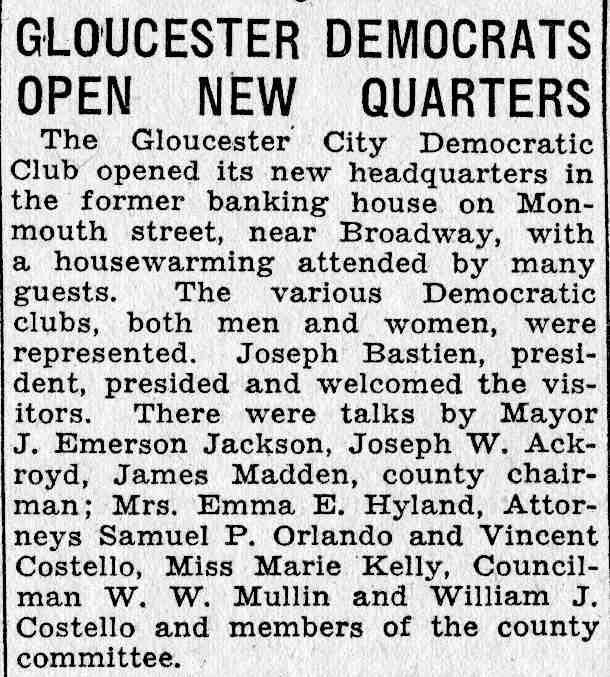
The Gloucester City Democratic Club opened its new headquarters in the former banking house on Monmouth street, near Broadway, with a housewarming attended by many guests. The various Democratic clubs, both men and women, were represented. Joseph Bastien, president, presided and welcomed the visitors. There were talks by Mayor J. Emerson Jackson, Joseph W. Ackroyd, James Madden, county chairman; Mrs. Emma E. Hyland, Attorneys Samuel P. Orlando and Vincent Costello, Miss Marie Kelly, Councilman W. W. Mullin and William J. Costello and members of the county committee.
$40,400 Suit Opens Over Auto Crash
Camden Courier-Post —
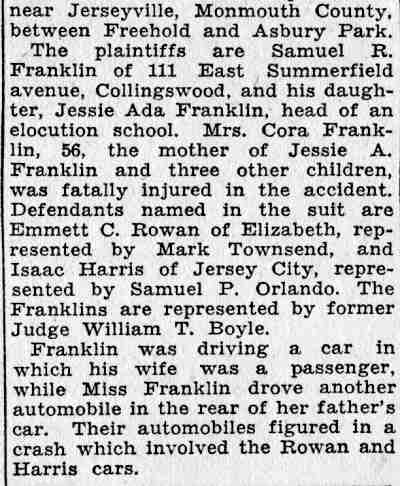
Collingswood Man and Daughter Ask Heavy Damages From 2 Car Owners
A Collingswood man and his daughter are plaintiffs in a $40,400 suit being tried before Judge Henry T. Eldredge and a jury in Camden County Circuit Court as the result of a four-cornered motor collision Sept. 1, 1930, near Jerseyville, Monmouth County, between Freehold and Asbury Park.
The plaintiffs are Samuel R. Franklin of 111 East Summerfield Avenue, Collingswood, and his daughter, Jessie Ada Franklin, head of an elocution school.
Mrs. Cora Franklin, 56, the mother of Jessie A. Franklin and three other children, was fatally injured in the accident.
Defendants named in the suit are Emmett C. Rowan of Elizabeth, represented by Mark Townsend, and Isaac Harris of Jersey City, represented by Samuel P. Orlando. The Franklins are represented by former Judge William T. Boyle.
Franklin was driving a car in which his wife was a passenger, while Miss Franklin drove another automobile in the rear of her father’s car. Their automobiles figured in a crash which involved the Rowan and Harris cars.
Two Youths Given 7 to 10 Years in Attack on Girl
Camden Courier-Post —
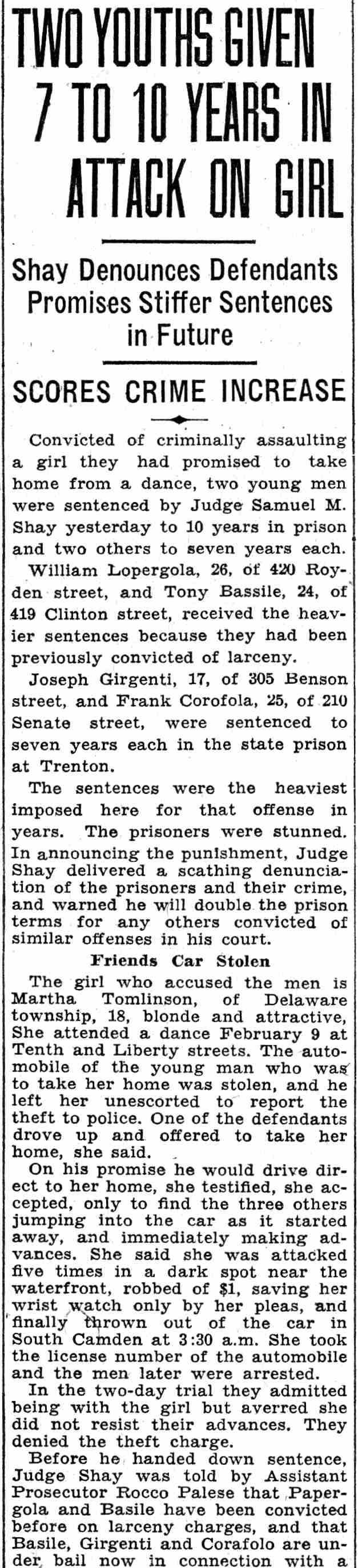
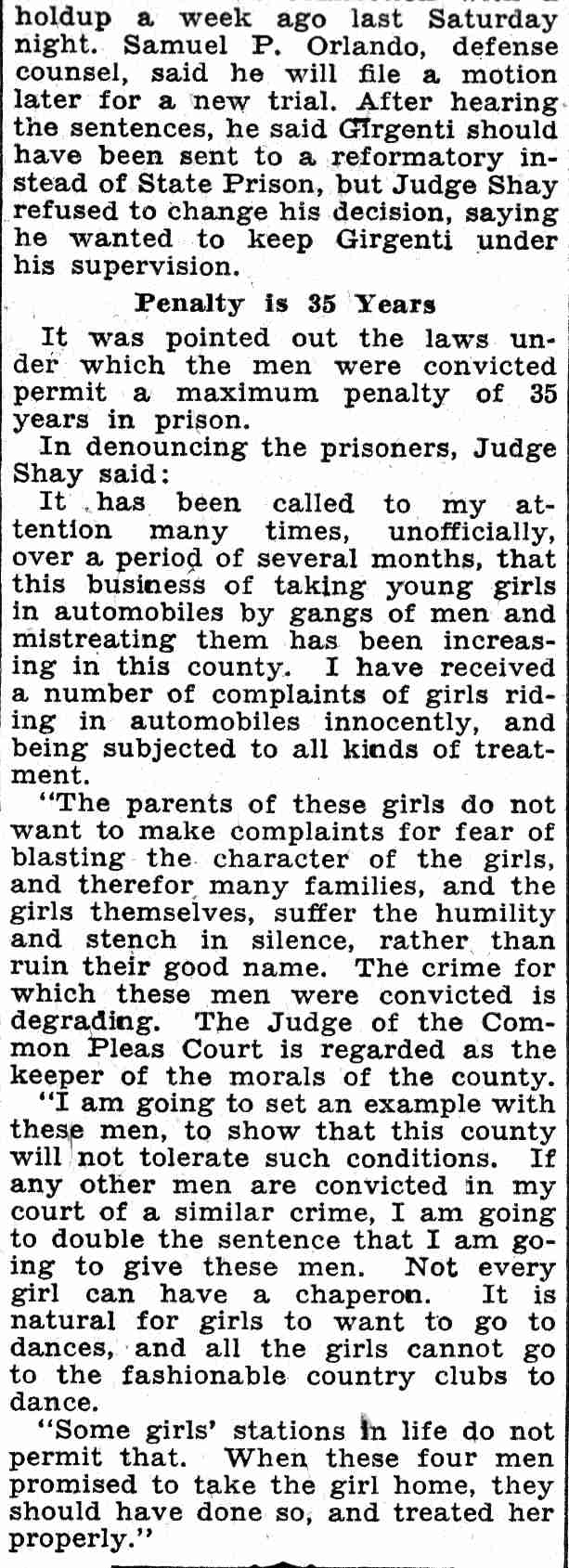
Shay Denounces Defendants Promises Stiffer Sentences in Future
SCORES CRIME INCREASE
Convicted of criminally assaulting a girl they had promised to take home from a dance, two young men were sentenced by Judge Samuel M. Shay yesterday to 10 years in prison and two others to seven years each.
William Lopergola, 26, of 420 Royden street, and Tony Bassile, 24, of 419 Clinton street, received the heavier sentences because they had been previously convicted of larceny.
Joseph Girgenti, 17, of 305 Benson street, and Frank Corofola, 25, of 210 Senate street, were sentenced to seven years each in the state prison at Trenton.
The sentences were the heaviest imposed here for that offense in years. The prisoners were stunned. In announcing the punishment, Judge Shay delivered a scathing denunciation of the prisoners and their crime, and warned he will double the prison terms for any others convicted of similar offenses in his court.
Friends Car Stolen
The girl who accused the men is Martha Tomlinson, of Delaware township, 18, blonde and attractive, [sic] She attended a dance February 9 at Tenth and Liberty streets. The automobile of the young man who was to take her home was stolen, and he left her unescorted to report the theft to police. One of the defendants drove up and offered to take her home, she said.
On his promise he would drive direct to her home, she testified, she accepted, only to find the three others jumping into the car as it started away, and immediately making advances. She said she was attacked five times in a dark spot near the waterfront, robbed of $1, saving her wrist watch only by her pleas, and finally thrown out of the car in South Camden at 3:30 a.m. She took the license number of the automobile and the men later were arrested.
In the two-day trial they admitted being with the girl but averred she did not resist their advances. They denied the theft charge.
Before he handed down sentence, Judge Shay was told by Assistant Prosecutor Rocco Palese that Papergola [sic] and Basile have been convicted before on larceny charges, and that Basile, Girgenti and Corafolo are under bail now in connection with a holdup a week ago last Saturday night. Samuel P. Orlando, defense counsel, said he will file a motion later for a new trial. After hearing the sentences, he said Girgenti should have been sent to a reformatory instead of State Prison, but Judge Shay refused to change his decision, saying he wanted to keep Girgenti under his supervision.
Penalty is 35 Years
It was pointed out the laws under which the men were convicted permit a maximum penalty of 35 years in prison.
In denouncing the prisoners, Judge Shay said:
It has been called to my attention many times, unofficially, over a period of several months, that this business of taking young girls in automobiles by gangs of men and mistreating them has been increasing in this county. I have received a number of complaints of girls riding in automobiles innocently, and being subjected to all kinds of treatment.
“The parents of these girls do not want to make complaints for fear of blasting the character of the girls, and therefor [sic] many families, and the girls themselves, suffer the humility and stench in silence, rather than ruin their good name. The crime for which these men were convicted is degrading. The Judge of the Common Pleas Court is regarded as the keeper of the morals of the county.
“I am going to set an example with these men, to show that this county will not tolerate such conditions. If any other men are convicted in my court of a similar crime, I am going to double the sentence that I am going to give these men. Not every girl can have a chaperon. It is natural for girls to want to go to dances, and all the girls cannot go to the fashionable country clubs to dance.
“Some girls’ stations in life do not permit that. When these four men promised to take the girl home, they should have done so, and treated her properly.”
City Athletic Club to Act on Opening
Camden Courier-Post —
Plans for early occupancy of the City Athletic Club’s building at Admiral Wilson and Baird boulevards, will be submitted to members at a mass meeting Monday at 7.30 p.m.
The first unit of the $1,000,000 structure is 95 percent completed, Samuel P. Orlando, secretary, said last night. Members will inspect the building before the meeting and act on a proposal by the board of governors to open the unit. Details of the plan will not be disclosed until the meeting.
The unit, built at a cost of $120,000, lacks only furnishing and minor interior décor to be ready for occupancy. Work on the other seven sections of the clubhouse will be completed later.
Construction of the project was started last January. The building is three stories and contains all modern club facilities. In the basement will be a grill, dormitories for employees and offices. The gymnasium, cloakroom, steam room, reception room, and solarium are on the first floor. The second floor is given over to reception and reading rooms, billiard parlor and squash courts. Main and private dining rooms, roof garden, barber shop and other rooms are on the third floor.
Plans for the building were drawn so that work on the other units can be started at any time.
Magistrates Organize
Camden Courier-Post —
O’Grady Elected President of County Association — ‘Racket’ Attacked
Permanent organization of the Camden County Magistrates and Constables Protective Association was effected last night at a meeting in American Legion Hall, Mt. Ephraim, when officers were elected. Ninety-two persons attended.
The officers are John S. O’Grady, Camden, president; Winfield Clark, vice president; W.L. Sauerhoff, secretary; Frank Timmons, financial secretary; William E. Laird, treasurer; Fern Glenn and Joseph Scarduzio, sergeants at arms; Samuel P. Orlando and Gene Mariano, solicitors; Michael J. Mulvihill, Harry C. Longerbein, Albert C. Becker, Vernon Lyon and Thomas Feeser, trustees.
The association went on record unanimously opposing magazine advertising “rackets” and announced it would support anyone who gives information concerning the sponsors of such schemes. The association will meet again February 20.
New Athletic Club Here Is Inspected
Camden Courier-Post —
Members Visit Building and Discuss Plans for Opening
The new City Athletic Club building at Admiral Wilson and Baird boulevards was inspected last night by the membership, when plans for immediate opening were discussed at a mass meeting attended by 100.
The structure, the first unit of a $1,000,000 project, was built at a cost of $120,000. The clubhouse is artistically laid out and provides for every social and athletic activity.
Franklin P. Jones, president of the First National Bank of Beverly and chairman of the club’s finance committee; Samuel P. Orlando, secretary, and other officers of the club submitted reports and plans at the meeting which are expected to assure immediate opening of the club.
The club has 785 members, of which 600 are founder members. The land, comprising seven and one-half acres, was purchased for cash at $150,000. George W. Shaner & Sons, Palmyra, are the contractors, and Paul P. Cret and Joseph N. Hettel, the architects.
E.E. Shumaker, former president of the RCA Victor Company, is president of the club. The vice presidents are Eldridge R.F. Johnson, George L. McGinley and Charles W. Russ. George B. Yard, Jr., is treasurer. Construction of the first unit was started last January. The building is three stories. Plans for it were drawn so that work on the other units can be started at any time.
Joe Montana Wed to Miss Palladino
Camden Courier-Post —
Camden Wrestler and Bride Are Given Dinner Attended by Notables
Miss Emma Palladino, one of the fairest daughters of Camden’s “Little Italy” yesterday became the bride of Joseph Montana, heavyweight wrestler, at Our Lady of Mt. Carmel Church, Fourth and Division streets.
Idol of Italian youth in this city Montana was hailed by hundreds of them outside the church. A number of relatives and friends, including prominent figures in the legal and professional life of the city, attended a dinner in honor of the couple at Overbrook Villa, Lindenwold, following the ceremony.
The bride, 20, is the daughter of Joseph Palladino, commercial photographer of 1115 South Fourth street. She graduated from Camden High school in 1928. Montana is 26 and a contender for the world’s heavy-weight wrestling diadem. Following a wedding tour through the West the couple plan to reside in Camden.
Miss Emenia D’Alesio, of Audubon, and Miss Rose Marini and Miss Cecelia Szymanski, of Camden, served as bridesmaids. Attending the groom were Gene Mariano, Michel D’Ilesia and William Palladino. The bride carried a bouquet of lillies of the valley and white roses while her attendants held tulips and roses. The church was beautifully decorated with varied floral designs, gold ribbons, silks and satins.
The guest list at the bridal dinner included: Assemblyman Frank M. Travaline, Jr., City Commissioner Clay W. Reesman, director of parks and public property; Acting Chief of Police of John W. Golden, former Prosecutor and Mrs. Ethan P. Wescott, Samuel P. Orlando, Guido Laurini, Detective Fiore Troncone, Antonio Mecca, Mr. and Mrs. William Denof, Mr. and Mrs. Pasquale Ianuzzi, Frank H. Ryan, Thomas H. Ryan, Dr. and Mrs. Robert Principato, Mr. and Mrs. William Averall, Luke McKenna, Mr. and Mrs. Gene Mariani, Mr. and Mrs. Frank Abbott, Frank P. Cocchiaraley and Miss Regina Cocchiaraley, all of Camden; Miss Mary Montana, and Mr. and Mrs. Ettore Montana, of Columbus OH., and Aristadino D’Guilia and sons, Albert and Peter, of Buffalo, NY.
Noted Italian Flier Guest of Orlando
Camden Courier-Post —
Captain Cesaro Sabelli, noted Italian ace, who is planning a New York to Rome flight late this month, was a weekend guest of Samuel P. Orlando, Camden attorney, at 2613 Baird Boulevard.
He expressed great concern for his friend, Jimmie Mattern, around the world flier, who is believed lost on the first leg of his flight to Paris. Captain Sabelli’s plane is under guard in the hangar at Floyd Bennett field, where Mattern also kept his ship.
Borden to Be Guest of Realty Board
Camden Courier-Post —
Newly Elected President of Commission Will Be Honored at Dinner
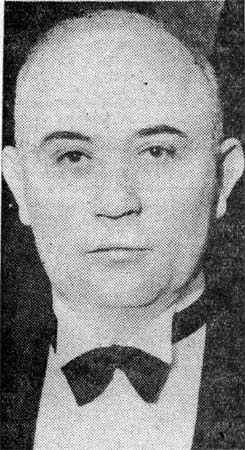
Edward J. Borden will be guest of honor tonight of the Camden County Real Estate Board at a banquet in honor of his election as president of the New Jersey Real Estate Commission.
The banquet, to be held in the Camden Club, 315 Cooper street, will be attended by lawyers, real estate men and public officials from all sections of the state. The Real Estate Board, of which Borden was thrice president, is giving the dinner.
Among the guests who will attend are former U.S. Senator David Baird, Jr., Assemblyman Frank M. Travaline, Jr., Mayor Roy R. Stewart and other members of the Camden City Commission; Dr. Leon N. Neulen, city superintendent of schools, and Police Judge Garfield Pancoast. The speakers include Samuel P. Orlando, former assistant prosecutor of Camden county.
Celebration Planned — Fourth of July Address
Camden Courier-Post —
A flag-raising and parade are among the events planned in the Fourth of July program being arranged by the Dayton Community Association.
Four-year-old Barbara Fallon will unfurl a large flag at the home of J. Nehring, 1223 Dayton Street, at 9 a.m. In the flag-raising exercises, Nehring has donated the banner.
Arrangements have been completed to have American Legion Posts 74, 231 and 2685, together with two troops of Boy Scouts and a motorcycle police escort to parade with the officers and members of the association from Kaighn and Mt. Ephraim avenues to the scene of the flag raising.
Samuel P. Orlando, former assistant prosecutor, will deliver an address after the flag-raising. Herbert C. Vennell, the president, will preside. Henry Knauer, Republican county committeeman, will address the association at 1 p.m.
Banquet to Orlando Planned by Club Here
Camden Morning Post —
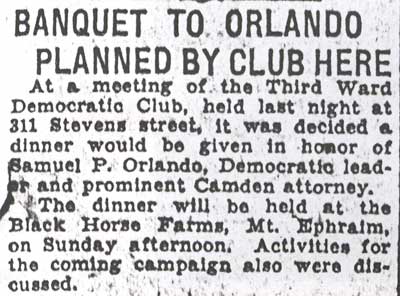
Banquet to Orlando Planned by Club Here
BANQUET TO ORLANDO PLANNED BY CLUB HERE
At a meeting of the Third Ward Democratic Club, held last night at 311 Stevens street, it was decided a dinner would be given in honor of Samuel P. Orlando, Democratic leader and prominent Camden attorney. The dinner will be held at the Black Horse Farms, Mt. Ephraim, on Sunday afternoon. Activities for the coming campaign also were discussed.
Denof Denies He Ran in ’31 for Kelleher
Camden Courier-Post — May 9–11, 1934
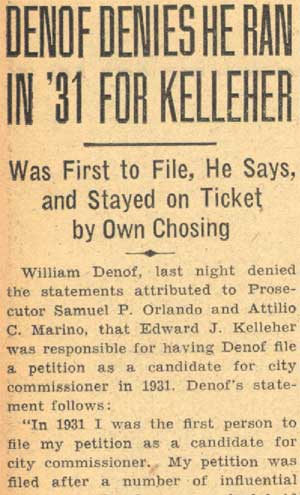
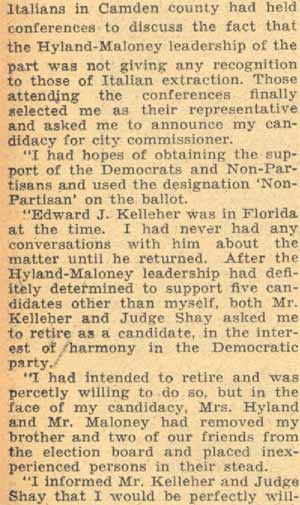
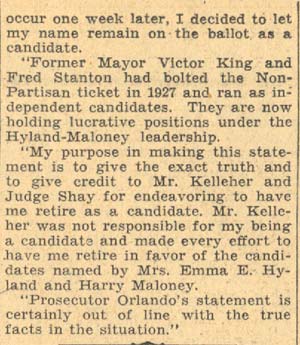
DENOF DENIES HE RAN IN ‘31 FOR KELLEHER
Was First to File, He Says, and Stayed on Ticket by Own Chosing [sic]
William Denof, last night denied the statements attributed to Prosecutor Samuel P. Orlando and Attilio C. Marino, that Edward J. Kelleher was responsible for having Denof file a petition as a candidate for city commissioner in 1931. Denof’s statement follows:
“In 1931 I was the first person to file my petition as a candidate for city commissioner. My petition was filed after a number of influential Italians in Camden county had held conferences to discuss the fact that the Hyland-Maloney leadership of the part [sic] was not giving any recognition to those of Italian extraction. Those attending the conferences finally selected me as their representative and asked me to announce my candidacy for city commissioner.
“I had hopes of obtaining the support of the Democrats and Non-Partisans and used the designation ‘Non-Partisan’ on the ballot.
“Edward J. Kelleher was in Florida at the time. I had never had any conversations with him about the matter until he returned. After the Hyland-Maloney leadership had defiitely [sic] determined to support five candidates other than myself, both Mr. Kelleher and Judge Shay asked me to retire as a candidate, in the interest of harmony in the Democratic party.
“I had intended to retire and was percetly [sic] willing to do so, but in the face of my candidacy, Mrs. Hyland and Mr. Maloney had removed my brother and two of our friends from the election board and placed inexperienced persons in their stead.
“I informed Mr. Kelleher and Judge Shay that I would be perfectly willing to retire from the race, if these three Democrats, who had served the party from the time they became of age, were restored to their positions on the election boards.
“Mrs. Hyland and Mr. Maloney refused to reinstate them. Believing that they were not interested in winning the city election but were more inteersted [sic] in winning the primary election for themselves which was to occur one week later, I decided to let my name remain on the ballot as a candidate.
“Former Mayor Victor King and Fred Stanton had bolted the Non-Partisan ticket in 1927 and ran as independent candidates. They are now holding lucrative positions under the Hyland-Maloney leadership.
“My purpose in making this statement is to give the exact truth and to give credit to Mr. Kelleher and Judge Shay for endeavoring to have me retire as a candidate. Mr. Kelleher was not responsible for my being a candidate and made every effort to have me retire in favor of the candidates named by Mrs. Emma E. Hyland and Harry Maloney.
“Prosecutor Orlando’s statement is certainly out of line with the true facts in the situation.”
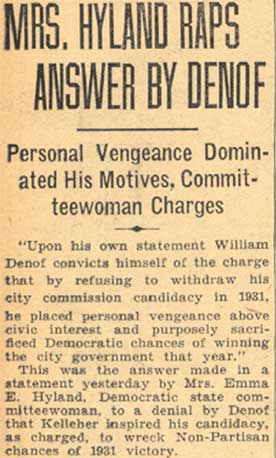
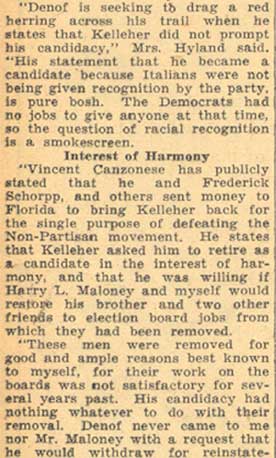
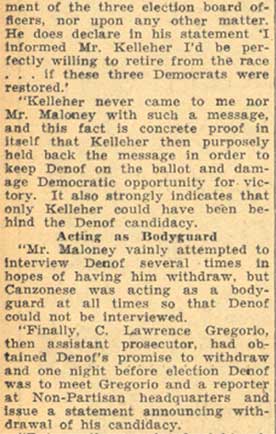
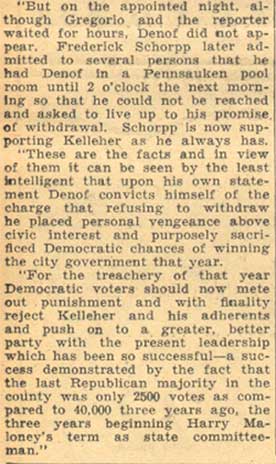
MRS. HYLAND RAPS ANSWER BY DENOF
Personal Vengeance Dominated His Motives, Committeewoman Charges
“Upon his own statement William Denof convicts himself of the charge that by refusing to withdraw his city commission candidacy in 1931, he placed personal vengeance above civic interest and purposely sacrificed Democratic chances of winning the city government that year.”
This was the answer made in a statement yesterday by Mrs. Emma E. Hyland, Democratic state committeewoman, to a denial by Denof that Kelleher inspired his candidacy, as charged, to wreck Non-Partisan chances of 1931 victory.
“Denof is seeking to drag a red herring across his trail when he states that Kelleher did not prompt his candidacy,” Mrs. Hyland said. “His statement that he became a candidate because Italians were not being given recognition by the party, is pure bosh. The Democrats had no jobs to give anyone at that time, so the question of racial recognition is a smokescreen.
Interest of Harmony
“Vincent Canzonese has publicly stated that he and Frederick Schorpp, and others sent money to Florida to bring Kelleher back for the single purpose of defeating the Non-Partisan movement. He states that Kelleher asked him to retire as a candidate in the interest of harmony, and that he was willing if Harry L. Maloney and myself would restore his brother and two other friends to election board jobs from which they had been removed.
“These men were removed for good and ample reasons best known to myself, for their work on the boards was not satisfactory for several years past. His candidacy had nothing whatever to do with their removal. Denof never came to me nor Mr. Maloney with a request that he would withdraw for reinstatement of the three election board officers, nor upon any other matter. He does declare in his statement ‘I informed Mr. Kelleher I’d be perfectly willing to retire from the race...if these three Democrats were restored.'
“Kelleher never came to me nor Mr. Maloney with such a message, and this fact is concrete proof in itself that Kelleher then purposely held back the message in order to keep Denof on the ballot and damage Democratic opportunity for victory. It also strongly indicates that only Kelleher could have been behind the Denof candidacy.
Acting as Bodyguard
“Mr. Maloney vainly attempted to interview Denof several times in hopes of having him withdraw, but Canzonese was acting as a bodyguard at all times so that Denof could not be interviewed.
“Finally, C. Lawrence Gregorio, then assistant prosecutor, had obtained Denof’s promise to withdraw and one night before election Denof was to meet Gregorio and a reporter at Non-Partisan headquarters and issue a statement announcing withdrawal of his candidacy.
“But on the appointed night, although Gregorio and the reporter waited for hours, Denof did not appear. Frederick Schorpp later admitted to several persons that he had Denof in a Pennsauken pool room until 2 o’clock the next morning so that he could not be reached and asked to live up to his promise of withdrawal. Schorpp is now supporting Kelleher as he always has.
“These are the facts and in view of them it can be seen by the least intelligent that upon his own statement Denof convicts himself of the charge that refusing to withdraw he placed personal vengeance above civic interest and purposely sacrificed Democratic chances of winning the city government that year.
“For the treachery of that year Democratic voters should now mete out punishment and with finality reject Kelleher and his adherents and push on to a greater, better party with the present leadership which has been so successful—a success demonstrated by the fact that the last Republican majority in the county was only 2500 votes as compared to 40,000 three years ago, the three years beginning Harry Maloney’s term as state committeeman.”
Chiseling in the Breadline or on the Payroll?
Camden Evening Courier —
Exemplary punishment — $1000 fine or three years in jail — is what Prosecutor Orlando offers to “charity chiselers” whom he finds receiving county relief without needing it.
His crusade to break up this contemptible practice is based upon several cases discovered by the Camden County E.R.A. advisory board and a 1931 law making false acceptance of relief a misdemeanor.
This adds credence to frequent charges that emergency relief has been used as a political racket. And a thorough cleaning up is propitious. But wait!
In his report to the government, State Relief Chairman John Colt said in the cost of ADMINISTERING relief the salaries of relief employees were included as relief administered.
By this token, persons on the relief payroll are as much relief-recipients as the destitute persons in the bread line.
Where are the records showing how much of the total relief expenditure goes for salaries? John Colt told the Courier-Post there were no records and “no way to tell.”
When the new Camden county relief director, W.W. Logan, tried to find out the same thing concerning the $2,000,000 spent for county relief since last October the records suddenly disappeared from the Camden county relief office!
The crusade of Prosecutor Orlando against relief chiselers will serve a valuable purpose if it provides the clue and SHOWS WHY THOSE RECORDS DISAPPEARED.
Who was afraid of those figures becoming PUBLIC?
If payroll employees of the county relief have bank accounts or other wealth or means of support, then under their designation by Colt as relief recipients, they are just as answerable to prosecution as the man who has something and goes to the food order line for more.
If the jobs in the county relief are taken away from those who do not need them and given to those who DO — then Prosecutor Orlando’s investigation will perform far-reaching good.
He cannot act too soon!
12 Questioned, 2 Men Held in Murder Probe
Camden Evening Courier —

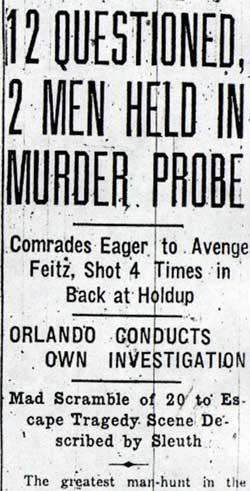
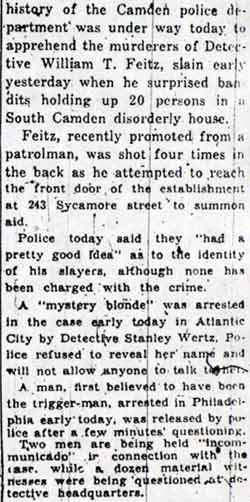
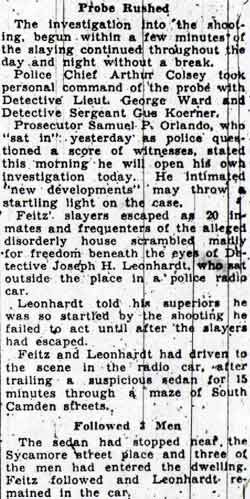
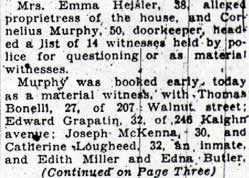
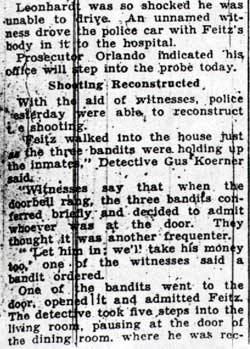

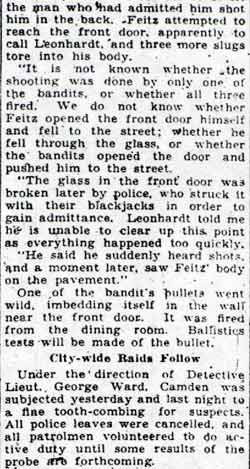
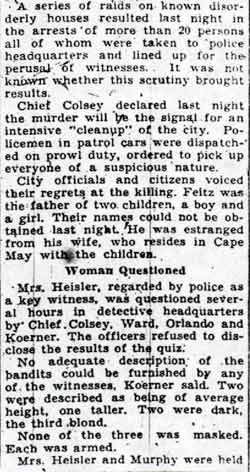
COLSEY LEADS CITY-WIDE HUNT FOR BANDIT KILLERS OF COP
Comrades Eager to Avenge Feitz, Shot 4 Times in Back at Holdup
ORLANDO CONDUCTS OWN INVESTIGATION
Mad Scramble of 20 to Escape Tragedy Scene Described by Sleuth
The greatest man-hunt in the history of the Camden police department was under way today to apprehend the murderers of Detective William T. Feitz, slain early yesterday when he surprised bandits holding up 20 persons in a South Camden disorderly house.
Feitz, recently promoted from a patrolman, was shot four times in the back as he attempted to reach the front door of the establishment at 243 Sycamore street to summon aid.
Police today said they “had a pretty good idea” as to the identity of his slayers, although none has been charged with the crime.
A “mystery blonde” was arrested in the case early today in Atlantic City by Detective Stanley Wertz [sic]. Police refused to reveal her name and will not allow anyone to talk to her.
A man, first believed to have been the trigger-man, arrested in Philadelphia early today, was released by police after a few minutes’ questioning.
Two men are being held “incommunicado” in connection with the case, while a dozen material witnesses were being questioned at detective headquarters.
Probe Rushed
The investigation into the shooting, begun within a few minutes of the slaying continued throughout the day and night without a break.
Police Chief Arthur Colsey took personal command of the probe with Detective Lieut. George Ward and Detective Sergeant Gus Koerner.
Prosecutor Samuel P. Orlando, who “sat in” yesterday as police questioned a score of witnesses, stated this morning he will open his own investigation today. He intimated “new developments” may throw a startling light on the case.
Feitz’ slayers escaped as 20 inmates and frequenters of the alleged disorderly house scrambled mainly for freedom beneath the eyes of Detective Joseph H. Leonhardt, who sat outside the place in a police radio car.
Leonhardt told his superiors he was so startled by the shooting he failed to act until after the slayers had escaped.
Feitz and Leonhardt had driven to the scene in the radio car, after trailing a suspicious sedan for 15 minutes through a maze of South Camden streets.
Followed 3 Men
The sedan had stopped near the Sycamore street place and three of the men had entered the dwelling. Feitz followed and Leonhardt remained in the car.
Mrs. Emma Heisler, 38, alleged proprietress of the house, and Cornelius Murphy, 50, doorkeeper, headed a list of 14 witnesses held by police for questioning or as material witnesses.
Murphy was booked early today as a material witness, with Thomas Bonelli, 27, of 207 Walnut street; Edward Grapatin, 32, of 246 Kaighn avenue; Joseph McKenna, 30, and Catherine Lougheed, 32, an inmate, and Edith Miller and Edna Butler, colored domestics employed by Mrs. Heisler.
Joseph Powell, 25, former Camden boxer, and Stanley, his brother, were the two men held incommunicado. Police refused to reveal what connection either had with the murder, although stating they were merely being held pending investigation.
Feitz died five minutes after being admitted to West Jersey Homeopathic hospital, where he was taken by Leonardt [sic] and McKenna, who stopped in his flight from the house to assist the wounded policeman. Three .32-calibre slugs were buried in his back and a fourth had pierced his wrist.
Lieutenant Ward today clamped down on news of the investigation, ordering all detectives and police to refuse information to news reporters.
Orlando said he would make known facts in the case known to him later today.
The Heisler woman, said by police to be the sister-in-law of Patrolman Thomas Cheeseman, recently demoted city detective, was not booked on the police docket this morning, but Ward declared he was not through questioning her and that she would be “booked” later in the day.
Several of the witnesses made their escape from the vicinity of the shooting in Powell’s car, police stated, one of whom was the mysterious woman arrested early today in Atlantic City.
Supreme Court Justice Frank T. Lloyd last night declared the case would be investigated by the September Grand Jury. It will not, he said, assume more importance in that body’s deliberations than the numbers racket.
Note Lack of Noise
Investigators were at a loss to understand why Feitz and Leonhardt, seated in an automobile on a quiet side street within 20 feet of where a holdup was taking place, did not hear any accompanying sounds. The belief was expressed that 20 men and women, being robbed, would become hysterical and noisy. The Sycamore street house is a ramshackle, two-story structure, with no vestibule leading into the parlor. There is no porch.
Powell drove first to the Lougheed woman’s home, where Mrs. Heisler, the Lougheed woman and Grapatin alighted. He then drove to Atlantic City with the unidentified girl, he said.
Police, advised of Powell’s presence in the house, dispatched the license number of his green sedan over the police teletype system.
Powell was apprehended at Folsom, 40 miles from Camden, as he was returning to Camden from Atlantic City. Sergeant Albert T. Varreiman of the Mt. Ephraim state police barracks stopped Powell’s machine and took him into custody. Powell was alone.
Feitz’s murder was a climax to half an hour’s scrutiny by him and Leonhardt into the suspicious actions of the four bandits. A car in which they were riding was sighted in the neighborhood by the two detectives at 2 a. m.
Trailed Car Fifteen Minutes
They trailed it in their police car for 15 minutes, as it wound through the narrow streets, repeatedly passing the Sycamore street house. Finally, the detectives saw the bandits park their machine on Locust street. Three of them emerged, walked down Sycamore street, and entered the house.
According to Leonhardt, neither he nor Feitz obtained the license number of the bandit car.
Upon seeing them enter the place, Leonhardt drove the police car around the block and stopped in front of the house.
Feitz and Leonhardt sat outside in their machine for 15 minutes. Finally, Leonhardt said, Feitz opened the door and stepped to the sidewalk.
“I’m going in there and see what’s going on,” he said.
Turning, he walked up the steps and rang the doorbell. Leonhardt said the door was opened after a short pause, and Feitz entered. The door was closed.
Hears Bandits’ Guns
Almost immediately, Leonhardt heard the muffled roar of the bandits’ revolvers. Feitz’s body came flying through the door. Pandemonium followed. As the persons in the house fled, neighbors came to doors and windows. Almost immediately, the street was filled.
Leonhardt was so shocked he was unable to drive. An unnamed witness drove the police car with Feitz’s body in it to the hospital.
Prosecutor Orlando indicated his office will step into the probe today.
Shooting Reconstructed
With the aid of witnesses, police yesterday were able to reconstruct the shooting.
“Feitz walked into the house just as the three bandits were holding up the inmates,” Detective Gus Koerner said.
“Witnesses say that when the doorbell rang, the three bandits conferred briefly and decided to admit whoever was at the door. They thought it was another frequenter.
“’Let him in; we’ll take his money too,’ one of the witnesses said a bandit ordered.
One of the bandits went to the door, opened it and admitted Feitz. The detective took five steps into the living room, pausing at the door of the dining room, where he was recognized by a bandit who was frisking the inmates.
“This bandit shouted: ‘It’s a dick; let ‘im have it!’”
Shot in Back
As Feitz reached for his revolver, the man who had admitted him shot him in the back. Feitz attempted to reach the front door, apparently to call Leonhardt, and three more slugs tore into his body.
“It is not known whether the shooting was done by only one of the bandits, or whether all three fired. We do not know whether Feitz opened the front door himself and fell to the street; whether he fell through the glass, or whether the bandits opened the door and pushed him to the street.
“The glass in the front door was broken later by police, who struck it with their blackjacks in order to gain admittance. Leonhardt told me he is unable to clear up this point as everything happened too quickly.
“He said he suddenly heard shots, and a moment later, saw Feitz’ body on the pavement.”
One of the bandit’s bullets went wild, imbedding itself in the wall near the front door. It was fired from the dining room. Ballistics tests will be made of the bullet.
City-wide Raids Follow
Under the direction of Detective Lieut. George Ward, Camden was subjected yesterday and last night to a fine tooth-combing for suspects. All police leaves were cancelled, and all patrolmen volunteered to do active duty until some results of the probe are forthcoming.
A series of raids on known disorderly houses resulted last night in the arrests of more than 20 persons all of whom were taken to police headquarters and lined up for the perusal of witnesses. It was not known whether this scrutiny brought results.
Chief Colsey declared last night the murder will be the signal for an intensive “cleanup” of the city. Policemen in patrol cars were dispatched on prowl duty, ordered to pick up everyone of a suspicious nature.
City officials and citizens voiced their regrets at the killing. Feitz was the father of two children, a boy and a girl. Their names could not be obtained last night. He was estranged from his wife, who resides in Cape May with the children.
Woman Questioned
Mrs. Heisler, regarded by police as a key witness, was questioned several hours in detective headquarters by Chief Colsey, Ward, Orlando and Koerner. The officers refused to disclose the results of the quiz.
No adequate description of the bandits could be furnished by any of the witnesses, Koerner said. Two were described as being of average height, one taller. Two were dark, the third blond.
None of the three was masked. Each was armed.
Mrs. Heisler and Murphy were held without bail as material witnesses. Powell, accompanied by Camden detectives, left for Atlantic City to show them where he dropped off the unidentified girl inmate of the house. They had not returned at a late hour last night.
According to Murphy, two of the bandits previously had visited the house as patrons, and at one time attempted to “shake down” Mrs. Heisler. She resisted their demands, Murphy declared.
Other persons arrested as material witnesses who, after hours of questioning were released in their own recognizance, include:
Frank Adams, 21, of 938 Atlantic avenue; Joseph MacDonald, 20, of 1605 South Sixth street; Henry Gorba, 19, of 17 North Twenty-first street and Edward McKenna, 31, of 1304 Broadway.
Edith Miller, 28, colored, of 205 Sycamore street, and Edna Butler, 32, also colored, 1122 South Second street, also were arrested and held as witnesses. They are inmates of the house, Koerner said.
Police said the bandits, in their search for booty, forced their victims to remove their shoes during the holdup to ascertain whether they were concealing any money. Only $8 was taken.
An autopsy performed on Feitz’ body yesterday by Coroner Arthur H. Holl and County Physician Edward B. Rogers showed that two of the bullets had penetrated the detective’s body. Coroner Holl, in whose undertaking establishment the detective’s body lay last night, declared death was virtually instant.
Chief Colsey last night denied Feitz and Leonhardt were acting under orders to watch the Sycamore street house.
“There have been general orders out to clean up all disorderly houses for a long time,” Colsey said. “I imagine the detectives were more interested in what the four men were doing than they were in the house. I talked at great length with Leonhardt and he told me neither he nor Feitz knew the place was a disorderly house.”
Leonhardt could not be reached last night to give his version of the affair. Colsey said Leonhardt was taking an active part in police efforts to solve the crime.
“If I had known the house in Sycamore street was a disorderly house,” Colsey said, “I would of course have ordered it raided long ago.”
Feitz and Leonhardt were assigned to detective duty from the uniformed ranks last week, replacing former Detectives Thomas Cheeseman and Vernon Jones, who are now reduced to rank of patrolmen.
Chief Colsey said the reason Cheeseman and Jones were reduced was “merely for the good of the department.” He would not amplify that statement.
According to Detective Rox Saponare, Cheeseman is the brother-in-law of Mrs. Heisler, charged with operating the house. Cheeseman, also active in the investigation of the killing, could not be reached last night to comment.
Commended for Bravery
Feitz was appointed to the police force March 1, 1928. He was appointed to the detective bureau last week by Mayor Roy R. Stewart. In 1931, Feitz was commended for bravery in arresting three men in a holdup at a chain grocery store at Locust street and Kaighn avenue.
Last week, the same store was robbed, and Feitz arrested three other men for the theft.
Leonhardt, 39, resides at 512 Division street. The last arrest he made in company with Feitz was at 12.45 a. m. the morning of Feitz’ death. The officers nabbed Cecilia Spencer, 28, colored, at 806 Locust street, a block from the Sycamore street house, on charges of soliciting.
Chief Colsey and other city officials reached Feitz’ bedside in the hospital too late to see him alive. The officer died without regaining consciousness. Funeral arrangements were not completed last night.
Before the estrangement from his wife two years ago, Feitz lived with her and their children at 1062 Langham avenue. He resided recently at the Liberty street address with his widowed mother, Mrs. Pauline Feitz, who last night was prostrated at the news of her son’s death.
Chief Colsey last night absolved Leonhardt of any negligence in not chasing the killers. The police chief declared Leonhardt’s first duty was to look to the condition of Feitz.
Chief Colsey said Mayor Stewart, vacationing in Ocean City, will not return until tomorrow morning. Any investigation into possible negligence on the part of police in permitting the Sycamore street house to operate will be conducted after the mayor returns, Colsey said.
“I consider it more important at this time to lend all our efforts toward solving the crime rather than in conducting any side-bar probe into the question of negligence by any policemen,” Colsey said.
Lieut. Bakley and 11 Police Suspended in Feitz Inquiry
Camden Evening Courier —
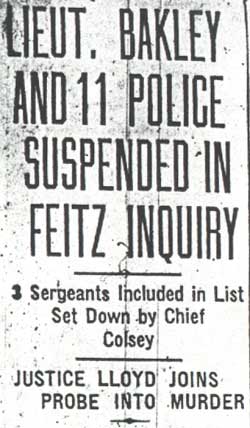
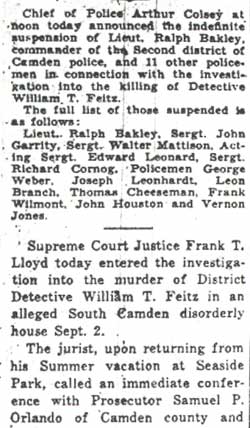
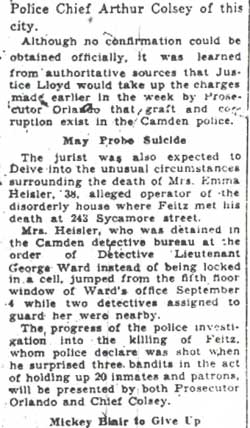
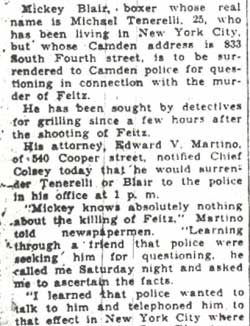
3 Sergeants Included in List Set Down by Chief Colsey
JUSTICE LLOYD JOINS PROBE INTO MURDER
Chief of Police Arthur Colsey at noon today announced the indefinite suspension of Lieut. Ralph Bakley, commander of the Second district of Camden police, and 11 other policemen in connection with the investigation into the killing of Detective William T. Feitz.
The full list of those suspended is as follows:
Lieut. Ralph Bakley, Sergt. John Garrity, Sergt. Walter Mattison, Acting Sergt. Edward Leonard, Sergt. Richard Cornog, Policemen George Weber, Joseph Leonhardt, Leon Branch, Thomas Cheeseman, Frank Wilmont [sic], John Houston and Vernon Jones.
Supreme Court Justice Frank T. Lloyd today entered the investigation into the murder of District Detective William T. Feitz in an alleged South Camden disorderly house Sept. 2.
The jurist, upon returning from his Summer vacation at Seaside Park, called an immediate conference with Prosecutor Samuel P. Orlando of Camden county and Police Chief Arthur Colsey of this city.
Although no confirmation could be obtained officially, it was learned from authoritative sources that Justice Lloyd would take up the charges made earlier in the week by Prosecutor Orlando that graft and corruption exist in the Camden police.
May Probe Suicide
The jurist was also expected to delve into the unusual circumstances surrounding the death of Mrs. Emma Heisler, 38, alleged operator of the disorderly house where Feitz met his death at 243 Sycamore street.
Mrs. Heisler, who was detained in the Camden detective bureau at the order of Detective Lieutenant George Ward instead of being locked in a cell, jumped from the fifth floor window of Ward’s office September 4 while two detectives assigned to guard her were nearby.
The progress of the police investigation into the killing of Feitz, whom police declare was shot when he surprised three bandits in the act of holding up 20 inmates and patrons, will be presented by both Prosecutor Orlando and Chief Colsey.
Mickey Blair to Give Up
Mickey Blair, boxer whose real name is Michael Tenerelli, 25, who has been living in New York City, but whose Camden address is 833 South Fourth street, is to be surrendered to Camden police for questioning in connection with the murder of Feitz.
He has been sought by detectives for grilling since a few hours after the shooting of Feitz.
His attorney, Edward V. Martino, of 540 Cooper street, notified Chief Colsey today that he would surrender Tenerelli or Blair to the police in his office at 1 p.m.
“Mickey knows absolutely nothing about the killing of Feitz,” Martino told newspapermen. “Learning through a friend that police were seeking him for questioning, he called me Saturday night and asked me to ascertain the facts.”
“I learned that police wanted to talk to him and telephoned him to that effect in New York City where he has been staying for the past few weeks. He later called me back and told me that he would be in Camden at 1 p.m. today.”
‘Attended Funeral’
Martino revealed that Tenerelli or Blair said he had been in Camden prior to the killing of Feitz and also on Labor Day, the day following the shooting of the detective. He was here to attend the funeral of a brother-in-law, Martino said.
Neither Chief Colsey or other police or detective officials would comment upon what they hoped to learn from Tenerelli that might bring an early solution of the murder and lead to the arrest of the killers.
Prosecutor Orlando at the conference with Justice Lloyd in his City Hall-Court House offices, was to present a complete report on the murder of the detective together with statements obtained from all persons who figured in the crime.
Will Probe Numbers
Prosecutor Orlando stepped in and assumed nominal charge of the investigation last Thursday when he ordered police to submit to him all reports and statements of witnesses. However it was learned that the police are still directing the search for the killers.
The conference between Justice Lloyd, Prosecutor Orlando and Chief Colsey comes on the eve of swearing in the September Grand Jury tomorrow at which time the grand jurors wil [sic] be ordered among other issues, to probe into the “numbers” racket in Camden county.
Feitz Witness Dies in 5-Floor City Hall Jump
Camden Evening Courier —
Should Have Been Kept in Cell, Stewart and Orlando Say
WOMAN TRIED IN VAIN TO TALK WITH WARD
Colsey Will Conduct Investigation in Attempt to Fix Blame
A complete investigation was ordered today by Mayor Roy R. Stewart into the suicide yesterday of Mrs. Emma Heisler, 38, who plunged five floors from a detective bureau window in city hall.
Mrs. Heisler was the key witness to the murder early Sunday of Detective William T. Feitz. It was in Mrs. Heisler’s alleged disorderly house at 243 Sycamore street that Feitz was killed.
Mayor Stewart, ordering the investigation, freely admitted today that Mrs. Heisler should have been locked in a city hall jail cell instead of being permitted to roam about detective headquarters.
Colsey to Conduct Probe
Mayor Stewart delegated Police Chief Arthur Colsey to conduct the probe and determine whether there is evidence of police laxity in the suicide of Mrs. Heisler.
From two sources since the woman was taken into custody were the police warned against permitting her to walk unguarded in city hall. The warnings were ignored.
Only yesterday, a short time before the woman leaped to her death, a Courier-Post reporter made the comment in detective headquarters:
“You’d better watch that woman, or she’s liable to jump from a window and sprain her ankle.”
A similar warning that Mrs. Heisler should be locked in a cell was delivered by Prosecutor Samuel P. Orlando.
Less than an hour before she took her death leap, Mrs. Heisler had pleaded with Lieutenant Ward to let her talk to him.
“I’ve got something in my heart I must let out,” she told Ward, interrupting him as he gave a last-minute telephone report of the murder probe to Mayor Stewart. The mayor was about to catch a 4.20 p. m. train to his Ocean City summer home.
Three times, Ward said, she tried to drag him from the telephone as he talked to Stewart, each time insisting she had something to tell him.
Ward Refused to Listen
Ward concluded the conversation with Stewart and then left the bureau instead of talking to her.
At 5.12 p. m. Mrs. Heisler rushed from the detectives’ room into Ward’s private office, raised the only window not guarded by a glass ventilator and leaped to her death.
Whatever she had in her heart was still there.
She never regained consciousness fully and died at 6.12 p. m. in Cooper Hospital.
With her, police believe, went their best chance of learning the identity of Feitz’s slayers.
After Ward brusquely rebuffed the woman as she attempted to tell him something that he, by his own admission, believes might have been the identity of the killers, she went back into the desk room where all detectives sit when idle.
A Courier-Post reporter was outside the counter separating the detectives’ office space from that area reserved for the public—barred from the inner sanctum by Ward’s orders.
The reporter said the woman was disheveled in appearance, her blonde hair straggling about her face, her eyes showing that she was under a severe emotional strain.
Detectives Laugh
“You’d better watch that woman,” he told Detective Robert Ashenfelder. “She’s liable to jump from a window and sprain her ankle.”
The detectives laughed.
A few minutes later she sat at a desk near the entrance to Ward’s
(Continued on Page Two)
(Continued from Page One)
private office, in the corner of the bureau.
“She was about to break. I think she was ready to tell us who killed Feitz,” Detective Sergeant Gus Koerner said afterward.
After Ward refused to let her unburden herself—possibly of information the entire department has been seeking night and day since Feitz’s death—she appeared highly agitated.
The woman leaped from her desk and rushed into Ward’s private office.
Body Broken Badly
She raised the only window not guarded by a ventilator and leaped. She landed on the iron windshield bar of a roadster, and the force of her fall almost cut her body in half. She bounced into the seat of the car owned by Andrew Stewart, 143 West Cottage avenue, Haddonfield.
Detectives Clifford Carr and Robert Ashenfelter were the only members of the force in the bureau. Carr was answering a telephone. Ashenfelter was questioning Camillo Cinelli, 848 South Third street, a former pugilist known as Billy Hart, about some matter not connected with the murder.
“We were standing almost at the door of Ward’s office,” Ashenfelter said. “Cinelli wanted a drink of water and I followed him to the water bottle, away from the door. We drank and started back.
“Cinelli was in front of me and I could not see the woman. All of a sudden we heard the sound of tinkling glass. Cinelli ran into Ward’s office. I followed him. The woman was gone. We looked out the window and saw her in a roadster with the top down.
Takes Her to Hospital
“I went downstairs in the private elevator, loaded the woman into a car and went with her to Cooper Hospital. Carr went downstairs with me, but he had to return to the office.”
Carr said he was answering a telephone when he heard the sound of glass, looked about for the woman and saw she was gone. Then he too rushed to Ward’s window and looked out to see her in the car below.
The woman’s skull was crushed. Her fall bent the metal bar of the windshield almost to the dash and shattered the glass—to give notice of her death to her previous captors upstairs.
At the hospital, Dr. Roscoe Kandle examined the woman and shook his head, then ordered her removed to a ward cot. She was in a semi-comatose state.
Carpani and Lieutenant Ward, who had rushed to the hospital for his delayed reception of her story, found her unable to tell what was in her heart.
Her brothers, Albert and William Slonski of 1300 South Broad street, Philadelphia, arrived before she died.
Father James Foley, pastor of Immaculate Conception Roman Catholic Church, administered extreme unction to the woman. He happened to be in the hospital, asked if she were a Catholic, and gave her the last rites of her faith for the living.
Neither Mayor Stewart nor Chief of Police Colsey would criticize any member of the detective force for the woman’s leap, but Prosecutor Orlando was outspoken in his belief that police laxity, in spite of a warning from him, had caused her death and had removed the state’s chief witness against Feitz’s slayers, “if they are caught.”
Orlando Warned Mayor
“At 2 p. m. today,” Orlando said. “I told Mayor Stewart that woman ought to be locked in a cell and held on the charge of maintaining a disorderly house.
“It is a regrettable thing that she was permitted to commit suicide. It may prove costly in the prosecution of Feitz’s slayers, if they are caught.
“I am not having much to do with the investigation. I am hoping the police will bring it to the point where I can prepare to prosecute.”
“I will not criticize any member of the force for Mrs. Heisler’s leap,” Chief Colsey said. “We had agreed to allow Ward to have his way. He felt, and convinced us, that we could get more from her by treating her kindly.
‘She Appeared Contented’
“As a matter of fact, she appeared contented. When Mayor Stewart and I questioned her earlier in the afternoon, she appeared in better condition than at any time since she was brought here.
“If she had wanted to leap from a window, she had had ample opportunities. She could have leaped while the mayor and I were questioning her, for that matter. We did not suspect she would attempt her life.
“She anwered [sic] questions better—more straightforwardly—for Mayor Stewart and me than at any time before.
“I believe she knew who killed Feitz. She said she didn’t. I think she would have told us tonight who killed him. She was beginning to open up.”
Ward, silent since Monday morning, said virtually the same thing, although he insisted he was “not talking anyway.”
Ward Calls It Fear
“She was about ready to tell what she knew,” the chief of detectives said. “It probably was fear that had kept her from it before. She feared she would be killed if she did tell. I think she knew who killed Feitz.
“She came to me three times while I was talking to Mayor Stewart on the phone and I had to put my hand over the phone to send her out,” Ward confessed. “She kept saying she had something to tell me. I think she was ready to tell it all.
“I had to leave the office after talking to the mayor,” Ward continued. “I didn’t get to question her further. I wasn’t here when she jumped. I’m not talking, anyway,” Ward said.
It was Mayor Stewart who revealed that the woman told Ward “I’ve got something in my heart and I must let it out.”
This, the mayor said, Ward told him on the telephone, interrupting the conversation to hear that much and then leaving the bureau before hearing what it was.
Disagrees With Colsey
Mayor Stewart’s opinion of the woman’s nervous condition was the reverse of Chief Colsey’s, however. He said:
“The death of the Heisler woman is very unfortunate. But we believe it will not retard our investigation into Feitz’s murder. We are hopeful that there are others who know just as much as Mrs. Heisler knew.
“I noticed this afternoon as Chief Colsey and I questioned her that she was in a very nervous condition. Several times she became flustered and appeared bewildered when attempting to answer questions.
“Her mind at times seemed to become a total blank.”
‘Ward’s Idea’
Asked why the woman had not been booked and locked in a cell, Mayor Stewart said:
“This angle had been gone over very carefully several times and it was Ward’s idea that Mrs. Heisler be given freedom of the bureau and treated with kindness, with the hope that she would reveal valuable information.
“I am sorry now I did not insist that she be placed in a cell.
“In the future, definite steps will be taken to prevent like happening.”
Asked whether any disciplinary action would be taken against members of the detective bureau as punishment for laxity in watching the woman, the mayor said:
“No. There will be no such action. I acquiesced in Ward’s desire to allow the woman freedom, trusting his judgment that this course might reduce the best results.”
Voluntary Prisoner
Mrs. Heisler was allowed many privileges during her detention. She was held as a voluntary prisoner, Chief Colsey said, adding:
“But if she had wanted to leave, we would have booked her and put her in a cell.”
He admitted the woman was held—though technically not held—in excess of the 48 hours police are permitted to hold a prisoner without filing charges.
“You can hold them as long as necessary in a murder case,” Colsey said.
Rests in Comfort
For two days the Courier-Post Newspapers had been printing pointed stories to the effect that Mrs. Heisler was allowed free run of detective headquarters, being treated as a guest while all others linked in any way with the murder were locked up in cells.
She was not even sent to a cell to sleep. Detectives converted a bench in the line-up room, which opens onto their quarters, into a bed, using blankets, overcoats and other pieces of clothing and bedding, impounded as stolen, to make her comfortable.
Detectives Served Her
An unidentified friend was permitted to bring her $10 in cash. She was allowed to smoke at will, to eat when and what she desired, and to have coffee brought to her by detectives at any and all hours.
That the Heisler woman had operated disorderly houses for six or seven years in Camden was generally known, although police would not admit the knowledge.
She ran a place at Sixth and Spruce streets for a time; then operated another house at Third and Mechanic street, a third at Ninth and Pine streets, and still another at Second and Chestnut streets. Then she ran a house at 242 Sycamore street, moved away, and then opened a new place at 243 Sycamore street, where Feitz was killed. This place had been in operation about seven months.
Sergeant Koerner said the woman had shown every indication that she was on the point of “breaking.”
‘Bad Break’ for Police
“She would walk up to me and other men as though she wanted to tell us something. Then she would turn and walk away. She was getting ready to tell everything, I believe. It is a bad break that she is dead.
“I think she knew who killed Feitz. The men had been there before. They had asked for her by name at the door, and she had admitted them. She is bound to have known them.
“She was ready to tell who they were, I believe, but every time she got to the point of telling, something would come up in her throat. I think it was fear.”
Chief Colsey continued to drive all members of the force night and day on the investigation, determined, he said, to clean it up as soon as possible.
Orlando Pores Over Data on Feitz Murder
Camden Evening Courier —

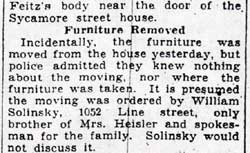
Prosecutor Ready to Take Charge of Probe Should Need Be Seen
3 SOUGHT AS KILLERS DESCRIBED IN REPORT
Cops Devote Spare Time to Hunt in Hope of Avenging Detective
Ward ‘Not Interested’ in Killer Reward Offer
Lieut. George Ward, in charge of the Detective Bureau, was asked today if he was in favor of the city offering a reward for information leading to apprehension and conviction of Feitz’s slayers.
“I don’t care,” he said.
“Don’t you think it might help find the killers?”
“I don’t know anything about it,” he replied. “Go ahead and offer a reward yourself.”
“Suppose you were very busy on the case last night? Any important developments?”
“I didn’t do a thing on it,” he answered. “We haven’t got anywhere at all.”
Then he hung up.
Prosecutor Samuel P. Orlando today began a study of all police data on the murder of Detective William T. Feitz, Jr., with a view to taking a directing hand in the investigation.
The prosecutor received from Police Chief Arthur Colsey a report he called for yesterday, setting forth all the circumstances of the killing and, supposedly, all the information regarding the killers which police have obtained.
The report is understood to contain the names and descriptions of the three gunmen sought in the killing of Feitz at 2 a. m. last Sunday in an alleged disorderly house at 243 Sycamore street. The first police version was that the men were holding up and robbing 20 persons in the house when Feitz entered, after following the bandit car about the neighborhood because of its suspicious actions.
Shakedown Hinted
Later developments, however, indicate the men were trying to “shake down” Mrs. Emma Heisler, 38, proprietress of the place, for “hush money.” Mrs. Heisler committed suicide at 5 p. m. Tuesday by leaping from a fifth-floor window of the Detective Bureau in City Hall, where she had been permitted the freedom
(Continued on Page Two)
(Continued from Page One)
of the large office, according to police.
Orlando said he will study the report on the murder and suicide case between now and Monday, and he expects on Monday to go before Supreme Court Justice Frank T. Lloyd to discuss the feasibility of engaging private investigators to augment his staff of county detectives, for the purpose of pushing the probe at a faster pace than police detectives seem to have done.
After Orlando indicated he was not entirely satisfied with the progress, or lack of progress, police have made, Chief Colsey announced for the first time that his men have a “pretty good idea” who the killers are, and the investigation has now narrowed down to a search for them. Two are former pugilists of Camden, and the third is a notorious Eastern Pennsylvania ex-convict, robber and “trigger-man,” who is described as the man who poured four bullets into Feitz’s body near the door of the Sycamore street house.
Furniture Removed
Incidentally, the furniture was moved from the house yesterday, but police admitted they knew nothing about the moving, nor where the furniture was taken. It is presumed the moving was ordered by William Solinsky, 1052 Line street, only brother of Mrs. Heisler and spokesman for the family. Solinsky would not discuss it.
Feitz Slain Balking Grafters—Orlando
Camden Evening Courier —
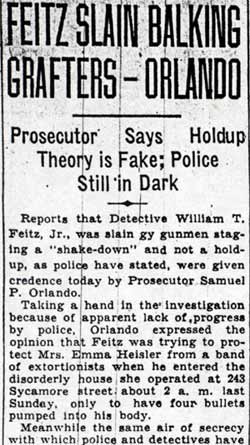
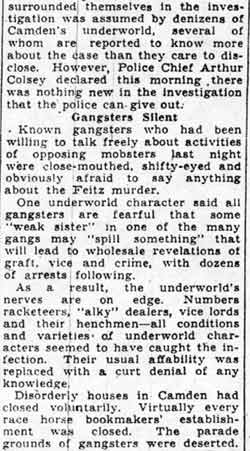
Prosecutor Says Holdup Theory is Fake; Police Still in Dark
Reports that Detective William T. Feitz, Jr., was slain gy [sic] gunmen staging a “shake-down” and not a hold-up, as police have stated, were given credence today by Prosecutor Samuel P. Orlando.
Taking a hand in the investigation because of apparent lack of progress by police, Orlando expressed the opinion that Feitz was trying to protect Mrs. Emma Heisler from a band of extortionists when he entered the disorderly house she operated at 243 Sycamore street about 2 a. m. last Sunday, only to have four bullets pumped into his body.
Meanwhile the same air of secrecy with which police and detectives have surrounded themselves in the investigation was assumed by denizens of Camden’s underworld, several of whom are reported to know more about the case than they care to disclose. However, Police Chief Arthur Colsey declared this morning there was nothing new in the investigation that the police can give out.
Gangsters Silent
Known gangsters who had been willing to talk freely about activities of opposing mobsters last night were close-mouthed, shifty-eyed and obviously afraid to say anything about the Feitz murder.
One underworld character said all gangsters are fearful that some “weak sister” in one of the many gangs may “spill something” that will lead to wholesale revelations of graft, vice and crime, with dozens of arrests following.
As a result, the underworld’s nerves are on edge. Numbers racketeers, “alky” dealers, vice lords and their henchmen—all conditions and varieties of underworld characters seemed to have caught the infection. Their usual affability was replaced with a curt denial of any knowledge.
Disorderly houses in Camden had closed voluntarily. Virtually every race horse bookmakers’ establishment was closed. The parade grounds of gangsters were deserted. They could be found only in “back rooms” and the less populous corners—and most of them were alone, in marked contrast to their penchant for hangers-on.
They were cleared for action, observers decided, and ready for a “big break” of some sort—fearful that an aroused police department might crack down with such ruthless abandon that “shooting it out” might become the necessary “play” for self-preservation.
Orlando expressed the opinion that Feitz was killed by “shake-down” men after he had quizzed a number of witnesses in the Feitz murder, including Cornelius Murphy, who, police say, was caretaker at the Heisler establishment.
This quiz was launched yesterday afternoon.
Orlando’s reconstruction of the crime was in harmony with persistent rumors that have been in circulation ever since Feitz was shot to death early last Sunday. His theory, however, is at variance with that of Camden city police department detectives, who have insisted that Feitz was killed when he went into the house and caught a trio of men “sticking up” the patrons in the place.
Orlando’s questioning of witnesses corroborated reports that the county intends to take charge of the investigation into the case.
“Matter of Time”
While admitting that neither he nor the police knows the identity of the slayers, Orlando expressed confidence that their apprehension was only a matter of time.
At the same time, both Orlando and police chieftains denied reports that a widely known South Camden boxer had been arrested in New York as a material witness, and is being held incommunicado in connection with the murder.
“My present plans are to take all the information available on the case before Justice Frank T. Lloyd Monday, so he can direct us in future developments,” explained the prosecutor.
Asked for his opinion of the conditions which led up to the shooting, Orlando replied: “I think these men went into the place to obtain money from the operator of the house. Feitz went in to frustrate the attempt and was murdered.”
“Have you any idea of the specific time we can expect the suspects to be taken into custody?” the prosecutor was asked.
“No. Any statement I might make along those lines would be merely guess-work.”
“Does your statement mean you have decided not to take what evidence is available before Justice Lloyd?” Orlando then was asked.
“No. This information is preliminary to a report I intend to give Justice Lloyd Monday so he can direct us.”
Welcomes Interviews
“Do you have any intention of clamping down on news to the press?”
“Absolutely not. On the contrary, I shall be glad to give a daily interview to the newspapers. I think the public should be kept cognizant of developments, and I want to cooperate with the press,” whereupon the prosecutor gave out the following formal statement:
“Pursuant to a request which I made to Chief Colsey yesterday, the Chief and Lieutenant George Ward came to my office this afternoon and submitted to me for inspection reports which they have made up setting forth a series of events in the Feitz murder investigation.
“This report was supplemented by a more detailed and minute verbal report by Lieutenant Ward and Chief Colsey, and following this conference I came to city hall, where I read over some statements which have been taken from some of the witnesses in the case.
Talks to Witnesses
“In order to satisfy myself more thoroughly, I have talked to some of the witnesses myself, but have not been able to talk to all of them because of the lack of time and because I wish to give the stenographers a chance to transcribe the notes they have made on the prior witnesses.
“I feel satisfied from the information obtained from the witnesses that while the names of the slayers have not been mentioned and we do not have them, a careful and minute description which has been given by two or three of the witnesses who were in the premises the night in question will lead us to the individuals responsible for this murder.
“We can’t give out that information because we believe it would frustrate the investigation and give the culprits a chance to secrete themselves, but we intend to use all of the police facilities available to locate these individuals who answer the descriptions given. And until we have in our custody these men who answer these descriptions, there will be nothing of major importance that we can give out excepting that we are looking for them.
“It is merely an opinion, but I believe we should be able to take into custody these individuals that have been described.”
Feitz’s Killers Known to Blair, Colsey Says; 3 Held in Number Drive
Camden Evening Courier —
Mickey Blair was held without bail by Police Judge J. Warrant Switzer today on a warrant charging him with “unlawfully conspiring with John Doe and others to hold up and rob Mrs. Emma Heisler and others at her home, and during the commission of the crime one William Feitz, a police officer, was shot and killed.” Blair pleaded not guilty.
The secret to the identity of the killers of Detective William T. Feitz, Camden police said today, is held by Michael Tenerelli, 25, known in pugilistic ranks as Mickey Blair, one-time lightweight boxer.
As a result, both Camden county authorities and Camden police concentrated their efforts on grilling Tenerelli, who had been held incommunicado since he surrendered to the police here Monday.
“Mickey Blair knows more than he is telling us,” said Police Chief Arthur Colsey. “We intend to find out if we have to keep him confined to jail indefinitely.
“Our questioning of Blair leads us to believe that he knows who the killers of Feitz are. We have a very good idea as to their identity and are looking for them but Blair’s confirmation would help us considerably.
“Solution of the murder never looked more encouraging than it does today,” Chief Colsey added.
Plans New Parley
The Camden police head said that he would confer today with both Prosecutor Samuel P. Orlando and Mayor Roy R. Stewart in connection with the investigation in the murder.
Several witnesses, now held in cells at police headquarters are to be examined, Chief Colsey revealed, to further break down the alibi of Blair which is to the effect that he was in New York City at the time that Feitz was shot to death in a South Camden alleged disorderly house.
It was also reported that Camden authorities have asked New York police to take into custody a reputed gunman and “trigger” man who killed Feitz. His identity was not revealed.
Prosecutor Orlando was expected to place a more serious charge against Blair sometime today. He is already being held without bail on a charge of being a material witness and with conspiracy in a robbery in connection with the shaking down of Mrs. Emma Heisler, alleged operator of the disorderly house where Feitz was shot at 243 Sycamore street.
Another new development yesterday came with the revelation by Supreme Court Justice Frank T. Lloyd that Feitz was in the disorderly house when one or more men bent on “shaking down” Mrs. Heisler entered and shot Feitz.
This was direct contradiction of the version first given out by police.
(Continued on Page Two)
(Continued from Page One)
They said Feitz followed a car containing suspicious looking characters and saw them enter the house, walked in after them and stumbled onto a hold-up.
Justice Lloyd would not amplify his statement, made to the new grand jury, except to say “that is my information.”
The “serious charge” which Colsey said will be placed against Blair will result in part from a breaking down of Blair’s alibi, Colsey said.
“We have checked up on statements made by Tenerelli as to his whereabouts and we found out he was not where he said he was. He said he was in New York at the time of the killing. He was not there.
“He is lying about his whereabouts.
“It will be a long time before we are through with Tenerelli. We think he will or can give us information which will prove valuable to our case.”
The New York mobster angle came from a police official under orders not to talk. He said:
“We have a complete description of this man and this marks him as so strikingly different from the average man that he would know immediately whom we were seeking if we gave out the description. Publication of his description might drive him to plastic surgery in an effort to obliterate telltale characteristics of appearance.”
Store Bandits to Be Quizzed in Chester on Feitz Murder
Camden Evening Courier —
Material Witness Will View Suspects Caught by Camden Sleuths — Brickner Questioned by Colsey on Holdup
Seven men and women held by Camden police as material witnesses in the murder of Detective William T. Feitz two weeks ago in an alleged South Camden disorderly house will look over two men arrested in Chester PA after a store holdup here.
This was announced today by County Detective Lawrence T. Doran, who is directing the investigation for Prosecutor Samuel P. Orlando.
At the same time, Chief Doran disclosed that after a conference with Police Chief Arthur Colsey, orders were issued that every person arrested in Camden, whether the charge is trivial or serious, will be placed in a police “lineup” and the material witnesses will face them to see if any of Feitz’s killers are among them.
Chief Doran was not sure whether the Camden County authorities would be able to bring the two robbery suspects to Camden because they are also wanted in Pennsylvania for almost a score of other holdups and burglaries.
Will Visit Chester
In the event that Chester authorities will not turn the two men over to Camden detectives, the witnesses will go to Chester to examine them, Chief Doran said.
Those held in Chester in connection with the holdup Wednesday night of the candy store of Michael Guzik at 1301 Sheridan Street identified themselves as Peter Muraska, 10, of 342 McDowell Street, and Ray Tuttle, 30, of 2529 West Ninth Street, both of Chester.
While neither Chief Doran nor Chief Colsey believe Muraska or Tuttle may be implicated in the murder of the detective because they are not known to be killers, both declared the suspects will be questioned as to their whereabouts at the time Feitz was shot to death.
“We are letting nothing slip through our fingers at this stage of the investigation,” Chief Doran said. “There is a bare possibility that either of these two suspects may be implicated or have some knowledge that would be useful to us in solving this crime.”
While negotiations were under way between Camden County authorities and Chester police to bring the suspects here, Chief Colsey was making inquiry into the actions of Patrolman William Brickner during the holdup.
Questioned by Colsey
Brickner was summoned to Chief Colsey’s office at City Hall today to explain why he had rushed from his home at 1263 Chase Street to the scene of the holdup when told by neighbors that it was taking place and then gave his gun to his son Elmer so he could watch the place so he the policeman could telephone police headquarters for help.
According to Guzik, the proprietor of the store, the bandits were in his store 30 minutes. They locked the doors behind them and gagged Guzik and guarded his wife, Blanche, and her sister, Mary Pitura, 18.
The bandits broke open a trunk from which they took $100 in pennies, $30 in scrip, and $4 in silver. Guzik said the pennies represented his profit in a penny vending machine over a period of time.
It was while Guzik was left alone that he shouted from one of his windows and neighbors called Brickner who was at home and off duty. His son Elmer fired one shot at the fleeing car before the patrolman came back from telephoning for help.
Several numbers of the license plates on the bandits car were covered with tape but one of the youngsters in the neighborhood succeeded in pushing aside the tape and getting the complete number which was turned over to police. Yesterday Detective Lieutenant Ward, accompanied by Detective Sergeant Gus Koerner and Detective Joseph Carpani went to Chester and made the arrests.
The car, which carried Pennsylvania tags, was listed in the name of Archie Hendrickson of Morton Avenue, Chester, police said.
Mickey Blair Admits Visit to Heisler Home on Fatal Night
Camden Courier-Post — September 14–15, 1934
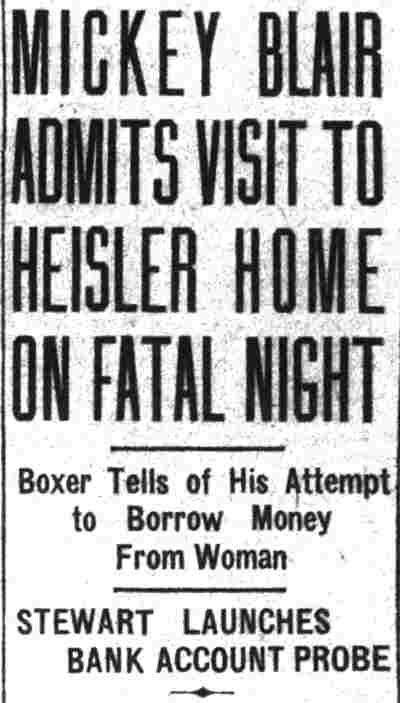
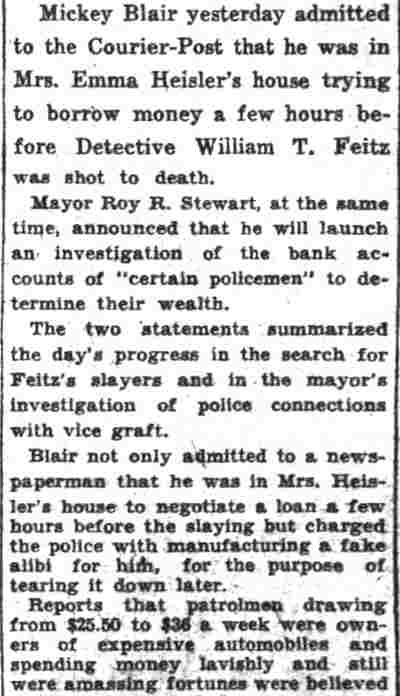
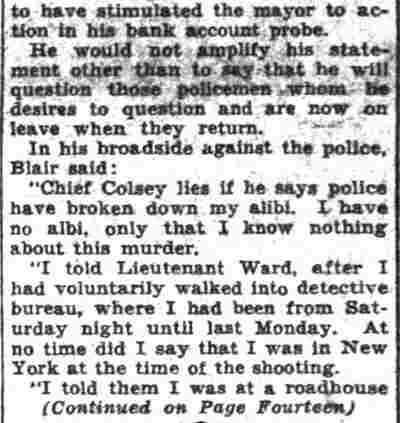
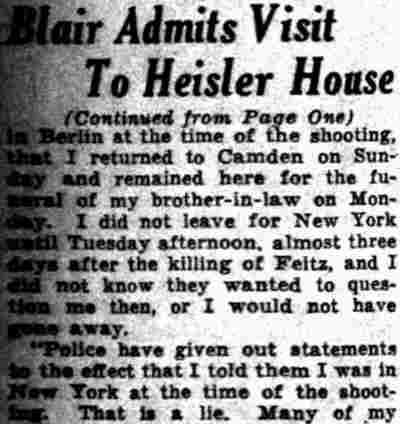
Mickey Blair Admits Visit to Heisler Home on Fatal Night
Boxer Tells of His Attempt to Borrow Money From Woman
STEWART LAUNCHES BANK ACCOUNT PROBE
Mickey Blair yesterday admitted to the Courier-Post that he was in Mrs. Emma Heisler’s house trying to borrow money a few hours before Detective William T. Feitz was shot to death.
Mayor Roy R. Stewart, at the same time, announced that he will launch an investigation of the bank accounts of “certain policemen” to determine their wealth.
The two statements summarized the day’s progress in the search for Feitz’s slayers and in the mayor’s investigation of police connections with vice graft.
Blair not only admitted to a newspaperman that he was in Mrs. Heisler’s house to negotiate a loan a few hours before the slaying but charged the police with manufacturing a fake alibi for him, for the purpose of tearing it down later.
Reports that patrolmen drawing from $25.50 to $36 a week were owners of expensive automobiles and spending money lavishly and still were amassing fortunes were believed to have stimulated the mayor to action in his bank account probe.
He would not amplify his statement other than to say that he will question those policemen whom he desires to question and are now on leave when they return.
In his broadside against the police, Blair said:
“Chief Colsey lies if he says police have broken down my alibi. I have no alibi, only that I know nothing about this murder.
“I told Lieutenant Ward, after I had voluntarily walked into detective bureau, where I had been from Saturday night until last Monday. At no time did I say that I was in New York at the time of the shooting.
“I told them I was at a roadhouse in Berlin at the time of the shooting, that I returned to Camden on Sunday and remained here for the funeral of my brother-in-law on Monday. I did not leave for New York until Tuesday afternoon, almost three days after the killing of Feitz, and I did not know they wanted to question me then, or I would not have gone away.
“Police have given out statements to the effect that I told them I was in New York at the time of the shooting. That is a lie. Many of my friends and acquaintances saw me Saturday night at Berlin and others saw me the following day and on Monday. I can prove everything I have told the police to be true.
“I knew Emma Heisler and have known her for several years. I wouldn’t say she was a close friend, but I did know her fairly well. Police have accused me of attempting to shake her down for money. That is not my racket.
“I did attempt to borrow from Emma on Saturday, but I can’t see anything wrong in that. I tried several friends, because I needed a little money at the time to purchase flowers for my brother-in-law’s funeral.
She Promised Loan
“When I saw her early Saturday night, she told me to come back on Monday and she would lend me the money. I was thankful because of the favor, so why should I try to do the woman any harm?
“Police say I am the ’finger-man’ in the shooting. That makes me laugh. They know they haven’t a shred of evidence to prove such a lie. They’ve got to hang it on somebody, so they blame it on me.
“It’s been the same in all big cases. Somebody has to get blamed. It was just unfortunate for me that I happened to be talking with Mrs. Heisler a short time before the slaying. I had nothing to hide when I went to her for a loan and I have nothing to hide now.
“Two or three persons were there when I asked to borrow the money. Do you think anyone who was attempting to frighten the woman would do it before all these witnesses? I knew this woman when she had a place down the street from where Feitz was shot. I knew her when she conducted many other places in the city, and she knew me. I would have been crazy to try anything wrong with her, even if I wanted to, which I didn’t, because everybody in Camden knows me and would recognize me.
Says He Attended Wake
“I told police that I left Fourth and Spruce streets about 1 a. m. Sunday, and arrived at the roadhouse in Berlin about a half hour later.
Many people saw me there. I stayed at the place until late Sunday afternoon and then returned to Camden.
“I was at home all of Sunday night until I attended a wake at the home of my sister on Decatur street. Then on Monday I was at the funeral and Monday night I visited several places in the city. I had made arrangements to go to New York, but postponed my trip until Tuesday after my brother-in-law’s death.
“While in New York I heard from a friend who told me police were looking for me. I immediately telephoned Edward V. Martino, who has represented me in other matters, and asked him to learn if that were true. He called me back and said it was. I told him my business in New York would be completed on Monday and that I would return to Camden at that time and visit detective headquarters.
“I paid my own expenses to get here, and since the time I gave myself up, police have constantly walked me about with handcuffs on. Do you think I would have surrendered to police if I had any intentions of running away?”
Martino Raps Police
“I have told the truth and I am innocent of any connection with the death of Detective Feitz. If police want to give out the true story, they will verify that everything I have told you is what I told them. And every word of it is the truth.”
Martino, who was present during the interview, added that it was “a disgrace” to the police department in the manner in which Blair has been treated since his surrender.
“When Blair gave himself up,” Martino said, “I instructed him to go to detective bureau by himself. I did not request the right to protect his constitutional rights, because it was my idea that by not interfering, the police could not find any excuse in their failure to solve the crime. They not only failed to appreciate the co-operation given them, but are continually giving out so many contradictory statements that the general public is given the impression that Blair is deliberately lying.”
Prosecutor Samuel P. Orlando, meanwhile, disclosed yesterday that the new grand jury will not hear witnesses in the Feitz murder case, or open a probe into vice conditions in Camden at its first session next Thursday.
“Facts in the murder probe and pertaining to vice conditions will not be ready in time for consideration by the new grand jury next Thursday,” the prosecutor said. “The veniremen will act on pending cases, including those of several alleged numbers barons arrested during the last week.”
Meanwhile, the police continued their crusade against the numbers racket, making their tenth and eleventh arrests in a week.
At the same time, Fred Klosterman, an alleged numbers baron, who surrendered Wednesday, was held in $5000 bail by Police Judge J. Harry Switzer for the grand jury. His brother, Joseph Klosterman, was held in similar bail previously, also on a charge of operating a numbers game.
The two men apprehended yesterday were arrested by George Clayton, a policeman, charged with being numbers writers. They will be given a hearing in police court today. The men gave their names as John Geronio, 52, of 1042 Cooper street, and Crawford Smith, 51, of 702 Carman street.
Fred Klosterman is 33 and gave his address as 1050 Mechanic street. Joseph Klosterman, 35, gave his address as 1400 Mechanic street.
The Klostermans, according to police, are among the topnotch numbers barons of the city. Both pleaded not guilty to the charges against them.
No disposition was made in police court of the case of Mrs. Mollie Schwartz, 42, who was arrested Wednesday on a charge of operating a still at a double dwelling at 3404 Rosedale avenue. Police Lieut. John Potter said the woman admitted operating the still.
Strict co-operation with the State Alcoholic Beverage Commission in the detection, closing up and prosecution of speakeasies is being given by the Camden police department.
That statement was made yesterday by Mayor Roy R. Stewart, who is the director of the department of public safety, and came as the result of an interview which Howard B. Dyer, an investigator of the state beverage commission had with the mayor. Dyer was formerly deputy city clerk.
An anonymous letter to Camden police led yesterday to the arerst [sic] of Glenn Brown, 48, colored, on a charge of operating a 50-gallon still at 141 Mt. Vernon street. Brown was held in $500 bail at police headquarters for a hearing today in police court.
Brown was arrested by Police Lieut. Walter Welch, who said the still was found in the basement of the Mt. Vernon street address and it had been in operation shortly before the raid.
The technical charge against Brown is violation of Section 48
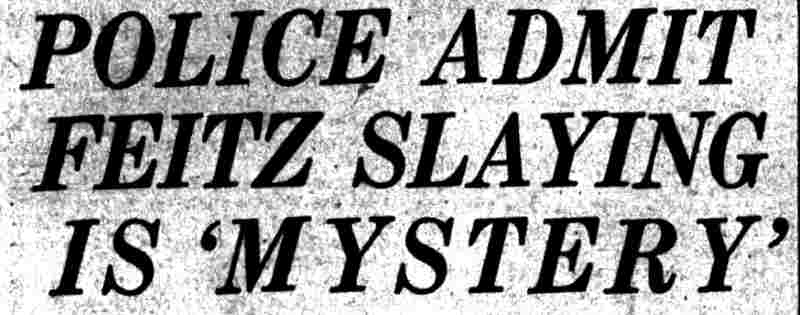
POLICE ADMIT FEITZ SLAYING IS ‘MYSTERY’
‘Still in the Dark,’ Cops Say After Three Weeks of Vice Probe
BLAIR LAWYER SCORES ‘FARCE’
Editorial: “The Cop, the Criminal—And Who Else?” appears on page ten.
Three weeks after the slaying of Detective William T. Feitz, police admitted yesterday that they are “completely in the dark” in their efforts to solve the murder and find the slayer.
Although Mickey Blair, former pugilist, is held as the most important witness in the case and police say they believe Blair knows who killed Feitz, they have no one under direct suspicion, the police said.
This was in direct contradiction to a police statement of several days ago, in which it was said that a New York gunman of peculiar appearance was sought as the trigger man.
Lawyer Flays Police
The conflicting stories coming from the police department yesterday drew a scathing fire of ridicule from Blair’s attorney, Edward V. Martino.
In a review of Blair’s surrender, Martino flayed the police for “many contradictory statements” and said their handling of Blair is a “disgrace to the department.”
The handling of the case drew this comment from Martino:
“Such conduct on the part of an intelligent police force is detestable.”
Martino’s criticism of the department and the announcement that Mayor Roy R. Stewart will present such facts and evidence as he has gathered in his probe of police connivance with vice or dereliction in duty to Supreme Court Justice Frank T. Lloyd constituted the only developments in the case yesterday.
Double-cross Hinted
Stewart said he will give Justice Lloyd and Prosecutor Samuel P. Orlando his complete data on the police and Feitz probes and is ready to present the same data to the grand jury if Lloyd and Orlando consider this course advisable.
Martino, describing step-by-step the events leading to Blair’s surrender and his subsequent examination drew the conclusion that Police Chief Arthur Colsey is “either telling a deliberate falsehood” or has been double-crossed with misinformation by his detectives. Martino said:
Police Admit Defeat In Vice Slaying
“On Saturday past, I received a New York telephone communication from Mickey Blair, and he told me that he had been advised that the police were looking for him. He requested me to ascertain whether this was true, and if so he would gladly come to Camden.
“I talked to Lieutenant George A. Ward on Sunday afternoon, and he told me that they did want Mickey. I talked with Mickey that afternoon, and he told me that he would come to Camden at about 1 p. m. on Monday.
“He entered my office at about 12 noon, and after talking to me about five minutes, during which time he told me that he knew absolutely nothing about the shooting, I advised him to go to the detective bureau alone.
Would Not Interfere
“I did not request the right to protect his constitutional rights, because it was my idea that by not interfering, the police could not find any excuse in their failure to solve the crime.
“They not only failed to appreciate the co-operation given them, but are continuously giving out so many contradictory statements that the general public is given the impression that Blair is deliberately lying. Chief Colsey has repeatedly told the newspapers that Blair stated that he was in New York at the time of the crime.
“Colsey is either telling a deliberate falsehood or he has been misinformed by one or two of his examiners. I talked with Blair at the county jail, and although he appeared tired and worn, he was surprised to learn of the story given out by Colsey.
“It is difficult to understand why the police did not arrest Mickey before he left Camden for New York, since he was in Camden until the Tuesday following the murder.
“He attended a wake at the home of his sister on Sunday, and attended the funeral on Monday (Labor Day) from his sister’s home on Decatur street, Camden. He did not leave Camden for New York until some time on Tuesday afternoon.
Called a Disgrace
“The general physical appearance of Blair before Judge J. Harry Switzer was a disgrace to the Camden City Police Department. He was handcuffed and chained, although he was thoughtful enough to pay his own expenses in traveling from New York, and willingly submit to the police. Such conduct on the part of an intelligent police force is detestable.
“My only hope is that the crime is solved, but in doing so, the officials in charge should be careful that they charge the guilty man or men with the crime.”
The sweeping grand jury investigation of crime and vice ordered of the grand jury by Justice Lloyd is not expected to start, Prosecutor Orlando disclosed, for at least two weeks.
“Our evidence is not entirely at hand,” said Orlando, “and until it is ready I will not proceed. Another reason why I can’t go ahead with it is the large number of cases which I have ready at this time and which must be presented to the grand jury when it opens its sessions next Thursday.”
Earlier, both Prosecutor Orlando and Police Chief Colsey admitted that the authorities were no nearer a solution to the murder of Feitz than they were 20 days ago when he was shot and killed in an alleged disorderly house in South Camden.
Furthermore, previous statements of the police notwithstanding, the identity of the killer or killers is shrouded in as much mystery as it ever was.
“Who killed Feitz?” was a question asked Prosecutor Orlando.
“I don’t know—do you?” was Orlando’s “two-way” reply.
Still ‘In Dark’
The prosecutor’s statement was the first revelation that police and Camden county authorities are still in the dark.
Police Chief Colsey echoed Prosecutor Orlando’s statement by telling newspapermen upon being questioned that he “wished he did know who killed Feitz.”
“We’re entirely in the dark,” he added.
Heretofore the police, through statements made by Chief Colsey, have expressed their confidence that they knew who the slayer or slayers of the detective were and were following important clues which would lead to their arrest.
While the authorities were admittedly groping about for clues in the Feitz murder, the police drive on gambling continued yesterday with the arrest of two alleged “numbers” bankers.
Held in $2000 bail to await the action of the grand jury on charges of operating a “numbers” lottery by Police Judge Switzer were Crawford Smith, 51, of 702 Carman street, and John Deronio, 52, of 1042 Cooper street. Smith pleaded not guilty to the charge which grew out of Deronio’s admission to police that he “wrote” the “numbers” for Smith for a considerable period of time.
Both Smith and Deronio were arrested by Patrolman George Clayton. Deronio pleaded guilty to the charge.
Will View 3 Suspects
Three suspects charged with the robbery of a South Camden candy store Wednesday night were either to be brought to Camden or material witnesses in the Feitz murder were to be taken to Chester, Pa., where they are being held, to learn whether either suspect could be identified as one of the killers.
Mayor Stewart continued his questioning of police yesterday, seeking data on crime and vice in this city.
Questioned by the mayor in his office were Lieutenant George Frost, commander of the police department’s one-man vice squad who is said to have told the mayor considerable about conditions, former City Detective Ben Simon who is now a patrolman; Vernon Jones, one of the 13 suspended policeman [sic] and the officer on the beat at Second and Sycamore streets the night Feitz was killed, and Detective Stanley Wirtz.
Chief County Detective Lawrence T. Doran, who is conducting Prosecutor Orlando’s investigation into the murder, said a search of the records of the city assessor’s office revealed the property in which the late Mrs. Emma Heisler was charged with operating a disorderly house is owned by the Hyman Varbalow Building and Loan Association.
Rented in Oct., 1933
It was rented, Chief Doran said, by Nathan U. Katz, a real estate agent of 410 Kaighn avenue, to a “Mary Dudley” on October 18, 1933, for $15 a month. However, the occupants did not enter the house immediately, according to Doran, because of needed repairs, which were made.
Katz told detectives that the rent was always paid in advance by a man who called at his real estate office. There was no lease on the property, it being rented from month to month.
“Had I known the place was being used for immoral purposes I would have ordered the people out long ago,” Katz told detectives.
At the same time, Chief Doran disclosed that after a conference with Police Chief Colsey, orders were issued that every person arrested in Camden, whether the charge is trivial or serious, will be placed in a police “lineup” and the material witnesses will face them to see if any of Feitz’s killers are among them.
Chief Doran was not sure whether Camden county authorities would be able to bring the two robbery suspects to Camden because they are also wanted in Pennsylvania for almost a score of other holdups and burglaries.
In the event Chester authorities will not turn the two men over to Camden detectives, the witnesses will go to Chester to examine them, Chief Doran said.
“We are letting nothing slip through our fingers at this stage of the investigation,” Chief Doran said. “There is a bare possibility that either of these two suspects may be implicated or have some knowledge that would be useful to us in solving this crime.”
Judge Neutze Decrees Prison Sentences to Replace Fines
Camden Courier-Post —
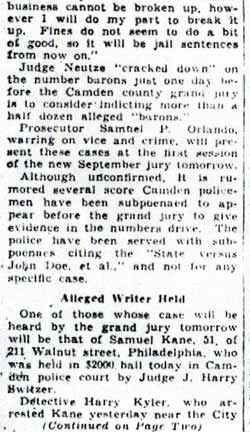
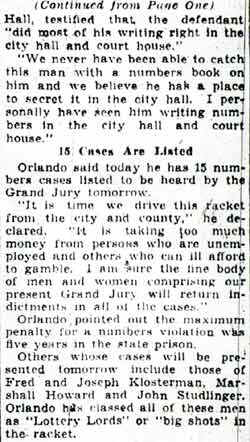
GRAND JURY QUIZ OPENS TOMORROW
Alleged Writer Arrested Near City Hall; Held By Switzer
Long prison terms instead of fines will be given number barons and operators who are convicted in the Camden County Criminal Court.
That was the promise made today by Judge Frank F. Neutze to “lottery lords”, who may appear in his court as he sentenced Austin “Shamus” Maguire, former pugilist, to serve 30 days in the county jail and to pay a fine of $200.
“Yours is the last case in which a fine will be imposed,” Judge Neutze told Maguire. “In the future every numbers baron and operator convicted in this court will serve jail sentences and those who are second offenders will go to Trenton for long prison terms.”
Maguire, indicted for a year-old offense as a numbers bank operator, pleaded non vult to the charge before Judge Neutze, who seized upon the occasion to warn racketeers he “was going to do his part to rid the city of vice and crime.”
“In sentencing you, I am taking into consideration the fact that you are an intelligent youth, now willing to do what is right,” the judge said. “This charge, I am informed, is a year old and I am told you are now not in this business.
Grand Jury to Meet
“I am also taking into consideration the fact that you were an honor student at Camden Catholic High school. However, I am serving notice that in the future I am going to step down and send number barons to prison. There will be no more fines. They tell me this number business cannot be broken up, however I will do my part to break it up. Fines do not seem to do a bit of good, so it will be jail sentences from now on.”
Judge Neutze “cracked down” on the number barons just one day before the Camden county grand jury is to consider indicting more than a half dozen alleged “barons.”
Prosecutor Samuel P. Orlando, warring on vice and crime, will present these cases at the first session of the new September jury tomorrow.
Although unconfirmed, it is rumored several score Camden policemen have been subpoenaed to appear before the grand jury to give evidence in the numbers drive. The police have been served with subpoenas citing the “State versus John Doe, et al.” and not for any specific case.
Alleged Writer Held
One of those whose case will be heard by the grand jury tomorrow will be that of Samuel Kane, 51, of 211 Walnut street, Philadelphia, who was held in $2000 bail today in Camden police court by Judge J. Harry Switzer.
Detective Harry Kyler, who arrested Kane yesterday near the City Hall, testified that the defendant “did most of his writing right in the city hall and court house.”
“We never have been able to catch this man with a numbers book on him and we believe he has a place to secret it in the city hall. I personally have seen him writing numbers in the city hall and court house.”
15 Cases Are Listed
Orlando said today he has 15 numbers cases listed to be heard by the Grand Jury tomorrow.
“It is time we drive this racket from the city and county,” he declared. “It is taking too much money from persons who are unemployed and others who can ill afford to gamble. I am sure the fine body of men and women comprising our present Grand Jury will return indictments in all of the cases.”
Orlando pointed out the maximum penalty for a numbers violation was five years in the state prison.
Others whose cases will be presented tomorrow include those of Fred and Joseph Klosterman, Marshall Howard and John Studinger. Orlando has classed all of these men as “Lottery Lords” or “big shots” in the racket.
Bribery Charged by Grand Jurors
Camden Courier-Post —
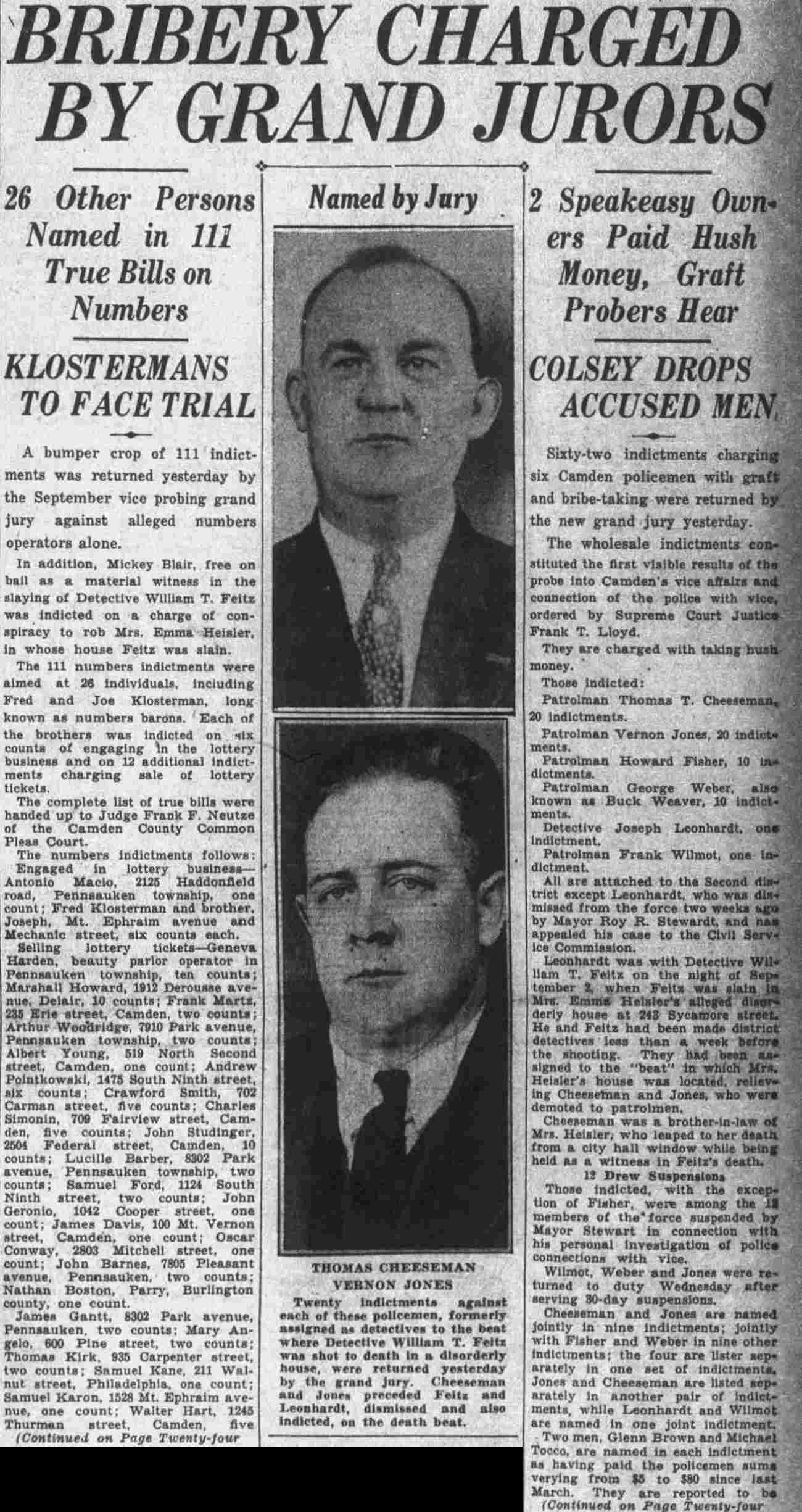
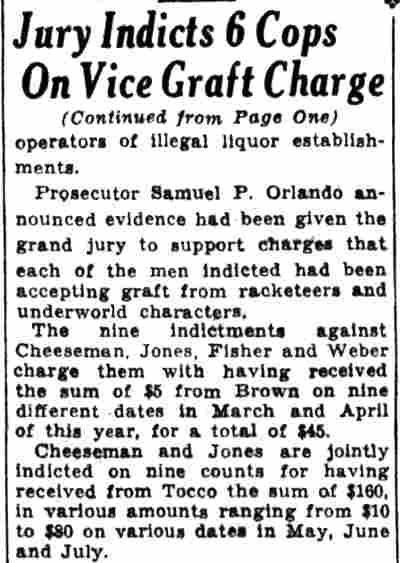
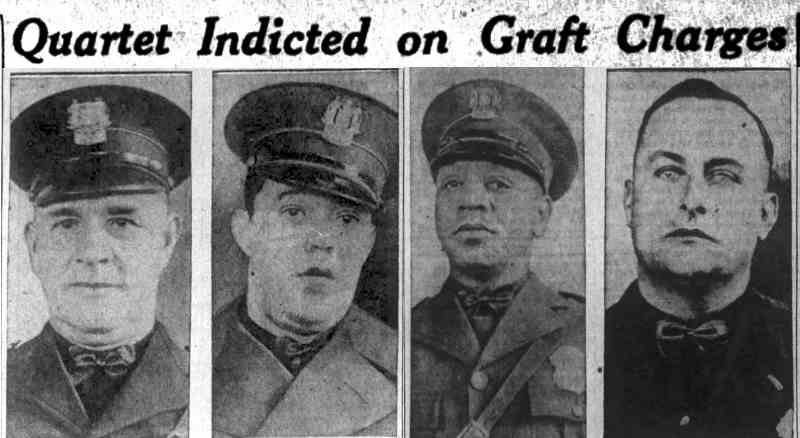

26 Other Persons Named in 111 True Bills on Numbers
KLOSTERMANS TO FACE TRIAL
A bumper crop of 111 indictments was returned yesterday by the September vice probing grand jury against alleged numbers operators alone.
In addition, Mickey Blair, free on bail as a material witness in the slaying of Detective William T. Feitz was indicted on a charge of conspiracy to rob Mrs. Emma Heisler, in whose house Feitz was slain.
The 111 numbers indictments were aimed at 26 individuals, including Fred and Joe Klosterman, long known as numbers barons. Each of the brothers was indicted on six counts of engaging in the lottery business and on 12 additional indictments charging sale of lottery tickets.
The complete list of true bills were handed up to Judge Frank F. Neutze of the Camden County Common Pleas Court.
The numbers indictments follows [sic]:
Engaged in lottery business—Antonio Macio, 2125 Haddonfield road, Pennsauken township, one count; Fred Klosterman and brother, Joseph, Mt. Ephraim avenue and Mechanic street, six counts each.
Selling lottery tickets—Geneva Harden, beauty parlor operator in Pennsauken township, ten counts; Marshall Howard, 1912 Derousse avenue, Delair, 10 counts; Frank Martz, 235 Erie street, Camden, two counts; Arthur Woodridge, 7910 Park avenue, Pennsauken township, two counts; Albert Young, 519 North Second street, Camden, one count; Andrew Pointkowski, 1475 South Ninth street, six counts; Crawford Smith, 702 Carman street, five counts; Charles Simonin, 709 Fairview street, Camden, five counts; John Studinger, 2504 Federal street, Camden, 10 counts; Lucille Barber, 8302 Park avenue, Pennsauken township, two counts; Samuel Ford, 1124 South Ninth street, two counts; John Geronio, 1042 Cooper street, one count; James Davis, 100 Mt. Vernon street, Camden, one count; Oscar Conway, 2803 Mitchell street, one count; John Barnes, 7805 Pleasant avenue, Pennsauken, two counts; Nathan Boston, Parry, Burlington county, one count.
James Gantt, 8302 Park avenue, Pennsauken, two counts; Mary Angelo, 600 Pine street, two counts; Thomas Kirk, 935 Carpenter street, two counts; Samuel Kane, 211 Walnut street, Philadelphia, one count; Samuel Karon, 1528 Mt. Ephraim avenue, one count; Walter Hart, 1245 Thurman street, Camden, five counts; Frank Kulzcnski, 1100 Orchard street, two counts.
The presentment required only three minutes and the grand jury immediately withdrew to its chambers to consider new evidence in its probe of vice and gambling here.
It was indicated that the first batch of indictments found by the grand jury was just that, and that further true bills would be forthcoming as the work of sifting the mass of evidence continues.
A quartet of former city detectives who were transferred to regular police duty June 14, and seven attaches of the county jail were among the list of witnesses subpoenaed.
The erstwhile plainclothesmen are Clarence Arthur, Benjamin Simon, Clifford Del Rossi and Leon Branch. All were put into uniform without explanation, and with the understanding, they declare, that they would not be displaced. All expressed surprise at their removal, inasmuch as others were later appointed to their posts, because they had good records while members of the detective bureau.
Arthur and Branch appeared briefly before the probing body.
Crawford Smith is the brother of Detective Walter Smith and former Detective Howard Smith, it was reported by Mayor Roy R. Stewart.
Michael Tenerelli, known in fistic cicles [sic] as Mickey Blair, was among those waiting in the grand jury anteroom when the jury adjourned to be called before the probers. All those called were subpoenaed on “John Doe” warrants.
Mickey told reporters he has no idea what form of questioning will be followed when he is called into the grand jury room. He was recently released under bail of $5000 as a material witness in the Feitz killing investigation.
Those who could not be heard by the grand jurors before adjournment yesterday were told to come back next Thursday.
Among the witnesses in the vice probe called into the jury room were two Camden county jail attaches, Mrs. Lillian Vincent, matron, and Frank Tyson, jail clerk.
Both were asked questions regarding the proceedure [sic] followed in releasing prisoners from the pail [sic], it was learned. Tyson was not asked by the grand jurors if the prisoners were ever allowed to leave jail before their terms were up, he said.
“We never discharged a prisoner during my long experience in the county jail,” he told reporters, “without the proper release slip. I do not know of any prisoner ever being released before his time was up.”
Other members of the county jail staff waiting to appear were Edmund Powell, former warden; William Kinsler, Walter Taylor, Joseph Rea and John Feitz.
Another witness to testify was Mrs. Anna Smallwood, of Fifth and Chestnut, who posted $5000 bail for Mickey Blair to effect the former boxer’s release in the Feitz murder case.
It is thought that the county jail attaches will be questioned in an endeavour to learn how prisoners are released before time, although confirmation of this report was lacking.
The grand jury also returned indictments against Robert R. Young and Fred H. Schmitz, both of Philadelphia, former employes of the RCA Victor Company, charging them with the theft of four automobile radio sets from the plant on September 19.
Harry Smith, John Lockwood, Edward Troutman and Thomas Moreland, of Camden, were charged with larceny of merchandise from the American Stores Company on August 30.
Stanley Gaisor and Henry Parewicz, both of Camden, were indicted on charges of the theft of an automobile owned by County Physician Edward B. Rogers. The automobile was stolen in Camden, August 31.
Paul Pralas was indicted on charges of atrocious assault and battery on Rocco Piliro on September 19 in Camden.
The following were indicted on charges of desertion and non-support: Cornelius Chambers, charged by his wife, Ethel, with deserting her and three small children.
Thomas Porter, of Clementon, with non-support of his three small children. Frank Drew, Camden, desertion and non-support of his wife, Martha, and three minor children. Walter Butterfield, Brooklawn, with desertion of his wife, Verna, and one minor child. Eugene Morselander, of Camden, with desertion of his wife, Gladys.
2 Speakeasy Owners Paid Hush Money, Graft Probers Hear
COLSEY DROPS ACCUSED MEN
Sixty-two indictments charging six Camden policemen with graft and bribe-taking were returned by the new grand jury yesterday.
The wholesale indictments constituted the first visible results of the probe into Camden’s vice affairs and connection of the police with vice, ordered by Supreme Court Justice Frank T. Lloyd.
They are charged with taking hush money.
Those indicted:
Patrolman Thomas T. Cheeseman, 20 indictments.
Patrolman Vernon Jones, 20 indictments.
Patrolman Howard Fisher, 10 indictments.
Patrolman George Weber, also known as Buck Weaver, 10 indictments.
Detective Joseph Leonhardt, one indictment.
Patrolman Frank Wilmot, one indictment.
All are attached to the Second district except Leonhardt, who was dismissed from the force two weeks ago by Mayor Roy R. Stewardt [sic], and has appealed his case to the Civil Service Commission.
Leonhardt was with Detective William T. Feitz on the night of September 2, when Feitz was slain in Mrs. Emma Heisler’s alleged disorderly house at 243 Sycamore street. He and Feitz had been made district detectives less than a week before the shooting. They had been assigned to the “beat” in which Mrs. Heisler’s house was located, relieving Cheeseman and Jones, who were demoted to patrolmen.
Cheeseman was a brother-in-law of Mrs. Heisler, who leaped to her death from a city hall window while being held as a witness in Feitz’s death.
12 Drew Suspensions
Those indicted, with the exception of Fisher, were among the 12 members of the force suspended by Mayor Stewart in connection with his personal investigation of police connections with vice.
Wilmot, Weber and Jones were returned to duty Wednesday after serving 30-day suspensions.
Cheeseman and Jones are named jointly in nine indictments; jointly with Fisher and Weber in nine other indictments; the four are lister [sic] separately in one set of indictments. Jones and Cheeseman are listed separately in another pair of indictments, while Leonhardt and Wilmot are named in one joint indictment.
Two men, Glenn Brown and Michael Tocco, are named in each indictment as having paid the policemen sums verying [sic] from $5 to $80 since last March. They are reported to be operators of illegal liquor establishments.
Jury Indicts 6 Cops On Vice Graft Charge
Prosecutor Samuel P. Orlando announced evidence had been given the grand jury to support charges that each of the men indicted had been accepting graft from racketeers and underworld characters.
The nine indictments against Cheeseman, Jones, Fisher and Weber charge them with having received the sum of $5 from Brown on nine different dates in March and April of this year, for a total of $45.
Cheeseman and Jones are jointly indicted on nine counts for having received from Tocco the sum of $160, in various amounts ranging from $10 to $80 on various dates in May, June and July.
Cheeseman and Jones are each indicted on two separate counts. Jones is charged with having accepted a $40 bribe from Tocco on May 24 and with having received another $5 from Brown on March 3. Cheeseman is indicted for receiving the same sums from the same persons on the same dates.
Fisher is indicted alone on one count of having received a $5 bribe from Brown in March. Weber was also indicted alone for the same offense.
Leonhardt and Wilmot, mentioned in only one indictment, are charged with having accepted $20 from Tocco in March.
Cheeseman has been a member of the police department for 16 years, most of which he served in the capacity of a detective. He was demoted on Sept. 3, 1930, to the rank of a patrolman, but later was again promoted to district detective. Two months ago he was demoted back to patrolman again and has been patrolling a ‘beat’ in South Camden since that time.
Cheeseman Appointed in 1918
Cheeseman is 48. He was appointed to the police force on January 11, 1918, and lives at 249 Rand street. He has served in various capacities since appointment, having been a member of the city vice squad, detective bureau, district detective and patrolman. His rank in the department was listed as a detective, although recently he has been assigned to uniform in South Camden.
Fisher, 42, of 1139 Baring street, was appointed to the force September 29, 1919. He has spent comparatively all of his time in the department as a patrolman in the Second Police district.
Jones is 37 and lives at 1011 South Sixth street. He received his appointment April 27, 1924. He has served on the vice squad, as a detective and plainclothesman. He was recently demoted to a patrolman’s rank.
Leonhardt lives at 553 Division street and is 39. He was appointed a member of the police department on April 25, 1924, two days before Jones. He served until recently as a patrolman, but was promoted to district detective when Jones suffered demotion. He was discharged from the police payroll on September 26 by Mayor Stewart, who said he had gathered evidence against him in his probe of the department which followed the murder of Feitz.
Wilmot is 32 and lives at 201 Kaighn avenue. He was appointed a policeman on July 1, 1928, and has served as a member of the Second district since his appointment.
Weber, 47, of 1369 Princess avenue, was made a member of the force on May 17, 1922. He also has served his entire time as a patrolman in the Second district.
The indictments were presented to Judge Frank F. Neutze in Justice Lloyd’s absence.
Five Are Suspended
Mayor Stewart and Police Chief Arthur Colsey conferred shortly after the indictments were returned.
[Text between this point and the next crop is not on the scan; crop 09a is not in the archive.]
and Judge Neutze to grant these men a speedy trial,” the mayor declared, “so that the cases against them will be disposed of and their guilt or innocence established. In this way the community will have the benefit of their services, if they be found not guilty, as soon as possible.”
None of the policemen indicted had been arrested last night.
Chief of County Detectives Lawrence T. Doran said he expects them to surrender today and post such bail as may be set.
Named by Jury
THOMAS CHEESEMAN
VERNON JONES
Twenty indictments against each of these policemen, formerly assigned as detectives to the beat where Detective William T. Feitz was shot to death in a disorderly house, were returned yesterday by the grand jury. Cheeseman and Jones preceded Feitz and Leonhardt, dismissed and also indicted, on the death beat.
Quartet Indicted on Graft Charges
Four of the six policemen indicted yesterday on charges of bribery. They are George Weber, (upper left) also known as “Bucky Weaver”; Frank Witmot [sic] (upper right), Howard Fisher, (lower left), and Joseph Leonhardt, (lower right), who had been dismissed from the police department.
2 More Arrested in Numbers War
Camden Courier-Post —
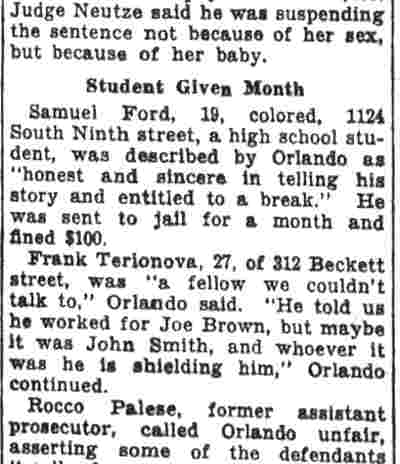
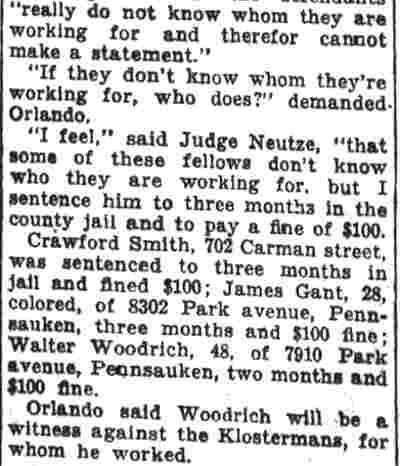
2 More Arrested in Numbers War
Pair Seized Few Hours After Neutze Gives 12 Heavy Sentences
Action yesterday backed up the assertions of Camden county and city law officials that they are out to break the back of the numbers racket here.
Judge Frank F. Neutze, in criminal court, meted out sentences of from one to six months and fines of from $100 to $250 to 12 minions of the “higher ups.”
A few hours later two more alleged number writers fell into the police net. Both suspects were jailed in default of $2000 bail each for hearings in police court today.
Alleged to be carrying 120 numbers slips and $203.30, Dominick Mozzare, 25, of 6816 Highland avenue, was arrested at Twenty-seventh street and River road at 3 p. m. by Acting Sergeant Louis Schmidt and Patrolmen Paul Edwards and Elwood Humphreys. Questioned at the detective bureau in City Hall, Mozzare said he did not know the identity of the “higher-up” for whom he worked. He said he is an automobile trimmer. Police declared he had been in the racket about eight months and had been under suspicion several months.
An hour or so earlier, Horace Gunby, 27, colored, 1863 South Tenth street, was picked up at Seventh street and Ferry avenue by Sergeant John Garrity and Acting Sergeant Earl Cunningham. They said Gunby carried several numbers slips and a small amount of money. He gave his occupation as a bellhop.
Gives Heaviest Sentences
In cracking down on the 12 defendants haled before him in Camden County Criminal Court Judge Neutze adopted a policy of issuing the heaviest jail sentences possible and imposing the heaviest fines under the law to all convicted or confessed underlings of the numbers barons in the hope of eventually trapping the ring-leaders through informers, or forcing them out of business.
Those who received the heaviest sentences were Andrew Piontkowski, 1475 South Ninth street, alleged lieutenant of the Klosterman brothers, under indictment as gambling barons; Walter Hart, 1245 Thurman street, also an alleged Klosterman aide, and Frank Martz, 235 Erie street. Each was sentenced to six months and fined $250. Martz is a second offender.
Judge Neutze expressed agreement with the suggestion of Prosecutor Samuel P. Orlando that the practice of numbers barons paying salaries to their henchmen while the henchmen are in jail can be broken up by placing so many “small fry” behind the bars that the “big shots” cannot afford to pay them, and thus the names of the “big shots” will eventually come out.
All of the defendants had previously pleaded guilty or non vult.
Thomas Kirk, 935 Carpenter street, drew a sentence of three months in jail and a $100 fine despite the plea of his attorney, former Police Judge Garfield Pancoast, that Kirk was “only an employe.”
“That makes no difference to me,” said the court. “He was in the numbers racket.”
Called Klostermans’ Aide
When Pointkowski came before the court, Orlando said:
“This is one of the lieutenants of the Klostermans, and he refused to talk to me. When first arrested, he told Camden police he worked for the Klostermans, but he turned a right-about-face when I talked to him and tried to make monkeys of us.”
“Well, I’ll send him upstairs for six months and fine him $250 and maybe he’ll talk then,” said Judge Neutze.
Orlando asked the court to send Hart to the state prison.
“This man,” said the prosecutor, “is very close to the big shots.”
“Whom do you mean—the Klostermans?” asked Neutze.
“I certainly do,” replied Orlando. “He is also a second offender. He’s been in this business over four years, working for the Klostermans, and should go to the state prison.”
“Whenever I hear that name Klosterman, I see red,” said Neutze as he pronounced sentence.
The Klosterman brothers, Fred and Joseph, of East Camden, have been indicted as number lottery operators but their trial has been postponed.
Martz was described by Orlando as having served 60 days in jail in 1932 for writing numbers, and he was sentenced to six months and a $250 fine, without further questioning.
Refuses Leniency
John Studinger, who formerly operated a store at 2504 Federal street, was sentenced to three months in jail and fined $100. His counsel, District Court Judge Joseph Varbalow, argued he was only a “small fry” and putting him in jail would not break up the lotteries.
“This racket is no worse than raffles, punchboards, slot machines and all the disorderly houses that are thriving in this county,” said Varbalow.
“I started in on these number writers with short jail terms,” answered Neutze, “and then I began adding fines. But I found that did not stop the lawbreakers, for when these fellows get out they start all over again. I understand the lottery racket is getting worse and worse here and I’m going to do something about it.”
Charles Simonin, who conducts a grocery store at 709 Fairview street, was given 30 days and fined $100. Father of two daughters, he pleaded he accepted a proposition from a stranger who asked him to sell numbers in his store, and then would come around daily and collect them, giving Simonin a small “cut.” He contended he did not know the name of the man with whom he dealt, much less the identity of the heads of the ring.
Mrs. Mary Angelo, grocer, 600 Line street, the mother of a 3-year-old baby, had pleaded guilty with a story similar to Simonin’s. She received a three-month suspended sentence but must pay a fine of $100. Judge Neutze said he was suspending the sentence not because of her sex, but because of her baby.
Student Given Month
Samuel Ford, 19, colored, 1124 South Ninth street, a high school student, was described by Orlando as “honest and sincere in telling his story and entitled to a break.” He was sent to jail for a month and fined $100.
Frank Terionova, 27, of 312 Beckett street, was “a fellow we couldn’t talk to,” Orlando said. “He told us he worked for Joe Brown, but maybe it was John Smith, and whoever it was he is shielding him,” Orlando continued.
Rocco Palese, former assistant prosecutor, called Orlando unfair, asserting some of the defendants “really do not know whom they are working for and therefor cannot make a statement.”
“If they don’t know who they’re working for, who does?” demanded Orlando.
“I feel,” said Judge Neutze, “that some of these fellows don’t know who they are working for, but I sentence him to three months in the county jail and to pay a fine of $100. Crawford Smith, 702 Carman street, was sentenced to three months in jail and fined $100; James Gant, 28, colored, of 8302 Park avenue, Pennsauken, three months and $100 fine; Walter Woodrich, 48, of 7910 Park avenue, Pennsauken, two months and $100 fine.
Orlando said Woodrich will be a witness against the Klostermans, for whom he worked.
Prison Terms for Reneging Witnesses in Number Case
Camden Courier-Post —
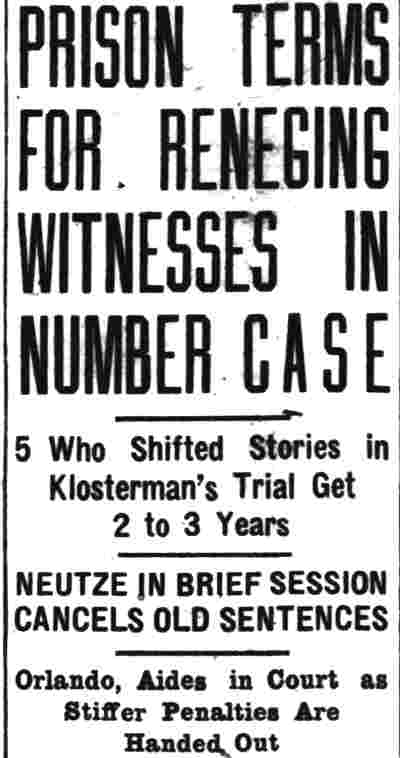
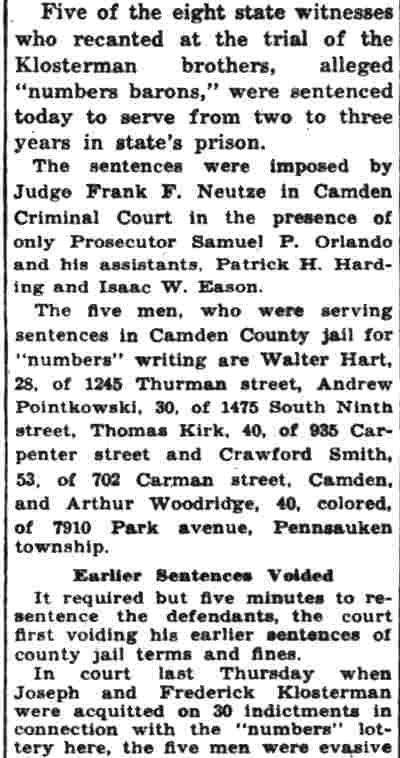
5 Who Shifted Stories in Klosterman’s Trial Get 2 to 3 Years
NEUTZE IN BRIEF SESSION CANCELS OLD SENTENCES
Orlando, Aides in Court as Stiffer Penalties Are Handed Out
Five of the eight state witnesses who recanted at the trial of the Klosterman brothers, alleged “numbers barons,” were sentenced today to serve from two to three years in state’s prison.
The sentences were imposed by Judge Frank F. Neutze in Camden Criminal Court in the presence of only Prosecutor Samuel P. Orlando and his assistants, Patrick H. Harding and Isaac W. Eason.
The five men, who were serving sentences in Camden County jail for “numbers” writing are Walter Hart, 28, of 1245 Thurman street, Andrew Pointkowski, 30, of 1475 South Ninth street, Thomas Kirk, 40, of 935 Carpenter street and Crawford Smith, 53, of 702 Carman street, Camden, and Arthur Woodridge, 40, colored, of 7910 Park avenue, Pennsauken township.
Earlier Sentences Voided
It required but five minutes to resentence the defendants, the court first voiding his earlier sentences of county jail terms and fines.
In court last Thursday when Joseph and Frederick Klosterman were acquitted on 30 indictments in connection with the “numbers” lottery here, the five men were evasive in their testimony as to whether the Klostermans were the “numbers” bankers.
Today when lined up before Judge Neutze in Criminal Court they gaped in astonishment at the swiftness with which they were sent to prison for longer terms.
One of the five, Crawford Smith, nearly collapsed in a chair in which he was permitted to sit during sentencing. Smith has been suffering from a heart ailment.
Turning to Hart, Judge Neutze said:
“I sentenced you to six months in the county jail and ordered you to pay a fine of $250. That fine has been paid. Who paid it?”
“I don’t know,” Hart replied.
“Well, I am going to void my previous sentence,” the court declared. “There are five indictments against you on ‘numbers’ charges. I am going to sentence you to state prison to serve from two to three years on each indictment. The sentences will run concurrently.”
Continues Re-Sentencing
Pointkowski was next. The jurist turning to the defendant who had been given six months in the county jail and a $250 fine on Jan. 3, said:
“There are six indictments on ‘numbers’ charges against you. Your new sentence will be from two to three years in state prison, the terms to run concurrently.”
Woodridge was next. He had been found guilty Jan. 3 on one indictment charging “numbers” writing and sentenced to two months in jail and fined $100.
“I am going to void your sentence and send you to state prison for two to three years.”
Lloyd Again Prods Orlando and Cops In Numbers Cases
Camden Courier-Post —
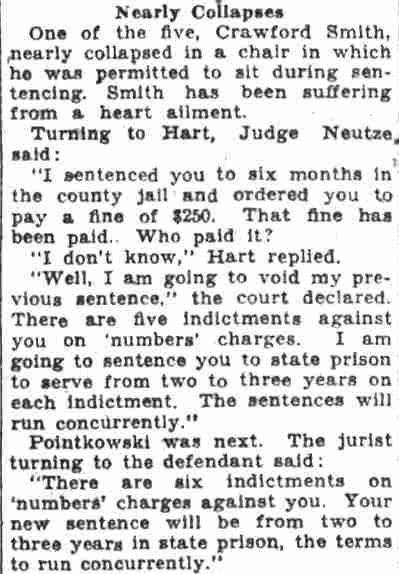
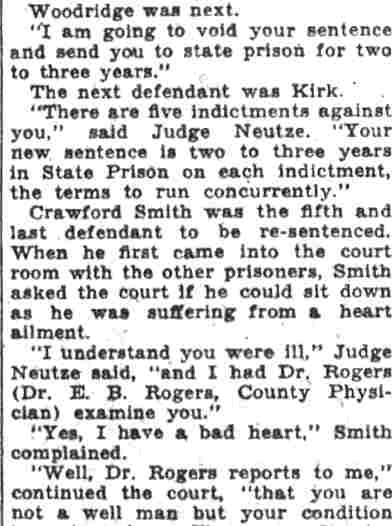
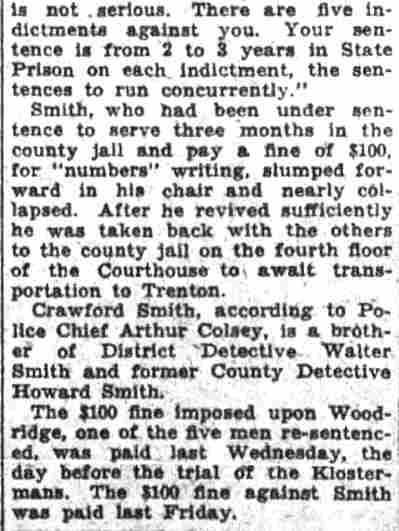
Lloyd Again Prods Orlando and Cops In Numbers Cases
Detectives Told to Produce or Quit by Jurist
FIVE GET ’PEN’ IN ABOUT-FACE
Five state witnesses, who thought they got off “easy” in numbers cases, yesterday underwent reversal of county jail terms and found themselves sentenced to the penitentiary.
Judge Frank F. Neutze sentenced them in Criminal Court.
Terms ranged from two to three years, and they followed the witnesses’ sudden “about-face” in the Klosterman brothers’ case. The five all convicted numbers writers, recanted testimony last week at the brothers’ trial.
Censure of the prosecutor’s office by Supreme Court Justice Frank T. Lloyd followed. Justice Lloyd called Prosecutor Samuel P. Orlando and his staff to his chambers on the fourth floor of the new courthouse. Attending the conference in addition to Orlando were:
Assistant Prosecutors Harding and Eason, Chief County Detective Lawrence T. Doran, County Detectives James J. Mulligan, James Wren, Joseph Bennie, Casimir Wojtwokiak [sic] and Elmer Mathis, and Mrs. Daisy Rourke and Mrs. Ethel Michener, stenographers.
“Go out and do some work, or else be replaced,” is the ultimatum said to have been hurled at the detectives by Justice Lloyd. He is said to be aroused over apparent inactivity of county detectives on evidence in the Klosterman case.
That there is “nothing to stop the prosecutor” from having the Klostermans re-indicted on numbers charges is the contention of the Supreme Court Justice, and Prosecutor Orlando, when told of this statement, declared he was “working on it.”
Jail terms, which Judge Neutze voided, before imposing prison sentences, was begun by the accused quintet on January 3. They also were fined on single indictments. Yesterday’s sentences, with a single exception, were upon other indictments returned against the same defendants. The five sentenced are:
Walter Hart, 28, of 1245 Thurman street, who was serving six months in the county jail and fined $250 on one of five “numbers’ indictments.
Andrew Pointkowski, 30, of 1475 South Ninth street, who was serving six months and fined $250 on one of six “numbers” indictments.
Fined, Jailed
Thomas Kirk, 40, of 935 Carpenter street, who was serving a three-month jail sentence and fined $100 on one of five “numbers” indictments.
Crawford Smith, 53, of 702 Carman street, under a three-month county jail sentence and $100 fine on one of five “numbers” indictments.
Arthur Woodridge, 40, colored, of 7910 Park avenue, Pennsauken township, who was serving a two-month county jail sentence and was fined $100 on one “numbers” indictment.
No explanation could be obtained as to the re-sentencing of Woodridge who had been indicted twice for “numbers” but acquitted on one bill and sentenced to the county jail on the other charge.
Justice Lloyd’s statement as to whether the Klostermans would be re-indicted and tried again on “numbers” charges came in response to a question by a Courier-Post representative.
“Will the Klostermans be re-indicted?” the jurist was asked.
“Not on the dates in August and September, 1934, during which they were alleged to have operated a ’numbers’ lottery and also been acquitted.
“However there is nothing to stop the prosecutor from indicting them for conducting the same illegal business in May, June and July of last year.”
Only five minutes were required to re-sentence the five men in a court room that was almost empty as no announcement had been made previously of what Judge Neutze intended to do. However, Prosecutor Orlando and his assistants, Patrick H. Harding and Isaac W. Eason, were in court.
“It is true I had them over here,” Justice Lloyd said regarding the censuhe [sic] confernece [sic]. “I am sorry that it got out. I have made a record of what I told them, but I can’t discuss it or tell what I said to them because I promised them that I would not make it public. But if things don’t work out the way they should, then I will have something to say.”
None of the prosecutors or other employes would make any statement relative to what Justice Lloyd told them.
Conference Result
Before imposition of sentence, no mention was made by Judge Neutze in the presence of the defendants of their “change of heart” on the witness stand last Thursday when the Klostermans were on trial.
Asked the reason for it, Judge Neutze said:
“I didn’t have to—they knew!”
The re-sentences, it was stated by Judge Neutze after he had left the bench, followed a conference held Saturday in which he participated with Justice Lloyd and Prosecutor Orlando.
“We reached the conclusion that these recanting state’s witnesses should be punished,” Judge Neutze declared.
Three other state’s witnesses also recanted their previous statements at the trial of the Klostermans which resulted in Judge Neutze directing the jury to find Frederick and Joseph Klosterman not guilty on 30 indictments charging them with operation of the “numbers” lottery.
It was indicated by both court officials and the prosecutor’s office that nothing in the way of punishment can be imposed on them because they are not serving jail sentences.
The trio is Albert Young, 35, of 519 North Second street, sentenced to three months and a $100 fine last Nov. 2 by Judge Neutze on one “numbers” indictment and released by the jurist in time to spend Christmas holidays with his family; Frank Kulczynski, 40, of 1100 Orchard street, who was sentenced Nov. 26 to two months in the county jail and a $200 fine on one “numbers” indictment and given a suspended sentence on a second “numbers” charge, and Harry Koron, 40, of 528 Mt. Ephraim avenue, fined $200 and sentenced to two months in the county jail on Nov. 26 for “numbers” writing.
Judge Neutze’s statement in connection with re-sentencing of the five men follows:
“During the trial I was absolutely disgusted at the testimony that these men gave. I had been informed they would testify against the Klostermans and connect the Klostermans with the “numbers” racket.
“When they got on the witness stand I was surprised to see them doing an about-face. They used up a great amount of the county’s time and money and I made up my mind then that they would be punished. I had a conference on Saturday with Prosecutor Orlando and gave him my views on additional punishment for these men.
“He agreed with me that these men should be punished and I asked him to bring the five men into court to be sentenced on the other “numbers” indictments. That was agreeable to him. The sentences speak for themselves.”
On Saturday, Judge Neutze, in a statement to the Courier-Post, said he would not move for re-sentencing of the five recanting state witnesses on other “numbers” indictments because it was up to the prosecutor.
At the same time he denied that the prosecutor on January 3, when the five men with seven other men and women “numbers” writers were sentenced, had asked him to impose stiff prison sentences to make the defendants “talk” as to who the “higher-ups” were.
Justice Lloyd in a statement yesterday said the five men who were sentenced to prison received only what they “were entitled to.”
“These men not only committed these crimes, but they deceived the prosecutor as to what they would testify to,” Justice Lloyd said. When they came into court they deviated from their testimony and were guilty of either lying or perjury when they denied they knew the Klostermans.
Misled Prosecutor
“They were guilty of misleading the prosecutor’s office and they were entitled to exactly what they got.
“The prison sentences today will show the criminal they cannot play fast and loose with the courts. The sentences meet with the hearty approval of myself, Judge Neutze and Prosecutor Orlando.”
Prosecutor Orlando, located before Justice Lloyd, who was hearing a motion in which the prosecutor was interested, said:
“I am heartily in accord with the sentences imposed by Judge Neutze.”
In court last Thursday when the Klosterman brothers were acquitted the five men were evasive in their testimony as to whether the Klostermans were the “numbers” bankers.
Yesterday when lined up before Judge Neutze they gaped in astonishment at the swiftness with which they were sent to prison for longer terms.
Nearly Collapses
One of the five, Crawford Smith, nearly collapsed in a chair in which he was permitted to sit during sentencing. Smith has been suffering from a heart ailment.
Turning to Hart, Judge Neutze said:
“I sentenced you to six months in the county jail and ordered you to pay a fine of $250. That fine has been paid.. Who paid it?
“I don’t know,” Hart replied.
“Well, I am going to void my previous sentence,” the court declared. There are five indictments against you on ’numbers’ charges. I am going to sentence you to state prison to serve from two to three years on each indictment. The sentences will run concurrently.”
Pointkowski was next. The jurist turning to the defendant said:
“There are six indictments on ’numbers’ charges against you. Your new sentence will be from two to three years in state prison, the terms to run concurrently.”
Woodridge was next.
“I am going to void your sentence and send you to state prison for two to three years.”
The next defendant was Kirk.
“There are five indictments against you,” said Judge Neutze. “Your new sentence is two to three years in State Prison on each indictment, the terms to run concurrently.”
Crawford Smith was the fifth and last defendant to be re-sentenced. When he first came into the court room with the other prisoners, Smith asked the court if he could sit down as he was suffering from a heart ailment.
“I understand you were ill,” Judge Neutze said, “and I had Dr. Rogers (Dr. E. B. Rogers, County Physician) examine you.”
“Yes, I have a bad heart,” Smith complained.
“Well, Dr. Rogers reports to me,” continued the court, “that you are not a well man but your condition is not serious. There are five indictments against you. Your sentence is from 2 to 3 years in State Prison on each indictment, the sentences to run concurrently.”
Smith, who had been under sentence to serve three months in the county jail and pay a fine of $100, for “numbers” writing, slumped forward in his chair and nearly collapsed. After he revived sufficiently he was taken back with the others to the county jail on the fourth floor of the Courthouse to await transportation to Trenton.
Crawford Smith, according to Police Chief Arthur Colsey, is a brother of District Detective Walter Smith and former County Detective Howard Smith.
The $100 fine imposed upon Woodridge, one of the five men re-sentenced, was paid last Wednesday, the day before the trial of the Klostermans. The $100 fine against Smith was paid last Friday.
Klostermans Identified as Numbers Kings by 5 Witnesses
Camden Courier-Post —
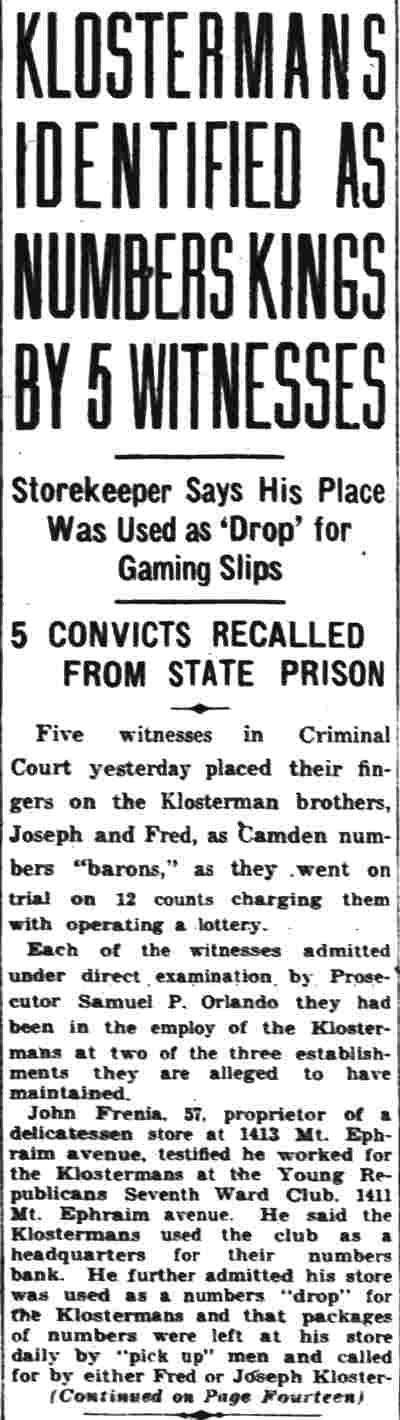
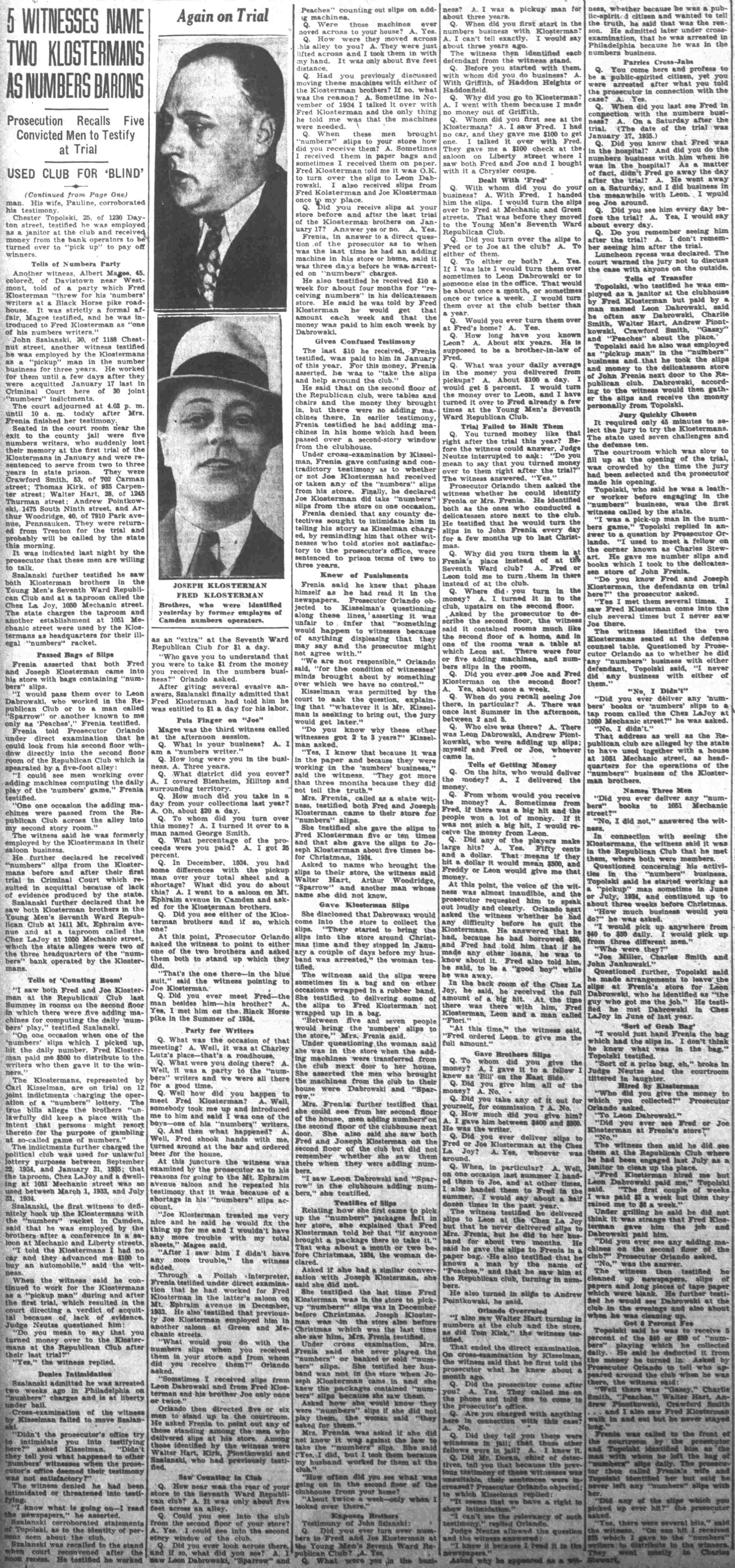
Storekeeper Says His Place Was Used as ‘Drop’ for Gaming Slips
5 CONVICTS RECALLED FROM STATE PRISON
Five witnesses in Criminal Court yesterday placed their fingers on the Klosterman brothers, Joseph and Fred, as Camden numbers “barons,” as they went on trial on 12 counts charging them with operating a lottery.
Each of the witnesses admitted under direct examination by Prosecutor Samuel P. Orlando they had been in the employ of the Klostermans at two of the three establishments they are alleged to have maintained.
John Frenia, 57, proprietor of a delicatessen store at 1413 Mt. Ephraim avenue, testified he worked for the Klostermans at the Young Republicans Seventh Ward Club, 1411 Mt. Ephraim avenue. He said the Klostermans used the club as a headquarters for their numbers bank. He further admitted his store was used as a numbers “drop” for the Klostermans and that packages of numbers were left at his store daily by “pick up” men and called for by either Fred or Joseph Klosterman. His wife, Pauline, corroborated his testimony.
Chester Topolski, 25, of 1230 Dayton street, testified he was employed as a janitor at the club and received money from the bank operators to be turned over to “pick up” to pay off winners.
Tells of Numbers Party
Another witness, Albert Magee, 45, colored, of Davistown near Westmont, told of a party which Fred Klosterman “threw for his ‘numbers’ writers at a Black Horse pike roadhouse. It was strictly a formal affair, Magee testified, and he was introduced to Fred Klosterman as “one of his numbers writers.”
John Szalanski, 30, of 1188 Chestnut street, another witness testified he was employed by the Klostermans as a “pickup” man in the number business for three years. He worked for them until a few days after they were acquitted January 17 last in Criminal Court here of 30 joint “numbers” indictments.
The court adjourned at 4.03 p. m. until 10 a. m. today after Mrs. Frenia finished her testimony.
Seated in the court room near the exit to the county jail were five numbers writers, who suddenly lost their memory at the first trial of the Klostermans in January and were resentenced to serve from two to three years in state prison. They were Crawford Smith, 53, of 702 Carman street; Thomas Kirk, of 935 Carpenter street; Walter Hart, 28, of 1245 Thurman street; Andrew Pointkowski, 1475 South Ninth street, and Arthur Woodridge, 40, of 7910 Park avenue, Pennsauken. They were returned from Trenton for the trial and probably will be called by the state this morning.
It was indicated last night by the prosecutor that these men are willing to talk.
Szalanski further testified he saw both Klosterman brothers in the Young Men’s Seventh Ward Republican Club and at a taproom called the Chez La Joy, 1050 Mechanic street. The state charges the taproom and another establishment at 1051 Mechanic street were used by the Klostermans as headquarters for their illegal “numbers” racket.
Passed Bags of Slips
Frenia asserted that both Fred and Joseph Klosterman came into his store with bags containing “numbers” slips.
“I would pass them over to Leon Dabrowski, who worked in the Republican Club or to a man called “Sparrow” or another known to me only as ‘Peaches’,” Frenia testified.
Frenia told Prosecutor Orlando under direct examination that he could look from his second floor window directly into the second floor room of the Republican Club which is spearated [sic] by a five-foot alley:
“I could see men working over adding machines computing the daily play of the ‘numbers’ game,” Frenia testified.
“One one [sic] occasion the adding machines were passed from the Republican Club across the alley into my second story room.”
The witness said he was formerly employed by the Klostermans in their saloon business.
He further declared he received “numbers” slips from the Klostermans before and after their first trial in Criminal Court which resulted in acquittal because of lack of evidence produced by the state.
Szalanski further declared that he saw both Klosterman brothers in the Young Men’s Seventh Ward Republican Club at 1411 Mt. Ephraim avenue and at a taproom called the Chez LaJoy at 1050 Mechanic street, which the state alleges were two of the three headquarters of the “numbers” bank operated by the Klostermans.
Tells of ‘Counting Room’
“I saw both Fred and Joe Klosterman at the Republican Club last Summer in rooms on the second floor in which there were five adding machines for computing the daily ‘numbers’ play,” testified Szalanski.
“On one occasion when one of the ‘numbers’ slips which I picked up, hit the daily number, Fred Klosterman paid me $500 to distribute to the writers who then gave it to the winners.”
The Klostermans, represented by Carl Kisselman, are on trial on 12 joint indictments charging the operation of a “numbers” lottery. The true bills allege the brothers “unlawfully did keep a place with the intent that persons might resort thereto for the purpose of gambling at so-called game of numbers.”
The indictments further charged the political club was used for unlawful lottery purposes between September 22, 1934, and January 31, 1935; that the taproom, Chez LaJoy and a dwelling at 1051 Mechanic street was so used between March 1, 1933, and July 31, 1934.
Szalanski, the first witness to definitely hook up the Klostermans with the “numbers” racket in Camden, said that he was employed by the brothers after a conference in a saloon at Mechanic and Liberty streets.
“I told the Klostermans I had no car and they advanced me $100 to buy an automobile,” said the witness.
When the witness said he continued to work for the Klostermans as a “pickup man” during and after the first trial, which resulted in the court directing a verdict of acquittal because of lack of evidence, Judge Neutze questioned him:
“Do you mean to say that you turned money over to the Klostermans at the Republican Club after their last trial?”
“Yes,” the witness replied.
Denies Intimidation
Szalanski admitted he was arrested two weeks ago in Philadelphia on “numbers” charges and is at liberty under bail.
Cross-examination of the witness by Kisselman failed to move Szalanski.
“Didn’t the prosecutor’s office try to intimidate you into testifying here?” asked Kisselman. “Didn’t they tell you what happened to other ‘numbers’ witnesses when the prosecutor’s office deemed their testimony was not satisfactory?”
The witness denied he had been intimidated or threatened into testifying.
“I know what is going on—I read the newspapers,” he asserted.
Szalanski corroborated statements of Topolski, as to the identity of persons seen about the club.
Szalanski was recalled to the stand when court reconvened after the noon recess. He testified he worked
Again on Trial
JOSEPH KLOSTERMAN
FRED KLOSTERMAN
Brothers, who were identified yesterday by former employes of Camden numbers operators.
as an “extra” at the Seventh Ward Republican Club for $1 a day.
“Who gave you to understand that you were to take $1 from the money you received in the numbers business?” Orlando asked.
After giving several evasive answers, Szalanski finally admitted that Fred Klosterman had told him he was entitled to $1 a day for his labor.
Puts Finger on “Joe”
Magee was the third witness called at the afternoon session.
Q. What is your business? A. I am a “numbers writer.”
Q. How long were you in the business. A. Three years.
Q. What district did you cover? A. I covered Blenheim, Hilltop and surrounding territory.
Q. How much did you take in a day from your collections last year? A. Oh, about $20 a day.
Q. To whom did you turn over this money? A. I turned it over to a man named George Smith.
Q. What percentage of the proceeds were you paid? A. I got 25 percent.
Q. In December, 1934, you had some differences with the pickup man over your total sheet and a shortage? What did you do about this? A. I went to a saloon on Mt. Ephraim avenue in Camden and asked for the Klosterman brothers.
Q. Did you see either of the Klosterman brothers and if so, which one?
At this point, Prosecutor Orlando asked the witness to point to either one of the two brothers and asked them both to stand up which they did.
“That’s the one there—in the blue suit,” said the witness pointing to Joe Klosterman.
Q. Did you ever meet Fred—the man besides him—his brother? A. Yes, I met him on the Black Horse pike in the Summer of 1934.
Party for Writers
Q. What was the occasion of that meeting? A. Well, it was at Charley Lutz’s place—that’s a roadhouse.
Q. What were you doing there? A. Well, it was a party to the “numbers” writers and we were all there for a good time.
Q. Well how did you happen to meet Fred Klosterman? A. Well, somebody took me up and introduced me to him and said I was one of the boys—one of his “numbers” writers.
Q. And then what happened? A. Well, Fred shook hands with me, turned around at the bar and ordered beer for the house.
At this juncture the witness was examined by the prosecutor as to his reasons for going to the Mt. Ephraim avenue saloon and he repeated his testimony that it was because of a shortage in his “numbers” slips account.
“Joe Klosterman treated me very nice and he said he would fix the thing up for me and I wouldn’t have any more trouble with my total sheets,” Magee said.
“After I saw him I didn’t have any more trouble,” the witness added.
Through a Polish interpreter, Frenia testified under direct examination that he had worked for Fred Klosterman in the latter’s saloon on Mt. Ephraim avenue in December, 1933. He also testified that previously Joe Klosterman employed him in another saloon at Green and Mechanic streets.
“What would you do with the numbers slips when you received them in your store and from whom did you receive them?” Orlando asked.
“Sometimes I received slips from Leon Dabrowski and from Fred Klosterman and his brother Joe only once or twice.”
Orlando then directed five or six men to stand up in the courtroom. He asked Frenia to point out any of those standing among the men who delivered slips at his store. Among those identified by the witness were Walter Hart, Kirk, Piontkowski and Szalanski, who had previously testified.
Saw Counting in Club
Q. How near was the rear of your store to the Seventh Ward Republican club? A. It was only about five feet across an alley.
Q. Could you see into the club from the second floor of your store? A. Yes. I could see into the second story window of the club.
Q. Did you ever look across there, and if so, what did you see? A. I saw Leon Dabrowski, “Sparrow” and “Peaches” counting out slips on adding machines.
Q. Were those machines ever moved across to your house? A. Yes.
Q. How were they moved across this alley to you? A. They were just lifted across and I took them in with my hand. It was only about five feet distance.
Q. Had you previously discussed moving these machines with either of the Klosterman brothers? If so, what was the reason? A. Sometime in November of 1934 I talked it over with Fred Klosterman and the only thing he told me was that the machines were needed.
Q. When these men brought “numbers” slips to your store how did you receive them? A. Sometimes I received them in paper bags and sometimes I received them on paper. Fred Klosterman told me it was O.K. to turn over the slips to Leon Dabrowski. I also received slips from Fred Kolsterman [sic] and Joe Klosterman once to my place.
Q. Did you receive slips at your store before and after the last trial of the Klosterman brothers on January 17? Answer yes or no. A. Yes.
Frenia, in answer to a direct question of the prosecutor as to when was the last time he had an adding machine in his store or home, said it was three days before he was arrested on “numbers” charges.
He also testified he received $10 a week for about four months for “receiving numbers” in his delicatessen store. He said he was told by Fred Klosterman he would get that amount each week and that the money was paid to him each week by Dabrowski.
Gives Confused Testimony
The last $10 he received, Frenia testified, was paid to him in January of this year. For this money, Frenia asserted, he was to “take the slips and help around the club.”
He said that on the second floor of the Republican club, were tables and chairs and the money they brought in, but there were no adding machines there. In earlier testimony, Frenia testified he had adding machines in his home which had been passed over a second-story window from the clubhouse.
Under cross-examination by Kisselman, Frenia gave confusing and contradictory testimony as to whether or not Joe Klosterman had received or taken any of the “numbers” slips from his store. Finally, he declared Joe Klosterman did take “numbers” slips from the store on one occasion.
Frenia denied that any county detectives sought to intimidate him in telling his story as Kisselman charged, by reminding him that other witnesses who told stories not satisfactory to the prosecutor’s office, were sentenced to prison terms of two to three years.
Knew of Punishments
Frenia said he knew that phase himself as he had read it in the newspapers. Prosecutor Orlando objected to Kisselman’s questioning along these lines, asserting it was unfair to infer that “something would happen to witnesses because of anything displeasing that they may say and the prosecutor might not agree with.”
“We are not responsible,” Orlando said, “for the condition of witnesses’ minds brought about by something over which we have no control.”
Kisselman was permitted by the court to ask the question, explaining that “whatever it is Mr. Kisselman is seeking to bring out, the jury would get later.”
“Do you know why these other witnesses got 2 to 3 years?” Kisselman asked.
“Yes, I know that because it was in the paper and because they were working in the ‘numbers’ business,” said the witness. “They got more than three months because they did not tell the truth.”
Mrs. Frenia, called as a state witness, testified both Fred and Joseph Klosterman came to their store for “numbers” slips.
She testified she gave the slips to Fred Klosterman five or ten times and that she gave the slips to Joseph Klosterman about five times before Christmas, 1934.
Asked to name who brought the slips to their store, the witness said Walter Hart, Arthur Woodridge, “Sparrow” and another man whose name she did not know.
Gave Klosterman Slips
She disclosed that Dabrowski would come into the store to collect the slips. “They started to bring the slips into the store around Christmas time and they stopped in January a couple of days before my husband was arrested,” the woman testified.
The witness said the slips were sometimes in a bag and on other occasions wrapped in a rubber band. She testified to delivering some of the slips to Fred Klosterman not wrapped up in a bag.
“Between five and seven people would bring the ‘numbers’ slips to the store,” Mrs. Frenia said.
Under questioning the woman said she was in the store when the adding machines were transferred from the club next door to her house. She asserted the men who brought the machines from the club to their house were Dabrowski and “Sparrow.”
Mrs. Frenia further testified that she could see from her second floor of the house, men adding numbers on the second floor of the clubhouse next door. She also said she saw both Fred and Joseph Klosterman on the second floor of the club but did not remember whether she saw them there when they were adding numbers.
“I saw Leon Dabrowski and “Sparrow” in the clubhouse adding numbers,” she testified.
Testifies of Slips
Relating how she first came to pick up the “numbers” packages left in her store, she explained that Fred Klosterman told her that “if anyone brought a package there to take it.” That was about a month or two before Christmas, 1934, the woman declared.
Asked if she had a similar conversation with Joseph Klosterman, she said she did not.
She testified the last time Fred Klosterman was in the store to pick-up “numbers” slips was in December before Christmas. Joseph Klosterman was in the store also before Christmas which was the last time she saw him, Mrs. Frenia testified.
Under cross examination, Mrs. Frenia said she never played the “numbers” or banked or sold “numbers” slips. She testified her husband was not in the store when Joseph Klosterman came in and she knew the packages contained “numbers” slips because she saw them.
Asked how she would know they were “numbers” slips if she did not play them, the woman said “they asked for them.”
Mrs. Frenia was asked if she did not know it was against the law to take the “numbers” slips. She said “Yes, I did, but I took them because my husband worked for them at the club.”
“How often did you see what was going on in the second floor of the clubhouse from your home?”
“About twice a week—only when I looked over there.”
Exposes Brothers
Testimony of John Szalanski:
Q. Did you ever turn over numbers to Fred and Joe Klosterman at the Young Men’s Seventh Ward Republican Club? A. Yes.
Q. What were you in the business? A. I was a pickup man for about three years.
Q. When did you first start in the numbers business with Klosterman? A. I can’t tell exactly. I would say about three years ago.
The witness then identified each defendant from the witness stand.
Q. Before you started with them, with whom did you do business? A. With Griffith, of Haddon Heights or Haddonfield.
Q. Why did you go to Klosterman? A. I went with them because I made no money out of Griffith.
Q. Whom did you first see at the Klostermans? A. I saw Fred. I had no car, and they gave me $100 to get one. I talked it over with Fred. They gave me a $100 check at the saloon on Liberty street where I saw both Fred and Joe and I bought with it a Chrysler coupe.
Dealt With ‘Fred’
Q. With whom did you do your business? A. With Fred. I handed him the slips. I would turn the slips over to Fred at Mechanic and Green streets. That was before they moved to the Young Men’s Seventh Ward Republican Club.
Q. Did you turn the slips over to Fred or to Joe at the club? A. To either of them.
Q. To either or both? A. Yes. If I was late I would turn them over sometimes to Leon Dabrowski or to someone else in the office. That would be about once a month, or sometimes once or twice a week. I would turn them over at the club better than a year.
Q. Would you ever turn them over at Fred’s home? A. Yes.
Q. How long have you known Leon? A. About six years. He is supposed to be a brother-in-law of Fred.
Q. What was your daily average in the money you delivered from pickups? A. About $100 a day. I would get 5 percent. I would turn the money over to Leon, and I have turned it over to Fred already a few times at the Young Men’s Seventh Ward Republican Club.
Trial Failed to Halt Them
Q. You turned money like that right after the trial this year? Before the witness could answer, Judge Neutze interrupted to ask: “Do you mean to say that you turned money over to them right after the trial?” The witness answered, “Yes.”
Prosecutor Orlando then asked the witness whether he could identify Frenia or Mrs. Frenia. He identified both as the ones who conducted a delicatessen store next to the club. He testified that he would turn the slips in to John Frenia every day for a few months up to last Christmas.
Q. Why did you turn them in at Frenia’s place instead of at the Seventh Ward club? A. Fred or Leon told me to turn them in there instead of at the club.
Q. Where did you turn in the money? A. I turned it in to the club, upstairs on the second floor.
Asked by the prosecutor to describe the second floor, the witness said it contained rooms much like the second floor of a home, and in one of the rooms was a table at which Leon sat. There were four or five adding machines, and numbers slips in the room.
Q. Did you ever see Joe and Fred Klosterman on the second floor? A. Yes, about once a week.
Q. When do you recall seeing Joe there, in particular? A. There was once last Summer in the afternoon, between 2 and 5.
Q. Who else was there? A. There was Leon Dabrowski, Andrew Piontkowski, who were adding up slips; myself and Fred or Joe, whoever came in.
Tells of Getting Money
Q. On the hits, who would deliver the money? A. I delivered the money.
Q. From whom would you receive the money? A. Sometimes from Fred, if there was a big hit and the people won a lot of money. If it was not such a big hit, I would receive the money from Leon.
Q. Did any of the players make large hits? A. Yes. Fifty cents and a dollar. That means if they hit a dollar it would mean $500, and Freddy or Leon would give me that money.
At this point, the voice of the witness was almost inaudible, and the prosecutor requested him to speak out loudly and clearly. Orlando next asked the witness whether he had any difficulty before he quit the Klostermans. He answered that he had, because he had borrowed $50, and Fred had told him that if he made any other loans, he was to know about it. Fred also told him, he said, to be a “good boy” while he was away.
In the back room of the Chez La Joy, he said, he received the full amount of a big hit. At the time there was there with him, Fred Klosterman, Leon and a man called “Flori.”
“At this time,” the witness said, “Fred ordered Leon to give me the full amount.”
Gave Brothers Slips
Q. To whom did you give the money? A. I gave it to a fellow I knew as ‘Bill’ on the East Side.
Q. Did you give him all of the money? A. No.
Q. Did you take any of it out for yourself, for commission? A. No.
Q. How much did you give him? A. I gave him between $400 and $500. He was the writer.
Q. Did you ever deliver slips to Fred or Joe Klosterman at the Chez La Joy? A. Yes, whoever was around.
Q. When, in particular? A. Well, on one occasion last summer I handed them to Joe, and at other times, I also handed them to Fred in the summer. I would say about a half dozen times in the past year.
The witness testified he delivered slips to Leon at the Chez La Joy but that he never delivered slips to Mrs. Frenia, but he did to her husband for about two months. He said he gave the slips to Frenia in a paper bag. He also testified that he knows a man by the name of “Peaches,” and that he saw him at the Republican club, turning in numbers.
He also turned in slips to Andrew Pointkowski, he said.
Orlando Overruled
“I also saw Walter Hart turning in numbers at the club and the store, as did Tom Kirk,” the witness testified.
That ended the direct examination. On cross-examination by Kisselman, the witness said that he first told the prosecutor what he knew about a month ago.
Q. Did the prosecutor come after you? A. Yes. They called me on the phone and told me to come to the prosecutor’s office.
Q. Are you charged with anything here in connection with this case? A. No.
Q. Did they tell you there were witnesses in jail; that these other fellows were in jail? A. I knew it.
Q. Did Mr. Doran, chief of detectives, tell you that because the previous testimony of these witnesses was unsuitable, their sentences were increased? Prosecutor Orlando objected; to which Kisselman replied:
“It seems that we have a right to show intimidation.”
“I can’t see the relevancy of such testimony,” replied Orlando.
Judge Neutze allowed the question and the witness answered:
“I knew it because I read it in the newspapers.”
Asked why he appeared as a witness, whether because he was a public-spirited citizen and wanted to tell the truth, he said that was the reason. He admitted later under cross-examination, that he was arrested in Philadelphia because he was in the numbers business.
Parries Cross-Jabs
Q. You come here and profess to be a public-spirited citizen, yet you were arrested after what you told the prosecutor in connection with the case? A. Yes.
Q. When did you last see Fred in connection with the numbers business? A. On a Saturday after the trial. (The date of the trial was January 17, 1935.)
Q. Did you know that Fred was in the hospital? And did you do the numbers business with him when he was in the hospital? As a matter of fact, didn’t Fred go away the day after the trial? A. He went away on a Saturday, and I did business in the meanwhile with Leon. I would see Joe around.
Q. Did you see him every day before the trial? A. Yes, I would say about every day.
Q. Do you remember seeing him after the trial? A. I don’t remember seeing him after the trial.
Luncheon recess was declared. The court warned the jury not to discuss the case with anyone on the outside.
Tells of Transfer
Topolski, who testified he was employed as a janitor at the clubhouse by Fred Klosterman but paid by a man named Leon Dabrowski, said he often saw Dabrowski, Charlie Smith, Walter Hart, Andrew Piontkowski, Crawford Smith, “Gassy” and “Peaches” about the place.
Topolski said he also was employed as “pickup man” in the “numbers” business and that he took the slips and money to the delicatessen store of John Frenia next door to the Republican club. Dabrowski, according to the witness would then gather the slips and receive the money personally from Topolski.
Jury Quickly Chosen
It required only 45 minutes to select the jury to try the Klostermans. The state used seven challenges and the defense ten.
The courtroom which was slow to fill up at the opening of the trial, was crowded by the time the jury had been selected and the prosecutor made his opening.
Topolski, who said he was a leather worker before engaging in the “numbers” business, was the first witness called by the state.
“I was a pick-up man in the numbers game,” Topolski replied in answer to a question by Prosecutor Orlando. “I used to meet a fellow on the corner known as Charles Stewart. He gave me number slips and books which I took to the delicatessen store of John Frenia.
“Do you know Fred and Joseph Klosterman, the defendants on trial here?” the prosecutor asked.
“Yes I met them several times. I saw Fred Klosterman come into the club several times but I never saw Joe there.
The witness identified the two Klostermans seated at the defense counsel table. Questioned by Prosecutor Orlando as to whether he did any “numbers” business with either defendant, Topolski said, “I never did any business with either of them.”
“No, I Didn’t”
“Did you ever deliver any ‘numbers’ books or ‘numbers’ slips to a tap room called the Chez LaJoy at 1050 Mechanic street?” he was asked.
“No. I didn’t.”
That address as well as the Republican club are alleged by the state to have used together with a house at 1051 Mechanic street, as headquarters for the operations of the “numbers” business of the Klosterman brothers.
Names Three Men
“Did you ever deliver any “numbers” books to 1051 Mechanic street?”
“No, I did not,” answered the witness.
In connection with seeing the Klostermans, the witness said it was in the Republican Club that he met them, where both were members.
Questioned concerning his activities in the “numbers” business, Topolski said he started working as a “pickup” man sometime in June or July, 1934, and continued up to about three weeks before Christmas.
“How much business would you do?” he was asked.
“I would pick up anywhere from $40 to $50 daily. I would pick up from three different men.”
“Who were they?”
“Joe Miller, Charles Smith and John Jankowski.”
Questioned further, Topolski said he made arrangements to leave the slips at Frenia’s store for Leon Dabrowski, who he identified as “the guy who got me the job.” He testified he met Dabrowski in Chez LaJoy in June of last year.
‘Sort of Grab Bag’
“I would just hand Frenia the bag which had the slips in. I don’t think he knew what was in the bag,” Topolski testified.
“Sort of a prize bag, eh,” broke in Judge Neutze and the courtroom tittered in laughter.
Hired by Klosterman
“Who did you give the money to which you collected?” Prosecutor Orlando asked.
“To Leon Dabrowski.”
“Did you ever see Fred or Joe Klosterman at Frenia’s store?”
“No.”
The witness then said he did see them at the Republican Club where he had been engaged last July as a janitor to clean up the place.
“Fred Klosterman hired me but Leon Dabrowski paid me,” Topolski said. “The first couple of weeks I was paid $3 a week but then they raised me to $6 a week.”
Under grilling he said he did not think it was strange that Fred Klosterman gave him the job and Dabrowski paid him.
“Did you ever see any adding machines on the second floor of the club?” Prosecutor Orlando asked.
“No,” was the answer.
The witness then testified he cleaned up newspapers, slips of papers and long pieces of tape paper which were blank. He further testified he would see Dabrowski at the club in the evenings and also about when he was cleaning up.
Got 5 Percent Fee
Topolski said he was to receive 5 percent of the $40 or $50 of “numbers” playing which he collected daily. He said he deducted it from the money he turned in. Asked by Prosecutor Orlando to tell who appeared around the club when he was there, the witness said:
“Well there was “Gassy,” Charlie Smith, “Peaches,” Walter Hart, Andrew Piontkowski, Crawford Smith . . . and I also saw Fred Klosterman walk in and out but he never stayed long.”
Frenia was called to the front of the courtroom by the prosecutor and Topolski identified him as the man with whom he left the bag of “numbers” slips daily. The prosecutor then called Frenia’s wife and Topolski identified her but said he never left any “numbers” slips with her.
“Did any of the slips which you picked up ever hit?” the prosecutor asked.
“Yes, there were several hits,” said the witness. “On one hit I received $15 which I gave to the “numbers” writers to distribute to the winners. They went mostly to Charles Stewart.”
Fingerprints Betray Criminals Here As Expert Aids Judge and Prosecutor
Camden Courier-Post —

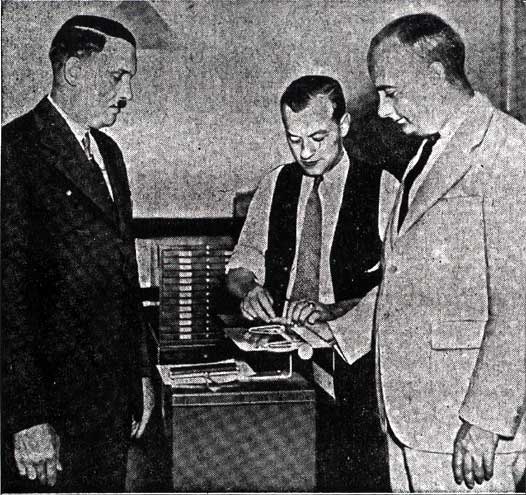

Hidden Pasts of Many Law Violators Revealed by Scientific Process as Local Authorities Work in Unison With National and State Agencies; George Roundey, County Aid, Efficient Link in Hunt For Enemies to Society
Judge Frank F. Neutze, intrigued by the system which has equipped him with more knowledge of prisoners than they wish him to possess, is fingerprinted in the bureau of identification at the Camden county jail. George Roundey, expert of the bureau, is shown making impressions of the jurist’s fingers, while Sheriff Joseph H. Van Meter is an interested onlooker.
Scene: Camden County Criminal Court. John Doe is facing the court for sentence having just been convicted for burglary.
Judge Frank F. Neutze: “Doe, you have been convicted by a jury and I will now impose sentence. Have you ever been convicted of any other crime?”
John Doe: “No, your honor, this is the first time that I have ever been in trouble.”
Judge Neutze: “I don’t believe you” (he scrutinizes several papers on the bench before him). “You became a criminal when you were 12 years old when you lived in Portland, Me. You served three terms in reformatories in Maine, Vermont, and New Hampshire. You also served two terms of five years each in Sing Sing. You did three years at Joliet. You served 18 months for burglary in California. You also served time in Wisconsin for robbery and another five year term in Texas for holdup with a revolver. You will serve from five to seven years in state prison. Next case, Mr. Prosecutor.”
(The court lays the paper aside and picks up others as the next defendant appears for sentence).
John Doe might have escaped with a lighter prison sentence had Judge Neutze not had those mysterious sheets of paper before him. The papers were given to the court 24 hours before John Doe appeared for sentence by George Roundey, chief of the bureau of identification of the Camden county jail. They contained the complete criminal record of all defendants appearing before the court should the defendant have a criminal record.
Roundey has a room in the jail that is devoted exclusively to photographic and fingerprint work. His files contain thousands of fingerprints and photographs of captured and “wanted” criminals.
Roundey is one of the busiest men in the court house. Every minute of his working day he is taking rogues gallery pictures, filing applications for revolver permits, filing fingerprints by the hundreds, received from various police departments throughout the nation.
Although Roundey’s department is small, police officials who have visited it state it to be one of the most complete they have ever seen. They marvel at the fact that it is being operated by only one man.
A Psychologist, Too
Roundey is not only a fingerprint expert but a student of psychology and human nature. On numerous occasions after police have questioned arrested criminals with no result Roundy [sic] takes them into his office to be photographed and fingerprinted and treats them like human beings and it invariably happens that Roundey [sic] suggestions to the criminal to “come clean” has resulted in defendants “copping a plea” and saving the county the expense of a trial.
“I consider the work of George Roundey, in the identification and record bureau of the county prison, to be most invaluable to my court,” Judge Neutze said. “Every defendant who appears before me has or has not a police record. If he has a record, Roundey sees that a copy of that record is in my hands when the defendant is up for trial and sentence. His co-operation with my court has been most splendid and the court feels proud to have such a young man working with it. He is always on the job and in imposing sentence I depend largely on the notations that Roundey has placed in my hands.”
Similar praise of Roundey’s works was voiced by Prosecutor Samuel P. Orlando.
Helps Reduce Crime
“The prosecutors [sic] office, before Roundey started the identification bureau, had no set way of learning the past records of persons brought into this office. Since he assumed charge of the identification bureau several years ago, his work there has been most beneficial to this office. It is to be regretted that his department is not as extensive as it should be and we all wish that the Board of Freeholders could see their way clear to appropriate more money to extend the facilities and scope of this department which to my mind has been instrumental in cutting down crime in this county,”
Sheriff Joseph H. Van Meter also was loud in his praise for the work done for the county by Roundey’s department. Van Meter said that Roundey has completed plans for a “stand-up” room in the county jail where complainants might look over defendants for identification purposes without being seen by the suspects. It is expected that this identification room will be completed in several weeks.
Roundey, found in his “workshop” filing fingerprints, reluctantly consented to an interview. He continued working as he was being asked about his work.
“Everyone arrested for an indictable offense, regardless of whether they are sentenced in police court or not, are fingerprinted and photographed,” he said.
Records Exchanged
“After we get our returns from the state and national bureaus on each subject, we contact every police department that has had anything to do with the criminal and find out from them what their charges were and also the final disposition of their case. We further check to see if that department wants the person that we have.
“After we get back all of our returns from the different departments, we make four copies of the subject’s completed record. One of these is placed in our files as a master record. The others we keep until the subject is placed on trial, and on that trial three copies are given to Mr. Brager, N. J. parole officer; the prosecutor’s office, and to Judge Neutze.
“Judge Neutze has on the bench with him on every trial day, either a clean bill of health or the criminal to write us for the final dispositions as they will appear on the returns sent out by the state and national bureaus. This alone will mean considerable saving both in time and money to our bureau in the future.
“In my spare time I have made up a small modus operandi file for the bureau. Every one who is arrested for breaking and entering, robbery, larceny of auto or any type of larceny is indexed in our files, this file shows name, description, fingerprint classification and with whom the subject associates. Any department who later makes an arrest on this man, or who suspects him on some job, can come to this bureau and get a list of the names of his pals and in that way many jobs can be cleaned up as the police know who they want from the start of the case.
List of ‘Wanted’ Persons on File
“A ‘wanted’ file is kept of everyone that is known to be wanted by the prosecutor’s office and all other departments in the county. These persons who are wanted are also posted as wanted in the state and national bureaus. They in turn notify us the minute that the wanted person is arrested by any other department in the country.
“Before this department was established, neither the prosecutor nor the judge knew the past history of record of every person who comes before him that we have had in the jail.
“We miss a few cases because the defendant is let out on bail at the hearing and is not committed to the county jail. This can only be eliminated by having a county bureau of identification and require that every person arrested for an indictable offense be brought to that bureau for fingerprinting before he or she is released in bail. Judge Neutze has worked very well with me in this respect. If he is doubtful of a person who I have not had a chance to investigate, he always sends them up to the jail for printing and defers sentence until my investigation is completed.
Every Case Studied
“Every case that goes through this bureau is followed by us until it is disposed of, either by the grand jury throwing it out or by being tried in court and found not guilty or guilty. In this way we get the final disposition of each case and forward them to the state police and Washington bureau so that the final disposition of every case handled by this bureau appears on the master records of their bureaus. This will in the future keep other departments who may arrest this subject from having any criminal who was brought to trial.
“A library of fingerprint reference books and fingerprint law is kept in the bureau, not only for the use of the department but also for the use of the prosecutor’s office should questions on these subjects arise. Considerable money was saved in the building of this department by former Sheriff Pelouze and myself. We visited several other departments and profited greatly by their experience and also by their mistakes. Total cost of the department including files, indexes, cameras, building and equiping [sic] dark room, rogues gallery, was less than $1400. Money saved by securing ruling from the postmaster general that prints are printed matter and may be sent as third class and not first is about $75.00 per year.
Urges Extension of Work
“This county needs and should have a bureau that would be open 24 hours a day. Everyone arrested should be brought to that bureau for fingerprinting so that their identification could be established before they are released in bail. In this way the prosecutor and the court would have complete records of everyone brought to trial. It would also be of use to the county probation officer in that many of his men on probation or parole are arrested in other towns and he has no way of knowing it.
“Applications for pistol permits are investigated. Five copies of prints are taken. One copy is for the police chief of the town where the applicant resides; the bureau of investigation, Washington; the N. J. state police, Trenton; the Camden county clerk, and our own bureau. The police chief must sign any application and also answer questions that appear on a sheet attached.
“All guns owned by an applicant must be brought to the bureau so that we may check the numbers and file them with the state police. An applicant must have a very good reason for carrying a pistol or the permit is denied. We have cut down on the number of permits in the county, exclusive of Camden City, as ourt [sic] total number of applicants since 1933 is only 165. As soon as a person who holds a pistol permit is adrested [sic], this bureau is notified by the state and national bureaus, we in turn advise the judge who issued that permit, of the arrest, so that he can take whatever action in the matter he cares to. No one is issued a permit without the consent of the police chief of his or her town.”
Bathtub Gin Maker Is Held for Court
Camden Courier-Post —
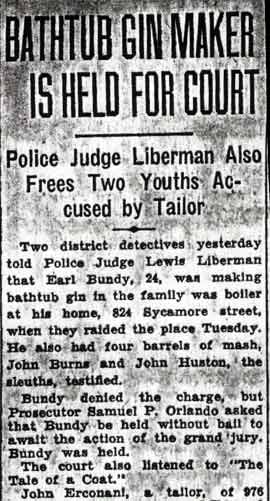
Police Judge Liberman Also Frees Two Youths Accused by Tailor
Two district detectives yesterday told Police Judge Lewis Liberman that Earl Bundy, 24, was making bathtub gin in the family was [sic] boiler at his home, 824 Sycamore street, when they raided the place Tuesday. He also had four barrels of mash, John Burns and John Huston, the sleuths, testified.
Bundy denied the charge, but Prosecutor Samuel P. Orlando asked that Bundy be held without bail to await the action of the grand jury. Bundy was held.
The court also listened to “The Tale of a Coat.” John Erconani, a tailor, of 976 South Eighth street, accused Edward Hargrove, 18, of 1178 Penn street, and James Walter, 15, of 1185 Penn street, of taking the garment from his store yesterday.
According to the evidence Hargrove presented a ticket calling for a coat that had been left for repairs. The tailor and his customer searched for the garb, but couldn’t find it.
Then Hargrove left and Erconani said another coat left with him. Erconani asked that the youths be convicted, declaring that if the coat was gone he would have to pay for it, and that he had a sick child that required the money for medicine and professional attention.
Detective Robert Ashenfelter asked for a further hearing to make an investigation, but Herbert Richardson, attorney for the boys, said no evidence had been introduced to prove that they had taken the coat.
Judge Liberman agreed and dismissed the charges, but told Ashenfelter that if further investigation disclosed evidence to the contrary, the youths would be re-arrested.
Francis Murtagh, 24, of 117 North Thirty-fourth street, paid a $3 fine for reckless driving. It was testified that Murtagh was doing 55 miles an hour at 2.30 a.m. and that he was chased a mile and a half before he was overhauled.
3 in Assembly Race Plan Tour Tonight
Camden Courier-Post —
Lodge, Sheehan and Roye to Speak at Democratic Rallies
All three Democratic Assembly nominees—Henry Lodge, Bartholomew Sheehan and Harry Roye—will speak tonight at three Roosevelt rallies, one at Magnolia and the others in the First and Ninth wards, Camden. Announcement was made they also will endeavor to address other Roosevelt meetings tonight.
The other rallies tonight will include meetings in Ashland, Pennsauken and the Fourth, Twelfth and Thirteenth wards.
A Collingswood rally will be conducted this afternoon, at 3.30 o’clock, at 784 Haddon avenue, that borough.
Lodge will be the principal speaker at the Ashland rally, to be held at the hall of Ashland Fire Company, under sponsorship of the Ashland Democratic Club.
The other Ashland speakers will include Edward J. Kelleher, Camden county campaign manager; former Prosecutor Ethan P. Wescott, Frank M. Lario, Grover Richman, Jr.; Samuel T. French, Jr.; William Brooks; Thomas M. Madden, of the Camden County Board of Elections, and Benjamin Dzick.
The Magnolia rally, sponsored by the Roosevelt Democratic Club, will be held at the fire hall there at Evesham avenue, west of Warwick road. The speakers will include Sheehan, Roye and Lodge; Mrs. Bertha Shippen Irving, Guy Lee, Jr., nominee for Congress; Mayor-designate George E. Brunner, of Camden, state committeeman; Howard Callingham, Daniel West, Mildred Yemmans, Mrs. Emma E. Hyland, Democratic state committeewoman; Oliver H. Bond. Kelleher, Prosecutor Samuel Iando [sic], Alice Pearl Harris and George Aaron.
Rally in First Ward
The First ward meeting will be at 325 State street, sponsored by the First Ward Democratic Club. The speakers include Lodge, Roye and Sheehan, City Commissioner Frank J. Hartmann, Jr.; Gene Mariano, Camden county Italian campaign chairman; Aaron, Samuel T. French, Sr.; Kelleher, Norman Heine, Frank Crawford and John Blandy.
Sheehan, Roye and Lodge also will address the Ninth Ward Democratic Club’s Roosevelt rally at Sixth and Berkley street. Also listed for addresses are Lee, Dr. Ernest Larossa, nominee for coroner; Aaron, Angelo De Persia, Blandy, and Kelleher.
Mrs. Bertha Shippen Irving, Haddonfield postmaster, will address the Collingswood meeting this afternoon under auspices of the Collingswood Democratic Club. Other speakers also will be heard.
The Twelfth ward meeting will be that of the Twelfth Ward Democratic Club at 2822 Mitchell street. Among the speakers will be Kelleher, Allen Dolgin, Samuel Gelfand, Dr. Bowman, Carl Egerton, Foster Meekins and Ralph Acoo.
Fourth Ward Rally
The Fourth ward rally, to be conducted at 428 Stevens street by the Fourth Ward Democratic Club, will be addressed by Meyer Wessel, formerly of the Camden Board of Education; Benjamin Daick, Madden, Lario, Kelleher and De Persia.
The Pennsauken Colored Democratic Club is sponsoring a Roosevelt rally at 1838 North Forty-ninth street, Pennsauken, with Dr. Howard Primas, Grace Jones, Dr. Bowman, Milton Jones, Clarence Leigh, and Kelleher listed as the speakers.
The Thirteenth Ward Democratic Club will conduct another Roosevelt rally at Haddon and Kaighn avenues. The speakers tonight will include Isaac Eason, assistant prosecutor; Freeholder Andrew J. McMahon, Frank Suttill, Edward Fox, Leonard Savadove, Howard Callingham, Kelleher, Anthony Mitchell and Abe Greenberg.
A group of speakers will address two central-city rallies in the morning and afternoon, one at 11.45 o’clock and the other at 7.45 p. m. The speakers listed are Theodore French, John Donges, Clarence Dunkelberger, Grover Richman, Jr.; Joseph Moss, A. David Epstein, S. A. Levy, Harry Adams, Benton Childers and Victor Rocco.
A. Harry Moore Club to Hold Rally Tonight
Camden Courier-Post —
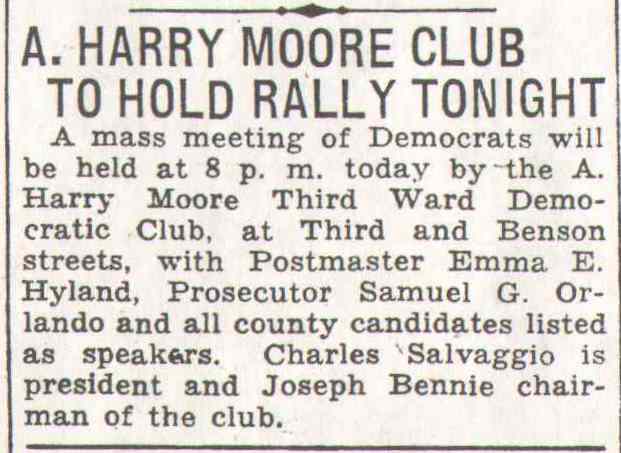
A mass meeting of Democrats will be held at 8 p. m. today by the A. Harry Moore Third Ward Democratic Club, at Third and Benson streets, with Postmaster Emma E. Hyland, Prosecutor Samuel G. [sic] Orlando and all county candidates listed as speakers. Charles Salvaggio is president and Joseph Bennie chairman of the club.
Zied Still Guilty, Says Prosecutor
Trenton Times —
CAMDEN, April 18 (P).—Samuel P. Orlando, Camden County prosecutor, has informed Governor Hoffman he does not feel that “new evidence” in the case of Charles Zied, sentenced to die for slaying a detective, warranted any further inquiry.
Orlando announced last night he had written his opinion to the Governor, asserting he has not changed his belief in the prisoner’s guilt.
Zied, 37, formerly identified with the “Tri-State Gang,” out of existence since the execution of its leaders a year ago, was convicted of killing Detective William Feitz in the holdup of a Camden disorderly house last April. He was granted a 30-day reprieve by Governor Hoffman on March 31
Zied will be re-sentenced after his reprieve expires April 30.
Zeid Faces Trial, Court Is Guarded
Trenton Times —
Zeid Faces Trial, Court Is Guarded
Accused Camden Slayer Is Linked with Tri-State Gang
New Jersey swung its far-famed “Jersey justice” into action today against Charles Zeid, seeking retribution from him for the slaying of one of its officers of law. The Philadelphian — a member, police say, of the notorious “tri-State gang” — goes on trial in a heavily-guarded court room on a charge of shooting Detective William T. Feitz in an attempted hold-up of a reputed disorderly house.
New Jersey is the third State to charge a murder against members of the gang. In Virginia, Robert Mais and Walter Legenza, co-leaders of the gang, paid with their lives for the fatal shooting of a bank truck driver. Pennsylvania recently charged the kidnap-slaying of William Weiss, night life figure, against Frank Wiley and Martin Farrell, reputed members, who have been sentenced to die in the electric chair.
Judge Frank F. Neutze, who has refused to grant further postponement to Zeid, declared he will take no chances and has ordered officers to mingle with the spectators and watch for any outbreak. Feitz was shot to death September 2, 1934, as he entered an alleged disorderly house during a holdup, as part of his duties, authorities say.
Zeid’s court-appointed attorney, John A. Penn, in reply to a request for a bill of particulars, has been told by Prosecutor Samuel P. Orlando that “Zeid or one or two accomplices” were the slayers.
Man Shot in Holdup of Card Game Dies
Camden Courier-Post —
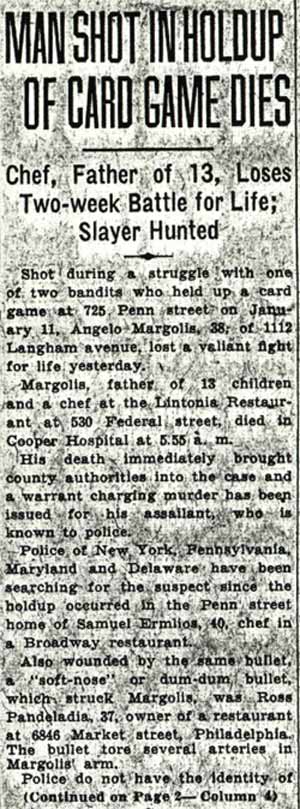
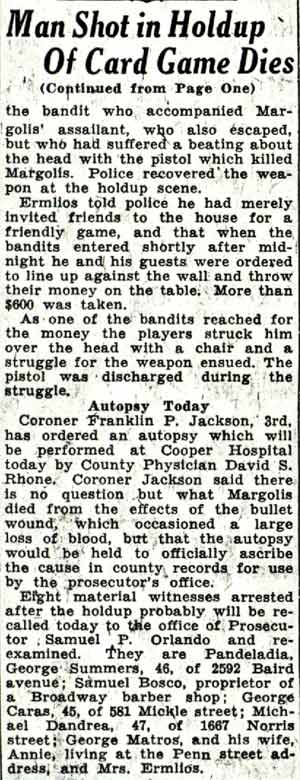
Chef, Father of 13, Loses Two-week Battle for Life; Slayer Hunted
Shot during a struggle with one of two bandits who held up a card game at 725 Penn street on January 11, Angelo Margolis, 38, of 1112 Langham avenue, lost a valiant fight for life yesterday.
Margolis, father of 13 children and a chef at the Lintonia Restaurant at 530 Federal street, died in Cooper Hospital at 5.55 a.m.
His death immediately brought county authorities into the case and a warrant charging murder has been issued for his assailant, who is known to police.
Police of New York, Pennsylvania, Maryland and Delaware have been searching for the suspect since the holdup occurred in the Penn street home of Samuel Ermlios, 40, chef in a Broadway restaurant.
Also wounded by the same bullet, a “soft-nose” or dum-dum bullet, which struck Margolis, was Ross Pandeladia, 37, owner of a restaurant at 6846 Market street, Philadelphia. The bullet tore several arteries in Margolis’ arm. Police do not have the identity of the bandit who accompanied Margolis’ assailant, who also escaped, but who had suffered a beating about the head with the pistol which killed Margolis. Police recovered the weapon at the holdup scene.
Ermlios told police he had merely invited friends to the house for a friendly game, and that when the bandits entered shortly after midnight he and his guests were ordered to line up against the wall and throw their money on the table. More than $600 was taken.
As one of the bandits reached for the money the players struck him over the head with a chair and a struggle for the weapon ensued. The pistol was discharged during the struggle.
Autopsy Today
Coroner Franklin P. Jackson, 3rd, has ordered an autopsy which will be performed at Cooper Hospital today by County Physician David S. Rhone. Coroner Jackson said there is no question but what Margolis died from the effects of the bullet wound, which occasioned a large loss of blood, but that the autopsy would be held to officially ascribe the cause in county records for use by the prosecutor’s office.
Eight material witnesses arrested after the holdup probably will be recalled today to the office of Prosecutor Samuel P. Orlando and reexamined. They are Pandeladia, George Summers, 46, of 2592 Baird avenue; Samuel Bosco, proprietor of a Broadway barber shop; George Caras, 45, of 581 Mickle street; Michael Dandrea, 47, of 1667 Norris street; George Matros, and his wife, Annie, living at the Penn street address, and Mrs. Ermlios.
2 Girls, Youth Held in Probe of Fatal Card Game Holdup
Camden Courier-Post —
Arrests in Delair and Here Follow 14-Day Hunt for Dum-Dum Bandit
Two girls and a man are held incommunicado by the Camden city and county police, pending an official examination of the brain of Angelos Malagas, a restaurant cook. Malagas died in the Cooper Hospital on Sunday, 13 days after he had been the victim of a holdup and alleged assault.
Malagas was one of the victims held up in a card game at 725 Penn street on January 11 and died after making a valiant fight for life.
The three prisoners are Luigi Tortu, 21, of 426 Line street, Camden; Pearl Wills, 18, of 7900 Day street, Delair, and Evelyn Buffa, 18, of 810 Florence street, Camden. Tortu was arrested yesterday in Delair as he was keeping a “date” with the Wills girl. He was seized by Detectives Harry Kyler and Thomas Murphy, of the city detective bureau, and James Mulligan of the county staff.
Second Girl Arrested
The Wills girl also was arrested and after the pair were questioned the sleuths came to Camden where they picked up Miss Buffa.
None of the detectives last night would give an inkling as to the reason for holding the prisoners “on ice,” or if any charges would be preferred against them.
Meanwhile Coroner Franklin P. Jackson III refused to give a certificate of death until the chemical test of Malagas’ brain is made by Philadelphia experts. Dr. David S. Rhone, county physician, sent the organ away yesterday, after Dr. Rhone had performed an autopsy. Dr. Rhone refused to disclose result of the post-mortem at this time.
Malagas’ funeral will be held from his home, 1110 Langham avenue, at 3 p.m. tomorrow, and from the Schroeder home, 715 Cooper street. Burial will be in Locustwood Memorial Park.
Hunted for 13 Days
Thirteen days’ hunt for Tortu came to a climax yesterday when the detectives learned that the young man was calling frequently on the Wills girl at her home. Armed with this information they went to Delair, posted themselves in the vicinity of the Wills’ home and waited for their quarry.
They were there a short time when Tortu appeared and was arrested immediately. The Wills girl and her friend, Miss Buffa, are said to be held as material witnesses, but the detectives refused last night to tell where they were detained.
Two men were identified with the holdup, according to the victims’ story told to the police. A search by the police of New York, New Jersey, Pennsylvania and Delaware for the fugitive, who is believed to have severed Malagas’ arm with a “dum dum bullet” has been in progress since the crime was committed.
Also wounded in the holdup was Ross Pandeladia, 37, owner of a restaurant at 6846 Market street, Philadelphia.
Police do not have the identity of the bandit who accompanied Malagas’ assailant. The fugitive suffered a beating about the head with the pistol which was said to have been used on Malagas. Police recovered the weapon at the holdup scene.
The occupant of the place, Samuel Ermlios told police he had merely invited friends to the house for a friendly game, and that when the bandits entered shortly after midnight he and his guests were ordered to line up against the wall and throw their money on the table. More than $600 was taken.
As one of the bandits reached for the money the players struck him over the head with a chair and a struggle for the weapon ensued. The pistol was discharged during the struggle.
Eight material witnesses arrested after the holdup will be recalled to the office of Prosecutor Samuel P. Orlando and re-examined. They are Pandeladia, George Summers, 46, of 2592 Baird avenue; Samuel Bosco, proprietor of a Broadway barber shop; George Caras, 45, of 581 Mickle street; Michael Dandrea, 47, of 1667 Norris street; George Matros, and his wife, Annie, living at the Penn street address, and Mrs. Ermlios.
Tortu was arrested late in December, 1937, when detectives took four suspects whom the police sought to identify with various holdups committed in South Jersey during the latter part of last year.
Tortu then gave his address as 426 Line street. Arrested at the same time was a girl who said she was Evelyn Buffalo, and who gave the address, 322 Penn street, as her home. It was at the Penn street house that the suspects were arrested.
Others captured at the time were Frank Luggi, 21, 322 Penn street; Nicholas Dandrea, 27, of 529 Line street, and Frederick Gasperone, who gave a false address when he was booked.
Justice of the Peace George Wilkinson, of Stratford, held Luggi, Gasperone and Dandrea for the grand jury, on the charge of breaking into the garage of Albert Weston at Stratford on Thanksgiving. Tortu was discharged.
Donges Assigned to Head Court Here
Camden Courier-Post —
Legal Profession Pleased at Designation to Preside Over Lloyd’s District
Supreme Court Justice Ralph W. E. Donges yesterday was assigned to preside over the Camden-Gloucester county Second judicial district of the Supreme Court.
A copy of the order of assignment was received by County Clerk Leslie H. Ewing. Justice Donges will take over the circuit presided over for many years by Justice Frank T. Lloyd who retired on pension last month.
Word of Justice Donges’ assignment to his “home” district elicited expressions of pleasure from many members of the legal profession in Camden county.
Heretofore Justice Donges has been serving the First judicial district, embracing Cape May, Cumberland, Salem and Atlantic counties. His new assignment was made by a vote of the membership of the state Supreme Court, Chief Justice Thomas J. Brogan signed the assignment order.
“Pleasure to Come Back”
“It is a real pleasure to come back to my home county,” Justice Donges said. “I was very happy in my first assignment, but it is a great satisfaction to be among my friends in Camden and Gloucester counties.”
Louis B. Duc, president of the Camden county Bar Association, said he felt he spoke for every member of the county bar when he said the assignment of Justice Donges was a most natural choice.
“For several decades only sons of Camden County have had the assignment to the Second judicial district,” he said. “Our regret at losing Justice Lloyd is balanced by our joy of receiving Justice Donges.
“The bar of Camden County tenders him our loyalty and appropriate greetings on his return home.”
Outstanding Citizen
Another who expressed keen pleasure over the assignment was Samuel T. French, a veteran member of the local bar.
“Justice Lloyd served the Supreme Court and the citizens of New Jersey faithfully and with glory to himself. Now Justice Donges takes up where he left off. It was to be expected that Justice Donges should be assigned to Camden County.
“He is an outstanding citizen and an eminent jurist who has given dignity to his democracy is unchallenged.”
Speaking as a junior member of the bar Bartholomew A. Sheehan joined in a personal tribute:
“As one of the younger members of the bar naturally am pleased over his assignment to Camden. Justice Donges has distinguished himself as one of New Jersey’s ablest and most eminent jurists and a judge who is keenly interested in the problems of the young law practitioners.
Burling Pleased
“State Senator Albert E. Burling expressed his pleasure by declaring he had the honor as senator from Camden County to present Justice Donges’ reappointment to the State Senate for confirmation.
“I have long admired Justice Donges for his ability, his industry and integrity as an associate Justice of the State Supreme Court,” Burling said.
“Many members of the bar regretted his elevation to the state’s highest court because he was a judge of the Circuit Court. His elevation was richly deserved.
“With other members of the Camden county bar I wish to join in extending a gracious welcome to Justice Donges on his return to his home county.”
Orlando Lauds Donges
Prosecutor Samuel P. Orlando was another who paid tribute to Donges. He said:
“I am highly pleased, to say the least. Justice Donges has served his state faithfully in his high judicial position. He is esteemed by all who know him and he commands the respect of all good citizens.
“I propose as county prosecutor to give Justice Donges the same wholehearted co-operation as given to his predecessor, Justice Frank T. Lloyd.”
Justice Donges was lauded by County Solicitor Walter S. Keown as one of the state’s outstanding jurists.
“I regret that Justice Lloyd decided to retire after his long and honored career on the bench,” Keown said. “However it is with mingled happiness and satisfaction that members of the local bar welcome Justice Donges to his own home district.”
The retirement of Justice Lloyd leaves eight justices for the nine circuits. Circuit Court Judge Newton H. Porter, of Essex County, has been named by Governor Moore to succeed Justice Lloyd. The nomination is before the Senate for confirmation.
Real Estate Board Annual Banquet
Camden Courier-Post —
“We must put an immediate curtailment on this lavish spending down in Washington, which leads only to unbalanced budgets,” so declared Congressman Dewey Short, Republican, of Missouri, principal speaker last night at the 22nd annual banquet of the Camden County Real Estate Board, held in the Hotel Walt Whitman, with more than 400 attending.
Among the guests were, former Judge Frank F. Neutze, Judge Clifford A. Baldwin, County Prosecutor Samuel P. Orlando, Assistant County Prosecutor Patrick H. Harding, State Senator Albert E. Burling.
Is Zat So!
Camden Courier-Post —
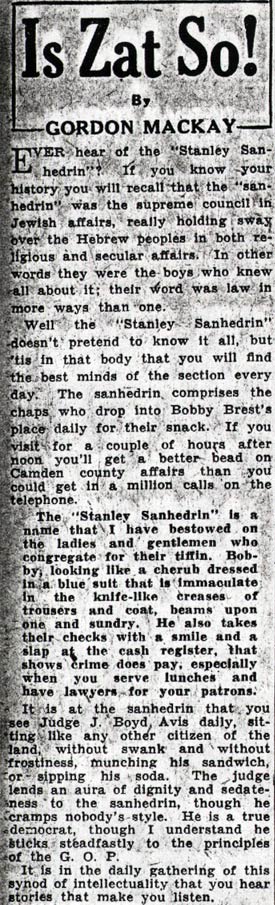
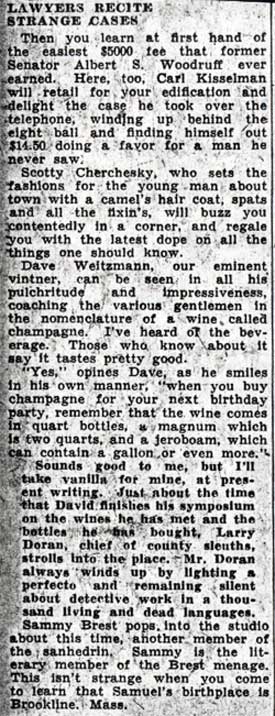
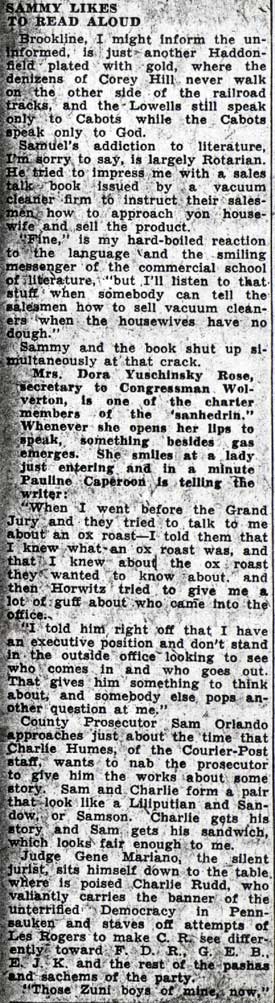
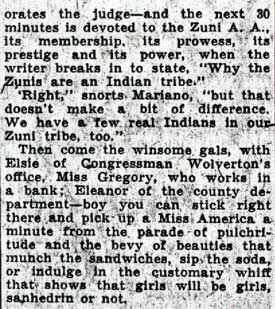
By GORDON MACKAY
EVER hear of the “Stanley Sanhedrin”? If you know your history you will recall that the “sanhedrin” was the supreme council in Jewish affairs, really holding sway over the Hebrew peoples in both religious and secular affairs. In other words they were the boys who knew all about it; their word was law in more ways than one.
Well the “Stanley Sanhedrin” doesn’t pretend to know it all, but ‘tis in that body that you will find the best minds of the section every day. The sanhedrin comprises the chaps who drop into Bobby Brest’s place daily for their snack. If you visit for a couple of hours afternoon you’ll get a better bead on Camden county affairs than you could get in a million calls on the telephone.
The “Stanley Sanhedrin” is a name that I have bestowed on the ladies and gentlemen who congregate for their tiffin. Bobby, looking like a cherub dressed in a blue suit that is immaculate in the knife-like creases of trousers and coat, beams upon one and sundry. He also takes their checks with a smile and a slap at the cash register, that shows crime does pay, especially when you serve lunches and have lawyers for your patrons.
It is at the sanhedrin that you see Judge J. Boyd Avis daily, sitting like any other citizen of the land, without swank and without frostiness, munching his sandwich, or sipping his soda. The judge lends an aura of dignity and sedateness to the sanhedrin, though he cramps nobody’s style. He is a true democrat, though I understand he sticks steadfastly to the principles of the G. O. P.
It is in the daily gathering of this synod of intellectuality that you hear stories that make you listen.
LAWYERS RECITE STRANGE CASES
Then you learn at first hand of the easiest $5000 fee that former Senator Albert S. Woodruff ever earned. Here, too, Carl Kisselman will retail for your edification and delight the case he took over the telephone, winding up behind the eight ball and finding himself out $14.50 doing a favor for a man he never saw.
Scotty Cherchesky, who sets the fashions for the young man about town with a camel’s hair coat, spats and all the fixin’s, will buzz you contentedly in a corner, and regale you with the latest dope on all the things one should know.
Dave Weitzmann, our eminent vintner, can be seen in all his pulchritude and impressiveness, coaching the various gentlemen in the nomenclature of a wine called champagne. I’ve heard of the beverage. Those who know about it say it tastes pretty good.
“Yes,” opines Dave, as he smiles in his own manner, “when you buy champagne for your next birthday party, remember that the wine comes in quart bottles, a magnum which is two quarts, and a jeroboam, which can contain a gallon or even more.”
Sounds good to me, but I’ll take vanilla for mine, at present writing. Just about the time that David finishes his symposium on the wines he has met and the bottles he has bought, Larry Doran, chief of county sleuths, strolls into the place. Mr. Doran always winds up by lighting a perfecto and remaining silent about detective work in a thousand living and dead languages.
Sammy Brest pops into the studio about this time, another member of the sanhedrin. Sammy is the literary member of the Brest menage. This isn’t strange when you come to learn that Samuel’s birthplace is Brookline, Mass.
SAMMY LIKES TO READ ALOUD
Brookline, I might inform the uninformed, is just another Haddonfield plated with gold, where the denizens of Corey Hill never walk on the other side of the railroad tracks, and the Lowells still speak only to Cabots while the Cabots speak only to God.
Samuel’s addiction to literature, I’m sorry to say, is largely Rotarian. He tried to impress me with a sales talk book issued by a vacuum cleaner firm to instruct their salesmen how to approach yon housewife and sell the product.
“Fine,” is my hard-boiled reaction to the language and the smiling messenger of the commercial school of literature, “but I’ll listen to that stuff when somebody can tell the salesmen how to sell vacuum cleaners when the housewives have no dough.”
Sammy and the book shut up simultaneously at that crack.
Mrs. Dora Yuschinsky Rose, secretary to Congressman Wolverton, is one of the charter members of the ‘sanhedrin.” Whenever she opens her lips to speak, something besides gas emerges. She smiles at a lady just entering and in a minute Pauline Caperoon is telling the writer:
“When I went before the Grand Jury and they tried to talk to me about an ox roast—I told them that I knew what an ox roast was, and that I knew about the ox roast they wanted to know about. and then Horwitz tried to give me a lot of guff about who came into the office.
“I told him right off that I have an executive position and don’t stand in the outside office looking to see who comes in and who goes out. That gives him something to think about, and somebody else pops another question at me.”
County Prosecutor Sam Orlando approaches just about the time that Charlie Humes, of the Courier-Post staff, wants to nab the prosecutor to give him the works about some story. Sam and Charlie form a pair that look like a Liliputian and Sandow, or Samson. Charlie gets his story and Sam gets his sandwich, which looks fair enough to me.
Judge Gene Mariano, the silent jurist, sits himself down to the table where is poised Charlie Rudd, who valiantly carries the banner of the unterrified Democracy in Pennsauken and staves off attempts of Les Rogers to make C. R. see differently toward F. D. R., G. E. B., E. J. K. and the rest of the pashas and sachems of the party.
“Those Zuni boys of mine, now,” orates the judge—and the next 30 minutes is devoted to the Zuni A. A., its membership, its prowess, its prestige and its power, when the writer breaks in to state, “Why the Zunis are an Indian tribe.”
“Right,” snorts Mariano, “but that doesn’t make a bit of difference. We have a few real Indians in our Zuni tribe, too.”
Then come the winsome gals, with Elsie of Congressman Wolverton’s office, Miss Gregory, who works in a bank; Eleanor of the county department—boy you can stick right there and pick up a Miss America a minute from the parade of pulchritude and the bevy of beauties that munch the sandwiches, sip the soda, or indulge in the customary whiff that shows that girls will be girls, sanhedrin or not.
Sam Bosco Murder Case
Camden Courier-Post —
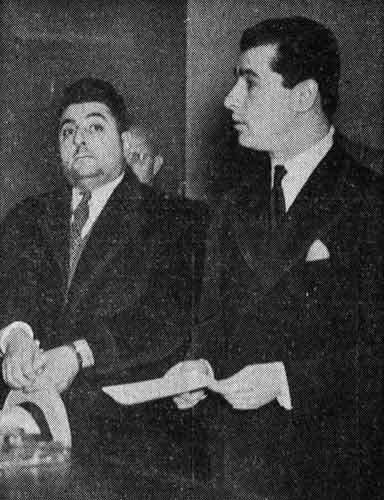
Bosco was in the ante-room — still waiting to testify — shortly after 4 p.m. when Mark Reeve, clerk of the jury, came out and whispered to City Detective Thomas Murphy. Murphy walked over to Bosco. He placed a hand on his shoulder and said: “You are under arrest.”
“What for?” Bosco asked. “The grand jury just indicted you on a charge of murder,” Murphy replied.
Prosecutor Orlando said: “I will give the grand jury the full facts. The members will decide for themselves what action to follow.”
11 Nabbed by Police in Gambling Raids
Camden Courier-Post —
Ten men and a woman were arrested in gambling raids over the weekend by Camden city and county authorities.
Seven were arrested for operating a “bingo numbers” racket. A warrant also was issued for Frank Palese, 400 Spruce street, a member of a widely known South Camden family, as the “big shot” of the racket, according to Chief Lawrence T. Doran, of county detectives. Doran said last night Palese is still a fugitive.
Police Chief William Linderman, County Detective Chief Lawrence T. Doran and County Detectives Wilfred Dube, James J. Mulligan, Joseph Bennie and Casmir Wojtkowiak arrested the four men, all of whom were taken at once to the office of Prosecutor Orlando for questioning.
It was revealed at the prosecutor’s office that an attempt to flood Camden city and county with the new numbers game has been made during the last two weeks.
Florence Winters, 1938
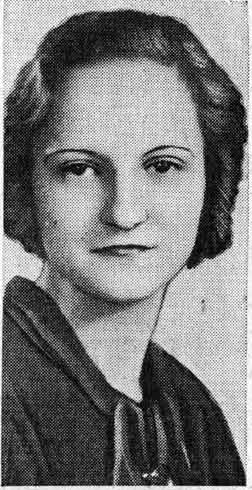
Florence Winters, who was to lead the grand march at the Beauticians and Barbers Association ball in February 1938.
Gloucester Group to Give Ball Here
Camden Courier-Post —
Camden Officials to Attend Barbers’ and Beauticians’ Fete Monday
To Lead March — Florence Winters. She will lead the grand march of the first annual ball of the Beauticians and Barbers Association of Gloucester, to be held Monday night in the Moose ballroom, 808 Market street.
More than 700 persons, including Camden city and county officials, will attend the first annual ball of the Beauticians and Barbers Association to be given Monday night at the Moose ballroom, 808 Market street, Camden.
The group, a Gloucester city organization headed by Peter A. Sessa, president of the Gloucester Master Barbers, and Miss Florence Winters, president of the Beauticians, voted to hold the event in Camden because ample quarters are not available in Gloucester due to condemnation of the old city hall.
Guests at the ball will include City Commissioners Mary W. Kobus, Frank J. Hartmann, Jr., Harold W. Bennett, Frederick von Nieda and Mayor George Brunner. Other guests will be Postmaster Emma E. Hyland, Prosecutor Samuel P. Orlando, Judges Joseph Varbalow and Gene Mariano, Mary Soistmann, Democratic state committeewoman, and Frank B. Hanna and Mrs. Florence Baker, members of the Republican State Committee; City Solicitor Firmin Michel; Mayor John F. Gorman, of Gloucester; A. L. Kuhn, of Trenton, and Charles E. Paglucia, of Plainfield, members of the State Board of Barber Examiners; Lewis Waldman, of Trenton, president of the State Master Barbers’ Association, and Vincent Ferrante, president of the Camden Master Barbers’ Association.
Music will be furnished by Bob Horton and his orchestra, and dancing will be supervised by Prof. Edward Daisey.
The committee in charge includes Lewis Kelly, chairman; Johanna Fox, secretary; Peter Pellegrino, treasurer; Verna Casey, Margaret Shuster, Catherine Moran, Effie Jones, Anna Caldwell, Florence Winters, Jean Gorman, Arthur Kinch, Nicholas Casto, Dominick La Bascio, Rocco Burgo, Peter Sessa and William Cheeseman.
Pinner Given Hospital Rule on Admission to Lakeland
Camden Courier-Post —
Freeholder Group Rescinds Right of Mrs. Gray to Govern Patients
Authority to decide whether patients shall be admitted to or excluded from the County General Hospital at Lakeland was transferred last night from Mrs. Mary A. Gray, the superintendent, to Dr. Warren E. Pinner, chairman of the Freeholders’ general hospital committee.
The action was taken by the institutions committee of the Freeholders — the body which succeeded the old Lakeland central committee as the supreme arbiter of county institutional affairs.
Director J. William Mullin of the Freeholders board made the announcement in his capacity as chairman of the institutions committee. Dr. Pinner could not be reached by telephone for comment.
It was reported by Mullin that the finance and budget committees will take whatever action is suggested by Prosecutor Samuel P. Orlando that the three process servers in the sheriff’s office be transferred back to the prosecutor’s office.
Reform in Parole Urged by Orlando
Camden Courier-Post —
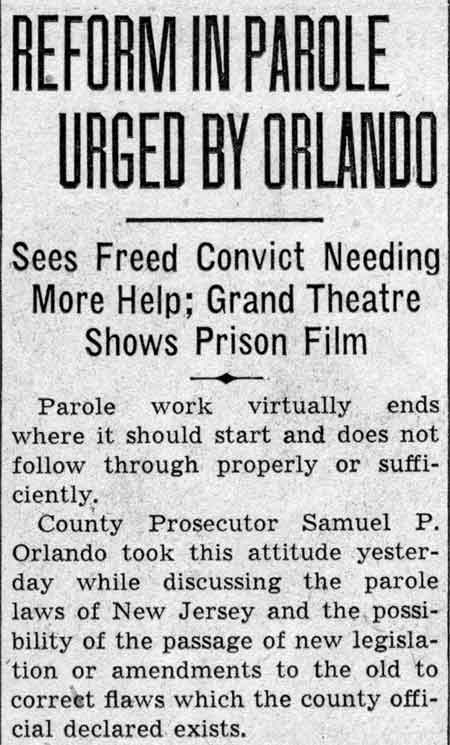
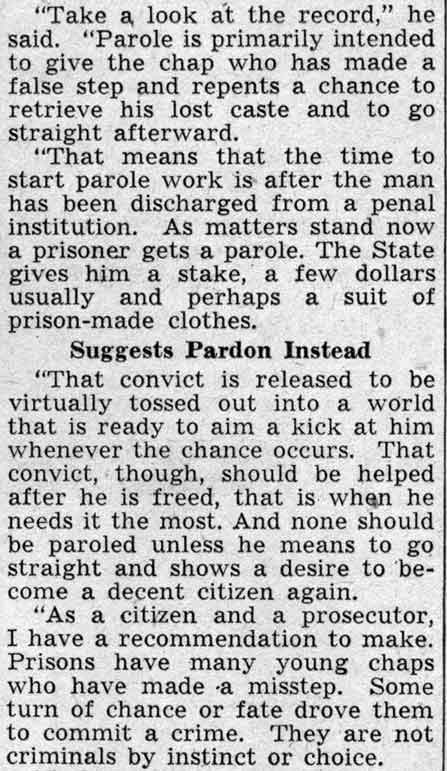
REFORM IN PAROLE URGED BY ORLANDO
Sees Freed Convict Needing More Help; Grand Theatre Shows Prison Film
Parole work virtually ends where it should start and does not follow through properly or sufficiently.
County Prosecutor Samuel P. Orlando took this attitude yesterday while discussing the parole laws of New Jersey and the possibility of the passage of new legislation or amendments to the old to correct flaws which the county official declared exists.
“Take a look at the record,” he said. “Parole is primarily intended to give the chap who has made a false step and repents a chance to retrieve his lost caste and to go straight afterward. That means that the time to start parole work is after the man has been discharged from a penal institution. As matters stand now a prisoner gets a parole. The State gives him a stake, a few dollars usually and perhaps a suit of prison-made clothes.
“That convict is released to be virtually tossed out into a world that is ready to aim a kick at him whenever the chance occurs. That convict, though, should be helped after he is freed, that is when he needs it the most. And none should be paroled unless he means to go straight and shows a desire to become a decent citizen again.
“As a citizen and a prosecutor, I have a recommendation to make. Prisons have many young chaps who have made a misstep. Some turn of chance or fate drove them to commit a crime. They are not criminals by instinct or choice. I don’t believe in any parole system as such for those chaps. I think they should be investigated in prison and inquiry be made into the turn these young fellows intend to take after they are free. If they intend to make good, eschew crime, and become citizens, don’t parole them, pardon them.
“Let the Governor do it, too. The parole board can inform the Governor after the convict has served a sufficient time to pay for his misdeed that he is eligible for a pardon. Let the Governor accept the recommendation and free the boy, without any strings. That lets him start from scratch again and makes him as good a citizen as anybody else.
“Let’s start this business of helping the parolees after they get out, not before. Let’s not desert them and give them a kick, let’s give them a chance for a good start and put it right up to them. And let’s not free men whom we cannot trust to go straight after they get out. We have too many sex murders now by congenital criminals who managed to fool parole boards and cost decent persons their lives afterwards.”
Warner Brothers are giving you a chance to see the inside of a prison, and to let you get at first hand the picture of the convict’s life. The Grand Theater is showing “Penitentiary” and prizes are to be awarded to the patrons who turns in the best letters on the parole system and the picture. The film is scheduled to start next Thursday. For the 50 best letters on the subject, the Grand management will award 50 pairs of guest tickets.
Checked and Double Checked by Jiminy
Camden Courier-Post —
“Checked and Double-Checked” column by Jiminy in the Camden Courier-Post, February 19, 1938, containing social notes and brief items about David Baird Jr., Emma E. Hyland, Marie V. Kelley Verdiglione, Charley Humes and other Camden figures.
Frank Palese — South 4th Street
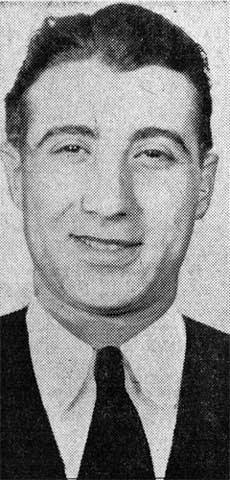
Portrait photograph of Frank Palese, subject of a 1938 gambling warrant, at 900 South Fourth Street. His brother Rocco Palese also figures in the Camden Democratic organization.
Grand Jury Vice Probe to Be Ordered by Lloyd; Stewart Quizzes Cops
Camden Evening Courier —
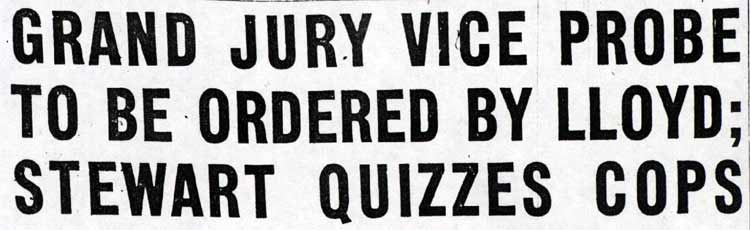
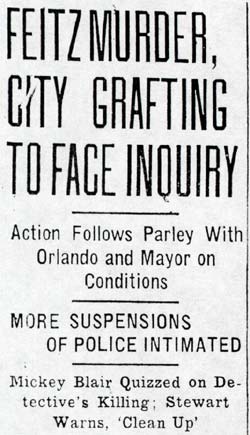
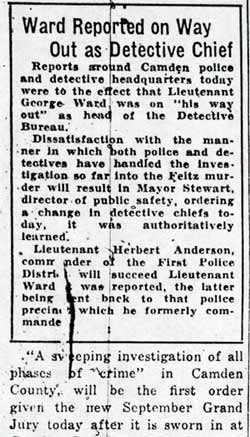
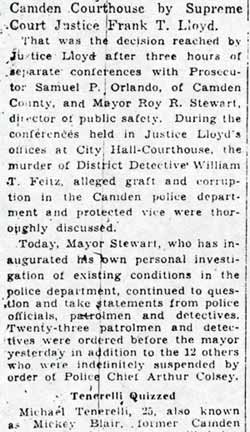
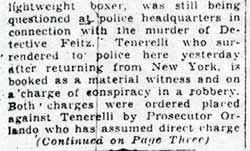
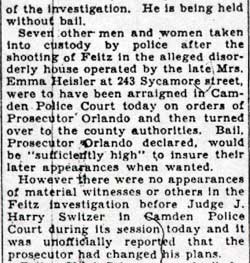
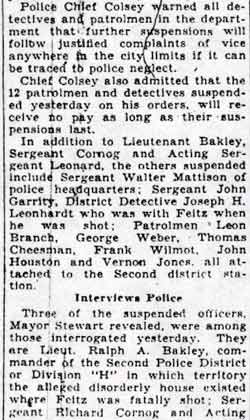
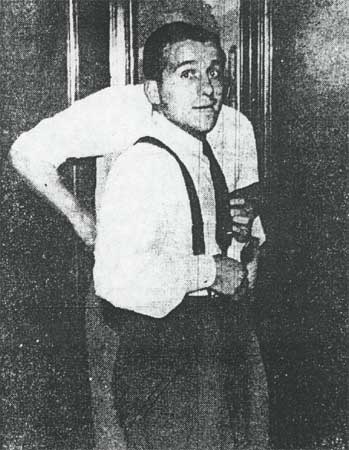

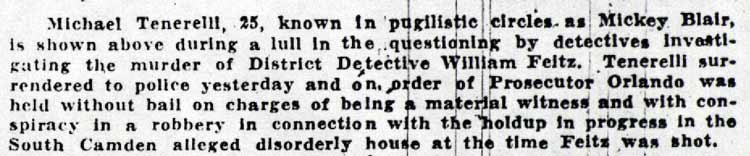
FEITZ MURDER, CITY GRAFTING TO FACE INQUIRY
Action Follows Parley With Orlando and Mayor on Conditions
MORE SUSPENSIONS OF POLICE INTIMATED
Mickey Blair Quizzed on Detective’s Killing; Stewart Warns, ‘Clean Up’
Questioned in Feitz Murder
Michael Tenerelli, 25, known in pugilistic circles as Mickey Blair, is shown above during a lull in the questioning by detectives investigating the murder of District Detective William Feitz. Tenerelli surrendered to police yesterday and on order of Prosecutor Orlando was held without bail on charges of being a material witness and with conspiracy in a robbery in connection with the holdup in progress in the South Camden alleged disorderly house at the time Feitz was shot.
Ward Reported on Way Out as Detective Chief
Reports around Camden police and detective headquarters today were to the effect that Lieutenant George Ward was on “his way out” as head of the Detective Bureau.
Dissatisfaction with the manner in which both police and detectives have handled the investigation so far into the Feitz murder will result in Mayor Stewart, director of public safety, ordering a change in detective chiefs today, it was authoritatively learned.
Lieutenant Herbert Anderson, commander of the First Police District, will succeed Lieutenant Ward as it was reported, the latter being sent back to that police precinct which he formerly commanded.
“A sweeping investigation of all phases of “crime” in Camden County, will be the first order given the new September Grand Jury today after it is sworn in at Camden Courthouse by Supreme Court Justice Frank T. Lloyd.
That was the decision reached by Justice Lloyd after three hours of separate conferences with Prosecutor Samuel P. Orlando, of Camden County, and Mayor Roy R. Stewart, director of public safety. During the conferences held in Justice Lloyd’s offices at City Hall-Courthouse, the murder of District Detective William T. Feitz, alleged graft and corruption in the Camden police department and protected vice were thoroughly discussed.
Today, Mayor Stewart, who has inaugurated his own personal investigation of existing conditions in the police department, continued to question and take statements from police officials, patrolmen and detectives. Twenty-three patrolmen and detectives were ordered before the mayor yesterday in addition to the 12 others who were indefinitely suspended by order of Police Chief Arthur Colsey.
Tenerelli Quizzed
Michael Tenerelli, 25, also known as Mickey Blair, former Camden lightweight boxer, was still being questioned at police headquarters in connection with the murder of Detective Feitz. Tenerelli who surrendered to police here yesterday after returning from New York, is booked as a material witness and on a charge of conspiracy in a robbery. Both charges were ordered placed against Tenerelli by Prosecutor Orlando who has assumed direct charge of the investigation. He is being held without bail.
Seven other men and women taken into custody by police after the shooting of Feitz in the alleged disorderly house operated by the late Mrs. Emma Heisler at 243 Sycamore street, were to have been arraigned in Camden Police Court today on orders of Prosecutor Orlando and then turned over to the county authorities. Bail, Prosecutor Orlando declared, would be “sufficiently high” to insure their later appearances when wanted.
However there were no appearances of material witnesses or others in the Feitz investigation before Judge J. Harry Switzer in Camden Police Court during its session today and it was unofficially reported that the prosecutor had changed his plans.
Police Chief Colsey warned all detectives and patrolmen in the department that further suspensions will follow justified complaints of vice anywhere in the city limits if it can be traced to police neglect.
Chief Colsey also admitted that the 12 patrolmen and detectives suspended yesterday on his orders, will receive no pay as long as their suspensions last.
In addition to Lieutenant Bakley, Sergeant Cornog and Acting Sergeant Leonard, the others suspended include Sergeant Walter Mattison of police headquarters; Sergeant John Garrity, District Detective Joseph H. Leonhardt who was with Feitz when he was shot; Patrolmen Leon Branch, George Weber, Thomas Cheeseman, Frank Wilmot, John Houston and Vernon Jones, all attached to the Second district station.
Interviews Police
Three of the suspended officers, Mayor Stewart revealed, were among those interrogated yesterday. They are Lieut. Ralph A. Bakley, commander of the Second Police District or Division “H” in which territory the alleged disorderly house existed where Feitz was fatally shot; Sergeant Richard Cornog and Acting [lines between the bottom of crop 15 and the top of crop 16 are not captured in the scanned crops]
Edwin Andrews, Winslow township; Joseph Dougherty, 140 Prospect avenue, Merchantville.
William Tomlinson, Glendale, Voorhees township; Edmund S. Stafford, 546 Stevens street; Harry Buffington, 123 East Clinton avenue, Oaklyn; Samuel A. Dobbins, 2599 Baird boulevard; Charles H. Thatcher, 129 Kendall boulevard, Oaklyn; Richard S. Thompson, East Zane avenue, Collingswood; Benjamin F. Stemmer, 420 Third Avenue, Haddon Heights; Horace J. Harvey, 721 Amherst avenue, Audubon; H. B. Cox, Evesham avenue, Voorhees township; Dr. Walter F. Wood, Collingswood; John W. Underwood, 801 Cumberland street, Gloucester; Clarence Alloway, Blackwood; Charles A. McWilliams, Blackwood; Louis G. Clark, Barrington; Albert J. Cline, 18 East Crystal Lake avenue, Westmont; Robert Bushbeck, First avenue, Pine Hill, Harry Burkhardt, Bell road, Mt. Ephraim; George T. Schuster, 223 Woodland terrace, Collingswood; Chesley L. Hutchins, 711 Market street, Gloucester and Otto Vierling, Evergreen avenue, Runnemede.
The order of Justice Lloyd for a wide grand jury probe of crime follows upon a decision he made 10 days ago to have the same body open an investigation into the “numbers” racket in Camden city and county. At that time he declared he did not believe any graft or corruption existed in the Camden police department in connection with the operation of the lottery game here.
Tenerelli was identified, Colsey said, as a frequenter of Mrs. Emma Heisler’s disorderly house at 243 Sycamore street, where Feitz was killed, and was booked as a material witness in the Feitz murder, and on a charge of “shaking down” Mrs. Heisler by force, prior to the murder.
Unlike Mrs. Heisler, who leaped to her death after 60 hours freedom in the detective bureau, Blair was slapped without bail into the “cold storage” or incommunicado cell in the bureau.
Blair, after surrendering to Colsey, was sent to the “downstairs” jail and kept there until about 4 p. m. yesterday. Then he was questioned for an hour and a half by Prosecutor Orlando and Colsey.
Blair denied all knowledge of the murder, Colsey said, after the grilling ceased, but added that two inmates of Mrs. Heisler’s house, whom he would not identify, named Blair as one of several men who had come several times to Mrs. Heisler’s place, attempted to extort money from her and, failing, had “held up the place” or a “shakedown.”
This coincided with the statement of Detective Sergeant Gus Koerner, on the day Feitz was killed, that the place had been held up several times, and Mrs. Heisler, because of the nature of her occupation, would not report the holdups.
Prosecutor Orlando, subsequently, had stated that Feitz met death in an attempt to block a “shake-down” holdup of the place.
Boxer Is Identified
Both the inmates of Mrs. Heisler’s place, held incommunicado, looked at Blair in the new detective bureau “lineup” room and identified him as a shakedown visitor, but said he was not in the house on the night of the murder, Colsey said.
The chief then was asked if he believes friends of Blair staged the fatal shake-down and killed Feitz, and replied:
“That’s what we want to know. We don’t know yet. But we are getting somewhere and will solve this case.”
The two inmates of the Heisler house were brought back to the lineup room a second time, took another look at Blair through the screen that made him a “high-lighted” figure and prevented him from seeing them and reaffirmed their previous statements, Colsey said.
Upon the suspension of the twelve members of the force and the installation of a new acting second district commander and new acting sergeants to relieve those suspended, Chief Colsey said he issued the following order to the entire department:
Calls for Cleanup
“All vice must be eliminated absolutely and entirely in Camden. This means all types of vice, including the numbers racket, gambling houses, disorderly houses, horse-race bookmaking speakeasies and everything else though it may not be specifically enumerated here.
“In the future if any complaint of vice comes in, and is proved to be justified, and is attributable to negligence on the part of any patrolmen of police officer [sic], immediate suspension of the negligent members of the force will follow without exception.”
Chief Colsey also said he will recommend that bail of $2000 be set in all numbers racket cases in future, and that all arrested be held for grand jury action, except in cases where innocent players are brought in.
‘Prompted by Facts’
In making public the suspensions of the policemen, Chief Colsey said his action was “prompted by facts” uncovered during the course of his investigation.
In announcing the taking over of the murder investigation, Prosecutor Orlando said:
“As a result of my conference with Justice Lloyd it has been decided that the prosecutor’s office from this time on will take charge of the murder investigation.
“In doing so, however, it does not mean that the city police will cease acting in the matter and will act with just as much zeal as is within their command in bringing about the apprehension of those responsible.
“This investigation has been taken over by this office by reason of the policy assumed in other murder investigations. Hereafter all murder investigations in Camden county will be under the supervision of the prosecutor’s office and at the same time through co-ordinated efforts of this office and the police department of the particular community where the murder takes place.
“As far as developments are concerned, there is nothing new in the case except the arrest of Mickey Blair, who was surrendered by his counsel and who is in the custody of the police until he is committed.”
Lieutenant Walter Welch in command of the Third Police District was assigned by Chief Colsey to replace Lieutenant Bakley and make the suspensions of all sergeants and patrolmen in that precinct effective immediately. Sergeant John Potter of the Third District was named an acting lieutenant to replace Lieutenant Welch as commander of that precinct.
Welch said he will instruct every policeman under his new command that he must work in harmony with earnest efforts to stamp out vice.
“If they do not do this,” Welch said, “I do not want them. They will be of no use to me. They know what to expect if they fail to cooperate. My efforts will be directed to maintaining order without vice in the Second district, just as I have done in the Third.”
Is Zat So!
Camden Courier-Post —
Fair, charming and clever, Mrs. Rocco Palese is one of my “favorite girl friends”—this is rather an exclusive organization—to be found in South Jersey. When this charming matron proceeded to rebuke me with the chastening rod the other day, I was obedient to the command of Camden’s fair daughter.
“The great trouble with you,” opined Mrs. Palese, who was talking with Mrs. Florence Baker, Republican state committeewoman, who is also one of the “F. G. F.,” is that you don’t write enough about women.”
“Why you should have column after column about the fine women we have in Camden,” she added.
As I left the charming Mrs. Palese and the equally winsome Madame Baker it was my fortune to encounter one of the others who are ensconced in the Circle of “F. G. F.” She is Mrs. Emma E. Hyland, postmaster of Camden and for years the brave matron who carried aloft the banner of an unterrified but unwelcome Democracy.
Mrs. Hyland smiled in that manner so disarming, and in her own diplomatic way. My thoughts meanwhile ran back to a banquet that was held a few nights before, in which the winsome Mrs. Hyland administered one verbal spanking to that glutton for punishment who writes this potpourri.
Mrs. Hyland verifies sapient remarks made by that astute counselor, Samuel P. Orlando, to wit: “The great wonder in my mind has been that Mrs. Hyland could battle in politics the way she has and still retain her femininity to such a marked degree.”
Harmony Dwells in Democracy
The sentiments expressed so tersely but eloquently by the limb of the law named Orlando meets with my emphatic “aye.” Therefore, when Mrs. Hyland proceeded to chastise this scribe because the Mackay hinted that harmony does not dwell in Democracy’s tents, the lady appeared vocally ruffled as she proceeded to shoot Mackay at sunrise.
We acknowledged the lambasting, but still there lurked in our mind the same old seed of suspicion. We recalled when Harry Moore was inducted into office as the only Governor to thrice have held that exalted office. The inauguration tickets were not profuse in the Brunner-Kelleher camp, hence we wondered why.
At the same time we remembered an innocent remark that we had read in the column of our able colleague, the cheery sprite, known as Charlie Humes. It was to the effect “that I am not supposed to bring people up here now.”
As we trudged along the streets our minds burrowed in thought and our brains deeply immersed in imagination we pulled up near Broadway and Stevens street in front of the red brick building which the unrighteous now call “No Man’s Land” or more formally the Republican county headquarters.
We were startled out of our reverie by hearing a dulcet voice shouting: “My car is afire! My car is afire! I can’t put it out!”
Instantly we knew that voice. It was that of another of our “F. G. F.” in trouble, this time Mrs. Baker. Her gasoline chariot had come ablaze. She was in quandary terrific as to extinguishing the flames.
Squish! Squish! Out Goes Fire
Don’t tell me why woman loses her head in an emergency. Out of a store came a lady; racing with a can in her hand. She was Sadye Levinsky, one of the few women pharmacists in Camden county.
Miss Levinsky knew her stuff as she also knows Mrs. Baker. Sadye went at her job in calm matter-of-fact fashion that would have won the envy of any volunteer fireman who ever borrowed Fred Lynch’s rubber boots.
Squish! Squish! Squish! went the pump in the can. Out, pronto went the flames. Mrs. Baker was profuse in her thanks as Miss Levinsky waved the emergency treatment of the fiery chariot aside, it was all in the day’s work.
“Boy,” we were saluted. “I’ve just seen the best emotional thespian, that hasn’t made Hollywood. She’s a knockout, about the prettiest girl in this county.”
“Where is this paragon,” we queried, wanting to know something about such a lady myself.
“She is in court trying to get alimony from her husband, Dr. Eppelman,” said the barrister. We trudged over to the courthouse where we met a group who were discussing the Ethel Barrymore who had just asked her dentist husband be compelled to support her and a child.
“Phew,” said Walter Keown, who was hubby’s counsel, “what an actress, what an actress;” Now that was some tribute for we’ve seen Pete Keown in court and he can do a John Barrymore, too.
It was at that moment that a petite blonde; with a face that rivaled Helen of Troy’s and could launch a thousand ships from any dock in the world came around the corner. She was fetchingly dressed and surrounded by a flotilla of males; all members of her families.
She was Mrs. Eppleman, and that lawyer’s description of her glamour and charm was a prize bit of understatement. If she can act as good as she looks they better get Carole Lombard, Lucille Ball and some of those other gals an annuity right away, for they’ll be pushed off the map.
Hardly had we sauntered away from this beauty when we encountered Mrs. Pauline Caperoon, our best bet for the prize politician among all her sex in Camden County. Pauline was as energetic, as politic and loquacious as is characteristic and we had a talkfest about certain folk and their foibles that was enriched, by the strength of Mrs. Caperoon’s vocabulary, with an added trimming of a most conservative type from the writer.
After we had chatted with Pauline and learned plenty we should know we walked away again. Just in time to see Mayor Brunner and Mrs. Kobus hiking for a train to Trenton. Of course, we knew they were just running up to see the Governor, but nothing political. We subsided.
Thus, Mrs. Palese, we feel that we have covered the ground pretty well today in a single column, to bring to the attention of our readers something about women.
Checked and Double-Checked
Camden Courier-Post —
By JIMINY
THE week’s prize story, as it is being told around the courthouse, concerns the new “bingo” numbers racket in which a half dozen or more suspects were arrested. Prosecutor Orlando was questioning the prisoners when there came this repartee:
PROSECUTOR: “What’s the matter with you? Don’t you read the papers? Didn’t you read where we had banned bingo?”
PRISONER: “Yeah, I read that—but I thought you meant churches!”
* * *
Alleviating the daily burden of digesting news comes an occasional missive like this:
“Dear Sir:
“I am writing you to request a part time job writing column consisting of notes obtained from bartenders and waiters who work in cafes or inns and who advertise in the Courier-Post. I am married, 28 years old, have one child and good reference. If interested, call —— or write.
“B. R. McLaughlin.”
If there were such a job, it wouldn’t be open.
* * *
THE plan of David Baird to throw Harry Ecky out of his job for Bill Lehman is a shining example of how the Camden county Republican party is disintegrating because one man refuses to substitute gas-electric buses for horsecars. . . . The appointment of Harry Ecky was one of the few creditible [sic] appointments the Gentleman Farmer has had a hand in for some years. . . . Ecky is not only a straight, efficient registrar; he is a credit to his party, a popular man in North Camden and, until this political assassination, has been a loyal Baird follower in the face of endless adverse criticism. . . . The fact that Baird hopes to dump one of his most loyal workers merely to make room for his headquarters errand boy, doesn’t sit well with the uptown Republicans. . . . It is a good break for the New Deal Republicans, for such a flagrant case of double-cross brings sharply to the understanding of Old Guard Republicans why the New Deal Republicans seceded and struck out for themselves. . . . You can safely bet that regardless of whether Baird is successful in ousting Ecky, the First ward will henceforth be New Deal. . . .
One of the surprising features of yesterday’s recall election at Wildwood was the fact that William “Dutch” Kinsler was very active as a district leader. . . . For the Democrats. . . . “Dutch” was a guard at the Camden county jail for many years. . . . And was a vehement Bairdite. . . .
Social Notes: Prosecutor Sam Orlando is Florida-bound. . . . Al Woodruff is back from the West Indies. . . . Mrs. Emma Hyland and Mrs. Marie (Kelley) Verdiglione visited Gov. Moore at Trenton on Wednesday. . . .
In recent weeks we have been enjoying a joust with the editor (?) of a weakly paper and very probably he has been enjoying it too from behind the eight ball. . . Now, a political chameleon who issues a throw-away folder in the suburbs, is trying to muscle in to draw some comment from us. . . We can’t joust there, being under a handicap, as we cleave to facts and truth. . . Whereas no such restriction hinders or worries the suburban pensman. . . That can be attested by the fact that the Camden County Grand Jury once preseented [sic] him with a diploma. . . In recognition of his expertness. . . At criminal libel. . . He pleaded non vult (guilty) to the indictment, throwing himself upon the mercy of the court. . . The grand jury’s too busy these days with bingo and bagatelle.
Out in one of the suburbs the ABC agents are investigating a councilman who is a bartender in one of the taprooms in his community, which they say is illegal, since the governing body of which he is a member is also the issuing authority for liquor licensees. . . The taproom recently was told to close on time. . . It must be Spring . . . Mrs. Roy Lehman, of Lucaston, writes in this year’s first letter about having seen a robin. . . And some boys were playing marbles under the bridge around Third street the other day.
Some more social notes: Corporal Sol Polkowitz, of the Malaga state police barracks, is on a 36-day leave in order to tour England, France, Germany, Switzerland, Czecho-Slovakia and Roumania. . . Is Chief John Branin about to leave Delaware township? . . . Mrs. Kathryn Sheeran’s friends threw her a surprise birthday party the other night. . . Walter Fallon, who told us, wouldn’t say what birthday.
Charley Humes and Chinny Weber will battle it out for last place in the ping-pong league tonight. . . Mrs. Beatrice Di Guiseppe, of 425 Pine street, has a dracena plant which has just burst into rare bloom. . . She got it seven years ago from Pasquale Iannuzzi . . . One of the staff found an old photograph near Broadway and Federal, and it may have some sentimental value for the loser. . . On the back are some notations, among them this: “Don’t you think Robert James some boy—don’t you think you could love your little grandson”. . . It is torn in half, though, and maybe that’s a story in itself. . . Aside to Mrs. M. R. of Gloucester: Have you heard favorable word from the Westville authorities?
Michel Confirmed as Prosecutor Here
Camden Courier-Post —
Senate Finally Approves Choice Announced by Edison 2 Months Ago
Trenton, June 30. — Firmin Michel, former Camden city solicitor, was confirmed tonight by the Senate as county prosecutor, succeeding Samuel P. Orlando. He was nominated two months ago by Governor Edison.
District Judge Bartholomew A. Sheehan, of Camden, was confirmed as a member of the State Labor Mediation Board.
Michel, widely known member of the South Jersey Bar, had the support of Mayor George E. Brunner, of Camden, and was favored by State Senator Alfred E. Driscoll, Republican majority leader and chairman of the Senate Judiciary Committee.
Orlando has been serving as prosecutor by virtue of holding a position as special assistant attorney general. Opposition to Orlando’s reappointment developed following suit he instituted for pay deducted under an economy program extending back several years.
Salary of prosecutor is $7500.
Driscoll, as the Senate representative of Camden county, blocked reappointment of Orlando in January and the position went over to the administration of Governor Edison when appointive powers of former Governor A. Harry Moore expired.
Michel’s name then was proposed by State Democratic Committeeman Vincent L. Gallaher and was endorsed by Driscoll. Michel lives at 313 South Sixth street and has law offices at 309 Market street.
Scarduzio Jailed by Orlando After Gun Play in Restaurant
Camden Courier-Post —
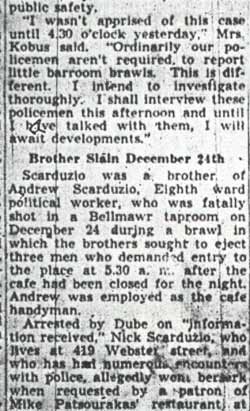
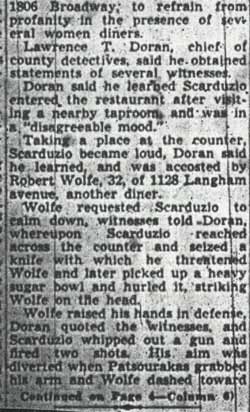
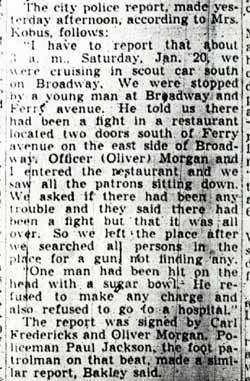
Action Follows Police Failure to Report On Shooting
PROBE ORDERED BY MRS. KOBUS
Nick Scarduzio, 39, former Summer policeman, was held last night without bail for grand jury action on a charge of atrocious assault and battery and intent to kill as a sequel to a gun-play row at 3 a. m. Saturday in a South Camden restaurant.
Scarduzio was taken into custody by County Detective Wilfred Dube on orders of Prosecutor Samuel P. Orlando.
Investigation of police failure to report immediately the shooting affray was promised by Commissioner Mary W. Kobus, director of public safety.
“I wasn’t apprised of this case until 4.30 o’clock yesterday,” Mrs. Kobus said. “Ordinarily our policemen aren’t required to report little barroom brawls. This is different. I intend to investigate thoroughly. I shall interview these policemen this afternoon and until I have talked with them, I will await developments.”
Brother Slain December 24th
Scarduzio was a brother of Andrew Scarduzio, Eighth ward political worker, who was fatally shot in a Bellmawr taproom on December 24 during a brawl in which the brothers sought to eject three men who demanded entry to the place at 5.30 a. m. after the cafe had been closed for the night. Andrew was employed as the cafe handyman.
Arrested by Dube on “information received,” Nick Scarduzio, who lives at 419 Webster street, and who has had numerous encounters with police, allegedly went berserk when requested by a patron of Mike Patsourakas’ restaurant at 1806 Broadway to refrain from profanity in the presence of several women diners.
Lawrence T. Doran, chief of county detectives, said he obtained statements of several witnesses.
Doran said he learned Scarduzio entered the restaurant after visiting a nearby taproom and was in a “disagreeable mood.”
Taking a place at the counter, Scarduzio became loud, Doran said he learned, and was accosted by Robert Wolfe, 32, of 1128 Langham avenue, another diner.
Wolfe requested Scarduzio to calm down, witnesses told Doran, whereupon Scarduzio reached across the counter and seized a knife with which he threatened Wolfe and later picked up a heavy sugar bowl and hurled it, striking Wolfe on the head.
Wolfe raised his hands in defense, Doran quoted the witnesses, and Scarduzio whipped out a gun and fired two shots. His aim was diverted when Patsourakas grabbed his arm and Wolfe dashed toward the rest of the place as the other diners scattered.
More Shots Fired
Scarduzio attempted to follow Wolfe, according to Doran, and the fleeing man hid behind a box in a rear room. Scarduzio raced past him into an alleyway where, the detective chief said, he saw another figure and fired two more shots. Wolfe later was taken to Cooper Hospital where three stitches were used to close the wound caused by the sugar bowl.
Doran said three city policemen arrived later at the scene, but that subsequent investigation revealed no account of the incident was on city police records. No report was made to the city detective bureau.
Orlando ordered the county detective bureau to investigate the case and Scarduzio’s arrest followed. Doran also related that the weapon which was taken from Scarduzio by Patsourakas and “broken” was later taken over by city police.
Chief of Police Ralph Bakley, who was taking reports from the three city officers, said there was nothing said by them about taking the gun from the restaurant owner. He will question them on that phase of the case later today, he said.
Was Special Officer
Scarduzio was employed last month by Commissioner Kobus as a special officer making a check on all-day parkers in the city business section. Doran said he learned the man is no longer employed by the city.
The city police report, made yesterday afternoon, according to Mrs. Kobus, follows:
“I have to report that about 3 a. m. Saturday, Jan. 20, we were cruising in scout car south on Broadway. We were stopped by a young man at Broadway and Ferry avenue. He told us there had been a fight in a restaurant located two doors south of Ferry avenue on the east side of Broadway. Officer (Oliver) Morgan and I entered the restaurant and we saw all the patrons sitting down. We asked if there had been any trouble and they said there had been a fight but that it was all over. So we left the place after we searched all persons in the place for a gun, not finding any. ‘One man had been hit on the head with a sugar bowl.’ He refused to make any charge and also refused to go to a hospital.”
The report was signed by Carl Fredericks and Oliver Morgan. Policeman Paul Jackson, the foot patrolman on that beat, made a similar report, Bakley said.
Checked and Double-Checked
Camden Courier-Post —
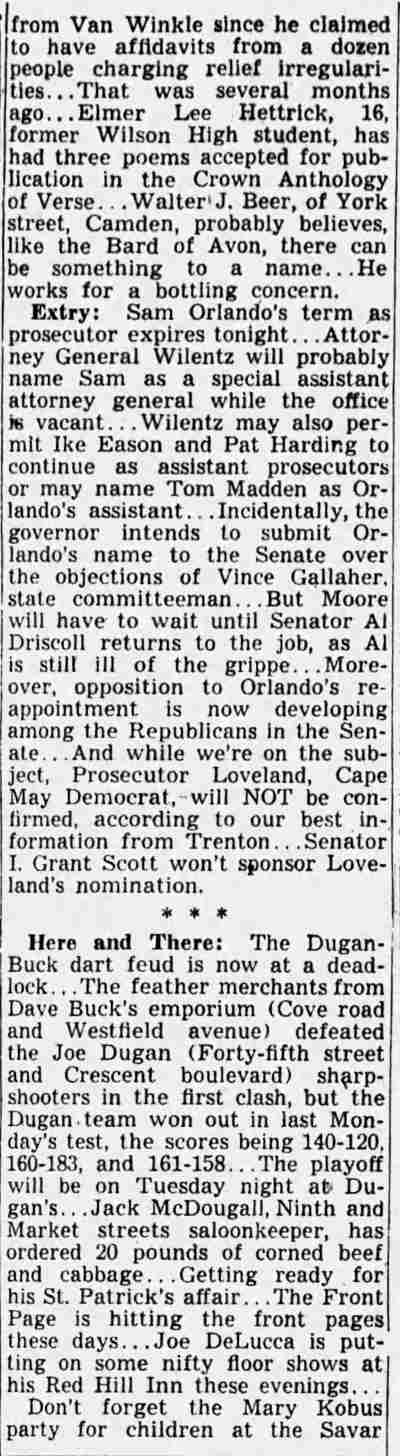
By JIMINY
Politix: The question mark of the budding city commission campaign is, of course, Commissioner Frank J. Hartmann. The latter was apparently defeated on the face of election day returns four years ago, but the organizations of Mayor George Brunner and Commissioner Mary Kobus put up the money to finance a recount. The result was that Hartmann was declared the winner, and the Brunner-Kobus-Hartmann majority ran the city’s affairs.
The results accomplished by the Brunner-Kobus-Hartmann administration have caused numerous persons, political and otherwise, to express the wish that the three commisioners [sic] run on the same ticket at the May election. Mayor Brunner and Mrs. Kobus are committed to run together, but to date Hartmann has made absolutely no move to join them. In fact, it appears that he has gone out of his way in an effort to antagonize them.
Moreover, his actions of the last week or so have created doubt in the minds of some observers as to whether he intends to run on any ticket, as a lone wolf, or not al [sic] all. The last point is easily answered. Hartmann himself declared this week: “I’m GOING to be re-elected!” Furthermore, he has been busy buliding [sic] up an organization of his own. Employes in his department have been ordered to form “Hartmann for Commissioner” Clubs in their wards. A campaign fund is being raised among his employes for his election expenses. He has been having conferences with County Treasurer Ed Kelleher, Democrat, and Irving Levinsky, a Verga Republican, among others.
But some of the things that Hartmann has done or attempted during the last few days has caused a goodly portion of our citizenry to wonder whether someone hasn’t been misleading Hartmann with a great deal of very bad advice.
For instance, this week Hartmann offered a departmental budget that exceeded his last year’s budget by approximately $90,000, which would have meant about a seven-cent increase in the city tax rate for 1939. That is just about political suicide before a city election, and is not at all in line with Hartmann’s past pledges and performances. As head of the finance department Mayor Brunner cut out the greater part of this unusual increase, and was justified in doing so to protect the taxpayers.
There were a few other unusual little affairs this week. Hartmann shouted “Liar!” at City Comptroller Sid McCord this week, but apologized later. “Sid” is probably the best liked city employe and certainly one of the most efficient public servants these last ten decades. One of Hartmann’s employes went to the comptroller’s office Monday—the city payday—and asked for all the salary checks for highway department employes.
Moreover, since his own extra-high budget was trimmed, Hartmann has had an employe going over the Brunner and Kobus payrolls to see how many were hired since 1936. His own payroll might be scrutinized in the same manner.
And his attitude at the budget hearing was not in line with his previous policies. While he and Brunner were arguing over Hartmann’s request for $7000 for playgrounds, Hartmann finally said: “If you want to cross it out, it’s okay by me.”
Then remembering a reporter was at the hearing, Hartmann asked the scribe whether he had jotted down that remark, and whether he intended printing it. The reporter replied he would print whatever he considered news.
“I thought this was a meeting to go over my budget,” commented Hartmann.
“It’s a public meeting to go over your budget, the sort of thing you always yelled for before you were elected,” the newspaperman reminded Hartmann.
“Well,” retorted Hartmann, doing an about-face, “see if you consider this news: I’m going to get up at the commission meeting and fight for $7000 for playgrounds.”
Personals: Charlie Swing, majordomo of the Farragut Yacht Club in East Camden, has bought himself a boat...The vessel is the “Helma,” which has been lying off Twenty-fifth street...It was sold by the U. S. marshal in admiralty and Charlie, with the legal aid of former Senator Al Woodruff, bought it in for $100...In its heyday, this little ship was worth about $20,000, and it has quite a history...For it was the ship you often saw in that old hair-raising thriller, “The Perils of Pauline”...Pearl White fell off it or was thrown off it quite consistently...Incidentally, Al Woodruff is off to the Virgin Islands to brush up on his Shakespeare and on his game fishing...Speaking of vacationing, E. Heulings Antrim, Merchantville’s director of public works, is in Florida...So is Bill Lehman, of the election bureau...And Funnies Fitz sent us a card from North Carolina a week ago, probably his last clarified mome[?]t...
Frank Van Never, a Camden Bridge policeman, and former Secret Service man during the war, is very ill at the Veterans Hospital in Philadelphia...”Red” Holder, the strongest man in the Campbell Soup A. A., is wearing a bearskin coat these days...He wrestled the bear for it...Hoseman Herbert Baxter, of No. 8 Engine Company, 619 Kaighn avenue, rounded out 20 years of service in the fire department this week...He has an unusual record...Another firefighter, John Peterson, of the Twenty-seventh street and Hayes avenue station, was operated on at West Jersey Hospital this week...The engagement of Miss Alberta M. Beaumont and Dale W. Petross (well known outdoor showman) was announced at Dempsey’s place in New York Saturday...Frank Donio, Republican member of the Winslow township committee, probably wasn’t any too pleased when C. P. Van Winkle and the Democrats begain [sic] calling his “Boss” Donio, but now he can laugh at it...He even gave out cigars with a wrapper bearing the legend “Compliments of Little Boss Hague Donio”...Incidentally, we haven’t heard from Van Winkle since he claimed to have affidavits from a dozen people charging relief irregularities...That was several months ago...Elmer Lee Hettrick, 16, former Wilson High student, has had three poems accepted for publication in the Crown Anthology of Verse...Walter J. Beer, of York street, Camden, probably believes, like the Bard of Avon, there can be something to a name...He works for a bottling concern.
Extry: Sam Orlando’s term as prosecutor expires tonight...Attorney General Wilentz will probably name Sam as a special assistant attorney general while the office is vacant...Wilentz may also permit Ike Eason and Pat Harding to continue as assistant prosecutors or may name Tom Madden as Orlando’s assistant...Incidentally, the governor intends to submit Orlando’s name to the Senate over the objections of Vince Gallaher, state committeeman...But Moore will have to wait until Senator Al Driscoll returns to the job, as Al is still ill of the grippe...Moreover, opposition to Orlando’s reappointment is now developing among the Republicans in the Senate...And while we’re on the subject, Prosecutor Loveland, Cape May Democrat, will NOT be confirmed, according to our best information from Trenton...Senator I. Grant Scott won’t sponsor Loveland’s nomination.
* * *
Here and There: The Dugan-Buck dart feud is now at a deadlock...The feather merchants from Dave Buck’s emporium (Cove road and Westfield avenue) defeated the Joe Dugan (Forty-fifth street and Crescent boulevard) sharpshooters in the first clash, but the Dugan team won out in last Monday’s test, the scores being 140-120, 160-183, and 161-158...The playoff will be on Tuesday night at Dugan’s...Jack McDougall, Ninth and Market streets saloonkeeper, has ordered 20 pounds of corned beef and cabbage...Getting ready for his St. Patrick’s affair...The Front Page is hitting the front pages these days...Joe DeLucca is putting on some nifty floor shows at his Red Hill Inn these evenings...
Don’t forget the Mary Kobus party for children at the Savar[words missing between crops] on Feb. 18...The now famous baseball film will be shown...The All Ireland Ball will be at Turner’s Hall, Broad and Columbia, Philadelphia, next Friday...The new storms have made Merchantville streets, particularly Maple avenue, look like Swiss cheese...The Public Service Drum and Bugle Corp, Post No. 231, was invited to participate in the Fortieth Annual Military Ball and Drum Corp Contest at the Arcadia Ballroom, Brooklyn, today...A red car was running around with one light an evening or so ago...
Peter McGlade, Gloucester City treasurer, is disappointed in the small number of old shoes he received for the WPA shoe-mending project for schoolchildren...A hot school election is brewing in Haddon Heights...Aside to Carl Christians: Joe Dugan has returned from the hospital sans operation; does that change Tuesday’s Battle of the Century?...Hank Collins’ cafe at Thirteenth and Samson is a popular nightspot with the local gentry...
The Feb. 23 reunion of the Cranmer School graduates of 15 or 20 years ago is gaining impetus...In addition to the “contact men” announced in this column last Saturday, Mrs. William Reed, the former Grace Cummings, 3006 Mickle street, is trying to locate members of the ‘20 and ‘21 classes...Dr. Richard Cranmer, 3416 Federal street, is handling general arrangements...Another aside...To Boots Pinner: How about getting our crew together and joining in on the festivities?
Crippled Children to Attend Outing
Camden Courier-Post —
100 Little Folks to Be Guests on Sgt. Ray Smith’s Birthday
More than 100 crippled children from this vicinity will be entertained at the seventh annual Sgt. Ray Smith’s crippled children’s day and birthday party, next Monday.
The party, an annual affair, is staged by the Elks’ crippled childrens committee and the Sgt. Ray’s birthday party committee.
The youngsters will meet at the Elks Home, 808 Market street, and will be taken to Clementon Park in buses where Theodore Gibbs, manager of the park will throw open the entire facilities of the park for the crippled children, staging a special show in the afternoon. A luncheon will be served at the park by the committee.
At four o’clock the youngsters will be taken to the Silver Lake Inn where a special amateur show will be staged on the lawn by the crippled children themselves.
Those who have been invited to attend are Mayor George E. Brunner, Congressman Charles A. Wolverton, Prosecutor Samuel P. Orlando, Firmin Michel, Albert E. Burling, Albert Austermuhl, secretary of the Board of Education, George I. Shaw, Mary W. Kobus, director of Public Safety; Dr. Henry J. Schireson, Camden county freeholders Robert Worrell, Mrs. Alice Predmore, S. Norcross 3rd, members of Veterans of Foreign Wars of Camden County Council and many business men and civic leaders.
The Wilkie Tragedy — December 1953
A difficult case that Samuel P. Orlando was only indirectly involved in was the tragic suicide of James S. Wilkie, son of a veteran Camden police officer, John V. Wilkie, in December 1953. The elder Wilkie and Orlando had worked together and been friends since the 1920s. For several days after the shooting, Sgt. Wilkie claimed that he had shot his son, in order that he receive a Catholic funeral. He retracted his confession after it became apparent that he could not deceive the city and county investigators, and was released after the grand jury refused to return an indictment.
This tragic case saw the involvement of many of Camden’s law enforcement and legal community, including Mitchell H. Cohen, Benjamin Asbell, Wilfred Dube, Thomas Murphy, James J. Mulligan, J. James Hainsworth, John Healey, and Joseph Bennie, among others.
Sgt. Wilkie Is Still Held in Jail, His Bail of $50,000 Unchanged
Camden Courier-Post —

Cut Considered After Retraction Of ‘Confession’
Police Sgt. John V. Wilkie, Camden’s notebook cop, remained in jail today in default of $50,000 bail despite his admission Thursday he “confessed” accidentally killing his son in an effort to have full burial rites of the Roman Catholic Church accorded the youth.
Wilkie’s admission of the fabrication as a desperate self-sacrificing attempt for his son came Thursday afternoon after he learned the church had reiterated that his son, James, 17, could not be given requiem rites and be buried in consecrated ground.
Wilkie admitted that when he returned to his home, at 1144 Princess ave., at 2.18 a. m. Sunday, he found his son dead of a revolver shot instead of having been shot in a struggle with Wilkie for the latter’s service revolver.
Services for Wilkie’s son will be held Monday at 11 a. m. in the Robert J. Blake Funeral Home, 851 Haddon ave. Burial will be in New Camden Cemetery, Mt. Ephraim and Ferry aves., a nondenominational cemetery. There will be a public viewing at the funeral home Sunday night.
Wilkie, a member of Sacred Heart R.C. Church, Broadway and Ferry ave., will be permitted to attend the services under guard.
Asked about the continuing high bail, Prosecutor Mitchell Cohen said there has been “no request from Wilkie nor his attorney, Elmer Bertman, for reduction of bail.”
Favorable to Lower Bail
Cohen, however, continued, “In light of the new circumstances, I certainly would entertain such a request.” He continued:
“In view of the holiday weekend, I probably won’t be in my office until Monday. Nor is the sheriff’s office open during the weekend to receive the bail.
“It would be necessary to contact me with a request for bail reduction and also to make special arrangements with Sheriff Hainsworth to post the bail.”
Late Thursday, Cohen told reporters he had no alternative but to present all of the facts in the case to the grand jury and “let them decide.”
Tells of Repudiation
“In the presence of Chief Mulligan and Capt. Dube of the county detectives staff; Capt. Murphy of the Camden City detective bureau; Samuel P. Orlando as a friend of Wilkie’s, and Fred Albert, court stenographer, Wilkie has made a statement which repudiates a ‘confession’ he made to me earlier this week.
“He states that he found his son, James, dead of a gunshot wound when he returned to his home early on the morning of Dec. 20.
“Wilkie states that he concocted his story that he and his son wrestled over possession of the gun, which was Wilkie’s service revolver, and that the gun was discharged accidentally.
Father Denied Suicide
“Wilkie told us he had determined to do everything within his power, say anything and be willing to take any kind of punishment, in order to obtain a Catholic funeral for his son.
“He still insists that his son did not commit suicide, that he had just bought some new clothes and had said or done nothing to indicate he might take his life.
“I must say here that the facts available to us do not coincide with a theory of accidental death.
“After Wilkie had made his ‘confession’ to us, we had him illustrate several times with county detectives how he said he tussled with his son. We knew then the son could not have been accidentally shot in such a struggle.
State Police Tests
“All tests by state police laboratories and our medical reports clearly evidenced Wilkie was not telling the truth.
“The bullet entered one temple and emerged from the other on a straight line instead of at an angle. The course the bullet took made it clear the shot was fired with deliberation by a gun held in the decedent’s hands or in some other hands.
“Since a complaint has been made and a court has instructed me to present this matter to the grand jury, I must do so. Therefore the charge of manslaughter will remain pending the grand jury’s deliberation.”
Wilkie, according to Sheriff Hainsworth, spent a “restful day” Christmas in a cell in E block on the sixth floor of City Hall.
The sheriff said Wilkie was in “good spirits and talked frequently with other prisoners.”
‘Larry’ Doran Given Tribute at Dinner On Retirement as Head of Co. Sleuths
Camden Courier-Post —
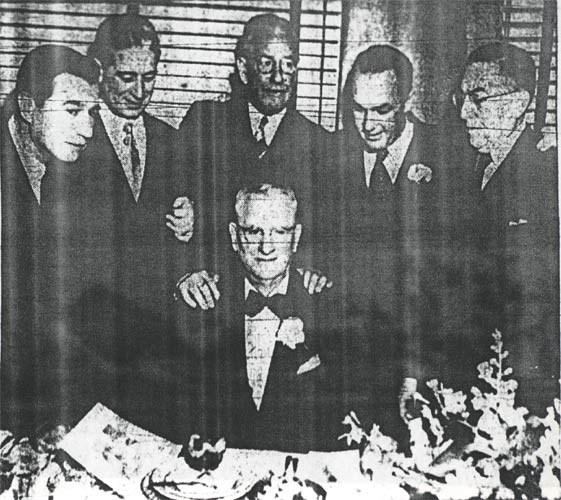
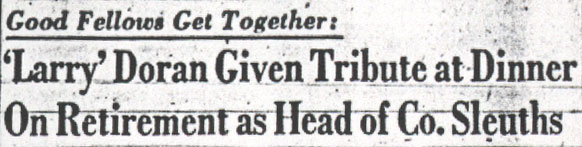
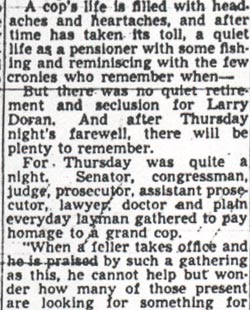
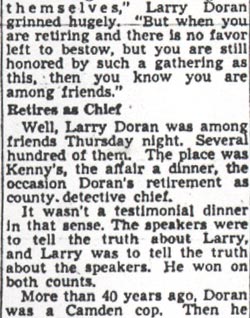
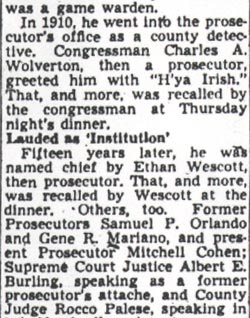
Good Fellows Get Together:
A cop’s life is filled with headaches and heartaches, and after time has taken its toll, a quiet life as a pensioner with some fishing and reminiscing with the few cronies who remember when—
But there was no quiet retirement and seclusion for Larry Doran. And after Thursday night’s farewell, there will be plenty to remember.
For Thursday was quite a night. Senator, congressman, judge, prosecutor, assistant prosecutor, lawyer, doctor and plain everyday layman gathered to pay homage to a grand cop.
“When a feller takes office and he is praised by such a gathering as this, he cannot help but wonder how many of those present are looking for something for themselves,” Larry Doran grinned hugely. “But when you are retiring and there is no favor left to bestow, but you are still honored by such a gathering as this, then you know you are among friends.”
Retires as Chief
Well, Larry Doran was among friends Thursday night. Several hundred of them. The place was Kenny’s, the affair a dinner, the occasion Doran’s retirement as county detective chief.
It wasn’t a testimonial dinner in that sense. The speakers were to tell the truth about Larry, and Larry was to tell the truth about the speakers. He won on both counts.
More than 40 years ago, Doran was a Camden cop. Then he was a game warden.
In 1910, he went into the prosecutor’s office as a county detective. Congressman Charles A. Wolverton, then a prosecutor, greeted him with “H’ya Irish.” That, and more, was recalled by the congressman at Thursday night’s dinner.
Lauded as ‘Institution’
Fifteen years later, he was named chief by Ethan Wescott, then prosecutor. That, and more, was recalled by Wescott at the dinner. Others, too. Former Prosecutors Samuel P. Orlando and Gene R. Mariano, and present Prosecutor Mitchell Cohen, Supreme Court Justice Albert E. Burling, speaking as a former prosecutor’s attache, and County Judge Rocco Palese, speaking in behalf of all assistant prosecutors—and they were legion—spoke of his unflagging devotion to duty, his perseverance and his loyalty. U. S. District Judge Thomas M. Madden, Superior Court Judge Frank T. Lloyd Jr., whose father knew Doran well while a Supereme [sic] Court Justice; Superior Court Judge Ralph W. E. Donges, and County Judge Bart A. Sheehan, the principal speaker, all lauded Doran not only as a law enforcement officer but also as an institution in the community.
There were many fellow police officers on hand, too. They included Assistant Superintendent of Philadelphia Police George Richardson, who presented Doran with a season pass for the Athletics on behalf of Connnie [sic] Mack; Capt. Thomas Cunningham and Lt. William Kelly of the state police. Chiefs John Parker of Audubon; Thomas Thorpe, of Pennsauken; William Beck of Collingswood; William Snyder of Haddon township; William Padgett of Haddonfield; County Detective Chief George Small of Gloucester; County Detective Captain Clinton Zeller of Burlington, and detectives from Mercer and Atlantic counties.
Receives $500 Bond
Many other public figures were there, including State Sen. Bruce Wallace, Assemblyman George Neutze, County District Judge Edward Martino, City Police Judge John DiMona, city and county officials, and the entire personnel of the prosecutor’s office.
The dinner committee was headed by Anthony Mitchell and [text missing between crops] presentation of a $500 savings bond to Doran, but the highlight of the evening was Doran’s impromptu remarks of appreciation. He spoke with the humility of a man overwhelmed by the eulogies he had heard applied to himself, reminisced humorously, and capped the best address of the evening by resting his case with the summation:
“A cop’s life is filled with headaches. And sometimes he causes heartache. I have enforced the law as I saw it without favor. I did the best I could. And I have no apologies.”
Crippled Children’s Party Tomorrow
Camden Courier-Post —
41st Annual Affair
The Crippled Children’s Committee of Camden Elks Lodge 293 will sponsor its 41st annual party for crippled children tomorrow.
S.S. Norcross 3rd, exalted ruler of the lodge, and Edward J. Griffith, president of the Crippled Children’s Committee, said the children will board buses at 10:30 AM at the Elks’ home, 807 Cooper Street.
First stop will be Sergeant Ray Smith’s home on Lake Renee, where the children will have their annual picnic lunch. Following lunch they will ride horses from the Persian Acres Dude Ranch operated by County Detective Robert Di Persia.
Erial Fire Company will pick up the children for a ride to the Nike Missile Base in Erial, then onto Clementon Lake Park. Following dinner in the Chick Barn at Silver Lake Inn, the youngsters will return to the Elks’ Home.
Among those helping Sgt. Ray celebrate his 72nd birthday at Silver Lake Inn later in the evening will be former Judge Samuel P. Orlando, Congressman John E. Hunt, Jersey Joe Walcott, Mayor Alfred Pierce and state Senator Frederick J. Scholz and recently appointed Prosecutor A. Donald Bigley.
Bosco Committed to County Jail Cell
Camden Courier-Post —
Barber Held in Slaying Case Pending Formal Indictment by Grand Jury
Sam Bosco, mid-city barber, was held for the county prosecutor’s office on the charge of murder, following court action yesterday termed by Police Judge Gene R. Mariano as unprecedented in Camden legal annals.
Prosecutor Samuel P. Orlando announced he tried to bring the grand jury together for action in a true bill against the prisoner. The members had scattered so widely, however, they could not meet, but the true bill is expected Friday, when the jury makes its presentment.
Bosco is cited in connection with the death of Angelo Magalas, restaurant chef who died as a result of a holdup of a card game at 725 Penn Street, January 10. Magalas was shot in the arm during the crime, and the wound reputedly hastened his death from another ailment from which he was suffering.
Arrested at Jury Room
The action against Bosco follows an odd legal path. The barber was waiting to be called by the grand jury as a witness into the death of Magalas, for which Frank Luggi is now sought.
While Bosco was sitting in the anteroom awaiting his call before the grand jury, Detective Thomas Murphy placed him under arrest.
At the time it was believed a true bill had been found against the man, but it has developed the arrest was on a warrant obtained by Murphy.
When Bosco arraigned yesterday it was revealed the charge was murder, but he was held under the warrant which Murphy had obtained, and the grand jury had not found the true bill to date.
The court was puzzled as to the action that could be taken in the case, but Judge Mariano said he remanded Bosco, on the wish of the prosecutor who told the court he would summon the grand jury to act on Bosco’s case.
“I was informed the grand jury would be summoned,” said Judge Mariano, “and I know the prosecutor did get in touch with some of the members, but they were not all available to sit.
Held for Prosecutor
“Hence the prosecutor may bring them today, tomorrow, or any other day that suits. No case such as this has ever come to my attention, and I simply acted to aid the county prosecutor’s office, and to put Bosco in charge of the county officials and out of the city’s hands, where I do not believe the case should rest at present time.
“I suggested to Prosecutor Orlando that it would be well to obtain a bench warrant in order to hold Bosco, and he agreed with me at that time. We also called in John L. Morrissey, counsel for Bosco, and I understand that he agreed with the procedure I had outlined.
“So I held Bosco to await the action of the county prosecutor’s office and he is being held a prisoner under those exact circumstances. Bosco is charged with murder now.”
Hearing Held Unnecessary
Bosco appeared in court unkempt, unshaven and handcuffed on complaint by Detective Murphy that on Jan. 10 Bosco “did feloniously and willfully murder, kill and slay” Magalas in a card game holdup was not read to the prisoner and he was not even asked to plead.
“For the purpose of the prisoner being committed to the county jail pending a further hearing next Monday, there is no necessity for a hearing at this time,” said City Prosecutor Cohen. “He has already been indicted.
“The usual procedure is to hold a hearing only when there has been no action by the Grand Jury, but in this case, the indictment having been found, it is necessary only to send him to the county jail on the strength of the indictment.”
John L. Morrissey, Bosco’s attorney, objected that no indictment officially has been presented, the Grand Jury not being scheduled to make its formal presentment until Friday.
“Detective Murphy,” Cohen replied, “was instructed last Friday by the Grand Jury to take this man into custody because an indictment had been found. If counsel insists on production of the indictment, I believe the case should be postponed until Monday.”
“In three days,” Morrissey argued, “we have been able to obtain absolutely no information regarding the evidence or witnesses. There is no indictment officially. Of course, it is common gossip that the defendant has been indicted, but neither the county nor the city seems to know what to do with him. I think some evidence should be presented to show us why he is being held.”
Murphy interjected that both the Grand Jury foreman and Assistant Prosecutor Patrick J. Harding had instructed him to arrest Bosco, but Morrissey replied that “that is only hearsay evidence.”
Jury To Be Called
“I have been in touch with County Prosecutor Orlando,” Judge Mariano explained, “and he is going to call the Grand Jury together as soon as he can to make a special presentment.”
“Well, what is our status here?” inquired Morrissey.
“He is a county prisoner,” said Mariano, “the city has nothing to do with it. If an indictment has been presented, the county would be able to have the defendant. I see no harm committing him until further action by the Grand Jury.”
Morrissey then asked that bail be set. Cohen objected on the ground that the court had no legal right so to do. Mariano said he had the right but would not set bail.
“This is the first time I ever saw a defendant held without evidence or testimony,” remarked Morrissey.
“There will be plenty of witnesses when the time comes,” Cohen answered.
“What do you know about it?” Morrissey shot back. “You don’t know anything about it. You don’t even know who the witnesses will be.”