Gordon MacKay
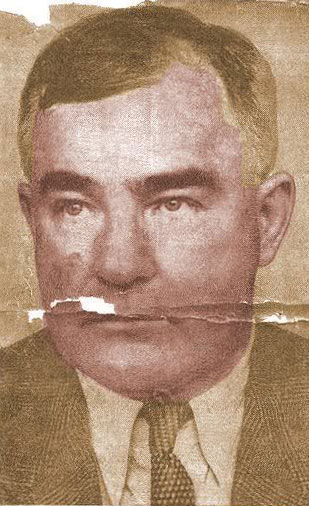
Gordon MacKay
GORDON MACKAY was born Massachusetts on August 27, 1877. He began working in journalism in Boston in 1895, and came to Philadelphia in 1909.
By 1911 he was employed by the Philadelphia Times, and his columns on baseball were already being circulated nationally. In early 1913 he was working as a sportswriter for the Cleveland Leader, and was already well known as a sports reporter. He returned to Philadelphia, and worked as sports editor for the Philadelphia Press, the Philadelphia Inquirer, the Philadelphia Public Ledger, and lastly the Philadelphia Record. He also covered general news stories. By 1935 Gordon Mackay had come to work in Camden, as a featured columnist and reporter with the Camden Courier-Post.
He married to Inez Kane around 1913 at the age of 35. Gordon and Inez Kane Mackay were living with Inez’ mother and siblings at the time of the 1920 census, at 2229 North 13th Street in Philadelphia. Gordon Mackay was already working as a newspaper reporter in Philadelphia by this time. By 1925 he was working for the Philadelphia Inquirer, and was referred to in one of the Inquirer’s advertisements as “That king of baseball writers and recognized authority on boxing, wrestling, and other sports.”
In 1930 Gordon Mackay was sports editor of the Philadelphia Record. Gordon and Inez Mackay were living in April of that year at a home they had bought at 5850 Pendridge Street in Philadelphia, with their three children, Gordon J., Elizabeth, and Jane.
Gordon Mackay was one of 13 reporters who in 1931 made up a panel responsible for picking the American and National League All Star Teams, which in those days were post-season awards, as the mid-season All Star Game had not been instituted yet. In November of 1931, he wrote a column for Record which was reprinted in the Frankford Gazette of Northeast Philadelphia, concerning the demise of the Frankford Yellowjackets, an early NFL franchise.
As stated above, by 1935 Gordon Mackay was writing for the Camden Courier-Post. In Camden he wrote about more than sports. His column, which was published several times a week, was entitled Is Zat So? A wonderful writer with a great command of the English language, Mackay wrote on a variety of subjects, and seemed to be acquainted with virtually everyone in Camden and Philadelphia, great and small. A prolific worker, Gordon Mackay was still covering the news for the Courier along with writing his regular column.
Gordon Mackay passed away at the state hospital in Trenton New Jersey on February 16, 1941. He had been in hospital for 18 months. His health had declined after the death of his wife on December 31, 1938.
Tommy Loughran Has His Work Cut Out For Him When He Faces Tunney
Philadelphia — 1922
Down by the sad sea waves that billow their way to the sands of Wildwood, Tommy Loughran, the real Adonis of the padded mitts, is finishing his training for another ambitious fight for the nineteen-year-old lion of the hour in fistic Philadelphia.
On Thursday night Tomasco intends to wallop Gene Tunney, and of course, Gene expects to interpose considerable objection to any such intentions on the part of the South Philadelphia battler.
Loughran looks like the best bet that boxing devotees of this city have to wear a crown later in his young life. Nineteen years old, tall, and put together in fine symmetry and ample preparations, Tommy has a long ring career ahead of him if one of those tough birds do not make him a wreck and total loss long before his time.
Fighting Tunney cannot be called easy. Gene is a real fighter, first in the trenches of Flanders and next in the resined arenas of his homeland.
Rise to Fame Rapid
His rise to fame and fortune were rapid and his descent out of the chains speedy. Managed and chaperoned by a wily manager, who knew how to bring his lad to the eminence and peak in jigtime, Tunney has had a profitable career under the foxy and wise Doc Bagley, who has had a stable of fighters since the days when Hector was a pup.
He picked Tunney out of the fistic flotsam and jetsam that the war tossed upon the shores of fighting America, and Doc showed excellent judgment and a keen mind for getting the ducats as revealed in the splendid record which Tunney accumulated in the past few years.
Gene mounted the ladder of fame by leaps and bounds. So rapidly did he move his way upward that he was signed for a bout with Battling Levinsky, the Doctor Jekyll and Mister Hyde of the boxing circles.
As Barney Williams, this fighter did not accumulate much except muscles on his legs from running around the ring. But as Battling Levinsky, with Dan Morgan as his mentor, the Quaker City boxer made a goodly pile of grit and also acquired a title, somewhat shopworn and marked down, but a title, nevertheless.
Was Proud Possessor
It was called the light-heavyweight championship, whatever that may mean. But, whatever it was, Barney Battling held it. He was its more or less proud possessor on the evening he first made the intimate acquaintance of Eugene Tunney, Esq.
Gene poked Barney around something scandalous on that occasion and wound up by yanking that title right off Barney’s curly bean. Gene wore the bauble until the night he lured Harry Greb, the Pittsburgh Kangaroo and shimmy dancer, into the ring.
When these boys bade farewell to the spectators Harry wore the crown and Gene wore divers and sundry bruises, inflected with more or less severity by the victorious Stogieman.
Greb came over here and fought Loughran several weeks ago, and while in the opinion of this writer Greb was entitled to a shade, there were numerous spectators among those present who thought that the laurel and the garland should roost on the clammy brow of Thomas.
Fight Was Close
The fight was close and very even, but the knowledge and ring craft of Greb gave him the verdict, so far as the opinion of this humble disciple of the typewriter and papyrus was concerned.
Now Loughran takes on Tunney and the latter will prove to be no cinch. If Tommy has learned something from his bout with Greb he may eke through a winner, but Tunney is no mark for anybody.
Gene can box and is long and rangy. He has had more experience than the handsome Thomas. But the latter is always ready and willing and has supreme confidence in his own ability to put the bee to the visiting fireman.
Thomas Apollo is a fine drawing card at the gate, and it is possible that South Philadelphia will flit through the turnstile in a steady parade to watch its favorite and idol in action. The Phillies’ park, where the impresarios will conduct these fistic melees, is adequate to hold the crowd, and a good night’s programme should ensue.
The Loughran-Tunney bout is the headliner, but there are other numbers on the card that shape up tolerably well too. Earl France, dignified collegian, with an intelligent knowledge of how to handle a foe, is due to mingle responsive dukes with George K. O. Chaney, whose left hand is as poisonous as a viper’s caress.
A lightweight bout in which much will be at stake will bring together Pal Moran, of New Orleans, and Harry (Kid) Brown, of this city. Moran, who has fought Benny Leonard twice, aspires to be the next opponent of Lew Tendler.
Lightweights also will appear in the other two contests. Joe Tiplitz and Joe Benjamin have been matched for the second number while Kid Wagner, of this city, and Earl Baird, of New York, will fight in the opening contest.
* * *
Ten Best Bouts Fought By Loughran and Tunney
Tommy Loughran: Jimmy Darcy…13…W; Young Fisher…12…W; Mike McTigue…10…N.D.; Jackie Clark…8…N.D.; Fay Kaiser…8…N.D.; Bryan Downey…8…N.D.; Harry Greb…8…N.D.; Vinnie Lopez…5…K.O.; Frank Carbone…8…N.D.; Len Rawlins…6…N.D.
Gene Tunney: Battling Levinsky…15…W; Harry Greb…15…L; Charley Weinert…12…N.D.; Whitey Wenzel…8…K.O.; Sergeant Ray Smith…2…K.O.; Sergeant Ray Thompson…3…K.O.; Fay Kaiser…10…W; Jimmy Darcy…12…W; Jack Renault…10…W; Clay Turner…8…W
Pottsville Is King
Philadelphia Inquirer —
Speaking of champions, and who can mention the name of the Pottsville Maroons without speaking of champions. The Chicago Cardinals are trying to cloud the title to the kingship by framing up a pretty putrid sort of buncombe. But the Cardinals can frame their stuff. Joe Carr as president of the National Pro League can rant and rave and gesticulate and ban, the Westeners can rail and bluster, but where-ever the football fan reads the dope, Pottsville is the professional champion of football.
Pretty scurvy trick that worked, we’ll inform the universe. The Cardinals, in order to tie Pottsville and thus place themselves in alignment, for a battered crown, revived the disfranchised Milwaukee team and beat them. To form an eleven, to have a sufficient ensemble aboard the field, four Chicago high school boys, we are informed, were imported for the occasion. The names of the kids escape us for the minute, but we understand they have made a clean breast of the whole affair.
Pottsville has been the target for a lot of official acts since the Maroons came down here to play the Four Horsemen. They invaded territorial rights, but verbal permission was given to them, and it was the official who was to blame and not Pottsville.
But the strangest part of the whole matter is how the Chicagoans hoodwinked themselves. They had never seen the Maroons in action, as we understand, and thought Pottsville had some sort of hick team, comprised of boys who carried straws stuck in the corner of their mouths and who had to currycomb their hair every morning to get the hayseed out.
So the Cardinals merrily challenged the Pottsville boys to play a game in the Illinoisan metropolis. Doc Striegal, manager of the Maroons, wired and asked if it was for a title.
Thought It Was Easy
Covering their face with their hands to smother the broad smile that curved their manly lips, the Cards wired right back and said it was for the title surely. Certainly, certainly. Who were these hicks from a jerkwater burg named Pottsville who thought they could beat the great Cardinals of the greatest city of Illinois? Faugh! Perish the thought! Well the Maroons went out to Chicago and took the Cardinals just as the exalted General Grant took Richmond. Didn’t take the Maroons quite so long as it took U.S.G., but it amounted to the same thing.
So bitterly disappointed were the Chicagoans over the fact that they had tossed away their own title that the manager is said to have broken down and wept. Not figuratively speaking, but actual tears did the noble-hearted son of the wide open space shed. Then came this hodge podge known as the victory over Milwaukee and now the Cardinals feel they have a chance for the title. But we’re just the same as the Veteran Athletes. So far as we are concerned we sat at the banquet board of the champion football players in the world of the commercialed cowskin, and that goes for us to the end of the chapter.
Furthermore we want to say that whenever you speak of sports in the coal countree, you speak of SPORTS too. Pottsville handed the crown, the laurel, the bay and the garlands to their heroes, and did it niftily, ornately and meritoriously. But that isn’t all they handed to them. They got a brown traveling bag that made the writers mouth water. They got gold footballs, they got sweaters, they got jeweled emblems, they got a lot of presents, and everyone of those boys knew there was a Santa Claus before Pottsville got done showering them with gifts.
Merited His Praise
No wonder Herb Stein, the peerless center said to this writer, astonishment in every word, surprise in every tone.
“Did you ever see anything like it? I wouldn’t expect anything like this from a college, but to a professional team. By gee, it’s wonderful!” Wonderful was the very term.
Incidentally Pottsville is going out and do its football on a big scale next season. It wouldn’t be a bit surprising if a stadium with a capacity of 15,000 were built, and the Maroons given a throne in keeping with the dignity of their rulership. But stadium or no stadium, Missus Pottsville’s football family are all Maroons, and they are the champions of the world.
Laugh off that one, Chicago—
Gordon MacKay Writes About Yellow Jackets
Frankford Gazette —
Expresses Regret At Passing of Great Gridiron Machine
Gordon Mackay, well known sports writer in “The Philadelphia Record” on Monday, had this to say of the Frankford Yellow Jackets —
“The current depression and internal troubles appear to have doomed professional football in Frankford. The mere fact that Shep Royle quit active connection with the eleven, that Louis Castor, one of the pioneers in founding the eleven, brought suit and that the players have decided to travel, bring vividly to mind that the Jackets seem to have reached the end of the trail. The principle reason for a dubious future lies in the idle looms of the district. Frankford is a textile center, and when looms are not humming and cotton and other staples not produced, the prosperity of the community is seriously endangered, and sport suffers along with other things.
No matter the future nothing can dim the prestige, power and advertising the Yellow Jackets brought to a thriving home and prosperous community. For years and years an intercommunity rivalry existed between Frankford and Holmesburg. Geography and sport conspired to create a natural enmity between the villages, an enmity that existed not only along the broad lines of sport, however.
The annual football duel between these rivals was one big autumn festivity in that section. Victory had adorned the banners of both until finally Frankford had an enormous idea, a great vision. Professional football was pushing its nose at this time and Royle, Castor, Howard Bowker and others of the invincibles determined on a plan so radical as to stamp Frankford as its originator.
The community would enter the National League of Professional Football. This idea might seem trite nowadays, but fifteen years or more ago, when Frankford broached the proposition, it was not only one of the most radical steps in sport, but one of the most dramatic attempts around here in many seasons.
Frankford Showed Great Civic Spirit
Skeptics abounded on every hand. New York, Chicago, cities of that size might support a professional football team. But Frankford? Bah! Here were Penn, Temple, Villanova, a host of colleges all drawing football support from the army who marched to the gridiron stands every week-end.
But the soul of the adventurer and the iron of the pioneer were in those young men of Frankford. They formed the Frankford A. A., subscribed for its stock, swept a big community idea right into the consciousness of the Northeast. It was the first time a community the size of Frankford dared brave the wrath of the gods and dared to launch a project of such size and moment.
The noble experiment in Frankford was watched with eager and intense eyes at home and abroad. Shep, Howard, Lou – all lads who made the Jackets a landmark in Frankford, all plunged ahead with lusty spirit and growing funds. Behind the team marched a solid phalanx of support, the community of Frankford.
The first season was weathered. These doughty lads masked their home address under no municipal costume. No sir, these lads who went here, there and everywhere to play, East and West, were the FRANKFORD YELLOW JACKETS. The name of the community wandered about the whole world, and parts of the nation where pro football teams dwelt became Frankford conscious.
It was the greatest advertising the community ever had. It did more good than 100 orators and was of more value than 200 ballyhoos. Frankford football spoke for itself and its community. Within a few years the experiment was stamped with success and doubt and trepidation no longer existed in Frankford on the El.
Once, perhaps twice, the championship was won and added laurels came to the players and added luster to the community. The Frankford idea spread into Green Bay, Wis., and Portsmouth, Ohio.
Crash Imminent, Dissolution Inevitable
It was always with a mind that could sense progress that these pioneers dealt with the question of football in Frankford. It was always with a point of view where money wasn’t the ultimate to be considered. In fact, these adventurers and experimenters never profited a cent personally from football – all the money was given to community projects, hospitals and other institutions of like nature and value and use.
So Frankford and its football became a fixture and folks paid less attention outside. Frankford’s place in pro football was firmly and definitely established. We hope our outlook is wrong, we hope that Frankford remains secure in its old place. But things look doubtful, and let us hope that such a community drama, a community adventure, shall not perish from the gridiron.”
Is Zat So? — Princeton University Football
Camden Courier-Post —

Gordon MacKay’s “Is Zat So?” column on Princeton football, October 12, 1932
Is Zat So? — Joe Hamilton and the Labor Temple
Camden Courier-Post —
FIFTY years rolled away in the twinkling of an eye the other day and once more we sat in the peanut gallery of the Old Howard listening to “Alexander” tell his trials and tribulations to “Henry Clay Jones.” You youngsters of 40 perhaps do not know those distinguished thespians, but ask dad, he knows.
He’ll tell you all about McIntyre and Heath. Jim McIntyre, now called to join the celestial choir, while Tom Heath, at 84, still lives in stage memories that can never fade, for him or those who witnessed the famous “Georgia Minstrels.”
McIntyre & Heath were as familiar to the average eye as ham and eggs, bread and milk, coffee and sugar for 60 years. Perhaps, no team in the history of Thespis ever existed so long together. Even now the eye dims a mite to think that the kids of today have no chance to see the lugubrious Alexander, taken away from “his good job in the livery stable,” to travel with a minstrel troupe that usually was stranded and never billed.
The reason that memory took a nose dive into the past was Joe Hamilton. Joe, now a veteran trouper himself, intends to give Camden a treat on December 10, when he’ll put on an old time minstrel show in the Labor Temple.
This veteran will gather about him the boys who were the stars of blackface years ago. While many will be missing in the flesh their ghosts will hover over the circle as end men crack their jokes, and the interlocutor puts the questions glibly and often to that immemorial “Mr. Bones,” without whom no minstrel show is complete and no production is a minstrel show.
Joe Hamilton Real Veteran
Joe Hamilton himself was one of the best of all minstrels, a trouper who still hankers for the banjo and the burnt cork. To prove that this venerable hoofer still can slap down those soft shoe as agilely as he did in days of yore, Joe may dance a bit after the interlocutor rails for the “opening number” 15 days before next Christmas.
The veteran minstrel was born in Kensington, or to be more specific, in Fishtown. That means perhaps little to the resident of Camden, but “Fishtown” has a physical identify that makes it still apart from Philadelphia, although it remains its Sixteenth ward.
Joe, like all other gamins of the district, won his first spurs as a thespian when he was the winner of an amateur night, given at one of the local theatres in his district. It was a few steps, and we mean steps literally and figuratively, for Joe was a dancer, in the parlance of the profession “a hoofer,” that took Joseph from the amateur ranks to those of professional entertainers.
As a minstrel and an actor he traveled all over the country, and believe it or not, Mr. Ripley, while Joe has reached that allotted span of threescore and ten, he can hum a mean number, warble a fine ballad or topical song, and throw a few steps that would make the average hoofer look like a contortionist.
For 38 years after that fateful amateur night, Joe was on the stage. He played with McIntyre and Heath, and one of his proudest memories is the offer that McIntyre made to Joe, asking him to take Heath’s part, when that veteran performer had become ill and wanted a rest. Joe was a pal of all the great song writers and songbirds of an era that alas, has passed away, to the sadness of the trouper and the utter woe of those who sat and heard them in the good old days.
Old Pals Have Passed Away
It fell to our lot to know personally many of the old minstrels and singers whose names were those of the friends of long ago to Joe. First was the late Hughie Dougherty, who was one of Frank Dumont’s minstrels, in the heyday of that minnesinger in the old Arch Street Theatre.
Hughie and myself were strong friends. We were together on a training trip with the Athletics to Atlanta in 1910, when Connie Mack was piloting the team that later in the year was to give the lean leader his first world champion baseball… Hibernian brogue under… the patois of the blackface comic is a secret which he alone knew and he never told me, anyway.
Then Joe and Jimmy Thornton were buddies. Jimmy, who wrote “When You Were Sweet Sixteen,” “My Sweetheart’s the Man in the Moon” and other song hits of another and to my mind, a more melodious day, was also a friend of yours truly.
One of the Christmas cards we especially treasure every Yuletide is from Jimmy, who now lives in Long Island. Jimmy, in the days when he and his grand wife, the late Bonnie Thornton, were headliners, liked to dwell where wassail prevailed. It was during those moods that good old Irish melody spurred him to write some of “the most singingest” songs that were “ever warbled by a barbershop quartet, or by strolling minstrels, standing by the old board fence in the light of the moon.”
Make no mistake about Joe Hamilton, either. A little troubled and beset by his old enemy rheumatism, he has days when he doesn’t feel so chipper, but usually he is a grizzled old veteran who wears well and defies Father Time to give him a bust in the nose.
Agile in mind and “trippety” on his feet yet, Joe wants to show the youngsters of today a real minstrel show. The thespian spirit and traditions of the stage have hit the Hamilton family in another direction, too.
One of Camden’s prettiest contributions to stage, screen and radio is Kay Hamilton, or otherwise Mrs. Peter Trado. Winsome and petite, Kay has delighted thousands upon thousands with her singing over the air, in musical comedy and talking pictures. If possible, she’ll be along to help Dad in his coming minstrel show, which will be the goods.
Is Zat So! — January 3, 1938
Camden Courier-Post —
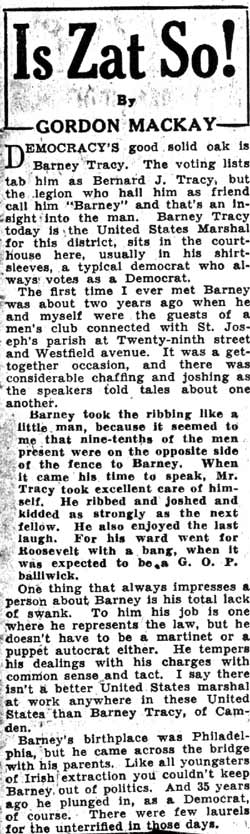
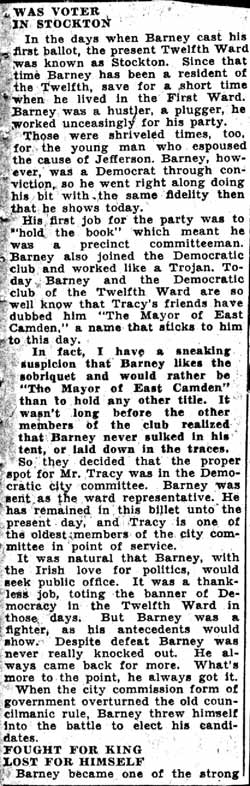
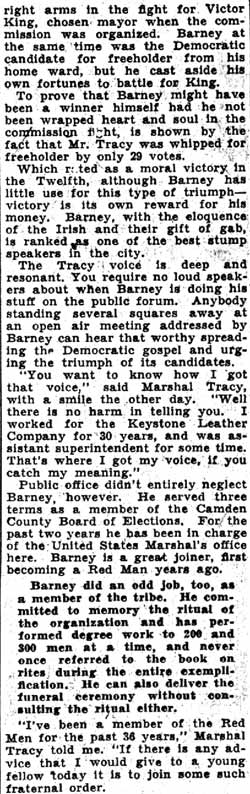
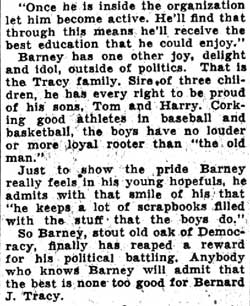
Is Zat So! by Gordon MacKay, Camden Courier-Post, January 3, 1938 — East Camden, Bernard J. “Barney” Tracy
Is Zat So! — January 4, 1938
Camden Courier-Post —
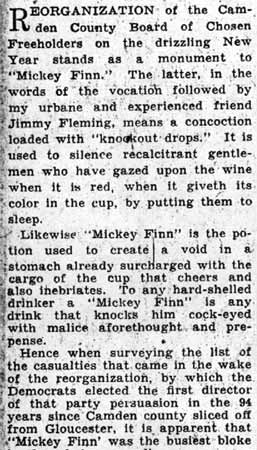
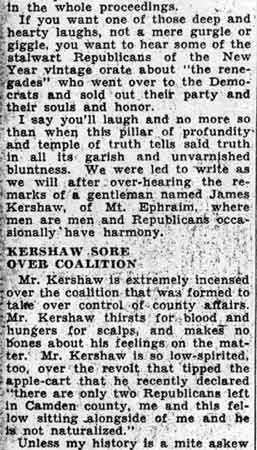
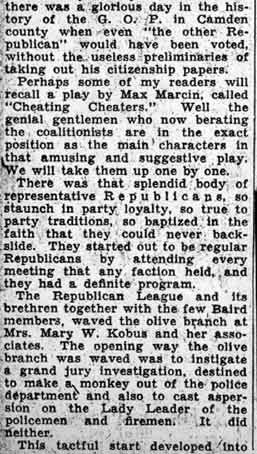
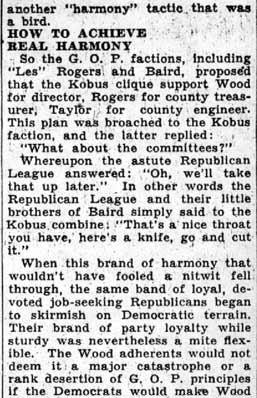
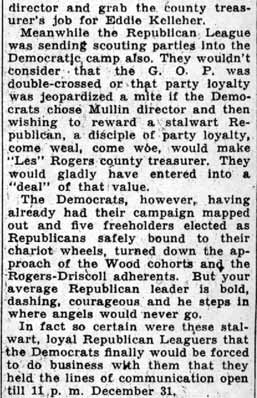
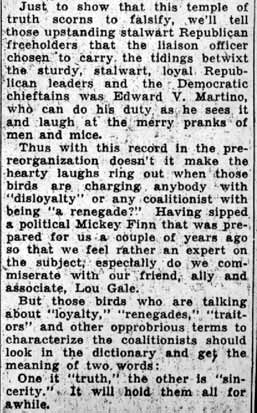
Is Zat So! by Gordon MacKay, Camden Courier-Post, January 4, 1938 — Republican Politics in Camden County
Is Zat So! — January 5, 1938
Camden Courier-Post —
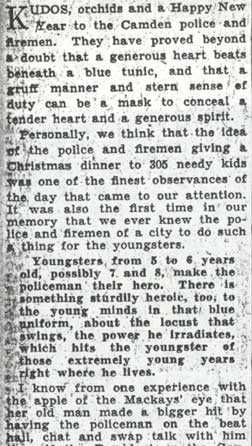
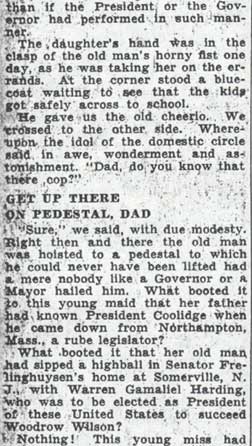
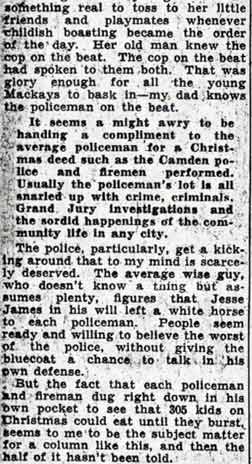
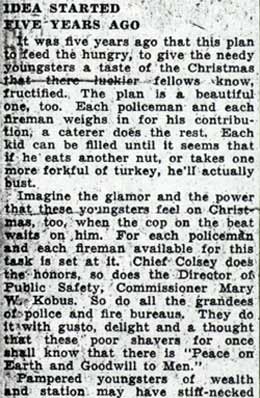
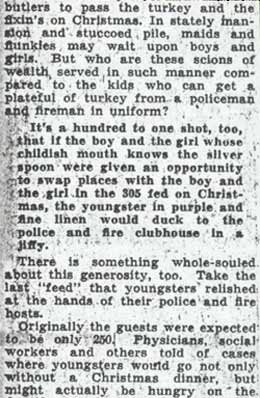
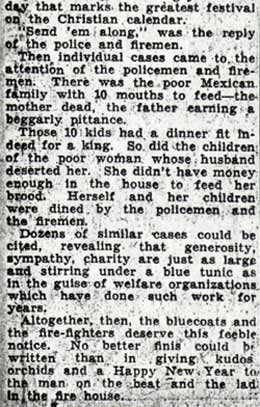
Is Zat So! by Gordon MacKay, Camden Courier-Post, January 5, 1938 — Camden Police Christmas Charity Activities
Is Zat So! — January 7, 1938
Camden Courier-Post —
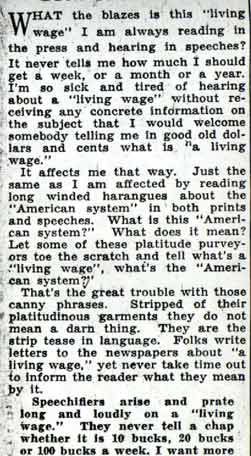
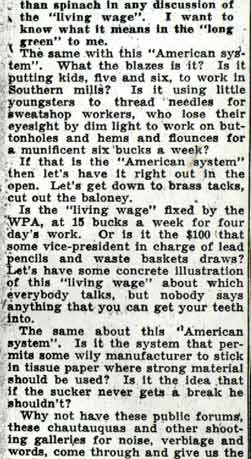
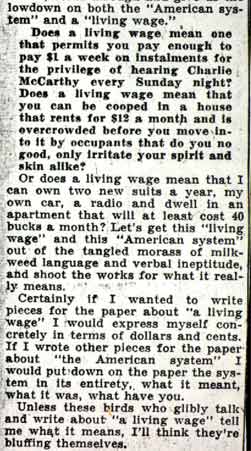
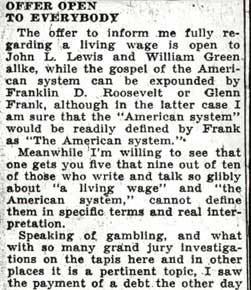
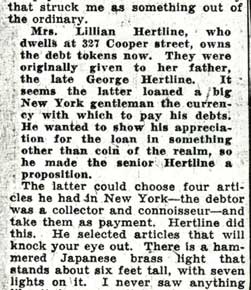
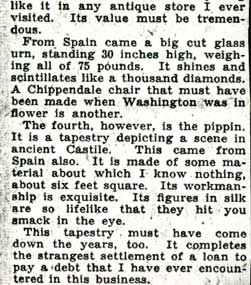
Is Zat So! by Gordon MacKay, Camden Courier-Post, January 7, 1938 — “A Living Wage” & George Hertline’s Bet
Is Zat So! — January 8, 1938
Camden Courier-Post —
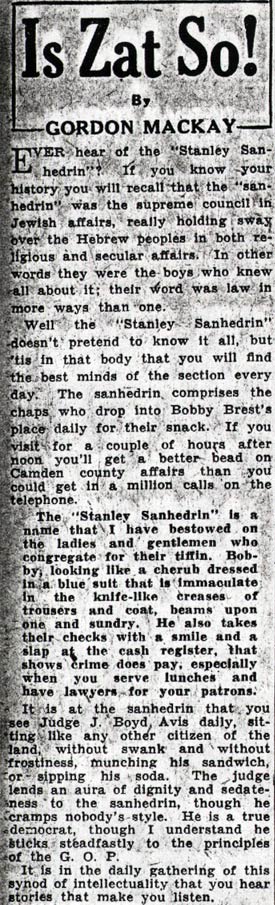
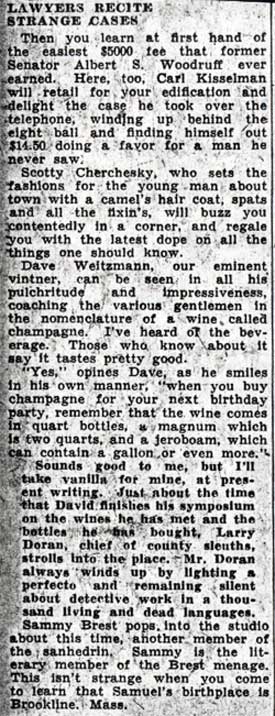
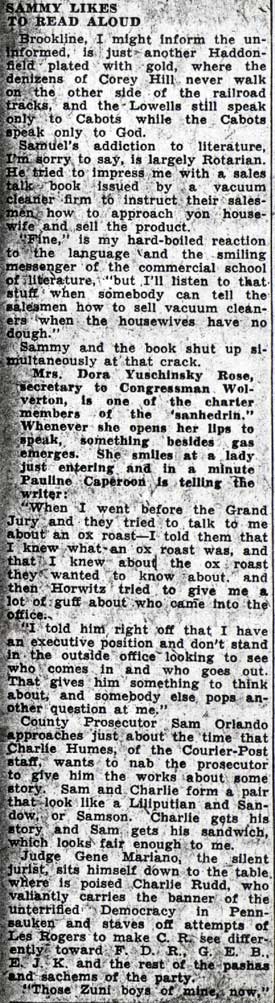
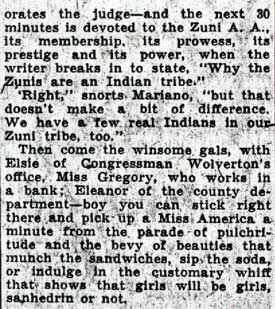
Is Zat So! by Gordon MacKay, Camden Courier-Post, January 8, 1938 — The Stanley Sanhedrin, Dave Weitzman, Dora Rose, Gene R. Mariano, Samuel P. Orlando
Is Zat So! — January 13, 1938
Camden Courier-Post —
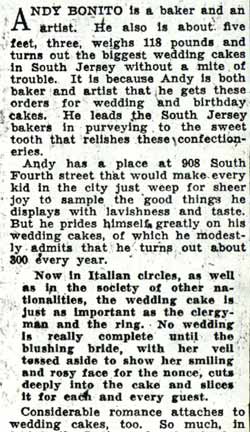
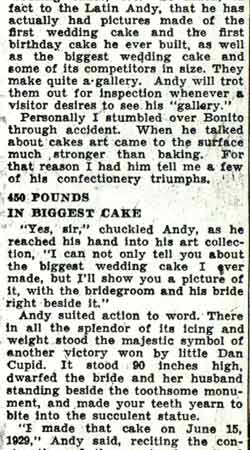
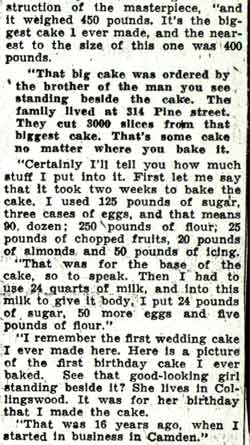
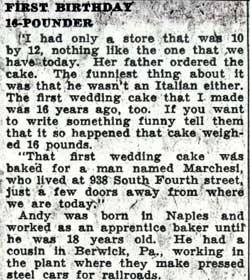
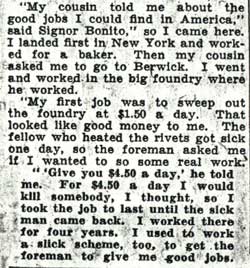
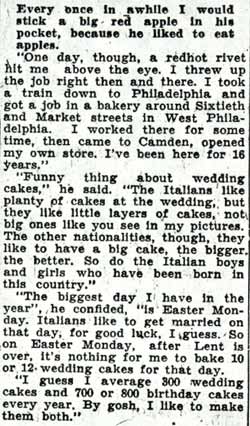
Is Zat So! by Gordon MacKay, Camden Courier-Post, January 13, 1938 — Andy Bonito’s Italian Bakery (known as Oriti’s Pastry from the 1940s through early 1970s)
Is Zat So! — January 14, 1938
Camden Courier-Post —
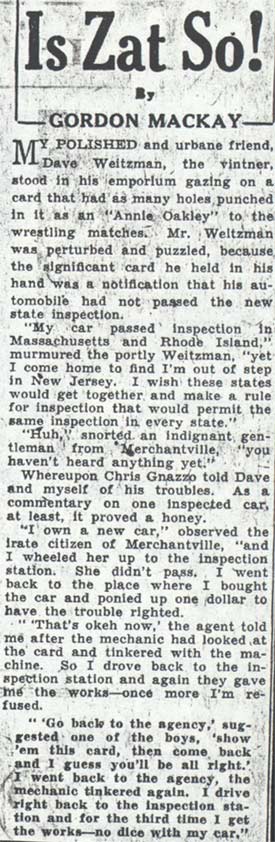
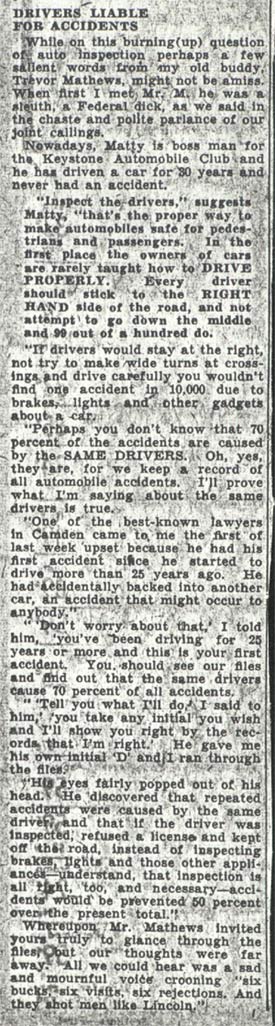
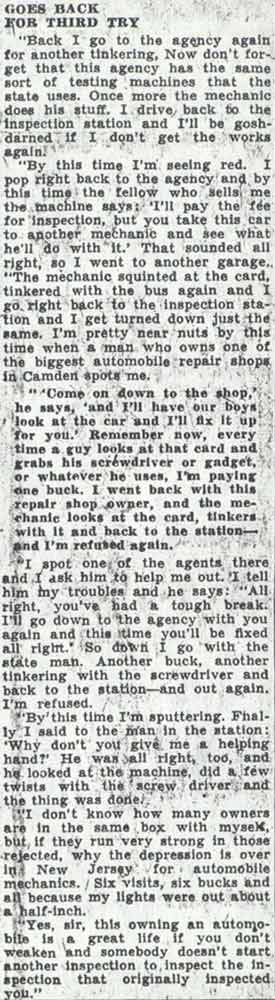
Is Zat So! by Gordon MacKay, Camden Courier-Post, January 14, 1938 — Dave Weitzman, Motor Vehicle Inspections
Is Zat So!
Camden Courier-Post —
By GORDON MACKAY
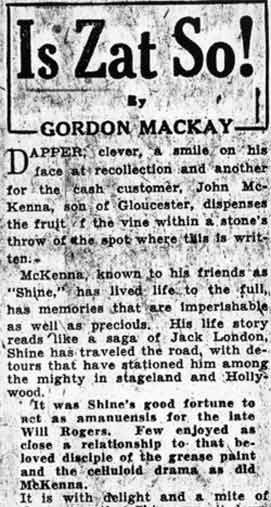
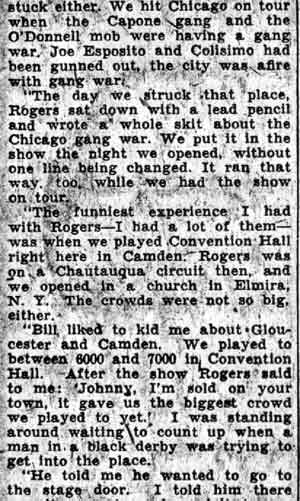
DAPPER; clever, a smile on his face at recollection and another for the cash customer, John McKenna, son of Gloucester, dispenses the fruit of the vine within a stone’s throw of the spot where this is written.
McKenna, known to his friends as “Shine,” has lived life to the full, has memories that are imperishable as well as precious. His life story reads like a saga of Jack London. Shine has traveled the road, with detours that have stationed him among the mighty in stageland and Hollywood.
It was Shine’s good fortune to act as amanuensis for the late Will Rogers. Few enjoyed as close a relationship to that beloved disciple of the grease paint and the celluloid drama as did McKenna.
It is with delight and a mite of sadness, too, that Shine can sit down by the hour if need be, and recite tale after tale, anecdote after anecdote of the comedian, who brought to the American stage a whiff of the prairie breeze and created for American newspaper life a homely philosophy such as the newspaper world perhaps had never known before.
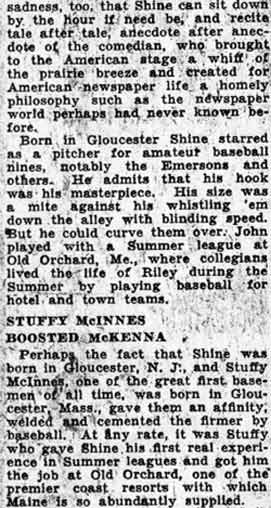
Born in Gloucester Shine starred as a pitcher for amateur baseball nines, notably the Emersons and others. He admits that his hook was his masterpiece. His size was a mite against his whistling ‘em down the alley with blinding speed. But he could curve them over. John played with a Summer league at Old Orchard, Me., where collegians lived the life of Riley during the Summer by playing baseball for hotel and town teams.
STUFFY McINNES BOOSTED McKENNA
Perhaps the fact that Shine was born in Gloucester, N. J., and Stuffy McInnes, one of the great first basemen of all time, was born in Gloucester, Mass., gave them an affinity, welded and cemented the firmer by baseball. At any rate, it was Stuffy who gave Shine his first real experience in Summer leagues and got him the job at Old Orchard, one of the premier coast resorts with which Maine is so abundantly supplied.
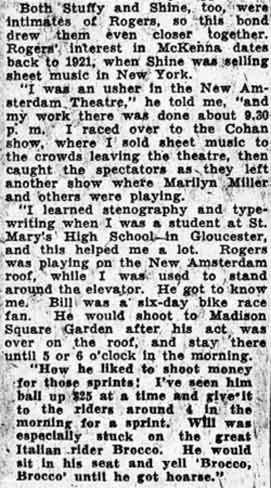
Both Stuffy and Shine, too, were intimates of Rogers, so this bond drew them even closer together. Rogers’ interest in McKenna dates back to 1921, when Shine was selling sheet music in New York.
“I was an usher in the New Amsterdam Theatre,” he told me, “and my work there was done about 9.30 p. m. I raced over to the Cohan show, where I sold sheet music to the crowds leaving the theatre, then caught the spectators as they left another show where Marilyn Miller and others were playing.
“I learned stenography and typewriting when I was a student at St. Mary’s High School—in Gloucester, and this helped me a lot. Rogers was playing on the New Amsterdam roof, while I was used to stand around the elevator. He got to know me. Bill was a six-day bike race fan. He would shoot to Madison Square Garden after his act was over on the roof, and stay there until 5 or 6 o’clock in the morning.
“How he liked to shoot money for those sprints! I’ve seen him ball up $25 at a time and give it to the riders around 4 in the morning for a sprint. Will was especially stuck on the great Italian rider Brocco. He would sit in his seat and yell ‘Brocco, Brocco’ until he got hoarse.”
PICKED ARTICLES WITH ONE FINGER
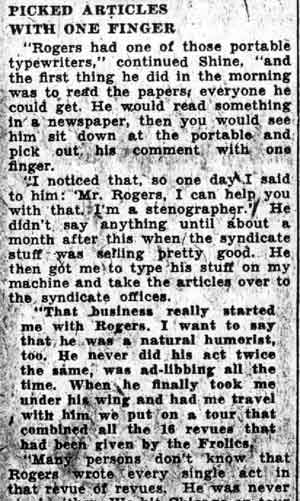
“Rogers had one of those portable typewriters,” continued Shine, “and the first thing he did in the morning was to read the papers; everyone he could get. He would read something in a newspaper, then you would see him sit down at the portable and pick out, his comment with one finger.
“I noticed that, so one day I said to him: ‘Mr. Rogers, I can help you with that. I’m a stenographer.’ He didn’t say anything until about a month after this when the syndicate stuff was selling pretty good. He then got me to type his stuff on my machine and take the articles over to the syndicate offices.
“That business really started me with Rogers. I want to say that he was a natural humorist, too. He never did his act twice the same, was ad-libbing all the time. When he finally took me under his wing and had me travel with him we put on a tour that combined all the 16 revues that had been given by the Frolics.
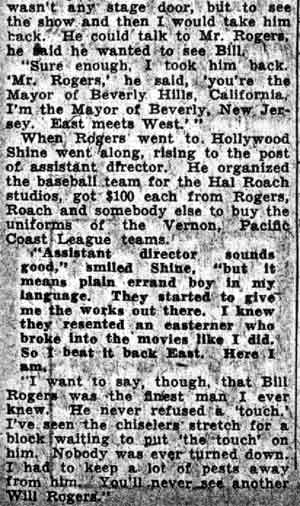
“Many persons don’t know that Rogers wrote every single act in that revue of revues. He was never stuck either. We hit Chicago on tour when the Capone gang and the O’Donnell mob were having a gang war. Joe Esposito and Colisimo had been gunned out, the city was afire with gang war.
“The day we struck that place, Rogers sat down with a lead pencil and wrote a whole skit about the Chicago gang war. We put it in the show the night we opened, without one line being changed. It ran that way, too, while we had the show on tour.
“The funniest experience I had with Rogers—I had a lot of them—was when we played Convention Hall right here in Camden. Rogers was on a Chautauqua circuit then, and we opened in a church in Elmira, N. Y. The crowds were not so big, either.
“Bill liked to kid me about Gloucester and Camden. We played to between 6000 and 7000 in Convention Hall. After the show Rogers said to me: ‘Johnny, I’m sold on your town, it gave us the biggest crowd we played to yet.’ I was standing around waiting to count up when a man in a black derby was trying to get into the place.
“He told me he wanted to go to the stage door. I told him there wasn’t any stage door, but to see the show and then I would take him back. He could talk to Mr. Rogers, he said he wanted to see Bill.
“Sure enough, I took him back. ‘Mr. Rogers,’ he said, ‘you’re the Mayor of Beverly Hills, California. I’m the Mayor of Beverly, New Jersey. East meets West.’”
When Rogers went to Hollywood Shine went along, rising to the post of assistant director. He organized the baseball team for the Hal Roach studios, got $100 each from Rogers, Roach and somebody else to buy the uniforms of the Vernon, Pacific Coast League teams.
“Assistant director sounds good,” smiled Shine, “but it means plain errand boy in my language. They started to give me the works out there. I knew they resented an easterner who broke into the movies like I did. So I beat it back East. Here I am.
“I want to say, though, that Bill Rogers was the finest man I ever knew. He never refused a ‘touch.’ I’ve seen the chiselers stretch for a block waiting to put ‘the touch’ on him. Nobody was ever turned down. I had to keep a lot of pests away from him. You’ll never see another Will Rogers.”
Is Zat So! — January 17, 1938
Camden Courier-Post —
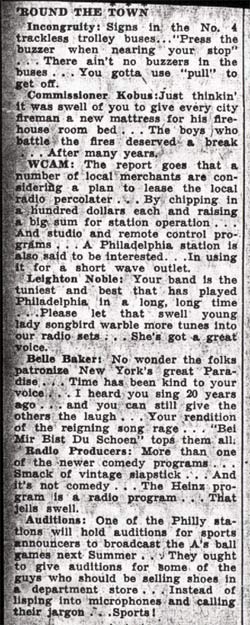
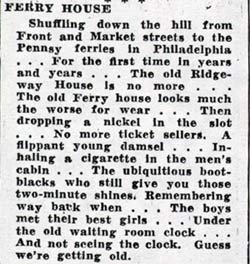
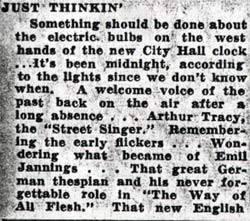
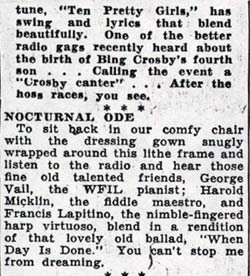
Is Zat So! by Gordon MacKay, Camden Courier-Post, January 17, 1938 — Child entertainers, show business
Is Zat So! — January 18, 1938
Camden Courier-Post —
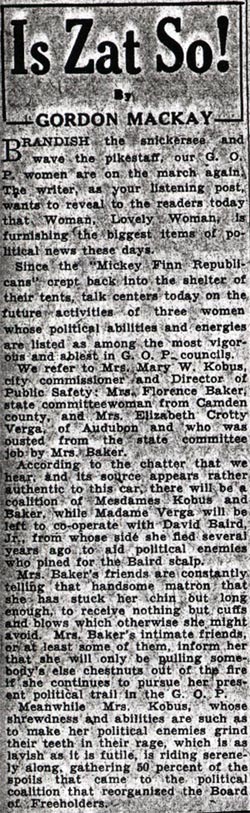
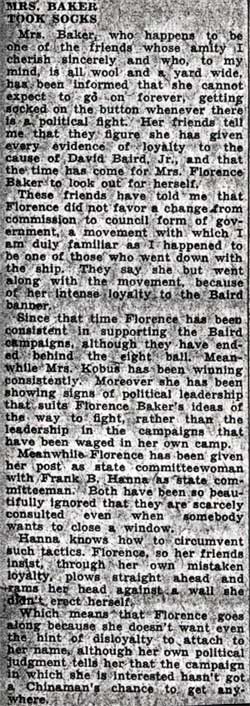
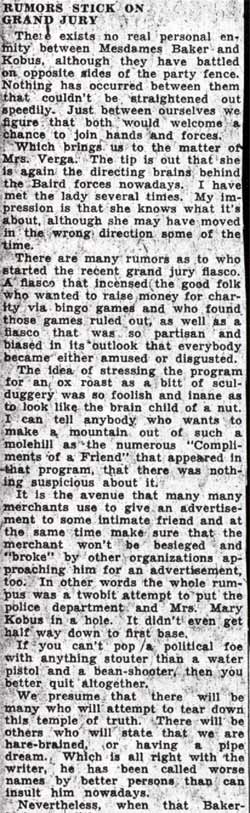
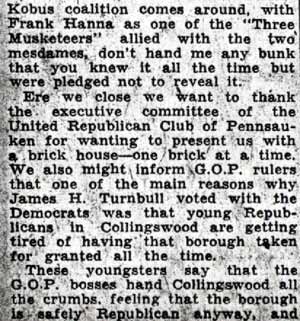
Is Zat So! by Gordon MacKay, Camden Courier-Post, January 18, 1938 — Republican Politics, Florence Baker, David Baird Jr., Mary Kobus
Is Zat So! — January 20, 1938
Camden Courier-Post —
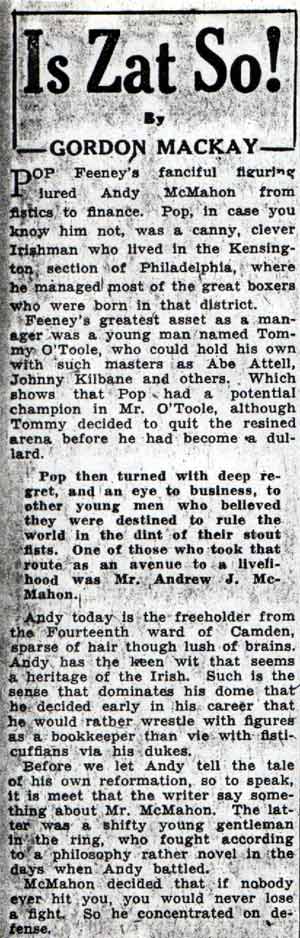
POP Feeney’s fanciful figuring lured Andy McMahon from fistics to finance. Pop, in case you know him not, was a canny, clever Irishman who lived in the Kensington section of Philadelphia, where he managed most of the great boxers who were born in that district.
Feeney’s greatest asset as a manager was a young man named Tommy O’Toole, who could hold his own with such masters as Abe Attell, Johnny Kilbane and others. Which shows that Pop had a potential champion in Mr. O’Toole, although Tommy decided to quit the resined arena before he had become a dullard.
Pop then turned with deep regret, and an eye to business, to other young men who believed they were destined to rule the world in the dint of their stout fists. One of those who took that route as an avenue to a livelihood was Mr. Andrew J. McMahon.
Andy today is the freeholder from the Fourteenth ward of Camden, sparse of hair though lush of brains. Andy has the keen wit that seems a heritage of the Irish. Such is the sense that dominates his dome that he decided early in his career that he would rather wrestle with figures as a bookkeeper than vie with fisticuffians via his dukes.
Before we let Andy tell the tale of his own reformation, so to speak, it is meet that the writer say something about Mr. McMahon. The latter was a shifty young gentleman in the ring, who fought according to a philosophy rather novel in the days when Andy battled.
McMahon decided that if nobody ever hit you, you would never lose a fight. So he concentrated on defense.
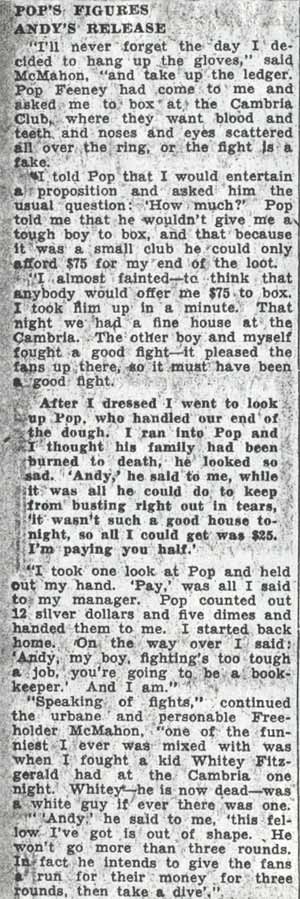
**POP’S FIGURES**
**ANDY’S RELEASE**
“I’ll never forget the day I decided to hang up the gloves,” said McMahon, “and take up the ledger. Pop Feeney had come to me and asked me to box at the Cambria Club, where they want blood and teeth and noses and eyes scattered all over the ring, or the fight is a fake.
“I told Pop that I would entertain a proposition and asked him the usual question: ‘How much?’ Pop told me that he wouldn’t give me a tough boy to box, and that because it was a small club he could only afford $75 for my end of the loot. I almost fainted—to think that anybody would offer me $75 to box. I took him up in a minute. That night we had a fine house at the Cambria. The other boy and myself fought a good fight—it pleased the fans up there, so it must have been a good fight.
“After I dressed I went to look up Pop, who handled our end of the dough. I ran into Pop and I thought his family had been burned to death, he looked so sad. ‘Andy,’ he said to me, while it was all he could do to keep from busting right out in tears, ‘It wasn’t such a good house tonight, so all I could get was $25. I’m paying you half.’
“I took one look at Pop and held out my hand. ‘Pay,’ was all I said to my manager. Pop counted out 12 silver dollars and five dimes and handed them to me. I started back home. On the way over I said: ‘Andy, my boy, fighting’s too tough a job, you’re going to be a bookkeeper.’ And I am.”
“Speaking of fights,” continued the urbane and personable Freeholder McMahon, “one of the funniest I ever was mixed with was when I fought a kid Whitey Fitzgerald had at the Cambria one night. Whitey—he is now dead—was a white guy if ever there was one.
“‘Andy,’ he said to me, ‘this fellow I’ve got is out of shape. He won’t go more than three rounds. In fact he intends to give the fans a run for their money for three rounds, then take a dive’.”
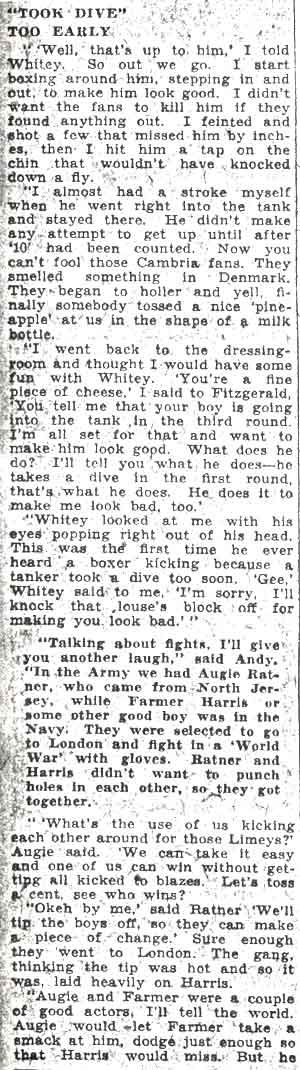
**“TOOK DIVE” TOO EARLY**
“‘Well, that’s up to him,’ I told Whitey. So out we go. I start boxing around him, stepping in and out, to make him look good. I didn’t want the fans to kill him if they found anything out. I feinted and shot a few that missed him by inches, then I hit him a tap on the chin that wouldn’t have knocked down a fly.
“I almost had a stroke myself when he went right into the tank and stayed there. He didn’t make any attempt to get up until after ‘10’ had been counted. Now you can’t fool those Cambria fans. They smelled something in Denmark. They began to holler and yell, finally somebody tossed a nice ‘pineapple’ at us in the shape of a milk bottle.
“I went back to the dressing room and thought I would have some fun with Whitey. ‘You’re a fine piece of cheese,’ I said to Fitzgerald, ‘You tell me that your boy is going into the tank in the third round. I’m all set for that and want to make him look good. What does he do? I’ll tell you what he does—he takes a dive in the first round, that’s what he does. He does it to make me look bad, too.’
“Whitey looked at me with his eyes popping right out of his head. This was the first time he ever heard a boxer kicking because a tanker took a dive too soon. ‘Gee,’ Whitey said to me, ‘I’m sorry. I’ll knock that louse’s block off for making you look bad.’”
“Talking about fights, I’ll give you another laugh,” said Andy.
“In the Army we had Augie Ratner, who came from North Jersey, while Farmer Harris or some other good boy was in the Navy. They were selected to go to London and fight in a ‘World War’ with gloves. Ratner and Harris didn’t want to punch holes in each other, so they got together.
“‘What’s the use of us kicking each other around for those Limeys?’ Augie said. ‘We can take it easy and one of us can win without getting all kicked to blazes. Let’s toss a cent, see who wins?’
“‘Okeh by me,’ said Ratner. ‘We’ll tip the boys off, so they can make a piece of change.’ Sure enough they went to London. The gang, thinking the tip was hot and so it was, laid heavily on Harris.
“‘Augie and Farmer were a couple of good actors, I’ll tell the world. Augie would let Farmer take a smack at him, dodge just enough so that Harris would miss. But he didn’t hit Harris more than a dozen blows in the whole bout.
“The boys who had their dough down were all figuring what a party they would throw when they collected. They almost fell dead when the referee announced Ratner the winner.
“‘Why?’ You know why. The English referee hands you more for defense than offense. The ability not to be hit is bigger with them than the ability to hit the other fellow. Augie forgot that. So did Farmer. But the referee didn’t, he gave the duke to Ratner.
“‘What happened?’ Well you figure a couple of hundred gobs and a couple of hundred doughboys who had that money in the bag, only to lose it, you’ll get a working picture of what happened.”
“Yes sir, Pop Feeney gave me those twelve silver cartwheels and he made a bookkeeper out of me. I’m not a bit sorry he did.”
Is Zat So! by Gordon MacKay, Camden Courier-Post, January 20, 1938 — Camden, Sports — Andy McMahon
Is Zat So!
Camden Courier-Post —
By GORDON MACKAY—
GENIUS blooms in many strange places in Camden. Take a walk to Second and Elm streets some idle moment and keep your eyes peeled for a huge boot that stands as a business sign. It is one of the few boots seen nowadays to advertise a shoemaker, cobbler, cordwainer, or any other plain and fancy name you dub men who make shoes.
When I was a kid and my own old man sat at a bench to hammer the brads into a half sole job, every shoemaker had such a boot stuck right out in front of his place of business. Time, neon lights and some of the other flashy agenda of commerce have put the old shoes in their place, so to see one good staunch old-timer who still has that boot standing out front is to race back to boyhood.
The gentleman who believes in signs is Tom Holman. He is 66, and has resided around Second and Elm streets for the past 45 years. Tom is as much a fixture and institution in that neighborhood as the Delaware River, and much more sociable to meet.
Dickens would have liked to greet Tom, or browse through his cobblery. He would have found it indeed an “Old Curiosity Shop,” filled with treasures such as only Tom Holman would collect in his years in Camden.
It was 52 years ago that a youngster born in London sailed for these shores on the “Lord Clive.” His uncle had settled in Camden, so Tom came here. He has remained ever since. Tommy had been apprenticed to a shoemaker and had passed to become a “shooie,” as they term the cobbler in Dear Ole Lunnon.
Youngster Had Passion for Sea
This youngster had a passion for the sea. Whether it was a kickback to some old ancestor, Tom doesn’t know, but his inordinate love for the sea exists even today. You’ll discover that, too, when you see his ship models, one a cutter, the other a schooner. They cover about one-half the space in this shoe repairing place at Second and Elm streets.
So excessive was the ardor that the young man felt for the bounding main and the life on the ocean wave, that when he was 18 he couldn’t repress the yearning. Then Tom did the obvious thing that all youths did in our day when they wanted to make a pilgrimage to Britain. He shipped on a cattle boat.
Such life wasn’t too onerous and it smacked of adventure. A little dirtier, perhaps, than dawdling about a studio, but packed with adventure, the smell of the sea and lowing of the kine. It wasn’t such tough work as described by some of the young men who became writers after shooting over the Atlantic Ocean in a cattle boat.
You watered the stock in the morning, gave the steers cracked wheat at noon, tossed them hay for supper. Tommy came back to Camden only to become possessed of another urge. This time he remained on dry land and became an addict to the bicycle.
Tom was a high class young pilgrim on those wheels which we youngsters called “safeties.” Tom’s first wheel had solid tires. He rode to the Delaware Water Gap in Pennsylvania and back one Sunday, 186 miles or better. When Tom returned he was so stiff in the joints and other spots that he could hardly walk, but he still was a firm and fast adherent to the bicycle.
Worked Five Years on Model
You’ll appreciate the classic lines and grand beauty of those ship models, which Tom races in Haddonfield and other suburbs where a body of water and a breeze brisk enough blows to sail his craft. The coop required four years to build, the schooner five years—tasks which could be performed only between slaps at the pegs for the half soles. The models are things of permanent beauty. To get one from Tom would require perhaps more suasion and spondulix than I can afford. I’ll tell the cock-eyed world. But the ship models are not the only things to be found in this “Old Curiosity Shop.”
On the floor will be found musical instruments, fearfully and wonderfully made. They’re called tubas, and should be played only by elephants. One of them is a delicate piece of brass that only weighs 35 pounds while its kid sister weighs around 23 pounds.
“I rarely play the bigger one,” Tom confided to me, “but use the littler one whenever I have to play in the band for the parades of Lu Lu Temple. You know, the Shriners of Philadelphia.”
Tom has a gallery galore of photographs of the Lu Lu Temple Band parading hither and yon. There is Tom, who doesn’t appear to outweigh the bigger tuba, umphing along like a drum major. A sheet of music rests beside the bigger tuba in the store. Holman admits the soft impeachment that he tootles the tuba when business becomes a mite slack.
He confessed one musical crime to me, which he said he wouldn’t mind seeing in print if the victim didn’t object. As the latter concurred in the idea, let it be stated that Tom committed the major felony of trying to teach Dan McConnell of the Courier Post staff to play the cornet.
“Dan was a nice young fellow,” said Tom. “He worked for me when he was only about 10. He wanted to play the cornet, so I taught him. There was a woman upstairs who complained about Dan’s music. Dan finally had to sneak away and practice in one of the freight cars that stood on the railroad siding here.
“I guess when you tell Dan how rotten he was as a cornetist, he’ll probably tell you about the time I built a nice boat to sail on the Delaware—everybody owned a boat to sail on the river in those days. When I built her out in the yard she was so big I couldn’t get her out. I had to use a derrick.”
“But you tell Dan that as a cornetist he’s a good shoe salesman and let it go at that.”
In the window as you reach the door stands a pair of big seaboots, an advertisement for shoe repairing.
A sailor came in here one day, said Holman, “and said to me: ‘I found this pair of boots 40 years ago in the hold of a German vessel. Take ’em and use ’em as a sign for your window. That was 15 years ago. They have remained there ever since.”
That’s Tom Holman, steadfast to the old customs.
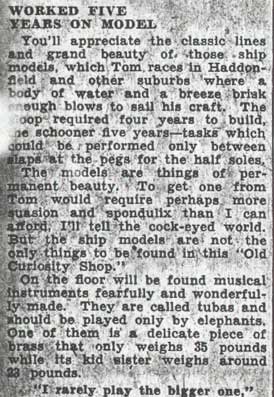
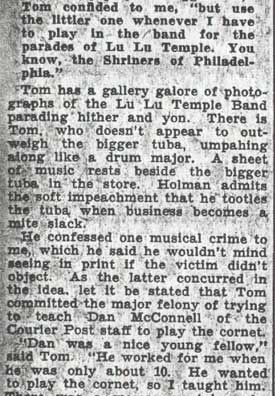
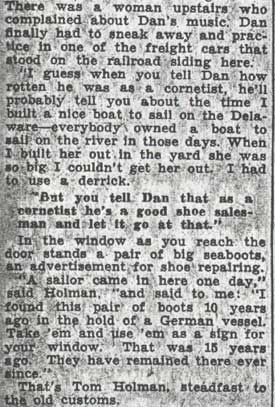
Is Zat So! by Gordon MacKay, Camden Courier-Post, January 21, 1938 — North Camden — Tom Holman; Dan McConnell (Note: subject’s name was misspelled as “Holman”)
Is Zat So! — January 22, 1938 (H.L. Keely)
Camden Courier-Post —
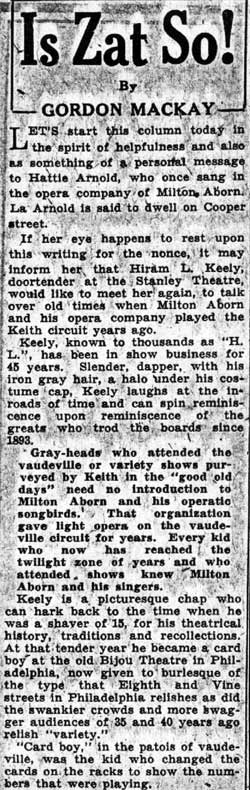
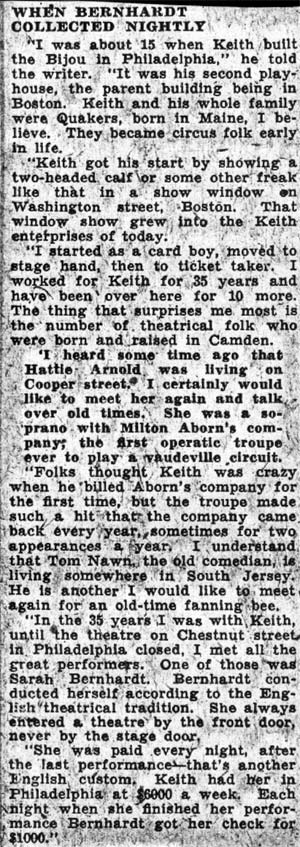
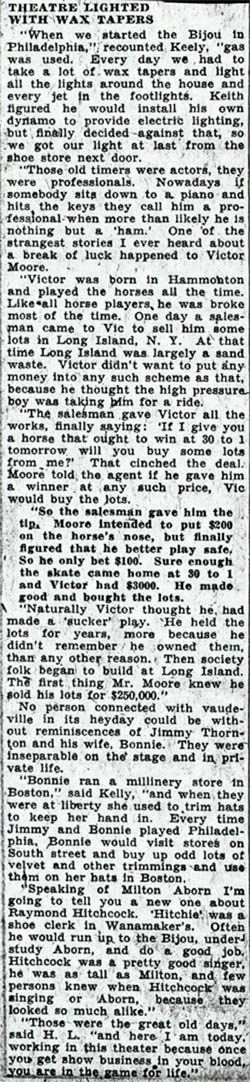
Is Zat So! by Gordon MacKay, Camden Courier-Post, January 22, 1938 — Camden, Vaudeville — H.L. Keely
Murder and Kidnaping In ‘75 Bared by Man Here
Camden Courier-Post —
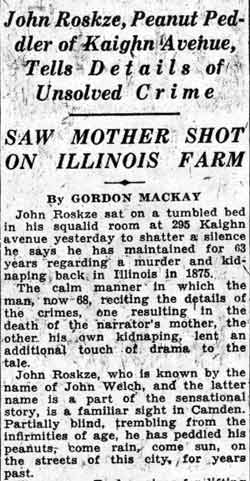
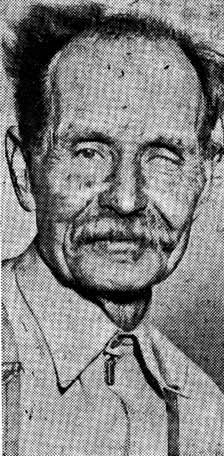
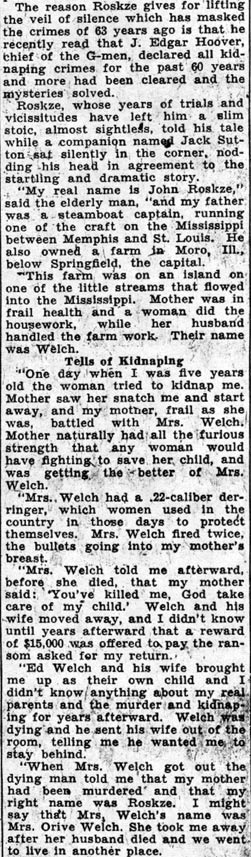
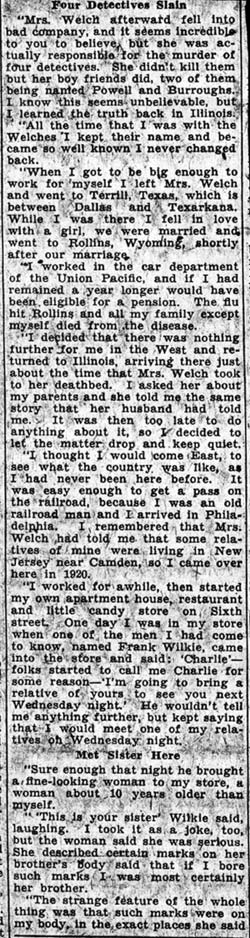
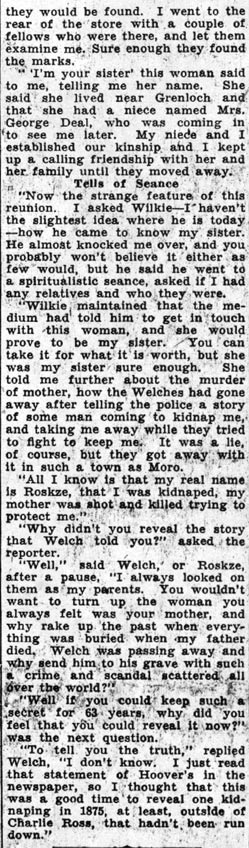
John Roskze, Peanut Peddler of Kaighn Avenue, Tells Details of Unsolved Crime
SAW MOTHER SHOT ON ILLINOIS FARM
By GORDON MACKAY
John Roskze sat on a tumbled bed in his squalid room at 295 Kaighn avenue yesterday to shatter a silence he says he has maintained for 63 years regarding a murder and kidnaping back in Illinois in 1875.
The calm manner in which the man, now 68, reciting the details of the crimes, one resulting in the death of the narrator’s mother, the other his own kidnaping, lent an additional touch of drama to the tale.
John Roskze, who is known by the name of John Welch, and the latter name is a part of the sensational story, is a familiar sight in Camden. Partially blind, trembling from the infirmities of age, he has peddled his peanuts, come rain, come sun, on the streets of this city, for years past.
The reason Roskze gives for lifting the veil of silence which has masked the crimes of 63 years ago is that he recently read that J. Edgar Hoover, chief of the G-men, declared all kidnaping crimes for the past 60 years and more had been cleared and the mysteries solved.
Roskze, whose years of trials and vicissitudes have left him a slim stoic, almost sightless, told his tale while a companion named Jack Sutton sat silently in the corner, nodding his head in agreement to the startling and dramatic story.
“My real name is John Roskze,” said the elderly man, “and my father was a steamboat captain, running one of the craft on the Mississippi between Memphis and St. Louis. He also owned a farm in Moro, Ill., below Springfield, the capital.
“This farm was on an island on one of the little streams that flowed into the Mississippi. Mother was in frail health and a woman did the housework, while her husband handled the farm work. Their name was Welch.
Tells of Kidnaping
“One day when I was five years old the woman tried to kidnap me. Mother saw her snatch me and start away, and my mother, frail as she was, battled with Mrs. Welch. Mother naturally had all the furious strength that any woman would have fighting to save her child, and was getting the better of Mrs. Welch.
“Mrs. Welch had a .22-caliber derringer, which women used in the country in those days to protect themselves. Mrs. Welch fired twice, the bullets going into my mother’s breast.
“Mrs. Welch told me afterward, before she died, that my mother said: ‘You’ve killed me, God take care of my child.’ Welch and his wife moved away, and I didn’t know until years afterward that a reward of $15,000 was offered to pay the ransom asked for my return.
“Ed Welch and his wife brought me up as their own child and I didn’t know anything about my real parents and the murder and kidnaping for years afterward. Welch was dying and he sent his wife out of the room, telling me he wanted me to stay behind.
“When Mrs. Welch got out the dying man told me that my mother had been murdered and that my right name was Roskze. I might say that Mrs. Welch’s name was Mrs. Orive Welch. She took me away after her husband died and we went to live in another place.
Four Detectives Slain
“Mrs. Welch afterward fell into bad company, and it seems incredible to you to believe, but she was actually responsible for the murder of four detectives. She didn’t kill them but her boy friends did, two of them being named Powell and Burroughs. I know this seems unbelievable, but I learned the truth back in Illinois.
“All the time that I was with the Welches I kept their name and became so well known I never changed back.
“When I got to be big enough to work for myself I left Mrs. Welch and went to Terrill, Texas, which is between Dallas and Texarkana. While I was there I fell in love with a girl, we were married and went to Rollins, Wyoming, shortly after our marriage.
“I worked in the car department of the Union Pacific, and if I had remained a year longer would have been eligible for a pension. The flu hit Rollins and all my family except myself died from the disease.
“I decided that there was nothing further for me in the West and returned to Illinois, arriving there just about the time that Mrs. Welch took to her deathbed. I asked her about my parents and she told me the same story that her husband had told me. It was then too late to do anything about it, so I decided to let the matter drop and keep quiet.
“I thought I would come East, to see what the country was like, as I had never been here before. It was easy enough to get a pass on the railroad, because I was an old railroad man and I arrived in Philadelphia. I remembered that Mrs. Welch had told me that some relatives of mine were living in New Jersey near Camden, so I came over here in 1920.
“I worked for awhile, then started my own apartment house, restaurant and little candy store on Sixth street. One day I was in my store when one of the men I had come to know, named Frank Wilkie, came into the store and said: ‘Charlie’—folks started to call me Charlie for some reason—’I’m going to bring a relative of yours to see you next Wednesday night.’ He wouldn’t tell me anything further, but kept saying that I would meet one of my relatives on Wednesday night.
Met Sister Here
“Sure enough that night he brought a fine-looking woman to my store, a woman about 10 years older than myself.
“’This is your sister’ Wilkie said, laughing. I took it as a joke, too, but the woman said she was serious. She described certain marks on her brother’s body said that if I bore such marks I was most certainly her brother.
“The strange feature of the whole thing was that such marks were on my body, in the exact places she said they would be found. I went to the rear of the store with a couple of fellows who were there, and let them examine me. Sure enough they found the marks.
“’I’m your sister’ this woman said to me, telling me her name. She said she lived near Grenloch and that she had a niece named Mrs. George Deal, who was coming in to see me later. My niece and I established our kinship and I kept up a calling friendship with her and her family until they moved away.
Tells of Seance
“Now the strange feature of this reunion. I asked Wilkie—I haven’t the slightest idea where he is today—how he came to know my sister. He almost knocked me over, and you probably won’t believe it either as few would, but he said he went to a spiritualistic seance, asked if I had any relatives and who they were.
“Wilkie maintained that the medium had told him to get in touch with this woman, and she would prove to be my sister. You can take it for what it is worth, but she was my sister sure enough. She told me further about the murder of mother, how the Welches had gone away after telling the police a story of some man coming to kidnap me, and taking me away while they tried to fight to keep me. It was a lie, of course, but they got away with it in such a town as Moro.
“All I know is that my real name is Roskze, that I was kidnaped, my mother was shot and killed trying to protect me.”
“Why didn’t you reveal the story that Welch told you?” asked the reporter.
“Well,” said Welch, or Roskze, after a pause, “I always looked on them as my parents. You wouldn’t want to turn up the woman you always felt was your mother, and why rake up the past when everything was buried when my father died. Welch was passing away and why send him to his grave with such a crime and scandal scattered all over the world?”
“Well if you could keep such a secret for 63 years, why did you feel that you could reveal it now?” was the next question.
“To tell you the truth,” replied Welch, “I don’t know. I just read that statement of Hoover’s in the newspaper, so I thought that this was a good time to reveal one kidnaping in 1875, at least, outside of Charlie Ross, that hadn’t been run down.”
Is Zat So! — January 26, 1938
Camden Courier-Post —
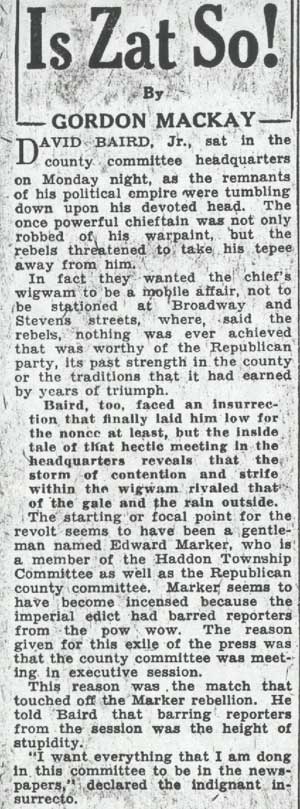
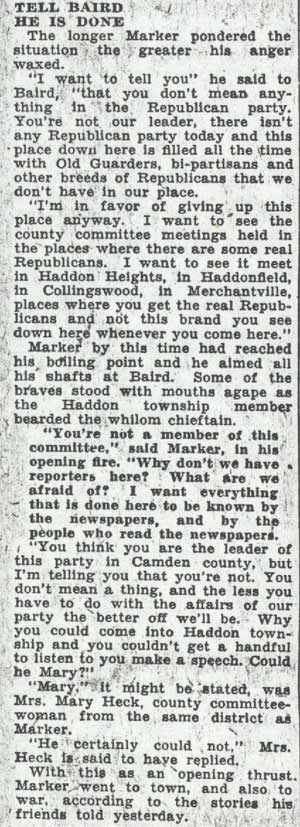
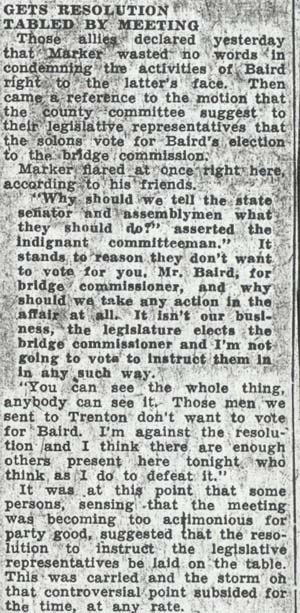
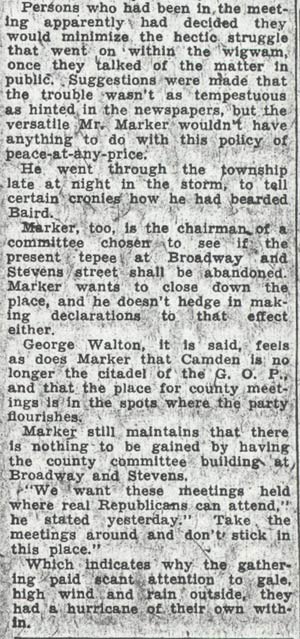
Is Zat So! by Gordon MacKay, Camden Courier-Post, January 26, 1938 — Camden, Politics — David Baird Jr.
Is Zat So! — January 27, 1938
Camden Courier-Post —
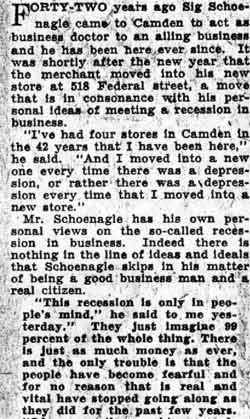
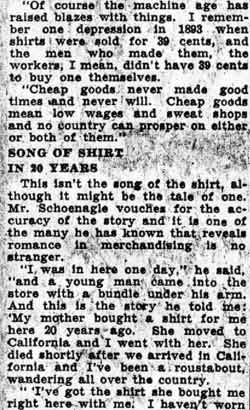
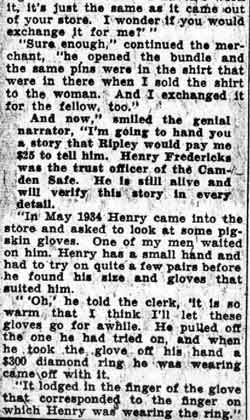
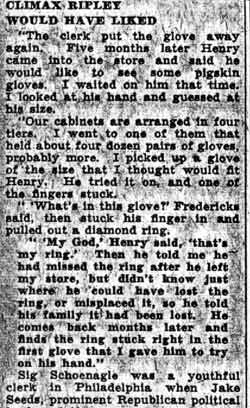
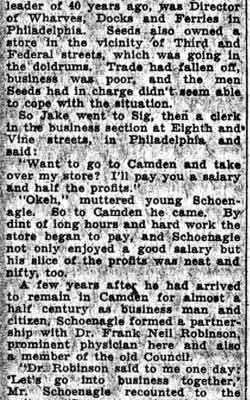
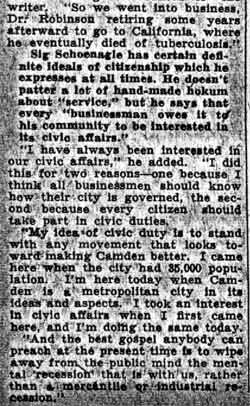
Is Zat So! by Gordon MacKay, Camden Courier-Post, January 27, 1938 — Camden, Business — Sig Schoenagle
Is Zat So! by Gordon Mackay
Camden Courier-Post —
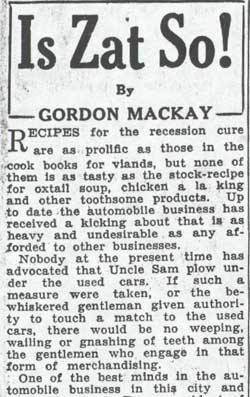
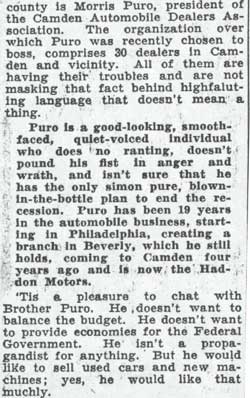
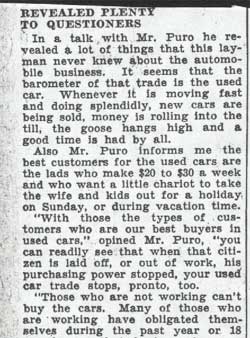
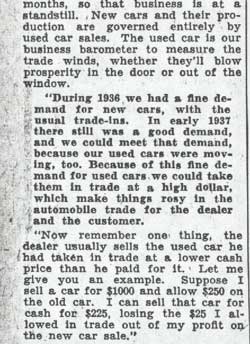
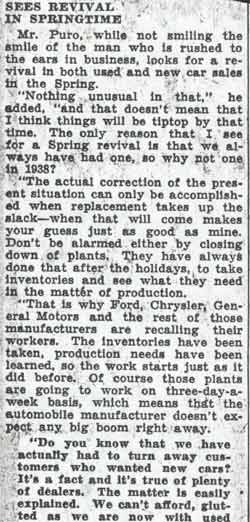
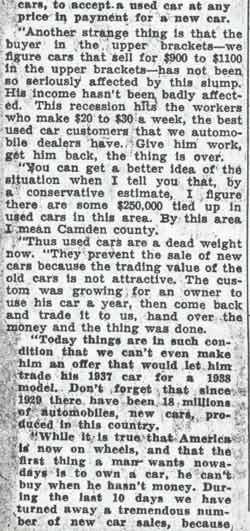
Is Zat So! by Gordon MacKay, Camden Courier-Post, January 28, 1938 — Camden, Camden Car Dealers
Is Zat So!
Camden Courier-Post —
By GORDON MACKAY
STOUT fellas like Connie Mack and Gerry Nugent would sum up the situation like this:
“Time to warm up a new pitcher and send that bird to the showers.”
Big Business needs to warm up some new pitchers to put the ball over the plate at the hearings before the various legislative committees of the Congress. None of those who have toed the rubber heretofore seems to have anything on the ball, and are trying to get by with a prayer rather than plenty of stuff.
Let’s look over the lads who stepped out of the bullpen to don the spangles for Big Business. The first was William Knudsen, head of General Motors. In his line Knudsen is one of the big boys of the motor world, and knows his stuff about making whizcars from the sprocket to the windshield.
He told and told truly that General Motors wasn’t employing so many men because the demand for new cars slackened, and there was no use in building cars when nobody would buy them; That is so axiomatic that it shouldn’t be taken as a pearl of great price or revealing any tremendous wisdom.
Mr. Knudsen also found that policies of the administration had created a reign of “fear.” So he replied to a question to that effect pumped at him by Senator Lodge, the youthful son of Massachusetts. When Knudsen declared that the administration inculcated fear by its acts, Senator Byrnes asked the motor magnate what corrective remedy he would apply to allay fear and to repel the recession.
That was the poser. Summed up in a nutshell Knudsen didn’t have any answer. All he knew was that what Roosevelt did was wrong.
Why Salaries So Large Eh Wot?
Personally I would propound a question to General Motors’ Knudsen and all the other Knudsens. Trade in automobiles went to pot during 1937, especially during the latter part of the year. Workers were thrown into idleness, wages were reduced because hours of labor were curtailed. At the same time the salaries of the executives headed by Alfred P. Sloan with more than $500,000 amounted to more than three million dollars.
Supposedly these executives received those tremendous salaries because of their value to the corporation. The thing that sticks in my craw is how to evaluate an executive’s salary. He gets $500,000 when business is good, he gets just as much salary when business hits the skids.
The worker doesn’t continue to work 40 hours a week when no automobiles are sold. Then why should Mr. Sloan, et al, receive the same salary during bad times as in flourishing times?
You would be informed if you asked that question that Sloan and his associates are worth every nickel they get because of the business they bring to General Motors. All right. But are they worth as much salary when business is rotten and they apparently have fallen down on the job like a ton of bricks?
You don’t pay workers full time when they haven’t the work at hand. You don’t pay a worker who falls down on the job and lets business go to blazes as much salary as you do when business booms and the goose hangs high.
If Sloan and his associates are worth $500,000 in boom times because they make business for the corporation, they most certainly should take a big cut when they let trade go to pot and bring rotten days to General Motors. Bad logic, poor reasoning to say that. Sloan is worth as much money when he lets business become poor, as he is when business booms. No can do! Doesn’t sound right.
Du Pont Also Works “In Fog”
Big Business sent Lammot du Pont to the mound with instructions to shoot them down the middle and not to work the corners of the plate. Mr. du Pont said the businessman was in a “fog of uncertainty” because he did not know what the Administration was doing. Perhaps there have been a groundwork for that belief.
Morgenthau wants the budget balanced, Ickes and Hopkins want WPA and relief supplied with more money. Eccles argues for spending, expenditures. In that respect the administration not only has Mr. du Pont guessing but persons devoted to the New Deal as well.
Taking the du Pont word for the fact that he was in “a fog of uncertainty” over the Administration’s policies, du Pont also proved that he was in something of a mist himself over several other matters.
He attacked the Wagner Labor Law as “uncertain” regarding the dealings between employer and employee, then followed this by saying that du Pont had no labor troubles because the corporation “followed the law.” On one hand du Pont didn’t know what the law meant, on the other he knew it so well that by strict obedience to its provisions du Pont warded off any possibility of labor troubles.
Du Pont also stated that he held the policies of the New Deal in great fear, yet under Roosevelt the du Pont dividends became richer and more lush than ever before. The “fog of uncertainty” had not blotted dividends out of existence, in fact it seemed to have bolstered them.
Despite this “fog of uncertainty” du Pont said that his corporation planned to spend $35,000,000 in plant expansion in 1938, which didn’t make sense to the committee in view of the fact that all corporate spending had been supposed to have been suspended until the magnates were able to see “through the fog of uncertainty.”
Big Business’ last nominee for the slab was a rookie named Jimmy Cromwell. His mother is the wife of E. T. Stotesbury, partner in the House of Morgan. Jimmy’s wife is the former Doris Duke, one of the richest women in the United States.
Jimmy went to Washington to ask the repeal of estate taxes, to free the poor toiler by sticking a sales tax on everything he bought. Jimmy proved he had plenty of courage if his common sense might have been open to argument.
Cromwell’s big moment was when he declared that his wife had 50 millions in tax exempt securities. In other words the poor sucker named John Q. Public had to pay taxes that protected this Duke wealth that didn’t yield a nickel to Uncle Sam.
If the Doris Duke Cromwell bonds were stolen it would be the sucker money provided by the plumber, the shoemaker, the printer and other forms of civic life that would pay the police to recover the bonds.
If the Duke heiress should be “snatched,” it would be the money of the newsdealer, the reporter, the automobile mechanic that would pay the police that would save Doris Duke Cromwell.
For sheer unadulterated brass you have to hand it to Jimmy. With the Duke-Cromwell domicile paying not one cent for protection out of this tremendous wealth, Jimmy had the gall to ask the plumber, the newsdealer and the other protectors of his wealth and his wife’s wealth to pay two cents sales tax on a pound of steak, to run the government.
Warm up another pitcher, pronto.
Is Zat So?
Camden Courier-Post —
By GORDON MACKAY
PENNSAUKEN and politics are allied and tied together like ham and eggs. The boys and the girls, too, play the game in that township eight days in every week. You find more cliques, coteries and cabals in Pennsauken than might be expected in a place thrice its size. Every time you step on a man’s toe in that place, you’ve trod on the bunion of a political leader, or at least a person who believes himself a political leader.
The Democratic leader, at least on the nights that the Pennsauken Democratic Club meets, is Charlie Rudd. Charlie is a tall, good-looking barrister, with a yen toward peace and a hankering for victory. In appearance Mr. Rudd is both natty and personable. In brains Mr. Rudd, while no Jim Farley, speaking politically, knows his way around.
One of the principal assets I find in Brother Rudd is his absolute refusal to take himself so seriously that he has to order his hats direct from the manufacturer.
Corliss Spoofs at the Groundhog
Camden Courier-Post —
Marmota Monax Nothing but a Ham Prophet Anyhow, Camden Expert Declares
We’ll Get Weather of Some Variety
By GORDON MACKAY
Let Marmota Monax do his best or worst today, it’s all the same to Samuel T. Corliss, Camden’s weather expert and a man who declares the groundhog is a ham prophet anyway you take him.
“Groundhog? Hunh!” declared the venerable gentleman who measures the wind often to find if Summer has gone with the wind, or Winter either. “What difference does it make whether the groundhog pops out to see his shadow, or to take a squint at the world in general? He doesn’t mean anything.
“I see where a University of Pennsylvania professor says the groundhog probably comes out of his hole to grab some garlic. Well that sounds reasonable to me. It’s about the only thing that would bring a groundhog out.”
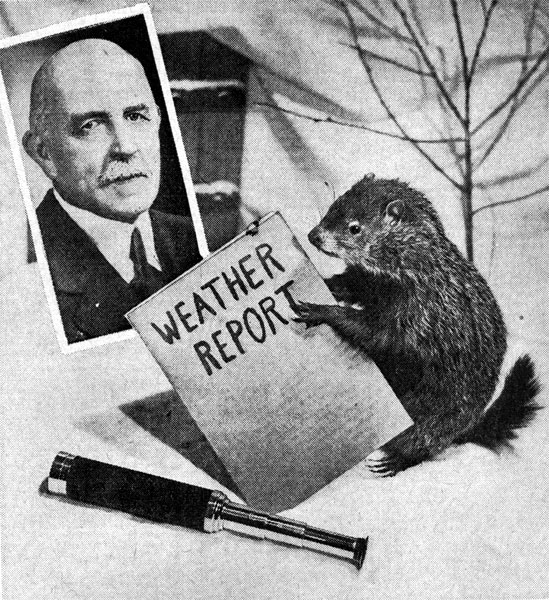
“Groundhogs are in the same class with goose bones, heavier pelts, thicker coats on pigeons and the rest of those old-fashioned ways to reveal the coming weather. And none of them is worth a darn. None of them is any good.
“Let me tell you a story to illustrate just how little the groundhog has on the ball. There were a couple of farmers in Pennsylvania talking together about the coming Winter.
“‘This is going to a terrible Winter,’ said one of them. ‘The animals all have heavier coats, the pigeons are getting thicker coverings, the bark on the tree is growing thicker, too.’
“‘My gosh,’ replied the other farmer, ‘you’re not going to have all that to yourself are you. Over in our county we haven’t noticed any such things as that, so I guess this Winter is all going to be in your county.’
“Same way with the ground hog. He doesn’t mean a thing as far as the weather is concerned, whether he sees his shadow or not means nothing.”
“Then you think the stuff about the groundhog and St. Swithin’s Day is bunk?” he was asked.
“I don’t think anything about that,” was the reply. “I just think the groundhog and his shadow is a fable and the stuff about St. Swithin and the weather is a fairy tale. I’ll rely on the wind to tell the weather, it hasn’t failed me yet.”
“Give you an idea. Rained hard on Monday and friends of mine wanted to go somewhere today. So they called me up to ask me what Tuesday’s weather was going to be. I told them it would be clear and cold but one of them said, ‘the weatherman says it will be fair and warmer.’
“‘That’s all right with me,’ I told this friend, ‘but I say it will be clear and colder.’ Who wins?”
Clear and cold it certainly was. Then Corliss smiled—the veteran prophet has passed his 80th birthday and is still going strong—and said;
“Want to put a knockout on the groundhog, once and for all?”
“Sure,” he was told, “it’s nice work if you can do it.”
“Groundhog comes out in February doesn’t he? Yes. Well I want to say that February and August are the only feminine months in the year. Thought that ‘feminine’ would get you. What does it mean? It means that February and August are the only months in the year that won’t be dictated to.
“I never make any predictions about either of them, for they’ll fool all the weather prophets in the universe. I just want to say that I measured this Winter with the wind the same as always, and I told the Courier-Post we would have a ‘normal’ Winter. That means not too hot and not too cold. And that’s what we have had thus far and that’s what we’ll have until Spring.
“So don’t bother about the groundhog. As a weather prophet he is just a ham anyway.”
Is Zat So?
Camden Courier-Post —
By GORDON MACKAY
SQUIRE BENJAMIN FOGELMAN relishes a title that has made him both fortune and fame in the past decade; For the squire is that large and vocal gentleman known as “Benny the Bum,” who has one of the night spots in Philadelphia.
Mr. Fogelman has been a choice acquaintance and friend of mine for many years, and there is much about Benjamin, the Vagrant, to interest one and also to weld him to friendship with Bee, the Bee.
Our original tete-a-tetes with Benjamin, the Nomad, date back to the days when Mr. Fogelman was casting sheep’s eyes at repeal and wondering when legitimate liquor would smooth his pathway into the night life of the Quaker City…
Mr. Fogelman’s business, as we noted, was largely comprised of losing bets on prize fights. Benjamin, the Hobo, at the time we speak would willingly bet on anything and everything. And, there were those who accommodated Benjamin, the Wanderer by betting him to a standstill, and also seeing that he did not win by taking care of the jury before the fight started.
It was during a run of ill luck that Benny, the Traveler, came to me, not with tears in his eyes, but with wistfulness in his face and anguish in his tones. Somehow or other, Benjamin seemed to believe that sports writers possessed occult information denied to other denizens of this mundane sphere. So he beseeched us to yank him out of the depression in which he found himself by always betting on the wrong gee.
Two Knockouts on Single Card
It so happened that when Benjamin, the Bee, appealed to us there was a fight program arranged for the following Monday night at the Arena. On the card were two gentlemen, one named George Courtney and another whose name escapes me for the nonce. Both could box, both could hit.
Courtney and the other disciple of the manly art were in separate melees. Thus, as Mr. Fogelman, still suffering from the slings and arrows of outrageous fortune, appealed to the writer for a good thing…
Junior Red Cross Activities Told to Astonished Elders
Camden Courier-Post —
12,000 Members in County Learn Meaning of Real Charity Through Aid to Sick and Needy School Classmates
By GORDON MACKAY
Bright-faced boys and girls of the Collingswood schools, representative of the 12,000 members the junior council of the Red Cross has in Camden County, astonished their elders last night by the nature and scope of their humanitarian work.
These revelations were made at the meeting of the Camden County Chapter of the Red Cross, with Dr. Leon N. Neulen, superintendent of Camden city schools, presiding. So remarkably humane did these boys and children reveal themselves that they shared honors with Fireman Harry Cooling, of the Collingswood fire department, who was an unsung hero until last night, too.
Henry D. Rooney, familiarly known in Red Cross circles as “Pop” and the man in charge of the first aid efforts of the organization, disclosed the hero role that Cooling played some months ago.
“Cooling was a student at the first aid school we were maintaining at Collingswood,” said Rooney, “and he was in class one night studying when a call came to him. The police department had found a woman overcome by gas.”
Errand of Mercy
“The Policeman who found the victim knew the fire department was at first aid school that night. So he telephoned to the firemen for assistance and Harry Cooling responded. He revived the woman and then summoned a doctor.
“The physician sent for an ambulance to take the victim to the hospital. The doctor said to Harry: ‘You’re going with us.’ That woman became unconscious twice when on the way to the hospital and each time Harry revived her. She is alive and well today.”
William Stevenson, who is chairman of the junior council in Collingswood and a senior in the high school, opened the program for his associates. He disclosed that every student in the high schools and every pupil in the elementary grades is a member of the junior council. They are organized to take care of needy pupils, and the anonymous manner in which such humanitarian work is performed was explained at length by the young spokesman.
$967 Spent In Aid
Miss Dorothy Thorne gave an insight into the activities of the juniors, measured in dollars and cents. She told of the collection of $1001 from the Collingswood school children during the past year, of which $967.34 was spent to aid youngsters, needy, sick or ailing.
The manner in which these young people spent the money was an insight into the expansive work they do. One needy pupil was given a vital X-ray examination for which the juniors paid $15. Another bill of $10 which was paid, provided medicine in hospitals for students whose own pocketbooks couldn’t supply the money. Milk for babies, meat for the hungry, clothing for the needy—all these activities were set forth in a chapter that evoked praise from Dr. Neulen, the chairman.
The Christmas work of the high and grade school youngsters, too, formed an illuminating chapter. Miss Jessie Watt of the high school, recited how the schools have been supplying these baskets for five years.
152 Baskets Sent Out
“No family is identified by name,” she said, “but each is known by a number which is placed on the basket and the address of the person to whom the basket is to be delivered is appended.
“In 1937 at Christmas we sent out 152 baskets.”
“These baskets,” added Miss Watt, “if totaled in money, would have amounted to possibly $1500, all of the baskets being supplied by the school children alone.”
Douglas Reese of the high school senior class, who helped to deliver the baskets, told of the joy of the recipients, and how he and his fellows learned how the other half lived.
“It was an experience we will never forget,” he declared.
Richard Miller, a chubby youngster who attends Garfield school, recited the international amity which is promoted by Collingswood grade schools and foreign school children.
“We send cartons from our school, and the other schools to foreign countries, filled with toys and playthings, dolls and everything that a child would ask at Christmas, but no war toys,” he said. “And no soap,” he declared fervently, while his elder auditors roared, “because we don’t want to insult them by making them think we think they need soap.”
Betty Jane Vogel, also of the Garfield school, told of the instruction which the pupils receive, while Phyllis Greene, of the junior high school, narrated how each of the 300 girls in the school supplied a garment she had made to be given a needy girl last Christmas.
Dorothy Paul, of Oaklyn, who attends Collingswood High school, revealed the international friendship and amity that Collingswood youngsters are promoting by an exchange of letters and gifts. She exhibited a tremendous portfolio which had been sent by Collingswood High to a high school in Czechoslovakia. The aliens to reciprocate, sent back a portfolio showing the process of steel-making in the great plants at Skoda.
Miss Paul also explained that these exchanges were made with high schools as far afield as South Africa, with those in Italy and other European countries.
Helen Barton, also a student at the junior high, was the 1937 delegate to the national conference of the junior council held in Washington. She recited how the juniors had contributed between $15,000 and $18,000 during the last year to be expended in helping communities to supply libraries and playgrounds to the boys and girls of those places.
Miss Barton also recited a story regarding an accident which had occurred to two children in Delaware, who afterwards became wards of junior council.
“They had been in an accident,” she related, “and it was necessary to resort to plastic surgery in order to keep their faces from being scarred for life. The junior council sent them to Johns Hopkins Hospital, where the operations were performed and new faces literally given to the children.”
Reports were received from various committees at the session held before the juniors took charge. Representatives told how the various communities are fighting the depression by having the various Red Cross units make sweaters, jackets and other articles of clothing to supply the needy who lack these essentials.
The county chapter, too, reported $6000 sent to Washington national headquarters as payment for the membership which had been recruited during the past year. Miss Viola E. Williams, executive secretary, reported the chapter would embrace 12,500 members shortly, the greatest known to the organization since wartime.
Mrs. M. E. Linden was presented with a pin for having recruited the largest number of new members for the Collingswood unit.
Is Zat So!
Camden Courier-Post —
By GORDON MACKAY
CHEMIST by profession and rated as South Jersey’s foremost expert on toxicology in court trials, A. C. Herting of Haddon Heights, holds many interesting experiences during his career. The Hertings were chemists as a matter of heritage. “A. C.,” the Haddon Heights chemist is known, was educated at the College of Pharmacy, Temple University, and the University of Leipzig, Germany.
His father was one of the leading chemists of Philadelphia, employed by several corporations as their expert. “A. C.” followed in the sire’s steps. Chemistry is a science as interesting as it is valuable. To appear as a witness in murder trials is sufficient repute to fix a man’s status.
Herting has been a government witness in several murder cases, two of which stand out in his memory because of the bizarre and novel features connected with the crimes and the trial of the defendants. One of these was the murder of an organist some years ago in one of the Amboys.
“This girl was beautiful,” Herting told the writer, “she was the organist in one of the leading churches of the city. She married a young man who had been her swain since childhood. He left her the day following the wedding, and not a word ever came from either bride or bridegroom as to the reasons for this apparent desertion.
“One night she was heard playing the organ in the church, an edifice which was a short distance from her home. In fact the girl could walk the distance in five minutes. Her duties as organist ended at 9 p.m., so her father waited for his daughter’s arrival.”
Girl Slain in Drunken Frenzy
“The father became uneasy when five minutes after the hour had gone. When 10 minutes tied, and his daughter did not appear, the father started to search for her. It was snowing. When he got outside, the father discovered something that looked like a bundle lying on the ground. It was his ravished child.
“Suspects were arrested and their clothing turned over to me. I found blood spots on several of these garments belonging to different suspects. Finally I nailed a Negro as the murderer because the bloodspots on his coat corresponded to the blood of the girl who was slain.”
“In another murder case that was tried in Salem County,” continued Herting, “it was necessary to present tests that were the result of experiments on guinea pigs. In fact I earned the nickname ‘The Guinea Pig Chemist.’
“The layout was this: boarding in Pennsgrove was a dope peddler and a young fellow who worked at duPont’s. There were a number of other young men boarding there, who were employed in the duPont plant, too. The bunch formed a clique, played pool together, went to shows together, were an informal club.
“One night Haslett—he was the chap who died—was invited by the other fellows to play pool. ‘No,’ Haslett said, ‘I’ve got a bad headache and think I’ll pass tonight.’ ‘Oh,’ the drug peddler told him, ‘I’ll give you something that will cure that headache right away.’”
“The narcotic dealer went to his own room, came back with a powder. Haslett swallowed it.
The party started for the pool game. Haslett had just about reached the sidewalk, when he collapsed. He was hurried to the hospital, but did not regain consciousness before he died.
“The police were told about the headache powders. Here occurred the first untoward incident regarding that case. The coroner and coroner’s physician differed politically.”
Compelled to Make Autopsy on Victim
“As a result of this political antagonism,” narrated Herting, “neither of them was willing to perform the autopsy. So I performed it. I discovered morphine in the stomach of the victim. As an outcome of the autopsy, policemen searched the drug peddler’s room, to discover many decks of heroin there.
“He was arrested, and indicted for second degree murder in giving Haslett an overdose of heroin. I had a problem there. Morphine found in the victim’s stomach, no narcotic but heroin found in the room. My theory was that heroin introduced into the system by mouth would become morphine in the stomach, as morphine is the base of heroin.
“I was compelled to experiment on guinea pigs and rabbits to prove my theory. I fed these animals heroin in an overdose to correspond to the amount of morphine found in Haslett’s stomach. I discovered the truth: heroin taken internally in that manner became morphine.
“I presented my findings, attending the trial until the case was given to the jury. I had to make a 5 p.m. train out of Salem on that day, so I didn’t get the result of the verdict. I looked in the newspapers for several days, but could discover nothing about the verdict.
“It slipped my mind until one day I was walking down Market street in Camden, when I happened to run into the judge who tried the case. He looked at me in a curious manner, then said: ‘Do you belong to any fraternal orders?’ I told him I was an Odd Fellow. Then I asked the question I had long wanted answered: ‘What was the verdict?’
“‘Acquittal,’ he told me. I could scarcely believe it, although I believed then, and I believe now, that the government erred in not asking for an indictment for involuntary manslaughter rather than second degree murder.
“‘Yes,’ he said to me, ‘I knew the verdict would be acquittal when I saw the prosecutor allow one juror enter the box.’
“‘How was that?’ I asked rather surprised. ‘Well,’ the judge said, ‘the juror and the defendant were both members of the same fraternal order.’ I thought that was rather far-fetched reasoning. I was convinced that this might be something of an alibi for the acquittal.
“I had another case in Salem County, where a gang of four bad men banded together to rob. They didn’t intend to murder but one night they took a guard at duPont’s, robbed him, then shot him to prevent identification.
“I was the chemist retained by the government to test bloodstains found on the garments of one of the men. The defendants said they had stolen some chickens and killed them, and that the stains were chicken’s blood.
“The defense lawyer challenged my qualifications. He thought he would be smart, so he said: ‘I suppose you can tell chicken blood, cat blood, elephant blood, can you?’ ‘Yes,’ I answered. ‘Oh,’ he replied, eyeing me as if I was a smarty and trying to get by with a bluff, ‘and how would you be able to qualify to tell those different kinds of blood?’
“‘Because of the tests that I have made in the Philadelphia Zoo on the various animals you have named,’ I replied. That shut him up right then and there.”
Is Zat So?
Camden Courier-Post —
By GORDON MACKAY
SILENCE is golden where rumpus and ruction in the Democratic camp is concerned. Once upon a time whenever the unterrified Democracy squabbled and battled, fought and bled, ‘twas tip secret. Indeed, the Democrats seemed to occupy nine-tenths of their time fighting over something that wasn’t worth a left hook to the chin.
It was row, row, row, from morn till late at night, fighting over the crumbs that fell from the tables of the opulent G. O. P. of that day and date. Nowadays, however, the shoe is on the other foot. It is the G. O. P. that lurks ‘round for the crumbs, of both comfort and patronage, fighting their battles and spreading the tidings of their strife to the four corners of the county.
Meanwhile, the Democrats have foxily masked their bitterness, put a lid on acrimonious charges, created the erroneous inference that the dove of peace bears an olive branch in its bill. The impression is that a cooing pigeon is no sweeter than the harmony that prevails among the bigwigs of the party of Jefferson, Jackson and Roosevelt of Hyde Park. Despite the apparent smoothness of the appearance, there is strife and battle galore raging beneath the surface. It is carried on in a quiet strain. That it exists is only too true, as the warring leaders would admit, if they were compelled to testify under oath.
Oddly enough it seems a battle for leadership rather than spoils. For the Brunner-Kelleher wing of party leadership has a blunt edge on its rivals. This edge is due to the fact that the other camp has its leaders all nicely tucked away in lucrative jobs.
Leaders Cared for in Billets
A brief glance over the situation will reveal this fact. Harry T. Maloney, a chubby gentleman with a beaming face and a modulated voice, is the collector of internal revenue. Mrs. Emma E. Hyland, suave, maternal and friendly to one and all, is postmaster. Samuel P. Orlando, both debonair and daring, is county prosecutor.
Naturally, none of these leaders has a valid claim to kick against the personal deal received from the Democratic party and its leadership. None of those mentioned above could expect to see huge forces rallying around their flag, when those to whom the invitation must be given are found idle and unemployed.
Practically then the Brunner-Kelleher faction is in the position of declaring that the present Democratic leadership hasn’t treated the rival clique any too poorly, when such jobs are allotted to the leadership of the antis, opposed to the Mayor and County Treasurer.
Though this be logical, yet whoever heard of logic swaying politics, or guiding a politico? The battle for leadership goes on apace. Circumstances lent an opportunity to the anti-Brunner leadership that came close to spelling curtains for the ruling element in the local Democratic camp.
All the strife and its consequent strategy harks back to the Moore-Clee battle of last November. Mayor Brunner and Treasurer Kelleher were on a spot. They had Moore, with his anti-Roosevelt record in the United States Senate, his Hague smear, for their gubernatorial candidate. So many different elements in the Democratic party opposed Moore and Hague that Brunner was right behind the eight ball.
He couldn’t help the Clee vote that piled up here any more than he could take credit for the tremendous sweep that carried the county for Roosevelt in 1936. Brunner in one instance was riding on a victor’s coattails in Camden County. In the other instance he was beneath a juggernaut that was flattening him out, along with Kelleher.
Situation Gave Rivals Chance
Harry Roye, one of their ticket for Assembly, kicked over the traces. Support usually given to Brunner and Kelleher in certain quarters was missing. George and Eddie were fighting a hopeless cause.
But this didn’t deter the other faction from making hay while the sun shone. Missionaries of that camp ran to North Jersey with stories that Brunner and Kelleher were lying down on the job. As a matter of fact neither was lying down on the job. Both were punch drunk, politically speaking, from the socks they were taking on the chin for Moore.
The tales bore fruit. North Jersey began to act decidedly sore toward the local majority leaders. When the freeholders’ election revealed a gain of eight seats for the Brunner-Kelleher leadership, the glee of the rival camp was unrestrained. The couriers of the other faction raced to Jersey City and jubilantly yelled “We told you so.” These ambassadors pointed to the triumph of the freeholders on the Democratic ticket as convincing proof that Brunner and Kelleher and their allies laid down on Moore to save the local ticket.
When George and Eddie went to Jersey City to confer with Moore, Hague and the party dictators, the Camdenites were confronted with this view of the election results in Camden County. Then Brunner and Kelleher cut loose. They told Hague’s minions and Moore’s messengers that Camden County leaders had a right to be sore, not North Jersey. All that Brunner and Kelleher and their allies had sacrificed, declared the Camden county leaders, were three assemblymen, absolute control of the County Board of Freeholders and several minor posts as well.
Instead of Brunner and Kelleher lying down on the job, the North Jersey doubters were told, it was the fact that Brunner and Kelleher in carrying along Moore had lost everything else.
The Camden county leaders were indignant, sore and talkative, too. They pointedly told Hague and his allies, that if they didn’t like the manner in which the Camden County leaders had performed to go take a jump in the nearest Jake.
Pyne Poynt Club Arranges Banquet
Camden Courier-Post —
Annual Get-Together of 27 Year-Old Organization Set for February 26
Twenty-seven years ago a group of North Camden young men banded together to promote sports.
Since that time an enviable record of achievements has been set up as the result of that meeting in the home of Albert R. Heap, 544 Bailey Street, in the latter part of January, 1911.
There, it was that the young men formed themselves into the Pyne Poynt Social Club. They met there for about three weeks, then moved to the Southwest corner of Fifth and Erie Streets; which has been the headquarters since.
The original group and those who joined in the years which immediately followed the organization meeting have scattered, many of them have moved out of the city, but each year they get together at a banquet.
Annual Banquet February 26
The time now is approaching when the annual banquet will be held. It is scheduled for Saturday night, February 26, in the headquarters of the organization.
It is the gala occasion to which the older members look forward through the year—the opportunity to reminisce on the days that have gone and to recount the things they have done to promote sports. And, while the years have piled up for them, individually, there’s not one of the group of about 60 members, who will attend the banquet, who is not just as peppy as ever in his interest for the original undertaking of the club.
“It will be the twenty-seventh annual banquet,” said Frank Kelley, chairman of the banquet committee, “and the boys will be coming home for the get-together. They’ll come from Washington, from Illinois, Delaware, several sections of New Jersey and Pennsylvania. Old friendships will be renewed, old times and the affairs of the Pyne Poynt Social Club of bygone years will be discussed. It will be a night that will be enjoyed by everybody.”
Gordon Mackay To Speak
It seems fitting, members pointed out, that the principal speaker should be a man well versed in sports, from the marble games of boyhood, through baseball, football, championship fights—everything in sports. The speaker will be Gordon Mackay, member of the editorial staff of the Courier-Post Newspapers.
Mackay, through his 40 years in newspaper work, will recount his experiences in sports—and Mackay knows sports and those who have made history in its various phases.
In addition to Kelley, the banquet committee is composed of Hamilton Batten, George Ash, Alfred J. Ross, Jr., Jacob Dreher, Ellery Caskey, Nick Adezio, Edward H. Winters, Alex Kahnweiler and Harry F. Walton. As chairman of the entertainment committee, Ross will be assisted by: Robert Johnson, William Huber and Caskey.
Is Zat So!
Camden Courier-Post —
By GORDON MACKAY
THIS writer makes a grand salaam to the school children of Collingswood. The youngsters are members of the junior council of the American Red Cross, itself indicative of the humanitarian objectives of the young folk. Few persons, unless they are cognizant of the grand work of the school pupils in the grade schools and the students in the high schools, can realize how effective these youngsters are in their charities and humanities.
When I stop to consider that, years ago, when this grizzled old codger was a pupil in a grammar school, that the only contact we had with foreign nations was on a round globe that turned on a swivel, the amity and alliances that these Collingswood boys and girls have built abroad seem a miracle.
We also regard as significant a little incident connected with this international alliance between Southern Jersey and Central Europe. One realizes that the children in the classrooms reflect the nature of domestic thought, the trend of home training, home beliefs, home aims. This fact was proved to a startling degree by the straw votes taken in the suburban high schools in 1936 on the presidential contest.
The communities ran almost identical at the polls with the straw votes in the classrooms, so that the school children were really revealing the manner in which pa and ma were going to vote at the polls.
This prelude was merely to allude more convincingly to a little fact that may have escaped particular attention at a recent meeting of the Camden County Chapter of the Red Cross in the Collingswood borough hall. The students in the junior high school made a portfolio last Christmas to send to high school children in Czechoslovakia.
MUNITIONS WORK AT SKODA SHOWN
Naturally as junior members of the great Red Cross, the C.H.S. students included in their portfolio, largely pictorial, scenes that were “interesting to pacific students here, pictures of school work, student activities, and the like.
It is significant that the portfolio which the students in a high school in Prague returned to Collingswood contained pictures of the great munitions works called Skoda. A plant that ranks with the Krupps in Germany, or any of the great plants in our own country.
I have been hearing views given by those who have returned from Europe. These travelers agree Europe is martial-minded, and that war is in everybody’s thought, if not on everybody’s lips. It was necessary to take everything with a grain of salt, for after all, an American viewpoint on a European situation is not necessarily reflective of European thoughts.
But a school child’s mind is reflective of the thoughts of his elders.
The mere fact that these children in Czechoslovakia should believe that their friends in South Jersey would be interested in pictures of the great munitions plant reveals to me, at least that Europe is war-minded. I believe the kids disclosed this better than all the premiers, dictators and rulers on the continent.
I shall stick to the original premise that a child reflects its domicile, reflects its parents, reflects the home thoughts and beliefs, and this portfolio, filled with pictures of a munitions plant, is the best argument to me that Europe is thinking and dreaming of war. Hence the warrant, insofar as I am concerned, for the increase in Uncle Sam’s own national defenses.
It also indicates the simplicity of the student mind in Prague. At a distance of thousands of miles these simple children probably felt that the little pals in America were thinking along the same lines as the offspring of the Czechs.
MUCH CREDIT DUE YOUNGSTERS
Hence what could come with greater pleasure to the Collingswood children, or be fraught with a sterner message that we in Czechoslovakia are prepared, too, than to send the Jersey children a book filled with majestic pictures of Skoda’s great munitions plant.
Indeed, to my mind, it was the most telling and significant indication that war is in the European mind from peasant to dictator. To turn to the other side of the picture the work of these children among the needy of the school students is one of the finest examples of brotherly love to be found anywhere.
These youngsters, too, have learned the great lesson of real benevolence — that charity must be anonymous, that giving to the poor must be done in a spirit of helpfulness, in a mood of brotherliness whereby the one who has, gives of his store to the one who has not.
The manner in which these youngsters distribute their Christmas baskets is in this same generous spirit. The families in want are not exposed, their names are a secret. The baskets are filled; each has a number and an address. The almoners deliver these baskets to the addresses. All the children know, unless the person to whom the basket is delivered furnishes the information, is that the right number got the right basket.
The mere fact that these school children in Collingswood could collect $1001 for their charitable work is in itself a high water mark of excellence and efficiency. And the manner in which the kids distributed the money, the practical uses to which they put the funds, is another feather in their caps.
When I read about this Junior Red Cross I got the impression that it was one of the usual organizations for the youngsters, an organization that gave them a pin to wear and a sweater to knit, then decided to call everything jake.
That is the usual nature of most of these “junior” organizations — a pair of knitting needles, some wool and a pin: Presto; the whole thing is complete, the entire picture filled. If I was astounded at the international scope of their work, or the fact that these school children were actually carrying on international amity in its most fruitful fashion, between the children of the various countries, the elders present were paralyzed.
If those elders revealed an insight into their real impression of the junior council, I’m sure they would say that they had had the same idea as Mackay — a pin, a skein of wool, a pair of knitting needles.
When the amplified, expansive labors of these children were disclosed to them, the elders were flabbergasted, but delightedly so. The children won unstinted plaudits from the chairman, Dr. Leon N. Neulen, and they deserved every tribute, every garland.
So I wish they would take another grand salaam from the author.
Is Zat So!
Camden Courier-Post —
By GORDON MACKAY
YOU can always rely on Camden to bring back the normal balance. The more I see of this city the more it is impressed on me that realism can be found anywhere in the place. Camden is a good antidote for pessimism and cynicism, if you only want to find the cure and are fortunate enough to locate it.
This thought seeped into my ken the other day after I had read one of those kind of magazine articles, that always give me a pain in the neck. It was one of those “expert” articles telling youth how to find its proper sphere in the business world.
The dame who was dishing out the piffle-paffle on that score had the decency to admit that one of her students wanted to “know how he would get a job” rather than listen to all the ballyhoo about how to fill in your own conspicuous niche.
Accompanying the article was the usual honey from personnel managers about openings that their corporation possessed for the paragons who could answer all the requirements. The fact that these personnel managers declared there was always room for such material made me laugh. For, argued the Mackay, if all these positions are crying and begging for men, how come there are 10 million unemployed in this country, according to unemployment census.
Of course the whole business was a lot of guff and meant nothing in the face of the facts. Certainly these positions couldn’t go begging without being filled from the raw material that might be found in the army of 10 million idle workers. That type of hooey is even too tough for an incurable optimist like myself to swallow.
Laughabilities Rise at Detective “Mag”
My laughter increased as I read one of those “true detective” publications. What made me laugh was that every article, factually correct, ended with the admonition that crime does not pay. That suited me all right, too. Until I cast a surreptitious eye over the advertisements in this magazine; only to discover that it was packed from cover to cover with all the gyp and sucker advertisements that one can shake up.
The fact that this magazine was pushing out its message that crime does not pay and then purveying to the lads that trim the suckers whenever the trimming was good was too much for my blood. I began to want to exercise profanity, which is something that intimate friends know is a thing that Mackay rarely uses.
So we went for the domestic hearth in both sorrow and anger, only to bump into Mark Marritz. Mark will never be president of the United States but if Haddon Township remains a G.O.P. citadel it is a fair assumption that Mark will always be solicitor for the township unless he rebels and becomes a Democrat.
Now Mark Marritz is an excellent antidote for skepticism, pessimism and cynicism regarding America and her institutions. Mark was born in Kiev, Russia where he remained until he was 10 years old, when the family migrated to Wilmington.
“You can’t tell me anything about Russia today,” Marritz ventured to the writer. “Because I know how it was before the World War. I was born in Kiev and we were compelled to keep a picture of the Czar in the house, in fact every household in Russia had to display the Czar’s picture.”
“Jewish boys in Kiev, where they had massacres and pogroms against the Jewish people, were not allowed to go to school. They were prohibited from getting an education.”
Had His Fight to Get Ahead
“The only way we Jewish boys—my father was a merchant in Kiev—could get an education was through the rabbi. He couldn’t have a regular school either, he was compelled to teach each boy as a separate pupil.
“I got a good working knowledge of mathematics from the rabbi and also some of the Russian and Jewish culture. Imagine how I felt, too, when my father came to America and we settled in Wilmington. For I had to go into the first class in the lowest grade at school, because I could not speak English.”
“I had to learn the alphabet just like youngsters who were going to a school for the first time. As soon as I mastered English, though, I went ahead more rapidly, for the rabbi’s teaching had given me education along the lines that were necessary to me.”
Marritz is a walking advertisement for the destiny and glories of the melting pot. Energetic, good-looking, personable and with a talent for conversation and a penchant for the law. Mark assuaged some of the indignation that was wrought when we read the hooey that had been printed in those magazines.
Next we get a further advance back to normalcy when we bumped into Pat Iarossi. Pat is a barber but that doesn’t deter him from basking in the sunshine at Miami and thanking his lucky stars that his family moved from San Marco in Italy to Camden years ago.
Pat is another excellent example of the melting-pot. His barber-shop is now located at 600 North Third Street, site having been Pat’s for the past 14 years. Before that he had a shop on Front Street, where he barbered the native sons and daughters for 20 years.
Make no mistake, Pat has carried the tradition of the America that benefited him so much into his own activities. The years of service of his four employees amount to 52.
The oldest employee has been stropping the razors there for 18 years while the baby of the outfit, who is not so old either, has been employed by Pat for 10 years. Two others enjoy terms of 14 and 12 years.
Pat’s greatest memories cluster about Ann Pennington, Camden’s gift to the Follies and the stage, and the Dooleys, a theatrical family which also is a proud Camden possession.
“I used to cut Ann Pennington’s hair when she was a child,” Pat recalled. “And the Dooleys always made my shop their headquarters. Billy Dooley worked for me. The kids, six of them, trained in a patch we called the ‘cow lot.’ Rae and May were the two girls, while Johnny was the big shot of the boys.”
“They used to turn cartwheels right out in the lot there and come into my shop to do a little vocal rehearsing. Ann Pennington was always dancing, you couldn’t keep her feet still. I remember one day Ann, Johnny Dooley and a girl named Moore went over to Lubin’s in Philadelphia, trying to break into the movies.
“Lubin wouldn’t handle them and they all came crying into my shop.” Whereupon Pat produced a post card dated in 1911 showing Johnny Dooley starring in the old Bijou Theatre in Philadelphia.
So Pat has no envy of the thespians or of anybody else. Why should he—Miami is some place to spend the Winter.
Is Zat So!
Camden Courier-Post —
By GORDON MACKAY
May we not at this time proffer a suggestion to Mayor Brunner, Eddie Kelleher and the other party sachems that should be a sure-fire plan to make Camden county safe for Democracy? We advise that the Democrats gather a fund of $4000, the money to be expended in giving testimonial dinners to Republican leaders, near-leaders and persons who figure themselves to be both.
Engage tables enough to accommodate about 350 persons. Invite representatives of all the various G. O. P. factions in the county, give a half dozen tickets to boisterous Democrats, so that the latter can sit back in their seats and enjoy the subsequent dogfight on a full stomach.
This idea that I am advancing to register about 5000 more Democrats in the county and paralyze the remnants of the once-powerful county G.O.P., was born when I attended the recent testimonial dinner to Louis Bantivoglio, freeholder from the Fifth ward.
Naturally my attendance was purely in a professional capacity. Speeches were made by divers and sundry spokesmen, the high-light being the sales talk for Bantivoglio and Baird by David Baird, Jr. The latter waxed wrathfully but warily in castigating the “half-breeds,” as he once sarcastically termed the Republicans of the ilk and stature and political leanings of Commissioner Mary W. Kobus.
Rarely, too, have we ever attended a banquet, either in the capacity of guest or reporter that ever awakened so many echoes of the past as did the dinner to the Fifth ward freeholder.
Mrs. Kobus Elected Louis
First came the information from friends of Commissioner Kobus that she was responsible for the election of Bantivoglio from the Fifth ward as freeholder. In view of the fact that Squire Baird seemed to feel that the freeholder’s election was a personal triumph, this appeared strange to yours truly.
We moseyed about, however, and discovered that whether the squire likes it or not Mary W. Kobus and her minions did elect Bantivoglio. The leaders of the Kobus faction who put the thing across were headed by a woman named Madeline Salvatore and a gentleman named “Bucky” Branch.
Bantivoglio was elected by something less than 40 votes. These votes could easily have been given to his opponent but there were strategic reasons why the Kobus faction didn’t want a Democrat chosen from the Fifth ward.
So Branch, who is a policeman, I believe, and who was not working on election day, it being his regular day off, went into his precinct and put over the votes that elected Bantivoglio.
And Mr. “Bucky” Branch, I have been informed, has been so sore at the fact that he did elect Louis Bantivoglio that he moans and cries and berates himself ever since the trick was turned.
Politicos who told me the story about the Kobus support for Bantivoglio gave a rather sensible reason for the step that was taken by the anti-Baird folk. The New Dealers among the Republicans sensed that the division between the Republicans and Democrats in the 1938 Board of Freeholders was going to be exceedingly close.
Too close, in fact, to take any chances. So it was decided to support Bantivoglio in the Fifth ward, because he was a regular Baird Republican and couldn’t be won to the coalition. The reasoning of the Kobusitees was clear and correct.
Had Bantivoglio been beaten by a Democrat, the board would have been divided equally. The Democrats would then have been able to deal with an individual rather than a faction. One vote would have given either side control. Thus by putting Bantivoglio across the Kobus faction made it imperative for the Democrats to deal with that clique; in fact Brunner and his minions had to do that little thing.
In view of this analysis I’m content to believe that the Kobus claim that the New Dealers elected Louis Bantivoglio is absolutely okay.
Lady “Copper” Not Trade Party
Now don’t get the information askew. Mrs. Kobus had no official or personal hand in this matter. It was the keen thought of some of her lieutenants, whose judgment appears to have been excellent, that fashioned this plan and executed it.
Meanwhile numerous politicos have been jibing Baird’s statement that he would “rather have one Louis Bantivoglio than 1000 ingrates.” These political seers and soothsayers declared that such a declaration proved that its author was all wet in his political judgment and short sighted in his political history.
These politicos ambushed Mackay the other day, crammed him into a corner and told him that if it “hadn’t been for Bantivoglio Baird would have control of the city commission today.”
These chuckling anti-Bairdites not only bearded me in my den, but dared me to disprove their statements by taking a look at the record. A stranger to politics in Camden, I didn’t know the import of this statement until I squinted at the ward returns for the 1935 city commission election.
There in black and white is the proof that Baird lost the city commission fight because of the Bantivoglio-Leo Rea alliance in the Fifth ward. Just to take a look at the record again and to refresh jaded memories, the regular Baird slate received the following votes in the Fifth ward:
Bennett, 1016; Leonard, 1001; Lummis, 962; Rhone, 963; von Nieda, 1081. The New Deal ticket, then supported by the Messrs. Bantivoglio and Rea, polled these votes: Baker, 1032; Brunner, 1022; Hartmann, 1001; Kobus, 1024, and Reesman, 930.
We would call your attention particularly to the Leonard-Hartmann vote. Louis and Leo supported candidates Brunner, Kobus and Hartmann, of the New Deal.
Leonard and Hartmann polled exactly the same vote, 1001. And the recount revealed Hartmann a winner by SEVEN votes, the box score showing Hartmann, 17,338, and Leonard, 17,331. And the Fifth ward turned the trick, for it would have been easy for Louis and Leo to have given Hartmann the same vote that Reesman received, or 71 less, and elected Leonard. There would have been no recount then.
Which scrutiny of the returns would seem to show that Bantivoglio as a friend of the squire proved his valor and vigilance in the cause by seating a New Deal commissioner and owing his seat in the Board of Freeholders to the Kobus clan.
In connection with this fund which the Democrats should raise to give testimonial dinners to G.O.P. leaders et cetera we might suggest that on each occasion they have, David Baird Jr., named for a new office. In order, that my friend, Florence Baker, can show her loyalty and friendship to the Old Guard Field Marshal by asking his election to the said office.
This suggestion to the Messrs. Brunner, Kelleher and the others is made tax-free, and no charge for usage. If that scheme doesn’t make Camden county safe for Democracy, nothing will.
Baird Aides Held Seeking City Rule
Camden Courier-Post —
Orlando Warns Democrats at Fete to Moore, Crean and Mrs. Soistmann
By GORDON MACKAY
David Baird Jr., and his allies have already arranged their slate for the next city commission election and are laying plans to recapture the city government of Camden. Democrats should know of this movement and prepare to thwart the proposed plans at once.
This warning was given by County Prosecutor Samuel P. Orlando last night, at a testimonial dinner in the Hof Brau at which three Ninth Ward Democrats were feted, and at which 500 were present. The trio honored comprised Mrs. Mary Ellen Soistmann, state committee woman; Oscar Moore, freeholder, and John J. Crean, assistant city solicitor and county committeeman.
While the three guests were feted and presented with wrist watches and other tokens, the affair took on a love feast aspect for the three New Deal commissioners and all shades and leanings of Democratic leadership.
Mayor George E. Brunner was toastmaster and took occasion to poke fun at the G.O.P. and its tribulations over the county headquarters.
“I have just received word,” said the Mayor with due solemnity, “that the Republican county committee of whom I read today was having trouble over their headquarters, have finally solved their troubles tonight.”
“I understand they are giving up their present location and have just been presented by the Bell Telephone Company with a booth, and are now looking for another tenant to whom the committee can sublet half the space.”
Orlando’s warning came after he congratulated the special guests. He said: “I have every reason to believe that Dave Baird and the rest of the Republican chieftains are already laying their plans to capture the city commission. They are working to the end with their own slate, so that they can take from the people of Camden the good government which they have received for some time. We Democrats do not want to take this warning lightly, we want to remember that Baird and his chieftains are already working toward capturing the government of Camden, and this is something that we want to prevent at all hazards.”
Orlando also congratulated the gathering as an indication of the growth of the party, and the faith that the people of Camden come to have in the Democratic party and in its principles.
Disclaims Harmony Rift
Mrs. Emma E. Hyland, postmaster and long a figure in Ninth Ward affairs declared she resented any newspaper stories that hinted that there was the slightest rift in the Democratic party.
County Treasurer Edward J. Kelleher, hailed as “The Father of the Democratic Party in Camden County” contrasted the spectacle before him with the harmony dinner which he and others sponsored years ago. “We sold 150 tickets,” he said, “and gave away 150 more, and when the sponsors reached the hall at 7 p.m., the hour of the dinner, there wasn’t a single other person on hand. Later the hall was filled, and it held 200 guests. 200 to attend a Democratic harmony dinner that embraced all of Camden county.”
Officials Laud Guests
Mrs. Bertha Shippen Irving, postmaster of Haddonfield; Police Judge Gene R. Mariano and others also congratulated the guests. Mayor Brunner introduced Commissioner Frank J. Hartmann by calling attention to the cleanup campaign now under Hartmann auspices.
“Just as Hartmann is making Camden a cleaner city in which to live,” said the Mayor, “so has Commissioner Kobus made the city clean from crime. The streets are clean, the city is clean, and this has only been made possible by the efforts of the three commissioners who have worked in harmony, and who are going to continue to work in harmony.” Crean, Moore and Mrs. Soistmann spoke their thanks to those present for the banquet, the gifts and the sentiments expressed.
Is Zat So!
Camden Courier-Post —
By GORDON MACKAY
COUNTY PROSECUTOR SAM ORLANDO, with a laugh on his lips and paternal pride in his eyes, was telling me how Signor Mike Orlando intended to become a county prosecutor like his dad. Signor Mike has reached the ripe and robust age of 7. His career, as mapped by the precocious young gentleman is as follows: “Go to Peddie Institute, then to Princeton, then to the Harvard Law School, pass the bar association, go around and shake hands with every body, get elected, then don’t do any more work.”
“That’s Mike’s program,” said his dapper daddy, while a series of chuckles rippled from his lips. “And Mike’s program is not so bad, but it’s a lot different from his old man’s, although I did pass the examinations and was admitted to the bar 15 years after I landed in this country.”
Then Signor Orlando, the Elder, recited the pilgrimage of a young Sicilian of 9 from his native Italy to the Cumberland County city of Bridgeton. It might be dubbed “The Americanization of Samuel P. Orlando.”
“My father was a laborer,” said Sam, “and when I came to this country with my parents we settled in Bridgeton. I started school when I was 9. That was how old I was when I got here. They put me in the ‘zero’ class, with kids 5 and 6 years old.
“I was the only Italian pupil in the school. I didn’t know but four words of English. They were ‘yes,’ ‘no,’ ‘good day,’ ‘goodbye.’ I stood about two feet higher than the rest of my class, because they were kids just starting to school.”
“Well, as I was the first Italian in Bridgeton school, I got the works from fellows who today are the best and closest friends I have anywhere. They laughed at me. Because I didn’t know the language they gave me all sorts of steers that made me the joke of the school. Kids do that, it’s all in fun, anyway.”
Sent Home on Bluff
“I’ll never forget the first day we had school and the recess came around 10:30. The class was allowed out for five or 10 minutes. I went out with the rest and the other kids said to me: ‘Go home, all over today.’ I went home. When I got there my mother asked me why I wasn’t in school.
“I told her the school was through, that I was sent home. She told me to go back to school. I did and found out I had been razzed. In Italy, although I was only 9, I worked in the fields before we came to this country. And to help the old man I got up at 4 o’clock in the morning and worked till 8 o’clock at night on the farms around Bridgeton.”
“That’s one thing I feel proudest about, that I was admitted to the bar 15 years after I landed in this country, not able to speak or to understand a single word of English. Even when I got the hang of English at school I spoke broken English and forgot to sound the final ‘a’ in banana like the rest of them.
“When I think of 30 years ago and the way we went through school and fought for a chance to make good, Mike gives me a laugh. He is the modern kid, he isn’t going to become county prosecutor the hard way. Mike has it all figured out, and he told me just how it would be done—just as I’ve told it to you.”
Is Zat So!
Camden Courier-Post —
By GORDON MACKAY
HOLLYWOOD scenario writers toy with fanciful plots and bizarre situations, all children of imagination wedded to screen-breeding. At the same time we can point to two stories from real life that, transferred to the screen, would make a rip-snorting factual movie that would interest anybody who cared to see it.
Our first hero would be Colonel James Joseph Tunney of Greenwich, Conn. He is known to millions everywhere as Gene Tunney, who retired undefeated as heavyweight champion of the world. No fanciful tale, no imaginative plot could excel in realism and fact the actual life history and career of Gene Tunney. A second character from real life we would recommend to the Ben Hechts of Hollywood is James Michael Curley of Boston, twice mayor of his native city, twice governor of his native Massachusetts.
Had not arrogance and ruthlessness characterized Curley, while at the peak of his power, he would now be sitting in the United States Senate wearing the toga that enwraps young Henry Cabot Lodge, Jr. For Curley could never see harmony restored between himself and his political enemies. He remained so vindictive that he recently was defeated in an attempted comeback as Mayor of Boston.
“Jim” was defeated, too, by a youngster who formerly was his aide. Defeated more as a rebuke to his unyielding hatred of those who had opposed him than as a setback to the brand of politics which Jim Curley always played. A scenario dealing with Curley’s career would have to hark back 35 years.
Two Curleys Became Pals
At that time Jim and Tom Curley, who had no kinship other than politics, were young Democrats in Ward 17, Boston. They rebelled against the domination of the Old Guard in ward affairs, organizing the Tammany Club to give the former battle.
In the course of events the entrenched political rulers of the ward laughed at these young “pretenders.” To these hard-shelled oldsters the Curleys and their cohorts were just “young whippersnappers.” The first couple of elections revealed the Tammany Club behind the eight ball, but persistence finally won, Jim and Tom became co-leaders of the ward.
Ward politics in Boston, as in other large cities, is based largely on aid. The poor are fed, the judge is asked to go easy, the cops are told to lay off, typical machine politics rule the roost. The Curleys, tutored in this game early, worked it even to bigger results.
Then came the climax to their careers up to that time. An examination was held for post office clerks in Boston. About 100 or more men appeared to take the examinations. Federal jobs were not regarded as such sinecures then as now in the days of depressions, recessions, processions and what have you.
After the list of eligibles was made public, Jim Curley and Tom Curley were arrested. The charge was that each of them had impersonated a candidate for one of the jobs, taken the examination in his name, and the funniest thing about it one of the substitutes had failed to pass.
The Curleys made no attempt to deny their complicity in such a ruse and subterfuge. They were too slick for that—aid had been furnished to other chaps in devious ways, but nobody had ever been willing to take the rap from Uncle Sam to take examinations for clerkships and post-office jobs.
Jim and Tom were found guilty and went to Charles street jail, there to remain for several months. They were treated as heroes. Callous politics found nothing nefarious in “fronting for a guy.” Jim and Tom were rated as masters, because they were willing to jeopardize their liberty to help another chap out.
Curley Both Impressive
Both were handsome, impressive in manner. Jim had the more magnetic personality. As an orator Jim ranked with the best in Massachusetts, where they breed orators in every block. Curley’s rivals tried to block his path to the board by citing his jail sentence. Instead of hurting Curley this charge only made him stronger with the body politic.
Several terms Curley passed in the board of aldermen, then he decided to go to Congress. Curley won the Democratic nomination, equivalent to election in his district. Jim served several terms there. In Congress Jim decided he wanted to become Mayor of Boston. His birthplace where the Lowells and the Cabots sneered openly at the man who went to Congress from Charles street jail, as they jeeringly declared.
Curley knew how to handle that type of Mayflower aristocracy. As a matter of fact the Plymouth Rock brethren have the bluest blood and the least voice in affairs of any group in Boston politics. They have the Somerset and Algonquin clubs, they have the Junior League, fill all the Sunday society pages, but they never reach a seat in the municipal government—the proletariat sees to that. Boston is the only city in which I ever lived where the sacred cows were so turned out to dry pastures, never even given a bell to wear around their necks. Curley was chosen mayor several times. This position started his downfall.
A vindictive gentleman, with a tongue that dripped acid and vituperation, he could get under the skin of his rivals as no other political figure in the state. Curley’s rise didn’t set so well with the state bosses. When Jim announced that he would be a candidate for governor, they tried to stop him dead.
Banquet Arranged by Pyne Poynt Club
Camden Courier-Post —
27th Annual Event Expected to Break Record on Night of Feb. 26
The twenty-seventh annual banquet of the Pyne Poynt Social Club promises to be the most successful and best attended in the history of this North Camden sports and social group.
From different parts of the country acknowledgments are coming in to Frank Kelley, chairman of the banquet committee, from members that they will be present at the dinner to be held Saturday night, Feb. 26, at the club’s headquarters, corner of Fifth and Erie streets.
This year the principal speaker will be Gordon Mackay, member of the editorial staff of the Courier-Post newspapers. Mackay, who has been associated with newspapers for the last 40 years, will talk of sports, on which he is an acknowledged authority.
Since the organization of the club, in the latter part of January, 1911, the following have been presidents: Harry F. Walton, 1911 and 1912; Cecil Battle, 1913 and 1914; George Townsend, 1915 and 1916; Frank Boyer, 1917; John Begg, 1918; Frank Haines, 1919, 1920 and 1931; John R. Taylor, 1921; Alex Kahnweiler, 1922; Ed. H. Winters, 1923, 1924, 1925, 1926, 1927, 1928, 1929, 1930, 1935, 1936 and 1937; Richard Barry, 1932 and 1933; and Frank J. Hartmann, Jr., now city commissioner, in 1934.
Is Zat So!
Camden Courier-Post —
By GORDON MACKAY
“EIGHTY-EIGHT communities can’t just be wrong, when they run from Massachusetts to Florida.
Thus when they say that John C. Remington, Jr., is a good consulting engineer that’s good enough for me and the compliment should tickle Jay Remington down to his great toe.
Visit his office, however, and you’ll see the trophy that he prizes the highest has nothing to do with engineering. It’s a silver mug presented to the Remington-Vosbury team for winning the championship in the Camden Industrial Baseball League. The engraving shows that the silver cup was acquired in 1926, or a dozen years ago.
Now the 88 names on the blackboard that stands in the hallway outside the offices of Remington and Goff on Cooper street testify to the professional standing of the firm and its head. But the silver mug reveals that Jay Remington is prouder of the fact that he played football 14 years, and baseball for as long a period, than he is of any keys that might be presented to him to reveal that he was a tiptop student.
In a gabfast, too, he and I became quite convinced that he had really introduced baseball to London before the late John J. McGraw and the major league missionaries from the United States had slipped baseball into a clutch with cricket as the great British sport.
“Come to think about it,” said Remington, “perhaps we five chaps who went over on a cattle-boat after I was graduated from Drexel Institute really did put baseball on first base in London. I want to tell you about that so you’ll be able to understand the whole business.”
Storm Scared Mr. Remington
“When I was graduated from Drexel in 1909 four others and myself made a trip on a cattle boat. The name of the ship was the ‘Crown Point.’ We had 406 head of cattle aboard when we sailed.
“We were about two weeks getting across and before we reached the English Channel we ran into the worst storm that I ever saw. I was scared to death. The waves washed overboard 12 cattle that were on the poop deck and we had three calves born on the voyage to equal things a little.
“We also had a smart aleck in our bunch. When the storm was at its worst and we were afraid that we would never hit dry land again he liked to sit down on a box and play ‘Home, Sweet Home’ for us on a mouth-organ. Maybe we didn’t crown that bird whenever he started that tune.
“When I got to London I got a job with the Western Electric Company at West Woolwich, a suburb of London. We had a lot of other Americans working in the plant. So we started playing baseball. Then we had two leagues, and I guess I helped to found the first baseball leagues that London ever had.
“I remember we had six teams in each league. Our club was called the ‘Nondescripts,’ another was the ‘Crystal Palace,’ a third one was named ‘Shepard’s Bush.’ We played in the Crystal Palace in London and we played TWILIGHT BASEBALL. I’m darn sure that we had the first twilight leagues ever in baseball.
“The days are strange in London. It will be as bright as daylight until 9 or 9.30 p.m. and in a half an hour it will be as black as your hat. The Londoners got to like our baseball and would pay six-pence and a shilling to sit in the Crystal Palace. It wasn’t anything odd to have 3000 or 4000 to watch one of the ball games.”
Limehouse Dens Opened to Him
“I had one experience in London that I’ll never forget—a walk down ‘Petticoat Lane.’ That street harbors more crooks than any in the world.
“It came about in a peculiar manner. At the boarding-house where I lived was another young fellow with whom I became quite chummy. He turned out to be one of the men of Scotland Yard. He took me through the opium dens in Limehouse, then he suggested that we do ‘Petticoat Lane.’
“That’s a street where you find the real cockney in London. It has everything in the way of crooks and criminals. Before we started for ‘The Lane’ this sleuth said to me: ‘Now you’ll get your pocket picked before you have been 10 minutes in ‘The Lane.’”
“He knew where I kept my watch, in my vest pocket. I wanted to outsmart him, and when he wasn’t looking I switched my watch to the fob pocket of my pants. We hadn’t gone 100 steps into The Lane before I put my hand in my pocket and the watch was gone.
“I told the detective and he laughed, then called to a fellow who seemed to be loitering in front of a pool room. When we walked over to the stranger, the fellow on the sidewalk said: ‘This your watch?’ And he handed me my watch, which was once my father’s.
“‘Better keep an eye on that watch,’ the second Scotland Yard man said. ‘You’ll probably lose it again in a few minutes.’ This time I was bound to outsmart the whole Yard. So I wrapped the watch in my handkerchief, and dropped it in my upper vest pocket. We walked down The Lane a little further and seemed to get into a crowd. When I reached for my watch, I’ll be darned if it wasn’t gone again.”
Remington says that he loved football and wouldn’t have quit the gridiron after 14 years of strife and battle save that he was married. “I played for Haddonfield High, for Drexel and for the Frankford A. C. Played halfback and fullback. The games we had in pro football with Holmesburg A. C.—the Yellowjackets succeeded them—were hummers.”
Is Zat So! — Dr. Garrett C. Pogue
Camden Courier-Post — February 13–14, 1938
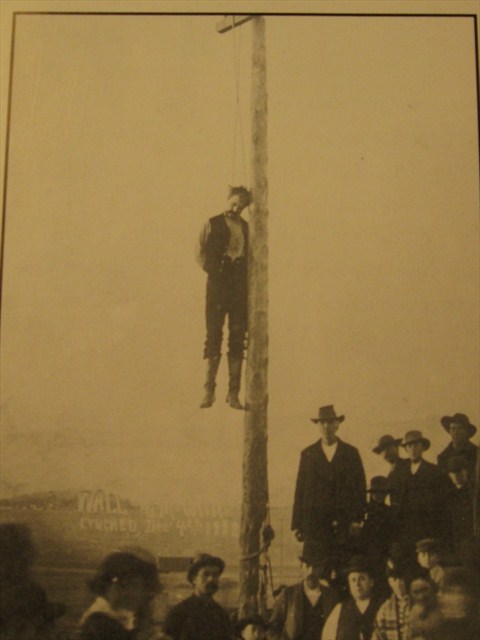
Dr. Pogue’s vision is as clear as in the days of his youth. His health is marred only by a cold that troubles him tormentingly but not seriously. His adventures and experiences are a fortune that money cannot buy, nor time and passing years wither in his memory.
Few men have leaped the five years above the allotted three score years and 10 to know such a life as has been Garrett Pogue’s. Born of good Quaker folk he lived by the gun for years, was a peace officer in the Wild West, when it was both wild and woolly. Famed marshals were his buddies, noted outlaws his prey.
Perhaps the most thrilling and dramatic of all his tales of the days that saw him cavalryman, cow-puncher and co-partner of the men who helped to win the West from outlawry and banditry is the tale he tells of “Billy, the Kid.”
“I was riding alone through the desert,” said Dr. Pogue, “and I saw the speck of a camp fire down in an arroyo, or valley. I was riding with my rifle over the saddle, my guns in my belt, when I caught the glint of steel in the firelight. ‘Hands Up!’”
“A man stood down in the arroyo and he said: ‘Come down off that hoss with your hands up.’ He had a rifle to enforce the command. Now it’s no easy matter to slide down from a horse, with your hands in the air. I did.
“‘Where you going and who are you?’ asked this rifleman. Just then I noticed a second man sitting by the fire, and the light glinted on another rifle. ‘Pogue’s the name,’ I told him, ‘and I’m riding from Texas to Arizona.’ ‘My name’s Bonney,’ the first man said, ‘and folks call me “Billy, the Kid.”’”
“‘Billy, the Kid,’ an outlaw for whom marshals all over the West were hunting, with 20 rewards on his head. He didn’t know that I was a deputy sheriff, I had my badge tucked down in my shoe.
“I slept that night by the camp-fire, not six feet from Billy, the most feared killer in the whole West. I had breakfast with them in the morning and rode away.”
Meets Billy Again
“It was months later, I had turned up in New Mexico. I was a deputy to Marshal Pat Garrett, about whom there are 1000 stories and legends, all of them true. ‘Garrett,’ Pat said to me one night, ‘I’m told Billy, the Kid is going to visit that Mexican girl he is sweet on over at the ranch.
“‘Get your guns and we’ll get Billy.’ I took my Winchester and a couple of other guns for my belt. Pat and I rode for the ranch, I was behind a tree with the rifle sticking out, Pat was around behind the corral. Sometime afterward Billy rode up, whistled a couple of times, then rose in his saddle and started to dismount.
“I had a dead bead on his back. I didn’t fire a shot. Why? Because I got to thinking about that night by the campfire when we broke bread together and he could have killed me as easy as wink. Something just naturally paralyzed my arm. I waited there, with the hammer of the rifle down, watching Billy to go into the house.”
Outlaw Dies on Floor
“In about two minutes it sounded as if all hell broke loose. Guns were popping, but pretty soon there wasn’t a sound. I went into the house. There was Billy on the floor, gasping out his last breath. Pat Garrett was on the floor, a couple of wounds in his shoulder, cussing me a blue streak for not throwing a gun on Billy and giving it to him.
“I explained the whole thing to Garrett, and while he cussed a lot he didn’t say anything more.”
Dr. Pogue was born in 1863, his mother was 48 when he was born, his parent dying in childbirth. His father was 54 at the time, two brothers had given up their lives for the Union cause, one at Shiloh, the other at Antietam.
Is Zat So!
Camden Courier-Post —
By GORDON MACKAY
FIVE of us sat about the festive board at a meeting of the Chamber of Commerce in Paulsboro not so long ago. Ed Martin, the president, who is also the superintendent of the machine shop of a big oil company, had just recited how an employee had been cajoled into breaking a contract that his firm did not like.
Then up spake Henry W. Peterson. Henry is the president of a big sand company and a member of the South Jersey Port Commission. He is quite a “joiner.” Although Henry dwells in Woodbury he belongs to many of the organizations that are located in boroughs where Henry and his company do business. Henry is 45, looks 35, has a laughing eye, a happy look and is darn good company at any stage of the game. He has a liberal outlook on life and its problems.
While I wouldn’t nominate Henry as a Brain Truster, he’s no hard-boiled Tory or case-hardened conservative either. Just a good scout. Henry recited a story, also. We have heard plenty during the last five years about how “practical” men were needed at the helm instead of “visionaries” who don’t know anything about business.
It seems that Henry’s dad was a butter and egg man in Philadelphia, and did business in such marts as a commission merchant on South Water street. The elder Peterson traveled the Middle West to make contacts to sell butter and eggs for the western farmers.
Inventor Had Some Gadget
“While father was in Minneapolis,” he said, “he met a man named Swanborg, a Swede. Swanborg had been educated in Europe, and entered the employ of Henry Ford, where he rose to the position of chief chemist.
“Along came the war and Swanborg went into the chemical warfare division. After peace was declared Swanborg had a yen to invent things. The first thing he discovered was a motor fuel with alcohol as a base, which could be produced to sell at four cents a gallon.
“You can see what a hit that would make with the Standard Oil Company and other big corporations that sold gasoline. The inventor went to the big fellows and offered them his patent, to be awarded on a royalty basis for the inventor.
“Swanborg didn’t want to make millions on this fuel. He really wanted the public to have the advantage of his discovery, in order that automobile upkeep would be cheap for the average guy. So he asked Big Business to finance the invention.
“Representatives of a big oil company tested the fuel. They had two automobiles run 200 miles on the speedway in Indianapolis, one using gasoline for fuel, the other using Swanborg’s motive power. At the end of the 200 miles’ run both machines were taken down. It was found that Swanborg’s fuel held up just as good as gasoline. This meant that motor fuel had been revolutionized.”
“Sold” Invention to Subsidiary
“But the big oil companies couldn’t market it, because that would destroy the market for gasoline. Swanborg was willing to accept a royalty. The big gasoline company, however, suggested an alcohol distributing corporation, one of the biggest in the country.
“Swanborg entered negotiations with this alcohol corporation which was probably a subsidiary of the oil company. The deal was made, but Swanborg who didn’t know anything about business, did not specify how many gallons of the fuel must be sold yearly in order to insure him a royalty—he was satisfied that the public should have the benefits of this discovery that enabled a man to run his car on a fuel that could be sold for four cents a gallon.
“So the alcohol corporation took over the fuel. And promptly sold enough of it to give Swanborg about $80 a month royalty, but it kept that cheap fuel off the market and prevented a tremendous reduction of the sale of gasoline.”
Camden — Sixth Ward Democratic Club Meeting
Camden Courier-Post —
By GORDON MACKAY
“MARMOTA MONAX, alias A. Groundhog and Samuel T. Corliss can battle over the ranking of weather prophets, but I’ll take Connie Mack or Gerry Nugent for mine. I know that Spring is on the wing, and that the time is near at hand when the young man’s fancy lightly turns to thoughts of love, as the poet sings.
For the writer has just received the annual brochure stating where the Athletics and the Phillies will pass the Spring training period in 1938. The Mackmen are going to Lake Charles, La., while the Phillies will move to Biloxi, Miss.
The transfer of the training camps means that Florida is passing out of the picture as the base of the major league baseball clubs. The Mackmen were stationed at Fort Myers, away down on the tip of the state, for a dozen years, while the Phillies traveled to Winter Haven, for a half dozen or more.
When Rommel Tossed ‘Knuckles,’
In those days the Mackmen boasted Cy Perkins, Jumping Joe Dugan, Jimmy Dykes, Eddie Rommel and others. The Athletics were loitering in last place, for this was one of the seasons when the cellar and Connie were constant companions.
The cynosure of the Lake Charles folk was a tall, gangling, slimjim, who stood six inches above six feet and seemed to weigh about as much as a lead pencil. He was Bryan Harris, known as “Slim,” who had a checkered career as a pitcher. “Slim” came from some town in Texas.
Camden — Mayor Brunner at Sixth Ward Democratic Club
Camden Courier-Post —
Mayor George E. Brunner addressed representatives from clubs of the ward at the headquarters of the Sixth Ward Democratic Club, 548 Walnut Street.
“I want to be reelected in 1939. I like the office and I want to go back. I recall one non-partisan commissioner who said he didn’t care to be returned, but I noticed 20 days before election he was battling for all he was worth to be reelected.
“I won’t stand up here and tell you I don’t care for the office. I do. It’s tougher than managing fighters, or in being a plumber—and I’ve been both—but I like it, and I want to stay right in it, so I’m telling you tonight I want to go back.”
“I am glad you are gathered here tonight,” he said, “because there is no better time to organize for the campaign to elect the city commission than today. The city election is one year from next May, but already our enemies are preparing for the campaign.”
“We found the city on the verge of bankruptcy, going nowhere fast. These three persons went to work to bring the city out of chaos. We have taken advantage of the Federal funds to help our city, we have not been afraid to sponsor WPA projects to keep men and women employed.”
“The city of Camden has cooperated with the Federal government more than all the rest of the communities in South Jersey combined.”
Uncle Sam and Boy, 12, Enter Third Annual Stamp Exhibition
Camden Courier-Post —
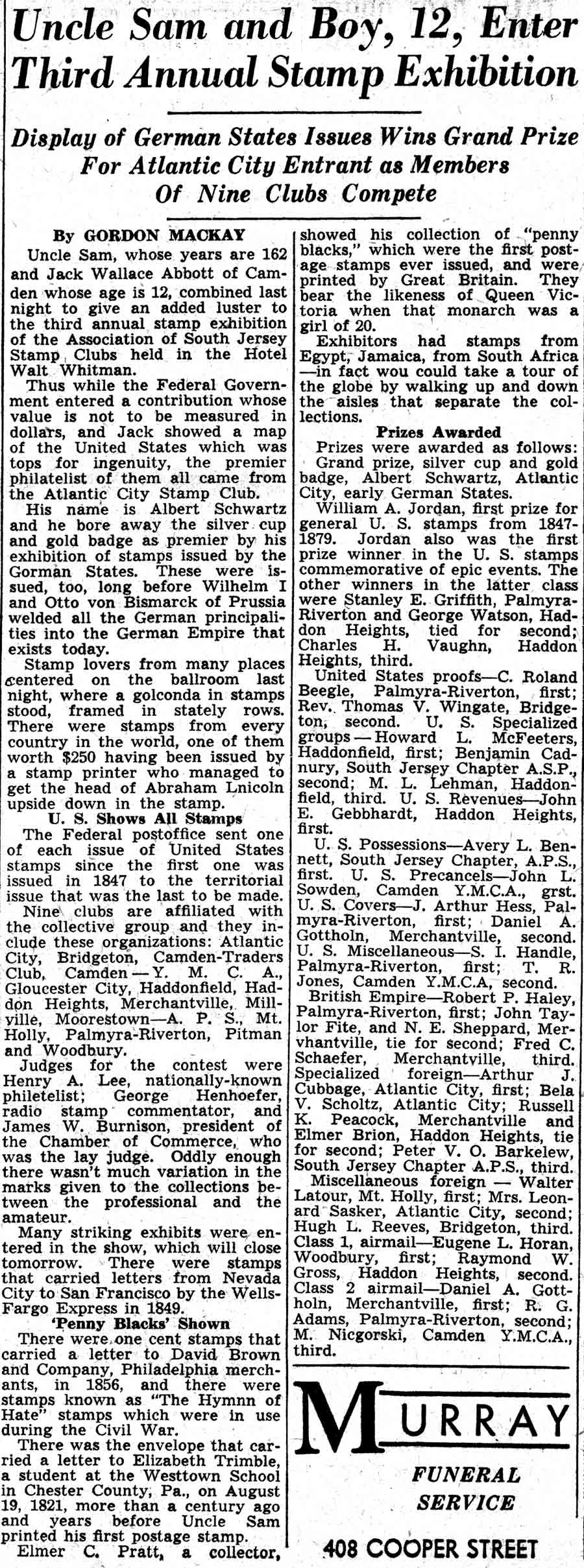
Display of German States Issues Wins Grand Prize For Atlantic City Entrant as Members Of Nine Clubs Compete
By GORDON MACKAY
Uncle Sam, whose years are 162 and Jack Wallace Abbott of Camden whose age is 12, combined last night to give an added luster to the third annual stamp exhibition of the Association of South Jersey Stamp Clubs held in the Hotel Walt Whitman.
Thus while the Federal Government entered a contribution whose value is not to be measured in dollars, and Jack showed a map of the United States which was tops for ingenuity, the premier philatelist of them all came from the Atlantic City Stamp Club.
His name is Albert Schwartz and he bore away the silver cup and gold badge as premier by his exhibition of stamps issued by the Gorman [sic] States. These were issued, too, long before Wilhelm I and Otto von Bismarck of Prussia welded all the German principalities into the German Empire that exists today.
Stamp lovers from many places centered on the ballroom last night, where a golconda in stamps stood, framed in stately rows. There were stamps from every country in the world, one of them worth $250 having been issued by a stamp printer who managed to get the head of Abraham Lnicoln [sic] upside down in the stamp.
U. S. Shows All Stamps
The Federal postoffice sent one of each issue of United States stamps since the first one was issued in 1847 to the territorial issue that was the last to be made.
Nine clubs are affiliated with the collective group and they include these organizations: Atlantic City, Bridgeton, Camden-Traders Club, Camden—Y. M. C. A., Gloucester City, Haddonfield, Haddon Heights, Merchantville, Millville, Moorestown—A. P. S., Mt. Holly, Palmyra-Riverton, Pitman and Woodbury.
Judges for the contest were Henry A. Lee, nationally-known philetelist; George Henhoefer, radio stamp commentator, and James W. Burnison, president of the Chamber of Commerce, who was the lay judge. Oddly enough there wasn’t much variation in the marks given to the collections between the professional and the amateur.
Many striking exhibits were entered in the show, which will close tomorrow. There were stamps that carried letters from Nevada City to San Francisco by the Wells-Fargo Express in 1849.
‘Penny Blacks’ Shown
There were one cent stamps that carried a letter to David Brown and Company, Philadelphia merchants, in 1856, and there were stamps known as “The Hymnn [sic] of Hate” stamps which were in use during the Civil War.
There was the envelope that carried a letter to Elizabeth Trimble, a student at the Westtown School in Chester County, Pa., on August 19, 1821, more than a century ago and years before Uncle Sam printed his first postage stamp.
Elmer C. Pratt, a collector, showed his collection of “penny blacks,” which were the first postage stamps ever issued, and were printed by Great Britain. They bear the likeness of Queen Victoria when that monarch was a girl of 20.
Exhibitors had stamps from Egypt, Jamaica, from South Africa—in fact wou [sic] could take a tour of the globe by walking up and down the aisles that separate the collections.
Prizes Awarded
Prizes were awarded as follows:
Grand prize, silver cup and gold badge, Albert Schwartz, Atlantic City, early German States.
William A. Jordan, first prize for general U. S. stamps from 1847-1879. Jordan also was the first prize winner in the U. S. stamps commemorative of epic events. The other winners in the latter class were Stanley E. Griffith, Palmyra-Riverton and George Watson, Haddon Heights, tied for second; Charles H. Vaughn, Haddon Heights, third.
United States proofs—C. Roland Beegle, Palmyra-Riverton, first; Rev. Thomas V. Wingate, Bridgeton, second. U. S. Specialized groups—Howard L. McFeeters, Haddonfield, first; Benjamin Cadnury, South Jersey Chapter A.S.P., second; M. L. Lehman, Haddonfield, third. U. S. Revenues—John E. Gebbhardt, Haddon Heights, first.
U. S. Possessions—Avery L. Bennett, South Jersey Chapter, A.P.S., first. U. S. Precancels—John L. Sowden, Camden Y.M.C.A., grst. [sic] U. S. Covers—J. Arthur Hess, Palmyra-Riverton, first; Daniel A. Gottholn, Merchantville, second. U. S. Miscellaneous—S. I. Handle, Palmyra-Riverton, first; T. R. Jones, Camden Y.M.C.A, second.
British Empire—Robert P. Haley, Palmyra-Riverton, first; John Taylor Fite, and N. E. Sheppard, Merchantville, tie for second; Fred C. Schaefer, Merchantville, third. Specialized foreign—Arthur J. Cubbage, Atlantic City, first; Bela V. Scholtz, Atlantic City; Russell K. Peacock, Merchantville and Elmer Brion, Haddon Heights, tie for second; Peter V. O. Barkelew, South Jersey Chapter A.P.S., third.
Miscellaneous foreign — Walter Latour, Mt. Holly, first; Mrs. Leonard Sasker, Atlantic City, second; Hugh L. Reeves, Bridgeton, third. Class 1, airmail—Eugene L. Horan, Woodbury, first; Raymond W. Gross, Haddon Heights, second. Class 2 airmail—Daniel A. Gottholn, Merchantville, first; R. G. Adams, Palmyra-Riverton, second; M. Nicgorski, Camden Y.M.C.A., third.
Is Zat So! — February 21, 1938
Camden Courier-Post —
By GORDON MACKAY
TWO South Jersey personages have been recognized recently by the Republican high command as the leaders of the G. O. P. in their respective counties. The persons chosen for this signal distinction are Commissioner Mary W. Kobus of Camden and State Treasurer William H. Albright of Woodbury, Gloucester county.
One North Jersey leader is also recognized. He is County Clerk Lloyd B. Marsh of Passaic county. These nominees were chosen by the vote of representative Republicans in every section of the state. The selections received the unofficial blessing of the party’s high command.
The poll which resulted in this triumvirate being chosen as the outstanding party leaders in the state was conducted by the “Republican Standard Bearer,” an official organ of the G. O. P., fostered by the high command and endorsed by the party chieftains in every section of the state.
Marsh’s Modesty Quite Compelling
Marsh’s choice is quite a tribute to his modesty, as a man named Lloyd B. Marsh is the managing director of the “Republican Standard Bearer.” To think that some other leader in Passaic County should have been chosen in a contest conducted by Marsh’s own newspaper, of course, is carrying human credulity a bit too far.
I seem to recall, too, that considerable bitterness was expressed by numerous lieutenants of Senator Lester H. Clee over the returns from Passaic county on last election day. There were loud blasts from Clee quarters that the Essex county senator had been sacrificed in Passaic and Essex counties. That in the former bailiwick political hari kari had been committed on the G. O. P. gubernatorial nominee.
These accusations, of course, came from partial sources. On the other hand there was the excusatory declaration that Marsh was sold out by his own lieutenants, who butchered Clee to make a Roman holiday, although personally Marsh remained highly loyal to the Clee candidacy.
If the latter view be correct then we ask as a plain, unadulterated newspaperman, who the blazes can reckon Marsh an outstanding leader when he can’t even control the actions of his own lieutenants? If that be leadership it’s certainly a most peculiar type.
Pardoned Slayer Hires Only Ex-Convicts For Work in Small Factory at West Berlin
Camden Courier-Post —
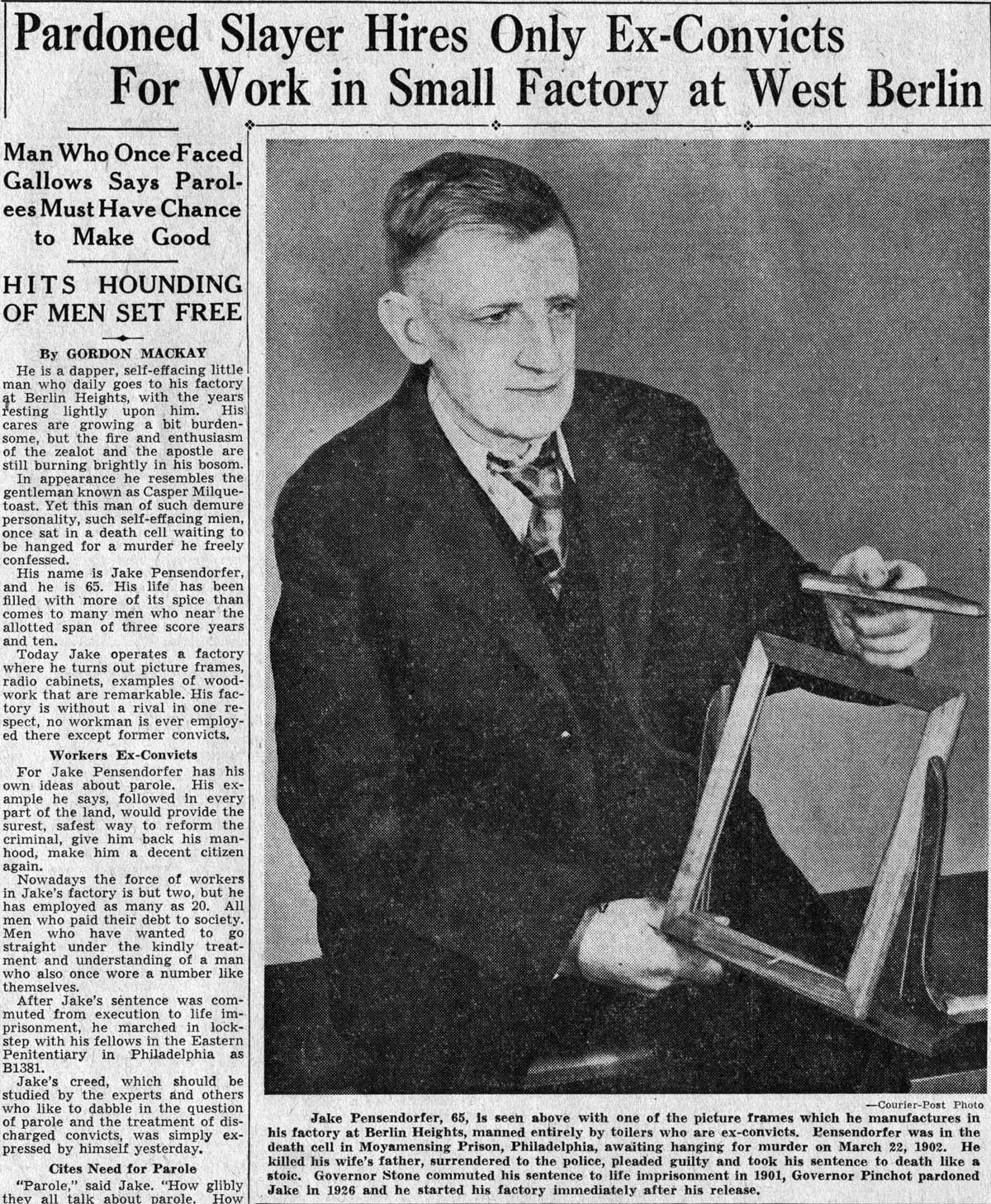
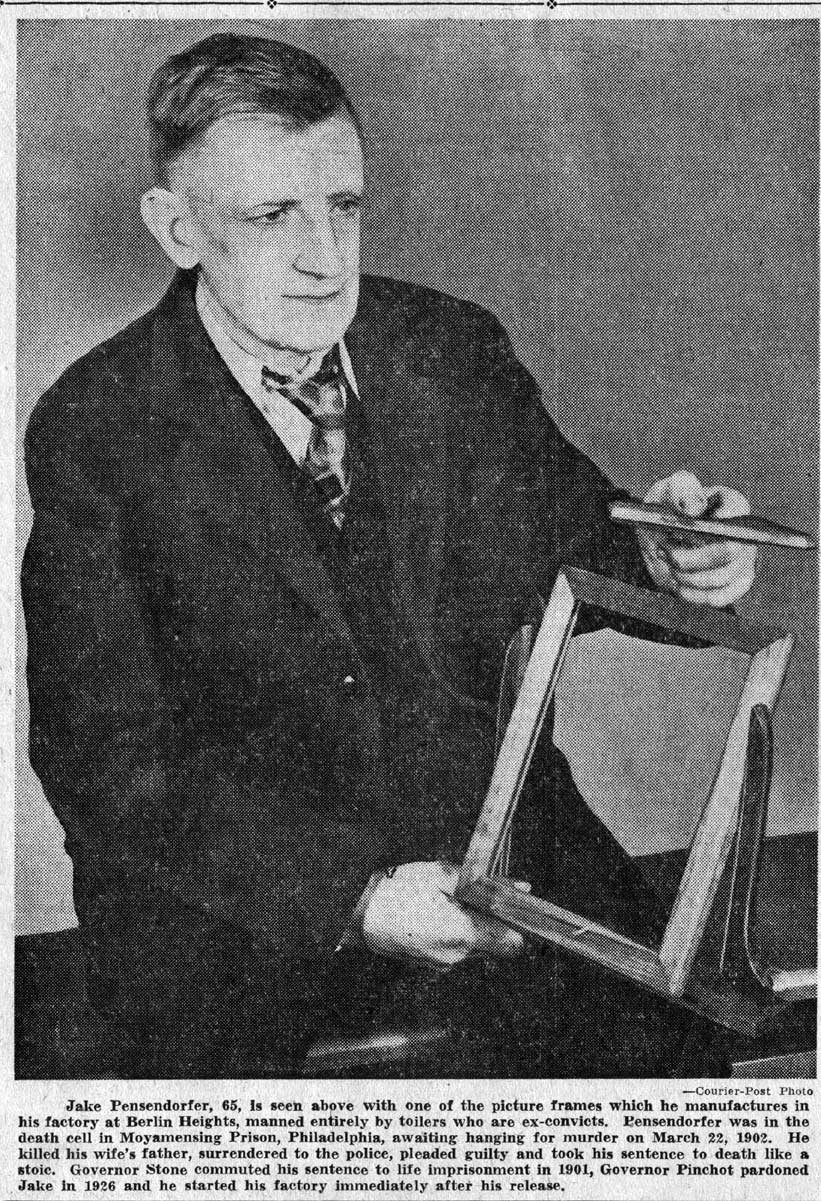

Man Who Once Faced Gallows Says Parolees Must Have Chance to Make Good
HITS HOUNDING OF MEN SET FREE
By GORDON MACKAY
Courier-Post Photo
Jake Pensendorfer, 65, is seen above with one of the picture frames which he manufactures in his factory at Berlin Heights, manned entirely by toilers who are ex-convicts. Pensendorfer was in the death cell in Moyamensing Prison, Philadelphia, awaiting hanging for murder on March 22, 1902. He killed his wife’s father, surrendered to the police, pleaded guilty and took his sentence to death like a stoic. Governor Stone commuted his sentence to life imprisonment in 1901, Governor Pinchot pardoned Jake in 1926 and he started his factory immediately after his release.
He is a dapper, self-effacing little man who daily goes to his factory at Berlin Heights, with the years resting lightly upon him. His cares are growing a bit burdensome, but the fire and enthusiasm of the zealot and the apostle are still burning brightly in his bosom.
In appearance he resembles the gentleman known as Casper Milquetoast. Yet this man of such demure personality, such self-effacing mien, once sat in a death cell waiting to be hanged for a murder he freely confessed.
His name is Jake Pensendorfer, and he is 65. His life has been filled with more of its spice than comes to many men who near the allotted span of three score years and ten.
Today Jake operates a factory where he turns out picture frames, radio cabinets, examples of woodwork that are remarkable. His factory is without a rival in one respect, no workman is ever employed there except former convicts.
Workers Ex-Convicts
For Jake Pensendorfer has his own ideas about parole. His example he says, followed in every part of the land, would provide the surest, safest way to reform the criminal, give him back his manhood, make him a decent citizen again.
Nowadays the force of workers in Jake’s factory is but two, but he has employed as many as 20. All men who paid their debt to society. Men who have wanted to go straight under the kindly treatment and understanding of a man who also once wore a number like themselves.
After Jake’s sentence was commuted from execution to life imprisonment, he marched in lockstep with his fellows in the Eastern Penitentiary in Philadelphia as B1381.
Jake’s creed, which should be studied by the experts and others who like to dabble in the question of parole and the treatment of discharged convicts, was simply expressed by himself yesterday.
Cites Need for Parole
“Parole,” said Jake. “How glibly they all talk about parole. How little they really know about it. I learned in the pen that the only way in which parole could be effective was to keep men after they were free under a control that would understand them, treat them decently, put no obstacles in their own attempt to redeem themselves.
“That’s why I started my factory. I knew. I had been a ‘con’. I knew. I would like to get enough orders all the time that would let me keep from 10 to 20 of these ex-convicts occupied.
“I’ve discovered that so long as they are controlled by me, they are safe, go straight. When they come under some other influence, they are always in danger. My first rule is no hard liquor. A glass of beer, yes, but no booze. Then I keep them busy, keep them occupied. Then they go straight as a string.
“It was my own idea to build this factory. I pay good wages, but I do something more. I keep these men away from bad company. What can a convict do? He comes out of stir with a $5 bill, nowhere to go. He has to buy clothes. He has to eat. He has to sleep. Is it any wonder that he slips back into crime?
Opposes Hounding Men
“Have some place for him to go when he comes out. Let him know that he is going to work for somebody who isn’t suspicious of every move he makes, doesn’t watch him, hound him. That’s the reason why I wish my factory could be run with as many ex-convicts as I can use—because I’m doing more for society, I think, than all the papers and confabs that would patch the planet of Mars.”
That for the gospel that Jake preaches as one who himself has paid.
The trail that carried Jake to the death cell was bordered with romance. Forty-three years ago a dapper young machinist from Vienna lived in Audubon. He arrived in this country several years before. His mother worked as a domestic for Henry Gouchey, who manufactured music boxes and amassed a fortune.
The Gouchey home was in Chestnut Hill, still the fashionable residential section of suburban Philadelphia. The dapper young machinist visited his mother while she was a domestic. He also met the daughter of the house, three years his senior.
Love flourished once more and again the romance of the Rich Young Girl and the Poor Young Man blossomed into marriage. Again the infuriated father refused to countenance the marriage. Once more the stern sire tempted the young bride to desert her husband, to free herself from marital bonds.
Killed Father-in-Law
The father succeeded, and thus Henry Gouchey sealed his own death warrant. For the dapper young machinist from Vienna went to Chestnut Hill one night in 1901 and shot his father-in-law dead. Satisfied that the man he believed had wrecked his life was slain, Pensendorfer went to the nearest police station and surrendered.
Mute he stood in court, refusing to tell a story that has not been unlocked by his lips even to the present time. He pleaded guilty before Judge Charles G. Audenreid, now dead, to murder in the first degree. Jake was sentenced to die on the gallows on March 22, 1902.
“How did I feel in the death cell?” asked Jake yesterday, “I just figured that it was a case of got to go. I killed him because I wanted to kill him.
“I wouldn’t tell my story in court, although I’m sure it would have let me out. In the death cell I was 27. When you’re 27, what you care? I killed him expecting that I would be hanged. So I wasn’t bothered a great deal.
‘Gave No Trouble’
“I didn’t even give them any trouble in court. I just pleaded guilty, let it go at that. But I had told the whole story to my lawyer, Max Greenwald. He may have told it to the Governor—Stone, I think—for after I remained in the death cell for two months, they came to me one day and told me the sentence had been commuted.
“I went up to the Eastern Pen, where I interested the warden in having the men at work instead of sticking to their cells, perhaps of plotting things all the time. I feel good about that, for I honestly think I was the first man that had prison labor started in the Eastern Pen.”
Pensendorfer was a model prisoner, who eked out quite a little money by selling his handiwork and skill to the visitors to the penitentiary who wanted souvenirs of their visits. The convict B 1381 made brushes mainly.
So exemplary was Pensendorfer’s conduct in the penitentiary that his case attracted the attention of Captain Herbert Smith, the warden. The latter with other officers signed a petition to the Pennsylvania Pardon Board to grant freedom to Jake in 1926.
The action was favorable, Governor Gifford Pinchot signed the pardon. Pensendorfer had served 25 years for the slaying. His first act was to move to Berlin Heights and establish the factory which had been his dream as the path to redemption of convicts.
Married Nine Years Ago
Nine years ago Pensendorfer married again. He lives quietly in Berlin Heights. For one whose hours were once numbered by judicial decree, Jake is a picturesque character. His cheeks are like roses, his skin bright, his eyes clear.
He does not spend his time railing against society, nor does he express the slightest remorse for the crime that sent him to the shadow of the noose, and a quarter century in prison. Pensendorfer declares that Gouchey wrecked his life. The only manner in which the father-in-law could pay was to die at Pensendorfer’s hands.
“I know the true facts of the case,” argues Jake, “and because I’m the only one who does, my conscience is clear even today.”
Is Zat So!
Camden Courier-Post —
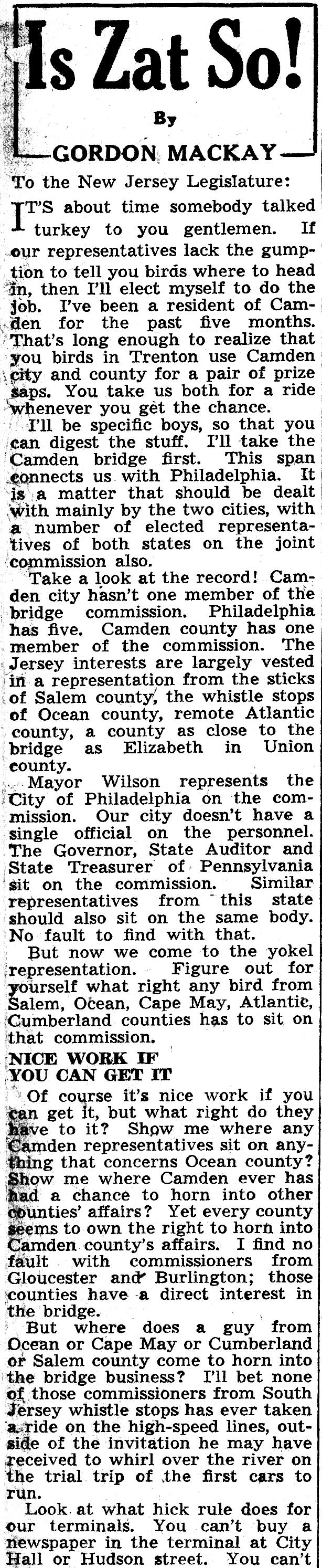

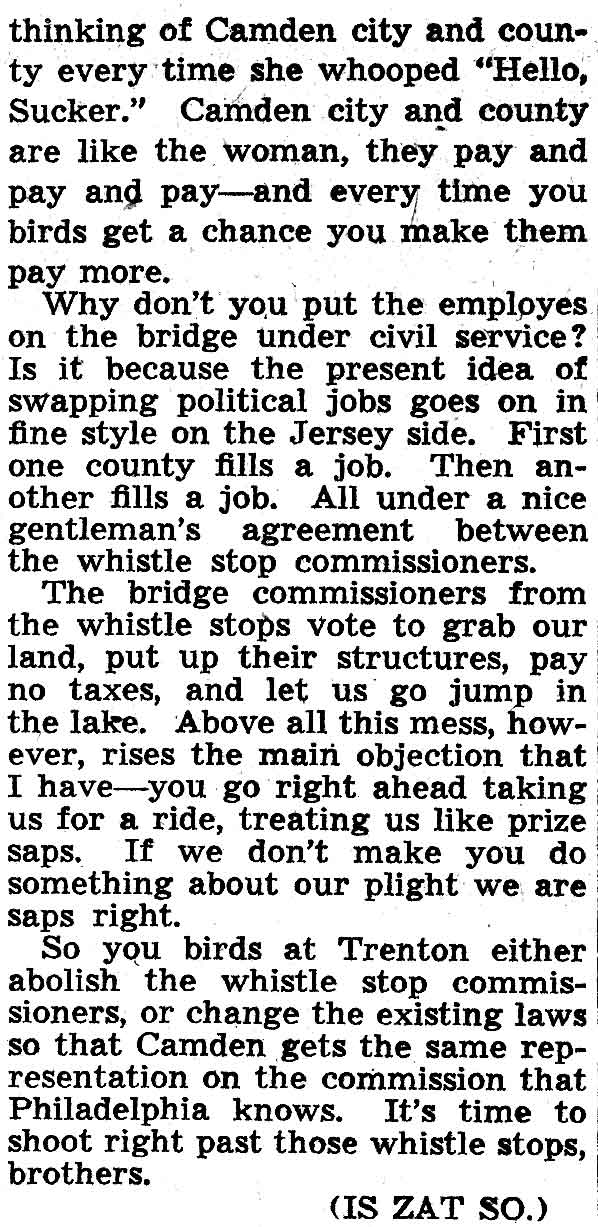
By GORDON MACKAY
To the New Jersey Legislature:
IT’S about time somebody talked turkey to you gentlemen. If our representatives lack the gumption to tell you birds where to head in, then I’ll elect myself to do the job. I’ve been a resident of Camden for the past five months. That’s long enough to realize that you birds in Trenton use Camden city and county for a pair of prize saps. You take us both for a ride whenever you get the chance.
I’ll be specific boys, so that you can digest the stuff. I’ll take the Camden bridge first. This span connects us with Philadelphia. It is a matter that should be dealt with mainly by the two cities, with a number of elected representatives of both states on the joint commission also.
Take a look at the record! Camden city hasn’t one member of the bridge commission. Philadelphia has five. Camden county has one member of the commission. The Jersey interests are largely vested in a representation from the sticks of Salem county, the whistle stops of Ocean county, remote Atlantic county, a county as close to the bridge as Elizabeth in Union county.
Mayor Wilson represents the City of Philadelphia on the commission. Our city doesn’t have a single official on the personnel. The Governor, State Auditor and State Treasurer of Pennsylvania sit on the commission. Similar representatives from this state should also sit on the same body. No fault to find with that.
But now we come to the yokel representation. Figure out for yourself what right any bird from Salem, Ocean, Cape May, Atlantic, Cumberland counties has to sit on that commission.
NICE WORK IF YOU CAN GET IT
Of course it’s nice work if you can get it, but what right do they have to it? Show me where any Camden representatives sit on anything that concerns Ocean county? Show me where Camden ever has had a chance to horn into other counties’ affairs? Yet every county seems to own the right to horn into Camden county’s affairs. I find no fault with commissioners from Gloucester and Burlington; those counties have a direct interest in the bridge.
But where does a guy from Ocean or Cape May or Cumberland or Salem county come to horn into the bridge business? I’ll bet none of those commissioners from South Jersey whistle stops has ever taken a ride on the high-speed lines, outside of the invitation he may have received to whirl over the river on the trial trip of the first cars to run.
Look at what hick rule does for our terminals. You can’t buy a newspaper in the terminal at City Hall or Hudson street. You can’t buy a cigarette. You can’t buy a sandwich. You can’t buy a single thing, except a ticket. Where in blazes did you ever see anything like this exist before? Show me any terminal in a city that seems to be metropolitan where the bus lines, car lines, bridge lines or other avenues of public travel do not cater to the wants and needs of the patrons.
Yet two or three guys from the sticks have the nerve to stand up at a meeting of the commission and yawp and yip about putting in stores, newsstands, commercial enterprises that you find in every other terminal I ever knew. They prattle about “hot dog stands” defacing the station. Why those birds don’t even go into one of the high-speed line stations twice in a year and they lock them up at 8 p. m. now.
So you gentlemen at Trenton better sit down on those commissioners from the whistle stops. Abolish the law that permits their appointment, or abolish them. I don’t care which.
MAKES TERMINAL LOOK LIKE DICKENS
Take a look at the terminals. They have all the robust life and energy of a morgue. They are dismal, dour, dank. If those whistle stop commissioners want to learn the truth about conditions let them watch the terminals.
Then let them dig the sleep out of their eyes and endeavor to make the terminals like other terminals, places of commerce and trade as well as transportation. Let ‘em stray away from home long enough to visit the Sixty-ninth street Terminal in Philadelphia, or the Grand Central and Pennsylvania stations in New York.
Those whistle stop commissioners should stop taking themselves so seriously. You gentlemen at Trenton should tell them that. Let them act like commissioners, not like a burgess from one of the communities that boasts the surprising population of 152 souls, including children.
Now you birds want to listen to another complaint. You have something called the South Jersey Port Commission. And did you take Camden city for a ride on that one? I’ll tell the world.
Camden city pays $170,000 a year to run that thing. The state kicks in with a share, too. How many representatives do you suppose the City of Camden has on the port commission that runs the riverfront piers in this city?
Well, if the city had two more representatives, it would have exactly two. The county has one. How that mistake occurred is something that you gentlemen will have to learn by burrowing in your own archives.
The city foots the bill. It can find out what becomes of its doremi by reading the minutes of the annual meeting, or the annual report of the treasurer. Take your choice. All the while Camden industries are paying the same rates as industries that are situated on the banks of raging, turbulent Rancocas Creek, or that boiling, tossing stream known as Little Timber.
But this is up to you gentlemen, entirely. Our industries pay taxes, the householder pays taxes. He contributes 11 cents per $100 in order that big business concerns situated on those roaring, swishing, leaping streams like Rancocas and Little Timber can enjoy the same rates at the port terminals as local industry. Yet the outside interests don’t pay a cent toward port upkeep.
Tex Guinan must have been thinking of Camden city and county every time she whooped “Hello, Sucker.” Camden city and county are like the woman, they pay and pay and pay—and every time you birds get a chance you make them pay more.
Why don’t you put the employes on the bridge under civil service? Is it because the present idea of swapping political jobs goes on in fine style on the Jersey side. First one county fills a job. Then another fills a job. All under a nice gentleman’s agreement between the whistle stop commissioners.
The bridge commissioners from the whistle stops vote to grab our land, put up their structures, pay no taxes, and let us go jump in the lake. Above all this mess, however, rises the main objection that I have—you go right ahead taking us for a ride, treating us like prize saps. If we don’t make you do something about our plight we are saps right.
So you birds at Trenton either abolish the whistle stop commissioners, or change the existing laws so that Camden gets the same representation on the commission that Philadelphia knows. It’s time to shoot right past those whistle stops, brothers.
(IS ZAT SO.)
Is Zat So! — February 24, 1938
Camden Courier-Post —
By GORDON MACKAY
FREED from the restraint of judicial dignity, former Supreme Court Justice Frank T. Lloyd is back to the simple pleasures of the barrister once more. The justice makes no bones about his release from the ermine. After 30 years tied to judicial duties he told me the other day he “felt like a man free from prison.”
“Maybe that’s hardly the right comparison,” laughed the jurist, “but let’s say that I feel like a boy out of school. You know that’s a trying position, being on the Supreme bench.”
“I’ll say that I went through 2000 books a year. The worst of the experience was that you never were free from your work. Don’t mistake my meaning. You spent your day in the chambers or in the courtroom, then when you went to bed at night the problems, the cases, the decisions, the opinions all raced through your mind during the night.”
“So you like the work of getting back into practice?” we asked the justice.
“Yes sir,” he replied. Then his eyes twinkled as we suggested that perhaps he might run against a contretemps sometime.
“I want to be around the courtroom,” I told the justice, “when you begin to slam an opinion or precedent and find you set them both.”
Might Happen Here All Right
“You know,” he said seriously, “such a thing could easily happen. In fact, it did to one of my colleagues. You can’t keep track of thousands of opinions a year. No man can.
“To refer to my colleague on the supreme bench. He was hearing an argument one day, shortly before I retired from the bench. Counsel for one of the litigants quoted an opinion given in a case similar to the one being heard, and in which my colleague made a ruling.
“It was apparent the justice did not hold much sympathy with the opinion which had just been read.”
“Who wrote that opinion my colleague asked, rather sharply. ‘Well,’ counsel smiled, ‘with all due reference to the court, you did.’”
“Now,” laughed the former justice, “it won’t do for me to make any arguments unless I’m pretty sure of the origin of the decisions and precedents I quote.”
If Justice Lloyd becomes mellow with his release from the judicial serfdom which he says he feels his present freedom to be, I figure New Jersey has judges who should be summarily pushed right into the lay ranks as speedily as possible.
This Garden State, with Hague in Jersey City and some of the judges who wear its ermine, should be rather tolerant of doings below the Hague-Sweatshop Line.
When we scan the destruction of civil liberty in Jersey City, and read some of the unholy decisions of the bench, we stand aghast.
Berry Seems Anomaly on Bench
This Maja Leon Berry seems a veritable anomaly to be wearing the ermine of any judiciary. The decisions that he makes in labor matters are absolutely without reason in either law or fact. He is probably the worst foe that constitutional government knows on any bench of which I have heard.
His ruling that a strike in any plant ends when strikebreakers fill the places, of the strikers’ is such a miscarriage of justice, that, if rendered from a backwoods bench, would be laughed out of court.
No, court can sensibly or in reality declare when a strike starts, or when it ends.
That is a matter for the parties involved, the strikers. To say that a strike ends when strike-breakers fill places is the same, as to declare that no freeholder can vote on a question in Camden, because a spectator is occupying his seat. That decision just about hits the apex of the ridiculous. That any jurist would make such a decision, save at a minstrel show or a comic opera, is proof enough that one vice-chancellor is the “Berry” for legal decisions that can’t be found in Blackstone, Coke or any other lawyer’s mind, save Berry’s.
Along with that masterpiece that a strike ends when there are no vacant places at the loom, Berry climbs another legal Matterhorn. The climax to judicial nonsense that leaves Berry in a class by himself.
Berry has just decreed that a labor union cannot be the judge of its own membership. He has ordered a union to reinstate a member who was ousted, for good and sufficient reasons according to the union.
Berry says no. The member must be reinstated because the union is not to be the sole judge of the qualifications of its own membership, a privilege that has been given to any organization of which I have ever heard or read.
Of course, the opportunity to place labor spies in a union is wide open under such a decision. Judging from Berry’s record that might be the inspiring motive in, both the member’s suit and the bench’s decision.
Vice-Chancellor Berry, too, seems to believe, as did Congressman Tim Campbell, famous Tammany sachem of years ago: “What’s the Constitution among friends?” The vice-chancellor has just decided that peaceful picketing may be satisfactory to the United States Supreme Court; but we’ll have none of those didoes in Ocean County, where justice and freedom sit personified in Vice Chancellor Maja Leon Berry.
Therefore, peaceful picketing of hotels where strikes are in existence in Lakewood, or any other spot, is illegal. We’ll have none of that Russian gold circulating in Lakewood, any more than in Jersey City. We’ll have no sabotage of our kitchens and menus in Lakewood hotels under orders from Moscow.
Is Zat So!
Camden Courier-Post —
By GORDON MACKAY
Freed from the restraint of judicial dignity, former Supreme Court Justice Frank T. Lloyd is back to the simple pleasures of the barrister once more. The justice makes no bones about his release from the ermine. After 30 years tied to judicial duties he told me the other day he “felt like a man free from prison.”
“Maybe that’s hardly the right comparison,” laughed the jurist, “but let’s say that I feel like a boy out of school. You know that’s a trying position, being on the Supreme bench.”
“I’ll say that I went through 2000 books a year. The worst of the experience was that you never were free from your work. Don’t mistake my meaning. You spent your day in the chambers or in the courtroom, then when you went to bed at night the problems, the cases, the decisions, the opinions all raced through your mind during the night.”
“So you like the work of getting back into practice?” we asked the justice.
“Yes sir,” he replied. Then his eyes twinkled as we suggested that perhaps he might run against a contretemps sometime.
“I want to be around the courtroom,” I told the justice, “when you begin to slam an opinion or precedent and find you set them both.”
Might Happen Here All Right
“You know,” he said seriously, “such a thing could easily happen. In fact, it did to one of my colleagues. You can’t keep track of thousands of opinions a year. No man can.
“To refer to my colleague on the supreme bench. He was hearing an argument one day, shortly before I retired from the bench. Counsel for one of the litigants quoted an opinion given in a case similar to the one being heard, and in which my colleague made a ruling.
“It was apparent the justice did not hold much sympathy with the opinion which had just been read.”
“Who wrote that opinion my colleague asked, rather sharply. ‘Well,’ counsel smiled, ‘with all due reference to the court, you did.’”
“Now,” laughed the former justice, “it won’t do for me to make any arguments unless I’m pretty sure of the origin of the decisions and precedents I quote.”
If Justice Lloyd becomes mellow with his release from the judicial serfdom which he says he feels his present freedom to be, I figure New Jersey has judges who should be summarily pushed right into the lay ranks as speedily as possible.
This Garden State, with Hague in Jersey City and some of the judges who wear its ermine, should be rather tolerant of doings below the Hague-Sweatshop Line.
When we scan the destruction of civil liberty in Jersey City, and read some of the unholy decisions of the bench, we stand aghast.
Berry Seems Anomaly on Bench
This Maja Leon Berry seems a veritable anomaly to be wearing the ermine of any judiciary. The decisions that he makes in labor matters are absolutely without reason in either law or fact. He is probably the worst foe that constitutional government knows on any bench of which I have heard.
His ruling that a strike in any plant ends when strikebreakers fill the places, of the strikers’ is such a miscarriage of justice, that, if rendered from a backwoods bench, would be laughed out of court.
No, court can sensibly or in reality declare when a strike starts, or when it ends.
That is a matter for the parties involved, the strikers. To say that a strike ends when strike-breakers fill places is the same, as to declare that no freeholder can vote on a question in Camden, because a spectator is occupying his seat. That decision just about hits the apex of the ridiculous. That any jurist would make such a decision, save at a minstrel show or a comic opera, is proof enough that one vice-chancellor is the “Berry” for legal decisions that can’t be found in Blackstone, Coke or any other lawyer’s mind, save Berry’s.
Along with that masterpiece that a strike ends when there are no vacant places at the loom, Berry climbs another legal Matterhorn. The climax to judicial nonsense that leaves Berry in a class by himself.
Berry has just decreed that a labor union cannot be the judge of its own membership. He has ordered a union to reinstate a member who was ousted, for good and sufficient reasons according to the union.
Berry says no. The member must be reinstated because the union is not to be the sole judge of the qualifications of its own membership, a privilege that has been given to any organization of which I have ever heard or read.
Of course, the opportunity to place labor spies in a union is wide open under such a decision. Judging from Berry’s record that might be the inspiring motive in, both the member’s suit and the bench’s decision.
Vice-Chancellor Berry, too, seems to believe, as did Congressman Tim Campbell, famous Tammany sachem of years ago: “What’s the Constitution among friends?” The vice-chancellor has just decided that peaceful picketing may be satisfactory to the United States Supreme Court; but we’ll have none of those didoes in Ocean County, where justice and freedom sit personified in Vice Chancellor Maja Leon Berry.
Therefore, peaceful picketing of hotels where strikes are in existence in Lakewood, or any other spot, is illegal. We’ll have none of that Russian gold circulating in Lakewood, any more than in Jersey City. We’ll have no sabotage of our kitchens and menus in Lakewood hotels under orders from Moscow.
Pyne Poynt Club Fete Set Tomorrow
Camden Courier-Post —
27th Annual Get-Together Will Hear Gordon Mackay Tell of Oldtime Sports
When members of the Pyne Poynt Social Club gather in the club’s headquarters, southwest corner of Fifth and Erie streets, tomorrow night it will be to mark the twenty-seventh annual get-together which will be observed with a banquet.
Harry F. Walton, first president of the organization, which was formed in the latter part of January, 1911, will be toastmaster. He served as head of the club in 1911 and 1912.
Gordon Mackay, member of the news staff of the Courier-Post newspapers and an authority on sports, will be the speaker. Mackay will give highlights on sporting activities with which he has become so familiar in his 40 years of newspaper work. Frank H. Ryan, managing editor of the Courier-Post, will be a guest.
“Many of the members of the club have gone far afield from Camden,” said Walton, “but on the occasion of the annual dinner they all try to get back home and rekindle the friendships made when they were kids up here in North Camden.”
Is Zat So!
Camden Courier-Post —
By GORDON MACKAY
Fair, charming and clever, Mrs. Rocco Palese is one of my “favorite girl friends”—this is rather an exclusive organization—to be found in South Jersey. When this charming matron proceeded to rebuke me with the chastening rod the other day, I was obedient to the command of Camden’s fair daughter.
“The great trouble with you,” opined Mrs. Palese, who was talking with Mrs. Florence Baker, Republican state committeewoman, who is also one of the “F. G. F.,” is that you don’t write enough about women.”
“Why you should have column after column about the fine women we have in Camden,” she added.
As I left the charming Mrs. Palese and the equally winsome Madame Baker it was my fortune to encounter one of the others who are ensconced in the Circle of “F. G. F.” She is Mrs. Emma E. Hyland, postmaster of Camden and for years the brave matron who carried aloft the banner of an unterrified but unwelcome Democracy.
Mrs. Hyland smiled in that manner so disarming, and in her own diplomatic way. My thoughts meanwhile ran back to a banquet that was held a few nights before, in which the winsome Mrs. Hyland administered one verbal spanking to that glutton for punishment who writes this potpourri.
Mrs. Hyland verifies sapient remarks made by that astute counselor, Samuel P. Orlando, to wit: “The great wonder in my mind has been that Mrs. Hyland could battle in politics the way she has and still retain her femininity to such a marked degree.”
Harmony Dwells in Democracy
The sentiments expressed so tersely but eloquently by the limb of the law named Orlando meets with my emphatic “aye.” Therefore, when Mrs. Hyland proceeded to chastise this scribe because the Mackay hinted that harmony does not dwell in Democracy’s tents, the lady appeared vocally ruffled as she proceeded to shoot Mackay at sunrise.
We acknowledged the lambasting, but still there lurked in our mind the same old seed of suspicion. We recalled when Harry Moore was inducted into office as the only Governor to thrice have held that exalted office. The inauguration tickets were not profuse in the Brunner-Kelleher camp, hence we wondered why.
At the same time we remembered an innocent remark that we had read in the column of our able colleague, the cheery sprite, known as Charlie Humes. It was to the effect “that I am not supposed to bring people up here now.”
As we trudged along the streets our minds burrowed in thought and our brains deeply immersed in imagination we pulled up near Broadway and Stevens street in front of the red brick building which the unrighteous now call “No Man’s Land” or more formally the Republican county headquarters.
We were startled out of our reverie by hearing a dulcet voice shouting: “My car is afire! My car is afire! I can’t put it out!”
Instantly we knew that voice. It was that of another of our “F. G. F.” in trouble, this time Mrs. Baker. Her gasoline chariot had come ablaze. She was in quandary terrific as to extinguishing the flames.
Squish! Squish! Out Goes Fire
Don’t tell me why woman loses her head in an emergency. Out of a store came a lady; racing with a can in her hand. She was Sadye Levinsky, one of the few women pharmacists in Camden county.
Miss Levinsky knew her stuff as she also knows Mrs. Baker. Sadye went at her job in calm matter-of-fact fashion that would have won the envy of any volunteer fireman who ever borrowed Fred Lynch’s rubber boots.
Squish! Squish! Squish! went the pump in the can. Out, pronto went the flames. Mrs. Baker was profuse in her thanks as Miss Levinsky waved the emergency treatment of the fiery chariot aside, it was all in the day’s work.
“Boy,” we were saluted. “I’ve just seen the best emotional thespian, that hasn’t made Hollywood. She’s a knockout, about the prettiest girl in this county.”
“Where is this paragon,” we queried, wanting to know something about such a lady myself.
“She is in court trying to get alimony from her husband, Dr. Eppelman,” said the barrister. We trudged over to the courthouse where we met a group who were discussing the Ethel Barrymore who had just asked her dentist husband be compelled to support her and a child.
“Phew,” said Walter Keown, who was hubby’s counsel, “what an actress, what an actress;” Now that was some tribute for we’ve seen Pete Keown in court and he can do a John Barrymore, too.
It was at that moment that a petite blonde; with a face that rivaled Helen of Troy’s and could launch a thousand ships from any dock in the world came around the corner. She was fetchingly dressed and surrounded by a flotilla of males; all members of her families.
She was Mrs. Eppleman, and that lawyer’s description of her glamour and charm was a prize bit of understatement. If she can act as good as she looks they better get Carole Lombard, Lucille Ball and some of those other gals an annuity right away, for they’ll be pushed off the map.
Hardly had we sauntered away from this beauty when we encountered Mrs. Pauline Caperoon, our best bet for the prize politician among all her sex in Camden County. Pauline was as energetic, as politic and loquacious as is characteristic and we had a talkfest about certain folk and their foibles that was enriched, by the strength of Mrs. Caperoon’s vocabulary, with an added trimming of a most conservative type from the writer.
After we had chatted with Pauline and learned plenty we should know we walked away again. Just in time to see Mayor Brunner and Mrs. Kobus hiking for a train to Trenton. Of course, we knew they were just running up to see the Governor, but nothing political. We subsided.
Thus, Mrs. Palese, we feel that we have covered the ground pretty well today in a single column, to bring to the attention of our readers something about women.
Is Zat So! — February 26, 1938
Camden Courier-Post —
By GORDON MACKAY
TALK about the long arm of coincidence, wait until you read this. Some years ago there was a senator from Camden county named Albert S. Woodruff. A lawyer of recognized ability throughout the state, he was also a political figure of prominence in the councils of the state government and the G. O. P.
During his tenure at Trenton a measure was adopted which called for codification of the state laws, or something of that nature whereby a good part of the statute law of New Jersey was rewritten.
One of the laws that came into revision was the law that created the Delaware River Joint Commission, the group that has control of the vested interests of the state in Camden Bridge.
And one of the committee that revised those laws was Senator Albert S. Woodruff of Camden county. From this prelude we’ll give the floor to Br’er Woodruff and let him give an interesting revelation as to the reason why the law governing appointments to the bridge commission from New Jersey was rewritten.
“I was fearful,” the former solon told me yesterday, “that we might come to the time when New Jersey would have a Democratic governor who would have the appointment of the bridge commission in his control. I didn’t want the Republican party thus to be stripped of membership on the commission so I wrote, deliberately and with premeditation the clause in the bill that provides for ad interim appointments only until ‘the Legislature meets.’”
“I figured that it was rational to assume that in the majority of elections the Legislature would be under Republican control. In fact, my belief is borne out by the complexion of the two branches since revision.”
See What Future Has Developed
“The intention of that law,” continued the ex-senator, “was to have no ad interim appointment last longer than the date when the Legislature organized. Thus we would always be assured of G. O. P. membership in control of the bridge on the Jersey side because the Legislature would always remain in our hands, I felt.”
Is Zat So! — February 28, 1938 (Pyne Poynt Banquet)
Camden Courier-Post —
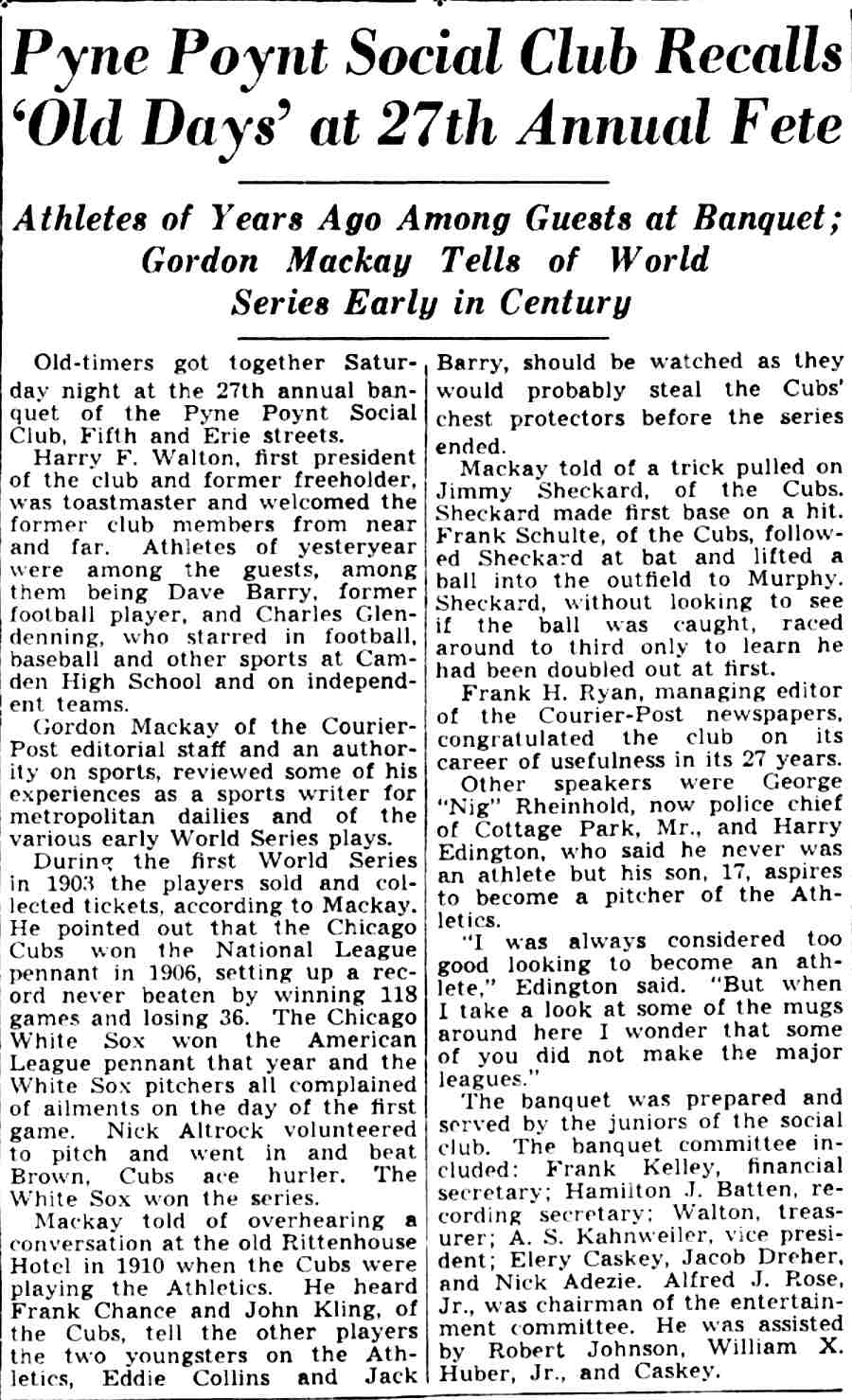
Pyne Poynt Social Club banquet, February 28, 1938 — Gordon MacKay as speaker
Allen Feted at Birthday Party; Joins G.O.P. Tribute to Forrest
Camden Courier-Post —
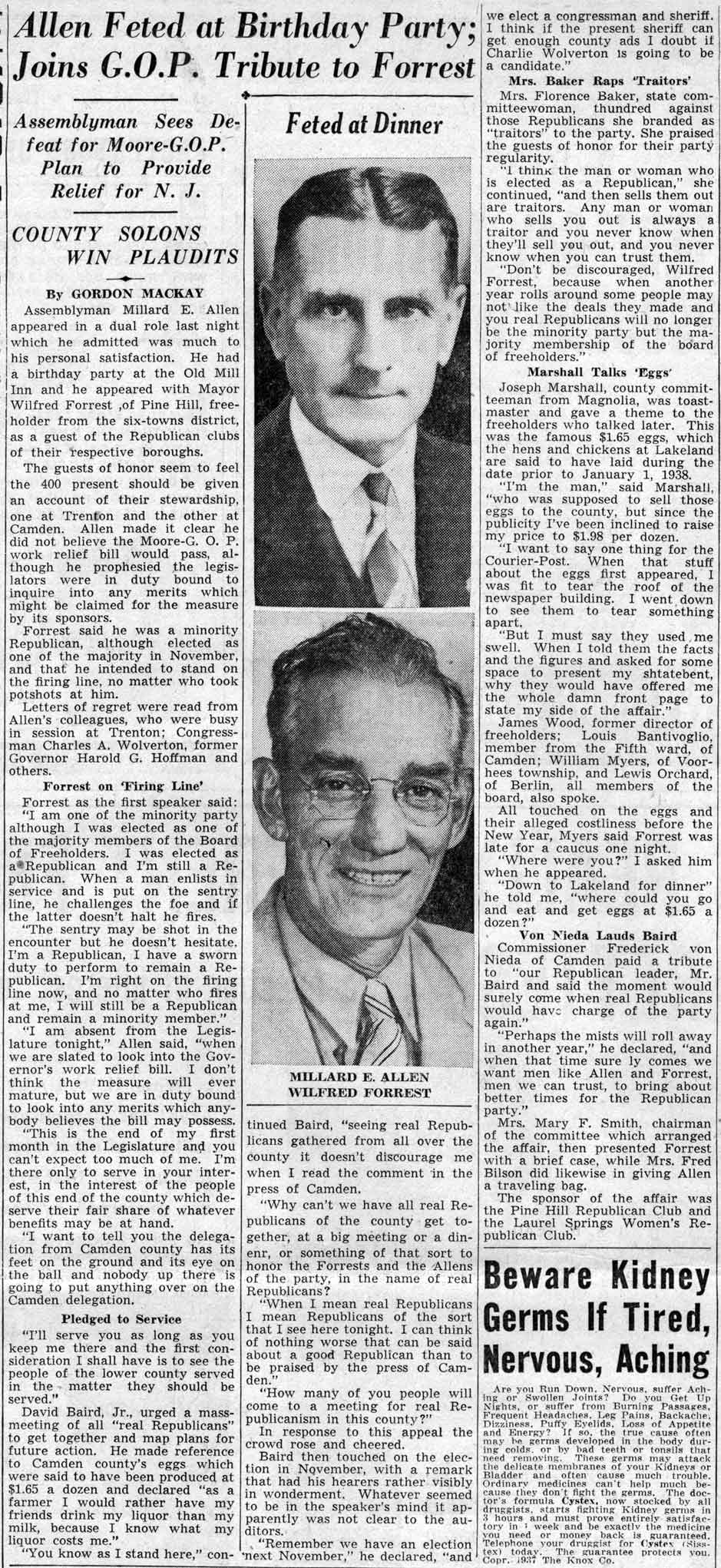
Assemblyman Sees Defeat for Moore-G.O.P. Plan to Provide Relief for N. J.
COUNTY SOLONS WIN PLAUDITS
Feted at Dinner
MILLARD E. ALLEN
WILFRED FORREST
By GORDON MACKAY
Assemblyman Millard E. Allen appeared in a dual role last night which he admitted was much to his personal satisfaction. He had a birthday party at the Old Mill Inn and he appeared with Mayor Wilfred Forrest of Pine Hill, freeholder from the six-towns district, as a guest of the Republican clubs of their respective boroughs.
The guests of honor seem to feel the 400 present should be given an account of their stewardship, one at Trenton and the other at Camden. Allen made it clear he did not believe the Moore-G.O.P. work relief bill would pass, although he prophesied the legislators were in duty bound to inquire into any merits which might be claimed for the measure by its sponsors.
Forrest said he was a minority Republican, although elected as one of the majority in November, and that he intended to stand on the firing line, no matter who took potshots at him.
Letters of regret were read from Allen’s colleagues, who were busy in session at Trenton; Congressman Charles A. Wolverton, former Governor Harold G. Hoffman and others.
Forrest on ‘Firing Line’
Forrest as the first speaker said: “I am one of the minority party although I was elected as one of the majority members of the Board of Freeholders. I was elected as a Republican and I’m still a Republican. When a man enlists in service and is put on the sentry line, he challenges the foe and if the latter doesn’t halt he fires.
“The sentry may be shot in the encounter but he doesn’t hesitate. I’m a Republican, I have a sworn duty to perform to remain a Republican. I’m right on the firing line now, and no matter who fires at me, I will still be a Republican and remain a minority member.”
“I am absent from the Legislature tonight,” Allen said, “when we are slated to look into the Governor’s work relief bill. I don’t think the measure will ever mature, but we are in duty bound to look into any merits which anybody believes the bill may possess.
“This is the end of my first month in the Legislature and you can’t expect too much of me. I’m there only to serve in your interest, in the interest of the people of this end of the county which deserve their fair share of whatever benefits may be at hand.
“I want to tell you the delegation from Camden county has its feet on the ground and its eye on the ball and nobody up there is going to put anything over on the Camden delegation.
Pledged to Service
“I’ll serve you as long as you keep me there and the first consideration I shall have is to see the people of the lower county served in the manner they should be served.”
David Baird, Jr., urged a mass meeting of all “real Republicans” to get together and map plans for future action. He made reference to Camden county’s eggs which were said to have been produced at $1.65 a dozen and declared “as a farmer I would rather have my friends drink my liquor than my milk, because I know what my liquor costs me.”
“You know as I stand here,” continued Baird, “seeing real Republicans gathered from all over the county it doesn’t discourage me when I read the comment in the press of Camden.
“Why can’t we have all real Republicans of the county get together, at a big meeting or a dinner, or something of that sort to honor the Forrests and the Allens of the party, in the name of real Republicans?
“When I mean real Republicans I mean Republicans of the sort that I see here tonight. I can think of nothing worse that can be said about a good Republican than to be praised by the press of Camden.”
“How many of you people will come to a meeting for real Republicanism in this county?”
In response to this appeal the crowd rose and cheered.
Baird then touched on the election in November, with a remark that had his hearers rather visibly in wonderment. Whatever seemed to be in the speaker’s mind it apparently was not clear to the auditors.
“Remember we have an election next November,” he declared, “and we elect a congressman and sheriff. I think if the present sheriff can get enough county ads I doubt if Charlie Wolverton is going to be a candidate.”
Mrs. Baker Raps ‘Traitors’
Mrs. Florence Baker, state committeewoman, thundered against those Republicans she branded as “traitors” to the party. She praised the guests of honor for their party regularity.
“I think the man or woman who is elected as a Republican,” she continued, “and then sells them out are traitors. Any man or woman who sells you out is always a traitor and you never know when they’ll sell you out, and you never know when you can trust them.
“Don’t be discouraged, Wilfred Forrest, because when another year rolls around some people may not like the deals they made and you real Republicans will no longer be the minority party but the majority membership of the board of freeholders.”
Marshall Talks ‘Eggs’
Joseph Marshall, county committeeman from Magnolia, was toastmaster and gave a theme to the freeholders who talked later. This was the famous $1.65 eggs, which the hens and chickens at Lakeland are said to have laid during the date prior to January 1, 1938.
“I’m the man,” said Marshall, “who was supposed to sell those eggs to the county, but since the publicity I’ve been inclined to raise my price to $1.98 per dozen.
“I want to say one thing for the Courier-Post. When that stuff about the eggs first appeared, I was fit to tear the roof off the newspaper building. I went down to see them to tear something apart.
“But I must say they used me swell. When I told them the facts and the figures and asked for some space to present my shtatebent [sic], why they would have offered me the whole damn front page to state my side of the affair.”
James Wood, former director of freeholders; Louis Bantivoglio, member from the Fifth ward, of Camden; William Myers, of Voorhees township, and Lewis Orchard, of Berlin, all members of the board, also spoke.
All touched on the eggs and their alleged costliness before the New Year, Myers said Forrest was late for a caucus one night.
“Where were you?” I asked him when he appeared.
“Down to Lakeland for dinner” he told me, “where could you go and eat and get eggs at $1.65 a dozen?”
Von Nieda Lauds Baird
Commissioner Frederick von Nieda of Camden paid a tribute to “our Republican leader, Mr. Baird and said the moment would surely come when real Republicans would have charge of the party again.”
“Perhaps the mists will roll away in another year,” he declared, “and when that time sure ly [sic] comes we want men like Allen and Forrest, men we can trust, to bring about better times for the Republican party.”
Mrs. Mary F. Smith, chairman of the committee which arranged the affair, then presented Forrest with a brief case, while Mrs. Fred Bilson did likewise in giving Allen a traveling bag.
The sponsor of the affair was the Pine Hill Republican Club and the Laurel Springs Women’s Republican Club.
Is Zat So! By Gordon Mackay (about Frankie Conway)
Camden Courier-Post —
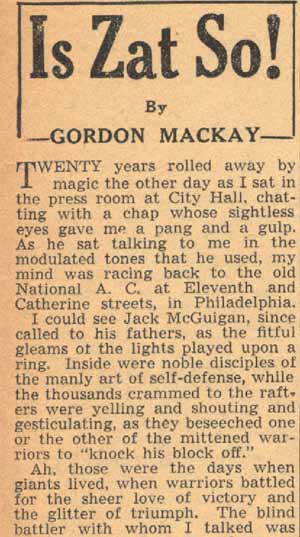
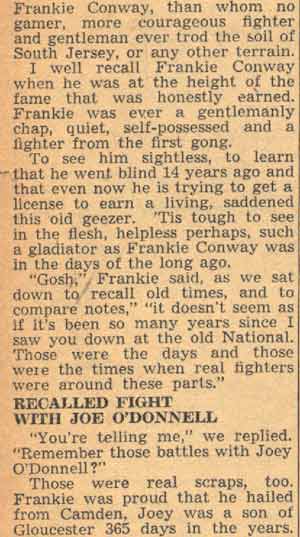
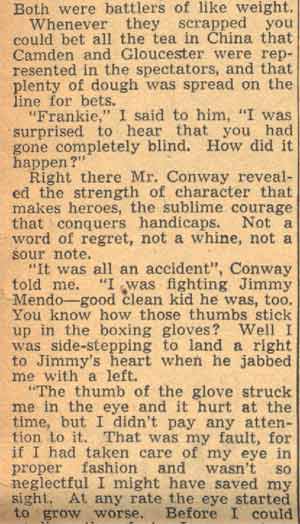
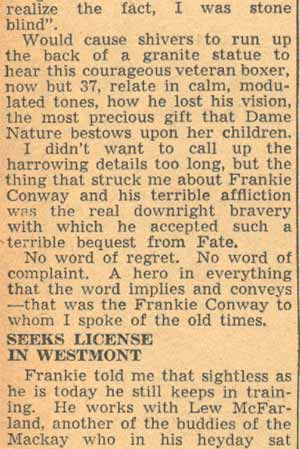
Is Zat So!
By GORDON MACKAY—
TWENTY years rolled away by magic the other day as I sat in the press room at City Hall, chatting with a chap whose sightless eyes gave me a pang and a gulp. As he sat talking to me in the modulated tones that he used, my mind was racing back to the old National A. C. at Eleventh and Catherine streets, in Philadelphia. I could see Jack McGuigan, since called to his fathers, as the fitful gleams of the lights played upon a ring. Inside were noble disciples of the manly art of self-defense, while the thousands crammed to the rafters were yelling and shouting and gesticulating, as they beseeched one or the other of the mittened warriors to “knock his block off.”
Ah, those were the days when giants lived, when warriors battled for the sheer love of victory and the glitter of triumph. The blind battler with whom I talked was Frankie Conway, than whom no gamer, more courageous fighter and gentleman ever trod the soil of South Jersey, or any other terrain. I well recall Frankie Conway when he was at the height of the fame that was honestly earned. Frankie was ever a gentlemanly chap, quiet, self-possessed and a fighter from the first gong.
To see him sightless, to learn that he went blind 14 years ago and that even now he is trying to get a license to earn a living, saddened this old geezer. ’Tis tough to see in the flesh, helpless perhaps, such a gladiator as Frankie Conway was in the days of the long ago.
“Gosh,” Frankie said, as we sat down to recall old times, and to compare notes, “it doesn’t seem as if it’s been so many years since I saw you down at the old National. Those were the days and those were the times when real fighters were around these parts.”
RECALLED FIGHT WITH JOE O’DONNELL
“You’re telling me,” we replied. “Remember those battles with Joey O’Donnell?”
Those were real scraps, too. Frankie was proud that he hailed from Camden, Joey was a son of Gloucester 365 days in the years.
Both were battlers of like weight. Whenever they scrapped you could bet all the tea in China that Camden and Gloucester were represented in the spectators, and that plenty of dough was spread on the line for bets.
“Frankie,” I said to him, “I was surprised to hear that you had gone completely blind. How did it happen?”
Right there Mr. Conway revealed the strength of character that makes heroes, the sublime courage that conquers handicaps. Not a word of regret, not a whine, not a sour note.
“It was all an accident”, Conway told me. “I was fighting Jimmy Mendo—good clean kid he was, too. You know how those thumbs stick up in the boxing gloves? Well I was side-stepping to land a right to Jimmy’s heart when he jabbed me with a left.
“The thumb of the glove struck me in the eye and it hurt at the time, but I didn’t pay any attention to it. That was my fault, for if I had taken care of my eye in proper fashion and wasn’t so neglectful I might have saved my sight. At any rate the eye started to grow worse. Before I could realize the fact, I was stone blind”.
Would cause shivers to run up the back of a granite statue to hear this courageous veteran boxer, now but 37, relate in calm, modulated tones, how he lost his vision, the most precious gift that Dame Nature bestows upon her children.
I didn’t want to call up the harrowing details too long, but the thing that struck me about Frankie Conway and his terrible affliction was the real downright bravery with which he accepted such a terrible bequest from Fate.
No word of regret. No word of complaint. A hero in everything that the word implies and conveys—that was the Frankie Conway to whom I spoke of the old times.
SEEKS LICENSE IN WESTMONT
Frankie told me that sightless as he is today he still keeps in training. He works with Lew McFarland, another of the buddies of the Mackay who in his heyday sat watching the hooks and jabs and counters in the old, old days that make me feel like Methuselah. Great boys, Frankie and Lew. Pals together as once they were rivals in the ring. Working together at Lew’s health institute. Pals whom Tom Ryan, sports editor of the Courier-Post, recently wrote about in one of the most graphic, corking stories that I’ve read on a sports page in some time.
Everything Tom said about Frankie and Lew I’ll echo. I sat often at the ringside with the smell of resin in my nostrils, the fitful gleams of the lights playing garishly on features, sometimes blood-smeared, sometimes puffed through mutual assault and battery, sometimes grewsome in the pummeling the countenance had suffered.
Never did I see two gladiators who were more courageous, more honest in giving the spectators a legitimate run for their money than Frankie and Lew. Those lads deserve something from life. They deserve something from Fate. They deserve something from those white-collared spectators who vicariously fought through the mittened hands of Conway and McFarland.
None of my business either, this discussion regarding a license for Frankie Conway. But to me, who has known the little warrior for years, who realizes his worth in the squared circle, his decency as a fighter and a gentleman, I don’t see how anybody can keep a license away from Frankie Conway.
Ten chances to one that most of the dudes who refuse licenses to chaps like Conway are the same birds who sit in comfort and ease, wearing white collars and feeling ennobled, while they yell “Kill that bum!” because they want their buck’s worth of gore and mayhem.
Personally, I like to see the white collar boys in the audience wallow in gore that isn’t theirs. But after all, I’m still in Frankie Conway’s corner, come what may.
Is Zat So! by Gordon MacKay, Camden Courier-Post, June 1, 1938
Is Zat So! — June 8, 1938
Camden Courier-Post —
Is Zat So!
Camden Courier-Post —
By GORDON MACKAY—
DAPPER and entertaining, my legal friend, L. Scott Cherchesky, as a barrister has had considerable experience with the genus criminis, or crook to you, my dear sir. Mr. Cherchesky also figures that no crook or smart guy exists in the flesh who doesn’t at some time or other in his career meet Mr. Wiser Guy.
In support of this theory Scotty spun a fanciful tale the other day. It shows that Barnum’s trenchant observation that “the public likes to be fooled,” and the sage words of the guy who opined “there was a sucker born every minute and another one to take him,” are still hitting the high brackets.
Scotty, it seems, was retained to defend a blue sky operator whose cases still are pending. This same gentleman with the Ponzi plans and the lack of mazuma to carry them into effect, is charged with fleecing victims in Camden, Philadelphia and many of the South Jersey way stations.
His modus operandus was through oil wells, the juiciest morsel that swindlers hold out to suckers. In his flights through frenzied finance, Mr. Client, according to Scotty, only gleaned about 10 million bucks, which is still a goodly sum even if you don’t have it.
Adept in luring the gold from the pockets of the chaps and miladies who would get rich speedily, this same smart bird went down before one of the hoariest, most exploited and commonplace swindling games in the ken of detectives—the old wire-tapping stunt.
And Mr. Alleged Blue Sky Operator, who had wooed 10 million bucks from various pockets, sunk 15 G’s, as the wasp-waisted lads about town say, or expressed in clearer English, $15,000. He also bit at suckerbait that wouldn’t fool a yokel who had never listened to a radio.
ALBANY SETTING BEG BIGSWINDLE
“I’ll start at the end of the story and work back,” said the attorney. “This client of mine outlined to me how certain stockbrokers he knew had obtained wire service whereby they could get the returns from the race tracks three minutes before the news actually was flashed over the legitimate wires.
“’They want me to take a flyer on the thing,’ this client told me. He outlined the old stuff. I said to him: ‘All right, how much did they hook you for?’ He turned a little red and answered: ‘They got me for 15 G’s’. And this is how it was worked.
“His stock broker friend explained to the sucker I was counsel for all about the wire service. He also told my friend that he would have to go to Albany, as the boys didn’t want to play around New York. My client went to Albany and made contact with the man he was to meet.
“The stock broker friend had fed my client plenty of baloney that these chaps were big boys and didn’t play with pikers. They wanted a fast cleanup and my client was urged to get the entire 15 G’s on the first tip given to beat the races fast.
“My blue sky pal went to Albany, immediately got in contact with the steerer for the outfit. This worthy told my client to remain in his hotel and to keep his eye on the ticker in the room. My client wanted to play safe, so he said he would bet $500 on the first horse that was given to him.
“Oh no he was told. No bookie in town would carry a straight $500 bet, but my client could bet a ten spot. He did. His horse came home, he was paid six to one for his money. Of course the racket was that he was tipped to a horse just before post time apparently, but he really was given a horse that already had won.”
TOOK $15,000 FROM WISE CHUMP
“Naturally this win made the sucker who was my client feel that everything was on the up and up. So they baited the hook a little fatter for him the next time, he was allowed to bet 100 smackers. Meantime, the stock broker who had put my client wise in the first place told my client not to monkey with piking bets, but to slap down the whole 15 G’s.
“My client tried to follow this advice, but the wise guys running the racket would only take 100 berries. The horse came in ahead and paid even money. By now my client was hooked in the gills, like any sucker right from a rural hamlet. Even worse for that matter.
“They jerked him around for a week or more, let him visit the poolroom in a fine hotel suite where they were running the racket and greasing the ways for the big killing. This time the 15 G’s could be laid on the line.
“Now mark you that wire service was real. They did get the flash a minute or two before it was made official and posted. So my client takes his $15,000 and lays it on the horse he is given. My client goes to the poolroom to match his money run.
“He gets a run for it, all right. The chap who is announcing the race—you know the old stuff of McGinnis comes into the stretch leading by two lengths, all the old racetrack patter—has my client’s horse leading right to the wire.
“My client starts to wonder how long this has been going on, when bango! the operator yells ‘Flash! Sucker Boy disqualified for fouling.’ Sucker Boy isn’t the name of the nag, but it was really the name of my client. The wise ones collect his 15 G’s. He fades into the cold world.
“It isn’t until he buys a newspaper later that he discovers no such horse as ‘Sucker Boy’ ran in the race and that he was taken for 15 G’s.
“Now comes another payoff. My client is redhot under the collar. He offers to be reasonable if the guys will pay him back his dough. It’s no dice. So we have the gang arrested, for my client knows the members. One of them, the boss man, gets five years, the others go to Sing Sing for stretches, too.”
“Interesting,” I told Scotty, “and probably they’ll have company soon. I guess you don’t need any chart on that crack, eh?”
Jury Dismissed in Arsenic Case
Camden Courier-Post —
Of Dead Mouse in Prune Juice
Restaurant Customer Ill After Alleged Discovery of Reputed Rodent; Sues for Damages to Health and Good Nature
Hopelessly divided, six to six, the jury in Camden’s celebrated “arsenic case” was discharged last night in Court No. 4 by former Judge Leroy W. Loder, of the Cumberland County Common Pleas Court, sitting as special justice to hear the case.
After Foreman Richard C. Hutchinson, of Collingswood, stated he did not believe the jurors could agree if sent back for an all night session Judge Loder discharged them.
Allegations she had drunk prune juice, freighted with an arsenic-stuffed mouse, were the basis on which the plaintiff, Miss Celeine Seigle of Camden asked damages from the Home Restaurant Company Camden, of which Frank Testa is manager.
The plaintiff was represented by Charles A. Rizzi, William Tomar and Saul Teitelman while the defendant’s counsel included Charles E. Gant, David E. Van Name and Henry D. Lodge.
Discovered Dead Mouse
Miss Siegle went to the restaurant about 5.30 p.m. on March 6, last. She ordered prune juice, drank the beverage, and discovered the dead rodent at the bottom.
“I was taken deathly sick,” she testified, “and was compelled to return home in a taxicab where I was attended by my family physician. I have been intermittently ill ever since, having lost considerable weight.”
Thomas F. Connery followed her on the witness stand. He said he sat at the table directly across from Miss Seigle and saw the entire episode. Connery, on cross examination, said he had not seen the plaintiff drop anything into the glass. Melvin E. Karns, who said he attended Miss Seigle, described her illness and also the symptoms.
Karns said he discovered by chemical analysis arsenic in the mouth of the mouse and also in the prune juice. He described the amount as one part in 40,000, which he asserted would have been sufficient to cause Miss Seigle’s illness.
Knew His Arsenic
On cross examination Karns detected the presence of arsenic by chemical analysis, and also that he was qualified to describe arsenic poisoning because of the number of such cases he had known.
Testa described the cleanliness with which he said he safeguarded customers, and denied the restaurant was crowded at the time of Miss Seigle’s alleged sickness.
Samuel L. Shapiro, a law student, stated he was the sandwich man at the restaurant and poured out all the fruit juices ordered. He recited and illustrated how he had poured Miss Seigle’s drink, denying anything was in the glass save prune juice.
Miss Myrtle A. Haffer, a waitress, disputed every statement made by the plaintiff’s witnesses. She described how she had fastened her eyes on Shapiro when he poured the juice. On cross-examination by Tomar, she denied “she was very friendly with the sandwich man.”
She also stated she took Miss Seigle to a room after her illness and the girl told her to “go away and leave me alone.”
“She wouldn’t take a dose of aromatics,” testified the waitress, “and she wouldn’t let me get her a glass of water. Why she wasn’t sick after she almost drank the mouse.”
William E. Peel and Dominic Gattuso, court officers, guarded the jury while they were deliberating and Charles M. Ackley, court clerk, was given the verdict of disagreement.
P. S. All this happened at the practice trial by members of the graduating class of the South Jersey Law School as part of the commencement program.
Obituaries
Philadelphia Record —
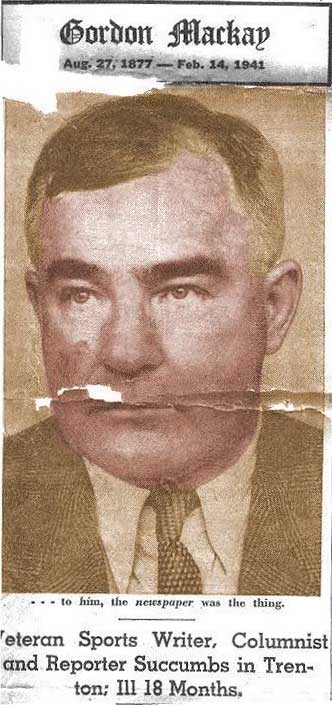
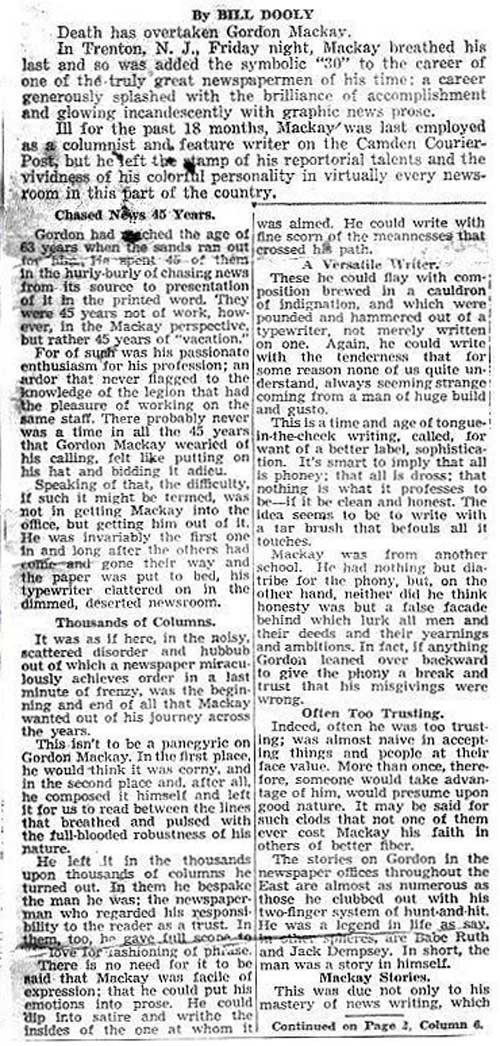
Philadelphia Record — February 16, 1941
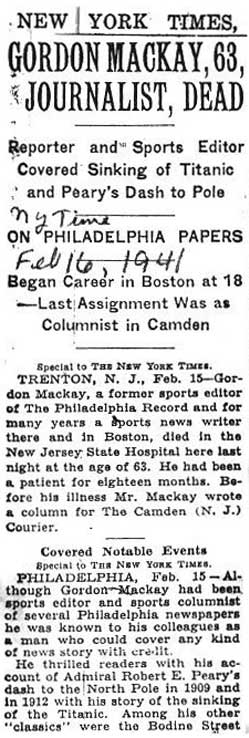
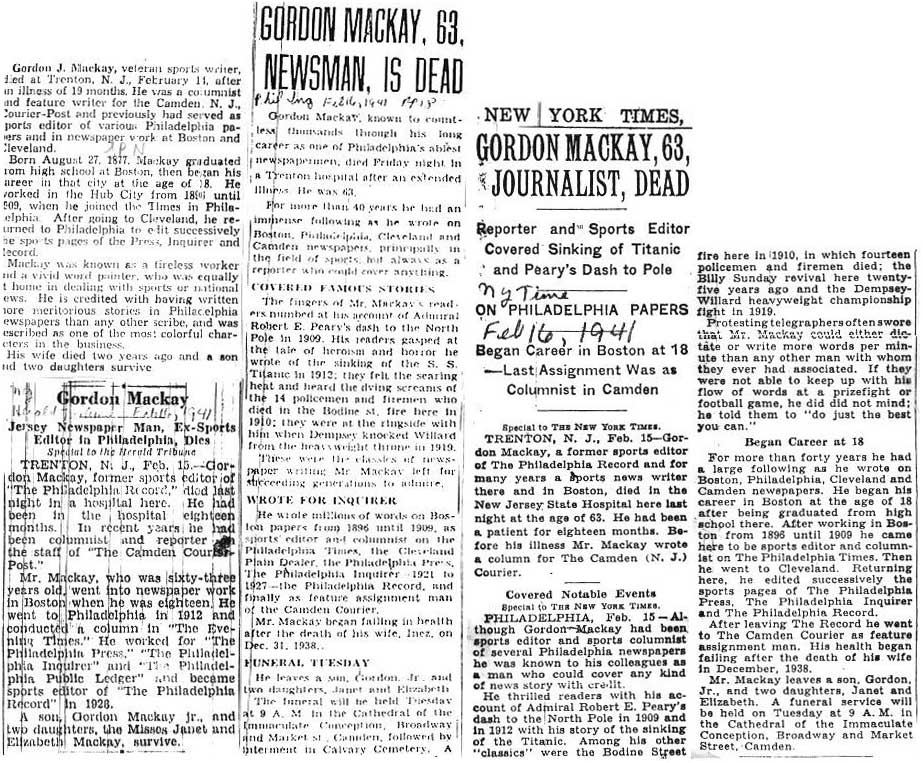
New York Times — February 16, 1941, pp. 40; February 20, 1941, pp. 2, col. 6
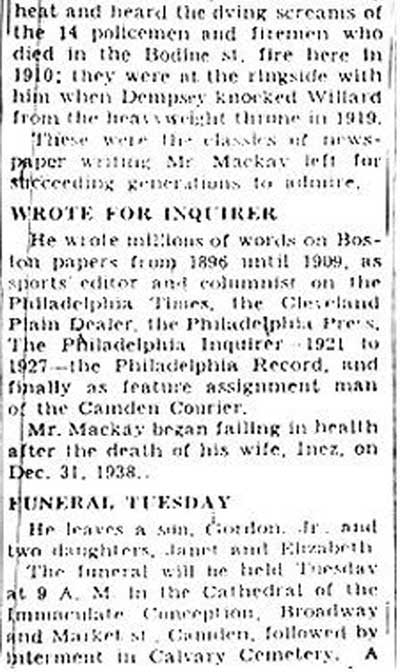
Philadelphia Inquirer — February 16, 1941, pp. 18
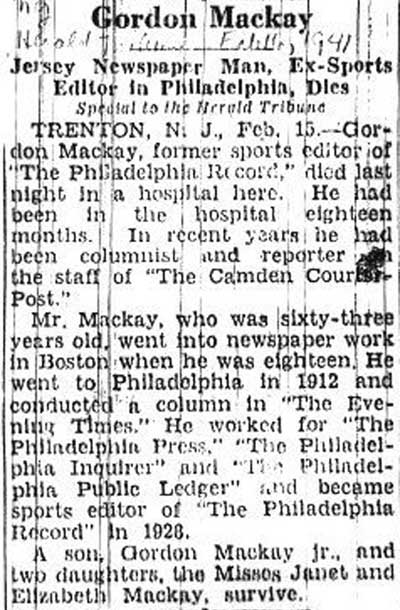
New York Herald-Tribune — February 16, 1941
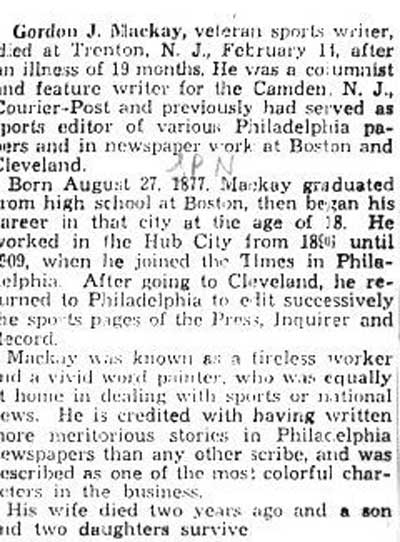
The Sporting News — February 1941