Introduction
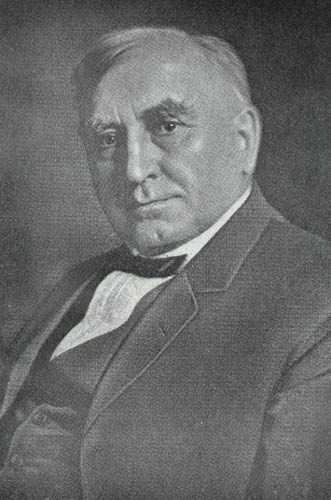
Judge John W. Wescott
JOHN W. WESCOTT was born in Waterford Township in Camden County NJ on February 28, 1849. He is not to be confused with John L. Westcott, who served as a Mayor of Camden from 1892 to 1898.
After graduating with a degree in law from Yale College in New Haven CT, John W. Wescott was admitted to the bar in Connecticut in 1876 and in New Jersey in 1878. Quickly rising to prominence in Camden’s legal circles, he was made President Judge of the Camden County Courts in 1885. He had offices at 205 Market Street in 1887. By 1890 he had moved his practice to the then new Security Trust Building at 301 Market Street. By 1897 he had made unsuccessful bids for election to the New Jersey State Senate and the United States House of Representatives as a Democrat in generally Republican districts.
A longtime resident of Haddonfield NJ, Judge Wescott was a Democrat and was renowned for having given both of President Woodrow Wilson’s nominating addresses. One was at the Democratic Convention in Baltimore on June 27, 1912, and the other at the Democratic Convention in St. Louis MO on June 10, 1916. Afterwards, when he was Attorney General of New Jersey he wrote a book on the events in Woodrow Wilson’s life.
Widely known as a trial lawyer, John W. Wescott trained several lawyers who went on to distinguished careers in their own right, including Ralph W.E. Donges, who for many years was a justice on the New Jersey State Supreme Court.
Judge John W. Wescott passed away in 1927, as did his younger brother Dr. William A. Westcott. They were buried near each other in the family plot at Harleigh Cemetery in Camden NJ. Judge Wescott was eulogized in March and April of 1930 in separate articles that were included in the Archive, the yearbook of the South Jersey Law School in Camden NJ.
Of Judge Wescott’s three sons, two went on to prominence in local circles, Ralph W. Wescott being a member of the Delaware River Port Authority and Ethan P. Wescott holding at one time the position of Prosecutor for Camden County.
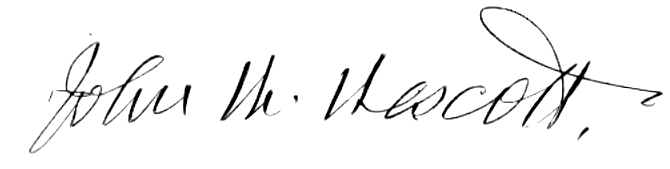
Signature of John W. Wescott
Camden Political Banner Raisings and Parades
Philadelphia Inquirer —
A Republican banner raising took place in front of Constable Almor Barr’s cigar store, Front and Birch streets, on Saturday evening. At the same time the Central Democratic Club raised a banner on Federal street, above Front. After these proceedings both parties had parades, which were of the go-as you-please order. Some of the Republicans paraded the streets in the upper end of the city, accompanied by a club from Philadelphia. The South End Club and Pioneer Corps were satisfied in parading through the lower section. The Democrats followed out the plan adopted by their opponents. The Central Club, with a band, and members of the Stockton Cleveland and Hendricks Club paraded North Camden, and the Seventh Ward Club paraded the southern section of the city. At the Republican meeting Candidate for Congress George Hires, of Salem, and others addressed the meeting. At the Democratic meeting Candidate for Congress Thomas M. Ferrell of Glassboro; John W. Westcott, candidate for Senator from Camden county; Richard F. Smith, Sheriffalty candidate; Senator Kennedy, of Philadelphia; John J. Walsh, of Camden, and others addressed the assemblage.
Democratic Mass Meeting at Third and Market Streets
Philadelphia Inquirer —

A Democratic mass meeting will be held at Third and Market streets this evening. Addresses will be made by John W. Wescott, Howard Carrow, C.G. Garrison and others.
Throughout the State
Trenton Evening Times —
Judge Charles T. Reed, of Camden, died on Saturday night. He will be buried on Wednesday. The Camden courts will adjourn to-day and the Bar Association will take proper action.
Applicants for the position made vacant by the death of Judge Reed, of Camden, are already looming up. The aspirants thus far are Ex-Judge David J. Pancoast, Ex-City Solicitor Alfred Hugg, John H. Westcott [sic], John K. R. Hewitt and Charles G. Garrison. It is asserted in local political circles that Lawyer Garrison can be appointed if he desires, although he has expressed himself as being indifferent in the matter. Alfred Hugg, it is stated, has influence with Governor Abbett, while John Westcott will be pushed forward as the representative of the young Democracy. Hewitt has probably the least show of any of the aspirants. He is being pushed by a number of his friends, although a trouble he had with the courts a few years ago will probably be urged against him.
Special Session of Camden Criminal Court
Philadelphia Inquirer —
At the special session of the Camden Criminal Court on Saturday, before Judges Wescott, Woolston and Gaunt, William Massey was convicted of breaking and entering the residence of John Osler, at No. 317 Clinton street, where he was found concealed under a bed by Mayor Bradshaw on Wednesday night last. Sentence in his case was suspended until the 31st instant in order to give him a chance to prove character. Jane Wilson, who brutally beat a four-year-old adopted daughter and rubbed salt into the wounds, was convicted and sentenced to two months’ imprisonment. The following wife beaters had sentence suspended in their cases: Samuel Doughty, William Devlin, William Anderson and Isaac France. Adalaide Whitely was sentenced to three months in the county jail, and Kate Rice to fifteen days on assault and battery charges. Miss Emma Devine was committed to jail in default of $1000 ball [sic] for perjury. She had sworn to a charge of assault and battery against her husband, and at the trial stated she had falsely accused him.
Camden and Vicinity
Philadelphia Inquirer —
Items of Interest from the Cities and Towns Across the Delaware.
Mrs. Lizzie Fullerton, who was committed to the county jail by Justice Wright of Gloucester City, for disorderly conduct, and who afterwards had the Justice arrested for misdemeanor in office, was released by Judge Wescott yesterday on a writ of habeas corpus.
The German Mass Meeting.
Camden Daily Courier —
A PURELY DEMOCRATIC GATHERING AT THE COURT HOUSE.
Tuetonic [sic] Republicans Fail to Turn Out—An Audience of Vice Presidents—Judge Wescott Expresses a Love for German Vote.
About two hundred persons, one half of whom were vice presidents and all known as Democrats, gathered at the court house last night to attend the German Democratic mass meeting. There were few Republicans present and consequently the meeting and its object—a German-Republican revolt—was a complete failure. A German band played some familiar tunes of the Fatherland. Four airs had been rendered and yet no speakers appeared, when finally Editor Alexander Schlessinger, of the Camden County Journal, Captain Stahl and Dr. Beurnt, of Philadelphia, appeared. John Heilemann then walked up to the bar and called the meeting to order. Eli Bachrach was unanimously chosen chairman, and Messrs. Pfeiffer and Goldenberg were appointed a committee to escort the gentleman to the chair. In a few words of his native language he thanked the meeting for the honor conferred. Dr. Conrad G. Hoell, Jacob Vissell, Anthony J. Oberst, H. Gausselman, were elected secretaries.
THE VICE PRESIDENTS.
The following long list of vice presidents was then announced: At large, Dr. B. J. Weyle; First ward—Francis D. Pastorius, John Scharnagl, Wilhelm Hage, Christian Killinger, David Goldenberg; Second ward—John Heilemann, John Pfeiffer, Christian Eckert, John Hausbeck, Charles E. Wentz, Ernest C. Wentz; Third ward—Solomon Seybold, Wilhelm Myers, J. Henry Sauers, Gus Weber, George Bristle, Joseph Meyer, Sr.; Fourth ward—George Holl, Theodore G. Mayer, Emanuel Schneider, Conrad Spalt, Charles Benkert; Fifth ward—Peter Dankelmann, John F. Riegen, George Horneff, Sr., Theodore Krug; Sixth ward—Anthony Kobus, George Pfeiffer, Sr., George Pfeiffer, Jr., John Welsh, Sr., Dennis Lutenbacher, Frederick Lutz, Fred George Brum, A. Tegtmeier, Michael N. Voll, George Kleinheintz, Lewis Schiemer; Seventh ward—Edward N. Cohn, Charles Helm, Anthony Vall, Dr. H. W. Miller, Edward Schuster, Sr.; Eight [sic] ward—Dr. John W. Dognes, John Heim, John Schaus, Martin J. Eno; Wrightsville—Frank Berberick, David Hess, Jacob Meyer; East Camden—Fred Spuhler; Merchantville—Jacob Moeck, Gottlieb C. Moeck; Gloucester City—Fred Geissel, John Bender; Berlin—Peter Mucker; Blackwoodtown—Christ. Ebensperger; Milford—Louis Clipper; Collingswood—John Schnutzius.
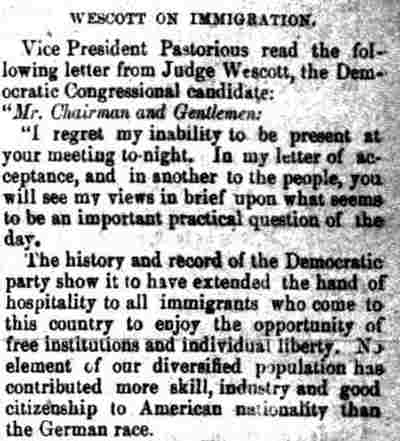
WESCOTT ON IMMIGRATION.
Vice President Pastorious read the following letter from Judge Wescott, the Democratic Congressional candidate:
“Mr. Chairman and Gentlemen:
“I regret my inability to be present at your meeting to-night. In my letter of acceptance, and in another to the people, you will see my views in brief upon what seems to be an important practical question of the day.
The history and record of the Democratic party show it to have extended the hand of hospitality to all immigrants who come to this country to enjoy the opportunity of free institutions and individual liberty. No element of our diversified population has contributed more skill, industry and good citizenship to American nationality than the German race.
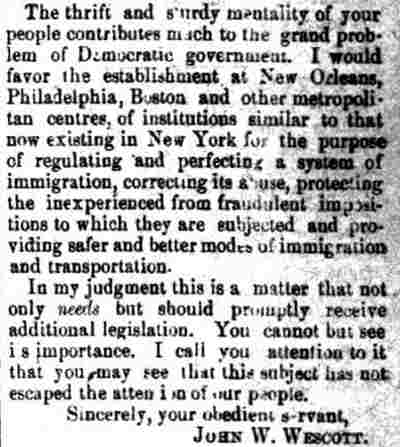
The thrift and sturdy mentality of your people contributes much to the grand problem of Democratic government. I would favor the establishment at New Orleans, Philadelphia, Boston and other metropolitan centres, of institutions similar to that now existing in New York for the purpose of regulating and perfecting a system of immigration, correcting its abuse, protecting the inexperienced from fraudulent impositions to which they are subjected and providing safer and better modes of immigration and transportation.
In my judgment this is a matter that not only needs but should promptly receive additional legislation. You cannot but see its importance. I call your attention to it that you may see that this subject has not escaped the attention of our people.
Sincerely, your obedient servant,
JOHN W. WESCOTT.
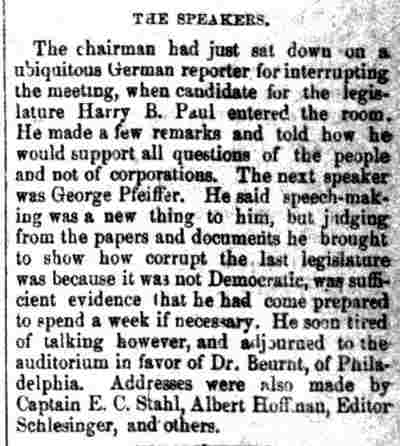
THE SPEAKERS.
The chairman had just sat down on a ubiquitous German reporter for interrupting the meeting, when candidate for the legislature Harry B. Paul entered the room. He made a few remarks and told how he would support all questions of the people and not of corporations. The next speaker was George Pfeiffer. He said speech-making was a new thing to him, but judging from the papers and documents he brought to show how corrupt the last legislature was because it was not Democratic, was sufficient evidence that he had come prepared to spend a week if necessary. He soon tired of talking however, and adjourned to the auditorium in favor of Dr. Beurnt, of Philadelphia. Addresses were also made by Captain E. C. Stahl, Albert Hoffman, Editor Schlesinger, and others.
Governor Green to Appoint Charles G. Garrison
Philadelphia Inquirer —
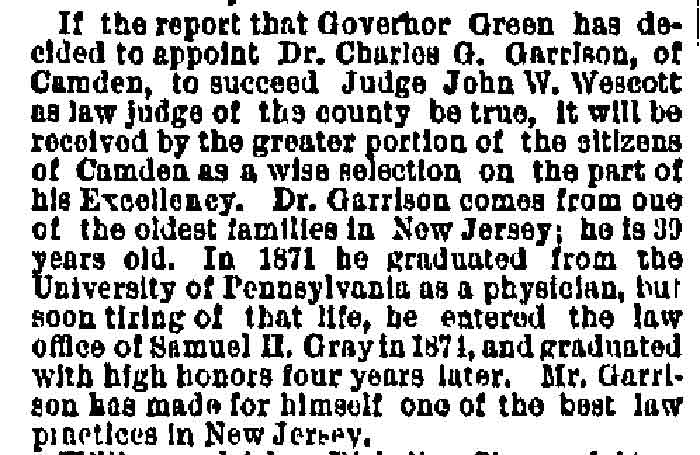
If the report that Governor Green has decided to appoint Dr. Charles G. Garrison, of Camden, to succeed Judge John W. Wescott as law judge of the county be true, it will be received by the greater portion of the citizens of Camden as a wise selection on the part of his Excellency. Dr. Garrison comes from one of the oldest families in New Jersey; he is 39 years old. In 1871 he graduated from the University of Pennsylvania as a physician, but soon tiring of that life, he entered the law office of Samuel H. Gray in 1874, and graduated with high honors four years later. Mr. Garrison has made for himself one of the best law practices in New Jersey.
The Logue Assault.
Camden Post —

Stratton and Mellon on Trial in Court.
LOGUE’S STORY OF THE ATTACK
The Young Woman Tells Her Story —Damaging Evidence Against the Defendants.
In the Quarter Sessions Court yesterday afternoon the case of John F. Stratton and Henry Mellon, the two young men charged with the murderous attack upon Joseph Logue, near Starr’s crossing, Tenth and Line streets, on May 6th, was begun. Ex-Judge Wescott and Howard Carrow conducted the defense and Prosecutor Jenkins appeared for the State. In response the latter’s command for witnesses to take the benches on the right of the bar enclosure, fourteen persons arose from the audience and took seats there.
The first witness was Logue himself, who had been confined in the Cooper Hospital about ten days suffering from his injuries. He is a tall, well-built young fellow of 32. “On the evening of May 6th,” he said, “I was in company with Miss Sarah Lewine; I was walking along Haddon avenue. We started from Third and Royden street. We walked out Benson to Haddon avenue and out to Newton avenue, and turned up Newton avenue toward Federal street. Just after we crossed the Camden and Atlantic railroad, these two men sprang up and the tallest one, Stratton, took hold of the lady and the smaller one, Mellon, took hold of me. I asked them what they wanted and they said they arrested me. I asked them what I had done and they said I would find out. Stratton kept telling Mellon to take the woman away. Mellon pulled open his coat and showed what looked like a star, saying that was his authority for making the arrest. He hit me in the head with a blackjack. Then when I tried to get away Stratton stabbed me in the side with a knife.”
“Do you identify either of these men?” asked Mr. Jenkins.
“Yes, sir; I am positive Stratton is the tall one. Mellon looks like the smaller man of the two. I described the two men before I was arrested.”
Ex-Judge Wescott’s rigid cross-examination failed to shake his story in any detail. He identified Stratton, who was taken to him in the hospital, as the taller man of the two.
“What were you doing out there?” asked ex-Judge Wescott.
“Taking a walk.”
“Who was the lady?”
“Miss Sarah Lewine.”
“How long have you known her?”
“About six years.”
The next witness was Miss Lewine, a chestnut-haired, ruddy complexioned young woman, of about thirty summers. “I was to meet Mr. Logue at eight o’clock that night,” she began with a smile, “but it might have been a few minutes after.”
She corroborated Logue’s testimony, adding that as the men came up to them she pulled Logue’s coat to signal him to keep quiet. “After Mr. Logue was cut,” she said, “the two men ran past me. Mr. Logue came back to me and said he was stabbed, and that I should go home.”
She was unable to identify either of the defendants as the assailants of that night. Mr. Wescott tried hard to entangle her as to her ability to determine the difference in the sizes of the two men as they lay upon the ground, but she refused to be tangled up and adhered rigidly to her story with marked indications of deepest truth and sincerity.
“Now, Miss Lewine, you have frequently heard that one of the men was tall and the other short, haven’t you?” asked Mr. Wescott.
“Didn’t I see them?” answered the witness pertinaciously, and all further questioning failed to get more from her.
Christopher Smith, of 1904 Fillmore street, employed as night watchman on the Line street sewer, then in course of construction. On the night of the assault he saw Stratton and Mellon about 7 o’clock. Mellon came up to him and spoke, and shortly afterwards Stratton came up. Mellon took a knife out of his pocket, continued Smith, and handed it to Stratton. The latter said “If anybody bothers me, I’ll cut the d— guts out of them.” The blade, I guess, must have been three or four inches long. The handle was of bone, I think. They stayed there about half an hour and it was dark when they left, walking up Haddon avenue.
The point where the defendants were seen by Smith is a square from where the assault was committed. Mr. Jenkins tried to show that both young men frequented this particular locality, but it was objected to and withdrawn. Smith admitted that he saw Mellon have a blackjack one night at Haddon avenue and Line street. Stratton was with him at the time. That was on Friday, May 4th, two days before the assault.
The Court took a recess at this point till this morning.
When the case was resumed this morning Logue produced in evidence, the coat he wore the night he was assaulted, exhibiting the hole cut by the knife and the blood stains from the wounds in the head and side.
Then Dr. Henry Jarrett, resident physician of the Cooper Hospital, was called. He testified as to the wounds received and said the knife thrust might have been fatal if it had gone in deep enough, or Logue might have bled to death if a large enough blood vessel had been severed.
“Could he have bled to death from either of the wounds?” asked Mr. Jenkins.
“No, sir.”
“How long have you been practicing?” asked Mr. Wescott.
“I have been at Cooper Hospital since July 28th, last.”
“When did you graduate?”
“A year ago last April.”
“That will do.”
Charles R. Locke, a fellow employe of Mellon’s at the paper mill, 83 Cooper St., saw Mellon have, on the Friday before the assault, a large knife, such as sailors carry, with a blade two and a half or three inches long. It had a rough bone handle.
Knight Haines, a boy, on the Saturday night before the assault, between 8.30 and 9.30 saw Stratton and Mellon on the lots in front of the city hall, within a short distance of where Logue was attacked. Stratton and Mellon were on their hands and knees and when they recognized him they said: “Oh, is it you? Don’t give us away.” He said Stratton had a knife and Mellon a blackjack.
“Did you have a girl with you?” asked Mr. Wescott.
“I don’t know,” said Haines, smiling.
Kentucky Rosebud Knocks Out Dixon
Philadelphia Inquirer —

Kentucky Rosebud Knocks Out Dixon
The Champion Feather-Weight Defeated in Two Rounds by Walter Edgerton.
He Is Knocked Senseless and Has to Be Dragged to His Corner.
Sensational Termination of the Friendly Boxing Bout at Industrial Hall in Behalf of the Bread Fund—Wild Excitement Follows the Fall of the Champion—Other Events of an Interesting Program.
By a single blow from the gloved fist of Walter Edgerton, the “Kentucky Rosebud,” George Dixon, the undefeated feather-weight champion of the world, was completely knocked out last night at the Industrial Hall athletic carnival for the benefit of the Bread Fund. The champion was knocked flat and was fairly dragged to his chair. Only prompt interference prevented a probably sensational termination of an ordinarily friendly bout.
It occurred in the second round of their set-to, which had been eagerly looked forward to by the assemblage of over 2000 persons present as the star event of the evening. It was known that the “Rosebud,” who has achieved a widespread local reputation, had long been anxious to meet the champion in a finish contest, and everyone expected some hot and fast work, but the climax of the “go” utterly paralyzed them.
There was a cordial greeting for the champion when he entered the ring, and an equally warm one for the “Rosebud.” Jimmy McHale looked after the Philadelphian, and Tom O’Rourke, Dixon’s manager, and Professor Jack Lynch were behind the champion. The first round was a good-natured bit of sparring and the second of the same nature, the exchanges being somewhat in favor of Dixon.
THE KNOCK-OUT BLOW.
Towards the end of the second round they came together in a fast rally and the “Rosebud” landed on the champion’s jaw with a heavy right-hand swing. Dixon went down backward like a log, his face wearing a dazed look. His body had hardly touched the floor when the watchful O’Rourke and Lynch sprang forward simultaneously.
The limp form of the champion was seized under the arms and he was literally dragged to his chair, which sat only a few feet distant. The “Rosebud” merely looked at the fallen Dixon and made no move. In an instant the most intense excitement prevailed. The big crowd, dazed for a few fleeting seconds by the sensational conclusion of the round, broke into a confusion of cries and exclamations.
“He’s out! he’s out!” was uttered by hundreds, and in the few succeeding moments, during which those on the stage worked vigorously with the champion, there was a wild hum of speculation and comment.
On the raised platform a little anxious-looking group about Dixon were busily engaged in the work of bringing him around, while the audience breathlessly awaited results. For two minutes the champion of all feather-weights never opened his eyes. For two or three minutes more he rested and regained his strength and senses. Then he sprang forward for the last round. It was an interesting battle, in which Dixon landed good and hard twice, but the revenge the champion was expected to seek did not result in any hard fighting.
JOE BUTLER GUARDS DIXON.
Just before the final round Jimmy McHale wanted time called a minute or so before it was, and he and Tom O’Rourke had a war of words. After the men left the stage the friends of the “Rosebud” attempted to hustle the Dixon party, but big Joe Butler took charge of the champion and guarded him safely to his room.
Tom O’Rourke and several of Dixon’s friends attempted to explain the champion’s downfall by saying it was an accident that the “Rosebud” had struck Dixon on the jaw with his elbow. Those who saw the blow delivered only laughed at this lame excuse. Never was a blow fairer delivered nor was there ever a fairer knock-out.
A CHANCE FOR A FIGHT.
“I suppose the ‘Rosebud’ will be able to get backing now,” said Tom O’Rourke. “You can say that Dixon will meet him for ten rounds or to a finish any time he can raise a respectable stake.”
The “Kentucky Rosebud” shook a thousand hands after he came out of his dressing room. “I knewed I’d be champion some day,” said he. “George is a very nice fighter, but I always felt it in my bones dat I could whip him.”
“The Rosebud will be the biggest coon on Lombard street to-morrow,” said Joe Butler, “and he will wear his white high hat for sure.”
JUDGE WESCOTT ON BOXING.
Preceding the Dixon-Rosebud contest there was a long and attractive program of sparring and wrestling bouts, interspersed with musical selections by the First Regiment Band. Just before the athletes began their work there was a short program by the band and an address by Judge Wetcott [sic], of Camden, who declared boxing to be one of the greatest of athletic sports. He said it had suffered sadly through misrepresentation. The judge was loudly applauded and then the sports began.
William Kirby and Frank Farley sparred three warm rounds and were followed by John Corrigan, of Manayunk, and Thomas Devlin, boxing instructor of the Roxborough Athletic Club. Then Joe Butler, the well-known Philadelphia middle-weight, met his old antagonist, Jim Daly, of Buffalo, N. Y., in three interesting rounds, where points were about even. There was an exciting six-minute wrestling match between Emil Beck, of the Bank Clerks’ Association, and William Diggins, of England, in which neither man gained a fall. Professor William H. Coupe, instructor of the A. C. S. N., met Herman Wolfe in a six-minute bout with the same result.
Benton Hall Case
Camden Post —

BENTON HALL CASE
Lawyer Crandall Asks for a New Writ of Error.
CASE OUT OF THE COURT’S HANDS
Judge Carrow Asks for a Reconsideration of Sentence in the Case — Still Trying to Keep Harriet Smith from State Prison.
Edward Benton and Joseph Hall, who were sentenced to three months each on conviction for criminal libel and whose appeal to the Supreme Court was dismissed on Tuesday, owing to the neglect of Counselor John J. Crandall, who failed to appear, have not yet given up their fight.
Judge Carrow has been retained, and the case assumes another phase. In court this morning Prosecutor Jenkins declared that if ever there was a manifestation of counsel’s neglect this was one.
The court gave Crandall an opportunity for argument tomorrow, when it is expected the remitater [sic] will arrive.
Lawyer Wm. J. Kraft said that Judge Carrow was counsel in the case also, and would have something to say.
“If Carrow is in the case I’ll withdraw,” declared Lawyer Crandall.
Later on Judge Carrow appeared and asked that the Court reconsider the sentence of three months in jail and make the sentence a fine. He said that while he had not been acting openly he had all along been associated with the defense. He placed the case in Mr. Crandall’s hands.
Mr. Carrow did not appear as hired counsel, but the defendants were friends of his and he made this plea for them. Obvious punishment was already had. The crime was not of a serious character. The publication was made in good faith and for the good of the public. The defendant’s did not know that Kappel and Cable was the same man. There was some foundation for the article and it was admitted at the trial that money had been unlawfully obtained.
A fine, Judge Carrow said, would dispose of the matter, and the best element of this county wanted the sentence reconsidered.
The Court said it could do nothing now as it was out of the Court’s hands, but the matter could be heard when the records arrive from the Supreme Court.
In the matter of Harriet Smith, who was sentenced to one year in State Prison for policy writing, County Physician Jones was called to the stand. He said he had examined Mrs. Smith’s condition in jail and found her suffering from palpitation of the heart. Dr. Jones said that in his opinion there was nothing to prevent her being taken to State Prison.
Dr. McAllister corroborated Dr. Jones’ statement, he having also examined Mrs. Smith.
Counselor Harry S. Scovel, who with Mr. Rex appeared for the defendant, said he had nothing more to say, but that Judge Wescott had been brought into the case and would make a motion the nature of which Mr. Scovel did not know.
The Court laid the matter over until tomorrow to hear Judge Wescott, who is in Trenton today.
Mrs. Grantz, wife of Police Officer Grantz of Stockton, who got three months for assault and battery, appeared before the Court but could say nothing through her sobs. Judge Vroom questioned her for some time relative to her husband’s business and her family and then said the Court would consider the matter.
Fighting to Save Benton
Camden Daily Telegram —

FIGHTING TO SAVE BENTON.
Judge Carrow Comes to the Aid of Lawyer Crandall in the Case.
The case of Edward M. Benton and Joseph H. Hall, of the Citizen, came up before Judges Vroom, McDowell and Burdsall this morning in the Quarter Sessions Court. A number of members of the Committee of One Hundred were present as spectators. Lawyer J. J. Crandall appeared for the defendants. He made application for a new writ and attempted to throw the blame on County Clerk Barber and others for the dismissal of the other writ. He said he could not get the records from Clerk Barber nor could he secure the stenographic notes.
Later in the case Prosecutor Jenkins said he wished to make a statement for the public. He said that Mr. Crandall had cast reflections on County Clerk Barber and that the latter wanted it understood that he was not to blame in this matter as Mr. Crandall had not asked for the records until last Saturday. He had given Mr. Barber no time in which to get the records desired. Prosecutor Jenkins declared that if ever there was a manifestation of counsel’s neglect this case was one.
The Court refused to take any action in the matter, claiming that the records had been removed to the Supreme Court and no official notice had been received as to the action taken. The Court gave Crandall an opportunity for argument to-morrow, when it is expected the remitater [sic] will arrive.
Lawyer W. J. Kraft, who with Judge Carrow has been retained in the case, whispered to Mr. Crandall and the latter turned on him and shouted: “I want no advice from you.”
Lawyer Kraft said to the Court that Judge Carrow was also counsel in the case and would have something to say later.
“If Carrow is in the case I’ll withdraw” declared Lawyer Crandall.
Judge Carrow appeared later and asked the court to reconsider the sentence and make it a fine. He said that he was not regularly employed as counsel in the case, but was acting through friendship to the defendants. He said he had been in the case from the first and had placed the matter in the hands of Lawyer Crandall. Judge Carrow said the best element of the community desired to see the sentence reconsidered as the publication was made in good faith.
The court answered that nothing could be done until the records arrived.
County Physician Jones was called to the stand in the case of Mrs. Harriet Smith the convicted policy dealer, who was to have been taken to State Prison yesterday. He testified that he had examined Mrs. Smith’s condition in the county jail and found that she was suffering from nervous trouble and palpitation of the heart.
Dr. Jones stated in answer to questions by the Court, that in his opinion there was nothing to prevent her being taken to State Prison. Judge Vroom asked if it might precipitate a collapse.
“I stand by my certificate,” replied the County Physician. He said he did not believe that if Mrs. Smith had regular employment in the prison it would interfere with her condition. In reply to Lawyer Rex he said he did not think the shock of being taken to prison would produce serious results.
Dr. Alexander McAllister corroborated the testimony of County Physician Jones as he had also examined Mrs. Smith. He was asked if she could bring on these attacks at will. Dr. McAllister said to a certain extent she might as she could allow herself to become sufficiently excited.
The court laid the matter over until to-morrow in order that Judge Westcott, who has been retained by Mrs. Smith may be heard.
Mrs. Grantz, wife of Policeman Grantz, of Stockton, who was sentenced to three months in the county jail for assault and battery, appeared to ask for a reconsideration of his sentence. She could say nothing for her sobs and after asking her some questions about her husband’s business and family the matter was taken under consideration.
A short session of the Orphans’ Court was held when the Elliott case was laid over until to-morrow. A few minor motions were heard.
The Rule Dismissed
Camden Post —

To Cause Pensauken Saloon Keepers to Show Cause.
THE CHEMICAL CASE GOES OVER
On Representation Made of Efforts to Abate the Nuisance. More Time Wanted on Policy Cases.
The jury in the case of Washington Kettline charged with writing policy, last evening, returned a verdict of guilty.
Charles Gilbert was placed on trial on a similar charge. Policeman Shaw testified that on May 3 last, he arrested Gilbert on a warrant in a house on Locust street, between Spruce and Division streets. A rubber stamp and some other policy paraphernalia were on a table, but he did not know to whom it belonged.
The jury after several hours’ deliberation, returned a verdict of not guilty.
In the Quarter Sessions Court today Judge Vroom announced that the rules to show cause why certain liquor licenses should not be revoked were made returnable this morning and the first case moved was that of Christopher Smith, of Pensauken township.
Fred A. Rex representing all the licenses contended that Quarter Sessions Court had no jurisdiction in the matter and that the Common Pleas had a certain course to pursue.
He contended that the Court could not of its own motive revoke these licenses.
He read the sections of the Werts’ Act in reference to the matter which showed that to revoke a license there must be a complaint signed by three persons and verified by their oaths, setting forth the reasons for the revocation of a license, and that this complaint must be served on the licensee and made returnable not less than ten days nor more than thirty days after service.
Judge Vroom looked at the act and immediately dismissed the rule to show cause, as ordered by the court.
The rule dismissed had reference to the licenses of Chris. Smith, Walter Hubbs, Annie Strenger, Frank Weideman and Fred. Herald, all of Pennsauken township.
M. V. Grey presented an affidavit to the court to the effect that the United States Chemical Works was making every effort to abate the nuisance, and asked that the trial be put off for the term.
The Chemical Company was indicted on complaint of a number of citizens, who said that their appetites were injured by the stench and their clothing spoiled by certain acids in the atmosphere which came from the works.
Prosecutor Jenkins said he believed the company was doing everything possible to remedy the evil, and as the charge was not a malicious one and the April term of court being close at hand he was willing to give a firm which gave employment to so many people a chance to abate the nuisance.
Judge McDowell said there were many complaints, but if the company was using every endeavor to get a process that would remedy the evil, he for one would willingly let the case go over. Judges Vroom and Burdsall took the affidavit into consideration and allowed the case to go over for the term.
Judge Wescott, who has recently been retained as one of counsel for the indicted policy writers, asked for a postponement of the cases, not for the term, but to give an opportunity to counsel to prepare their cases.
Judge Wescott presented an affidavit to the effect that there was good cause to believe that slips, upon which indictments had been found, were forged, and he wanted time to have them examined by an expert and wanted the Prosecutor of the Pleas to hand them over to him for that purpose.
“Are you only suspicious that they are forged?” asked the Court.
“There is more than suspicion in fact I could almost make an affidavit to that fact,” was Judge Wescott’s reply. The accused represented by Judge Westcott [sic] are Harriet Smith, Susan Kinsey, W. Fields, Archibald Clark, Ed. Bassett and Harry Drake.
The Court after an animated conference put the cases off until Thursday next, the 30th inst, at which time the trials must come off if the state is ready. The alleged forged slips are to be examined in the County Clerk’s office, in the presence of counsel for the defendants and the state.
Judge Wescott got a rule to show cause why a new trial should not be granted Wash Ketline, who was convicted yesterday afternoon of policy selling.
Judge Vroom made the announcement that on Tuesday and Wednesday next week there will be a call of the trial list in the Common Pleas Court, and on those days cases that are ready will be tried by jury.
The jurors were ordered to return on Tuesday, but as all would not be needed, any jurors deserving to be excused until Thursday could be excused, but all must be back in court on Thursday next.
The Hatch land case still on trial before Judge Miller today. There are still a large number of witnesses to be heard for the Hatch’s.
Lively Trials of Policy Cases
Camden Daily Telegram —
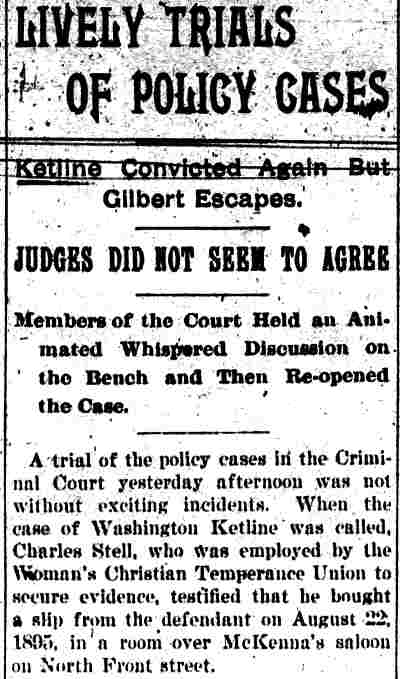
Ketline Convicted Again But Gilbert Escapes.
JUDGES DID NOT SEEM TO AGREE
Members of the Court Held an Animated Whispered Discussion on the Bench and Then Re-opened the Case.
A trial of the policy cases in the Criminal Court yesterday afternoon was not without exciting incidents. When the case of Washington Ketline was called, Charles Stell, who was employed by the Woman’s Christian Temperance Union to secure evidence, testified that he bought a slip from the defendant on August 22, 1895, in a room over McKenna’s saloon on North Front street.
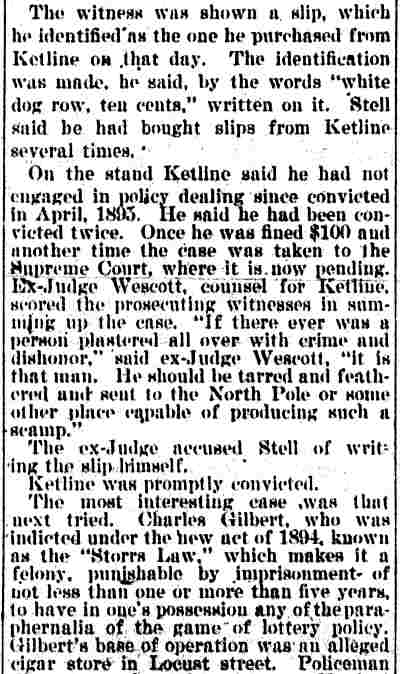
The witness was shown a slip, which he identified as the one he purchased from Ketline on that day. The identification was made, he said, by the words “white dog row, ten cents,” written on it. Stell said he had bought slips from Ketline several times.
On the stand Ketline said he had not engaged in policy dealing since convicted in April, 1895. He said he had been convicted twice. Once he was fined $100 and another time the case was taken to the Supreme Court, where it is now pending. Ex-Judge Wescott, counsel for Ketline, scored the prosecuting witnesses in summing up the case. “If there ever was a person plastered all over with crime and dishonor,” said ex-Judge Wescott, “it is that man. He should be tarred and feathered and sent to the North Pole or some other place capable of producing such a scamp.”
The ex-Judge accused Stell of writing the slip himself.
Ketline was promptly convicted.
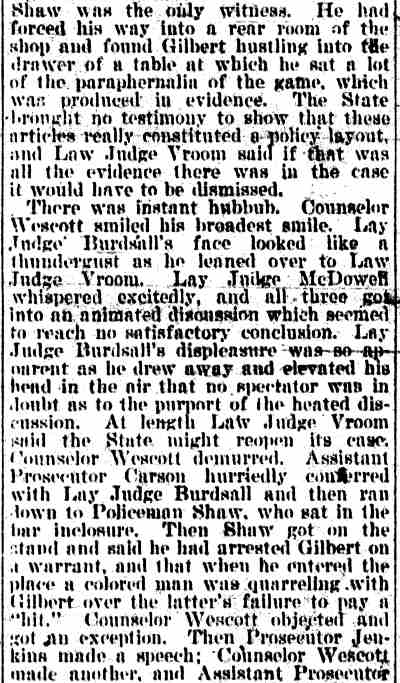
The most interesting case was that next tried. Charles Gilbert, who was indicted under the new act of 1894, known as the “Storrs Law,” which makes it a felony, punishable by imprisonment of not less than one or more than five years, to have in one’s possession any of the paraphernalia of the game of lottery policy. Gilbert’s base of operation was an alleged cigar store in Locust street. Policeman Shaw was the only witness. He had forced his way into a rear room of the shop and found Gilbert hustling into the drawer of a table at which he sat a lot of the paraphernalia of the game, which was produced in evidence. The State brought no testimony to show that these articles really constituted a policy layout, and Law Judge Vroom said if that was all the evidence there was in the case it would have to be dismissed.
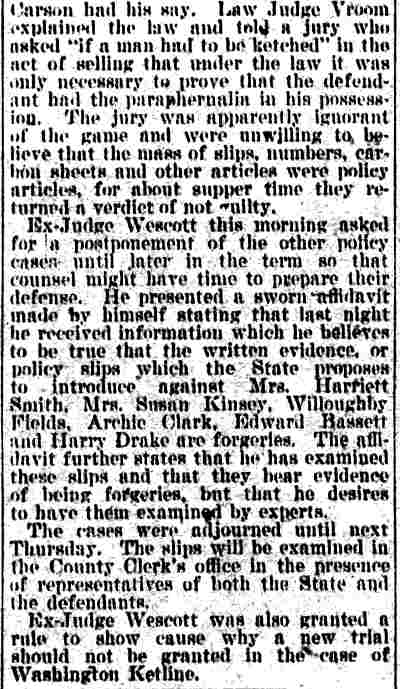
There was instant hubbub. Counselor Wescott smiled his broadest smile. Lay Judge Burdsall’s face looked like a thundergust as he leaned over to Law Judge Vroom. Lay Judge McDowell whispered excitedly, and all three got into an animated discussion which seemed to reach no satisfactory conclusion. Lay Judge Burdsall’s displeasure was so apparent as he drew away and elevated his head in the air that no spectator was in doubt as to the purport of the heated discussion. At length Law Judge Vroom said the State might reopen its case. Counselor Wescott demurred. Assistant Prosecutor Carson hurriedly conferred with Lay Judge Burdsall and then ran down to Policeman Shaw, who sat in the bar inclosure. Then Shaw got on the stand and said he had arrested Gilbert on a warrant, and that when he entered the place a colored man was quarrelling with Gilbert over the latter’s failure to pay a “hit.” Counselor Wescott objected and got an exception. Then Prosecutor Jenkins made a speech; Counselor Wescott made another, and Assistant Prosecutor Carson had his say. Law Judge Vroom explained the law and told a jury who asked “if a man had to be ketched” in the act of selling that under the law it was only necessary to prove that the defendant had the paraphernalia in his possession. The jury was apparently ignorant of the game and were unwilling to believe that the mass of slips, numbers, carbon sheets and other articles were policy articles, for about supper time they returned a verdict of not guilty.
Ex-Judge Wescott this morning asked for a postponement of the other policy cases until later in the term so that counsel might have time to prepare their defense. He presented a sworn affidavit made by himself stating that last night he received information which he believes to be true that the written evidence, or policy slips which the State proposes to introduce against Mrs. Harriett Smith, Mrs. Susan Kinsey, Willoughby Fields, Archie Clark, Edward Bassett and Harry Drake are forgeries. The affidavit further states that he has examined these slips and that they bear evidence of being forgeries, but that he desires to have them examined by experts.
The cases were adjourned until next Thursday. The slips will be examined in the County Clerk’s office in the presence of representatives of both the State and the defendants.
Ex-Judge Wescott was also granted a rule to show cause why a new trial should not be granted in the case of Washington Ketline.
John W. Wescott
Biographical Review: Camden and Burlington Counties — 1897
JOHN W. WESCOTT, generally known as Judge Wescott, has offices at the corner of Third and Market Streets, Camden. He was born at Waterford, Camden County, N.J., February 20, 1849, and is the eldest son of John and Catherine (Bozorth) Wescott. He is a descendant of one of the oldest and best known families in New Jersey. His father, who still lives, acquired a wide reputation as a glass cutter of very marked ability, having spent most of his active life in that craft. He now lives in comfortable retirement at Berlin, Camden County. His wife, Judge Wescott’s mother, springs of a distinguished French family, and is a woman of powerful and original character.
Of the four children born to them, three are now living. Elmira W., the eldest, married George W. Fisher, a graduate of Yale College. She is the mother of Professor Irving Fisher, of Yale, a young man of wide reputation among scholars; and of Bert W., a brilliant student now in the academic department of Yale. The youngest child of John and Catherine is William A., a prominent and well-known physician at Berlin.
John W. Wescott spent a short time in his boyhood as a pupil in the common school at Waterford under Charles T. Reed, who afterward became President Judge of the Courts of Camden County, and whom he succeeded on the same bench. At sixteen he went to Wilbraham Academy, Mass., where he was graduated three years later with distinction. He then entered Yale College, spending four years in the classical and three in the law department, taking the regular degrees. He was admitted to the Connecticut bar in 1876 and to the New Jersey bar as an attorney in 1878, and became a counsellor in 1881. He began practice at Camden in 1879, and was subsequently appointed Special Master and Examiner in Chancery. In 1884 he was made President Judge of the Camden County Courts, and he served as such until 1887.
Judge Wescott is a Democrat in his political views. He was an unsuccessful candidate for the State Senate and for Congress, cutting down by his vigorous canvasses Republican majorities always large and reliable in South Jersey. He was also on the electoral ticket in President Cleveland’s second campaign. He is a member of the Masonic order and various other societies, including the Reform Club of New York.
In 1874 Judge Wescott married Frances L. Oatman, of Connecticut. They have three sons—Harry D., Ethan P., and Ralph W. Mrs. Wescott is a woman of wide and varied culture, a member of the Episcopal Church of Haddonfield, where they live.
The Judge’s home is as near ideal as mutual devotion, books, pictures, music, and other delightful accessories can make. As a lawyer and a gentleman of extensive reading, he is justly regarded as one of the foremost members of the New Jersey bar. He has been connected with numerous important causes, and generally conducts them successfully. His successful defence of Francis Lingo, a poor negro, indicted for murder, was one of the most remarkable exhibitions of skill, endurance, learning, and originality in judicial history. It attracted universal attention, and at once placed Judge Wescott in the forefront of the great jury lawyers of the United States. He is generally found with the under dog in legal controversies, and is at his best when against great odds. The public generally regard his strongest point to be his power in presenting a case to a jury; but, as a debater of legal questions purely, it would be difficult to excel him.
Excise Probe Is Used as Shield in Libel Action
Trenton Times —
Camden Police Captain Makes Answer To $10,000 Damage Suit of Saloon Keeper.
Police Captain Arthur Stanley of Camden, has filed in the Supreme Court his pleas in the suit instituted against him by Patrick Carr, a Camden saloon keeper, for $10,00 [sic] damages. Carr asks the damages on the allegation that the Police Captain testified before the State Excise Commission at its hearing in the Camden Court House last July that “he (Carr) is not a fit person to keep a saloon.” Carr alleges also that Stanley further testified that this complainant kept the same kind of a saloon as certain other persons named, meaning thereby that Carr kept a disorderly house. Carr in his declaration claimed that the statements were untrue and asked the damages for injury to his good name and busines [sic] credit. Carr is represented by John W. Westcott of Camden.
In his plea Captain Stanley denies that he has been guilty of any grievance against Carr. He declares that the statements were made by him as a Captain of Police, presiding over the precinct in which Carr’s saloon is located; that they were made before the State Excise Commission appointed by Governor Fort under a joint resolution of the Legislature to investigate the whole excise question.
AT PUBLIC HEARING.
The plea of the defendant goes on to declare that at the time in question the commission was holding a public hearing in the Court House in Camden and this defendant was subpoenaed to give testimony. He was under oath to tell the truth concerning Camden excise matters, especially in his precinct, as to the general character of the licensees there. Captain Stanley avers further that the statements attributed to him were made in reply to the inquiries then being made by the commission and were not made for the purpose of injuring the plaintiff in any way. The defendant says his sole purpose was to inform the commission as to the whole excise conditions in Camden.
Going on in his plea Captain Stanley says that all of the statements in Carr’s declaration alleged to have been made by this defendant are in fact true and the defendant is ready to verify the truth of them. Stanley, therefore, asks the court to give judgment in his favor. The defendant is represented by Lawyer Peter Backes, of this city, who is one of the State Excise probers.
Recruiting “Drive” in Camden Churches
Philadelphia Inquirer —
National Guardsmen Visit Three Edifices, Seeking New Members. Wescott Chides Slackers
In an effort to arouse something like enthusiasm among the young men of Camden, recruiting sergeants of the Third Regiment, N. G. N. J., were stationed at several of the churches yesterday. In the morning they were at the First Baptist Church and at night at the First Presbyterian Church. Others spent the day at St. John’s P. E. Church. The sergeants had application cards which were distributed among the men, several of whom expressed their intention of joining.
Every effort is being made to infuse something akin to war time enthusiasm in the young men of the city, but the recruiting has been very slow, both for the Guardsmen and the regular army service. At the big rally held in the Third Regiment Armory, Saturday afternoon, Attorney General John W. Wescott chided the young men, who he declared, would apparently sooner have a good time than respond to their country’s call.
Major Harry G. Kramer, who is trying to get together enough men to compose an engineering corps, has obtained the names of about eighty from Camden county. As soon as he has a sufficient number he will organize them. His campaign has been the most energetic of any and yet he has experienced the greatest difficulty in getting responses to his appeals.
Officials Celebrate Birthdays
Philadelphia Inquirer —
Attorney General John W. Wescott and Prosecutor William J. Kraft, in Camden, yesterday jointly celebrated their natal anniversaries. Both are Democrats and are close personal friends. The Attorney General was born in 1847 and the Prosecutor in 1870. They were the recipients of the felicitations of their host of friends and each was the guest of the other at an informal luncheon. Mr. Kraft will step out of office on March 14 to be succeeded by Speaker of the House Charles A. Wolverton, who was an assistant to Prosecutor Henry S. Scovel some years ago. Mr. Kraft will resume his private law practice with his son, Bayard, who is now in France, and Wayne, who has been associated with his father in the Prosecutor’s office.
John Wesley Wescott
South Jersey: A History 1664–1924
JOHN WESLEY WESCOTT—An eminent jurist, attorney and statesman of New Jersey, John W. Wescott has retained a modesty of spirit that has endeared him to the many with whom he has come in contact during his splendid career. He is one of the State’s oldest attorneys, marked by a dignity of manner and integrity of character that have served him well in his practice. As a practicing attorney, as judge, as the man who twice nominated Woodrow Wilson for President of the United States, as attorney-general of the State of New Jersey, Mr. Wescott has acquired an experience through his contact with men of the nation, that has enriched his knowledge of human nature and proved invaluable to him in the many problems which have confronted him and which he has so successfully met. His association with President Wilson was especially beneficial.
In one respect Judge Wescott strongly resembles the late President Roosevelt, for like him, he was weakly as a boy, and like him, he developed his physique to so excellent a point that, later, while a student at Yale University, he became one of that institution’s leading athletes, and that without impairing his leadership in scholarly attainments. In college he gave promise of doing many and diverse things well, which characterized him later in life.
John Wesley Wescott was born in Waterford, New Jersey, February 20, 1849, the son of John and Katherine Van Overterfer (Bozarth) Wescott. The beginning of the Wescott line in this country can be traced back to two brothers, Richard and Stukeley Westcote, who came into Massachusetts with Roger Williams and went with him into Rhode Island. From there a son came into New Jersey and died at Fairfield in what is now Cumberland County in 1702. The family in England includes that John Westcote who became Lord Lyttleton, the great lawyer, celebrated in the commentaries of Lord Coke. Mr. Wescott’s mother’s family came from northern France, where there are still many Bozarths. John Wescott was a glass-cutter and had very limited means. He desired his son to pursue the craft of glass cutting, but his mother had greater ambitions for him, and it was by her cooperation that he started on the educational career which, she hoped, was to make him a preacher of the gospel of the Methodist Episcopal Church. During the Civil War he made an effort to join the Union Army. His rejection, however, even as a drummer boy, because of his slenderness, pointed out to him the necessity of a strong body, in consequence of which he came to be noted as one of the all-round athletes of Yale. At the age of seventy-four years he retains the vigor and the working power of much younger men and attributes this to persistence in regular and athletic physical habits.
He received his preliminary education at Wesleyan Academy, Wilbraham, Massachusetts, from which he was graduated in 1868. He then went to Yale University, from the academic department of which he was graduated in 1872, with the degree of Bachelor of Arts, and four years later he graduated from the law school of Yale with the degree of Bachelor of Laws, becoming automatically a member of the Connecticut bar, as graduation from the law department of Yale constituted full admission. While a student, he rowed on Yale’s first eight-oared varsity crew, and was one of the founders of modern football. He also took the Townsend prize, one of the highest university honors for oratory and English composition. After establishing connections in New Haven in the legal world, he returned to New Jersey and became an attorney in 1878, and counselor three years later, practicing in Camden. His success as an attorney was complete and it was not long before his reputation went beyond the boundaries of the county and reached the State Capital at Trenton. In 1884 Governor Leon Abbett made him the presiding judge of the Court of Common Pleas of Camden County, a position which he retained until 1887. Thereafter he returned to private practice and became senior member of the firm of Wescott & Weaver of Camden. Although the greater part of his legal work has been done in New Jersey, he has also practiced in a lesser degree in the courts of Connecticut, Pennsylvania and North Carolina. One of the most remarkable cases in the annals of New Jersey law in which Judge Wescott figured was that in which he triumphed, single-handed, over race prejudice and circumstantial evidence, and brought about the freedom of a man virtually facing the gallows. In 1894, Camden County was agitated by the murder of the wife of John Miller, a farmer, living near Merchantville, and a vigorous pursuit of the clues culminated in the arrest of Francis Lingo, a negro. The negro stoutly asserted his innocence and the Supreme Court assigned Mr. Wescott to defend him. An antagonistic public sentiment forced Lingo’s conviction, but after an exhaustive argument before a full bench on appeal, the verdict was set aside and a new trial ordered. At the second trial, Mr. Wescott’s cross-examination of the State’s witnesses was so thorough and illuminating that the court directed Lingo’s acquittal without calling on the defense to produce any testimony.
Mr. Wescott’s first public appearance in politics was as a presidential elector on the Cleveland ticket in 1892. He enjoys the unique distinction of having twice nominated the candidate for President of the United States and of having seen his party nominee elected. In the Democratic National Convention of 1912, and again in that of 1916, he was selected to make the nominating speech that put Woodrow Wilson formally before the country. He contributed in no small degree to President Wilson’s success in both campaigns by his efforts on the stump. His effective delineation of the President’s character was a factor in causing a Democratic victory in New Hampshire, a chronically Republican State, in the campaign of 1916. Mr. Wescott was also selected by the National Committee to offset the effects of a speech by Charles Evans Hughes, the Republican Presidential candidate at Rockland, Maine, with the result that Wilson carried Rockland.
The manner in which Mr. Wescott first came into contact with President Wilson, at that time President of Princeton University, is typical. In 1910 he responded to the progressive agitation to the extent of actively supporting the candidacy for Governor of Frank S. Katzenbach, who three years before had lost to John Franklin Fort, by a slim majority, and who was then opposed for the candidacy by a man named Woodrow Wilson. Mr. Wescott’s speech for Katzenbach all but defeated the nomination of Wilson, who, at that time, was as completely unknown to Mr. Wescott in the political sense as he was to the country-at-large. Immediately after the speech nominating Mr. Wilson, Judge Wescott had left Taylor’s Opera House without waiting to hear the candidate’s speech of acceptance. He read it in the evening paper, however, on his way home and was so struck by its force that he wrote to Mr. Wilson and was soon thereafter received in the Wilson home at Princeton, where the two men at once became friends. When, in 1912, Governor Wilson sought among the New Jersey delegates, the one best fitted to put his nomination before the National Convention in Baltimore, he chose Mr. Wescott. Mr. Wescott’s formal presentation of Governor Wilson’s name became a powerful campaign document. Four years later the President selected Mr. Wescott again to present his name at the National Convention in St. Louis.
In 1914, Governor Fielder named him Attorney-General of New Jersey, the office of which Mr. Wescott fulfilled with distinguished ability for the period of the five-year term. His friends entered him in the 1912 primary and again in the 1916 primary as a candidate for United States Senator, and he made an excellent showing at both polls, being generally regarded as the preference of the National administration.
During the period of American participation in the World War, he was a prominent worker in civilian activities, taking part in all of the Liberty Loan campaigns. He is a trustee of the New Jersey State School Fund; the Woman’s College of New Jersey; and is a Methodist in religious affiliation. He is a member of the Masonic Order, in which he holds the thirty-second degree; the Alpha Delta Phi Fraternity; the Academy of Political and Social Science; and the New Jersey Bar Association, of which he was president in 1913.
John Wesley Wescott married, at New Haven, Connecticut, January 1, 1875, Frances Marie Louise Leclerc Pryor, daughter of Ethan and Marian (Brown) Pryor, and they are the parents of three sons: Henry D., born in 1876; Ethan P., a sketch of whom follows; and Ralph W., born in 1883.
Mr. Wescott has his Camden office at No. 301 Market Street, while the family residence is in Haddonfield, New Jersey.
The Wescott Family Plot at Harleigh Cemetery
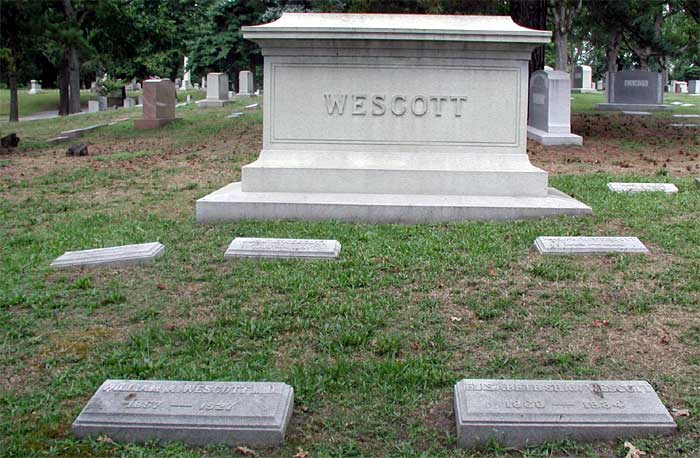
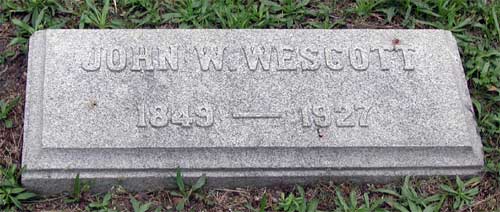
The Wescott Family Plot at Harleigh Cemetery, Camden NJ
Ralph W.E. Donges' Memorial to Judge John W. Wescott
Published in the 1930 Archive, the yearbook of the Law School of South Jersey, Camden NJ
My admiration for Judge Wescott developed early. I admired my own father greatly, and he, I discovered, regarded the militant young Judge not only as a friend, but as a heroic character.
I went into the old Camden County Court House one day—I heard my future preceptor try a case. The picture is with me now, of the skilled, aggressive advocate, and the brilliant, splendidly poised trial judge, the late Charles Grant Garrison, who sat in the trial of cases, where I have the privilege of sitting now. From then on my ambition remained fixed. What earnest boy has not dreamed a future? I wanted to become a lawyer, a trial lawyer, a great trial lawyer if possible—and I wanted to learn the law under Judge Wescott. I think my father hoped that I would follow him in the practice of medicine—in which he was rendering a great service to the community—but when he realized the earnestness of my wish to study law, he did not try to dissuade me, but took me to the Judge’s office, and shortly thereafter my legal training began. Not, however, at the first interview. It was not enough that his good friend had a son who wanted to become a lawyer. I had to convince one, then the other, that it was no passing whim on my part. These were my first two important arguments. To me they were vital, and, having won the first, I struggled the harder to win the next. When Judge Wescott saw that I was in earnest and not to be discouraged by his warnings of the difficulties and dangers of a lawyer’s life, he, with evident reluctance, consented to try me out for a time. He told me he hesitated to take students because he had neither time nor inclination for their instruction. Nevertheless, that was a happy day for me, not only because it meant the beginning of my legal training, but because I knew that it meant an exceptionally good training. By this I do not mean that my preceptor was, in the usual sense, an exceptionally good teacher. Indeed, he had but little knack in giving personal instruction. He had neither the interest in legal technicalities nor the requisite patience for teaching by rote. But he was an inspiring example. To be with him in the office and the courtroom was a constant stimulus to exertion and the acquirement of skill in every branch of the law. The young men he took as students, developed in nearly every instance into capable lawyers. The late Judge Vroom, Francis D. Weaver, who later became his partner, Howard L. Miller, and the Judge’s own three sons, are some of these students, who either preceded or followed my apprenticeship.
Judge Wescott was interested primarily in the character of his students. He looked first, I think, for honesty, next for courage, lastly for skill and learning. All are prime essentials, but I place them in the order in which he held them, and in which he exemplified them. Great as were his skill and learning, they rested on the greater foundation of courage; and that, in turn, rested on his essential honesty of character, which sprang from the love in his heart.
He was a lover of all mankind and his fighting spirit was aroused whenever he believed human right was invaded. To him the financial benefit of winning a case, either to the client or to himself was not to be considered, in comparison with the vindication of a right. If he sometimes appeared adamantine or intolerant, it was only because he believed an injustice or an untruth was being perpetrated. He had no disposition to compromise or temporize with either.
By nature, then, a kindly, lovable soul, as I have good reason to know, he would become hard and merciless in his condemnation of sham, hypocrisy, deceit and attempted injustice. In the event of what he conceived to be an oppression, by whomsoever attempted, he flung into the conflict with all of his tremendous powers. I wish space permitted a narration of some instances of the exhibition of his courage, skill, and resourcefulness. None, who has heard him, can forget his matchless elegance, his compelling reasoning, his quiet commanding presence, as he sought to vindicate what he believed in the moment to be right.
Judge Wescott was essentially an advocate, but such was his belief in the majesty of the law for the honest settlement of differences between suitors, that I believe he never took pleasure in the winning of any case, unless he believed that substantial justice had been done between the parties.
His life is an inspiration to those following him, an exemplification, as above stated, of honesty, courage, learning, and skill. Fidelity to duty, as he saw that duty, was the cardinal principle that controlled his activities as an advocate—“With firmness in the right, as God gives us to see the right.
Judge Wescott was a great lawyer, a brilliant and courageous advocate, a warm hearted, sympathetic friend, a thorough-going American, to whom Shakespeare’s words most aptly apply.
Take him for all in all, We shall not look upon his like again.
—Ralph W.E. Donges, Camden NJ, April 1930
Judge Wescott
From “Days of Yore” as told by Bill Day, popular writer of a column in the Haddon Gazette.
It is common knowledge that Haddonfield was one of the most prominent Republican towns in the state of New Jersey, and a prominent citizen of Haddonfield in the early 1900’s was the Hon. John W. Wescott, a retired Judge, but still active in his Camden law practice, along with his two sons who were also well known. One son, Ralph, was a member of the Port Authority, and the other, Ethan, was the Prosecutor of Camden County.
Judge Wescott was a Democrat and was renowned for having given Woodrow Wilson’s nominating addresses. One was at the Democratic Convention in Baltimore June 27, 1912, and the other at the Democratic Convention in St. Louis, Missouri June 10, 1916. Afterwards, when he was Attorney General of New Jersey he wrote a book on the events in Woodrow Wilson’s life.
In the shoemaker shop in Haddonfield another of the few Democrats in Haddonfield sat working every day. If you were a voter of the right political party you never had to wait for your shoes to be repaired when a mending was required.
Some mornings on his way to the trolley car which he would ride to Camden to his office, Judge Wescott would stop in the shoe shop to pass the time of day. The conversation would be political and, of course, the main topic would be Wilson.
At 12 o’clock when the fire bell would ring, the Judge would go home for lunch. The law business would suffer from neglect that day.
Just another interesting yarn that makes Haddonfield so much a colorful community.
Funeral Services Held for Francis D. Weaver
Camden Courier-Post —
Funeral services were held yesterday for Francis D. Weaver, 76, president of the New Jersey Board of Tax Appeals, who died Friday of pneumonia. Burial was in Evergreen Cemetery.
Mr. Weaver, who resided at 323 Cooper Street, served as a member of the Camden County Tax Board from 1913 to 1924. In 1924, he was appointed by Governor Silzer to the old State Board of Taxes and Assessments, becoming president in 1929. On July 1, 1936, Governor Hoffman named him for another five-year term.
A former law partner of the late John W. Wescott, who was state attorney general, Mr. Weaver later formed a partnership with George H. Jacobs here. He is survived by his widow and daughter, Mrs. Helen MacCausland.
Walt Whitman Acclaimed as ‘International Prophet’
Camden Courier-Post —
Wescott Recalls Friendship with Poet at Ceremonies Here Marking 120th Anniversary of his birth; Donaldson Tells of Buggy Gift
By Walter B. Batezel
Acknowledged by the world as the poet of democracy, Camden’s own Walt Whitman was acclaimed here yesterday on the 120th anniversary of his birth as the “prophet of a new internationalism.”
This interpretation of Whitman and his famous “Leaves of Grass,” which introduced free verse to the world and the rugged liberty loving character of America so lustily praised in his songs, was offered by Ralph W. Wescott, of Haddonfield.
Wescott was one of three speakers for the Walt Whitman Foundation which is charged with maintenance of the Whitman home at 330 Mickle Street as a literary shrine. Also speaking on Whitman were Thomas B. Donaldson, Philadelphia insurance man, who as a boy knew Whitman, and Mrs. Elizabeth Cady Conover, also of Philadelphia.
The meeting was held at the headquarters of the Camden County Historical Society, Euclid Avenue and Park Boulevard. Wescott, former comptroller of customs of the Port of Philadelphia and son of the late Judge John W. Wescott, who was an intimate friend of Whitman in Camden and who twice nominated Woodrow Wilson for the presidency, based his lauding of Whitman as an “international prophet” upon excerpts from Whitman’s books.
Urged Universal Freedom
“It is the very catholicity of the man which causes us to celebrate his birthday anniversary,” said Wescott. “He has been seen as the precursor of socialism and the completely going anti-socialist.”
“We almost shrink from news abroad, and we are bound to consider what Whitman’s response would have been. In his poem ‘Salutation,’ I think we find in Whitman the prophecy of a new internationalism, a poem in which he asked for universal freedom against slavery, and called for an international brotherhood.”
“It is unique and significant that on this 120th anniversary of Whitman the New York World’s Fair acclaims him by statue and adulation, and in 1876 during the Centennial Exposition in Philadelphia Whitman indited a poem addressed to foreign readers in which he directed their attention to ‘the peculiar glory of the United States’ as something ‘vaster, saner, more splendid in comradeship, knitting closer all nations and humanity.’”
“Whitman himself wrote poets were necessary to fulfillment of a world brotherhood because their work was needed to vitalize the message of statesmen.”
Preached Good Will
“In the British-written preface to Whitman’s ‘Specimen Days in America,’ which he wrote in Camden and Laurel Springs, there occurred the sentence ‘Whitman preached goodwill between common people of all nations.’ In all the things written of him, Whitman said he liked that description best.”
“So, in Whitman’s own words we find the real message, and as expressed in one of his poems, and so which was an obsession with him in his declining days—we instinctively seek a ‘universal, comprehensive solidarity of man.’ There was no braver or more humanistic American writer than Whitman, nor more humanistic statement for the world than his ‘Leaves of Grass.’”
“Boyhood Recollections of Whitman,” by Donaldson, whose father Blaine Donaldson, of Philadelphia, was a benefactor and fast friend of Whitman, regaled the little literary group of 40 which appeared to honor the birthday of the “Good Gray Poet.”
It was Donaldson’s father who, anxious to aid the paralytic poet in reaching the outdoors, wrote to all of America’s most famous writers and asked they subscribe to a fund to purchase a pony and buggy for Whitman.
Great Writers Gave
The contributors to the fund, Donaldson said, included Ralph Waldo Emerson, John Greenleaf Whittier, John Burroughs, Robert W. Ingersoll, Rutherford B. Hayes, General Phil Sheridan and Oliver Wendell Holmes.
“Hayes and Sheridan were frequent visitors to our home,” said Donaldson, “as was Henry Irving, the actor. Sheridan came often to sniff brandy and Whitman met these men there, but Walt came chiefly for mental regalement and food, because my mother was a good cook.”
“I was a lad of eight to eleven years when Whitman made his visits, and no matter who was there Whitman always dominated the room. In fact, he loved my father so much that he requested that my father be a pallbearer for him.”
“My sister and I sat in his lap often, and we liked that because he looked like Santa Claus, and most children were drawn naturally toward him. He was different and comradely. I can pay tribute to Walt’s whiskers because he didn’t chew tobacco, not then anyway, if later.”
“Walt had the eyes of a stage manager and nothing escaped and no matter how distinguished the audience, Whitman was the boss. His favorite pastime at our home was dipping bananas into sherry wine and eating them as though they were lollypops.”
“It was in 1885 that my father decided to get Walt a pony and buggy, and when the outfit was purchased as a gift from America’s greatest writers to Walt. I was commissioned with a guardian to drive it to Camden.”
Pony Was Groggy
“When I got the pony there in the afternoon Whitman came out and said: ‘Bless me,’ and got in right away. Walt then took to the open in later days, but he soon began to complain the pony was ‘groggy and too slow.’ A few days later Walt turned up at home with a three-gaited horse.”
“The horse obviously was too spirited for Whitman’s crippled condition, and when this was drawn to his attention he said, ‘There is no sense in giving me a crippled horse. What does a helpless hulk like me want with another cripple? This horse is lithesome.’”
“I have some mementos from Whitman which I cherish, but most interesting of all was his personality. To know him was better than any souvenir of him, and in the language of today he had ‘umph!’”
“Mrs. Davis, who took him and who loved him as a mother would, caring for his every wish, was a kind, genial soul, and she in fact, supported Whitman while he saved his money for a monument to himself.”
Full of People
“I recall Whitman’s last days, when my father visited him. Father came home and said the house in Camden was full of people hovering over him with pencil and paper to catch his last words, and that few of them had gone down into their jeans to give him a cent.”
“But over all, I think our attitude toward Whitman must be an offering of our mentality, and our tribute is one of admiration and affection.”
Mrs. Conover paid memorial tribute to Dr. Alexander Macalister, former physician to Whitman, who died last November, and who was president of the Walt Whitman Foundation; Mrs. Sarah D. Wolverton, also a member of the foundation, who died last year; Mrs. Alice Walker Griffiths who lived in Camden at the George Whitman home while Walt lived there, and Mrs. Ruth Stafford Goldy, both of whom died last year. It was at the Stafford home in Laurel Springs that Whitman recuperated from his paralytic stroke.
Mrs. Conover said she was not “impressed by recent documents on Whitman” which she generally described as “insolent,” and said “nearness of approach and intimacy are necessary to get to a cosmic soul.”
“The most direct way to Whitman is through ‘Leaves of Grass,’” she said.
She then told of a recent incident on the finding of a first edition of “Leaves of Grass,” owned by “an unappreciative New York bootlegger,” and in which was found a manuscript of one of Whitman’s poems, “A Backward Glane O’re Traveled Road,” and the title of which had been written and changed three times by the poet on the manuscript.
Cites Honors to Poet
Mrs. Conover also called attention to the Sprague collection of Whitmania on exhibit this year in the Library of Congress, dedication of the Whitman statue at the World’s Fair yesterday, and issuance of a postage stamp in his honor.
“Whitman sailed his ship in deep waters,” she said, “and paid no attention to the shallows. He was the world’s greatest optimist, and under these tremulous, troubled and fear-filled times we should follow as Americans his words, ‘My foothold is tenoned and mortised in granite.’”
Mrs. Conover lauded Mrs. Martha Davis, curator of the Whitman house, as “a stout-hearted disciple of Walt Whitman.”
Wescott, in behalf of the Whitman foundation, presented to the Camden County Historical Society a picture of the Walt Whitman home for its archives. The picture was received for the society by Mrs. A. Haines Lippincott.