Introduction
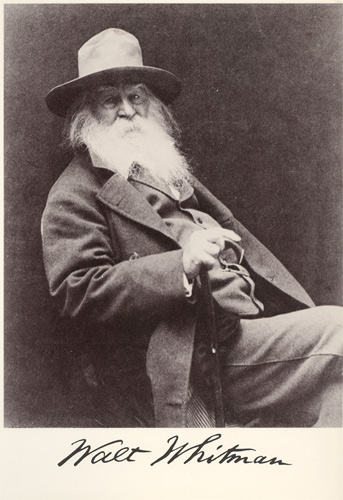
Walt Whitman.
The Walt Whitman House at 328 Mickle Street in Camden, New Jersey, was the home of the poet Walt Whitman during the last nineteen years of his life. Born on May 31, 1819, near Huntingdon, Long Island, he had a varied career as a writer, war correspondent and poet. During the Civil War he ministered to the wounded of both the North and South at Washington. He spent the last 19 years of his life in Camden, where he died in 1892.
Whitman’s Will Filed
Philadelphia Inquirer —
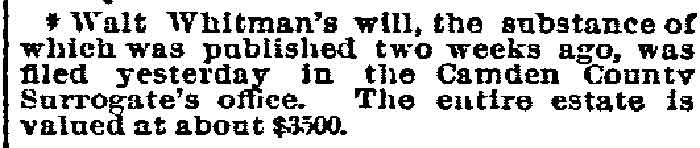
Walt Whitman’s will, the substance of which was published two weeks ago, was filed yesterday in the Camden County Surrogate’s office. The entire estate is valued at about $3500.
400 Friends Pay Homage To ‘Good Gray Poet’
Camden Courier-Post —
Men and Women From Many Sections Visit Walt Whitman’s Tomb and Old Mickle Street Home on His 114th Anniversary
“It’s just a little street where old friends meet”
That’s Mickle Street where Walt Whitman, the “Good Gray Poet,” once lived, and old friends came back here from near and far yesterday to mingle under the portals of the house in which he wrote his famous works, on the 114th anniversary of his birth.
Among them was Mrs. Augusta K. Dole, 71, of Metuchen, whose husband has been a sports writer on New York newspapers for 45 years.
“They call it a dingy street and some are ashamed to return and say they lived there,” Mrs. Dole said. And with a gesture of the hand she pointed out the homes of some of neighbors, who became famous.
Among them was Button; famous artist [architect]. Another was the grandmother of J. B. Van Sciver.
“I lived at 319 Mickle Street when I was a young lady,” she said. “I was one year old when we moved into the house right across the street from Whitman. I remember when he lived on Stevens Street before he moved to Mickle Street.
Knew Whitman Well
“We lived at the Mickle Street address about 15 or 16 or 20 years; I knew Whitman well. He always stopped and exchanged greetings with me. I frequently saw him on the ferryboats crossing the rivers.
“I want to take issue right here with those who have questioned his chastity. He was more like Christ than anyone else. I saw him admiring me as a young woman one day on a ferryboat.”
“Years later I read a description of myself in one of his works. I did not begin to read his work until 30 years ago. He wrote of the true things in life. He wrote of life as it is and as we see it. I am glad to come here today at the invitation of the committee,”
Mrs. Dole sat in the last chair in which the poet rested before his last illness. She was introduced to Dr. Alexander MacAlister, who was his personal physician in his last illness and who is a member of the Walt Whitman foundation.
Then she posed with an etching by Lewis Daniel, New York artist, at the Walt Whitman art gallery, 641 Market Street. It is one of 14 the young artist drew on “The Song of the Open Road.” Two lines taken from the book are sketched under the etching as follows:
“The earth is crude and incomprehensible at first— Nature is rude and incomprehensible at first.”
400 Visit Home
More than 400 guests visited the home of the poet during the day to be welcomed by members of the foundation. Mrs. Charles A. Wolverton, wife of Congressman Wolverton, was chairman of the reception committee.
Many of the guests visited the tomb of the poet in Harleigh Cemetery where the door is ajar at his request “that his spirit may come and go as I choose.’” But no flowers were placed there as he requested none.
Born on May 31, 1819, near Huntingdon, Long Island, he had a varied career as a writer, war correspondent and poet. During the Civil War he ministered the wounded of both the North and South at Washington. He spent the last 19 years of his life in Camden, where he died in 1892.
Under the bed in his second story front bed room today is a huge metal bathtub, which he designed for use in his invalid days. His library, horsehair furniture, his favorite rocking chair and a cane with which he knocked on the floor to call his housekeeper.
Some of his writings, manuscripts and other works are the property of Miss Ann Harned and Madge Barton Feurer. They are now at the New Jerseyanna Exhibition at the State House at Trenton.
New Painting Viewed
A new painting of Walt Whitman has been completed by Byron T. Connor, of 4320 Manor Avenue, Merchantville, and is now on display at the Hotel Walt Whitman. The painting was completed in three weeks, so as to be ready for the birthday ceremonies.
Later it will be moved from the hotel and placed either in the Whitman home or hung in the lobby of the Walt Whitman Theatre.
Miss Harned, daughter of the late Thomas B. Harned, one of Whitman’s literary executors; Joseph Praissman and Mrs. Martha Davis curator of the Whitman home, were members of the anniversary committee headed by Mrs. Wolverton.
With few exceptions, members of the Walt Whitman Foundation attended yesterday’s program, including Dr. Macalister, chairman; Dr. Cornelius Weygandt, vice chairman; Mrs. Juliet Lit Stern, Joseph M. Conover, Mrs. Helen Taft Manning, Mrs. Allen Drew Cook, Mrs. Nicholas Douty, Dr. Herbert Spencer Harned, J. Frederick Harned, Roy Helton, William T. Innes, Eldridge R. Johnson, William H. Ketler, Dr. Rufus M. Jones, former Mayor Victor King, Oscar Wolf, John Frederick Lewis, Jr., Dr. Bliss Perry, Harrison S. Morris, Agnes Repplier, former Mayor Winfield S. Price, Vernon Whitman Rich, Dr. J. Duncan Spaeth, Dr. Felix E. Schelling, Dr. Robert E. Spiller, Mrs. David Abeel Storer, Frederick Von Nieda and Ralph W. Wescott.
Among the visitors was former Assemblyman William H. Iszard, who is secretary of the committee, which acquired the home as a national shrine. Iszard sponsored legislation in the Assembly for its upkeep.
Camden Honors Whitman on 120th Anniversary
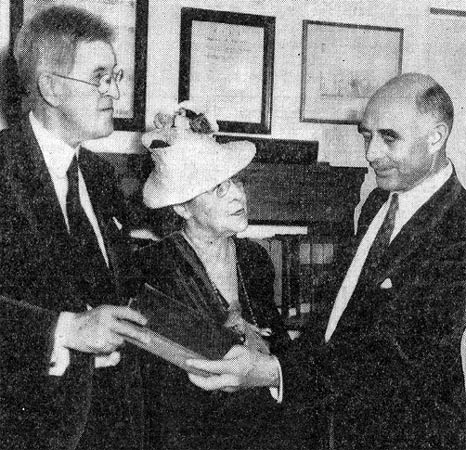
Left: Thomas B. Donaldson, who knew Whitman; Mrs. Elizabeth Cady Conover; and Ralph W. Wescott, member of the foundation. All three were speakers at the exercises held at headquarters of the Camden County Historical Society.
Walt Whitman Acclaimed as ‘International Prophet’
Camden Courier-Post —
Wescott Recalls Friendship with Poet at Ceremonies Here Marking 120th Anniversary of his birth; Donaldson Tells of Buggy Gift
By Walter B. Batezel
Acknowledged by the world as the poet of democracy, Camden’s own Walt Whitman was acclaimed here yesterday on the 120th anniversary of his birth as the “prophet of a new internationalism.”
This interpretation of Whitman and his famous “Leaves of Grass,” which introduced free verse to the world and the rugged liberty loving character of America so lustily praised in his songs, was offered by Ralph W. Wescott, of Haddonfield.
Wescott was one of three speakers for the Walt Whitman Foundation which is charged with maintenance of the Whitman home at 330 Mickle Street as a literary shrine. Also speaking on Whitman were Thomas B. Donaldson, Philadelphia insurance man, who as a boy knew Whitman, and Mrs. Elizabeth Cady Conover, also of Philadelphia.
The meeting was held at the headquarters of the Camden County Historical Society, Euclid Avenue and Park Boulevard. Wescott, former comptroller of customs of the Port of Philadelphia and son of the late Judge John W. Wescott, who was an intimate friend of Whitman in Camden and who twice nominated Woodrow Wilson for the presidency, based his lauding of Whitman as an “international prophet” upon excerpts from Whitman’s books.
Urged Universal Freedom
“It is the very catholicity of the man which causes us to celebrate his birthday anniversary,” said Wescott. “He has been seen as the precursor of socialism and the completely going anti-socialist.”
“We almost shrink from news abroad, and we are bound to consider what Whitman’s response would have been. In his poem ‘Salutation,’ I think we find in Whitman the prophecy of a new internationalism, a poem in which he asked for universal freedom against slavery, and called for an international brotherhood.”
“It is unique and significant that on this 120th anniversary of Whitman the New York World’s Fair acclaims him by statue and adulation, and in 1876 during the Centennial Exposition in Philadelphia Whitman indited a poem addressed to foreign readers in which he directed their attention to ‘the peculiar glory of the United States’ as something ‘vaster, saner, more splendid in comradeship, knitting closer all nations and humanity.’”
“Whitman himself wrote poets were necessary to fulfillment of a world brotherhood because their work was needed to vitalize the message of statesmen.”
Preached Good Will
“In the British-written preface to Whitman’s ‘Specimen Days in America,’ which he wrote in Camden and Laurel Springs, there occurred the sentence ‘Whitman preached goodwill between common people of all nations.’ In all the things written of him, Whitman said he liked that description best.”
“So, in Whitman’s own words we find the real message, and as expressed in one of his poems, and so which was an obsession with him in his declining days—we instinctively seek a ‘universal, comprehensive solidarity of man.’ There was no braver or more humanistic American writer than Whitman, nor more humanistic statement for the world than his ‘Leaves of Grass.’”
“Boyhood Recollections of Whitman,” by Donaldson, whose father Blaine Donaldson, of Philadelphia, was a benefactor and fast friend of Whitman, regaled the little literary group of 40 which appeared to honor the birthday of the “Good Gray Poet.”
It was Donaldson’s father who, anxious to aid the paralytic poet in reaching the outdoors, wrote to all of America’s most famous writers and asked they subscribe to a fund to purchase a pony and buggy for Whitman.
Great Writers Gave
The contributors to the fund, Donaldson said, included Ralph Waldo Emerson, John Greenleaf Whittier, John Burroughs, Robert W. Ingersoll, Rutherford B. Hayes, General Phil Sheridan and Oliver Wendell Holmes.
“Hayes and Sheridan were frequent visitors to our home,” said Donaldson, “as was Henry Irving, the actor. Sheridan came often to sniff brandy and Whitman met these men there, but Walt came chiefly for mental regalement and food, because my mother was a good cook.”
“I was a lad of eight to eleven years when Whitman made his visits, and no matter who was there Whitman always dominated the room. In fact, he loved my father so much that he requested that my father be a pallbearer for him.”
“My sister and I sat in his lap often, and we liked that because he looked like Santa Claus, and most children were drawn naturally toward him. He was different and comradely. I can pay tribute to Walt’s whiskers because he didn’t chew tobacco, not then anyway, if later.”
“Walt had the eyes of a stage manager and nothing escaped and no matter how distinguished the audience, Whitman was the boss. His favorite pastime at our home was dipping bananas into sherry wine and eating them as though they were lollypops.”
“It was in 1885 that my father decided to get Walt a pony and buggy, and when the outfit was purchased as a gift from America’s greatest writers to Walt. I was commissioned with a guardian to drive it to Camden.”
Pony Was Groggy
“When I got the pony there in the afternoon Whitman came out and said: ‘Bless me,’ and got in right away. Walt then took to the open in later days, but he soon began to complain the pony was ‘groggy and too slow.’ A few days later Walt turned up at home with a three-gaited horse.”
“The horse obviously was too spirited for Whitman’s crippled condition, and when this was drawn to his attention he said, ‘There is no sense in giving me a crippled horse. What does a helpless hulk like me want with another cripple? This horse is lithesome.’”
“I have some mementos from Whitman which I cherish, but most interesting of all was his personality. To know him was better than any souvenir of him, and in the language of today he had ‘umph!’”
“Mrs. Davis, who took him and who loved him as a mother would, caring for his every wish, was a kind, genial soul, and she in fact, supported Whitman while he saved his money for a monument to himself.”
Full of People
“I recall Whitman’s last days, when my father visited him. Father came home and said the house in Camden was full of people hovering over him with pencil and paper to catch his last words, and that few of them had gone down into their jeans to give him a cent.”
“But over all, I think our attitude toward Whitman must be an offering of our mentality, and our tribute is one of admiration and affection.”
Mrs. Conover paid memorial tribute to Dr. Alexander Macalister, former physician to Whitman, who died last November, and who was president of the Walt Whitman Foundation; Mrs. Sarah D. Wolverton, also a member of the foundation, who died last year; Mrs. Alice Walker Griffiths who lived in Camden at the George Whitman home while Walt lived there, and Mrs. Ruth Stafford Goldy, both of whom died last year. It was at the Stafford home in Laurel Springs that Whitman recuperated from his paralytic stroke.
Mrs. Conover said she was not “impressed by recent documents on Whitman” which she generally described as “insolent,” and said “nearness of approach and intimacy are necessary to get to a cosmic soul.”
“The most direct way to Whitman is through ‘Leaves of Grass,’” she said.
She then told of a recent incident on the finding of a first edition of “Leaves of Grass,” owned by “an unappreciative New York bootlegger,” and in which was found a manuscript of one of Whitman’s poems, “A Backward Glane O’re Traveled Road,” and the title of which had been written and changed three times by the poet on the manuscript.
Cites Honors to Poet
Mrs. Conover also called attention to the Sprague collection of Whitmania on exhibit this year in the Library of Congress, dedication of the Whitman statue at the World’s Fair yesterday, and issuance of a postage stamp in his honor.
“Whitman sailed his ship in deep waters,” she said, “and paid no attention to the shallows. He was the world’s greatest optimist, and under these tremulous, troubled and fear-filled times we should follow as Americans his words, ‘My foothold is tenoned and mortised in granite.’”
Mrs. Conover lauded Mrs. Martha Davis, curator of the Whitman house, as “a stout-hearted disciple of Walt Whitman.”
Wescott, in behalf of the Whitman foundation, presented to the Camden County Historical Society a picture of the Walt Whitman home for its archives. The picture was received for the society by Mrs. A. Haines Lippincott.
Photos
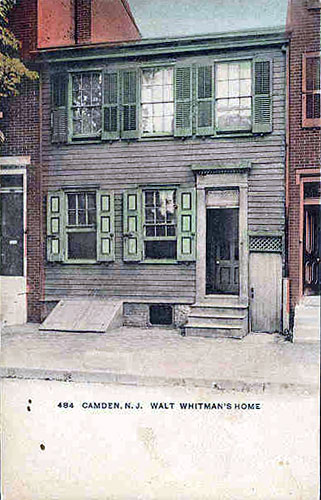
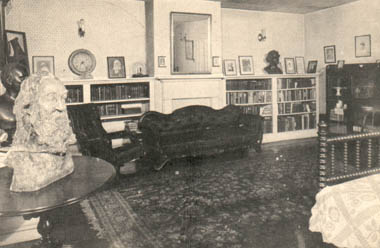
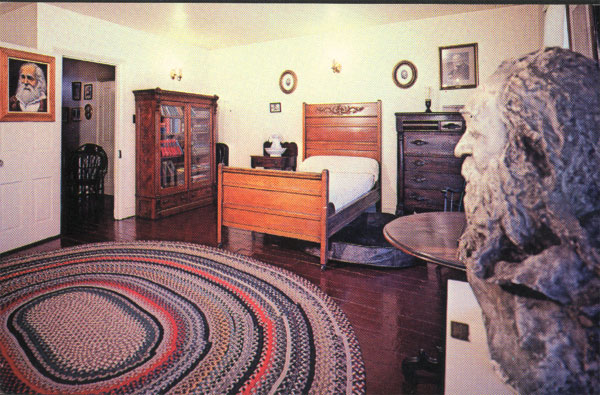
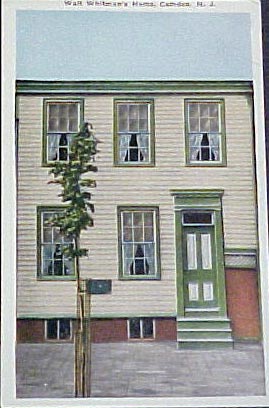
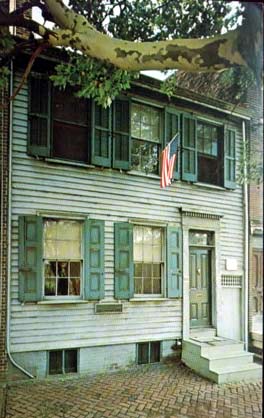
Postcards of the Walt Whitman House, 328 Mickle Street (later Mickle Boulevard), Camden NJ. Published within 15 years of his passing, these are among the most contemporary pictures of the house as it would have looked during the poet’s lifetime.
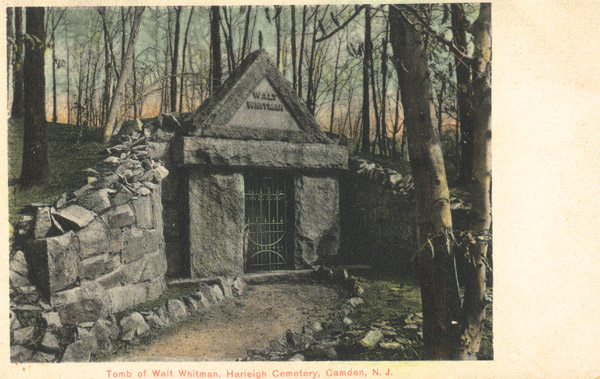
Tomb of Walt Whitman, Harleigh Cemetery, Camden NJ.
Mrs. Augusta K. Dole at the Walt Whitman Home
Camden Courier-Post —
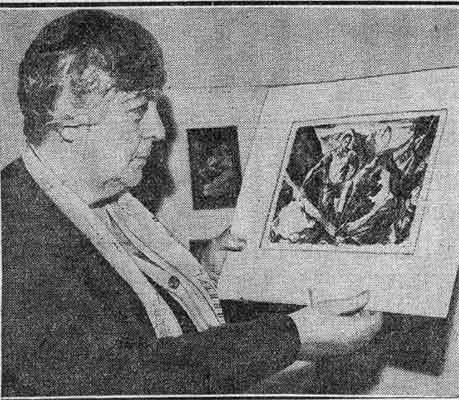
Mrs. Augusta K. Dole, New York woman, posed with etching on “The Song of the Open Road,” as she sat in last chair Walt Whitman occupied at Mickle Street Home.