Nathan Rosengarten
NATHAN ROSENGARTEN was born in Philadelphia to Robert Rosengarten and his wife, the former Fannie Schneidman. In June of 1917 the family lived at 427 Shunk Street in Philadelphia, the elder Rosengarten then working as a salesman for J.N. Hough at 1818 Callowhill Street, Philadelphia PA. By 1919 the family had moved to 2629 South 2nd Street in Philadelphia. The Rosengarten family remained in Philadelphia into the late 1920s. Four children were born there, Lillian, Laura, Nathan, and Rosalie.
Robert Rosengarten was involved with H.S. Dewees and together they operated the Dewees and Rosengarten Typewriter and Adding Machine Company at 410 Market Street beginning around 1919. This business is now known as Dewees Business Systems and has been located for many years in Cherry Hill NJ.
The Rosengarten family moved to Camden NJ around 1929 from Philadelphia, settling on Langham Avenue in the Camden neighborhood known as Parkside. An ardent Zionist, Robert Rosengarten was been a member of Congregation Beth El, which was then located on Park Boulevard between Baird Boulevard and Belleview Avenue, not far from his home.
Young Nathan Rosengarten became friends with Harry Cutler, the son of Herman Z Cutler, a prominent businessman and, like Robert Rosengarten, a member of Congregation Beth El and active in Jewish civic and religious life.
Nathan Rosengarten’s son Robert wrote in July of 2009:
The only guy my dad mentioned hanging with in high school was Harry Cutler (son of Herman Z.) Harry I believe was born in 1915 as was my dad, but he does not seem to be in the January 1934 class. 2 stories I have heard about Harry Cutler — he always seemed to be around my grandparents home at dinner time (Aunt Laura said this). Also he and my dad talked incessantly about joining the Navy. My granddad I guess got tired of hearing the story and on a real cold night, said, “You want to see what it’s like on board a ship in the Navy?,” and put my dad out on the back porch and locked the door for a while.
Nathan Rosengarten graduated from Camden High School in January of 1934. He received an engineering degree from Drexel in Philadelphia in 1939. While at Drexel he had a co-op (work and study) job with the Lycoming Manufacturing Company. It was here that he became interested in aircraft engines.
Nathan Rosengarten’s son Robert wrote in 2009:
Dad had a co op job at Lycoming in Williamsport PA in the winter of 1935–1936 so he was there for the big Susquehanna flood of 1936. He was part of the National Guard watching for looters in the aftermath. He always talked about animals that got caught in trees and drowned.
Dad also used to talk about a guy named Hansberry or Handsbury [probably Harvey L. Hansberry, graduated Drexel’s College of Engineering in 1936, had a long and distinguished career with the Civil Aviation Administration and the Federal Aviation Administration — pmc] that went to Drexel and also was working in Williamsport. He had a car and Dad said he rode to Camden a few times with him. It sounded like this guy was also from Camden and went to Camden HS. I believe the car was a 1934 Plymouth and it was pushed hard on these trips back and forth — the guy had a girlfriend in Camden or Philadelphia.
Around 1936 Dad sought to get into West Point. I believe I have the letter from Congressman Wolverton that got him the interview/medical exam.
Dad went to Pratt & Whitney [the Pratt-Whitney Aircraft Company — pmc] in 1939 after graduating from Drexel. The company sent him to the University of Connecticut for graduate work while he was there. Dad quit P&W in the spring of 1941 because the company wanted to “fix it” so he would not be called for military service. Dad wanted to go to the Combat Engineers so he quit the company and moved back to Camden for a short time. He learned of positions available at Wright Field (now Wright-Patterson Air Force Base) and left for Ohio in June, 1941. As a flight test engineer he bailed out of a British Mosquito aircraft that caught fire during a test just west of Dayton, Ohio on March 14, 1943. The exact location of the bailout was always a mystery to us until a local man called me a few months ago and said he was a witness at 7 years old and lived next to the site — I now know exactly where this happened.
After graduating from Drexel he went to work for the Pratt-Whitney Aircraft Company. He enlisted in the United States Army and served for 32 years, retiring in 1973 as a full Colonel.
Colonel Rosengarten was instrumental in the development of jet engines for United States military aircraft. He was the first test engineer of jet propelled aircraft in the United States. In April and May of 1946 he served as project leader on test flights made in a captured German Messerschmidt ME-163B jet propelled fighter. A Lieutenant Colonel by 1951, he was in charge of Aircraft and Missiles at the Air Technical Intelligence Center in 1951. The center’s responsibility included the investigation of UFO reports. He also was involved in investigating UFO sightings in 1951. In September of that year he took steps that led to the initiation of Project Blue Book, which would be the lead agency in UFO investigation for the next eighteen years. Robert Rosengarten wrote in 2009:
My dad has always been rather nonchalant about his involvement with UFOs despite being one time head of Project Blue Book at Wright-Patterson Air Force Base. I know people have contacted him and he’s not very forthcoming.
Colonel Rosengarten spent most of his career based in Ohio. He married on April 21, 1954, and with his wife Irma raised two sons, Robert Rosengarten and David Rosengarten. His sister Lillian married Camden realtor Ellis Goodman, and conducted the business herself for many years after his passing.
Robert Rosengarten wrote:
My dad and mom were married April 21, 1954. I would say they dated as far back as 1949. Dad’s always said he didn’t feel free to marry for a long time due to the responsibilities of his work. I am pleased to see him recognized as he really gave his life to his career. He was the essence of the “company man,” EXTREMELY dedicated to his work.
Letter from Congressman Charles A. Wolverton
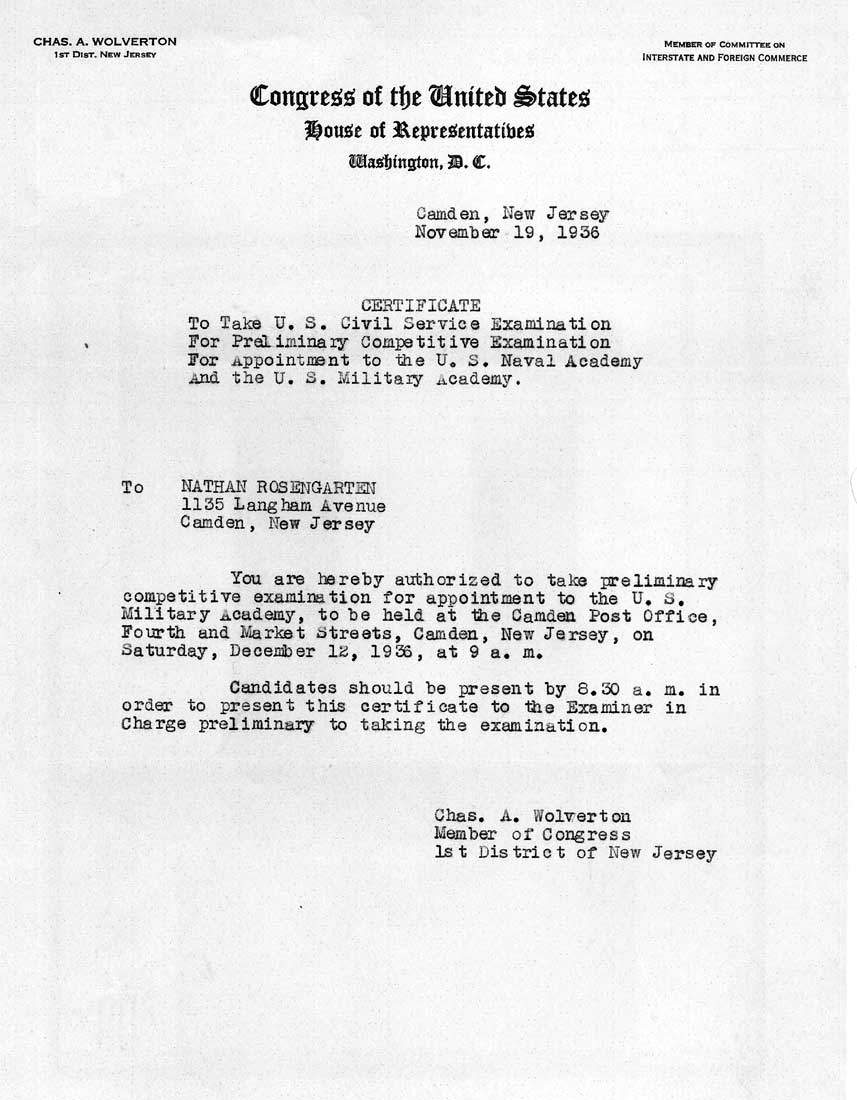
Congress of the United States, House of Representatives, Washington, D.C.
Camden, New Jersey — November 19, 1936
CERTIFICATE — To Take U.S. Civil Service Examination for Preliminary Competitive Examination for Appointment to the U.S. Naval Academy and the U.S. Military Academy.
To Nathan Rosengarten, 1135 Langham Avenue, Camden, New Jersey
You are hereby authorized to take preliminary competitive examination for appointment to the U.S. Military Academy, to be held at the Camden Post Office, Fourth and Market Streets, Camden, New Jersey, on Saturday, December 12, 1936, at 9 a.m.
Candidates should be present by 8:30 a.m. in order to present this certificate to the Examiner in Charge preliminary to taking the examination.
Chas. A. Wolverton, Member of Congress, 1st District of New Jersey
Berlin Entry Led by Camden Soldier
Camden Courier-Post —
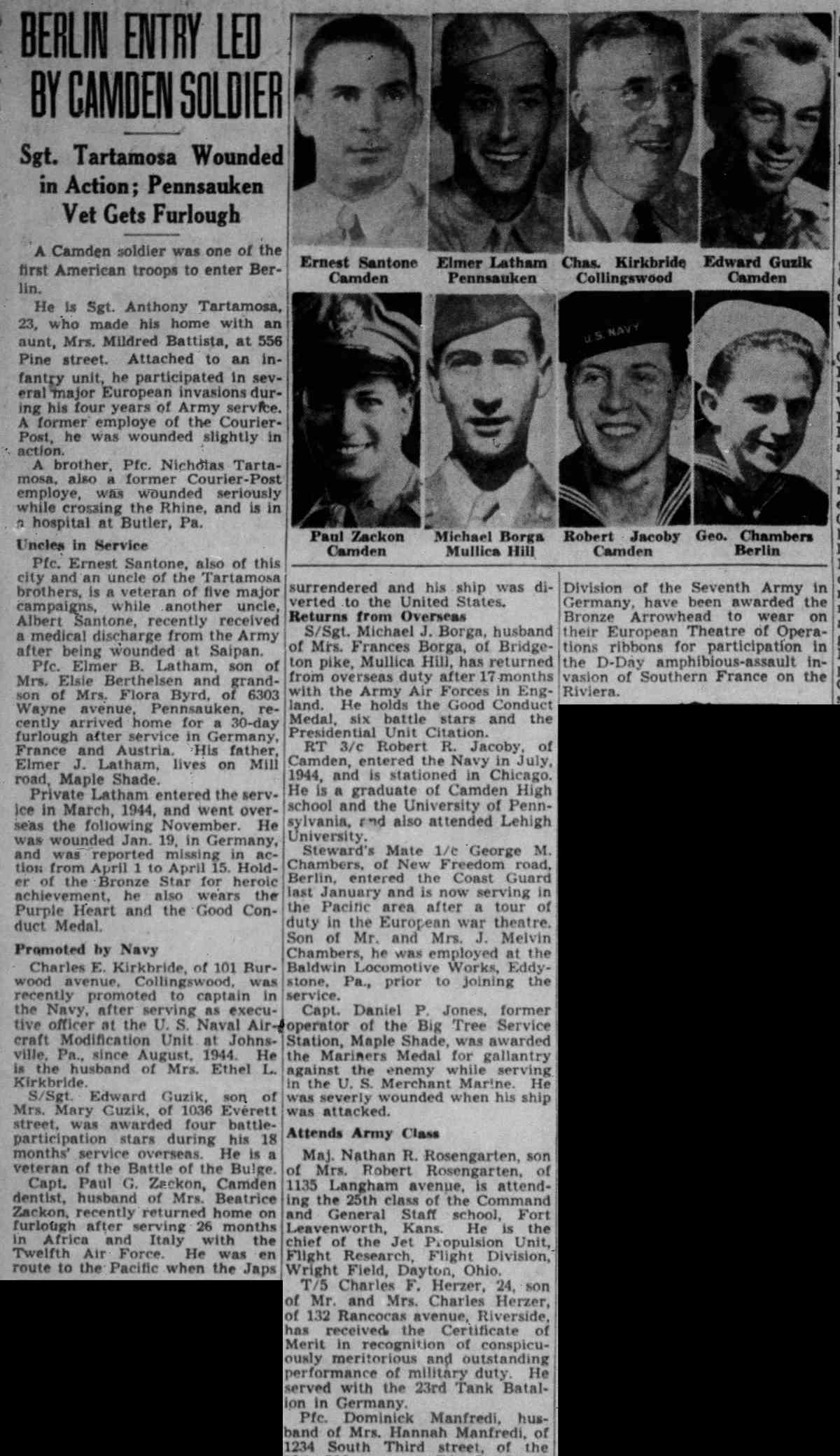
BERLIN ENTRY LED BY CAMDEN SOLDIER
Sgt. Tartamosa Wounded in Action; Pennsauken Vet Gets Furlough
A Camden soldier was one of the first American troops to enter Berlin.
He is Sgt. Anthony Tartamosa, 23, who made his home with an aunt, Mrs. Mildred Battista, at 556 Pine street. Attached to an infantry unit, he participated in several major European invasions during his four years of Army service. A former employee of the Courier-Post, he was wounded slightly in action.
A brother, Pfc. Nicholas Tartamosa, also a former Courier-Post employee, was wounded seriously during fighting in the Rhineland and is in a hospital at Butler, Pa.
Uncles in Service
Pfc. Ernest Santone, also of this city and an uncle of the Tartamosa brothers, is a veteran of five major campaigns, while another uncle, Albert Santone, recently received a medical discharge from the Army after being wounded at Saipan.
Pfc. Elmer B. Latham, son of Mrs. Flora Byrd, of 6303 Wayne avenue, Pennsauken, recently arrived home for a 30-day furlough after service in Germany, France and Austria. His father, Elmer Latham, lives on Hill road, Maple Shade.
Private Latham entered the service in March, 1944, and went overseas the following November. He was wounded Jan. 19, in Germany, and was recovering in action from April 1 to April 15. Holder of the Bronze Star for heroic achievement, he also wears the Purple Heart and the Good Conduct Medal.
Promoted by Navy
Charles E. Kirkbride, of 101 Burwood avenue, Collingswood, was recently promoted to captain in the Navy, after serving as executive officer of the U.S. Naval Aircraft Modification Unit at Johnsville, Pa., since August, 1944. He is the husband of Mrs. Ethel L. Kirkbride.
S/Sgt. Edward Guzik, son of Mrs. D. Guzik, of 1016 Everett street, was awarded four battle-participation stars during his 18 months overseas. He is a veteran of the Battle of the Bulge.
Capt. Paul G. Zackon, Camden dentist and son of Mrs. Bernice Zackon, recently returned home on furlough after serving 26 months overseas, first with the Twelfth Air Force. He was en route to the Pacific when the Japs surrendered and his ship was diverted to the United States.
S/Sgt. Michael J. Borga, husband of Mrs. Frances Borga, of Bridgeland, returned home and has returned from overseas duty after 17 months with the Army Air Forces in England. He holds the Good Conduct Medal, six battle stars and the Presidential Unit Citation.
RT Robert R. Jacoby, of Camden, entered the Navy in July, 1944, and is stationed in Chicago. He is a graduate of Camden High school and the University of Pennsylvania, and also attended Lehigh University.
Steward’s Mate 1/c George M. Chambers, of New Freedom road, Berlin, entered the Coast Guard last January and is now serving in the Pacific area after a tour of duty in the European war theatre. Son of Mr. and Mrs. J. Melvin Chambers, he was employed at the Baldwin Locomotive Works, Eddystone, Pa., prior to joining the service.
Capt. Daniel J. Jones, former operator of the Big Trunk Service Station, Maple Shade, was awarded the Mariners Medal for gallantry against the enemy while serving in the U.S. Merchant Marine. He was severely wounded when his ship was attacked.
Attends Army Class
Maj. Nathan H. Rosengarten, son of Mrs. Robert Rosengarten, of 1135 Langham avenue, Camden, is attending the 25th Command and General Staff school, Fort Leavenworth, Kans. He is the chief of the Jet Propulsion Unit, Flight Research, Flight Division, Wright Field, Dayton, Ohio.
T/5 Charles F. Herzer, 24, son of Mr. and Mrs. Charles Herzer, of 132 Rancocas avenue, Riverside, has received the Certificate of Merit in recognition of conspicuously meritorious and outstanding performance of military duty. He served with the 23rd Tank Battalion in Germany.
Captured Me-163B Komet Tested at Muroc Field — April–May 1946
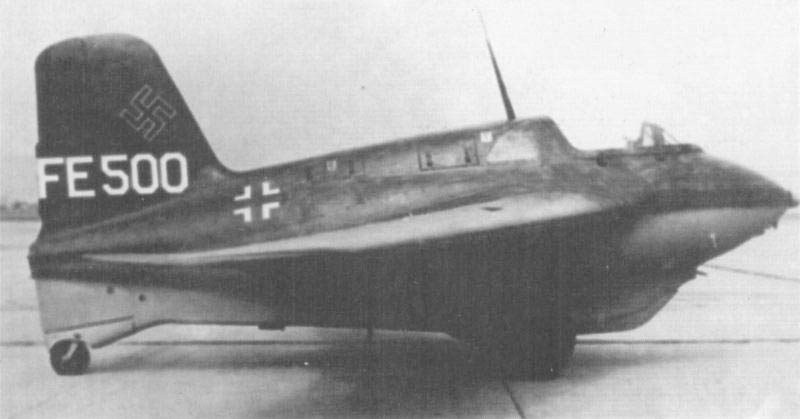
A captured German Messerschmitt Me-163B Komet jet fighter, designated FE-500 (foreign equipment), at Muroc Field during test flights conducted in April and May 1946 under the direction of Major Nathan Rosengarten.
The “FE” in the FE-500 designation stood for “foreign equipment.” Nathan Rosengarten, then a Major, was the engineer in the testing of this aircraft.
Wright Field — circa 1947
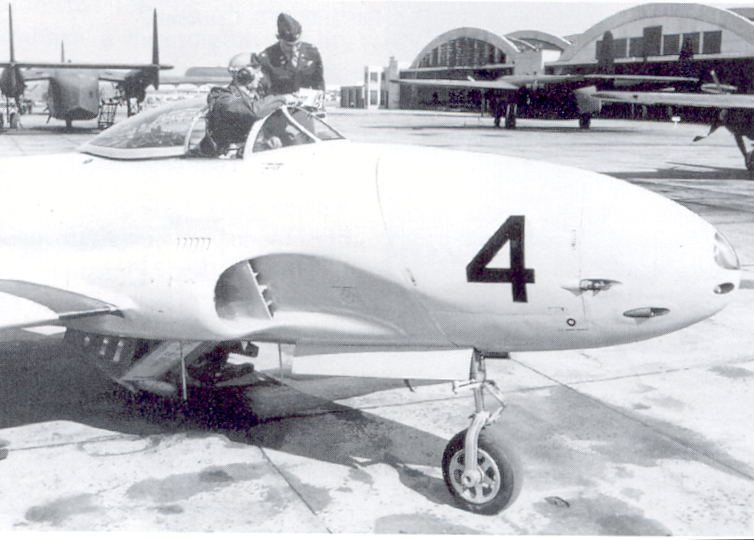
Wright Field (present-day Wright Patterson Air Force Base) — circa 1947
The F-80 Shooting Star, first introduced into the Test Pilot School curriculum in August 1947, allowed students to learn the unique characteristics of jet aircraft. Major Nathan Rosengarten, Chief, Air Technical Service Command Flight Research Branch, checks data with pilot Captain Conrad Nelson.
Testing military aircraft was just the beginning
Dayton Daily News —
By Sandra Baer
Ninety-three year-old Nathan Rosengarten, of Bellbrook is a living legend, who regales visitors with stories of his career as one of the country’s first military aircraft test engineers. In addition to working with Orville Wright, Rosengarten is also known as the first test engineer to fly a jet engine propelled aircraft in the United States.
“I had a tremendous career,” said Rosengarten, who test-engineered many of the experimental planes now housed in the Air Force Museum. “I was always interested in doing things I’d never done before.”
Rosengarten was born on Labor Day in Philadelphia, Pa, but at the age of 11 moved to Camden, N.J.
“I had an uncle, who I really looked up to, who was an architect,” said Rosengarten, whose older sister still lives in New Jersey.
“He went to Drexel and designed most of the cathedrals along the Mainline. I remember him taking me to a millionaire’s estate and letting me hold the end of a tape measure.”
Despite his early thoughts of a career in wrestling, Rosengarten followed his father’s advice and studied engineering at Drexel University after graduating from Camden High School in 1934.
It was during his first co-op position and his first time away at home, at the Lycoming Division in Williamsport, Pa., that he became interested in aircraft engines. During his second co-op year in Williamsport, he volunteered to work with the National Guard after the Susquehanna River flooded its banks and left a portion of the city underwater.
After graduating from Drexel in 1939 with a degree in mechanical engineering, Rosengarten accepted a position in the junior executive program at the Pratt-Whitney Aircraft Company in East Hartford, Conn. The program involved working full time for the company while attending evening graduate classes at the University of Connecticut.
In 1941, after only two years with Pratt and Whitney, Rosengarten abruptly resigned after finding out that his name had been put on a list to prevent him from being drafted into the military.
“I felt I ought to be commissioned in the reserves,” said Rosengarten, who wanted to work as a combat engineer in the Army Corp of Engineers. “I told them, ‘In this time of war, I intend to be in uniform and you can’t stop me. I resign.’”
Rosengarten joined the Army, finally retiring in 1973 as a U.S. Air Force colonel. During this time, he also worked full time as a civilian at Wright Field, later renamed Wright-Patterson Air Force Base.
“I needed an engineering job and heard about an opening at Wright Field, so I called, but the job was already filled and I was offered a position as a test engineer,” said Rosengarten, who was the fourth test engineer hired, after one died, one refused to fly without insurance, and another, his boss, lost an eye when the landing gear on a test plane wouldn’t retract, causing an accident. “I would never marry while I was doing that type of work.”
Rosengarten, known as “Rosie,” survived a plane crash near Columbus in 1943 with slight injuries, parachuting from a newly designed wooden British Mosquito aircraft that was traveling at 18,000 feet and 365 mph. The test pilot fractured his back in the fall.
In 1951, Rosengarten met his wife, Irma, who lived one street behind him in Dayton. The couple moved to Bellbrook in 1961 with their two sons, Robert, an engineer working at WPAFB, who lives in Bellbrook with wife, the former Kathy Schuff, and their two children, and David, a subcontractor living in Spring Valley with his wife, the former Becky Keiter, and their two children.
Rosengarten went on to have a distinguished career at WPAFB. He received numerous awards, including the Legion of Merit for testing the first jet engine aircraft in the United States.
In 1985, Rosengarten and his wife founded the WPAFB Educational Fund, which provides scholarships and no-interest college loans to dependents of base employees. The fund continues, though the Rosengarten name is no longer attached to it.