Introduction
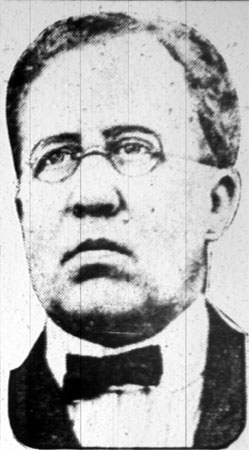
Albert Clement Middleton was born around 1871 to Frank B. and Sallie Middleton. His father was a well known merchant in Camden. At the time of the 1880 Census the family lived at 717 Cooper Street, the corner of North 8th and Cooper Streets. That block included the John Cooper family at 715, Benjamin C. Reeve at 701, and Benjamin Starr at 700, all well-known men in their day. At the time of the 1880 Census Albert was the oldest of 4 children, the others being Edward, Frank, and Mary.
Albert Middleton’s childhood was spent on Cooper Street in Camden. Childhood friends included future lawyer Martin Bergen and Volney Bennett, whose family’s lumber business is still in operation after well over 100 years. Another childhood friend Will Paul, later a journalist in Camden, wrote of Albert Middleton in the early 1940s:
In the house adjoining Coopers lived a boy with whom I went to school. He was big, inclined to be fat and was very good natured. When two of us lightweights would try to throw him, he would grin and shake us off. None of us then suspected he was going to have an important part in giving Camden its greatest industry and the whole world a popular instrument of entertainment. The boy was Albert C. Middleton. How he became the partner, with financial backing, of Eldridge Johnson when the latter was moving on from his small machine shop to manufacture Victor Talking Machines is too well known to be told again here.
Frank B. Middleton took a position with the Pennsylvania Railroad later in the 1880s. After attending school, Albert C. Middleton entered into the workplace as a clerk in Philadelphia. In these years he made the acquaintance of inventor Eldridge R. Johnson, who had been working on the problem of producing a commercially viable phonograph. He had been producing a pre-Victrola version for the Berliner Company when that organization’s operations were halted in 1900. In September of that year Johnson met with inventor Leon Douglass, who was also involved in phonograph development. A company was formed in September of 1900 which became the Victor Talking Machine Company. Eldridge Johnson, Leon Douglass and Albert C. Middleton were among the original incorporators, along with Thomas Parvin. Albert Middleton was the company’s first secretary.
Victor’s success meant wealth for Middleton, but it appears it never went to his head. Will Paul relates:
As one of his boyhood pals I should have had some enjoyment from his great wealth. And I did. It was one day when I had called at the Victor office to see some department head and had been waved to a bench by one of those reception queens who treat you like something the cat dragged in. As I sat there wishing I were the queen’s boss, so I could fire her, Bert came in the door. I greeted him with a “Hello, Bert, you old sonofagun,” and a slap on the back. If he hadn’t been a millionaire, I couldn’t have got square with the queen.
Albert C. Middleton served as secretary of the Victor Company until 1914. His assistant, in 1910, was Albert W. Atkinson, who also had been with Victor from the beginning. Albert C. Middleton then sat on the Board of Directors of the Victor Company until 1920. In 1928 he was made Treasurer of the State of New Jersey. Horace G. Githens, a Camden County freeholder from North Camden, served underneath Middleton as Deputy State Treasurer. Albert C. Middleton was still serving as State Treasurer in April of 1930.
Albert Middleton suffered a heart attack while at the Hotel Walt Whitman on November 11, 1938. He passed away at home in March of 1939.
First National Bank
Bank Directory — March–
First National Bank
Camden, N.J. — Philadelphia Office: 246 Market Street, Discount Day Thursday
Officers
| Name ↕ | Role ↕ |
|---|---|
| David Baird | President |
| William T. Read | Vice President and Solicitor |
| Charles Lafferty | Cashier |
| W.S. Ayres | Assistant Cashier |
| Theodore Thompson | Assistant Cashier |
Directors
| Name ↕ |
|---|
| David Baird |
| Frank L. Starr |
| Alfred W. Clement |
| Walter J. Staats |
| Frank C. Somers |
| David Baird Jr. |
| J.J. Albertson |
| Joseph W. Graham |
| Albert C. Middleton |
| Lawrence M. Verga |
| Ferdinand A. Loeb |
| Melbourne F. Middleton Jr. |
| William T. Read |
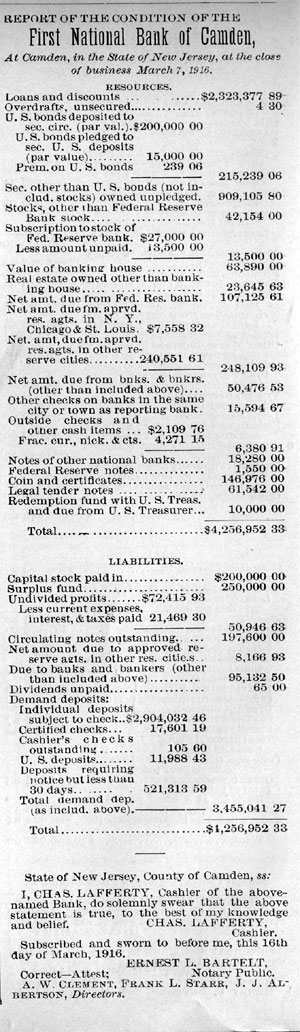
Camden Safe Deposit and Trust Company
Bank Directory —
Camden Safe Deposit and Trust Company
Camden, N.J.
Officers
| Name ↕ | Role ↕ |
|---|---|
| Alexander C. Wood | President |
| Ephraim Tomlinson | 2d Vice President |
| Joseph Lippincott | Treasurer and Secretary |
| Ephraim Tomlinson | Trust Officer |
| George J. Bergen | Solicitor |
Directors
| Name ↕ |
|---|
| Alexander C. Wood |
| Joseph W. Cooper |
| George Reynolds |
| Ephraim Tomlinson |
| Joseph H. Gaskill |
| George W. Jessup |
| Edward L. Farr |
| William Joyce Sewell Jr. |
| Edmund E. Reed Jr. |
| J. Dayton Voorhees |
| William J. Bradley |
| Albert C. Middleton |
| George J. Bergen |
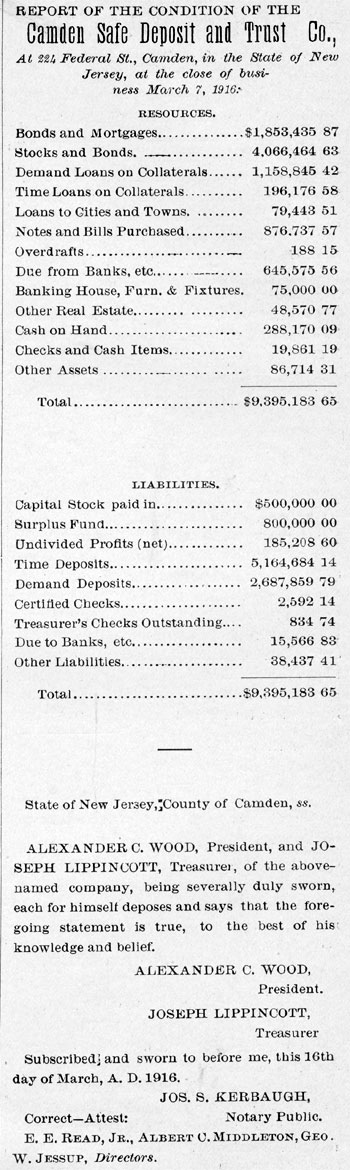
Albert C. Middleton Now N.J. Treasurer
Camden Courier-Post —
Sworn in at Trenton Ceremony; Many Camden Leaders in Attendance
Trenton, Jan. 31 – Albert C. Middleton, of Moorestown, today was formerly elected and sworn in State Treasurer of New Jersey, succeeding William T. Read, of Camden, at a ceremony conducted in the Assembly Chamber at the State House here.
Horace G. Githens
Camden Courier-Post —
Joshua C. Haines
Camden Courier-Post —
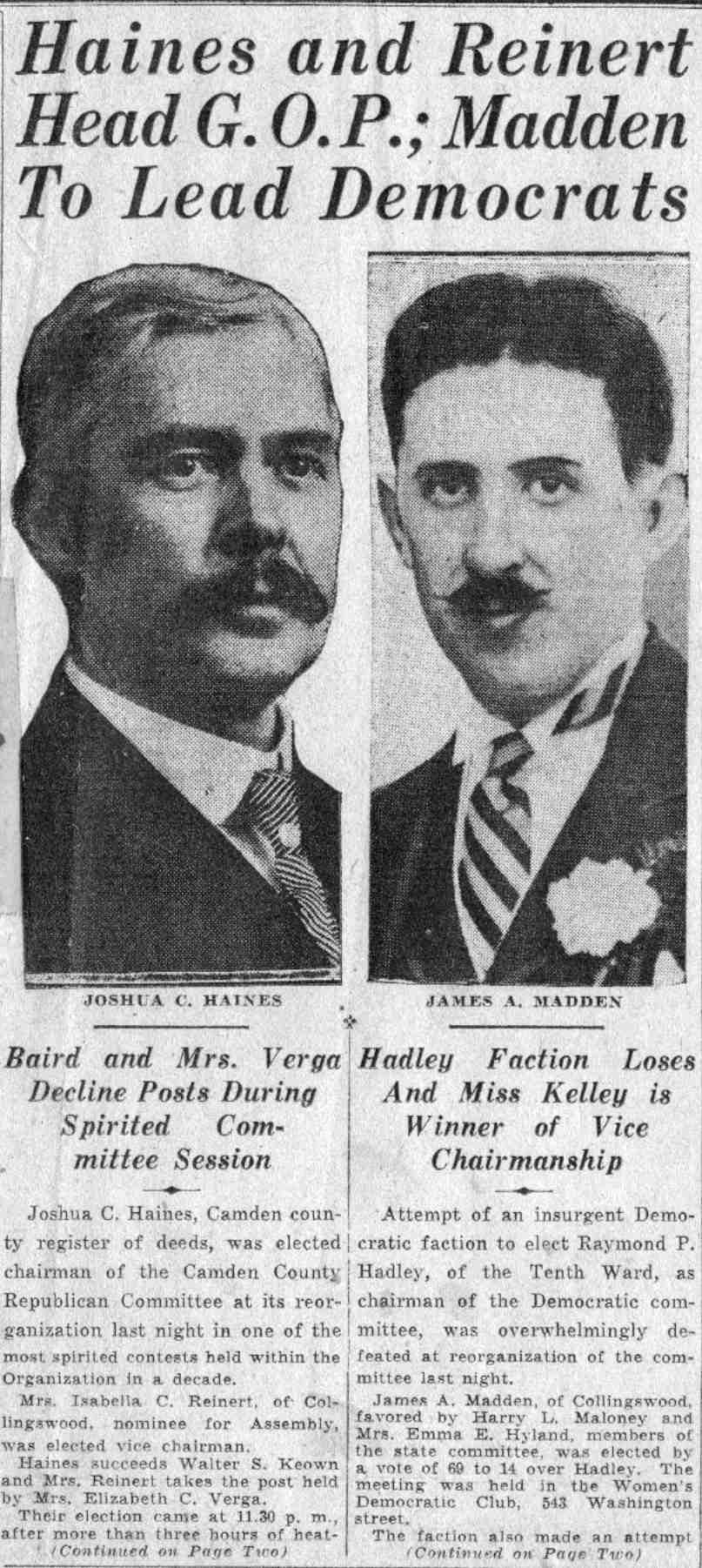
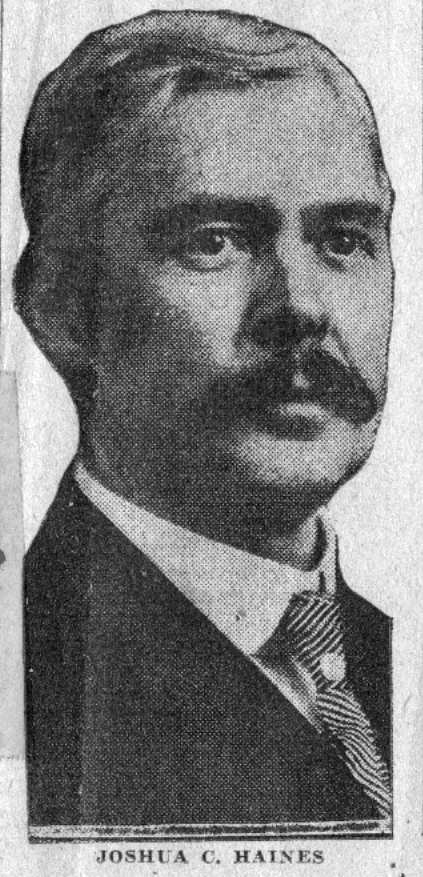
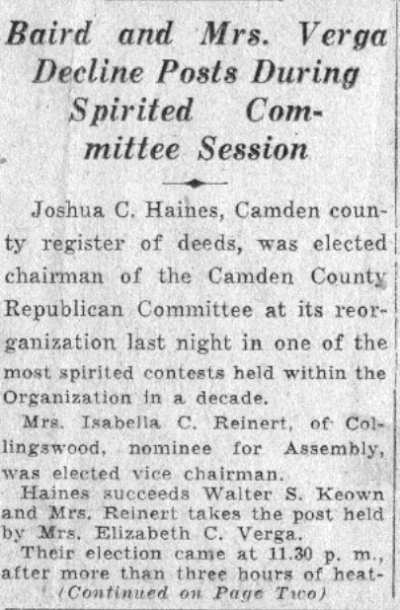
Named: Joshua C. Haines, Isabella C. Reinert, Elizabeth C. Verga, David Baird Jr., Walter Keown, Frank B. Hanna, Etta C. Pfrommer, Howard B. Dyer, William D. Sayrs Jr., Lottie B. Stinson, Anna G. Holl, Margaret Wermuth, Carlton M. “Cy” Harris, J.C. Remington, Charles A. Wolverton, Carl Kisselman, Edward Deibert, L. Scott Cherchesky, William E.A. King, J. Claud Simon, T. Phillips Brown, J.H. Reiners, Rocco Palese, Morris Praissman, George R. Pelouze, Albert S. Woodruff, Clay W. Reesman, William Wimer, Horace G. Githens, J. Wesley Sell, and A.C. Middleton.
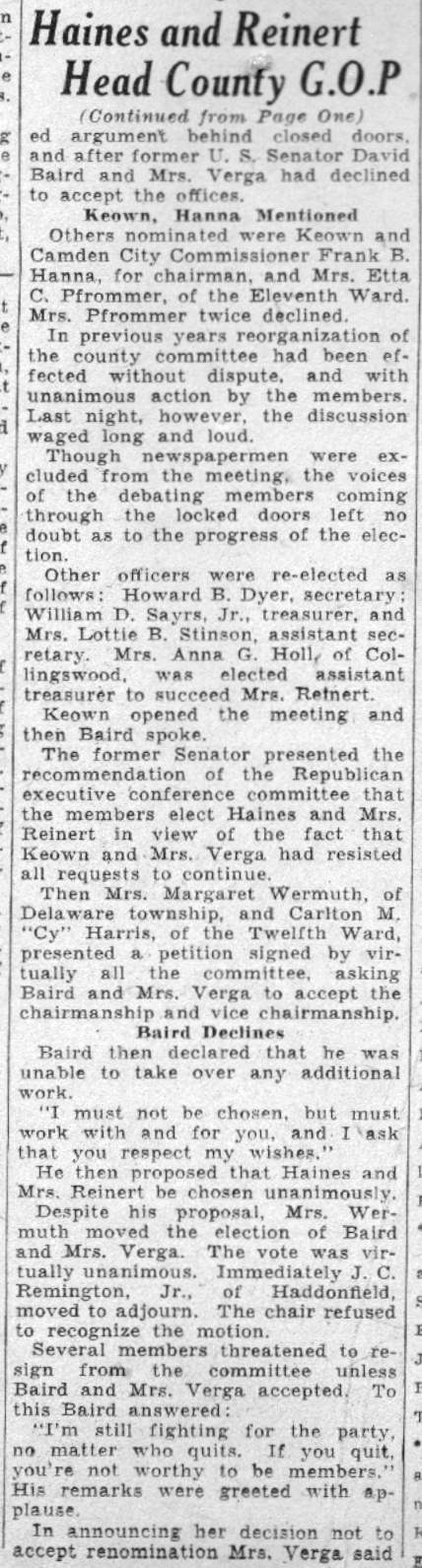

her duties as state vice chairman, taking her into all the 21 counties, made it impossible for her to continue to devote the time to the county committee which it deserved. In explaining these reasons to the vice chairman still has two years to run.
Haines Finally Elected Then Baird accepted the resignation from the chairmanship and Mrs. Verga from the vice chairmanship. Keown was nominated for re-election, and Hanna for the chairman position. Baird was renominated by Remington. Keown reiterated his insistence, issued some months ago, not to stand for re-election. Baird again declined. Then Keown moved the election of Haines and Mrs. Reinert and the discussion which followed continued for three hours. Finally the vote was taken at 11.30 and Haines and Mrs. Reinert were elected. Mrs. Reinert, however, declined the office, stating her candidacy for the Assembly precluded her at this time. Then Mrs. Pfrommer was nominated, but she turned it down twice. After much persuasion Mrs. Reinert agreed to accept the office, with the provision that she serve through the summer and that she be permitted to resign later, if she wished. In congratulating Mrs. Reinert, Congressman Charles A. Wolverton urged the election of Baird and Mrs. Verga. The committee elected the following solicitors: Carl Kisselman, Edward R. Deibert, L. Scott Cherchesky, William E.A. King, J. Claud Simon, T. Phillips Brown, J. H. Reiners, Jr., Rocco Palese and Morris Praissman.
Members of the Republican County Committee, which organized last night, follow:
Camden City (*Indicates New Member) First Ward—William H. Heiser and Marie McCready Second—James Corea and *Susie Marchiano Third—James E. Tatem and *Mary A. Ivins Fourth—Martin A. McNulty and Madeline Salvatore Fifth—Howard B. Dyer and Mary S. Hartung Seventh—Edward A. Kemble and Mary D. Guthridge Eighth—*Edmund A. Walsh and Mamie F. Piraine Ninth—Edward Holloway and Deborah Schuck Tenth—*Henry I. Haines and Lillian M. Walker Eleventh—Horace B. Beideman and Etta C. Pfrommer Twelfth—Carlton M. Harris and Mary E. Hamel Thirteenth—Henry Knauer and Louella I. Whaland Fourteenth—Jesse M. Donaghy and Lottie B. Stinson
David Baird Jr.
Camden Courier-Post —
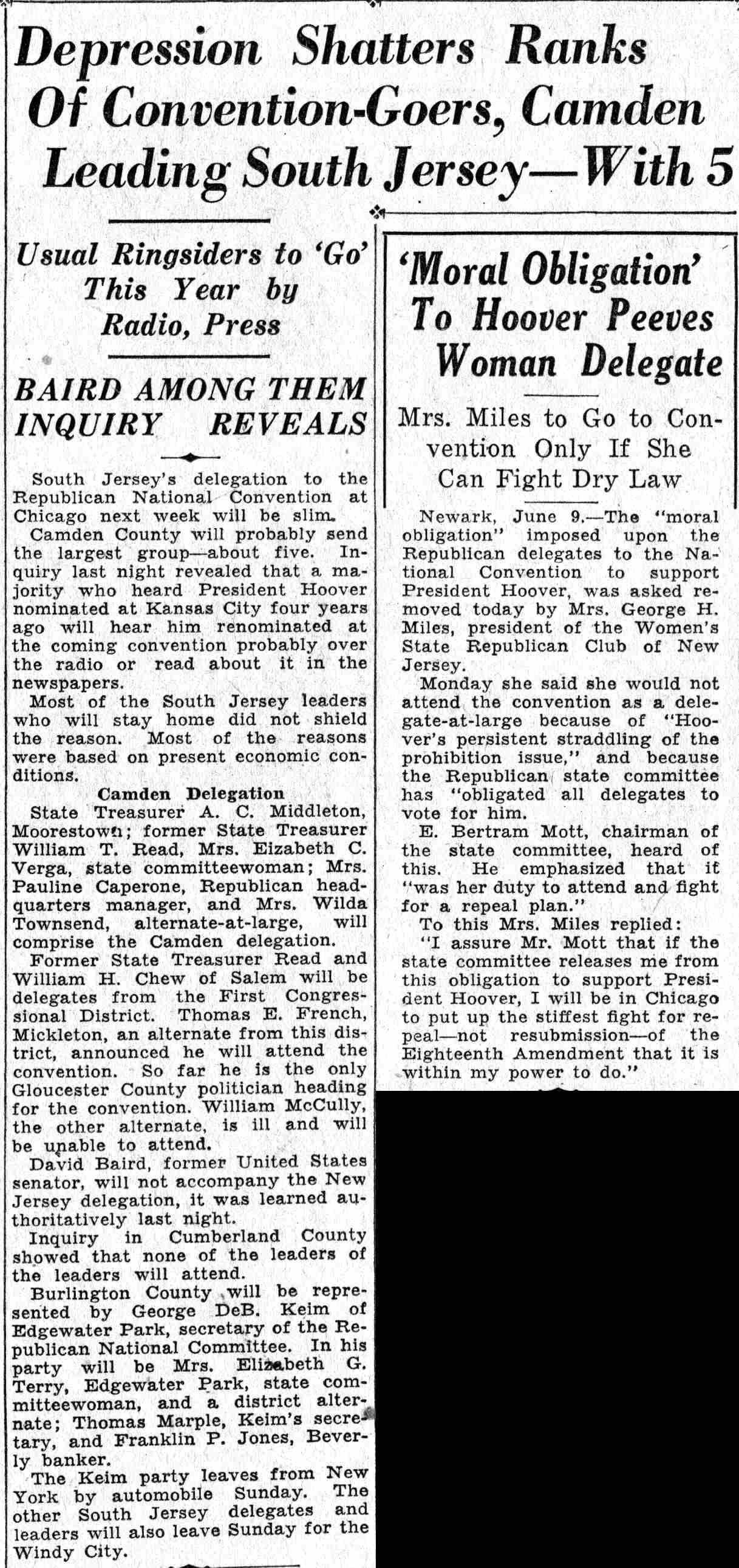
Named: A.C. Middleton, Mrs. Elizabeth Verga, William T. Read, Pauline Caperoon, Wilda Townsend, and David Baird Jr..
Increase in Cargo at Terminals Here Shown in Report
Camden Courier-Post —
$25,000 Asked of Legislature as Port Commission Share of Gas Tax
550 Ships Dock in Year
Trenton, Feb. 1 – The cargo movement through the Camden Marine Terminals increased from 221,668 tons in 1936 to 230,868 tons last year, the South Jersey Port Commission reported to the legislature last night. This increase, the report states, was despite a maritime strike and the business recession.
A total of 550 vessels of all types berthed last year at the terminals, which serve the South Jersey Port district comprising seven tidewater counties bordering on the Delaware River and bay.
The water-borne commerce of the district during 1936, according to a survey made by the commission, amounted to 6,428,437 tons, valued at $108,591,938, an increase of more than 25 percent over the 1935 figures.
The commission asked the legislature for $25,000 as its share of the $250,000 allotment to the State Board of Commerce and Navigation from gas tax funds provided for, in a bill now before the legislature, the money to be used for dredging in the district.
A summary of other matters covered in the report follows:
New Warehouses
“New cargo warehouses built at a cost exceeding $500,000 proved their earning capacity during the year.
“Five steamship lines operate on regular schedule from the terminals carrying cargoes to and from all Atlantic, Gulf and Pacific coast ports and to Hawaii and the Far East. Foreign cargoes are handled largely by tramp steamers. The lumber movement from the Pacific coast and fertilizers for farms showed a considerable increase.
“In order that industries located on the Delaware river below Camden may have free customs services, the same as their competitors on the Pennsylvania side of the river, the commission has made application to the Secretary of the Treasury for extension of the customs port limits of the Port of Philadelphia for a distance of 11 miles in New Jersey.
“At a recent hearing before the Board of Engineers for Rivers and Harbors, representatives of New Jersey, Pennsylvania and Delaware joined in urging that the Port of Philadelphia be provided with a channel 40 feet in depth to the sea. This was demanded for the national defense as well as to put the Delaware River ports on an equality as to channel depth with New York, Boston and Norfolk. The Port Commission believes the plea will be successful.
“Figures are given showing an increase in traffic across the Delaware River. The construction of two vehicular tunnels is planned by private interests.
Opposes Civilian Bill
The Commission is opposing the pending Federal regional authorities’ bills now before the Rivers and Harbors Committee of the House of Representatives and says the work of waterways improvement, ‘which has been under the direction of the army engineers for over a century, should not be turned over to civilian control. The bills are termed an unwarranted and unnecessary invasion of the sovereign rights of New Jersey.’
“The Pettingill bill repealing the long-and short-haul clause of the Interstate Commerce Act is denounced as striking a severe blow at the water-carriers, marine terminals and longshoremen. The bill is now before the Senate.
“The Commission reports upon its intervention in rate cases before Federal and State regulatory bodies and is a party defendant in the Southern Governors’ rate case.
“Working in close touch with the army engineers, the Commission has been active in procuring improvements in many South Jersey navigable streams. There is a shore line of over 200 miles in the Port District, 135 miles being on tidewater of Delaware River and bay.
“Gloucester County holds first place among the Port District counties in water-borne tonnage chiefly on account of its large oil refineries. Camden County ranks second and Salem County third.
“The Commission paid off $50,000 of its 4-1/2% percent Marine Terminal bonds in 1937. Its total outstanding bonded indebtedness is $2,180,000.”
The members of the South Jersey Port Commission are A.C. Middleton, Chairman; Henry W. Peterson and W. C. Garlan, the latter a new member appointed as successor to T. Yorke Smith, who died March 23, 1937 after having served on the commission for ten years.
Obituary
New Jersey Mirror —
Albert C. Middleton Ex-State Treasurer, Died in Moorestown
Co-Founder of Victor Talking Machine Company; Was 70 Years of Age
In Ill Health About Two Years
Albert C. Middleton, former State Treasurer of New Jersey, chairman of the South Jersey Port Commission since 1926, died on Saturday morning at his home, 232 East Main street, Moorestown, after a long illness. He was 70 years old, and a native of Camden. Mr. Middleton had been in ill health for two years. A year ago he suffered a stroke, and last Armistice Day he collapsed from a heart attack, while dining at the Hotel Walt Whitman, Camden. He was revived but never fully recovered and recently his condition became increasingly worse.
Mr. Middleton was co-founder with Eldridge R. Johnson of the Victor Talking Machine Company, now a subsidiary of the Radio Corporation of America. He retired as treasurer of the firm just before its merger with R.C.A. He constantly advocated frequent changes in Victrola models, which many of his colleagues said was a major factor in the volume of the company’s business. He also was the first to recommend national advertising of the project. He was a leader of the development of the Camden Marine Terminal.
A member of one of South Jersey’s oldest Quaker families, Mr. Middleton was educated in Friends’ schools in Camden and in Philadelphia. He early made his mark in the business and political world, but except as State Treasurer and membership on the South Jersey Port Commission, which he held to his death, never occupied public positions. He was for many years a director of the First Camden National Bank and Trust Company, of the old Camden Safe Deposit and Trust Company, and of the Camden Fire Insurance Company. In 1928 he was elected by joint session of the Legislature as State Treasurer, and was re-elected in 1931. He was for years a member of the Union League, in Philadelphia, and of the old Camden Republican Club when it was located at 308–312 Cooper Street.
Mr. Middleton was a graduate of the Friends’ School of Philadelphia and was a director of the Friends’ Society of America. Surviving are his wife, Mrs. Rena Middleton, a daughter, Miss Rena Middleton; two brothers, Frank Middleton, of Haddonfield, and Edward Middleton, of Moorestown, and a sister, Mrs. Charles K. Perry, of Camden. Funeral services were held at 11 a.m. Tuesday at his late residence.
Talking Things Over With the Editor
New Jersey Mirror —
Former State Treasurer Albert C. Middleton, who died at his home in Moorestown on Saturday, was one of the best known citizens of his community. Indeed, his reputation, largely by reason of having been the state’s chief fiscal officer for six years, extended far beyond the confines of his own county. By some he was regarded more as a Camden figure than as a Burlington countian, although he had made his home in Moorestown for many years. His business activities had largely to do with the Victor Talking Machine Company, in which, as an associate of Eldridge R. Johnson, pioneer of the vast business now owned by the Radio Corporation of America, he made the large fortune with which he had long been credited.
Mr. Middleton was a political protege of the late David Baird, Sr., and it was largely through the latter’s influence that he was made State Treasurer. He also was a director in important financial and industrial institutions. His activity in politics was a development in his later life. He had not been in good health for some time and had dropped some of his former responsibilities, although continuing as a member of the South Jersey Port Commission of which he had been president since its creation in 1927. He came of Quaker stock and was a graduate of the Friends’ School of Philadelphia, and a director of the Friends’ Society of America.