Introduction
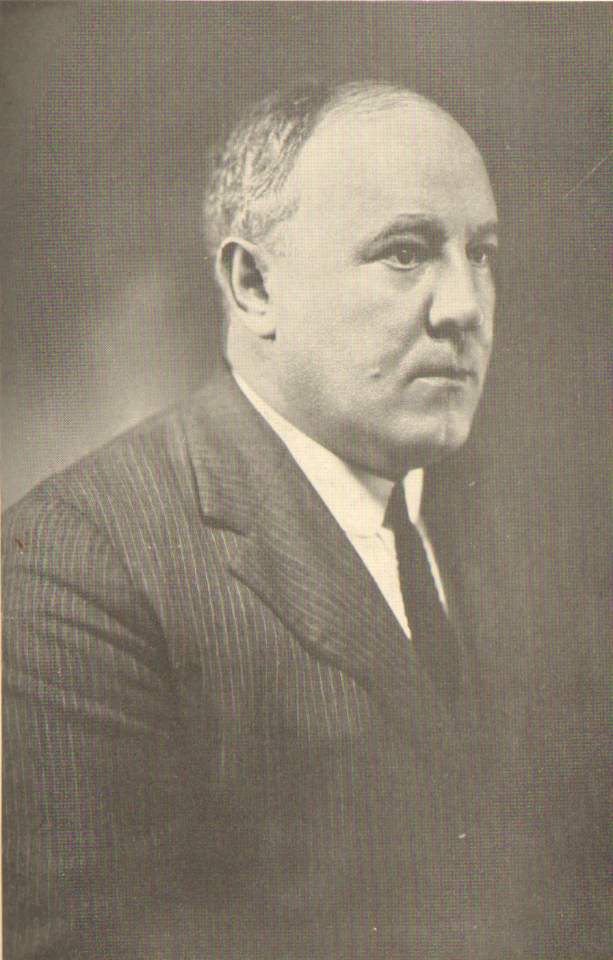
Ethan P. Wescott
ETHAN PRYOR WESCOTT was born in New Jersey in 1881 to John W. and Frances Oatman Wescott. His father, John W. Wescott, was a noted trial lawyer and judge. John W. Wescott was also known for having given both of President Woodrow Wilson’s nominating addresses. One was at the Democratic Convention in Baltimore on June 27, 1912, and the other at the Democratic Convention in St. Louis MO on June 10, 1916. Afterwards, when he was Attorney General of New Jersey he wrote a book on the events in Woodrow Wilson’s life.
Ethan P. Wescott grew up in Haddonfield NJ, where his family owned a home at 43 Chestnut Street. After completing his education and passing the bar, he followed his father into the legal profession. By January of 1920 he had married, and was living with wife Edna and daughter Catherine at 730 Park Avenue in Collingswood NJ. A son, John, was born shortly afterward. The Wescott family was still in Collingswood as of the 1930 Census.
Ethan P. Wescott had a long career as a lawyer. In the 1920s he and Joseph A. Varbalow partnered in a law firm. He was Camden County Prosecutor in the late 1920s. His brother Ralph W. Wescott served as a member of the Delaware River Port Authority. After retiring from the practice of law in the 1930s, he went into the dairy business.
Ethan P. Wescott was active in fraternal and Masonic affairs, including the Junior Order of American Mechanics, the Improved Order of Red Men, and Camden Lodge 293 of the Elks. He passed away in 1954. He was buried at the family plot at Harleigh Cemetery in Camden NJ, where he rests with his father and other family members.
South Jersey: A History 1664–1924
South Jersey: A History 1664–1924
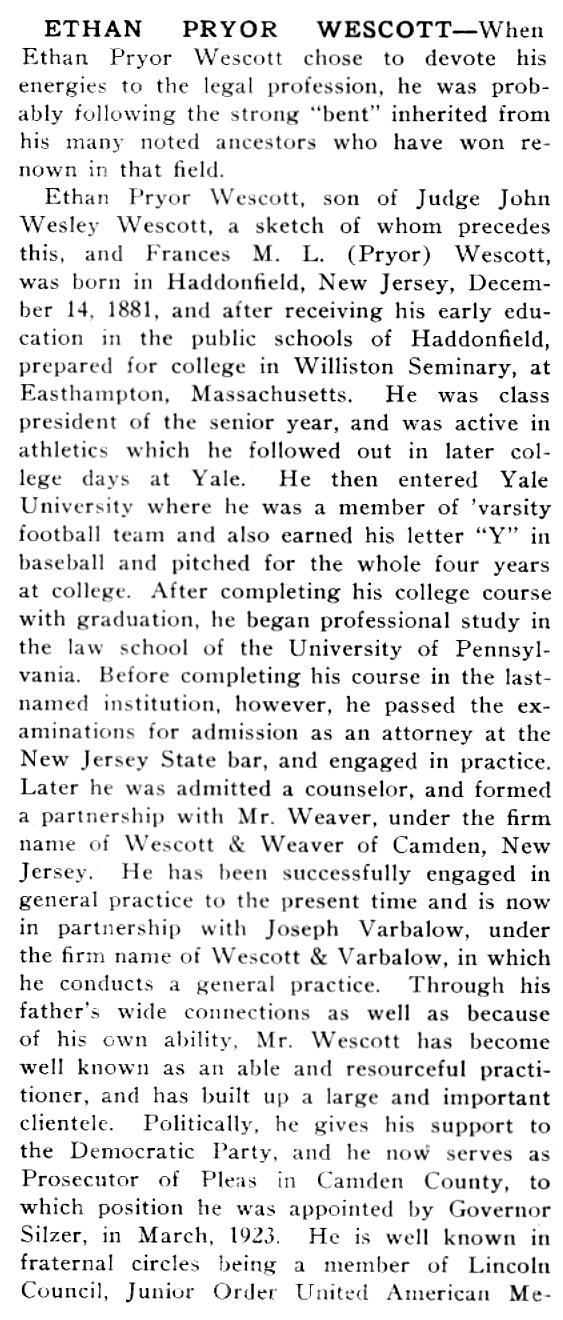
ETHAN PRYOR WESCOTT—When Ethan Pryor Wescott chose to devote his energies to the legal profession, he was probably following the strong “bent” inherited from his many noted ancestors who have won renown in that field.
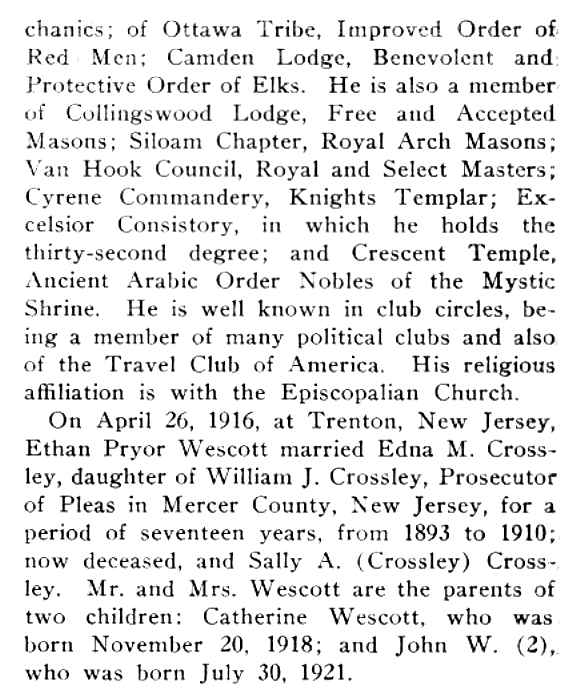
Ethan Pryor Wescott, son of Judge John Wesley Wescott, a sketch of whom precedes this, and Frances M. L. (Pryor) Wescott, was born in Haddonfield, New Jersey, December 14, 1881, and after receiving his early education in the public schools of Haddonfield, prepared for college in Williston Seminary, at Easthampton, Massachusetts. He was class president of the senior year, and was active in athletics which he followed out in later college days at Yale. He then entered Yale University where he was a member of ‘varsity football team and also earned his letter “Y” in baseball and pitched for the whole four years at college. After completing his college course with graduation, he began professional study in the law school of the University of Pennsylvania. Before completing his course in the last-named institution, however, he passed the examinations for admission as an attorney at the New Jersey State bar, and engaged in practice. Later he was admitted a counselor, and formed a partnership with Mr. Weaver, under the firm name of Wescott & Weaver of Camden, New Jersey. He has been successfully engaged in general practice to the present time and is now in partnership with Joseph Varbalow, under the firm name of Wescott & Varbalow, in which he conducts a general practice. Through his father’s wide connections as well as because of his own ability, Mr. Wescott has become well known as an able and resourceful practitioner, and has built up a large and important clientele. Politically, he gives his support to the Democratic Party, and he now serves as Prosecutor of Pleas in Camden County, to which position he was appointed by Governor Silzer, in March, 1923. He is well known in fraternal circles being a member of Lincoln Council, Junior Order United American Mechanics; of Ottawa Tribe, Improved Order of Red Men; Camden Lodge, Benevolent and Protective Order of Elks. He is also a member of Collingswood Lodge, Free and Accepted Masons; Siloam Chapter, Royal Arch Masons; Van Hook Council, Royal and Select Masters; Cyrene Commandery, Knights Templar; Excelsior Consistory, in which he holds the thirty-second degree; and Crescent Temple, Ancient Arabic Order Nobles of the Mystic Shrine. He is well known in club circles, being a member of many political clubs and also of the Travel Club of America. His religious affiliation is with the Episcopalian Church.
On April 26, 1916, at Trenton, New Jersey, Ethan Pryor Wescott married Edna M. Crossley, daughter of William J. Crossley, Prosecutor of Pleas in Mercer County, New Jersey, for a period of seventeen years, from 1893 to 1910; now deceased, and Sally A. (Crossley) Crossley. Mr. and Mrs. Wescott are the parents of two children: Catherine Wescott, who was born November 20, 1918; and John W. (2), who was born July 30, 1921.
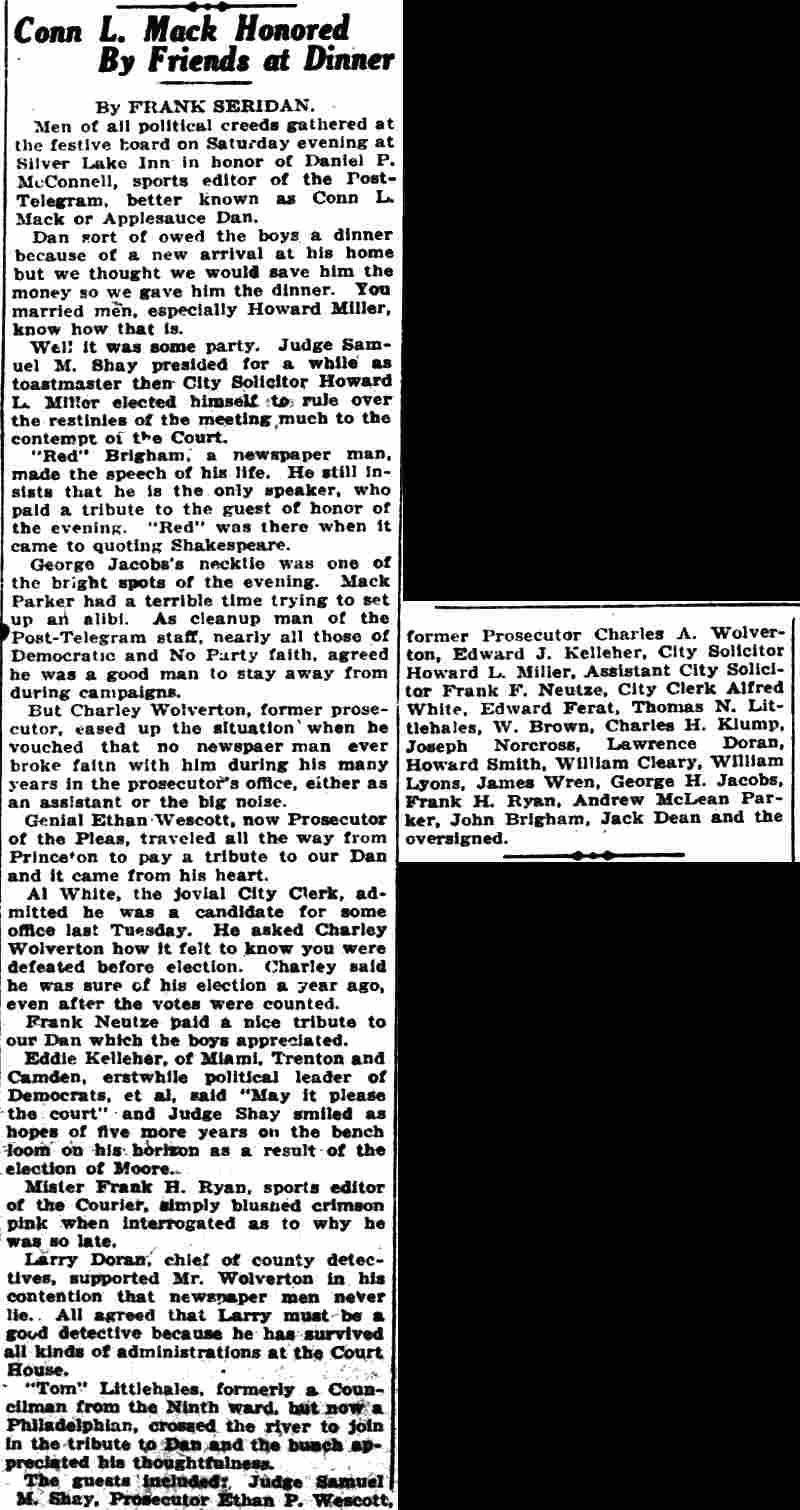
Conn L. Mack Honored By Friends at Dinner
Camden Daily Courier —
By FRANK SERIDAN [sic].
Men of all political creeds gathered at the festive board on Saturday evening at Silver Lake Inn in honor of Daniel P. McConnell, sports editor of the Post-Telegram, better known as Conn L. Mack or Applesauce Dan.
Dan sort of owed the boys a dinner because of a new arrival at his home but we thought we would save him the money so we gave him the dinner. You married men, especially Howard Miller, know how that is.
Well it was some party. Judge Samuel M. Shay presided for a while as toastmaster then City Solicitor Howard L. Miller elected himself to rule over the restinies [sic] of the meeting much to the contempt of the Court.
“Red” Brigham, a newspaper man, made the speech of his life. He still insists that he is the only speaker, who paid a tribute to the guest of honor of the evening. “Red” was there when it came to quoting Shakespeare.
George Jacobs’s necktie was one of the bright spots of the evening. Mack Parker had a terrible time trying to set up an alibi. As cleanup man of the Post-Telegram staff, nearly all those of Democratic and No Party faith, agreed he was a good man to stay away from during campaigns.
But Charley Wolverton, former prosecutor, eased up the situation when he vouched that no newspaer [sic] man ever broke faith with him during his many years in the prosecutor’s office, either as an assistant or the big noise.
Genial Ethan Wescott, now Prosecutor of the Pleas, traveled all the way from Princeton to pay a tribute to our Dan and it came from his heart.
Al White, the jovial City Clerk, admitted he was a candidate for some office last Tuesday. He asked Charley Wolverton how it felt to know you were defeated before election. Charley said he was sure of his election a year ago, even after the votes were counted.
Frank Neutze paid a nice tribute to our Dan which the boys appreciated.
Eddie Kelleher, of Miami, Trenton and Camden, erstwhile political leader of Democrats, et al, said “May it please the court” and Judge Shay smiled as hopes of five more years on the bench loom on his horizon as a result of the election of Moore.
Mister Frank H. Ryan, sports editor of the Courier, simply blushed crimson pink when interrogated as to why he was so late.
Larry Doran, chief of county detectives, supported Mr. Wolverton in his contention that newspaper men never lie. All agreed that Larry must be a good detective because he has survived all kinds of administrations at the Court House.
“Tom” Littlehales, formerly a Councilman from the Ninth ward, but now a Philadelphian, crossed the river to join in the tribute to Dan and the bunch appreciated his thoughtfulness.
The guests included: Judge Samuel M. Shay, Prosecutor Ethan P. Wescott, former Prosecutor Charles A. Wolverton, Edward J. Kelleher, City Solicitor Howard L. Miller, Assistant City Solicitor Frank F. Neutze, City Clerk Alfred White, Edward Ferat, Thomas N. Littlehales, W. Brown, Charles H. Klump, Joseph Norcross, Lawrence Doran, Howard Smith, William Cleary, William Lyons, James Wren, George H. Jacobs, Frank H. Ryan, Andrew McLean Parker, John Brigham, Jack Dean and the oversigned.
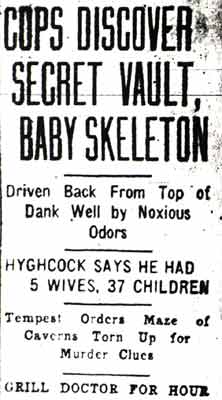
Cops Discover Secret Vault, Baby Skeleton
Camden Courier —
Voodoo Man Confesses Bigamy
Driven Back From Top of Dank Well by Noxious Odors
Hyghcock Says He Had 5 Wives, 37 Children
Tempest Orders Maze of Caverns Torn Up for Murder Clues
Grill Doctor for Hour
Camden Courier — An Independent Republican Newspaper — Final — Vol. 41, No. 267 — Camden, N. J., Friday, April 10, 1925 — 32 Pages—Two Cents
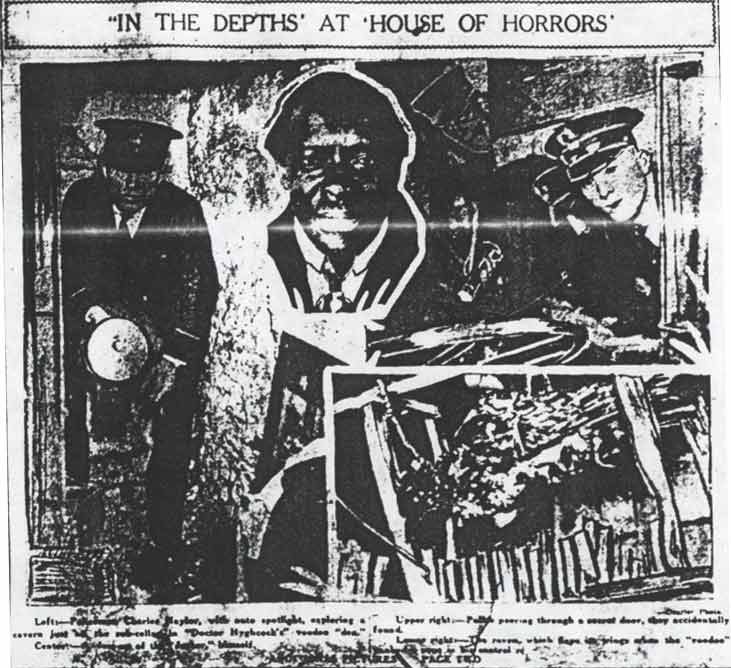
“In the Depths” at “House of Horrors”
Left:—Policeman Charles Naylor, with auto spotlight, exploring a cavern just [illegible] the sub-cellar in “Doctor Hyghcock’s” voodoo “den.” Center:—[illegible] of the “doctor” himself.
Upper right:—Police peering through a secret door, they accidentally found.
Lower right:—The room, which [illegible] the “voodoo” [illegible].
—Courier Photo
Additional Pictures Page Two
Police investigating the “voodoo den” of H.H. Hyghcock, 413–15 Liberty Street, whose arrest on suspicion of murder made several important discoveries today.
They are:
1 — The finding of a bloodstained hatchet buried under the floor of one of the underground rooms.
2 — Discovery of a hidden vault, the entrance freshly cemented and covered with wall-papered boards.
3 — Discovery of what is believed to be a well under the “sacrifice room.” When the police tore off the lid of the well today, they were driven from the underground passage by the odor that emanated from the large hole.
4 — A blood-stained mattress cover, hidden in a second story rear room, was found.
5 — Police digging in the underground den this afternoon unearthed the skeleton of a baby, the fourth infant’s body found in the “voodoo den.”
6 — Lastly, police say Hyghcock is the biggest liar they have ever seen.
When informed of the finding of the supposed vault Director Tempest instructed Captain Gordon to “tear it out if you have to tear down the house.”
The police questioned the “voodoo medicine man” for an hour this morning during which he admitted he is a bigamist. He confessed that he had five wives and is the father of 37 children.
Hyghcock Questioned For Hour
After spending the night in a prison cell, Hyghcock was taken before Deputy Director Tempest. In the room at the same time was Chief Tatem, Captains Colsey, Golden, Humes, and Sieh.
Hyghcock was visibly serious as he sat in a chair facing the police officials. He clasped and unclasped his hands and stroked his goatee as his eyes shifted around the room.
Director Tempest started the first shot of a barrage of questions that swept over the voodoo man before he was allowed to leave the room.
For nearly an hour the medicine man matched his wits with those of the police. Several times he seemed about to crack and reveal something startling but caught himself just as he was to fall into a trap.
As each question was asked him Hyghcock repeated it slowly and after thinking a few seconds made answer.
“Hyghcock,” Director Tempest began, “how many children have you?”
“Newspaper reporters printed stories that I have thirty-two children” the prisoner answered. “That is all wrong. I have thirty-seven children.”
Five Wives, Says Hyghcock
“How many wives have you had?”
“Five” he answered.
“All living?”
“Two are living.”
“Are you a bigamist?”
“Yes, I guess you would call me that. I don’t know where my fourth wife is now.”
“How long have you been married to this wife?”
“Thirty-two years.”
“All your children living?”
“All but two.”
“Where are the other thirty five?”
“Scattered all over.”
“How many women have you killed in your time?”
During the questioning of his married life Hyghcock smiled continuously as he answered the questions.
The last question had the effect of an electric shock upon the prisoner.
“Come on, come on,” Director Tempest said. “How many women have you killed?” This was one question that Hyghcock did not repeat.
Says He Bought Dead Bodies
“I never killed any women” he answered as he looked at the faces of those gathered around him.
“How many operations have you performed in that den of yours?”
“I didn’t perform any operations.”
“How do you account for the finding of those bodies of these infants in the cellar?”
“I bought those babies from Dr. White on South Street in Philadelphia.”
“You are lying, aren’t you?”
“No sir” Hyghcock said, as he toyed with his hat.
“Tell the truth now. How many women died in that house of yours?”
“Who said I killed anybody?”
“We have the goods on you, so you might as well come clean. Your daughter has told us she saw you kill that light skinned colored woman when your wife was away. What did you kill that woman for?”
“My daughter say that? She must be wrong.”
“Why should your daughter say you killed a woman if you did not? We know you shot that woman and your daughter saw you do it. Why should your daughter say such a thing if it were not true?”
Stumped by Daughter’s Tale
Beads of perspiration broke out on the prisoner’s face.
“I don’t know” he answered.
“Didn’t you take a woman’s body out of that house not so long ago?”
“No.”
“How many women have died in that house?”
“Only my daughter.”
“Are you a physician?”
“Sorta of a physician.”
“Why do you have the stethoscope in your home?”
“What kind of thing is that?”
“Are you a physician and well acquainted with surgical instruments?”
“Yes, sorta,” Hyghcock said. The stress was beginning to tell on him.
“And you don’t know what a stethoscope is? You are not a doctor, Hyghcock. You are a liar.”
“Yes sir” he answered.
“Are you a regular minister?”
“Sorta. I’m an evangelist.”
“Ordained?”
“What do you mean? I’ve been an evangelist since I was a child.”
“Ever been arrested before?”
“Yes, in Philadelphia. Man I was with shot a woman with a baby in her arms.”
“You did the shooting, didn’t you?”
“No sir.”
“But you shot the woman in your house on Liberty Street, didn’t you?”
“No sir.”
Women Boarders
“How many women do you keep at your house at one time?”
“Four or Five.”
“What for?”
“Boarders.”
“You are lying now, aren’t you?”
“No sir.”
“How many women have you killed?”
“None.”
“What do you know about the bloody hatchet we found in your cellar?”
“I don’t know anything about it. Where did you find it?”
“We are asking the questions, you just answer them.”
“Did you ever have a hatchet?”
“Yes, I lost it six months ago.”
“How did the blood get on it?”
“I don’t know.”
“Why did you cement that vault?”
“What vault?”
“The vault in your cellar that you just cemented a short time ago. You might as well come clean and tell us about what is hidden behind that cement wall because we are going to find it out.”
Hyghcock shifted in his chair and the perspiration flowed in a stream from his forehead. He bit his lips.
“There is nothing much there” he said after thinking for fully a minute.
Walls Against Water
“What did you build it for?”
“To keep the water out.”
“Why didn’t you cement up the rest of the cellar?”
“I don’t know.”
“You know that we know you are lying, don’t you?”
Hyghcock did not answer that question.
“Why did you dig out all those rooms in the cellar?”
“For church services.”
“Did you use about 65 small rooms underground for church services?”
“Yes.”
[TEXT illegible]
[TEXT illegible]
[TEXT illegible]
[TEXT illegible]
“In the room way back under the yard. That was the main church?”
“How can you take nine people and put them in 35 rooms?”
“I don’t know.”
“Then why did you have so many rooms?”
“The people wanted them.”
“What people?”
“My congregation.”
“Are you a regular minister?”
“Mr. Johnson in Newport News told me I could be a minister.”
“What was that room where the crow was swinging on the board supposed to be?”
Noah’s Ark Room
“That was the Noah’s ark room. The bird was on the ark.”
“What was the idea of having ropes to make the stuffed bird flap his wings?”
“That was part of the church service.”
“How many women are you in love with?”
“I don’t know. A lot are in love with me.”
“Hyghcock, you have been performing illegal operations in that house of yours, and we have more than 100 letters from women that were sent to you. Those letters contain evidence that will be used against you. What have you to say about them? You read the letters, because they were open when we found them.”
“Just what particular letters are you talking about?”
Director Tempest then went through some letters and mentioned the names and addresses of the senders. Many of them were from white women. To each letter called to his attention Hyghcock said:
“I just can’t recall reading that letter.”
“How about this letter from Ann Miller of Philadelphia telling you that she was thorough with you because you killed the man next door?”
“I don’t remember seeing that letter.”
“You are lying Hyghcock, and you had better come clean and tell the truth.”
“Women Stuck on Me”
Then letters containing endearing terms were read to him. Asked what he had to say about them, he answered:
“They are some of the women who are stuck on me.”
“How many women are stuck on you? Are there as many as 100?”
“I don’t think there are that many. I know women all over the country and they write to me.”
“What do women all over the country write to you for?”
“I guess they like me.”
“I guess they do,” Director Tempest said as he gazed at the prisoner, who averted his glances.
“Ever perform any operations on any of these women?”
“No sir.”
“Then what do they write to you about?”
“I don’t know.”
“What is in that well under the board in the cellar?”
“What well?”
“Did you throw any bodies down there?”
“No sir, I ain’t hid no bodies.”
“Where did you bury the women who died in your house?”
“Nobody died there.”
“Why did you go out late at night in your automobile with a shovel?”
“Who said so?”
“You did, didn’t you?”
“I can’t recall.”
Says He Took Women Into Tunnels
“Just think for a minute.”
“Nope, I can’t recall.”
“Did you take women into those underground rooms?”
“Yes, I took them down to church services.”
“Didn’t take any men down there, did you?”
“No sir.”
“How did you come to dig all those rooms?”
“I was looking for money.”
“What do you mean?”
“When I first moved into the house I dug in the cellar one day and found $25.00.”
“What has that got to do with the rooms?”
“Well, I kept on digging and found $300.00 more.”
“Yes, go on.”
“Go on where?”
“What gave you the idea for all of the rooms?”
“Well, when I moved into the house there were rooms directly under the [XXXXX] and I dug [XXXX] the back yard [XXXXX XXXX XXXXXXXX].”
“For how long have you been live there?”
“Eight or ten years.”
“Who dug that cellar with you?”
“A man by the name of ______ (Name withheld at the request of the police).”
“What did he do?”
Becomes Badly Mixed
“He helped me to make the room — the chapel.”
“Did he help you get rid of the bodies?”
“No sir.”
“Who did help you get rid of them?”
“Nobody.”
“Did it all yourself?”
“Did I do it all myself — yes, sir — no, sir.”
“Well, what do you mean?”
“I mean I didn’t do anything. I hid no bodies.”
“What did you bury the hatchet for?”
“I didn’t bury any hatchet.”
“How did it happen the hatchet was covered with blood?”
“I don’t know.”
“What did you have those shovels and picks down in the cellar for?”
“To dig with.”
“Dig what?”
“What is this religious college you have up by Willow Grove?”
“Who told you about that?”
“You tell me about it now.”
“I started a church up there.”
“You built shacks and rented them to colored people for $30.00 a month and then charged them $10.00 a month extra. What was the extra $10.00 for?”
“It was for the Lord.”
“What do you mean Lord Hyghcock?”
“No, for the church.”
Sold Willow Grove Settlement
“Do you still have the church settlement?”
“No, I sold it.”
“Sold the church too?”
“Yes.”
“Why did you tell your wife you would kill her if she went into the cellar of the house where all those rooms were?”
“Who said so?”
“You did, didn’t you?”
“I can’t recall.”
“When you would have a crowd of women in the rooms you would send your wife away, wouldn’t you?”
“Not exactly.”
“Speaking of illegal operations, do you know Miss…”
“Who ain’t one of the women I operated on.”
“Who are some of these women, then?”
“I ain’t operated on any women.”
“Did you tell women to keep away from you?”
“Yes.”
“Tell us about how you shot that woman and buried her body.”
“I ain’t shot nobody.”
“How did you kill her, with that hatchet?”
“No sir.”
“Come on, tell us how you killed her.”
“I didn’t kill any women.”
“The woman just died in the house, oh?”
“No sir.”
“How about the man who lived next door whom you said you killed?”
“I didn’t kill anybody.”
When Tempest finished, each of the police captains fired a barrage of questions at Hyghcock.
Several times under severe questioning by Captain Golden, Hyghcock became confused and gave evasive answers.
Turning to Captain Schregler, Director Tempest said:
“He’s a liar, take him upstairs.”
Mrs. Hyghcock Quizzed
Hyghcock was then taken up to the bureau for further questioning by detectives. His wife was quizzed in an adjoining room and when she was taken back to her cell, their seven year-old daughter, who told the police her father killed a woman in the house when she was questioned again repeated her version of the killing.
During the questioning of Hyghcock in the Detective Bureau, Commissioner Middleton came into the room. He sat with the detectives as they questioned the 71 year-old medicine man.
Where the Ropes Came From
A Broadway hardware merchant called at police headquarters today and told the police that he had been selling rope to Hyghcock for the past two years.
“He would come into the store and buy the rope in six foot lengths. He would also buy barn lanterns by the dozen. I often wondered what he intended to use them for but I never asked him.”
The ceiling of the underground den was a cobweb of ropes, which operated through pulling and rang bells, opened doors, and made the raven in “Noah’s Ark” flap his wings.
That Hyghcock contemplated more cement work, when discovered, was evident yesterday when the police found a load of sand in the front part of the cellar. In the afternoon a truck with fifteen bags of cement came to the Hyghcock house.
The driver, seeing the crowd, drove away, taking the cement with him.
Director Tempest sent a detail of police and firemen to destroy the maze of underground tunnels and “torture chambers” under the “voodoo” houses. The entire cellar of the two houses will be dug up to a depth of six feet in an effort to learn if any human bodies are buried there.
The “voodoo palace” was raided early yesterday morning by a detail of police who arrested “Dr.” H.H. Hyghcock, a 71 year-old “medicine man.” When the police searched the house yesterday they discovered the bodies of two small infants hidden in one of the underground rooms.
County detectives who went on the case yesterday and city police are endeavoring to learn if any women were murdered in the house. The decision to tear out the thirty-five underground rooms came at a conference at police headquarters last night between Prosecutor Wescott, City Prosecutor Bernard Bertman, Director Tempest, and Chief Tatem.
Each of the officials declared that he believed a digging up of the cellar would reveal the finding of human bodies.
Will Do It Monday
“I am going to order a detail of firemen and policemen to the cellar of the two houses” Director Tempest said, “with instructions to tear out every one of those rooms in the cellar. After the cellar is cleared the policemen and firemen will dig up every foot of the cellar. I have some information which I cannot divulge that leads one to believe that our search will not be unsuccessful. It is not probable, however, that the work of clearing up that underground ‘hotel’ will be started before Monday.”
“In my police experience I have never seen anything that compares with that underground voodoo den.”
Hyghcock was questioned for several hours last night by detectives. He refused to make any statements, even when he was shown incriminating letters that were found in his home. The police seized more than 100 of the letters which were mailed from every state in the Union. Many will be used against the “physician” when he is placed on trial as they reveal he practiced medicine without a license.
The police place great stress upon the statement of Hyghcock’s seven year-old daughter who told them that her father killed a woman in the house a week ago and buried her body. The child is being held in custody as a material witness as is the wife of the “medicine man.”
Last night more than 5,000 morbid curious people gathered at the Hyghcock house and stormed the doors seeking admittance to the underground passages. A detail of police inside the house fought back the crowd. A riot call was sounded at 9:00 o’clock and two details of police were rushed to the scene. The crowd was driven back and the street roped off. During the excitement the front door was smashed in by the crowd.
Today detectives are reading the large bale of letters found in the house. They also seized the prisoner’s set of books, which show he received large sums of money from superstitious persons for “love and enemy” charms. The books contain the names and addresses of more than 1,000 of Hyghcock’s customers.
Police said that although Hyghcock has only been a resident of this city for three years, he has amassed a small fortune and owns considerable property here and in Pennsylvania. They said that several years ago Hyghcock built a small chapel near Willow Grove. Around this chapel he erected 20 small frame houses. He rented them to colored folks who joined his religious sect and in addition to the rent paid him an assessment of $10 a month which he said he turned over to the Lord.
Three Years of Work
When Hyghcock was taken from his cell in police headquarters last night to be questioned he smiled as the cell doors clanged open. He was taken to detective headquarters and questioned, but refused to make any statement. He will be questioned again today.
The police said he must have spent nearly three years building the underground “chamber of horrors.” So quietly did he work that none of his neighbors knew the spooky subway rooms existed. Most of the excavating was done between midnight and 3 o’clock in the morning.
Entering the house at 413 Liberty Street, a visitor sees a small counter and a candy show case. Arrayed on shelves behind the counter are bottles of pop and packages of cigarettes. Three feet away from the counter toward the kitchen is a door leading into a hallway three feet square. A winding flight of steps lead to the upper floors and a door in the hallway opens onto a narrow winding stairway into the cellar.
Secret Winding Passages
Once in the cellar the visitor finds himself in a small alley running toward the front of the house. In this alley are shelves filled with roots and herbs. The aisle turns at right angles to the right and one sees a large door upon which is printed “Noxvill.” A heavy spring slams the door to. The visitor is then in complete darkness. In front of him is a winding, twisting passageway, barely three feet wide. Directly over his head are ropes running along the ceiling which control the opening and closing of doors and the ringing of bells.
To the right is a dark room. The rays of a flashlight thrown into the room reveals a stuffed bird resting on a swinging shelf. A pull on one of the many ropes causes the crow to flap his wings. Just ahead in the passageway, and to the right and left are three doors. Sleigh bells are fastened to each of the doors. The door to the right leads to a tunnel connecting with the house at 415 Liberty Street, next door. The other doors lead into other rooms and in the rooms are other doors leading into still other rooms.
Rooms Poorly Furnished
And so on down the entire length of the cellar.
In the rooms which are not more than four feet square there is very little furniture. The walls and partitions are made of packing box lumber covered with various pieces of wall paper, one shade bordering on the other. In each “den” a kerosene lantern, or lamp hung on a hook. The air is stifling.
In the room known to the police as the “Graveyard” are three lanterns and several spades and picks lying on the dirt floor. The soil shows that it has recently been dug up.
Still following the dark passages the visitor finds himself confronted with a door, with a glass panel in the bottom. A heavy spring makes the door hard to open, but a pull on one of the many strands of rope running along the ceiling and the door swings slowly open without the least effort. It is controlled in some mysterious manner by weights.
Hyghcock has undermined his entire back yard. Back under the yard runs the passageway with the dens turning off to the right or left. In one of the underground rooms a large clock instead of being placed high on the wall is fastened down near the ground. The clock was functioning yesterday but was four hours fast.
Tunnels Become Confusing
Now the passageways get narrower and darker and the odor is sickening. Towards the extreme rear of the room is the “Sacrifice Chapel.” This contains a baptismal bath, a large Bible, a [XXXXX] and a carriage wheel with various colored spokes. The wheel spins from an iron peg driven into the wall. Everywhere is seen patchwork carpenter work. A birds-eye view of the underground rooms reminds one of the futurist, or cubist, paintings. In one of the rooms the floors are covered with freshly laid cement. The police will endeavor to find if anything is buried underneath the flooring.
Just ahead is daylight. One finds a small hole in the roof where a chimney or an uphill coal stove extrudes into the yard. This follows another maze of doors. In several parts of the tunnel thick doors can be opened at the same time to form a triangle. Not twenty more feet down this dark passageway and a ladder leading upward is seen. It is a hastily constructed affair and the top rungs are covered with grips made of automobile tires.
A walk through the upper story of the two houses show that bedrooms have been partitioned off to make three rooms.
He Doted On Bells
Overhead is the network of ropes operating on pulleys the [XXXXX XX XXXX XXXX]. In the underground rooms and tunnels, [XXXX XXXXX] and a door [XXXX XXXX. XXXX XXXX] will open or a bell will ring. Hyghcock just doted on bells. The largest bell is fastened to a door on the third floor. This one can be sounded from the rear room in the tunnel by means of the rope. Bells are everywhere. They range from baby bell rattles to large cow bells.
The rooms on the upper floors each contain beds. Yesterday they were in disorder. The bed clothing was scattered on the floor and the floors were strewn with papers, letters, books, and clothing. In a closet in a third story room was found two new dolls in a basin, glassware, phonograph records — everything imaginable. The rooms resembled “junk shops.”
Yesterday the police spent most of their time searching for bloodstains on the floors and walls of the buildings. Trunks were forced open and those were found to contain soiled linens. The police questioned Hyghcock’s seven year-old daughter.
“How many men did your father kill in here?” Patrolman Charley Naylor asked the girl.
Says “Pop” Killed Woman
“My Pop did not kill any men” the child answered, “but when my mother was in Washington to see my sister not long ago, a woman came to the house and started to fight with Pop. It was late at night. They fought terrible and they were in the big room in the front of the house. I saw them fighting and my Pop got a gun and shot the woman. Pop took her out in the automobile and buried her. He told me to keep quiet and said the woman was sick and died and he buried her in a cemetery.”
The child was taken to police headquarters when she was again questioned by Director Tempest and Chief Tatem. The police tried to get her to change her story but she refused to do so and stuck to the narrative she first told in her home. Her mother was then arrested and detained as a material witness.
Persons living in the neighborhood said today that on two occasions they had seen Hyghcock place large bundles in the back of his car at night, place a shovel in the rear of the car and drive away.
The police have been unable to learn much so far about Hyghcock prior to coming to this city. They do know that he came here from Norfolk, VA where he still claims to be in the undertaking business.
Strange Powders Sold
Hyghcock, the police said, manufactured powders and sold them to colored people as good luck charms. If a woman was unfriendly with another woman she went to Hyghcock and for $12 she received a small bottle of powder. This she sprinkled in front of her enemy and from then on “everything will suffer for the enemy because she would be pursued by evil spirits and her luck would be something terrible.”
If a superstitious young man who “rolled the bones” as a pastime wanted to stage a winning streak, he would visit the medicine man. For $40.00 he would give the man with the gambling instinct a blue powder that he was supposed to rub on his hands just before it was his time to “roll.” Powder to keep another woman from stealing one’s husband went for $30.09, Hyghcock’s records show. What the 9 cents was for is not known. In one day, the police said, Hyghcock sold more than $190 worth of powder that originally cost about twenty cents.
The more serious charge against the prisoner is that he used the building for immoral purposes and for performing illegal operations.
New Jersey Notes
Philadelphia Inquirer —
New Jersey Notes
Approximately 20,000 school children will take part in the Peter Pan Memorial dedication in Johnson Park, Camden on September 24, according to Dr. James E. Bryan, superintendent of schools. The statue is the gift of Eldridge R. Johnson, of the Victor Talking Machine Company.
Although Prosecutor Westcott, of Camden county, asserted that he will make every effort to send to prison those who are responsible for the alleged ballot box frauds during the last primaries in Camden, State Senator Woodruff replied that he would take no interest in the exhaustive probe now under way. He was quoted as saying that the police protected “Mikey” Brown’s gang instead of the downtown voters.
Camden police and Federal dry agents ascended on twelve houses yesterday, but were disappointed with the results which is said to be attributed to “tips” leaking out. The raiders confiscated three stills, forty-five gallons of alleged moonshine and seventeen barrels of mash. In one of the places, a woman, said to be owner of the premises, and three men were arrested and charged with interfering with Federal officers.
Keen desire for newspaper notoriety was blamed by Mrs. William Clark, of Camden, for the action of her sister, who last Friday “borrowed” Peggy Clark, two-and-a-half years old, and returned with the child Tuesday night. The mother of the infant yesterday caused the abduction charges to be dismissed.
Jersey Raid Is Admitted by Robbers
Trenton Evening Times —

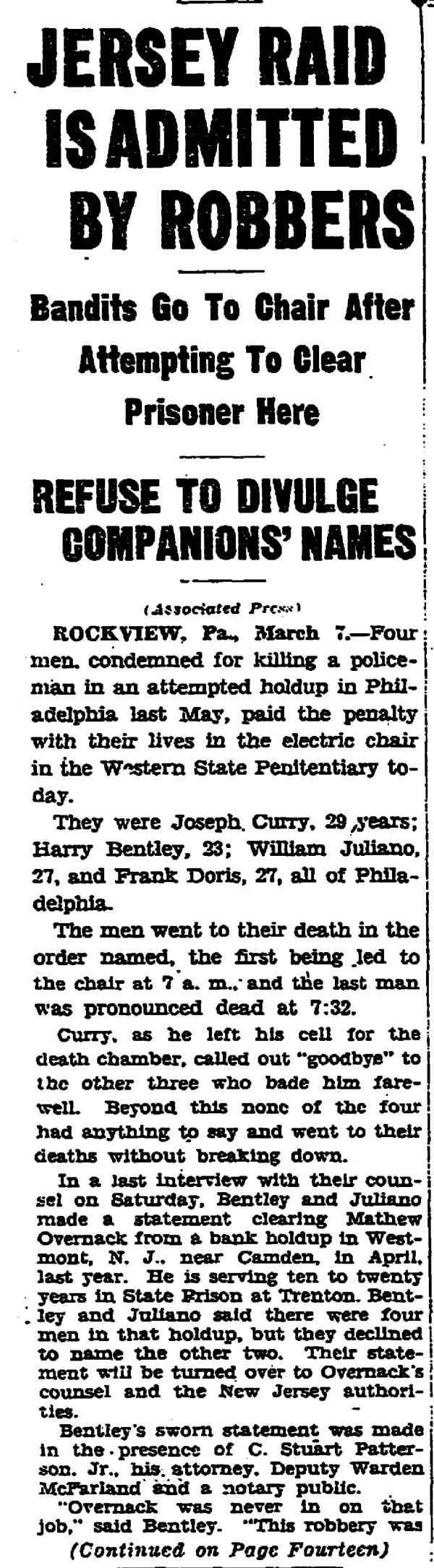

Bandits Go To Chair After Attempting To Clear Prisoner Here
Refuse to Divulge Companions’ Names
ROCKVIEW, Pa., March 7.—Four men, condemned for killing a policeman in an attempted holdup in Philadelphia last May, paid the penalty with their lives in the electric chair in the Western State Penitentiary today.
They were Joseph Curry, 29, years; Harry Bentley, 23; William Juliano, 27, and Frank Doris, 27, all of Philadelphia.
The men went to their death in the order named, the first being led to the chair at 7 a. m., and the last man was pronounced dead at 7:32.
Curry, as he left his cell for the death chamber, called out “goodbye” to the other three who bade him farewell. Beyond this none of the four had anything to say and went to their deaths without breaking down.
In a last interview with their counsel on Saturday, Bentley and Juliano made a statement clearing Mathew Overnack from a bank holdup in Westmont, N. J., near Camden, in April, last year. He is serving ten to twenty years in State Prison at Trenton. Bentley and Juliano said there were four men in that holdup, but they declined to name the other two. Their statement will be turned over to Overnack’s counsel and the New Jersey authorities.
Bentley’s sworn statement was made in the presence of C. Stuart Patterson, Jr., his attorney, Deputy Warden McFarland and a notary public.
“Overnack was never in on that job,” said Bentley. “This robbery was”
Four Die Clearing Trenton Convict (Continued from Page One)
planned by one of us two weeks before the holdup was committed, but the care of the homeless was the city’s major problem.
“I walked into the bank and got four or five thousand dollars. I got the cashier to give me time to observe the number of the bank’s bills.”
Bentley’s statement goes into considerable detail but its authenticity cannot be verified. The camera marks in the safe, the precise denominations of the bills and other details are furnished by Bentley, but Prosecutor Harry M. Cooper, of county detective chief, asked Juliano if he had anything to say and the latter replied: “Nothing.”
“Confessions,” now held by a supporting affidavit, were made in the presence of two of the four bank bandits who were unable to reply on more than the most minute details. The statements reached the conclusion at the same time and on the same minute details. Prosecutor Doran made it clear he was going to the grave with me.
The crime for which the four men were sent to the chair was a holdup of the Other Bank & Trust Company; an attempted holdup in Philadelphia. Miller had $60,000 in an account. In the fight that followed in the bank, the station agent was killed. Prosecutor Wescott was one of the Board of Pardons was filing the information with the authorities at Trenton. The documents contain the bare assertion that county prosecutor Ethan P. Wescott was at the center of activities. The movements contain the bare assertion that county prosecutor Ethan P. Wescott is not only one of the best legal experts, but is the far-head of the most complex criminals this decade has seen.
Murder Motive at G.O.P. Club Splits Sleuths
Camden Evening Courier —
County Detectives Contend Philadelphia Gangster Was Slain in Quarrel Over Woman
Police Claim Hold-Up Attempt Caused Fight
Devon Charged With Crime, Flannery and Taxi Driver Held Without Bail
With city and county authorities definitely divided on the motive and circumstance of the Sixth Ward Republican Club slaying, Joseph “Polack Joe” Deven was arraigned in Camden police court today and held without bail on a murder charge.
Through County Solicitor Walter Keown, retained as his attorney, Deven waived a police court hearing and was held to await grand jury action in the slaying of Joseph Cimini, Philadelphia gangster, at the political club early Saturday morning.
At the same time County Prosecutor Ethan P. Wescott announced his operatives had abandoned the theory Cimini was killed as the aftermath of an attempted hold-up, and were concentrating their investigation in the case on an effort to “find the woman.”
Statements of witnesses to the fatal shooting, the prosecutor added, made no mention of a hold-up, but contained the declaration that Cimini had been shot as a result of a feud with Charles “Chick” Hunt, former South Camden pugilist, concerning the affection of “Chick’s girl.”
Police Claim Holdup
On the other hand, Captain John Golden, chief of the city detective bureau, declared he was unable to recall any mention of a girl in the statements obtained from witnesses, and added emphatically that his department still held the shooting had followed an attempted holdup of the club by Cimini and Joseph “Mose” Flannery.
Flannery and Hunt were both witnesses to the shooting by Deven, picturesque figure in Third Ward politics, which occurred at the Sixth Ward Club’s headquarters, 908 Broadway.
After Deven had appeared in Police Court today, Flannery was arraigned as a material witness and as an accessory to the crime, with an additional charge accusing him of carrying concealed deadly weapons. Similar charges were made against Russell Sage, a taxicab driver, who arrived at the club with Flannery and Cimini early Saturday morning. These two were committed to the county jail without any bail by Judge Bernard Bertman.
Hunt, however, was released under $1,000 bail as was Martin O’Brien, 27 years old, a former New Jersey State Trooper, and Harry Waterhouse, 28 years old, 1102 Marion street.
Three Others Arrested
During the day the police continued to build up their case against Flannery by arraigning him on the charges made by Milton Feinstein and Henry Mehrer. They also arrested Joseph Genther, 29 years old, 414 Atlantic Avenue; Robert Wolfe, 21 years old, 1106 Mechanic Street, and Eli Conaghy, 27 years old, 814 South 6th Street. Wolfe, who is Flannery’s brother-in-law, and Genther were held “on suspicion” of having been with “Mose” at the time the latter is declared to have attacked and attempted to rob Mehrer, an Audubon policeman, outside the Ringside Inn, on the Black Horse Pike.
Conaghy, Flannery and Sage were arraigned and held without bail on charges of threatening to kill Feinstein and of carrying concealed deadly weapons. Feinstein declares these three with Cimini, the slain man, entered his cafe on January 2 and attempted to hold him up, threatening to kill him if he refused to “come across.” When he defied them by telling them to “go ahead and shoot,” Feinstein says, they departed.
Wolfe, Genther, and Conaghy were arrested by City Detectives George Ward and Thomas Cheeseman. It was Cheeseman who lodged the formal complaint of murder against Deven.
Two Others Released
Two other men who were questioned in connection with the murder case were in court this morning but neither was held. They are Newton Blanchard, 923 St. John Street, a former boxing referee and alleged “stick man” at the crap game declared to have been in progress at the club before the shooting, and Michael Dandrea, 26 years old, of 1657 Norris Street. Both men had been released after questioning on Saturday. Police say they are the men who told police that trouble was imminent at the club and that “Flannery and another fellow are trying to stick up a bunch of other fellows.”
The city police hold-up theory was further attacked today by Francis J. McCarthy, a Philadelphian, who arrived before noon at the county prosecutor’s office and said he would co-operate with the authorities. He wishes to clear the dead man, he said, of the stigma of suspicion that he was slain while engaged in an attempted robbery.
Hearing in Police Court was brief. There was no testimony and Keown merely announced Deven would waive a hearing. Appearing also as attorney for Hunt, O’Brien, and Waterhouse, he said the other three men were “present at the unfortunate shooting” and thus should be held as material witnesses. He added the prosecutor’s office had permitted the release of the three under $1,000 bail each and requested Judge Bertman follow suit. The court acceded to this request but stipulated that new bail must be provided. The three men were freed shortly afterward when the bond was furnished by James Louis, 603 Kaighn Avenue, who had provided the bail yesterday in the prosecutor’s office.
Despite the declaration by two Camden district detectives who were present at the time and who said there was no evidence that gambling was in progress at the club, county detectives disclosed today that statements of the shooting contained the assertion that the men had gathered for a crap game.
These witnesses also declared the fatal shooting resulted from an argument over a woman for whose attention Cimini and Hunt were rivals.
In circles where the leading figures in the shooting move, it was freely predicted things would be fixed up for Deven and that Flannery, political worker and supposed gangster, was to be “made the goat.”
Flannery is blamed by the city police for precipitating the battle. He has also been identified, according to County Detective Howard Smith, as one of the men who beat and robbed Henry Mehrer, an Audubon policeman, outside the Ringside Inn on the Black Horse Pike a fortnight ago. In addition, he is charged with attempting to hold up Milton Feinstein, cafe proprietor, 508 Kaighn Avenue. Cimini and Sage were also identified by Feinstein, according to Detective Smith.
According to the version of Cimini’s death given in statements by witnesses to county detectives, “Chick” Hunt might have been the victim of the slaying had it not been for Deven’s interference.
Gamble Over Affections
Like actors in a carefully-rehearsed drama, the various witnesses to the shooting made their statements nearly twelve hours after the shooting and, both city and county detectives say they agreed in all important aspects. Prosecutor Wescott declared, however, that no mention of an attempted hold-up was made despite the fact that City Detectives Clarence Arthur and Clarence Bunker—before whose eyes Cimini was shot down—stated Flannery and Cimini were holding the other men at bay when the detectives entered the room.
Instead, the statements of the witnesses described the scene as a dramatic gamble, with death as the stake, over the affections of a woman beloved by both Cimini and Hunt. This woman, who is married and estranged from her husband, is being sought today, Prosecutor Wescott said. According to detectives, Hunt was severely beaten last Wednesday night in a downtown gambling place by members of Cimini’s gang. Cimini, known also as Joseph Gannon, was a brother of William Cimini, a pugilist known in the ring as Billy Gannon.
The stories told by the witnesses place Hunt as one of the players in the crap game which was in progress at the club on Saturday morning. Deven was at the window, looking out, according to the witnesses, when he saw a taxicab draw up in front of the building. Flannery, Cimini and Sage descended and entered the club, it was declared.
“Here comes Mose, Chick, with that guy what’s gunnin’ for you” Deven is declared to have shouted.
A dozen gamesters fled from the room. “Chick” and a few of his friends held their ground and were waiting when the trio entered. Cimini, it is stated, walked over to Hunt.
“I told you,” he said with a sneer, “to stay away from that dame. She’s my girl. You were warned and now you gotta take your medicine.”
Hunt said nothing.
Flannery drew from his pockets two automatics and flung them on the green-topped table, the stories go.
“C’mon, Chick,” he said. “Don’t be yella. He toldja about the broad and he toldja what he’d do. Take your gun and shoot it out.”
“Chick” demurred.
“I don’t want none of that stuff, Mose,” he pleaded. He eyed Cimini carefully as the latter held one hand on the butt of a pistol which protruded from his belt.
Deven Interferes
Hunt made no careless movements toward the pistols on the table. Then Deven is declared to have interfered.
“None of that stuff, Mose,” he said warningly. “Who’s this guy to come here making trouble? He’s no member, is he?”
Cimini moved quickly, the witnesses say. With an upward flip of his hand he brought the barrel of the automatic sharply against Deven’s chin. The latter lurched forward snatching one of the pistols from the table.
The weapon was discharged, the bullet tearing through Cimini’s heart. He died instantly.
The next moment, Arthur and Bunker, district detectives summoned by one of the players who had fled, burst through the door and lined up the men against the wall.
A short time later police arrested Blanchard and Dandrea. Blanchard, police say, was the man who gave them warning of the impending battle. Both men were released after questioning.
Released from Lakeland
The detectives found Deven cringing with fear under the table, the weapon still in his hand. Four other pistols were picked up in different parts of the room.
Deven was identified as a lovesick husband who appeared in the prosecutor’s office several months ago and asked to be “put away.” His wife had left him, he said, and he was afraid he might harm someone.
He was committed to the asylum at Lakeland. When or how he was released is a mystery. Lakeland officials said they had no record of him. Deven once shot himself in a suicide attempt police say, in grief over estrangement from his wife.
Gangdom’s prevailing opinion is that Flannery is “in” for it. Attempts and threats against the blond gangster’s life have furnished many lurid tales for the habitués of downtown hangouts.
Further, Flannery has made many bitter enemies through his political activities. In the last election he worked as a Democrat against “Mikey” Brown in the Eighth Ward. His overbearing tactics and bravado among the other downtown characters has increased the feeling against him, it is said.
Thus far, he has succeeded in keeping out of the toils for any length of time. His police record includes arrests for rum-running, carrying concealed weapons, alleged ballot frauds and attempted murder. His most recent arrest came in Philadelphia when he figured in a pistol battle in which a man was slain.
Love Plot Fades as Motive Behind Clubhouse Killing
Camden Evening Courier —
Mrs. Katherine Rosalie Denies She is “Chick’s Girl” or “Anybody’s Girl,” But Thinks Flannery and Cimini May Have Used Her as Excuse For Starting Fatal Fight
The suspected “love motive” in the Sixth Ward Republican Club slaying broke down today under the glaring light of investigation. It was the second time within two days that the investigation behind the killing of Joseph Cimini, otherwise Joseph Gannon, had been seemingly explained only to have the explanation rejected.
First, Camden city detectives had affirmed their belief that the fatal shooting was the aftermath of a hold-up attempt by Joseph “Mose” Flannery and Cimini. This theory went by the boards when the statements of witnesses, taken by Prosecutor Ethan P. Wescott disclosed no hint that any such hold-up had been attempted.
Then came the confident introduction by authorities of the “love motive.” Charles “Chick” Hunt, former South Camden pugilist and one of those present at the time of the slaying. Mr. Hunt argued with Cimini over a girl the detectives hinted, and this had precipitated the battle.
Woman Reverses Story
But today, from the Cupid’s bow lips of pretty Katherine Rosalie there issued a statement which wrecked the suspected love triangle in the case, so prominently put forward yesterday as “the real solution.”
“I never knew this Cimini,” declared Mrs. Rosalie.
“I’m not Chick Hunt’s girl,” added the 22-year-old brunette who, up until that moment, had been called “Chick’s sweetie” by investigators.
“I’m not anybody’s girl,” she asserted positively, her dark eyes flashing in a manner that proved to interviewers she certainly would encounter no difficulty in attaining the status she so decisively denied.
It was yesterday, shortly after Joseph Deven had been committed to jail without bail on a murder charge, that Rosalie went to the County Courthouse and told her story to Assistant Prosecutor Joseph Varbalow.
Search for Husband
Immediately thereafter, County Solicitor Walter Keown, attorney for Deven, Hunt and two of the other witnesses who are ranged on the side of “Polack Joe” in the case, declared his belief “the shooting came as a result of a plot between Cimini and Rosalie, because Rosalie was jealous of Hunt.”
Accepting this version, Varbalow announced that a search would be made for John Rosalie, husband of the young woman who was called “Chick’s girl.” The inferential theory, according to Varbalow, was that Cimini was a friend of Rosalie, and that he had taken up his friend’s cause by calling Hunt to “shoot it out.” A melee had ensued, according to this theory in which Deven had taken Hunt’s side. Then, to continue this line of deduction, Cimini had struck Deven with the butt of a gun and Deven had fired another gun, killing Cimini.
Some of this may have been true, according to Mrs. Rosalie’s assertion. But she does not believe that her husband’s jealousy, linked to his possible acquaintance with Cimini, was the real cause of the shooting. She has heard, she says, that Flannery and Cimini used a previous argument with her husband as “an excuse” to precipitate the argument which resulted in Cimini’s death. But she believes that it was only an excuse.
Denies Knowing Pair
Thus the picture changes and, according to the latest theory, Flannery and Cimini entered the Sixth Ward Republican Club on Saturday and picked a fight with Hunt — ostensibly because of the latter’s acquaintance with Mrs. Rosalie, but actually because of previous ill-feeling between “Mose” and “Chick.”
“I did not know either Flannery or Cimini,” Mrs. Rosalie told the Evening Courier in an exclusive interview today. “In fact, I have never seen either of them and did not know who they were. It’s true that my husband and my brother-in-law, had an argument with Chick Hunt. I have known Hunt for only a short time. Since meeting him I have regarded him as a personal friend, but I certainly do not like the imputation that I’m ‘Chick’s girl.’ I am not anybody’s girl.”
“When I read in the newspapers that they were looking for Chick Hunt’s girl, however, I remembered the argument my husband and my brother-in-law had with Hunt. I did not see how this could have any bearing on the shooting, but I decided to go to the prosecutor’s office and tell them what I knew in the event that it might be some help to them.”
Heard of Old Feud
“I have read that, when Cimini and Flannery went into the club on Saturday morning, they started the trouble by claiming that Chick was crossing up a friend of theirs. I have heard it said they started the argument by recalling an argument between Chick and my husband.”
“If they did this, it was without foundation, as far as I know. I believe that, if this is what they did, they were merely using the argument between my husband and Chick as an excuse to get into a new argument with Hunt. In fact, I have heard that there had been ill feeling between Flannery and Chick long before I ever met Hunt.”
Varbalow said Mrs. Rosalie, who lives at 311 Cooper Street, told him of the jealousy which her husband bore toward Hunt. She and her husband have been estranged for eight months, Varbalow says she told him. For a little more than two months, she has known Hunt. Some weeks ago, she underwent a blood transfusion operation and, when her husband came to the hospital to visit her, he found Hunt there. Later, Rosalie and Howard Churchill, his brother-in-law, set upon Hunt outside Mrs. Rosalie’s former apartment at 500 Broadway and beat him, according to the statement Varbalow says the girl made to him.
Battle Echo of Murder at Club
Camden Evening Courier —
Mrs. Rosalie and Her Rival for ‘Chick’ Hunt Describe Event in Court
Swap Punches In Street
Pretty, piquant Katherine Rosalie—for love of whom men are declared to have fought to the death in the rooms of the Sixth Ward Republican Club—today waged her own fight against her self-avowed rival for the attentions of Charles “Chick” Hunt.
In Camden Police Court this morning, Mrs. Rosalie appeared as complainant against Miss Elsie Berendt, 1901 Broadway, who, by her own assertion, was “Chick’s girl” until Katherine came along.
The court battle, moreover, was merely an aftermath to a hand-to-hand encounter which both declared to have taken place yesterday at the corner of Fourth and Arch Streets. Today’s chapter of the comedy-drama was ended when Judge Bernard Bertman sent both young women home, after chiding Miss Berendt for being “too nervy” and “talking too much.” Miss Berendt was kept in custody by Judge Bertman for about five minutes and then dismissed. Meanwhile Mrs. Rosalie had departed in triumphant possession of Mr. Hunt’s company.
Mrs. Rosalie, 22-year-old brunette, entered the official investigation of the slaying of Joseph Cimini, at the Sixth Ward Republican Club, after county detectives advanced the theory that the fight which resulted in the final shooting had been caused by an argument over “Chick’s girl.” Hunt, a former South Camden pugilist, was in the club at the time of the shooting. According to detectives, the fight had started between Joseph “Mose” Flannery and Hunt; Cimini had entered the argument on behalf of Flannery, and Joseph “Polack Joe” Deven had shot Cimini when the latter struck him with the butt of a revolver.
Both Waiting For Hunt
Mrs. Rosalie, after recounting her story of her friendship with Hunt to Assistant Prosecutor Joseph Varbalow, denied she was “Chick’s girl,” or “anybody’s girl.” But, apparently, Elsie didn’t look at it that way.
According to the testimony of the two young women and of Hunt, in Police Court today, the encounter between the girls took place late yesterday afternoon. Katherine said she was waiting for Hunt at Fourth and Arch Street. Elsie said she was waiting for Hunt at Fourth and Federal Street, a short block distant.
“Chick” arrived, it was testified, and Elsie met him first. She asked the whereabouts of Katherine. Then she saw Katherine and went there. She accused Katherine of having called her a “bum” and of using other uncomplimentary terminology. Katherine promptly denied it.
What happened then depends on whether Katherine’s story or Elsie’s is correct. Katherine said Elsie hit her. Elsie says Katherine hit her. Hunt apparently acted as peacemaker for the nonce and the match wound up in Police Court today.
Girl’s Story Is Denied
There, Elsie earned the disapproval of Judge Bertman by declaring, in great detail and in determined tones, that she had lived with Hunt for seven years as his wife; that she had gone to work as a waitress, and supported him and that he had deserted her several weeks ago when Katherine appeared on the scene.
“Chick” denied all this, declaring he lived at 1213 Broadway and not with Miss Berendt. It was then Elsie received the Court’s opprobrium for “talking too much” and evidencing “too much nerve.” And that was about all there was to it.
Meanwhile, it became increasingly evident that it was a tangled case which Prosecutor Ethan P. Wescott is to present to the Camden County grand jury in connection with the slaying of Cimini, otherwise “Joe Gannon” last Saturday morning.
“Polack Joe” Deven, held on a charge of murder, has admitted firing the shot that killed Cimini before the eyes of two Camden district detectives and nearly a score of other men.
Motive A Mystery
But just how it happened or why, or what led to the argument that seems to have preceded the shooting remained today as much of a mystery as though Cimini had been slain in some lonely DeRussey’s lane instead of in a crowded clubroom.
The investigation so far has focused definitely around the figures of Hunt and Flannery, the latter a storm-center of Eighth Ward politics and police records.
From the tangled web of evidence which county detectives have gathered, it appears only that the argument which resulted in the shooting of Cimini by Deven was caused by ill-feeling between Flannery and Hunt. Whether that ill-feeling had to do with the fading love motive that county detectives so confidently built up until yesterday, whether it was over the crap game supposed to have been in progress at the club, or whether it had a political tinge, is part of the mystery.
Clings to Love Motive
County detectives still cling to a somewhat obscure “love motive,” though it is admitted that they’re not getting very far with it.
The latest development along this line is the arrival in the prosecutor’s office, late yesterday, of John Rosalie, estranged husband of the attractive young woman, who denied that he knew either Flannery or Cimini and stated that he knew nothing whatever concerning the latter’s death.
Assistant Prosecutor Joseph Varbalow, after hearing Mrs. Rosalie’s statement the day before, had announced yesterday that the authorities were “looking for Rosalie.” Mrs. Rosalie had told of the apparent jealousy of her husband—a jealousy which she insists is unfounded—concerning Hunt. She had told how Rosalie and his brother-in-law, Howard Churchill, had set upon Hunt one day at her apartment and had beaten him. She said that she believed her husband might have been acquainted with Cimini.
The theory formed by detectives after that, was that Cimini had gone to the Sixth Ward Republican Club early last Saturday for the purpose of “getting” Hunt because of his, Cimini’s friendship for Rosalie.
Theories Break Down
This was the theory that seemingly broke down when Rosalie appeared and declared he didn’t know either Cimini or Flannery. It apparently broke down just as had a former theory, to the effect that Cimini and Hunt had been rivals for the affections of Mrs. Rosalie, for the latter also declares she knew neither Cimini nor Flannery.
It broke down just as had the city detectives’ theory that it all happened because of an attempted hold-up by Flannery and Cimini, for none of the witnesses mention a hold-up affair in their statements to Wescott. Flannery has made no statement, though apparently he holds the key to the story. His reply to all inquiries is “See my lawyer.” And no one knows who his lawyer may be.
Patrons, Patronesses Announced Today for First Military Ball
Camden Courier-Post —
Patrons and patronesses for the first military ball of the Camden Post No. 960, Veterans of Foreign Wars, to be held on Friday evening February 3 in the Elks auditorium, Seventh and Cooper Streets, are announced today.
The following prominent men and women are listed: Mrs. J.W. Connor, Miss C.M. Day, Mrs. J.H. Forsyth, Mrs. H.J. Goodyear, Miss B. Graham, Mrs. R.E. Green, Mrs. E.F. Haines, Mrs. J. Hood Jr., Mrs. W. Hurley, Mrs. J. Jarrell, Mrs. T. Keefe, Mrs. J.F. Kobus, Mrs. L. Liberman, Mrs. F.L. Lloyd, Mrs. M.A. Logan, Mrs. T.P. McConaghy, Mrs. F.F. Neutze, Mrs. L.K. Marr, Mrs. J.A. Pennington, Mrs. M.E. Ramsey, Mrs. E. Truax, Mrs. S.M. Shay, Mrs. W.J. Staats, Mrs. B.G. Tarburton, Mrs. R.W. Waddell, Mrs. E. Watson, Mrs. E.P. Wescott, Mrs. C.A. Wolverton.
David Baird Jr., William T. Boyle, Isaac Ferris, William Hurley, John Hood Jr., John Jarrell, Victor King, William J. Kraft, Thomas Keefe, Joseph F. Kobus, Hon. Edmund B. Leaming, Dr. A. Haines Lippincott, James H. Long, L.K. Marr, Dr. Thomas P. McConaghy, Hon. Frank F. Neutze, Samuel P. Orlando, Albert E. Simmons, Edwin Watson, Ethan P. Wescott.
Judge Shay to Be Next Prosecutor
Camden Courier-Post —
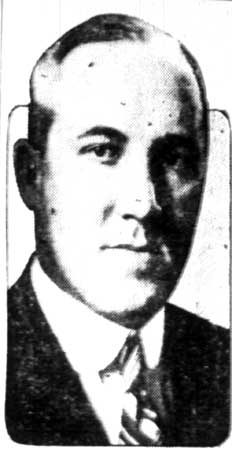
Camden Trenton Bureau
Trenton, Jan. 31—The name of Judge Samuel M. Shay, of the Camden County Court of Common Pleas, has been handed to Governor Moore as the choice of the Camden Democratic organization for prosecutor, succeeding Ethan Wescott.
The name was submitted to Governor Moore last night by a delegation of Camden Democrats, headed by Edward J. Kelleher.
That Governor Moore will send the nomination to the State Senate appears certain, and it not likely that any serious objection will be raised in that body, inasmuch as Judge Shay’s reputation is of the highest and he has been twice before confirmed for the judgeship by the Senate.
Sees Drastic Changes
The choice of Judge Shay was a big surprise in state Democratic ranks, and started a flurry of speculation. If Judge Shay is appointed to the prosecutorship it will leave a vacancy on the bench of the Court of Common Pleas. Although the Camden Democrats are said to be a unit in supporting Shay and also on the other changes they contemplate, no definite word leaked out as to who will be Shay’s successor on the bench.
Judge Shay’s appointment as prosecutor, it was said by Camden Democrats who were here last night, mean drastic changes to the personnel of the Camden Prosecutor’s office. One of the rumors in effect is that District Court Judge Frank F. Neutze will be elevated to the County judgeship and that Prosecutor Wescott will succeed Neutze. It is also rumored that Judge Shay’s present post may go to either former Judge William T. Boyle or former Judge William C. French. Both Boyle and French formerly held the county judgeship position.
Another rumor is that Samuel P. Orlando will be named first assistant prosecutor and that either Francis G. Homan or Lawrence Gregorio, the incumbent will be named second assistant prosecutor.
The names of former Police Judge John T. Cleary and Assistant Prosecutor Joseph A. Varbalow also figure in the rumor. Cleary has been mentioned as first assistant prosecutor several times.
Term is 5 Years
Judge Shay is now serving his second term as Judge. He was reappointed for a five-year tenure of office last March. The term of the prosecutor’s office also is five years.
The proposed changes are said to be steps toward a complete reorganization of the Democratic party in South Jersey.
State Senator Joseph H. Forsyth, whose ‘O. K.’ is necessary before the appointment of Judge Shay could become official, under the “Senatorial courtesy rule” would not comment on the situation here today.
Interviewed in the Senate Chamber prior to the opening of today’s session, Senator Forsyth refused to admit that Governor Moore had sent for him last night and had discussed the appointment of Judge Shay. Forsyth’s answer, however, indicated that he had been in conference with the Governor on the subject last night.
“I have not made up my mind as to my attitude on the nomination of Judge Shay,” Senator Forsyth said. “I want to take up the matter with the Governor first. I do not think it would be proper to give my decision to the newspapers before I discuss the matter with the Governor.”
Headed by Assistant Prosecutor Lawrence Gregorio, County Detective Frank Cocchilaraley and Justice of the Peace Jack O’Grady, a delegation of Camden Democrats were scheduled to arrive in Trenton this afternoon for a conference with Governor Moore in the interest of Prosecutor Wescott.
O’Grady stated he will present letters from the Bricklayers and Ironworkers Unions urging the reappointment of Wescott. Cocchiaraley is heading a group of South Camden Italians who are also favoring the reappointment of Wescott.
Whitman Park Shop 21st Sniper Target
Camden Courier-Post —

Window Shattered But No Missile is Found; 2 Sleuths on Case
While county and city detectives, police of a half-dozen communities and scores of volunteer sleuths sought vainly for some clue to his identity, South Jersey’s “phantom sniper” today fired his twenty-first shot.
Arriving at his place of business, 1201 Mt. Ephraim avenue, this morning, Benjamin Donde found that the plate glass in the door of the shop had been drilled by a small hole, apparently made by a bullet.
As in most of the cases attributed to the “sniper,” no missile was found despite a careful search inside the store.
The twentieth incident of the sort, occurring yesterday when the windshield of an automobile in which Abe Fuhrman, Camden jeweler, and his two sons were riding, had served virtually to eliminate theories that the “sniper’s” weapon might be a sling-shot or a revolver equipped with a silencer.
The missile which drilled a hole in the Fuhrman auto’s windshield was a small, nickel-plated screw. This, of course, could not have been fired from an ordinary rifle or pistol. Police agree, moreover, that no sling shot could be made sufficiently powerful to have driven the screw through the heavy plate glass of the windshield. As it struck, the missile whistled past the ears of the occupants, only a few inches over the heads, and imbedded itself in the upholstery at the rear of the car.
County Detectives Howard Smith and William Cleary, it was announced today, had been assigned to special duty in the manhunt for the sniper.
They were assigned by Prosecutor Ethan P. Wescott. Both agree that the weapon used by the sniper is a compressed air gun.
Bank Embezzler Jokes When Taken to County Prison
Camden Courier-Post —
Garrett Waives Reading of Indictment for $19,000 Systematic Thefts; His Wife Remains Loyal, Discrediting His Confession
Laughing at photographers who tried to snap a picture as he covered his face with his hat and joking with the officers who accompanied him, Burd S. Garrett, for seven years a teller employed by the East End Trust Company was taken from the West Jersey Hospital this morning at 11:15 to the County Courthouse.
When arraigned before Justice of the Peace Peter J. Wallace in the office of Lawrence T. Doran, chief of county detectives, he waived reading and hearing of the complaint charging him with embezzlement of $19,000 of the bank’s funds.
Less than ten minutes after he had entered Chief Doran’s office, the confessed embezzler, accompanied by Detective William Cleary, reappeared and walked to the county jail where he was committed.
Prosecutor Ethan P. Wescott did not attend the arraignment and it was expected that he would set Garrett’s bail sometime this afternoon, when he would announce his intentions as to presentment of the case to the grand jury.
Garrett, who according to Assistant Prosecutor Joseph A. Varbalow admitted manipulation of the bank funds, which he lavished on his wife and the six children he had instructed from birth in the principles of honesty, appeared unmoved this morning by the proceedings.
His face has regained the color it had lost when detectives first began questioning him, as he lay in a coma on a cot at the hospital last Saturday. Since Sunday afternoon, when he broke down and admitted the charges against him, he has chatted with his constable guard.
Garrett’s appearance today was that of a businessman in comfortable circumstances. He was well dressed, in a gray suit, dark overcoat, and wore a light gray soft felt hat. His eyes, behind tortoise shell glasses, were bright, and minus the stare of three days ago.
His wife, despite his reported confession, reiterated her belief today that “it can’t be true.” Firmly declaring that she used economic measures in her housekeeping…
Polack Joe Out on Bail Despite Murder Charge
Camden Courier-Post —
Slayer in 6th Ward G.O.P. Club Fracas Released From Jail by Varbalow
JUDGE SHAY, WESCOTT NOT CONSULTED IN MOVE
Findings of Grand Jury Will Not be Returned Until Tomorrow
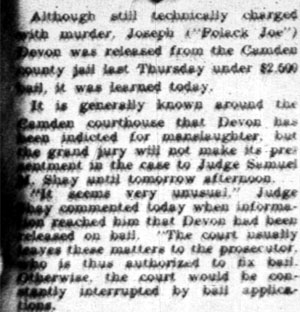
Although still technically charged with murder, Joseph (“Polack Joe”) Devon was released from the Camden county jail last Thursday under $2,500 bail, it was learned today.
It is generally known around the Camden courthouse that Devon has been indicted for manslaughter, but the grand jury will not make its presentment in the case to Judge Samuel M. Shay until tomorrow afternoon. “It seems very unusual,” Judge Shay commented today when information reached him that Devon had been released on bail. “The court usually leaves these matters to the prosecutor, who is thus authorized to fix bail. Otherwise, the court would be constantly interrupted by bail applications.”
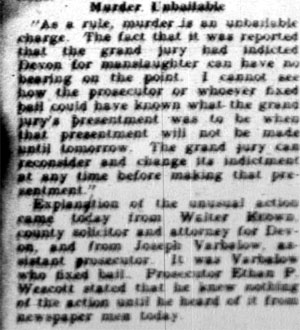
Murder Unbailable
“As a rule, murder is an unbailable charge. The fact that it was reported that the grand jury had indicted Devon for manslaughter can have no bearing on the point. I cannot see how the prosecutor or whoever fixed bail could have known what the grand jury’s presentment was to be when that presentment will not be made until tomorrow. The grand jury can reconsider and change its indictment at any time before making that presentment.”
Explanation of the unusual action came today from Walter Keown, county solicitor and attorney for Devon, and from Joseph Varbalow, assistant prosecutor. It was Varbalow who fixed bail. Prosecutor Ethan P. Wescott stated that he knew nothing of the action until he heard of it from newspaper men today.
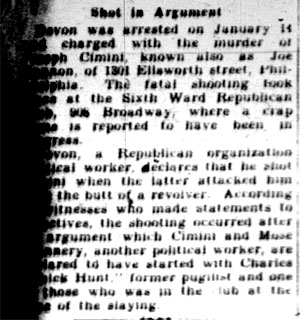
Shot in Argument
Devon was arrested on January 14 and charged with the murder of Joseph Cimini, known also as Joe Gannon, of 1301 Ellsworth street, Philadelphia. The fatal shooting took place at the Sixth Ward Republican Club, 908 Broadway, where a crap game is reported to have been in progress.
Devon, a Republican organization political worker, declares that he shot Cimini when the latter attacked him with the butt of a revolver. According to witnesses who made statements to detectives, the shooting occurred after an argument which Cimini and Mose Flannery, another political worker, are declared to have started with Charles “Chick” Hunt, former pugilist and one of those who was in the club at the time of the slaying.
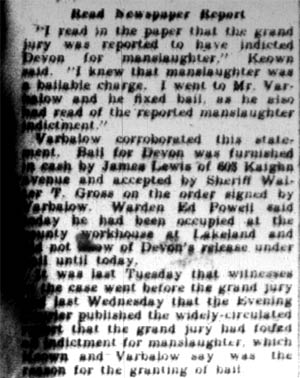
Read Newspaper Report
“I read in the paper that the grand jury was reported to have indicted Devon for manslaughter,” Keown said. “I knew that manslaughter was a bailable charge. I went to Mr. Varbalow and he fixed bail, as he also had read of the reported manslaughter indictment.”
Varbalow corroborated this statement. Bail for Devon was furnished in cash by James Lewis of 60[?] Kaighn avenue and accepted by Sheriff Walter T. Gross on the order signed by Varbalow. Warden Ed Powell said today he had been occupied at the county workhouse at Lakeland and did not know of Devon’s release under bail until today.
It was last Tuesday that witnesses in the case went before the grand jury and it was last Wednesday that the Evening Courier published the widely-circulated report that the grand jury had found an indictment for manslaughter, which Keown and Varbalow say was the reason for the granting of bail.
Katzenbach May Probe Release of ‘Polack Joe’
Camden Courier-Post —
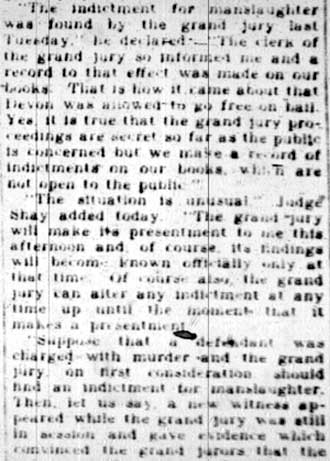
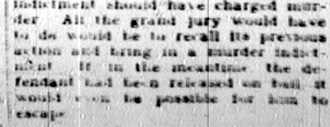
Supreme Court Justice Will ‘Inquire Into’ Granting Bail to Devon on Murder Charge, Week Before Expected Grand Jury Action
An investigation into the release on bail of Joseph (“Polack Joe”) Devon a full week before the Camden county grand jury was scheduled to present its expected indictment for manslaughter and while the accused slayer of Joseph Cimini was still formally charged with murder, was imminent today.
Supreme Court Justice Frank S. Katzenbach, at his office in Trenton, stated this morning that he would “inquire into the circumstances of the case” when he comes to Camden next week to open the current term of court here.
At the same time Common Pleas Judge Samuel M. Shay revealed how it was possible for Devon to have been released on bail while still formally charged with murder, through the acquiescence of Joseph Varbalow, acting assistant prosecutor. Varbalow’s action, it was also pointed out, may be illegal. Attorneys recalled that only a Supreme Court justice can grant an application for bail to a defendant charged with murder. Instances in which a person accused of murder has been released on bail are few, the records show, and “in every case the bail warrant has been signed by a Supreme Court justice.” This was the procedure, for example, in the release on bail of Mrs. Frances Stevens Hall shortly after her arrest in the famous Hall-Mills murder trial.
In the case of Devon, however, no Supreme Court justice was notified.
Further than this, Judge Shay, whose signature appears on the bail warrant, was not consulted.
Devon was held without bail on a murder charge after the fatal shooting of Cimini at the Sixth Ward Republican Club last January. On March 27 the case was presented to the grand jury with appearance of witnesses to the shooting before that body. The following day the report was widely circulated around the Camden Court House that Devon had been indicted for manslaughter.
Apparently this report, “unofficial” in character, was the only basis for release of Devon on bail. The grand jury will not make its presentment until this afternoon. If the manslaughter indictment has been found, it will thus not be formally recorded until this afternoon. But on Thursday last, while he was still technically held for murder, Devon was freed under $2,500 bail.
“All bail warrants must be signed by the judge,” it was explained today by Judge Shay, who did not learn of Devon’s release until yesterday, although his name appears on the bail warrant. “For some time, however, the custom has been in this county and I believe in others as well for the judge to sign a number of these bail warrants in blank and turn them over to the prosecutor’s office. This is done because of the trust placed in the prosecutor’s office by the court, and in order that the judge may not be interrupted during court sessions or at his home with applications for bail.”
“Of course, if the judge finds that this trust is misplaced, it will be necessary for him to take over these matters himself and consider applications for bail individually instead of leaving it to the prosecutor’s office.”
Acting Prosecutor Ethan P. Wescott said yesterday that he had known nothing of Devon’s release on bail. The agreement for the acceptance of bail was made, it was learned, between Varbalow and Walter Keown, county solicitor and attorney for Devon.
“We could not refuse to fix bail after Devon had been indicted for a bailable offense,” Varbalow stated in explanation, although admitted that the only definite basis for his belief that the offense charged against Devon was bailable was an unofficial report that a manslaughter indictment had been found.
Varbalow definitely stated today that the indictment found against Devon was one of manslaughter and would be so reported this afternoon by the grand jury.
“The indictment for manslaughter was found by the grand jury last Tuesday,” he declared. “The clerk of the grand jury so informed me and a record to that effect was made on our books. That is how it came about that Devon was allowed to go free on bail. Yes, it is true that the grand jury proceedings are secret so far as the public is concerned, but we make a record of indictments on our books, which are not open to the public.”
“The situation is unusual,” Judge Shay added today. “The grand jury will make its presentment to me this afternoon and, of course, its findings will become known officially only at that time. Of course also, the grand jury can alter any indictment at any time up until the moment that it makes a presentment.”
“Suppose that a defendant was charged with murder and the grand jury, on first consideration, should have had an indictment for manslaughter. Then, let us say, a new witness appeared while the grand jury was still in session and gave evidence which convinced the grand jurors that the indictment should have charged murder. All the grand jury would have to do would be to recall its previous action and bring in a murder indictment. If in the meantime the defendant had been released on bail, it would even be possible for him to escape.”
Bar Urges Forsyth to Raise Neutze Ban
Camden Courier-Post —
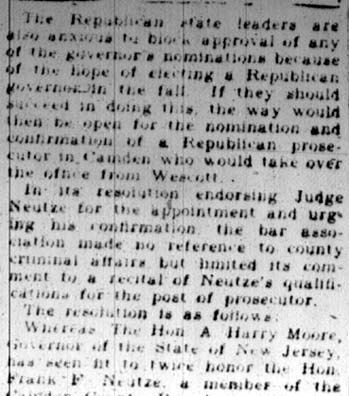
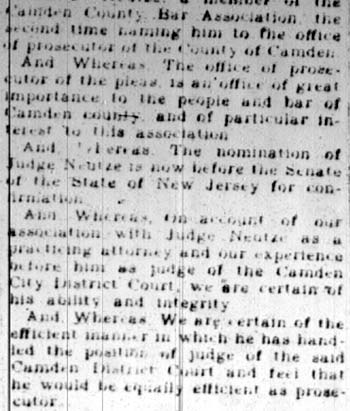
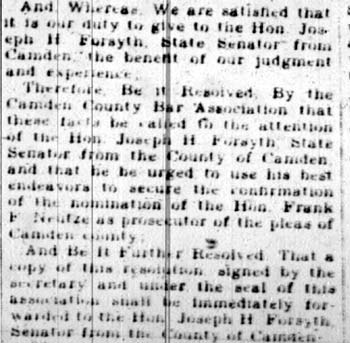
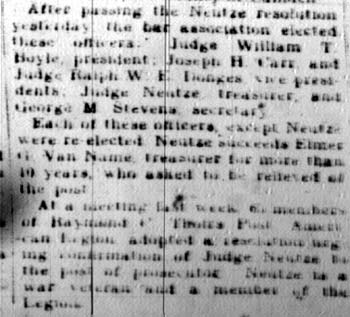
Resolution Asks Senator to Permit Confirmation as Prosecutor
The Camden County Bar Association today was on record as urging State Senator Joseph H. Forsyth to permit confirmation of Judge Frank F. Neutze as Camden county prosecutor.
The association, composed of attorneys of both political parties, adopted a resolution yesterday which [?] upon Senator Forsyth to withdraw his opposition to Neutze.
Meanwhile, however, the Republican State Senators conferred at Trenton and decided to withhold confirmation of most of Governor A. Harry Moore’s important appointments. Neutze’s nomination, sent to the Senate after Forsyth had refused to approve the appointment of Judge Samuel M. Shay to the post, is among these, as is the nomination of Judge Charles Egan as Hudson county prosecutor.
The Camden county Republican organization, it is known, favors retention of Ethan P. Wescott as prosecutor until after the November election. Wescott is now serving as acting prosecutor under temporary appointment as deputy attorney general, to which position he was recently named by Attorney General Edward L. Katzenbach upon expiration of his regular term as prosecutor. Unless the senate confirms Neutze, it was said at Governor Moore’s office today, no further nominations to the post will be sent to the senate.
The Republican state leaders are also anxious to block approval of any of the governor’s nominations because of the hope of electing a Republican governor in the fall. If they should succeed in doing this, the way would then be open for the nomination and confirmation of a Republican prosecutor in Camden who would take over the office from Wescott.
In its resolution endorsing Judge Neutze for the appointment and urging his confirmation the bar association made no reference to county criminal affairs but limited its comment to a recital of Neutze’s qualifications for the post of prosecutor.
The resolution is as follows:
Whereas The Hon. A. Harry Moore, Governor of the State of New Jersey, has seen fit to twice honor the Hon. Frank F. Neutze, a member of the Camden County Bar Association, the second time naming him to the office of prosecutor of the County of Camden.
And Whereas, The office of prosecutor of the pleas, is an office of great importance to the people and bar of Camden county, and of particular interest to this association.
And Whereas, The nomination of Judge Neutze is now before the Senate of the State of New Jersey for confirmation.
And Whereas, On account of our association with Judge Neutze as a practicing attorney and our experience before him as judge of the Camden City District Court, we are certain of his ability and integrity.
And Whereas, We are certain of the efficient manner in which he has handled the position of judge of the said Camden District Court and feel that he would be equally efficient as prosecutor.
And Whereas, We are satisfied that it is our duty to give to the Hon. Joseph H. Forsyth, State Senator from Camden, the benefit of our judgment and experience.
Therefore, Be It Resolved, By the Camden County Bar Association that these facts be called to the attention of the Hon. Joseph H. Forsyth, State Senator from the County of Camden, and that he be urged to use his best endeavors to secure the confirmation of the nomination of the Hon. Frank F. Neutze as prosecutor of the pleas of Camden county.
And Be It Further Resolved, That a copy of this resolution, signed by the secretary and under the seal of this association, shall be immediately forwarded to the Hon. Joseph H. Forsyth, Senator from the County of Camden.
After passing the Neutze resolution yesterday, the bar association elected these officers: Judge William T. Boyle, president; Joseph H. Carr, and Judge Ralph W. E. Donges, vice presidents; Judge Neutze, treasurer; and George M. Stevens, secretary.
Each of these officers except Neutze were re-elected. Neutze succeeds Elmer ti Van Name, treasurer for more than 10 years, who asked to be relieved of the post.
At a meeting last week 60 members of Raymond C. Thomas Post, American Legion, adopted a resolution urging confirmation of Judge Neutze for the post of prosecutor. Neutze is a war veteran and a member of the Legion.
Orlando Raids 35 Gambling Haunts in Slot Machine Drive
Camden Evening Courier —
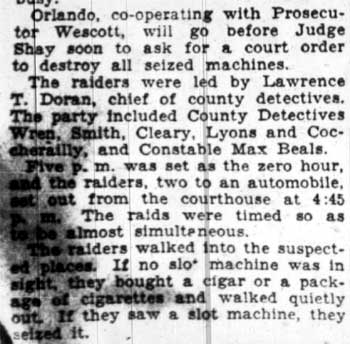
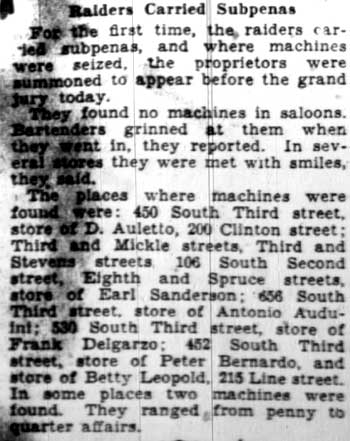
The second blow within 24 hours at the slot-machine “racket” in Camden was to be made this afternoon in the grand jury rooms in Camden County Court House.
[illegible] with evidence secured in [illegible]ay’s surprise raid, Assistant Prosecutor Samuel P. Orlando was to ask the jury to inquire into the illegal operation of the machines in Camden saloons, cigar stores and cafes.
The grand jury convened at 1:30 p. m.
[illegible]teen of the “money” devices were seized, and as many proprietors of the places where they were found were summoned to appear before the jurors when county detectives and constables swooped down on 35 alleged gambling haunts.
A conference of Republican organization leaders was held this morning, at which the slot machine raids and the impending grand jury investigation were discussed. According to authentic reports, it was the opinion of the leaders that an intensive grand jury probe would be “bad politics.”
It was decided to bring pressure to bear upon Prosecutor Ethan P. Wescott to “call off” Assistant Prosecutor Orlando, who engineered the raids last night.
This afternoon, when the grand jury convened, both Wescott and Orlando went before the jury, in their closed session.
Orlando made it clear, in a statement, that he is not after “small fry” but intends to get the “higher-ups” in the slot machine “game” in Camden city and county.
“I am not going to give the proprietors of the slot machines time to exert their usual political pull, but I intend to have them before the grand jury immediately. I am going to find out, with the help and co-operation of the members of the jury, where they got their machines, how they arrive at their percentage and who is protecting them.
“I have been making a survey of Camden county, including the city, since I took office ten days ago,” he continued, “and I have considerable evidence. I believe that there are, conservatively, 500 slot machines in Camden county and that the income from each of them averages from $50 [illegible] a week. You can make your own multiplication. I believe nearly $[illegible],000 a week is split up, in various ways, from the slot machine racket in the city and county. That money, wherever it goes, is coming from many people who can ill afford to lose it. They need it to pay their butchers and grocers.”
Several Places ‘Tipped Off’
Although Orlando struck quickly, there were several places where the coming of his men had been “tipped off.” A few places, where the noise of machines had been heard for weeks by passersby were strangely silent last night when the county raiders got busy.
Orlando, co-operating with Prosecutor Wescott, will go before Judge Shay soon to ask for a court order to destroy all seized machines.
The raiders were led by Lawrence T. Doran, chief of county detectives. The party included County Detectives Wren, Smith, Cleary, Lyons and Cocherailly, and Constable Max Beals.
Five p. m. was set as the zero hour, and the raiders, two to an automobile, set out from the courthouse at 4:45 p. m. The raids were timed so as to be almost simultaneous.
The raiders walked into the suspected places. If no slot machine was in sight, they bought a cigar or a package of cigarettes and walked quietly out. If they saw a slot machine, they seized it.
Raiders Carried Subpenas
For the first time, the raiders carried subpenas, and where machines were seized, the proprietors were summoned to appear before the grand jury today.
They found no machines in saloons. Bartenders grinned at them when they went in, they reported. In several stores they were met with smiles, they said.
The places where machines were found were: 450 South Third street, store of D. Auletto, 200 Clinton street; Third and Mickle streets, Third and Stevens streets 106 South Second street, Eighth and Spruce streets, store of Earl Sanderson; 656 South Third street, store of Antonio Auduini; 530 South Third street, store of Frank Delgarzo; 452 South Third street, store of Peter Bernardo, and store of Betty Leopold, 215 Line street. In some places two machines were found. They ranged from penny to quarter affairs.
500 Arrested in Roadhouse Raids
Lancaster Daily Eagle —
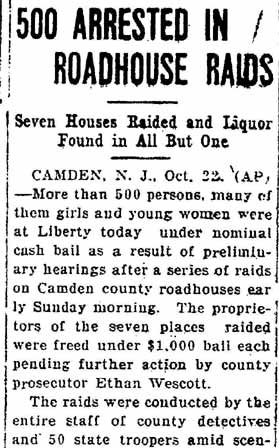
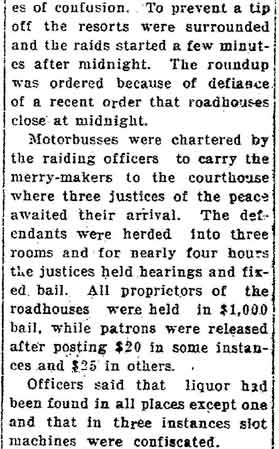
Seven Houses Raided and Liquor Found in All But One
CAMDEN, N. J., Oct. 22. (AP.)—More than 500 persons, many of them girls and young women were at Liberty today under nominal cash bail as a result of preliminary hearings after a series of raids on Camden county roadhouses early Sunday morning. The proprietors of the seven places raided were freed under $1,000 bail each pending further action by county prosecutor Ethan Wescott. The raids were conducted by the entire staff of county detectives and 50 state troopers amid scenes of confusion. To prevent a tip off the resorts were surrounded and the raids started a few minutes after midnight. The roundup was ordered because of defiance of a recent order that roadhouses close at midnight.
Motorbusses were chartered by the raiding officers to carry the merry-makers to the courthouse where three justices of the peace awaited their arrival. The defendants were herded into three rooms and for nearly four hours the justices held hearings and fixed bail. All proprietors of the roadhouses were held in $1,000 bail, while patrons were released after posting $20 in some instances and $25 in others. Officers said that liquor had been found in all places except one and that in three instances slot machines were confiscated.
Joe Montana Wed to Miss Palladino
Camden Courier-Post —
Camden Wrestler and Bride Are Given Dinner Attended by Notables
Miss Emma Palladino, one of the fairest daughters of Camden’s “Little Italy” yesterday became the bride of Joseph Montana, heavyweight wrestler, at Our Lady of Mt. Carmel Church, Fourth and Division streets.
Idol of Italian youth in this city Montana was hailed by hundreds of them outside the church. A number of relatives and friends, including prominent figures in the legal and professional life of the city, attended a dinner in honor of the couple at Overbrook Villa, Lindenwold, following the ceremony.
The bride, 20, is the daughter of Joseph Palladino, commercial photographer of 1115 South Fourth street. She graduated from Camden High school in 1928. Montana is 26 and a contender for the world’s heavy-weight wrestling diadem. Following a wedding tour through the West the couple plan to reside in Camden.
Miss Emenia D’Alesio, of Audubon, and Miss Rose Marini and Miss Cecelia Szymanski, of Camden, served as bridesmaids. Attending the groom were Gene Mariano, Michel D’Ilesia and William Palladino. The bride carried a bouquet of lillies of the valley and white roses while her attendants held tulips and roses. The church was beautifully decorated with varied floral designs, gold ribbons, silks and satins.
The guest list at the bridal dinner included: Assemblyman Frank M. Travaline, Jr., City Commissioner Clay W. Reesman, director of parks and public property; Acting Chief of Police of John W. Golden, former Prosecutor and Mrs. Ethan P. Wescott, Samuel P. Orlando, Guido Laurini, Detective Fiore Troncone, Antonio Mecca, Mr. and Mrs. William Denof, Mr. and Mrs. Pasquale Ianuzzi, Frank H. Ryan, Thomas H. Ryan, Dr. and Mrs. Robert Principato, Mr. and Mrs. William Averall, Luke McKenna, Mr. and Mrs. Gene Mariani, Mr. and Mrs. Frank Abbott, Frank P. Cocchiaraley and Miss Regina Cocchiaraley, all of Camden; Miss Mary Montana, and Mr. and Mrs. Ettore Montana, of Columbus OH., and Aristadino D’Guilia and sons, Albert and Peter, of Buffalo, NY.
30 Cops Shifted Today in Opening of New District
Camden Courier-Post —

Shake-Up in Camden Force is Most Drastic in History
SMITH AT CITY HALL
Drastic shifts in the Camden police department, affecting more than 30 members of the force became effective at 8 a.m. today.
The shake-up, announced yesterday by Commissioner David S. Rhone, director of public safety, is the result of creation of a fourth police district.
The outstanding changes are the promotion of Sergeant of Detectives George Ward to acting lieutenant in the First district, supplanting Sergeant Samuel Nayler, who is sent to headquarters, and the return to the city detective bureau of Acting County Detective Howard Smith.
Smith was detailed to the second district today and was assigned to a robbery investigation in the thirteenth ward.
District Captaincies Abolished
With the shifts, the rank of district captain is abolished. Instead, lieutenants will be in charge of the districts. Captains will be in charge only of the traffic and detective bureaus and headquarters, Commissioner Rhone said.
The removal of Sergeant Naylor from the First District was not unexpected, since he had been “on the carpet” last October as a result of a speakeasy shooting in his district. Naylor, though holding the rank of sergeant, was acting captain of the district.
He was threatened with dismissal by Chief Stehr and Commissioner Rhone if the vice conditions in the First District were not cleaned up. The situation came to a climax with the wounding of Charles Arini and Louis Dei Duca in a speakeasy at Third and Mickle streets in October. It was reported Naylor was to be removed from the district several times since.
Ward Again Promoted
Ward was promoted to sergeant of detectives two months ago. Under the transfer, he is promoted again, remaining as acting lieutenant for a year, until he takes an examination for a lieutenancy.
Other police officers now acting-lieutenants will become lieutenants after examination.
Naylor, who was in charge of the First district for several years, will serve as desk sergeant under Capt. A. Lincoln James.
The return of Smith to the city detective bureau was requested by Prosecutor Clifford A. Baldwin, it is understood. Smith has been a county detective for more than eleven years. He first was transferred to the prosecutor’s office at the request of Prosecutor Charles A. Wolverton. Although a Republican, he was retained there under Prosecutor Ethan P. Wescott. Although some surprise was occasioned by the announcement of Smith’s return to the city force, inasmuch as the new prosecutor is a Republican, it was said that Baldwin wished to begin his term with an entire new force.
Worked For City Also
Although Smith acted for the county and was paid by the county, he received a salary of $1 a year to retain him in the city so that he could be recalled at any time.
Through the shift, Sergeant Charles Laib, serving under Traffic Inspector Charles T. Humes, is elevated to acting captain of the traffic department. In the future all motorcycle men with the exception of George Clayton will report direct to Humes and Laib instead of to headquarters.
Ralph Bakley, who has been acting sergeant of the First District, has been named acting lieutenant of the Second District, and Thomas Cunningham, who was acting captain of the Second District, becomes acting lieutenant of the new Fourth District. William Horner, who has been acting captain of the Third District, is elevated to the rank of acting lieutenant and remains in charge of that district.
3 in Assembly Race Plan Tour Tonight
Camden Courier-Post —
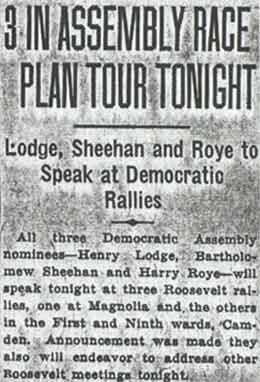
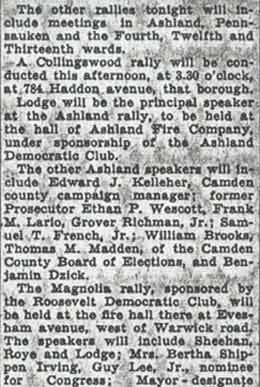
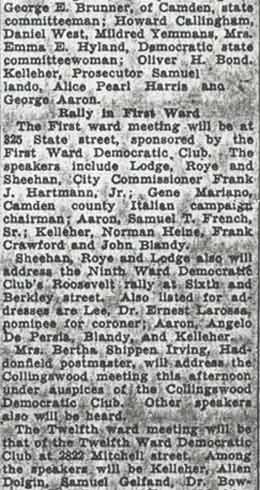
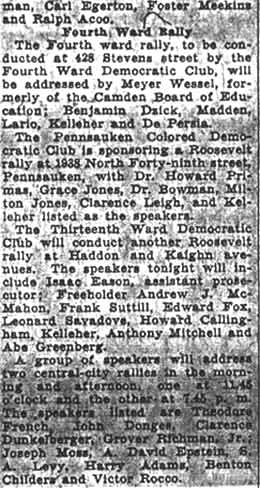
Lodge, Sheehan and Roye to Speak at Democratic Rallies
All three Democratic Assembly nominees—Henry Lodge, Bartholomew Sheehan and Harry Roye—will speak tonight at three Roosevelt rallies, one at Magnolia and the others in the First and Ninth wards, Camden. Announcement was made they also will endeavor to address other Roosevelt meetings tonight.
The other rallies tonight will include meetings in Ashland, Pennsauken and the Fourth, Twelfth and Thirteenth wards.
A Collingswood rally will be conducted this afternoon, at 3.30 o’clock, at 784 Haddon avenue, that borough.
Lodge will be the principal speaker at the Ashland rally, to be held at the hall of Ashland Fire Company, under sponsorship of the Ashland Democratic Club.
The other Ashland speakers will include Edward J. Kelleher, Camden county campaign manager; former Prosecutor Ethan P. Wescott, Frank M. Lario, Grover Richman, Jr.; Samuel T. French, Jr.; William Brooks; Thomas M. Madden, of the Camden County Board of Elections, and Benjamin Dzick.
The Magnolia rally, sponsored by the Roosevelt Democratic Club, will be held at the fire hall there at Evesham avenue, west of Warwick road. The speakers will include Sheehan, Roye and Lodge; Mrs. Bertha Shippen Irving, Guy Lee, Jr., nominee for Congress; Mayor-designate George E. Brunner, of Camden, state committeeman; Howard Callingham, Daniel West, Mildred Yemmans, Mrs. Emma E. Hyland, Democratic state committeewoman; Oliver H. Bond. Kelleher, Prosecutor Samuel Iando [sic], Alice Pearl Harris and George Aaron.
Rally in First Ward
The First ward meeting will be at 325 State street, sponsored by the First Ward Democratic Club. The speakers include Lodge, Roye and Sheehan, City Commissioner Frank J. Hartmann, Jr.; Gene Mariano, Camden county Italian campaign chairman; Aaron, Samuel T. French, Sr.; Kelleher, Norman Heine, Frank Crawford and John Blandy.
Sheehan, Roye and Lodge also will address the Ninth Ward Democratic Club’s Roosevelt rally at Sixth and Berkley street. Also listed for addresses are Lee, Dr. Ernest Larossa, nominee for coroner; Aaron, Angelo De Persia, Blandy, and Kelleher.
Mrs. Bertha Shippen Irving, Haddonfield postmaster, will address the Collingswood meeting this afternoon under auspices of the Collingswood Democratic Club. Other speakers also will be heard.
The Twelfth ward meeting will be that of the Twelfth Ward Democratic Club at 2822 Mitchell street. Among the speakers will be Kelleher, Allen Dolgin, Samuel Gelfand, Dr. Bowman, Carl Egerton, Foster Meekins and Ralph Acoo.
Fourth Ward Rally
The Fourth ward rally, to be conducted at 428 Stevens street by the Fourth Ward Democratic Club, will be addressed by Meyer Wessel, formerly of the Camden Board of Education; Benjamin Daick, Madden, Lario, Kelleher and De Persia.
The Pennsauken Colored Democratic Club is sponsoring a Roosevelt rally at 1838 North Forty-ninth street, Pennsauken, with Dr. Howard Primas, Grace Jones, Dr. Bowman, Milton Jones, Clarence Leigh, and Kelleher listed as the speakers.
The Thirteenth Ward Democratic Club will conduct another Roosevelt rally at Haddon and Kaighn avenues. The speakers tonight will include Isaac Eason, assistant prosecutor; Freeholder Andrew J. McMahon, Frank Suttill, Edward Fox, Leonard Savadove, Howard Callingham, Kelleher, Anthony Mitchell and Abe Greenberg.
A group of speakers will address two central-city rallies in the morning and afternoon, one at 11.45 o’clock and the other at 7.45 p. m. The speakers listed are Theodore French, John Donges, Clarence Dunkelberger, Grover Richman, Jr.; Joseph Moss, A. David Epstein, S. A. Levy, Harry Adams, Benton Childers and Victor Rocco.
The Wescott Family Plot at Harleigh Cemetery
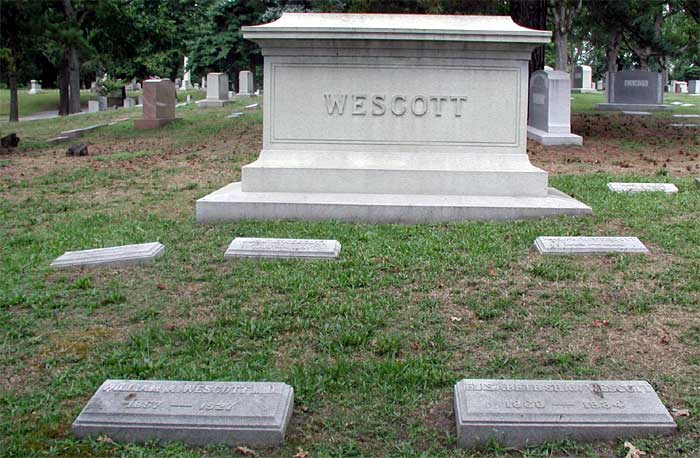
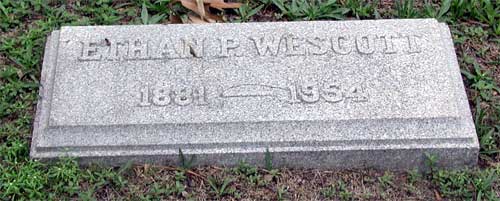
The Wescott Family Plot at Harleigh Cemetery, Camden NJ
‘Larry’ Doran Given Tribute at Dinner On Retirement as Head of Co. Sleuths
Camden Courier-Post —
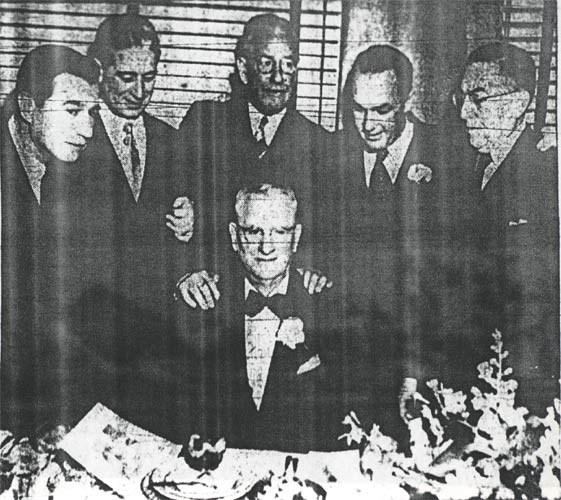
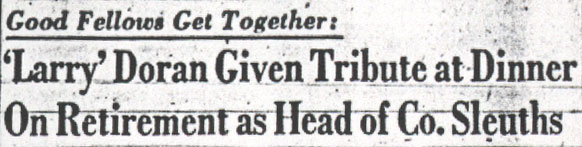
Good Fellows Get Together:
A cop’s life is filled with headaches and heartaches, and after time has taken its toll, a quiet life as a pensioner with some fishing and reminiscing with the few cronies who remember when—
But there was no quiet retirement and seclusion for Larry Doran. And after Thursday night’s farewell, there will be plenty to remember.
For Thursday was quite a night. Senator, congressman, judge, prosecutor, assistant prosecutor, lawyer, doctor and plain everyday layman gathered to pay homage to a grand cop.
“When a feller takes office and he is praised by such a gathering as this, he cannot help but wonder how many of those present are looking for something for themselves,” Larry Doran grinned hugely. “But when you are retiring and there is no favor left to bestow, but you are still honored by such a gathering as this, then you know you are among friends.”
Retires as Chief
Well, Larry Doran was among friends Thursday night. Several hundred of them. The place was Kenny’s, the affair a dinner, the occasion Doran’s retirement as county detective chief.
It wasn’t a testimonial dinner in that sense. The speakers were to tell the truth about Larry, and Larry was to tell the truth about the speakers. He won on both counts.
More than 40 years ago, Doran was a Camden cop. Then he was a game warden.
In 1910, he went into the prosecutor’s office as a county detective. Congressman Charles A. Wolverton, then a prosecutor, greeted him with “H’ya Irish.” That, and more, was recalled by the congressman at Thursday night’s dinner.
Lauded as ‘Institution’
Fifteen years later, he was named chief by Ethan Wescott, then prosecutor. That, and more, was recalled by Wescott at the dinner. Others, too. Former Prosecutors Samuel P. Orlando and Gene R. Mariano, and present Prosecutor Mitchell Cohen, Supreme Court Justice Albert E. Burling, speaking as a former prosecutor’s attache, and County Judge Rocco Palese, speaking in behalf of all assistant prosecutors—and they were legion—spoke of his unflagging devotion to duty, his perseverance and his loyalty. U. S. District Judge Thomas M. Madden, Superior Court Judge Frank T. Lloyd Jr., whose father knew Doran well while a Supereme [sic] Court Justice; Superior Court Judge Ralph W. E. Donges, and County Judge Bart A. Sheehan, the principal speaker, all lauded Doran not only as a law enforcement officer but also as an institution in the community.
There were many fellow police officers on hand, too. They included Assistant Superintendent of Philadelphia Police George Richardson, who presented Doran with a season pass for the Athletics on behalf of Connnie [sic] Mack; Capt. Thomas Cunningham and Lt. William Kelly of the state police. Chiefs John Parker of Audubon; Thomas Thorpe, of Pennsauken; William Beck of Collingswood; William Snyder of Haddon township; William Padgett of Haddonfield; County Detective Chief George Small of Gloucester; County Detective Captain Clinton Zeller of Burlington, and detectives from Mercer and Atlantic counties.
Receives $500 Bond
Many other public figures were there, including State Sen. Bruce Wallace, Assemblyman George Neutze, County District Judge Edward Martino, City Police Judge John DiMona, city and county officials, and the entire personnel of the prosecutor’s office.
The dinner committee was headed by Anthony Mitchell and [text missing between crops] presentation of a $500 savings bond to Doran, but the highlight of the evening was Doran’s impromptu remarks of appreciation. He spoke with the humility of a man overwhelmed by the eulogies he had heard applied to himself, reminisced humorously, and capped the best address of the evening by resting his case with the summation:
“A cop’s life is filled with headaches. And sometimes he causes heartache. I have enforced the law as I saw it without favor. I did the best I could. And I have no apologies.”
Suttill, Wescott Are Picked for Renomination
Camden Courier-Post —
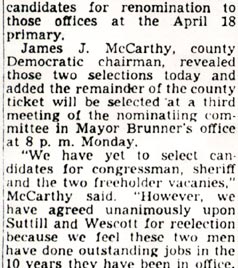
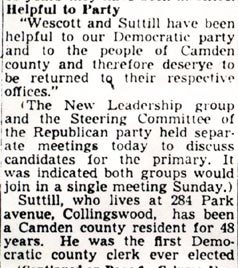
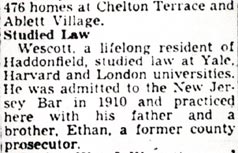
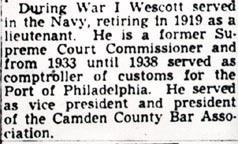
Democrats to Slate Rest of Ticket at Parley Monday
County Clerk Frank J. Suttill and Register of Deeds Ralph W. Wescott will be the Democratic candidates for renomination to those offices at the April 18 primary.
James J. McCarthy, county Democratic chairman, revealed those two selections today and added the remainder of the county ticket will be selected at a third meeting of the nominatiing [sic] committee in Mayor Brunner’s office at 8 p. m. Monday.
“We have yet to select candidates for congressman, sheriff and the two freeholder vacancies,” McCarthy said. “However, we have agreed unanimously upon Suttill and Wescott for reelection because we feel these two men have done outstanding jobs in the 10 years they have been in office.
Helpful to Party
“Wescott and Suttill have been helpful to our Democratic party and to the people of Camden county and therefore deserve to be returned to their respective offices.”
(The New Leadership group and the Steering Committee of the Republican party held separate meetings today to discuss candidates for the primary. It was indicated both groups would join in a single meeting Sunday.)
Suttill, who lives at 284 Park avenue, Collingswood, has been a Camden county resident for 48 years. He was the first Democratic county clerk ever elected in this county. He was a former member of the Democratic county committee and was a candidate for the Assembly in 1926 and 1928, and a candidate for register of deeds in 1930, but failed of election both times. He also served as chairman of the Camden Housing Authority, its executive director, and a supervisor of the authority in the construction of 476 homes at Chelton Terrace and Ablett Village.
Studied Law
Wescott, a lifelong resident of Haddonfield, studied law at Yale, Harvard and London universities. He was admitted to the New Jersey Bar in 1910 and practiced here with his father and a brother, Ethan, a former county prosecutor.
During War I Wescott served in the Navy, retiring in 1919 as a lieutenant. He is a former Supreme Court Commissioner and from 1933 until 1938 served as comptroller of customs for the Port of Philadelphia. He served as vice president and president of the Camden County Bar Association.