Introduction
STEPHEN DECATUR BUTTON was born on June 15, 1813 in Preston CT to Roswell and Lydia Avery Button. He apprenticed for five years to his Uncle Samuel Button, a carpenter, at the age of sixteen. Button moved to New York City after gaining his freedom where he became an assistant to the architect George Purvis, with whom he remained for about two years. Striking out on his own, Button worked independently for a decade in the Hoboken, NJ, area. In the mid-1840s he moved south, working in Florida and Georgia in 1845–46.
In the latter year he entered and won the competition for the Alabama State Capitol in Montgomery with a Roman Revival design. Relocating to the Philadelphia area, he formed a partnership with his brother-in-law, Joseph C. Hoxie, in 1848. This formal relationship continued until about 1852 when it was dissolved by mutual agreement. The earliest known Hoxie & Button design is the Egyptianesque Odd Fellows’ Cemetery Entrance, built around 1849 in Philadelphia. By the 1850s, however, Button appears to have fully embraced the picturesque, eclectic, and flexible Italianate style that would characterize most of his important commissions, such as the Spring Garden Institute, from around 1851–1852, and the Romanesque First Baptist Church, built between 1853 and 1856. In 1854 Button entered the competition for the Academy of Music and secured the second premium after the winning design of Lebrun and Runge. In 1858 he designed the more conservative Colestown Cemetery gatehouse, which still stands at the corner of Church Road and Kings Highway.
A successful contemporary of Thomas Ustick Walter and Samuel Sloan, Button was one of the organizers of the Pennsylvania Institute of Architects in 1861 which later became the Philadelphia Chapter of the American Institute of Architects. His practice was largely confined to Philadelphia, Camden, NJ, where he designed the City Hall and several schools and churches, and New Jersey shore communities.
In Camden, Stephen Decatur Button’s most lasting work has been the Richard Fetters School on the southwest corner of South 3rd Street at Walnut Street. Erected in 1875 along with two identical twin structures, the Isaac S. Mulford School which was diagonally across the street, and the John W. Mickle School at 6th and Van Hook Streets, Fetters remains in use in use in 2007, long after many schools built subsequently were abandoned. The design in Camden that he was most recognized for in his day was of course Camden’s City Hall, which stood on Haddon Avenue, and remained in use until its replacement in 1930. He also designed the First Presbyterian Church, and the Second Presbyterian Church.
Besides his work in Camden and Philadelphia, Stephen Decatur Button also designed at least 30 buildings in Cape May and Sea Isle City, may of which remain in use today. Among his works were the Chalfont, Congress Hall, and Stockton Hotels.
Stephen D. Button has been characterized by his biographer as “a capable, financially successful architect much in demand in the Philadelphia area” in the mid-nineteenth century.”
Stephen Decatur Button had moved to Camden by October of 1854 when his wife Hannah Mariah, bore him a son, William Goodwill Button. A daughter, Maria Lydia, known as Lydia, came two years later. The Buttons made there home at 330 Mickle Street. They still lived there at the time of the 1880 Census, although William had wed and moved out on his own.
Stephen Decatur Button would remain at that address though the rest of his life. By 1887 his neighbor at 328 Mickle just happened to be the famous poet Walt Whitman. One can only speculate on whether these two creative individuals influenced any of the other’s work. As an old man, he didn’t wear glasses to do his work. When he was eighty, in June 1893, Mr. Button was presented with an illuminated testimonial to which were appended the names of forty architects of various parts of the country. A sketch of his life was published in the Philadelphia papers, and on his anniversary he was deluged by telegrams of congratulations from friends throughout the country.
Mr. Button died on January 17, 1897. He gave his valuable architectural library to the Philadelphia Chapter of the American Institute of Architects. Stephen Button was also a one of the most learned mineralogists in South Jersey, and had a private collection of rare and beautiful specimens. This collection was given to the South Jersey Institute.
Stephen Decatur Bunting was succeeded in his office at 430 Walnut Street in Philadelphia by Schermerhorn & Reinhold. During his life he was a member of the following organizations, the American Institute of Architects (the AIA), the Philadelphia Chapter of the AIA, and the Pennsylvania Institute of Architects. He also was affiliated with the Spring Garden Institute.
City Hall
Camden NJ
The postcards below are of Camden’s first City Hall. The center card was postmarked in 1907, the other two were mailed in 1914.
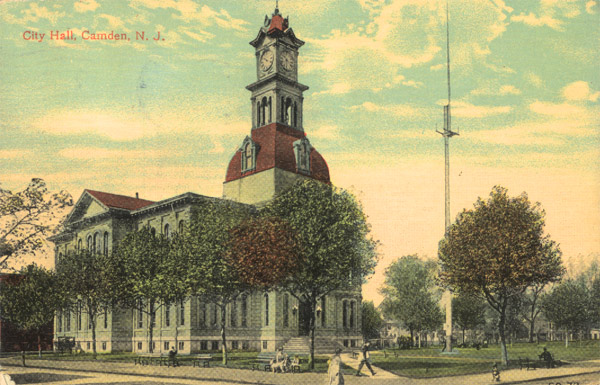
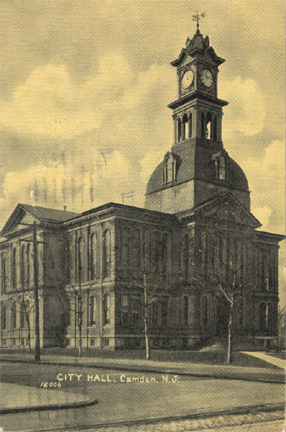
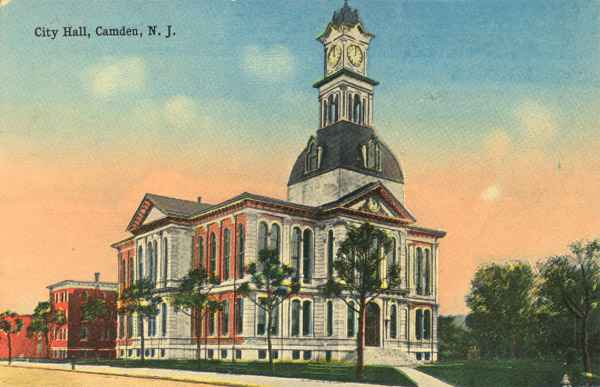
Camden City Hall postcards. Above: center card postmarked 1907, others mailed 1914.
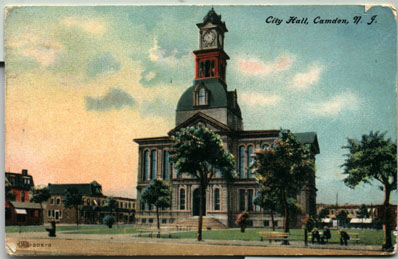
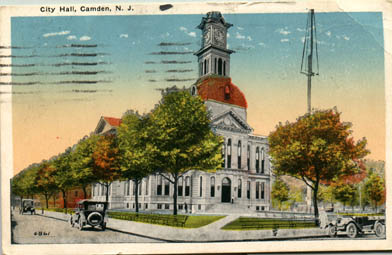
Additional views of Camden City Hall
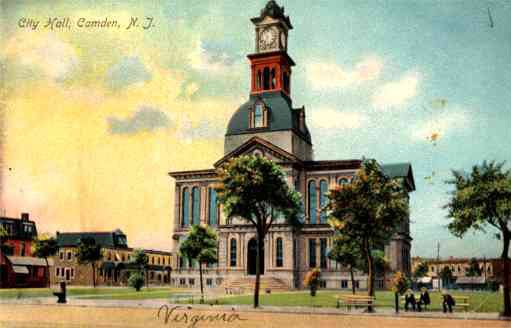
Camden City Hall postcard
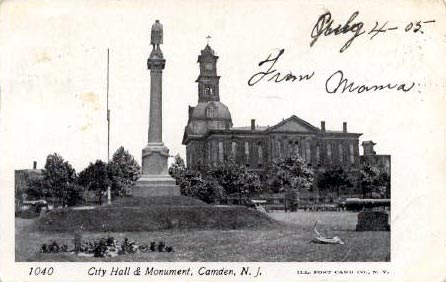
Camden’s first City Hall and the Soldier’s Monument. The card was mailed August 4, 1905.
400 Friends Pay Homage To ‘Good Gray Poet’
Camden Courier-Post —
Men and Women From Many Sections Visit Walt Whitman’s Tomb and Old Mickle Street Home on His 114th Anniversary
“It’s just a little street where old friends meet”
That’s Mickle Street where Walt Whitman, the “Good Gray Poet,” once lived, and old friends came back here from near and far yesterday to mingle under the portals of the house in which he wrote his famous works, on the 114th anniversary of his birth.
Among them was Mrs. Augusta K. Dole, 71, of Metuchen, whose husband has been a sports writer on New York newspapers for 45 years.
“They call it a dingy street and some are ashamed to return and say they lived there,” Mrs. Dole said. And with a gesture of the hand she pointed out the homes of some of neighbors, who became famous.
Among them was Button; famous artist [architect]. Another was the grandmother of J. B. Van Sciver.
“I lived at 319 Mickle Street when I was a young lady,” she said. “I was one year old when we moved into the house right across the street from Whitman. I remember when he lived on Stevens Street before he moved to Mickle Street.
Knew Whitman Well
“We lived at the Mickle Street address about 15 or 16 or 20 years; I knew Whitman well. He always stopped and exchanged greetings with me. I frequently saw him on the ferryboats crossing the rivers.
“I want to take issue right here with those who have questioned his chastity. He was more like Christ than anyone else. I saw him admiring me as a young woman one day on a ferryboat.”
“Years later I read a description of myself in one of his works. I did not begin to read his work until 30 years ago. He wrote of the true things in life. He wrote of life as it is and as we see it. I am glad to come here today at the invitation of the committee,”
Mrs. Dole sat in the last chair in which the poet rested before his last illness. She was introduced to Dr. Alexander MacAlister, who was his personal physician in his last illness and who is a member of the Walt Whitman foundation.
Then she posed with an etching by Lewis Daniel, New York artist, at the Walt Whitman art gallery, 641 Market Street. It is one of 14 the young artist drew on “The Song of the Open Road.” Two lines taken from the book are sketched under the etching as follows:
“The earth is crude and incomprehensible at first— Nature is rude and incomprehensible at first.”
400 Visit Home
More than 400 guests visited the home of the poet during the day to be welcomed by members of the foundation. Mrs. Charles A. Wolverton, wife of Congressman Wolverton, was chairman of the reception committee.
Many of the guests visited the tomb of the poet in Harleigh Cemetery where the door is ajar at his request “that his spirit may come and go as I choose.’” But no flowers were placed there as he requested none.
Born on May 31, 1819, near Huntingdon, Long Island, he had a varied career as a writer, war correspondent and poet. During the Civil War he ministered the wounded of both the North and South at Washington. He spent the last 19 years of his life in Camden, where he died in 1892.
Under the bed in his second story front bed room today is a huge metal bathtub, which he designed for use in his invalid days. His library, horsehair furniture, his favorite rocking chair and a cane with which he knocked on the floor to call his housekeeper.
Some of his writings, manuscripts and other works are the property of Miss Ann Harned and Madge Barton Feurer. They are now at the New Jerseyanna Exhibition at the State House at Trenton.
New Painting Viewed
A new painting of Walt Whitman has been completed by Byron T. Connor, of 4320 Manor Avenue, Merchantville, and is now on display at the Hotel Walt Whitman. The painting was completed in three weeks, so as to be ready for the birthday ceremonies.
Later it will be moved from the hotel and placed either in the Whitman home or hung in the lobby of the Walt Whitman Theatre.
Miss Harned, daughter of the late Thomas B. Harned, one of Whitman’s literary executors; Joseph Praissman and Mrs. Martha Davis curator of the Whitman home, were members of the anniversary committee headed by Mrs. Wolverton.
With few exceptions, members of the Walt Whitman Foundation attended yesterday’s program, including Dr. Macalister, chairman; Dr. Cornelius Weygandt, vice chairman; Mrs. Juliet Lit Stern, Joseph M. Conover, Mrs. Helen Taft Manning, Mrs. Allen Drew Cook, Mrs. Nicholas Douty, Dr. Herbert Spencer Harned, J. Frederick Harned, Roy Helton, William T. Innes, Eldridge R. Johnson, William H. Ketler, Dr. Rufus M. Jones, former Mayor Victor King, Oscar Wolf, John Frederick Lewis, Jr., Dr. Bliss Perry, Harrison S. Morris, Agnes Repplier, former Mayor Winfield S. Price, Vernon Whitman Rich, Dr. J. Duncan Spaeth, Dr. Felix E. Schelling, Dr. Robert E. Spiller, Mrs. David Abeel Storer, Frederick Von Nieda and Ralph W. Wescott.
Among the visitors was former Assemblyman William H. Iszard, who is secretary of the committee, which acquired the home as a national shrine. Iszard sponsored legislation in the Assembly for its upkeep.
330 Mickle Street, October 1, 2005
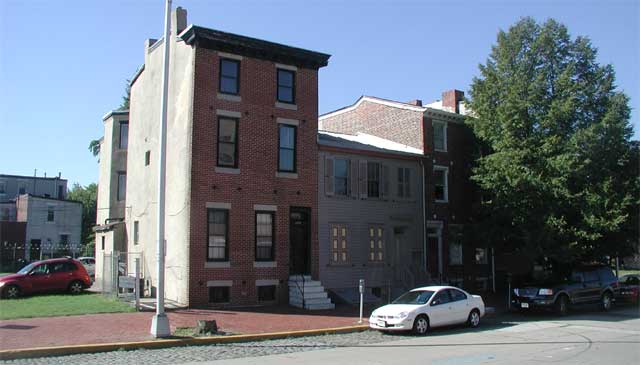
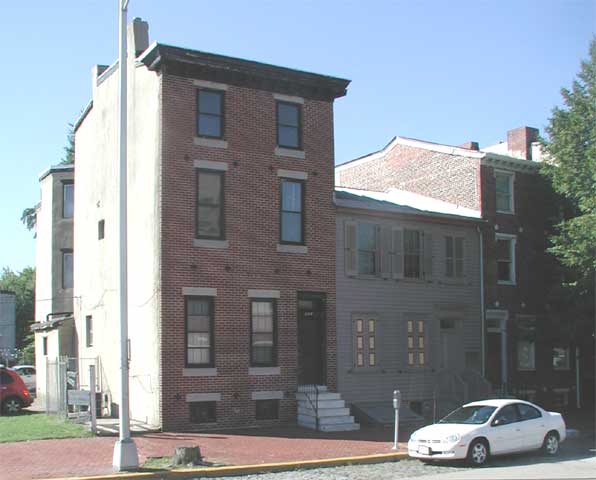
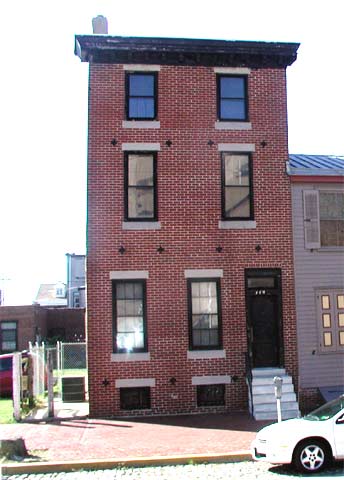
330 Mickle Street, Camden NJ — October 1, 2005