Introduction
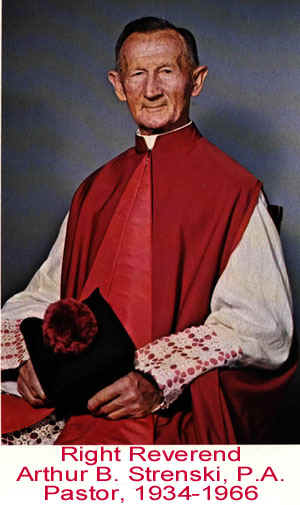
Monsignor Arthur B. Strenski
Monsignor Arthur B. Strenski was born in Poland on October 6, 1880. He was ordained in 1905, and after serving at three different parishes, was assigned to St. Joseph Church in Camden in 1934. His impact on the church and the community cannot be in any way understated. Under his leadership the St. Joseph Cemetery in Chews Landing (Gloucester Township), St. Mary’s Home for the Aged in Cherry Hill, and St. Joseph High School in Camden (closed 1979) were established. He also served the diocese in other roles. In 1950, he was appointed Director of the Diocesan Displaced Persons Bureau. Monsignor Strenski stepped down as the active pastor of St. Joseph’s in the spring of 1966. He continued to serve as Pastor Emeritus for another fifteen years. Monsignor Strenski peacefully died in his sleep on February 19, 1980, having lived and served for nearly a century.
Biography by Paul Zachary
Parish historian Paul Zachary wrote this article on Monsignor Strenski and his years at St. Joseph Church in Camden NJ. For more information about St. Joseph’s, including a superb history of the church from its earliest days in the 1900s to the present day.
All the men who held the position of pastor at St. Joseph’s until this time had served the parish well, each attending to the needs of his particular tenure. The priest who came to Camden on September 28, 1934, however, was a man of vision who would serve the parish with particular distinction. This was the Right Reverend Monsignor Arthur B. Strenski, P.A.
Mr. Zachary wrote a biography of Monsignor Strenski in 1955, when the pastor was celebrating his fiftieth year in the priesthood. According to this book, he was born in the village of Wojsk in Poland on October 6, 1880 to August and Antoinette Strenski. When he was six his father died, and five years later he emigrated to New York with his mother and siblings. (One of Arthur’s brothers, Emil, would also go on to become a priest and a monsignor.) His mother was a multilingual woman who established and ran a private school in New York to support her children.
Arthur Strenski attended St. Francis Xavier College in New York and St. Mary’s Seminary in Baltimore before his ordination on June 21, 1905, at the Basilica of the Assumption of the Blessed Virgin Mary in Baltimore. On the following day he said his first Mass at his brother Emil’s parish, St. Joseph’s, in Jamaica, New York.
He served as a curate at three different parishes, first assisting at Sacred Heart in South Amboy under the Reverend Francis Czernecki (who would later serve as pastor of St. Joseph’s.) Later, at St. Peter’s in New Brunswick and at St. James in Jamesburg, he discovered something important about his vocation. As the visiting chaplain for two State Homes for Boys, he became interested in the problems of youth, and thereafter decided to devote himself to the prevention of such problems. He was convinced that Catholic education could help children avoid the sad stories he saw in the Boy’s Homes.
In 1910, Father Strenski was assigned his first pastorship, taking over when Father Czernecki fell ill at Sacred Heart in South Amboy. He remained there for fifteen years and concentrated his energies on improving parish education facilities. He was transferred to St. Hedwig’s in Trenton in 1925. During his ten years of duty there, he supervised the building of a new church, school, and Junior High. On June 26, 1926, Pope Pius XI made Father Strenski a Domestic Prelate.
He was still at St. Hedwig’s when the Great Depression struck the country in 1929. Father Martin Lipinski, who served as Monsignor’s assistant for a time, once remarked to a visitor that he had been surprised, on arriving at his posts at the lack of furnishings in the rectory. There was one chair in the office. The furniture, Father Lipinski told his visitors had been sold by Monsignor Strenski to help the parish poor.
St. Joseph’s Reaches a Peak
Five years later, when Father Czernecki retired as pastor of St. Joseph’s, Bishop Moses E. Kiley appointed Monsignor Strenski as his successor in the Camden parish.
Mr. Zachary provided a description of the Monsignor in a 1955 biography. He writes that the priest was “not the impressive man one could imagine while reading an account of his activities.” He was a little above average in height but looked taller because of his slight frame. “He is soft-spoken and never raises his voice in excitement or when he is trying to score a point. He is pleasant to talk to and while listening he will impress you with his interest.”
One of Monsignor’s first acts was to reactivate the church societies and to ask of all his parishioners what most successful leaders ask: for patience, cooperation, hard work sacrifice and perseverance. During his thirty-two year pastorship, Monsignor Strenski’s congregation gave him their best efforts. Under his quiet, confident leadership the parish thrived.
To make room for expanded parish activities, the basement of the school was re-excavated, deepened and renovated into a combination hall and cafeteria, now known as the Lower Hall.
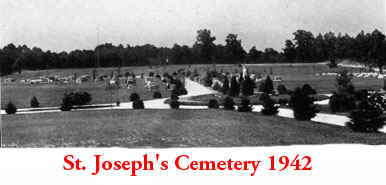
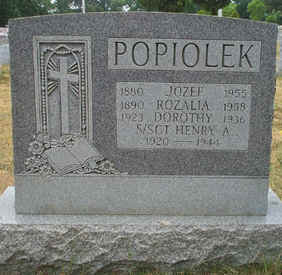
St. Joseph Cemetery in Chews Landing and the memorial to Dorothy Popiolek, the first person buried there
In 1936, Monsignor acquired seventeen and a half acres in Chews Landing, about eight miles from Camden, on which he developed a cemetery. While the land was being cleared in preparation for Memorial Day, when Bishop Kiley would publicly bless the cemetery, a dying thirteen-year-old girl named Dorothy Popiolek expressed a wish to be the first to be buried there. The pastor altered his original plans and performed a private blessing on the spot where the girl now lies. It is strangely fitting that this young girl’s name in Polish means “little ashes.”
Two additional purchases of land eventually increased the cemetery’s acreage to thirty-three and its total capacity to more than 10,000 graves.
In the fall of that year, Monsignor turned his attention to his favorite project: education. A Junior High School was established in the parish, eventually requiring the leasing of two nearby vacant stores for classrooms.
In 1938, Monsignor Strenski received three important appointments in the newly formed Camden Diocese. He was named Diocesan Consulters Presiding Judge of the Marriage Tribunal, and Examiner of the Junior Clergy. The following year, Monsignor’s plans for further development of the parish schools were interrupted and put on hold with the advent of the Second World War.
According to Mr. Zachary:
The war began with the surprise attack on Poland by Germany on September 1, 1939. Hundreds of parishioners were streaming out of the church after eleven o’clock High Mass while newspaper boys greeted them with shouts to buy a special Sunday War Extra published by the weekday Philadelphia Evening Bulletin. The bold headline declared England and France were at war with Germany, redeeming a pledge to aid beleaguered Poland.
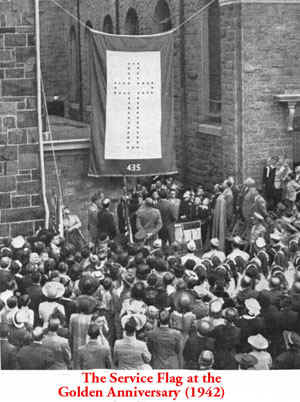
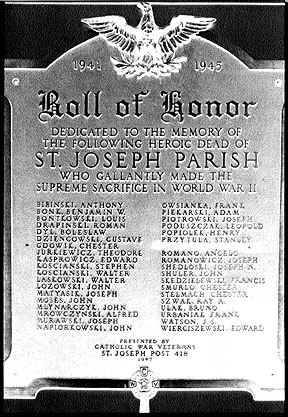
St. Joseph’s service flag and Honor Roll plaque listing 37 parish members killed in World War II
The United States entered the war on December 7, 1941, after Japan’s attack on Pearl Harbor. St. Joseph’s sent 1,630 young men and women to join the armed forces. Food, gasoline and other resources were rationed. Victory gardens were planted. Monsignor Strenski was appointed a public member of the U.S. War Labor Board and spoke at numerous War Bond rallies and patriotic gatherings. In all, 37 parish sons were killed in the war; their names are listed on the Honor Roll plaque which hangs in the vestibule of the church.
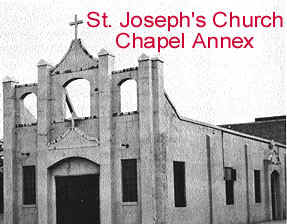
St. Joseph’s Chapel Annex
On June 6, 1944, the St. Joseph’s Chapel Annex opened at a site some eight city blocks from the church. Four well-attended Masses were said there on Sunday to relieve congestion at the main church.
Four years earlier, Monsignor Strenski, demonstrating concern for the elderly, had established St. Mary’s Home for the Aged on Kresson Road in Cherry Hill. He invited the Little Sisters of the Immaculate Conception of Stara-Wies, Poland, to staff the Homes and in September of 1940, three Sisters arrived. (This is now St. Mary’s Nursing Home, which has expanded to include a Village of St. Mary’s for Senior Citizens.)
When the war ended, Monsignor again took up his banner of education. St. Joseph’s High School was established in 1946. Three years later the school was accredited, and with the 34 members of the first graduating class looking on, ground was broken for a new school building on Mt. Ephraim Avenue near St. Joseph’s Church Annex.
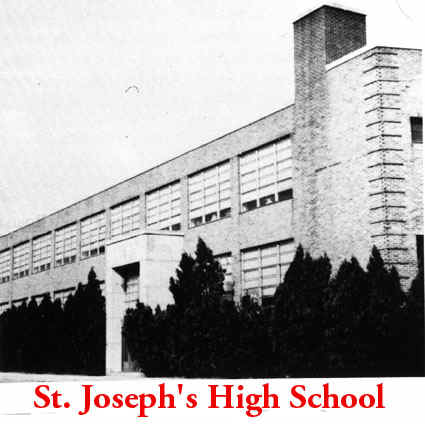
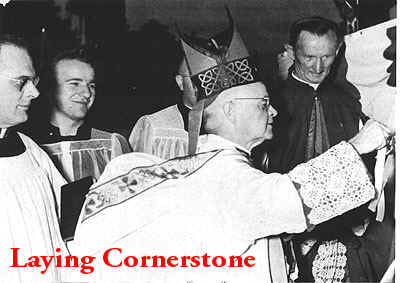
St. Joseph High School and the cornerstone laying ceremony
The project was slated to cost more than a million dollars. The undaunted pastor was aided in the project by countless “angels,” as he called them, clergy and laity who worked and sacrificed to help him complete it. Various area contractors and industrialists donated their services or contributed financially to the school fund. Every day, Monsignor personally inspected progress at the site. His assistants grew used to accepting promissory notes in lieu of a check on payday. Work continued for three years, then, on August 8, 1951 Bishop Eustace officiated at the laying of the cornerstone. On November 27, 1952, the school was dedicated.
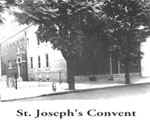
Convent of the Felician teaching sisters
In this endeavor, as in most of Monsignor’s efforts to promote Catholic education, the parish benefited from the continued and invaluable presence of the Felician teaching sisters, who staffed the new school.
While the school project was underway Monsignor had received yet more recognition for his work for the Catholic Church. On May 20, 1949, Pope Pius XII named him a Protonotary Apostolic. (This gave him, at certain times some specified privileges, which were normally reserved for Bishops.) In 1950, he was appointed Director of the Diocesan Displaced Persons Bureau.
Change
With the ending of the Korean War in 1953, government home loans to veterans spurred a suburban housing boom. This began the long slow flight from the cities, which weakened many urban parishes. Monsignor Strenski could not understand what drew his parishioners away from the solid community which all had worked so hard to build.
Monsignor celebrated his golden Sacerdotal Jubilee at the age of seventy-five in 1955. Eight hundred members of the parish joined in an impressive tribute to him held in the high school auditorium. In 1958, he doubled the size of the high school, allowing for broader curricula and increasing the student body to nearly 900 students.
Counting the years of his ministry at St. Joseph’s, together with the years spent at Sacred Heart in South Amboy and St. Hedwig’s in Trenton, Monsignor Strenski labored in the role of Good Shepherd for forty-five years.
It was at St. Joseph’s he achieved his greatest distinction in the educational field. With the help of God and loving parishioners, he was able to found a parochial high school — his cherished dream come true; the keystone placed firmly into position in the gateway through which learning and success would march hand in hand for the Youth placed in his charge.
On his twenty-fifth anniversary of service of St. Joseph’s Parish, Monsignor received the rare Pro Ecclesia et Pontifice medal, which was brought from Rome by Bishop McCarthy. He was now seventy-nine years old and developing a respiratory weakness, but during the last few years of his pastorship he renovated the church in anticipation of the Diamond Jubilee celebration of 1967. The electrical system was modernized. Fresh murals were painted on the walls and ceiling. He had earlier installed a marble communion rail, and now finished his work on the sanctuary by adding marble flooring, side altars, and a center altar which faced the congregation for the new liturgical dialogue Mass.
Monsignor Strenski’s health forced him, at the age of 86, to accept Archbishop Damiano’s direction to step down as pastor. He became the parish’s first Pastor Emeritus on March 17, 1966, and continued to serve in this capacity for fifteen years.
South Camden Couple Wed by Msgr. Strenski
Camden Courier-Post —
South Camden Couple Wed by Msgr. Strenski
The marriage of Miss Dorothy Harczynska, daughter of Mr. and Mrs. Andrew Harczynska, of 936 Mechanic Street, to John Walker, son of Mrs. Bessie Walker, of 1449 South Ninth Street, was solemnized Saturday at 9 a.m. in St. Joseph’s R.C. Church, this city. Msgr. Albert Strenski officiated.
Miss Sophia Maultz of Philadelphia and Leonard Rogalski of this city were attendants. A reception followed at the Mechanic Street address where the couple live.
Photos
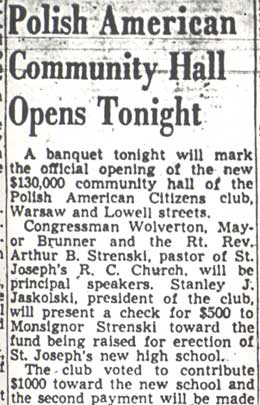
Polish American Community Hall Opens Tonight
A banquet tonight will mark the official opening of the new $130,000 community hall of the Polish American Citizens club, Warsaw and Lowell streets.
Congressman Wolverton, Mayor Brunner and the Rt. Rev. Arthur B. Strenski, pastor of St. Joseph’s R. C. Church, will be principal speakers. Stanley J. Jaskolski, president of the club, will present a check for $500 to Monsignor Strenski toward the fund being raised for erection of St. Joseph’s new high school.
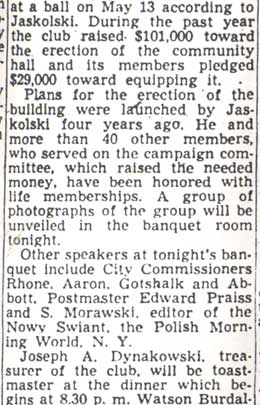
The club voted to contribute $1000 toward the new school and the second payment will be made at a ball on May 13 according to Jaskolski. During the past year the club raised $101,000 toward the erection of the community hall and its members pledged $29,000 toward equipping it.
Plans for the erection of the building were launched by Jaskolski four years ago. He and more than 40 other members, who served on the campaign committee, which raised the needed money, have been honored with life memberships. A group of photographs of the group will be unveiled in the banquet room tonight.
Other speakers at tonight’s banquet include City Commissioners Rhone, Aaron, Gotshalk and Abbott, Postmaster Edward Praiss and S. Morawski, editor of the Nowy Swiant, the Polish Morning World, N. Y.
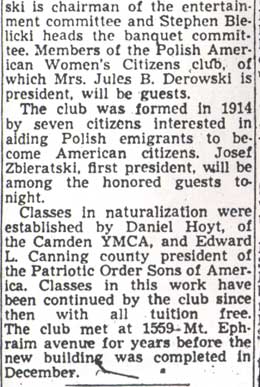
Joseph A. Dynakowski, treasurer of the club, will be toastmaster at the dinner which begins at 8.30 p.m. Watson Burdalski is chairman of the entertainment committee and Stephen Blelicki heads the banquet committee. Members of the Polish American Women’s Citizens club, of which Mrs. Jules B. Derowski is president, will be guests.
The club was formed in 1914 by seven citizens interested in aiding Polish emigrants to become American citizens. Josef Zbieratski, first president, will be among the honored guests tonight.
Classes in naturalization were established by Daniel Hoyt, of the Camden YMCA, and Edward L. Canning county president of the Patriotic Order Sons of America. Classes in this work have been continued by the club since then with all tuition free. The club met at 1559-Mt. Ephraim avenue for years before the new building was completed in December.
Camden Courier-Post, March 18, 1950.
Camden Courier-Post — Wednesday, September 17, 1975
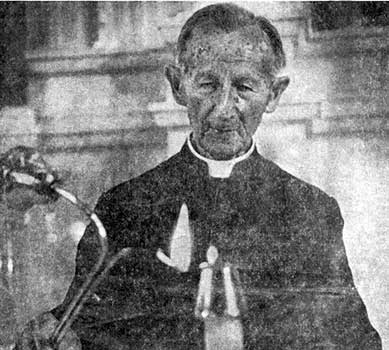
He’s 95 and going strong. Msgr. Arthur B. Strenski, the oldest priest in New Jersey, is celebrating the 70th anniversary of his ordination Thursday. The occasion will be marked by a special mass at 6:30 PM at St. Joseph’s Church in Camden, where Msgr. Strenski is pastor emeritus.
By RONALD G. BURNS Of The Bulletin Staff
Monsignor Arthur B. Strenski, his eyes twinkling with good humor, likes telling the priests of his parish, “don’t become bishops; they don’t last.“
At 95, Father Strenski ought to know ... He’s outlasted eight of them.
A slender, wizened, wisp of a man, Father Strenski has just completed his 70th year as a Roman Catholic priest. A special Mass was said in his honor Thursday night.
Among other accomplishments, Father Strenski has outlived six popes and served 30 years as pastor of St. Joseph’s Church in Camden. He retired in 1964, but has remained as pastor emeritus.
’No Special Secret’
“There’s no special secret to a long life,“ he says. ”Just live simply, eat plain food and don’t get angry. My motto is ’Punctuality, regularity and exactness.’“
In addition, Father Strenski never drinks or smokes, and avoids coffee.
“An occasional cup of tea is the most I ever have,“ he says. ”And I feel extremely fit.“
To provide his point, he eagerly gets up before several smiling priests gathered for lunch in the rectory dining room and performs simple hand exercises.
Touches His Toes
Then, to a round of applause, he touches his toes. “How do you like that,“ he says. ”Good, huh?“
But for Father Strenski, the present seems to hold only pasing interest. It is talk of the distant pastthat most enlivens his conversation, recalling his emigration from Poland at the age of 11, recalling his mother (“a great woman, a strong-willed disciplinarian“) and, as much as anything, recalling his days at Xavier High School in New York.
“I remember being a young cadet taking part in ceremonies to welcome back Admiral Dewey from the Spanish-American War,“ Father Strenski says. ”Somehow I ended up standing about four feet from him. He hal just come back from Manila; I could have reached out and touched him.“