Isaac M. Shreeve (Shreve)
ISAAC M. SHREEVE was born February 28, 1853 to Isaac M. and Mary Wilkinson Shreeve. His father, a Civil War veteran, had passed before he turned 14. When the census was taken in 1870, the family lived in Camden’s Middle Ward. It appears that their neighbors were the Whitcraft family. As the Whitcrafts were also the next door neighbors at the time of the 1880 Census it is highly likely that the address was 557 Bridge Avenue. There is some confusion as to how Isaac M. Shreeve spelled his name, it turns up in print as Shreeves, Shreeve, and Shreve.
On January 4, 1876 Isaac M. Shreeve married Nellie Bacon. When the 1880 Census was taken the Shreeves family was at 557 Bridge Avenue. Three children had been born, William Shreeve, Mary R. Shreeve, and Isaac Shreeve. James Beale Shreeve, Alfred Shreeve, Joseph Shreeve, and Maud Marion Shreeve came later. Sadly, Alfred and Maude died while quite young. In 1880 Isaac M. Shreeve was employed as the janitor of Morgan’s Hall. This job ended shortly after owner John Morgan passed away in December of 1881. On April 8, 1882 Isaac M. Shreeve was appointed to the Camden Fire Department, assigned as a hoseman at Engine Company 2. He also was partners in a house painting business in the 1880s with brother firefighter William H. Bassett. In 1887 he joined the Camden Police Department.
The Camden City Directory shows the Shreeve family still living at 557 Bridge Avenue through 1890. By 1887 Isaac Shreeve had been appointed an officer on the Camden Police Department.
Isaac Shreeve was serving as a policeman in Camden when, in May of 1890, while responding to a report of a burglary in progress at a Chinese laundry at Broadway and Berkley Street, he was shot and seriously wounded by Ben Hudson, a notorious local criminal. Fortunately Isaac Shreeve recovered from his wounds and eventually returned to work with the Camden police. Ben Hudson’s criminal career came to an end on October 6, 1895, when he was shot and killed in a running gun battle while evading arrest near Cobb’s Island Station, Virginia. His brother Bill was wounded by the same bullet and arrested. After leaving the police force, Isaac Shreeve did some business as a bail bondsman in the 1890s.
By 1906 Isaac Shreeve had moved to 17 South 36th Street in East Camden. Sometime between then and the summer of 1910 Isaac Shreeve returned to the Camden Police Department. Nellie Bacon Shreeve passed away between the time of the compilation of the 1914 City Directory and January 1920, when the Census was taken. At that time Isaac Shreeve was still living at 17 South 36th Street and a member of the Camden Police Department. A Jennie S. Perkins was living at the address as well, and they wed soon after the Census was taken. Isaac Shreeve was then still living at 17 South 36th Street and even though he was past 70, was still working for the Camden Police Department.
By 1920 son Joseph Shreeve had married Laura Boulton, of 15 North 32nd Street in East Camden. He had also become a Camden policeman. He served on horseback in the late 1910s and early 1920s. Laura’s younger brother Lawrence Boulton had a long career as a fire fighter in Camden.
Still working as a policeman at the age of 73, Isaac Shreeve passed away on June 19, 1926 in Camden, suffering a stroke while responding to a call. While not regarded as a line of duty death at the time, by today’s standards this would be.
Irate ‘Assemblymen.’
Camden Post —

SERVING TWO MASTERS.
Morgan’s Hall a Prey to too Much Janitor.
Morgan’s Hall has become the central figure in an interesting contest for mastery, and two if not three janitors contend for the honor of opening and closing its doors, and lighting up, dusting out and arranging its spacious hallways, stairway, stage and auditorium. Two sable Hamites may now be seen moving amidst its lights and shadows, and supplementing the careful supervision of Isaac Shreeve, who for so long a time, and so tenderly, aided the tottering steps of the late owner, who sought by daily walks to relieve the monotony of the sick room, and desisted only when feebleness, even when so faithfully helped, rendered the exercise impossible.
Mr. Shreeve is and is not janitor of the hall. He holds the keys, but others open and close the building with duplicates. They receive pay and so does he. They are not his helpers but supplanters. This curious state of things has a history, which, if not momentous in the magnitude of the deeds that make it, becomes interesting in the very pettiness of their origin.
John Morgan died leaving by will his estate to his infant son, his widow, however, to have one-third the income so long as she remains a widow. The law, in absence of a will, would give her that much for her life regardless of the duration of her widowhood, and she has six months in which she may elect, whether to take her dower under the will, and lose it when she marries, or take it under the law and hold it whether she marries or no.
But this has little to do with the triune janitorship of the hall. The will appointed Mrs. Morgan and Jonathan Burr executors, and the latter trustee of the estate, during the minority of the heir. As trustee he has charge of the hall, as well as other property, rents it and selects its care-taker. What good or bad understanding may have existed between the trustee and janitor, between the death of Mr. Morgan and the fifteenth of February, is not of sufficient import to inquire into, but on that date the deposing of Mr. Shreeve was resolved upon. The history of that event, so far as it relates to the present topic is clearly and freely told by Mr. Shreeve.
Prosecutor of the Pleas Richard S. Jenkins, Peter L. Voorhees and Hamilton Markley were a committee of the Camden Assembly, and before the death of Mr. Morgan, while he was lying sick in his room, waited upon him and engaged the hall for the 4th of January and 15th of February for the use of the Assembly. The agreement was drawn up and signed, and the price, $60, paid. The first Assembly was held and all passed off well. While the committee was preparing the room for the second Assembly—partitioning off a portion with curtain hangings and were placing carpet on the stairway and hallway, and so out to the street—a mandate from Frank J. Burr, son of the trustee, was received ordering the janitor, Mr. Shreeve, to stop the committee in their work. This he refused to do as the agreement allowed them the privilege. Another order from the same source, added the threat of a discharge on failure to comply. The committee, all lawyers, bade the janitor proceed, counselling him that he was in the right, and that if he was discharged they would see him in as good a situation. The work went on, the janitor was discharged, two colored men placed in charge, and the old janitor, who, by advice of the committee, carried out the contract of the deceased owner, still retain [sic] the keys and receives his salary.
Mr. Burr, the trustee, has little to say about the matter. He appointed his son, Frank J. Burr, to look after the hall, and when the changes were being made by the Assembly committee, knowing their action to be contrary to the rules established for the conduct of the hall, Shreeve was ordered to desist, and, on refusal, dismissed. The Assemblymen are reticent, as all lawyers are when fee-less, but it is given out that they hold that the trustee must not delegate his powers to another, as to do so is to invalidate his authority to act. From this has grown out a vast amount of twaddle about breaking the will.
Camden’s New Firemen
Philadelphia Inquirer —
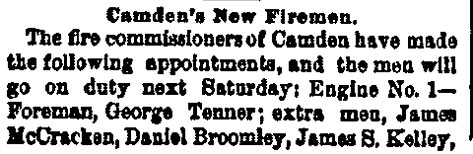
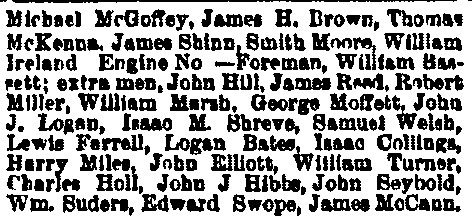
The fire commissioners of Camden have made the following appointments, and the men will go on duty next Saturday: Engine No. 1—Foreman, George Tenner; extra men, James McCracken, Daniel Broomley, James S. Kelley, Michael McGoffey, James H. Brown, Thomas McKenna, James Shinn, Smith Moore, William Ireland Engine No —Foreman, William Bassett; extra men, John Hill, James Reed, Robert Miller, William Marsh, George Moffett, John J. Logan, Isaac M. Shreve, Samuel Welsh, Lewis Farrell, Logan Bates, Isaac Collings, Harry Miles, John Elliott, William Turner, Charles Holl, John J Hibbs, John Seybold, Wm. Suders, Edward Swope, James McCann.
Fire Commission Appointments
Philadelphia Inquirer —
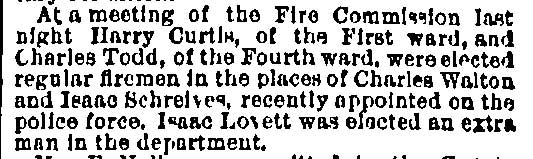
At a meeting of the Fire Commission last night Harry Curtis, of the First ward, and Charles Todd, of the Fourth ward, were elected regular firemen in the places of Charles Walton and Isaac Schreives, recently appointed on the police force. Isaac Lovett was elected an extra man in the department.
In the Political Whirl
Philadelphia Inquirer —
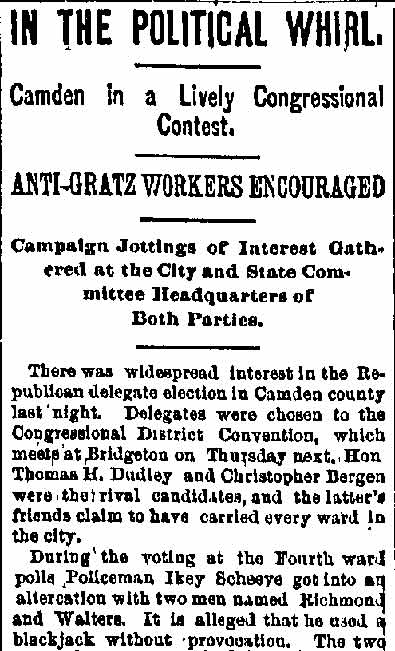
Camden in a Lively Congressional Contest.
ANTI-GRATZ WORKERS ENCOURAGED
Campaign Jottings of Interest Gathered at the City and State Committee Headquarters of Both Parties.
There was widespread interest in the Republican delegate election in Camden county last night. Delegates were chosen to the Congressional District Convention, which meets at Bridgeton on Thursday next. Hon. Thomas H. Dudley and Christopher Bergen were the rival candidates, and the latter’s friends claim to have carried every ward in the city.
During the voting at the Fourth ward polls Policeman Ikey Scheeve got into an altercation with two men named Richmond and Walters. It is alleged that he used a blackjack without provocation. The two men who were assaulted immediately engaged the services of a lawyer, who will cause Sheeve’s arrest to-day on the charge of assault and battery. Following are the delegates elected in Camden city and in the various townships:
First Ward—W. Baily, Isaac Githens, George Barrett, Frank Welch and Howland Croft.
Second Ward—J. Willard Somers, Frank C. Somers, John Wells, W. H. Day and Samuel Bakely.
Third Ward—Dilwyn Pettit, J. Milton Powell, David Freeman, Sr., George Denny and Albion Lane.
Fourth Ward—Everett Ackley, Samuel M. Gall, William Ireton, Joseph Brown and Howard Lee.
Fifth Ward—Christopher J. Mines, Jr., Frederick Parker, John H. Miller, David Rankin and Samuel Roach.
Sixth Ward—A. R. Dease, James Brown, Isaac Robinson, John Brother and James Hewitt.
Seventh Ward—John C. Edwards, M. D. Cornish, William K. Price, Reuben Gaskill and John W. Everman.
Eighth Ward—Samuel H. Mourey, William H. Smith, Herman Helmbold, E. Thompson and Thomas Watson.
Stockton township was carried by Dudley, and W. Harrison Livermore carried Woodbury. Centre, Delaware and Haddon townships of Camden county were carried by Bergen.
The Congressional district includes Camden, Gloucester, Cumberland, Salem and Cape May counties. The indications are that Congressman Hires will be renominated.
Camden’s Sunday News
Philadelphia Inquirer —
Cooper Hospital surgeons yesterday doctored a deep gash in the head of John Weidner, 62 years old, of 116 Mechanic street.
Mrs. Thomas S. Mason, who was shot by her husband, is pronounced out of danger by the Cooper Hospital authorities.
Edward H. B. Watts, a freight brakeman, of 134 East Huntingdon street, Philadelphia, was brought into the Cooper Hospital yesterday with his leg broken above the ankle.
Policeman William Stanton, who was arrested and severely handled by Policemen Isaac McKinley and Isaac Shreeve, while quarreling with his wife a week ago, has brought suit against his fellow-officers in the Supreme Court for damages for injuries they inflicted.
Alleged Policy Offenders Bailed
Camden Daily Courier —
ALLEGED POLICY OFFENDERS BAILED.
Harriet Smith, John Walters, Walter Garwood and William and Fred Parker, charged with violating the law against lotteries, were arraigned in the Court of Quarter Sessions this morning and all entered pleas of not guilty. The defendants were allowed to enter bail in the sum of $500 each. Two charges are against Walters and bail in his case was fixed at $800. Ex-Policeman Isaac Shreeves and W. H. Jones, of the Eighth ward, were accepted as bondsmen.
Over in Camden
Camden Daily Telegram —
OVER IN CAMDEN
Harriet Smith, Walter Garwood, Frederick and William Parker entered pleas of not guilty to charges of violating the policy laws, and John Walters entered a similar plea for the same offense and a felony in connection with the policy laws. Walters’ bail had been surrendered and the others renewed their bail. Harry S. Scovel, who is counsel for all the accused policy dealers, appeared with William Jones, a colored contractor of the Eighth ward, and ex-Policeman Isaac Shreeves as bondsmen. Shreeves stated that he owned four houses valued at from $7,000 to $8,000.
“Are you not on the bonds of a number of others before the Court?” asked Prosecutor Jenkins.
“No, sir,” was the reply of ex-Policeman Shreeves.
“Ain’t you bail for several boys indicted at the last term of Court?”
“I think I entered bail for them in the sum of $100 each.”
After looking over the records Shreeves was accepted as one of the bondsmen. He is surety for George Roop in the sum of $1,000, besides smaller amounts for members of the Spider gang.
The bail of Mrs. Smith, the Parkers and Garwood, was fixed at $500 each, and that of Walters at $800.
Merry War of Policy Men
Camden Daily Telegram —

Accused Dealers Given Hearings By Justice Cassady.
LIKELY TO PLAY THE COURT ROW
Three of the Prisoners Placed Under Bail and the Cases of Seven Others Continued—The Complainant Merely Smiles.
Several more arrests have been made in the policy war now going on between two factions in this city. Three alleged policy writers were held in $500 bail each this morning by Justice Cassady and seven other cases were postponed as some of the witnesses and one or two of the defendants were not present.
Archie Clark, colored, was the first arraigned before Justice Cassady. Kate Miskelly was called as a witness but swore that she had never bought policy of the defendant. Other witnesses were not present and his case was postponed.
Susan Smith, alias Kinsey, was not present and her case was put off until this afternoon at 2 o’clock.
William Sampson, colored, was the next defendant. His place is in Centreville. Benjamin Shaw, colored, identified a five cent policy slip he had bought from Sampson last June.
“Did you make a hit?” asked Lawyer H. S. Scovel who appeared to represent all the defendants.
“No, sir,” was the reply.
“What row is this?”
“I don’t know.”
“Is it the court row?”
“It seems to be in this instance,” ejaculated Justice Cassady, as he fixed bail at $500 for the defendant’s appearance at the September term of court.
Richard Quinn, colored, testified that he had never purchased any policy of Sampson, but that he had seen Shaw buy it there. Samuel Davis furnished bail for Sampson.
Jacob Derry, colored, of Baxter’s court, was the next victim. Quinn swore that he bought a five cent policy slip in the defendant’s place on June 10 last. Shaw testified that he saw Quinn buy the slip. Bail was fixed at $500, which was furnished by ex-Policeman Isaac Shreeve.
“How much bail are you responsible for now?” asked Justice Cassady.
“He has been relieved of it all,” said Lawyer Scovel. “The defendants have either been released or are serving time in Trenton.”
Edward Bassett failed to appear and his case was postponed.
Herbert Drake, colored, of the Seventh ward, was then arraigned. Shaw identified a policy slip he had purchased from the defendant on June 20 last. Quinn swore that he saw Shaw buy the slip. Isaac Shreeve furnished $500 bail for Drake’s appearance at Court.
“I seem to be in demand here,” said Shreeve as he stepped forward to furnish the surety for Drake. “Can’t I get a job at Pitman Grove?”
“We don’t want any policy people down there,” replied Justice Cassady.
The witnesses failed appear [sic] against Fred Parker and Lawyer Scovel remarked:
“Your honor, the defendant don’t appear to be very well.”
“He’ll probably be sicker before we get through with him,” retorted Justice Cassady.
His case was postponed along with those of John Scanlon, John Brady and John Walters.
W. Harry Getty is the complainant in all the policy cases now before Justice Cassady. He was an interested spectator at the hearings this morning, and smiled pleasantly at the fierce glances of some of the defendants
Charles Gilbert, who was committed to the county jail last week by Justice Schmitz in default of $1,000 bail, charged with writing and selling policy, was released from jail this morning. Mary Ellis, of Collingswood, furnished the necessary bail.
Policy and Pleasantries
Camden Daily Courier —

TRIAL OF ACCUSED DEALERS CHARACTERIZED BY WITTICISMS.
But It May Not be So Humorous When They Get Into Court—Three Held in Bail to Appear at Court—Six Were to Have Hearings.
A good-sized crowd of alleged policy slip sellers, witnesses, spectators and others gathered at the office of Justice of the Peace Cassady, this morning, where charges against several accused policy sellers were heard by the ‘Squire. W. H. Getty, who, it is said, represents one faction of the policy people, was on hand, and is the complainant against ten of the alleged law violators. Lawyer Harry Scovel appeared on behalf of the accused men, and saw that they secured bail. The first case examined was that against William Sampson, colored. Benjamin Short, a light-colored negro, was sworn, and ‘Squire Cassady said:
“Short, do you know William Sampson.”
The witness replied, “Yes, sir,” but his reply was slow and hesitating; in short he testified as though he disliked to do so.
“Do you know where he keeps?” was the next question put by the ‘Squire.
“Well, no;” was Short’s answer, “can’t say just where it is, but I know it’s down in Centreville.”
“Did you ever buy any policy slips off of him?” “Yes, sir.”
“When?” “On the 20th of June.”
“What did you pay for the slip?” “Ten cents.”
At this point the irrepressible Harry Scovel broke in with, “Did you make a ‘hit’ Short?”
“No, sir; I didn’t,” answered the witness, half smiling.
“What row did you play, the funeral row?” “No, sir.”
The witness was handed a policy slip and asked if he identified it as the one he purchased June 20th from the accused seller, William Simpson [sic], and he said that he did.
Richard Quinn, colored, tall and very black, sworn, testified that he was with the witness, Short, when the latter bought the slip from Simpson.
“That’s enough for this case,” decided ‘Squire Cassady. “Sampson, you are held in $500 bail to appear at the next term of court. Can you furnish bail?”
“Yes, we have bail for him,” interposed Lawyer Scovel. “Mr. Davis?”
Liveryman Samuel W. Davis stepped forward, qualified, and was accepted as bondsman.
Jacob Derry, colored, was next called. The two witnesses who testified in Sampson’s case, Short and Quinn, also testified in Derry’s case. Quinn swore that Derry kept a policy place on Baxter’s court and that on June 20th he purchased a policy slip of Derry and paid him five cents therefor. Short, who was with Quinn, corroborated the latter’s testimony.
Derry was held in $500 bail, ex-Policeman Isaac Shreeves going on his bond.
Herbert Drake, colored, the next accused policy seller arraigned, had no more than seated himself in a chair than Lawyer Scovel said, “you’re not related to the lawyer, are you, Drake?”
Drake smiled. “Might be related to you, Harry,” put in the ‘Squire.
“He is—as a good Republican,” retorted the attorney.
“Well, Adam was father to us all,” resignedly said the ‘Squire, and then the legal mill ground on. In Drake’s case the witness Short testified that he purchased policy slips of the accused, who keeps in the Second ward. The slip, pinned to the writ of complaint, was handed Short and he identified the slip he purchased. Quinn, who was with Short at the time of the sale, corroborated Short’s testimony.
Drake was held in $500 bail, ex-Policeman Shreeve also going his security to appear next September in court.
“Parker is here, Your Honor,” announced Lawyer Scovel. Parker, a rather tall colored man, came slowly forward. “Parker is sick today,” continued the attorney, “and he’s been sick for some time. I ——“
“Yes, and he may be sicker before he gets through with this,” put in ‘Squire Cassady.
“He may, and then again he may not,” glibly retorted the genial Harry, “but I want to say this, ‘Squire, Parker’s a sick man and the case against him is not ready. I’ll go his security to have him here whenever you want him.”
“All right, then,” said the ‘Squire. You can go on his bond.”
When the case of Susie Kinsey, alias Smith, was called, a witness with a huge, Paderewski-like shock of blood red hair arose and started toward the ‘Squire’s desk. The ‘Squire had been busy writing and when he glanced up and for the first time saw the huge globule of fiery red hirsute appendages approaching, he gasped, “O—h—h! Fire!”
“Somebody skin out and turn in an alarm,” was Lawyer Scovel’s timely “chip-in.”
After the laugh had subsided, the red-haired man said that he didn’t know Mrs. Smith or Mrs. Kinsey; had never purchased policy slips of her and didn’t know she was “in the business.”
“I’ll lay the case over, then,” said the ‘Squire, “until the other witnesses are here.”
Complaints lodged against other accused sellers were not heard this morning, but were laid over without date. The cases were those against Brake, Berry, Scanlon, Clark, Grady and Walker. Evidence against the accused was not in readiness to proceed against them.
Despite the evident feeling of pleasantry on the surface of matters this morning, there was also the plain indications of considerable hard feelings, which showed itself when many of the colored people glanced at each other or listened to the testimony which militated against them.
A rumor was in circulation this morning that a certain printing plant used to print policy slips, and which is said to be kept in a house on a main thoroughfare, was to be raided. The feeling between the two policy factions is undoubtedly running high, and, as one Justice of the Peace put it, “we (meaning the Justices) are reaping advantages from it.”
Ben Hudson Killed
Camden Daily Courier —
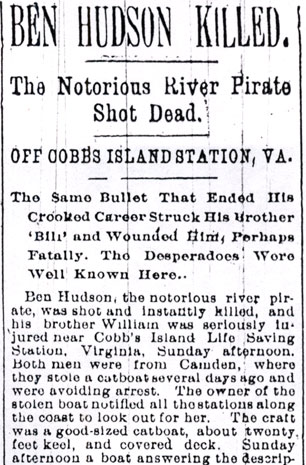
The Notorious River Pirate Shot Dead
Off Cobbs Island Station, Va.
The Same Bullet That Ended His Crooked Career Struck His Brother ‘Bill’ and Wounded Him, Perhaps Fatally. The Desperadoes Were Well Known Here.
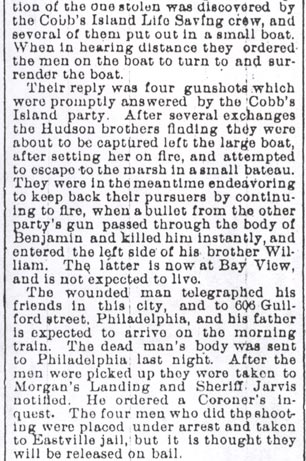
Ben Hudson, the notorious river pirate, was shot and instantly killed, and his brother William was seriously injured near Cobb’s Island Life Saving Station, Virginia, Sunday afternoon. Both men were from Camden, where they stole a catboat several days ago and were avoiding arrest. The owner of the stolen boat notified all the stations along the coast to look out for her. The craft was a good-sized catboat, about twenty feet keel, and covered deck. Sunday afternoon a boat answering the description of the one stolen was discovered by the Cobb’s Island Life Saving crew, and several of them put out in a small boat. When in hearing distance they ordered the men on the boat to turn to and surrender the boat.
Their reply was four gunshots which were promptly answered by the Cobb’s Island party. After several exchanges the Hudson brothers finding they were about to be captured left the large boat, after setting her on fire, and attempted to escape to the marsh in a small bateau. They were in the meantime endeavoring to keep back their pursuers by continuing to fire, when a bullet from the other party’s gun passed through the body of Benjamin and killed him instantly, and entered the left side of his brother William. The latter is now at Bay View, and is not expected to live.
The wounded man telegraphed his friends in this city, and to 606 Guilford street, Philadelphia, and his father is expected to arrive on the morning train. The dead man’s body was sent to Philadelphia last night. After the men were picked up they were taken to Morgan’s Landing and Sheriff Jarvis notified. He ordered a Coroner’s inquest. The four men who did the shooting were placed under arrest and taken to Eastville jail, but it is thought they will be released on bail.
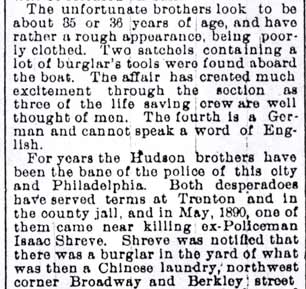
The unfortunate brothers look to be about 35 or 36 years of age, and have rather a rough appearance, being poorly clothed. Two satchels containing a lot of burglar’s tools were found aboard the boat. The affair has created much excitement through the section as three of the life saving crew are well thought of men. The fourth is a German and cannot speak a word of English.
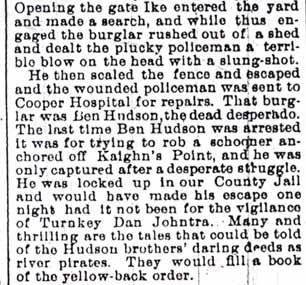
For years the Hudson brothers have been the bane of the police of this city and Philadelphia. Both desperadoes have served terms at Trenton and in the county jail, and in May, 1890, one of them came near killing ex-Policeman Isaac Shreve. Shreve was notified that there was a burglar in the yard of what was then a Chinese laundry, northwest corner Broadway and Berkley street.
Opening the gate Ike entered the yard and made a search, and while thus engaged the burglar rushed out of a shed and dealt the plucky policeman a terrible blow on the head with a slung-shot. He then scaled the fence and escaped and the wounded policeman was sent to Cooper Hospital for repairs. That burglar was Ben Hudson, the dead desperado.
The last time Ben Hudson was arrested it was for trying to rob a schooner anchored off Kaighn’s Point, and he was only captured after a desperate struggle. He was locked up in our County Jail and would have made his escape one night had it not been for the vigilance of Turnkey Dan Johntra. Many and thrilling are the tales that could be told of the Hudson brothers’ daring deeds as river pirates. They would fill a book of the yellow-back order.
Swinging the Ax on Camden Police
Philadelphia Inquirer —
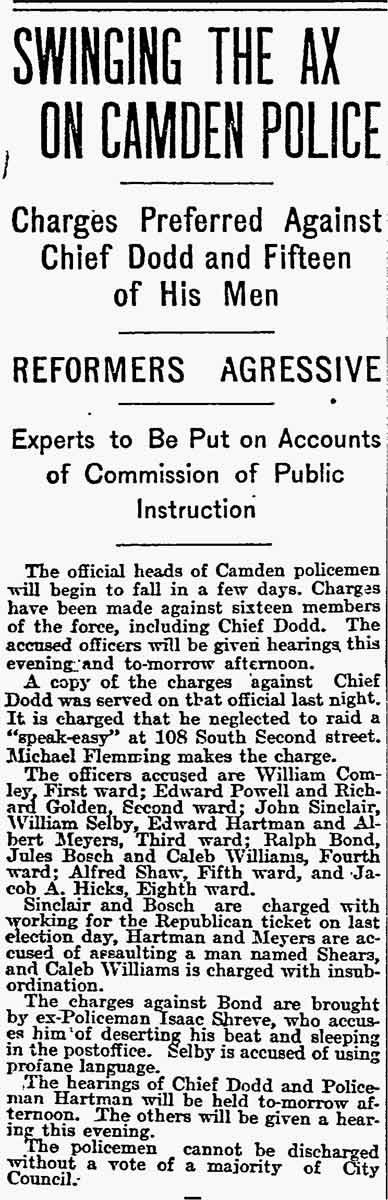
Charges Preferred Against Chief Dodd and Fifteen of His Men
REFORMERS AGRESSIVE [sic]
Experts to Be Put on Accounts of Commission of Public Instruction
The official heads of Camden policemen will begin to fall in a few days. Charges have been made against sixteen members of the force, including Chief Dodd. The accused officers will be given hearings this evening and to-morrow afternoon.
A copy of the charges against Chief Dodd was served on that official last night. It is charged that he neglected to raid a “speak-easy” at 108 South Second street. Michael Flemming makes the charge.
The officers accused are William Comley, First ward; Edward Powell and Richard Golden, Second ward; John Sinclair, William Selby, Edward Hartman and Albert Meyers, Third ward; Ralph Bond, Jules Bosch and Caleb Williams, Fourth ward; Alfred Shaw, Fifth ward, and Jacob A. Hicks, Eighth ward.
Sinclair and Bosch are charged with working for the Republican ticket on last election day, Hartman and Meyers are accused of assaulting a man named Shears, and Caleb Williams is charged with insubordination.
The charges against Bond are brought by ex-Policeman Isaac Shreve, who accuses him of deserting his beat and sleeping in the postoffice. Selby is accused of using profane language.
The hearings of Chief Dodd and Policeman Hartman will be held to-morrow afternoon. The others will be given a hearing this evening.
The policemen cannot be discharged without a vote of a majority of City Council.
Side-Splitting Farce Goes On
Camden Daily Telegram —
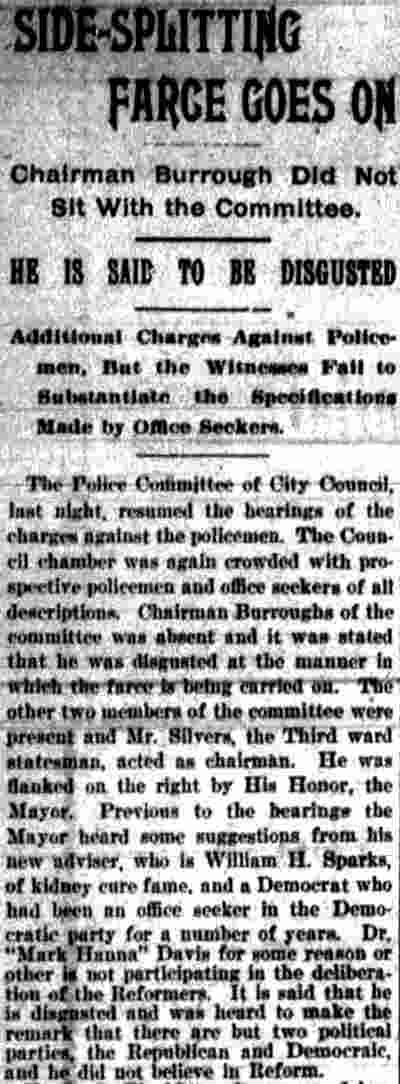
Chairman Burrough Did Not Sit With the Committee.
HE IS SAID TO BE DISGUSTED
Additional Charges Against Policemen, But the Witnesses Fail to Substantiate the Specifications Made by Office Seekers.
The Police Committee of City Council, last night, resumed the hearings of the charges against the policemen. The Council chamber was again crowded with prospective policemen and office seekers of all descriptions. Chairman Burroughs of the committee was absent and it was stated that he was disgusted at the manner in which the farce is being carried on. The other two members of the committee were present and Mr. Silvers, the Third ward statesman, acted as chairman. He was flanked on the right by His Honor, the Mayor. Previous to the hearings the Mayor heard some suggestions from his new adviser, who is William H. Sparks, of kidney cure fame, and a Democrat who had been an office seeker in the Democratic party for a number of years. Dr. “Mark Hanna” Davis for some reason or other is not participating in the deliberation of the Reformers. It is said that he is disgusted and was heard to make the remark that there are but two political parties, the Republican and Democratic, and he did not believe in Reform.
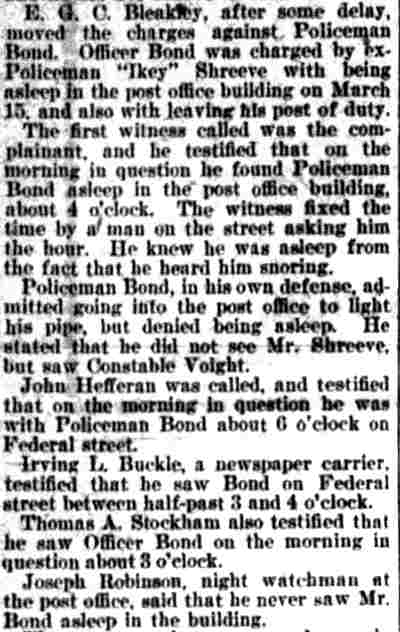
E. G. C. Bleakley, after some delay, moved the charges against Policeman Bond. Officer Bond was charged by ex-Policeman “Ikey” Shreeve with being asleep in the post office building on March 15, and also with leaving his post of duty.
The first witness called was the complainant, and he testified that on the morning in question he found Policeman Bond asleep in the post office building, about 4 o’clock. The witness fixed the time by a man on the street asking him the hour. He knew he was asleep from the fact that he heard him snoring.
Policeman Bond, in his own defense, admitted going into the post office to light his pipe, but denied being asleep. He stated that he did not see Mr. Shreeve, but saw Constable Voight.
John Hefferan was called, and testified that on the morning in question he was with Policeman Bond about 6 o’clock on Federal street.
Irving L. Buckle, a newspaper carrier, testified that he saw Bond on Federal street between half-past 3 and 4 o’clock.
Thomas A. Stockham also testified that he saw Officer Bond on the morning in question about 3 o’clock.
Joseph Robinson, night watchman at the post office, said that he never saw Mr. Bond asleep in the building.
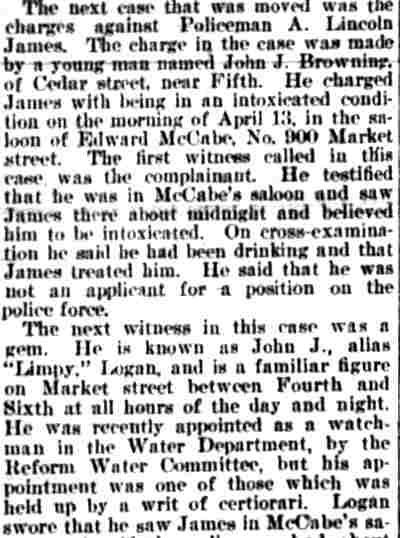
The next case that was moved was the charges against Policeman A. Lincoln James. The charge in the case was made by a young man named John J. Browning, of Cedar street, near Fifth. He charged James with being in an intoxicated condition on the morning of April 13, in the saloon of Edward McCabe, No. 900 Market street. The first witness called in this case was the complainant. He testified that he was in McCabe’s saloon and saw James there about midnight and believed him to be intoxicated. On cross-examination he said he had been drinking and that James treated him. He said that he was not an applicant for a position on the police force.
The next witness in this case was a gem. He is known as John J., alias “Limpy,” Logan, and is a familiar figure on Market street between Fourth and Sixth at all hours of the day and night. He was recently appointed as a watchman in the Water Department, by the Reform Water Committee, but his appointment was one of those which was held up by a writ of certiorari. Logan swore that he saw James in McCabe’s saloon and said the policeman had about nine drinks. He felt certain that James was intoxicated and that he was half drunk when he came into the saloon. The witness on cross examination admitted that he had plenty of beer and that they were coming at a good gait.
John Dorsey, a companion of Logan, corroborated the testimony of his bosom friend and became very indignant when asked if James did not treat him. He said that he had been drinking and paid for all he got.
Policeman James admitted that he was in McCabe’s saloon on the date mentioned. He said he had been in Stockton and arrived at McCabe’s about midnight and while there he had four glasses of beer.
Edward McCabe, the proprietor of the saloon, testified that James was in his place about midnight, but denied that he was intoxicated.
I. Newton Hillman and Hilton Taylor also testified to seeing James and were positive that he was not in an intoxicated condition.
The charges against Policemen Elwyn Steen and William Comley were then taken up. Both of the men were charged with the same offense and were placed on trial together. Lawyer Grey opposed to going to trial without Comley being present as he said he had been informed that he was sick.
Mr. Bleakley opposed his motion and said that Comley was seen in the corridor of the hall early in the evening.
The committee decided to go on with the hearing.
The charge in this case was made by Thomas Neville who swore that both of the policemen were seen to enter the office of Messrs. Shivers & Moffett, on the morning of May 6, at 12.15, and that they remained there until 1.30 a. m.
Counsel for Policeman Steen admitted that his client was in the office of Shivers & Moffett on the date specified, but denied that he remained as long as was charged.
Policeman Steen was put on the stand and testified that on the morning of May 6 he met Policeman Comley, who informed him that he believed there was some person in the office of Shivers & Moffett and Comley asked him to go with him. He said that when they reached the office they found a window open. They then made a search of the premises and also the lumber yard. He testified that the place had been frequently robbed and that Messrs. Shivers & Moffett had furnished Policeman Comley with a key, for the purpose of going through the place.
Henry Moffett, a member of the firm of Shivers & Moffett, testified that the firm had furnished a key to Policeman Comley.
At this juncture Mr. Bleakley went through the crowd and finally landed ex-Excise Commissioner Jacob Gnang on the stand. He said that he knew Policeman Comley and saw him standing in the corridor of the Hall early in the evening.
After considerable delay, occasioned by a conference, between the committee, Mayor Hatch, Acting City Clerk Kramer and Lawyer Bleakley, the committee decided not to take up any more charges and adjourned the hearings until to-morrow night.
As soon as Mayor Hatch reached the Police Department he ordered Chief Dodd to suspend Policeman Comley.
No decisions were given in the other cases.
Camden Policemen Held in Bail
Philadelphia Inquirer —
Patrolmen Isaac Shreeve and Isaac Lovett, of the Camden police force, have been held in ball [sic] by Justice Finley on a charge of assaulting David Humphries, whom they arrested on the East Side last Wednesday evening.
Policeman Matlack Suspended
Philadelphia Inquirer —
Policeman A. L. Matlack, of the East Side, Camden, was given a hearing by Mayor Hatch yesterday on a charge of being unduly harsh towards Mrs. Mary Rose when he arrested her after a quarrel over the killing of some chickens. The Mayor suspended Matlack for ten days. The alleged unwarranted arrest of David Humphries by Patrolmen Isaac Shreeve and Isaac Lovett on the same occasion has not been taken up by the Mayor or Police Committee as yet. Humphries has brought suit for damages against the officers.
Policeman Shot Two Mad Dogs
Philadelphia Inquirer —
Policeman Isaac Shreeve yesterday shot two mad dogs in front of No. 1 Patrol House in Camden.
Many Accused of Election Frauds
Philadelphia Inquirer —
Camden County Grand Jury Returns Fifty-five True Bills of Indictment
Most of Them Are Impounded by Order of Court, While Constables Get Busy
In a partial presentment made before Supreme Court Justice Garrison, in Camden, yesterday, the grand jury returned fifty-five true bills as a result of its probe into alleged election irregularities. Judge Garrison at once ordered County Clerk Patterson to impound most of the true bills until the defendants are apprehended and held in sufficient security to guarantee their appearance at court for trial. Bench warrants were issued and the force of constables was busy last night trying to locate those indicted.
As an evidence of how grave the accusations are in the eyes of the law, Common Pleas Court Judge Joline demanded $6000 bail when Policeman Samuel Flick, of the Twelfth ward, was arrested by County Detective Doran in the court room. Flick is under six indictments, two for perjury and four for false registration. He was at once taken before Judge Joline when security was furnished by Isaac Shreeve, a fellow policeman of the accused officer.
Other Indictments
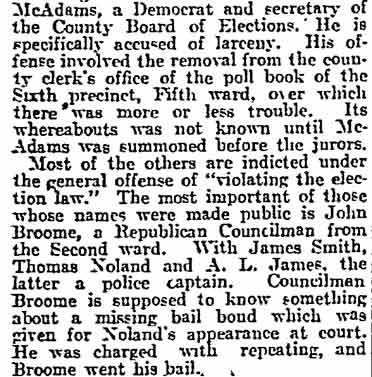
Among those indicted was Francis J. McAdams, a Democrat and secretary of the County Board of Elections. He is specifically accused of larceny. His offense involved the removal from the county clerk’s office of the poll book of the Sixth precinct, Fifth ward, over which there was more or less trouble. Its whereabouts was not known until McAdams was summoned before the jurors.
Most of the others are indicted under the general offense of “violating the election law.” The most important of those whose names were made public is John Broome, a Republican Councilman from the Second ward. With James Smith, Thomas Noland and A. L. James, the latter a police captain. Councilman Broome is supposed to know something about a missing bail bond which was given for Noland’s appearance at court. He was charged with repeating, and Broome went his bail.
Indicted on Five Counts
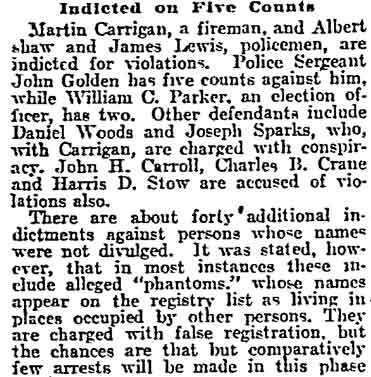
Martin Carrigan, a fireman, and Albert Shaw and James Lewis, policemen, are indicted for violations. Police Sergeant John Golden has five counts against him, while William C. Parker, an election officer, has two. Other defendants include Daniel Woods and Joseph Sparks, who, with Carrigan, are charged with conspiracy. John H. Carroll, Charles B. Crane and Harris D. Stow are accused of violations also.
There are about forty additional indictments against persons whose names were not divulged. It was stated, however, that in most instances these include alleged “phantoms,” whose names appear on the registry list as living in places occupied by other persons. They are charged with false registration, but the chances are that but comparatively few arrests will be made in this phase of the matter.
Probe Still Deeper
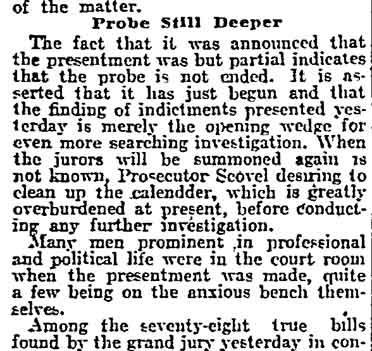
The fact that it was announced that the presentment was but partial indicates that the probe is not ended. It is asserted that it has just begun and that the finding of indictments presented yesterday is merely the opening wedge for even more searching investigation. When the jurors will be summoned again is not known, Prosecutor Scovel desiring to clean up the calendder [sic], which is greatly overburdened at present, before conducting any further investigation.
Many men prominent in professional and political life were in the court room when the presentment was made, quite a few being on the anxious bench themselves.
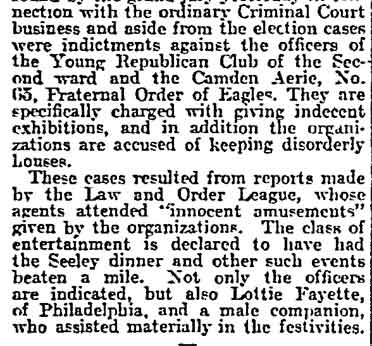
Among the seventy-eight true bills found by the grand jury yesterday in connection with the ordinary Criminal Court business and aside from the election cases were indictments against the officers of the Young Republican Club of the Second ward and the Camden Aerie, No. 65, Fraternal Order of Eagles. They are specifically charged with giving indecent exhibitions, and in addition the organizations are accused of keeping disorderly houses.
These cases resulted from reports made by the Law and Order League, whose agents attended “innocent amusements” given by the organizations. The class of entertainment is declared to have had the Seeley dinner and other such events beaten a mile. Not only the officers are indicated [sic], but also Lottie Fayette, of Philadelphia, and a male companion, who assisted materially in the festivities.
Dog Poisoner at Work
Camden Post-Telegram —
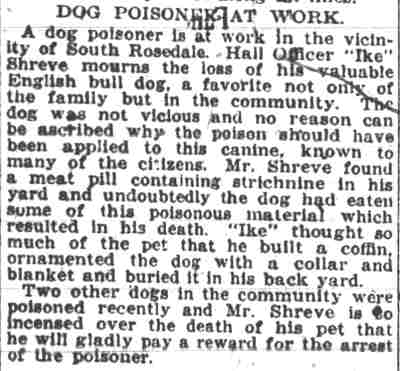
A dog poisoner is at work in the vicinity of South Rosedale. Hall Officer “Ike” Shreve mourns the loss of his valuable English bull dog, a favorite not only of the family but in the community. The dog was not vicious and no reason can be ascribed why the poison should have been applied to this canine, known to many of the citizens. Mr. Shreve found a meat pill containing strichnine [sic] in his yard and undoubtedly the dog had eaten some of this poisonous material which resulted in his death. “Ike” thought so much of the pet that he built a coffin, ornamented the dog with a collar and blanket and buried it in his back yard.
Two other dogs in the community were poisoned recently and Mr. Shreve is so incensed over the death of his pet that he will gladly pay a reward for the arrest of the poisoner.
Officer Shreeve Weds Mrs. Perkins
Camden Post-Telegram —
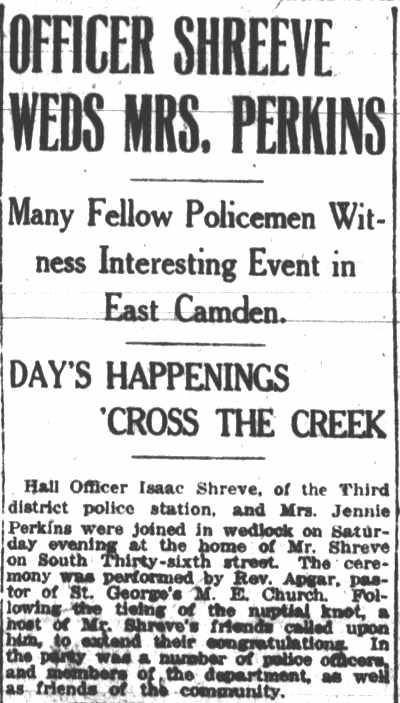
Many Fellow Policemen Witness Interesting Event in East Camden.
DAY’S HAPPENINGS ’CROSS THE CREEK
Hall Officer Isaac Shreve, of the Third district police station, and Mrs. Jennie Perkins were joined in wedlock on Saturday evening at the home of Mr. Shreve on South Thirty-sixth street. The ceremony was performed by Rev. Apgar, pastor of St. George’s M. E. Church. Following the tying of the nuptial knot, a host of Mr. Shreve’s friends called upon him, to extend their congratulations. In the party was a number of police officers, and members of the department, as well as friends of the community.
Isaac Shreve Dies, Veteran Policeman
Camden Courier-Post —
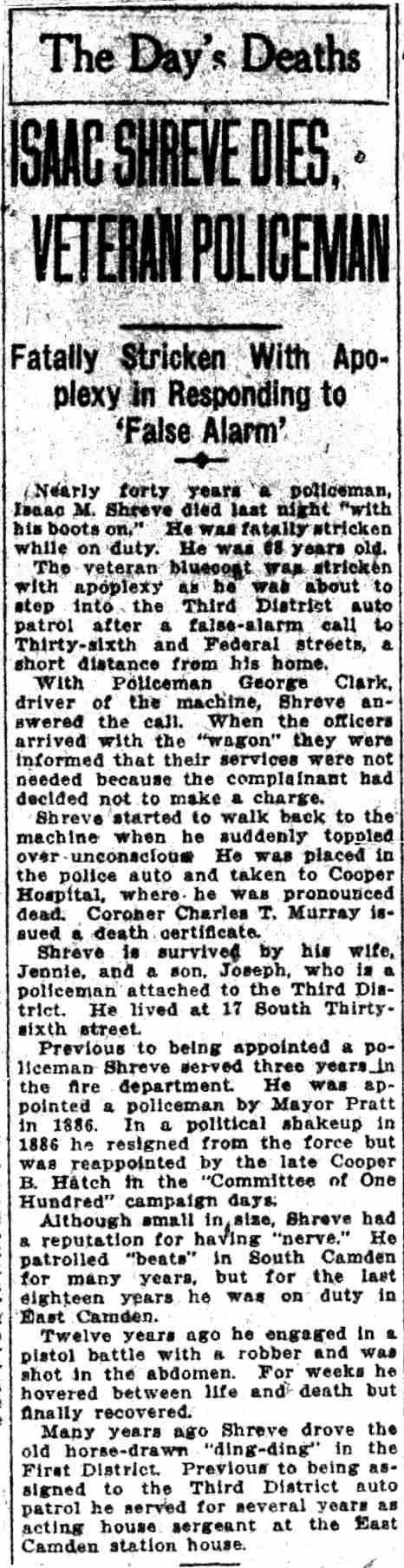
The Day’s Deaths
Fatally Stricken With Apoplexy in Responding to ‘False Alarm’
Nearly forty years a policeman, Isaac M. Shreve died last night “with his boots on.” He was fatally stricken while on duty. He was 6[?] years old.
The veteran bluecoat was stricken with apoplexy as he was about to step into the Third District auto patrol after a false-alarm call to Thirty-sixth and Federal streets, a short distance from his home.
With Policeman George Clark, driver of the machine, Shreve answered the call. When the officers arrived with the “wagon” they were informed that their services were not needed because the complainant had decided not to make a charge.
Shreve started to walk back to the machine when he suddenly toppled over unconscious. He was placed in the police auto and taken to Cooper Hospital, where he was pronounced dead. Coroner Charles T. Murray issued a death certificate.
Shreve is survived by his wife, Jennie, and a son, Joseph, who is a policeman attached to the Third District. He lived at 17 South Thirty-sixth street.
Previous to being appointed a policeman Shreve served three years in the fire department. He was appointed a policeman by Mayor Pratt in 1886. In a political shakeup in 1886 he resigned from the force but was reappointed by the late Cooper B. Hatch in the “Committee of One Hundred” campaign days.
Although small in size, Shreve had a reputation for having “nerve.” He patrolled “beats” in South Camden for many years, but for the last eighteen years he was on duty in East Camden.
Twelve years ago he engaged in a pistol battle with a robber and was shot in the abdomen. For weeks he hovered between life and death but finally recovered.
Many years ago Shreve drove the old horse-drawn “ding-ding” in the First District. Previous to being assigned to the Third District auto patrol he served for several years as acting house sergeant at the East Camden station house.
Camden Cops Hard Hit by Illness and Mishap
Camden Daily Courier —
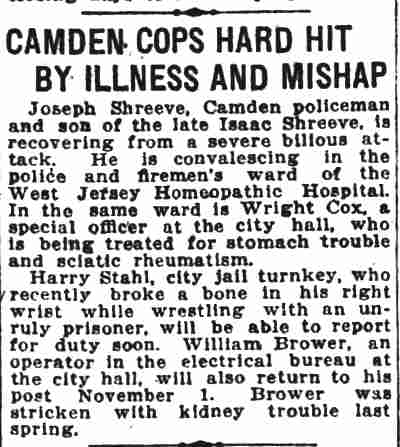
Joseph Shreeve, Camden policeman and son of the late Isaac Shreeve, is recovering from a severe bilious attack. He is convalescing in the police and firemen’s ward of the West Jersey Homeopathic Hospital. In the same ward is Wright Cox, a special officer at the city hall, who is being treated for stomach trouble and sciatic rheumatism.
Harry Stahl, city jail turnkey, who recently broke a bone in his right wrist while wrestling with an unruly prisoner, will be able to report for duty soon. William Brower, an operator in the electrical bureau at the city hall, will also return to his post November 1. Brower was stricken with kidney trouble last spring.