John A. Furey
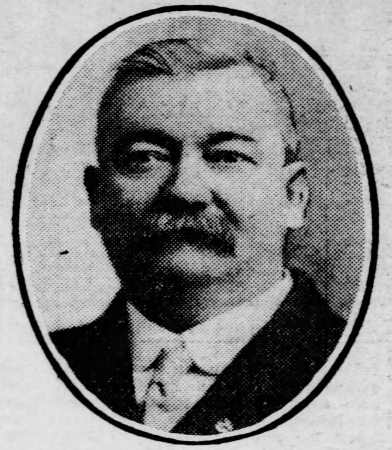
John A. Furey circa 1905
John A. Furey was born in Pennsylvania, according to most Census records, in June of 1851, although some indicate 1853. He married his wife Jennie around 1874, and a son, Walter was born soon afterwards. By 1879 he was working in Camden as a policeman, and living at 527 Jackson Street. The Census shows the Furey family still at 527 Jackson Street. John Furey was then working as a riveter. His son Walter was then five years of age. Soon after the Census was taken, John A. Furey went into the saloon business. He had already become involved in politics, serving as the Republican committeeman from the Eighth Ward in 1880 and as a tax collector. He later was elected as freeholder from the Eighth Ward, holding that post from 1888 until 1890.
A well known man for a number of reasons, John Furey is listed in the Camden City Directories of 1881–1882, 1882–1883 and 1883–1884 as a saloonkeeper at 214 Federal Street. From 1884 through 1887 City Directories show him running a bar at the corner of South 2nd Street and Kaighn Avenue.
After leaving Camden County’s Board of Chosen Freeholders, John Furey was appointed to the Excise Commission, which oversaw bars and liquor licenses in Camden. In May he was made a member of City Council, replacing Isaac Ferris, who had resigned. This however created quite a stir as the City Solicitor serving at that time declared that John Furey could not hold two posts at the same time. The case went to the New Jersey Supreme Court which ruled against his holding both positions.
Sadly, son Walter Furey died around 1892. John Furey remained politically active through the 1890s. This building was still operating as Furey’s Hall as late as 1914. He worked as a private detective until at least 1906, and with his wife conducted a drugstore. The 1892 Camden City Directory lists “Furey’s Hall” at South 4th Street and Kaighn Avenue. He also became involved in real estate.
By 1892 John A. Furey and his family were then living at 1627 Fillmore Street in Camden’s Eighth Ward. They remained at that address through 1899. The 1900 Census reveals the Fureys had moved to 1647 Broadway by the summer of that year.
When the census was taken in 1910 John A. Furey had retired. Mr. and Mrs. Furey were still living at 1647 Broadway. He later became active in another sort of business enterprise, as the 1914 Camden City Directory lists Furey’s Hall on the northwest corner of South 4th Street and Kaighn Avenue. This building, still standing and in use in 2009, was for many years the home of Camden Bar and Restaurant Supply. Gene Robison, who grew up in the neighborhood and worked briefly in the building, noticed the small sign high up on the building saying “Furey’s Hall,” which has now been covered by stucco.
During America’s involvement in World War I, John A. Furey served on the local Public Safety Council. However, his health had been failing for some time and he died on June 1, 1917. A man of considerable means, his will left an endowment for the establishment of a clinic hospital “for the worthy poor”; it is not known to this writer if that was ever done.
Mrs. Jennie Furey was still living at 1647 Broadway, where she was operating a drugstore as late as January 5, 1920.
Philadelphia Inquirer — July 19, 1879
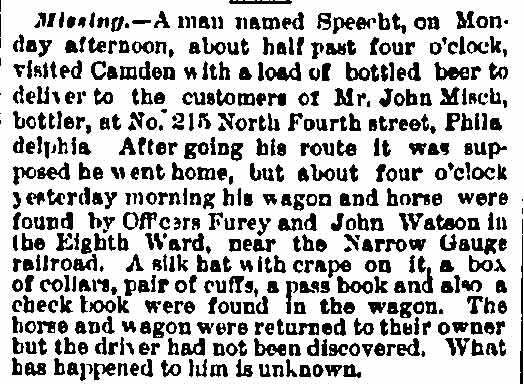
Missing.—A man named Speercht, on Monday afternoon, about half past four o’clock, visited Camden with a load of bottled beer to deliver to the customers of Mr. John Misch, bottler, at No. 215 North Fourth street, Philadelphia. After going his route it was supposed he went home, but about four o’clock yesterday morning his wagon and horse were found by Officers Furey and John Watson in the Eighth Ward, near the Narrow Gauge railroad. A silk hat with crape on it, a box of collars, pair of cuffs, a pass book and also a check book were found in the wagon. The horse and wagon were returned to their owner but the driver had not been discovered. What has happened to him is unknown.
Philadelphia Inquirer — November 29, 1880
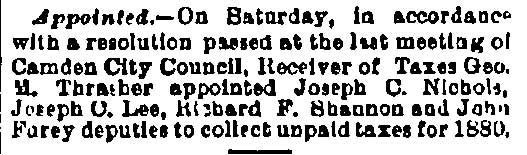
Appointed.—On Saturday, in accordance with a resolution passed at the last meeting of Camden City Council, Receiver of Taxes Geo. H. Thrasher appointed Joseph C. Nichols, Joseph C. Lee, Richard F. Shannon and John Furey deputies to collect unpaid taxes for 1880.
Philadelphia Inquirer — February 2, 1883
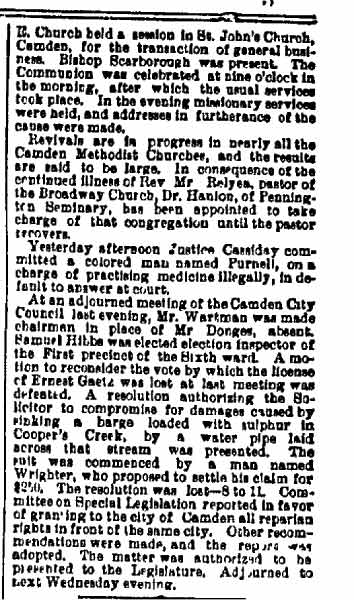
OVER THE RIVER
Last evening the justices of the peace of Camden, and the constables, held a meeting in the court house to take preliminary measures towards forming a permanent organization for the protection of their interests
Yesterday Josiah Ewings had a hearing in the Camden District Court, on the charge of refusing to support his wife. She testified that he had not provided for her the past nine months. It was shown, however, that she was not a resident of Camden, and the case was dismissed
Joseph Fury and James Ayres, two young men who, several days ago, committed an assault and battery on James Dudley, had a hearing before Mayor Bradshaw yesterday morning, and were held in $100 each to answer at court.
It is stated that there are ten cases of small-pox in Marlton, and fears are entertained that it may become epidemic. That place contains about one thousand inhabitants.
At the annual meeting of the stockholders of the Camden Fire Insurance Association yesterday afternoon the following directors were elected for the ensuing year: Josiah D. Rogers, Henry B. Wilson, Jonathan Burr, Edmund E. Reed, Christopher J. Mines, William P. Tatem, Jesse E. Hueston, E. E. Reed, Jr., George W. Gilbert, William S. Scull, William W. Bozarth, John Burr, Charles Wilson. Subsequently the directors organized by electing Henry B. Wilson, president; Jonathan Burr, secretary; R. W. Birdsell, assistant secretary; Edmund R. Read, treasurer, and Christopher J. Mines, surveyor.
Mayor Williams, of Gloucester City, is lying dangerously sick at his home in that city.
Yesterday the convocation of Burlington P.
E. Church held a session in St. John’s Church, Camden, for the transaction of general business. Bishop Scarborough was present. The Communion was celebrated at nine o’clock in the morning, after which the usual services took place. In the evening missionary services were held, and addresses in furtherance of the cause were made.
Revivals are in progress in nearly all the Camden Methodist Churches, and the results are said to be large. In consequence of the continued illness of Rev. Mr. Relyes, pastor of the Broadway Church, Dr. Hanlon, of Pennington Seminary, has been appointed to take charge of that congregation until the pastor recovers.
Yesterday afternoon Justice Cassaday committed a colored man named Purnell, on a charge of practising medicine illegally, in default to answer at court.
At an adjourned meeting of the Camden City Council last evening, Mr. Wartman was made chairman in place of Mr. Donges, absent. Samuel Hibbs was elected election inspector of the First precinct of the Sixth ward. A motion to reconsider the vote by which the license of Ernest Gaetz was lost at last meeting was defeated. A resolution authorizing the Solicitor to compromise for damages caused by sinking a barge loaded with sulphur in Cooper’s Creek, by a water pipe laid across that stream was presented. The suit was commenced by a man named Wrigbtner, who proposed to settle his claim for $250. The resolution was lost—8 to 11. Committee on Special Legislation reported in favor of granting to the city of Camden all riparian rights in front of the same city. Other recommendations were made, and the report was adopted. The matter was authorized to be presented to the Legislature. Adjourned to next Wednesday evening.
Philadelphia Inquirer — March 14, 1888
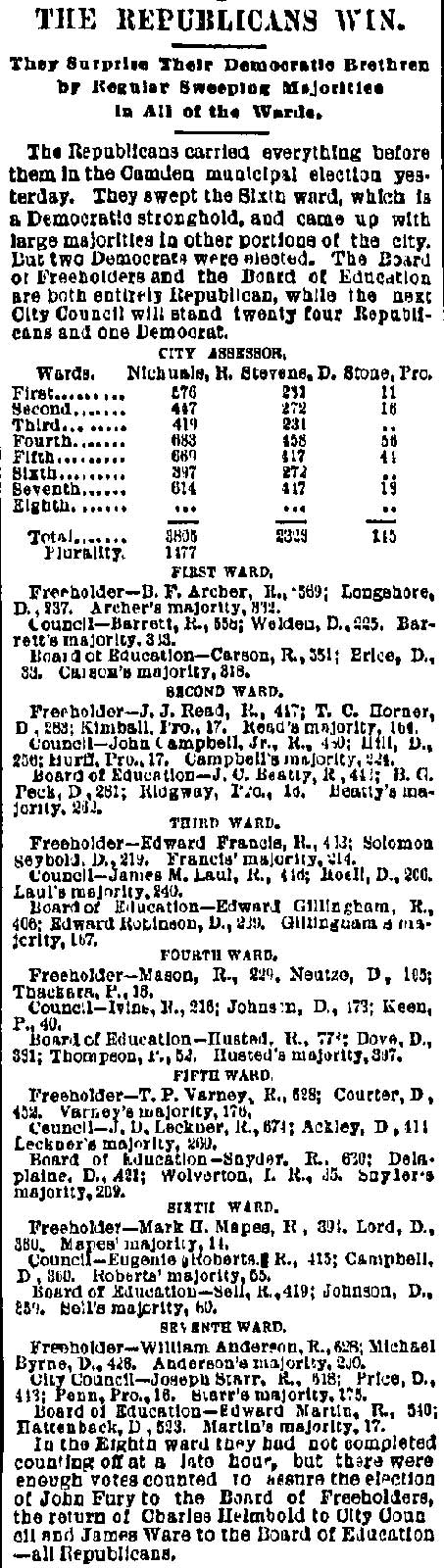
THE REPUBLICANS WIN.
They Surprise Their Democratic Brethren by Regular Sweeping Majorities in All of the Wards.
The Republicans carried everything before them in the Camden municipal election yesterday. They swept the Sixth ward, which is a Democratic stronghold, and came up with large majorities in other portions of the city. But two Democrats were elected. The Board of Freeholders and the Board of Education are both entirely Republican, while the next City Council will stand twenty four Republicans and one Democrat.
CITY ASSESSOR.
Wards. Nichols, R. Stevens, D. Stone, Pro.
First… 576 231 11
Second… 447 272 16
Third… 419 231 —
Fourth… 683 458 56
Fifth… 669 417 41
Sixth… 397 272 —
Seventh… 614 417 19
Eighth… — — —
Total… 3805 2298 115
Plurality… 1177
FIRST WARD.
Freeholder—B. F. Archer, R., 569; Longshore, D., 337. Archer’s majority, 232.
Council—Barrett, R., 556; Welden, D., 225. Barrett’s majority, 331.
Board of Education—Carson, R., 351; Erice, D., 33. Carson’s majority, 318.
SECOND WARD.
Freeholder—J. J. Read, R., 417; T. C. Horner, D., 253; Kimball, Pro., 17. Read’s majority, 164.
Council—John Campbell, Jr., R., 450; Hill, D., 256; Hurll, Pro., 17. Campbell’s majority, 194.
Board of Education—J. C. Beatty, R., 417; B. G. Peck, D., 261; Ridgway, Pro., 16. Beatty’s majority, 156.
THIRD WARD.
Freeholder—Edward Francis, R., 413; Solomon Seybold, D., 219. Francis’ majority, 194.
Council—James M. Laul, R., 440; Roell, D., 200. Laul’s majority, 240.
Board of Education—Edward Gillingham, R., 406; Edward Robinson, D., 239. Gillingham’s majority, 167.
FOURTH WARD.
Freeholder—Mason, R., 220; Neutze, D., 105; Thackara, P., 18.
Council—Irvine, R., 216; Johnson, D., 173; Keen, P., 40.
Board of Education—Husted, R., 774; Dove, D., 391; Thompson, I., 54. Husted’s majority, 397.
FIFTH WARD.
Freeholder—T. P. Varney, R., 628; Courter, D., 452. Varney’s majority, 176.
Council—J. D. Leckner, R., 674; Ackley, D., 411. Leckner’s majority, 263.
Board of Education—Snyder, R., 630; Delaplaine, D., 421; Wolverton, I. R., 45. Snyder’s majority, 209.
SIXTH WARD.
Freeholder—Mark H. Mapes, R., 391; Lord, D., 380. Mapes’ majority, 11.
Council—Eugene J. Roberts, R., 415; Campbell, D., 360. Roberts’ majority, 55.
Board of Education—Sell, R., 419; Johnson, D., 359. Sell’s majority, 60.
SEVENTH WARD.
Freeholder—William Anderson, R., 628; Michael Byrne, D., 428. Anderson’s majority, 200.
City Council—Joseph Starr, R., 518; Price, D., 413; Penn, Pro., 18. Starr’s majority, 175.
Board of Education—Edward Martin, R., 540; Hattenback, D., 523. Martin’s majority, 17.
In the Eighth ward they had not completed counting off at a late hour, but there were enough votes counted to assure the election of John Furey to the Board of Freeholders, the return of Charles Helmbold to City Council and James Ware to the Board of Education—all Republicans.
Philadelphia Inquirer — February 16, 1890
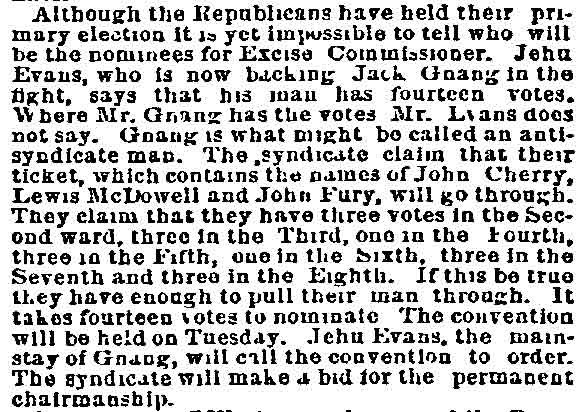
Although the Republicans have held their primary election it is impossible to tell who will be the nominees for Excise Commissioner. Jehu Evans, who is now looking sick (because in the fight, says that his man has fourteen votes. Where Mr. Clardy has the votes Mr. Evans does not say. Gnang is what might be called an anti-syndicate man. The syndicate claim that they hold tickets, which contains the names of John Cherry, Lewis McDowell and John Burry, will go through. They claim that they have three votes in the Second ward, three in the Third, one in the Fourth, three in the Fifth, one in the Sixth, three in the Seventh and three in the Eighth. If this be true they have enough to pull their man through. It takes fourteen votes to nominate. The convention will be held on Tuesday. Jehu Evans, the unanimity of Gnang, will call the convention to order. The syndicate will make a bid for the permanent chairmanship.
Philadelphia Inquirer — March 14, 1890
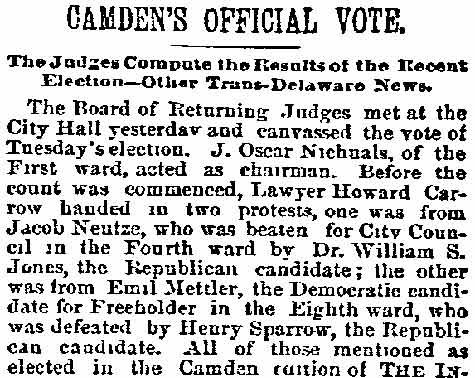
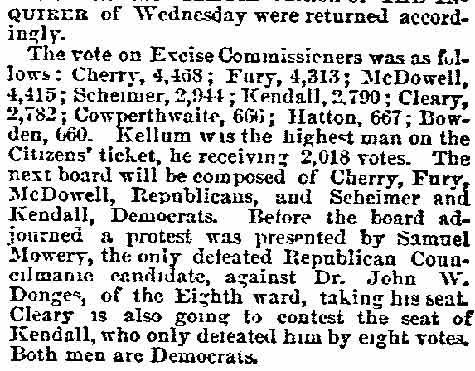
Named: John Furey, J. Oscar Nichuals, Howard Carrow, Jacob Neutze, Dr. William S. Jones
Emil Mettler, Henry Sparrow, Dr. John W. Donges, John Cherry, Lewis McDowell
Samuel Mowery, Scheimer, Kendall, Hatton, Bowden, Cowperthwaite, Kellum, and Cleary.
Philadelphia Inquirer — December 28, 1890
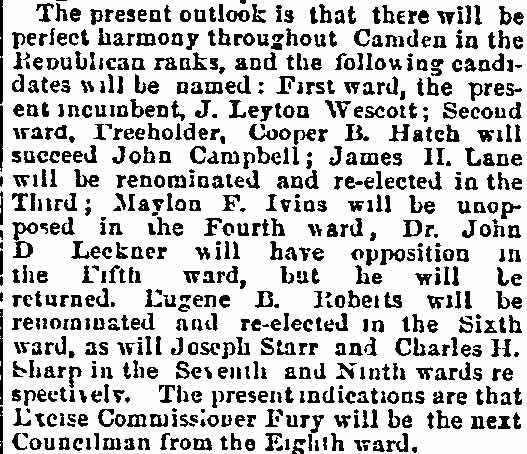
The present outlook is that there will be perfect harmony throughout Camden in the Republican ranks, and the following candidates will be named: First ward, the present incumbent, J. Leyton Wescott; Second ward, Freeholder, Cooper B. Hatch will succeed John Campbell; James H. Lane will be renominated and re-elected in the Third; Maylon F. Ivins will be unopposed in the Fourth ward, Dr. John D. Leckner will have opposition in the Fifth ward, but he will be returned. Eugene B. Roberts will be renominated and re-elected in the Sixth ward, as will Joseph Starr and Charles H. Sharp in the Seventh and Ninth wards respectively. The present indications are that Excise Commissioner Fury will be the next Councilman from the Eighth ward.
Philadelphia Inquirer — May 1, 1891
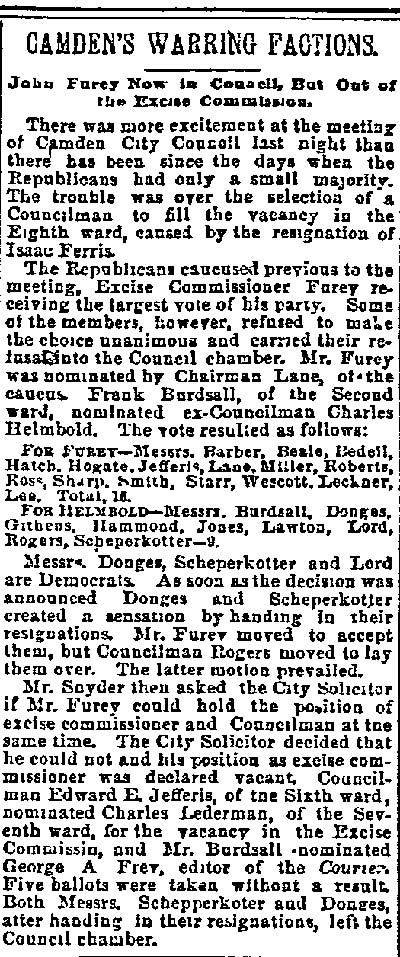
CAMDEN’S WARRING FACTIONS.
John Furey Now in Council, But Out of the Excise Commission.
There was more excitement at the meeting of Camden City Council last night than there has been since the days when the Republicans had only a small majority. The trouble was over the selection of a Councilman to fill the vacancy in the Eighth ward, caused by the resignation of Isaac Ferris.
The Republicans caucused previous to the meeting, Excise Commissioner Furey receiving the largest vote of his party. Some of the members, however, refused to make the choice unanimous and carried their refusal into the Council chamber. Mr. Furey was nominated by Chairman Lane, of the caucus. Frank Burdsall, of the Second ward, nominated ex-Councilman Charles Helmbold. The vote resulted as follows:
For Furey—Messrs. Barber, Beale, Bedell, Hatch, Hogate, Jefferis, Lane, Miller, Roberts, Ross, Sharp, Smith, Starr, Westcott, Leckner, Lee. Total, 16.
For Helmbold—Messrs. Burdsall, Donges, Githens, Hammond, Jones, Lawton, Lord, Rogers, Scheperkotter—9.
Messrs. Donges, Scheperkotter and Lord are Democrats. As soon as the decision was announced Donges and Scheperkotter created a sensation by handing in their resignations. Mr. Furey moved to accept them, but Councilman Rogers moved to lay them over. The latter motion prevailed.
Mr. Snyder then asked the City Solicitor if Mr. Furey could hold the position of excise commissioner and Councilman at the same time. The City Solicitor decided that he could not and his position as excise commissioner was declared vacant. Councilman Edward E. Jefferis, of the Sixth ward, nominated Charles Lederman, of the Seventh ward, for the vacancy in the Excise Commission, and Mr. Burdsall nominated George A. Frey, editor of the Courier. Five ballots were taken without a result. Both Messrs. Schepperkotter and Donges, after handing in their resignations, left the Council chamber.
Philadelphia Inquirer — May 7, 1891
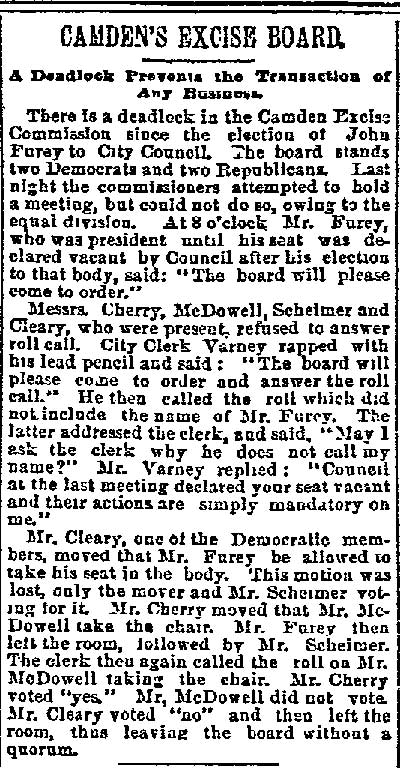
John A. Furey — John Cherry
Philadelphia Inquirer — May 21, 1891
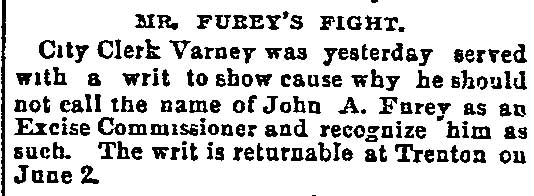
John A. Furey — Thaddeus P. Varney
Philadelphia Inquirer — June 19, 1891
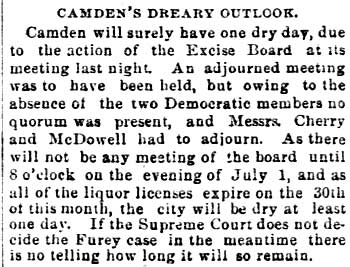
CAMDEN’S DREARY OUTLOOK.
Camden will surely have one dry day, due to the action of the Excise Board at its meeting last night. An adjourned meeting was to have been held, but owing to the absence of the two Democratic members no quorum was present, and Messrs. Cherry and McDowell had to adjourn. As there will not be any meeting of the board until 8 o’clock on the evening of July 1, and as all of the liquor licenses expire on the 30th of this month, the city will be dry at least one day. If the Supreme Court does not decide the Furey case in the meantime there is no telling how long it will so remain.
Philadelphia Inquirer — June 25, 1891
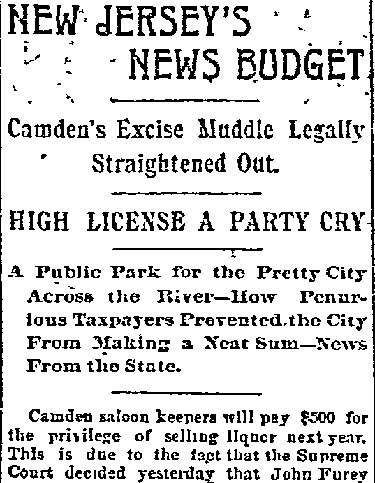
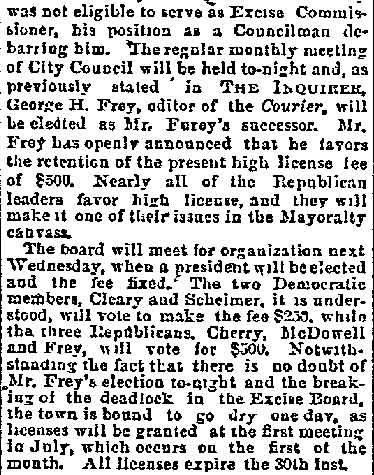
New Jersey’s News Budget. Camden’s Excise Muddle Legally Straightened Out. High License a Party Cry. A Public Park for the Pretty City Across the River—How Pennsylvania Triumphed—The City From Making a Neat Sum—News From the State.
Camden saloon keepers will pay $500 for the privilege of selling liquor next year. This is due to the fact that the Supreme Court decided that John Furey could not hold two positions at the same time.
Philadelphia Inquirer — June 29, 1891
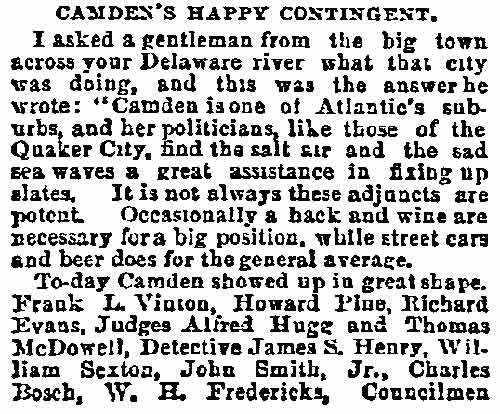
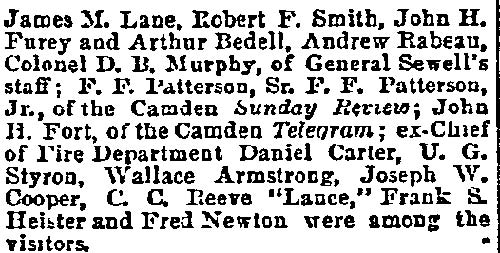
Named: James M. Lane, Robert F. Smith, John A. Furey, Arthur Bedell
Andrew Rabeau, Col. Daniel B. Murphy, Gen. William J. Sewell
Frank Ford Patterson Sr., Frank Ford Patterson Jr.
John Fort, Daniel Carter, U.G. Styron, Wallace Armstrong
Joseph W. Cooper, C.C. Reeve, Frank S. Heister, Fred Newton
Frank L. Vinton, Howard Pine, Richard Evans
Judge Alfred Hugg, Judge Thomas McDowell
James S. Henry, William Sexton, John Smith Jr., Charles Bosch, and W.H. Fredericks.
Philadelphia Inquirer — March 14, 1897
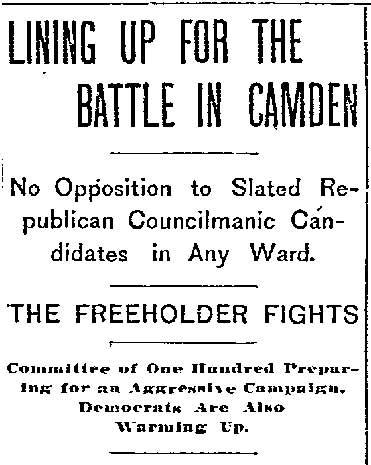
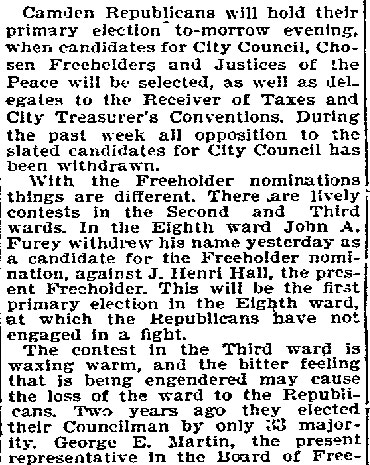
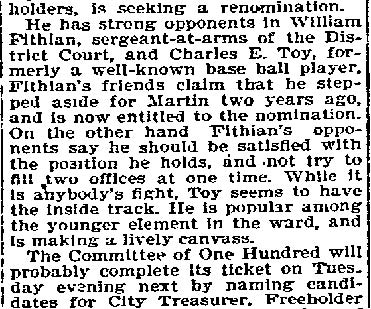
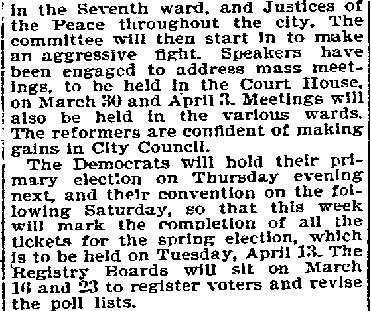
Named: John A. Furey, J. Henri Hall, George E. Martin, William Fithian, and Charles E. Toy.
Philadelphia Inquirer — February 22, 1898
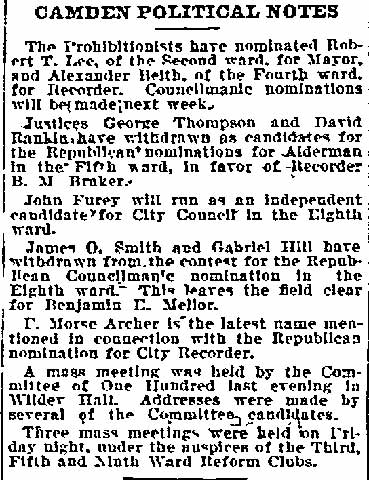
CAMDEN POLITICAL NOTES.
—The Prohibitionists have nominated Robert T. Lee, of the Second ward, for Mayor, and Alexander Heith, of the Fourth ward, for Recorder. Councilmanic nominations will be made next week.
—Justices George Thompson and David Rankin have withdrawn as candidates for the Republican nominations for Alderman in the Fifth ward, in favor of Recorder B. M. Braker.
—John Furey will run as an independent candidate for City Council in the Eighth ward.
—James O. Smith and Gabriel Hill have withdrawn from the contest for the Republican Councilmanic nomination in the Eighth ward. This leaves the field clear for Benjamin E. Mellor.
—F. Morse Archer is the latest name mentioned in connection with the Republican nomination for City Recorder.
—A mass meeting was held by the Committee of One Hundred last evening in Wilder Hall. Addresses were made by several of the Committee’s candidates.
—Three mass meetings were held on Friday night, under the auspices of the Third, Fifth and Ninth Ward Reform Clubs.
Philadelphia Inquirer — April 27, 1898
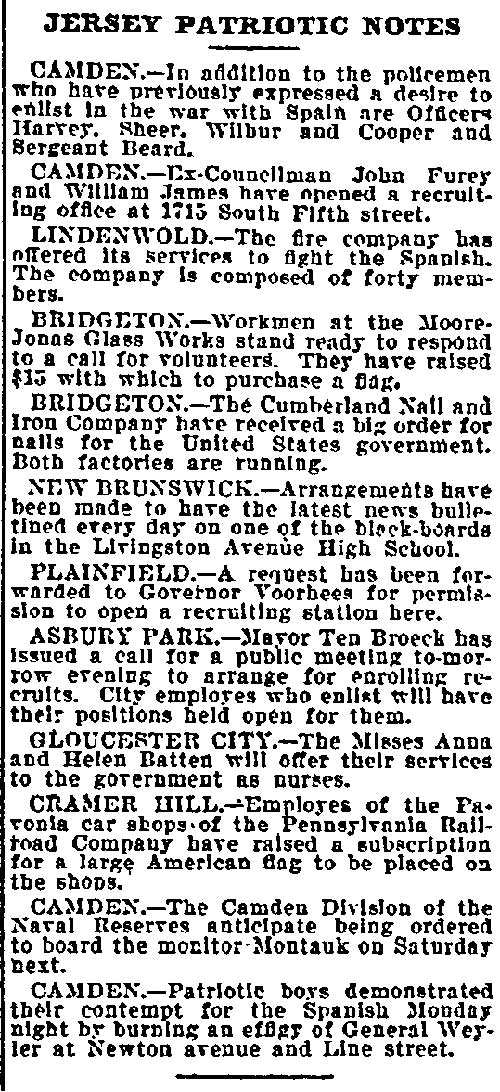
Named: John A. Furey, William James, and South 5th Street.
Philadelphia Inquirer — February 17, 1903
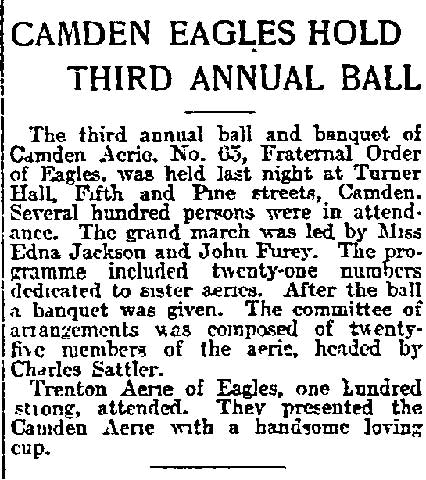
Named: Edna Jackson, John A. Furey, Charles Sattler
Camden Aerie No. 65, Fraternal Order of Eagles
Turner Hall, South 5th Street, and Pine Street.
Philadelphia Inquirer — April 2, 1903
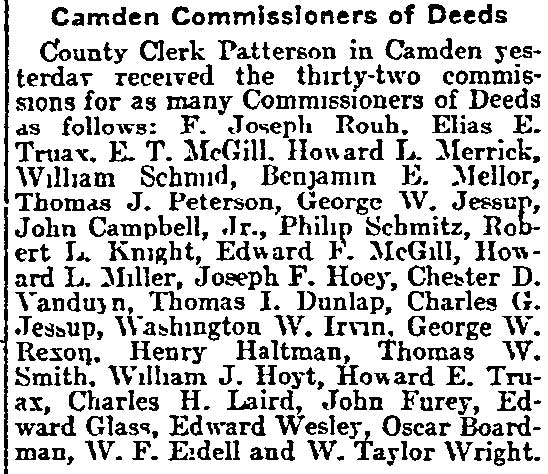
Camden Commissioners of Deeds
County Clerk Patterson in Camden yesterday received the thirty-two commissions for as many Commissioners of Deeds as follows: F. Joseph Rouh, Elias E. Truax, E. T. McGill, Howard L. Merrick, William Schmid, Benjamin E. Mellor, Thomas J. Peterson, George W. Jessup, John Campbell, Jr., Philip Schmitz, Robert L. Knight, Edward F. McGill, Howard L. Miller, Joseph F. Hoey, Chester D. Vanduyn, Thomas I. Dunlap, Charles G. Jessup, Washington W. Irvin, George W. Reson, Henry Haltman, Thomas W. Smith, William J. Hoyt, Howard E. Truax, Charles H. Laird, John Furey, Edward Glass, Edward Wesley, Oscar Boardman, W. F. Ezdell and W. Taylor Wright.
Philadelphia Inquirer — February 12, 1905

State Deputy John A. Furey will institute a lodge of the Fraternal Order of Eagles at Orange to-morrow night. The lodge will have a membership of 105.
Philadelphia Inquirer — March 8, 1905
Charles M. Ferat — John A. Furey
Philadelphia Inquirer — August 12, 1905
Off for Denver to Represent Eagles.
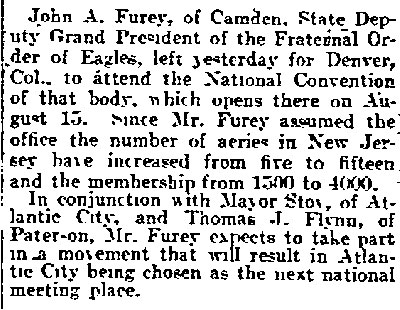
John A. Furey, of Camden, State Deputy Grand President of the Fraternal Order of Eagles, left yesterday for Denver, Col., to attend the National Convention of that body, which opens there on August 13. Since Mr. Furey assumed the office the number of series in New Jersey have increased from five to fifteen and the membership has increased to 1000.
In conjunction with Mayor Stott, of Atlantic City, and Thomas E. Fay, Patron, Mr. Furey expects to take part in a movement that will result in Atlantic City being chosen as the next national meeting place.
Philadelphia Inquirer — December 16, 1905
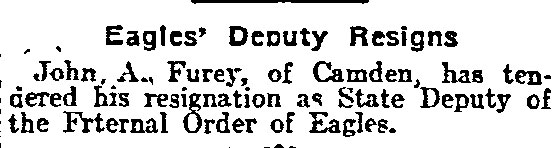
Eagles’ Deputy Resigns. John A. Furey, of Camden, has tendered his resignation as State Deputy of the Fraternal Order of Eagles.
Philadelphia Inquirer — June 28, 1906

** “Golden Rule” John A. Furey was given a reception last night by the Harmony Singing Society.
Camden Post-Telegram — May 11, 1908

Annual Memorial Services Held Yesterday at the Camden Theatre
Render Elaborate Program
The annual memorial service of Camden Aerie, No. 65, Fraternal Order of Eagles, were held in the Camden Theatre yesterday afternoon. They were of the usual impressive character and the several hundred persons were at times very visibly affected.
The feature of the occasion was in the reading of the roll of the dead by Worthy Secretary Charles F. Sattler. In the rear of the stage there was a large painting representing the setting of the sun. The frame was draped in black crepe, incandescent lights being arranged about it at intervals. As the names of the departed were announced the lights were extinguished.
The oration was given by Grand Trustee Thomas C. Hayes, of Nevada. [sic] His address was a splendid, eloquent effort and was in thorough keeping with the occasion.
The balance of the program, replete with interesting features, included the following:
Orchestra— (a) March-Coronation....Meyerbeer (b) Overture—Morning, Noon and Night....Suppe (c) Intermezzo-Traumerei....Schumann
Opening address....Worthy President Frank S. Devereaux.
Quartet, “Come Gracious Spirit”....Marzo La Favorita Quartet. Miss Julia Robinson, soprano; Miss Katharine Rosenkranz, contralto; A. D. McNichol, tenor; Henry Hotz, basso; W. Silvano Thunder, accompanist.
Prayer....Worthy Chaplain John L. Jarvis.
Tenor solo, “The Lord is my Light”....Allittson A. D. McNichol.
Contralto solo, “From the Depths”....Campana Miss Katharine Rosenkranz.
Remarks....Past Worthy President William M. Petzelt.
Duet, from “The Crucifixion”....Stainer Misses Robinson and Rosenkranz.
Recitation, “The Last Hymn”....M. Farningham Miss Marjorie R. Durgin.
Orchestra, “Serenade”....A. Emil Titl
Flute solo by Wm. A. Joseph.
Roll Call of Our Honored Dead....Worthy Secretary Chas. F. Sattler
Soprano solo, “Show Me Thy Ways”....Flotow Miss Julia Robinson.
Memorial Address—Grand Trustee Thos. C. Hayes, of Newark, N. J.
Trio, “Protect Us Through the Night”....Nicolai Misses Robinson and Rosenkranz and Mr. McNichol.
Orchestra, Inflamatus from “Stabat Mater”....Rossini
Bass solo, “Through the Darkness”....Rossini Henry Hotz.
Quartet, “Incline Thine Ear”....Himmel La Favorita Quartet.
Hymn, “Nearer My God, to Thee”....Mason Sung by entire audience.
Benediction....Worthy Chaplain John L. Jarvis.
Orchestra, “Stars and Stripes”....Sousa Brother Anthony J. Oberst, Musical Director.
Those in whose memory the services were held included the following:
Alfred Kemble, died June 16, 1901. William Denneller, died October 4, 1902. Conrad Brill, Jr., died July 8, 1903. Charles Beale, died October 29, 1903. Frank Burt, died March 10, 1904. Dr. P. W. Beale, died June 7, 1904. Jacob Hess, died August 16, 1904. Daniel W. Broomley, died September 1, 1904. Frederick Johnson, died December 3, 1904. William H. Cole, died December 21, 1904. J. S. B. Candler, died January 15, 1905. Harry B. Middleton, died April 7, 1905. George D. Strain, died July 9, 1905. Martin MacNeil, died July 30, 1905. Adolph Peschlow, died January 28, 1906. H. J. McNermy, died March 2, 1906. L. L. McClennan, died March 15, 1906. Henry Price, died June 6, 1906. Nathaniel Myers, died October 7, 1906. Isaac Toy, died December 25, 1906. Thomas J. Farnan, died March 12, 1907. George Griffin, died March 18, 1907. George W. Haman, died April 5, 1907. Michael Raidon, died May 23, 1907. Thomas Flatley, died August 8, 1907. John F. Berton, died November 1, 1907. Joseph E. Healy, died December 29, 1907. Thomas Dwyler, died February 10, 1908. Michael J. Lynch, died March 19, 1908. Otto Heydrich, died March 24, 1908.
The officers of the local aerie include these: Past Worthy Presidents, John H. Riddle, John A. Furey, James F. Cleary, Wm. H. Cole (deceased), Julius R. Schaaf, Wm. F. Jann, John J. Cleary, William M. Petzelt; Worthy President, Frank S. Devereaux; Worthy Vice President, Theodore B. Rambo; Worthy Secretary, Chas. F. Sattler; Worthy Treasurer, George S. Dilmore; Worthy Chaplain, John J. Jarvis; Worthy Conductor, Harry A. Durgin; Inside Guard, Robert M. Hartman; Outside Guard, B. Tierney; Worthy Trustees, Anthony J. Oberst, Harry C. Halbert, Charles E. Cullen; Worthy Physicians, Dr. W. P. Wingender, Dr. J. L. Mahaffey.
House Committee—A. J. Docherty, chairman; Edward Hagerty, Frank Applegate, Wm. Vander-Straeten, Wm. J. Lawler.
Memorial Committee—Anthony J. Oberst, chairman; William M. Petzelt, Julius R. Schaaf, William F. Jahn, Chas. F. Sattler, James F. Cleary, Theodore B. Rambo, George Fisher, George S. Dilmore, Harry A. Durgin, John L. Jarvis.
Ushers—John J. Burk, chairman; Frank Moncreif, Louis Bennett, Robert C. Barr, Wm. A. Atkin, Jr., John Lloyd, Joseph Taylor, Charles Mulner, Chas. Blank, Geo. W. Johnson, Arthur Colsey, Wm. D. Hoover, Fay La Fayette, Howard A. Fern.
Philadelphia Inquirer — June 2, 1917
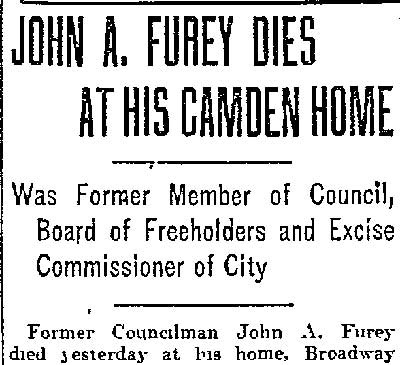
John A. Furey Dies at His Camden Home.
Was Former Member of Council, Board of Freeholders and Excise Commissioner of City
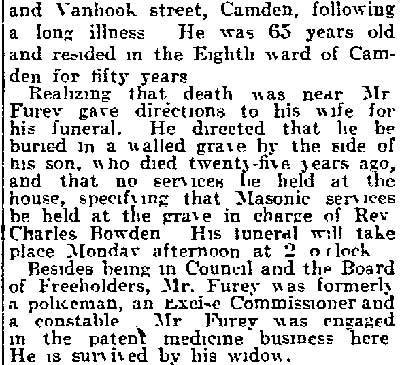
Former Councilman John A. Furey died yesterday at his home, Broadway and Vanhook street, Camden, following a long illness. He was 65 years old and resided in the Eighth ward of Camden for fifty years.
Realizing that death was near, Mr. Furey gave directions to his wife for his funeral. He directed that he be buried in a walled grave by the side of his son, who died twenty-five years ago, and that no services be held at the house, specifying that Masonic services be held at the grave in charge of Rev. Charles Bowden. His funeral will take place Monday afternoon at 2 o’clock.
Besides being in Council and the Board of Freeholders, Mr. Furey was formerly a policeman, an Excise Commissioner and a constable. Mr. Furey was engaged in the patent medicine business here. He is survived by his widow.
Philadelphia Inquirer — June 16, 1917
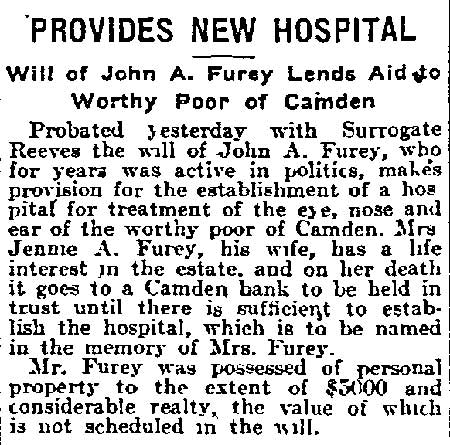
Provides New Hospital. Will of John A. Furey Lends Aid to Worthy Poor of Camden
Probated yesterday with Surrogate Reeves the will of John A. Furey, who for years was active in politics, makes provision for the establishment of a hospital for treatment of the eye, nose and ear of the worthy poor of Camden. Mrs. Jennie A. Furey, his wife, has a life interest in the estate, and on her death it goes to a Camden bank to be held in trust until there is sufficient to establish the hospital, which is to be named in the memory of Mrs. Furey.
Mr. Furey was possessed of personal property to the extent of $5000 and considerable realty, the value of which is not scheduled in the will.
When G.O.P. Battled G.O.P.
Camden Courier-Post —
Typical Convention Rumpus Stirred ‘Regular’ and ‘True’ Republicans as Gibbs and Morgan Were Nominated for Sheriff in ‘81
Another in a series of articles on Camden affairs and personalities of yesteryear
By Ben Courter
Rival factions in the political conventions of long ago were more bitter toward one another than toward the common foe. So-called “rump” conventions were by no means exceptions. By “rump” was meant merely those who refused to play with the regulars and who set up the nominations, as did the Bull Moose on the national scale in the historic scrap of 1912 which resulted in the three-cornered battle of Wilson, Roosevelt and Taft, giving the Princeton professor the start that was to make him a world figure. Factions we still have, of course, and it is quite proper, since too much regularity often breeds party decay. But present-day political methods are certainly lacking in the spectacular rumpuses that stirred the rank and file in the period when delegates met and made their nominations.
In a recent article allusion was made to the Democratic convention of September 20, 1878, when Nathan T. Stratton, of Millville, was nominated for Congress by the Democrats in the midst of downright fisticuffs, when “liar” and “hypocrite” and worse was hurled about the hall.
Lest it may be assumed the party of Jefferson and Jackson only was given to such methods, it is fitting to give a picture on the other side of the political house. Dr. William H. Iszard’s inexhaustible scrap book, loaned me by his son, former Assemblyman Iszard comes across with a copy of a tabloid political sheet, “The True Republican,” which gives a recital of a battle royal in the G.O.P. ranks which will be of interest to some old-timers I know are still about.
Rival Conventions
That was the convention to nominate a sheriff called at Gloucester City Hall on Saturday, October 8, 1881, where we find the redoubtable Colonel James Matlack Scovel once more a moving factor, but this time in the ranks of the “regular Republicans” or at least so they called themselves as opposed to the “rump” set up by a rival group. Christopher J. Mines, long Fifth ward leader and later sheriff, apparently had been selected as temporary chairman with William A. Husted, who died last year well in his 70’s, as secretary. But when that part of the delegation marched up to city hall, like the famed king’s horses—they marched down again.
As a matter of fact, not much marching was done in the hall—for it was asserted by the “true Republicans” that when they essayed to enter the portals they found Colonel Scovel and Henry M. Jewett, father of Harry Jewett, a Camden newspaperman of the long ago and for years later Jersey editor of the Inquirer, in command. More, it was charged “people representing the worst elements of society” were on guard and presented a phalanx which even the huskies of the opposing force could not break. Mines was strong-armed by the minions of Scovel and Jewett and there was so much hooting and yelling and cussin’ that the “true” part of the outfit walked out, all 29 of them, over to Moss’ hall where they proceeded to carry on their convention to their own taste.
And all 29 of these valiant Republicans voted for Eli B. Morgan as their candidate for sheriff. You old timers will be interested in recalling these delegates who refused to kowtow to ‘Colonel Jim.’ In the Third ward there was James M. Lane, Charles S. Cotting and George Martin, in the Fourth, Husted, the Sixth, C. C. Smith, Thad Varney, Charles A. Sawyer: in the Seventh, Stephen Walters, Charles Lederman, William Simpson; in Gloucester, John W. Wright, David Anderson, Frank Mills, Robert Lafferty, Richard Allen, Jesse Daisey, Samuel Wood; in Haddon, Charles M. Macready, Elwood J. Haines in Delaware, William Brick, William Graff, Isaac Coles; in Merchantville, Matthias Homer, William Naylor, and in Center, James Davis, Garrett Patton and Gilbert Shaw.
Hot Statement
These “true Republicans” in a statement to the party rank and file, under the Algeresque title of “Now or Never,” scathingly said: “It becomes the duty of every Republican voter of Camden county, who has the future interest of the party at heart, to administer a severe and lasting rebuke to all candidates who employ the element and encourage the means that were used in controlling the Sheriff’s convention at City Hall, Gloucester City. It discounted anything within the memory of the oldest Democrat inhabitant. What with Col. Joseph Nichols urging the crowd to go elsewhere and nominate Gibbs, and the immaculate Billy Warner of the Fifth ward ordering them to burst the door in, coupled with the commanding voice of that great patriot and life-long Republican, James M. Scovel, alias Mountain Partridge, together with the curses and threats from John Furey, Jack Quigley, Pud Young, Bill Derr, ‘Tar Heel’ Jim Hayes, the able city solicitor, and a gang of Philadelphia roughs, a beautiful spectacle was presented.”
The “Gibbs” mentioned was Theodore B. Gibbs who long lived in the white mansion on the banks of Clementon lake and whose ancient grist mills ground the grain for farmers from miles around. None in the county was held in higher esteem and in later years most of the valiant 29 were among his closest friends, unnecessary proof the political animosities are, as a rule, not very enduring. Gibbs was nominated by the “regular” Convention which ousted the 29 and a mighty hot shrievalty campaign ended on November 10 with his ejection, in spite of the “now or never” demand of his opponents headed by Eli Morgan.
The latter was a real estate man, son of Randall Morgan, elected sheriff by a whisker over “Ham” Bitten in 1869, and brother of J. Willard Morgan, long a Republican chieftain. It was the elder Morgan who defeated Bitten, a rough and ready character nominated as a joke, by a narrow squeak.
In the shrievalty scrap of 1881, Gibbs received 5,381 and Morgan, 1,189. Angus Cameron, the Democratic candidate was given 4,450 votes. Nor did the “true” nominees for coroner fare any better. Sam Bennett, William Thompson and Alexander Powell being defeated by ‘Doc’ John D. Leckner, Jacob Justice and William Duble.
But the “true” Republicans licked their wounds and most of them were ready to “yen their heads off” when Colonel Scovel in later campaigns made the welkin ring with his call from the rostrum to wallop the enemy. If you now come across any of the few actors of that period still in the flesh an allusion to that “spectacle” of half century ago will sure bring one big chuckle with the declaration “them was the days.”
Furey's Hall — 277–347 Kaighn Avenue
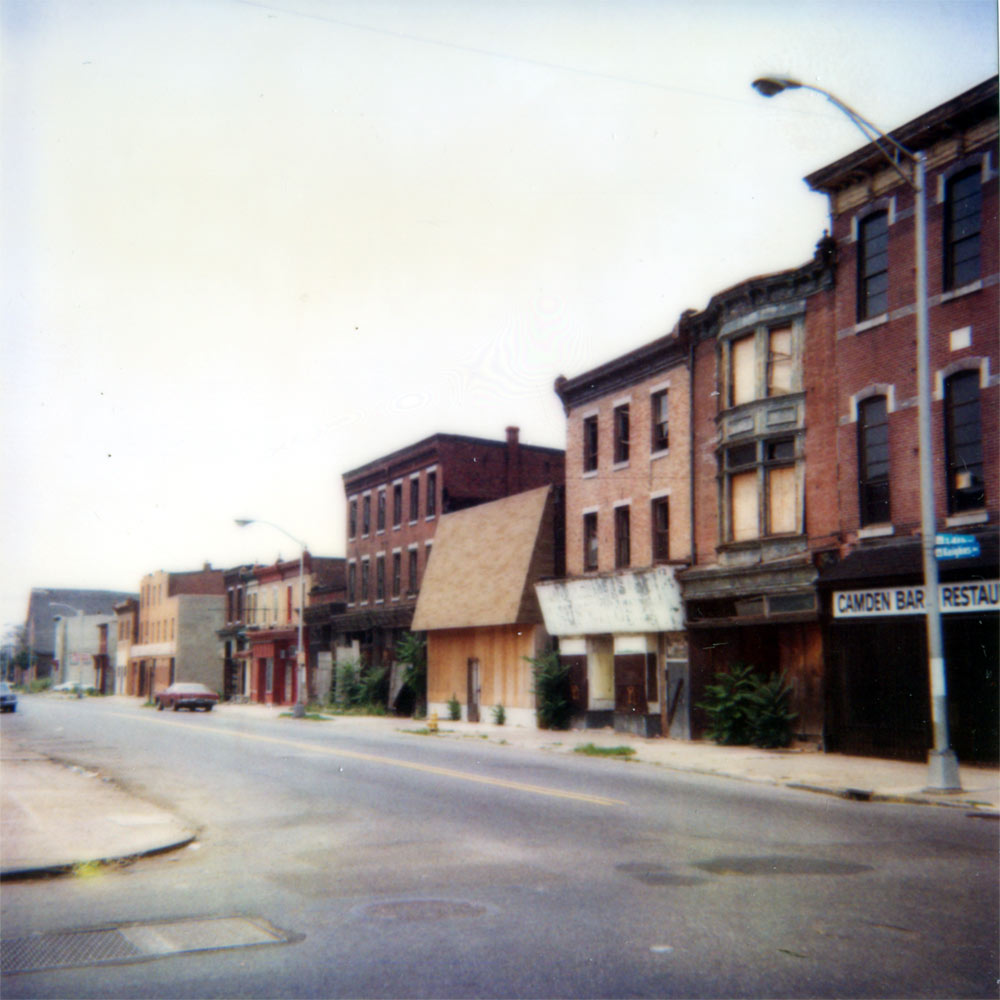
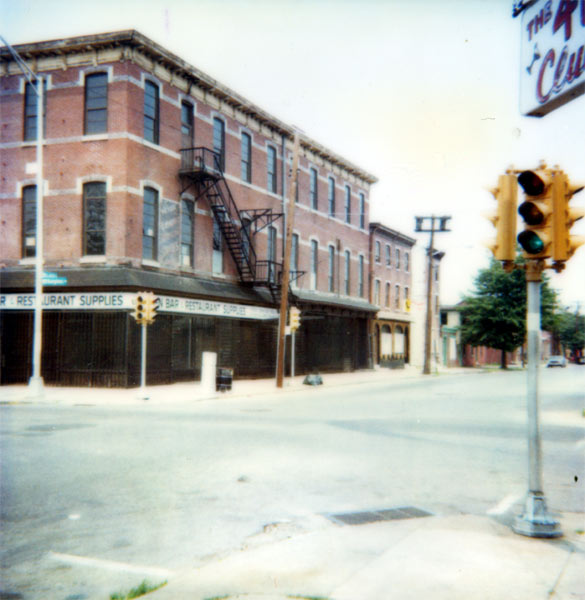
277 to 341–347 Kaighn Avenue, northwest corner — 341–347 was at one time called Furey’s Hall. From 1934 into the 1990s it was the home of Camden Bar & Restaurant Supplies Inc. Photos taken July 4, 1974.