Introduction
DANIEL A. CARTER was born in Cincinnati, Ohio on January 31, 1847 to Nathaniel Carter and the former Mary Beck.
Daniel A. Carter enlisted for a three year term in the United States Navy at Camden on February 6, 1862. He was discharged at Mound City, Illinois on February 5, 1865, having completed his service.
By the 1880s he was receiving a pension from the United States government for his Civil War naval service. On January 31, 1890 he was granted an increase in his allotment, which was reported in the local press on February 8.
Returning to Camden after the Civil War, Daniel A. Carter entered the world of commerce and to an extent, politics. He married Laura V. Horner in Camden on October 29, 1876. Six children were born of this marriage— Mabel in 1877, Frank B. in 1880, Helen V. in 1883, Eva M. in 1890, Laura in 1892, and Estella in 1895. Sadly, Frank and Eva died as babies and Helen did not see her ninth year. The Carters are listed in the 1878–1879 City Directory at 731 Federal Street. Daniel Carter then worked as a commission merchant. The family remained at that address through 1885. The 1880 Census shows them living at the home of Laura’s parents, Thomas and Lizzie Horner, 731 Federal Street. Also living at the Federal Street address was Laura’s brother, George Horner, who had been a member of the Camden Fire Department for several years in the 1870s.
Daniel A. Carter was elected Chief of the Camden Fire Department in 1882, replacing Samuel S. Elfreth. He served for three years, Elfreth being returned to office in 1885.
The 1887 and 1888 Camden City Directories shows Daniel A. Carter at 733 Federal Street. He was then working as a solicitor for the West Jersey Railroad, which by 1888 had become the Camden & Amboy Railroad. By 1894 Daniel A. Carter had moved to 737 Federal Street. He changed jobs three times in this period, directories giving his occupation as bookkeeper (1894), salesman (1896), and insurance (1898). The 1900 Census shows the Daniel Carter and family living with his in-laws at 737 Federal Street. He was still selling life insurance at the time of the Census. Also residing at that address was his brother-in-law, George Horner, then a Camden police officer.
Sadly, by 1903 Daniel A. Carter and his wife had separated. He was living in Philadelphia by 1906.
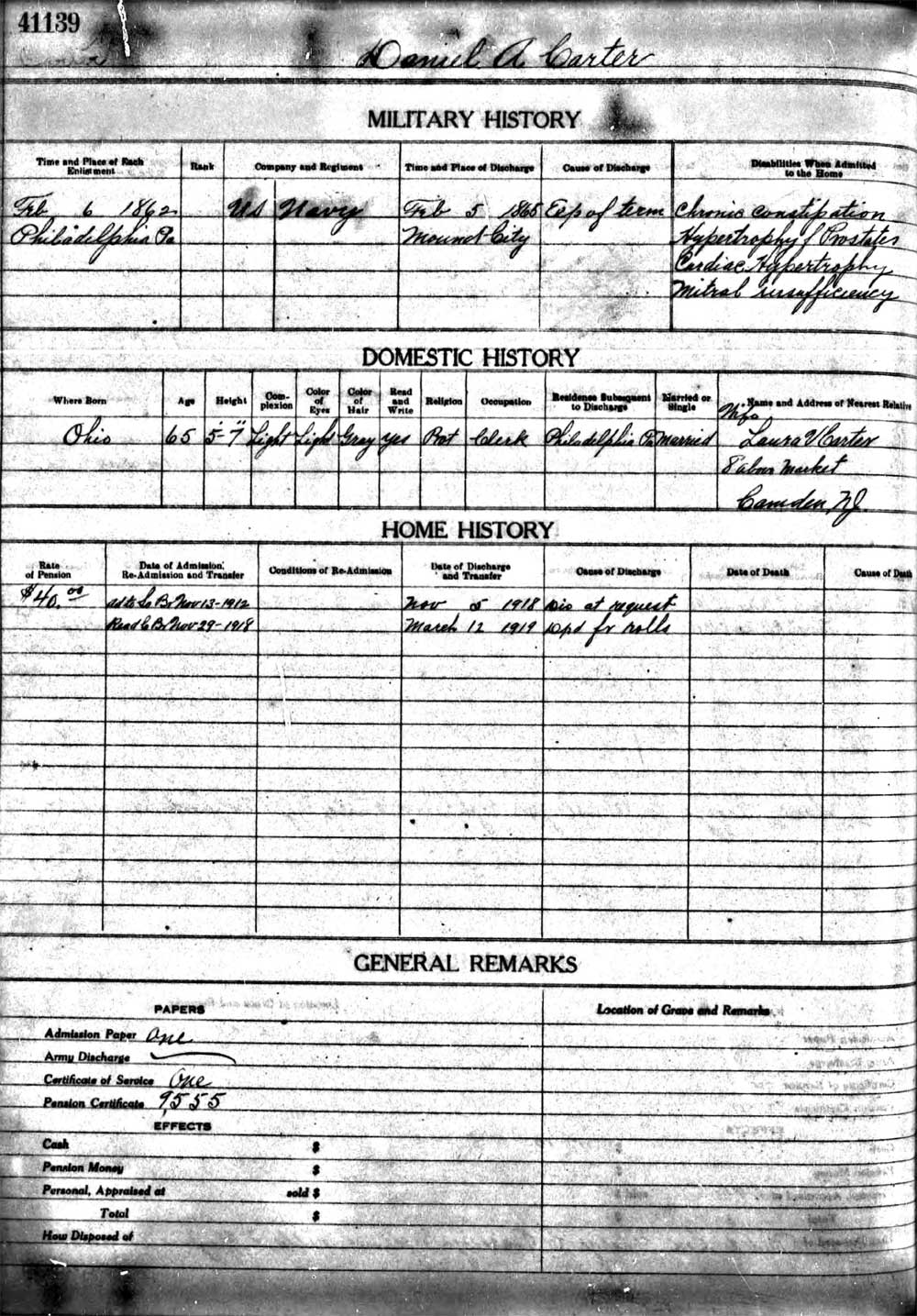
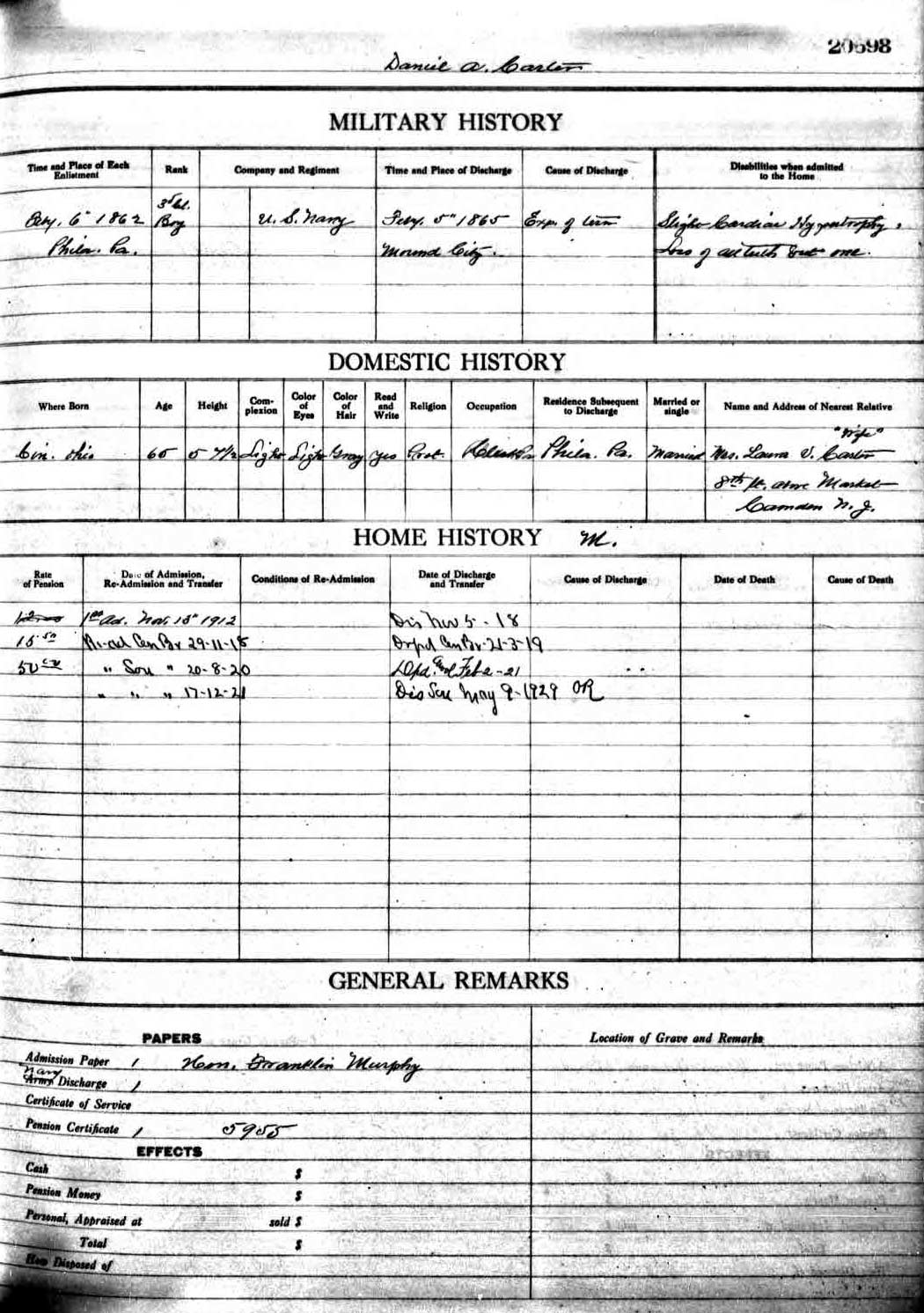
Ill health plagued Daniel Carter’s later years. He was admitted to the U.S. National Home for Disabled Volunteer Soldiers in Dayton, Ohio on November 18, 1912. On November 5, 1918 he checked himself out, but was readmitted on November 29th. He again left the home on March 21, 1919. The 1920 Census shows that Daniel A. Carter was living and working as a librarian at the United States Naval Hospital in Philadelphia. However, he was readmitted to the Home for Disabled Volunteer Soldiers on August 20, 1920, where he remained, except for a 15-day period in February of 1921, until May 9, 1929.
It is not known at this time when and where Daniel A. Carter passed away. Records indicate that he did not die at the Home for Disabled Volunteer Soldiers. He died on January 3, 1930 and was buried at Colestown Cemetery in Delaware Township (present-day Cherry Hill), New Jersey.
Entered on Their Duties.
Philadelphia Inquirer —
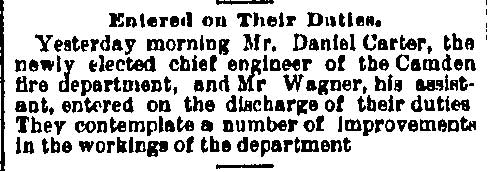
Yesterday morning Mr. Daniel Carter, the newly elected chief engineer of the Camden fire department, and Mr. Wagner, his assistant, entered on the discharge of their duties They contemplate a number of improvements in the workings of the department
Over the River.
Philadelphia Inquirer —
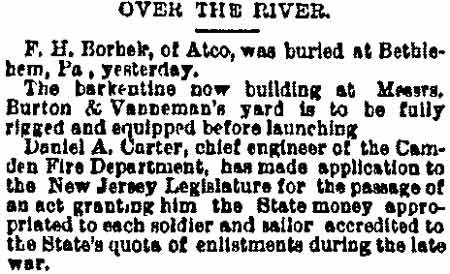
F. H. Borbek, of Atco, was buried at Bethlehem, Pa., yesterday.
The barkentine now building at Messrs. Burton & Vanneman’s yard is to be fully rigged and equipped before launching
Daniel A. Carter, chief engineer of the Camden Fire Department, has made application to the New Jersey Legislature for the passage of an act granting him the State money appropriated to each soldier and sailor accredited to the State’s quota of enlistments during the late war.
Gamewell Fire Alarm System Criticized
Philadelphia Inquirer —

The Gamewell fire alarm system in Camden is complained of by Chief Daniel S. Carter. It is said that alarms when sounded are transmitted in such a conflicting manner that it is almost impossible to secure a prompt response.
A Blaze in Camden
Philadelphia Inquirer —
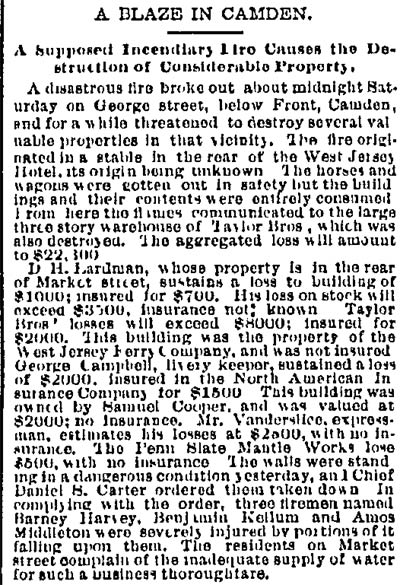
A Supposed Incendiary Fire Causes the Destruction of Considerable Property.
A disastrous fire broke out about midnight Saturday on George street, below Front, Camden, and for a while threatened to destroy several valuable properties in that vicinity. The fire originated in a stable in the rear of the West Jersey Hotel, its origin being unknown. The horses and wagons were gotten out in safety but the buildings and their contents were entirely consumed, and from here the flames communicated to the large three story warehouse of Taylor Bros., which was also destroyed. The aggregated loss will amount to $22,300.
D H. Lardman, whose property is in the rear of Market street, sustains a loss to building of $1000; insured for $700. His loss on stock will exceed $3500, insurance not known. Taylor Bros.’ losses will exceed $8000; insured for $2000. This building was the property of the West Jersey Ferry Company, and was not insured. George Campbell, livery keeper, sustained a loss of $2000, insured in the North American Insurance Company for $1500. This building was owned by Samuel Cooper, and was valued at $2000; no insurance. Mr. Vanderslice, expressman, estimates his losses at $2500, with no insurance. The Penn Slate Mantle Works lose $500, with no insurance. The walls were standing in a dangerous condition yesterday, and Chief Daniel S. [sic] Carter ordered them taken down. In complying with the order, three firemen named Barney Harvey, Benjamin Kellum and Amos Middleton were severely injured by portions of it falling upon them. The residents on Market street complain of the inadequate supply of water for such a business thoroughfare.
Pensions Granted
Philadelphia Inquirer —
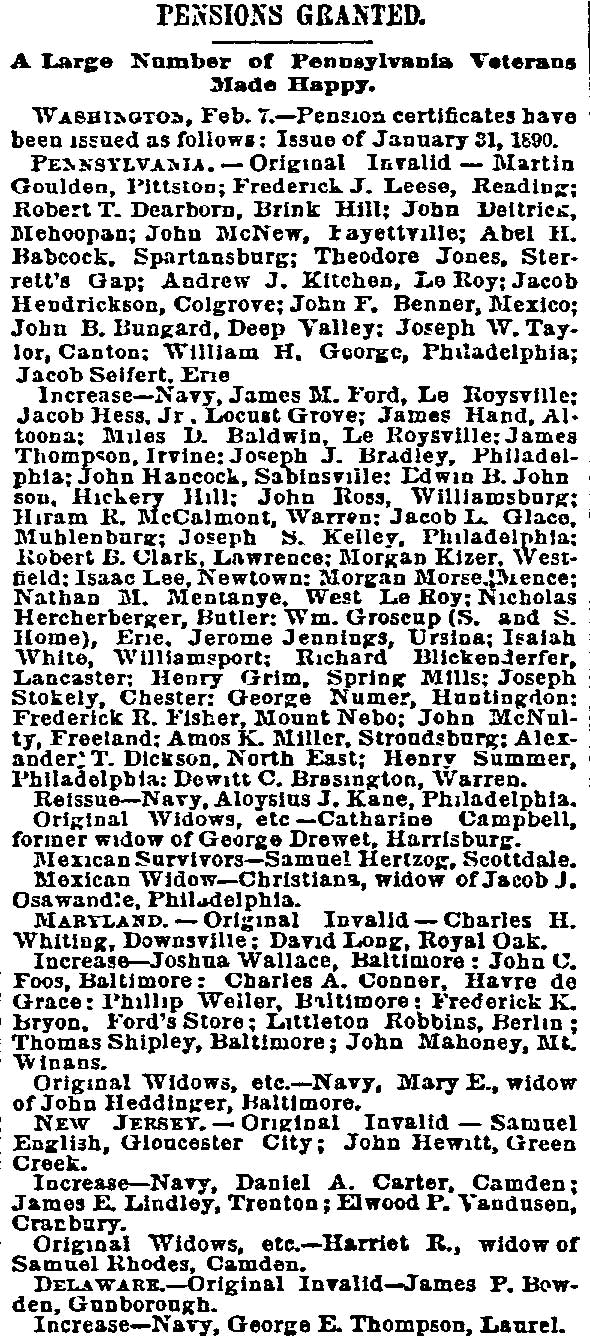
A Large Number of Pennsylvania Veterans Made Happy.
Washington, Feb. 7.—Pension certificates have been issued as follows: Issue of January 31, 1890.
Pennsylvania.—Original Invalid—Martin Goulden, Pittston; Frederick J. Leese, Reading; Robert T. Dearborn, Brink Hill; John Deitrick, Mehoopan [sic]; John McNew, Fayettville [sic]; Abel H. Babcock, Spartansburg; Theodore Jones, Sterrett’s Gap; Andrew J. Kitchen, Le Roy; Jacob Hendrickson, Colgrove; John F. Benner, Mexico; John B. Bungard, Deep Valley; Joseph W. Taylor, Canton; William H. George, Philadelphia; Jacob Seifert, Erie
Increase—Navy, James M. Ford, Le Roysville; Jacob Hess, Jr., Locust Grove; James Hand, Altoona; Miles D. Baldwin, Le Roysville; James Thompson, Irvine; Joseph J. Bradley, Philadelphia; John Hancock, Sabinsville; Edwin B. Johnson, Hickery Hill; John Ross, Williamsburg; Hiram R. McCalmont, Warren; Jacob L. Glace, Muhlenburg; Joseph S. Kelley, Philadelphia; Robert B. Clark, Lawrence; Morgan Kizer, Westfield; Isaac Lee, Newtown; Morgan Morse, Mence; Nathan M. Mentanye, West Le Roy; Nicholas Hercherberger, Butler; Wm. Groscup (S. and S. Home), Erie, Jerome Jennings, Ursina; Isaiah White, Williamsport; Richard Blickenderfer, Lancaster; Henry Grim, Spring Mills; Joseph Stokely, Chester; George Numer, Huntingdon; Frederick R. Fisher, Mount Nebo; John McNulty, Freeland; Amos K. Miller, Stroudsburg; Alexander T. Dickson, North East; Henry Summer, Philadelphia; Dewitt C. Brasington, Warren.
Reissue—Navy, Aloysius J. Kane, Philadelphia.
Original Widows, etc.—Catharine Campbell, former widow of George Drewet, Harrisburg.
Mexican Survivors—Samuel Hertzog, Scottdale.
Mexican Widow—Christiana, widow of Jacob J. Osawandle, Philadelphia.
Maryland.—Original Invalid—Charles H. Whiting, Downsville; David Long, Royal Oak.
Increase—Joshua Wallace, Baltimore; John C. Foos, Baltimore; Charles A. Conner, Havre de Grace; Phillip Weiler, Baltimore; Frederick K. Bryon, Ford’s Store; Littleton Robbins, Berlin; Thomas Shipley, Baltimore; John Mahoney, Mt. Winans.
Original Widows, etc.—Navy, Mary E., widow of John Heddinger, Baltimore.
New Jersey.—Original Invalid—Samuel English, Gloucester City; John Hewitt, Green Creek.
Increase—Navy, Daniel A. Carter, Camden; James E. Lindley, Trenton; Elwood P. Vandusen, Cranbury.
Original Widows, etc.—Harriet R., widow of Samuel Rhodes, Camden.
Delaware.—Original Invalid—James P. Bowden, Gunborough.
Increase—Navy, George E. Thompson, Laurel.
Camden’s Happy Contingent
Philadelphia Inquirer —
I asked a gentleman from the big town across your Delaware river what that city was doing, and this was the answer he wrote: “Camden is one of Atlantic’s suburbs, and her politicians, like those of the Quaker City, find the salt air and the sad sea waves a great assistance in fixing up slates. It is not always these adjuncts are potent. Occasionally a hack and wine are necessary for a big position, while street cars and beer does for the general average.
To-day Camden showed up in great shape. Frank L. Vinton, Howard Pine, Richard Evans, Judges Alfred Huge and Thomas McDowell, Detective James S. Henry, William Sexton, John Smith, Jr., Charles Bosch, W. H. Fredericks, Councilmen James M. Lane, Robert F. Smith, John H. Furey and Arthur Bedell, Andrew Rabeau, Colonel D. B. Murphy, of General Sewell’s staff; F. F. Patterson, Sr., F. F. Patterson, Jr., of the Camden Sunday Review; John H. Fort, of the Camden Telegram; ex-Chief of Fire Department Daniel Carter, U. G. Styron, Wallace Armstrong, Joseph W. Cooper, C. C. Reeve “Lance,” Frank S. Heister and Fred Newton were among the visitors.
Camden’s Happy Contingent.
Philadelphia Inquirer —
I asked a gentleman from the big town across your Delaware river what that city was doing, and this was the answer he wrote: “Camden is one of Atlantic’s suburbs, and her politicians, like those of the Quaker City, find the salt air and the sad sea waves a great assistance in fixing up slates. It is not always these adjuncts are potent. Occasionally a hack and wine are necessary for a big position, while street cars and beer does for the general average.
To-day Camden showed up in great shape. Frank L. Vinton, Howard Pine, Richard Evans, Judges Alfred Hugg and Thomas McDowell, Detective James S. Henry, William Sexton, John Smith, Jr., Charles Bosch, W. H. Fredericks, Councilmen James M. Lane, Robert F. Smith, John H. Furey and Arthur Bedell, Andrew Rabeau, Colonel D. B. Murphy, of General Sewell’s staff; F. F. Patterson, Sr. F. F. Patterson, Jr., of the Camden Sunday Review; John H. Fort, of the Camden Telegram; ex-Chief of Fire Department Daniel Carter, U. G. Styron, Wallace Armstrong, Joseph W. Cooper, C. C. Reeve “Lance,” Frank S. Heister and Fred Newton were among the visitors.
Jersey Veterans Have a Gala Day
Philadelphia Inquirer —
They Parade and Smell Gunpowder at Washington Park on the Delaware.
FT. MORGAN BOMBARDED
Guns Thundered; and a Great Crowd Viewed the Warlike Spectacle. Other Features of the Day.
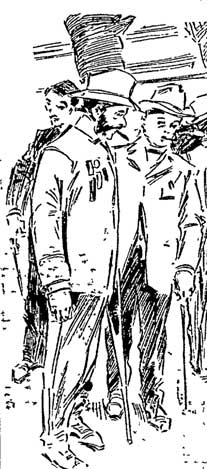
There was a great gathering of New Jersey veterans, their wives and children and their friends and neighbors, at Washington Park on the Delaware yesterday. Last evening when the crowd was greatest nearly 50,000 people were scattered throughout the spacious park. It was New Jersey Day in the three days’ fete, given in honor of the Grand Army of the Republic. The railroads ran special trains and gave a reduced rate from all stations south of Trenton, while extra trolley cars and boats were put on to carry the throng of visitors from Camden and vicinity.
Nearly every town and village in South Jersey was represented in the crowd. The blue uniforms of the veterans, the nautical rig of the Naval Reserves and the bright colors of Sons of Veterans and artillerymen gave a martial air to the gathering. The old soldiers straightened their time-burdened frames at the sound of music and marched about the park. In the evening there was the din of thundering guns and the smell of burning powder.
The main body of the veterans, consisting of the Camden Post of the G. A. R., reached the park about half-past 2 o’clock. They had joined in a parade in Camden under command of Captain R. M. Hillman, whose adjutant was R. L. Robinson and his aides, Daniel Carter and S. S. Weaver. The line was made up of Posts 5, 37, 51, 102 and the Sons of Veterans.
The parade down Federal street, Camden, was a pretty and inspiring spectacle, the White City Band leading the square-long procession of “vets” with the march from Sousa’s “El Capitan.” In the centre, marching with proud and measured step, was a pretty, curly-haired little girl, clad in red, white and blue and carrying the Stars and Stripes jauntily on her shoulder.
At Federal street ferry the veterans boarded the steamer George Law and were taken to the park. They marched to Camp Howell, where ranks were broken, and then scattered through the park to enjoy the amusement features or look up old comrades.
At half past 5 o’clock the veterans lined up on the river bank for dress parade. There were a thousand of the gallant defenders of the Union in line, and a pretty sight they made, stretching in a long line of blue across the green sward. In addition to the Camden posts there were delegations from William Howell Post, 31, of Woodbury; Parker Grubb Post, 16, of Burlington; Post 21, of Beverly; Post 42, of Bridgeton; Maurice River Post, No. 60, and Euphemia Grubb Camp, Sons of Veterans. A great crowd witnessed the dress parade and applauded the veterans.
The ceremony concluded with a salute to the flag and the firing of seventeen guns, the Governor’s salute.
The great event of the day was a naval engagement in the evening, intended to represent the bombardment of Fort Morgan, in Mobile harbor. Fort Morgan was located some distance out in the river, while the shore was lined with twenty guns and a mortar. Some of the guns were from the Richmond, of Uncle Sam’s Navy, and others were from Post 51, of Philadelphia. The bombarding force was made up of men from Post 51, of Philadelphia; a detachment of Battery A, N. G. P., Captain Stafford; Naval Reserves [illegible] the monitor Ajax, and Sons of Veterans. Out in the river was a naval flotilla of private yachts, under command of Commodore Abe Townsend. The boats were all gorgeously illuminated and decorated, and added much to the beauty of the spectacle. Captain of the shore battery: Joseph Mackey, of Naval Post, 400, of Philadelphia, supervised the work.
The engagement opened shortly after 8 o’clock. As the gunners warmed up to their work the din became deafening. Shells burst in the air over the fort, rockets soared skyward and the surface of the river was lighted up for miles. The fort was finally captured, amidst a triumphant display of fireworks.
The committee of the G. A. R. in charge of the affair gave a dinner at which, among other guests, were Generals Wagner and Mulholland and Captain Mackey, of Philadelphia; Department Commander Stauer and members of his staff, of Pennsylvania; Captain Leary, of the Richmond, U. S. N.; J. B. Kendrick, vice-president of the Third National Bank of Philadelphia, and Mayor Westcott and a number of Camden officials.
Camden News Notes
Philadelphia Inquirer —
•• Judge Joline yesterday made an order directing Daniel J. Carter, former fire chief, to give $5.50 per week toward his wife’s support.
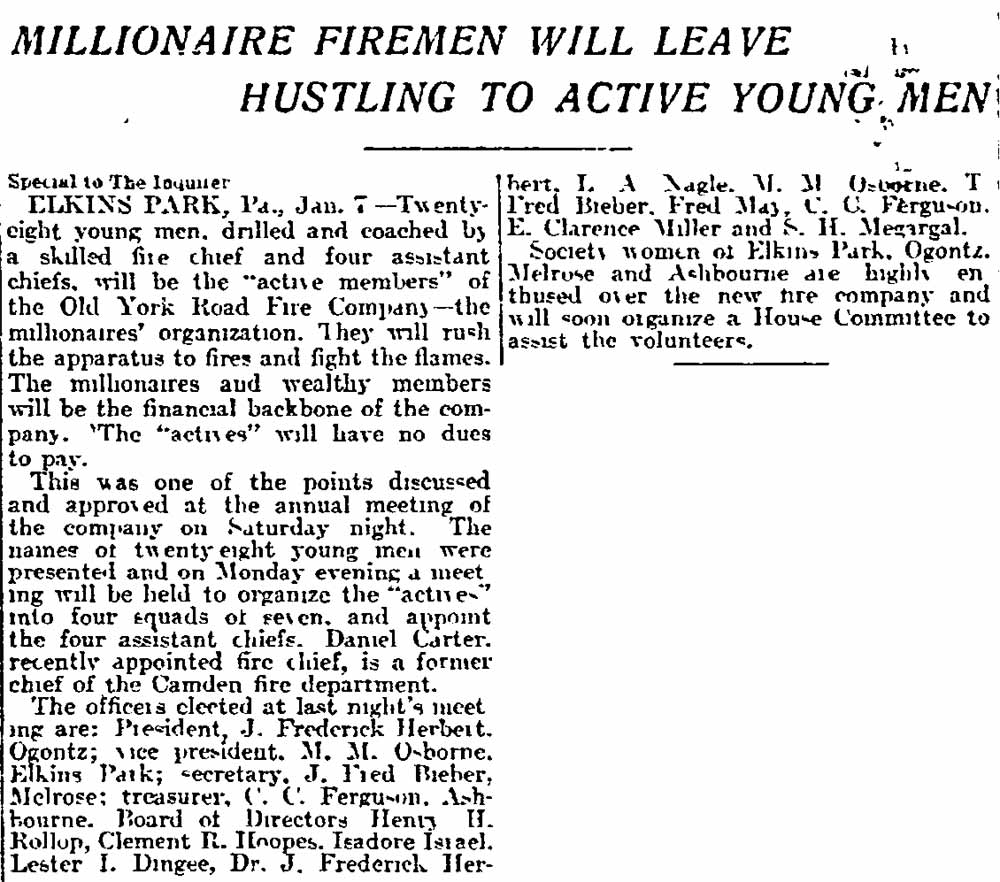
Millionaire Firemen Will Leave Hustling to Active Young Men
Philadelphia Inquirer —
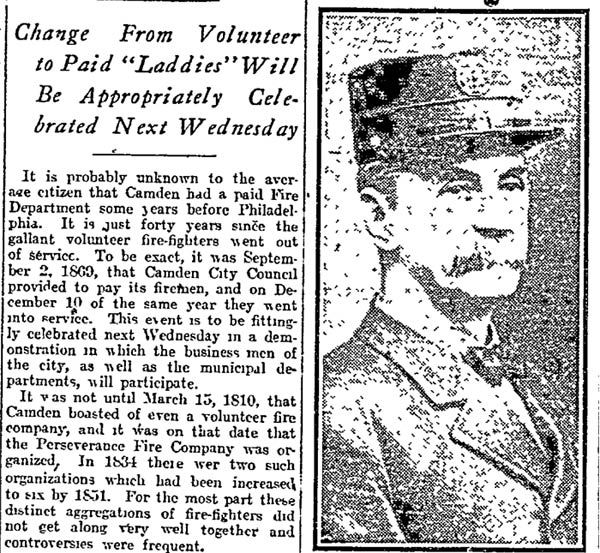
Daniel A. Carter
Camden Justly Proud of Splendid Fire Department
Philadelphia Inquirer —
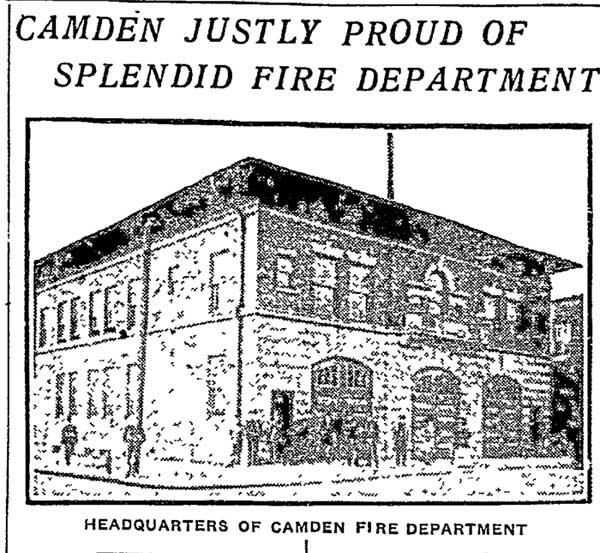
HEADQUARTERS OF CAMDEN FIRE DEPARTMENT
Change From Volunteer to Paid “Laddies” Will Be Appropriately Celebrated Next Wednesday
It is probably unknown to the average citizen that Camden had a paid Fire Department some years before Philadelphia. It is just forty years since the gallant volunteer fire-fighters went out of service. To be exact, it was September 2, 1869, that Camden City Council provided to pay its firemen, and on December 10 of the same year they went into service. This event is to be fittingly celebrated next Wednesday in a demonstration in which the business men of the city, as well as the municipal departments, will participate.
It was not until March 15, 1810, that Camden boasted of even a volunteer fire company, and it was on that date that the Perseverance Fire Company was organized. In 1834 there were two such organizations which had been increased to six by 1851. For the most part these distinct aggregations of fire-fighters did not get along very well together and controversies were frequent.
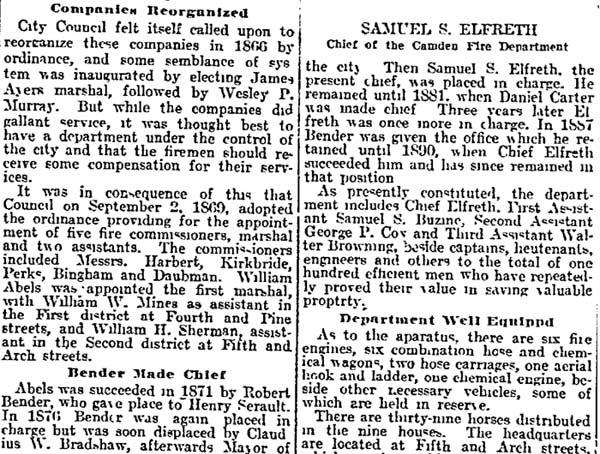
SAMUEL S. ELFRETH
Chief of the Camden Fire Department
Companies Reorganized
City Council felt itself called upon to reorganize these companies in 1866 by ordinance, and some semblance of system was inaugurated by electing James Ayers marshal, followed by Wesley P. Murray. But while the companies did gallant service, it was thought best to have a department under the control of the city and that the firemen should receive some compensation for their services.
It was in consequence of this that Council on September 2, 1869, adopted the ordinance providing for the appointment of five fire commissioners, marshal and two assistants. The commissioners included Messrs. Harbert, Kirkbride, Perks, Bingham and Daubman. William Abels was appointed the first marshal, with William W. Mines as assistant in the First district at Fourth and Pine streets, and William H. Sherman, assistant in the Second district at Fifth and Arch streets.
Bender Made Chief
Abels was succeeded in 1871 by Robert Bender, who gave place to Henry Serault. In 1876 Bender was again placed in charge but was soon displaced by Claudius W. Bradshaw, afterwards Mayor of the city. Then Samuel S. Elfreth, the present chief, was placed in charge. He remained until 1881, when Daniel Carter was made chief. Three years later Elfreth was once more in charge. In 1887 Bender was given the office which he retained until 1890, when Chief Elfreth succeeded him and has since remained in that position.
As presently constituted, the department includes Chief Elfreth, First Assistant Samuel S. Buzine, Second Assistant George P. Cox and Third Assistant Walter Browning, beside captains, lieutenants, engineers and others to the total of one hundred efficient men who have repeatedly proved their value in saving valuable proptrty [sic].
Department Well Equippd [sic]
As to the aparatus [sic], there are six fire engines, six combination hose and chemical wagons, two hose carriages, one aerial hook and ladder, one chemical engine, beside other necessary vehicles, some of which are held in reserve.
There are thirty-nine horses distributed in the nine houses. The headquarters are located at Fifth and Arch streets, which is thoroughly modern in all of its equipments.
Under Chief Elfreth, who has been in the service nearly forty years, the department has been brought to such a high standard of efficiency that the Underwriters’ Association recently paid special attention to it by decreasing insurance rates fifteen per cent. Councils’ Fire Commissioners, of which Councilman Harry R. Read is chairman, has also done much to make the department the success it is at present.
U.S. National Homes for Disabled Volunteer Soldiers
Dayton, Ohio
Hampton, Virginia
First City Fire House Located at 5th and Arch
Camden Courier-Post —

Hosemen, Tillermen and Laddermen Paid $50 Monthly While Call Men Received $75 a Year; Steam Engine Held for Emergency
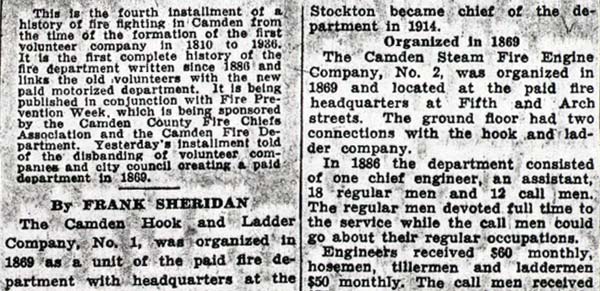
This is the fourth installment of a history of fire fighting in Camden from the time of the formation of the first volunteer company in 1810 to 1936. It is the first complete history of the fire department written since 1886 and links the old volunteers with the new paid motorized department. It is being published in conjunction with Fire Prevention Week, which is being sponsored by the Camden County Fire Chiefs Association and the Camden Fire Department. Yesterday’s installment told of the disbanding of volunteer companies and city council creating a paid department in 1869.
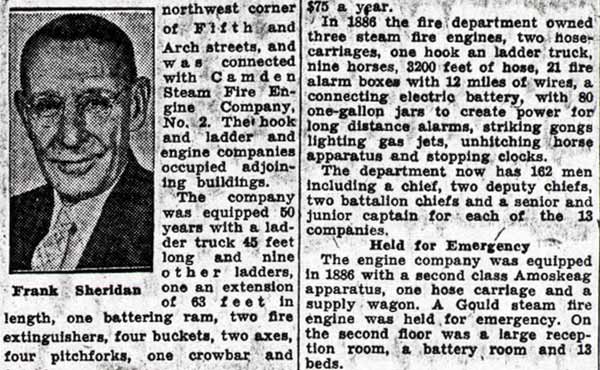
The Camden Hook and Ladder Company, No. 1, was organized in 1869 as a unit of the paid fire department with headquarters at the northwest corner of Fifth and Arch streets, and was connected with Camden Steam Fire Engine Company, No. 2. The hook and ladder and engine companies occupied adjoining buildings.
The company was equipped 50 years with a ladder truck 45 feet long and nine other ladders, one an extension of 63 feet in length, one battering ram, two fire extinguishers, four buckets, two axes, four pitchforks, one crowbar and four lamps.
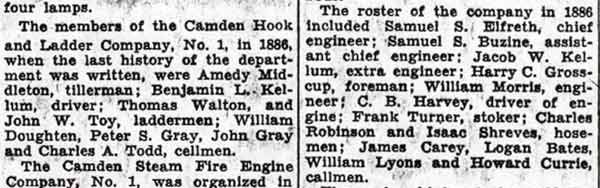
The members of the Camden Hook and Ladder Company, No. 1, in 1886, when the last history of the department was written, were Amedy Middleton, tillerman; Benjamin L. Kellum, driver; Thomas Walton, and John W. Toy, laddermen; William Doughten, Peter S. Gray, John Gray and Charles A. Todd, callmen.
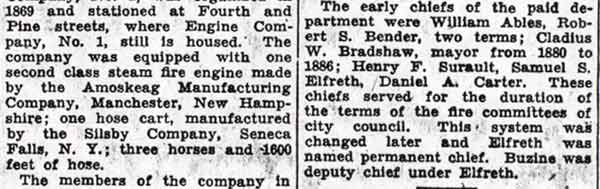
The Camden Steam Fire Engine Company, No. 1, was organized in 1869 and stationed at Fourth and Pine streets, where Engine Company, No. 1, still is housed. The company was equipped with one second class steam fire engine made by the Amoskeag Manufacturing Company, Manchester, New Hampshire; one hose cart, manufactured by the Silsby Company, Seneca Falls, N. Y.; three horses and 1600 feet of hose.
The members of the company in 1886 were John A. Stockton, foreman; G. Rudolph Tenner, engineer; William Deno, driver; William W. Laird, stoker; Wilson Bromley and Jacob F. Nessen, hosemen; William Deith, Andrew Miller, William Bogia and W. Elwood Campbell, callmen.
Stockton became chief of the department in 1914.
Organized in 1869
The Camden Steam Fire Engine Company, No. 2, was organized in 1869 and located at the paid fire headquarters at Fifth and Arch streets. The ground floor had two connections with the hook and ladder company.
In 1886 the department consisted of one chief engineer, an assistant, 18 regular men and 12 call men. The regular men devoted full time to the service while the call men could go about their regular occupations.
Engineers received $60 monthly, hosemen, tillermen and laddermen $50 monthly. The call men received $75 a year.
In 1886 the fire department owned three steam fire engines, two hose-carriages, one hook an [sic] ladder truck, nine horses, 3200 feet of hose, 21 fire alarm boxes with 12 miles of wires, a connecting electric battery, with 80 one-gallon jars to create power for long distance alarms, striking gongs lighting gas jets, unhitching horse apparatus and stopping clocks.
The department now has 162 men including a chief, two deputy chiefs, two battalion chiefs and a senior and junior captain for each of the 13 companies.
Held for Emergency
The engine company was equipped in 1886 with a second class Amoskeag apparatus, one hose carriage and a supply wagon. A Gould steam fire engine was held for emergency. On the second floor was a large reception room, a battery room and 13 beds.
The roster of the company in 1886 included Samuel S. Elfreth, chief engineer; Samuel S. Buzine, assistant chief engineer; Jacob W. Kellum, extra engineer; Harry C. Grossup, foreman; William Morris, engineer; C. B. Harvey, driver of engine; Frank Turner, stoker; Charles Robinson and Isaac Shreves, hosemen; James Carey, Logan Bates, William Lyons and Howard Currie, callmen.
The early chiefs of the paid department were William Ables, Robert S. Bender, two terms; Cladius [sic] W. Bradshaw, mayor from 1880 to 1886; Henry F. Surault, Samuel S. Elfreth, Daniel A. Carter. These chiefs served for the duration of the terms of the fire committees of city council. This system was changed later and Elfreth was named permanent chief. Buzine was deputy chief under Elfreth.
(Tomorrow’s installment will describe a sudden succession of chiefs brought about by the resignation of Elfreth and the death of Charles Worthington, who was fatally injured in a fall from a roof at a fire.)