Joseph Logue
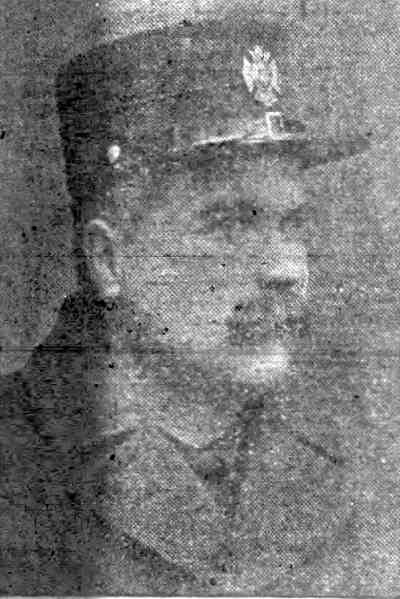
Portrait of Joseph Logue
[Portrait of Joseph Logue, Camden fireman, in uniform, published in the Camden Daily Courier on January 6, 1905]
JOSEPH LOGUE was born in July of 1855 according to the 1900 United States Federal Census. He was a native of Milltown, County Derry, in what is now called Northern Ireland and was a cousin of David Baird Sr.
Joseph Logue came to America in 1874. The 1876 Camden City Directory shows him living with his brother David at 131 Birch Street in North Camden. Over the next ten years he is in and out of Camden City Directories. He and his brother are both listed at 131 Birch Street in 1878. Joseph Logue reappears in City Directories in 1883, working for the Pennsylvania Railroad. From 1883 to 1887 he boarded at 525 Arch Street. Around 1882 he met and began seeing Miss Sarah Lewine (also spelled Lewin), who worked as a domestic servant.
Joseph Logue was out walking with Miss Lewine in May of 1888 when he was assaulted by two men and stabbed. The assailants were arrested, tried, and imprisoned. Joseph Logue moved to 729 Federal Street prior to the 1891 Directory’s compilation. His relationship with Miss Lewine lasted until the spring of 1891, and ended badly, with Miss Lewine suing Joseph Logue for breach of promise.
By June of 1891 Joseph Logue was seeing Miss Fannie Ellingsworth, and wound up in court when Lewine accused him of assaulting her when she confronted him and his new friend on the street. A jury declared him not guilty after ten minutes of deliberation. He was living at 129 Birch Street in 1891, and 114 England Place in 1892. Directories in 1893 and 1894 have him at 410 North Front Street.
Joseph Logue and his brother David were both staunch Republicans, as was their cousin, David Baird Sr., the head of the local party who served as Sheriff in the 1880s. David Logue was appointed turnkey at the County Jail on November 19, 1887. Most likely due to his political and familial relationships, Joseph Logue was appointed to the Camden Fire Department on May 29, 1894, and assigned to Hook and Ladder Truck No. 1, now known as Ladder Company 1, quartered on North 5th Street between Arch and Market Streets. When Joseph Logue was first assigned to Hook and Ladder Truck No. 1, the company was led by Foreman Benjamin L. Kellum; the tillerman was Peter S. Gray; and the laddermen consisted of Steward D. Bakley, John Gray, Edward Weston, Samuel Peoples, and William Bogia. When Bogia died later in 1894, Samuel Peoples took his place.
Joseph Logue moved to 527 North 2nd Street by 1895 and remained at that address as late as 1899. He was sent to Engine Company 4 on April 15, 1898. On June 15 of that year he married Fannie Illingsworth in Camden. They lived at 311 Birch Street in 1900. By 1901 they had moved to 932 North 2nd Street, where they would remain for the rest of Joseph Logue’s days.
Joseph Logue served the rest of his career at Engine Company 4. He retired on March 1, 1920.
Joseph Logue died at Bellevue Hospital in Camden on April 20, 1927. He was survived by his wife Fannie and his brother, David Logue, who had retired as the warden of the Camden County jail after 35 years of service.
Struck in the Dark
Camden Post —
STRUCK IN THE DARK.
A Mysterious Assault in A Lonely Spot.
JOSEPH LOGUE BADLY CUT.
Two Bogus Policemen Murderously Attack a Young Woman and Her Escort.
Joseph Logue, brother of Turnkey Logue, of the county jail, lies in the Cooper Hospital with a terrible knife wound in his left side, just below the ribs, and a blackjack wound in the head.
Logue is the victim of a daring, unprovoked and murderous assault. It is not known who his assailants were.
A little while after 9 o’clock last night Logue was walking out Haddon avenue below the city hall, with Miss Sarah Brown, a young woman of 30. As they were about to pass the platform at the Line street station two men sprang up apparently from the grass and confronted them.
“We’re officers,” said the taller of the two men, “and you’ll have to go to the city hall with us.”
“What for?” asked Logue astonished.
“You’ll find out when you get to the city hall,” was the answer.
“We’ve done nothing, and you can’t arrest us,” said Logue.
Then the man who had done the talking grappled with him. The other man caught hold of Miss Brown and endeavored to force her up Haddon avenue. She screamed, and Logue, becoming desperate, had almost succeeded in breaking away from his assailant, when the smaller of the two men relinquished Miss Brown and stealthily approaching Logue, dealt him a heavy blow on the head with a slungshot. Logue staggered, but recovering himself, struck out lustily. The smaller man then closed with him, and his first assailant, drawing a knife, stabbed him in the left side. Logue fell, and when Miss Brown’s cries for help had brought a crowd of excited people to the spot, the murderous assailants had disappeared.
Logue was taken to the Cooper Hospital apparently in a dying condition. A long, deep gash in his head showed where the blackjack had struck him, while the wound in his side bled profusely. Within two hours, however, the hemorrhage was stopped, and the hospital physicians expressed a belief that the wounded man would recover. The knife wound is an inch long and two inches deep, but did not strike any vital part.
Logue was seen at the hospital last night and told this story in a straightforward way. “I had met Miss Brown by appointment,” he said, “and we had gone out for a walk. We were conversing and did not notice the men until they were immediately alongside of us. I can not describe their appearance in any other way than to say one was tall the other short, although there was something peculiar about the smaller man’s stature that might aid me to identify him. They said they were officers and wanted to arrest us. They didn’t look like policemen, and I didn’t believe they were. Had I really thought they were policemen I would have been willing to go to the city hall with them, because I knew there could be no charge. I didn’t resist until one of the men caught hold of Miss Brown and I tried to push him away. The next thing I knew one of the men had struck me on the head with something and the other had plunged a knife into my side.”
Miss Brown went to the hospital to see her wounded escort after she had recovered from the shock, but the physicians refused to allow her to see him. She is about 30 years of age.
Supposed to be Logue's Assailant
Camden Daily Courier —
Supposed to be Logue’s Assailant
Policemen Peters and Anderson yesterday arrested John Stratton, living in Ross’ Court, and Henry Mellon, of Point street above Cooper, on suspicion of being the two men who murderously assaulted Joseph Logue, near the city hall, Sunday night. The men were seen in the vicinity of the place where the assault occurred. Logue, who is still at the hospital, partially identified Stratton as the man who robbed him, but could not positively recognize Mellon as his other assailant. The men were committed for a hearing to-night. Logue is improving.
Logue's Assailants Captured
Camden Daily Telegram —
Logue’s Assailants Captured
The Police Are Pretty Sure They Have the Right Parties.
Yesterday Officers Peters and Andrews captured the supposed assailants of Joseph Logue, the young man who was stabbed on Sunday night while in company with Miss Brown. The men arrested were Henry Mellon, of Point street above Second, who works in a lithographing establishment, and Joseph Stratton, a lather, living on Ross court. Stratton was taken to Cooper Hospital by Chief Dodd, and was identified by Logue as the man who assaulted him with the knife. Mellon admitted that they were in the vicinity Sunday evening.
Both parties will have a hearing before Mayor Pratt at 7:30 this evening.
Camden Notes
Philadelphia Inquirer —
Camden Notes.
Harry Mellon and Joseph Stratton, were arrested by Policeman Peters, of the Seventh ward, yesterday afternoon on the charge of having stabbed Joseph Logue, near the City Hall on Sunday night.
At a meeting of the Camden Board of Education held last night, Treasurer Rex made the following reports: Received, $31,131 88; paid out, $25,674 46; balance, $5457.43. Superintendent Bergen reported a daily attendance of 6790.
The stable of ex-Freeholder Gordon, at Second and Pine streets, was damaged by fire yesterday to the extent of $600. Origin unknown. Fully insured.
Logue's Assailants Committed
Camden Daily Courier —
LOGUE’S ASSAILANTS COMMITTED.
The Mayor Sends Them Before the Grand Jury.
Henry Mellon and James Stratton were given a private hearing before the mayor last evening on a charge of having stabbed Joseph Logue near Starr’s crossing on the Camden and Atlantic railroad on Sunday night, while attempting to protect Miss Brown from being assaulted. The evidence produced was of such a convincing nature that the mayor remanded the prisoners without bail to the county jail, so that the grand jury could act on the matter before their adjournment. The men were brought before the grand jury this morning. Logue is still in the Cooper Hospital, but is improving.
The Logue Assault
Camden Post —

THE LOGUE ASSAULT.
Stratton and Mellon on Trial in Court.
LOGUE’S STORY OF THE ATTACK
The Young Woman Tells Her Story — Damaging Evidence Against the Defendants.
In the Quarter Sessions Court yesterday afternoon the case of John F. Stratton and Henry Mellon, the two young men charged with the murderous attack upon Joseph Logue, near Starr’s crossing, Tenth and Line streets, on May 6th, was begun. Ex-Judge Wescott and Howard Carrow conducted the defense and Prosecutor Jenkins appeared for the State. In response to the latter’s command for witnesses to take the benches on the right of the bar enclosure, fourteen persons arose from the audience and took seats there.
The first witness was Logue himself, who had been confined in the Cooper Hospital about ten days suffering from his injuries. He is a tall, well-built young fellow of 32. “On the evening of May 6th,” he said, “I was in company with Miss Sarah Lewine; I was walking along Haddon avenue. We started from Third and Royden street. We walked out Benson to Haddon avenue and out to Newton avenue, and turned up Newton avenue toward Federal street. Just after we crossed the Camden and Atlantic railroad, these two men sprang up and the tallest one, Stratton, took hold of the lady and the smaller one, Mellon, took hold of me. I asked them what they wanted and they said they arrested me. I asked them what I had done and they said I would find out. Stratton kept telling Mellon to take the woman away. Mellon pulled open his coat and showed what looked like a star, saying that was his authority for making the arrest. He hit me in the head with a blackjack. Then when I tried to get away Stratton stabbed me in the side with a knife.”
“Do you identify either of these men?” asked Mr. Jenkins.
“Yes, sir; I am positive Stratton is the tall one. Mellon looks like the smaller man of the two. I described the two men before I was arrested.”
Ex-Judge Wescott’s rigid cross-examination failed to shake his story in any detail. He identified Stratton, who was taken to him in the hospital, as the taller man of the two.
“What were you doing out there?” asked ex-Judge Wescott.
“Taking a walk.”
“Who was the lady?”
“Miss Sarah Lewine.”
“How long have you known her?”
“About six years.”
The next witness was Miss Lewine, a chestnut-haired, ruddy complexioned young woman, of about thirty summers. “I was to meet Mr. Logue at eight o’clock that night,” she began with a smile, “but it might have been a few minutes after.”
She corroborated Logue’s testimony, adding that as the men came up to them she pulled Logue’s coat to signal him to keep quiet. “After Mr. Logue was cut,” she said, “the two men ran past me. Mr. Logue came back to me and said he was stabbed, and that I should go home.”
She was unable to identify either of the defendants as the assailants of that night. Mr. Wescott tried hard to entangle her as to her ability to determine the difference in the sizes of the two men as they lay upon the ground, but she refused to be tangled up and adhered rigidly to her story with marked indications of deepest truth and sincerity.
“Now, Miss Lewine, you have frequently heard that one of the men was tall and the other short, haven’t you?” asked Mr. Wescott.
“Didn’t I see them?” answered the witness pertinaciously, and all further questioning failed to get more from her.
Christopher Smith, of 1904 Fillmore street, employed as night watchman on the Line street sewer, then in course of construction. On the night of the assault he saw Stratton and Mellon about 7 o’clock. Mellon came up to him and spoke, and shortly afterwards Stratton came up. Mellon took a knife out of his pocket, continued Smith, and handed it to Stratton. The latter said “If anybody bothers me, I’ll cut the d— guts out of them.” The blade, I guess, must have been three or four inches long. The handle was of bone, I think. They stayed there about half an hour and it was dark when they left, walking up Haddon avenue.
The point where the defendants were seen by Smith is a square from where the assault was committed. Mr. Jenkins tried to show that both young men frequented this particular locality, but it was objected to and withdrawn. Smith admitted that he saw Mellon have a blackjack one night at Haddon avenue and Line street. Stratton was with him at the time. That was on Friday, May 4th, two days before the assault.
The Court took a recess at this point till this morning.
When the case was resumed this morning Logue produced in evidence, the coat he wore the night he was assaulted, exhibiting the hole cut by the knife and the blood stains from the wounds in the head and side.
Then Dr. Henry Jarrett, resident physician of the Cooper Hospital, was called. He testified as to the wounds received and said the knife thrust might have been fatal if it had gone in deep enough, or Logue might have bled to death if a large enough blood vessel had been severed.
“Could he have bled to death from either of the wounds?” asked Mr. Jenkins.
“No, sir.”
“How long have you been practicing?” asked Mr. Wescott.
“I have been at Cooper Hospital since July 28th, last.”
“When did you graduate?”
“A year ago last April.”
“That will do.”
Charles R. Locke, a fellow employe of Mellon’s at the paper mill, 83 Cooper St., saw Mellon have, on the Friday before the assault, a large knife, such as sailors carry, with a blade two and a half or three inches long. It had a rough bone handle.
Knight Haines, a boy, on the Saturday night before the assault, between 8.30 and 9.30 saw Stratton and Mellon on the lots in front of the city hall, within a short distance of where Logue was attacked. Stratton and Mellon were on their hands and knees and when they recognized him they said: “Oh, is it you? Don’t give us away.” He said Stratton had a knife and Mellon a blackjack.
“Did you have a girl with you?” asked Mr. Wescott.
“I don’t know,” said Haines, smiling.
Logue Tells His Story
Camden Daily Courier —
LOGUE TELLS HIS STORY.
STRATTON AND MELLON ON TRIAL FOR INTENT TO KILL.
The Young Man Who Was Assaulted and Stabbed Exhibits His Knife Wounds in Court — Sentence Suspended on Adams.
Thomas McLaughlin and Luke Elliot were acquitted yesterday afternoon of a charge of assault and battery. In the case of the State against Josiah Adams and William Laycock, for inhumanly beating and burning a valuable young cow, Adams was convicted and Laycock was acquitted. Adams was recommended to the mercy of the court.
The trial of John H. Stratton and Henry Mellon, charged with an assault and battery with intent to kill Joseph Logue near the city hall on May 6th, was begun last evening and continued this morning. Logue and Miss Sarah Lewine both swore to the facts of the assault. Logue and the woman were walking near the city hall, when the defendants came up and representing themselves to be police officers, attempted to arrest them for some alleged offense when, in the melee that ensued the assault was committed, which consisted in the stabbing of Logue with a penknife. The intent to kill was sought to be established by the fact that Christopher Smith, a night watchman in the vicinity, testified that he saw Mellon give Stratton a knife the night of the assault and had seen Mellon have a blackjack several days previous. This morning Logue exhibited to the jury the coat and vest he wore during the night of the assault, and the penknife punctures each had received. Dr. Jarret the resident surgeon testified that he saw Logue and treated his wound, which
WAS A DANGEROUS ONE.
Charles R. Lock testified he saw Mellon have a knife the Friday before the assault. Knight Haines said he saw the two defendants the day before the assault and one had a knife and the other a blackjack. The men seemed surprised when they saw witness and asked him “not to give them away.” Mayor Pratt, before the defendants were given their preliminary hearing, testified that the two men admitted that they were at the scene of the assault. Witness gave defendants a hearing in his private office. The defendants had counsel — Lawyer Denard Corbia — but as Prosecutor Jenkins objected he was not permitted to be at the hearing, which was entirely secret.
With this testimony the state closed, when Lawyer Carrow, representing Stratton, asked for his discharge on the ground that he had not been identified.
The motion was denied and the defendants, who were placed on the stand, denied having anything to do with the assault. The case will last all day.
Thomas Atkinson, for keeping a disorderly house, was fined $30 without costs.
Josiah Adams, convicted of cruelly beating and burning a cow, was discharged, sentence being suspended.
The trial of ex-Constable Jacob Meyer, for shooting his brother, was postponed until next term and the defendant’s bail increased from $500 to $1000.
Logue Assault Trial
Camden Daily Telegram —
Dr. Jarrett, surgeon in charge at Cooper Hospital, testified to the wounds received by Joseph Logue. The latter exhibited the coat and vest worn at the time.
Henry Mellon and John H. Stratton were placed on trial yesterday for assault on Joseph Logue with intent to kill. Christopher Smith, a watchman, was accosted by the defendants the night of the assault. He saw Mellon hand the knife to Stratton and had previously seen them hanging around in the vicinity. Mellon also had a blackjack. Logue and his companion, Miss Lewine, testified to the assault and stabbing.
Both Found Guilty
Camden Post —

BOTH FOUND GUILTY
Stratton and Mellon Convicted as Charged.
BARE ESCAPE FROM MURDER.
The Dastardly Assault on Joseph Logue and His Female Companion — The Defendants’ Injurious Admissions.
John H. Stratton and Henry Mellon were last night found guilty of the dastardly attack upon Joseph Logue and his female companion, in which Logue came near being the victim of a murderer. At the close of The Post’s report yesterday afternoon Stratton was on the stand in his own behalf. He denied seeing Logue and the young woman. He denied that he attacked any one. He denied having a black jack or a knife. He denied, in fact, pretty much everything that came his way. He said he had a wife and four children, and was 27 years old yesterday.
Under cross-examination Stratton admitted that he had frequently met Mellon at Starr’s crossing in the evening. On Saturday night previous to the assault they were together on the lots. “When I got there,” he went on, “Mrs. Hyatt, who was there, said to me, ‘You will put a mark on the wall because I had come in so early.’”
“What time did Mellon come there?” asked Mr. Jenkins.
“About half past nine.”
“And you had left him at Broadway and Pine, at about eight fifteen?”
“Yes, sir.”
“What did he come for?”
“I don’t know.”
“Didn’t he ask for you?”
“Yes, sir.”
“What did he say?”
“When he saw that I had my shoes off he said, ‘O, never mind.’”
Mr. Jenkins thought it necessary to indict by Stratton a note sent him by Mellon while the two were in jail, but Stratton refused to look at it.
Mellon, when called, said he was at Starr’s crossing on the night of Sunday, May 6th. He went there merely to take a walk. He told the same story as Stratton, without deviation.
The copy of a note written to Stratton by Mellon, in which the latter tells Stratton how he remembers a note (referring to the sewer watchman) was ten feet away when I handed you the knife, was then declared by the court to be a copy and not the original, and therefore could not be admitted in evidence because it was not properly proved. Mellon denied writing the note.
John Wagner testified that he left the Catholic church at 8:20 on the night of the assault and walked to his house on Going street, ten minutes and that one of the defense witnesses was there at that time.
Mrs. Stratton, the wife of one of the defendants, said on her husband’s behalf that on that Sunday night at about 8:30. “When he went out,” she said, “he said he would not be back long.” He was gone about three hours. Mrs. Hyatt said, “Why, John, it’s only half-past eight; you’re in early,” and she put a mark on the wall.
Hyatt, who jointly occupies the house with Stratton, testified that he came home at 8:20.
“Did you look at the clock?” asked Mr. Jenkins.
“A three dollar and a half clock.”
“Is it an alarm clock?”
“Yes.”
“How often do you set it?”
“Every night.”
“What; every night?”
“Oh, I don’t mean set it; I mean wind it.”
“Has it ever run down?”
“No.”
“What did you do when you moved, let it run on?”
“Yes, sir; it runs laying down or setting up.”
“What a wonderful clock; I think I’ll have to get one.”
This closed the case for the defense and Policeman Jacob Danks was called to rebut a statement by Mellon that he had never worn what looked like a policeman’s star. After some spirited sparring Officer Hone swore that he saw Mellon wear a star in Diamond Cottage Grove last summer.
William Mellon, a brother of Henry Mellon on the lots opposite the city hall, one night last summer about 8:30. “I was taking a walk with a young lady out there. Mellon came up to me and touched me and said he was going to take me to the city hall. He also took hold of the lady.” He was not cross-examined.
Harry Danks, a pimply faced young man, who acts as “runner” about the jail, was called to rebut Mellon, who denied having written a note to Stratton.
“Mellon gave me a note this morning to deliver to Stratton,” said Danks. “I don’t know what it contained.” The note shown by Prosecutor Jenkins was the one in question but it was not in an envelope.
Jailor David Logue, a brother of the injured man, testified that he received the note from Danks, as keeper of the jail. He told to copy it. Swindell testified that the copy shown by Prosecutor Jenkins was the one he had made of it. All of the testimony for the defense was then in.
Argument of counsel were begun at 4:30 and the jury did not retire until after 6. At nine o’clock the jury returned with a verdict of guilty as charged in the indictment.
Stratton and Mellon Convicted
Camden Daily Courier —
Stratton and Mellon Convicted.
The jury in the case of John H. Stratton and Henry J. Mellon, accused of a deadly assault upon Joseph Logue, went out yesterday afternoon and returned at nine o’clock last with a verdict of guilty as to both the defendants.
Stratton Pardoned
Camden Post —
STRATTON PARDONED.
The Man Who Nearly Killed Joseph Logue Gets Out After Serving but One Year.
Parties in this city have been quietly working for some time for the release of John H. Stratton, who was sentenced to ten years’ imprisonment in January, 1888, for assault and battery with intent to kill Joseph Logue, and yesterday he was pardoned by the State Board of Pardons. Henry Mellon, who was sentenced with Stratton, was pardoned some time ago.
For Breach of Promise
Camden Post —
For Breach of Promise.
Joseph Logue, of North Camden, was arrested last evening on a capias issued by Justice Cassady, charged with breach of promise of marriage with Sarah Levan, a pretty domestic in the employ of one of Camden’s first families, in the vicinity of Fifth and Cooper streets. Logue had a hearing last evening before Judge Cassady, who placed him under $2,500 bail for court. Bail was promptly furnished by one of Logue’s friends.
Sensational Assault and Battery Case
Camden Post —
SENSATIONAL ASSAULT AND BATTERY CASE.
The State moved the indictment against Joseph Logue for assault and battery on Sarah Louwin, living at Fifth and Cooper streets. Lawyer Harry Scovel was counsel for Logue. The witness being unable to speak loud enough, she was brought to a chair in front of the jurors.
Sarah Louwin testified that Logue kicked her on the 15th of last April, at Second and Penn streets. He had also struck her in the eye.
On cross examination the witness admitted that she had sued Logue for breach of promise.
Mr. Scovel — Haven’t you been before the Mayor a number of times for assault on Logue, and weren’t you angry because Logue was with another girl?
Mr. Scovel in opening said that Logue was not guilty of the striking; that Mrs. Louwin had conceived a passion for him which had not been reciprocated. She now sought to get “even” with Logue for going with other ladies.
Joseph Logue, 129 Birch street, testified that he had known Sarah Lowan for nine years; that he had taken her out a number of times. On the 15th of April, while in company with Fannie Ellingsworth, Sarah Louwin attempted to choke him and he pushed her away to prevent it. He did not strike her.
John Lee, James Baird, ex-Sheriff Baird, Martin Fullerton, Joseph Robinson, Mary Simpson, John Edgert, James Lenox, Surrogate West, testified to the good character and reputation for peace and quietness of the defendant.
Fannie Ellingsworth testified that she was with Logue on the 15th of April, and Sarah Louwin had come up to them and began to abuse Logue. He had only pushed her away.
Both sides were given five minutes for argument.
Mr. Scovel said “hell had no fury like a jealous woman.” He claimed that no striking had been proven.
Prosecutor Ridgway said it had been admitted by the defense that Logue had pushed the woman away, and this was assault and battery.
Judge Hugg said in his charge, that the act of touching a person in anger was assault. “This is the law, gentlemen. The facts are with you.”
Mr. Scovel objected to the charge and Judge Hugg said he had said nothing about the facts in the case; they were with the jury.
The jury were out but ten minutes and returned with a verdict of not guilty.
Loyal Orange Institution
Camden Post —
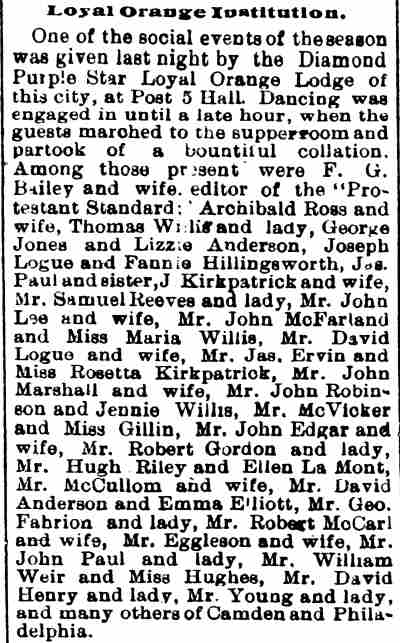
Loyal Orange Institution.
One of the social events of the season was given last night by the Diamond Purple Star Loyal Orange Lodge of this city, at Post 5 Hall. Dancing was engaged in until a late hour, when the guests marched to the supper room and partook of a bountiful collation. Among those present were F. G. Bailey and wife, editor of the “Protestant Standard;” Archibald Ross and wife, Thomas Willis and lady, George Jones and Lizzie Anderson, Joseph Logue and Fannie Hillingsworth, Jas. Paul and sister, J. Kirkpatrick and wife, Mr. Samuel Reeves and lady, Mr. John Lee and wife, Mr. John McFarland and Miss Maria Willis, Mr. David Logue and wife, Mr. Jas. Ervin and Miss Rosetta Kirkpatrick, Mr. John Marshall and wife, Mr. John Robinson and Jennie Willis, Mr. McVicker and Miss Gillin, Mr. John Edgar and wife, Mr. Robert Gordon and lady, Mr. Hugh Riley and Ellen La Mont, Mr. McCullom and wife, Mr. David Anderson and Emma Elliott, Mr. Geo. Fabrion and lady, Mr. Robert McCarl and wife, Mr. Eggleson and wife, Mr. John Paul and lady, Mr. William Weir and Miss Hughes, Mr. David Henry and lady, Mr. Young and lady, and many others of Camden and Philadelphia.
Additional Firemen in Camden
Philadelphia Inquirer —
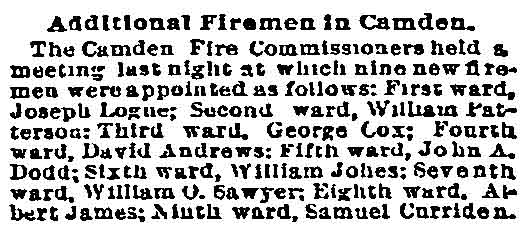
The Camden Fire Commissioners held a meeting last night at which nine new firemen were appointed as follows: First ward, Joseph Logue; Second ward, William Patterson; Third ward, George Cox; Fourth ward, David Andrews; Fifth ward, John A. Dodd; Sixth ward, William Jobes; Seventh ward, William O. Sawyer; Eighth ward, Albert James; Ninth ward, Samuel Curriden.
Fire Commissioners
Camden Daily Telegram —
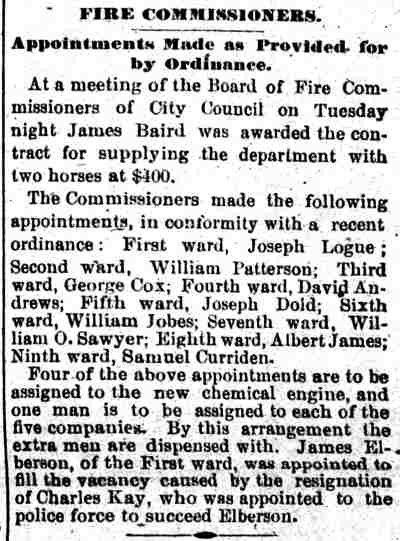
Fire Commissioners.
Appointments Made as Provided for by Ordinance.
At a meeting of the Board of Fire Commissioners of City Council on Tuesday night James Baird was awarded the contract for supplying the department with two horses at $400.
The Commissioners made the following appointments, in conformity with a recent ordinance: First ward, Joseph Logue; Second ward, William Patterson; Third ward, George Cox; Fourth ward, David Andrews; Fifth ward, Joseph Dold; Sixth ward, William Jobes; Seventh ward, William O. Sawyer; Eighth ward, Albert James; Ninth ward, Samuel Curriden.
James Elberson, of the First ward, was appointed to fill the vacancy caused by the resignation of Charles Kay, who was appointed to the police force to succeed Elberson.
Logue—Ellingsworth Wedding
Camden Daily Courier —
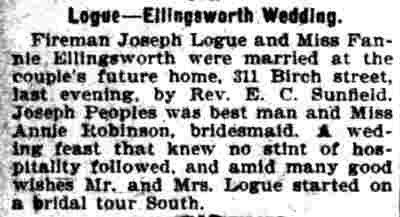
Logue — Ellingsworth Wedding.
Fireman Joseph Logue and Miss Fannie Ellingsworth were married at the couple’s future home, 311 Birch street, last evening, by Rev. E. C. Sunfield. Joseph Peoples was best man and Miss Annie Robinson, bridesmaid. A wedding feast that knew no stint of hospitality followed, and amid many good wishes Mr. and Mrs. Logue started on a bridal tour South.
Firemen's Close Call
Camden Evening Courier —
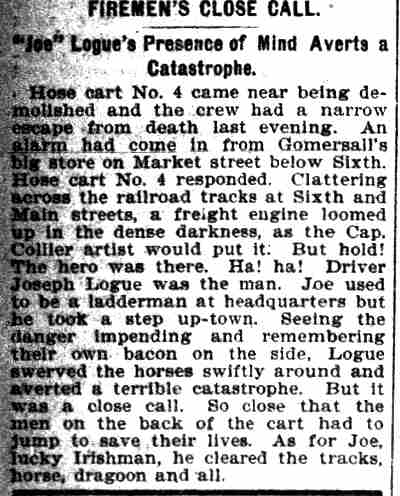
FIREMEN’S CLOSE CALL.
“Joe” Logue’s Presence of Mind Averts a Catastrophe.
Hose cart No. 4 came near being demolished and the crew had a narrow escape from death last evening. An alarm had come in from Gomersall’s big store on Market street below Sixth. Hose cart No. 4 responded. Clattering across the railroad tracks at Sixth and Main streets, a freight engine loomed up in the dense darkness, as the Cap. Collier artist would put it. But hold! The hero was there. Ha! ha! Driver Joseph Logue was the man. Joe used to be a ladderman at headquarters but he took a step up-town. Seeing the danger impending and remembering their own bacon on the side, Logue swerved the horses swiftly around and averted a terrible catastrophe. But it was a close call. So close that the men on the back of the cart had to jump to save their lives. As for Joe, lucky Irishman, he cleared the tracks, horse, dragoon and all.
Firemen's Close Shave
Camden Post-Telegram —
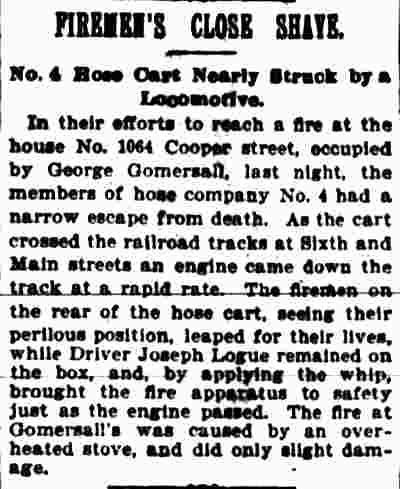
FIREMEN’S CLOSE SHAVE.
No. 4 Hose Cart Nearly Struck by a Locomotive.
In their efforts to reach a fire at the house No. 1064 Cooper street, occupied by George Gomersall, last night, the members of hose company No. 4 had a narrow escape from death. As the cart crossed the railroad tracks at Sixth and Main streets an engine came down the track at a rapid rate. The firemen on the rear of the hose cart, seeing their perilous position, leaped for their lives, while Driver Joseph Logue remained on the box, and, by applying the whip, brought the fire apparatus to safety just as the engine passed. The fire at Gomersall’s was caused by an overheated stove, and did only slight damage.
Sneak Thief Gets an Overcoat
Camden Post-Telegram —
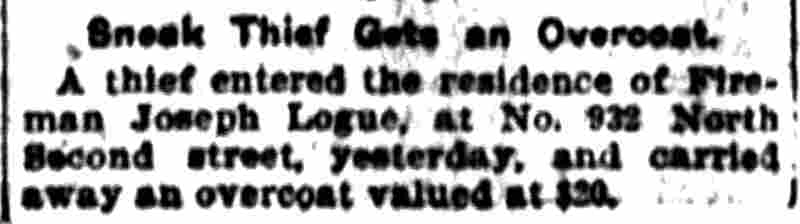
Sneak Thief Gets an Overcoat.
A thief entered the residence of Fireman Joseph Logue, at No. 932 North Second street, yesterday, and carried away an overcoat valued at $20.
Personal Notice
Camden Evening Courier —
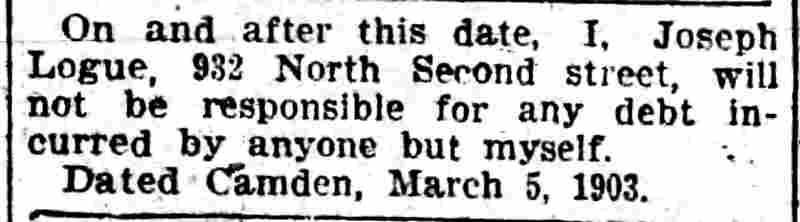
On and after this date, I, Joseph Logue, 932 North Second street, will not be responsible for any debt incurred by anyone but myself.
Dated Camden, March 5, 1903.
First Ward Club Had a Jolly Time
Camden Daily Courier —
FIRST WARD CLUB HAD A JOLLY TIME
Annual Election and Feast of Fun Held Last Night.
PATTERSON ELECTED PRESIDENT
Hospitality was rampant at the First Ward Young Republican Club last night. The occasion was the annual meeting. Following the election of officers there was a delightful entertainment and a splendid feast, the honors being done by Captain William E. Alberts, simply resplendent facially in his new bunch of whiskers; Recorder O. Glen Stackhouse, who salivated more buttered ham sandwiches than George Kappel did fried oysters; Eph Hires, the school janitor, who saw to it especially that no one was unattended to; Exciseman Joseph Kolb, who insisted on everybody taking something every other minute; John Beard, who was happy over being elected a ward committeeman, and a number of others who looked after the comfort of the many guests in fine style.
The officers elected were: President, County Clerk Frank F. Patterson, Jr.; Vice President, Freeholder George P. Pechin; Treasurer, Thomas Walton; Board of Directors, Court House Superintendent Joseph Burt, Captain William E. Alberts, Walter Banks, E. T. Hires, William Lyons, Charles Cook, William Weaver and Robert Finley. Joseph Baumeister was re-elected secretary and none better could have been selected as he had everything down pat.
An Italian orchestra with an Irishman playing the flute furnished the music, and there was great fun when Walter Banks got under a rubber plant and roared out “Under the Bamboo Tree.” The cosy club rooms were prettily and patriotically decorated and pretty nearly everybody in the town was there, from Cooper’s Point to Centreville. Among them were Senator William J. Bradley, ex-Mayor J. Leighton Westcott, Fire Chief Samuel S. Elfreth, who warmed up on ginger ale; President of City Council Samuel P. Jones, Councilman Joseph Potter, County Clerk Frank F. Patterson, Jr., whose re-election as president of the club was hearty and unanimous; Dr. John F. Leavitt, whose heroism and devotion to duty where disease stalks, has made Camden the healthiest city in the world; ex-County Physician William Iszard, Freeholder George Pechin, Fireman Joseph Logue, the owner of the great and only “Dewey;” Tony Mecca, president of the popular Italian Republican Club, and many others of equal note. The cigars were elegant, the menu grand, the orchestra in full harmony with the happy occasion, outside of playing “In the Good Old Summer Time,” and the guests will ever remember the event as one of the pleasantest of incidents.
The Courier's Camera
Camden Evening Courier —
THE COURIER’S CAMERA.
Fireman Joseph Logue is on duty at the Vine street engine house, [back from] a twelve days’ grand time of it in Wildwood with his old North Camden friend, Harry Dominitz, and maybe “Dewey” wasn’t glad to see the genial [Joe] back on the hose carriage.
Chat Among the Local Firemen
Camden Daily Courier —
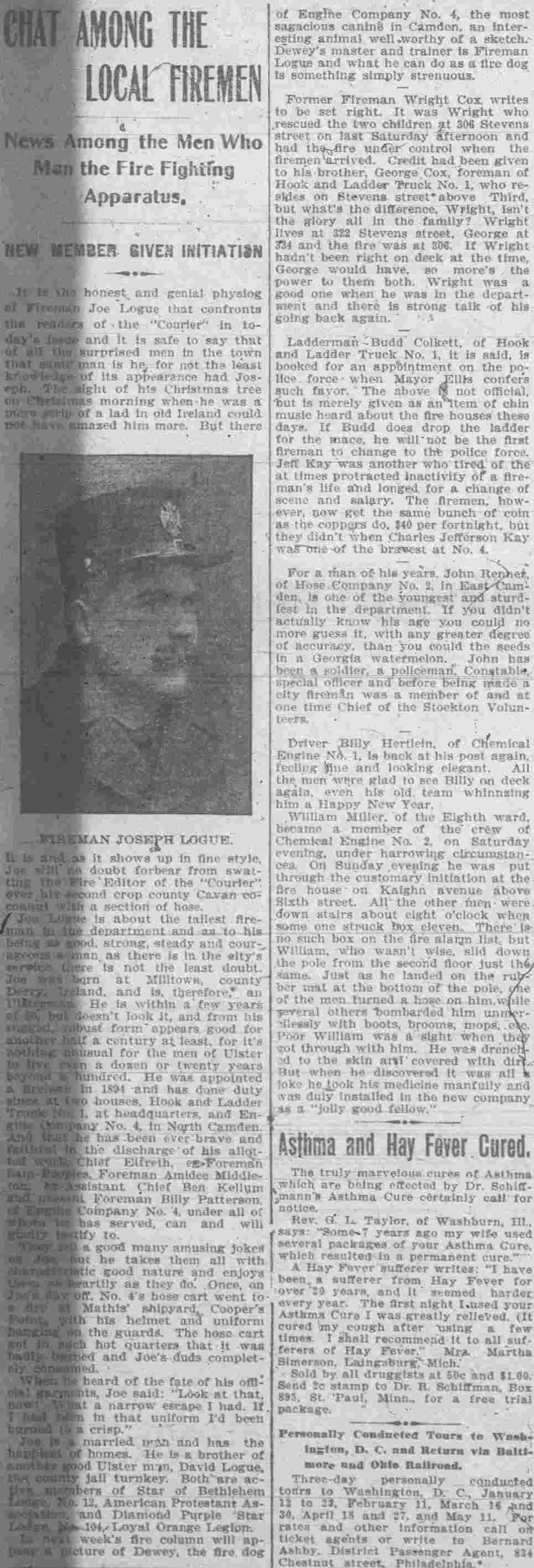
CHAT AMONG THE LOCAL FIREMEN
News Among the Men Who Man the Fire Fighting Apparatus.
NEW MEMBER GIVEN INITIATION
It is the honest and genial physiog of Fireman Joe Logue that confronts the readers of the “Courier” in today’s issue and it is safe to say that of all the surprised men in the town that same man is he, for not the least of his appearance had Joe expected. The sight of his Christmas tree on Christmas morning when he was a mere strip of a lad in old Ireland could not have amazed him more. But there it is and as it shows up in fine style, Joe will no doubt forbear from swatting the Fire Editor of the “Courier” with his trusty Cape Cavan county hose. Joe Logue is about the tallest fireman in the department and as to his being as good, strong, steady and courageous a man, as there is in the city’s service, there is not the least doubt. He was born at Milltown, county Derry, and is therefore an Ulsterite. He is within a few years of 40, but doesn’t look it, and from his rugged, robust form appears good for another half a century at least, for it’s not unusual for the men of Ulster to live even a dozen or twenty years beyond that. He was appointed a fireman in 1894 and has done duty since at two houses, Hook and Ladder Truck No. 1, at headquarters, and Engine Company No. 4, in North Camden. And that he has been ever brave and faithful in the discharge of his allotted tasks, Foreman Elfreth, ex-Foreman Billy Patterson, Assistant Chief Ben Kellum and present Foreman Billy Patterson, of Engine Company No. 4, under all of whom he has served, can and will testify to.
A good many amusing jokes can be told on them all with some good nature, and they do them as heartily as they do once. On a day off, No. 4’s boss cart went to Mathis’ shipyard, Cooper’s Point, with his helmet and uniform on as named for the guards. The hose cart put in such hot quarters that it was pulled out and Joe’s duds completely ruined.
When he heard of the fate of his official garments, Joe said: “Look at that, what a narrow escape I had. If I had been in that uniform I’d been pressed to a crisp.”
Joe is a married man and has the finest of homes. He is a brother of another good Ulster man, David Logue, the county jail turnkey. Both are members of Star of Bethlehem Lodge No. 12, American Protestant Association and Diamond Purple Star Lodge No. 104, Loyal Orange Legion.
The following column will appear a picture of Dewey, the fine fire dog of Engine Company No. 4, the most gorgeous canine in Camden. An interesting animal well worthy of a sketch. Dewey’s master and trainer is Foreman Logue and what he can do as a fire dog is something simply strenuous.
Fireman Overcome in Blazing Cellar
Camden Daily Courier —
FIREMAN OVERCOME IN BLAZING CELLAR
Rendered Unconscious By Smoke Joseph Logue is Bravely Rescued
POLICEMAN AND LADDIE AS HEROES
Bravery on the part of Policeman Harry Bakley and Fireman Harry Anderson perhaps saved the life of Fireman Joseph Logue, of the No. 4 house, when he was overcome with smoke in the cellar at the home of John Holloway, 215 Grant street, last night. Logue after being pulled from out of the cellar was revived and was able to resume his duties.
The alarm came in about 7.45 last night and the companies from the Fourth and Vine streets house and Fifth and Arch streets responded. On arriving at the house smoke was pouring from the cellar windows in volumes. Handicapped by the windows being bolted the firemen fought the fire from the inside of the house. As they opened the cellar door the smoke almost overpowered them.
Unable to get at the blaze, Logue descended the steps with an extinguisher and attempted to fight the fire. After waiting for several minutes his companions become alarmed and quickly made their way down the steps to find Logue. While groping in the blinding and choking smoke, Bakley tripped over what he thought an object on the floor. Reaching down he discovered it was the unconscious form of the fireman. Calling to Anderson, they carried the prostrated man up the steps.
His clothing was unbuttoned and Logue was laid on a blanket in the rear yard of the house, while his companions worked earnestly to get the smoke from his lungs. After several minutes’ work he recovered consciousness and refused to be taken to the hospital.
The fire although of slight nature, caused much excitement in the neighborhood and did damage of only a few dollars. The fire is thought to have been started by a child going into the cellar with a lighted candle and tripping, fell, the lighted candle igniting scattered paper lying on the floor.
Lobster Feed at Club House
Camden Daily Courier —
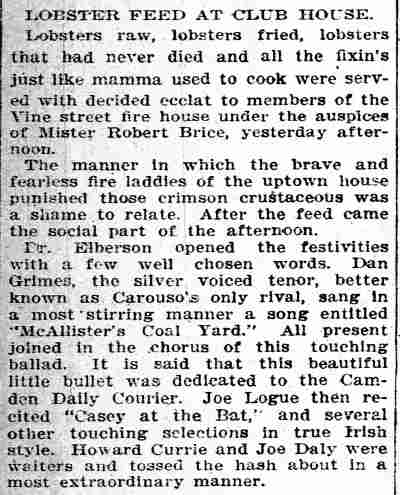
LOBSTER FEED AT CLUB HOUSE
Lobsters raw, lobsters fried, lobsters that had never died and all the fixin’s just like mamma used to cook were served with decided eclat to members of the Vine street fire house under the auspices of Mister Robert Brice, yesterday afternoon.
The manner in which the brave and fearless fire laddies of the uptown house punished those crimson crustaceous was a shame to relate. After the feed came the social part of the afternoon.
Fr. Elberson opened the festivities with a few well chosen words. Dan Grimes, the silver voiced tenor, better known as Carouso’s only rival, sang in a most stirring manner a song entitled “McAllister’s Coal Yard.” All present joined in the chorus of this touching ballad. It is said that this beautiful little bullet was dedicated to the Camden Daily Courier. Joe Logue then recited “Casey at the Bat,” and several other touching selections in true Irish style. Howard Currie and Joe Daly were waiters and tossed the hash about in a most extraordinary manner.
Firemen Enjoy Oyster Supper
Camden Post-Telegram —
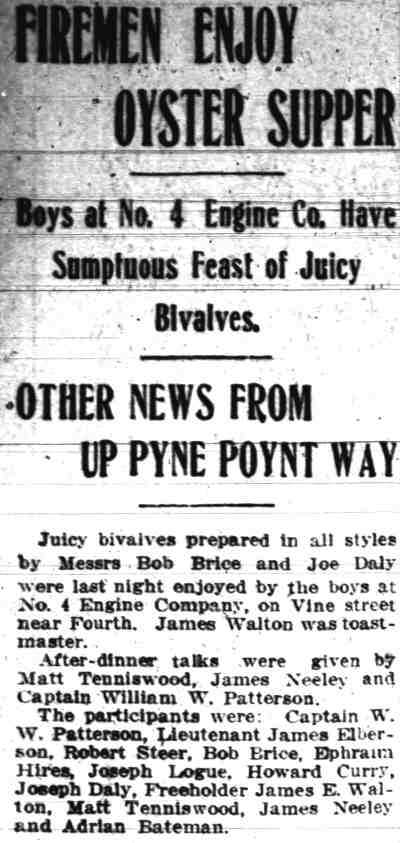
FIREMEN ENJOY OYSTER SUPPER
Boys at No. 4 Engine Co. Have Sumptuous Feast of Juicy Bivalves.
OTHER NEWS FROM UP PYNE POYNT WAY
Juicy bivalves prepared in all styles by Messrs Bob Brice and Joe Daly were last night enjoyed by the boys at No. 4 Engine Company, on Vine street near Fourth. James Walton was toastmaster.
After-dinner talks were given by Matt Tenniswood, James Neeley and Captain William W. Patterson.
The participants were: Captain W. W. Patterson, Lieutenant James Elberson, Robert Steer, Bob Brice, Ephraim Hires, Joseph Logue, Howard Curry, Joseph Daly, Freeholder James E. Walton, Matt Tenniswood, James Neeley and Adrian Bateman.
Firemen Escort Steer's Remains
Camden Post-Telegram —
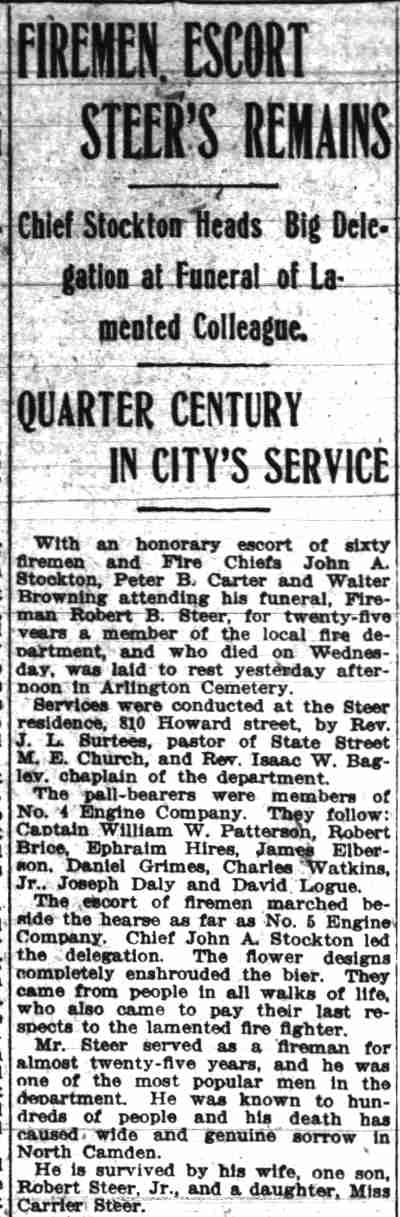
FIREMEN ESCORT STEER’S REMAINS
Chief Stockton Heads Big Delegation at Funeral of Lamented Colleague.
QUARTER CENTURY IN CITY’S SERVICE
With an honorary escort of sixty firemen and Fire Chiefs John A. Stockton, Peter B. Carter and Walter Browning attending his funeral, Fireman Robert B. Steer, for twenty-five years a member of the local fire department, and who died on Wednesday, was laid to rest yesterday afternoon in Arlington Cemetery.
Services were conducted at the Steer residence, 310 Howard street, by Rev. J. L. Surtees, pastor of State Street M. E. Church, and Rev. Isaac W. Bagley, chaplain of the department.
The pall-bearers were members of No. 4 Engine Company. They follow: Captain William W. Patterson, Robert Brice, Ephraim Hires, James Elberson, Daniel Grimes, Charles Watkins, Jr., Joseph Daly and David Logue.
The escort of firemen marched beside the hearse as far as No. 5 Engine Company. Chief John A. Stockton led the delegation. The flower designs completely enshrouded the bier. They came from people in all walks of life, who also came to pay their last respects to the lamented fire fighter.
Mr. Steer served as a fireman for almost twenty-five years, and he was one of the most popular men in the department. He was known to hundreds of people and his death has caused wide and genuine sorrow in North Camden.
He is survived by his wife, one son, Robert Steer, Jr., and a daughter, Miss Carrier Steer.
Charm Presented to Deputy Chief
Camden Daily Courier —
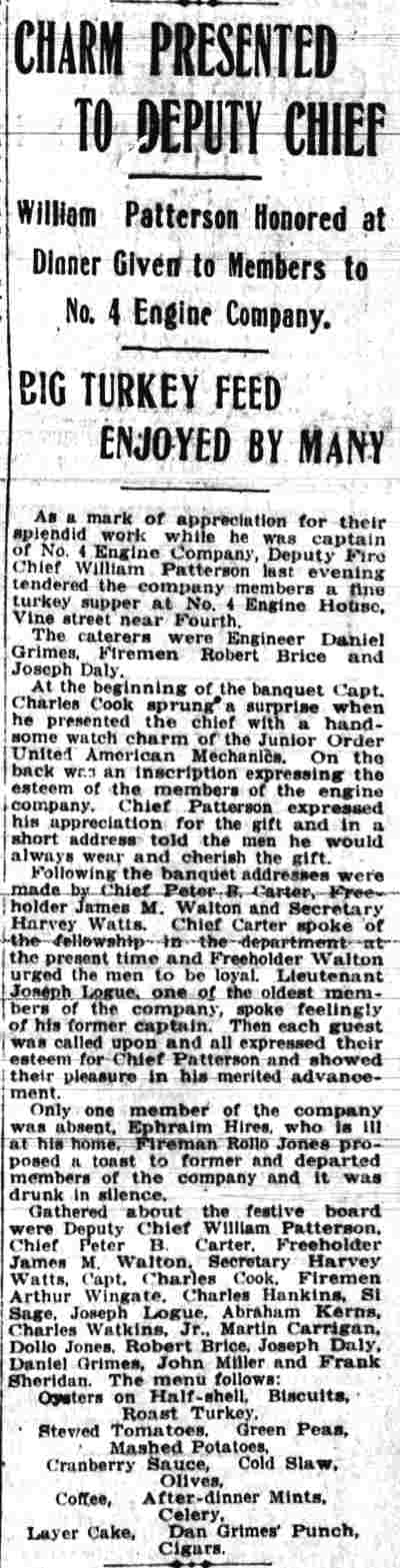
CHARM PRESENTED TO DEPUTY CHIEF
William Patterson Honored at Dinner Given to Members of No. 4 Engine Company.
BIG TURKEY FEED ENJOYED BY MANY
As a mark of appreciation for their splendid work while he was captain of No. 4 Engine Company, Deputy Fire Chief William Patterson last evening tendered the company members a fine turkey supper at No. 4 Engine House, Vine street near Fourth.
The caterers were Engineer Daniel Grimes, Firemen Robert Brice and Joseph Daly.
At the beginning of the banquet Capt. Charles Cook sprung a surprise when he presented the chief with a handsome watch charm of the Junior Order United American Mechanics. On the back was an inscription expressing the esteem of the members of the engine company. Chief Patterson expressed his appreciation for the gift and in a short address told the men he would always wear and cherish the gift.
Following the banquet addresses were made by Chief Peter B. Carter, Freeholder James M. Walton and Secretary Harvey Watts. Chief Carter spoke of the fellowship in the department at the present time and Freeholder Walton urged the men to be loyal. Lieutenant Joseph Logue, one of the oldest members of the company, spoke feelingly of his former captain. Then each guest was called upon and all expressed their esteem for Chief Patterson and showed their pleasure in his merited advancement.
Only one member of the company was absent, Ephraim Hires, who is ill at his home. Fireman Rollo Jones proposed a toast to former and departed members of the company and it was drunk in silence.
Gathered about the festive board were Deputy Chief William Patterson, Chief Peter B. Carter, Freeholder James M. Walton, Secretary Harvey Watts, Capt. Charles Cook, Firemen Arthur Wingate, Charles Hankins, Si Sage, Joseph Logue, Abraham Kerns, Charles Watkins, Jr., Martin Carrigan, Dollo Jones, Robert Brice, Joseph Daly, Daniel Grimes, John Miller and Frank Sheridan.
Fire Comrades Dead, Tries to End Life
Philadelphia Inquirer —
FIRE COMRADES DEAD, TRIES TO END LIFE
William J. Simpson, of Camden Department, Found in Ashpit With Wrists Cut
Almost dead from the loss of blood, City Fireman William J. Simpson, aged 56, of 604 North Sixth street, was found in the ash pit at No. 4 engine house, on Vine street near Fourth, Camden, yesterday. Both wrists were slashed and during a lucid interval he said he had cut them because he was tired of living. His condition last night was serious, although he has chances for recovery.
Friends of Simpson say that he has not been himself since the armory fire of 1906 when three of his companions were killed and he was among several badly injured. He has been transferred from several companies in the belief the change would do him good. Only Saturday he was sent in from an East Camden company. He has remained melancholy, however, and when last seen Monday night, complained of his nerves.
It was when Joseph Logue, a comrade, went down stairs at the firehouse that he found Simpson in the pit literally covered with blood. The injured fireman had been there for several hours, the blood having coagulated about the wounds.
Trolley Smashes Motor Fire Wagon
Camden Post-Telegram —
TROLLEY SMASHES MOTOR FIRE WAGON
One Fireman Hurt When Car Crashes Into No. 4 Combination Apparatus.
HORSE KILLED IN ANOTHER ACCIDENT
One fireman was badly injured, another had a narrow escape and one of the motorized fire machines was put out of commission last evening when the apparatus was struck by a trolley car at Fifth and Vine streets.
Fireman Joseph Logue, aged 60 years, of 932 North Second street, was injured. He was taken to Cooper Hospital suffering with hurts of the body, shoulders and head. He was later taken home. Fireman Ephraim Hires, the driver, escaped without a scratch.
Both firemen are members of No. 4 Engine Company, Fourth and Vine streets, and were the only passengers of the combination wagon, which was on its way to the grocery store and dwelling of Henry R. Hand at Seventh and Elm streets, where smoke pouring from a chimney caused some one to send in an alarm.
The trolley car struck the machine full in the center, overturning it, demolishing two wheels and tearing away the battery boards. Logue and Hires were thrown off.
No one on the car was hurt and the car itself was not much damaged.
His team struck from the rear by a southbound Haddon Heights trolley car on Haddon avenue, Oaklyn, at an early hour this morning, Charles Flexon, aged 40 years, a driver for the William Davis Bakery Company, had a narrow escape from death when the wagon he was driving was demolished and the horse injured so badly that it had to be killed. Flexon, whose home is at 509 Newton avenue, is in the Homeopathic Hospital with body bruises and shock. His condition is not serious.
The trolley company contends that the wagon did not carry an outside light and that in the darkness the vehicle could not be seen by the motorman. On the other hand, Mr. Davis says the wagon did display a light and that he has the crushed lantern. The injured driver was taken to the hospital in an automobile.
Logue Recovering from Trolley Accident
Camden Post-Telegram —
It is pleasing news to the many friends of Fireman Joseph Logue, of No. 4 Engine Company, to learn he is able to sit up at his home, 937 North Second street. “Joe” was injured early last week when the apparatus upon which he was riding was struck by a trolley car.
Logue to Return to Duty
Camden Post-Telegram —
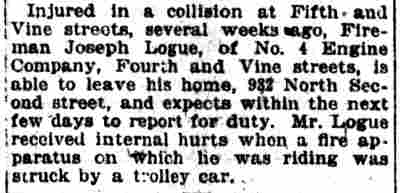
Injured in a collision at Fifth and Vine streets, several weeks ago, Fireman Joseph Logue, of No. 4 Engine Company, Fourth and Vine streets, is able to leave his home, 932 North Second street, and expects within the next few days to report for duty. Mr. Logue received internal hurts when a fire apparatus on which he was riding was struck by a trolley car.
Joseph Logue Dies, Fireman 22 Years
Camden Courier-Post —
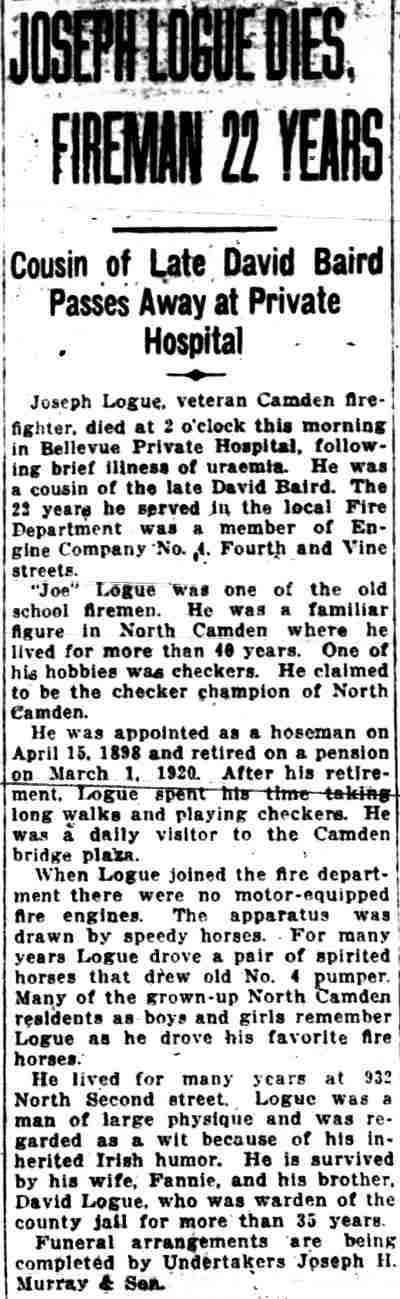
JOSEPH LOGUE DIES, FIREMAN 22 YEARS
Cousin of Late David Baird Passes Away at Private Hospital
Joseph Logue, veteran Camden firefighter, died at 2 o’clock this morning in Bellevue Private Hospital, following brief illness of uraemia. He was a cousin of the late David Baird. The 22 years he served in the local Fire Department was a member of Engine Company No. 4, Fourth and Vine streets.
“Joe” Logue was one of the old school firemen. He was a familiar figure in North Camden where he lived for more than 40 years. One of his hobbies was checkers. He claimed to be the checker champion of North Camden.
He was appointed as a hoseman on April 15, 1898 and retired on a pension on March 1, 1920. After his retirement, Logue spent his time taking long walks and playing checkers. He was a daily visitor to the Camden bridge plaza.
When Logue joined the fire department there were no motor-equipped fire engines. The apparatus was drawn by speedy horses. For many years Logue drove a pair of spirited horses that drew old No. 4 pumper. Many of the grown-up North Camden residents as boys and girls remember Logue as he drove his favorite fire horses.
He lived for many years at 932 North Second street. Logue was a man of large physique and was regarded as a wit because of his inherited Irish humor. He is survived by his wife, Fannie, and his brother, David Logue, who was warden of the county jail for more than 35 years.
Funeral arrangements are being completed by Undertakers Joseph H. Murray & Son.
Joseph Logue
Camden Courier-Post —
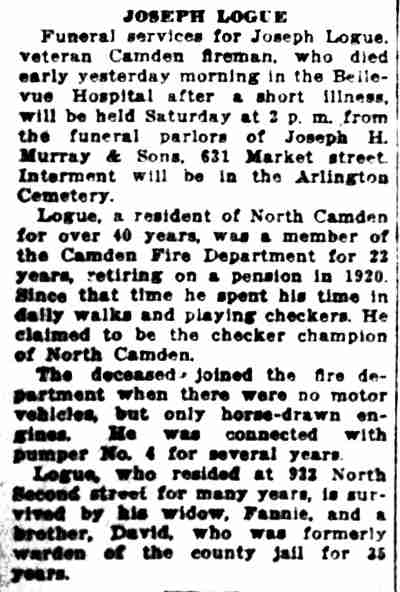
JOSEPH LOGUE
Funeral services for Joseph Logue, veteran Camden fireman, who died early yesterday morning in the Bellevue Hospital after a short illness, will be held Saturday at 2 p. m. from the funeral parlors of Joseph H. Murray & Sons, 631 Market street. Interment will be in the Arlington Cemetery.
Logue, a resident of North Camden for over 40 years, was a member of the Camden Fire Department for 22 years, retiring on a pension in 1920. Since that time he spent his time in daily walks and playing checkers. He claimed to be the checker champion of North Camden.
The deceased joined the fire department when there were no motor vehicles, but only horse-drawn engines. He was connected with pumper No. 4 for several years.
Logue, who resided at 932 North Second street for many years, is survived by his widow, Fannie, and a brother, David, who was formerly warden of the county jail for 25 years.
Logue Leaves Family $11,600
Camden Courier-Post —
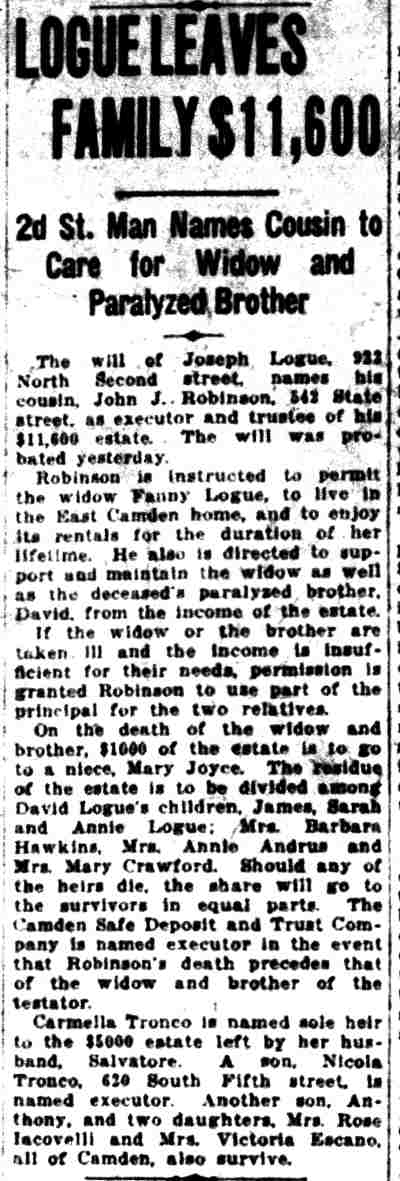
LOGUE LEAVES FAMILY $11,600
2d St. Man Names Cousin to Care for Widow and Paralyzed Brother
The will of Joseph Logue, 922 North Second street, names his cousin, John J. Robinson, 342 State street, as executor and trustee of his $11,600 estate. The will was probated yesterday.
Robinson is instructed to permit the widow Fanny Logue, to live in the East Camden home, and to enjoy its rentals for the duration of her lifetime. He also is directed to support and maintain the widow as well as the deceased’s paralyzed brother, David, from the income of the estate.
If the widow or the brother are taken ill and the income is insufficient for their needs, permission is granted Robinson to use part of the principal for the two relatives.
On the death of the widow and brother, $1000 of the estate is to go to a niece, Mary Joyce. The residue of the estate is to be divided among David Logue’s children, James, Sarah and Annie Logue; Mrs. Barbara Hawkins, Mrs. Annie Andrus and Mrs. Mary Crawford. Should any of the heirs die, the share will go to the survivors in equal parts. The Camden Safe Deposit and Trust Company is named executor in the event that Robinson’s death precedes that of the widow and brother of the testator.
Carmella Tronco is named sole heir to the $5000 estate left by her husband, Salvatore. A son, Nicola Tronco, 620 South Fifth street, is named executor. Another son, Anthony, and two daughters, Mrs. Rose Iacovelli and Mrs. Victoria Escano, all of Camden, also survive.