Harry B. Paul
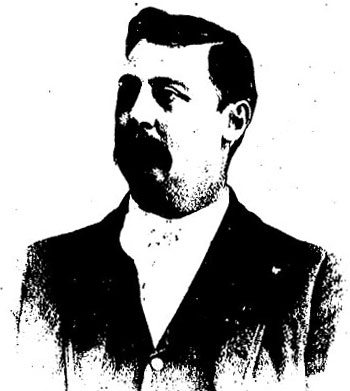
Harry B. Paul, c. 1897
HARRY B. PAUL was the son of David Sutterly Paul and his wife, the former Rebecca Hillman. He was active in politically as a Democrat in the late 1880s and 1890s. He was appointed Postmaster of Camden in 1894 by President Grover Cleveland. The Post Office was located at 420–424 Federal Street when he was appointed to the position. His efficiency was so noted that he was retained in the position of Postmaster even after the election of Republican President William McKinley. He was succeeded as Postmaster by Louis T. Derousse.
On January 28, 1897 then Postmaster Harry B. Paul was one of several dignitaries who were in attendance at the opening of the Catholic Lyceum, attached to the Church of the Immaculate Conception on Broadway at Market Street. Other attendees included the New Jersey Governor John W. Griggs, Mayor John L. Westcott, late Attorney-General Samuel H. Grey, Camden city solicitor J. Willard Morgan, Senator H. W. Johnson, then-Assemblymen Louis T. Derousse and Scovel, Sheriff David Baird Sr., ex-Judge Armstrong, Architect Henry S. Dagit, J. J. Burleigh, George A. Frey, and H. L. Bonsall. The Lyceum would evolve into Camden Catholic High School.
Harry B. Paul had passed away by June of 1903. His nephew, David Silvers Paul, later worked as a bank messenger for the Broadway Trust Bank. David Silvers Paul was kidnapped, robbed and murdered in October of 1920. His killers were arrested, tried, and executed in August of 1921.
The German Mass Meeting.
Camden Daily Courier —
A PURELY DEMOCRATIC GATHERING AT THE COURT HOUSE.
Tuetonic [sic] Republicans Fail to Turn Out—An Audience of Vice Presidents—Judge Wescott Expresses a Love for German Vote.
About two hundred persons, one half of whom were vice presidents and all known as Democrats, gathered at the court house last night to attend the German Democratic mass meeting. There were few Republicans present and consequently the meeting and its object—a German-Republican revolt—was a complete failure. A German band played some familiar tunes of the Fatherland. Four airs had been rendered and yet no speakers appeared, when finally Editor Alexander Schlessinger, of the Camden County Journal, Captain Stahl and Dr. Beurnt, of Philadelphia, appeared. John Heilemann then walked up to the bar and called the meeting to order. Eli Bachrach was unanimously chosen chairman, and Messrs. Pfeiffer and Goldenberg were appointed a committee to escort the gentleman to the chair. In a few words of his native language he thanked the meeting for the honor conferred. Dr. Conrad G. Hoell, Jacob Vissell, Anthony J. Oberst, H. Gausselman, were elected secretaries.
THE VICE PRESIDENTS.
The following long list of vice presidents was then announced: At large, Dr. B. J. Weyle; First ward—Francis D. Pastorius, John Scharnagl, Wilhelm Hage, Christian Killinger, David Goldenberg; Second ward—John Heilemann, John Pfeiffer, Christian Eckert, John Hausbeck, Charles E. Wentz, Ernest C. Wentz; Third ward—Solomon Seybold, Wilhelm Myers, J. Henry Sauers, Gus Weber, George Bristle, Joseph Meyer, Sr.; Fourth ward—George Holl, Theodore G. Mayer, Emanuel Schneider, Conrad Spalt, Charles Benkert; Fifth ward—Peter Dankelmann, John F. Riegen, George Horneff, Sr., Theodore Krug; Sixth ward—Anthony Kobus, George Pfeiffer, Sr., George Pfeiffer, Jr., John Welsh, Sr., Dennis Lutenbacher, Frederick Lutz, Fred George Brum, A. Tegtmeier, Michael N. Voll, George Kleinheintz, Lewis Schiemer; Seventh ward—Edward N. Cohn, Charles Helm, Anthony Vall, Dr. H. W. Miller, Edward Schuster, Sr.; Eight [sic] ward—Dr. John W. Dognes, John Heim, John Schaus, Martin J. Eno; Wrightsville—Frank Berberick, David Hess, Jacob Meyer; East Camden—Fred Spuhler; Merchantville—Jacob Moeck, Gottlieb C. Moeck; Gloucester City—Fred Geissel, John Bender; Berlin—Peter Mucker; Blackwoodtown—Christ. Ebensperger; Milford—Louis Clipper; Collingswood—John Schnutzius.
WESCOTT ON IMMIGRATION.
Vice President Pastorious read the following letter from Judge Wescott, the Democratic Congressional candidate:
“Mr. Chairman and Gentlemen:
“I regret my inability to be present at your meeting to-night. In my letter of acceptance, and in another to the people, you will see my views in brief upon what seems to be an important practical question of the day.
The history and record of the Democratic party show it to have extended the hand of hospitality to all immigrants who come to this country to enjoy the opportunity of free institutions and individual liberty. No element of our diversified population has contributed more skill, industry and good citizenship to American nationality than the German race.
The thrift and sturdy mentality of your people contributes much to the grand problem of Democratic government. I would favor the establishment at New Orleans, Philadelphia, Boston and other metropolitan centres, of institutions similar to that now existing in New York for the purpose of regulating and perfecting a system of immigration, correcting its abuse, protecting the inexperienced from fraudulent impositions to which they are subjected and providing safer and better modes of immigration and transportation.
In my judgment this is a matter that not only needs but should promptly receive additional legislation. You cannot but see its importance. I call your attention to it that you may see that this subject has not escaped the attention of our people.
Sincerely, your obedient servant,
JOHN W. WESCOTT.
THE SPEAKERS.
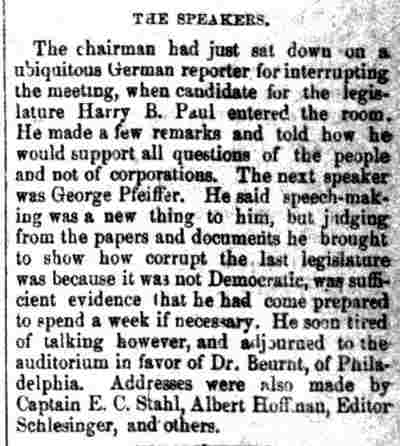
The chairman had just sat down on a ubiquitous German reporter for interrupting the meeting, when candidate for the legislature Harry B. Paul entered the room. He made a few remarks and told how he would support all questions of the people and not of corporations. The next speaker was George Pfeiffer. He said speech-making was a new thing to him, but judging from the papers and documents he brought to show how corrupt the last legislature was because it was not Democratic, was sufficient evidence that he had come prepared to spend a week if necessary. He soon tired of talking however, and adjourned to the auditorium in favor of Dr. Beurnt, of Philadelphia. Addresses were also made by Captain E. C. Stahl, Albert Hoffman, Editor Schlesinger, and others.
Politics in Jersey.
Philadelphia Inquirer —
The Bolting Sheriff’s Convention Meets at Merchantville—Party Matters Mixed.
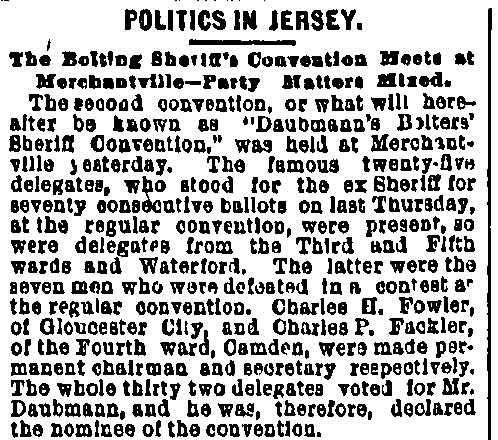
The second convention, or what will hereafter be known as “Daubmann’s Bolters’ Sheriff Convention,” was held at Merchantville yesterday. The famous twenty-five delegates, who stood for the ex-Sheriff for seventy consecutive ballots on last Thursday, at the regular convention, were present, so were delegates from the Third and Fifth wards and Waterford. The latter were the seven men who were defeated in a contest at the regular convention. Charles H. Fowler, of Gloucester City, and Charles P. Fackler, of the Fourth ward, Camden, were made permanent chairman and secretary reepectively [sic]. The whole thirty two delegates voted for Mr. Daubmann, and he was, therefore, declared the nominee of the convention.
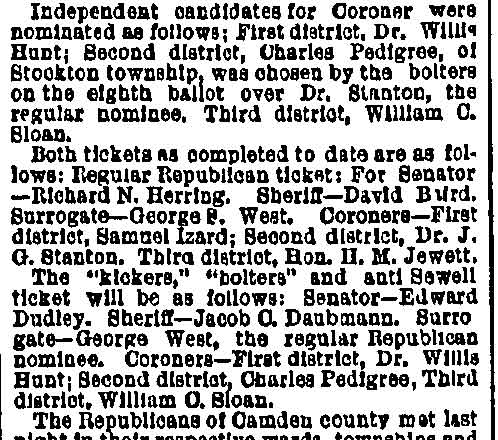
Independent candidates for Coroner were nominated as follows; First district, Dr. Willis Hunt; Second district, Charles Pedigree, of Stockton township, was chosen by the bolters on the eighth ballot over Dr. Stanton, the regular nominee. Third district, William C. Sloan.
Both tickets as completed to date are as follows: Regular Republican ticket: For Senator—Richard N. Herring. Sheriff—David Burd [sic]. Surrogate—George S. West. Coroners—First district, Samuel Izard; Second district, Dr. J. G. Stanton. Third district, Hon. H. M. Jewett.
The “kickers,” “bolters” and anti Sewell ticket will be as follows: Senator—Edward Dudley. Sheriff—Jacob C. Daubmann. Surrogate—George West, the regular Republican nominee. Coroners—First district, Dr. Willis Hunt; Second district, Charles Pedigree. Third district, William O. Sloan.
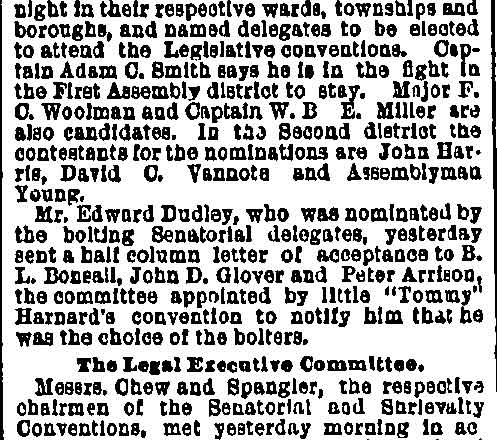
The Republicans of Camden county met last night in their respective wards, townships and boroughs, and named delegates to be elected to attend the Legislative conventions. Captain Adam C. Smith says he is in the fight in the First Assembly district to stay. Major F. C. Woolman and Captain W. B. E. Miller are also candidates. In the Second district the contestants for the nominations are John Harris, David C. Vannots and Assemblyman Young.
Mr. Edward Dudley, who was nominated by the bolting Senatorial delegates, yesterday sent a half column letter of acceptance to B. L. Bonsall, John D. Glover and Peter Arrison, the committee appointed by little “Tommy” Harnard’s convention to notify him that he was the choice of the bolters.
The Legal Executive Committee.
Messrs. Chew and Spangler, the respective chairmen of the Senatorial and Surlevalty Conventions, met yesterday morning in accordance with the party rules, and appointed the new Republican County Executive Committee for the ensuing year. Mr. Robinson, chairman of the Surrogate’s Convention, was not present. The committee consists as follows.
First ward, George Barrett; Second, John Campbell, Third, William H. Chandler; Fourth, William F. Reed; Fifth, J. D. Leckner, M. D.; Sixth, John Corbitt; Seventh, John Blowe; Eighth, James Ware; Stockton township, Geo. W. Molineaux; Merchantville borough, Wm. H. Moses; Delaware township, Clayton Stafford, Haddon township, A. W. Clements; Centre township, John Hutchinson, Waterford township, Adam Sloan; Winslow township, Simon McDougall; Gloucester township, Geo. H. Higgins; Gloucester City, First ward, John Gourley; Second, Frederick Burckman.
Political Pointers.
John Harris will undoubtedly be the Republican candidate for the Legislature in the Second district.
Harry B. Paul, of the First ward, wants the Democratic nomination for Sheriff.
Hon. George Pfeiffer leads the Democrats for the nomination of Senator. David M Chambers is also mentioned.
The friends of Mr. Dudley announced yesterday his intention of remaining in the field for Senator, although he is reported as offering to compromise on the basis that he is to be made the candidate for Senator and Mr. Baird for Sheriff, giving Mr. Herring the Assembly nomination in the Third district.
Chairman Heber Robinson, of the Surrogate’s Convention; Thomas Harnard, chairman of the “bolting” Senatorial Convention, and Charles P. Fowler, who presided at the “Daubmann bolting” Convention yesterday, it is said, are going to form another Executive Committee. Hence two tickets and two Executive Committees.
Jottings.
The dead body of an infant was found near the Timber Creek bridge, on the West Jersey Railroad, yesterday. It is believed that the babe was thrown from a window of a passing car. County Physician Gross will make an investigation.
The Board of Education of Camden held an adjourned meeting last night. Nothing of importance was transacted.
The Co-operative Association of Camden has elected these officers: President—George W. Tenner. Treasurer—Benjamin M. Braker. Directors—John H. Doerr, David Jones, L. D. Sheppard, H. C. Hopper, A. J. Hoey and Frank Warren.
The following sentences were imposed at the Camden Criminal Court yesterday: John O’Hara, larceny, fined $5; Raymond Mills, assault and battery, two years in the penitentiary; Charles Mead, breaking and entering five years.
Camden’s Factional Fight
Philadelphia Inquirer —
DEMOCRATIC LEADERS WARRING SAVAGELY AMONG THEMSELVES.
The Horse Railway Company Elects Officers—Other Gossip from the City Across the Delaware.
The Democrats of Camden had another fight among themselves last night. It was the same old story, the Pfeiffer and Thompson faction against each other. Last night was the time, according to the rules of the Democratic party of that city, for organizing the City-Committee. Notwithstanding the fact that John Heileman, who owns the hall where the call for the meeting was designated, had given notice through the local papers that he would not allow the meeting to be held at his place, there were a crowd on hand early in the evening. Instead of one meeting being held there were two. Both factions organized a City Committee.
The Thompson people were represented by the following committeemen: Second ward, Harry B. Paul; Fourth ward, Thomas Devine; Fifth ward, James Cleary; Sixth ward, John Foley; Seventh ward, David Corbeth [sic]; Eighth ward, Patrick Whalen; Ninth ward, Patrick J. Farley. The latter people were ready to recognize William H. Getty as the member-elect from the Third ward, but the latter gentlemen refused to take part with their faction. This committee organized by electing Harry B. Paul chairman, James Cleary secretary and Patrick J. Farley treasurer.
The Pfeiffer faction organized by electing John Johnson, of the Fourth ward, chairman; John McElwee, Ninth ward, secretary, and William Guthridge, Sixth ward, treasurer. The Pfeiffer people claim that they are the only committee organized in accordance with the rules. There are four Democratic committees now, both factions each having one city and county committee.
The Camden Republican Club last night elected: F. H. Burdsall, president; Watson Depuy and Postmaster Browning, vice presidents; George G. Felton, treasurer; S. Chew, Charles F. Ware, E. Woodward and Welling Schrack, directors.
At the annual election of the Camden Horse Company yesterday the following directors were elected: F. Wayland Ayres, W. S. Scull, G. Genge Browning, B. C. Reeve and E. Ambler Armstrong; president, W. G. Scull; secretary, Morris H. Hall; treasurer, G. Genge Browning; solicitor, E. A. Armstrong.
The case of A. Elwood Jones against John S. Davis was begun in the Court of Chancery yesterday before Vice Chancellor Green. When Davis purchased the United States Hotel of Atlantic City, about a year ago. Jones acted as agent. The latter now sues for services, and the defendant disputes his claim on the ground that he neglected his work.
A young son of Patrick Daly, a saloon-keeper, of Ninth and Division streets, while playing with some companions last night was accidentally stabbed in the back and now lies in a precarious condition.
Over in Camden.
Philadelphia Inquirer —
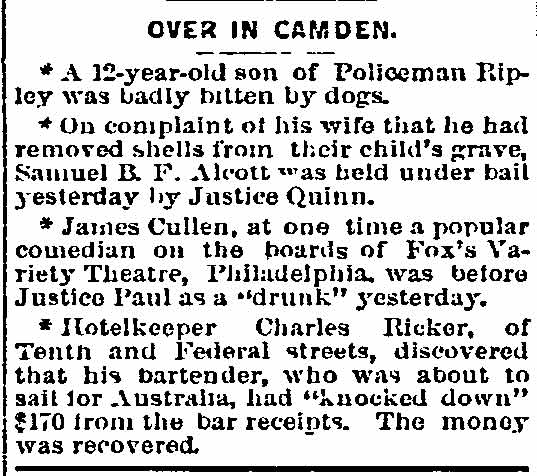
A 12-year-old son of Policeman Ripley was badly bitten by dogs.
On complaint of his wife that he had removed shells from their child’s grave, Samuel B. F. Alcott was held under bail yesterday by Justice Quinn.
James Cullen, at one time a popular comedian on the boards of Fox’s Variety Theatre, Philadelphia, was before Justice Paul as a “drunk” yesterday.
Hotelkeeper Charles Ricker, of Tenth and Federal streets, discovered that his bartender, who was about to sail for Australia, had “knocked down” $170 from the bar receipts. The money was recovered.
William Smith and “Gopher Bill” committed to jail
Philadelphia Inquirer —

William Smith and “Gopher Bill,” the latter a noted criminal, were committed to jail by Justice Paul yesterday for swindling charitable people by a bogus tale of woe.
Rained Blows on Her Rival's Face
Philadelphia Inquirer —
NEW JERSEY NEWS
Mrs. Shields Wielded a Cowhide in a Vigorous Manner.
Then She Read a Letter and the Crowd Cheered.
Pedestrians in the vicinity of Tenth and Penn streets, Camden, yesterday morning saw a stout little woman raining blows with a cowhide over the head and face of another woman, who made frantic efforts to wrrd [sic] off the punishment with an umbrella.
THE CROWD CHEERED.
A crowd collected and cheered the whip wielder when she explained that she had been deserted by her husband, who was living with the woman she had whipped. She fished from her pocket and read a letter which opened with “My dearest George,” and told in endearing words how much the writer loved him.
Policeman George Horner put an end to the scene by sending both women to the City Hall.
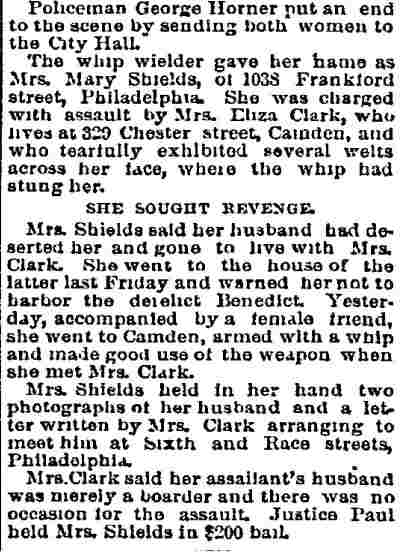
The whip wielder gave her name as Mrs. Mary Shields, of 1038 Frankford street, Philadelphia. She was charged with assault by Mrs. Eliza Clark, who lives at 329 Chester street, Camden, and who tearfully exhibited several welts across her face, where the whip had stung her.
SHE SOUGHT REVENGE.
Mrs. Shields said her husband had deserted her and gone to live with Mrs. Clark. She went to the house of the latter last Friday and warned her not to harbor the derelict Benedict. Yesterday, accompanied by a female friend, she went to Camden, armed with a whip and made good use of the weapon when she met Mrs. Clark.
Mrs. Shields held in her hand two photographs of her husband and a letter written by Mrs. Clark arranging to meet him at Sixth and Race streets, Philadelphia.
Mrs. Clark said her assailant’s husband was merely a boarder and there was no occasion for the assault. Justice Paul held Mrs. Shields in $200 bail.
Camden Police Board Trial Results
Trenton Evening Times —
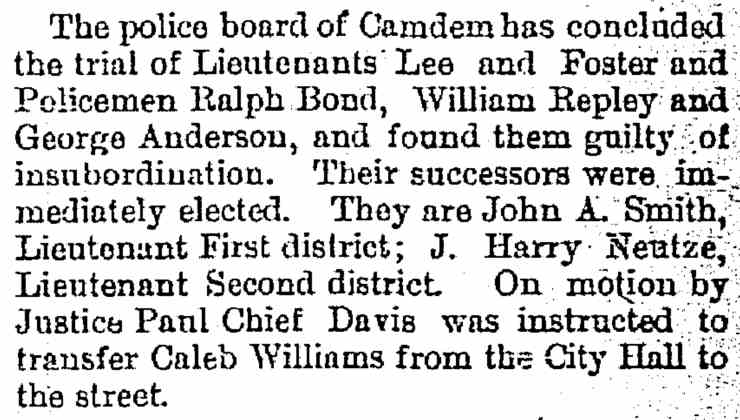
The police board of Camden has concluded the trial of Lieutenants Lee and Foster and Policemen Ralph Bond, William Repley and George Anderson, and found them guilty of insubordination. Their successors were immediately elected. They are John A. Smith, Lieutenant First district; J. Harry Neutze, Lieutenant Second district. On motion by Justice Paul Chief Davis was instructed to transfer Caleb Williams from the City Hall to the street.
Policemen Shoved Off
Philadelphia Inquirer —
NEW JERSEY NEWS.
POLICEMEN SHOVED OFF.
Partisanship, Not Efficiency, the Test for Service on Camden’s Force. Republicans Have to Go.
Fifteen Republican policemen had to pass under the rod at yesterday’s session of the Democratic Police Commission in Camden. Edward Cooper and Samuel Bakley were dismissed. The former was charged with failing to report the condition of the streets on his beat, and the latter with spending an hour watching a play in the Temple Theatre although he said he was ordered to go there and preserve order.
Colored policeman William H. Butts was called for trial.
“Are you guilty?” asked Police Justice Paul.
“Guilty of what?” answered the officer.
“Oh, of anything at all,” responded the Democratic justice. Then he said the case would be postponed until Thursday.
Officer Butts knew that this would merely delay his dismissal, and he insisted on resigning at once.
The following resignations of Republican policemen, to take effect on the 15th instant, were presented: Harry Nunes, Isaac McKinley, John Pratt, James O. Weaver, Samuel Paul, William D. Comley, Casper Hart. These take effect July 1: Benjamin Middleton, Jacob Woodsides, O. Glen Stackhouse. Frank Matlack and John Dall were suspended.
Louis Hesser, one of the newly appointed Democratic officers, resigned. The following Democrats were put on the force: James Rutledge, Edward Richardson, Harry L. Duffee, Michael Bradley, John E. Dunn, Thomas Murphy, John Logan, William Orcutt, Patrick Clark, Joseph Sloan and Amer Green. The latter takes the place of Sergeant Stackhouse at the City Hall.
Lambert Held for Robbery
Philadelphia Inquirer —
Must Answer Two Charges—New Clue in the Kairer Case.
Theodore Lambert, the negro first arrested on suspicion of being the murderer of Baker William G. Kairer, and later identified as being connected with two other robberies, was given a hearing before Police Justice Paul, in Camden, yesterday. He was committed in default of $1000 bail on the charge of breaking into Mrs. Mary Manlove’s residence, 2000 Broadway, on the night of August 9 last. Mrs. Manlove has recognized him as the man who raised her window and frightened her into a swoon.
Lambert will also have to answer, the charge of breaking into Mrs. Francis Hutt’s residence, 908 Jefferson avenue, and stealing a watch. The police still hope to connect him with the Kairer murder.
They have made no additional arrests in connection with the latter case, but are said to be working on a new clue.
Camden News Condensed
Philadelphia Inquirer —
Postmaster-elect Paul yesterday announced that he would appoint Edward Mills assistant postmaster.
Peter Brown, of 1111 Emma street, who is deranged, tried to cut his wife’s throat. He is in jail, and will probably be sent to an asylum.
Vice-Chancellor Green yesterday adjourned the suit of Simon Muhr against the majority stockholders of the Penn Electric Company.
Camden butchers and bakers held their annual picnic at Stockton Park yesterday. Thousands of pounds of meat were roasted and given away.
A colored farm hand who was employed by a farmer named Haines tried to wade across Timber Creek at Clement’s Bridge, and was drowned.
The body of Charles Elliott, of 1024 Sergeant street, Philadelphia, who was drowned on Sunday in Newton Creek, has not been recovered.
Henry Jackson, of 515 Mount Vernon street, gave his 3-year-old child a spoonful of laudanum in mistake for paregoric and the child narrowly escaped death.
The City Excise Commission will meet in the City Hall to-morrow night to fix the license fee and grant licenses. A public hearing will be given the advocates of a $500 fee.
Warrants have been issued for the arrest of F. J. Rouh, Croker Nobles, B. J. Lyons, T. J. Sherun, Jacob Seiser, Mary Hurley and Beck & Reese, charged with selling liquor under illegal county excise licenses.
The Sheriff’s sale of the property of Leonard Moore & Co., insolvent builders, has been postponed until the 25th inst., on application of counsel for Alford J. Wright, of Philadelphia, who is endeavoring to have his judgment for $3500 given precedence over the confessed judgments of $3540 to George W. Maynard’s Sons and $1605 to John Coleman, of Williamsport, Pa.
Nineteen-year-old Charles Furgeson, of Gloucester City, and Harry Tillerville, a Philadelphian, 21 years old, were committed to the Camden County Jail yesterday, without bail, charged by Mrs. Maggie Smith, of 1517 Cottage avenue, Philadelphia, with felonious assault. Mrs. Smith recognized the prisoners as two of the four men who way-laid her while she was walking from Gloucester to Camden on Sunday night.
Camden
Philadelphia Inquirer —
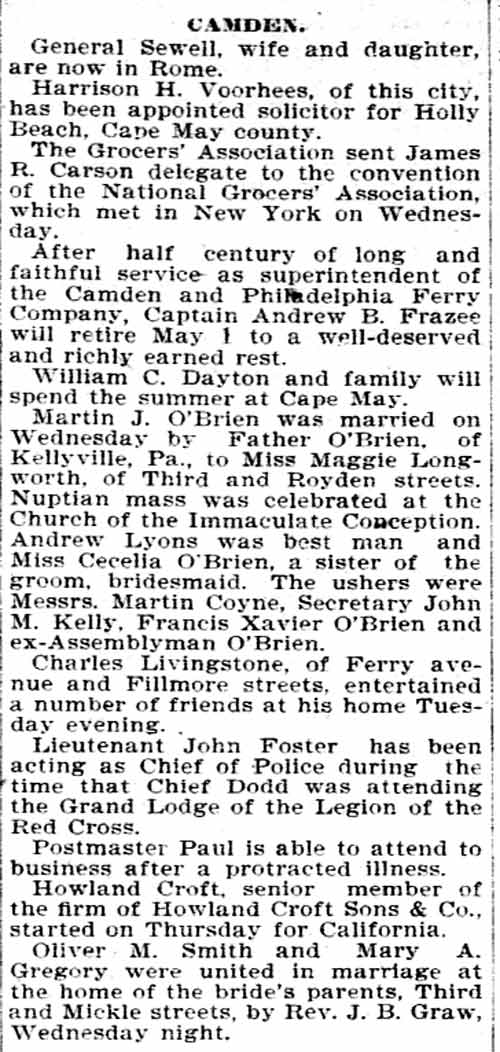
General Sewell, wife and daughter, are now in Rome.
Harrison H. Voorhees, of this city, has been appointed solicitor for Holly Beach, Cape May county.
The Grocers’ Association sent James R. Carson delegate to the convention of the National Grocers’ Association, which met in New York on Wednesday.
After half century of long and faithful service as superintendent of the Camden and Philadelphia Ferry Company, Captain Andrew B. Frazee will retire May 1 to a well-deserved and richly earned rest.
William C. Dayton and family will spend the summer at Cape May.
Martin J. O’Brien was married on Wednesday by Father O’Brien, of Kellyville, Pa., to Miss Maggie Longworth, of Third and Royden streets. Nuptian [sic] mass was celebrated at the Church of the Immaculate Conception. Andrew Lyons was best man and Miss Cecelia O’Brien, a sister of the groom, bridesmaid. The ushers were Messrs. Martin Coyne, Secretary John M. Kelly, Francis Xavier O’Brien and ex-Assemblyman O’Brien.
Charles Livingstone, of Ferry avenue and Fillmore streets, entertained a number of friends at his home Tuesday evening.
Lieutenant John Foster has been acting as Chief of Police during the time that Chief Dodd was attending the Grand Lodge of the Legion of the Red Cross.
Postmaster Paul is able to attend to business after a protracted illness.
Howland Croft, senior member of the firm of Howland Croft Sons & Co., started on Thursday for California.
Oliver M. Smith and Mary A. Gregory were united in marriage at the home of the bride’s parents, Third and Mickle streets, by Rev. J. B. Graw, Wednesday night.
Atlanta Exposition
Philadelphia Inquirer —
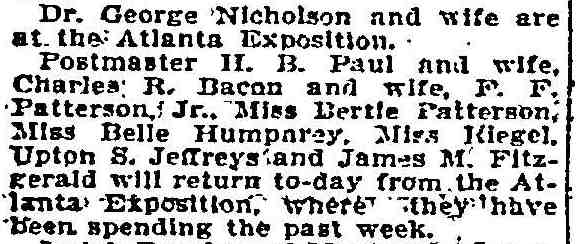
Dr. George Nicholson and wife are at the Atlanta Exposition.
Postmaster H. B. Paul and wife, Charles R. Bacon and wife, F. F. Patterson, Jr., Miss Bertie Patterson, Miss Belle Humphrey, Miss Riegel, Upton S. Jeffreys and James M. Fitzgerald will return to-day from the Atlanta Exposition, where they have been spending the past week.
Harry B. Paul
Biographical Review of New Jersey — 1897
Biographical Review of New Jersey — 1897
BIOGRAPHICAL REVIEW — 1897
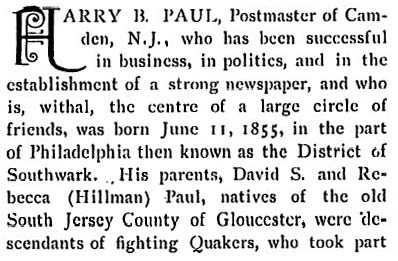
HARRY B. PAUL, Postmaster of Camden, N.J., who has been successful in business, in politics, and in the establishment of a strong newspaper, and who is, withal, the centre of a large circle of friends, was born June 11, 1855, in the part of Philadelphia then known as the District of Southwark. His parents, David S. and Rebecca (Hillman) Paul, natives of the old South Jersey County of Gloucester, were descendants of fighting Quakers, who took part in the War of Independence. After residing for a number of years in Philadelphia, where the father served the District of Southwark several times as Commissioner, they came to Camden in 1869.
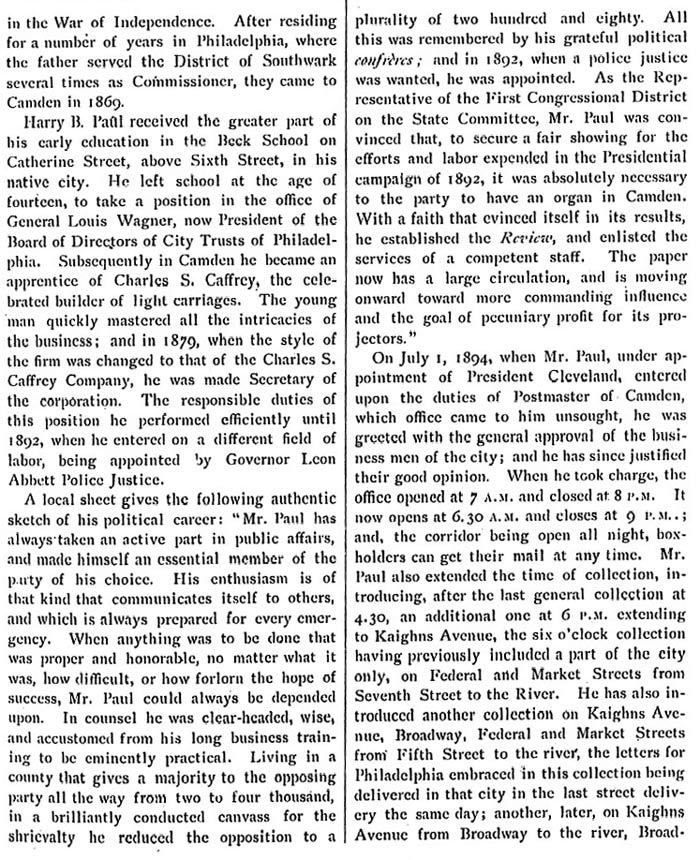
Harry B. Paul received the greater part of his early education in the Beck School on Catherine Street, above Sixth Street, in his native city. He left school at the age of fourteen, to take a position in the office of General Louis Wagner, now President of the Board of Directors of City Trusts of Philadelphia. Subsequently in Camden he became an apprentice of Charles S. Caffrey, the celebrated builder of light carriages. The young man quickly mastered all the intricacies of the business; and in 1879, when the style of the firm was changed to that of the Charles S. Caffrey Company, he was made Secretary of the corporation. The responsible duties of this position he performed efficiently until 1892, when he entered on a different field of labor, being appointed by Governor Leon Abbett Police Justice.
A local sheet gives the following authentic sketch of his political career: “Mr. Paul has always taken an active part in public affairs, and made himself an essential member of the party of his choice. His enthusiasm is of that kind that communicates itself to others, and which is always prepared for every emergency. When anything was to be done that was proper and honorable, no matter what it was, how difficult, or how forlorn the hope of success, Mr. Paul could always be depended upon. In counsel he was clear-headed, wise, and accustomed from his long business training to be eminently practical. Living in a county that gives a majority to the opposing party all the way from two to four thousand, in a brilliantly conducted canvass for the shrievalty he reduced the opposition to a plurality of two hundred and eighty. All this was remembered by his grateful political confrères; and in 1892, when a police justice was wanted, he was appointed. As the Representative of the First Congressional District on the State Committee, Mr. Paul was convinced that, to secure a fair showing for the efforts and labor expended in the Presidential campaign of 1892, it was absolutely necessary to the party to have an organ in Camden. With a faith that evinced itself in its results, he established the Review, and enlisted the services of a competent staff. The paper now has a large circulation, and is moving onward toward more commanding influence and the goal of pecuniary profit for its projectors.”
On July 1, 1894, when Mr. Paul, under appointment of President Cleveland, entered upon the duties of Postmaster of Camden, which office came to him unsought, he was greeted with the general approval of the business men of the city; and he has since justified their good opinion. When he took charge, the office opened at 7 A.M. and closed at 8 P.M. It now opens at 6.30 A.M. and closes at 9 P.M.; and, the corridor being open all night, box-holders can get their mail at any time. Mr. Paul also extended the time of collection, introducing, after the last general collection at 4.30, an additional one at 6 P.M. extending to Kaighns Avenue, the six o’clock collection having previously included a part of the city only, on Federal and Market Streets from Seventh Street to the River. He has also introduced another collection on Kaighns Avenue, Broadway, Federal and Market Streets from Fifth Street to the river, the letters for Philadelphia embraced in this collection being delivered in that city in the last street delivery the same day; another, later, on Kaighns Avenue from Broadway to the river, Broadway, north of Kaighns Avenue, and on Market and Federal Streets from Tenth Street to the river; and another and last collection at 11 P.M., the letters in which leave the post-office at 2 A.M., and are delivered in all cities within one hundred miles in the early morning delivery, and in cities within three hundred miles before noon. Mr. Paul has also introduced a Sunday collection at 5 P.M., a welcome innovation over previous usage, considering the large number of letters written on Sundays, which thus reach their respective destinations earlier than before. To the business portion of the community he has given a noon delivery, embracing Kaighns Avenue from Broadway to the river, and also Federal and Market Streets.
Mr. Paul has brought the service of his office up to a high degree of efficiency. He has retained the most capable employees, regardless of their political opinions, making the accommodation of the public his first consideration. Each department is filled with men of long experience, whose services under his direction have produced such happy results that a well-founded complaint in connection with any branch of the service is never heard. The practical wisdom of his administration is shown by the fact that the receipts of the office during the past two years, ending March 13, 1897, exceeded by several thousand dollars the receipts of any previous two years in the history of the office.
On December 19, 1889, Mr. Paul was united in marriage with Miss Bertha Riegel, of Philadelphia. One daughter, Marguerite, has blessed the union. Mr. Paul is a member of all the Masonic bodies of Camden, the Philadelphia Consistory (thirty-second degree), and Lulu Temple, A. A. O. N. M. S. He is also a member of the Benevolent and Protective Order of Elks.
The News From Jersey
Philadelphia Inquirer —
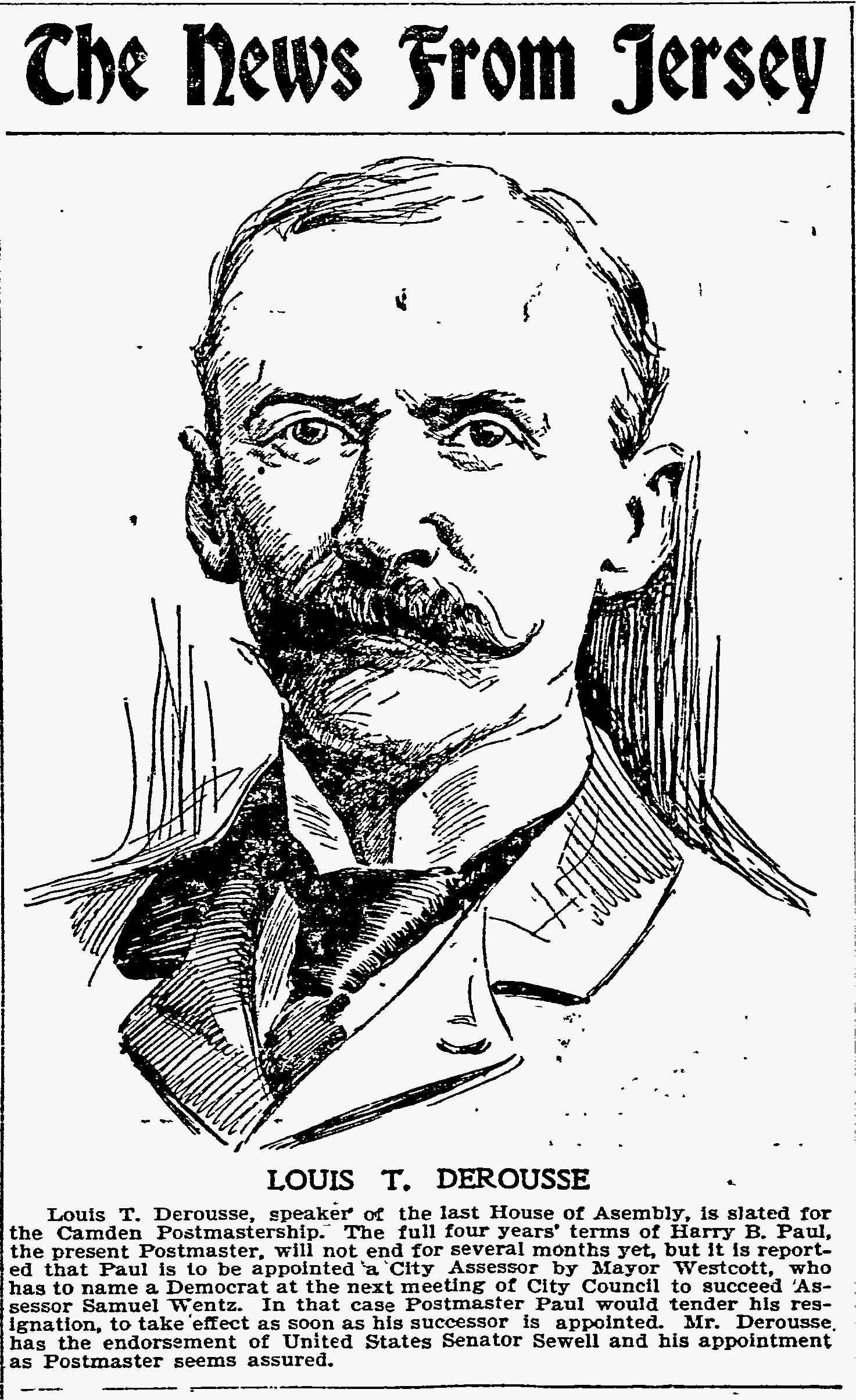
LOUIS T. DEROUSSE
Louis T. Derousse, speaker of the last House of Asembly [sic], is slated for the Camden Postmastership. The full four years’ terms of Harry B. Paul, the present Postmaster, will not end for several months yet, but it is reported that Paul is to be appointed a City Assessor by Mayor Westcott, who has to name a Democrat at the next meeting of City Council to succeed Assessor Samuel Wentz. In that case Postmaster Paul would tender his resignation, to take effect as soon as his successor is appointed. Mr. Derousse has the endorsement of United States Senator Sewell and his appointment as Postmaster seems assured.
In the Whirl of Camden Politics
Philadelphia Inquirer —
May Be Opposition to Ex-Sheriff Barrett’s Mayoralty Candidacy
CHAMBERS HESITATES
Thompsonites Hope to Coax Him Into Taking Their Nomination. Printing Registry Lists
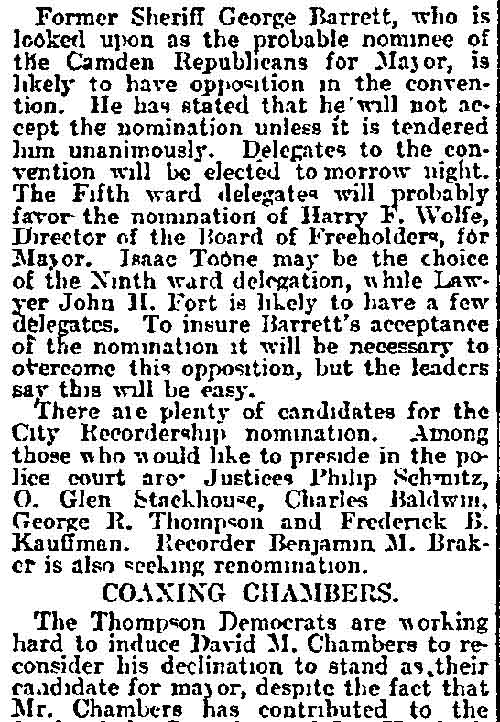
Former Sheriff George Barrett, who is looked upon as the probable nominee of the Camden Republicans for Mayor, is likely to have opposition in the convention. He has stated that he will not accept the nomination unless it is tendered him unanimously. Delegates to the convention will be elected to-morrow night. The Fifth ward delegates will probably favor the nomination of Harry F. Wolfe, Director of the Board of Freeholders, for Mayor. Isaac Toone may be the choice of the Ninth ward delegation, while Lawyer John H. Fort is likely to have a few delegates. To insure Barrett’s acceptance of the nomination it will be necessary to overcome this opposition, but the leaders say this will be easy.
There are plenty of candidates for the City Recordership nomination. Among those who would like to preside in the police court are: Justices Philip Schmitz, O. Glen Stackhouse, Charles Baldwin, George R. Thompson and Frederick B. Kauffman. Recorder Benjamin M. Braker is also seeking renomination.
COAXING CHAMBERS.
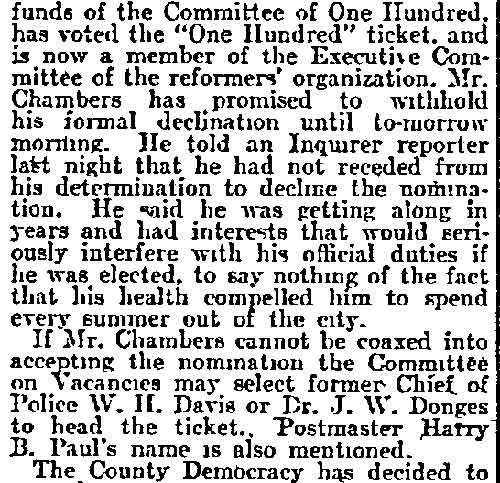
The Thompson Democrats are working hard to induce David M. Chambers to reconsider his declination to stand as their candidate for mayor, despite the fact that Mr. Chambers has contributed to the funds of the Committee of One Hundred, has voted the “One Hundred” ticket, and is now a member of the Executive Committee of the reformers’ organization. Mr. Chambers has promised to withhold his formal declination until to-morrow morning. He told an Inquirer reporter last night that he had not receded from his determination to decline the nomination. He said he was getting along in years and had interests that would seriously interfere with his official duties if he was elected, to say nothing of the fact that his health compelled him to spend every summer out of the city.
If Mr. Chambers cannot be coaxed into accepting the nomination the Committee on Vacancies may select former Chief of Police W. H. Davis or Dr. J. W. Donges to head the ticket. Postmaster Harry B. Paul’s name is also mentioned.
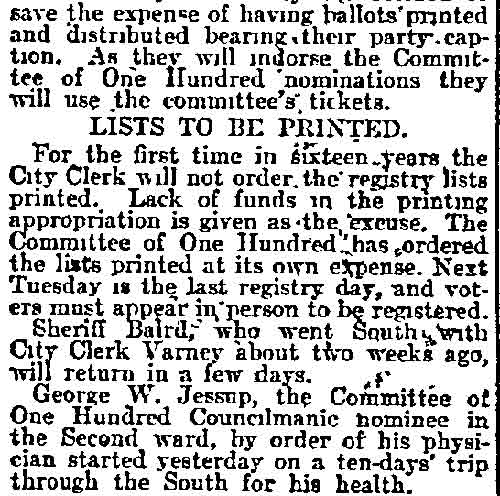
The County Democracy has decided to save the expense of having ballots printed and distributed bearing their party caption. As they will indorse the Committee of One Hundred nominations they will use the committee’s tickets.
LISTS TO BE PRINTED.
For the first time in sixteen years the City Clerk will not order the registry lists printed. Lack of funds in the printing appropriation is given as the excuse. The Committee of One Hundred has ordered the lists printed at its own expense. Next Tuesday is the last registry day, and voters must appear in person to be registered.
Sheriff Baird, who went South with City Clerk Varney about two weeks ago, will return in a few days.
George W. Jessup, the Committee of One Hundred Councilmanic nominee in the Second ward, by order of his physician started yesterday on a ten-days’ trip through the South for his health.
Camden Democrats on the Watch
Philadelphia Inquirer —
They Hope to Make a Hit at the Spring Election Two Weeks Hence
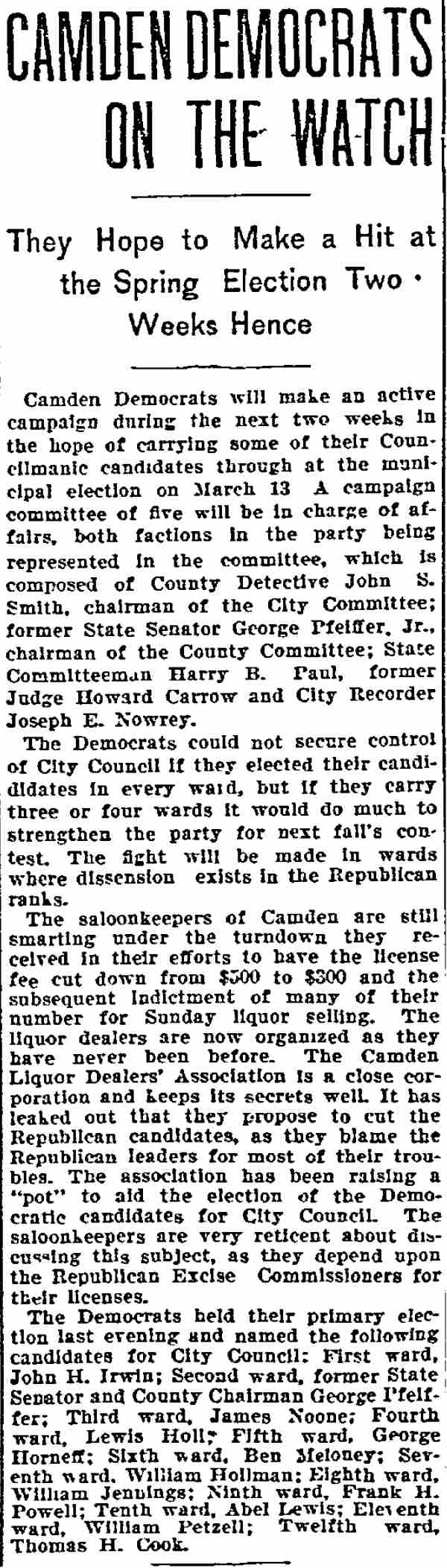
Camden Democrats will make an active campaign during the next two weeks in the hope of carrying some of their Councilmanic candidates through at the municipal election on March 13 A campaign committee of five will be in charge of affairs, both factions in the party being represented in the committee, which is composed of County Detective John S. Smith, chairman of the City Committee; former State Senator George Pfeiffer, Jr., chairman of the County Committee; State Committeeman Harry B. Paul, former Judge Howard Carrow and City Recorder Joseph E. Nowrey.
The Democrats could not secure control of City Council if they elected their candidates in every ward, but if they carry three or four wards it would do much to strengthen the party for next fall’s contest. The fight will be made in wards where dissension exists in the Republican ranks.
The saloonkeepers of Camden are still smarting under the turndown they received in their efforts to have the license fee cut down from $500 to $300 and the subsequent indictment of many of their number for Sunday liquor selling. The liquor dealers are now organized as they have never been before. The Camden Liquor Dealers’ Association is a close corporation and keeps its secrets well. It has leaked out that they propose to cut the Republican candidates, as they blame the Republican leaders for most of their troubles. The association has been raising a “pot” to aid the election of the Democratic candidates for City Council. The saloonkeepers are very reticent about discussing this subject, as they depend upon the Republican Excise Commissioners for their licenses.
The Democrats held their primary election last evening and named the following candidates for City Council: First ward, John H. Irwin; Second ward, former State Senator and County Chairman George Pfeiffer; Third ward, James Noone; Fourth ward, Lewis Holl; Fifth ward, George Horneff; Sixth ward, Ben Meloney; Seventh ward, William Hollman; Eighth ward, William Jennings; Ninth ward, Frank H. Powell; Tenth ward, Abel Lewis; Eleventh ward, William Petzell; Twelfth ward, Thomas H. Cook.
Talked About in Camden
Philadelphia Inquirer —

Among the progressive and successful business men of Camden is Hiram G. Hallinger, who is truly a self-made man. He was born in Bridgeton nearly thirty-seven years ago. At the age of 18 years he entered the steamboat brokerage business with his father in Philadelphia. Seven years ago he gave up this to go into the real estate business in Camden. He is one of the largest dealers in South Jersey and is an acknowledged authority on realty values. He is president of the Real Estate Title Company, of Camden, and a director in two other local institutions. He takes considerable interest in religious matters and is treasurer of one M. E. church and trustee in another. Mr. Hallinger is an extensive traveler and has visited every part of the United States during his annual vacations. His success is largely due to his integrity, perseverance and energy.
H. G. Hallinger.
Rev. F. F. Brace, D. D., ex-Superintendent of Public Education of Camden county, who has been seriously ill for several months past, is convalescent.
Miss Clara Shinn is visiting friends in Germantown.
Martin Bergen has returned from Iowa, where he has been coaching the Grinnell University football team.
William J. Thompson and wife, Richard J. Thompson, Mrs. Sweeney and Mrs. Flynn left on Thursday for a trip to Atlanta, Ga., to attend the Cotton Exposition.
County Clerk Robert L. Barber and Lawyer Fred A. Rex are at the Atlanta Exposition.
Alfred B. Sweeten and Miss Mary H. B. Middleton were married on Wednesday evening by Rev. E. C. Hancock.
James Hunt and George Beckett have been gunning in Cape May county the past two days.
Volney Bennett, Jr., has just completed a 10,900-mile trip throughout the United States that consumed ten months and three days.
Mrs. W. D. Brown is visiting at Auburn, Pa.
Miss R. Bourke has returned from the Atlanta Exposition.
Philip Nieukirk and wife, of Maryland, are spending a month visiting friends in Camden.
Charles Preisendanz and wife have returned from a trip through the South, stopping at Washington and the Atlanta Exposition.
Walter Wallace is at Norfolk, Va., on a two weeks’ visit.
Miss Alice Hastings is visiting relatives in Pottstown, Pa.
Miss Theresa Anthony, of Wilmington, Del., is visiting friends in Camden.
Dr. George Nicholson and wife are at the Atlanta Exposition.
Postmaster H. B. Paul and wife, Charles R. Bacon and wife, F. F. Patterson, Jr., Miss Bertie Patterson, Miss Belle Humphrey, Miss Kiegel, Upton S. Jeffreys and James M. Fitzgerald will return to-day from the Atlanta Exposition, where they have been spending the past week.
Josiah Bowden, of Montana, is visiting his father, Rev. Charles Bowden.
Editor Louis W. Albright has been spending the past two days gunning in Winslow township.
Register of Deeds Jacob Sickler took the oath of office for the second term of five years on Wednesday.
Ex-Sheriff David Baird, City Counsel J. Willard Morgan and City Clerk T. P. Varney left Tuesday night for Mobile, Ala. They will stop at the Atlanta Exposition.
John Truax and wife have returned from a trip to the Atlanta Exposition.
Grand Master Edwin Robinson, of the Shield of Honor, of New Jersey, is ill with typhoid fever.
Justice Charles M. Baldwin has been selected as chief marshal of the Volunteer Firemen’s Association for the parade at Haddonfield on Thanksgiving Day.
W. H. Etna is spending two weeks in the mountains of Pennsylvania.
Miss Fannie Hiers has been visiting friends at Merchantville.
Miss Leula Thomas, of Norristown, Pa., is visiting friends in Camden.
Miss Alice Jordan is on a visit at Pottsville, Pa.
Dr. A. B. Lippincott was sworn in as Coroner on Thursday.
Camden
Philadelphia Inquirer —
CAMDEN
Judge E. Ambler Armstrong is suffering from a severe cold.
Former Postmaster Harry B. Paul is able to be about again, after being confined to his home with the grip for a week.
Mr. H. J. Rumrille, private secretary to United States Senator Sewell, has pronounced inventive genius, and although a very busy man he has found time to perfect a number of useful inventions. One of these, and the latest of his ingenious contrivances, is a hair curler that should gain for him the favor of the fair sex. It will replace the awkward tongs most ladies use in fixing their hair, and with which they are forever burning their delicate fingers. Mr. Rumrille’s device is a small brass tube, with a simply-adjusted clamp to hold the hair, and a wooden handle that guards the fingers from the heat.
Mrs. Lizzie B. Koehler, of 708 Market street, Camden, daughter of George E. Boyer, Sr., is on a visit to Lansdale, Pa., where she is the guest of her sister, Mrs. S. S. Conver.
Mrs. Elizabeth Read, of Fifth and Cooper streets, is visiting her son, William Schellenger, at Wyncote, Pa.
William Swindell, of Baltimore, Md., was renewing acquaintanceships in Camden on Thursday.
Miss Sarah Mumford has returned from a visit to friends in Millville.
Florence Ivins, of 648 Locust street, entertained a number of friends on the occasion of her fifteenth birthday anniversary, on Thursday evening.
Rev. Joseph Garrison, the retiring pastor of Asbury M. E. Church, was tendered a farewell reception by his congregation on Thursday evening. He will assume charge of Medford M. E. Church to-day.
Miss Susie Lawrenson, of Mt. Ephraim, is visiting her sister, Mrs. W. A. Springer, of the East Side.
Abbatto Hanged in Camden Jail
Philadelphia Inquirer —
Quick Work by Sheriff Sell in Executing the Murderer of Genaro De Feo
Condemned Man Died Without a Struggle, and Was Buried in Potters’ Field
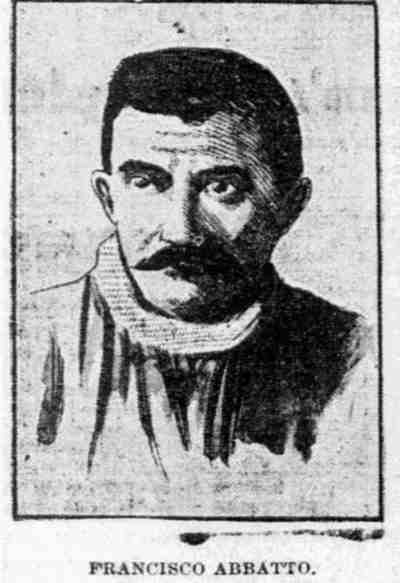
FRANCISCO ABBATTO.
John Wesley Sell, Sheriff of Camden county, had his first hanging yesterday, and he made a record for celerity in launching Francisco Abbatto into eternity. The earliest moment that the hanging could take place, under the order of the court, was 10 o’clock. Within 6 minutes after the hour struck Abbatto was standing on the gallows. A minute later the trap was sprung, and five minutes later the man was dead.
Abbatto slept soundly during his last night on earth. He was up betimes yesterday morning, and dressed himself in the black suit of clothes which he knew would be his death garments. He declined to eat any breakfast, but drank a cup of coffee. At 8 o’clock the priests came to prepare the condemned man for the end. They were Father Pozzi, of East Vineland, and Father Caruso, of the Church of Our Lady of Good Counsel, of Philadelphia.
FINAL PREPARATIONS.
The persons authorized by law to witness the execution, about forty in number, gathered in the Sheriff’s office by half past 9 o’clock. County Clerk Barber administered the oath to the twelve citizens appointed by Judge Garrison to see that the sentence of death was carried out. They were County Physician W. S. Jones, Dr. Alexander McAlister, Dr. S. Ramsdell, Dr. E. A. Y. Schellinger, Dr. A. H. Lippincott, Dr. Joseph Nicholson, Dr. Paul N. Mecray, Upton S. Jeffreys, Harry B. Paul, Charles R. Bacon, William H. Cole and County Detective John S. Smith.
The death jury were taken through the jail to the loft at the Broadway and Federal streets corner of the building, where the gallows awaited its victim.
A few minutes before 10 o’clock the Sheriff led his deputies and the newspaper men across the “Bridge of Sighs” to the jail, and they joined the group in the death chamber. The clock struck 10, and all was ready to execute the mandate of the law. Five minutes later a door at the foot of the gallows, leading into the jail opened, and the condemned man was seen walking to his doom.
QUICK EXECUTION.
The two priests were in the lead. They were silent, for they had finished their ministrations in the jail. Abbatto was supported on either side by Constable Voight, of the death watch, and County Detective Smith. He was pale, but he walked with a firm step. He paused an instant at the foot of the gallows, cast a furtive glance at the dangling rope, and then mounted the thirteen steps to the platform. The officers stepped back when they had placed the condemned man at the centre of the trap. An instant Abbatto stood gazing at a ray of sunlight on the floor, and then the black cap shut the light from his eyes. Quickly but carefully Sheriff Sell adjusted the noose, and then, at 10 07, as the murderer swayed like a reed in the wind the silence was broken by the crash of the falling trap doors and the body fell a distance of six feet.
Abbatto’s hands were manacled behind his back, but his legs were not pinioned. He did not struggle and only a few tremors shook his body. In five minutes the doctors found that the heart had ceased to beat, but the body was allowed to hang for twenty-eight minutes. Then it was taken in charge by Morgue Keeper O’Brien, and after the doctors had gotten through with it, it was buried in potter’s field. Death was due to strangulation, and the face of the dead man was not distorted.
ABBATTO’S CRIME.
Francisco Abbatto was hanged for the murder of Genaro DeFeo. The crime was committed on the night of April 22, 1899, in the woods near Blue Anchor, Camden county. After stabbing DeFeo to death, Abbatto hacked his victim’s head off. Both body and head were found in the woods by searchers eight days later. Abbatto boarded with DeFeo, and was enamoured of his wife. He induced Mrs. DeFeo to go to New York with him to search for her husband. When they returned Abbatto was arrested. At his trial he claimed that he had killed DeFeo during a quarrel. The Court of Errors and Appeals sustained the conviction and Governor Voorhees refused to grant a reprieve.
New Jersey Delegates Ready to Start for Kansas City
Philadelphia Inquirer —
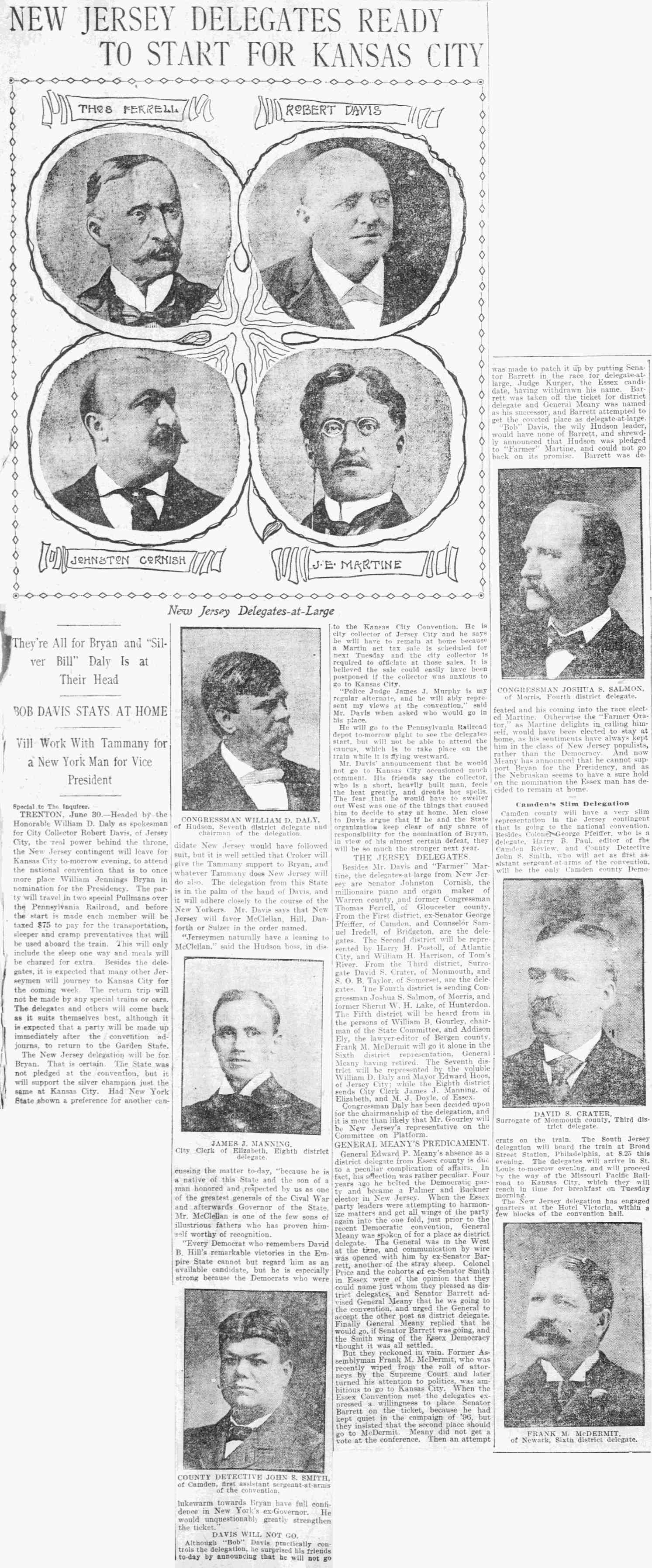
They’re All for Bryan and “Silver Bill” Daly Is at Their Head
BOB DAVIS STAYS AT HOME
Will Work With Tammany for a New York Man for Vice President
Special to The Inquirer.
TRENTON, June 30.—Headed by the Honorable William D. Daly as spokesman for City Collector Robert Davis, of Jersey City, the real power behind the throne, the New Jersey contingent will leave for Kansas City to-morrow evening, to attend the national convention that is to once more place William Jennings Bryan in nomination for the Presidency. The party will travel in two special Pullmans over the Pennsylvania Railroad, and before the start is made each member will be taxed $75 to pay for the transportation, sleeper and cramp preventatives that will be used aboard the train. This will only include the sleep one way and meals will be charged for extra. Besides the delegates, it is expected that many other Jerseymen will journey to Kansas City for the coming week. The return trip will not be made by any special trains or cars. The delegates and others will come back as it suits themselves best, although it is expected that a party will be made up immediately after the convention adjourns, to return to the Garden State.
The New Jersey delegation will be for Bryan. That is certain. The State was not pledged at the convention, but it will support the silver champion just the same at Kansas City. Had New York State shown a preference for another candidate New Jersey would have followed suit, but it is well settled that Croker will give the Tammany support to Bryan, and whatever Tammany does New Jersey will do also. The delegation from this State is in the palm of the hand of Davis, and it will adhere closely to the course of the New Yorkers. Mr. Davis says that New Jersey will favor McClellan, Hill, Danforth or Sulzer in the order named.
“Jerseymen naturally have a leaning to McClellan,” said the Hudson boss, in discussing the matter to-day, “because he is a native of this State and the son of a man honored and respected by us as one of the greatest generals of the Cival [sic] War and afterwards Governor of the State. Mr. McClellan is one of the few sons of illustrious fathers who has proven himself worthy of recognition.
“Every Democrat who remembers David B. Hill’s remarkable victories in the Empire State cannot but regard him as an available candidate, but he is especially strong because the Democrats who were lukewarm towards Bryan have full confidence in New York’s ex-Governor. He would unquestionably greatly strengthen the ticket.”
DAVIS WILL NOT GO.
Although “Bob” Davis practically controls the delegation, he surprised his friends to-day by announcing that he will not go to the Kansas City Convention. He is city collector of Jersey City and he says he will have to remain at home because a Martin act tax sale is scheduled for next Tuesday and the city collector is required to officiate at those sales. It is believed the sale could easily have been postponed if the collector was anxious to go to Kansas City.
“Police Judge James J. Murphy is my regular alternate, and he will ably represent my views at the convention,” said Mr. Davis when asked who would go in his place.
He will go to the Pennsylvania Railroad depot to-morrow night to see the delegates start, but will not be able to attend the caucus, which is to take place on the train while it is flying westward.
Mr. Davis’ announcement that he would not go to Kansas City occasioned much comment. His friends say the collector, who is a short, heavily built man, feels the heat greatly, and dreads hot spells. The fear that he would have to swelter out West was one of the things that caused him to decide to stay at home. Men close to Davis argue that if he and the State organization keep clear of any share of responsibility for the nomination of Bryan, in view of his almost certain defeat, they will be so much the stronger next year.
THE JERSEY DELEGATES.
Besides Mr. Davis and “Farmer” Martine, the delegates-at-large from New Jersey are Senator Johnston Cornish, the millionaire piano and organ maker of Warren county, and former Congressman Thomas Ferrell, of Gloucester county. From the First district, ex-Senator George Pfeiffer, of Camden, and Counselor Samuel Iredell, of Bridgeton, are the delegates. The Second district will be represented by Harry H. Postoll, of Atlantic City, and William H. Harrison, of Tom’s River. From the Third district, Surrogate David S. Crater, of Monmouth, and S. O. B. Taylor, of Somerset, are the delegates. The Fourth district is sending Congressman Joshua S. Salmon, of Morris, and former Sheriff W. H. Lake, of Hunterdon. The Fifth district will be heard from in the persons of William B. Gourley, chairman of the State Committee, and Addison Ely, the lawyer-editor of Bergen county. Frank M. McDermit will go it alone in the Sixth district representation, General Meany having retired. The Seventh district will be represented by the voluble William D. Daly and Mayor Edward Hoos, of Jersey City; while the Eighth district sends City Clerk James J. Manning, of Elizabeth, and M. J. Doyle, of Essex.
Congressman Daly has been decided upon for the chairmanship of the delegation, and it is more than likely that Mr. Gourley will be New Jersey’s representative on the Committee on Platform.
GENERAL MEANY’S PREDICAMENT.
General Edward P. Meany’s absence as a district delegate from Essex county is due to a peculiar complication of affairs. In fact, his selection was rather peculiar. Four years ago he belted the Democratic party and became a Palmer and Buckner elector in New Jersey. When the Essex party leaders were attempting to harmonize matters and get all wings of the party again into the one fold, just prior to the recent Democratic convention, General Meany was spoken of for a place as district delegate. The General was in the West at the time, and communication by wire was opened with him by ex-Senator Barrett, another of the stray sheep. Colonel Price and the cohorts of ex-Senator Smith in Essex were of the opinion that they could name just whom they pleased as district delegates, and Senator Barrett advised General Meany that he ws [sic] going to the convention, and urged the General to accept the other post as district delegate. Finally General Meany replied that he would go, if Senator Barrett was going, and the Smith wing of the Essex Democracy thought it was all settled.
But they reckoned in vain. Former Assemblyman Frank M. McDermit, who was recently wiped from the roll of attorneys by the Supreme Court and later turned his attention to politics, was ambitious to go to Kansas City. When the Essex Convention met the delegates expressed a willingness to place Senator Barrett on the ticket, because he had kept quiet in the campaign of ‘96, but they insisted that the second place should go to McDermit. Meany did not get a vote at the conference. Then an attempt was made to patch it up by putting Senator Barrett in the race for delegate-at-large, Judge Kurger [sic], the Essex candidate, having withdrawn his name. Barrett was taken off the ticket for district delegate and General Meany was named as his successor, and Barrett attempted to get the coveted place as delegate-at-large. “Bob” Davis, the wily Hudson leader, would have none of Barrett, and shrewdly announced that Hudson was pledged to “Farmer” Martine, and could not go back on its promise. Barrett was defeated and his coming into the race elected Martine. Otherwise the “Farmer Orator,” as Martine delights in calling himself, would have been elected to stay at home, as his sentiments have always kept him in the class of New Jersey populists, rather than the Democracy. And now Meany has announced that he cannot support Bryan for the Presidency, and as the Nebraskan seems to have a sure hold on the nomination the Essex man has decided to remain at home.
Camden’s Slim Delegation
Camden county will have a very slim representation in the Jersey contingent that is going to the national convention. Besides Colonel George Pfeiffer, who is a delegate, Harry B. Paul, editor of the Camden Review, and County Detective John S. Smith, who will act as first assistant sergeant-at-arms of the convention, will be the only Camden county Democrats on the train. The South Jersey delegation will board the train at Broad Street Station, Philadelphia, at 8.25 this evening. The delegates will arrive in St. Louis to-morrow evening, and will proceed by the way of the Missouri Pacific Railroad to Kansas City, which they will reach in time for breakfast on Tuesday morning.
The New Jersey delegation has engaged quarters at the Hotel Victoria, within a few blocks of the convention hall.
[Portrait captions]
Thos Ferrell. Robert Davis. Johnston Cornish. J. E. Martine. New Jersey Delegates-at-Large.
CONGRESSMAN WILLIAM D. DALY, of Hudson, Seventh district delegate and chairman of the delegation.
JAMES J. MANNING, City Clerk of Elizabeth, Eighth district delegate.
COUNTY DETECTIVE JOHN S. SMITH, of Camden, first assistant sergeant-at-arms of the convention.
CONGRESSMAN JOSHUA S. SALMON, of Morris, Fourth district delegate.
DAVID S. CRATER, Surrogate of Monmouth county, Third district delegate.
FRANK M. McDERMIT, of Newark, Sixth district delegate.
Glad Welcome for Mr. Bryan
Trenton Evening Times —
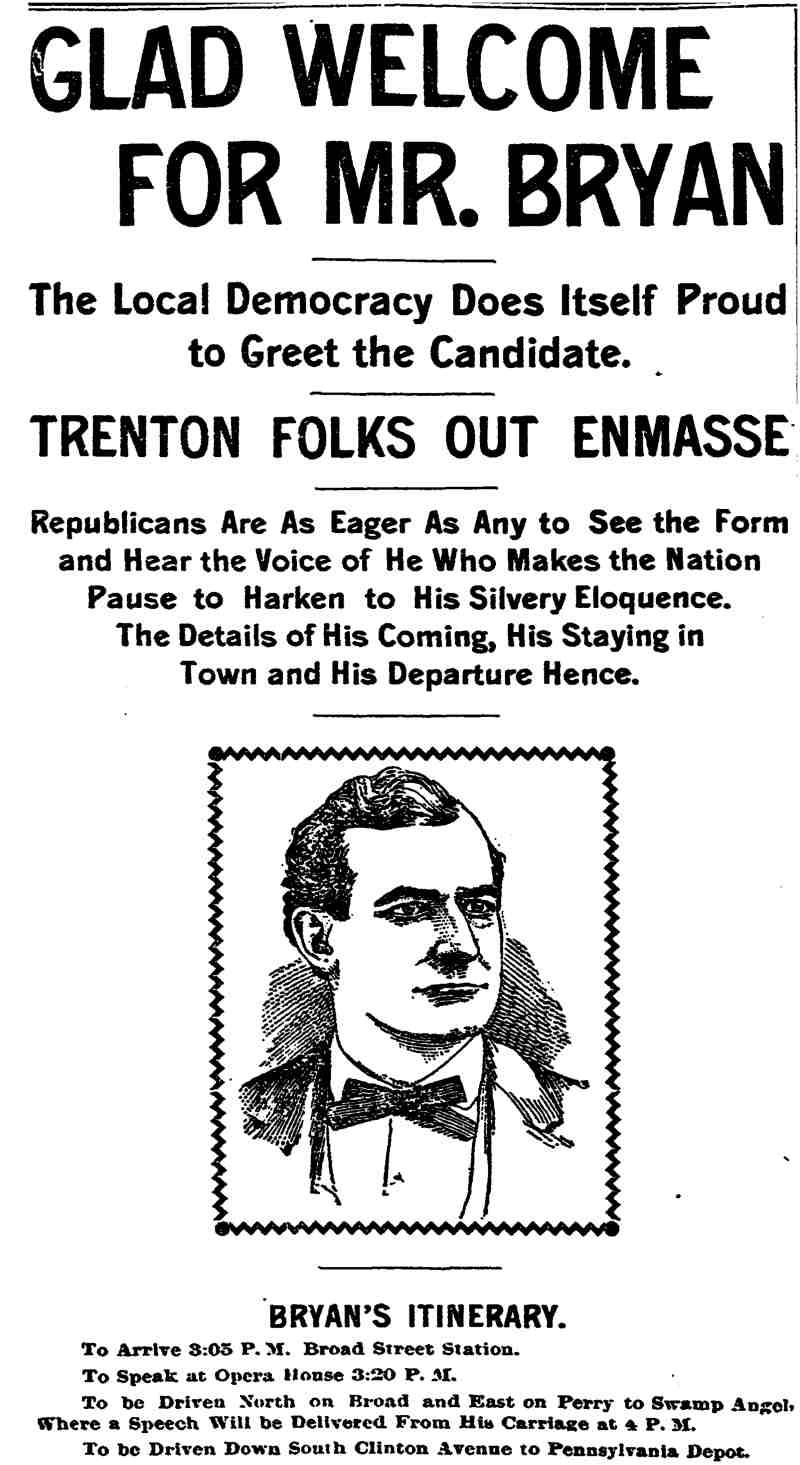
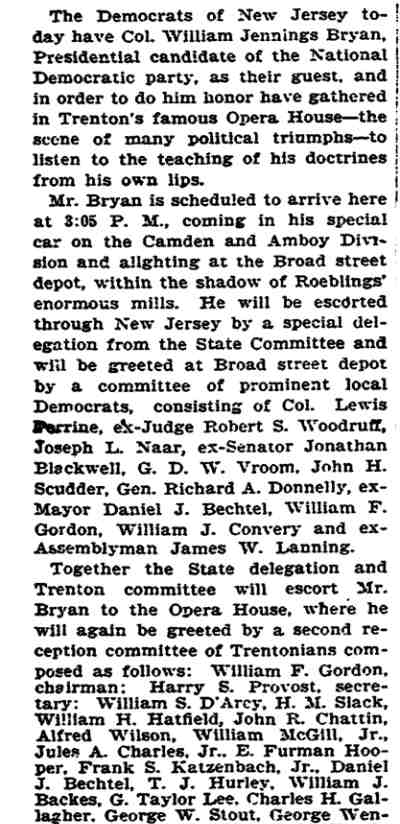
The Local Democracy Does Itself Proud to Greet the Candidate.
TRENTON FOLKS OUT ENMASSE
Republicans Are As Eager As Any to See the Form and Hear the Voice of He Who Makes the Nation Pause to Harken to His Silvery Eloquence. The Details of His Coming, His Staying in Town and His Departure Hence.
BRYAN’S ITINERARY.
To Arrive 3:05 P. M. Broad Street Station.
To Speak at Opera House 3:20 P. M.
To be Driven North on Broad and East on Perry to Swamp Angel, Where a Speech Will be Delivered From His Carriage at 4 P. M.
To be Driven Down South Clinton Avenue to Pennsylvania Depot.
The Democrats of New Jersey today have Col. William Jennings Bryan, Presidential candidate of the National Democratic party, as their guest, and in order to do him honor have gathered in Trenton’s famous Opera House—the scene of many political triumphs—to listen to the teaching of his doctrines from his own lips.
Mr. Bryan is scheduled to arrive here at 3:05 P. M., coming in his special car on the Camden and Amboy Division and alighting at the Broad street depot, within the shadow of Roeblings’ enormous mills. He will be escorted through New Jersey by a special delegation from the State Committee and will be greeted at Broad street depot by a committee of prominent local Democrats, consisting of Col. Lewis Perrine, ex-Judge Robert S. Woodruff, Joseph L. Naar, ex-Senator Jonathan Blackwell, G. D. W. Vroom, John H. Scudder, Gen. Richard A. Donnelly, ex-Mayor Daniel J. Bechtel, William F. Gordon, William J. Convery and ex-Assemblyman James W. Lanning.
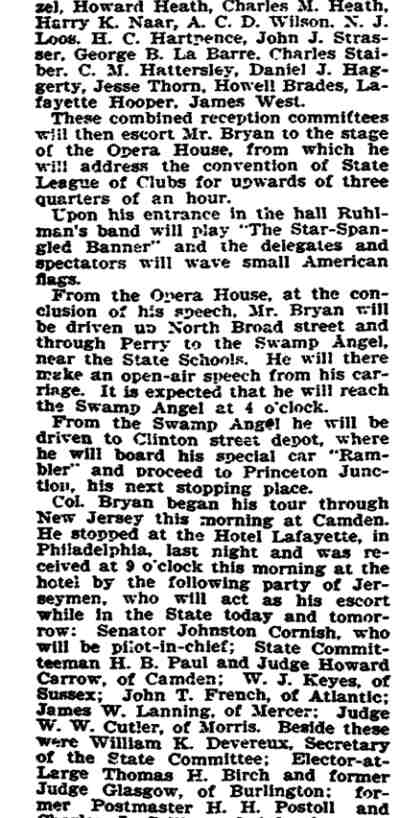
Together the State delegation and Trenton committee will escort Mr. Bryan to the Opera House, where he will again be greeted by a second reception committee of Trentonians composed as follows: William F. Gordon, chairman; Harry S. Provost, secretary; William S. D’Arcy, H. M. Slack, William H. Hatfield, John R. Chattin, Alfred Wilson, William McGill, Jr., Jules A. Charles, Jr., E. Furman Hooper, Frank S. Katzenbach, Jr., Daniel J. Bechtel, T. J. Hurley, William J. Backes, G. Taylor Lee, Charles H. Gallagher, George W. Stout, George Wenzel, Howard Heath, Charles M. Heath, Harry K. Naar, A. C. D. Wilson, N. J. Loos, H. C. Hartpence, John J. Strasser, George B. La Barre, Charles Staiber, C. M. Hattersley, Daniel J. Haggerty, Jesse Thorn, Howell Brades, Lafayette Hooper, James West.
These combined reception committees will then escort Mr. Bryan to the stage of the Opera House, from which he will address the convention of State League of Clubs for upwards of three quarters of an hour.
Upon his entrance in the hall Ruhlman’s band will play “The Star-Spangled Banner” and the delegates and spectators will wave small American flags.
From the Opera House, at the conclusion of his speech, Mr. Bryan will be driven up North Broad street and through Perry to the Swamp Angel, near the State Schools. He will there make an open-air speech from his carriage. It is expected that he will reach the Swamp Angel at 4 o’clock.
From the Swamp Angel he will be driven to Clinton street depot, where he will board his special car “Rambler” and proceed to Princeton Junction, his next stopping place.
Col. Bryan began his tour through New Jersey this morning at Camden. He stopped at the Hotel Lafayette, in Philadelphia, last night and was received at 9 o’clock this morning at the hotel by the following party of Jerseymen, who will act as his escort while in the State today and tomorrow: Senator Johnston Cornish, who will be pilot-in-chief; State Committeeman H. B. Paul and Judge Howard Carrow, of Camden; W. J. Keyes, of Sussex; John T. French, of Atlantic; James W. Lanning, of Mercer; Judge W. W. Cutler, of Morris. Beside these were William K. Devereux, Secretary of the State Committee; Elector-at-Large Thomas H. Birch and former Judge Glasgow, of Burlington; former Postmaster H. H. Postoll and Charles J. Collins, of Atlantic; former Assemblyman William J. Thompson and County Detective John S. Smith, of Camden.
After a reception the committee escorted him to Washington Park, where a meeting was held and Mr. Bryan made a speech. After the meeting the tour of the State was started and Trenton will be reached somewhere between 3 and 4 o’clock.
After leaving Washington Park Mr. Bryan proceeded northerly, speaking at Westville, Riverside and Burlington.
After leaving Trenton he will speak at Princeton Junction to students and thence go to New Brunswick. Leaving the latter place at 6:40 P. M., he will proceed to Elizabeth and from thence to Jersey City, where he will address five meetings tonight.
Tomorrow will be passed in the upper counties of the State.
Camden
Philadelphia Inquirer —
Judge E. Ambler Armstrong is suffering from a severe cold.
Former Postmaster Harry B. Paul is able to be about again, after being confined to his home with the grip for a week.
Mr. H. J. Rumrille, private secretary to United States Senator Sewell, has pronounced inventive genius, and although a very busy man he has found time to perfect a number of useful inventions. One of these, and the latest of his ingenious contrivances, is a hair curler that should gain for him the favor of the fair sex. It will replace the awkward tongs most ladies use in fixing their hair, and with which they are forever burning their delicate fingers. Mr. Rumrille’s device is a small brass tube, with a simply-adjusted clamp to hold the hair, and a wooden handle that guards the fingers from the heat.
Mrs. Lizzie B. Koehler, of 708 Market street, Camden, daughter of George E. Boyer, Sr., is on a visit to Lansdale, Pa., where she is the guest of her sister, Mrs. S. S. Conver.
Mrs. Elizabeth Read, of Fifth and Cooper streets, is visiting her son, William Schellenger, at Wyncote, Pa.
William Swindell, of Baltimore, Md., was renewing acquaintanceships in Camden on Thursday.
Miss Sarah Mumford has returned from a visit to friends in Millville.
Florence Ivins, of 648 Locust street, entertained a number of friends on the occasion of her fifteenth birthday anniversary, on Thursday evening.
Rev. Joseph Garrison, the retiring pastor of Asbury M. E. Church, was tendered a farewell reception by his congregation on Thursday evening. He will assume charge of Medford M. E. Church to-day.
Miss Susie Lawrenson, of Mt. Ephraim, is visiting her sister, Mrs. W. A. Springer, of the East Side.
Camden Elks Hold a Lodge of Sorrow
Philadelphia Inquirer —
CAMDEN ELKS HOLD A LODGE OF SORROW
Camden Lodge, No. 293, B. P. O. Elks, held its annual Lodge of Sorrow yesterday in the Masonic Building in the presence of an assemblage that taxed the seating capacity of the theatre. The music was under the direction of Professor James C. Warhurst, assisted by the choir of the North Baptist Church. Splendid renditions were given by the North Male Quartet and the St. Cecelia Ladies’ Quartet.
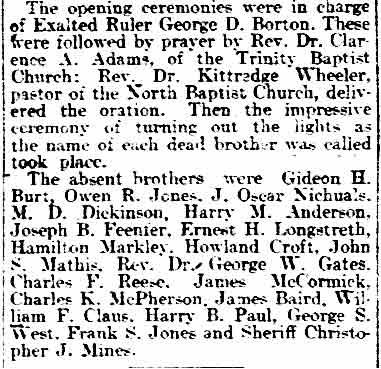
The opening ceremonies were in charge of Exalted Ruler George D. Borton. These were followed by prayer by Rev. Dr. Clarence A. Adams, of the Trinity Baptist Church; Rev. Dr. Kittredge Wheeler, pastor of the North Baptist Church, delivered the oration. Then the impressive ceremony of turning out the lights as the name of each dead brother was called took place.
The absent brothers were Gideon H. Burt, Owen R. Jones, J. Oscar Nicholas, M. D. Dickinson, Harry M. Anderson, Joseph B. Feenier, Ernest H. Longstreth, Hamilton Markley, Howland Croft, John S. Mathis, Rev. Dr. George W. Gates, Charles F. Reese, James McCormick, Charles K. McPherson, James Baird, William F. Claus, Harry B. Paul, George S. West, Frank S. Jones and Sheriff Christopher J. Mines.
Post and Courier parallel
Camden Courier-Post —


Mergers, shifting management mark early years
By STEPHEN M. O’KEEFE
Former Courier-Post Editor
As partners in establishing the Daily Post, Henry L. Bonsall and his son, Bartram L., also were witnesses to the founding of the Courier, first as a weekly in Haddonfield (April, 1878) then its transfer to Camden (July, 1879) and the beginning of the Courier as a daily on June 2, 1882.
The man who started the Courier was also a printer, Charles H. Whitecar, who had been employed by the elder Bonsall on the New Republic.
The son of a Methodist minister, Whitecar called his paper the Haddonfield Courier, then changed it to the Camden County Courier when he moved it to Camden in the summer of 1879. He had been publishing in the city only about three months when he was run over by a train at Haddonfield on Oct. 9. He died five days later at age 24.
WHITECAR HAD financial difficulties and occasionally the Post would speculate about whether he would fail. After his death, the paper was acquired by Sheriff William Cahoun and former Sheriff Jacob C. Daubman. They retained the name of Camden County Courier. The address listed as 132 Federal St., in May, 1880.
The paper was purchased by F. F. Patterson Sr. in September, 1880, and through that transaction it became identified with a family that figured prominently in New Jersey’s history for 78 years, from 1848 to 1926. Patterson made a daily of the Courier.
Frank Ford Patterson Sr. was a seasoned newspaperman when he acquired the County Courier. He continued issuing it on Saturdays with nine columns on each of four pages, compared to the six columns on each of the Post’s four pages. But the Post earned more revenue by printing each afternoon, except Sunday.
ON JUNE 2, 1882, Patterson started the daily. The Camden Daily Courier was circulated in the city while the County Courier was distributed in the outlying areas. The weekly was discontinued in 1884.
Patterson’s eldest son, Theodore N., was first associated in the Courier venture as business manager. The father was editor and top hand in the printing shop. Ownership of the paper was vested in the Courier Publishing Company, and Patterson shared control of the firm with John H. McMurray and Thomas C. Hamilton, as of Feb. 1, 1883.
Patterson, with the Courier, and Bonsall, with the Post, plodded along parallel lines during the next five years.
THE NEXT major event was in 1888, when George A. Frey came from Philadelphia to purchase the Courier. Associated with Frey were V.L. Cavanna and at least one other. Little is recorded about them, and Frey soon after appeared as the sole owner. In that role, he was credited with prudent management of the paper for more than 30 years.
Frey had worked on a newspaper in Pittsburgh and published a grocery business sheet in Philadelphia. In Camden, he became progressively identified with organizations dedicated to thrift, property acquisitions and banking. He served as Camden city treasurer for about 17 years and became president of a leading bank.
According to the talk around Camden, more than $18 million in municipal funds passed through Frey’s hands. Yet his accounts were always correct to the penny. Frey also had a reputation for punctuality. People used to say that when he was sighted strolling briskly to the old City Hall on Haddon Avenue a watch could be set at 8:58 a.m. and that he would take a seat at his desk at the stroke of 9.
IN HIS DRESS, Frey favored Prince Albert attire. The princely appearance was complete with his white mane, pointed mustache and neatly trimmed goatee. He owned a variety of canes. He was a firm believer in the value of walking and his trim figure relfected [sic] the benefits of that pastime.
Frey was a member of the state Board of Education and showed a steady interest in Bordentown Industrial Institute.
At the start of the Frey saga, Post and Bonsall had both experienced some troubles. One incident concerned the sale of a half-interest in the paper from father to son Aug. 1, 1883.
It is likely that expenses involved in equipping the plant at 116 Federal St. had drained the resources of Henry Bonsall and that Bartram drew upon his own savings to meet the costs. In any event, The Post Printing and Publishing Company was organized in 1886 with Bartram as secretary, Henry Bonsall, president, and Joseph M. Engrad, treasurer.
BONSALL HAD contracted for a new building, with a stone front, on the northeast corner of Front and Federal Streets. This was built and occupied in October 1887. Within two years a new press was purchased.
The Post continued to issue from the Front and Federal Street plant until June 12, 1899, when it was consolidated with the Camden Daily Telegram. The conbination [sic] was the Camden Post-Telegram. A major feature of the deal was the city’s first telegraphic news service.
James M. Fitzgerald, a stormy figure in the news field and politics, and Alvah M. Smith, a pipe-smoking writer, started the Telegram Feb. 24, 1886, at 95 Federal St. They were Democrats and offered some competition to the Republican Courier and Post.
They arranged for installation of a Morse apparatus with a wire connected to the Baltimore & Ohio Railroad Company cable.
IN LAUNCHING their enterprise, Fitzgerald and Smith decided to have news items sent as telegrams from correspondents in several key cities. In line with their plan, they selected Telegram as the name for the paper.
Fitzgerald has been described as a vigorous, intelligent and free-swinging journalist who delighted in aiming at a political target and walloping away with worlds [sic].
Smith, more careful and patient than Fitzgerald, spent about seven months with the Telegram and in September sold his one-third interest to his partner.
FRANCIS F. PATTERSON JR.
GEORGE A. FREY Courier Publisher until 1919
YEARS LATER, around 1916, Smith was hired by Frey and occupied a desk in the Camden Daily Courier newsroom alongside Ben Courter, an editorial writer. Ben was the second of four generations of Courters in the Courier-Post annals. His father, John D., started the strain in the 1870s, while his son, John D. and grandson, Robert, are included in the centennial roster of the Courier-Post.
After Smith’s separation from the Telegram the paper declined. Control shifted to John H. Fort the same month Smith quit. Fort was a newspaperman, lawyer, orator, historian and politician. With the Telegram, he added publisher to his titles.
Fort had his law office at his home, 311 Market St., and he moved the paper there, too. He changed the name to Daily Telegram and in 1888 formed the Telegram Publishing Company.
He enlisted Upton S. Jefferys, as secretary-treasurer, and Thomas C. Hamilton, as business manager. The latter two severed connections in 1890 and purchased the Saturday Evening Express, with an office at 211 Market St. but which was printed in Philadelphia.
AFTER THE 1888 sale of the Courier by his father, F.F. Patterson Jr. became a reporter on the Baltimore Herald. He was advancing to a desk position but accepted the city editorship of the Daily Telegram instead.
He was successively identified with the brief excitement that attended the Morning News and General Advertiser, another inovation [sic] of James M. Fitzgerald, and the Sunday Review, which was established by his brother, Theodore N. Patterson, in 1889.
In the fall of 1891, F.F. Patterson Jr. became New Jersey editor of the Philadelphia Record. He resigned in September, 1894, to take over the Camden Daily Telegram.
THAT CHANGE helped save the Telegram from complete failure. It had been subjected to several mutations and was handicapped by poor equipment. Worse, it was described as financially weak.
The paper was purchased by a group of Republican Party leaders who elected F.F. Patterson Jr. as president of the Camden Daily Telegram Company. He quickly discarded old type and badly-worm [sic] mechanical equipment and installed the first linotype machines ever used on a Camden newspaper.
Patterson’s father and brothers assisted in restoring the Telegram to a position of profit and influence in about two years. Theodore N. Patterson had disposed of the Sunday Review in 1892 to a syndicate financed by William J. Thompson, racetrack chieftain famed as the “Duke of Gloucester.”
AFTER THOMPSON put up the money to acquire the Sunday Review, it was changed from an independent Republican journal to a Democratic daily paper on Sept. 6, 1892. Harry B. Paul became publisher. The first editor was George M. Todd, perviously [sic] of the Elizabeth Herald. He was succeeded by Charles Bowman, who sprayed excitement over the political scene both in New Jersey and Pennsylvania.
Expenses and debts plagued the paper. On Feb. 13, 1894, it was subject to levy by Sheriff George Barrett and sold to William J. Paul. The Review was one of four daily newspapers in Camden, until it ceased publication Dec. 11, 1902. The others, the Post, Courier and Telegram, all were Republican sheets.
The Post and Telegram were consolidated June 12, 1899.
The Telegram was a livlier [sic] paper with the energy of the Pattersons devoted to it daily. The Post was noticeably slower, and the merger was considered to be in the best interest of Bonsall’s journal. It had been going along for nearly nine years without one of its mainsprings, since the death on Nov. 11, 1890, of Bartram Bonsall.
THE COMBINED papers appeared under the masthead of the Camden Post-Telegram, with Bonsall and his partner, Engard, teamed with F.F. Patterson Jr. and his brother, Theodore, as principals. Bonsall became the editor but died in 1900, at 66. He was replaced by Upton Jefferys, who resigned as New Jersey editor of the Philadelphia Inquirer.
Engard also died with a short time. The stock of both Bonsall and Engard was acquired by W. L. Patterson, then secretary-treasurer of the Post-Telegram Company. When the latter retired he was succeeded by Frank F. Patterson 3rd, who a quarter century was destined to be the last Patterson in a position of eminence in journalism.
The Courier and Post-Telegram continued an untroubled rivalry, each publishing 10, 12 and 16 pages, up to the end of 1919. The Post-Telgram [sic] occupied the row of buildings west of 2nd Street, at 139 Federal, while the Courier enjoyed more space since the transfer from 132