Introduction
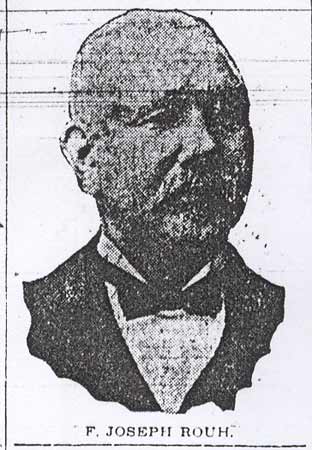
Portrait photograph of F. Joseph Rouh, published in the Camden Post-Telegram, May 11, 1914. Rouh operated a saloon at 751 Ferry Avenue (1890-1906) and later lived at 753 Ferry Avenue.
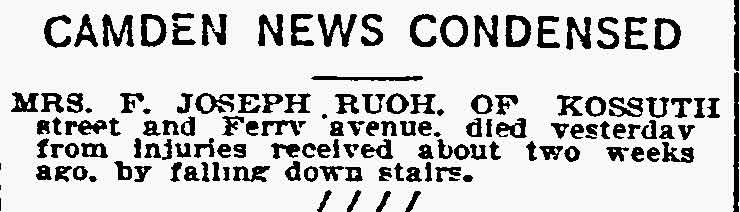
F. JOSEPH ROUH was born in France around 1843. He came to America with his wife and children in the 1870s. F. Joseph Rouh was living in Philadelphia when the Census was taken in 1880, and working as a musician. He first appears in Camden City Directories in 1890. He acquired 751 Ferry Avenue and opened up a saloon there. The premises had previously been a residence. Sadly, his wife died in December of 1897 from injuries sustained in a fall.
By 1906 F. Joseph Rouh had gone into real estate and turned the bar over to his son Frank J. Rouh. He was living next door at 753 Ferry Avenue with his wife Marianna. Another son, Charles, was also in the liquor business, at 1744 Broadway. Besides his real estate activities, F. Joseph Rouh also served Camden’s Eighth Ward as a justice of the peace.
F. Joseph Rouh passed away in May of 1914, and was buried at Evergreen Cemetery.
Warrants Issued for Liquor License Violations
Philadelphia Inquirer —
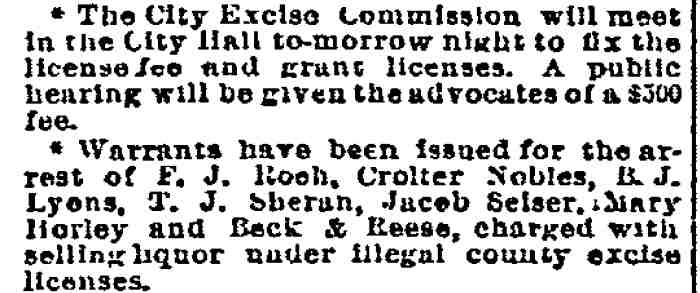
Philadelphia Inquirer — June 19, 1894 – Bernard J. Lyons – Thomas J. Sheeran – Jacob Seiser – John Beck – Charles F. Reese – Crowther Noble – Mary Hurley
Camden News Condensed
Philadelphia Inquirer —
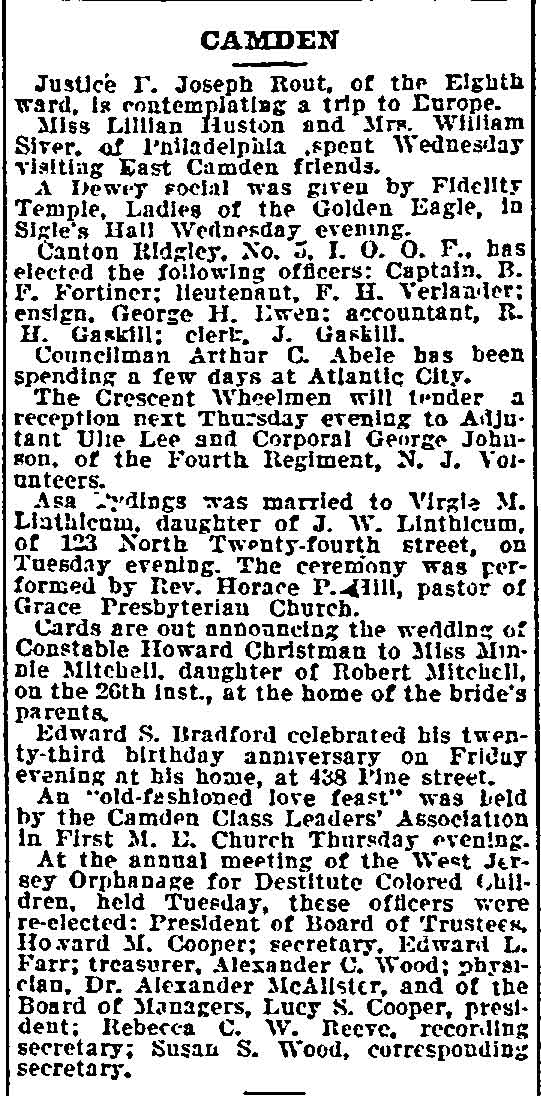
Camden
Philadelphia Inquirer —
Doings in Realty
Camden Daily Courier —
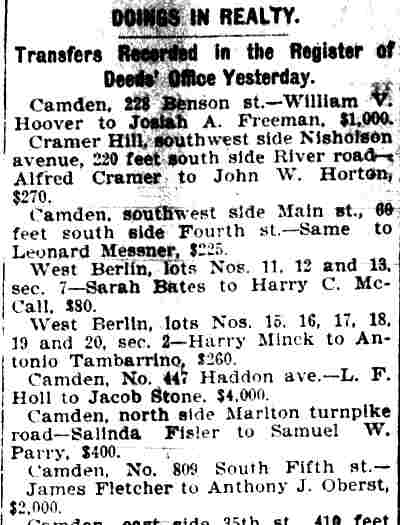
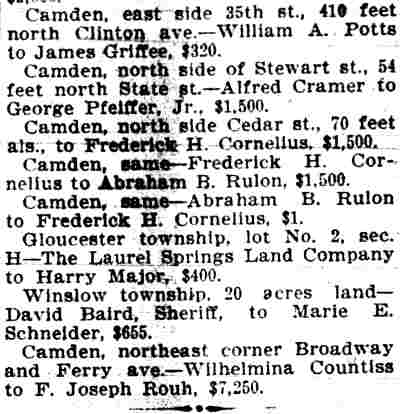
Named: Camden Daily Courier, August 31, 1899, Anthony Oberst, William V. Hoover, Josiah A. Freeman, Alfred Cramer, John W. Horton, Leonard Messner, Lewis F. Holl, Jacob Stone, Salinda Fisler, Samuel W. Parry, James Fletcher, William A. Potts, James Griffee, George Pfeiffer Jr., Frederick H. Cornelius, Abraham B. Rulon, David Baird Sr., F. Joseph Rouh, and Wilhelmina Countiss.
Camden Commissioners of Deeds
Philadelphia Inquirer —
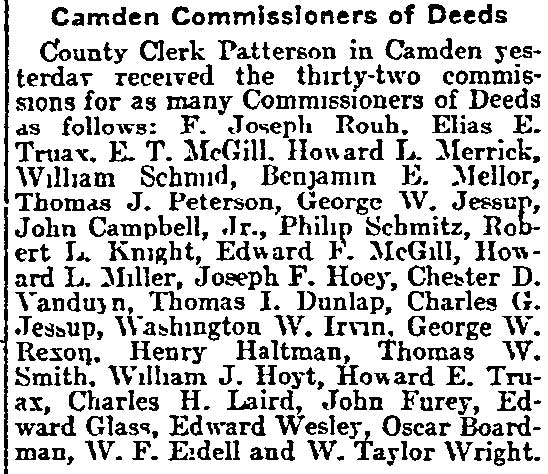
Camden Commissioners of Deeds
County Clerk Patterson in Camden yesterday received the thirty-two commissions for as many Commissioners of Deeds as follows: F. Joseph Rouh, Elias E. Truax, E. T. McGill, Howard L. Merrick, William Schmid, Benjamin E. Mellor, Thomas J. Peterson, George W. Jessup, John Campbell, Jr., Philip Schmitz, Robert L. Knight, Edward F. McGill, Howard L. Miller, Joseph F. Hoey, Chester D. Vanduyn, Thomas I. Dunlap, Charles G. Jessup, Washington W. Irvin, George W. Reson, Henry Haltman, Thomas W. Smith, William J. Hoyt, Howard E. Truax, Charles H. Laird, John Furey, Edward Glass, Edward Wesley, Oscar Boardman, W. F. Ezdell and W. Taylor Wright.
"CAMDEN NEWS NOTES"
Philadelphia Inquirer —
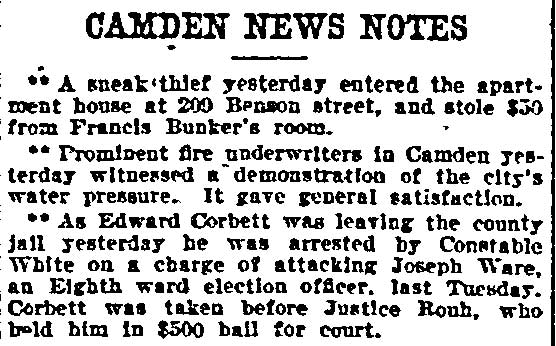
As Edward Corbett was leaving the county jail yesterday he was arrested by Constable White on a charge of attacking Joseph Ware, an Eighth ward election officer, last Tuesday. Corbett was taken before Justice Rouh, who held him in $500 bail for court.
Partnership Papers Signed in Justice Rouh’s Office
Philadelphia Inquirer —
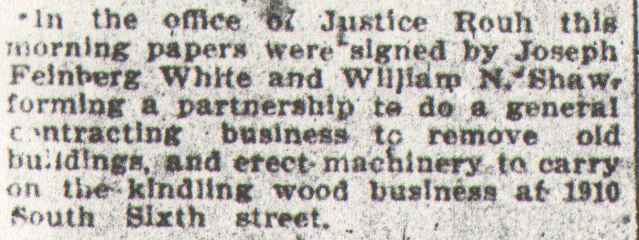
Philadelphia Inquirer — January 29, 1909 – South 6th Street – Joseph Feinberg White – William N. Shaw – F. Joseph Rouh
Final Tribute to Squire F. J. Rouh
Camden Post-Telegram —
Veteran Justice of the Peace Buried Today from Sacred Heart Church
REMAINS VIEWED BY SORROWING CROWDS
Final tribute was this morning paid to the departed memory of Justice F. Joseph Rouh when his funeral occurred from his late residence, 753 Ferry Avenue. High mass was sung at the Sacred Heart Church with Reverend J.B. McCloskey as celebrant, and the remains were interred at the family plot at Evergreen Cemetery by Undertaker George Blake.
The pallbearers were Frank Wagner, Daniel Kelly, William Mullin, William Buchey, J. Michael, and J. Buchey. The remains reposed in a handsome walnut casket and many floral pieces surrounded the bier. The name plate upon the casket bore the inscription:
F. Joseph Rouh
Died May 5, 1914
Aged 72 years
Last night hundreds of persons visited the Rouh residence and gazed upon the features of the aged and respected gentleman, who was known by almost everyone in the Eighth Ward. Squire Rouh was a pioneer resident of “Centerville” and his loss will be regretted by many.
Mr. Rouh’s death followed an illness of several months. His wife, Marianna Rouh, and one son, Charles Rouh, survive him.
Boys Find Charred Body in Fire Ruins
Philadelphia Inquirer —
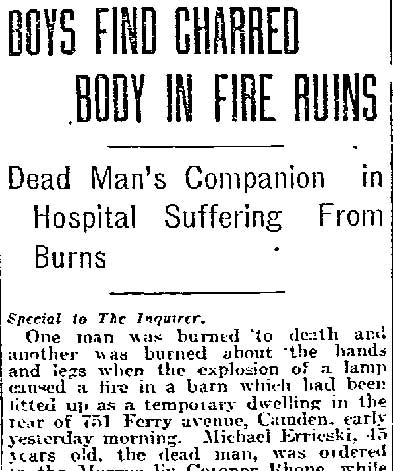
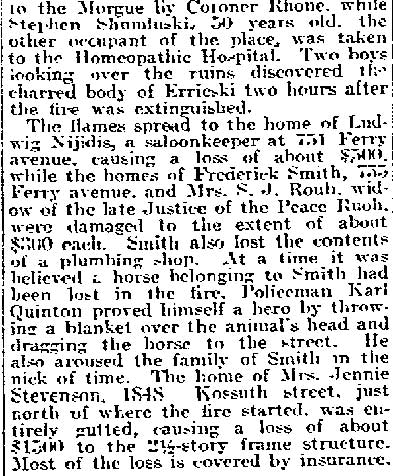
Philadelphia Inquirer — July 22, 1918 – Ferry Avenue – Michael Erriescki – Frederick Smith – Carl Quinton – L. Najulis Saloon – Jennie Stevenson – Kossuth Street – F. Joseph Rouh – Dr. David Rhone – Stephen Shumluski
Old Centreville Families
Camden Courier-Post —
Dr. Donges, Mills, Schepperkittes, Covely and Other Men Wrought Through Years to Bring Needed Improvements to District
By BEN COURTER
WHEN a larger community annexes an adjoining district the newer area is generally regarded, for a time at least, as a step-child. Older residents of East Camden will bear out that truism when they recall how difficult it was to obtain improvements. Years before, Newton Township which became part of Camden, had had the same experience. Under such circumstances, it requires tireless energy on the part of leading men to get what their district needs. Demands often go unheeded unless the community is fortunate in having those of spirit who insist on street improvements, water extension, lighting facilities and schools. That was more in evidence half a century ago than now, of course, for Camden itself was little more than a large village.
Down in Centreville there were men who looked after the interests of their constituents, who slowly but surely obtained, improvements and who insisted on being recognized by the powers that be. No one may think of old Centreville without thought of Dr. John W. Donges, whose value to not only that section but Camden at large, has been expatiated upon in these annals. He was not only a leading physician, with a practice extending into Camden, but a leader in many civic movements, and any article on that era would be incomplete without allusion again to the doctor whose services as a real family physician are part of the traditions of many old families.
Came Here In 1872
He came here in 1872 from Schuylkill County, Pennsylvania, when his health was affected by overwork through loyalty to his patients. He bought the drugstore at Ferry Avenue and Broadway, remaining there for many years. It was there Supreme Court Justice Ralph W. E. Donges spent his boyhood.
There, too, Dr. Clarence B. Donges and Attorney Raymond Donges were boys. Grant E. Kirk, clerk in his store, later becoming a physician and for several years a member of council and at one time being prominently boomed for mayor, married their sister. Dr. Donges was elected to council in 1878 on the Democratic ticket, itself an evidence of the high regard in which he was held, for the Eighth Ward generally was rock-ribbed Republican. Until the early part of this century he resided in his old place, but later went to Broadway and Clinton Streets. In later years, after he had retired, he was city assessor, “just to keep busy.” He died a few years ago, well in his 80s, mourned by a great host of Camdenites.
There was another widely known Centreville family of the old days, that of Samuel Mills, who had his own abattoir at Broadway and Jackson Street, where city-dressed meats were provided before the days of car refrigeration brought supplies from the great packing places in Chicago. His son, Charlie, was long a member of the Board of Education, while another, William, was a city councilman. Edward Mills, another son, was excise commissioner 35 years ago in the days when there was plenty of trouble with Sunday sellers.
Cornelius Schepperkotter was a factor in politics down that way, too, having a grocery store on Ferry Avenue at Ninth, later moving to the southwest corner when the Charles Sumner School was built. That school was torn down two years ago for the recreation center. Schepperkotter was a member of the old Board of Public Instruction in the late 90’s, named by Mayor Cooper B. Hatch. In later years and until his death, he was superintendent of Evergreen Cemetery. He was father of Mrs. Frank S. Albright, wife of City Clerk Albright.
Frank Covely
Shortly after the New York shipyard was opened, there moved to the “Hill” Frank D. L. Covely, who became a joiner and for years was foreman of the joiner shop. He was widely known as a secret society man and also as an effective campaign speaker for the G. O. P. He was a member of the Board of Education.
He sought to go to council, but that was at the time Kirk was a power in the ward. Covely laughingly used to tell of a meeting all set for him from which all save the colored folk were drawn away through strategy of his party opponents. But for ten years he was a member of the Board of Recreation Commissioners.
That movement owed much to his work. Nor did he forget his colored friends, for he had a playground established for them at Ferry Avenue and Phillips Street and the large one [Staley Park] at Seventh and Jefferson streets. Long afterward that was named for another city official, but Covely’s friends said it should have been for him, as a monument to his services for the boys and girls of Centreville. He died a few years ago at Bellmawr in his 70s, after a hectic experience as a chicken raiser at Port Norris.
There, too, was William Dorrell, superintendent of the old “Narrow Guage” who was one of the leading spirits in the paving of Broadway, nearly 60 years ago the big issue of that section. He lived in a house along the railroad still standing, as the hospital and dispensary of the shipyard.
Mention has been made of the Ferrises, the Helmbolds, the Yeagers, of Squire James D. Chester and Squire F. Joseph Rouh. There was also William O. Thompson, the leading contractor down that way for many years and Theodore Tiedeken, who established the wagon works on Van Hook Street, Martin Ewe, who had the hotel at Broadway and Emerald, and down the street a bit James Croker, who operated Tammany Hall. Forty years ago there was one of the best young athletes of the city, Thomas Nicholas, now retired Camden fire chief. He was down in old No. 3 with Bill Rose, long a fire captain, Bill Miller, Al James, Sam Lodge, Gus Dold and Jim Ware.
Many of these old timers have passed on, but others are still in the flesh but scattered to all parts of the city but it may be said the survivors look back on the days that were down there in Centreville with an interest that does not dim with the passing years.