Introduction
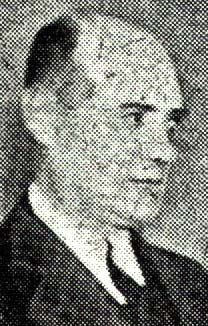
S. Raymond Dobbs
S. RAYMOND DOBBS was born Samuel Raymond Dobbs on October 28, 1894 to Samuel B. and Emily A. Dobbs. He was the oldest of the three Dobbs children, coming before sisters Emily and Edna. The elder Dobbs was in the brick business, and had done well for himself, by 1920 owning a home at 201 Westmont Avenue in Haddonfield NJ and employing a live-in servant. At the time of the 1920 census, S. Raymond Dobbs was working as a clerk in the brick business. He had previously served with the American Armed Forces in World War I, and is named among those who served from Haddonfield at World War I Memorial and Monument in that borough.
During the 1920s S. Raymond Dobbs got involved in the real estate business. He moved to Fairview, and served as the secretary of the Kearsarge Building & Loan Association during the mid- and late- 1920s.
After his move to Camden S. Raymond Dobbs became involved in politics, as a Democratic from the 14th Ward of Camden. He served during the mid-1930s as the executive secretary of the Camden Municipal Low-Cost Housing Committee, which was the governmental body that successfully arranged for the financing and eventual construction of Westfield Acres, Camden’s first public housing project. He also returned to school during this period, and was a member of the 1932 Class of the South Jersey Law School in Camden.
S. Raymond Dobbs was first hired by the City of Camden on November 30, 1935, when he took a position in the Department of Public Works as an assistant to City Commissioner and Director of Public Work Frank J. Hartmann Jr. On January 20, 1938, he was appointed to the Camden Board of Commissioners of Assessment and Taxes, later renamed the Board of Assessors. He was still serving in this capacity as late as 1947.
After leaving government, S. Raymond Dobbs went into real estate, maintaining an office in his home at 2957 Yorkship Square in the Fairview section of Camden as late as 1970. He passed away in November of 1972.
Frelinghuysen Majority Seen in Camden County
Philadelphia Inquirer –
FRELINGHUYSEN MAJORITY SEEN IN CAMDEN COUNTY
Aside from the United States Senatorial contest interest in the primary election in Camden today centres on one fight on the county ticket, two on the city ticket and several ward contests. Camden county is expected to give a big majority for Senator Frelinghuysen, who is opposed for renomination by George L. Record.
Justice of the Peace Simon Wilkinsky, of the Sixth ward, is contesting with Congressman F. F. Patterson for the nomination for Congress in the First New Jersey District, which comprises Camden, Gloucester and Salem counties. Wilkinsky is little known and the renomination of the Congressman by a large majority is predicted.
The contest for the Republican nomination for Surrogate is the only ripple on the county ticket. Harry Reeves, the incumbent, is opposed by Irving Buckle, former Freeholder and for a score of years active in the Republican organization. He resigned as county committeeman from the Fourth ward to make the fight against Reeves, who has the backing of the regulars. An odd twist to the campaign was taken yesterday when Leon Buckle, son of the candidate, filed a petition as an independent candidate for Surrogate at the general election. The law requires that such petitions be filed previous to the primary. Should the elder Buckle happen to win the nomination the son would, of course, withdraw his petition as an independent.
The contest on the city ticket is for the office of Recorder, which is the title held by the police magistrate. O. S. Stackhouse, the incumbent, is opposed by David Rankins, former Freeholder and former Overseer of the Poor. Mayor Frank S. Van Hart, City Treasurer George A. Frey and Receiver of Taxes A. B. Sparks are without opposition for nomination on the Republican ticket.
On the Democrat side Robert A. Irving is not opposed for the nomination for Surrogate. Nor is there any fight on the city ticket, the lone candidates being: For Mayor, Victor King; for Recorder, George W. Tash; for Receiver of Taxes, Benjamin S. Moloney; for City Treasurer, Isaac Albertson.
Assemblymen T. Harry Rowland, J. Heulings Coles and Willard T. Gibbs will be renominated by the Republicans without opposition. Their Democratic opponents, also unopposed, will be C. Lawrence Gregorio, John J. Tischner and Frank B. Hambleton. Frank J. Leonard and Dr. William H. Pratt are unopposed for the Republican nomination for Coroner. The Democrats have no candidates on their ballot for these places. Two nominees will be chosen by the voters writing their names on the ballots.
Much interest is being manifest in the contest for the two places on the Democratic State Committee. One man and one woman are to be named. Mrs. Katherine M. Donges, now a member of the committee, is opposed by Mrs. Mae Hawkins. Mrs. Donges was in the limelight some weeks ago when she is alleged to have said at a Democratic gathering that Senator Runyon, who is to be the Republican candidate for Governor, was drunk at a meeting in Camden. Senator Runyon is a pronounced dry and Mrs. Donges was severely criticized by members of both parties for her alleged remarks. …though Senator Runyon demanded an apology Mrs. Donges has neither affirmed or denied making such remarks. She is paired with State Committeeman Edward Kelleher, whose opponent is Albert Neutze.
The Republicans have Councilmanic contests in four of the fourteen wards. In the Fifth Ward Councilman Louis Bantivoglio is opposed by J. H. Williams, negro. The latter’s name appears on the primary ballot, but yesterday he announced he had withdrawn from the race. This leaves the field free to the present Councilman. John H. Carroll and John P. Shaw are rival candidates for the County Committee.
There is a lively contest in the Seventh ward for the nomination to succeed Mayor Van Hart in Council. The aspirants are Joseph B. Davis and William Frost. The latter has the backing of Patrick Carr, who seeks to wrest the county committeemanship from Street Commissioner Alfred L. Sayers. Carr has also filed a petition as an independent candidate for Council at the general election. The petition is defective and was sent back to Carr by County Clerk William D. Brown with instructions to amend it to comply with the law. Carr will withdraw as an independent candidate in the event of Frost winning at the primary today.
Councilman John Rogers and Charles E. Hill are rival contestants in the Tenth ward. In the same bailiwick Charles S. Wolverton and Samuel Edwards are fighting for the County Committee place, which is now held by Wolverton. There is also a contest for the female place on the County Committee.
In the Twelfth ward Councilman John Dobbins is being opposed for renomination by Mrs. Lizzie P. Abbott.
The Democrats have three Councilmanic contests. In the Thirteenth ward the opposing candidates are Edwin L. Aument and Frederick Stanton. Walter J. Farrell and John B. Dean are rivals in the Third ward, and S. Raymond Dobbs and Harry McCloskey are contests in the Fourteenth ward.
Camden county Socialists yesterday named a city and county ticket by petition as follows: Surrogate, Herman Neissner; Coroners, Francis Stratton, Clara K. Stamm; Assembly, Morris Steppa, Thomas Heil, Albert Bardsley; Mayor, Albert H. Starr, Stratton; Recorder, George A. Harkins; City Treasurer, John McAlack; Receiver of Taxes, Richard Davies. A petition as a Socialist candidate for Council in the Eleventh ward was filed by Leo M. Harkins. Independent petitions for Council were filed by William Smith, Eighth ward, and Joseph Wood, Fifth ward.
Kausel Is Given $4000 Job Over Hot Protest by ‘Rebel’ in G.O.P.
Camden Courier-Post –
‘Not Fitted for Job and 20 of You Admitted it’ Declares Van Meter
Collingswood Man’s Insurgency Punished
Joseph H. Van Meter, insurgent Republican freeholder from Collingswood, today declared that David Baird Jr., Republican leader, had admitted that Theodore Kausel was “not the man for the job” to which he was appointed by the Board of Freeholders yesterday.
Baird told him, however, said Van Meter, that a promise had been made “to take care of” Kausel because of the latter’s aid to the Republican Organization at the last municipal election.
Van Meter quotes Baird as follows:
“I’ll admit that Kausel is not the man for the job. But you have to help me out because we promised to take care of Kausel when he came over to us in the city election. And it was through Kausel that we got Hitchner and a lot of his crowd.”
“We’ve got ourselves tied up with him. We’ve got to take him, and I want you to go along, and help me out.”
“I know his business record and I know his political record. I know the freeholders don’t want him and our conference don’t want him, but we’ve got to eat crow, and I want you to help me out.”
Under the watchful eyes of organization leaders, Republican members of the Camden County Board of Freeholders yesterday took care of Theodore “Teddy” Kausel.
With David Baird Jr. and other chieftains of the party occupying front row seats, the board created the post of “general manager of county institutions” and promptly named Kausel for the job at an annual salary of $4,000.
Like ghosts at a feast, Baird and the other party leaders sat silently at the freeholders reorganization meeting. Like actors in a carefully pre-arranged play, a little uncertain of their cues, 20 Republican freeholders cast furtive eyes at the group of spectators.
They said no word, these freeholders. They made no reply when Joseph H. Van Meter, of Collingswood, breaking from their ranks, declared that 20 of them had told him that Kausel was unfit for the position to which he was being appointed. They listened in uncomfortable silence while Van Meter gave voice to a scathing denunciation of their “lack of backbone” and while a running fire of sarcasm from Democratic members fell upon their ears.
Scene Was Drama
The scene was drama. It might have been a revised performance of “Uncle Tom’s Cabin” with 28 furtive-eyed Uncle Toms and an impregnable line of Simon Legrees, cracking invisible whips in threatening gestures.
And the scene was also comedy. For of that score of men who, according to Van Meter, had agreed that Kausel was unfit for the job but “had to be taken care of,” none arose to protest against the action. Within their Hearts the chorus of Uncle Toms may have been saying: “The county may own our bodies, but our souls belong to the Republican Organization.” But if they thought this, they said no word.
Today it was pointed out that it will not be long before freeholders come up for renomination at the primaries. Today, it was also predicted that Van Meter has signed his political death warrant so far as the Republican organization was concerned. But at least he received the ungrudging tribute of the Democratic minority on the board, who joyfully proclaimed that they had found “at last a Republican with guts.”
Van Meter Fights Hard
Van Meter spared no words, took no half-measures. He accused his fellow Republican members of coercion, double-dealing and weakness. He fought the appointment bitterly. He raked up the vocational school matter, in which $85,000 had been paid for the school site on Kausel’s recommendation, a price later declared to be exorbitant.
Democratic members joined the Collingswood insurgent. They charged that the $4,000 appointment was the price of Kausel’s allegiance to the Republican party. They declared that he wasn’t worth it. They recalled, later, that Kausel had shifted from the Republican Organization to the Non-Partisan movement and then back again after being one of the loudest to criticize the Organization. They asserted that after his removal as chairman of the vocational school board, he had sought the appointment as city purchasing agent. They avowed that the Republican City Commissioners had “refused to handle Kausel” and had “wished him off on the county.”
The 26 other Republican freeholders—all of those present, excepting only Van Meter—continued to listen in silence. And when the vote came, every one of the 26 voted for the creation of the position of “general manager of county institutions” and for the appointment of Kausel.
A little later the reprisals upon Van Meter began. He was removed from the central plant and county farm committees of the board, shifted to the elections committee and allowed to remain on the printing and agricultural committees, regarded as unimportant groups.
Reprisals Were Threatened
“It doesn’t surprise me,” he said. “I was threatened with it. They told me they’d ruin me. But I couldn’t go back to Collingswood and ask the people to vote for me again if I hadn’t fought against this appointment.”
The defection of Van Meter came apparently as a surprise. The meeting had opened with the passage of the county budget on the first reading, the selection of Leslie H. Ewing, of Berlin, as director of the board, the calling of Frank P. Moles, of the Third Ward to be sworn in and his failure to respond or to appear for the gathering.
Minor matters had been attended to and then Fred W. George, clerk of the board, rose to his feet and began the task of reading a long list of proposed amendments to the rules. Buried far down in the list of revisions was that which, “for purposes of economy,” sought to place all county institutions under a central head to be known as general manager.
George lost his breath before he had more than half completed the list of amendments, and George Rothermel, pinch-hitting for Walter Keown as counsel for the board, took his place. Then Director Ewing called for a vote.
Schorpp Speaks
Frederick W. Schorpp, Eighth Ward Democrat, was the first to speak.
“I want to congratulate you gentlemen,” he said, “on the wonderful way you have camouflaged these changes. We have heard a long list of amendments to the rules read. But what the whole thing is can easily be seen. You gentlemen of the majority have a lame duck to take care of, and so you create this job. But I can’t see, really I can’t see why it is necessary to create a $4,000 plum for your lame duck and saddle it on the taxpayers.”
There was silence in the room. In the seat of the absent Freeholder William A. Robinson sat Baird. At the press table were Sheriff Walter Gross and City Commissioner William D. Sayrs, Jr. Ranged along the front row of the spectators’ section were Mayor Winfield Price and Commissioner Clay W. Reesman. They said nothing.
Louis C. Parker, Gloucester City Democrat, was next to speak. “All these changes in the rules accomplish is to create a new job,” he declared, agreeing with Schorpp.
S. Raymond Dobbs, Fourteenth Ward Democrat, objected and moved that the resolution changing the rules be laid over until the regular January meeting. He was overruled by Director Ewing. Schorpp sought to have the rules voted upon separately, but James Davis, chairman of the committee, refused to accept the suggestion.
The roll call began. In alphabetical order the names were called and the freeholders voted. Republicans voted in favor of adoption of the changes. The three Democrats voted against the resolution. Van Meter’s name was the last to be called.
“No,” he said calmly, and there was a gasp of surprise in the room. The clerk recorded the vote on the resolution as 26 to 4 and then began reading again. This was a new resolution. It named Theodore T. Kausel to the position just created and explained that he was to report to the “Lakeland Central Committee.”
Van Meter Protests
Van Meter rose slowly. He obtained recognition from the director and began, quietly but decisively.
“Gentlemen,” he said calmly. “I have studied this proposition. I have known about it for three days and three nights. I have talked to 20 Republicans member of this board and I have done all I could to get them to agree with me. And they did agree with me. They agreed, every one, that Kausel was not the man for this job. After what happened on the vocational school project, when Kausel was president of the school board, he is not the man. On his recommendation, the vocational school site was purchased for $85,000. And now you want to send him where he will handle about a million dollars of the taxpayers’ money.”
Van Meter’s tone was serious as he turned to his fellow members. Most of the latter sat silently in the seats. They did not glance at the Collingswood insurgent. Baird, Gross, Price, Sayrs and Reesman listened intently. A few of the freeholders craned their necks towards the windows as the Camden mummers, returning from the New Years Day parade in Philadelphia, marched past the courthouse. But Van Meter went on.
“There is not one of you that has backbone enough to come here and fight this thing.” Van Meter continued. “I can’t see it go through. I couldn’t ask the people of Collingswood to vote for me again if I let it go through without a fight. You agreed with me that Kausel was not the man for the job. Haven’t you any backbone with which to fight his appointment now?”
Slowly, in complete silence that followed, he turned till he faced Horace G. Githens, the majority floor leader. “Mr. Githens,” he said quietly and in a measured tone, “if you will throw away your messenger’s cap and wear a leader’s hat, I will follow you.”
He sat down and the silence continued.
Schorpp Lauds Van Meter
Schorpp rose again. “I’m glad to see one Republican who has backbone,” he said. “I told you there was a lame duck in this and here is the lame duck. ‘Woods (Samuel Woods, Republican freeholder from Haddonfield) and you others criticized Kausel and other members of the vocational school board for their purchasing of the land for the school, claiming that it was an exorbitant price to pay for the land. And now these same men who criticized Kausel are putting him in a position where he will handle millions of the taxpayers money.”
Dobbs followed on the floor. “I don’t want to stand here and talk until 10 o’clock tonight just to give you reasons why Kausel shouldn’t get the job. In the first place, I couldn’t give all the reasons in that time, and in the second place, they wouldn’t register with this bunch. This is entirely unfair. It’s too high a price to pay Kausel to come back into the Republican ranks. The Republican leaders should pay it, however, and not saddle the price on the taxpayers. Personally, I don’t think he’s worth much politically. We had him for awhile and have had some experience as to the value of his services. I thought he could be bought for less than $4000 anyway.”
The resolution came to a vote. The Republicans, with the exception of Van Meter, again voted solidly. Twenty-six votes were cast for the appointment of Kausel. Van Meter and the three Democrats did not vote.
Van Meter issued a statement after the meeting, explaining his stand. He said: “The reason I opposed Kausel’s appointment is because the man is extravagant. Director Ewing was one of the 20 Republicans I talked to who were opposed to him, but were afraid on the floor. I didn’t talk to the Democrats. Ewing and the other Republicans said, ‘What can we do. We must take care of him. We promised to.’”
Charges Unfair Tactics
“I knew when I went ahead with this that I’d be an outcast, but I was determined to do the right thing. This appointment is not the right thing. They told me I’d be ruined if I opposed them. Even up to the last minute before the meeting they came to my desk in the freeholder’s room and tried to throw a scare into me. I knew I’d be thrown out of committees and barred from the caucuses. They’ve let me remain on the printing committee. I’ve been on it a year, and it hasn’t met yet. Nevertheless, there is a $50,000 appropriation for printing.
“I’ve always tried to be on the level on this job. Why they had the workhouse slated for $120,000 but I fought and fought, and finally—well look at the budget—it’s cut down to $50,000. It’s not the first time I’ve saved them money. I don’t know Kausel personally, but I do know his record. It was because of his extravagance that he was fired from the Castle Kid Company. And when I say he is extravagant, I can prove every word of it.”
The new Lakeland central committee, authorized in the resolution appointing Kausel, was announced by Director Ewing at the close of the meeting. Ewing is to be a member, ex-officio, and Horace G. Githens becomes a member by virtue of being chairman of the finance committee. The chairman of the asylum committee, of the County Hospital committee, of the Almshouse committee, of the Detention Home committee, and the Tuberculosis Hospital committee all will become members.
Name ‘Official’ Papers
An earlier vote had been taken in which the Democrats moved to designate The Evening Courier as the newspaper in which the budget was to be officially printed. The Republican majority had designated two weekly papers, the Camden Argus and the Berlin Breeze.
“It’s obvious,” said Dobbs, “why these designations have been made.” Parker, Gloucester City Republican, agreed with this view and declared that the newspaper with the largest circulation in the county should be given the official county notices for publication as advertising. Schorpp ironically suggested that the Christian Science Monitor be substituted for one of the two weeklies designated and the roll was called. The Argus and the Breeze were officially designated.
The appointment of Kausel bought the meeting to a conclusion. Of all the Republican freeholders, Davis was the only one to speak. He merely declared that he was not one of the 20 men who Van Meter had said agreed that Kausel was not the man for the job.
Buyer of Camden Home Tangled in Heavy Loss
Camden Courier-Post –
Mortgages, New Loans, Foreclosure, Sale by Sheriff Unknown to Owner Lead to Loss of House After $3,000 Paid on It
He bought a home in Fairview and paid $500.00 cash. He kept up his payments on first and second mortgages to the extent of another $2500. Then he learned that the man from whom he had bought the house had purchased a third mortgage, outstanding on the dwelling and was about to foreclose it.
He obtained the agreement of the Kearsarge Building and Loan Association to a loan of $3600. He got another $900 from the Artisan Loan Company. He signed a note by which the former concern obtained the $3500 dollars from the Audubon National Bank.
Then, without his knowledge, former Sheriff Thomas Jack sold his house at Sheriff’s sale. He was forced to get out and the former owner took possession.
That is the way in which Arthur C. Clarke, of Fairview, outlined the tangled financial transactions today in bringing suit against the building and loan association, the loan company, and James H. Fisher, of Brooklyn NY, from whom he originally bought the property at Octagon Road and Yorkship Avenue.
Would Annul Sale
Clarke asked Vice Chancellor Edward E. Leaming in Camden Chancery Court today to set aside the sheriff’s sale as illegal, to give him back his house, and to rule that the money he still owes to the two loan organizations be held as mortgage on the property.
The purchase price of the house, Clarke sets forth in his petition, was $5,000 when he made the transaction with Fisher on May 9, 1928. He paid $500 down, took over a $1,900 first mortgage and gave Fisher a $2,500 second mortgage.
Clarke adds that he made the purchase with the understanding that the first mortgage was to remain in effect so long as he paid the interest charge on it. Meanwhile, however, he declared that Fisher bought this mortgage and sent him a notice of foreclosure.
In January, 1926, Clarke asserts Fisher started foreclosure proceedings. Meantime Clarke went to the Kearsarge Association, he says, and obtained that organization’s agreement to lend him $3600. The Artisans’ Loan Company, he says, promised him the loan of an additional $900, making a total of $4500, sufficient to pay off both mortgages.
New Loans Delayed
That was January 21, 1926 Clarke asserts, but he charges that the two organizations conspired to keep the money from him until last September and that the sheriff’s sale was conducted in the meantime. He had even gone so far, he declares, as to sign a note which he turned over to the Kearsarge Association, which had provided for a loan from the Audubon bank. He charges that the Kearsarge Association permitted its secretary, S. Raymond Dobbs, to keep this money until it was too late.
As a result of the tangle, Clarke declares, he has lost his house after paying some $3,800 on it, he still owes $3,100 to the Kearsarge association and $900 to the Artisans’ Company.
He further charges that the sheriff’s sale, at which the property was sold to Fisher, was illegal inasmuch as it was advertised that the house was in the Eighth Ward instead of the Fourteenth. Vice Chancellor Leaming is hearing testimony in the case this afternoon.
Home Loan Chief Names N. J. Aides
Camden Courier-Post –
Shanley Expects to Appoint Manager of Camden Office Today
Trenton, Aug. 11—Managers for three North Jersey district offices of the Federal Home Owners’ Loan Corporation were appointed this afternoon by G. Frank Shanley, New Jersey manager.
They are Charles P. Gillen, former Newark city commissioner, for the third (Newark) district; Richard J. Tarrant, of Jersey City, second (Jersey City) district, and George V. McDonough, West Orange city commissioner, for the fourth (Essex county) district.
McDonough was reported tonight to have declined the appointment.
Shanley said he expected to name the manager for the Camden office tomorrow. The Camden district will comprise eight South Jersey counties. Plans for additional offices in Atlantic City and Hackensack have been abandoned, it was said. Charles I. Lafferty, Atlantic county Democratic chairman was reported considered for the Atlantic City office if one were established there, but it was said he did not want the job.
It is reported that the names of former Mayor Victor King, of Camden, and former Freeholder S. Raymond Dobbs are being considered for the Camden managership. Other reports say a “dark horse” will be chosen.
Question of Bar in City Hall Put Up to Commission
Camden Courier-Post –
Veterans Offered Twelfth Floor, Want to Take Liquor Along
Bleakly Opposes Move
To drink or not to drink (over a bar) in City Hall—that is the question. Whether there is a difference between dispensing beer in the city-owned municipal building and other city-owned property is a problem to be settled by the city commissioners, possibly with the help of D. Frederick Burnett, commissioner of alcoholic beverage control. S. Raymond Dobbs, of Commissioner Frank J. Hartmann’s office, thinks there can be no legal objection, by the key to the presence of a bar in the statetuesque, 18-story building. Commissioner Hartmann is on vacation. E. G. Bleakly, city solicitor, while not certain of the legal points involved, says that the very idea of dispensing the foamy brew in City Hall is “ridiculous, a very bad thing and would tend to lower the moral of the city.”
May Become Oasis
If Dobbs carries his point, the twelfth floor of the municipal building may become even more popular than the health department, where marriage licenses are issued—become, in fact, an oasis, a place where city editors, for example, will call first when seeking reporters assigned to city hall.
The property has two buildings on it now, and they are occupied by Camden Post No. 980, Veterans of Foreign Wars, and August F. Walter Chapter No. 4, Disabled American Veterans of the World War. Fifteen years ago the city fathers spent $50,500 to provide quarters for these two organizations, either in accordance with, or beyond an act by the State Legislature. That’s another controversial point—whether municipalities must provide their veterans with meeting places or club houses. But more of that later.
Now in Poor Condition
Today the two buildings, at 308 and 310 Broadway, are, according to Dobbs, in poor condition. Dobbs is in charge of city property. “It would cost at least $2000 to put them in good shape now. There is no appropriation in the budget for that purpose. And if we wait until next year, it probably will cost twice that much for repairs.
“We have an offer from a company which proposes to demolish the present properties, level off the ground at its own expense and pay the city $1800 per year rental for a term of 10 years. However, the applicant is willing to have the lease provide that the city may terminate it any time after two years, by giving 90 days’ written notice. The rental is about $700 more per year than the unimproved land would produce in taxes on the basis of other Broadway assessments in the vicinity.”
Of course this property will probably become too valuable, within a few years, to be continuously used as a parking place, but it is Commissioner Hartmann’s thought that during the two years it would be so used under the terms of the lease, a purchaser might be found who would erect a substantial building upon the lot.
Merchants Favor Plan
Dobbs explained these facts to the Retail Merchants Division of the Chamber of Commerce and asked for an opinion from that body. J. Price Myers, chairman of the division, replied that the merchants voted unanimously to approve the proposal, provided the city should retain the privilege of cancelling the lease at the expiration of two years and also provided satisfactory headquarters are provided for the veterans’ organizations now occupying the buildings. Dobbs thereupon contacted the veterans and offered them the use of the eleventh and twelfth floors of city hall. “They seem to want to stay on Broadway, or close to it, which would seem to eliminate 805 Linden,” Dobbs explained today. “The Disabled Veterans, who are occupying 310 Broadway, are willing to move to city hall, but the Veterans of Foreign Wars, who have a bar on the second floor at 308, are wondering what will become of their bar if they move into the building.”
Solicitor Bleakly has ruled that no laws exist forbidding beer on city property. There has been a general impression to the contrary, and since the point was cleared up, Convention Hall has been rented twice in the last month to organizations which dispensed beer there.
Revenue Has Been Lost
“The city has lost considerable revenue because of the mistaken belief that permits to sell beer could not be obtained for city property.” “But Bleakly said there is a difference between beer flowing on city property leased out, and the city’s own municipal building.” “I certainly don’t think beer should be served in city hall, and I don’t think it ever will be,” Bleakly said. “While this is only personal opinion, I would be opposed to the presence of a bar in the building. But it is a question for the commissioners to decide.”
The two properties were purchased by the city in 1921, while Charles H. Ellis was mayor, before commission form of government. The veterans had been meeting in city hall, but it was suggested the building was too crowded. There was no bar then. The residence of the late George Holl, at 310 Broadway, was sold by him to the organization known as the Reliance Realty Company, which sold it to the city for $36,000. The building next door, at 308 Broadway, was sold by Israel Weitzman and Louis Tartar to the city for $14,500. Serial bonds bearing 4½ percent interest were issued against the total amount of the purchases, and bought by the city’s sinking fund as an investment. Some have matured; $30,500 worth still are outstanding.
Commissioners Sip Ice Water While Rejecting City Hall Bar
Camden Courier-Post –
When bigger and better bars are built, Camden city hall will not be a rendezvous for imbibers. That was revealed at yesterday’s commission meeting when Commissioner Frank J. Hartmann denied that his department ever had intended to install a bar on the 12th floor of city hall, as was hinted in newspaper stories this week. “That story was supposed to be funny, but to me it was not even humorous,” the commissioner declared. “I, for one, will never vote for installing a bar in the city hall.” “Neither will I,” Mayor Frederick von Nieda declared. Commissioner Harold W. Bennett also indicated he would not vote for a bar.
Dobbs Started Story
The story was handed to newsmen Monday by S. Raymond Dobbs, who was acting as commissioner while Hartmann was away on vacation. Dobbs took the floor yesterday to deny the Department of Public Works ever contemplated placing the bar in city hall. The story, according to Dobbs, grew out of a proposal to move Camden Post 980, Veterans of Foreign Wars, and August F. Walter Post No. 4, Disabled American War Veterans, from city-owned veteran homes at 306 and 310 Broadway to the municipal building. Hartmann explained that a company offered to pay the city for the use of the land for parking purposes and would raze the building. But where to quarter the veterans was the problem. It was proposed that they occupy a building at 805 Linden street, but they frowned on that, Dobbs said. The Disabled War Veterans agreed to move to the 12th floor of city hall, but the Veterans of Foreign Wars wanted to know if they could bring their bar to the municipal building, Dobbs explained.
Bleakly Thought It Legal
To which Dobbs is reported to have replied: “Why not?” City Solicitor E. G. C. Bleakly gave an opinion that there was no law against such a procedure. Then Dobbs was reported to have placed the matter before D. Frederick Burnett, state commissioner of alcoholic beverage control, for a ruling. Hartmann said the city was offered $1800 rental a year for 10 years for the site by a company, who agrees to level the ground. He declared it would cost $2000 to put the buildings in repair for the veterans. Mayor von Nieda declared he would oppose such a plan. He said the properties are too valuable to be sacrificed that way. “They can be put in condition for a small sum of money,” the mayor declared. The properties were acquired several years ago by the city for $55,000 as veterans’ homes. Under the state law the city must provide meeting quarters for war veteran organizations, Hartmann emphasized.
Gets Fan Mail
“I have received plenty of fan mail and telephone calls since the publication of the story,” Dobbs said. “It is true there has never been a recommendation from Commissioner Hartmann’s department to install a bar on the twelfth floor.” “When we received the proposal for a lease, we contacted the veterans’ organizations. The Walter Post agreed to our proposal to move to the city hall, but the Veterans of Foreign Wars wanted to know if they could move their equipment. We discovered it included one well kept and stocked bar. It had been placed on city property by a previous administration. I did tell the reporters about that and they put the rest in the story.”
“Is it true you have been offered a job as a bartender?” Commissioner George E. Brunner asked. Dobbs blushed a little and denied he had been made such an offer. But throughout the session of the commission, which waxed warm with the debate on the open bus question, the commissioners tilted glasses of ice water and pointed upward to the twelfth floor.
Diamond in Dutch—So Is City Over Bill for Treating Horse
Camden Courier-Post –

Question—Can Municipal Employe Collect for Coming to Aid of Fellow ‘Worker’? Then, Too, Is Animal Worth Fee of $3?
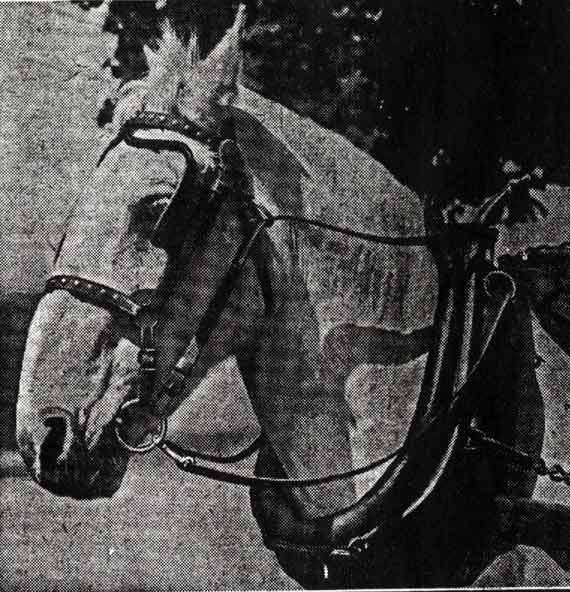
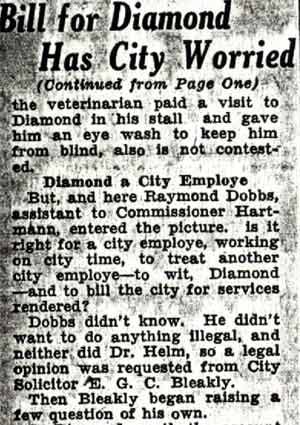
Diamond, Camden’s famous white cemetery horse, has eye trouble. And so has Camden, or so it seems. Anyhow, Diamond has the city legal department in a quandary; Commissioner Hartmann’s office in a turmoil and Dr. David D. Helm in or out a $3 bill for services rendered. It all started when the eyes of the big work horse started to water. Dr. Helm, who also is sanitary inspector, was summoned and treated the animal after which he turned in a bill for $3 to Commissioner Frank J. Hartmann, Jr., in whose department “Diamond” now works. There is where the city got its eye trouble. The commissioners thought they would put the bill on Dr. Helm’s “eye”—and for that matter they may still do so. That Dr. Helm saved Diamond’s life is unquestioned.
Bill for Diamond Has City Worried
The veterinarian paid a visit to Diamond in his stall and gave him an eye wash to keep him from going blind, also is not contested.
Diamond a City Employe
But, and here Raymond Dobbs, assistant to Commissioner Hartmann, entered the picture. Is it right for a city employe, working on city time, to treat another city employe—to wit, Diamond—and to bill the city for services rendered? Dobbs didn’t know. He didn’t want to do anything illegal, and neither did Dr. Helm, so a legal opinion was requested from City Solicitor E. G. C. Bleakly. Then Bleakly began raising a few questions of his own.
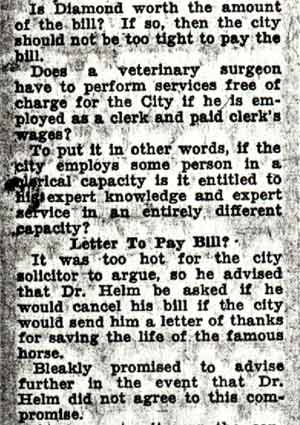
Is Diamond worth the amount of the bill? If so, then the city should not be too tight to pay the bill. Does a veterinary surgeon have to perform services free of charge for the City if he is employed as a clerk and paid clerk’s wages? To put it in other words, if the city employs some person in a clerical capacity is it entitled to his expert knowledge and expert service in an entirely different capacity?
Letter To Pay Bill?
It was too hot for the city solicitor to argue, so he advised that Dr. Helm be asked if he would cancel his bill if the city would send him a letter of thanks for saving the life of the famous horse. Bleakly promised to advise further in the event that Dr. Helm did not agree to this compromise.
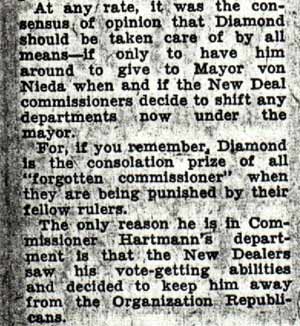
At any rate, it was the consensus of opinion that Diamond should be taken care of by all means—if only to have him around to give to Mayor von Nieda when and if the New Deal commissioners decide to shift any departments now under the mayor. For, if you remember, Diamond is the consolation prize of all “forgotten commissioner” when they are being punished by their fellow rulers. The only reason he is in Commissioner Hartmann’s department is that the New Dealers saw his vote-getting abilities and decided to keep him away from the Organization Republicans.
Brunner Appoints Dobbs to Tax Post
Camden Courier-Post –
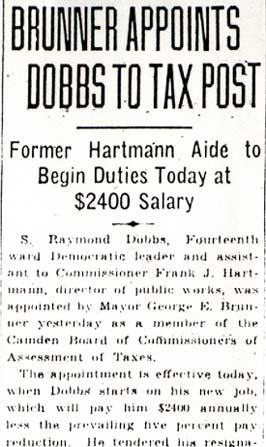
Former Hartmann Aide to Begin Duties Today at $2400 Salary
S. Raymond Dobbs, Fourteenth ward Democratic leader and assistant to Commissioner Frank J. Hartmann, director of public works, was appointed by Mayor George E. Brunner yesterday as a member of the Camden Board of Commissioners of Assessment of Taxes.
The appointment is effective today, when Dobbs starts on his new job, which will pay him $2400 annually less the prevailing five percent pay reduction. He tendered his resignation to Hartmann but will continue to direct the activities of the Bureau of City Property without compensation.
Dobbs has been associated with the department of public works since November 30, 1935. His appointment to the city tax board was recommended to the Mayor by Hartmann.
The appointment fills a vacancy left when Wilbur H. Ellis was retired on a disability pension.
Other members of the tax board are Maurice Clyman and Harry Langenbein, who were appointed last April.
Commissioner Hartmann expressed regret over Dobbs leaving his department, but stated he is confident his former aide will prove a valuable member of the tax board.
Dobbs is executive secretary of the Camden Municipal Low-Cost Housing Committee and is acting secretary of the New Jersey Conference on Municipal Low-Cost Housing Committees, which organizations have waged a determined fight to obtain enabling legislation to secure Federal funds for low-cost housing and slum clearance.
Reesman Swears in City Tax Assessors
Camden Courier-Post –
Clyman Elected President of 3-Man Board, Given Adjustment Power
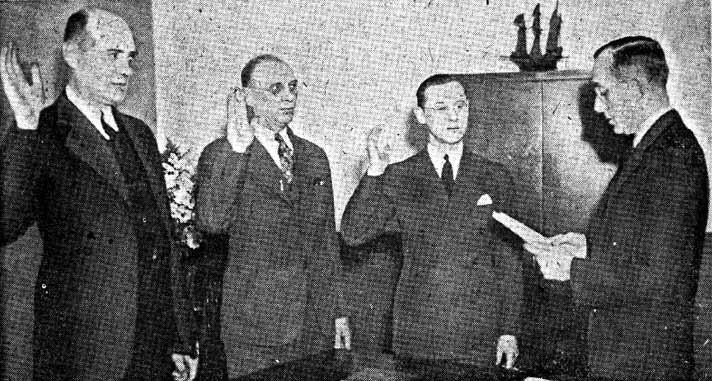
Camden’s three tax assessors were sworn in yesterday by City Clerk Clay W. Reesman.
S. Raymond Dobbs, former assistant to Commissioner Frank J. Hartmann, was appointed by Mayor George E. Brunner on Thursday and took over his duties yesterday. The first two members of the Camden Board of Commissioners of Assessments of Taxes, as the board is officially named by city ordinance, who were sworn in with Dobbs, were Maurice Clyman, of the Ninth ward, and Harry C. Langenbein, of the First ward. Both Clyman and Langenbein, who were appointed last April, were sworn in by the Mayor. On advise of City Solicitor Firmin Michel, all three were sworn in by the city clerk. Employees of the Department of Public Works presented Dobbs with a large basket of flowers.
Following the oath taking, the three members held an organization meeting. Clyman was elected president. Several rules were made by the assessors, who also decided to hold regular meetings on the first Tuesday of each month at 11 a.m. Taxpayers may appear in person to present claims or to seek information.
Clyman was authorized to make adjustments on personal or other taxes and report his actions to the other members at the meetings. According to Dobbs, it was found that clerks in the office had for years taken it upon themselves to cancel and adjust many tax and assessment items.
It was discovered that no minutes of the assessors had been recorded since July, 1935. Clyman immediately ordered a book for the keeping of minutes. The board members will take an inventory of all supplies and place the department on a more business-like basis.
The board decided to work overtime to complete all tax assessments so that the city’s books can be turned over to the Camden County Board of Taxation before February 1. City Clerk Clay W. Reesman is seen administering the oath of office to the three members of the Camden Board of Commissioners of Assessments of Taxes. Reading from left to right are S. Raymond Dobbs, new member of the board; Maurice Clyman and Harry C. Langenbein, the other members, and Reesman. Following this ceremony the assessors held an organization meeting when Clyman was elected president for this year.
Camden Group Wins Housing Bills Goal
Camden Courier-Post –
Newark Parley Results in Slashing Authority of State Director
A long and hard-fought campaign to obtain housing bills which will enable New Jersey municipalities to secure Federal funds for slum clearance and low-cost housing resulted in a moral victory for members of the Camden Municipal Low-Cost Housing Committee yesterday.
The local group, which several weeks ago inaugurated a statewide movement to obtain the legislation and to eliminate political chicanery in the legislation, returned last night from Newark after attending a stormy session that lasted more than four hours.
S. Raymond Dobbs, executive secretary of the Camden committee and acting secretary of the state conference of low cost housing committees, said the members of the local and state groups are satisfied with several amendments to be made to the present bills.
Four Housing bills will be presented in the Assembly next Monday night, Dobbs said. They will be introduced by Assemblyman Jennie A. Pilch, of Morris County, chairman of the Assembly housing committee. Assemblyman Oscar R. Wilensky, of Passaic County, majority leader of the House, will ask for their passage under suspension of rules, Dobbs said.
Mrs. Pilch has granted a public hearing on the bills to be held in the Assembly chamber next Wednesday at 1 p.m. The public hearing was requested by the Jersey City Chamber of Commerce.
“The members of our local group and those in the state conference feel a good job was done,” said Dobbs. “We didn’t get everything we wanted but at the same time we are confident these bills will be adopted and Camden will get its share of Federal money from the U. S. Housing Authority.”
Dobbs said Wilensky agreed to limit the authority of the state director of housing, set up in two of the bills, to municipalities under 50,000. In the original bills Camden and other cities would have to get written permission from the director before the City Commission could appoint or elect a housing committee.
Another bill was amended requiring the state director to forward to the U. S. Housing Authority within 20 days all applications for Federal money for slum clearance and low cost housing.
This amendment, Dobbs said, will prevent the state director from arbitrarily deciding whether or not Camden or any other municipality has the legal right to apply for Federal money.
The bill also designates the State Housing Authority as an advisory agency to the state director. In the opinion of Dobbs the state authority will be shorn of much of its power in the matter of housing matters in the state.
The four bills as amended will give Camden and other municipalities even greater autonomy than when they were first drawn, Dobbs declared.
Frederick Pitett, a retiring building contractor of Bergen County, is named in the bills as state director of housing, Dobbs said. The bills provide for a deputy director to be paid $4000 annually. Pitett’s salary will be fixed by the joint appropriations committee of the Legislature, according to Dobbs.
Those representing Camden at the conference besides Dobbs were Charles F. Hollopeter, local committee chairman, and acting chairman of the state group; Commissioner Harold W. Bennett, counsel, and Joseph N. Hettel, technical adviser to the Camden committee, and Horace R. Dixon, committee secretary.
The State Housing Authority was represented by Frederick W. Ehrlich, chairman; Harry I. Luftman, secretary, and Charles H. Ziegler and Mrs. Isora B. Somers.
Maurice Kaltz, solicitor for the New Jersey State Building and Construction Trades Council, also was present. Members of the Assembly housing committee, J. H. Schneider, counsel for the U.S. Housing Authority, and officials from other cities attended the session.
An observer was Albert Reitman, secretary to Senator Charles S. Loizeaux, of Union county, president of the State Senate.
Hartmann Has New Problem in Hamburgers on Parking Lot
Camden Courier-Post –
Lessee Seeks Opportunity to Augment Income Before Signing New Agreement Leaving Question in Lap of Commissioner
Commissioner Frank J. Hartmann almost daily is called upon to solve bewildering problems in his job of directing the 16 bureaus that make up the city Department of Public Works.
The almost over-night disappearance of six dilapidated houses left him somewhat perplexed, but yesterday another vexing matter was put to him for an official decision.
Hartmann must decide whether he will approve and seek the double approval of his colleagues in the City Commission on a matter of establishing a hamburger restaurant on the east end of the present commercial auto parking lot bounded by Federal, Arch, Fifth and Hudson streets.
Monroe Y. Brett, present leaseholder of the parking tract, notified Hartmann he will vacate the premises next Monday because the parking business proved a losing venture, due to the rent of $441 a month.
Hamburger to Rescue
However, Brett seized upon an idea that will permit him to continue occupancy. He passed the offer along to City Assessor S. Raymond Dobbs, acting supervisor of city property.
Brett wants the privilege of building and operating a hamburger restaurant, and if given that privilege he is willing to sign for a longer lease.
Dobbs put the matter up to Hartmann with the result Walter S. Anderson, an attorney and assistant to Hartmann, was called into a conference to debate the matter.
There is nothing in the rental resolution that stipulates for what the tract is to be used. Anderson said advertising of the leasehold agreement contains a notice that sets forth certain conditions in connection with the proposed second auction of the leasehold agreement are to be made on the date of the auction.
Stipulation May be Made
Further, the attorney said the city legal department with consent of the members of the City Commission can stipulate use of the tract.
The resolution authorizing sale of the rental agreement states the piece of ground, which is paved with concrete, is not needed for public use.
Dobbs insisted that if restrictions are not fixed, Brett or another lessee can build a hamburger restaurant, a hot dog stand or even a tent-covered market place. On this point both Anderson and Hartmann agreed.
The question to be decided is whether the city shall grant Brett permission to build his hamburger restaurant and pay the city $441 a month, or auction off the rental agreement for a stipulated amount of not less than $375 a month.
Whether the city will successfully negotiate a rental agreement for the new figure is in doubt, inasmuch as Brett was unable to make his parking business pay him a profit.
Assembly Approval Assured on Housing
Camden Courier-Post –
Further Delay Held Endangering Chance of Obtaining Federal Funds
Assembly approval of the long-delayed housing bills is expected tonight, Assemblyman Rocco Palese declared yesterday in announcing all difficulties confronting the measures have been “ironed out.”
Senate action also is expected, Palese reported.
Horace R. Dixon, secretary of the Camden Municipal Low-Cost Housing Committee has warned repeatedly, as have other members of the committee, that further delay will endanger the chances of obtaining Federal housing funds. Camden expects to apply for $8,000,000, Dixon said.
It has been estimated New Jersey will be allotted about $30,000,000 for slum clearance and low cost housing.
Felix Pitett, a Paterson banker, who is named in one of the bills as State housing administrator, told the members of the Assembly Housing Committee that if the job carries a salary he “would not be interested,” Palese said.
Paid Administrator Opposed
The local committee, which was instrumental in the formation of the New Jersey Conference of Municipal Low-Cost Housing Committees, opposed the naming of an administrator in the bill. Opposition was based on the creation of a high salary position.
Assemblyman Oscar R. Wilensky, of Passaic, drew the bills and named Pitett as administrator, but did not fix his salary. The bill named a deputy director at $4000 annually. The Camden group and members of other State committees withdrew their opposition when Wilensky agreed to drop his plan to set up county regional housing authorities.
“Pitett’s surprise statement changed the complexion of the bill,” Palese said. “I think Pitett’s action is almost without precedent. He is to be commended for his action. He told the committee he cannot give full time to the job but is willing to serve on a part time basis without compensation.”
Dixon scored rumors that municipalities have committees, and those which will set up local housing authorities to conform with the State legislation, seek to spend money for salaries of committee members.
$2500 Limit Demanded
“The local committee and those in the State group have definitely opposed any plans or schemes to set up a lot of salaried jobs,” Dixon said. “We want low-cost housing for Camden and we don’t intend to spend a lot of money for salaries and useless surveys.
“No municipality can spend more than $2500 for anything in connection with low-cost housing. One of the Assembly bills contains this provision.
“Camden is badly in need of low-cost housing. The slum areas must be eliminated and people shall have the right to rent modern, sanitary housing quarters at nominal rentals.”
The local committee and members of the State group, Dixon asserted, have opposed all political influence in the matter of obtaining enabling legislation for Federal funds.
Newark May Recall Action
Dixon said he understood an ordinance recently passed by the Newark City Commission, appointing a housing administrator and providing an annual appropriation of $10,000 for salary and expenses will be repealed, because it may conflict with the Assembly housing bills.
The present Newark ordinance also provides for the appointment of five housing commissioners each for a term of three years, and stipulates the City Commission shall fix the salary of the administrator.
Dixon said the local committee would be opposed to the appointment of a local administrator with a city salary.
Commissioner Frank J. Hartmann, who sponsored the present committee approved by the Camden City Commission, probably will present an ordinance at tomorrow’s meeting of the City Commission for a local housing authority and the appointment of five members as commissioners.
The present committee was created through a resolution approved by the commission.
Housing needs in Camden are more acute now than they were four years ago, Dixon told legislators in Trenton Monday night as he sought action on the housing bills.
Dixon, S. Raymond Dobbs, another member of the committee; Joseph Hettel, the technical adviser, and City Commissioner Harold W. Bennett, solicitor for the group, all attended the legislative session, but no action was taken on the bills.
Mayor Brunner and Commissioner Kobus joined in approving the resolution, but whether or not a vote to name members of an official local authority would be unanimous is a question. Recently, however, Bennett was named counsel for the present committee, indicating he and Commissioner von Nieda will go along with Hartmann if it comes to a controversy.
Bennett is studying the Newark ordinance creating a housing authority.
Real Estate Board Urges City-Owned Houses
Camden Courier-Post –

Sees Means of Improving Living Conditions for Low Wage Earners
Would Mean Revenue
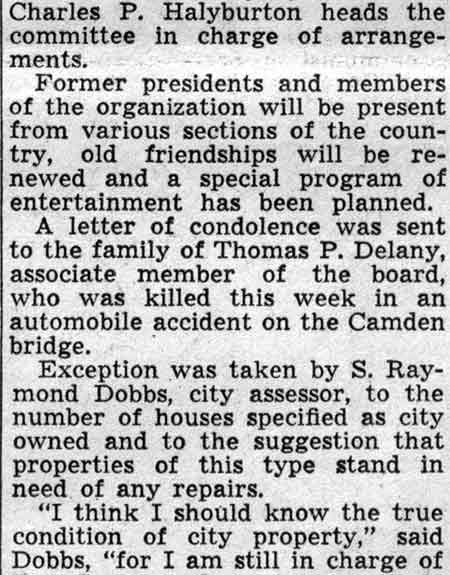
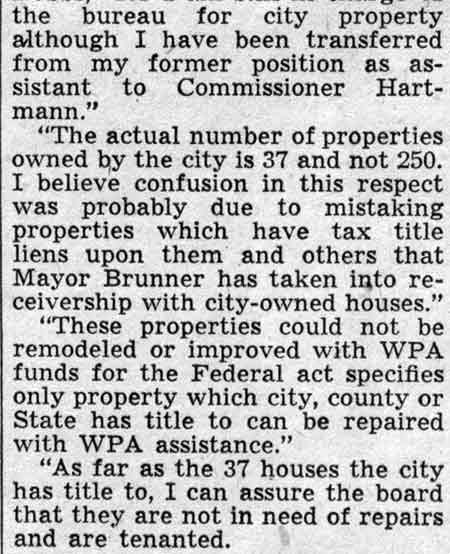
A proposal for renovation of 250 city-owned properties with WPA funds to provide better living accommodations for families of lower income will be studied by a special housing committee of the Camden County Real Estate Board.
Action for a survey of the situation in co-operation with the office of City Commissioner Frank J. Hartmann, Jr., was taken at the weekly luncheon of the board in Hotel Walt Whitman. J. Frank Hanly, former city housing commissioner, addressed the housing committee this week. It was arranged that Kircher, “for the city to recondition these properties through the WPA.” Renovated, these properties would place on the rental market improved housing.
Kircher explained the survey would be made at little or no cost to the city. The recommendation was made before the board in the form of a motion, which was unanimously approved by Carl R. Evered, chairman of the housing committee. The recommendation was ordered referred to the housing committee for study and action.
Evered stressed need for a housing committee composed of board members who “should stand ready at all times to advise the city” to ensure the housing enterprise is “conducted properly.”
“This Westfield Acres project,” he said, “for the city to recondition properties at a cost of $10,000 or less each, is a good thing for the city. If you will conduct the housing of these people on a business-like basis, I can assure the board that they are not in need of repair and can pay a fair rental.”
Exception was taken by S. Raymond Dobbs to the statement made by a number of houses specified as condemned. “I think I should know the true condition of city property,” said Dobbs. “I served as the city’s own real estate man from my former position as assistant to Commissioner Hartmann.”
S. Raymond Dobbs – Frank J. Hartmann Jr. – J. Frank Hanly – Hotel Walt Whitman – Ellis C. Kircher – Carl R. Evered – Westfield Acres – Thomas P. Delany
Henry Magin Laid to Rest By War Veteran Buddies
Camden Courier-Post –
Trucks of Flowers in Funeral Cortege
Funeral services for City Commissioner Henry Magin were held today with his colleagues in official and veterans circles participating.
Services were conducted in city commission chambers on the second floor of city hall, in charge of Rev. Dr. W.W. Ridgeway, rector of St. Wilfrid’s Episcopal Church.
The casket was carried by war veteran associates of the public works director, who died from a heart attack Friday. A color guard from the Veterans of Foreign Wars and the American Legion preceded the casket, followed by the four remaining members of the city commission, Mayor George Brunner and commissioners E. George Aaron, Mrs. Mary W. Kobus and Dr. David S. Rhone.
A guard of honor lined both sides of city hall steps, 22 policemen on one side and 22 firemen on the other, representing Magin’s age, 44 years.
Hundreds of men and women waited outside the building to pay their respects as the solemn procession filed by. Mayor Brunner had declared this morning a holiday for city employees. The casket was borne by Thomas Jackson and Samuel Magill, both past Legion commanders; Leon McCarty, past commander of August Walter Chapter, Disabled American Veterans; Richard Jermyn, past commander of Post 1270, Veterans of Foreign Wars; Benjamin P. Thomas, past captain of Sparrow Ship No. 1269, V.F.W.; and William Miller, past State commander, D.A.V.
Three trucks were required to carry the floral pieces from the scene of the services to the National Cemetery at Beverly, where burial took place.
An estimated 8000 persons from all walks of life paid their respects to the late official by viewing the body as it lay in state in the commission chambers.
The throng of mourners of Camden city and county was the largest to converge on a public building since the funeral of Fire Chief Charles Worthington, who was killed while fighting a fire almost 20 years ago. His body was placed on public view in the rotunda of the old county courthouse.
File Past Bier
A continuous progression of people filed past the flag draped bier for more than three and one-half hours. Scores of Republicans and hundreds of Democrats joined in the tribute.
Services were conducted by Camden lodges of Elks and Moose. Military rites were conducted by the Fairview Post, American Legion, of which Magin was a founder and past commander. The tribute was led by Mitchell Halin, post commander, and C. Richard Allen, past department commander.
James W. Conner, chief clerk of the city water bureau and past State Commander of the V.F.W., conducted rites at the grave.
Mayor Brunner and Commissioners Kobus, Aaron, and Rhone came early and remained throughout the hours of viewing. Mrs. Helen Magin, the widow, and daughter Helen, attired in deep mourning, arrived shortly after 7:00 PM.
Embraces Widow, Daughter
Commissioner Kobus, who knelt in prayer before the bier, arose and went over to Mrs. Magin and her daughter. Mrs. Kobus embraced and kissed the widow and daughter of the late commissioner. They were in tears.
Three firemen and three policemen maintained a vigil as a guard of honor. They were Patrolmen Jack Kaighn, George Weber, and William Deery and Firemen Arthur Batten, Warren Carter and William Reed.
American Legion and V.F.W. members in uniform alternated as members of the military guard of honor. A detail of 50 policemen was under command of Acting Lieutenant John Garrity. Fifty firemen, under supervision of Deputy Chief Walter Mertz, assisted the patrolmen in handling the crowd, which at times choked the stairways leading to the second floor.
Freeholders Arrive
Albert H. Molt, director of the Board of Freeholders and Freeholders John J. Tull, Oscar Moore, Ventorino Francesconi, Stanley Ciechanowski, Earl Armstrong and Emil J. McCall arrived shortly after 7:00 PM. Moore and Tull wore American Legion overseas caps. Albert S. Marvel, clerk of the board, accompanied the freeholders.
Employees of the various bureaus in the department of public works, headed by Commissioner Magin, came in delegations with the highway bureau having 150, the largest number.
Frank A. Abbott, acting director of the department, accompanied by James P. Carr, superintendent of Streets, led the highway bureau employees. Abbott is deputy director of revenue and finance and first assistant to Mayor Brunner. He was named by Brunner as acting director until the City Commission elects Mr. Magin’s successor.
County Clerk Frank J. Suttill, City Clerk Clay W. Reesman, Fire Chief John H. Lennox and James A. Howell, chief of the city electrical bureau, attended, as did Albert Austermuhl, secretary of the board of education. Every city department sent a floral piece.
Outstanding Floral Tribute
Outstanding among the floral tributes was a six-foot broken circle of varied flowers, an offering from Mayor Brunner and Commissioners Kobus, Aaron, and Rhone.
A floral chair was sent by the Camden Police and Firemen’s Association. The word “Rest” was made up of flowers. The offering of the Veterans League of South Jersey, an organization formed by Commissioner Magin and of which he was the first president, was a large floral pillow.
The freeholders and county officials gave a large floral basket. Floral tributes came from the employees of the board of education, the RCA Manufacturing Company, the police and fire bureaus, Pyne Point Athletic Association, the Elks, Moose and several Democratic clubs.
The floral tributes came in such numbers yesterday afternoon that Funeral Director Harry Leonard and his assistants could not find room for them in the commission chamber proper. They were banked on both sides, in the rear and over the casket.
Among prominent officials and citizens who came to pay their respects were Congressman Charles A. Wolverton and his son, Donnell, Assemblymen Joseph W. Cowgill and J. Frank Crawford, Sidney P. McCord, city comptroller, Thomas C. Schneider, president of Camden County Council No. 10, New Jersey Civil Service Association.
Others at Bier
Others were Sue Devinney, secretary to Mrs. Kobus; Fred S. Caperoon; Henry Aitken, city sealer of weights and measures, Horace R. Dixon, executive director of the Camden Housing Authority; George I. Shaw, vice president of the board of education.
Sgt. Ray Smith, chairman of the Elks Crippled Children Committee and commander of East Camden Post, V.F.W.; Albert Becker, commander of Camden County Post 126, Jewish War Veterans; Dr. Howard E. Primas and Wilbur F. Dobbins, members of the Camden Housing Authority; Postmaster Emma E. Hyland; Samuel E. Fulton, member of the Camden local assistance board.
Also former Assemblyman Rocco Palese, former Freeholder Maurice Bart and wife, County Detective James Mulligan, Deputy City Clerk William D. Sayrs, Mary King, secretary to City Clerk Reesman, Charles W. Anderson and John W. Diehl Jr., former members of the housing authority, Walter P. Wolverton, chief clerk of the public works department; Thomas J. Kenney, Maurice Hertz, Isadore Hermann, chief of the city tax title bureau; S. Raymond Dobbs, acting chief of city property, John Oziekanski, building inspector, Harry Langebein, city assessor.
Oliver H. Bond, housing manager of Clement T. Branch Village; former Judge Joseph Varbalow, acting city counsel John J. Crean, assistant City Counsel Edward V. Martino, Paul Day, secretary of city board of assessors, former Assemblyman William T. Iszard, Harry Roye, district director of NYA; Victor J. Scharle and Martin Segal, Democratic and Republican registrars, respectively, of the Camden County permanent registration bureau.
Mrs. Marian Garrity and Mrs. Mary F. Hendricks, vice chairman and secretary respectively, of the Republican City Committee; Dr. Ethan A. Lang and Dr. Richard P. Bowman, members of the board of education; Edward J. Borden, Carl Kisselman, Harry A. Kelleher, Samuel T. French Sr., former Freeholder Walter Budniak, Coroner Paul R. Rilatt, County Treasurer Edward J. Kelleher, William Shepp, of the city legal bureau, Marie Carr, stenographer, mayor’s office; Samuel T. French Jr., member, board of education.
Also John C. Trainor, member of the Camden County Board of Elections; Antonio Mecca, funeral director; Alexander Feinberg, solicitor of the housing authority, former Freeholder John T. Hanson, Sterling Parker and Paul Reihman, member of the county park commission.
James O’Brien, commander of the Camden Disabled American Veterans, was in charge of services by veterans at the cemetery. Former Freeholder Edward J. Quinlan, county vice-commander of the American Legion, directed last night memorial services and was in charge of the firing squad at the grave.