Introduction
Benjamin Lorenzo Kellum was born in Camden county, New Jersey in August of 1847 to Benjamin Kellum and his wife, the former Emeline Ware. He was one of at least three children, coming after Anna and before Jacob Kellum. His father appears to have passed away in the 1850s. Emeline Ware Kellum remarried on May 3, 1861, to John Bodine, with whom she had at least 5 children, Sarah, Samuel, David, Charles, and Harry prior to the 1860 Census. The census shows John and Emeline Bodine living in what was then Newton Township with the three Kellum children and the three younger children who had been born to date. John Bodine supported his family as a day laborer.
The United States went to war with itself in 1861. Not long after his sixteenth birthday, on September 2, 1864 Benjamin Kellum enlisted as a Private with Company D, 2nd New Jersey Cavalry Regiment, a unit which was also referred to as the 32nd New Jersey Volunteers. When Private Kellum enlisted the regiment was quartered in Memphis, Tennessee. Being ordered into Arkansas and disembarking at Osceola, the command crossed a swamp some 18 miles in length, the mud and water reaching to the saddle-girths of the horses, to Big lake, where after some brisk firing a Confederate train consisting of some 18 wagons, loaded with over 900 stand of arms of approved pattern, together with 11 prisoners and 2 commissioned officers, was captured. Reaching Verona, Miss., on Dec. 25, the command at once charged gallantly on the enemy, who was completely surprised and offered but a feeble resistance, most of them escaping into the timber under cover of the darkness leaving as spoils, eight buildings filled with fixed ammunition, estimated at 30 tons, 5,000 stands of new carbines, 8,000 sacks of shelled corn, a large quantity of wheat, an immense amount of quartermaster stores, clothing camp and garrison equipage, a train of cars and a large number of army weapons which had been captured by Confederate General Nathan Bedford Forrest from General Sturgis during the latter’s disastrous expedition in June.
The regiment also participated in the fight at Egypt Station, on December 28, 1864 in which 74 men and over 80 horses of the 2nd N. J. were killed or wounded. As part of an expedition sent out from Memphis to destroy the Mobile & Ohio railroad, 2nd New Jersey along with the 7th Indiana, 4th and 11th Illinois, 4th and 10th Missouri, 2nd Wisconsin, 1st Mississippi, and 3rd U.S. Colored Cavalry attacked the enemy at Egypt Station, Mississippi. The Confederate force was about 1,200 strong and consisted of infantry, cavalry and 4 guns mounted on platform cars. Two trains of Confederate troops under Major General Gardner were in sight when the attack was made, but a Federal force being thrown between them and the stockade, which was taken by assault in 2 hours, they were unable to do anything. The entire garrison, numbering 500, were made prisoners. The casualties are not given, but it is noted that Confederate Brigadier General Gholson was killed. The Union force also captured or destroyed 300 army wagons, 4,000 new carbines, an immense amount of ammunition, two trains of cars and a large amount of commissary and quartermaster’s stores.
The regiment returned by steamer to Memphis, having lost during the entire expedition 19 men killed, 69 wounded and 2 missing, and 155 horses and mules killed or disabled. The regiment campaigned in Mississippi and Alabama in March and April of 1865. Its last action occurred on April 28, 1865 at Clayton, Alabama.
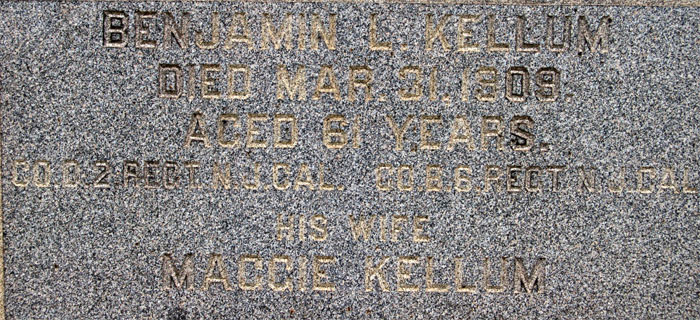
Private Benjamin L. Kellum mustered out of Company D, 2nd Cavalry Regiment New Jersey on June 29, 1865 at Vicksburg, Mississippi. He subsequently returned to his home and family in Camden. He reenlisted in 1866 and served another three years with the Sixth Cavalry Regiment before returning home for good upon discharge in April of 1869.
The 1870 Census shows Benjamin Kellum living with his mother, step-father, and siblings in Camden’s Middle Ward. His stepfather was working in a store, while Benjamin and younger brother Jacob Kellum worked as laborers.
Benjamin Kellum was appointed to the Camden Fire Department on May 7, 1874 as an extra man with the Hook & Ladder Company, joining his brother Jacob. The brothers served together with the Camden Fire Department for most of the rest of their working days.
Benjamin Kellum was promoted to Driver of the Hook & Ladder Company on November 12, 1874 to take the place of William Alcott, who had passed away on November 4. He was then living at 450 Henry Street and had been working as a laborer. Benjamin Kellum remained in the post of Driver until April 8, 1876 when he and many other Camden fire fighters were replaced for political considerations. Still living at 450 Henry Street, Benjamin Kellum was reappointed on April 8, 1877. He served for five years before again being dismissed from the department for political reasons. He returned in 1885, and remained a Camden Fire Department member until retiring in 1903.
The 1878 City Directory gives Benjamin Kellum’s address as 451 Henry Street. The 1880 Census shows Benjamin Kellum and his wife Annie living at 411 Bridge Avenue. The 1882–1883 Directory shows him back at 451 Henry Street. 1884 has an address of 422 Berkley Street, 1885 has him living at 424 Berkley Street. 1887 shows him living at 528 Lawrence Street. The next Directory, 1888–1889 gives an address of 534 Washington Street. The 1890–1891 and 1891–1892 editions have Benjamin Kellum at 524 Washington Street. The 1892–1893 Directory indicates a move to 516 Clinton Street. Benjamin Kellum remained at 516 Clinton Street into 1899, then moved to East Camden, taking up residence as well as responsibilities with the Fire Department in the wake of that year’s merger of the City of Camden and the Town of Stockton, which brought East Camden and Cramer Hill into the city.
Benjamin Kellum remarried around 1884. He and his wife Margaret “Maggie” Kellum were not, however, blessed with children. They did raise a nephew, Harry Suters, who lived with them in the 1890s and 1900s, and stayed with Mrs. Kellum after her husband’s death.
Benjamin Kellum was an active member of the Thomas M.K. Lee Post No. 5, G.A.R.. The post’s membership included many other prominent Camden citizens, and Camden Fire Department members Theodore Verlander, J. Kelly Brown, Jesse Chew, William Gleason, Thomas R. Grapevine, Frank S. Jones, William H. Shearman, William T.G. Young, and Charles G. Zimmerman.
By 1894 Benjamin Kellum had been promoted to foreman of what is now Ladder Company 1, a position equivalent to today’s Captain. In November of 1899 he was promoted to Assistant Chief, the equivalent of today’s Deputy Chief.
The 1900 Census lists Benjamin and Margaret Kellum, and their 15 year-old nephew Harry Suters, at 15 South 35th Street in East Camden. When grown to adulthood, Harry Suters would serve with the Fire Department for a few years. A young boy who lived next door, David W. Humphries, joined the Camden Fire Department in the 1920s; his brother Elwood Humphries became a Camden police officer.
Benjamin Kellum and family had moved to 13 South 34th Street by 1906.
Benjamin Kellum contracted tuberculosis in the early 1900s, and retired on half-pay from the Camden Fire Department effective August 1, 1903. He died on March 31, 1909, survived by his wife, nephew, and siblings. His younger brother, Jacob Kellum, continued to serve as a member of the Camden Fire Department. He was still on active duty in January of 1920.
Benjamin Kellum’s cousins, Robert Todd and Charles A. Todd, both served with the Camden Fire Department.
Firemen Appointed
Philadelphia Inquirer —
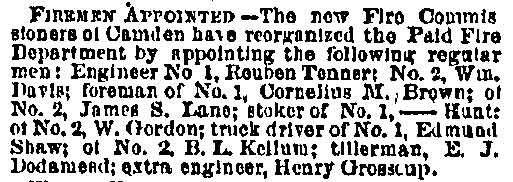
Firemen Appointed — The new Fire Commissioners of Camden have reorganized the Paid Fire Department by appointing the following regular men: Engineer No. 1, Rouben Tenner; No. 2, Wm. Davis; foreman of No. 1, Cornelius M. Brown; of No. 2, James S. Lane; stoker of No. 1, Hunt; of No. 2, W. Gordon; truck driver of No. 1, Edmund Shaw; of No. 2, B. L. Kellum; tillerman, E. J. Dodamead; extra engineer, Henry Grosscup.
The Primaries.
Camden Daily Courier —
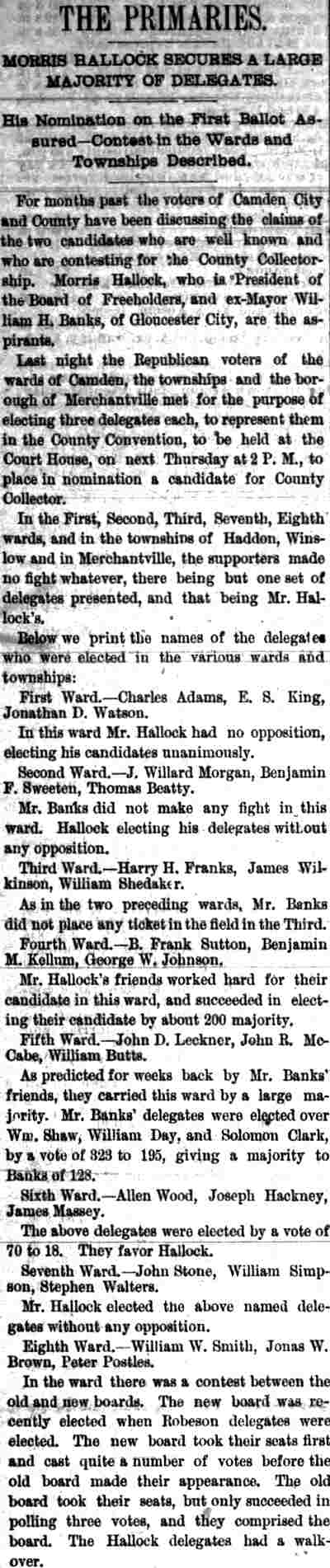
THE PRIMARIES.
MORRIS HALLOCK SECURES A LARGE MAJORITY OF DELEGATES.
His Nomination on the First Ballot Assured—Contest in the Wards and Townships Described.
For months past the voters of Camden City and County have been discussing the claims of the two candidates who are well known and who are contesting for the County Collectorship. Morris Hallock, who is President of the Board of Freeholders, and ex-Mayor William H. Banks, of Gloucester City, are the aspirants.
Last night the Republican voters of the wards of Camden, the townships and the borough of Merchantville met for the purpose of electing three delegates each, to represent them in the County Convention, to be held at the Court House, on next Thursday at 2 P. M., to place in nomination a candidate for County Collector.
In the First, Second, Third, Seventh, Eighth wards, and in the townships of Haddon, Winslow and in Merchantville, the supporters made no fight whatever, there being but one set of delegates presented, and that being Mr. Hallock’s.
Below we print the names of the delegates who were elected in the various wards and townships:
First Ward.—Charles Adams, E. S. King, Jonathan D. Watson.
In this ward Mr. Hallock had no opposition, electing his candidates unanimously.
Second Ward.—J. Willard Morgan, Benjamin F. Sweeten, Thomas Beatty.
Mr. Banks did not make any fight in this ward. Hallock electing his delegates without any opposition.
Third Ward.—Harry H. Franks, James Wilkinson, William Shedaker.
As in the two preceding wards, Mr. Banks did not place any ticket in the field in the Third.
Fourth Ward.—B. Frank Sutton, Benjamin M. Kellum, George W. Johnson.
Mr. Hallock’s friends worked hard for their candidate in this ward, and succeeded in electing their candidate by about 200 majority.
Fifth Ward.—John D. Leckner, John R. McCabe, William Butts.
As predicted for weeks back by Mr. Banks’ friends, they carried this ward by a large majority. Mr. Banks’ delegates were elected over Wm. Shaw, William Day, and Solomon Clark, by a vote of 323 to 195, giving a majority to Banks of 128.
Sixth Ward.—Allen Wood, Joseph Hackney, James Massey.
The above delegates were elected by a vote of 70 to 18. They favor Hallock.
Seventh Ward.—John Stone, William Simpson, Stephen Walters.
Mr. Hallock elected the above named delegates without any opposition.
Eighth Ward.—William W. Smith, Jonas W. Brown, Peter Postles.
In the ward there was a contest between the old and new boards. The new board was recently elected when Robeson delegates were elected. The new board took their seats first and cast quite a number of votes before the old board made their appearance. The old board took their seats, but only succeeded in polling three votes, and they comprised the board. The Hallock delegates had a walk-over.
Camden Firemen.
Philadelphia Inquirer —
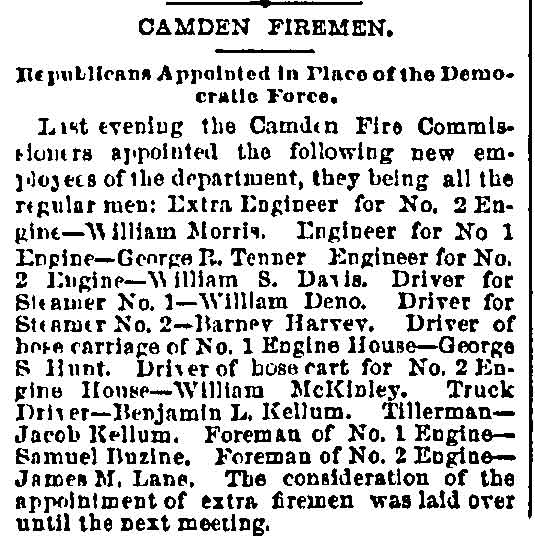
Republicans Appointed In Place of the Democratic Force.
Last evening the Camden Fire Commissioners appointed the following new employees of the department, they being all the regular men: Extra Engineer for No. 2 Engine—William Morris. Engineer for No 1 Engine—George R. Tenner. Engineer for No. 2 Engine—William S. Davis. Driver for Steamer No. 1—William Deno. Driver for Steamer No. 2—Barney Harvey. Driver of hose carriage of No. 1 Engine House—George S Hunt. Driver of hose cart for No. 2 Engine House—William McKibley. Truck Driver—Benjamin J. Kellam. Tillerman—Jacob Kellum. Foreman of No 1 Engine—Samuel Buzine. Foreman of No 2 Engine—James M. Lane. The consideration of the appointment of extra firemen was laid over until the next meeting.
A Blaze in Camden
Philadelphia Inquirer —
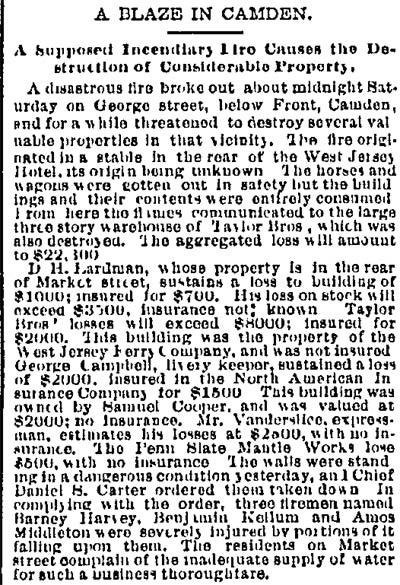
A Supposed Incendiary Fire Causes the Destruction of Considerable Property.
A disastrous fire broke out about midnight Saturday on George street, below Front, Camden, and for a while threatened to destroy several valuable properties in that vicinity. The fire originated in a stable in the rear of the West Jersey Hotel, its origin being unknown. The horses and wagons were gotten out in safety but the buildings and their contents were entirely consumed, and from here the flames communicated to the large three story warehouse of Taylor Bros., which was also destroyed. The aggregated loss will amount to $22,300.
D.H. Lardman, whose property is in the rear of Market street, sustains a loss to building of $1000; insured for $700. His loss on stock will exceed $3,300, insurance not known. Taylor Bros.' losses will exceed $8,000; insured for $2000. This building was the property of the West Jersey Ferry Company, and was not insured. George Campbell, livery keeper, sustained a loss of $2000, insured in the North American Insurance Company for $1500. This building was owned by Samuel Cooper, and was valued at $2,000; no insurance. Mr. Vanderslice, expressman, estimates his losses at $2,500, with no insurance. The Penn Slate Mantle Works lose $500, with no insurance. The walls were standing in a dangerous condition yesterday, and Chief Daniel A. Carter ordered them taken down. In complying with the order, three firemen named Barney Harvey, Benjamin Kellum and Amos Middleton were severely injured by portions of it falling upon them. The residents on Market street complain of the inadequate supply of water for such a business thoroughfare.
Fireman Kellum Committed to Asylum
Philadelphia Inquirer —

Benjamin Kellum, a member of the Camden Fire Department, has been declared insane and removed to the asylum at Blackwood.
Could Not Agree on New Fireman
Philadelphia Inquirer —
Camden Councilmen From East Side Split on Selecting Appointees
There Is Also Trouble in the Second Ward — Benjamin Kellum Made Assistant Chief — Other Promotions
The Camden Fire Commissioners last evening selected firemen for the five new fire companies from all the wards except the Second, Eleventh and Twelfth, as the Councilmen in these wards could not agree on the candidates the appointments were laid over until Monday evening next.
In the Second ward the Councilmen have agreed on John W. Vanhart. The other candidates are W. Scott Franklin, backed by Freeholder Whyte, and Edgar Bolton, who is the choice of Mayor Hatch and Councilman McGill. Bolton will probably be selected.
In the Eleventh ward a meeting was held by the Councilmen and the candidates agreed upon. Councilman Arnold has since repudiated the agreement, and last evening presented a new set of names to the conference of the commissioners. Councilman Longacre presented those previously agreed upon.
In the Twelfth ward Councilman Lee submitted names in opposition to those of Councilman Leas. It is quite probable that the choice of Councilmen Leas and Longacre, who are members of the Fire Committee, will be selected.
Benjamin Kellum, foreman of Truck No. 1, was appointed assistant chief. He will have charge of the East Side companies.
Charles Robinson, of the Seventh ward; George B. Wade, of the Sixth ward; Albert Jones, of the Ninth ward; George Cox, of the Third ward; Edward Weston, of the Ninth ward, and Samuel Peoples, of the Fifth ward, were elected foremen. They will be assigned to their posts of duty on Monday.
The selection of new firemen was as follows: First ward, Harry B. Middleton, Harry Burroughs; Third ward, Robert W. Colkett, William G. Hillman; Fourth ward, James E. Navins, Charles Todd; Fifth ward, Daniel Smith, Peter B. Carter; Sixth ward, Alfred Hayden, Henry Elliott; Seventh ward, Josiah Sage, Samuel Price; Eighth ward, William Rose, Charles Sturgis; Ninth ward, Daniel Grimes, Harry Wagner; Tenth ward, Augustus Kester, William Simpson.
The commissioners presented the bell now in the William Penn hose house, East Side, to the First Baptist Church.
Camden's Gallant Fire Fighters
Philadelphia Inquirer —
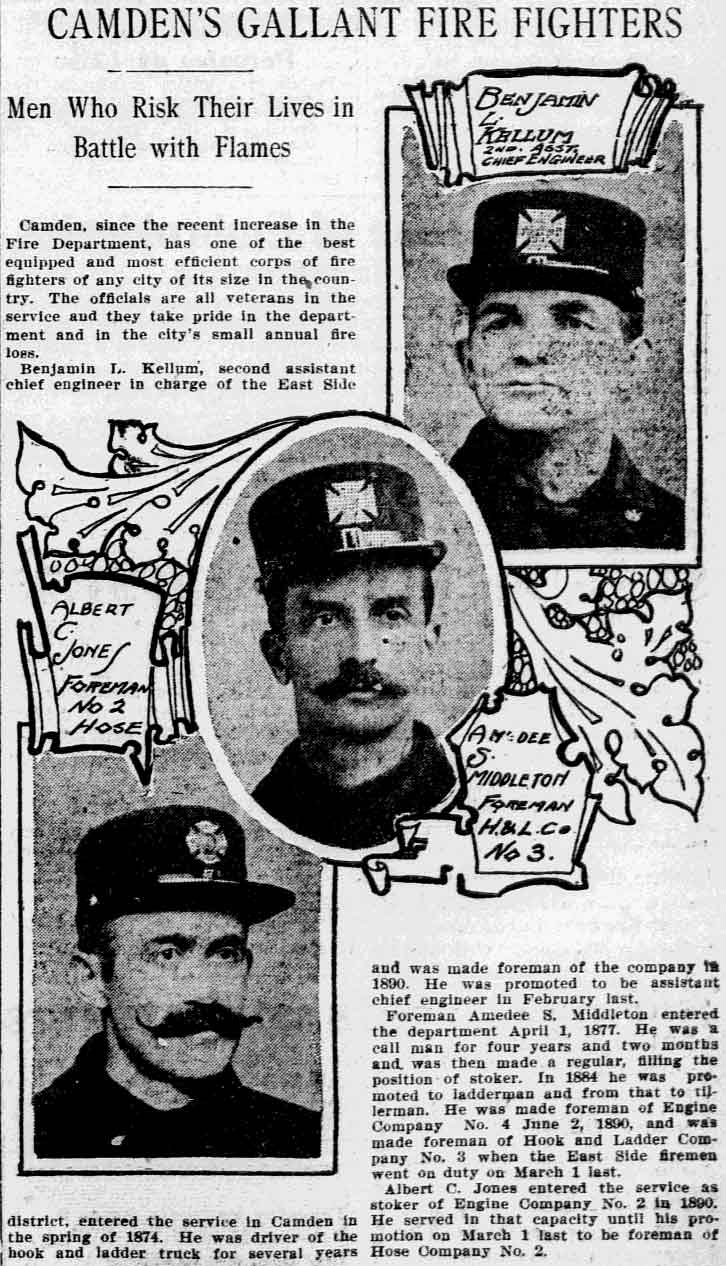
CAMDEN’S GALLANT FIRE FIGHTERS
Men Who Risk Their Lives in Battle with Flames
Camden, since the recent increase in the Fire Department, has one of the best equipped and most efficient corps of fire fighters of any city of its size in the country. The officials are all veterans in the service and they take pride in the department and in the city’s small annual fire loss.
Benjamin L. Kellum, second assistant chief engineer in charge of the East Side district, entered the service in Camden in the spring of 1874. He was driver of the hook and ladder truck for several years and was made foreman of the company in 1890. He was promoted to be assistant chief engineer in February last.
Foreman Amedee S. Middleton entered the department April 1, 1877. He was a call man for four years and two months and was then made a regular, filling the position of stoker. In 1884 he was promoted to ladderman and from that to tillerman. He was made foreman of Engine Company No. 4 June 2, 1890, and was made foreman of Hook and Ladder Company No. 3 when the East Side firemen went on duty on March 1 last.
Albert C. Jones entered the service as stoker of Engine Company No. 2 in 1890. He served in that capacity until his promotion on March 1 last to be foreman of Hose Company No. 2.
Camden's Pride Parades Before City's People
Philadelphia Inquirer —
CAMDEN'S PRIDE PARADES BEFORE CITY'S PEOPLE
Policemen and Firemen Make Their Initial Turnout and Present a Creditable Appearance—Reviewed by Officials—How the Departments Have Grown
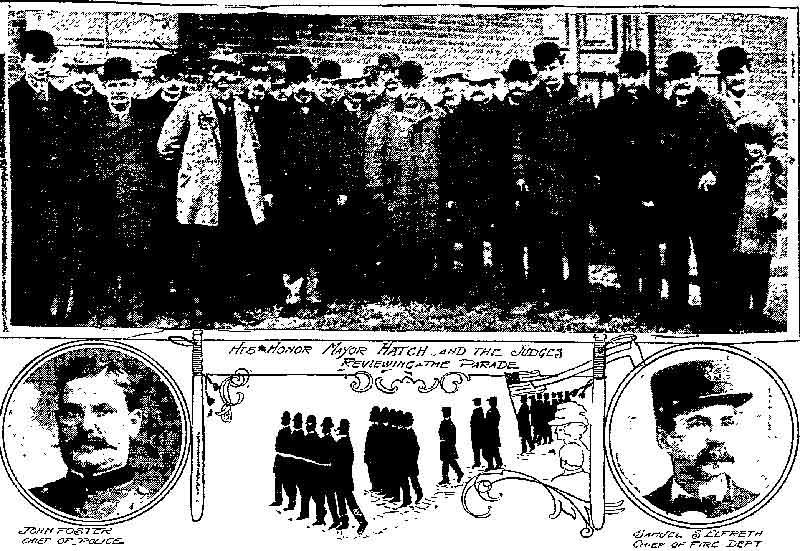
With a line up that could not be surpassed by the famous “Broadway Squad” of New York, Camden's policemen, or most of them, turned out in review yesterday. The military carriage of the men excited much favorable comment, especially among those who were not aware that the men have been drilled every week for a year past by Colonel D. B. Murphy, of the National Guard of New Jersey. The policemen were followed by an array of firemen and a variety of apparatus that made many of the natives gasp in astonishment. Altogether the procession was a revelation to Camden residents who thought they were well informed about their city.
The procession was headed by Jennings' Third Regiment Band. Then came Chief John Foster, of the Police Department, followed by a line composed of Police Captains Stanley, Alberts and Doyle and Sergeant Bentley. Following them under the silken folds of “Old Glory,” which he carried with a steady grasp, was Policeman George A. Donovan, a colored member of the force. Two platoons of forty policemen each were led by Sergeants Horner and Hyde. The police patrol wagons and the city ambulance brought up the end of the policemen's line. The total police force of the city consists of ninety nine men.
The City Band, followed by Chief Samuel S. Elfreth, of the Fire Department, in a carriage, marked the head of the firemen's line. The seventy-two men of this department were in two sections, the first being led by Assistant Chief Samuel Buzine, of the department headquarters, and the second by Assistant Chief Benjamin Kellum of the East Side. Between the two sections marched the Ivy Fife and Drum Corps. The apparatus in line consisted of six hose carts, five engines, three hook and ladder trucks, two chemical engines and a supply wagon.
The growth of Camden's police department may be seen by a comparison of the present with the year 1862, when six policemen sufficed to protect the entire city, which was then divided in three wards. In 1876 there were only sixteen policemen in the city and nine regular firemen under one chief. There were, however, thirty extra men subject to call by the chief.
The parade yesterday was reviewed by Mayor Hatch and the City Councilmen from the balcony on the Broadway side of the Court House.
After Long Service Retires on Pension
Philadelphia Inquirer —
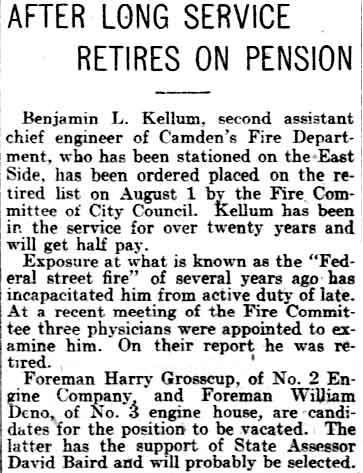
Benjamin L. Kellum, second assistant chief engineer of Camden’s Fire Department, who has been stationed on the East Side, has been ordered placed on the retired list on August 1 by the Fire Committee of City Council. Kellum has been in the service for over twenty years and will get half pay.
Exposure at what is known as the “Federal street fire” of several years ago has incapacitated him from active duty of late. At a recent meeting of the Fire Committee three physicians were appointed to examine him. On their report he was retired.
Foreman Harry Grosscup, of No. 2 Engine Company, and Foreman William Deno, of No. 3 engine house, are candidates for the position to be vacated. The latter has the support of State Assessor David Baird and will probably be selected.
Old Fireman’s Last Ride
Philadelphia Inquirer —
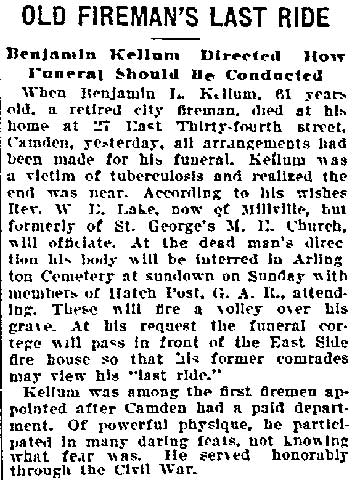
Benjamin Kellum Directed How Funeral Should Be Conducted
When Benjamin L. Kellum, 61 years old, a retired city fireman, died at his home at 27 East Thirty-fourth street, Camden, yesterday, all arrangements had been made for his funeral. Kellum was a victim of tuberculosis and realized that the end was near. According to his wishes Rev. W.E. Lake, now of Millville, but formerly of St. George’s M.E. Church, will officiate. At the dead man’s direction his body will be interred in Arlington Cemetery at sundown on Sunday with members of Hatch Post, G.A.R., attending. These will fire a volley over his grave. At his request the funeral cortege will pass in front of the East Side fire house so that his former comrades may view his “last ride.”
Kellum was among the first firemen appointed after Camden had a paid department. Of powerful physique, he participated in many daring feats, not knowing what fear was. He served honorably through the Civil War.
Fireman Buried as He Desired
Philadelphia Inquirer —
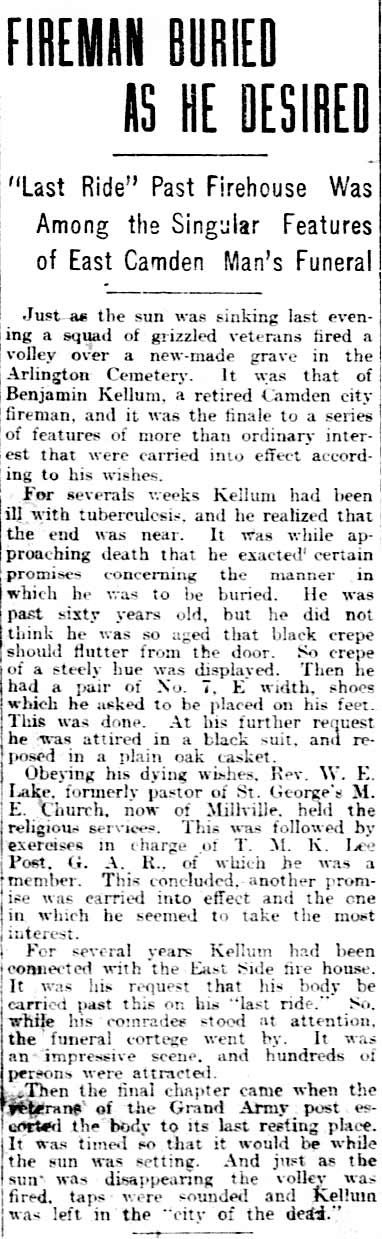
“Last Ride” Past Firehouse Was Among the Singular Features of East Camden Man’s Funeral
Just as the sun was sinking last evening a squad of grizzled veterans fired a volley over a new-made grave in the Arlington Cemetery. It was that of Benjamin Kellum, a retired Camden city fireman, and it was the finale to a series of features of more than ordinary interest that were carried into effect according to his wishes.
For several weeks Kellum had been ill with tuberculosis, and he realized that the end was near. It was while approaching death that he exacted certain promises concerning the manner in which he was to be buried. He was past sixty years old, but he did not think he was so aged that black crepe should flutter from the door. So crepe of a steely hue was displayed. Then he had a pair of No. 7, E width, shoes which he asked to be placed on his feet. This was done. At his further request he was attired in a black suit, and reposed in a plain oak casket.
Obeying his dying wishes, Rev. W.E. Lake, formerly pastor of St. George’s M.E. Church, now of Millville, held the religious services. This was followed by exercises in charge of T.M.K. Lee Post, G.A.R., of which he was a member. This concluded, another promise was carried into effect and the one in which he seemed to take the most interest.
For several years Kellum had been connected with the East Side fire house. It was his request that his body be carried past this on his “last ride.” So, while his comrades stood at attention, the funeral cortege went by. It was an impressive scene, and hundreds of persons were attracted.
Then the final chapter came when the veterans of the Grand Army post escorted the body to its last resting place. It was timed so that it would be while the sun was setting. And just as the sun was disappearing the volley was fired, taps were sounded and Kellum was left in the “city of the dead.”
Photographs
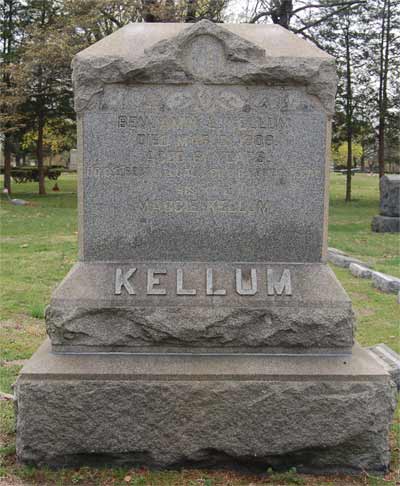
Benjamin L. Kellum