John H. Mathis & Company Ship Yard
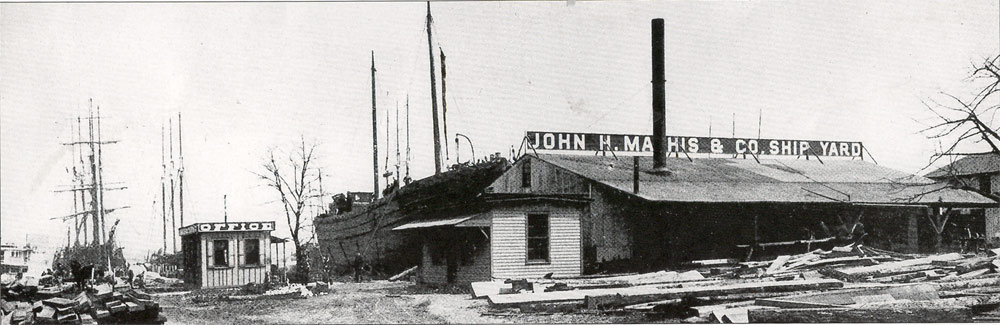
The John H. Mathis & Company Ship Yard — circa 1906
The John H. Mathis shipyard at Point & Erie Streets in Camden was known far and wide for its yachts and also produced ships for the Navy and Coast Guard. Famed yacht designer John Trumpy began building yachts at the Mathis yard in 1910, and remained there until he opened his own shipyard up in Maryland. During World War II a variety of ships were built, including minesweepers, transports, Coast Guard cutters, and ferries, among others.
The Mathis Shipyard closed in the 1960s. The Mathis Shipyard was later used by a firm called Camden Ship Repair.
One Mathis built ship, the Navy Ferry YFB-83, completed in April of 1949, remains in with the Navy today. Stationed in Hawaii. She is capable of ferrying 135 tons of cargo, and is used to shuttle personnel and equipment between Ford Island and the Mainland.
Another notable Mathis-built ship is the USS Sequoia AG-23, which served as a Presidential Yacht for Herbert Hoover and remained in naval service until 1977.
Historical and Industrial Review of Camden, N.J. — 1890
Historical and Industrial Review of Camden, N.J. — 1890
MORRIS & MATHIS, SHIPYARD, COOPER’S POINT.
PERHAPS none of the firms connected with the various ship-yards and marine railways at Cooper’s Point are better or more favorably know to the maritime community than Messrs. Morris & Mathis, whose yards are among the largest and best equipped in this line. The property has a frontage on the river of about 1,500 feet, and the facilities are of the best, comprising all the necessary plant and conveniences for both building and repairing all classes of wooden vessels, as well as a fully equipped marine railway, capable of hauling out any sailing vessel arriving at the port of Philadelphia.
The firm commenced business in 1876, and have conducted a most successful trade down to the present time, especially in the department of repairing, which is a most important branch of the business.
The members of the firm are Messrs. Joseph I. Morris and John S. Mathis, both of whom are practical ship-builders, and stand high in the maritime community. They are no less business men of vim and ability, and are influential Camden citizens.
Camden News Notes
Philadelphia Inquirer —
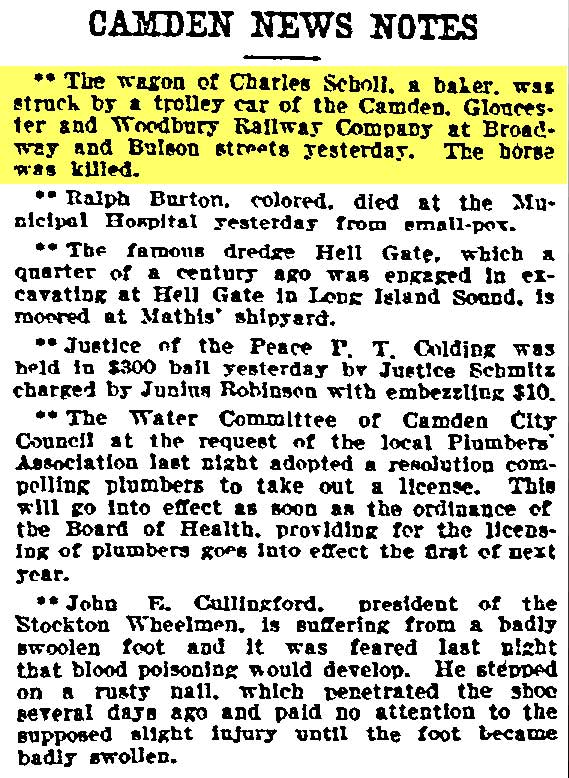
** The wagon of Charles Scholl, a baker, was struck by a trolley car of the Camden, Gloucester and Woodbury Railway Company at Broadway and Bulson streets yesterday. The horse was killed.
** Ralph Burton, colored, died at the Municipal Hospital yesterday from small-pox.
** The famous dredge Hell Gate, which a quarter of a century ago was engaged in excavating at Hell Gate in Long Island Sound, is moored at Mathis’ shipyard.
** Justice of the Peace P. T. Colding was held in $300 bail yesterday by Justice Schmitz charged by Junius Robinson with embezzling $10.
** The Water Committee of Camden City Council at the request of the local Plumbers’ Association last night adopted a resolution compelling plumbers to take out a license. This will go into effect as soon as the ordinance of the Board of Health, providing for the licensing of plumbers goes into effect the first of next year.
** John F. Cullingford, president of the Stockton Wheelmen, is suffering from a badly swollen foot and it was feared last night that blood poisoning would develop. He stepped on a rusty nail, which penetrated the shoe several days ago and paid no attention to the supposed slight injury until the foot became badly swollen.
Philadelphia Inquirer — December 9, 1903. Mentions Carl Scholl, Broadway, Camden Municipal Hospital, and Mathis Shipyard.
Philadelphia Inquirer — September 10, 1910
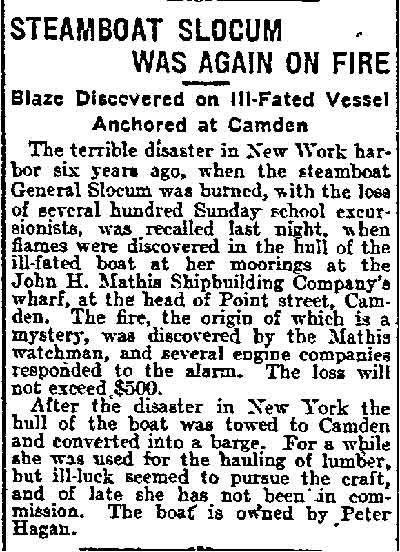
Philadelphia Inquirer — September 10, 1910. Mentions S.S. General Slocum, Mathis Shipyard, and Point Street.
Brass Stolen From Armour Boat
Philadelphia Inquirer —
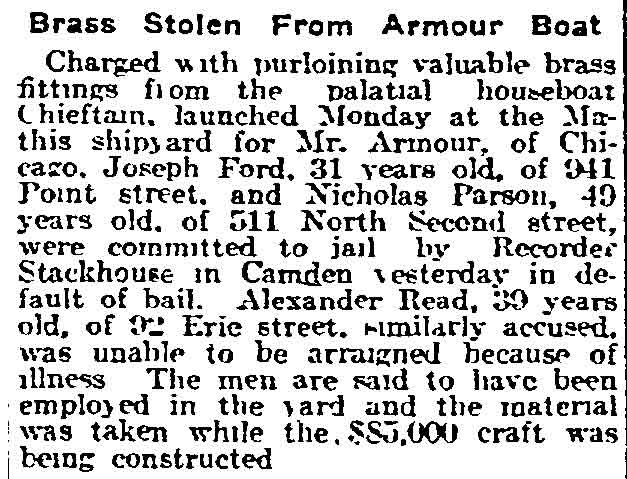
Charged with purloining valuable brass fittings from the palatial houseboat Chieftain, launched Monday at the Mathis shipyard for Mr. Armour, of Chicago, Joseph Ford, 31 years old, of 941 Point street, and Nicholas Parson, 49 years old, of 511 North Second street, were committed to jail by Recorder Stackhouse in Camden yesterday in default of bail. Alexander Read, 39 years old, of 92 Erie street, similarly accused, was unable to be arraigned because of illness. The men are said to have been employed in the yard and the material was taken while the $85,000 craft was being constructed.
Photos
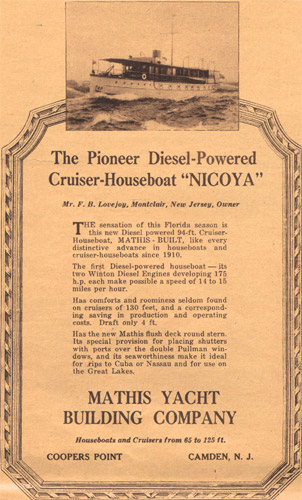
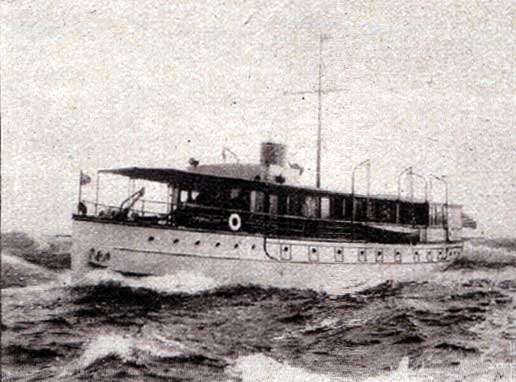
Mathis Shipyard, 1928
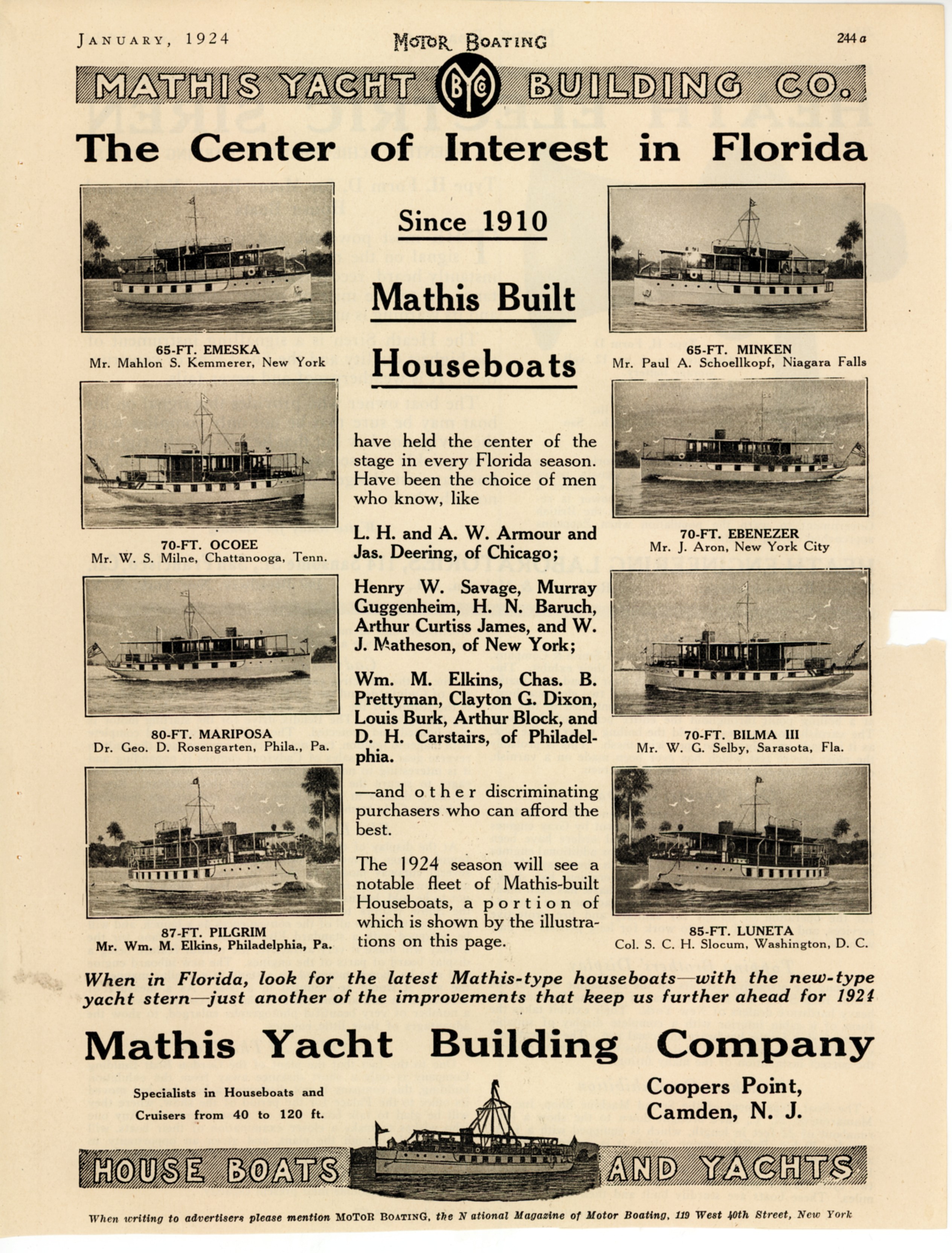
JANUARY, 1924 MOTOR BOATING 244 a
MATHIS YACHT BUILDING CO.
The Center of Interest in Florida
Since 1910
Mathis Built Houseboats
have held the center of the stage in every Florida season. Have been the choice of men who know, like
L. H. and A. W. Armour and Jas. Deering, of Chicago;
Henry W. Savage, Murray Guggenheim, H. N. Baruch, Arthur Curtiss James, and W. J. Matheson, of New York;
Wm. M. Elkins, Chas. B. Prettyman, Clayton G. Dixon, Louis Burk, Arthur Block, and D. H. Carstairs, of Philadelphia.
—and other discriminating purchasers who can afford the best.
The 1924 season will see a notable fleet of Mathis-built Houseboats, a portion of which is shown by the illustrations on this page.
65-FT. EMESKA
Mr. Mahlon S. Kemmerer, New York
65-FT. MINKEN
Mr. Paul A. Schoellkopf, Niagara Falls
70-FT. OCOEE
Mr. W. S. Milne, Chattanooga, Tenn.
70-FT. EBENEZER
Mr. J. Aron, New York City
80-FT. MARIPOSA
Dr. Geo. D. Rosengarten, Phila., Pa.
70-FT. BILMA III
Mr. W. G. Selby, Sarasota, Fla.
87-FT. PILGRIM
Mr. Wm. M. Elkins, Philadelphia, Pa.
85-FT. LUNETA
Col. S. C. H. Slocum, Washington, D. C.
When in Florida, look for the latest Mathis-type houseboats—with the new-type yacht stern—just another of the improvements that keep us further ahead for 1924
Mathis Yacht Building Company
Specialists in Houseboats and Cruisers from 40 to 120 ft.
Coopers Point, Camden, N. J.
HOUSE BOATS AND YACHTS
When writing to advertisers please mention MOTOR BOATING, the National Magazine of Motor Boating, 119 West 40th Street, New York
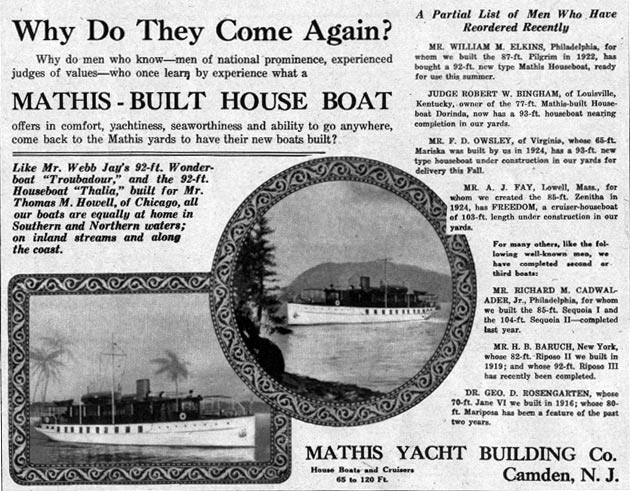
“Why Do They Come Again?” — Mathis Yacht Building Co. advertisement, Camden Courier-Post, July 5, 1926
USS Sequoia AG-23
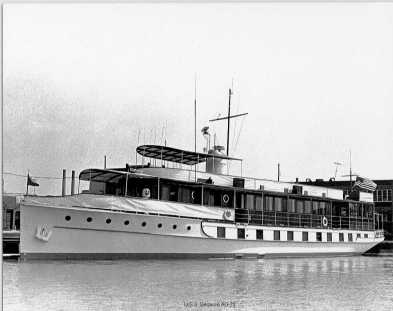
USS Sequoia AG-23 (Fifth Presidential Yacht)
The USS Sequoia was classified as an “Auxiliary—Miscellaneous” vessel with 100 tons displacement; length on water line, 99 feet, extreme beam at water line, 18 feet 2 inches. The Mathis Yacht Shipbuilding Company, Camden, New Jersey built her, in 1925. This vessel was taken over by the Navy from the Department of Commerce on March 25, 1933 and placed in commission on that date at Annapolis, Maryland. She was assigned to the Washington Navy Yard where she was fitted out as the Presidential Yacht. President Roosevelt made cruises in her during the period 1933–1935.
President Hoover spent his last Christmas in office aboard the Sequoia.
PYc-21 Alabaster

July 1945, USS Alabaster at anchor in San Pedro Bay, Philippine Islands while at Navy Yard for modification. The 3” bow gun and .50 cal. MG were replaced by 5–20 mm guns and 1–40 mm on the stern. Photo by Vincent Balderston (ex-ChMoMM USN), who served aboard Alabaster from January 25, 1942 until August 23, 1945, via Ralph L. Givens.
Built 1932 as the yacht Alamo by the Mathis Yacht Building Co., Camden, NJ; Renamed Rellimpa, Ranley and Ronaele before being acquired by the Navy, 3 January 1942; Converted for Naval service at Philadelphia Navy Yard; Commissioned USS Alabaster (PYc-21), 31 January 1942; Decommissioned, 17 December 1945 at San Pedro, CA; Struck from the Naval Register, 21 January 1946; Transferred to the Maritime Commission for disposal (date unknown); Sold by the Maritime Commission, 9 April 1947 to Lyman A. Whitney, San Diego, CA. Fate unknown.
Specifications: Displacement 385 t.; Length 148’; Beam 23’; Draft 8’ 3”; Speed 14.5k; Complement 48; Armament one single 3.”50 gun mount, two .50 cal. machine guns, two depth charge tracks; Propulsion two Winton diesel engines, two shafts.
Ronaele—a yacht built in 1932 at Camden, N.J., by the Mathis Yacht Building Co.—was acquired by the Navy on 3 January 1942; renamed Alabaster on 13 January 1942 and simultaneously classified a coastal patrol yacht and designated PYc–21; converted by the Philadelphia Navy Yard for naval service; and commissioned on 31 January 1942, Lt. Comdr. A. F. Edel, USNR, in command.
Assigned to the Inshore Patrol and based at the section base at Cape May, N.J., Alabaster began patrolling the coast of the United States from Delaware Bay to Chesapeake Bay early in February and continued that assignment through the remainder of 1942 and most of 1943. In September 1943, the Navy decided to convert the vessel to an antisubmarine warfare (ASW) training platform. She spent the next two months in the Philadelphia Navy Yard receiving the modifications needed to prepare her to carry out her new mission. On 30 November, she stood out of Philadelphia, bound for the Naval Air Station, Quonset Point, RI. The following day, the patrol yacht reported for duty with the Commander, Antisubmarine Development, Atlantic Fleet, at Quonset Point and began a month of training to ready her crew for the new assignment.
On 5 January 1944, she completed her training and received orders to report to the Commander, Eastern Sea Frontier for routing to the Canal Zone. Alabaster departed Cape May on 10 January and steamed—via Charleston, Miami, and Guantanamo Bay—to Balboa, Canal Zone, where she arrived on the 25th. The ship reported for duty with the 7th Fleet and got underway on 1 February with an oil tanker bound for Australia. The patrol yacht entered port at Cairns, Australia, on St. Patrick’s Day, but put to sea again on 25 March. The little warship arrived in Milne Bay, New Guinea, where she remained for about three months instructing Navy men in the use of various ASW devices. In mid-June, she moved to Seeadler Harbor at Manus in the Admiralty Islands where she resumed ASW training duties. On 19 October, she departed Manus to return to New Guinea and dropped anchor at Hollandia on the 21st. She remained at that base until the end of January 1945, providing ASW training services and making emergency repairs to radar and sonar equipment. On 31 January 1945, she weighed anchor and shaped a course for the Philippines. Alabaster arrived in San Pedro Bay, Leyte, on 6 February and resumed her previous training and repair missions.
The end of the war in mid-August 1945 found her still at Leyte, and she was then declared surplus to the needs of the Navy. The yacht cleared San Pedro Bay to return to the United States. Steaming via Eniwetok and Pearl Harbor, Alabaster entered port at San Pedro, Calif., on 25 October. She remained anchored in the bay at San Pedro until decommissioned on 17 December 1945. Her name was struck from the Navy list on 21 January 1946; and, on 9 April 1947, she was sold to Mr. Lyman A. Whitney, of San Diego.
The Minesweepers
In 1941 the Mathis Shipyard received a contract to build three 221’ Auk-class minesweepers, USS SWAY AM-120, USS SWERVE AM-121, and USS SWIFT AM-122.
USS SWERVE was mined and sunk off Anzio in 1944, and USS SWIFT was scrapped in 1972. USS SWAY was sold to Mexico and renamed Ignacio Miguel Altamirano, and remains in active service.
Aloe-Class Net Laying Ships
In 1941, the Mathis yard produced four Aloe-class net laying ships:
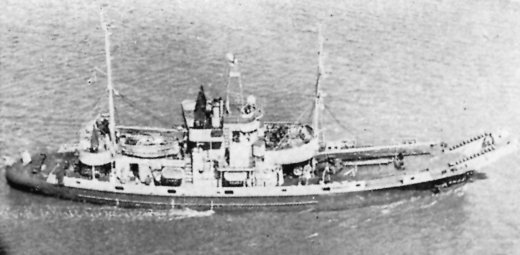
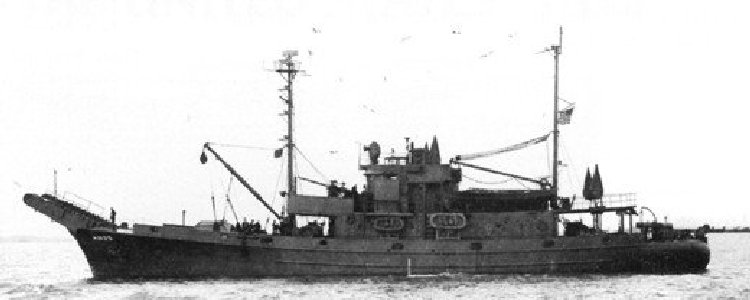
AN-34 Teaberry ex YN-29 — AN-35 Teak ex YN-30 — AN-36 Pepperwood ex YN-31 — AN-37 Yew ex YN-32
USS Teaberry and USS Teak
The Nautilus
In 1931 Sir Hubert Wilkins attempted to reach the North Pole by submarine. His ship, the Nautilus, was a World War I vintage American submarine, leased to Wilkins for the expedition. The Nautilus received her final modifications before the expedition at the Mathis Shipyard.
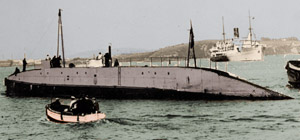
Nautilus being towed into Portsmouth, England
Wilkins’s Nautilus was not a state of the art submarine, nor was she specially built for the expedition. In the 1930s, most of the world’s submarines were dedicated to naval service, and most navies were reluctant to part with the few ships they had. In the wake of the London Naval Treaty, however, the United States was willing to part with a pre-World War I O-class submarine, the O-12 (hull number SS-73). Built in 1916 at the Lake Torpedo Boat Co., in Bridgeport, Connecticut, she was 175 feet long, with a beam of 16 feet 7 inches, and a draft of 13 feet 11 inches. Her top speed was 14 knots surfaced, and 11 knots submerged. Ironically, given the fate of the mission, Wilkins had been offered the O-13, but turned it down, feeling that the ship’s designation was a harbinger of bad luck.
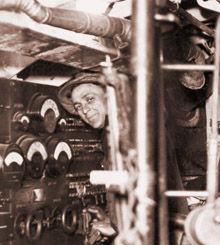
Crew members inside control room
The O-12 spent most of her career assigned to Submarine Division 1, based out of Coco Solo in the Panama Canal Zone. Her short naval career came to an end on June 17, 1924, when she was decommissioned and placed in reserve at the Philadelphia Navy Yard. Scheduled to be scrapped in accordance with the London Naval Treaty, the Secretary of the Navy turned her over to the U.S. Shipping Board who in turn chartered her to Lake & Danenhower, Inc., of Bridgeport, Connecticut, to be reconditioned for special arctic service. Since Wilkins was not an American citizen, the submarine could not be leased directly to him. The charter specified that a fee of $1 per year for five years was to be paid for her use, that the submarine would only be used for scientific research, and that she would be scrapped at the completion of the expedition.
Initial modifications were begun at the Philadelphia Navy Yard, but when that facility was unable to perform the required work the submarine was moved across the river to the Mathis Shipyard in Camden, New Jersey. Thirty-two new features were added to the boat, designed by the original builder, Simon Lake. These included a cushioned guide arm, a cushioning bowsprit 12 feet long to act as a bumper, an ice drill to provide access to the surface in case the submarine was unable to break through the ice, an emergency air intake system, and a diving chamber. The original superstructure was removed, and the conning tower and periscope were modified to be retractable. Lake also had the deck fittings enclosed within a wooden superstructure four feet wide and six feet high, inside of which he installed extra buoyancy chambers, which he considered necessary to prevent loss of stability during surfacing. On top of the superstructure Lake installed iron-shod “sledge runners” and two cleats at each end. Wilkins did not concur with all of the modifications introduced by Lake, fearing that they were more likely dangers than aids. A verbal agreement between the two men, however, gave Lake the final say.
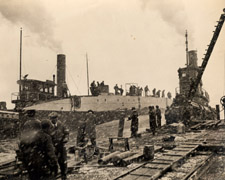
Nautilus leaving berth at Mathis Shipyard, Camden, NJ
Rechristened the Nautilus after Jules Verne’s fictional vessel, the boat’s record during the expedition was less than stellar. Plagued by mechanical difficulties and engine problems from the start, the crew were less than confident in their vessel’s capabilities. When Captain Danenhower noticed that the diving rudders were missing on August 22, he suspected sabotage by the crew, and as a result of the damage, many of the scientific experiments had to be cancelled. After spending some additional time in the arctic, Wilkins headed back to port in Bergen, Norway, having failed in his mission.
Since it was deemed suicidal to sail the Nautilus back to the United States, the submarine was turned over to the Bergen Shipping Company, and with the approval of the U.S. Shipping Board, she was scuttled in international waters off Norway on September 29. Even this ignominious fate did not come easy: the first attempt to sink the Nautilus had to be called off due to bad weather. She was finally sunk on November 20, 1931, in the fjord a short distance from Bergen. A number of ships accompanied the boat as she was towed to the site where a valve was opened in the forward tank. The Nautilus filled with water and sank at 12:00 noon. Fifty years later, a team of Norwegian divers from Sjøteknik A/S located the wreck of the submarine. She remains in very good condition, which has begun talk of raising her to display in the Bergen Maritime Museum.
The Washingtonian
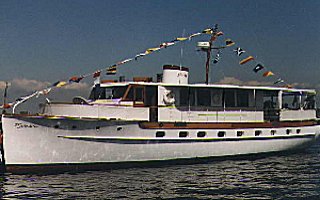
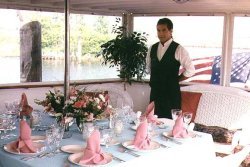
The Washingtonian (formerly The Lady) — a 63’ motor yacht built in 1939 at the historic Mathis Shipyard in Camden, NJ
The Washingtonian (formerly The Lady) — an impeccably maintained 63’ motor yacht built in 1939 at the historic Mathis Shipyard in Camden, NJ. She is certified by the US Coast Guard to accommodate up to 36 guests and can do so in complete comfort and safety.
She is Classic Elegance from the warmth of her 21” black walnut paneled saloon to her spacious aft deck adorned with wicker furniture. The ambiance created by the craftsmen of her time will most certainly conjure up images of another era.
She is owner operated and boasts her own gourmet chef with the ability to create the perfect menu suited to your special occasion ranging from hor d’oeurves with cocktails to an elaborate buffet table to a formal sit-down dinner (for up to 16 guests), and all in an style that only “The Washingtonian” can create. Musical entertainment and floral arrangements are available upon request.
She is available for cruises, morning afternoon or evening, as short as 2 hours or as long as a full day.
She will offer you and your guests that perfect setting to entertain in the graceful and elegant style of years past.
World War II Coast Guard-Manned U.S. Army Freight and Supply Ship Histories
Under a Joint Chiefs of Staff agreement signed 14 March 1944, the Coast Guard was designated to man certain small Army Transportation Corps vessels (with some already operating in the Southwest Pacific and manned at the time by civilians). The agreement reads: “The Coast Guard, due to decrease in category of defense in the United States, will have some personnel available to man ships and craft for which civilian personnel cannot be obtained.”
Five categories of Army vessels were specified for Coast Guard crews: AMRS (Army Marine Repair Ship), TY (tankers), LT (large tugs), FS (freight and supply vessels), and F (Freight vessels). The Coast Guard manned a total of 288 of these Army craft. One, the FS-34, was of the type “Design 277,” FS-140 through FS-234 were “Design 330,” and the rest were “Design 381.” The following are the FS Army vessels manned by Coast Guard crews:
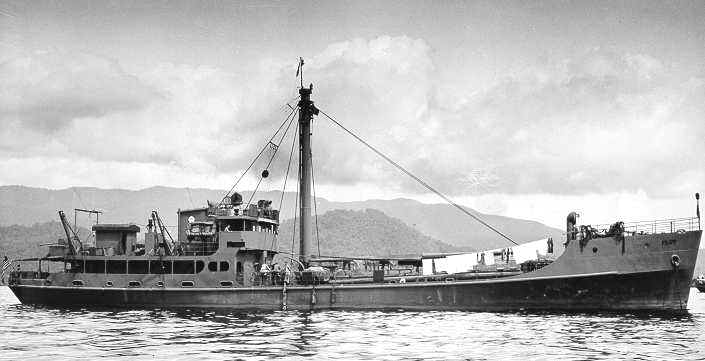
The Coast Guard-manned Army supply vessel USS FS-177. The famous movie Mister Roberts revolved around life on a FS vessel.
FS-311
The Coast Guard-manned Army vessel FS-311 was commissioned on 13 June 1944 at Mathis Shipyard, Camden, NJ with LTJG Kenneth P. Howard, USCGR, as commanding officer. On 17 July 1944, she departed New York for the Southwest Pacific where she operated during the war.
FS-314
The Coast Guard-manned Army vessel FS-314 was commissioned at Mathis Shipyard in Camden, New Jersey on 22 July 1944 with LTJG W. I. Mittendorf, USCGR, as commanding officer. On 4 September 1944 she departed New York. She was assigned to and operated in the Southwest Pacific during the war at Leyte and elsewhere.
FS-317
The Coast Guard-manned Army vessel FS-317 was commissioned 25 September 1944 at Mathis Shipyard, Camden, NJ with LT C.B. Christiansson as her first commanding officer. He was succeeded by LTJG T.B. Barron, USCGR, who in turn was succeeded on 14 November 1945 by LTJG J.V. Harrison, USCG. She departed New York on 22 October 1944 for the Southwest Pacific area where she operated during the war.
Rudder Magazine Index
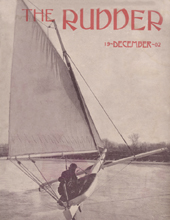
Cover of The Rudder Magazine from the collection at the Blunt White Library at Mystic Seaport. Rudder magazine was first published in 1891 and soon became one of the most important yachting and boating magazines available. This index, compiled initially by Library staff member and former Naval Commander Norman Clarke (1937–1996), concentrates on boat designs that appeared in the magazine through 1950.
Below are Mathis-built craft mentioned in Rudder:
| Type | Length | Name | Designer | Issue |
|---|---|---|---|---|
| cruiser | 36’3” | Deep Water | Geiger, Frederick C. | Jul 35:43 |
| cruiser | 77’ | Lady Baltimore | Bowes & Mower | Mar 15:118 |
| cruiser | 82’ | [no name] | Mathis Yacht Co. | Dec 10:320 |
| diesel cruiser | 126’ | Waleda II | Bowes, Thomas D. | Sep 29:51 |
| diesel cruiser | 140’ | Alamo | Tams, Inc. | Nov 31:57 |
| motor-sailer | 85’ | [no name] | Masterson-Schlegel | May 38:44 |
| schooner | 50’ | [no name] | Mower, Charles D. | Apr 33:40 |
| sloop | 30’ | Lodsen | Trumpy, John | Mar 34:47 |
| sloop | 46’6” | [no name] | Bowes, Thomas D. | Jun 35:49 |
USS Pilgrim II
Ferry Boat or Launch YFB-30: displacement 118; length 92’5”; beam 18’; draft 4’
Pilgrim II (YFB-30), a motor houseboat, was built for William H. Elkins of Philadelphia, Pa. in 1925 by the John H. Mathis Co., Camden, N.J. and acquired by the Navy from her owner 24 March 1942.
Converted for use as a river patrol boat by the Mathis Co. yard at Camden, Pilgrim II was assigned to the 4th Naval District and placed in service 28 April 1942 at the Philadelphia Navy Yard. Manned by a Coast Guard crew, she served as a Delaware River patrol craft through the end of the war.
Pilgrim II was struck from the Navy List and returned to her owner 10 June 1947.
Photos — Courtesy of Dave Boone
John H. Mathis & Company Ship Yard — photos courtesy of Dave Boone
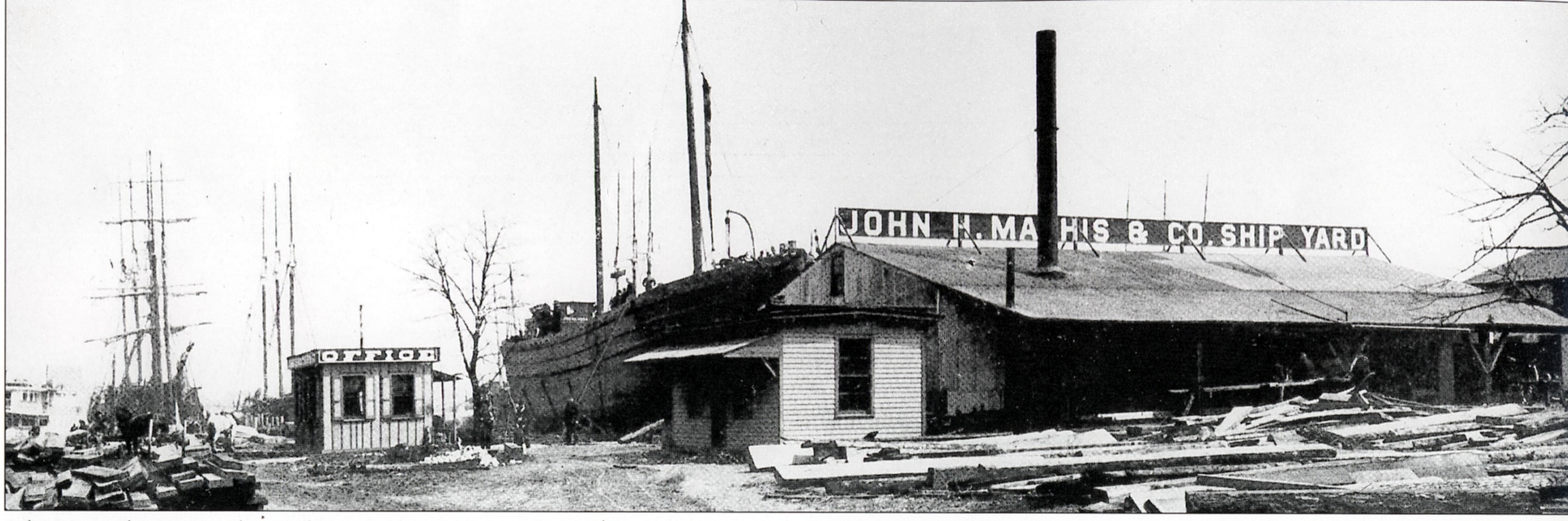
John H. Mathis & Company Ship Yard
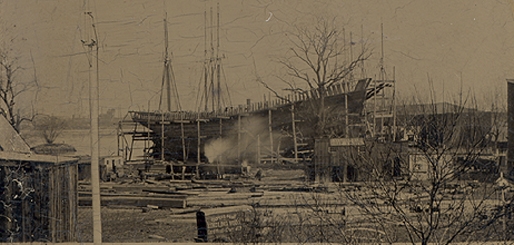
John H. Mathis & Company Ship Yard
The John H. Mathis & Company Ship Yard, circa 1906
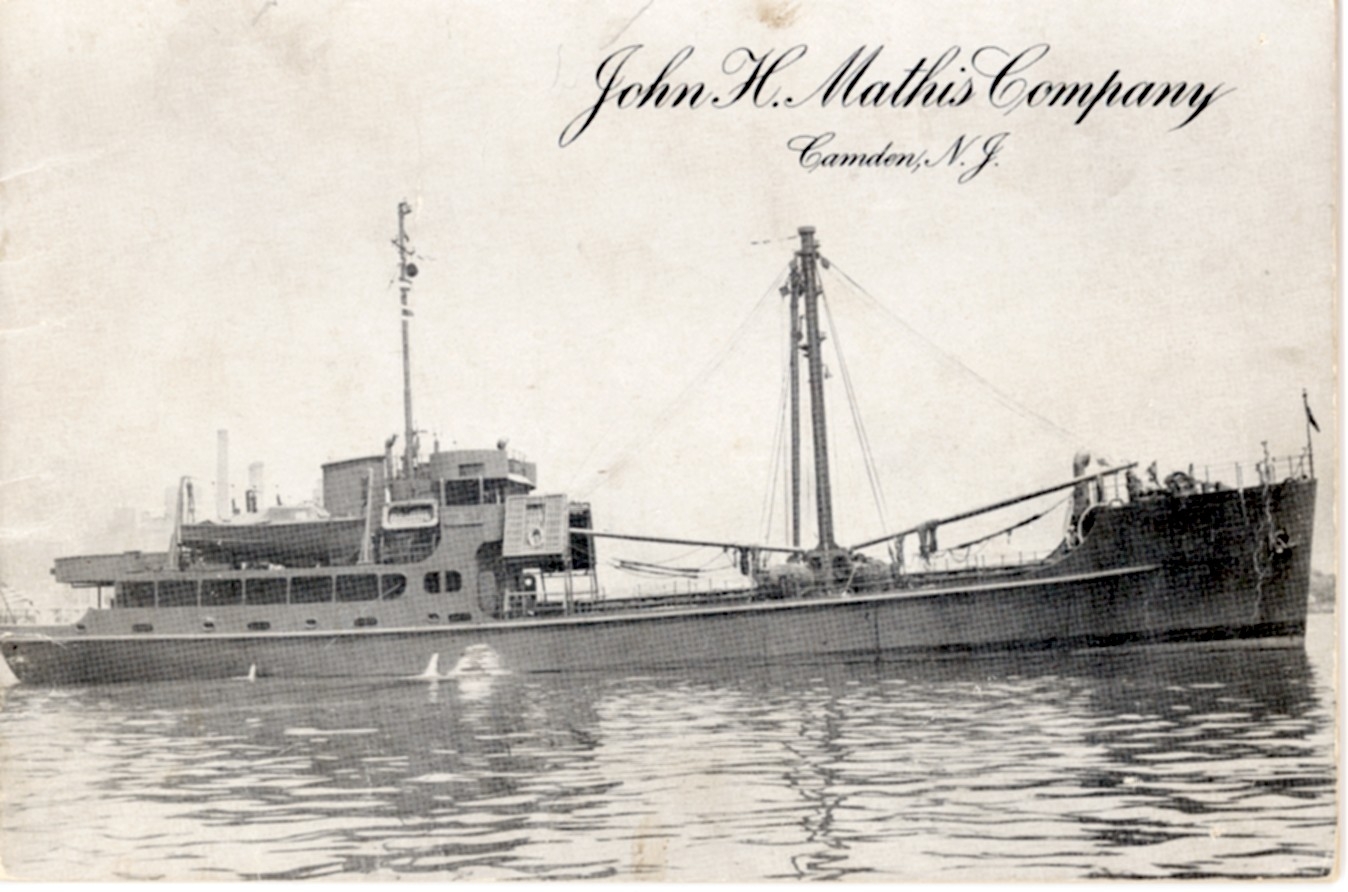
John H. Mathis Company
Camden, N.J.
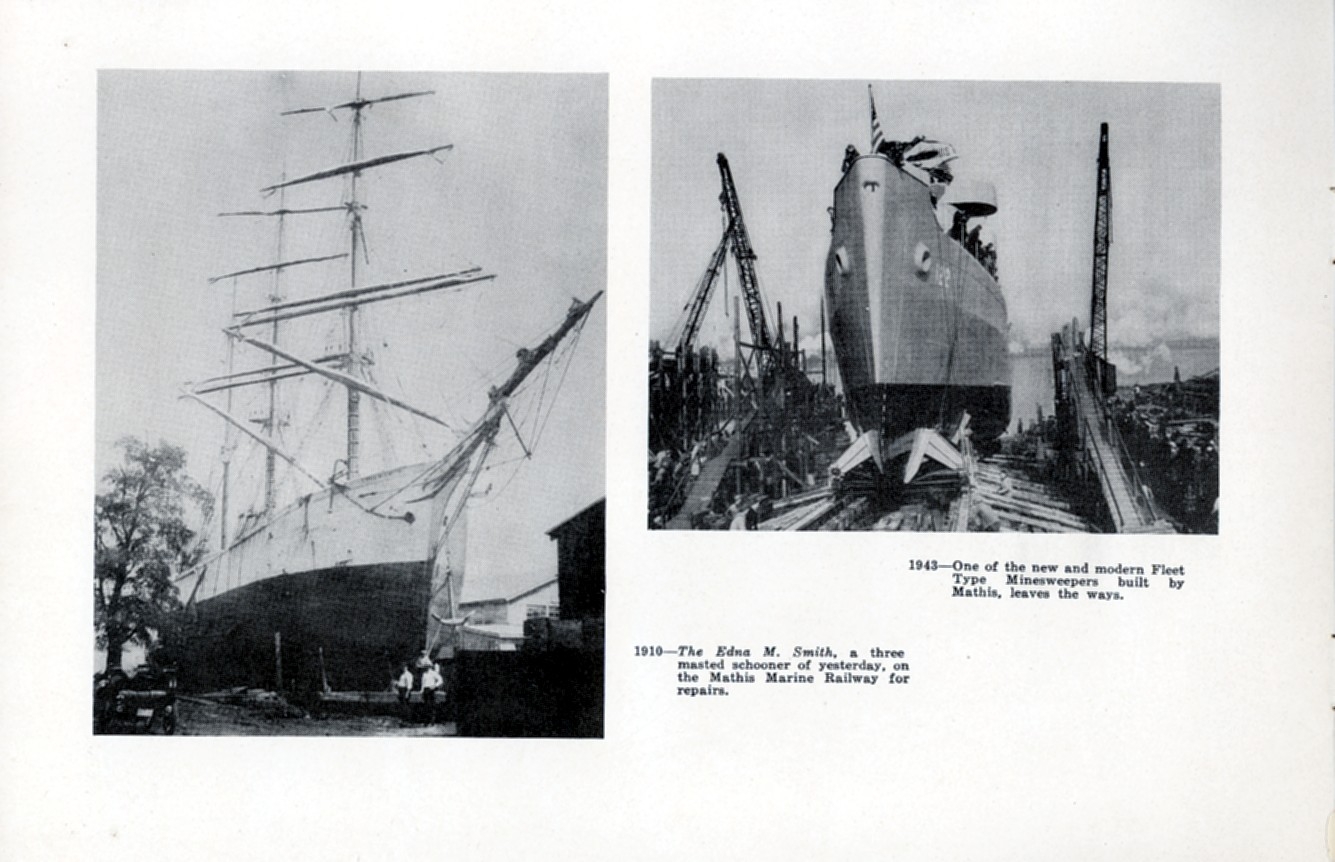
1910—The Edna M. Smith, a three masted schooner of yesterday, on the Mathis Marine Railway for repairs.
1943—One of the new and modern Fleet Type Minesweepers built by Mathis, leaves the ways.
SITUATED across the river from historic Philadelphia, the John H. Mathis ship yard is located approximately one mile north of the Delaware River Bridge, on the east bank.
During the British occupation of Philadelphia in 1777-78, Lt. Colonel Abercrombie used the present Mathis office building and yard site as his headquarters. Undoubtedly the Colonel selected this location because of its unusual relation to the river shipping facilities.
In 1930, Sir Hubert Wilkins' submarine expedition to the North Pole had its beginning in the Mathis yard. The famous "Nautilus" was converted for the expedition by us under the guidance of one of the world's greatest authorities on submarines, Simon Lake.
Other types of vessels built or converted by the Mathis Company include tugs, fishing trawlers, barges, cargo vessels, mine sweepers, net tenders, tankers, lighthouse tenders, car floats, lightships, landing craft and a hospital ship.
The Mathis name is an old one in the shipbuilding industry. With years of diversified experience building ships for peace and war this company has built a reputation for dependability and quality. The Mathis Company is equipped to build all classes of steel vessels up to 4000 tons.
The Mathis Marine Railway has been connected with shipping activities for years. Facilities include from design to delivery. Many of our craftsmen have been actively engaged in boat building in this location for the past quarter of a century.
In the future we will continue to build fine ships.
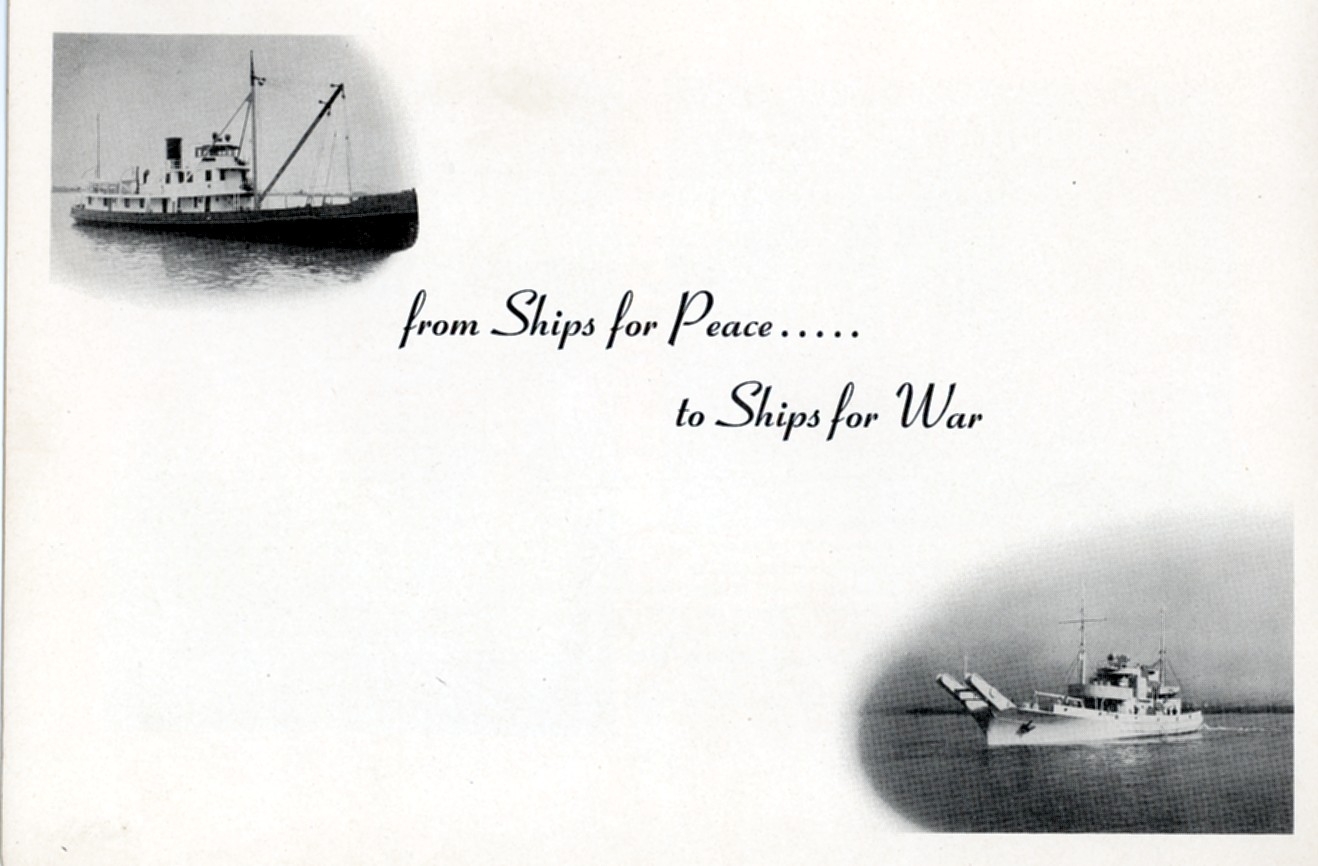
from Ships for Peace.....
to Ships for War
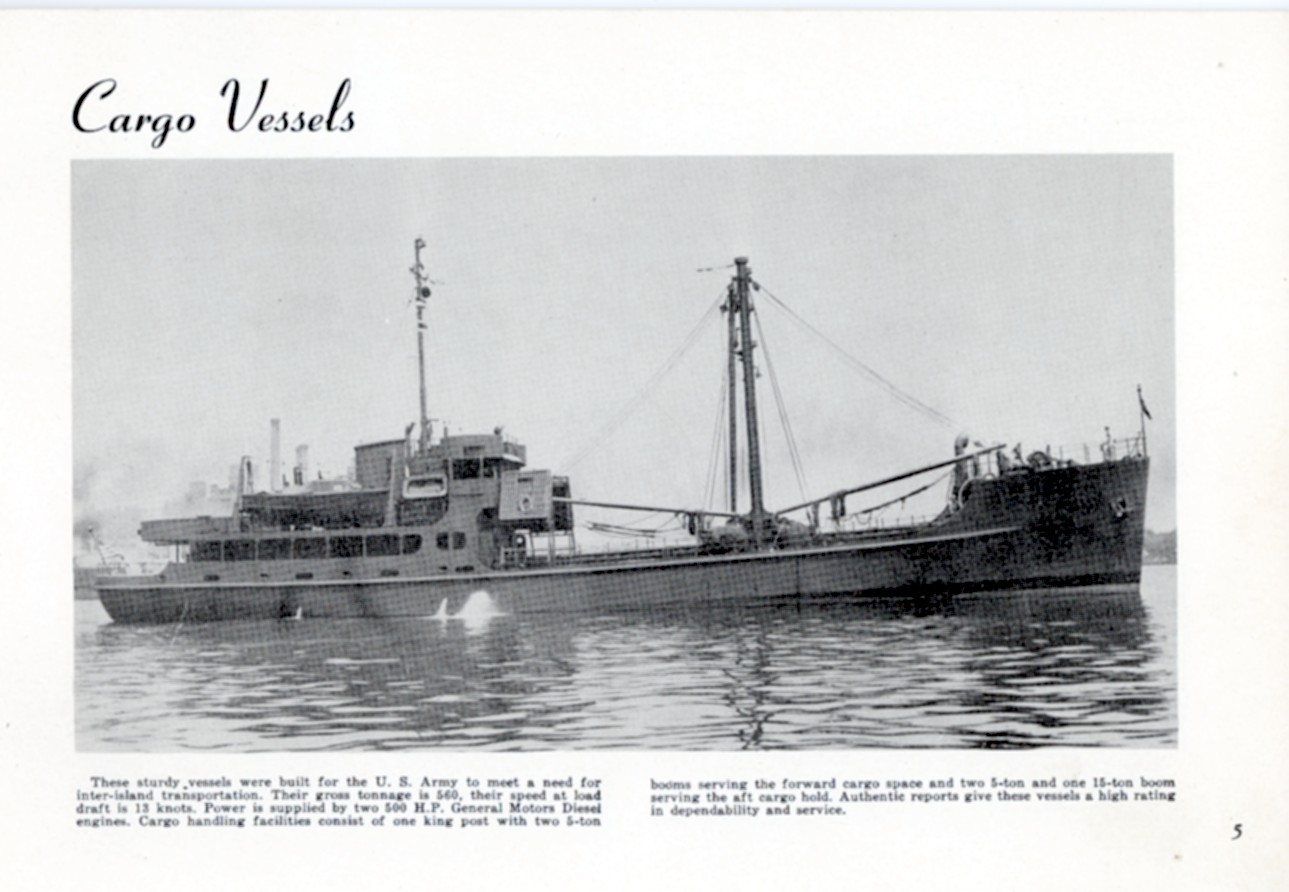
Cargo Vessels
These sturdy vessels were built for the U. S. Army to meet a need for inter-island transportation. Their gross tonnage is 560, their speed at load draft is 13 knots. Power is supplied by two 500 H.P. General Motors Diesel engines. Cargo handling facilities consist of one king post with two 5-ton booms serving the forward cargo space and two 5-ton and one 15-ton boom serving the aft cargo hold. Authentic reports give these vessels a high rating in dependability and service.
5
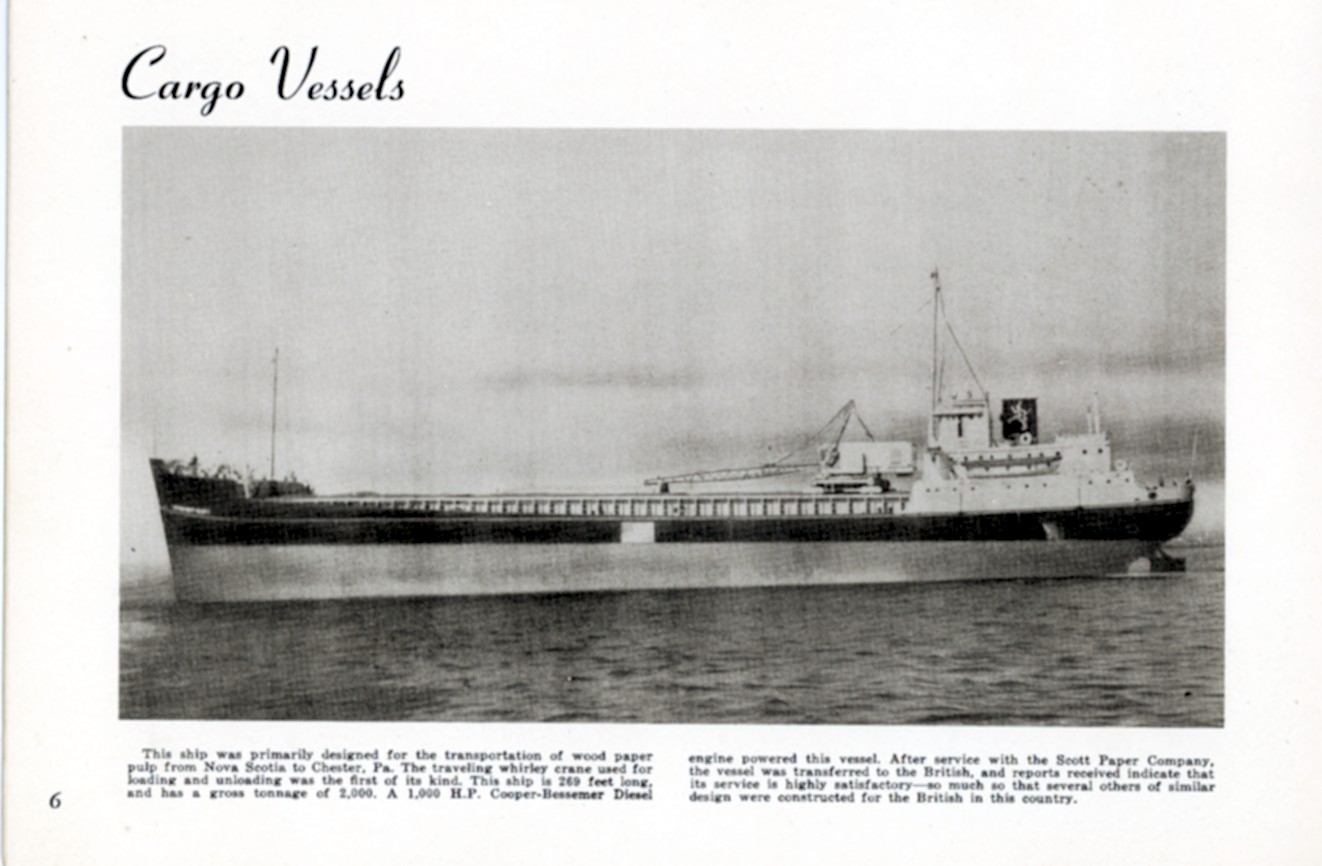
Cargo Vessels
This ship was primarily designed for the transportation of wood paper pulp from Nova Scotia to Chester, Pa. The traveling whirley crane used for loading and unloading was the first of its kind. This ship is 269 feet long, and has a gross tonnage of 2,000. A 1,000 H.P. Cooper-Bessemer Diesel engine powered this vessel. After service with the Scott Paper Company, the vessel was transferred to the British, and reports received indicate that its service is highly satisfactory—so much so that several others of similar design were constructed for the British in this country.
6
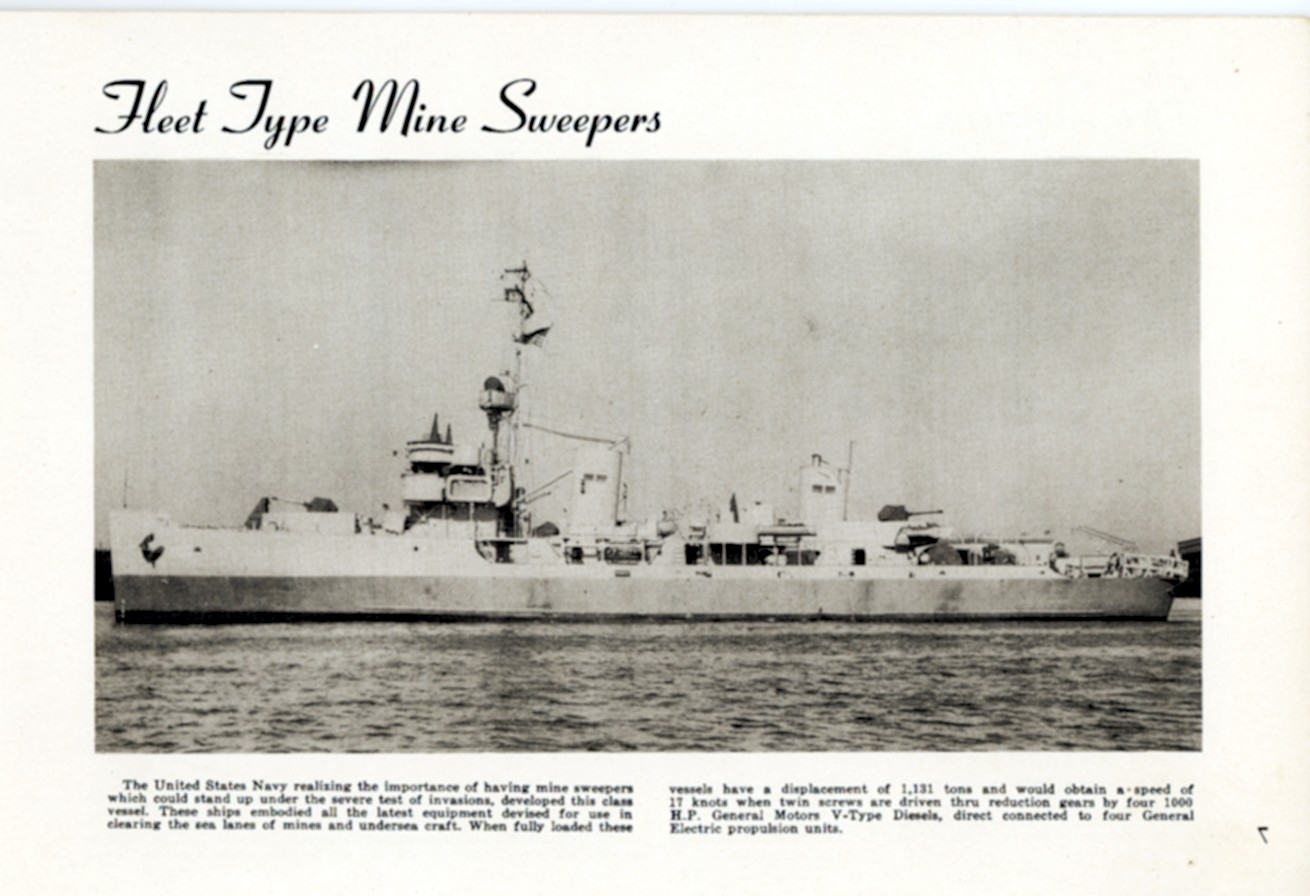
Fleet Type Mine Sweepers
The United States Navy realizing the importance of having mine sweepers which could stand up under the severe test of invasions, developed this class vessel. These ships embodied all the latest equipment devised for use in clearing the sea lanes of mines and undersea craft. When fully loaded these vessels have a displacement of 1,131 tons and would obtain a speed of 17 knots when twin screws are driven thru reduction gears by four 1000 H.P. General Motors V-Type Diesels, direct connected to four General Electric propulsion units.
7
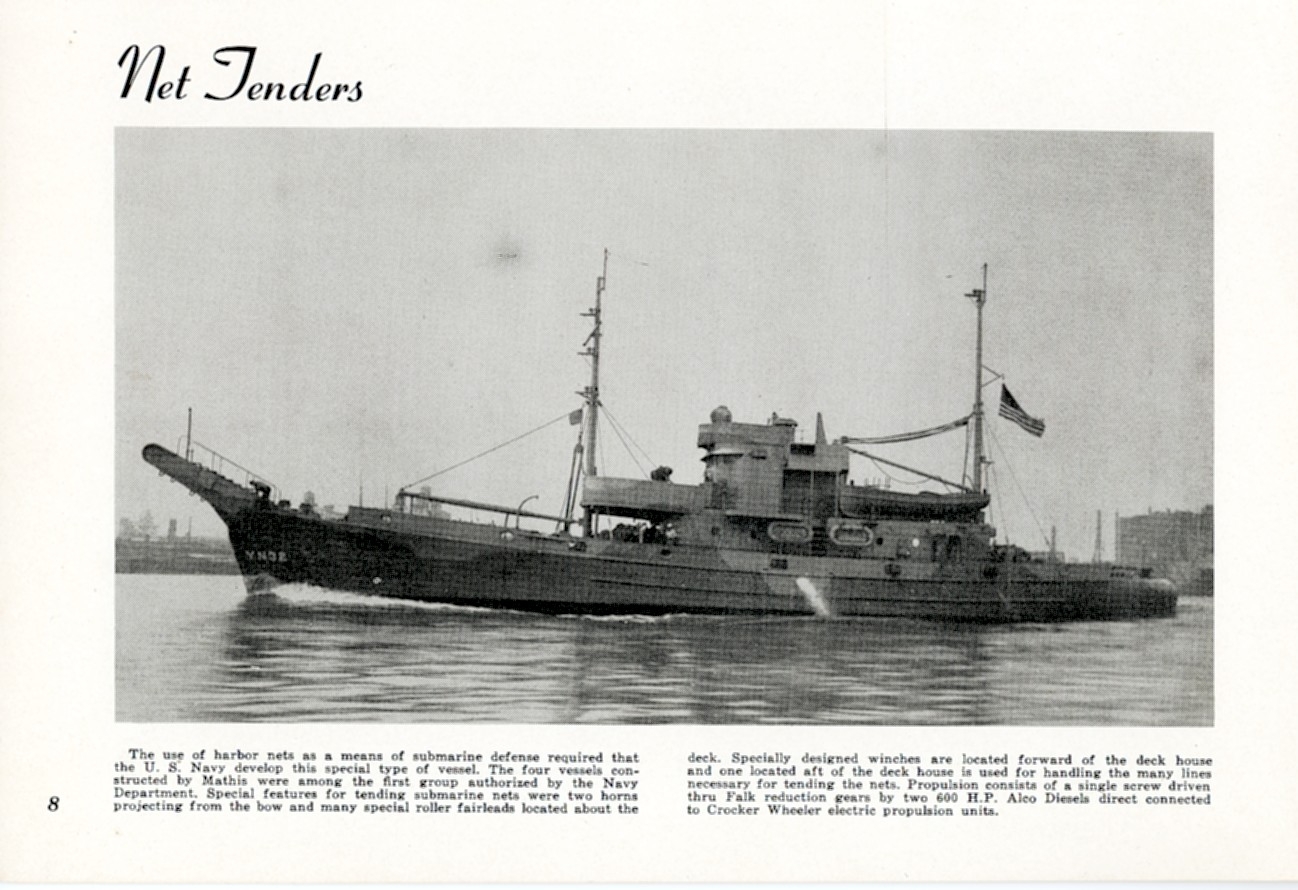
Net Tenders
The use of harbor nets as a means of submarine defense required that the U. S. Navy develop this special type of vessel. The four vessels constructed by Mathis were among the first group authorized by the Navy Department. Special features for tending submarine nets were two horns projecting from the bow and many special roller fairleads located about the deck. Specially designed winches are located forward of the deck house and one located aft of the deck house is used for handling the many lines necessary for tending the nets. Propulsion consists of a single screw driven thru Falk reduction gears by two 600 H.P. Alco Diesels direct connected to Crocker Wheeler electric propulsion units.
8
Patrol Boat
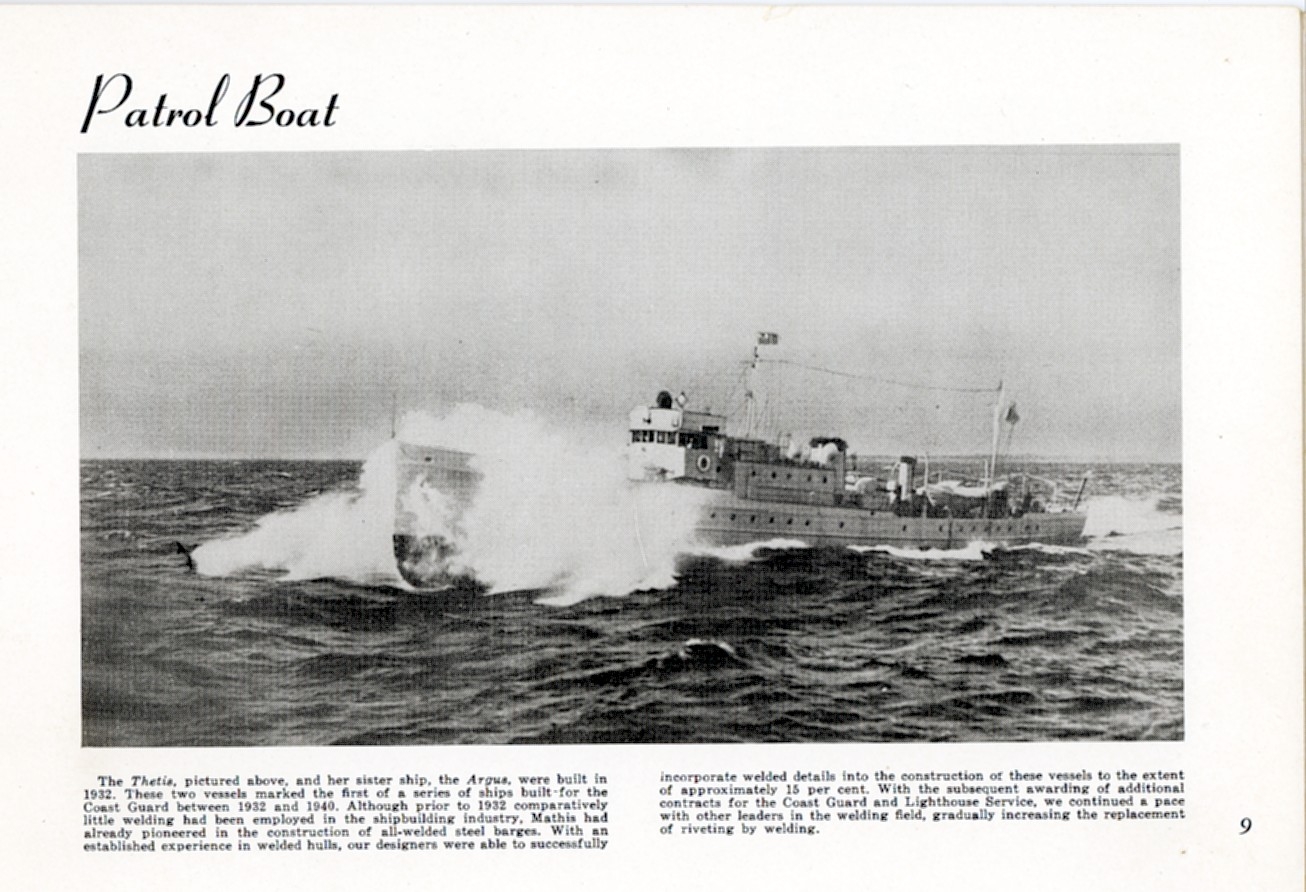
The Thetis, pictured above, and her sister ship, the Argus, were built in 1932. These two vessels marked the first of a series of ships built for the Coast Guard between 1932 and 1940. Although prior to 1932 comparatively little welding had been employed in the shipbuilding industry, Mathis had already pioneered in the construction of all-welded steel barges. With an established experience in welded hulls, our designers were able to successfully incorporate welded details into the construction of these vessels to the extent of approximately 15 per cent. With the subsequent awarding of additional contracts for the Coast Guard and Lighthouse Service, we continued a pace with other leaders in the welding field, gradually increasing the replacement of riveting by welding.
9
Lighthouse Tenders
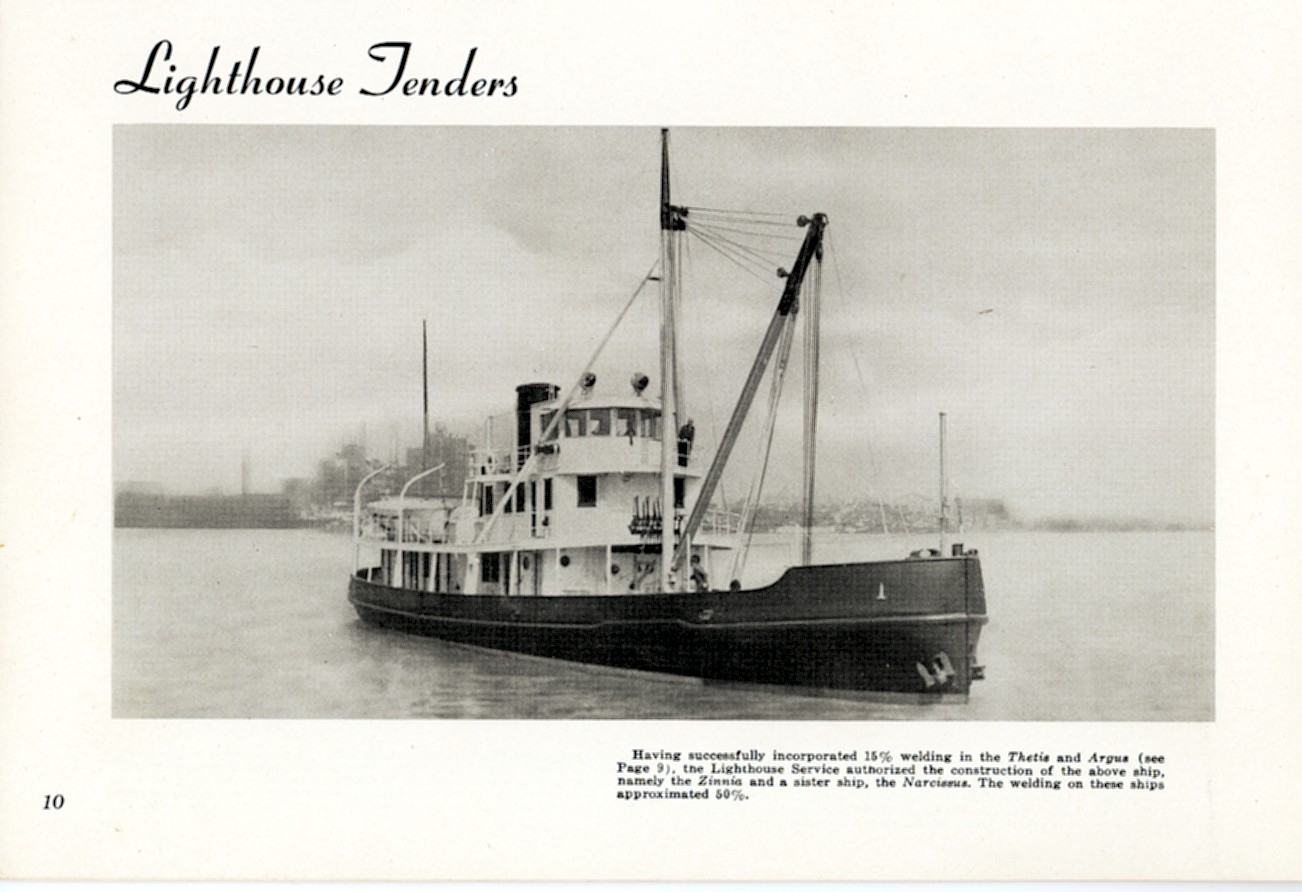
Having successfully incorporated 15% welding in the Thetis and Argus (see Page 9), the Lighthouse Service authorized the construction of the above ship, namely the Zinnia and a sister ship, the Narcissus. The welding on these ships approximated 50%.
10
Lighthouse Tenders
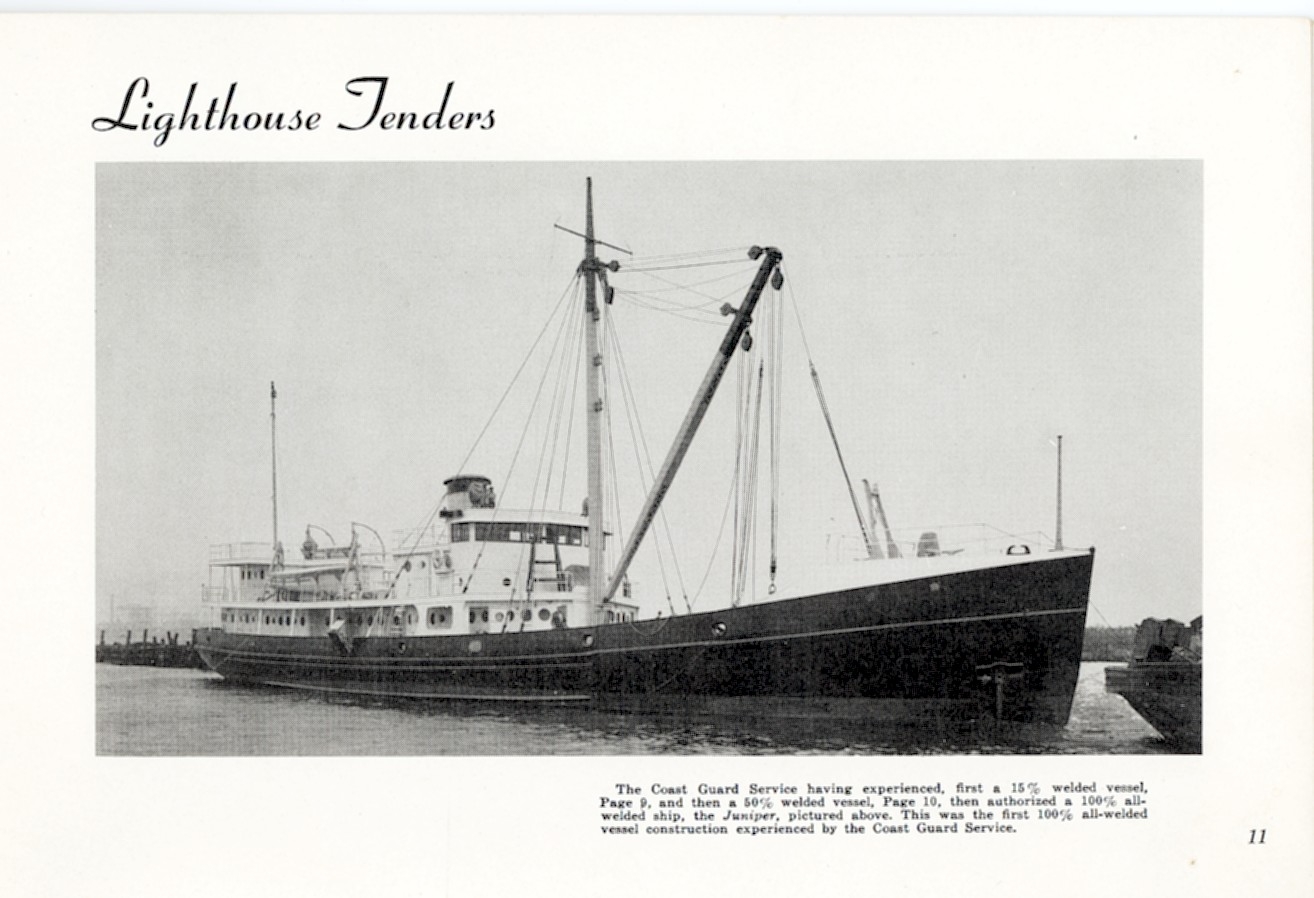
The Coast Guard Service having experienced, first a 15% welded vessel, Page 9, and then a 50% welded vessel, Page 10, then authorized a 100% all-welded ship, the Juniper, pictured above. This was the first 100% all-welded vessel construction experienced by the Coast Guard Service.
11
Hospital
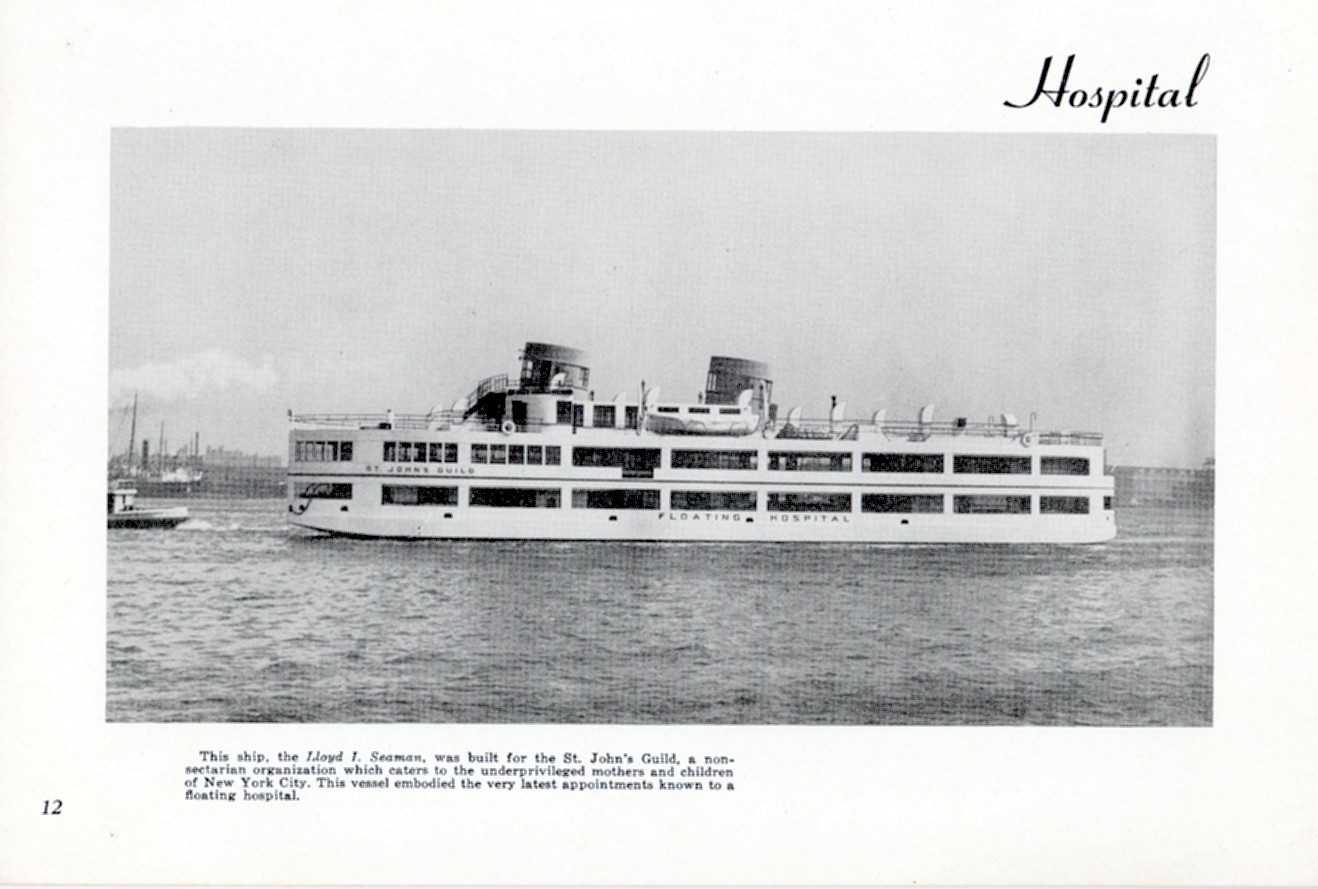
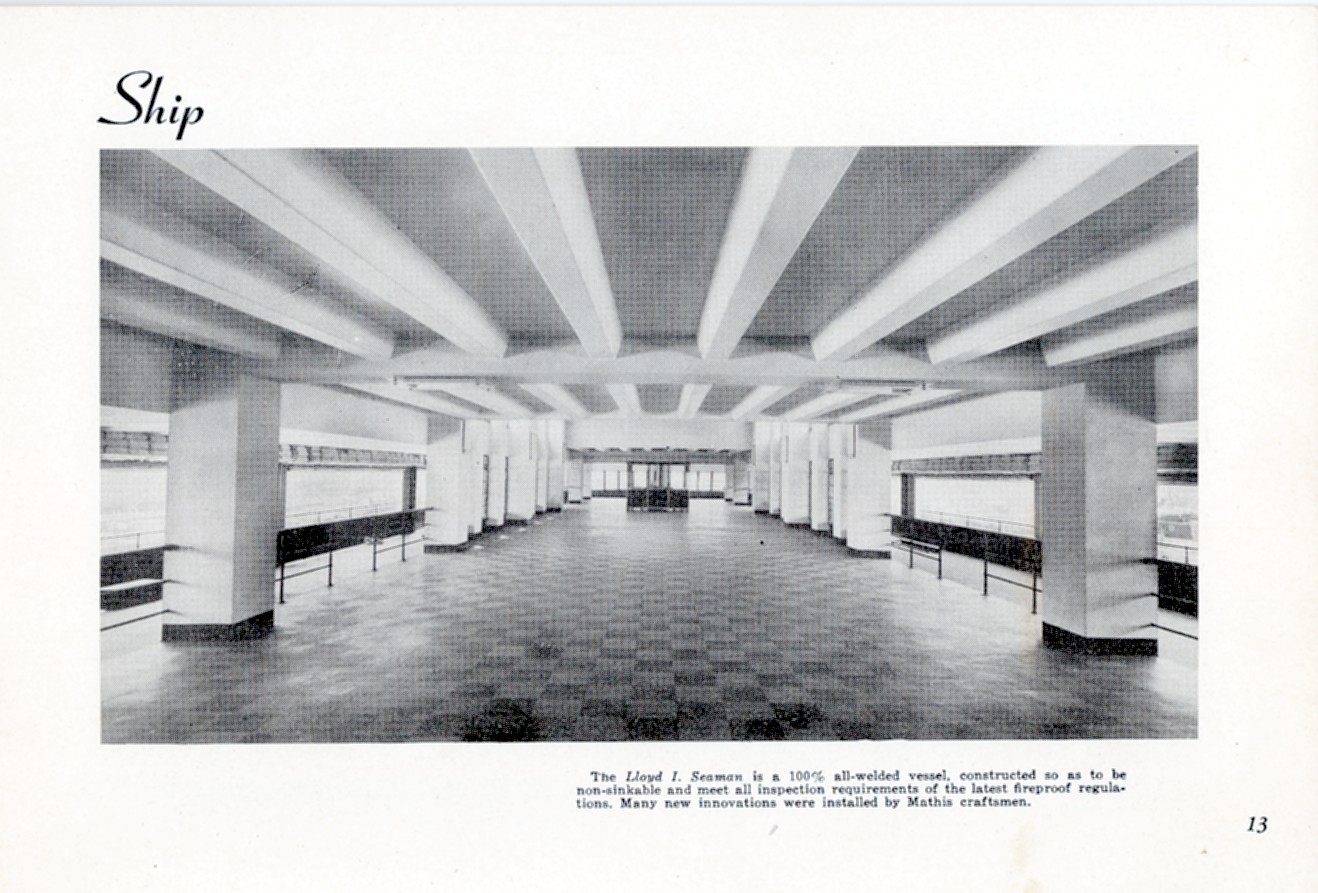
This ship, the Lloyd I. Seaman, was built for the St. John's Guild, a non-sectarian organization which caters to the underprivileged mothers and children of New York City. This vessel embodied the very latest appointments known to a floating hospital.
12
Ship
The Lloyd I. Seaman is a 100% all-welded vessel, constructed so as to be non-sinkable and meet all inspection requirements of the latest fireproof regulations. Many new innovations were installed by Mathis craftsmen.
13
Tankers
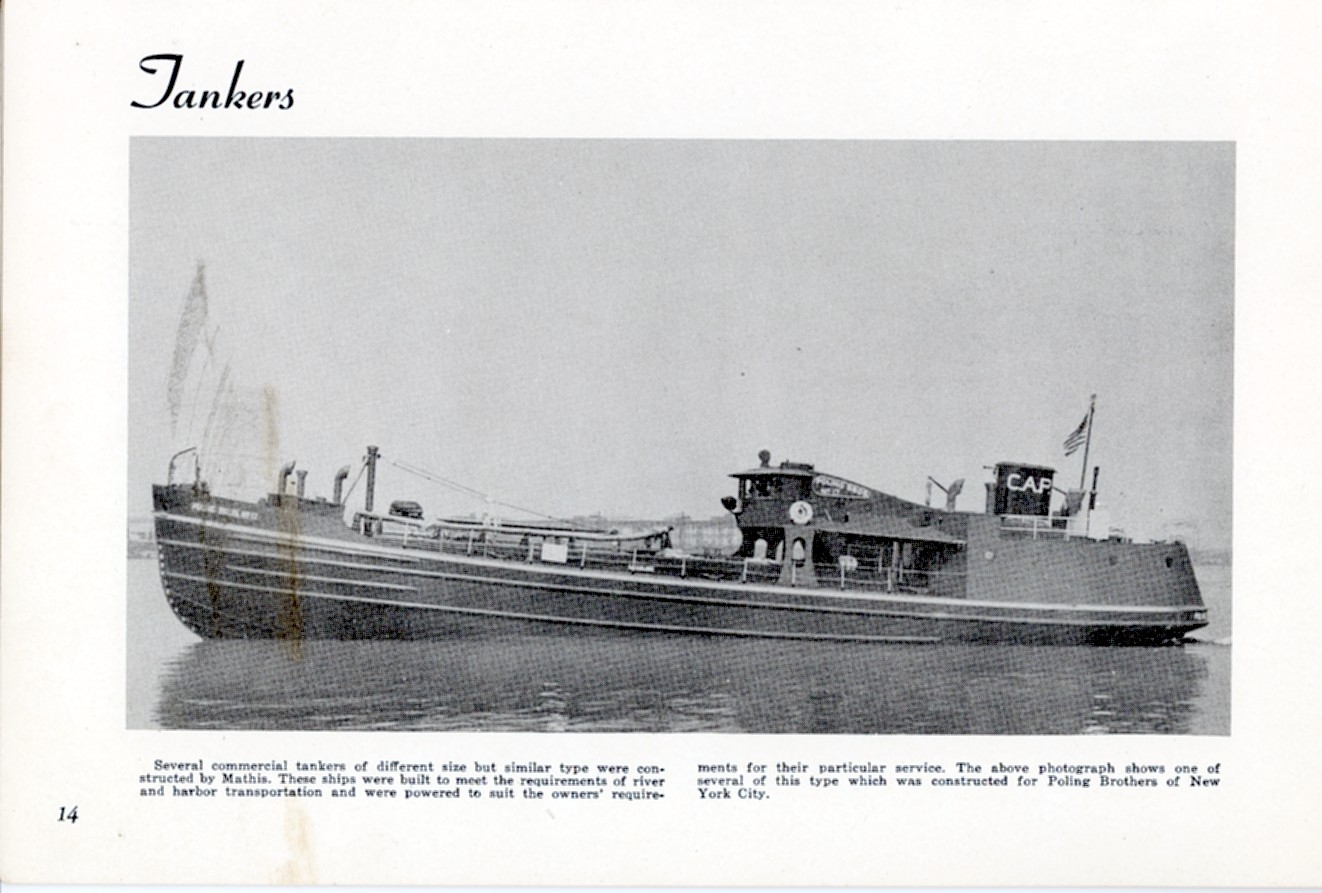
Several commercial tankers of different size but similar type were constructed by Mathis. These ships were built to meet the requirements of river and harbor transportation and were powered to suit the owners' requirements for their particular service. The above photograph shows one of several of this type which was constructed for Poling Brothers of New York City.
14
Tankers
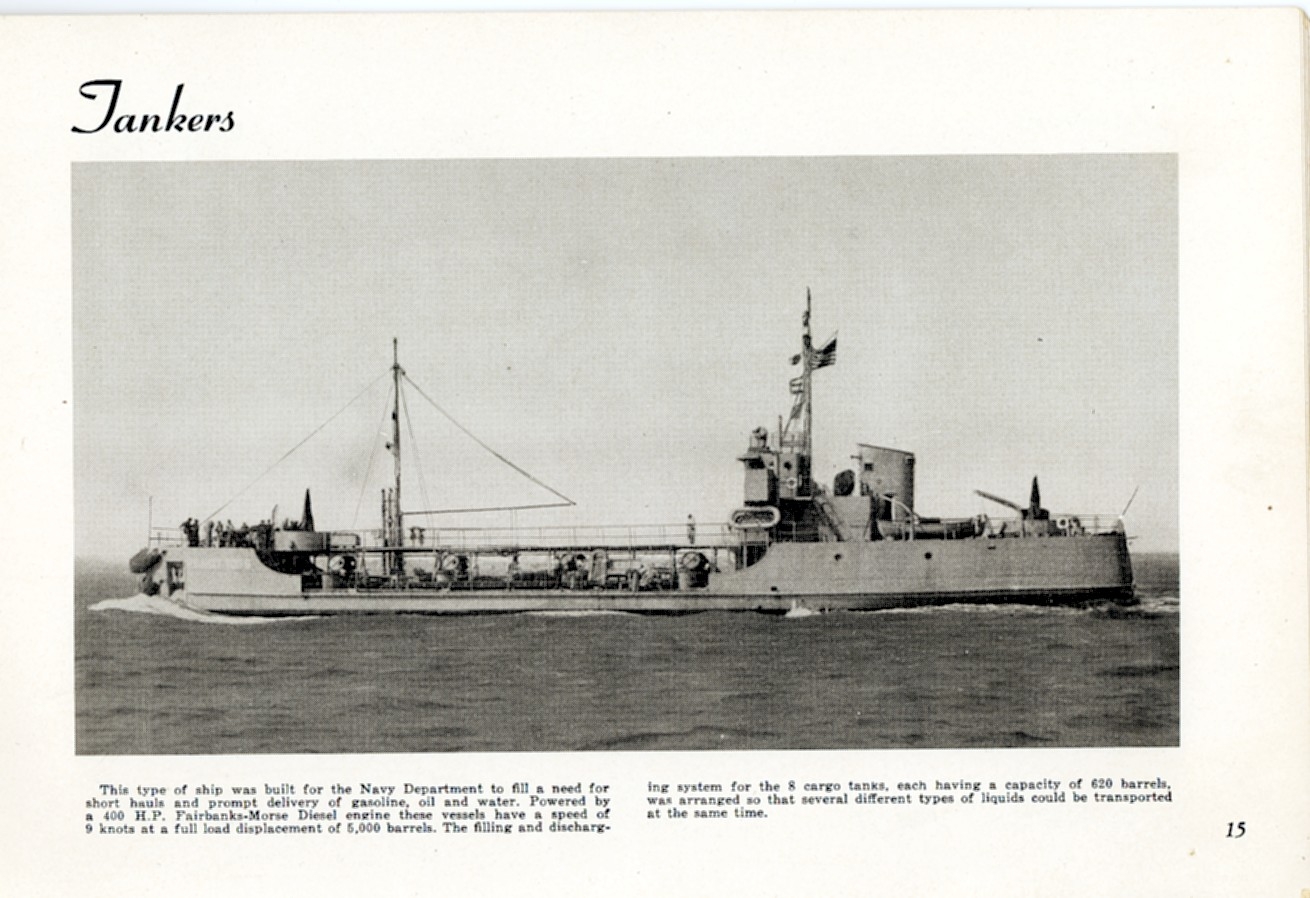
This type of ship was built for the Navy Department to fill a need for short hauls and prompt delivery of gasoline, oil and water. Powered by a 400 H.P. Fairbanks-Morse Diesel engine these vessels have a speed of 9 knots at a full load displacement of 5,000 barrels. The filling and discharging system for the 8 cargo tanks, each having a capacity of 620 barrels, was arranged so that several different types of liquids could be transported at the same time.
15
Tankers
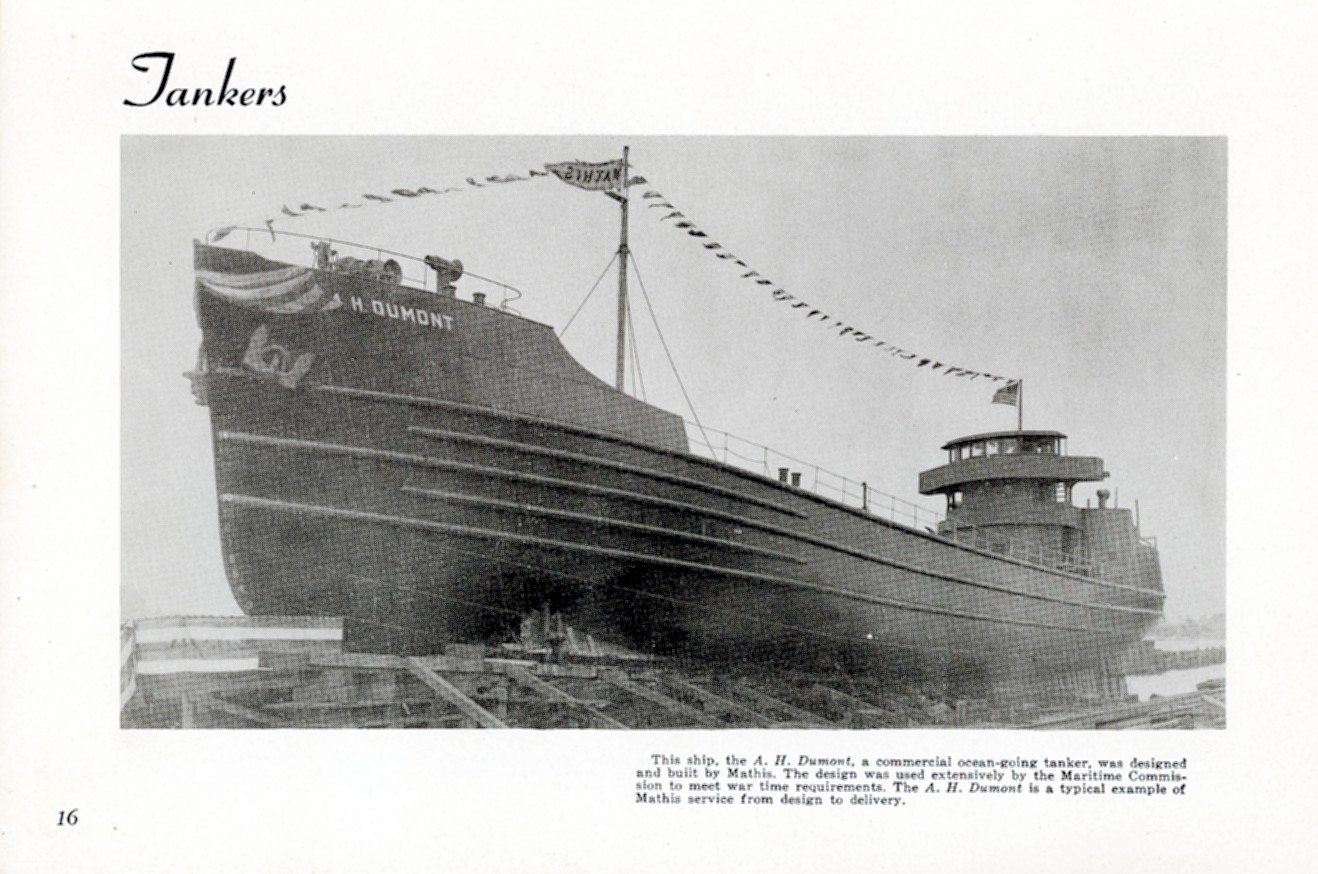
This ship, the A. H. Dumont, a commercial ocean-going tanker, was designed and built by Mathis. The design was used extensively by the Maritime Commission to meet war time requirements. The A. H. Dumont is a typical example of Mathis service from design to delivery.
16
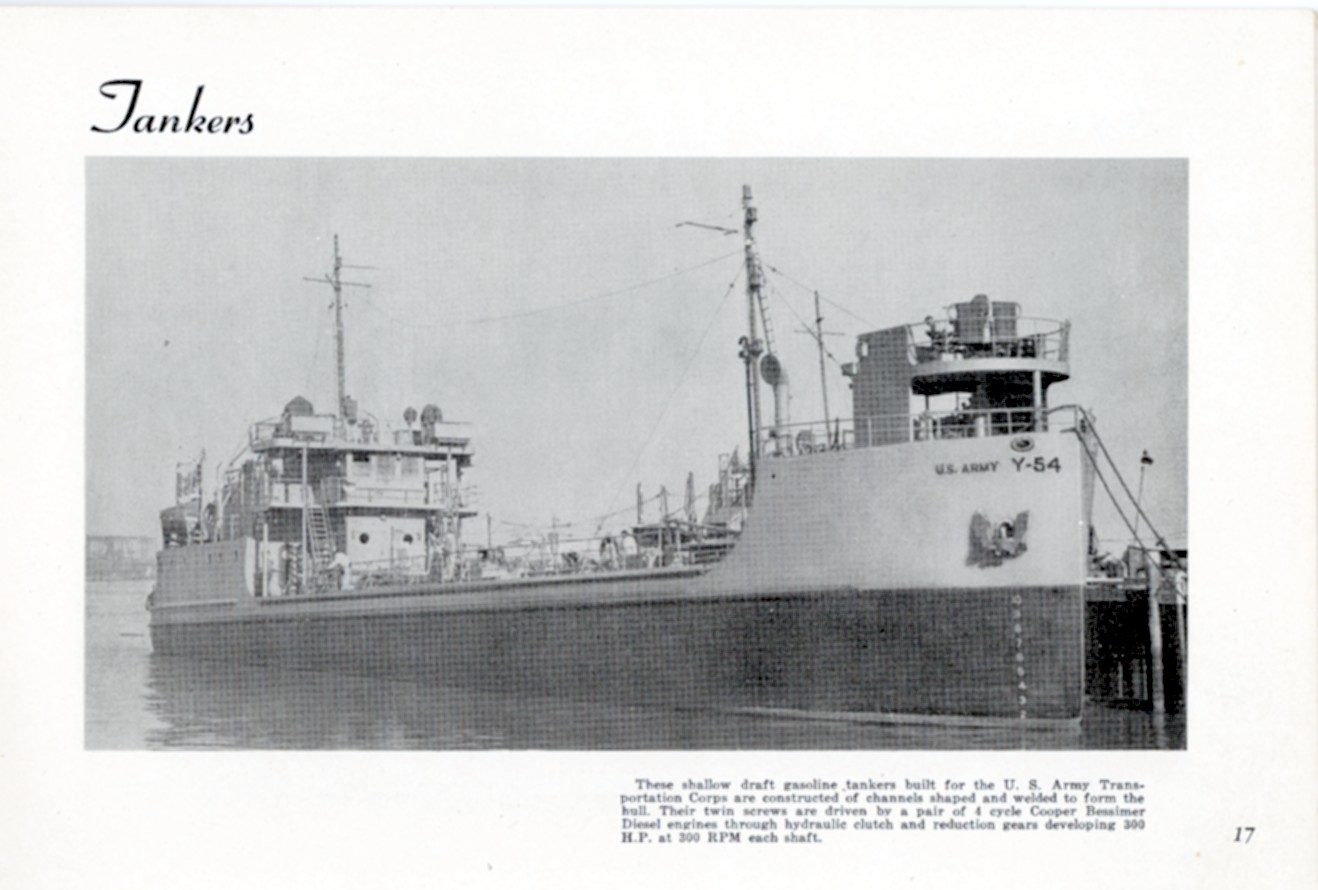
Tankers
These shallow draft gasoline tankers built for the U. S. Army Transportation Corps are constructed of channels shaped and welded to form the hull. Their twin screws are driven by a pair of 4 cycle Cooper Bessimer [sic] Diesel engines through hydraulic clutch and reduction gears developing 300 H.P. at 300 RPM each shaft.
17
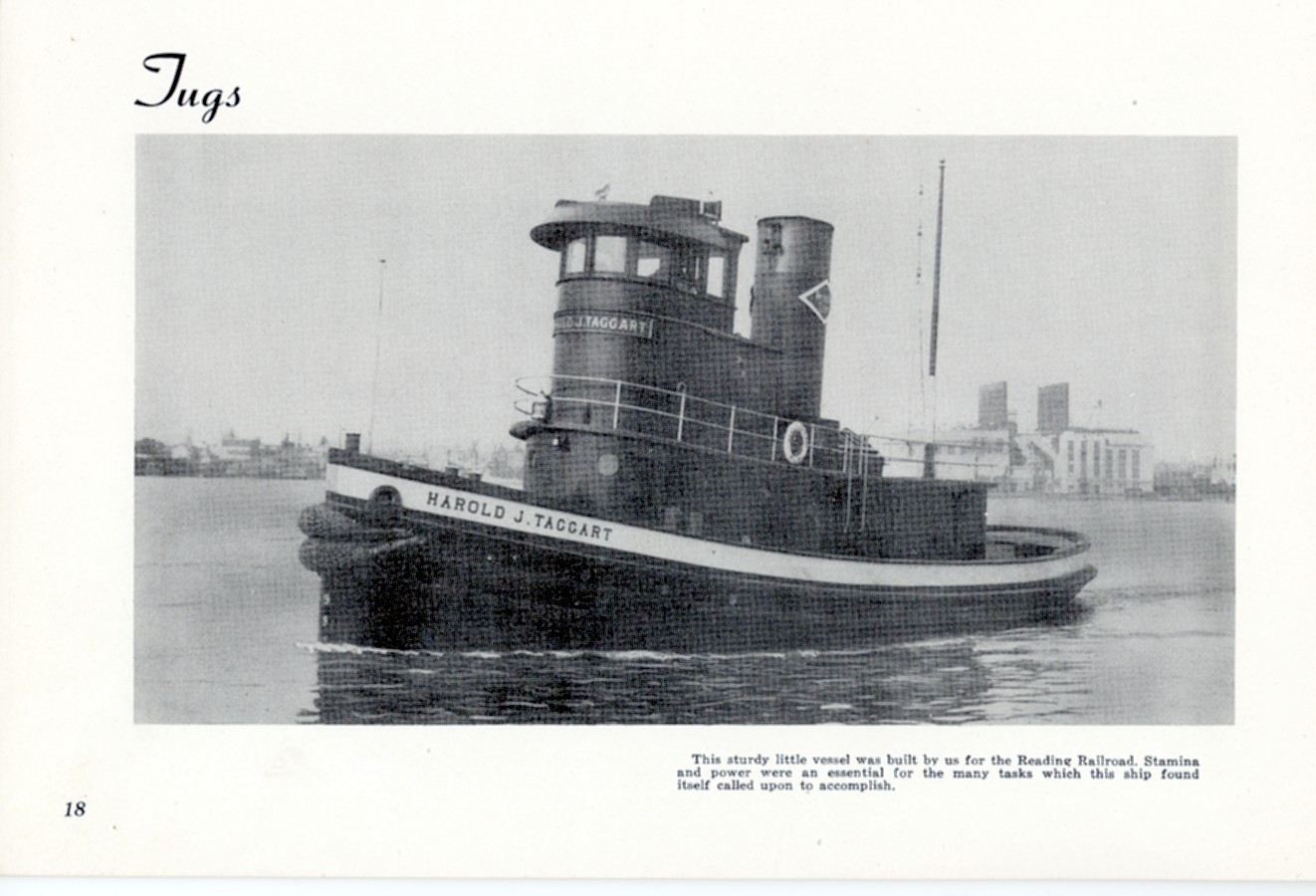
Tugs
This sturdy little vessel was built by us for the Reading Railroad. Stamina and power were an essential for the many tasks which this ship found itself called upon to accomplish.
18
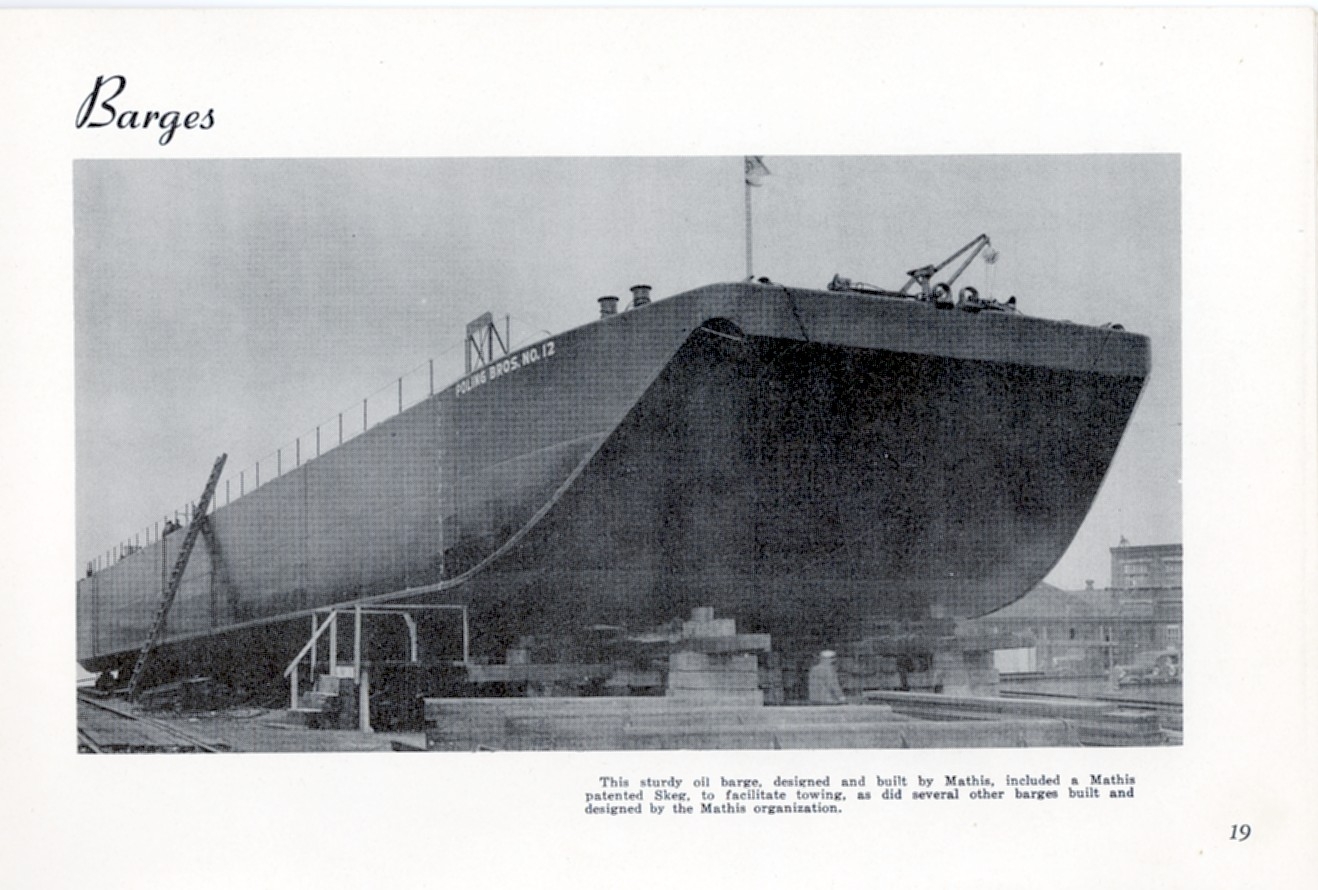
Barges
This sturdy oil barge, designed and built by Mathis, included a Mathis patented Skeg, to facilitate towing, as did several other barges built and designed by the Mathis organization.
19
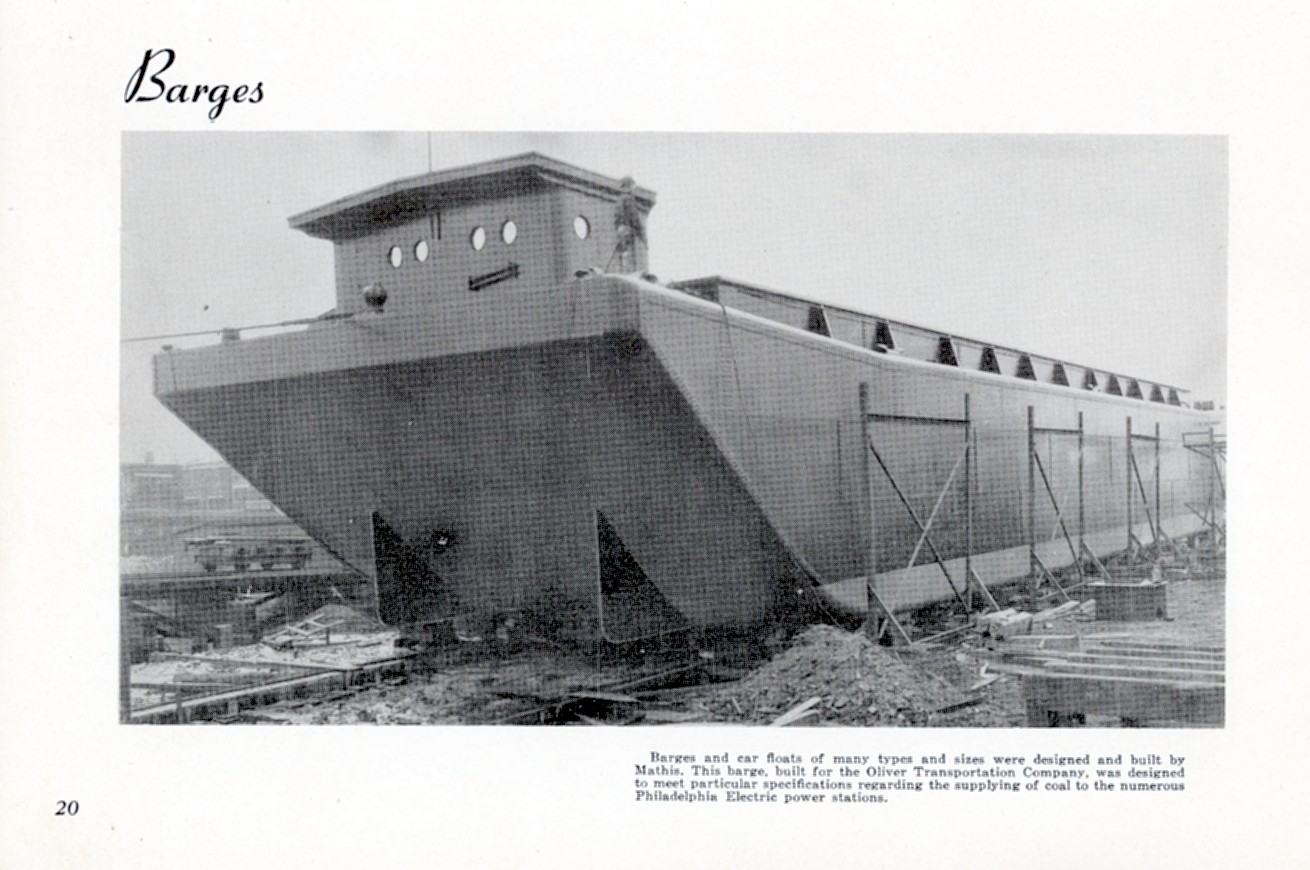
Barges
Barges and car floats of many types and sizes were designed and built by Mathis. This barge, built for the Oliver Transportation Company, was designed to meet particular specifications regarding the supplying of coal to the numerous Philadelphia Electric power stations.
20
SINCE the turn of the century Mathis not only has been building fine vessels but has also been repairing and converting others. Again our facilities include from design to delivery. During peace time many diversified types of seagoing craft have received their repairs here in our yard, such as freighters, lightships, tugs, railroad car floats, barges, private yachts, patrol boats and a submarine. During war time conversion and repair have been one of our outstanding facilities. During this period such vessels as trawlers, L.C.I. boats, patrol boats, lightships, yachts and others have received repairs and conversion. Conversion and repair include wood as well as steel vessels and machinery and hull repairs. Our craftsmen in these departments are versatile and dependent. These facilities together with a highly trained staff of engineers and craftsmen is your assurance of efficiency and prompt delivery when your repairs are made by the John H. Mathis Company.
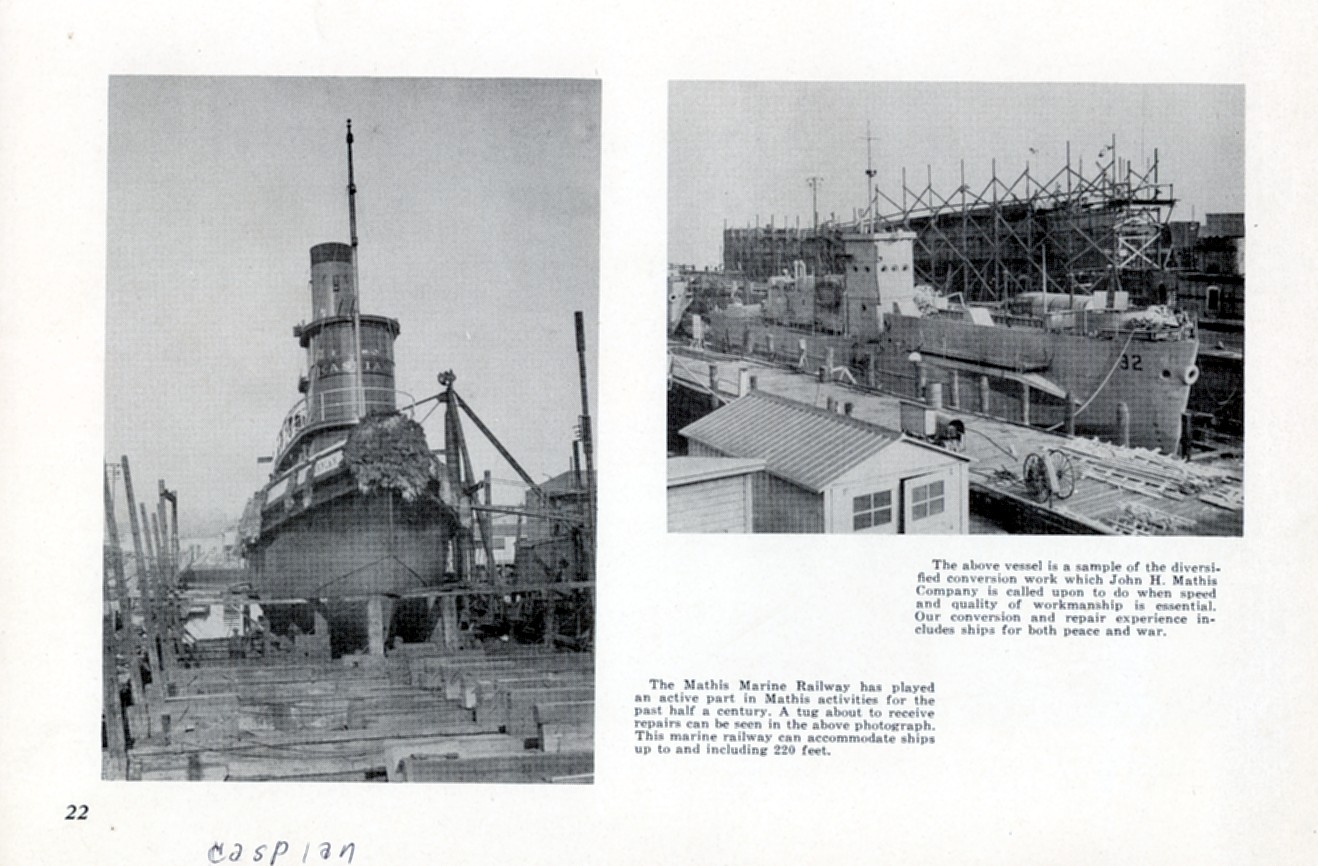
The above vessel is a sample of the diversified conversion work which John H. Mathis Company is called upon to do when speed and quality of workmanship is essential. Our conversion and repair experience includes ships for both peace and war.
The Mathis Marine Railway has played an active part in Mathis activities for the past half a century. A tug about to receive repairs can be seen in the above photograph. This marine railway can accommodate ships up to and including 220 feet.
22
[pencilled in the margin: Caspian]
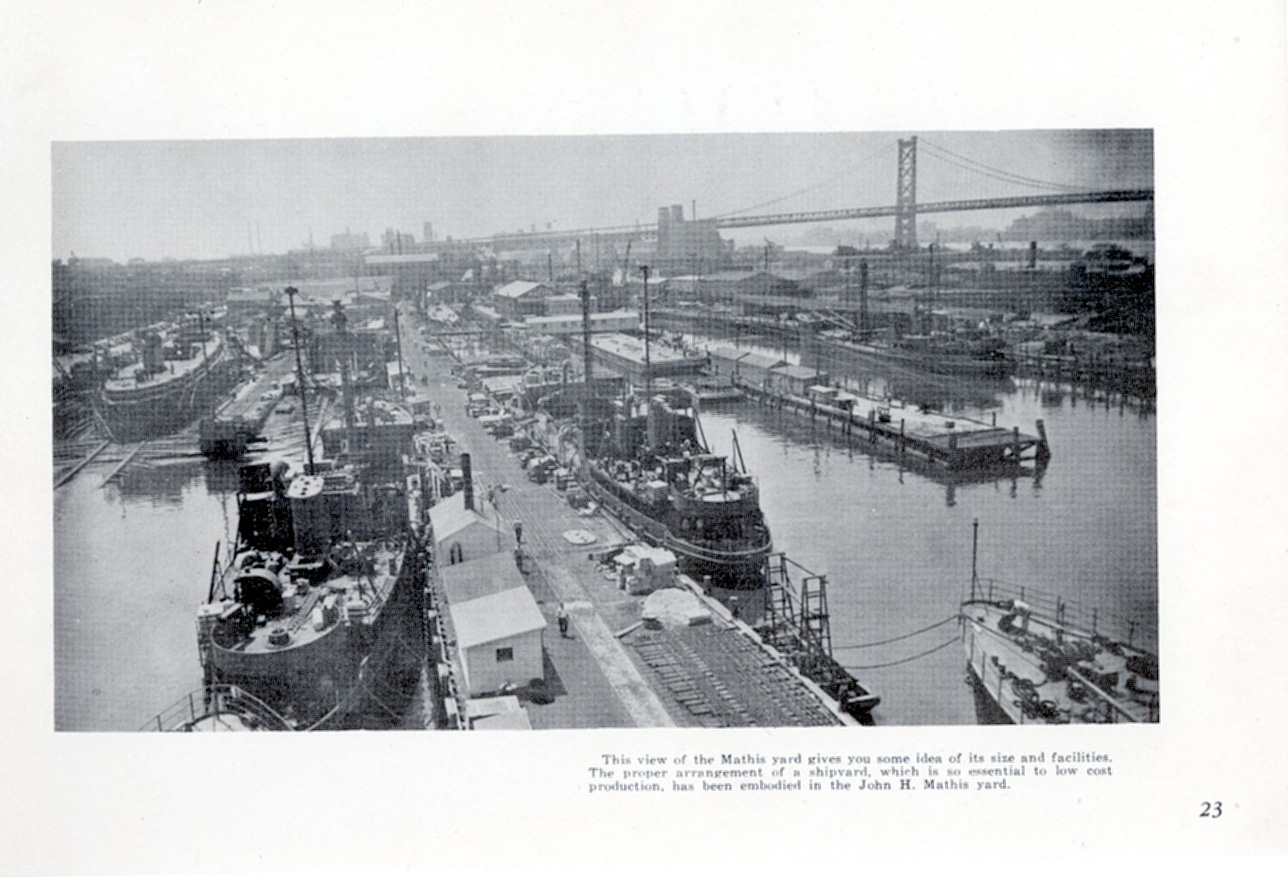
This view of the Mathis yard gives you some idea of its size and facilities. The proper arrangement of a shipyard, which is so essential to low cost production, has been embodied in the John H. Mathis yard.
23
[label] L. S. HUMES, DOCKMASTER
Camden Ship Repair 609-966-1091
Your inquiry on new ship construction, repair or conversion is invited. Space will not permit detailed information regarding the vessels pictured in this booklet. Any further pertinent facts or specifications regarding them will be gladly given upon request.
JOHN H. MATHIS CO.
POINT AND ERIE STREETS
CAMDEN, NEW JERSEY
New England Office
88 BROAD STREET, BOSTON, MASS.
In the Mathis Drydock
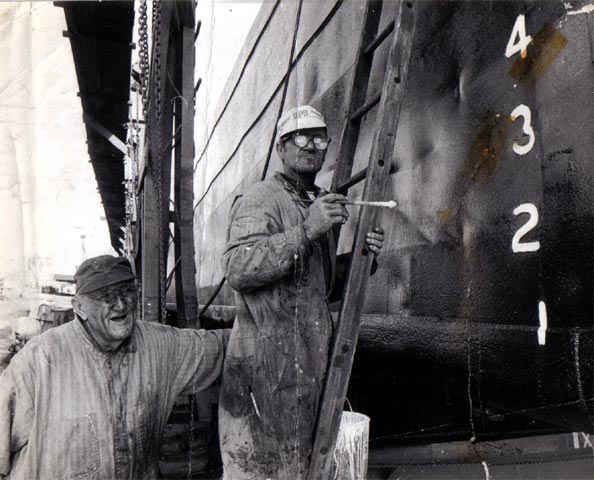
In the Mathis Drydock. Photo dates from the Camden Ship Repair days. “Red” & Johnny Wunch (on ladder). Photo courtesy of Floyd L. Miller Jr.
Camden News Notes
Philadelphia Inquirer —
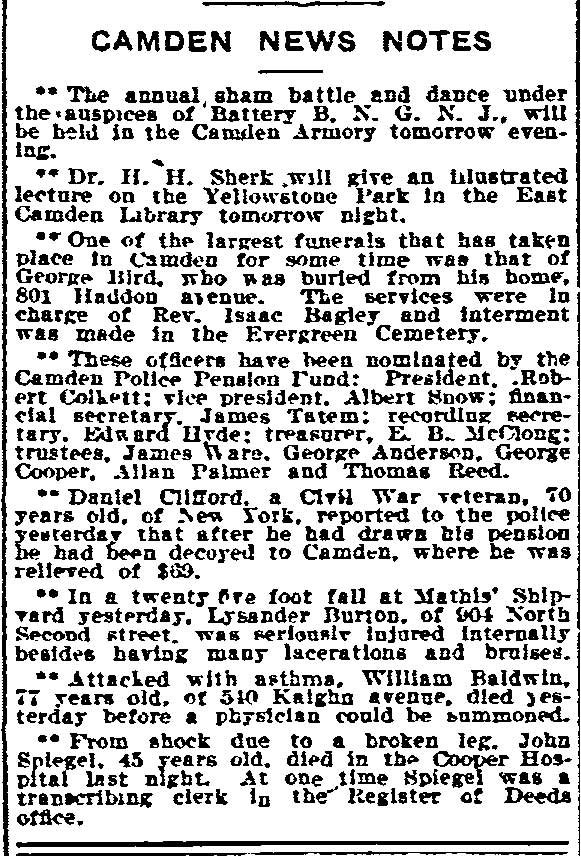
The annual sham battle and dance under the auspices of Battery B, N. G. N. J., will be held in the Camden Armory tomorrow evening.
Dr. H. H. Sherk will give an illustrated lecture on the Yellowstone Park in the East Camden Library tomorrow night.
One of the largest funerals that has taken place in Camden for some time was that of George Bird, who was buried from his home, 801 Haddon avenue. The services were in charge of Rev. Isaac Bagley and interment was made in the Evergreen Cemetery.
These officers have been nominated by the Camden Police Pension Fund: President, Robert Colkett; vice president, Albert Snow; financial secretary, James Tatem; recording secretary, Edward Hyde; treasurer, E. B. McClong; trustees, James Ware, George Anderson, George Cooper, Allan Palmer and Thomas Reed.
Daniel Clifford, a Civil War veteran, 70 years old, of New York, reported to the police yesterday that after he had drawn his pension he had been decoyed to Camden, where he was relieved of $69.
In a twenty five foot fall at Mathis’ Shipyard yesterday, Lysander Burton, of 904 North Second street, was seriously injured internally besides having many lacerations and bruises.
Attacked with asthma, William Baldwin, 77 years old, of 510 Kaighn avenue, died yesterday before a physician could be summoned.
From shock due to a broken leg, John Spiegel, 45 years old, died in the Cooper Hospital last night. At one time Spiegel was a transcribing clerk in the Register of Deeds office.
SHIPYARD FIRE MARS TENDER LAUNCHING
Camden Courier-Post —
560 Attending Ceremony at John A. Mathis Plant Startled by Blaze
Five hundred persons attending the launching of a net tender at the John H. Mathis Shipbuilding Corporation were startled Saturday when the cry of “fire” was sounded.
The blaze, although slight, was only a few yards from the crowds of employees, their relatives, and yard and Navy officials watching the launching.
The fire was caused when a large crane dumped hot coals on the railroad tracks, setting fire to the ties and a quantity of oil soaked rags. Employees of the yard watching the ceremonies, rushed to the danger spot and extinguished the flames within a few minutes.
However, due to the proximity of the fire to the ships and its possible danger if it gained headway, the Camden fire department was called.
Battalion Chief Charles Errickson, answering the call, collapsed from the heat a few minutes after returning to the fire house. His condition was not considered serious and he declined hospital treatment.
The ship sent down the ways was the net tender, U.S.S. Teak. It was launched three months ahead of schedule and Navy officials had attempted to keep the ship’s launching a secret until the fire disclosed the story.
Mrs. E. L. Patch, wife of Captain E. L. Patch, supervising naval construction at the New York Shipbuilding Corporation, christened the 160-foot vessel. Later, the hull was towed to Port Richmond where Diesel engines will be installed, before it is commissioned into the Navy. The ship cost $471,000 and is the second tender launched at the yard in recent months.
Two others of similar design are under construction on the ways. The yard also holds contracts for three minesweepers and 10 submarine chasers.
The net tenders are used for laying and repairing nets in harbors as a defense against submarines. The nets also are placed around anchored ships to protect them against torpedoes.
Shipyard employees, as a reward for finishing the ship ahead of schedule, were taken yesterday on a picnic to Seaside Heights, sponsored by the company. Ten chartered buses were provided for transportation.
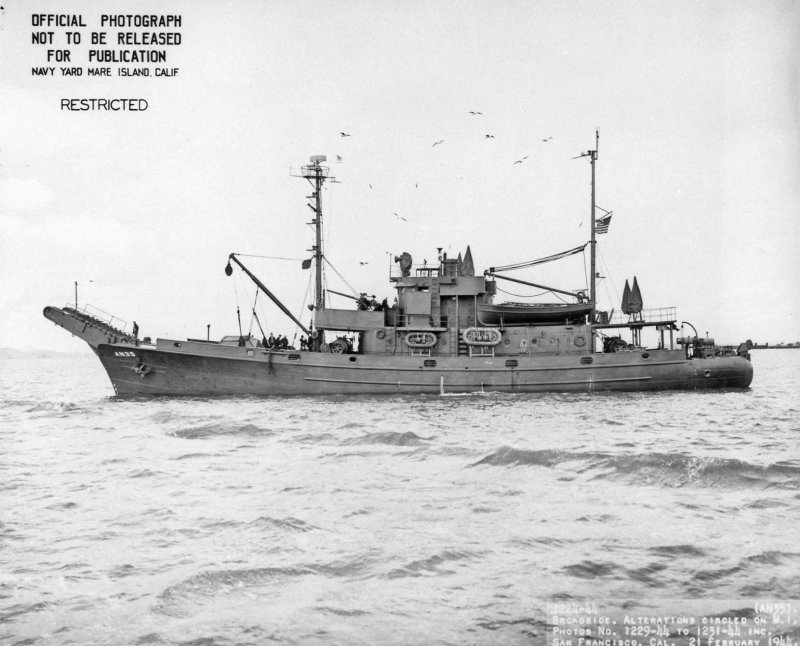
USS TEAK AN-35
Camden Fire Laid To Wrench Spark
Trenton Times —
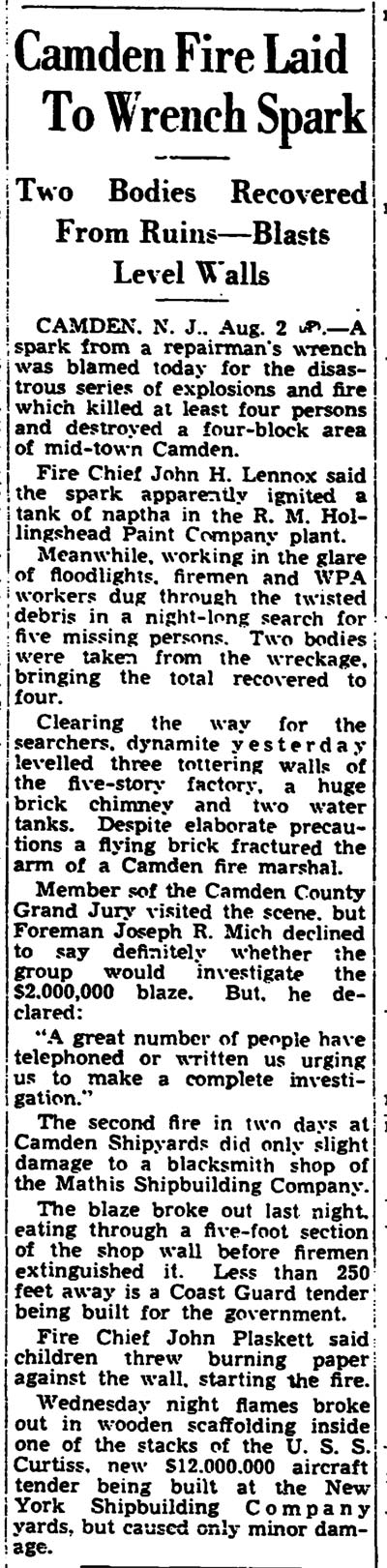
Two Bodies Recovered From Ruins—Blasts Level Walls
CAMDEN, N.J., Aug. 2 (UP) — A spark from a repairman’s wrench was blamed today for the disastrous series of explosions and fire which killed at least four persons and destroyed a four-block area of mid-town Camden.
Fire Chief John H. Lennox said the spark apparently ignited a tank of naptha [sic] in the R. M. Hollingshead Paint Company plant.
Meanwhile, working in the glare of floodlights, firemen and WPA workers dug through the twisted debris in a night-long search for five missing persons. Two bodies were taken from the wreckage, bringing the total recovered to four.
Clearing the way for the searchers, dynamite yesterday levelled three tottering walls of the five-story factory, a huge brick chimney and two water tanks. Despite elaborate precautions a flying brick fractured the arm of a Camden fire marshal.
Member sof [sic] the Camden County Grand Jury visited the scene, but Foreman Joseph R. Mich declined to say definitely whether the group would investigate the $2,000,000 blaze. But he declared: “A great number of people have telephoned or written us urging us to make a complete investigation.”
The second fire in two days at Camden Shipyards did only slight damage to a blacksmith shop of the Mathis Shipbuilding Company. The blaze broke out last night, eating through a five-foot section of the shop wall before firemen extinguished it. Less than 250 feet away is a Coast Guard tender being built for the government.
Fire Chief John Plaskett said children threw burning paper against the wall, starting the fire.
Wednesday night flames broke out in wooden scaffolding inside one of the stacks of the U.S.S. Curtiss, new $12,000,000 aircraft tender being built at the New York Shipbuilding Company yards, but caused only minor damage.
Camden Courier-Post — March 21, 1961
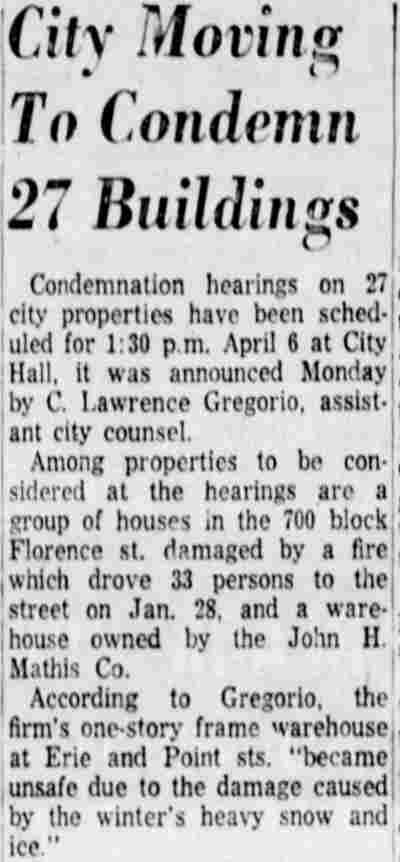
Camden Courier-Post — March 21, 1961. Mentions Mathis Shipyard and C. Lawrence Gregorio.