Camden Home for Friendless Children
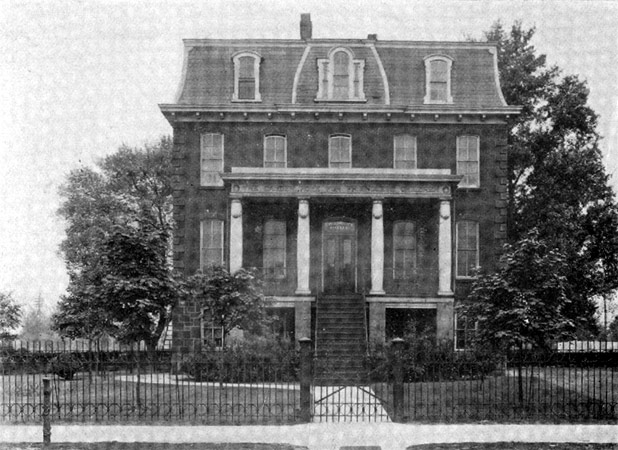
Camden Home for Friendless Children — 1915
The Camden Home for Friendless Children was established in 1865. By the 1890s the institution had located at 915 Haddon Avenue in Camden NJ.
Mrs. Lucretia Read, the widow of Camden realtor William T. Read Sr., and mother of New Jersey State Senator William T. Read Jr., was very active in the affairs of the Home. She served on the Board of Managers, and eventually was elected President of that body. She was President Emeritus of the Board of Managers when she died in October 1936 at the age of 83.
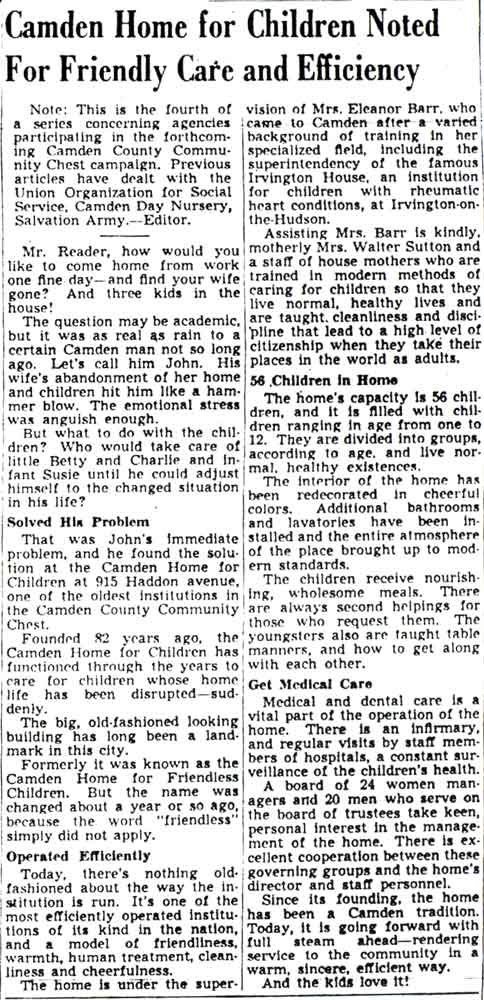
Shortly after World War II, in 1946, the name of the building was changed to the Camden Home for Children. The home, with its capacity of 56 children, eventually closed, due to age and growing needs. After being renamed the Camden Home for Children, the foundation operated in the 1960s and 1970s at Kaighn Avenue and Vesper Boulevard, a facility now used by the Camden Board of Education.
When the Camden Home for Friendless Children at 915 Haddon Avenue closed sometime in the 1960s, the building was razed, and the Camden branch of the Salvation Army built a new building which they presently occupy at the Haddon Avenue address. The old building is gone, but 915 Haddon Avenue is still an address that takes care of Camden's underprivileged children, as the Salvation Army has remained there.
For a number of years, the Camden Home for Children organization maintained offices in Westmont, New Jersey. Although as of 2011 there is no longer any office or facility, the organization continues to serve children in need in a behind-the-scenes capacity, supporting sister agencies in their missions.
The Camden Home for Friendless Children was renamed Camden Home for Children & S.P.C.C. after merger with the Society for the Prevention of Cruelty to Children. Longtime Executive Director John Powell passed away on August 20, 2010. He was succeeded in this position by Alan L. Stedman.
The Camden Home for Children Board accepts donations and bequests to augment its work which is to support various Southern New Jersey agencies working with youth, especially those in residential group settings, with grants for targeted capital projects that are otherwise unfunded by other private or government sources.
Information on past residents of the Camden Home for Children is confidential and subject to new privacy laws adopted by the State of New Jersey and will only be further accessed after adoption by the Camden Home Board of Trustees of a new Privacy Policy, scheduled for September 2011.
A Brief History of The Camden Home for Children & SPCC
“In Service to Youth”
A Need to House Orphans and Needy Children
At a meeting in the First Presbyterian Church on 5th Street in Camden in the Autumn of 1864, Mr. and Mrs. Earl J. Atkinson inspired other dedicated, community-spirited citizens to venture into a project with them. The purpose was to establish an Orphan's Home to care for children whose fathers failed to return from the Civil War. By February of 1865, the enterprise was established, and a house at 522 Federal Street was rented for these purposes in March. The first child was admitted on the 8th of May, 1865, to what was known as the Camden Home for Friendless Children. Now, almost 150 years later, The Camden Home for Children continues its dedication in giving back to the community by supporting those working with needy youth in South Jersey.
Soon the organization was able to rent an adjacent house, and then both were renovated and filled with children in need. On December 9th of 1873, the Camden Home for Children made the transition to a four-story facility at 915 Haddon Avenue where it remained until 1960, serving from 45 to 100 children at a time, never once asking for financial support from the public, but benefiting from a number of generous donors. The organization proved itself, as it kept its doors open through harsh times such as war and depression. Around 1946, the name was changed to The Camden Home for Children.
The Camden Home was caring for about 157 children in 1957, including those placed in foster homes, but had to turn away numbers of others. At one point the Camden Home served only children 12 and under. Later, children of school age were housed but younger children were placed in foster homes. By 1958 the Camden Home had a staff of 39 and an Executive Director as the administrator. The Board governing the Camden Home had 15 members. By 1958 it was stated that: All children who by circumstances are without a home are served by the Home. There is no distinction as to race, creed, or color. The only question is: “Does this child need care?”
The need had continued to grow so much that the Board acquired 8.5 acres of land at Kaighn's & Vesper Avenues, hired architects to plan three two-story buildings in a campus setting, and launched a fundraising campaign in 1957/58 to raise about $486,000 needed after sale of the Haddon Ave property to complete the new facility. Cecil Bentley was the President of the Building Fund Committee, and Bryant W. Langston was General Chairman of the fundraising drive.
The institution had one goal, and that was to provide the proper shelter and care for children who were abandoned, neglected, misguided, and lacked the proper medical needs and educational background. The idea has always been to prepare many of these adolescents for adulthood (T. Bergbauer, Courier-Post, 9/14/08). The funds were raised and the campus built, with the advice of experts in Child Welfare, so that each of the 6 floors would house only 12 children in a “cottage plan,” and the children would have the feeling of being in a home.
Changing Priorities with the Times
Known as an organization that has had its doors open to the community since 1865, The Camden Home for Children is truly an historic institution that has drawn in many dedicated citizens over the years. Making room for children and maintaining safe conditions was the organization's main priority. Photographs of this era show children at church and Sunday school and in moments of grace before meals. The pictures shed light on the spirit of the organization, as it opened its doors to all children, regardless of background. The Camden Home for Children is a community institution, operates as non-profit, and has never been owned or operated by the city or county.
As time went on, The Camden Home for Children continued to help those in need of a better life. Some came and left more quickly than others, but the organization had the same goal for all who walked through its doors. After moving from Haddon Avenue to Kaighn Avenue across from Farnham Park in November, 1960, the new $750,000 facility gave way to what was expected to be a better haven for children with less overcrowding and the ability to properly handle as many as 75 children at a time. At that point it was estimated the Home had served about 15,000 children. At the time of the closing of the facility in 1979, there were reported to be 31 state-referred, emotionally disturbed, inner city boys between the ages of 9 and 16 housed there.
The next nineteen years allowed The Camden Home for Children to provide the necessary shelter for those in crisis, to accept referrals and subsidies from government funding, and complete a merger with the Society for the Prevention of Cruelty to Children that created a new title – The Camden Home for Children & SPCC.
Finding Yet Another Role
In 1979, after 114 years of this tradition and largely because of state underfunding for those placed in the residential facility, the Board felt compelled to vote to close the facility. Without increased state funding, The Camden Home and many other residential facilities in New Jersey, were running large deficits and could not maintain the financial needs to stay open. The Courier-Post Editorial dubbed the Home “one of the city's outstanding institutions over a long period of years” (T. Bergbauer, Courier-Post, 9/14/08). And it was said to be “one of the most efficiently operated institutions of its kind in the nation and a model of friendliness, warmth, humane treatment, cleanliness and cheerfulness.”
Senator Cowgill, a member of the Board, led a group wishing to close the Home permanently and give its money to the courts. Dr. John (Jack) Breakstone was the Executive Director at that time, and David A. Stedman was President of the Board. They had other ideas. With the support of a majority of Board members who remembered the care the Home had once provided for Civil War orphans at one time and how it had shifted its role over the century to providing residential care for troubled boys, they believed the Home had a useful place in service to youth, even if its direct residential care of troubled youth would cease. And, although the facility itself closed on November 28, 1979, and the State of New Jersey was forced to find new placements for the many emotionally disturbed inner-city boys who were served by the Home, the Board decided to control its funds and continue in a different direction. The facility was sold to the Camden Board of Education for one dollar for use of the school administration, and in 1980 The Camden Home for Children and SPCC became incorporated as a nonprofit foundation.
Led by Dr. Breakstone, the Board assumed the task of helping to bring together other New Jersey youth agencies into a consensus bloc to lobby the State for more reasonable regulations and higher subsidies for its referrals. After this was successful, through existing endowments and return on investments over the years, the Camden Home began to award grant money to agencies and institutions that continue to provide services for children who are in crisis, primarily in the Camden, Gloucester and Burlington County area, but more recently extending to all of South Jersey. In recent years, under the guidance of Executive Director John Powell, the scope of assistance was expanded to assist the “aging out” population, those from 19 through 22. These young adults would otherwise have been denied full support in the transition to independence. Continually reexamining its role in service to youth, The Camden Home has and will continue to remain dedicated to all youth in need.
Works Cited
Bergbauer, Thomas (2008, September 14). Camden Home for Children was a haven for 114 years. Courier-Post, p. 3C.
Lieberman, Gail (1979, November 29). Children's Home shuts doors. Courier-Post.
Source: The History of Camden County, New Jersey by George R. Prowell. Philadelphia: L.J. Richards & Co., 1886.
1872 City Directory
1872 City Directory
CAMDEN HOME FOR FRIENDLESS CHILDREN is an institution located on Haddon Avenue, above Mount Vernon, the object and design of which is to afford a home, food, clothing and schooling for destitute friendless children, and, at a suitable age, to place them with respectable families to learn some useful trade or occupation. The home was established and is conducted by a corporation. The charter, granted by the State Legislature, April 6, 1865, sets forth that “Whereas, a number of citizens of this State have formed an association for the laudable and benevolent purpose of educating and providing for friendless and destitute children; and whereas, the Legislature of this State is willing to encourage such purposes; therefore, Be it enacted by the Senate and General Assembly of the State of New Jersey, that Matthew Newkirk, Elijah G. Cattell, James H. Stevens, George W.N. Custis, J. Earl Atkinson, Joseph C. De La Cour, Joseph D. Reinboth, Robert B. Potts, Jesse W. Starr, Edmund E. Read, John B. Graham, Benjamin H. Browning, Solomon M. Stimson, Philander C. Brinck, John Aikman, Thomas P. Carpenter, Elisha V. Glover, Thomas B. Atkinson, Isaac L. Lowe, Peter L. Voorhees, and their associates, be and they are hereby incorporated and made a body politic in law and fact, by the name, style and title of ‘The Camden Home for Friendless Children.’”
Nos. 520 and 522 Federal Street — Board of Trustees (1872)
E.G. Cattell, President — James H. Stevens, First Vice President — Jesse W. Starr, Second Vice President — Joseph C. De LaCour, Treasurer — William Curtiss, Corresponding Secretary — Joseph B. Cooper, Recording Secretary — Joseph D. Reinboth — Maurice Browning — Robert C. Cook — William Groves — Hon. John F. Starr — Dr. H. G. Taylor — Samuel H. Grey — Joseph L. De La Cour — John S. Read — Joseph M. Kaighn — George W. Carpenter — John S. Lee — Rodolphus Bingham — David S. Stetson
Matron: Miss Mary Nicholson — Teacher: Miss Mary McCully — Physician: H. G. Taylor, M.D. — Solicitor: Samuel H. Grey, Esq.
Buildings of the Home, Nos. 520 and 522 Federal Street.
Annual Fair for Benefit of the Home
Camden Democrat —
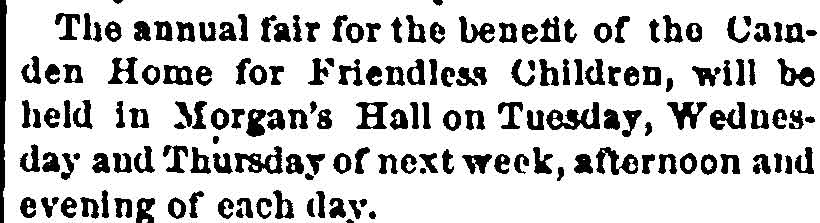
The annual fair for the benefit of the Camden Home for Friendless Children, will be held in Morgan's Hall on Tuesday, Wednesday and Thursday of next week, afternoon and evening of each day.
Building Fund Contributions
Camden Democrat —
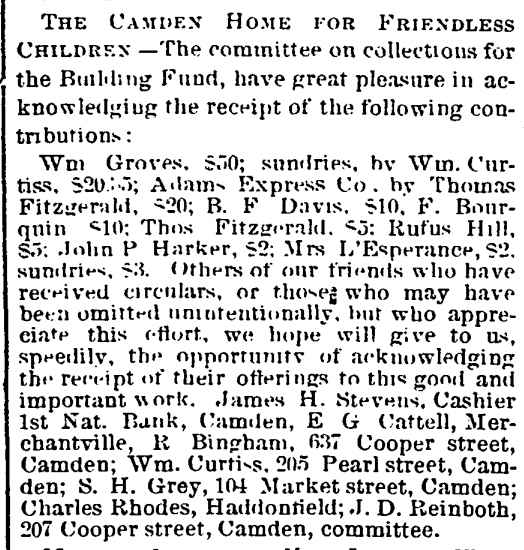
THE CAMDEN HOME FOR FRIENDLESS CHILDREN — The committee on collections for the Building Fund, have great pleasure in acknowledging the receipt of the following contributions:
Wm. Groves, $50; sundries, by Wm. Curtiss, $20.53; Adams Express Co. by Thomas Fitzgerald, $20; B. F. Davis, $10; F. Bourquin, $10; Thos. Fitzgerald, $5; Rufus Hill, $5; John P. Harker, $2; Mrs. L’Esperance, $2; sundries, $3. Others of our friends who have received circulars, or those who may have been omitted unintentionally, but who appreciate this effort, we hope will give to us, speedily, the opportunity of acknowledging the receipt of their offerings to this good and important work.
James H. Stevens, Cashier 1st Nat. Bank, Camden; E. G. Cattell, Merchantville; R. Bingham, 637 Cooper Street, Camden; Wm. Curtiss, 205 Pearl street, Camden; S. H. Grey, 104 Market street, Camden; Charles Rhodes, Haddonfield; J. D. Reinboth, 207 Cooper street, Camden, committee.
Lecture Ticket — April 7, 1875
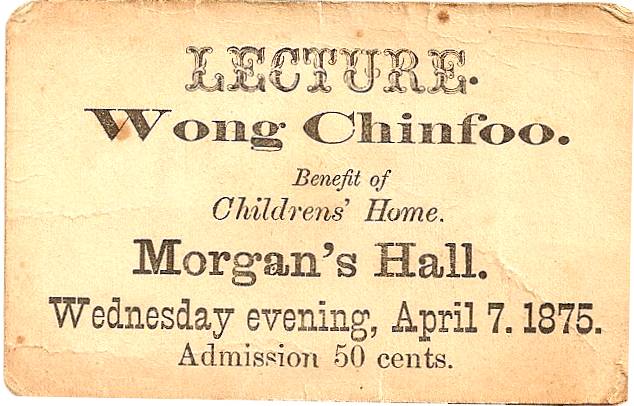
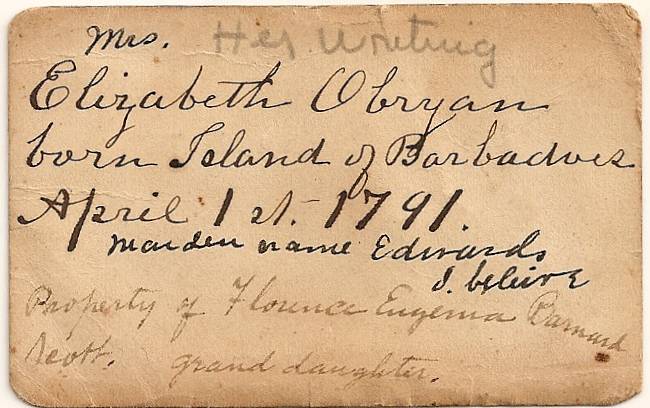
Front and reverse sides of a lecture ticket benefit for the Camden Home for Friendless Children, April 7, 1875. Elizabeth O’Bryan — Florence Eugenia Barnard — Wong Chinfoo
Camden Looks After Friendless Children
Philadelphia Inquirer —
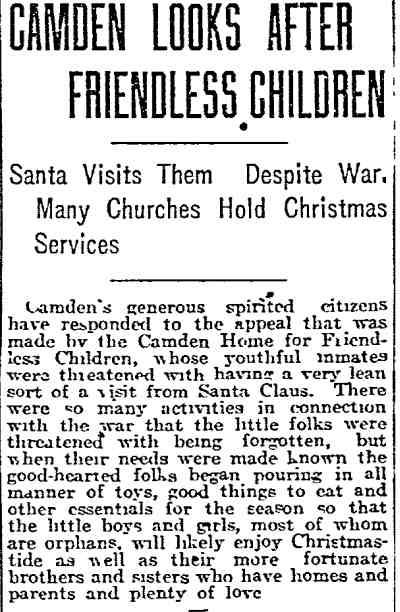
CAMDEN LOOKS AFTER FRIENDLESS CHILDREN
Santa Visits Them Despite War. Many Churches Hold Christmas Services
Camden’s generous spirited citizens have responded to the appeal that was made by the Camden Home for Friendless Children, whose youthful inmates were threatened with having a very lean sort of a visit from Santa Claus. There were so many activities in connection with the war that the little folks were threatened with being forgotten, but when their needs were made known the good-hearted folks began pouring in all manner of toys, good things to eat and other essentials for the season so that the little boys and girls, most of whom are orphans, will likely enjoy Christmastide as well as their more fortunate brothers and sisters who have homes and parents and plenty of love.
Thirty-Fourth Anniversary
Philadelphia Inquirer —

The thirty-fourth anniversary of the Camden Home for Friendless Children was celebrated yesterday.
Elks to Entertain Children at Christmas
Philadelphia Inquirer —
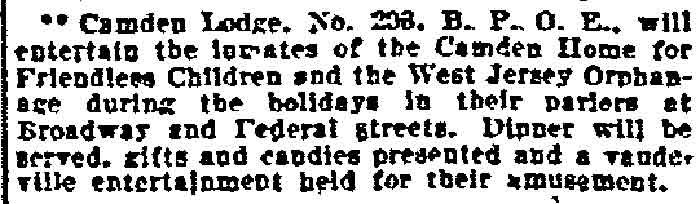
Camden Lodge, No. 293, B. P. O. E., will entertain the inmates of the Camden Home for Friendless Children and the West Jersey Orphanage during the holidays in their parlors at Broadway and Federal streets. Dinner will be served, gifts and candies presented and a vaudeville entertainment held for their amusement.
Girl Found After Disappearing from Home
Philadelphia Inquirer —
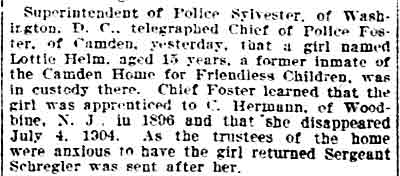
Superintendent of Police Sylvester, of Washington, D. C., telegraphed Chief of Police Foster, of Camden, yesterday, that a girl named Lottie Helm, aged 15 years, a former inmate of the Camden Home for Friendless Children, was in custody there. Chief Foster learned that the girl was apprenticed to C. Hermann, of Woodbine, N. J., in 1896 and that she disappeared July 4, 1904. As the trustees of the home were anxious to have the girl returned Sergeant Schregler was sent after her.
Photos
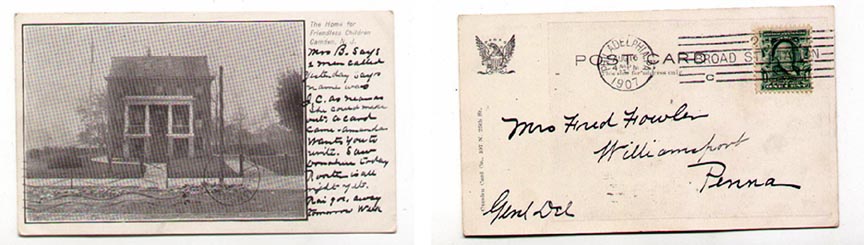
Postcard mailed in 1907
Camden Playgrounds to Be Opened Today
Philadelphia Inquirer —
Camden Playgrounds to Be Opened Today
Sixteen Recreation Centres Will Be Under Supervision of Trained Staff of Forty Persons
Under the direction of the Board of Playground Commissioners sixteen play centres will be opened for the season in Camden this morning. There will be a teaching staff of forty young men and women, in charge of Supervisor Frederick A. Finkeldey, Jr., of Bryn Athyn, Pa. Yesterday pastors in the various local churches spoke on the playground movement.
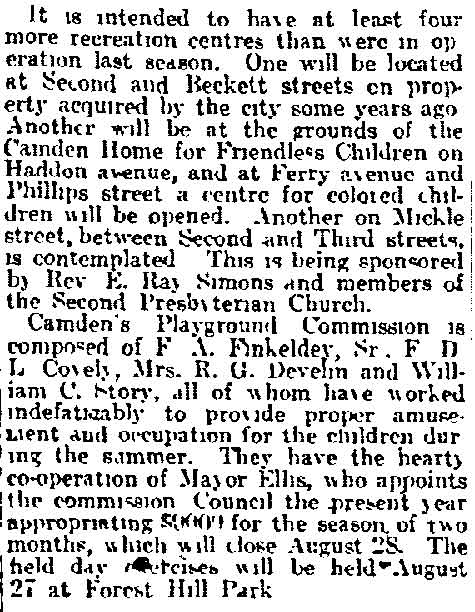
Frederick A. Finkeldey Jr. — Frederick A. Finkeldey Sr. — Rev. E. Ray Simons — Charles H. Ellis — F.D.L. Covely — Mrs. R.G. Develin — William C. Story — Camden Home for Friendless Children — South 2nd Street — South 3rd Street — Beckett Street — Haddon Avenue — Ferry Avenue — Phillips Street
Police Elect Officers
Philadelphia Inquirer —
Police Elect Officers
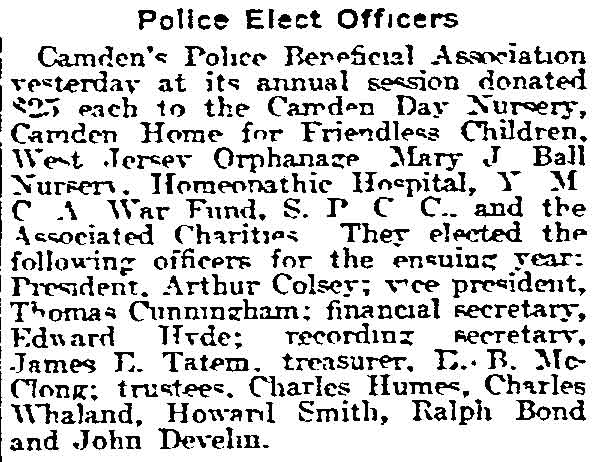
Camden’s Police Beneficial Association yesterday at its annual session donated $25 each to the Camden Day Nursery, Camden Home for Friendless Children, West Jersey Orphanage, Mary J. Ball Nursery, Homeopathic Hospital, Y. M. C. A. War Fund, S. P. C. C., and the Associated Charities. They elected the following officers for the ensuing year: President, Arthur Colsey; vice president, Thomas Cunningham; financial secretary, Edward Hyde; recording secretary, James E. Tatem; treasurer, E. B. McClong; trustees, Charles Humes, Charles Whaland, Howard Smith, Ralph Bond and John Develin.
Removed to Hospitals
Camden Courier-Post —
The police ambulance removed the following residents of South Camden to the hospitals late on Saturday afternoon:
West Jersey Homeopathic — William Perry, aged 62 years, 1725 Fillmore Street; Albert Biron, 24 years old, 1108 Baring Street.
Cooper Hospital — Mrs. Edna Rosenfelt, aged 23 years, 575 Washington Street; Margaret Radcliffe and John Carella, inmates of Children’s Home.
Picking Contest Winners
Camden Courier-Post —
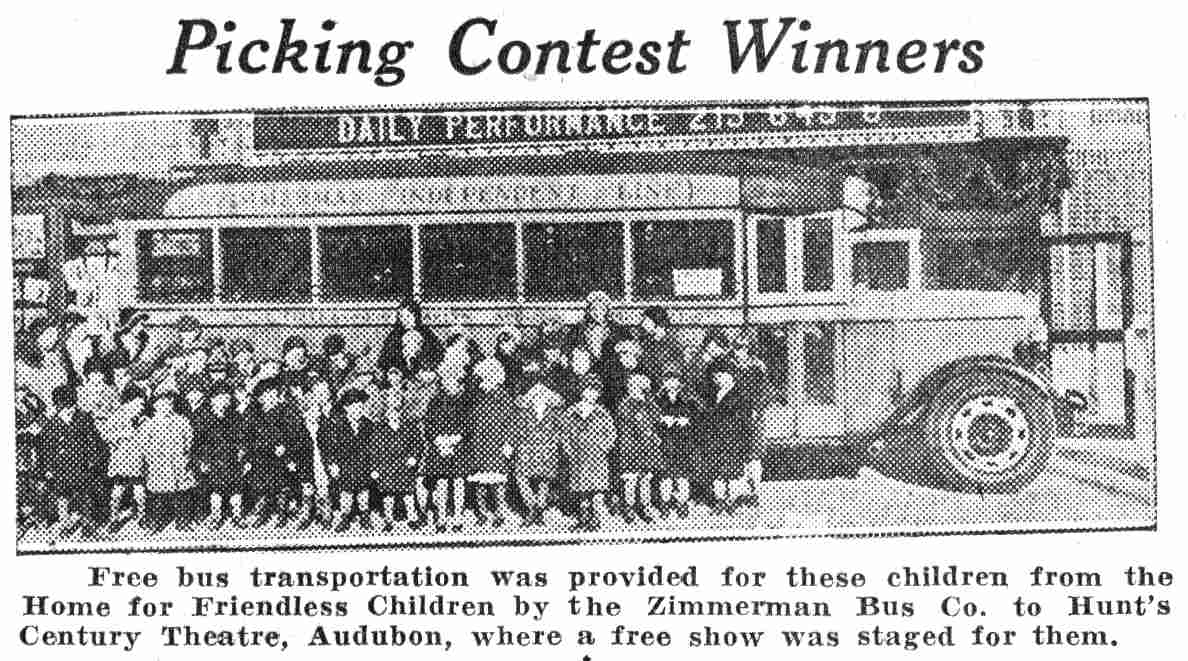
Picking Contest Winners
Free bus transportation was provided for these children from the Home for Friendless Children by the Zimmerman Bus Co. to Hunt’s Century Theatre, Audubon, where a free show was staged for them.
Children at Camden Home Have Big Time in Wading Pool
Camden Courier-Post —
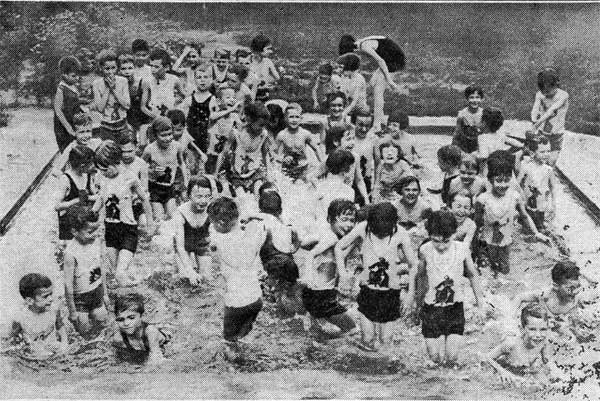
Youngsters at the Camden Home for Friendless Children yesterday attended “en masse” the opening of the wading pool at the home’s playground. More than 50 of the “swimmers” are shown above as they romped in the cooling waters.
Children at Camden Home Have Big Time in Wading Pool
Bathing Place, Given by Citizens Officially Opened — Four Youthful Charges, Left Motherless, to Return to Father
Bathing in the backyard is a privilege of the children of the Camden Home for Friendless Children that is enjoyed by few of the other youngsters in the city. Yesterday, 63 of the little charges of the institution romped and played in the newly opened wading pool in the home playground.
Built by contributions of residents of the city, the pool was officially opened yesterday for the first time this season to the delight of the children whose gay laughter and shouts resounded throughout the grounds.
The children, whose ages range from 4 to 12, finished their school term last Friday and are now on “vacation” during which time they are taken for sight-seeing trips and picnics by civic club groups and individuals.
Included among the recent outings given the children was a trip to the Philadelphia Zoological Gardens under auspices of the Camden Kiwanis Club. Plans are now complete for a picnic at Berlin Park under direction of Rev. George Yard and members of the First Methodist Episcopal Church.
Six of the children, some of whom have been at the home for more than six years, will leave the institution within the next few days. Four of those are returning to their father who was left with the motherless group upon the death of his wife.
Not all of the home inmates were among the “waders” at the pool yesterday. Five charges are but infants who are occupants of the “baby house,” and were unable to join the crowd.
Pyne Poynt Plans All-Day 4th Party
Camden Courier-Post —
Plans for the thirty-third anniversary of the Pyne Poynt Athletic Association to be observed with an all-day program at Pyne Poynt Park July 4 were discussed last night at a meeting in the Pyne Poynt Social Club.
Among the features tentatively planned are a children’s parade at 9:30 a.m., under the supervision of Isaac Kyler; memorial service at 11 a.m., under direction of William B. Sullender; sporting events for men, women and children to start at 1:30 p.m., under direction of Alfred J. Ross, Jr.; outdoor motion pictures starting at 9 p.m., under supervision of Robert J. Nelson and a dance in charge of Samuel G. Dickinson, Jr., starting at 10:30 p.m.
Committee chairmen chosen by Frank J. Hartmann, Jr., president, are: Grounds, Foster Willis; program, Otto E. Braun; police, Clifford Flennard; dancing, Samuel G. Dickinson, Jr.; first aid, Dr. Joseph E. Nowrey and William Hughes; transportation, Samuel J. Edwards; public speakers, William B. Sullender; motion pictures, Robert J. Nelson; decorations, Walter A. Reyno; sports, Alfred J. Ross, Jr.; ways and means, Frank J. Hartmann, Jr.; publicity, Walter S. Agin; parade marshal, Isaac Kyler; refreshments, George Washington Ash; light, William Hilton; and music, Frank Kelley.
Children of the Sheltering Arms Home, Home for Friendless Children and the Detention Home will be guests of the association during the day. Samuel J. Edwards will be in charge of their entertainment.
Children Entertained
Camden Courier-Post —
Children of the Camden home for friendless children were guests of the central branch of the Camden W. C. T. U. yesterday.
Gen. John A. Mather Camp No. 39
Camden Courier-Post —
Named: Gen. John A. Mather Camp No. 39, United Spanish War Veterans, Benjamin H. Young, Thomas Brooks, Theodore J. Lighthiser, William F. Smith, and Frank P. Hudson.
Habits of Cleanliness
Camden Courier-Post —
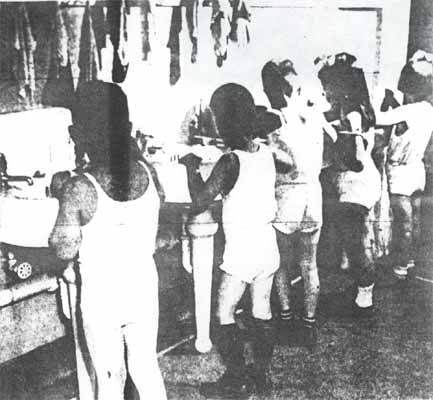

HABITS OF CLEANLINESS and personal hygiene are part of the routine for youngsters at the Camden Home for Children at 915 Haddon avenue, one of the oldest institutions in the Camden County Community Chest. Here boys and girls line up at wash basins for that all-important morning work-out with the tooth-brush.
Oral Interview with Carol Sampson-Feaster
Carol Sampson-Feaster
Caroline Suzanne “Carol” Sampson was born in 1921 in Philadelphia to William Allen Sampson (1860–1937) and the former Helen Ida Penny (1887–1931). Her mother was a native of Cape Sable Island, Nova Scotia who came to Massachusetts in the mid-1910s; her father was a Bostonian. The family, which included older siblings Lillian and Herbert, and younger brother John moved to Camden in around 1924. Younger brother William was born the following year, and baby sister Marion came in 1927.
Sadly, Helen Sampson took ill and died at the County Hospital at Lakeland, Gloucester Township in 1931 and Carol, John and Bill were sent to the Home of the Friendless Children. Their father William gave baby Marion to Mr. and Mrs. Fetters to raise. Mr. Sampson, who was much older, suffered a stroke years later, was unable to care for the children, and died in 1937. Then Herbert was sent to Flynn’s Gas Station in Gloucester, NJ, then later to the Frank Hitchner Farm in Salem, NJ until he enlisted in the US Army. Carol, John and William went to the Camden Detention home because they were too old to go back to the Home for Friendless Children. John and William were later sent to live with the Heble Family in Cramer Hill, NJ. Carol was in the Detention Home in Pennsauken 18 months until she later was sent to live with a family in Gloucester, NJ.
The following are excerpts from an oral interview conducted by Carol’s niece, Anne Sampson Harrison, prior to her death in 1998.
Q — Do you remember any of the friends you had at that time?
The only ones I really remember was when I was older and I was in the Children’s home. I can remember one funny story, when I was in the first children’s home. It was right before my mother died or right after. They put us all in the Camden Home for Children on Haddon Avenue.
Q — The Home for the Friendless?
Yeah, the Home for the Friendless Children, and I was 9 and I had 3 kids to take care of besides myself. I had to make sure they had their baths and were ready to go to church on Sunday’s. They used to be inspected by the matron, to make sure they were all right and that you were doing your job alright. We’d walk to church and another girl, I can’t remember her name, but the living room on the first floor and we were on the 4th floor, the girls, and the boys were on the 3rd.
We were down in the sewing room. Like every day, you didn’t have your own clothes, you just wore anything that fit you, you know, everything would be washed that night and then the next morning you were issued clothes that fit you and that’s what you wore. Like what you had on today, I might have worn yesterday. We were down there and we were putting them (the clothes) on the dumbwaiter. You had to pull it up till it was on the 4th floor and then I’m up there on the 4th floor taking them off and putting them away. And we got to fooling around, messing around and we’re hollering things up and down the dumbwaiter, “stick your head in, here comes a woodpecker” and it wasn’t her that was down there it was the sewing lady, Mrs. Fisher. And she was a lady and she had gray hair and it was up on a great big knot on top and she said, “Who is that up there? You come down here.” And I said to her, “I’m sorry, we were fooling around.” And she said, “You’re not supposed to be fooling around, you’re supposed to be working.” She made me write 500 times, I must not say to Mrs. Fisher, Stick your head in here comes a woodpecker. 500 times, I had to go to her room, every afternoon around 4 o’clock and I had to sit there and write so many till I had 500 done.
You know, these were the things and eh…when, the dining room, when you went in there, you had to sing, and everybody marches 2 by 2 and you sing a song going in and then you’d say grace and then everybody sits down. They served Squash and it was mashed and it had no taste, they had no salt and pepper on the tables and you handed them your plate and they went ahead and filled it up and I said, “What is that?” And they said, “It’s squash, it’ll make you grow.” Well I couldn’t eat that, but you weren’t allowed to throw anything away, but like chicken bones or anything that was un-edible, like bones of any kind. Everything else was edible. But I couldn’t eat this squash, so when I went up to take my plate back up, you scrape what was left in a big pan and then they put your plate on the table. So, I scraped it in but she caught me. Well she said, “Young lady, come with me.” And she grabbed me by the ear and she took me into the kitchen. And I said, “I’m sorry, but I couldn’t eat that, it was making me sick.” And she said, “Well, you’re going to eat some,” she said, “That’s good for you though, it’s good for your bones and will make you grow.” and she’s going on with all this baloney. So she sat me down with a soup bowl full of it and handed me a spoon and said start eating. Well, I just looked at the dish and upchucked all over. And she said, “You can go.” So she let me go, I was surprised she didn’t make me clean it up. The next time we had squash, she made sure she didn’t put none on my plate.
Years later, I went to a handwriting expert and the first one, with just my signature, he told me my whole life and I never saw him before. He told me, you lived in a…looks like an institution. He said, what’s that big oil tank doing on the side? This great big black oil tank. And I said, “That’s not an oil tank, it looks like an oil tank, but it’s not. It was actually used as a fire escape,” I said, “It had a slide all the way down from the fourth floor to the first” and I explained it all to him. And he told me my whole life.
Q — You said you lived on Fogarty, do you remember what the house looked like?
It was a row house, a skinny little house. You know, when anybody came to stay at the house, I had to sleep on the couch or the floor, and I thought that was great. I was only little so it was like camping out. I guess Herb told you that after they took my father to Lakeland, well by that time, they took him and he went on the farm, my brothers Bill and John and I were all taken to a detention home. They couldn’t take us back to the Camden Home for Children because we were too old. That only went up to maybe 10 years old. So we had to go to the detention home where they took the bad kids, you know, the kids that got into trouble.