James M. Lane
Leather helmet of natural grain believed to have been worn by Fireman Charles Baldwin, Hook & Ladder Company 1, when the paid force was organized in 1869. Number 21 at bottom of frontpiece indicates member’s badge number. (Courtesy of the Camden County Historical Society Collection.)
JAMES MASON LANE was born around 1838 in Pennsylvania to James S. and Mary Lane. His father was a bookbinder. They moved to Camden shortly after his birth, and they were in town in time for the 1840 Census. When the census was taken in 1850 the Lane family included older siblings John, William, Charles and Ann, and younger brothers Theophilus and Barton Lane. James M. Lane appears in the 1860 Census living in Camden’s South Ward with his brother, Charles M. Lane, a carpenter.
James M. Lane enlisted as a corporal in the 4th New Jersey Infantry Militia Regiment (also known as the Twentieth New Jersey Infantry) on April 14, 1861, and was subsequently assigned to Company G. The Fourth Regiment Militia was commanded by Colonel Matthew Miller, Jr. This regiment was mustered into the U.S. service at Trenton, April 27, 1861, to serve for three months, and left the state for Washington, D.C., on May 3, with 37 commissioned officers and 743 non-commissioned officers and privates. On July 24, the term of service having expired, the 4th returned to New Jersey and was mustered out at Trenton, July 31, 1861.
James M. Lane became one of the original members of the Camden Fire Department, entering service on December 7, 1869 as an extra man of the Hook & Ladder Company. Prior to entering the fire department he had been working as a Superintendent with the Camden & Amboy Rail Road. He was assigned badge number 25. According to Fire Department records, he was Superintendent of Floats for the Pennsylvania Railroad at Camden in the 1870s.
James M. Lane was promoted to Foreman of Engine Company 2 on April 8, 1877. He served in that capacity for two years. With Republicans regaining control of the city in 1879, Samuel S. Elfreth was elected Chief of the Fire Department and James M. Lane was promoted to Assistant. He remained in this position until July of 1882. James M. Lane returned in 1884, when he took over as Foreman of Engine Company 1 from William H. Bassett. When the fire department was reorganized on July 7, 1885 James M. Lane appears to have left the Fire Department, but later served as a member of Camden’s Fire Commission.
Always politically active, he was elected City Councilman from the Third Ward in the mid-1880s and was still in that position when he passed away on February 23, 1892. James M. Lane’s nephew, Albion R. Lane, was well known in Camden in later years operating a butter and egg business.
James M. Lane was an active member of Wyoming Tribe No. 55, Improved Order of Red Men, as were fellow Camden Fire Department members Joseph H. Minnett and Charles G. Zimmerman.
Firemen Appointed
Philadelphia Inquirer —
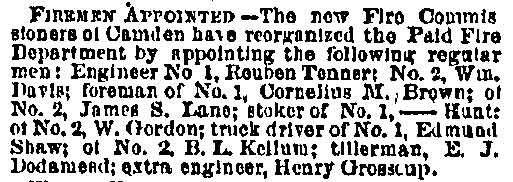
Firemen Appointed — The new Fire Commissioners of Camden have reorganized the Paid Fire Department by appointing the following regular men: Engineer No. 1, Rouben Tenner; No. 2, Wm. Davis; foreman of No. 1, Cornelius M. Brown; of No. 2, James S. Lane; stoker of No. 1, Hunt; of No. 2, W. Gordon; truck driver of No. 1, Edmund Shaw; of No. 2, B. L. Kellum; tillerman, E. J. Dodamead; extra engineer, Henry Grosscup.
An Attempted Outrage
Camden Daily Courier —
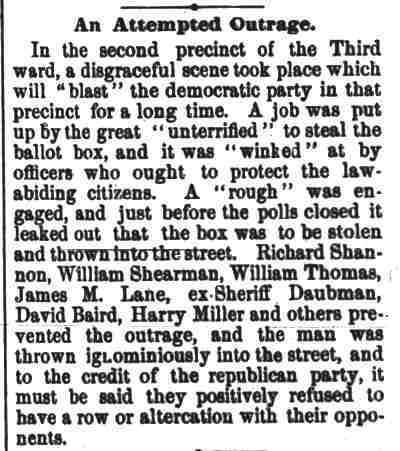
In the second precinct of the Third ward, a disgraceful scene took place which will “blast” the democratic party in that precinct for a long time. A job was put up by the great “unterrified” to steal the ballot box, and it was “winked” at by officers who ought to protect the law-abiding citizens. A “rough” was engaged, and just before the polls closed it leaked out that the box was to be stolen and thrown into the street. Richard Shannon, William Shearman, William Thomas, James M. Lane, ex-Sheriff Daubman, David Baird, Harry Miller and others prevented the outrage, and the man was thrown ignominiously into the street, and to the credit of the republican party, it must be said they positively refused to have a row or altercation with their opponents.
Camden Firemen
Philadelphia Inquirer —
Republicans Appointed In Place of the Democratic Force
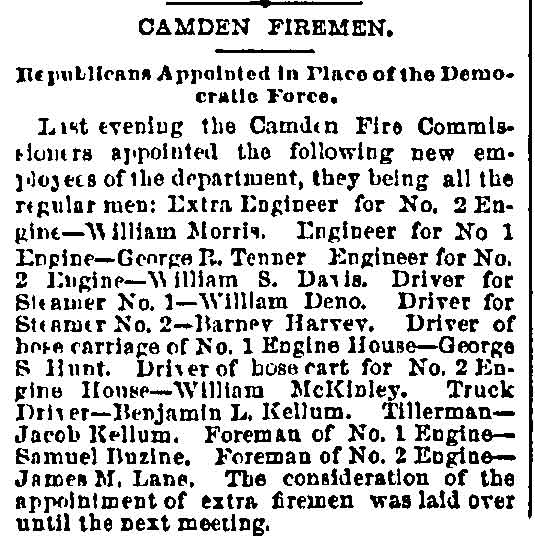
Last evening the Camden Fire Commissioners appointed the following new employees of the department, they being all the regular men: Extra Engineer for No. 2 Engine—William Morris. Engineer for No. 1 Engine—George R. Tenner. Engineer for No. 2 Engine—William S. Davis. Driver for Steamer No. 1—William Deno. Driver for Steamer No. 2—Barney Harvey. Driver of hose carriage of No. 1 Engine House—George S. Hunt. Driver of hose cart for No. 2 Engine House—William McKibley. Truck Driver—Benjamin J. Kellam. Tillerman—Jacob Kellum. Foreman of No. 1 Engine—Samuel Buzine. Foreman of No. 2 Engine—James M. Lane. The consideration of the appointment of extra firemen was laid over until the next meeting.
The Camden Primaries
Philadelphia Inquirer —
A Stubbornly Contested Fight Among the Republicans Last Night
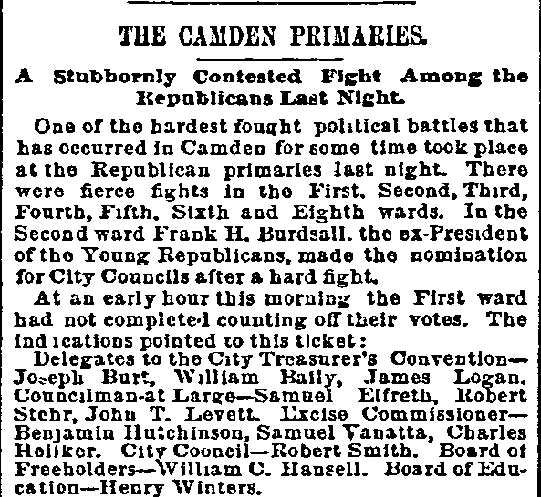
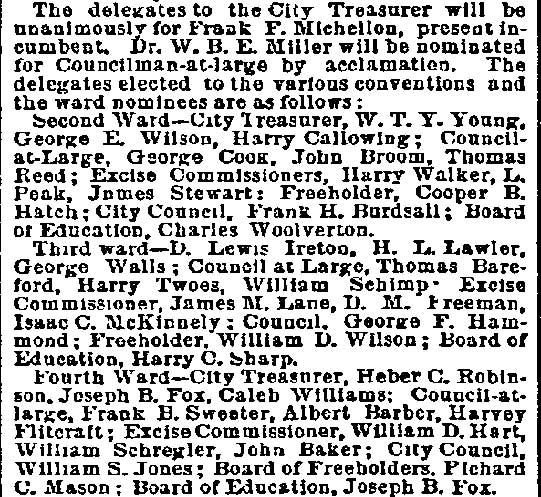
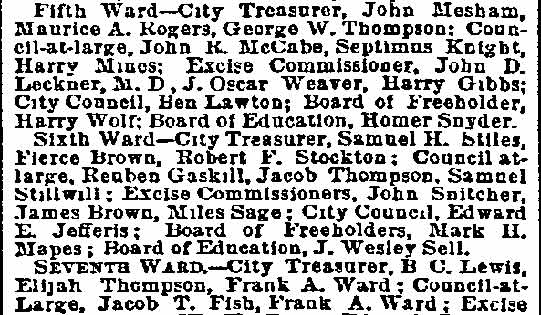
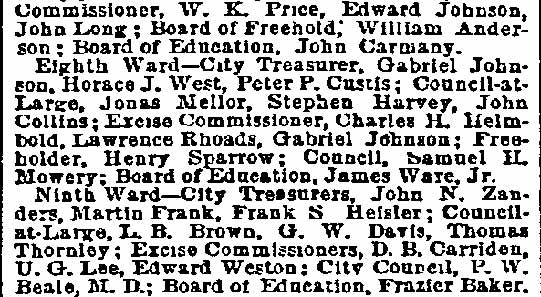
One of the hardest fought political battles that has occurred in Camden for some time took place at the Republican primaries last night. There were fierce fights in the First, Second, Third, Fourth, Fifth, Sixth and Eighth wards. In the Second ward Frank H. Burdsall, the ex-President of the Young Republicans, made the nomination for City Council almost a certainty.
The delegates went to the various conventions and the ward nominees are as follows:
Third ward—D. Lewis Iretoo, H. L. Lawler, George Walls; Council at Large, Thomas Barber, Harvey; Council, James Stewart; Excise Commissioner, James M. Lane, D. M. Freeman, Isaac C. McKinney; Council, George F. Hannigan, Frank Michellon, E. D. Wilson; Board of Education, Harry C. Sharp.
Eighth Ward—City Treasurer, Samuel Johnson, Horace J. West, Peter P. Custis; Council-at-Large, Jonas Mellor, Stephen Harvey, John Zanders; Commissioner, James M. Lane; Freeholder, Lawrence Rhoads, Gabriel Johnson; Freeholder, Henry Sparrow; Council, Samuel H. Stiles, George W. C. Hansell; Ulie G. Lee.
Camden Republican Outlook
Philadelphia Inquirer —
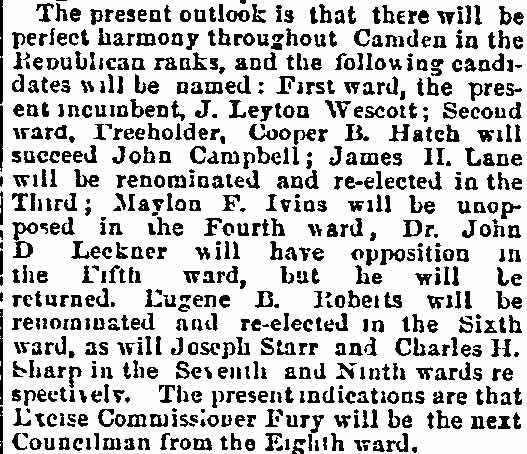
The present outlook is that there will be perfect harmony throughout Camden in the Republican ranks, and the following candidates will be named: First ward, the present incumbent, J. Leyton Wescott; Second ward, Freeholder, Cooper B. Hatch will succeed John Campbell; James H. Lane will be renominated and re-elected in the Third; Maylon F. Ivins will be unopposed in the Fourth ward, Dr. John D. Leckner will have opposition in the Fifth ward, but he will be returned. Eugene B. Roberts will be renominated and re-elected in the Sixth ward, as will Joseph Starr and Charles H. Sharp in the Seventh and Ninth wards respectively. The present indications are that Excise Commissioner Fury will be the next Councilman from the Eighth ward.
Camden’s Warring Factions
Philadelphia Inquirer —
John Furey Now in Council, But Out of the Excise Commission
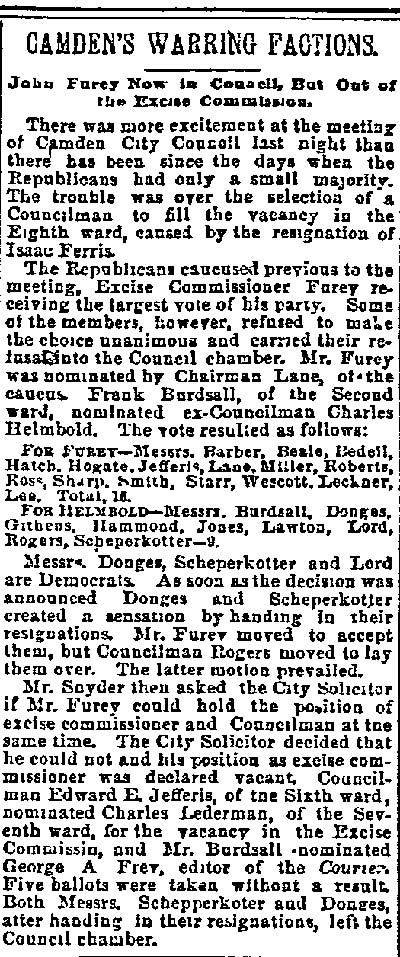
There was more excitement at the meeting of Camden City Council last night than there has been since the days when the Republicans had only a small majority. The trouble was over the selection of a Councilman to fill the vacancy in the Eighth ward, caused by the resignation of Isaac Ferris.
The Republicans caucused previous to the meeting, Excise Commissioner Furey receiving the largest vote of his party. Some of the members, however, refused to make the choice unanimous and carried their refusal into the Council chamber. Mr. Furey was nominated by Chairman Lane, of the caucus. Frank Burdsall, of the Second ward, nominated ex-Councilman Charles Helmbold. The vote resulted as follows:
For Furey—Messrs. Barber, Beale, Bedell, Hatch, Hogate, Jefferis, Lane, Miller, Roberts, Ross, Sharp, Smith, Starr, Westcott, Leckner, Lee. Total, 16.
For Helmbold—Messrs. Burdsall, Donges, Githens, Hammond, Jones, Lawton, Lord, Rogers, Scheperkotter—9.
Messrs. Donges, Scheperkotter and Lord are Democrats. As soon as the decision was announced Donges and Scheperkotter created a sensation by handing in their resignations. Mr. Furey moved to accept them, but Councilman Rogers moved to lay them over. The latter motion prevailed.
Mr. Snyder then asked the City Solicitor if Mr. Furey could hold the position of excise commissioner and Councilman at the same time. The City Solicitor decided that he could not and his position as excise commissioner was declared vacant.
Camden’s Happy Contingent
Philadelphia Inquirer —
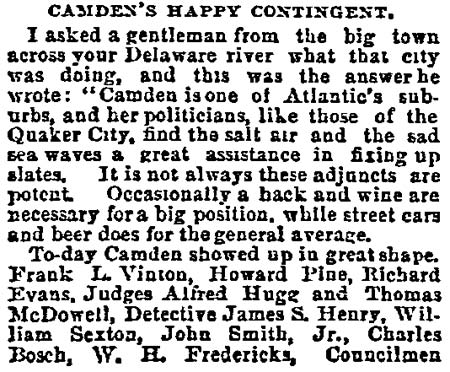
I asked a gentleman from the big town across your Delaware river what that city was doing, and this was the answer he wrote: “Camden is one of Atlantic’s suburbs, and her politicians, like those of the Quaker City, find the salt air and the sad sea waves a great assistance in fixing up slates. It is not always these adjuncts are potent. Occasionally a hack and wine are necessary for a big position, while street cars and beer does for the general average.
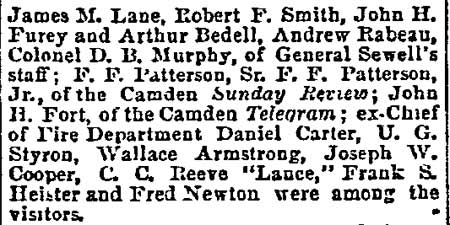
To-day Camden showed up in great shape. Frank L. Vinton, Howard Pine, Richard Evans, Judges Alfred Huge and Thomas McDowell, Detective James S. Henry, William Sexton, John Smith, Jr., Charles Bosch, W. H. Fredericks, Councilmen James M. Lane, Robert F. Smith, John H. Furey and Arthur Bedell, Andrew Rabeau, Colonel D. B. Murphy, of General Sewell’s staff; F. F. Patterson, Sr., F. F. Patterson, Jr., of the Camden Sunday Review; John H. Fort, of the Camden Telegram; ex-Chief of Fire Department Daniel Carter, U. G. Styron, Wallace Armstrong, Joseph W. Cooper, C. C. Reeve “Lance,” Frank S. Heister and Fred Newton were among the visitors.
Death Notice: James M. Lane
Philadelphia Inquirer —
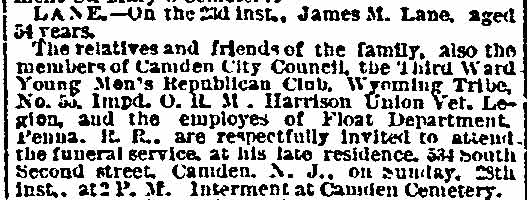
LANE — On the 23d inst., James M. Lane, aged 54 years.
The relatives and friends of the family, also the members of Camden City Council, the Third Ward Young Men’s Republican Club, Wyoming Tribe, No. 55, Impd. O. R. M., Harrison Union Vet. Legion, and the employes of Float Department Penna. R. R., are respectfully invited to attend the funeral service at his late residence, 534 South Second street, Camden, N. J., on Sunday, 25th inst., at 2 P. M. Interment at Camden Cemetery.
Camden Politics
Philadelphia Inquirer —
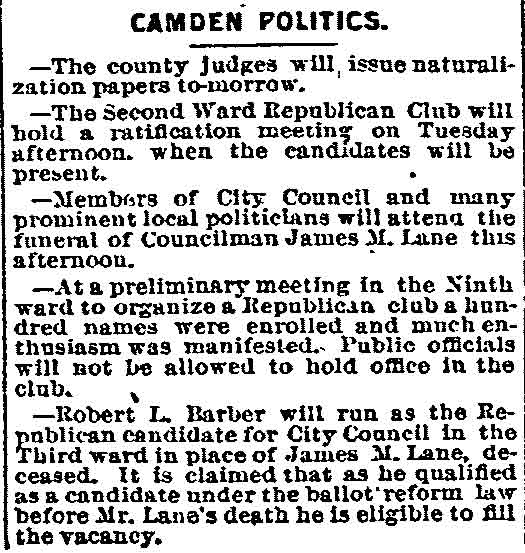
Members of City Council and many prominent local politicians will attend the funeral of Councilman James M. Lane this afternoon.
Robert L. Barber will run as the Republican candidate for City Council in the Third ward in place of James M. Lane, deceased. It is claimed that as he qualified as a candidate under the ballot reform law before Mr. Lane’s death he is eligible to fill the vacancy.
A Councilman’s Funeral
Philadelphia Inquirer —
Public Officials and Societies Do Honor to the Late James M. Lane
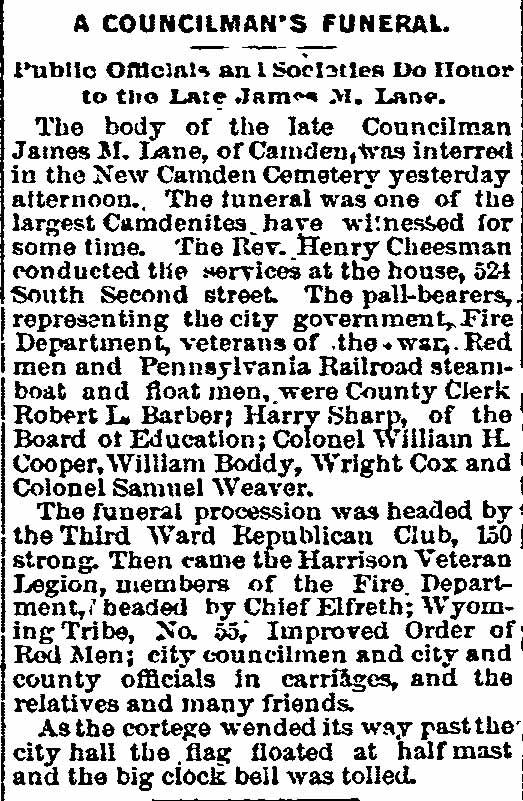
The body of the late Councilman James M. Lane, of Camden, was interred in the New Camden Cemetery yesterday afternoon. The funeral was one of the largest Camdenites have witnessed for some time. The Rev. Henry Cheeseman conducted the services at the house, 524 South Second street. The pall-bearers, representing the city government, Fire Department, veterans of the war, Red men and Pennsylvania Railroad steamboat and float men, were County Clerk Robert L. Barber; Harry Sharp, of the Board of Education; Colonel William H. Cooper, William Boddy, Wright Cox and Colonel Samuel Weaver.
The funeral procession was headed by the Third Ward Republican Club, 150 strong. Then came the Harrison Veteran Legion, members of the Fire Department, headed by Chief Elfreth; Wyoming Tribe, No. 55, Improved Order of Red Men; city councilmen and city and county officials in carriages, and the relatives and many friends.
As the cortege wended its way past the city hall the flag floated at half mast and the big clock bell was tolled.
When G.O.P. Battled G.O.P.
Camden Courier-Post —
Typical Convention Rumpus Stirred ‘Regular’ and ‘True’ Republicans as Gibbs and Morgan Were Nominated for Sheriff in ’81
Another in a series of articles on Camden affairs and personalities of yesteryear — By BEN COURTER
Rival factions in the political conventions of long ago were more bitter toward one another than toward the common foe. So-called “rump” conventions were by no means exceptions. By “rump” was meant merely those who refused to play with the regulars and who set up the nominations, as did the Bull Moose on the national scale in the historic scrap of 1912 which resulted in the three-cornered battle of Wilson, Roosevelt and Taft, giving the Princeton professor the start that was to make him a world figure.
That was the convention to nominate a sheriff called at Gloucester City Hall on Saturday, October 8, 1881, where we find the redoubtable Colonel James Matlack Scovel once more a moving factor, but this time in the ranks of the “regular Republicans” as opposed to the “rump” set up by a rival group. Christopher J. Mines, long Fifth ward leader and later sheriff, apparently had been selected as temporary chairman with William A. Husted as secretary. But when that part of the delegation marched up to city hall, like the famed king’s horses—they marched down again.
In the Third ward there was James M. Lane, Charles S. Cotting and George Martin among the 29 “true Republicans” who walked out and held their own convention, voting for Eli B. Morgan as their candidate for sheriff.
These “true Republicans” in a statement to the party rank and file, under the Algeresque title of “Now or Never,” scathingly said: “It becomes the duty of every Republican voter of Camden county, who has the future interest of the party at heart, to administer a severe and lasting rebuke to all candidates who employ the element and encourage the means that were used in controlling the Sheriff’s convention at City Hall, Gloucester City.”
The “Gibbs” mentioned was Theodore B. Gibbs who long lived in the white mansion on the banks of Clementon lake. Gibbs was nominated by the “regular” Convention and a mighty hot shrievalty campaign ended on November 10 with his election; in spite of the “now or never” demand of his opponents headed by Eli Morgan. In the shrievalty scrap of 1881, Gibbs received 5381 and Morgan, 1189. Angus Cameron, the Democratic candidate was given 4450 votes.