Introduction
Edward N. Cohn was born in 1832. On the 1870 Census he stated that he was born in Bohemia, in 1880 Germany. It is likely that he was born somewhere in what is now the Czech Republic. Edward Cohn appears to have served during the Civil War as a Sergeant with Company C of the 34th New Jersey Regiment from January 17, 1865 through January 16 of 1866, where he was mustered out in Mobile AL.
Edward N. Cohn appears in the 1870 census as living in Camden's North Ward. He had by then married his wife Adeline, who was Pennsylvania born. The Cohns had a three year old daughter, Adelia. Edward N. Cohn was then working in the lumber business. He was doing well in that trade, as the family employed a live-in domestic. He had also started building houses.
Edward Cohn was making his home in Bordentown NJ when the 1880 Census was taken. He was then in the retail lumber business. Business had been good to him, and the Cohn family was still employing a domestic. All through this period and into the 1880s he continued to engage in construction.
In 1886, George Reeser Prowell wrote of Edward N. Cohn, in his book History of Camden County, New Jersey:
Among the builders of Camden are several who have erected five or six hundred houses each. The heaviest operators are undoubtedly Cohn & Roberts, Wilson Ernst, and George Holl. Fine examples of the work of the firm first named are to be seen on Front and Point Streets, between Cooper and Linden. Mr. E.N. Cohn commenced building in 1866, erecting in that year 12 houses on Pearl Street. He then continued putting up blocks and separate structures, operating alone and in conjunction with Charles B. Richard and Asa R. Cox, and building not less than one hundred and fifty houses. He also erected the Pfeil and Galtz building, which was burned. In 1882 he formed a partnership with Joseph E. Roberts, who, individually, had built about two hundred houses, and as a firm they have since constructed at least four-hundred and fifty dwellings, to which line of building they devote themselves exclusively.
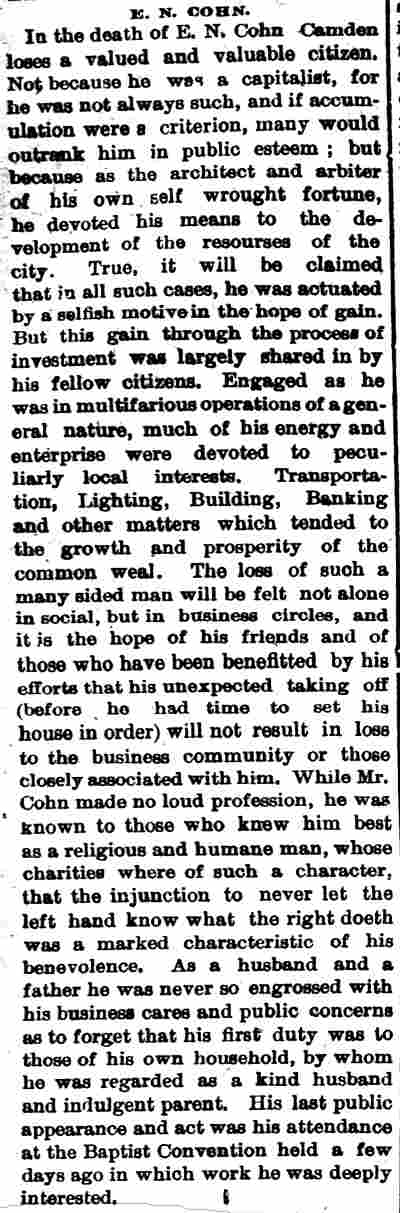
By 1887 Edward Cohn had moved back to Camden, and the family lived at the corner of 8th and Line Streets through 1889. In 1888 he began work on a mansion at North 8th and Cooper Streets. The 1890 Camden City Directory shows that Edward Cohn and family was living at 804 Cooper Street, then one of the most prestigious blocks in the city. Edward Cohn died on November 9, 1890.
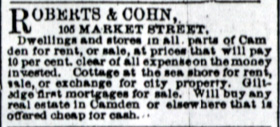
As indicated above, Edward Cohn had partnered with Joseph E. Roberts, president of the West Jersey Railroad Company. He would later also partner with George Holl. The Roberts and Cohn real estate firm was located at 105 Market Street. Edward Cohn bought land from John F. Starr Jr. in North Camden, and with partners Roberts and Holl built many two- and three-story row and frame houses from Cooper's Point to Pearl Street, which they sold and rented out to working class people. Cohn also bought land near the Liberty Park railroad station, where he built blocks of similar homes along Liberty Street, Mechanic Street, Atlantic Avenue, and Kaighn Avenue, between Haddon Avenue and Mount Ephraim Avenues.
Cohn Alley, which runs west off Haddon Avenue between Kaighn Avenue and Liberty Street, is named for Edward N. Cohn.
Photos
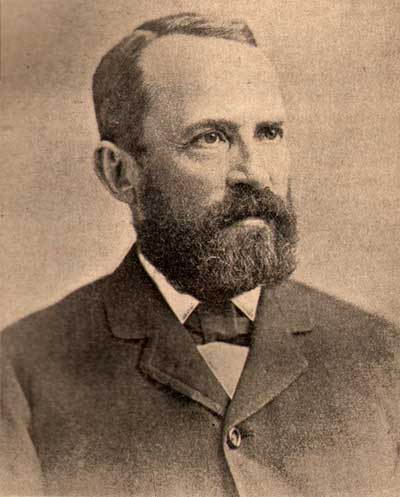
Edward N. Cohn portrait
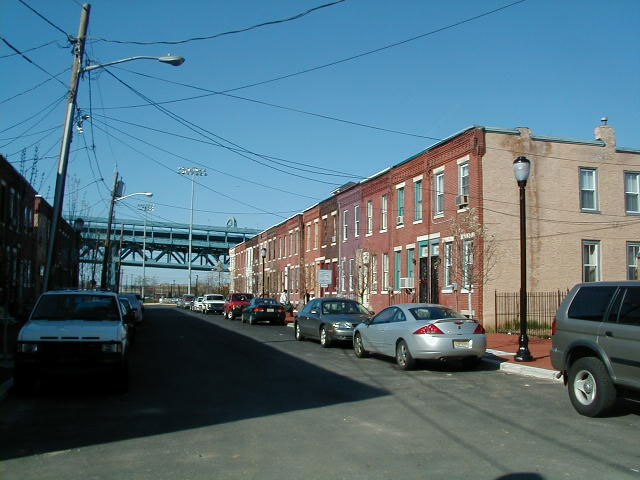
312 to 338 Point Street — 2003
These are the homes on Point Street which Prowell cites as "fine examples" of the homes built by Edward Cohn and Joseph Roberts prior to November of 1886.
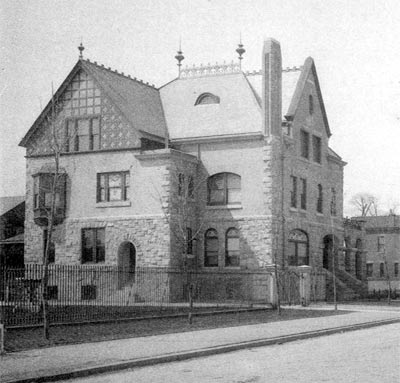
E.N. Cohn's Mansion at 804 Cooper Street as seen from 9th Street — 1893
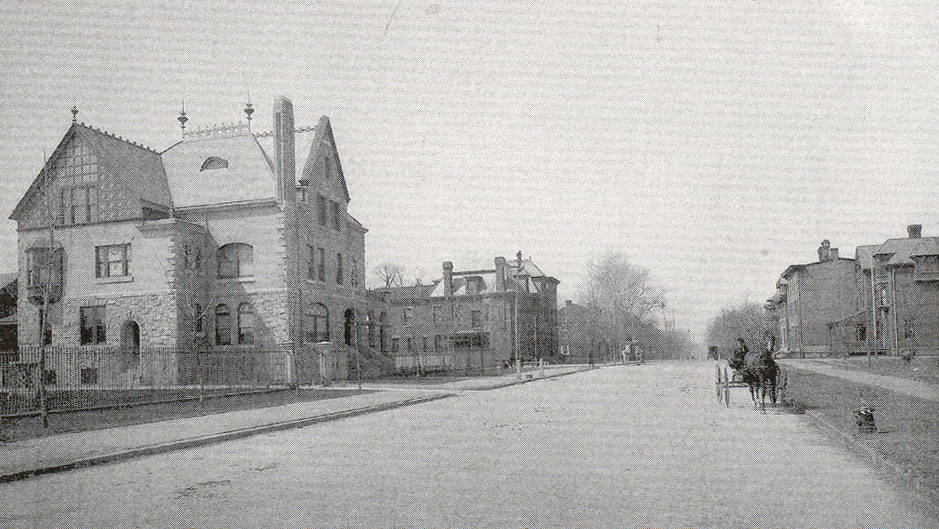
804 Cooper Street mansion detail
The German Mass Meeting.
Camden Daily Courier —
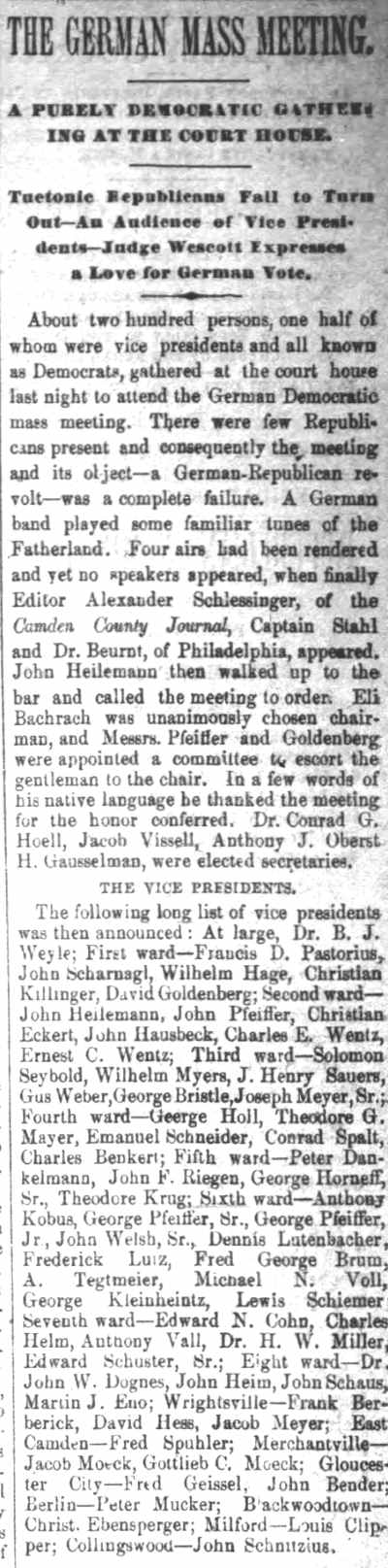
A PURELY DEMOCRATIC GATHERING AT THE COURT HOUSE.
Tuetonic [sic] Republicans Fail to Turn Out—An Audience of Vice Presidents—Judge Wescott Expresses a Love for German Vote.
About two hundred persons, one half of whom were vice presidents and all known as Democrats, gathered at the court house last night to attend the German Democratic mass meeting. There were few Republicans present and consequently the meeting and its object—a German-Republican revolt—was a complete failure. A German band played some familiar tunes of the Fatherland. Four airs had been rendered and yet no speakers appeared, when finally Editor Alexander Schlessinger, of the Camden County Journal, Captain Stahl and Dr. Beurnt, of Philadelphia, appeared. John Heilemann then walked up to the bar and called the meeting to order. Eli Bachrach was unanimously chosen chairman, and Messrs. Pfeiffer and Goldenberg were appointed a committee to escort the gentleman to the chair. In a few words of his native language he thanked the meeting for the honor conferred. Dr. Conrad G. Hoell, Jacob Vissell, Anthony J. Oberst, H. Gausselman, were elected secretaries.
THE VICE PRESIDENTS.
The following long list of vice presidents was then announced: At large, Dr. B. J. Weyle; First ward—Francis D. Pastorius, John Scharnagl, Wilhelm Hage, Christian Killinger, David Goldenberg; Second ward—John Heilemann, John Pfeiffer, Christian Eckert, John Hausbeck, Charles E. Wentz, Ernest C. Wentz; Third ward—Solomon Seybold, Wilhelm Myers, J. Henry Sauers, Gus Weber, George Bristle, Joseph Meyer, Sr.; Fourth ward—George Holl, Theodore G. Mayer, Emanuel Schneider, Conrad Spalt, Charles Benkert; Fifth ward—Peter Dankelmann, John F. Riegen, George Horneff, Sr., Theodore Krug; Sixth ward—Anthony Kobus, George Pfeiffer, Sr., George Pfeiffer, Jr., John Welsh, Sr., Dennis Lutenbacher, Frederick Lutz, Fred George Brum, A. Tegtmeier, Michael N. Voll, George Kleinheintz, Lewis Schiemer; Seventh ward—Edward N. Cohn, Charles Helm, Anthony Vall, Dr. H. W. Miller, Edward Schuster, Sr.; Eight [sic] ward—Dr. John W. Dognes, John Heim, John Schaus, Martin J. Eno; Wrightsville—Frank Berberick, David Hess, Jacob Meyer; East Camden—Fred Spuhler; Merchantville—Jacob Moeck, Gottlieb C. Moeck; Gloucester City—Fred Geissel, John Bender; Berlin—Peter Mucker; Blackwoodtown—Christ. Ebensperger; Milford—Louis Clipper; Collingswood—John Schnutzius.
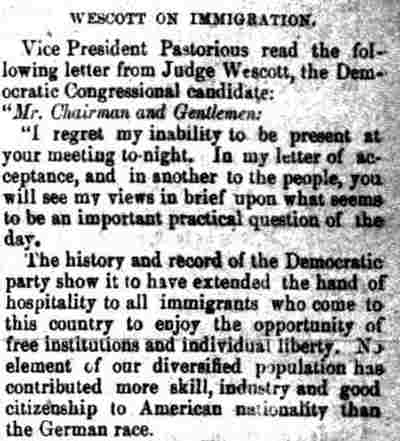
WESCOTT ON IMMIGRATION.
Vice President Pastorious read the following letter from Judge Wescott, the Democratic Congressional candidate:
“Mr. Chairman and Gentlemen:
“I regret my inability to be present at your meeting to-night. In my letter of acceptance, and in another to the people, you will see my views in brief upon what seems to be an important practical question of the day.
The history and record of the Democratic party show it to have extended the hand of hospitality to all immigrants who come to this country to enjoy the opportunity of free institutions and individual liberty. No element of our diversified population has contributed more skill, industry and good citizenship to American nationality than the German race.
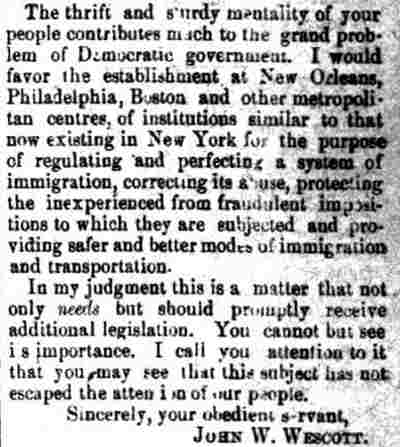
The thrift and sturdy mentality of your people contributes much to the grand problem of Democratic government. I would favor the establishment at New Orleans, Philadelphia, Boston and other metropolitan centres, of institutions similar to that now existing in New York for the purpose of regulating and perfecting a system of immigration, correcting its abuse, protecting the inexperienced from fraudulent impositions to which they are subjected and providing safer and better modes of immigration and transportation.
In my judgment this is a matter that not only needs but should promptly receive additional legislation. You cannot but see its importance. I call your attention to it that you may see that this subject has not escaped the attention of our people.
Sincerely, your obedient servant,
JOHN W. WESCOTT.
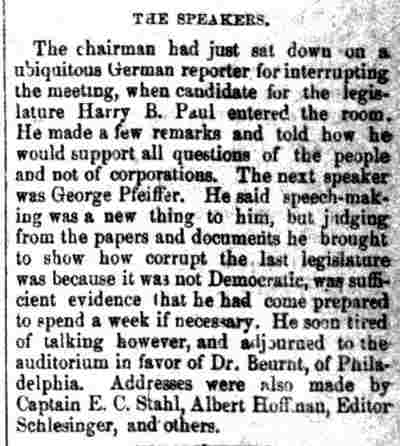
THE SPEAKERS.
The chairman had just sat down on a ubiquitous German reporter for interrupting the meeting, when candidate for the legislature Harry B. Paul entered the room. He made a few remarks and told how he would support all questions of the people and not of corporations. The next speaker was George Pfeiffer. He said speech-making was a new thing to him, but judging from the papers and documents he brought to show how corrupt the last legislature was because it was not Democratic, was sufficient evidence that he had come prepared to spend a week if necessary. He soon tired of talking however, and adjourned to the auditorium in favor of Dr. Beurnt, of Philadelphia. Addresses were also made by Captain E. C. Stahl, Albert Hoffman, Editor Schlesinger, and others.
Crystal Glass Company
Trenton Evening Times —
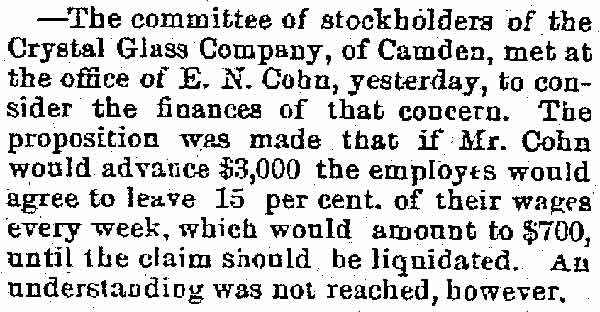
Crystal Glass Company, Trenton Evening Times, December 29, 1887
Marring Cooper Street
Camden Post —
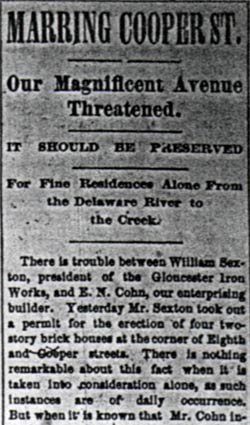
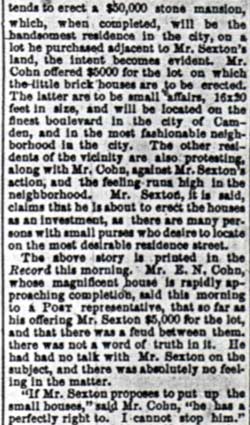
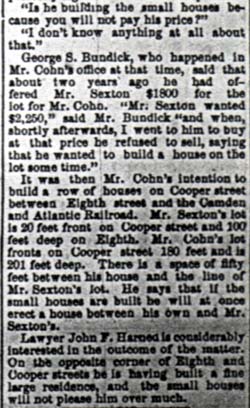
Marring Cooper Street. Camden Post — June 3, 1888
Building Boom in Camden
Philadelphia Inquirer —
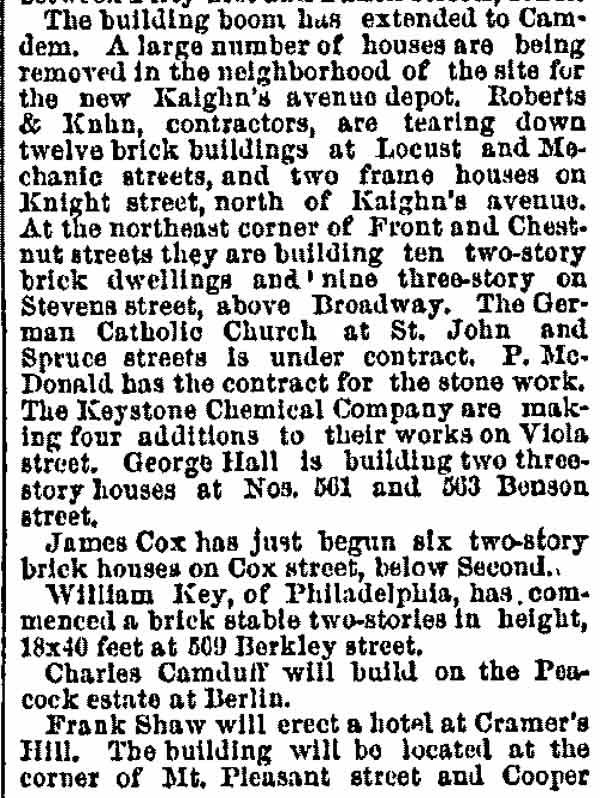
The building boom has extended to Camden. A large number of houses are being removed in the neighborhood of the site for the new Kaighn’s avenue depot. Roberts & Kuhn, contractors, are tearing down twelve brick buildings at Locust and Mechanic streets, and two frame houses on Knight street, north of Kaighn’s avenue. At the northeast corner of Front and Chestnut streets they are building ten two-story brick dwellings and nine three-story on Stevens street, above Broadway. The German Catholic Church at St. John and Spruce streets is under contract. P. McDonald has the contract for the stone work. The Keystone Chemical Company are making four additions to their works on Viola street. George Hall is building two three-story houses at Nos. 501 and 503 Benson street.
James Cox has just begun six two-story brick houses on Cox street, below Second.
William Key, of Philadelphia, has commenced a brick stable two-stories in height, 18x40 feet at 509 Berkley street.
Charles Camduff will build on the Peacock estate at Berlin.
Frank Shaw will erect a hotel at Cramer’s Hill. The building will be located at the corner of Mt. Pleasant street and Cooper
Building at 8th and Cooper
Camden Post —
Building at 8th and Cooper article
Corporation Elections
Philadelphia Inquirer —
CORPORATION ELECTIONS.
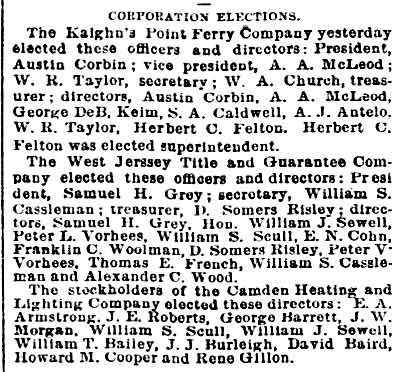
The Kaighn’s Point Ferry Company yesterday elected these officers and directors: President, Austin Corbin; vice president, A. A. McLeod; W. R. Taylor, secretary; W. A. Church, treasurer; directors, Austin Corbin, A. A. McLeod, George DeB. Keim, S. A. Caldwell, A. J. Antelo. W. R. Taylor, Herbert C. Felton. Herbert C. Felton was elected superintendent.
The West Jersey Title and Guarantee Company elected these officers and directors: President, Samuel H. Grey; secretary, William S. Cassleman; treasurer, D. Somers Risley; directors, Samuel H. Grey, Hon. William J. Sewell, Peter L. Vorhees, William S. Scull, E. N. Cohn, Franklin C. Woolman, D. Somers Risley, Peter V. Vorhees, Thomas E. French, William S. Cassleman and Alexander C. Wood.
The stockholders of the Camden Heating and Lighting Company elected these directors: E. A. Armstrong, J. E. Roberts, George Barrett, J. W. Morgan, William S. Scull, William J. Sewell, William T. Bailey, J. J. Burleigh, David Baird, Howard M. Cooper and Rene Gillon.
Death Notice
Camden Post —
Edward N. Cohn Death notice
Camden News Budget.
Philadelphia Inquirer —
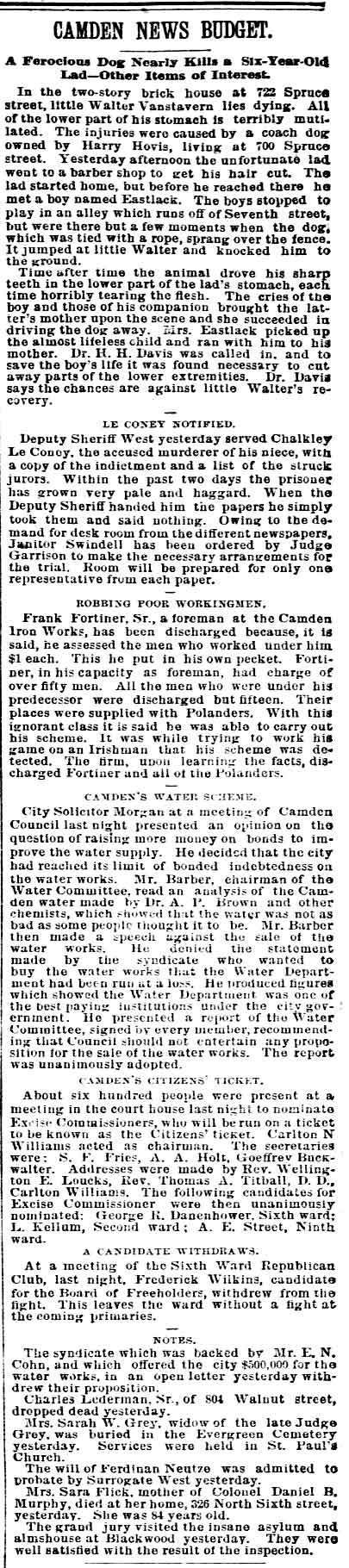
A Ferocious Dog Nearly Kills a Six-Year-Old Lad—Other Items of Interest.
In the two-story brick house at 722 Spruce street, little Walter Vanstavern lies dying. All of the lower part of his stomach is terribly mutilated. The injuries were caused by a coach dog owned by Harry Hovis, living at 700 Spruce street. Yesterday afternoon the unfortunate lad went to a barber shop to get his hair cut. The lad started home, but before he reached there he met a boy named Eastlack. The boys stopped to play in an alley which runs off of Seventh street, but were there but a few moments when the dog, which was tied with a rope, sprang over the fence. It jumped at little Walter and knocked him to the ground.
Time after time the animal drove his sharp teeth in the lower part of the lad’s stomach, each time horribly tearing the flesh. The cries of the boy and those of his companion brought the latter’s mother upon the scene and she succeeded in driving the dog away. Mrs. Eastlack picked up the almost lifeless child and ran with him to his mother. Dr. H. H. Davis was called in, and to save the boy’s life it was found necessary to cut away parts of the lower extremities. Dr. Davis says the chances are against little Walter’s recovery.
LE CONEY NOTIFIED.
Deputy Sheriff West yesterday served Chalkley Le Conoy, the accused murderer of his niece, with a copy of the indictment and a list of the struck jurors. Within the past two days the prisoner has grown very pale and haggard. When the Deputy Sheriff handed him the papers he simply took them and said nothing. Owing to the demand for desk room from the different newspapers, Janitor Swindell has been ordered by Judge Garrison to make the necessary arrangements for the trial. Room will be prepared for only one representative from each paper.
ROBBING POOR WORKINGMEN.
Frank Fortiner, Sr., a foreman at the Camden Iron Works, has been discharged because, it is said, he assessed the men who worked under him $1 each. This he put in his own pocket. Fortiner, in his capacity as foreman, had charge of over fifty men. All the men who were under his predecessor were discharged but fifteen. Their places were supplied with Polanders. With this ignorant class it is said he was able to carry out his scheme. It was while trying to work his game on an Irishman that his scheme was detected. The firm, upon learning the facts, discharged Fortiner and all of the Polanders.
CAMDEN’S WATER SCHEME.
City Solicitor Morgan at a meeting of Camden Council last night presented an opinion on the question of raising more money on bonds to improve the water supply. He decided that the city had reached its limit of bonded indebtedness on the water works. Mr. Barber, chairman of the Water Committee, read an analysis of the Camden water made by Dr. A. P. Brown and other chemists, which showed that the water was not as bad as some people thought it to be. Mr. Barber then made a speech against the sale of the water works. He denied the statement made by the syndicate who wanted to buy the water works that the Water Department had been run at a loss. He produced figures which showed the Water Department was one of the best paying institutions under the city government. He presented a report of the Water Committee, signed by every member, recommending that Council should not entertain any proposition for the sale of the water works. The report was unanimously adopted.
CAMDEN’S CITIZENS’ TICKET.
About six hundred people were present at a meeting in the court house last night to nominate Excise Commissioners, who will be run on a ticket to be known as the Citizens’ ticket. Carlton N. Williams acted as chairman. The secretaries were: S. F. Fries, A. A. Holt, Goeffrey Buckwalter. Addresses were made by Rev. Wellington E. Loucks, Rev. Thomas A. Titball, D. D., Carlton Williams. The following candidates for Excise Commissioner were then unanimously nominated: George R. Danenhower, Sixth ward; L. Kellum, Second ward; A. E. Street, Ninth ward.
A CANDIDATE WITHDRAWS.
At a meeting of the Sixth Ward Republican Club, last night, Frederick Wilkins, candidate for the Board of Freeholders, withdrew from the fight. This leaves the ward without a fight at the coming primaries.
NOTES.
The syndicate which was backed by Mr. E. N. Cohn, and which offered the city $500,000 for the water works, in an open letter yesterday withdrew their proposition.
Charles Lederman, Sr., of 804 Walnut street, dropped dead yesterday.
Mrs. Sarah W. Grey, widow of the late Judge Grey, was buried in the Evergreen Cemetery yesterday. Services were held in St. Paul’s Church.
The will of Ferdinand Neutze was admitted to probate by Surrogate West yesterday.
Mrs. Sara Flick, mother of Colonel Daniel B. Murphy, died at her home, 326 North Sixth street, yesterday. She was 84 years old.
The grand jury visited the insane asylum and almshouse at Blackwood yesterday. They were well satisfied with the result of the inspection.