Church of the Immaculate Conception — 1905 Golden Jubilee Book
The Messenger, Vol. V, Golden Number No. 9,
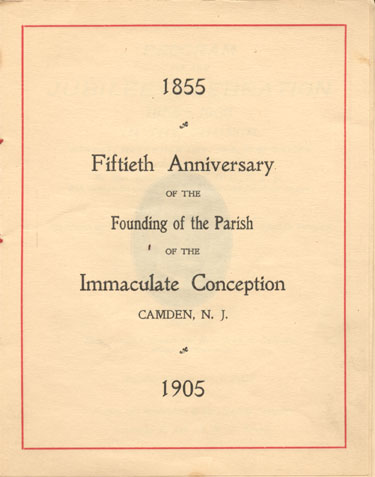
Golden Jubilee program cover, Church of the Immaculate Conception, Camden, N.J., 1855–1905.
On the square bounded by Broadway, Federal and Market Streets, in the heart of Camden, stands the Roman Catholic Church of the Immaculate Conception, its Rectory, School and Lyceum Building. It has perhaps a more numerous membership than any other church in Camden, and it is the largest Catholic congregation in the state south and west of Trenton.
This Golden Jubilee book, published in November 1905 as The Messenger (Vol. V, Golden Number No. 9), commemorates the 50th anniversary of the parish, established November 11, 1855. The book was compiled by Very Rev. Dean B. J. Mulligan, Rector, who served as the parish’s fourth pastor beginning October 23, 1895.
The 1905 Jubilee Book
Cover and title page of the 1905 Golden Jubilee book.
DEDICATION
To the noble men and women pioneers in planting the Church in this City and vicinity, to their children and grandchildren dead and living, who were to the end or are now true to the teaching of Holy Church, to the other faithful parishioners who have fought the good fight and have kept the faith and are now my joy and consolation, the following pages are cordially inscribed by the PASTOR.
PREFACE
Fifty years ago a handful of Catholics assembled in Starr’s Hall at the request of the Rev. Father Moran and received from his own lips the blessed message that he had been appointed by the Ordinary of the Diocese, Pastor of Camden, and of the country adjacent. On that day Camden ceased to be a mere mission and took its place in the family of parochial centers with a resident priest. The Pastor and most of those present on that historic occasion have already passed away, but the Church planted amid such humble surroundings took root, and like the mustard seed of the Gospel, has grown strong and spread its branches to new and then unheard of settlements.
Many times during the past ten years, since his advent into Camden, has the present Rector looked in vain for some treasured record of those years, and of the noble men and women who were the principal actors. They live in their works, ‘tis true, as the magnificent cluster of parish buildings testify, but the memory of their sacrifices, their struggles, their zeal for God and Holy Church, is only an uncertain and vague tradition in the minds of the present generation and is likely to wholly disappear when the few sere actors left have passed into the tomb. To snatch the few threads of the story of those fifty years from the web of time and weave them into a new and whole garment is the purpose of these pages.
Church Books, such as Baptismal, Marriage and Confirmation Records, Pew and Account Books, Receipts, Bills, Deeds, Mortgages and other legal Documents, in fact scraps of paper of almost every and any description have been looked into. The oldest inhabitants have been consulted and their version has been compared with other available records until the story has finally taken shape, though not as elegantly put together nor as accurately as the writer would wish, but it was the best he could do out of the material at hand. Feeling that gratitude is one of the most admirable of virtues and that none but the ignoble forget their beneficiaries, the writer indulges the fond hope that you will read with interest the struggles of those pioneers in the faith and retain in prayful remembrance, not only the name of the writer, when he shall have been summoned by the Master, but also of those, the many thousands, who were actors in planting and perpetuating the Church in this community.
Feast of the Patronage of the Blessed Virgin Mary, November 12, 1905
B. J. MULLIGAN, Rector.
Chapter I — Clergy & Parish Directory, 1905
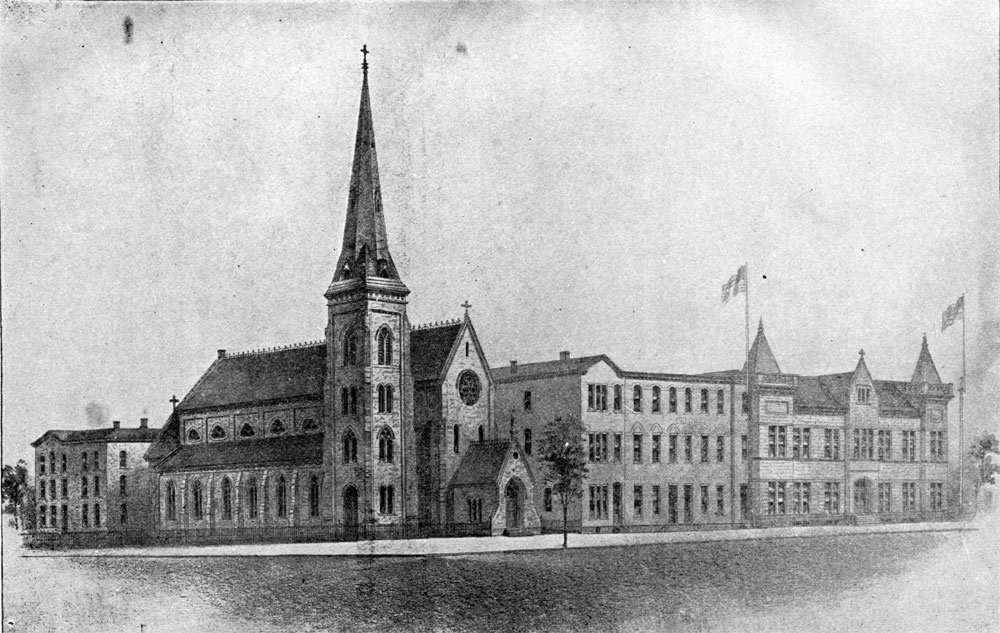
The Church and Other Buildings of the Immaculate Conception Parish, Camden, N.J., November 1905.
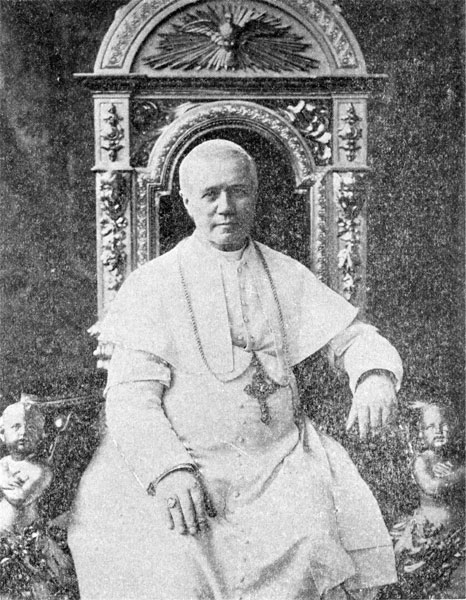
His Holiness, Pope Pius X.
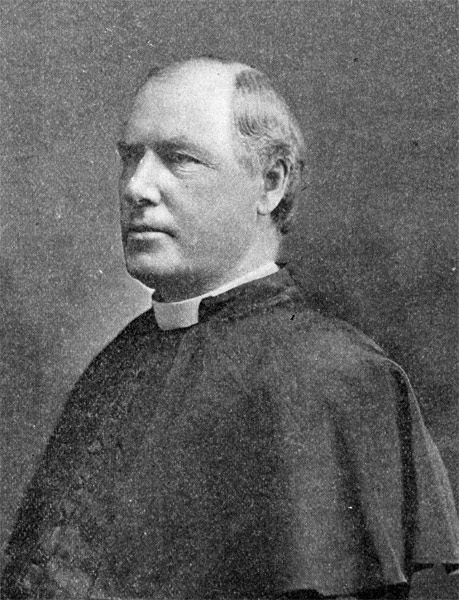
Very Rev. Dean B. J. Mulligan, Rector, The Church of the Immaculate Conception.
Clergy
Very Rev. Dean B. J. Mulligan, Rector
Rev. John A. Sullivan, First Assistant
Rev. Thomas B. Healy, Second Assistant
The Masses
On Sundays, 7.00, 8.00 A.M.; Children’s Mass, 9.00 A.M.; High Mass, 10.30 A.M.; July and August, 6.00, 7.00, 9.00 and 10.00 A.M.
Holy Days, 5.30, 7.00 A.M.; High Mass, 9.00 A.M. Week Days, 6.30, 8.00 A.M.
Sunday Afternoon and Evening Services
Sunday School and Benediction, 2:30 P.M. Baptisms 3.00 P.M. Vespers, Benedictions and Sermon 7.30 P.M.
Meetings of Church Societies and Sodalities
| Society | Meeting |
|---|---|
| Rosary Society | First Sunday of the month, at 3.30 P.M. |
| Sodality of the B.V.M. | Second and Fourth Sundays at 3.30 P.M. |
| Children of Mary | Third Sunday at 3.30 P.M. |
| St. Aloysius, Angels and Infant Sodalities | Third Sunday at 3.30 P.M. |
| Sacred Heart League | First Friday at 7.30 P.M. |
Societies Meeting in the Lyceum Building
| Society | Meeting |
|---|---|
| Catholic Lyceum Association — Joint Meeting | Third Tuesday at 8 P.M. |
| Catholic Lyceum Association — Ladies’ Auxiliary | Second Tuesday at 8 P.M. |
| Catholic Lyceum Association — Board of Directors | Third Tuesday at 7.30 P.M. |
| St. Patrick’s Total Abstinence | Last Sunday of the month at 3 P.M. |
| Temperance Cadets | First Sunday, 3.30 P.M. |
| Irish Catholic Benevolent Union — St. Joseph’s Society | First Tuesday at 8 P.M. |
| Irish Catholic Benevolent Union — Bishop O’Farrell Society | First Thursday at 8 P.M. |
| Irish Catholic Benevolent Union — Ladies’ Beneficial | Third Thursday at 8 P.M. |
| Ancient Order of Hibernians, Division No. 1 (Men) | First Friday at 8 P.M. |
| Ancient Order of Hibernians, Division No. 2 (Ladies’ Auxiliary) | Fourth Wednesday at 8 P.M. |
| Catholic Benevolent Legion — McCluskey Council, No. 131 | Second and Fourth Tuesday at 8 P.M. |
| Knights of Columbus — Camden Council, No. 439 | Second and Fourth Tuesday at 8 P.M. |
| St. Anthony’s Society for Relief of the Poor | First Monday, 7.30 P.M. |
| Bishop Bayley Building Loan | Last Monday of month, 7.30 P.M. |
| Parish Board of St. Michael’s Orphan Asylum | First Sunday of Month at 4 P.M. |
Parish Boundaries
Include that portion of the City of Camden North of and including Mt. Vernon Street, bounded on the West and North by the Delaware River, on the East by Cooper’s Creek. All Catholics, not Germans or Poles or Italians, living in that district, belong to the congregation of the Immaculate Conception.
Historical Sketch of the Parish
Chapter II — Early History
On the square bounded by Broadway, Federal and Market Streets, in the heart of Camden, stands the Roman Catholic Church of the Immaculate Conception, its Rectory, School and Lyceum Building. It has perhaps a more numerous membership than any other church in Camden, and it is the largest Catholic congregation in the state south and west of Trenton. Fifty years ago, when the parish comprised the whole city, with the adjacent country around, the entire congregation could find ample room in a comparatively small hall. Ten Priests are now ministering to the spiritual wants of the people, where the services of one alone were then deemed sufficient. Of the fifteen thousand souls in Camden in 1850 not more than three hundred were Catholic — most of them recent emigrants, poor, without influence, without church or church property of any kind.
When the first Catholic came to the settlement and what his name was we do not know. On his journey across the ocean in 1682, Col. Thomas Dongan, the younger son of a Catholic Baronet, a man of great wealth and influence, was accompanied by a Catholic Priest named the Rev. Thomas Harvey, who traveled extensively through New York and New Jersey, of which Mr. Dongan was then the Governor. They visited Philadelphia many times, stopping, no doubt, on the eastern banks of the Delaware, where Father Harvey administered the consolation of religion to the few of the fold found there.
In the middle part of the eighteenth century (1744) a celebrated Jesuit, Rev. Theo. Schneider, D.D., founded the missions of Haycock, Coshenhopen, in Pennsylvania, crossed the Delaware and traversed its whole length, from Cape May to its most northern tributary. He stopped at Bound Brook, at Burlington and at Gloucester, which then included Camden. “Father Farmer” (Rev. Ferdinand Steynimeyer) paid frequent visits during the Revolutionary period to both the English and American troops stationed along the East bank of the Delaware from Salem to Burlington.
It is interesting to note that the very land on which the parish buildings of the Immaculate Conception stand was the scene of a sharp skirmish between the American forces under “Mad” Anthony Wayne and the British troops. Being in need of provender for his horses, General Anthony Wayne led a company down the pike toward Haddonfield, but being discovered and pursued by the enemy, he retreated to the junction of the pike [Haddon Avenue] and Market Street, where he took stand and gave battle, with the result that the British fled toward Haddonfield, and Anthony returned in triumph to his own camp near Cooper Ferry. The Church of the Immaculate Conception stands on the very spot occupied by General Anthony Wayne and his troops on that very interesting occasion.
In 1828, when Camden was incorporated and received its charter, the entire population was only 1,143 souls. In 1830 the tide of emigration set strongly Camdenward, drawn thither for the building of the Camden and Amboy Railroad. In 1849 Father Waldron erected a small brick church in Gloucester. In 1851 Father Hannegan was appointed first resident pastor of Gloucester, with jurisdiction over Camden district. During the whole of 1852 no public services were held, “the Hall in which Mass was wont to be celebrated having been burnt, the interruption being caused by Native American hostility,” says Father Hannegan.
Chapter III — Bishop Neumann
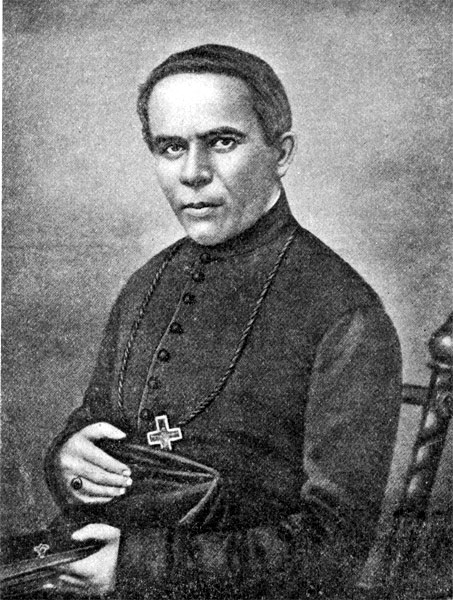
The Venerable John Nepomucene Neumann, Fourth Bishop of Philadelphia.
On the reopening of the mission in 1853, conditions had somewhat changed. The district was no longer under the jurisdiction of the Bishop of Philadelphia. With the consent of Bishop Neumann of Philadelphia, and of Bishop Hughes of New York, Eastern and Western Jerseys were united into one See, with Newark as the episcopal city.
The future Bishop of Philadelphia was born on the 28th of March, 1811, in a village of Bohemia. From his earliest years he manifested a vocation to the priesthood, and in 1831 began his theological studies in the city of Prague. He came to America and was admitted into the diocese of New York by Bishop Dubois on June 3, 1836. In 1840 he entered the Redemptorist Order, where his ability as Superior became known. He was chosen in 1852 to succeed the Right Rev. Francis Patrick Kendrick as Bishop of Philadelphia. The life of the saintly Bishop came to an abrupt termination on the 5th of January, 1860. His remains rest in the basement chapel of St. Peter’s Church, Philadelphia. The sanctity of Bishop Neumann led many to have recourse to him in prayer after his death, and many favors are attributed to his intercession. On the 17th of December, 1896, Leo XIII signed the commission which gave him the title of Venerable.
Chapter IV — Bishop Bayley & the Diocese of Newark
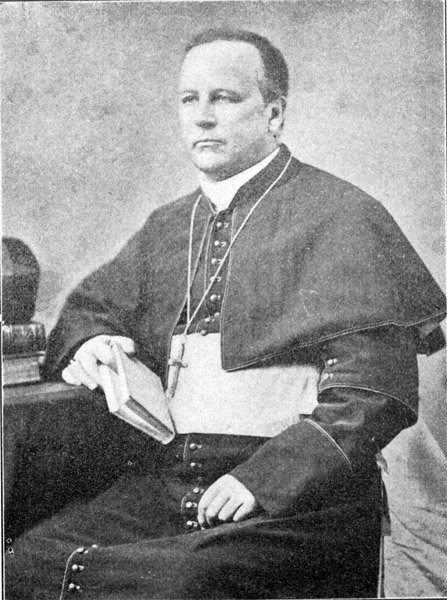
Most Rev. James Roosevelt Bayley, D.D. Bishop of Newark, October 30, 1853; promoted to Baltimore July 10, 1872. Camden was included in Diocese of Newark until November 1, 1883.
At the time of the erection of the diocese of Newark in 1853, the Reverend James Roosevelt Bayley was a young man, an energetic and zealous priest. Selected by Archbishop Hughes as his secretary, he had opportunities of learning much about the administration of a diocese under the most extraordinary ecclesiastic of the age. Though most gentle, charitable, and considerate of other needs, he was firm, without appearing so, when duty demanded; a gentleman of the highest culture and the most refined manners. For some years he had filled the honored position of rector of a Protestant Episcopal Congregation in New York City, but Protestantism did not satisfy his ardent desire for the whole truth, and he sought relief in the Old Church that had Apostolic succession as Her claim to authority.
At the first ordination held in the Diocese a young man, having finished his course at the seminary, presented himself and asked that apostolic hands be laid upon him. This person was The Rev. James Moran, the first priest ordained by Bishop Bayley.
Chapter V — Father Moran’s Administration, 1855–1863
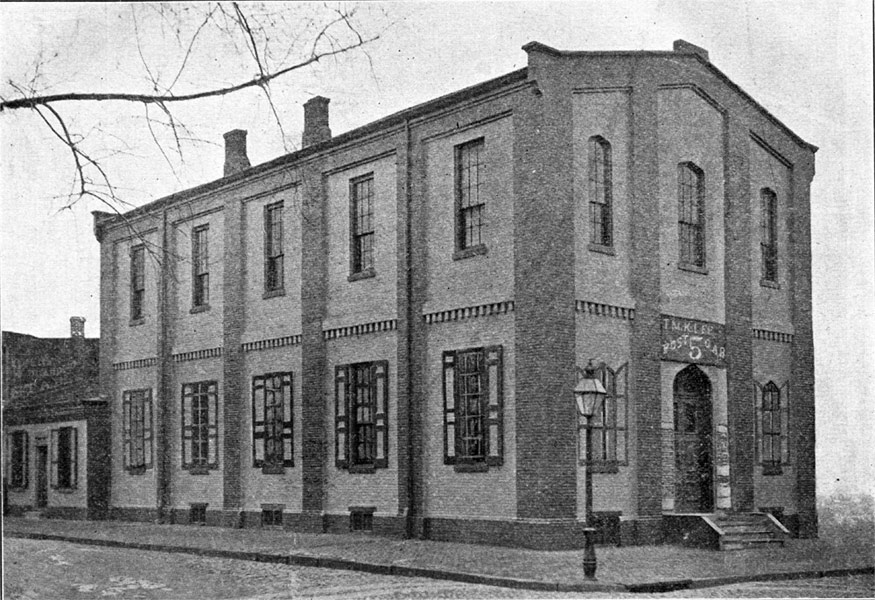
Church of the Immaculate Conception, Broadway and Market Street, Camden, ca. 1905.
Shortly after his elevation to the priesthood he was appointed to the new parish of Camden. “On the eleventh day of November, 1855,” he says in a note in the Church Registry, “Camden was erected into an independent Parish, separated from Gloucester, to which it had been hitherto attached as a mission or station and placed under the pastorial charge of the Rev. James Moran.”
Between Gloucester and Burlington there was not a single church, and only occasionally had the several settlements along the Delaware received a visit from a priest. Almost the whole of Camden County, therefore, fell under Father Moran’s jurisdiction. The old City Hall, or Starr’s Hall, had to serve yet for some time as a church. A small organ, the property of Miss Mary Cassidy, which for generations had been an heirloom in her family beyond the Atlantic, was brought into use on Sundays, thereby rendering the services more attractive and churchlike. Miss Cassidy, being an excellent musician and a finely educated lady, with her sister, Mrs. Jenks, undertook the task of organizing a choir, training the children to sing, playing the organ for Mass, and teaching the Sunday School.
Pioneers of Fifty Years Ago
Of the three or four hundred who assembled in Starr’s Hall on Sundays to be present at Holy Mass, after diligent inquiry and frequent searching of the Church books, the following names appear as regular contributors:
William Walsh, George Carroll, Cornelius Coleman, Hugh Reilly, James Ollis, Thomas Campbell, Patrick Dougherty, John Markey, Dr. Thomas Frank Cullen, John Gillman, David Brown, Edward Fitzpatrick, John Fitzpatrick, Patrick Maher, William Hickey, James Miles, Michael Logan, John Gorman, Edward Carey, Michael Hagerty, Andy Smith, John Welsh, John McAdams, Niel McLoughlin, John Morrissey, John Fisher, Bernard Reilly, Albert Smith, Patrick Burke, John Reily, Martin Ryan, Lawrence Mathews, Matthew Lennon, Michael Reilly, Christopher Walsh, James Maloy, Edward Steward, William Britt, Michael Hurley, David Slavin, Matthew McVey, Hugh Greenan, Bernard McLoughlin, Anthony Enkhausen, John Bitner, Anthony Vall, M. Havercamp, Patrick Kennedy, William Donnelly, Patrick Boyle, William Convery, Steven Wallace, Thomas Winters, Francis Winters, Thomas Buttler, Edward Kelly, John Cleary, Henry Lee, Patrick O’Niel, James Stack, Sr., John McKenna, Christopher Connolly, Henry M. Innes, Martin Hambrose, William Duffy, Robert Keefe, Patrick Rogers, John Rogers, Richard Rourke, Edward Rourke, John Doyle, Patrick Gallagher, James McCluskey, Andrew Kean, John Carver, John McHugh, James Hennessy, Patrick Early, John Delaney, Arthur Taney, John Marlow, Sylvester Consodine, Michael Nugent, John Walsh, Michael Gillon, Michael Dodd, Walter Brannin, John Hanlon, John Meany, Martin Maloney, John Mellon, David Creevy, John Murtha, John Barry.
Thomas Boothman, John Campbell, John Hoey, John Farrell, James Farrell, Daniel Farrell, Patrick Heffernan, Thomas Curley, Henry Curley, Michael Byrne, Peter Cunningham, Michael Dalton, Thomas Stanton, Thomas Calanhan, Hugh Fitzpatrick, John Daily, John McLaughlin, John Maher, Michael Butler, Michael Fagan, Mary A. Cassady, Catharine Jenks, Owen Treacy, Miss Weymann, Christy Carey, John McKenna, John McCaffrey, Mary Gray, Mathew McVey, Miss (Shay) Curley, Michael McNally, John Hanley, William McCann, Peter Dalton, Alex. Sweeney, Patrick Walsh, Kiern Daily, Peter Quinn, James Conners, Christopher O’Neill, Henry Kelley, Patrick Noone, Patrick Maloy, Cornelius Evens, H. Klostermann, Andrew Snitzius, Owen Carroll, William Walsh, Joseph Field, Thomas McCarthy, Ann Clark, Thomas O’Brien, John Kempton, Hugh Brady, Thomas Millett, John Bakey, John Ryan, Michael McCooley, Thomas Logan, Martin Hickey, Bernard Reilly, John McCann, John Kelley, Thomas Conway, John Longworth, Peter Verga, Michael Shay, Frank O’Brien, Thomas B. Sweeney, Martin Ryan, John Gallagher, Patrick Mathews, John Kean, James McCooley, John Lyons, Patrick Devlin, Bernard Kelley, James Lee, John Slavin, John Cassidy, Mathew Hart, Patrick Dougherty, Felix Treacy, James Muldoon, Michael Conley, Owen McGuire, John Hurley, James McIlvane, Richard Sheehan, Patrick Fitzpatrick, Ellen Winn.
On the eighth of February, 1857, the new bishop paid his first official visit to Camden and administered the sacrament of Confirmation to forty-five candidates. The first land the Catholics could call their own was purchased from W. D. Cooper, Esq., at Fifth Street and Taylor Avenue on the 23rd day of June of the same year. Ground was broken for a new Church on June 9th, 1859, and in just four months, the brick building at Fifth Street and Taylor Avenue was erected and open for divine worship October 9th, 1859, when it was blessed by the pastor and Mass was offered in it for the first time. On the 5th of November the same year the chapel was solemnly dedicated by Bishop Bayley.
The church, though built but two years, was found too small for the rapidly increasing congregation, and to meet the needs a gallery was erected. The building thus completed served as a chapel for several years until the opening of the new Church at Broadway and Market Street, when the old one was sold and is now occupied by Post 5, G.A.R.
The Rev. James Moran remained as pastor until September 1863, eight years, when he resigned and became affiliated with the diocese of Brooklyn, where he continued in the work of ministry until last year, 1904, when he was called by the Master. When he came to Camden a young priest in 1855, shortly after his ordination, he found no church, no rectory, no school. May his soul rest in peace.
Chapter VI — Father Byrne’s Administration, 1863–1873
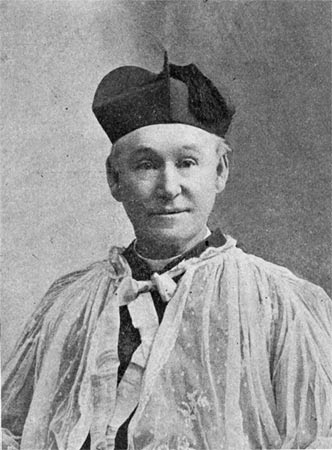
Rev. Patrick Byrne, Pastor of the Church of the Immaculate Conception, Camden, from September, 1863, to June, 1873.
When Father Byrne, who succeeded Father Moran, came to Camden to take charge of the Parish of the Immaculate Conception, June, 1863, the Church at Fifth Street and Taylor Avenue was deemed amply large for the congregation. In addition there were chapels at Snow Hill, Fellowship and Waterford, with small and much scattered congregations, which were attended at intervals by the pastor of Camden. As there was no Catholic Cemetery nearer than Gloucester or Philadelphia, and to provide one seemed to be a special necessity, to this question therefore did the young pastor give his first attention. At the junction of Westfield Turnpike and Federal Street, just two miles east of the Market Street Ferry, he found a plot of ground containing 8.97 acres which he secured for $3,588.00 from William B. Cooper, Esq.
On June, 1864, just one year after his advent into the Parish, he purchased from Abigail Cooper a plot of ground 100 feet on Broadway by 180 feet on Market Street, the price being $7,200. When the announcement came that every man in the Parish should, on a certain day, bring his pick and shovel and give a hand at the excavation for a new Church at Broadway and Market Street, there were so many willing to respond that the weaker and would-be wiser element either joined the workers or hid in the seclusion of their homes.
Corner Stone of New Church Laid
Bishop Bayley visited the Parish October 2, 1864, intending to lay the corner stone of the new Church, but work had not progressed sufficiently and the ceremony was postponed until Sunday, October 23, of the same year, when Dr. McQuaide, Vicar General of the Diocese, now Bishop of Rochester, performed the ceremony.
Plans had been prepared by Mr. Jeremiah O’Rourke, architect of Newark, for a stone church, 60 x 140 feet, with sanctuary of 25 feet added to length. Connoisseurs tell us it is the finest specimen of Gothic architecture in the United States. The church, though not yet completed, was opened for divine worship July 1866, a year and nine months after the laying of the corner stone.
In September 1885, the Rt. Rev. Michael Joseph O’Farrell, then Bishop of the Diocese of Trenton, decided to establish a new parish to supply the spiritual needs of Catholics in the southern section of the City. Land was secured at Ferry Avenue and Jasper Street, and the new parish was incorporated October 13, under the title of “The Church of the Sacred Heart,” with the Rev. William Lynch, as Pastor, July 5, 1886.
Sts. Peter and Paul
A considerable number of the Catholics of Camden in 1867 being of German extraction greatly desired to have a church in which they would hear the language of their mother tongue spoken on Sundays. A property was secured at Fourth and Division Streets for $4,000, the transfer being from the Second Baptist Church of Camden to the German Roman Catholic Church of Sts. Peter and Paul, May 3, 1867. This was the beginning of the German Catholic congregation of Camden.
Father Byrne, September, 1873, was called to another and then deemed more important charge, St. John’s, Trenton. His ten years in Camden wrought a complete change in the Parish Buildings, in the morality, the sobriety and the business capacity of his flock. To make men sober he organized a Temperance Society, which in numbers and in devotion to their pledge was second to none in the land; but, to hold men in organized sobriety they must be kept busy and they must be given some safe investment for their surplus earnings. Both organizations have weathered the vicissitudes of a third of a century, and to these under God must be attributed the fact that most of the Catholic families in Camden have their own homes.
Chapter VII — Bishops Corrigan, O’Farrell & McFaul
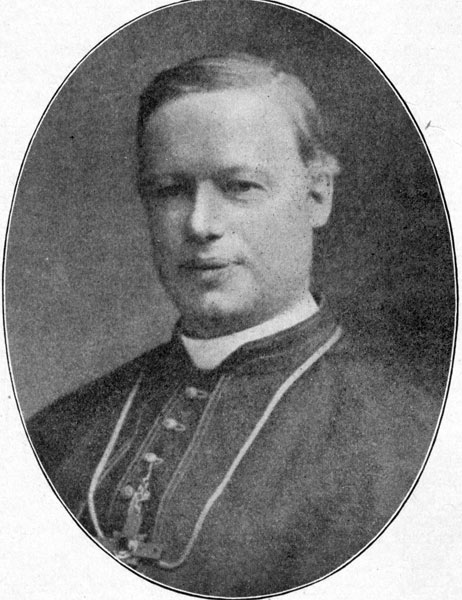
Most Rev. Michael Augustine Corrigan, D.D. Consecrated Bishop of Newark May 4, 1873; promoted to the Archiepiscopal See of Petra Oct. 1, 1880, and succeeded to the Archiepiscopal See of New York Oct. 10, 1885; died May 5, 1892.
When the news was rushed across the ocean that Bishop Bayley had been promoted by the Holy See to the Archbishopric of Baltimore the question immediately arose among clergy and people who would be his successor in the See of Newark. Rev. Dr. Corrigan was then the youngest Bishop in the United States, with a single exception in the whole world. Before departing for his new field of labors he secured the approval of the Holy See for the division of the diocese of Newark into that of Newark and Trenton. The six counties to the Northeast of the State being allotted to Newark, the fourteen to the West and South to Trenton. The populous diocese of Newark was given to Dr. Wigger, of Madison, N.J.; the large, sparse diocese of Trenton to Father O’Farrell, of St. Peter’s, New York.
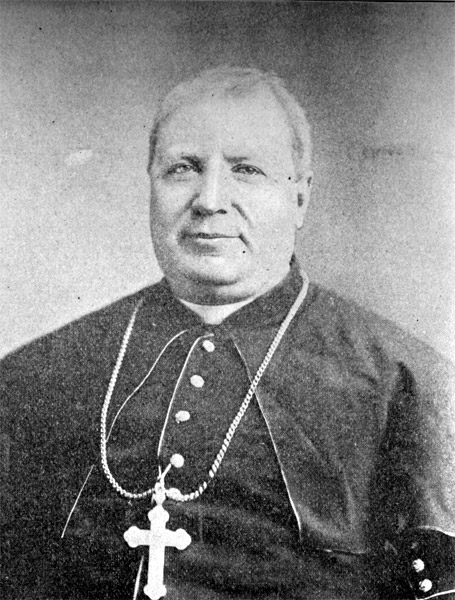
Rt. Rev. M. J. O’Farrell, D.D. Bishop of the Diocese of Trenton from November 1, 1881, to April 2, 1894.
Though brought up in community life, he proved himself, when entrusted with the episcopate office, possessed of the true missionary spirit. He was one of the most hard working, most successful as he was perhaps the most learned Bishop of the Catholic Church in the United States. After serving God in the diocese for thirteen years he was called to his reward. A young priest who had his confidence for many years, having been his secretary, Chancellor, Vicar General, was selected by Archbishop Corrigan for administrator of the diocese ad interim — Father McFaul was promoted to the bishopric of Trenton.
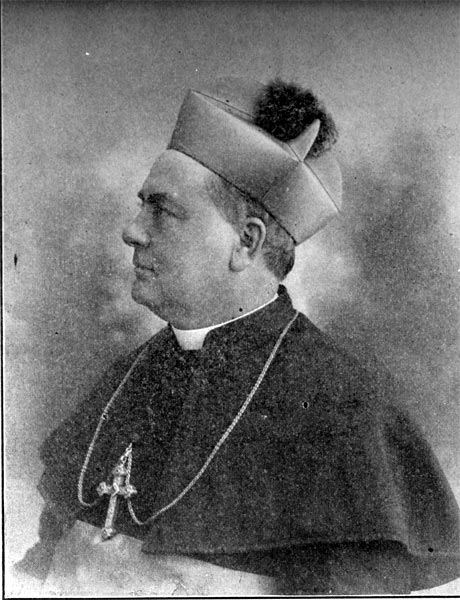
Rt. Rev. James A. McFaul, D.D., L.L.D. Bishop of the Diocese of Trenton. Consecrated October 18, 1894.
The Rt. Rev. James A. McFaul, D.D., was then in the forty-fourth year of his age, in the fourteenth of his priesthood. Then yet a youth he came with his parents from Ireland to New Jersey and settled near Bound Brook. He was ordained in 1877 by Bishop Corrigan. Assistant successively at St. Patrick’s, Jersey City; the Cathedral, Newark; the Cathedral, Trenton; pastor at Long Branch, later at St. Mary’s, Trenton, he became a marked man. Always in close touch with current events he is notably aggressive in his ideas while conservative as a churchman.
Chapter VIII — The Parochial School
The founders of the Parish of the Immaculate Conception, though poor, proved in a practical way their interest in Christian education, even before they had a church of their own in which they might worship. In 1859, when it became known that a Miss Sarah Fields proposed to open a school where Catholic children would be taught without insult to their faith, she was received with every expression of approval by Priest and people. Miss Fields opened a school in her own residence, at Fifth and Arch. It was a private venture, but it served every purpose, until the new church at Fifth Street and Taylor Avenue was erected, where more ample room on the second floor was provided and fitted up for school use. Thence she removed her pupils and opened the first parochial school in Camden, 1862.
Sisters of St. Joseph
The Sisters of St. Joseph from Chestnut Hill had been invited to Camden to take charge of the school September, 1874. Three Sisters were assigned to teach in the Parochial School. After the vacation (September, 1875), when school was again opened, the new brick building was found ready for occupancy. The transformation from the one-room school taught by Miss Field in 1859, with perhaps twenty pupils, to the grand imposing brick building on Broadway, with 250 children in attendance in 1875, was so great an event to the Catholic community of Camden. The Sisters of St. Joseph were recalled to their Mother House (1885), much to the regret of the entire Catholic population of the city. Their eleven years in Camden had been fruitful in good results.
Brothers of the Holy Cross
The Brothers of the Holy Cross, whose Mother House is at Notre Dame, Indiana, were engaged September, 1881, and entrusted with a special department in the school for boys, leaving to the Sisters the control of the girls. For eleven years (until 1892) they devoted all their energies to the work assigned them.
Sisters of Mercy
The Sisters of Mercy, having been affiliated with the diocese and having a Mother Home at Bordentown, were an exception among diocesan teaching orders. On the opening of the school after the vacation of 1885, six Sisters of Mercy came to take charge of the girls’ department of St. Mary’s. By absorbing the Academy with the Parochial School the standard of studies was raised, and from seven rooms with 385 children in 1895 we find fourteen rooms with 1000 children in 1905.
St. Mary’s School — Principals
Sisters of St. Joseph: Mother M. Xavier, Sister M. Ludovica.
Brothers of the Holy Cross: Brother Urban, Brother Justin, Brother Hillery, Brother Benjamin.
Sisters of Mercy: Mother Joseph, Sister M. Genevieve, Mother M. Gabriel, Sister M. Anthony, Sister M. Philomene, Sister M. Teresa.
Graduates, 1887–1905
1887 — Grace Gallagher.
1888 — Annie Walsh (Mrs. Richard Conners), Frances McLaughlin (Sr. M. de Secour).
1889 — Nellie McBride (Sr. M. Henrietta).
1891 — Agnes Dougherty (Mrs. Daniel Hassett), Alice Wagner (Mrs. Alice Plant), Elizabeth Callinan (Sr. M. Cephas).
1893 — Blanche Lowenstein (Sr. M. Immaculata).
1895 — Jane O’Hanlon, Mary Long, Patrick Harding.
1896 — Teresa Hartnett (Sr. M. Bernardine), Alice Manning.
1897 — Margaret Mullin, Cecelia Callinan.
1898 — Catharine Lorigan, Ella Fitzgerald, Agnes Powell, Winifred Burke, James Mullane, Edward Clare.
1899 — Elizabeth Duval, Raymond Long.
1900 — Anna Lorigan, Bertha Krout, Sophia Verga, George Devine.
1901 — Mary O’Brien, Ella Murphy, Anna Toomey, Emma Walker.
1902 — Elizabeth Burke, Josephine McGovern, Abigail Daley.
1903 — Annie Dugan, Catharine Frailey, Marie de La Reintrie, Eva Reiley, Anna Verga, Katie Bobenreith, Veronica Hay, Alice Sullivan, Charles Bechtel, Oliver Holt, Edward Mullane, Raymond Kelly, Regina Roche, Margaret Hanford.
1904 — Sarah Fish, Bessie Hunter, Helen Blake, Margaret Clare, Katie Schilp, Katie Toomey, James Ryan, Gerald Roche, Mary Gritton, Marie Sullivan, Alice Parker, Elizabeth Crotty, Margaret Brodey, Margaret Sexton, William O’Neill, William Kelly, Albert Luttenbacher.
1905 — Margaret Smith, Mary Toomey, Norah Timmons, Helen Whelan, Mary Flood, Ella Bobenreith, John Welsh, James Mullane, Nicholas Redmond, John O’Neill, Joseph Mulligan, John J. Kelly, Joseph Daley, John Kelly, Timothy O’Neill.
Chapter IX — Father Fitzsimmons’ Administration, 1873–1895
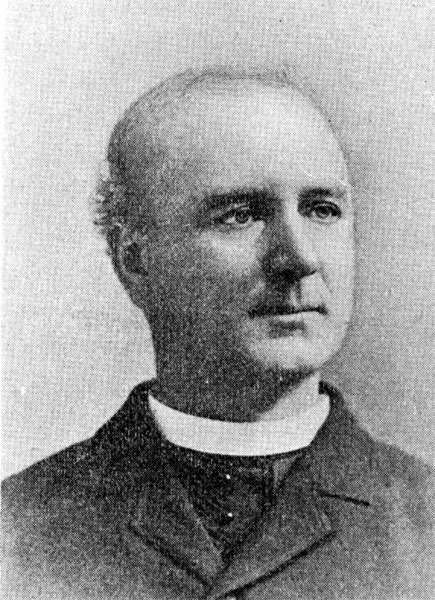
Very Rev. Dean P. Fitzsimmons, Pastor of the Church of the Immaculate Conception, Camden, from June, 1873, to August 31, 1895.
On the death of Father Mackin, Pastor of St. John’s Church, Trenton, March, 1873, all eyes were fixed on Father Byrne, of Camden, as his probable successor. Without hesitation and with as little delay as the circumstances would permit, the Bishop named him Rector, and he left Camden to assume his new charge early in June. The Bishop assured the congregation that the young man he was about to send them would take up the work where left off by Father Byrne and carry it on with energy — Father Fitzsimmons, the new Pastor, was blessed with good health, and gifted with talents of a high order.
One of his first official acts was, therefore, to have a Mission. For that purpose, October 18, 1873, he called in the Rev. Father Glackmire, S.J., at that time one of the most celebrated preachers of Missions and Spiritual Retreats in the country. At the end of two weeks, when the mission terminated, there was such a universal spiritual awakening that it might be truthfully said there was not a person of discerning age in the Parish who had not approached Holy Communion.
A new permit for a brick school building, 100 x 40 feet, with Sisters’ house attached, was issued April 14th, 1874; the estimated cost being forty thousand dollars. The work was carried on through the whole Summer and Fall, and the building was ready for occupancy in the following Spring (1875). A Brothers’ House becoming a necessity, ground was broken November 1, 1881, for the erection of the brick building on Seventh Street.
On the 11th of August, 1887, Emil Sheafer, master stone-mason, and Charles Johnson, carpenter, of Camden, entered into contract for the sum of $11,805 to erect and finish on the Church of the Immaculate Conception a tower and spire as per drawings and specifications furnished by Mr. Jeremiah O’Rourke, architect. The work progressed rapidly, and after twenty-four years, the church was now finished with the more solid and lasting stone spire.
In March, 1890, Ferdinando Baraldi, of Philadelphia, received the contract for frescoing and decorating the church, the price being $3,500. The same year the altar, at a cost of $3,000, was erected by Theis and Janssen, of New York city, and a new pipe organ, at a cost of $4,000, was added.
The Consecration of the Church, May 27–28, 1893
These two days will ever be memorable in the history of the Parish. The church though opened for divine worship in 1866 and dedicated with appropriate religious ceremonies, was not consecrated until May 27, 1893. The following account of the services on those two days is taken from an old file of the Public Ledger:
The consecration of the sacred edifice was performed on Saturday morning by Right Rev. Bishop O’Farrell, who was assisted by Very Rev. Dean Fitzsimmons, and Revs. Fathers John P. Kelley and J. M. O’Leary, Father Fitzsimmons’ assistants, and Rev. J. M. McClosky, of Beverly. The ceremonies of the consecration consumed nearly three hours.
“The church at 10.30 Sunday morning was again crowded to witness the concluding ceremonies, and shortly after that hour the procession of clergymen and acolytes entered the main door, led by Rev. Father Kelley, with the Most Rev. P. J. Ryan, Archbishop of Philadelphia; Right Rev. Thomas McGovern, of Harrisburg, Pa., and the Right Rev. M. J. O’Farrell bringing up the rear. The music for the occasion was of high order. A choir of 100 trained voices, under the direction of Professor Jacob Michel, Jr., of Philadelphia, sang Mozart’s ‘Twelfth Mass.’ The Germania Orchestra of fifteen pieces also accompanied the singers.
“At the conclusion of Father Fitzsimmons’ remarks, Bishop O’Farrell advanced to the altar steps and accepted the beautiful temple, saying he rejoiced over the gift that comes from the hearts of the people. He congratulated the Pastor, his assistants and the people, and said it was the first church consecrated in the Diocese since he had become its Bishop. At the conclusion of the Mass Bishop O’Farrell pronounced the Apostolic benediction, and as the clergymen left the sanctuary the Te Deum was sung.
Dean Fitzsimmons worked steadily and prudently; whatever he put his hand to that he did thoroughly. For over twenty-two years he served the Parish, always eloquent, genial, big hearted, ever having an eye to the spiritual welfare of his flock. He passed to his reward August 31, 1895, in the fifty-sixth year of his age. The funeral services, which were held on the 3rd of September, were the most elaborate of the Catholic Church. The Bishop and two hundred clergymen, besides a vast congregation of citizens irrespective of creed, testified by their presence their respect for the man and the priest. His body lies in a vault directly in front of the church. Requiescat in pace.
Curates During Father Fitzsimmons’ Pastorate
Rev. Martin A. V. D. Bogaard, from September, 1873, to Feb. 4th, 1876. Rev. J. J. Walsh, from Feb. 4th, 1876, to June 13th, 1877. Rev. James J. Brennan, from June, 1877, to June, 1879. Rev. James F. Devine, from June, 1879, to January, 1882. Rev. J. H. Fox, from January, 1882, to November, 1882. Rev. Dennis J. Duggan, from November, 1882, to March 13th, 1883. Rev. Daniel F. Curtin, from March, 1883, to June, 1883. Rev. John M. O’Leary, from August, 1883, to December, 1884. Rev. Father Tighe. Rev. Joseph F. Flannigan, from December, 1884, to February, 1886. Rev. M. E. Bric, from February, 1886, to December, 1888. Rev. Thomas A. Roche, from July 23, 1888, to October 20, 1890. Rev. William H. Miller, from July, 1889, to February 1, 1890. Rev. John Gammell, from February 6, 1890, to May 26, 1890. Rev. John Murphy, from May, 1890, to September, 1890. Rev. Michael Coghlan, from September 23, 1890, to January 28, 1893. Rev. J. P. Kelley, from November 27, 1890. Rev. J. M. O’Leary, from February 1, 1893. Rev. James Hendrick, from May 11, 1895.
Chapter X — Rev. Stephen M. Lyons
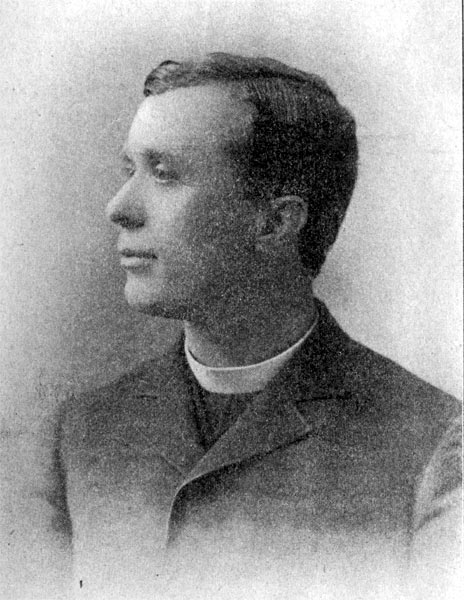
Rev. Stephen M. Lyons.
On the death of Father Fitzsimmons the management of the Parish, ad interim, until the appointment of a new Rector, was entrusted to the Rev. Stephen M. Lyons, who was assisted in the work of the Parish by Fathers O’Leary and Hendrick. In the short time Father Lyons had charge here, by his eloquence and general affability he captivated the good will of the people of Camden as no priest had ever done before, and he has still many warm friends and sincere admirers in the Parish. The choice for the permanent rectorate fell upon Father Mulligan, a priest of twenty years’ standing in the diocese, eighteen years of which had been passed as Rector in active work as a church builder. He was, therefore, appointed and took charge of the Parish October 23, 1895.
Chapter XI — Father Mulligan’s Administration, 1895–1905
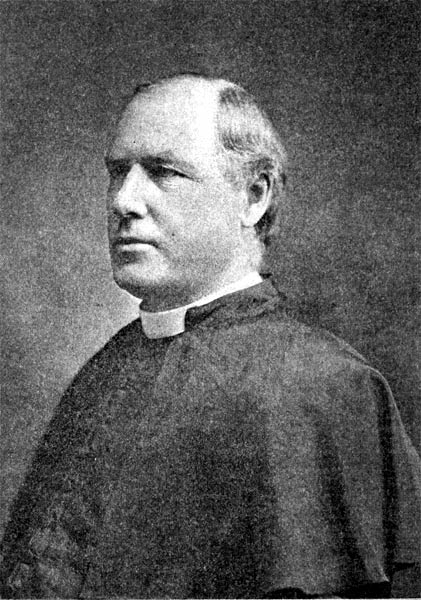
Very Rev. Dean B. J. Mulligan, Rector, The Church of the Immaculate Conception.
“Rev. B. J. Mulligan, the new pastor of the Church of the Immaculate Conception, successor to the late Dean Fitzsimmons,” says the Camden Courier, “was warmly welcomed to his charge last night (Oct. 23, 1895) by the parishioners at St. Mary’s Hall, Broadway above Federal Street. The hall was handsomely decorated with American flags, bunting, shields and laurel, among which a number of incandescent lamps were interspersed. On the stage was a large number of potted plants and palms, and in front the words ‘Welcome’ blazed brightly forth in electric lights.”
The concluding speaker of the evening was Mr. William J. Lorigan, who spoke for the young people of the parish, and blandly hinted, not too loud, that the young people would be glad if the new pastor would take into consideration the question of building a Lyceum, the most urgent need of the parish at the present time.
“The Reception Committee consisted of Rev. S. M. Lyons, J. J. Burleigh, F. X. O’Brien, Thomas Curley, Sr., John M. Kelly, John T. Sweeney, William Mullane, Thomas Calanon, John S. O’Hanlon, Edward Hilland, M. J. O’Brien, W. K. Davis, John Daley, Frank Deveraux, Owen McAdams, John Dougherty, Lawrence Matthews, John Hoey, John J. Conlan, James McFeeley, W. J. Lorigan, Jr., George Welsh, John R. Ryan, Michael Burns, Peter Quinn, Michael Quinn, Thomas Boyle, Edward Smith and Patrick Powell.”
Dean Mulligan again being called upon to speak, congratulated the people on the magnificent property owned by the Parish, but he also reminded them that large properties required large expenditures; that, while much had been done and well done, all was not yet done. Knowing that it is vain for man to labor if the Lord be not with him, the Pastor wished to begin his pastorate by urging all to a spiritual rewaking. He called in the Redemptorist Fathers, who began a two weeks’ mission.
Improvements Under Father Mulligan
Though the building of the Lyceum was begun in the Spring of 1896, involving an expenditure of $40,000, other improvements were not neglected. A contract in the sum of $3,500 was entered into with “The Mercer Steam Heating Company” for the installing of steam plant to heat both School and Sisters’ House. The Cemetery was also improved: the low places were filled up, the unsightly old buildings torn down, a new iron fence erected to replace the old wooden one, and a farm of 93 acres was secured just outside the city boundary for $9,000, a portion of which was laid out for cemetery purposes.
For the Golden Jubilee, perhaps not less than twenty thousand dollars will be spent on improvements to the church, but very little will be added to the debt, as good friends have helped us, and all have given their mite.
Curates During Father Mulligan’s Administration
Rev. J. M. O’Leary, to April 20, 1896. Rev. J. Hendrick, to January 11, 1898. Rev. Julian Zielenski, from November 27, 1895, to February 19, 1897. Rev. Francis Cunningham, from March 17, 1897, to June 19, 1897. Rev. J. A. Caulfield, from June 18, 1897, to June 23, 1892. Rev. Thomas H. Allen, from January 11, 1898, to April 7, 1900. Rev. W. P. Tighe, from June 2, 1900, to June 13, 1901. Rev. Richard P. Brennan, from July 10, 1901, to September 30, 1901. Rev. J. E. Murray, from October 6, 1901, to April 7, 1904. Rev. James C. Kane, from July 2, 1902, to August 2, 1902. Rev. J. B. Conway, from October 11, 1902, to January 19, 1904. Rev. W. J. Reddin, from January 19, 1904, to December 29, 1904. Rev. Thomas J. Rudden, from April 9, 1904, to September 9, 1904. Rev. T. F. Kearns, from September 22, 1904, to April 25, 1905. Rev. J. A. Sullivan, from December 29, 1904. Rev. James A. Healey, from April 25, 1905.
The Choir
Organist and Director: William H. Lorigan.
Sopranos: Miss Flora M. Kieffer, Miss Mary E. Frazier, Miss Mary T. Long, Miss Mary H. Sands, Miss Bertha M. Krout, Miss May R. Manning, Miss Mary P. Walsh, Miss Gertrude E. Britton, Miss Catharine P. McGlynn, Miss Margaret C. Manning, Miss Elizabeth A. Curtis, Miss Catharine C. Dunn, Miss Alice M. Sullivan, Miss Anna M. Dugan, Miss Catharine E. Callahan, Miss Genevieve E. Crosby, Miss Elizabeth A. Hunter, Mrs. Edward J. Kelley, Mrs. Richard A. Conner, Mrs. Jean L. Brown, Mrs. John H. Krout, Mrs. Joseph A. Helm, Mrs. Thomas F. Ryder.
Contraltos: Miss Margaret L. Kauffmann, Miss Stella R. Magee, Miss Bertha E. Fillion, Miss Margaret A. Frazier, Miss Mary J. Manning, Miss Mary G. Dugan, Miss Anna E. Verga, Miss Helen E. Healey, Miss Helen L. deLisle, Mrs. Oscar A. Kieffer.
Bass: Mr. Charles B. Magee, Mr. Maurice J. Long, Mr. Daniel J. Hilland, Mr. Thomas J. Atkinson, Mr. Oscar A. Kieffer, Mr. Clarence H. Walker, Mr. Paul G. Powell, Mr. Michael A. Hartmann, Mr. Thomas M. Fean, Mr. Thomas A. Cahill, Mr. Edward J. Rourke, Mr. Charles C. Buecker, Mr. William T. Burke, Mr. Frederick F. Kauffmann, Mr. Joseph P. Lorigan, Mr. William A. Murphy, Mr. Edward J. Doyle.
Tenor: Mr. Harry J. Weiss, Mr. James F. Lennon, Mr. Charles E. Hurley, Mr. William B. Farlow, Mr. Joseph A. Helm, Mr. John J. Conlen, Mr. Clement P. Wasielewski, Mr. John B. Lorigan, Mr. Joseph T. Bodell.
The faithful Sexton. Everybody knows him, and everybody respects him as an honest man — John Ryan.
Board of Trustees
In 1865 the Legislature passed an Act incorporating Religious Societies. Under this Act the Church of the Immaculate Conception was incorporated in 1865, with the following as the first Board of Trustees: The Rt. Rev. James Roosevelt Bayley, Bishop of the Diocese of Newark, president; the Very Rev. James Moran, Vicar General of the Diocese; Rev. Patrick Byrne, Treasurer; Mr. Lawrence Matthews, Secretary; John Hoey.
The present Board: the Rt. Rev. James A. McFaul, President; the Very Rev. Mgr. J. H. Fox, V.G.; the Very Rev. B. J. Mulligan, Secretary-Treasurer; Mr. John Hoey and Mr. John Logan.
Chapter XII — The Lyceum Association
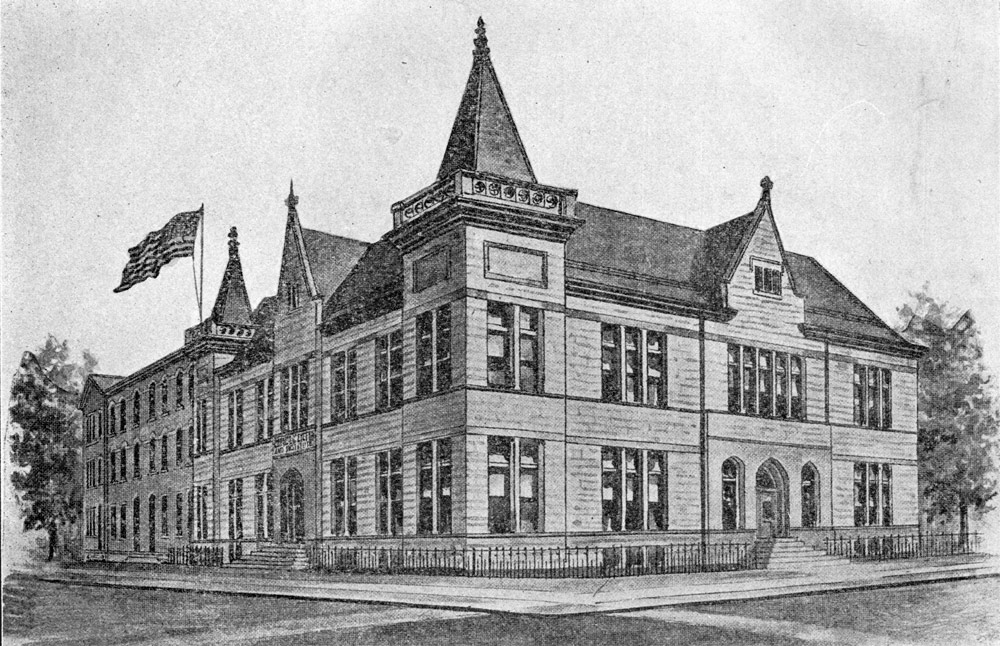
Lyceum and Parochial School Buildings.
For several years before his death Dean Fitzsimmons felt that the young people who went forth from the Parish School needed some center, under the guardianship of the Church, around which they might gather and spend their free evenings in bettering themselves socially, morally and intellectually. The Lyceum Association, having this end in view, was organized in 1894. On the 20th of May, 1896, ground was broken and the foundation was ready for the corner-stone laying.
Corner-Stone Laying, June 28, 1896
“In the presence of an assemblage,” says the Catholic Standard and Times, “numbering about eight thousand persons, including many Camden county and city officials, medical men, educators and officers of various banking institutions, the corner-stone of the new Lyceum and Institute was laid in accordance with the ritual of the Church by Bishop McFaul, the Ordinary of the Diocese of Trenton.” The building was ready for occupancy January 28, 1897.
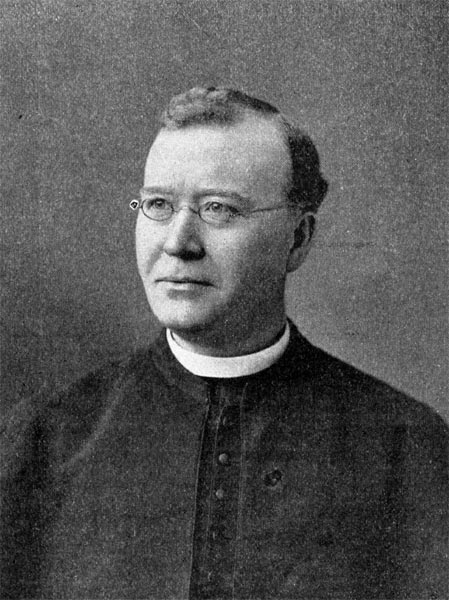
Rt. Rev. Mgr. James F. Loughlin, D.D., Chancellor of the Archdiocese of Philadelphia.
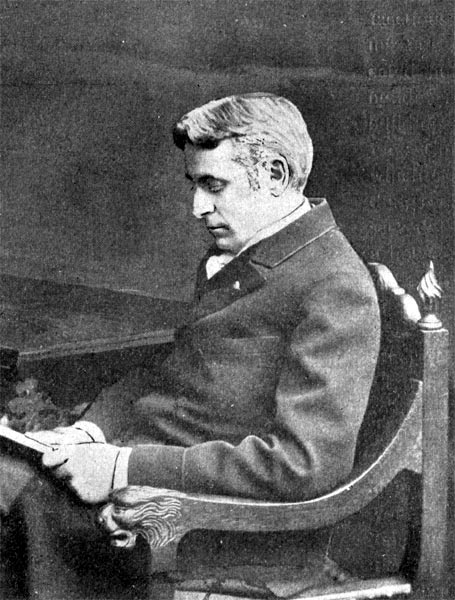
Hon. John W. Griggs, Governor of New Jersey.
Governor Griggs’ Address
You may wonder why I am here. I do myself. I am surely not here to execute laws, and I hardly know what I am here for. I will say, however, if we had a few more institutions of this kind, we would need fewer laws and few police. As I am not here to execute the law I must be here merely as a citizen to address you at the opening of this grand institution. I can truly say that the completeness of the whole building surprises me. We have two such buildings in Paterson, but the two of them placed together would not equal this.
“Give us more of these football players, wrestlers and athletes. I will not keep you any longer, as I understand there are other festivities to follow, but you have done a grand and glorious thing in erecting this institute, and I congratulate you. Now, on with the dance, Let joy be unconfined. And may God bless you and your grand work.
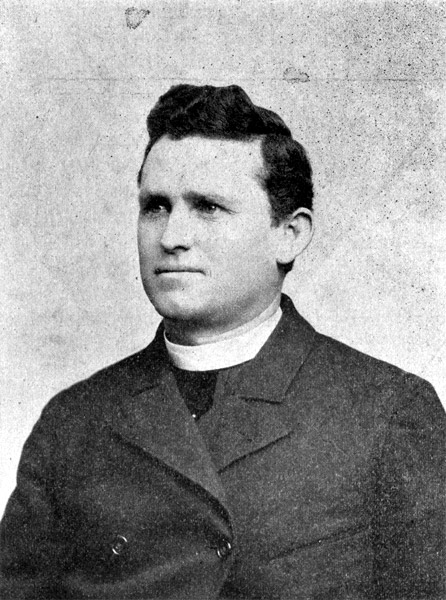
Rev. Walter T. Leahy, Pastor of St. Joseph’s Church, Swedesboro, N.J.
The first officers of the Lyceum Association were John J. Burleigh, president; Michael Byrne, vice president; John M. Kelly, recording secretary; James Clark, financial secretary; William L. Hurley, treasurer; Very Rev. Dean Mulligan.
Lyceum Lecture Course, 1897–1905
True to its purpose as an educational institution, the Lyceum Association inaugurated for the Fall and Winter months of each year a series of lectures by men the most prominent in Church and State.
| Speaker | Date | Topic |
|---|---|---|
| First Course | ||
| Rev. Joseph Vincent O’Connor | November 10, 1897 | “The Church and the American Republic” |
| Col. Alex. K. McClure | December 7, 1897 | “Abraham Lincoln and Men of War Times” |
| Hon. John Wanamaker | January 16, 1898 | “The Young Man in the Business World” |
| Hon. Charles Emory Smith | February 3, 1898 | “Russia and the Czar” |
| Judge E. A. Armstrong | March 16, 1898 | “New Jersey, Its History and Government” |
| Rev. Patrick Byrne | May 10, 1898 | “Ireland — Its History and Poetry” |
| Second Course | ||
| Mr. Henry Austin Adams | November 3, 1898 | “Cardinal Newman” |
| Mr. Henry Austin Adams | January 12, 1899 | “Gladstone” |
| Rt. Rev. Mgr. Thomas J. Conaty, D.D. | December 15, 1899 | “The Mission of the Church in Shaping, Defending and Perpetuating the Republic” |
| Dr. Maurice Francis Egan | February 16, 1900 | “Books and Books” |
| Rev. Henry Ward | March 9, 1900 | “Ireland, the Ever-Faithful Isle” |
| Rev. Wm. J. Cantwell, A.M. | April 10, 1900 | “Some Ministrations of the Church” |
| Third Course | ||
| Mr. Henry Austin Adams | December 13, 1900 | “The Stage” |
| Dr. Alexander P. Doyle, C.S.P. | January 11, 1901 | “A Glimpse Into the Twentieth Century” |
| Walter George Smith, Esq. | February 8, 1901 | “John Ledyard — Traveler, Writer and Naturalist” |
| Dwight R. Lowrey, Esq. | February 14, 1901 | “Rome, the Rome of Romulus and Remus” |
| Ex-Governor Robert E. Pattison | March 21, 1901 | “The Individual Man in History” |
| Very Rev. Dean B. J. Mulligan, A.M. | April 25, 1901 | “Visit to Rome and the Holy Father” |
| Rev. B. T. O’Connell, A.M. | May 23, 1901 | “The Church’s and Man’s Natural Rights” |
| Fourth Course | ||
| Mr. Henry Austin Adams | December 19, 1901 | “Belief and Brains” |
| Rev. Dr. John W. Norris | February 6, 1902 | “The Crusades” |
| James Minturn, Esq. | February 26, 1902 | “Lawyers and Lawyers” |
| Rev. Dr. Henry A. Brann | May 8, 1902 | “The Poet Dante” |
| Ambassador Wu Ting Fang | May 16, 1902 | “Are the Chinese Peculiar?” |
| Fifth Course | ||
| Rev. Dr. William J. Fitzgerald | November 13, 1902 | “Visit to the Holy Land” (Illustrated) |
| Prof. Scharf, Ph.D. | January 22, 1903 | “Schools and Schools” |
| Rev. Wm. O’Brine Pardow, S.J. | February 19, 1903 | “The Bible at the Beginning of the Twentieth Century” |
| U.S. Senator Charles E. Fairbanks | March 5, 1903 | “The Late Spanish War” |
| Rev. Michael Hagerty, D.D. | April 16, 1903 | “Six Years in Italy” |
| Sixth Course | ||
| Mr. Thomas Woodlock | December 10, 1903 | “Education Without Religion — Cause of Agnosticism in Religion and Politics” |
| Rev. Dr. H. T. Henry, Litt.D. | January 28, 1904 | “Religion and Philosophy of Shakespeare” |
| Rev. Stephen M. Lyons | May 15, 1904 | “Travels in Europe” |
| Seventh Course | ||
| Rev. Charles F. Kelley, S.J. | October 15, 1904 | “Young Men in the Church and in Society” |
| Rev. J. F. X. O’Connor, S.J. | April 3, 1905 | “Ireland — Its Saints, Music and Poetry” (Illustrated) |
| General St. Clair A. Mulholland | May 3, 1905 | “Four Years in the Civil War” (Illustrated) |
| Mr. Henry C. Walsh | May 22, 1905 | “The Moores” (Illustrated) |
Presidents of the Lyceum Association: Mr. John J. Burleigh, Mr. William J. Lorigan, Mr. William T. Boyle, Rev. John A. Sullivan.
Presidents of the Ladies’ Auxiliary: Mrs. William J. Lorigan, Mrs. John Farrell, Mrs. William S. Casselman, Miss Mary Frazier, Miss Mary Walsh.
Golden Jubilee Celebration Program — November 12, 1905
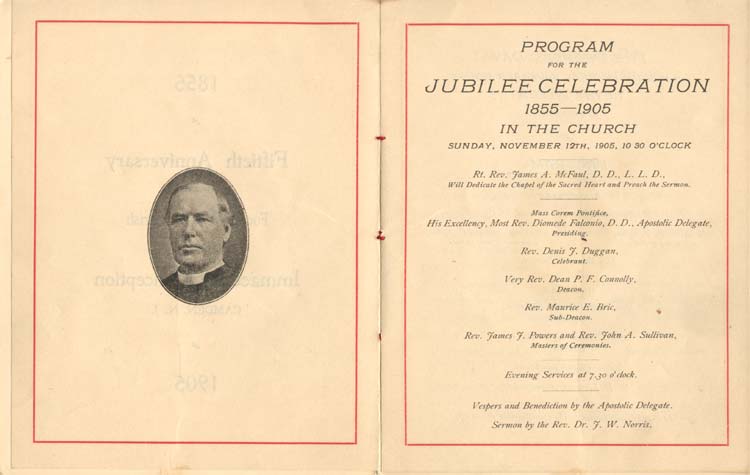
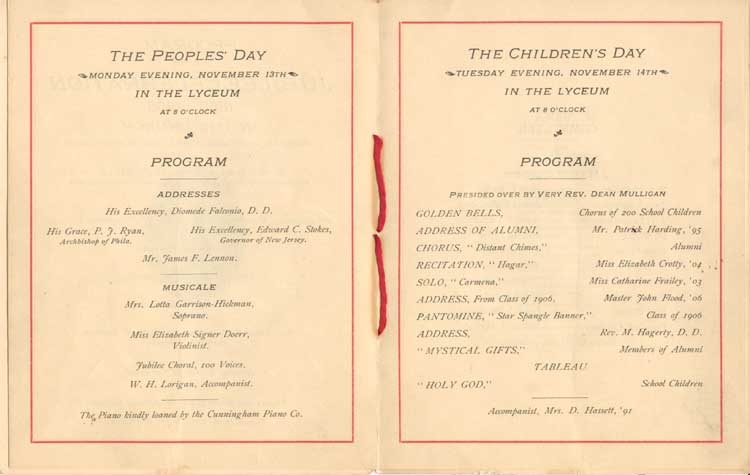
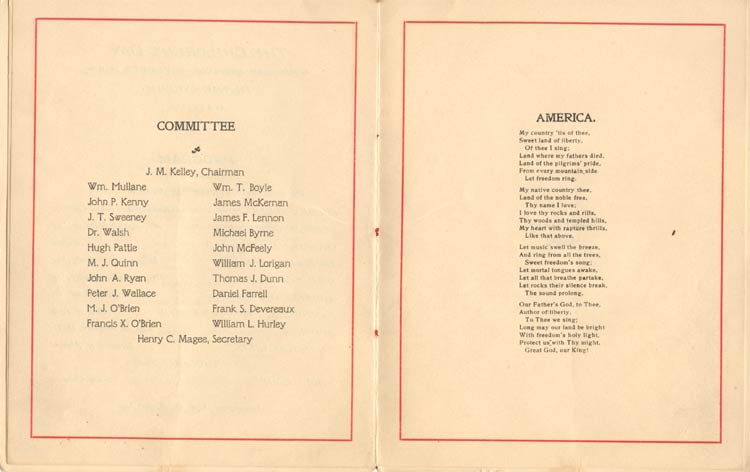
Golden Jubilee Celebration program, November 12, 1905, pages 2–5.
Sunday, November 12th, 1905, 10:30 O’Clock
Rt. Rev. James A. McFaul, D.D., L.L.D., will dedicate the Chapel of the Sacred Heart and preach the sermon.
Mass Corem Pontifice. His Excellency, Most Rev. Diomede Falconio, D.D., Apostolic Delegate, Presiding.
Rev. Denis J. Duggan, Celebrant.
Very Rev. Dean P. F. Connolly, Deacon.
Rev. Maurice E. Bric, Sub-Deacon.
Rev. James J. Powers and Rev. John A. Sullivan, Masters of Ceremonies.
Evening Services at 7:30 O’Clock.
Vespers and Benediction by the Apostolic Delegate.
Sermon by the Rev. Dr. J. W. Norris.
Jubilee Committee
J. M. Kelley, Chairman. William Mullane, William T. Boyle, John P. Kenny, James McKernan, J. T. Sweeney, James F. Lennon, Dr. Walsh, Michael Byrne, Hugh Pattie, John McFeely, M. J. Quinn, William J. Lorigan, John A. Ryan, Thomas J. Dunn, Peter J. Wallace, Daniel Farrell, M. J. O’Brien, Frank S. Devereaux, Francis X. O’Brien, William L. Hurley. Henry C. Magee, Secretary.