William H. Shearman
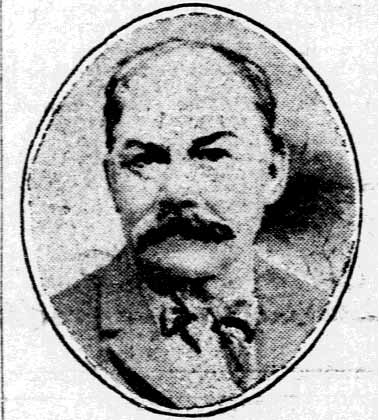
William H. Shearman
WILLIAM H. SHEARMAN was one of the original members of the Camden Fire Department, entering service on December 7, 1869 as the Assistant Marshall, a post similar in nature to that of Deputy Chief.
William Shearman was born in Pennsylvania around 1830. The 1850 census shows that he was living in Philadelphia with his wife Amanda at the home of a carpenter, Abraham Lower. It appears that Abram Lower was William Shearman’s father-in-law. Lower’s son Abram Lower Jr. was also living there at the time.
In April of 1861, war broke out between the northern and southern states. William H. Shearman answered his nation’s call to arms. He enlisted as a Private in Company H, Pennsylvania 19th Infantry Regiment on 18 May 1861.
The Nineteenth regiment originated in the National Guards, of Philadelphia, a uniformed regiment of the State militia. It was originally a single company, organized on the 11th of December, 1840, under Captain Thomas Tustin, succeeded in 1844 by Captain Stephen B. Kingston, and the latter in 1847 by Captain Peter Lyle. It was recruited for the Mexican war; but more troops volunteering than were needed, its services were not accepted. The company held a volunteer encampment of eight days’ duration in July, 1856, near the city of Lancaster, and again the year following at Bethlehem. NON SIBI, SED PATRLE, was adopted as its motto.
In 1858, it had so increased in numbers—having one hundred and twenty members as to be unwieldy on parade with other companies of only the minimum strength. It was accordingly divided and a battalion of four companies formed from it. Still maintaining a steady growth, on the 11th of December, 1860, a full regimental organization, with eight companies, was effected. Experiencing much inconvenience for the want of suitable Headquarters, the National Guards’ Hall was erected on Race street, Philadelphia, at an expense of one hundred and ten thousand dollars.
The Guards were in line at Harrisburg on the 22d of February, 1861, on the occasion of the reception of Abraham Lincoln, President elect, on his way to the National Capital. Upon the outbreak of the rebellion, the regiment was held in readiness, and on the 16th of April, 1861, its services were tendered to the Governor. On being accepted, recruiting immediately commenced, and on the 27th of April, with full ranks, it was mustered into the service of the United States, as the Nineteenth Pennsylvania volunteers, and the same field officers, who had commanded the Guards, were commissioned: Peter Lyle, Colonel D. W. C. Baxter, Lieutenant Colonel; J. W. Fritz, Major; H. A. B. Brown became Adjutant. Upon opening the books for recruits, men flocked to its standard, largely in excess of the number which the government would accept, and consequently many were rejected. So great was the desire to belong to this organization, that it was regarded as a personal favor to be accepted.
On the 10th of May, the regiment was ordered to Baltimore. Landing at Locust Point, it marched to the neighborhood of Fort McHenry, and encamped just outside the Fort, in Camp Pennsylvania. The thorough drill to which the National Guards from their first organization had been subjected, and the large experience of its officers, rendered the discipline of the recruited regiment easy, and it was soon brought to a high state of proficiency. There were few better drilled organizations, at this time, in the service.
The command of the Department of Annapolis, with Headquarters at Baltimore, had been given to General Cadwalader; but upon being assigned to the command of a division in General Patterson’s army, he was succeeded by General Banks. The latter soon discovered that unlawful combinations of men existed for the purpose of thwarting the operations of the government in its attempts to subdue armed rebellion, and that Marshal Kane, chief of police, was not only aware of their existence, but in contravention of his duty, and in violation of law, was both witness and protector to the transactions and parties engaged therein. It was rumored that these hostile organizations were soon to assume the offensive, and seize the Custom-House, Post-office, Telegraph, and a large amount of Coin in transit. Acting under instructions from his government, he determined to arrest the Marshal. This delicate and possibly difficult duty was assigned to the NINETEENTH regiment. Leaving two companies in camp, Colonel Lyle made the following disposition of the remainder of his force: selecting from each company five of the most judicious men and skillful marksmen, he placed them upon the sidewalks, with orders to keep abreast of their respective companies which were formed in platoons of ten in the street.
A little after midnight, the command moved quietly into the city, and in order to prevent any disturbance, and to cut off the possibility of an alarm being given, the troops were ordered to seize all persons found on the line of march, whether policeman or civilians, place them in the center of the column and compel them to march noiselessly along. Arriving at the residence of the Marshal, he was found and taken in custody, having had no suspicion of a purpose to capture him. He was taken to the Fort and placed in safe keeping, and the captives found upon the streets were dismissed. For several days succeeding this event, a portion of the regiment was on duty in the city, and upon its return, the regular routine of drill and camp life was resumed.
While stationed at Camp Pennsylvania the command received many favors from friends in Philadelphia, among others, a printing press and materials. In the ranks were not only printers and literary men, but skilled designers and engravers, and the publication of a camp newspaper, the NATIONAL GUARD, was commenced. It had an elaborately designed and neatly engraved head, with the words “NATIONAL GUARD” in scroll, with groups of flags displayed at either end, the regimental coat of arms with the motto NON SIBI, SED PATRLE entwined, the whole having been executed in camp. The first number was marked Volume II, Number 1, the first volume having been issued in the encampment at Lancaster in 1858. One number was profusely illustrated, delineating many ludicrous scenes in camp life, in which a pair of dilapidated army shoes and breeches came in for a share of ridicule.
General Banks was succeeded in the command of the Department by General Dix. As the expiration of the term of service of the three months, troops drew near, he was in danger of being left without a command. He accordingly made an earnest appeal to the several regiments to stay with him until their places could be filled by other troops. When he came to the camp of the Guards, they were massed in his front, and he urged his suit in a few well timed and eloquent remarks. It was a time to try the feelings of the officers. Anxious as they were, that their men should remain, they were still uncertain of the temper which would prevail. At the signal for a decision, there was not a dissenting voice, a result which excited the pride and satisfaction of every member of the regiment and elicited the compliments of the General. They were, however, detained only four days beyond their term of enlistment, and were mustered out at Philadelphia, on the 29th of August, 1861.
William H. Shearman soon went back to war. He was commissioned as a First Lieutenant in Company E, Pennsylvania 88th Infantry Regiment on October 22, 1861.
The Eighty-eighth Infantry Regiment, three companies of which were recruited in Berks county and the remainder in Philadelphia, was known as the Cameron Light Guards and was mustered into the U. S. service at Philadelphia in September, 1861 for a three years’ term. It was ordered to Washington on October 1, and assigned to guard duty at Alexandria, where it received its arms and equipment. On February 18, 1862, five companies were detailed for garrison duty in forts on the Potomac, and on April 17, the regiment, reunited, moved to Cloud’s mills, to guard the line of the Orange & Alexandria railroad from Bull Run to Fairfax Court House. May 7, the command was ordered to report to Gen. McDowell and assigned to Gen. Ricketts’ division.
Lieutenant Shearman resigned his commission on June 18, 1862, before his unit went into action. He returned to his wife and family. William Shearman and his brother-in-law Abraham Lower apparently moved to Camden in the 1860s, and became volunteer firemen. William Shearman’s daughter, Dollie Amanda Shearman, married William S. Davis in late 1869 or early 1870.
Despite opposition, on September 2, 1869 City Council enacted a municipal ordinance creating a paid fire department. It provided for the annual appointment of five Fire Commissioners, one Chief Marshal (Chief of Department) and two Assistant Marshals. The City was also divided into two fire districts. The boundary line ran east and west, starting at Bridge Avenue and following the tracks of the Camden and Amboy Railroad to the city limits. District 1 was south of this line and District 2 was north. The commissioners also appointed the firemen who were scheduled to work six 24 hour tours per week. William Abels, from the Weccacoe Hose Company No. 2 was appointed Chief Marshal with William W. Mines, from the Independence Fire Company No. 3 as Assistant Marshal for the 1st District, and William H. Shearman as the Assistant Marshal for the 2nd District. Abels had served with the volunteer fire departments of Philadelphia, Mobile, Alabama and Camden for sixteen years prior to his appointment as Chief of the paid force.
As stated above William Shearman was a charter member of the Camden Fire Department, entering service as Assistant Marshall on December 7, 1869. His brother-in-law, Abraham Lower, also was an original member, as an extra man with the Hook & Ladder Company, known today as Ladder Company 1. His son-in-law, William S. Davis, was appointed to the Fire Department in December of 1870.
William H. Shearman lived at 406 Pine Street when he joined the Fire Department. He was a stone cutter by trade. By the time the 1870 Census was compiled, William Shearman was living in Camden’s Middle Ward with his wife Amanda and daughters Caroline and Mary. Camden Fire Department records give his address in 1871 as 112 North 6th Street.
The 1878 City Directory has a listing for the Camden City Marble Works, Kripps & Shearman, proprietors, located at Arch and Federal Streets. Webster Kripps of 533 Arch Street was William Shearman’s partner in this business. The Directory shows “William Sherman, marble cutter,” at 2 Haddon Avenue.
The 1880 census lists William Shearman as “William H. Sherman” at 3 Haddon Avenue with a wife named Almira and no children. He may well have lost all of them to illness. William and Almira Sherman had wed in 1877. William H. Shearman was still working as a stone cutter. The Shearmans moved down the street to 33 Haddon Avenue prior to the compilation of the 1882–1883 City Directory.
The 1882–1883 and 1883–1884 City Directories show William Shearman had taken a post as Health Inspector for the City of Camden, and was also Commissioner of Highways. These positions had ended by the latter half of 1885, with a change in the political winds in Camden. William Shearman went into business as a contractor, and remained in that line of business the rest of his days.
The Shearmans were still at 33 Haddon Avenue by the time the 1900 Census was compiled. The census states that William H. Shearman was then in business as a paving contractor.
To his last day a resident of 33 Haddon Avenue, William H. Shearman passed away on April 28, 1904 and was buried at Evergreen Cemetery. He had long been a member of the Thomas M.K. Lee Post No. 5, Grand Army of the Republic (G.A.R.) and he received Grand Army honors at his burial.
William H. Shearman’s widow Almira applied for and received a Civil War veteran’s widow’s pension in May of that year.
Krips & Shearman’s Marble Works
Camden Democrat —
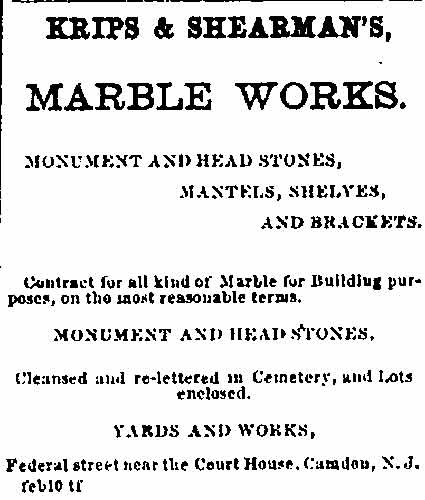
KRIPS & SHEARMAN’S,
MARBLE WORKS.
MONUMENT AND HEAD STONES, MANTELS, SHELVES, AND BRACKETS.
Contract for all kind of Marble for Building purposes, on the most reasonable terms.
MONUMENT AND HEAD STONES.
Cleansed and re-lettered in Cemetery, and Lots enclosed.
YARDS AND WORKS,
Federal street near the Court House, Camden, N.J.
Token of Esteem
Philadelphia Inquirer —
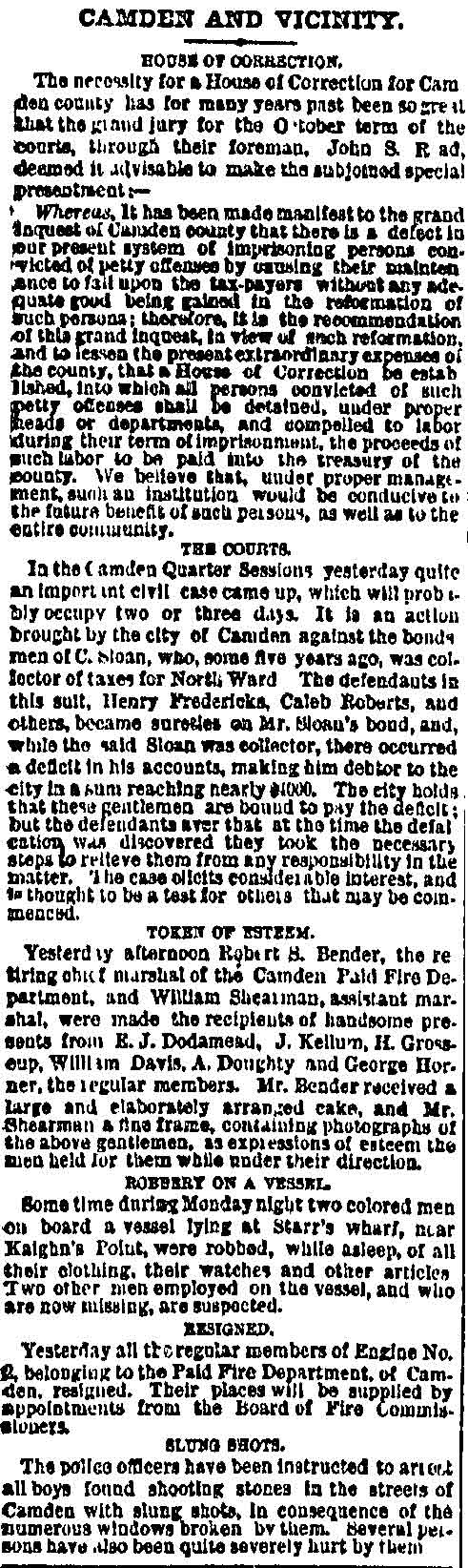
TOKEN OF ESTEEM.
Yesterday afternoon Robert S. Bender, the retiring chief marshal of the Camden Paid Fire Department, and William Shearman, assistant marshal, were made the recipients of handsome presents by E. J. Dodamead, B. L. Kellum, H. Grosscup, William Davis, A. Doughty and George Horner, the regular members. Mr. Bender received a large and elaborately arranged cake and Mr. Shearman a fine frame, containing photographs of all those belonging to and the names of all the men held for them while under their direction.
Workingmen’s Meeting
Philadelphia Inquirer —
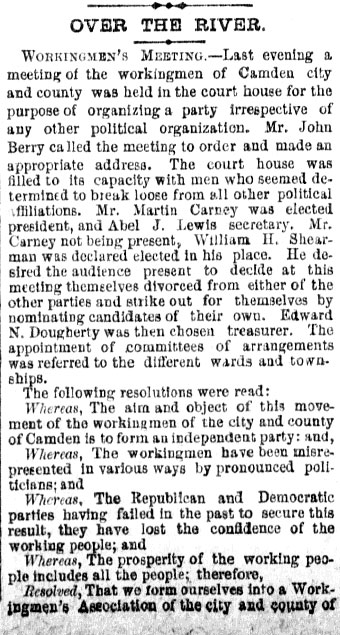
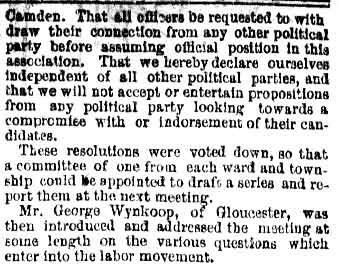
WORKINGMEN’S MEETING.—Last evening a meeting of the workingmen of Camden city and county was held in the court house for the purpose of organizing a party irrespective of any other political organization. Mr. John Berry called the meeting to order and made an appropriate address. The court house was filled to its capacity with men who seemed determined to break loose from all other political affiliations. Mr. Martin Carney was elected president, and Abel J. Lewis secretary. Mr. Carney not being present, William H. Shearman was declared elected in his place. He desired the audience present to decide at this meeting themselves divorced from either of the other parties and strike out for themselves by nominating candidates of their own. Edward N. Dougherty was then chosen treasurer. The appointment of committees of arrangements was referred to the different wards and townships.
The following resolutions were read:
Whereas, The aim and object of this movement of the workingmen of the city and county of Camden is to form an independent party; and,
Whereas, The workingmen have been misrepresented in various ways by pronounced politicians; and
Whereas, The Republican and Democratic parties having failed in the past to secure this result, they have lost the confidence of the working people; and
Whereas, The prosperity of the working people includes all the people; therefore,
Resolved, That we form ourselves into a Workingmen’s Association of the city and county of Camden. That all officers be requested to withdraw their connection from any other political party before assuming official position in this association. That we hereby declare ourselves independent of all other political parties, and that we will not accept or entertain propositions from any political party looking towards a compromise with or indorsement of their candidates.
These resolutions were voted down, so that a committee of one from each ward and township could be appointed to draft a series and report them at the next meeting. Mr. George Wynkoop, of Gloucester, was then introduced and addressed the meeting at some length on the various questions which enter into the labor movement.
Workingmen’s Meeting — Adjourned
Philadelphia Inquirer —

WORKINGMEN’S MEETING.—Last evening the workingmen in Camden held an adjourned meeting in the county court house for the purpose of perfecting their organization. William H. Shearman, of Gloucester city, was elected secretary. Mr. George Wynkoop, of Gloucester city, was then introduced and addressed the meeting at some length on the various questions which enter into the labor movement.
The Armstrong Murder
Philadelphia Inquirer —
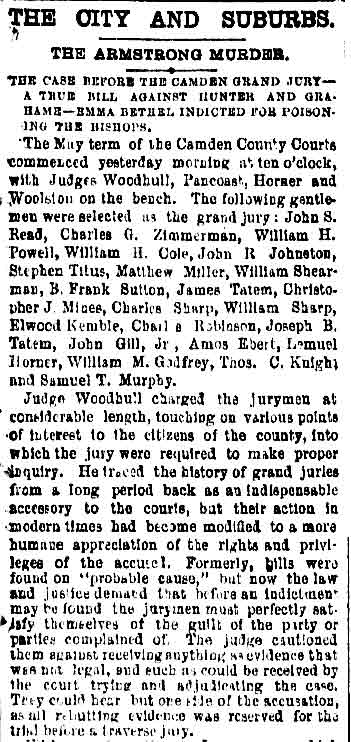
THE ARMSTRONG MURDER.
THE CASE BEFORE THE CAMDEN GRAND JURY—A TRUE BILL AGAINST HUNTER AND GRAHAME—EMMA BETHEL INDICTED FOR POISONING THE BISHOPS.
The May term of the Camden County Courts commenced yesterday morning at ten o’clock, with Judges Woodhull, Pancoast, Horner and Woolston on the bench. The following gentlemen were selected as the grand jury: John S. Read, Charles G. Zimmerman, William H. Powell, William H. Cole, John R. Johnston, Stephen Titus, Matthew Miller, William Shearman, B. Frank Sutton, James Tatem, Christopher J. Mines, Charles Sharp, William Sharp, Elwood Kemble, Charles Robinson, Joseph B. Tatem, John Gill, Jr., Amos Ebert, Lemuel Horner, William M. Godfrey, Thos. C. Knight and Samuel T. Murphy.
[Article continues about Judge Woodhull’s charge to the jury regarding the Armstrong Murder case and other matters…]
Decoration Day Parade
Philadelphia Inquirer —
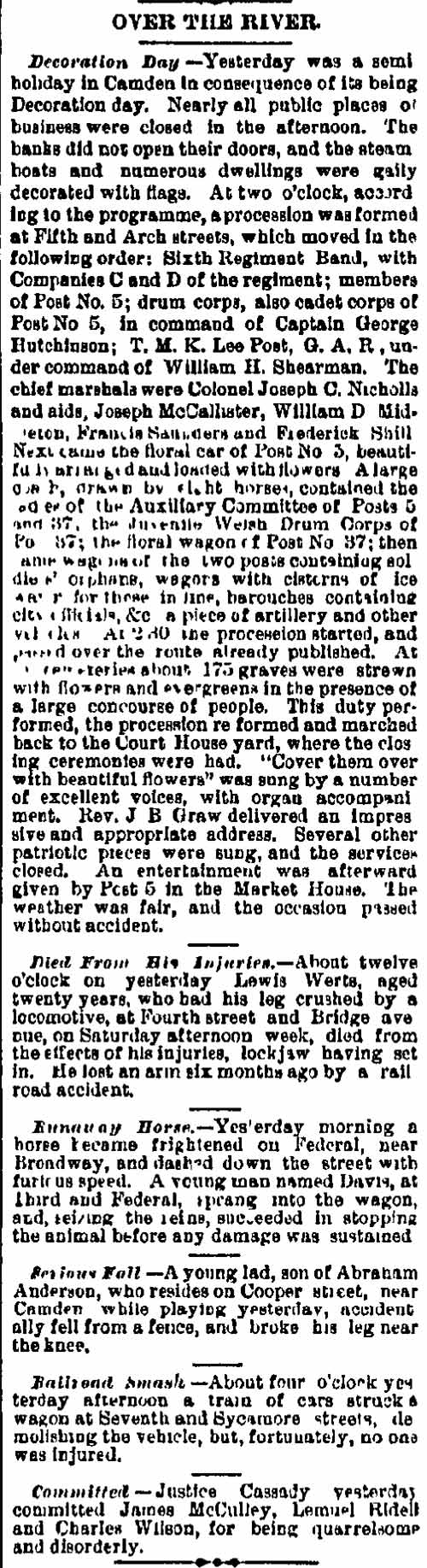
DECORATION DAY.—Yesterday was a semi holiday in Camden in consequence of its being Decoration day. Nearly all public places of business were closed in the afternoon. The banks did not open their doors, and the steam boats and numerous dwellings were gaily decorated with flags. At two o’clock, according to the programme, a procession was formed at Fifth and Arch streets, which moved in the following order: Sixth Regiment Band, with Companies C and D of the regiment; members of Post No. 5; drum corps, also cadet corps of Post No. 5, in command of Captain George Hutchinson; T. M. K. Lee Post, G. A. R., under command of William H. Shearman. The chief marshals were Colonel Joseph C. Nicholls and aids, Joseph McCallister, William D. Middleton, Francis Saunders and Frederick Shill. Next came the floral car of Post No. 5, beautifully arranged and loaded with flowers. A large one, drawn by eight horses, contained the [illegible] of the Auxiliary Committee of Posts 5 and 37; the Juvenile Welsh Drum Corps of Post 37; the floral wagon of Post No. 37; then came wagons of the two posts containing soldiers’ orphans, wagons with cisterns of ice water for those in line, barouches containing city officials, &c., a piece of artillery and other vehicles. At 2:30 the procession started, and passed over the route already published. At the cemeteries about 175 graves were strewn with flowers and evergreens in the presence of a large concourse of people. This duty performed, the procession reformed and marched back to the Court House yard, where the closing ceremonies were had. “Cover them over with beautiful flowers” was sung by a number of excellent voices, with organ accompaniment. Rev. J. B. Graw delivered an impressive and appropriate address. Several other patriotic pieces were sung, and the services closed. An entertainment was afterward given by Post 5 in the Market House. The weather was fair, and the occasion passed without accident.
Over the River
Philadelphia Inquirer —
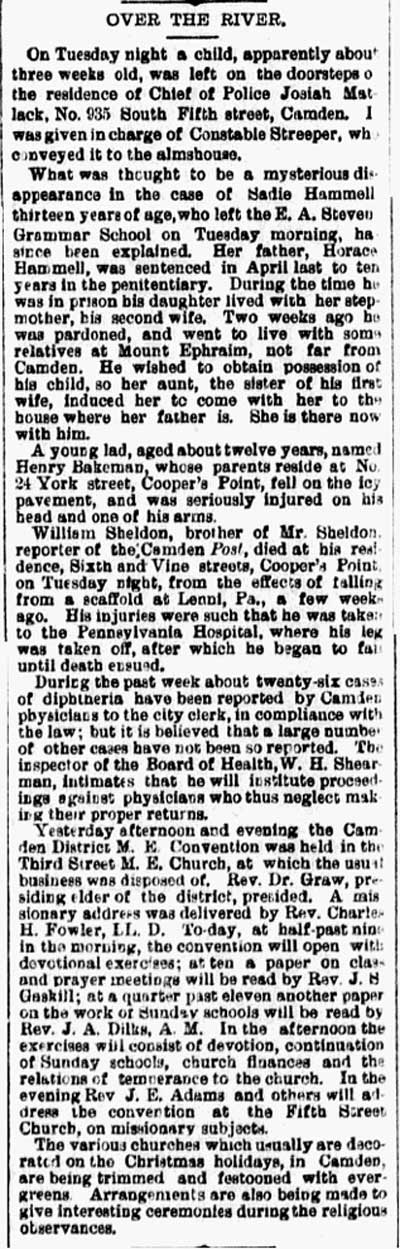
During the past week about twenty-six cases of diphtheria have been reported by Camden physicians to the city clerk, in compliance with the law; but it is believed that a large number of other cases have not been so reported. The inspector of the Board of Health, W. H. Shearman, intimates that he will institute proceedings against physicians who thus neglect making their proper returns.
Camden Politics
Philadelphia Inquirer —
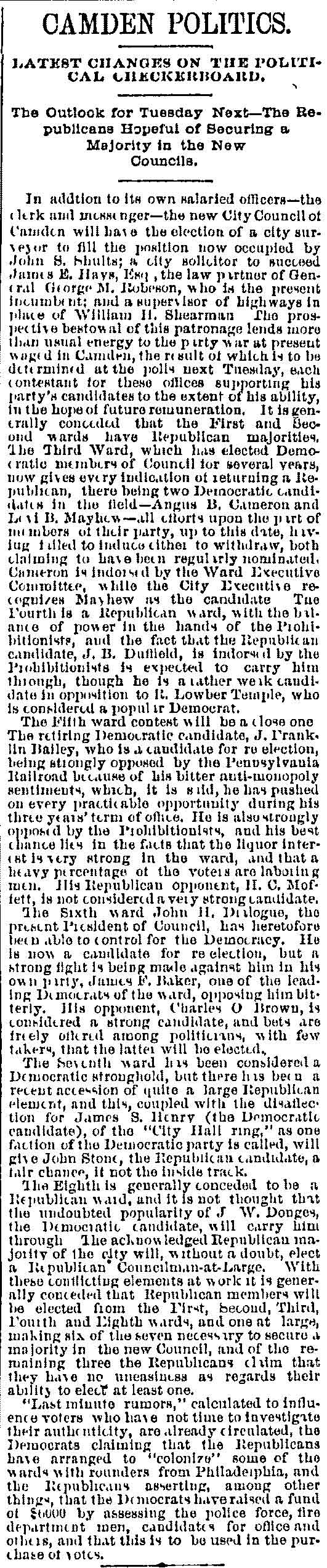
LATEST CHANGES ON THE POLITICAL CHECKERBOARD.
The Outlook for Tuesday Next—The Republicans Hopeful of Securing a Majority in the New Councils.
In addition to its own salaried officers—the clerk and messenger—the new City Council of Camden will have the election of a city surveyor to fill the position now occupied by John S. Shults; a city solicitor to succeed James E. Hays, Esq., the law partner of General George M. Robeson, who is the present incumbent; and a supervisor of highways in place of William H. Shearman. The prospective bestowal of this patronage lends more than usual energy to the party war at present waged in Camden, the result of which is to be determined at the polls next Tuesday, each contestant for these offices supporting his party’s candidates to the extent of his ability, in the hope of future remuneration.
An Attempted Outrage
Camden Daily Courier —
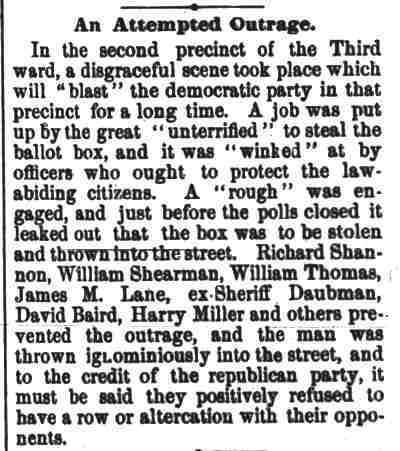
AN ATTEMPTED OUTRAGE.
In the second precinct of the Third ward, a disgraceful scene took place which will “blast” the democratic party in that precinct for a long time. A job was put up by the great “unterrified” to steal the ballot box, and it was “winked” at by officers who ought to protect the law-abiding citizens. A “rough” was engaged, and just before the polls closed it leaked out that the box was to be stolen and thrown into the street. Richard Shannon, William Shearman, William Thomas, James M. Lane, ex-Sheriff Daubman, David Baird, Harry Miller and others prevented the outrage, and the man was thrown ignominiously into the street, and to the credit of the republican party, it must be said they positively refused to have a row or altercation with their opponents.
Chief Franks Dead
Camden Daily Telegram —

CHIEF FRANKS DEAD.
AN ILLNESS OF SEVERAL MONTHS BRINGS HIS LIFE TO AN END.
WHO WILL BE HIS SUCCESSOR?
Lieutenant Stehr Wants It—So Does Contractor Shearman and “Davy” Baird is Working for His Brother.
Chief of Police Harry Houston Franks is dead. The deceased who is 50 years of age, had been ailing for several months and died about 2:30 o’clock Saturday morning, at his residence, Third and Royden streets. Mr. Franks who was an efficient officer was a candidate for the Mayoralty nomination in the Spring of 1885 and secured a number of delegates. Jesse Pratt had already been nominated by the Prohibitionists and was the young syndicate’s choice for nomination on the regular Republican ticket. In consequence of this a “deal” was made and when the Convention met Mr. Franks threw his delegates over to Pratt with the understanding that he was to be made Chief of Police in case of Pratt’s election. Unfortunately for the good government of the city, Pratt was elected and Chief of Police Franks, although not able to attend to his duties as he would have done if his health had permitted, did his best in every way to suppress violations of law which became a daily occurrence. The dead Chief is a brother of Detective Franks, of Philadelphia, and was born in the old Northern Liberties district of that city. He moved to this city in 1859 and immediately began to take a hand in politics. In 1878, * * * he was elected Constable for several terms in the Twenty-fifth Regiment New Jersey Volunteers, in which he served until the close of the war. The dead chief was a member of William B. Hatch Post, No. 37, G. A. R.; Camden Castle, No. 1, Knights of the Golden Eagle, Kearney Conclave of Heptasophs or Seven Wise Men. He was also a member of the Mysterious Brotherhood a social organization of this city.
During his illness Chief Franks often expressed the wish that a post mortem examination be made on his body after death. This was done yesterday by the Medical Examiner of County, Dr. Onan Gross. The organs of the dead man were found to be in a comparatively healthy condition, although the heart was observed to be much smaller in size than the average. The physicians examination proved beyond a doubt that death was due to cancerous ulceration of the oesophagus.
The Third Ward Republican Club, of which deceased was an active member, will meet this evening at Second and Bridge avenue for the purpose of appointing a committee to frame resolutions of condolence and to make arrangements to attend the funeral in a body. The city officials have also issued a call for a meeting with the same object in view. The funeral will take place on Thursday afternoon next at 1 o’clock.
Interment will be made in Evergreen Cemetery.
As yet he will not consider the question as to who will succeed the late Chief of Police for several days yet.
There are already three candidates for the position in the personages of Lieut. Louis H. Stehr, Contractor William Sherman and James Baird.
The patrolmen for the next thirty days will wear their badges in mourning.
Philadelphia Inquirer — May 2, 1904
Camden News Notes
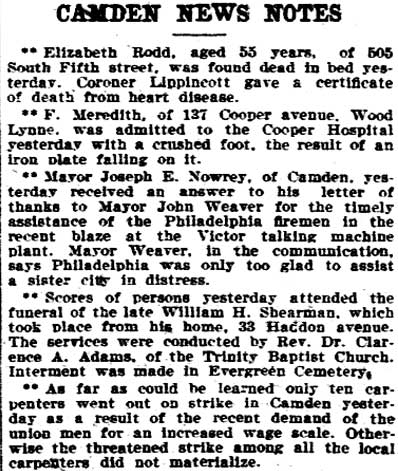
CAMDEN NEWS NOTES.
** Elizabeth Rodd, aged 55 years, of 505 South Fifth street, was found dead in bed yesterday. Coroner Lippincott gave a certificate of death from heart disease.
** F. Meredith, of 137 Cooper avenue, Wood Lynne, was admitted to the Cooper Hospital yesterday with a crushed foot, the result of an iron plate falling on it.
** Mayor Joseph E. Nowrey, of Camden, yesterday received an answer to his letter of thanks to Mayor John Weaver for the timely assistance of the Philadelphia firemen in the recent blaze at the Victor talking machine plant. Mayor Weaver, in the communication, says Philadelphia was only too glad to assist a sister city in distress.
** Scores of persons yesterday attended the funeral of the late William H. Shearman, which took place from his home, 33 Haddon avenue. The services were conducted by Rev. Dr. Clarence A. Adams, of the Trinity Baptist Church. Interment was made in Evergreen Cemetery.
** As far as could be learned only ten carpenters went out on strike in Camden yesterday as a result of the recent demand of the union men for an increased wage scale. Otherwise the threatened strike among all the local carpenters did not materialize.
Death Notice
Philadelphia Inquirer —
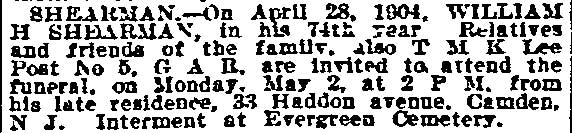
SHEARMAN.—On April 28, 1904. WILLIAM H SHEARMAN, in his 74th year. Relatives and friends of the family, also T M K Lee Post No 5, G A R, are invited to attend the funeral, on Monday, May 2, at 2 P M, from his late residence, 33 Haddon avenue, Camden, N J. Interment at Evergreen Cemetery.
Camden News Notes
Philadelphia Inquirer —
** Scores of persons yesterday attended the funeral of the late William H. Shearman, which took place from his home, 33 Haddon avenue. The services were conducted by Rev. Dr. Clarence A. Adams, of the Trinity Baptist Church. Interment was made in Evergreen Cemetery.
Civil War Pension Record
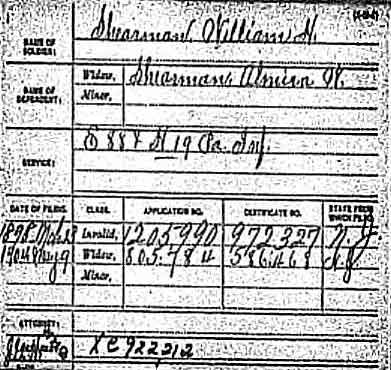
Civil War pension record for William H. Shearman (Invalid, 1898) and widow Almira H. Shearman (1904)
Pension filed 1898 (Invalid application no. 1205990, certificate no. 972327, State: NJ) for service in Company D, 88th Pennsylvania Infantry and Company H, 19th Pennsylvania Infantry. Following William Shearman’s death in 1904, widow Almira H. Shearman filed for a widow’s pension (application no. 805784, certificate no. 546069).