William J. Lorigan
WILLIAM J. LORIGAN was a well-known individual in Camden in the 1890s and 1900s. Born in Ireland around 1850, at the time of the 1870 Census he was living in Castleton, Rutland County, VT with his older brother John and sisters Ann, Susannah, and Margaret. The two Lorigan brothers were then working at a sawmill. An older relation, Michael Lorigan, had come to Castleton in the 1850s, as had a William and Catherine Lorigan. The nature of these relationships is unknown to this author at this time.
William J. Lorigan wed in the 1870s. Son William Henry Lorigan was born around 1875, followed by John two years later and Joseph in early 1880. July of 1880 found the family living in Newburgh NY, where William J. Lorigan worked as a painter. The family moved to Camden soon afterwards.
The 1887–1888 and 1888–1889 Camden City Directories show William J. Lorigan working as a “slate marbleizer,” then as a “superintendent.” In both years the family resided at 812 Linden Street in North Camden. The 1890–1891 Directory shows them at 409 Elm Street, near Elm and Main Street in North Camden. His occupation in that directory is listed as “manager,” and the Directory indicates he was working in Philadelphia. He was very active in the Church of the Immaculate Conception. His son, William H. Lorigan, served as organist and choir director at the church in the early 1900s.
By 1902 William Lorigan had partnered with department store executive William Leonard Hurley. The 1906 Camden City Directory shows son William H. Lorigan working as secretary at Gately & Hurley, and that the Lorigans were involved in a construction business. By 1902 William J. Lorigan had also established a shoe store at 426 Federal Street. He made his home at 502 North 4th Street.
With headquarters at 502 North 4th Street, the Lorigan family home, Lorigan & Hurley built the Princeton Avenue Houses, a block of homes on the one-block street of that name, between Pine and Division Streets east of South 7th Street. On May 16 that year, William J. Lorigan had the honor of introducing the Chinese Ambassador to the United States, Wu Ting Fang, at the Catholic Lyceum at Federal Street and Broadway. The speech had been preceded by a reception at the home of John J. Burleigh in Merchantville, where Mrs. Lorigan and daughter Kathryn served as escorts to the women in the Ambassador’s escort, which included U.S. Attorney General McCarter, Senators Dryden and Kean, Congressman Harry Loudenslager, and future Congressman William J. Browning. Ambassador Wu was at the Catholic Lyceum to speak as part of the Lyceum Association’s Lecture Series.
William J. Lorigan passed away before the census was enumerated in April 25, 1910. His family which then consisted of his widow Margaret, and eight children, William H., John B., Joseph P., Kathryn P., Anna, Agnes, Charles, and Walter, still resided at 502 North 4th Street in North Camden. The family maintained the North 4th Street address and the shoe store as late as 1916. Son William H. Lorigan remained in the home building business for many years. The 1914 City Directory shows the business at 315 State Street. The widow and children of William H. Lorigan resided at 10 North 27th Street when the 1947 Camden City Directory was compiled. William H. Lorigan Jr., last a resident of Cherry Hill, passed away in 2005.
Bogus Check on Lorigan Brothers
Philadelphia Inquirer —
George S. Neidlinger charged with passing bogus check on Lorigan Brothers.

George S. Neidlinger, who was released from the Mercer county jail yesterday after serving a sentence, was brought to Camden by County Detective Smith to answer a charge of passing a bogus check on Lorigan Brothers.
Princeton Avenue Houses
Camden Daily Courier — 1902
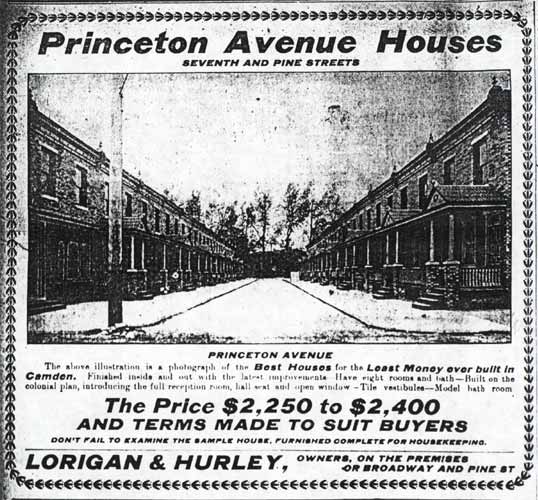
Seventh and Pine Streets
Princeton Avenue
The above illustration is a photograph of the Best Houses for the Least Money ever built in Camden. Finished inside and out with the latest improvements. Have eight rooms and bath—Built on the colonial plan, introducing the full reception room, hall seat and open window—Tile vestibules—Model bath room
The Price $2,250 to $2,400
AND TERMS MADE TO SUIT BUYERS
DON’T FAIL TO EXAMINE THE SAMPLE HOUSE, FURNISHED COMPLETE FOR HOUSEKEEPING.
LORIGAN & HURLEY, OWNERS, ON THE PREMISES OR BROADWAY AND PINE ST
They Dined with Minister Wu
Trenton Times —
Distinguished Jerseymen Met With the Chinese Diplomat in Camden.
The Rt. Rev. Bishop McFaul, Clerk in Chancery Stokes, United States Senators Dryden and Kean, Attorney General McCarter and John L. Kuser were among the guests of honor at a dinner given to Minister Wu Ting Fang at the home of John J. Burleigh in Merchantville last evening.
The Chinese minister visited Camden for the purpose of delivering a lecture at the Catholic Lyceum and was later tendered a reception at the Camden Republican Club.
He was accompanied from Washington by the United States Senators and Congressman Loudenslager, together with a Camden committee consisting of the Rev. J. A. Canfield, William L. Hurley and John M. Kelly.
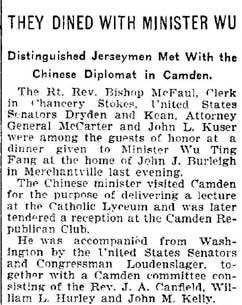
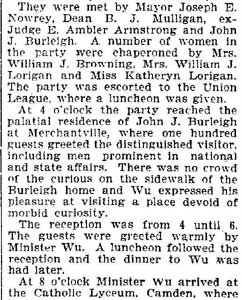
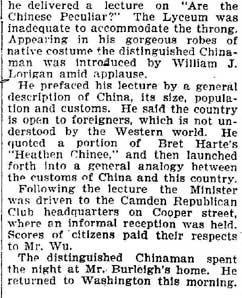
They Dined with Minister Wu
Distinguished Jerseymen Met With the Chinese Diplomat in Camden.
The Rt. Rev. Bishop McFaul, Clerk in Chancery Stokes, United States Senators Dryden and Kean, Attorney General McCarter and John L. Kuser were among the guests of honor at a dinner given to Minister Wu Ting Fang at the home of John J. Burleigh in Merchantville last evening.
The Chinese minister visited Camden for the purpose of delivering a lecture at the Catholic Lyceum and was later tendered a reception at the Camden Republican Club.
He was accompanied from Washington by the United States Senators and Congressman Loudenslager, together with a Camden committee consisting of the Rev. J. A. Canfield, William L. Hurley and John M. Kelly.
East Camden Notes
Camden Post-Telegram —
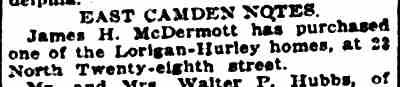
James H. McDermott has purchased one of the Lorigan-Hurley homes, at 23 North Twenty-eighth street.
East Camden Notes
James H. McDermott has purchased one of the Lorigan-Hurley homes, at 23 North Twenty-eighth street.
Hurley Based Success in Life and in Business on Square Deal to All
Camden Courier-Post —

By BEN COURTER
Nearly two score years ago an earnest young man called together a handful of employees in a small store at Fifth and Pine streets.
“Boys, see that door?” he said to them.
“Well, if by any chance I should be called upon to resort to unscrupulous methods in the conduct of this business that door will be closed and this enterprise will end. Square dealing is to be the principle on which we will do business, square dealing to everybody.”
That young man was William Leonard Hurley, then but 27 years old and virile, visioning a great business which he purposed to develop. It was the pronouncement of what then was nothing less than an ideal, for it was in a period when there was a tendency to take advantage of the unsuspecting to sell inferior goods at exorbitant prices. Many operated under what was known in the trade as the “borax system,” which resulted in the public looking askance at installment buying for the home.
Based on that determination to cultivate public confidence in his own business, Hurley built slowly but securely, his small enterprise into “the big trustful store,” with branches in half a dozen cities.
It was a determination that made him a kindred spirit, in later years, with Theodore Roosevelt whose guest the Rough Rider was to become in the midst of a political campaign that stirred the country from coast to coast. It was the straight-forward characteristic that likewise prompted his subsequent activities in the interest of Camden, that was to be a factor in throwing off the provincial spirit and entering the civic stride so pronounced in the advent of the Camden bridge and the extension of Broadway. In both these he was a strenuous advocate of civic expansion, scientifically planned.
Hurley Not Born With a ‘Silver Spoon’
When Hurley was born in Chester county, Pa., 65 years ago, it was not with a “silver spoon in his mouth.” His father, William Hurley, was a railroad man, an honest, hard-working father, who, in times which were hard enough for the bread-winner, struggled to keep his family in the necessities of life.
The son, William, obtained the rudiments of education under great difficulties, for schools were scarce and far between in the sparse settlement where his boyhood was spent. It was a school of hard knocks, an environment that evidenced the difficult problem the poorer class had in obtaining the bare necessities of life. It was the experience of those early years that William L. Hurley never forgot, for afterward, when success had come, he never was deaf to an appeal from those “pulling hard against the stream.”
At the age of 12 he obtained his first job on a farm in his native Chester county. Farming in those days was hard, strenuous work, seemingly never ending labor to the boy, even then strong and possessing much of the splendid physique of later years.
“I worked from four in the morning until after dark,” Hurley once said, in a reminiscent way. “The farmer usually woke me in the morning by pounding his cane on the floor.
“My duties? Well, they included milking ten cows, feeding chickens and pigs, cleaning the horses, husking corn and doing odd chores. The farmer paid me $4 a month and board.
“In those days boys worked just as hard as grown folks. It was no cinch and when darkness came I couldn’t run fast enough to the farmhouse and to bed. I was dead tired and the bed brought supreme happiness to me. Sleeping was about the only fun I had.”
So the years went on with the hard work on the farm. The future held no great promise. The railroad was more alluring. Since his father was a railroader, young Hurley decided to try that field.
Railroading in 80’s No ‘Automatic’ Job
Back in the 80’s railroading was a far different proposition than it is now. There was none of the automatic brakes and couplings and numberless other inventions that have made it comparatively a safe job today. The old-fashioned coupling pin, for instance, was the abomination of the brakeman. What it did to Hurley he carried to his dying day in the loss of the end of one of his middle fingers.
Not only did he act as brakeman but also as fireman. As he stoked the pulsing engine he dreamed of the day when he might take the throttle. It seemed a wonderful career then, but fate had other things in store for him. He sensed it when he concluded to better his wage of $1.[?]0 a day and get “something on the side.” That was by selling sewing machines at night, often after he had worked hard on drilling freights or stoking the engine through the day.
But this selling of sewing machines impressed young Hurley that perhaps after all there was something else in life other than guiding a great locomotive over the rails. At any rate he concluded to try it out and this in 1888, the year of the “great Blizzard” in this section, he obtained a job with Edward Gately & Co. in Philadelphia as canvasser. It was not long before he had two assistants who acted as collectors, one of whom, Harry F. Jones, was to become his partner in the Atlantic City store many years later.
Gately was a wealthy man who had made his money mostly in the installment business, one who ever had an eye open for the promising young men in his organization. It was his custom to give them a chance and take them into partnership, opening stores in various cities. Young Hurley was one of these promising young men. In 1890 the business of Gately & Hurley was started. To be exact it was on February 1 of that year that a small store was opened, the corner store under old Wildey Hall at Fifth and Pine streets. It was there that he was inspired to tell his then small force of his square dealing policy.
Worked Long Hours to Make Store Success
Young Hurley worked like a Trojan. None in the ranks put in longer hours than he, sometimes 18 or 20 before he was willing to call it a day.
Not only did he direct his force in garnering business, but he went out on the street, often with rugs across his shoulders, to obtain patronage. Many recall the stalwart, earnest young man and his breezy manner which seldom failed to bring result.
Nor was Hurley, in the flush of subsequent success, averse to recalling those strenuous days, usually with a chuckle and remembrance of old timers who had stood staunch and strong with his organization through the intervening years.
Four years later the business had grown to such proportions that he concluded another location was needed. That was after all the stores under Wildey Hall had been occupied. In 1894 the Gately & Hurley store was opened at Broadway and Pine streets. It was then 33 by 90 feet.
When Hurley impressed Gately with the necessity for expanding and having a real store he prepared plans for a four-story structure. Camden then was filled with the “can’t be dones.” Toone & Hollinshed at Broadway and Kaighn avenue was the biggest place on that thoroughfare. Mrs. Varney’s place was on Kaighn avenue, the store of E. V. Story at Sycamore street, Hughes Brothers at Walnut street, Fuhrman Brothers at Chestnut and a few notion places here and there. But the Hurley enterprise seemed so outlandish that one day as George Leathwhite, then Camden’s leading plumber, was looking over the building operation a prominent business man of the period asked.
“Who is the damn fool building this place?”
Nor was he mollified in the least when informed it was “Bill” Hurley. It was regarded altogether a foolhardy undertaking, one that would spell certain disaster. It was pointed out there was nothing just like it on Broadway and that there was nothing to warrant such an outlay.
As a matter of fact that pessimistic note eventually reached Gately. He had some misgivings and Hurley’s four-story building was kept down to three. Just two months after the store had been finished it was necessary to find warehousing room by renting the old bakery of William Kairer at Line and West street. Incidentally, it may be of interest to recall it was Kairer the baker, who had been shot and killed by a burglar in 1893. Theodore Lambert was hanged in the old county jail for that murder.
In 1900 Hurley bought the Gately interests, giving him exclusive ownership, and the business continued to grow making more additions necessary. The old Field properties, two and a half story bricks, were bought, torn down and the store extended.
In 1903 a store was established at Wilkes-Barre with Daniel Loughran as Hurley’s partner. Three years later Henry J. Tobin was made his partner in another store at Trenton. Then in 1912 John J. Powell was commissioned to open the Hurley-Powell store at Wilmington. Harry F. Jones, Hurley’s collector in the very early days opened the Hurley-Jones store at Atlantic City in 1915. Five years later another Hurley store started business at Bridgeton. And in 1923 the home store was remodeled and in the meantime, old Turner Hall, where many a gay night was had by the old timers in masked balls and other festivities, was converted into a warehouse with other structures doing like service. Hurley has long since been recognized as one of South Jersey’s merchant princes.
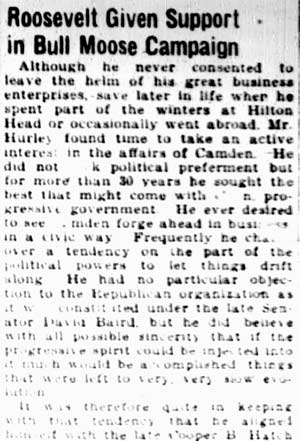
Roosevelt Given Support in Bull Moose Campaign
Although he never consented to leave the helm of his great business enterprises, save later in life when he spent part of the winters at Hilton Head or occasionally went abroad, Mr. Hurley found time to take an active interest in the affairs of Camden. He did not seek political preferment but for more than 30 years he sought the best that might come with [blacked out]n progressive government. He ever desired to see Camden forge ahead in business in a civic way. Frequently he chafed over a tendency on the part of the political powers to let things drift along. He had no particular objection to the Republican organization as it was constituted under the late Senator David Baird, but he did believe with all possible sincerity that if the progressive spirit could be injected into it much would be accomplished, things that were left to very, very slow evolution.
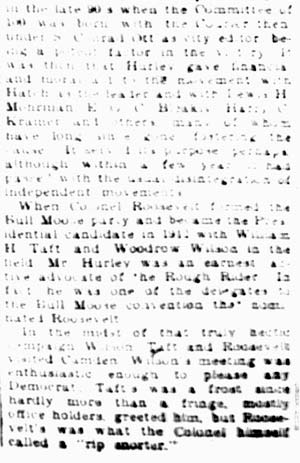
It was therefore quite in keeping with that tendency that he aligned himself with the late Cooper B. Hatch in the late 90’s when the Committee of 100 was born with the Courier then under S. Conrad Ott as city editor being a potent factor in the victory. It was then that Hurley gave financial and moral aid to the movement with Hatch as the leader and with Lewis H. Moorman, [blacked out], C. Kramer and others many of whom have long since gone fostering the cause. [blacked out] its purpose perhaps although within a few years it had passed with the usual disintegration of independent movements.
When Colonel Roosevelt formed the Bull Moose party and became the Presidential candidate in 1912 with William H. Taft and Woodrow Wilson in the field, Mr. Hurley was an earnest active advocate of the Rough Rider. In fact he was one of the delegates to the Bull Moose convention that nominated Roosevelt.
In the midst of that truly hectic campaign when Wilson, Taft and Roosevelt visited Camden, Wilson’s meeting was enthusiastic enough to please any Democrat. Taft’s was a frost and hardly more than a fringe, mostly office holders greeted him, but Roosevelt’s was what the Colonel himself called a “rip snorter.”
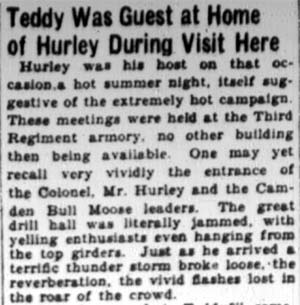
Teddy Was Guest at Home of Hurley During Visit Here
Hurley was his host on that occasion, a hot summer night, itself suggestive of the extremely hot campaign. These meetings were held at the Third Regiment armory, no other building then being available. One may yet recall very vividly the entrance of the Colonel, Mr. Hurley and the Camden Bull Moose leaders. The great drill hall was literally jammed, with yelling enthusiasts even hanging from the top girders. Just as he arrived a terrific thunder storm broke loose, the reverberation, the vivid flashes lost in the roar of the crowd.
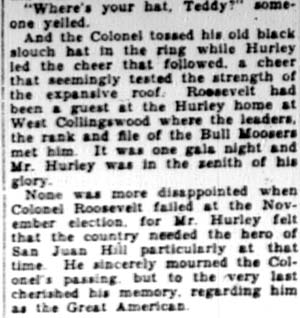
“Where’s your hat, Teddy?” someone yelled.
And the Colonel tossed his old black slouch hat in the ring while Hurley led the cheer that followed, a cheer that seemingly tested the strength of the expansive roof. Roosevelt had been a guest at the Hurley home at West Collingswood where the leaders, the rank and file of the Bull Moosers met him. It was one gala night and Mr. Hurley was in the zenith of his glory.
None was more disappointed when Colonel Roosevelt failed at the November election, for Mr. Hurley felt that the country needed the hero of San Juan Hill particularly at that time. He sincerely mourned the Colonel’s passing, but to the very last cherished his memory, regarding him as the Great American.
Backed Non-Partisan Move, Aided Opening of Broadway
As has been indicated, Mr. Hurley had no particular feeling against the Republican organization, but he was certain that Camden was on the threshold of big things and that there should be an awakening. There appeared to be no intention of getting out of the rut so far as the political powers were concerned and with the assurance of the bridge he regarded it necessary to be alive to the opportunities certain to come. There had been talk of certain outlets from the bridge which did not meet the situation in his judgment. For one thing, he was impressed with the extension of Broadway.
For more years than one might recall, Broadway had been Camden’s principal street. Many regarded it as the city’s most important business thoroughfare. Mr. Hurley early realized that to extend it to where the bridge plaza would eventually be located was a real civic essential, but the city administration did not consider the financial outlay that would be involved justified in the extension.
That was one of the factors that resulted in the Non-Partisan movement of 1922, of Mr. Hurley’s advocacy of its cause, of his financial and moral support. He was one of the leaders in the civic revolution that first brought the victory for commission form of government and later that ushered the Non-Partisan candidates into office.
It was the realization of a cherished dream when the new administration bought property that assured Broadway’s extension to the bridge plaza. It justified his prediction that it would be like giving a new blood stream to the city, for the Walt Whitman Hotel, the Wilson Building and others rapidly rising about Broadway and Cooper streets prove it beyond all doubt.
Camden Bridge Proposition Given Approval by Hurley
Mr. Hurley not only gave his every influence toward the Camden bridge proposition in the days when it was regarded more or less a joke, but he worked assiduously to crystalize [sic] sentiment so that the century-old dream would be a dream no longer. New Jersey did its part when Walter Edge was governor, but there was plenty of backing and filling on the part of Philadelphia and Pennsylvania. There were many discouraging epochs, even after a joint commission had been created, but Mr. Hurley was among those who refused to give up hope. What was subsequently accomplished was due mainly to men of his faith, of his courage, of his energy.
After its completion the necessity for a second span was impressed upon him. Shortly after the Camden bridge was opened to the public he advocated another from Market street, Gloucester to Pattison avenue, Philadelphia. Since other sites have been suggested. A joint commission has been named to make preliminary surveys but has been at loggerheads over a proposal to build a span from Red Bank to League Island. Mr. Hurley regarded his suggestion as far more feasible and he supported it by arguments that were hard to answer.
Throughout his career Mr. Hurley had been an earnest advocate of co-operation among business interests of the city. For many years there was the Board of Trade rather an innocuous organization, usually attended by half a dozen men and voiceless so far as influence went. He concluded a rejuvenation was necessary, consented to act as president and speeded it up with the late Louis T. Derousse as secretary. Later Charles M. Curry held that position and until the present Chamber of Commerce was formed under a campaign directed by the American City Bureau. Mr. Hurley or his subordinates had given it every possible aid to make it a factor in the community.
Assessment Commissioner Was Only Political Post
Aside from his principal business, Mr. Hurley was associated for many years with the late William J. Lorigan in building homes. Their first extensive operation was the construction of two rows of dwellings in Princeton avenue. Others were constructed in various parts of Camden and the development of the district about Twenty-seventh and Federal streets was largely due to the firm. After the elder Lorigan’s death he was succeeded by his son, William H. Lorigan, who has been associated with Mr. Hurley.
While he sought no political honors, Mr. Hurley did once accept for a few years a position. It was during the Committee of 100 regime when he became a commissioner of assessment. He [?] served for many years as a delegate to the Atlantic Deeper Waterways Convention. He took a keen interest in that organization and in the work of actually having an inland waterway along the eastern seaboard. It is slowly developing with the possibility of becoming an actuality a few years hence, mainly through the effort of men of Mr. Hurley’s caliber.
When he came to Camden Mr. Hurley first resided on Stevens street, then at [?] Pine and from 1894 to 19[?]9 at 7[?]8 Broadway. In the latter year he bought the estate on White Horse pike at West Collingswood that had been used as a sanitarium. The building was virtually reconstructed, the grounds were laid out in beautiful shrubbery and there were already fine nut trees which made it a show place. He called it Dungarvan, after the county in Ireland where his father was born.
It was there at his palatial home, with the beautiful surroundings that Mr. Hurley delighted in acting the role of host, of gathering about him old friends and harking back to the times that were.
Unspoiled Good Will Befriended All in Need
Old friends cherish the memory of one outstanding characteristic of “Bill” Hurley. Increasing fortune never “spoiled” him. He remained democratic until the end, and those who had known him through the years called him “Bill” just as they had done in the days when he was forging ahead in spite of the “can’t-be-dones.”
Nor did he ever forget an old customer. It might be an old, old woman upon whom fortune had consistently refused to shine but who made her little purchases at his store. None was too lowly for him to give his personal attention under such circumstances. There was ever a real grip of the hand that spoke sincerity.
It was quite natural that he enjoyed hunting and fishing. For many years his summer home was at Sea Isle City, where his family went through the vacation period each year. There he never failed to go out to sea or to try his luck off the pier, usually with an old friend. Catching the piscatorial beauties, particularly a channel bass or a drum, was regarded with almost the same satisfaction as putting over a big business deal.
Over a dozen years ago he bought the island at Hilton Head, off the coast of South Carolina and 30 miles from Savannah. While he enjoyed all the comforts of civilization, the surroundings were kept in their primitive simplicity. Nothing delighted him more than taking an old friend along to the island estate and showing the guest the time of his life.
Men like Hurley do much that is unheralded to alleviate the suffering of the world. Creed or color meant nothing to him if aid were needed. What he gave in that respect no one knows. Those long associated with him declare it was sufficient to make happy a small army in adversity.
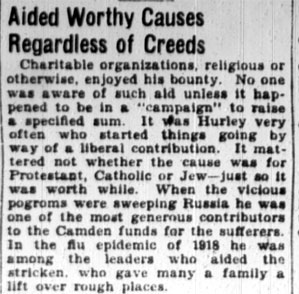
Aided Worthy Causes Regardless of Creeds
Charitable organizations, religious or otherwise, enjoyed his bounty. No one was aware of such aid unless it happened to be in a “campaign” to raise a specified sum. It was Hurley very often who started things going by way of a liberal contribution. It mattered not whether the cause was for Protestant, Catholic or Jew—just so it was worth while. When the vicious pogroms were sweeping Russia he was one of the most generous contributors to the Camden funds for the sufferers. In the flu epidemic of 1918 he was among the leaders who aided the stricken, who gave many a family a lift over rough places.
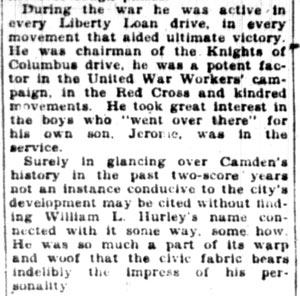
During the war he was active in every Liberty Loan drive, in every movement that aided ultimate victory. He was chairman of the Knights of Columbus drive, he was a potent factor in the United War Workers’ campaign, in the Red Cross and kindred movements. He took great interest in the boys who “went over there” for his own son, Jerome, was in the service.
Surely in glancing over Camden’s history in the past two-score years not an instance conducive to the city’s development may be cited without finding William L. Hurley’s name connected with it some way, some how. He was so much a part of its warp and woof that the civic fabric bears indelibly the impress of his personality.
Program for the Jubilee Celebration, 1855—1905
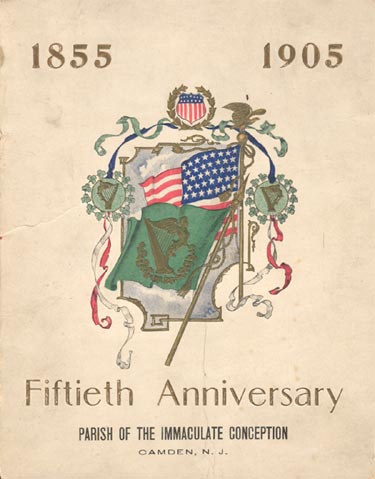
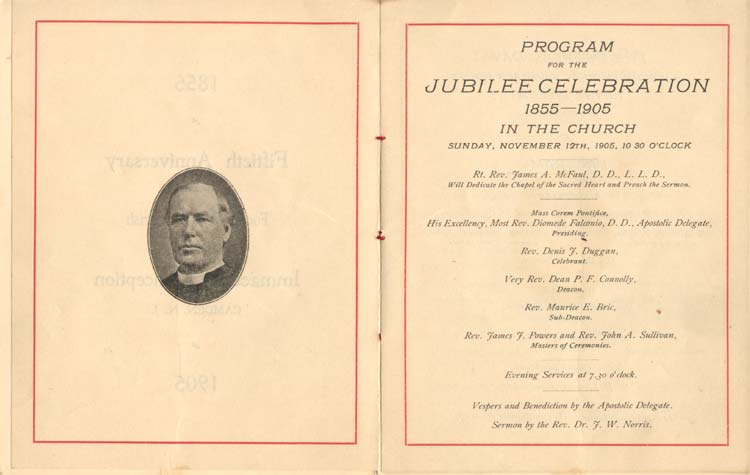
1855 1905. Fiftieth Anniversary. PARISH OF THE IMMACULATE CONCEPTION. CAMDEN, N. J.
1855. Fiftieth Anniversary OF THE Founding of the Parish OF THE Immaculate Conception. CAMDEN, N. J. 1905.
PROGRAM FOR THE JUBILEE CELEBRATION 1855—1905 IN THE CHURCH. SUNDAY, NOVEMBER 12TH, 1905, 10.30 O’CLOCK
Rt. Rev. James A. McFaul, D. D., L. L. D., Will Dedicate the Chapel of the Sacred Heart and Preach the Sermon.
Mass Corem [sic] Pontifice. His Excellency, Most Rev. Diomede Falconio, D. D., Apostolic Delegate, Presiding.
Rev. Denis J. Duggan, Celebrant.
Very Rev. Dean P. F. Connolly, Deacon.
Rev. Maurice E. Bric, Sub-Deacon.
Rev. James J. Powers and Rev. John A. Sullivan, Masters of Ceremonies.
Evening Services at 7.30 o’clock.
Vespers and Benediction by the Apostolic Delegate. Sermon by the Rev. Dr. J. W. Norris.
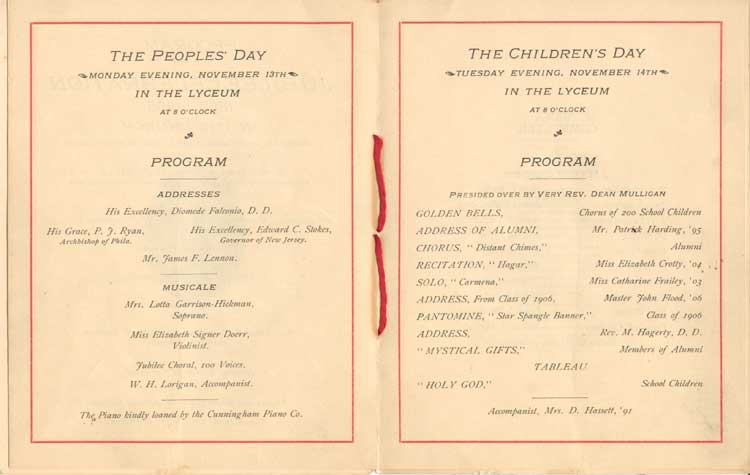
THE PEOPLES’ DAY [sic] MONDAY EVENING, NOVEMBER 13TH IN THE LYCEUM AT 8 O’CLOCK. PROGRAM
ADDRESSES: His Excellency, Diomede Falconio, D. D.; His Grace, P. J. Ryan, Archbishop of Phila.; His Excellency, Edward C. Stokes, Governor of New Jersey; Mr. James F. Lennon.
MUSICALE: Mrs. Lotta Garrison-Hickman, Soprano; Miss Elizabeth Signer Doerr, Violinist; Jubilee Choral, 100 Voices; W. H. Lorigan, Accompanist.
The Piano kindly loaned by the Cunningham Piano Co.
THE CHILDREN’S DAY. TUESDAY EVENING, NOVEMBER 14TH IN THE LYCEUM AT 8 O’CLOCK. PROGRAM. PRESIDED OVER BY VERY REV. DEAN MULLIGAN
GOLDEN BELLS, Chorus of 200 School Children. ADDRESS OF ALUMNI, Mr. Patrick Harding, ’95. CHORUS, “Distant Chimes,” Alumni. RECITATION, “Hagar,” Miss Elizabeth Crotty, ’04. SOLO, “Carmena,” Miss Catharine Frailey, ’03. ADDRESS, From Class of 1906, Master John Flood, ’06. PANTOMINE [sic], “Star Spangle Banner,” Class of 1906. ADDRESS, Rev. M. Hagerty, D. D. “MYSTICAL GIFTS,” Members of Alumni. TABLEAU “HOLY GOD,” School Children.
Accompanist, Mrs. D. Hassett, ’91
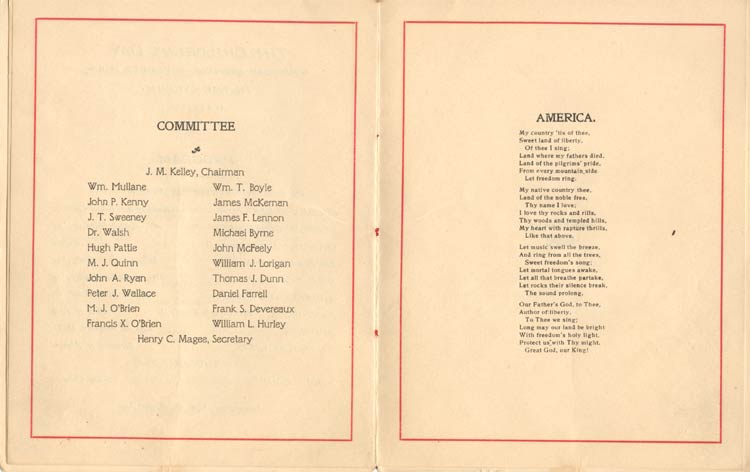
COMMITTEE
J. M. Kelley, Chairman. Wm. Mullane, Wm. T. Boyle, John P. Kenny, James McKernan, J. T. Sweeney, James F. Lennon, Dr. Walsh, Michael Byrne, Hugh Pattie, John McFeely, M. J. Quinn, William J. Lorigan, John A. Ryan, Thomas J. Dunn, Peter J. Wallace, Daniel Farrell, M. J. O’Brien, Frank S. Devereaux, Francis X. O’Brien, William L. Hurley. Henry C. Magee, Secretary.
AMERICA.
My country ’tis of thee, Sweet land of liberty, Of thee I sing; Land where my fathers died, Land of the pilgrims’ pride, From every mountain side Let freedom ring.
My native country thee, Land of the noble free, Thy name I love; I love thy rocks and rills, Thy woods and templed hills, My heart with rapture thrills, Like that above.
Let music swell the breeze, And ring from all the trees, Sweet freedom’s song; Let mortal tongues awake, Let all that breathe partake, Let rocks their silence break, The sound prolong.
Our Father’s God, to Thee, Author of liberty, To Thee we sing; Long may our land be bright With freedom’s holy light. Protect us with Thy might, Great God, our King!