Introduction
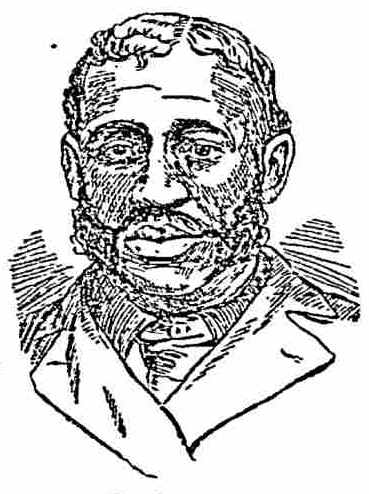
The United States Supreme Court has once more refused to be a party to the defeating of justice in this State. The Court yesterday declined to grant a writ of habeas corpus for Theodore Lambert, the Camden murderer, whose life his lawyer was trying to save on a technical ground.
The point raised by Lambert's lawyer was not based on any claim that the condemned man was not fairly tried, or that there was any possibility of his innocence; but upon what can be termed little else than a trick.
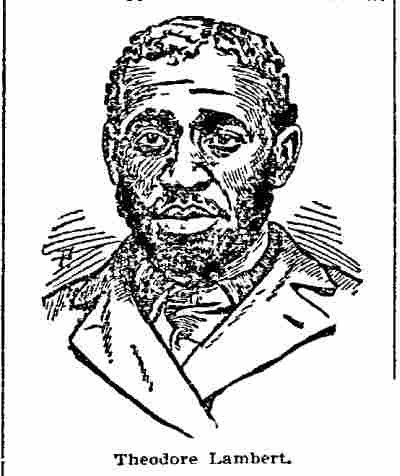
THEODORE LAMBERT was born Nicholas Theodore Lambert on September 20, 1871 in Camden's old Eighth Ward, to Annie and Theodore Lambert. His father was a veteran of the Civil War, serving with Company G of the 25th Regiment, U.S. Colored Infantry from February 1, 1864 through December 6, 1865. The 1870 Census shows Theodore and Annie Lambert living in Newton Township, which was dissolved and incorporated into Camden the following year. The Lambert family resided in and around South 9th Street and Ferry Avenue in Camden's Centerville neighborhood.
While the elder Lambert appears to have been a respectable fellow, a war veteran who lived to a ripe old age, his son, also known as “Dory” Lambert was not. Theodore Lambert was thoroughly evil, a violent career criminal who was in and out of prison. Young Lambert was in the midst of a spree of burglaries that had numbered at least twenty when, on December 4, 1893 he broke into the home of William G. Kairer Sr., well-known and respected baker, who lived at 429 Beckett Street, the corner of Beckett and Avon Streets, in South Camden. There Theodore Lambert shot and killed Mr. Kairer, who had been woken by the noise of the burglary.
Theodore Lambert was arrested, tried, and after numerous appeals, on December 19, 1895 executed at the Camden County Jail for murdering Mr. Kairer. He was buried at the Johnson cemetery on Federal Street in what is now East Camden.
Philadelphia Inquirer — February 8, 1886
Yesterday afternoon Theodore Lambert, colored, went to the cigar store of John Clarkin, at No. 737 Chestnut street, and, it is alleged, grabbed a handfull of cigars from the case. Mrs. Clarkin, who happened to come in the store about that time, attempted to take the stolen property from him, when he knocked her down and severely beat her about the face. He was afterwards arrested by Officer Blair and taken to the city hall, where he will have a hearing before the Mayor to-day. Dr. Henry attended the injured lady.
Philadelphia Inquirer — February 9, 1886
CAMDEN NEWS.
Matters of Interest in the City Across the Delaware.
Theodore Lambert, colored, who beat Mrs. Clarkin so badly on Sunday afternoon, when she attempted to take some cigars from him which he had stolen, had a hearing before Mayor Bradshaw yesterday, and was committed to the county jail in default of $600 bail.
Philadelphia Inquirer — December 12, 1889
Theodore Lambert and Daniel Sands were arrested yesterday on a charge of breaking into the house of H. N. Mulvey, No. 563 Mickel street. When Lambert was arrested by Officer Herneff he had one of Mr. Mulvey's overcoats which had been stolen, on his back. Mayor Pratt committed them in default of $1,000 bail each.
Philadelphia Inquirer — January 24, 1890
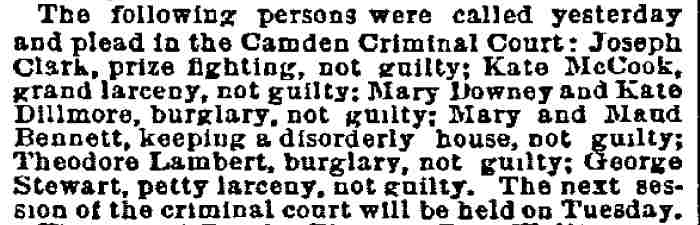
The following persons were called yesterday and plead in the Camden Criminal Court: Joseph Clark, prize fighting, not guilty; Kate McCook, grand larceny, not guilty; Mary Downey and Kate Dillmore, burglary, not guilty; Mary and Maud Bennett, keeping a disorderly house, not guilty; Theodore Lambert, burglary, not guilty; George Stewart, petty larceny, not guilty. The next session of the criminal court will be held on Tuesday.
Philadelphia Inquirer — December 5, 1893
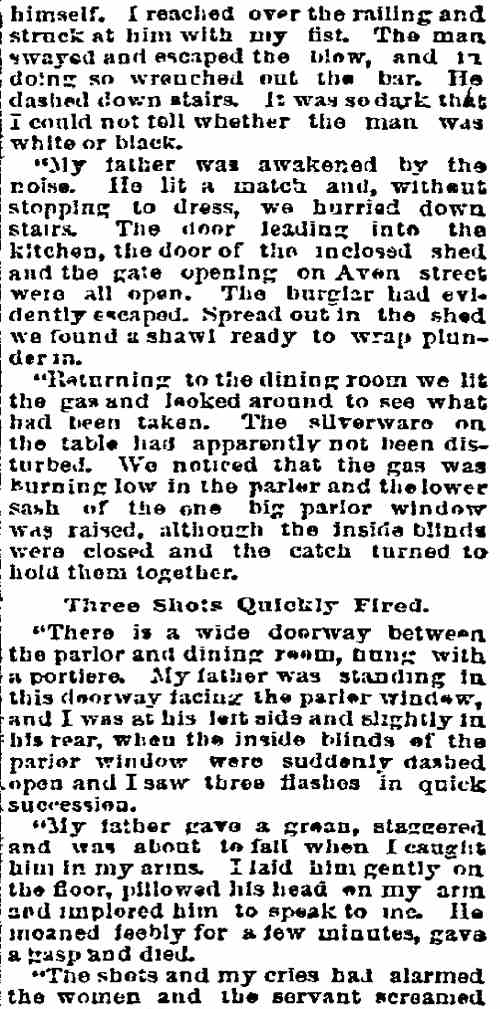
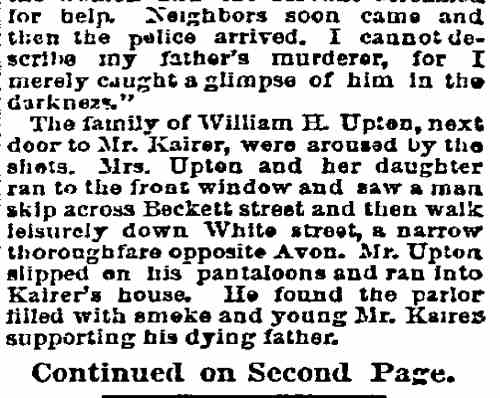
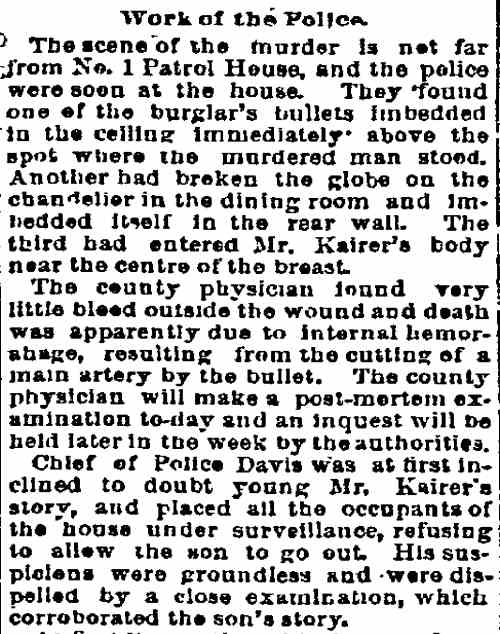
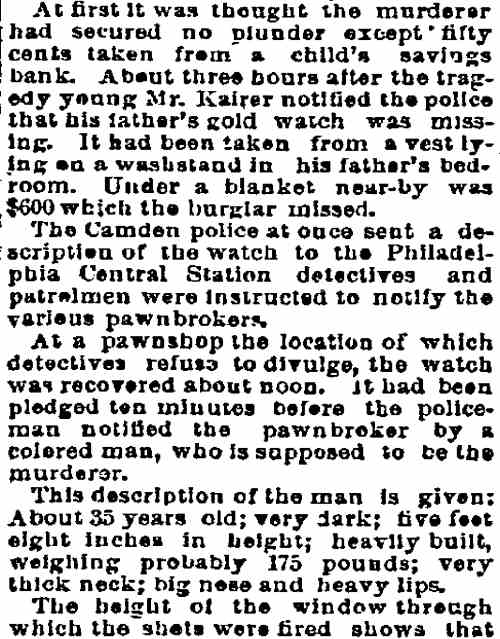
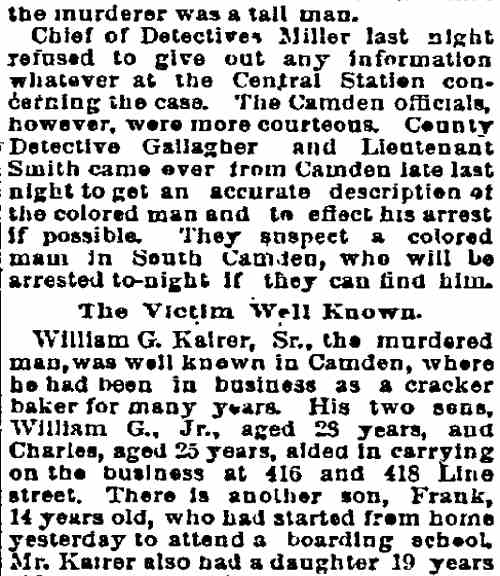
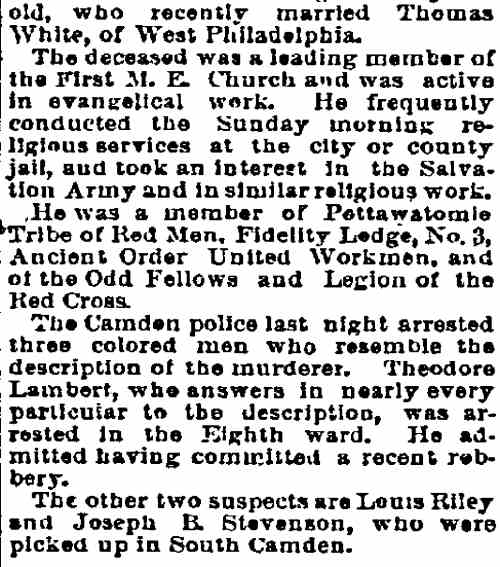
Thrilling Encounter of a Camden Baker and His Son With a Robber, Who Killed the Father.
Three Shots Through a Window and William G. Kairer Moaned and Died
The Murderer Believed to Be a Colored Man Who Pawned His Victim's Watch—Police Working on a Clue in Philadelphia—The Son's Story.
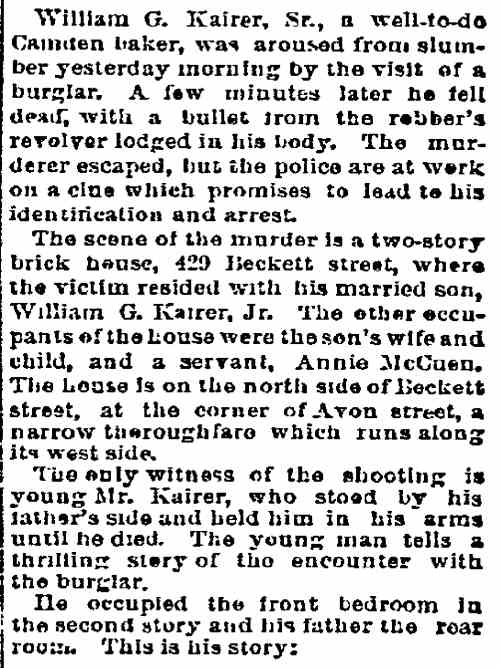
William G. Kairer, Sr., a well-to-do Camden baker, was aroused from slumber yesterday morning by the visit of a burglar. A few minutes later he fell dead, with a bullet from the robber's revolver lodged in his body. The murderer escaped, but the police are at work on a clue which promises to lead to his identification and arrest.
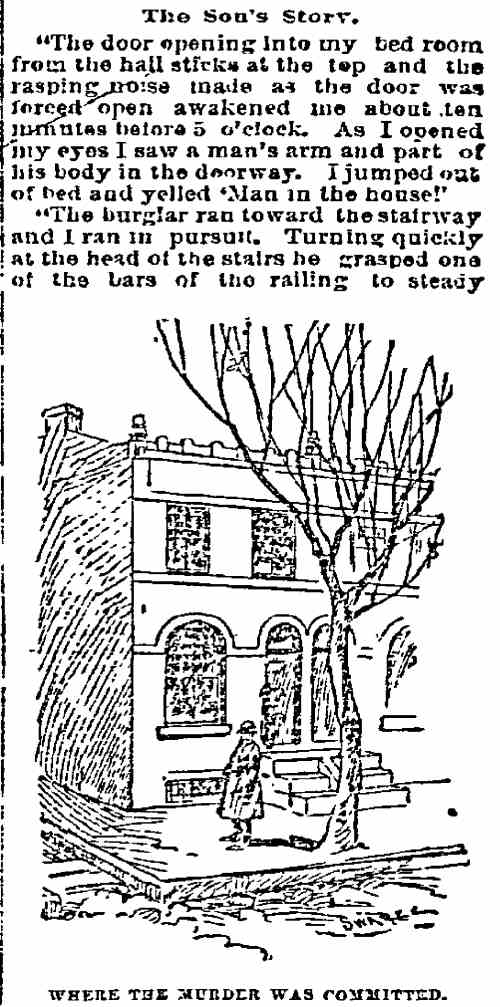
The scene of the murder is a two-story brick house, 429 Beckett street, where the victim resided with his married son, William G. Kairer, Jr. The other occupants of the house were the son's wife and child, and a servant, Annie McCuen. The house is on the north side of Beckett street, at the corner of Avon street, a narrow thoroughfare which runs along its west side.
The only witness of the shooting is young Mr. Kairer, who stood by his father's side and held him in his arms until he died. The young man tells a thrilling story of the encounter with the burglar.
The Camden police last night arrested three colored men who resemble the description of the murderer. Theodore Lambert, who answers in nearly every particular to the description, was arrested in the Eighth ward. He admitted having committed a recent robbery.
The other two suspects are Louis Riley and Joseph B. Stevenson, who were picked up in South Camden.
Photos: 429 Beckett Street
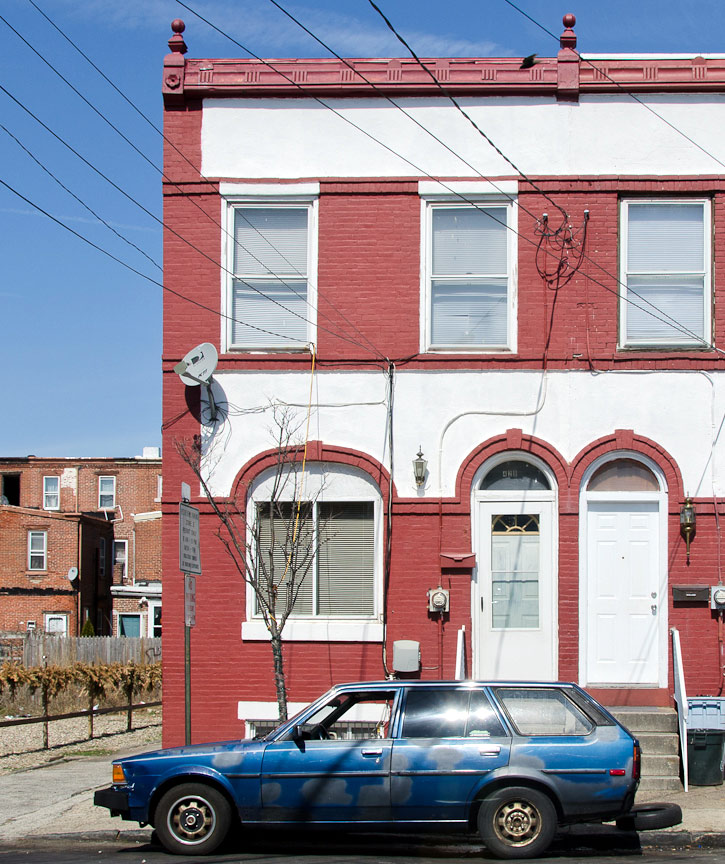
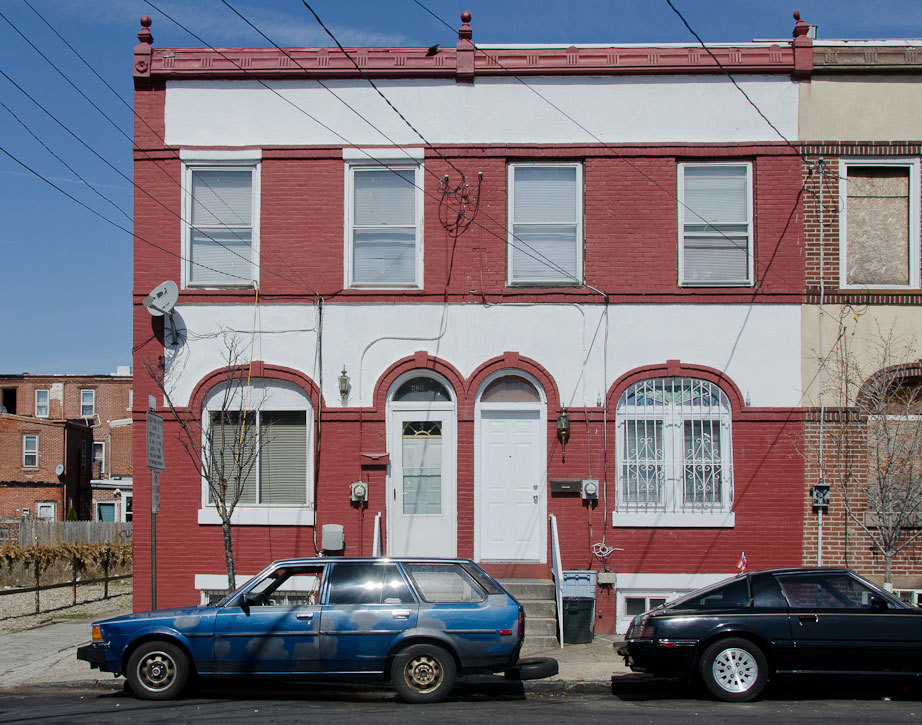
Left: 429 Beckett Street. Below: 429 & 431 Beckett Street. Photo taken March 14, 2012.
New York Herald — December 5, 1893
Brutal Murder of William G. Kairer, a Prominent Business Man of Camden, N. J.
FIRED THROUGH THE WINDOW.
Not Content with Escaping, Sought Vengeance on Those Whom He Had Despoiled
COLORED MAN UNDER ARREST
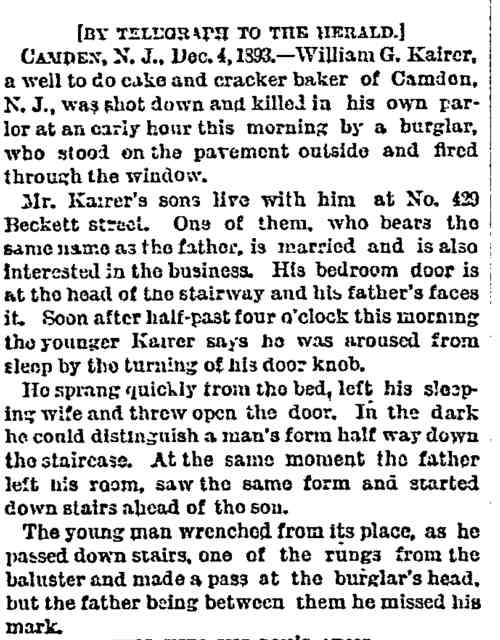
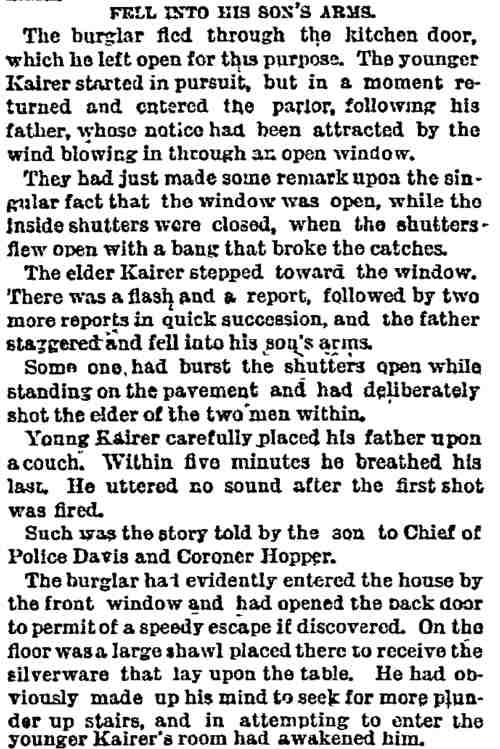
CAMDEN, N. J., Dec. 4, 1893.—William G. Kairer, a well to do cake and cracker baker of Camden, N. J., was shot down and killed in his own parlor at an early hour this morning by a burglar, who stood on the pavement outside and fired through the window.
Mr. Kairer's sons live with him at No. 429 Beckett street. One of them, who bears the same name as the father, is married and is also interested in the business. His bedroom door is at the head of the stairway and his father's faces it. Soon after half-past four o'clock this morning the younger Kairer says he was aroused from sleep by the turning of his door knob.
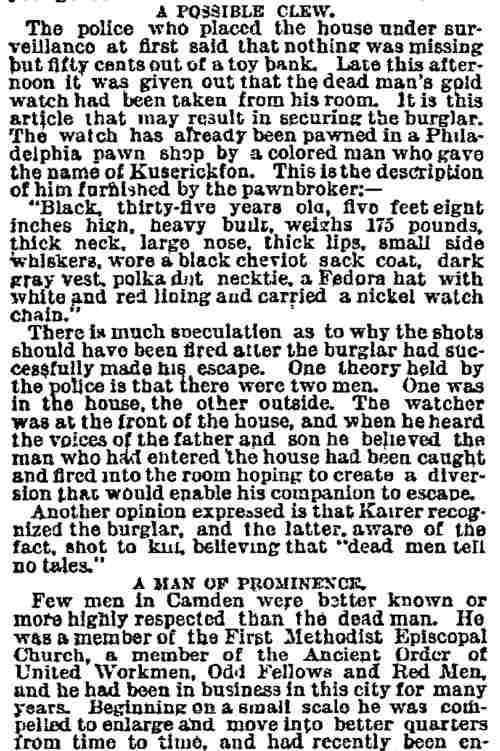
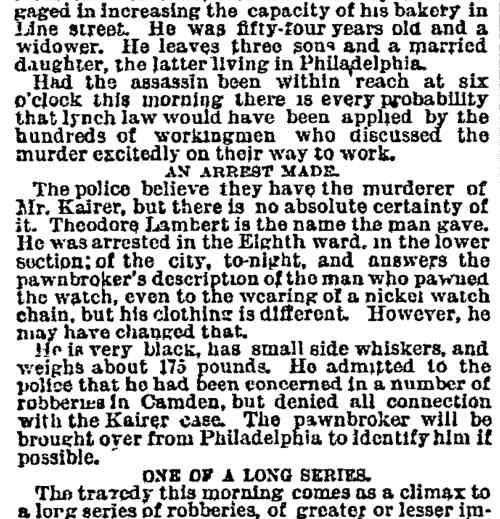
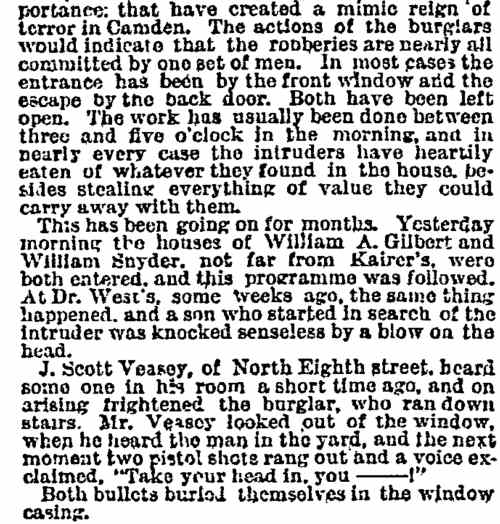
The police believe they have the murderer of Mr. Kairer, but there is no absolute certainty of it. Theodore Lambert is the name the man gave. He was arrested in the Eighth ward, in the lower section of the city, to-night, and answers the pawnbroker's description of the man who pawned the watch, even to the wearing of a nickel watch chain, but his clothing is different. However, he may have changed that.
He is very black, has small side whiskers, and weighs about 175 pounds. He admitted to the police that he had been concerned in a number of robberies in Camden, but denied all connection with the Kairer case. The pawnbroker will be brought over from Philadelphia to identify him if possible.
Philadelphia Inquirer — December 6, 1893
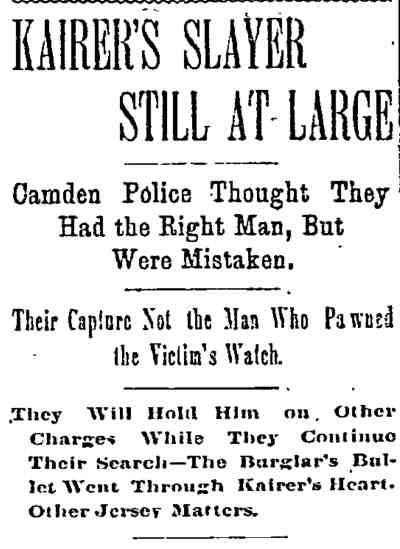
Camden Police Thought They Had the Right Man, But Were Mistaken.
Their Capture Not the Man Who Pawned the Victim's Watch.
They Will Hold Him on Other Charges While They Continue Their Search—The Burglar's Bullet Went Through Kairer's Heart—Other Jersey Matters.
When the Camden police arrested Theodore Lambert, colored, they thought they had the murderer of Cracker Baker William Kairer, who was shot in his home, 429 Beckett street, by a burglar early Monday morning. They held to this belief until late yesterday afternoon, when it was suddenly dispelled.
The only clue to the identity of the murderer started from the pawn shop of Ellis Silberstein, 123 North Ninth street, Philadelphia, where the murdered man's gold watch was pledged. A colored man brought the watch into the pawn shop five hours after the crime was committed.
Lambert has a bad record. He was sent to the New Jersey State Reform School when he was 15 years old. When he attained his majority he launched into a career of crime. He has served several terms in State prison, and was released but a few months ago after serving three years for robbing a house on Mickle street.
He was arrested at 1883 South Ninth street early yesterday morning, and the police also took into custody Joseph B. Stevens and Levin Riley, colored, who were in the house. George Greenleaf, colored, was also arrested on suspicion.
County Physician Iszard made a post-mortem examination yesterday afternoon of the body of the murdered man. He found the burglar's bullet had entered at the breast, passed through the heart and lodged in the spinal column.
Washington D.C. Evening Star — December 6, 1893
The Camden Murder.
The police believe they have the man who pawned the watch stolen from William Kairer's room in Camden early Monday morning a few minutes before the baker was murdered. Theodore Lambert, colored, is the man. Lambert's story of his whereabouts since the murder only adds to the evidence already against him.
Bridgeton Evening News — December 7, 1893
Camden's Latest Murder.
CAMDEN, N. J., Dec. 7.—The murderer of William G. Kairer, who was shot by a burglar, is still at large. Theodore Lambert, the colored man who was arrested on suspicion of being the person who pawned Mr. Kairer's watch, was not identified by Pawnbroker Silberstein's clerk, but the police are still holding him, as they hope to connect him with the murder.
Philadelphia Inquirer — December 8, 1893
“Shot by an Unknown Man” the Verdict of the Coroner's Jury.
Funeral Services Over the Remains of the Murdered Baker.
The Rewards Now Amount to a Thousand Dollars—Police Still Working in the Dark—A New But Faint Clue—Other Jersey Matters.
The closing scenes in Camden's latest tragedy were enacted yesterday. In the morning an inquest was held and in the afternoon the body of William G. Kairer, Sr., the wealthy baker who was shot by an unknown burglar, was buried.
The inquest was held by Coroner Hopper in the court house. The jury brought in a verdict “that William G. Kairer, Sr., came to his death from a pistol shot wound at the hand of a person or persons unknown.”
The funeral of the murdered man was held immediately after the inquest. Rev. J. B. Graw, D. D., pastor of the First M. E. Church, of which Mr. Kairer was a member, conducted the funeral services. The pall-bearers were A. F. Davies, Charles Parker, N. G. Stowell and C. T. Pierce. Delegations were present from Pottawatomie Tribe, Improved Order of Red Men; Fidelity Lodge, Ancient Order United Workmen, and the Legion of the Red Cross. The body was interred in Evergreen Cemetery.
Theodore Lambert, the colored man first arrested, is still held in custody, but he has not been connected with the crime.
Sergeant John A. Smith, of the Camden police force, last night arrested a colored man named Isaac Cox on suspicion of being the man who pawned Kairer's watch in Philadelphia.
Philadelphia Inquirer — December 10, 1893
Must Answer Two Charges—New Clue in the Kairer Case.
Theodore Lambert, the negro first arrested on suspicion of being the murderer of Baker William G. Kairer, and later identified as being connected with two other robberies, was given a hearing before Police Justice Paul, in Camden, yesterday. He was committed in default of $1000 bail on the charge of breaking into Mrs. Mary Manlove's residence, 2000 Broadway, on the night of August 9 last. Mrs. Manlove has recognized him as the man who raised her window and frightened her into a swoon.
Lambert will also have to answer the charge of breaking into Mrs. Francis Hutt's residence, 908 Jefferson avenue, and stealing a watch. The police still hope to connect him with the Kairer murder.
They have made no additional arrests in connection with the latter case, but are said to be working on a new clue.
Philadelphia Inquirer — December 11, 1893
Third District Police Think They Have the Murderer of Baker William Kairer.
Three more arrests of suspects in connection with the Kairer murder have been made. The Camden police picked up one of the men and the Philadelphia police the other two.
One of the latter so closely corresponds with the description of the colored man who tried to pawn the victim's watch that the Third district officers think they have the murderer. Their prisoner gives the name of George Harris.
Pawnbroker Silberstein's clerk was out of town yesterday, but will be taken to the station house to-day to see if he can identify Harris as the man who pawned Kairer's watch.
Officer Richardson, of the Camden force, picked up a colored man last night on suspicion of being the murderer. The prisoner gave the name of Henry Hansom, laborer, of Sycamore street, above Seventh. He is younger and not so heavily built as the supposed murderer, and will probably be released to-day.
Shenandoah PA Evening Herald — December 11, 1893
Another Kairer Suspect.
CAMDEN, N. J., Dec. 11.—Henry Hanson, a negro, was arrested last night on suspicion of having been implicated in the murder of William Kairer. He is said to answer the description of the man who pawned Kairer's watch in Philadelphia.
Trenton Evening Times — December 11, 1893
Charged With the Kairer Murder.
PHILADELPHIA, Dec. 11.—George W. Harris, a negro, was arrested on suspicion of being the murderer of William Kairer, the Camden baker.
Washington PA Semiweekly Observer — December 11, 1893
Camden's Latest Murder.
CAMDEN, N. J., Dec. 7.—The murderer of William G. Kairer, who was shot by a burglar, is still at large. Theodore Lambert, the colored man who was arrested on suspicion of being the person who pawned Mr. Kairer's watch, was not identified by Pawnbroker Silberstein's clerk, but the police are still holding him, as they hope to connect him with the murder.
Philadelphia Inquirer — December 19, 1893
Theodore Lambert, the colored burglar, was removed from the City Hall yesterday to the county prison. He was placed in solitary confinement in the infirmary directly under Prosecutor Jenkins' office. The police still expect to connect him with the murder of Baker William G. Kairer.
The Murder Weapon
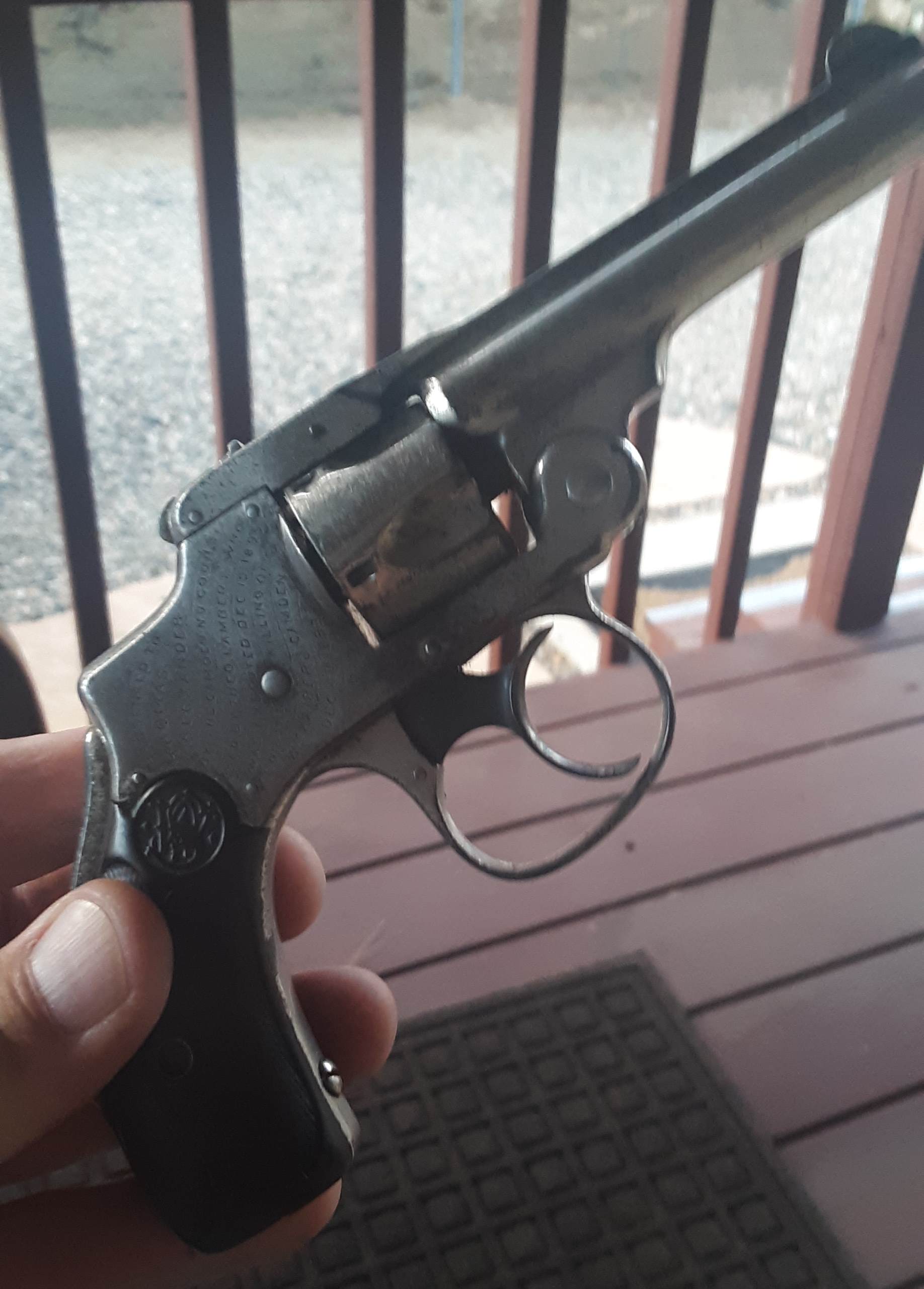
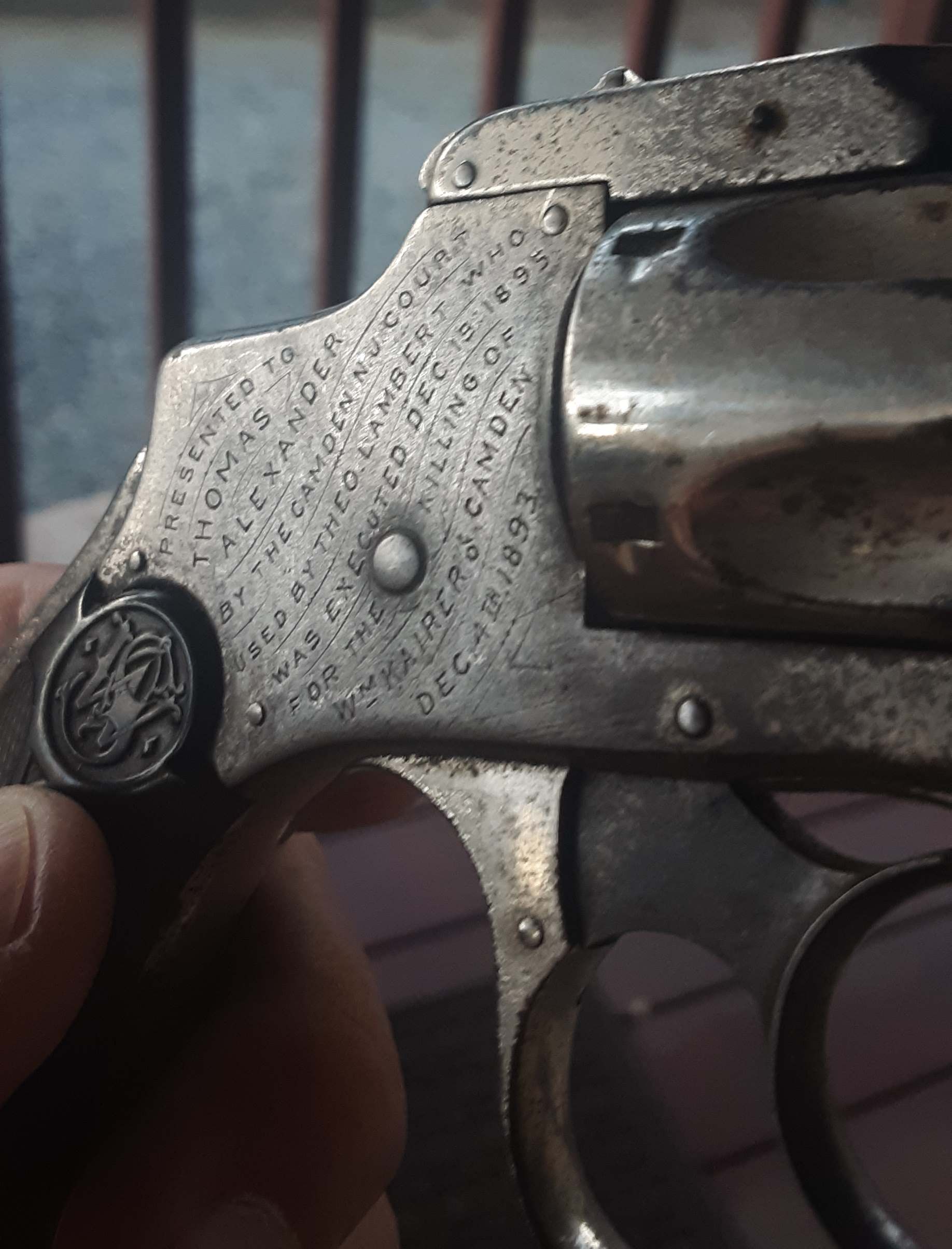
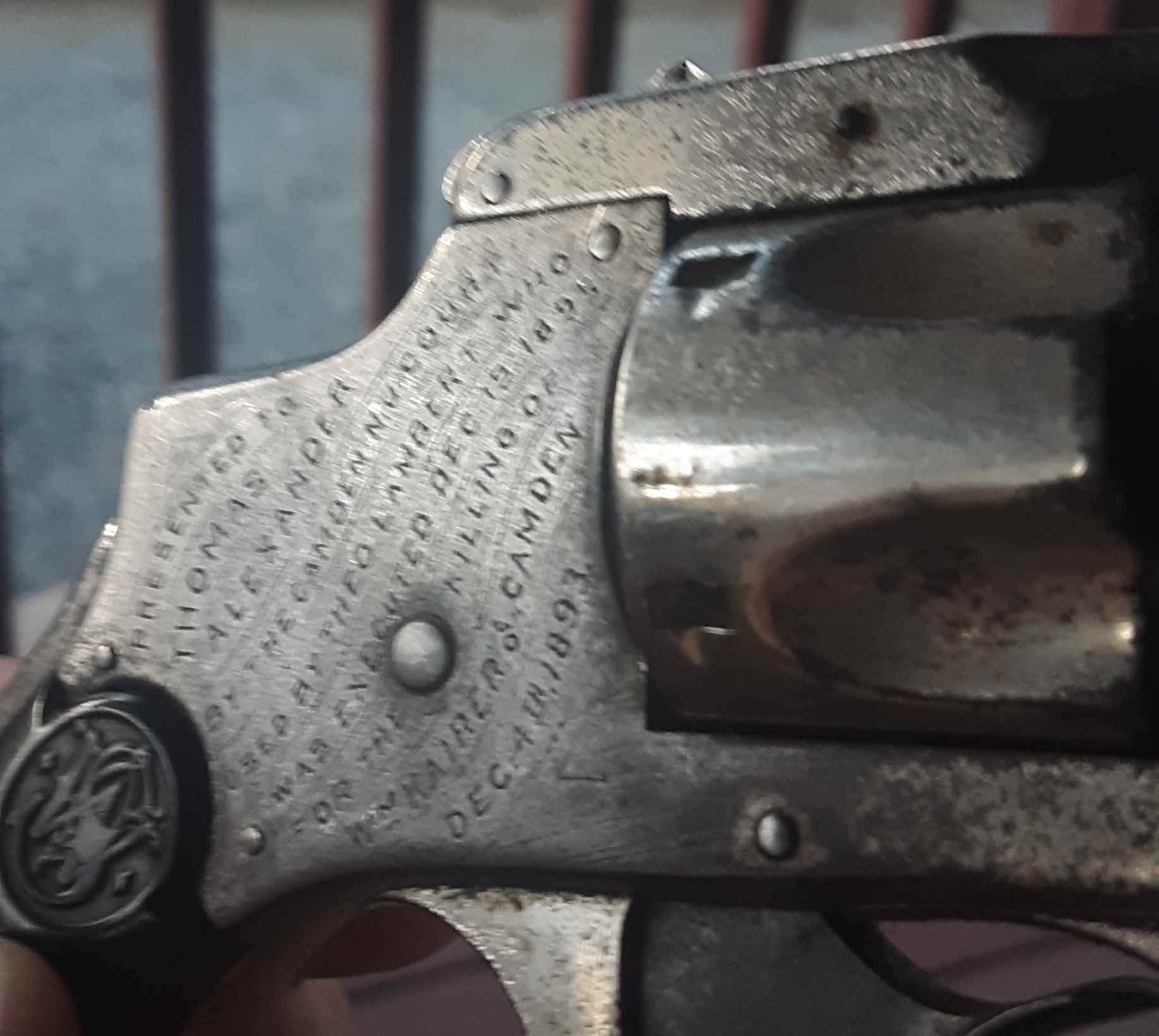
I own the gun used by Theodore Lambert to kill William G. Kairer [The weapon had been presented by the Camden County courts to Thomas Alexander—PMC]. Thomas Alexander was a detective with the Philadelphia Police department. He obtained direct evidence linking Lambert with the homicide.
The pistol is also accurately described in the articles as a “.32 cal. Self-cocking pistol.”
—Ray Byrne, September 2019
Harrisburg Patriot — February 5, 1894
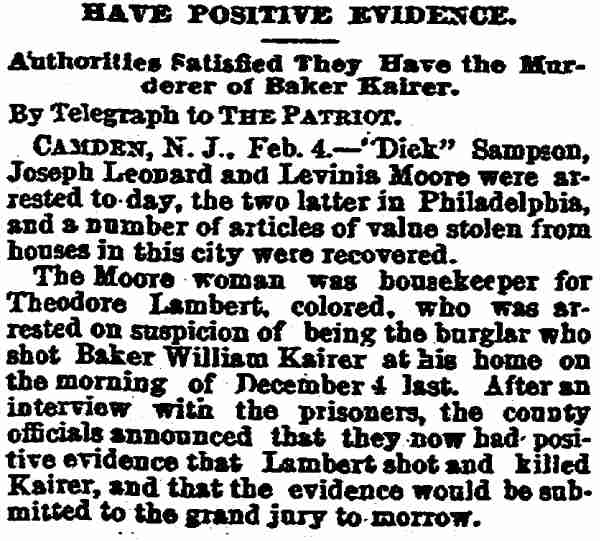
Authorities Satisfied They Have the Murderer of Baker Kairer.
CAMDEN, N. J., Feb. 4.—“Dick” Sampson, Joseph Leonard and Levinia Moore were arrested to-day, the two latter in Philadelphia, and a number of articles of value stolen from houses in this city were recovered.
The Moore woman was housekeeper for Theodore Lambert, colored, who was arrested on suspicion of being the burglar who shot Baker William Kairer at his home on the morning of December 4 last. After an interview with the prisoners, the county officials announced that they now had positive evidence that Lambert shot and killed Kairer, and that the evidence would be submitted to the grand jury to-morrow.
Philadelphia Inquirer — February 5, 1894
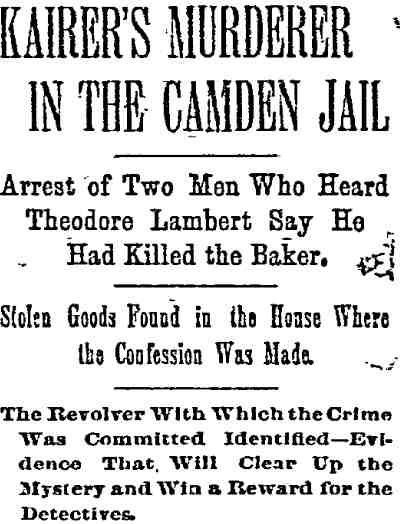
Arrest of Two Men Who Heard Theodore Lambert Say He Had Killed the Baker.
Stolen Goods Found in the House Where the Confession Was Made.
The Revolver With Which the Crime Was Committed Identified—Evidence That Will Clear Up the Mystery and Win a Reward for the Detectives.
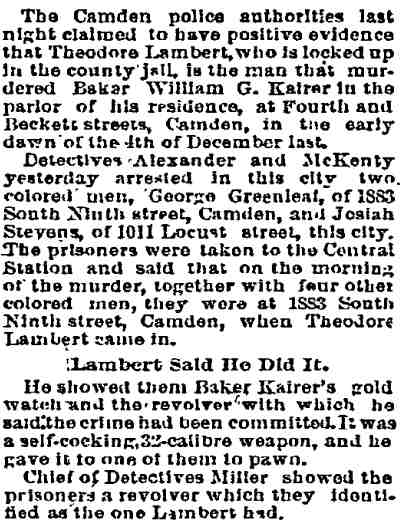
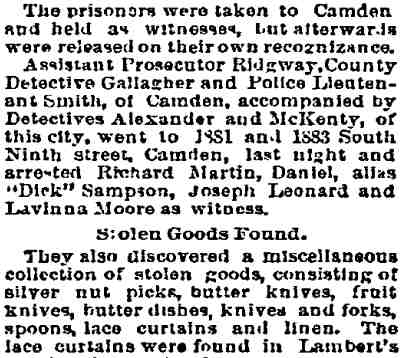
Theodore Lambert was arrested on suspicion of being the burglar who shot Baker William Kairer at his home on the morning of December 4 last. Lavinia Moore, housekeeper for Lambert, was arrested in Philadelphia. She swore that Lambert had confessed to her that he murdered Kairer. George Greenleaf, Josiah Stevens, Daniel “Dick” Sampson and Joseph Leonard were also taken into custody.
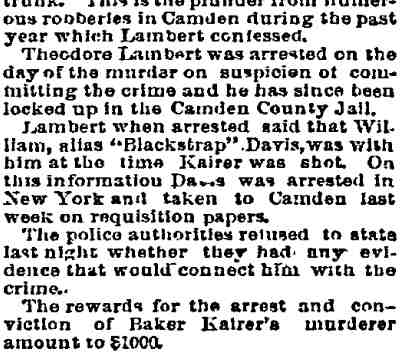
The county officials announced they now had positive evidence that Lambert shot and killed Kairer. The revolver with which the crime was committed was identified, and the evidence was submitted to the grand jury.
Philadelphia Inquirer — February 6, 1894
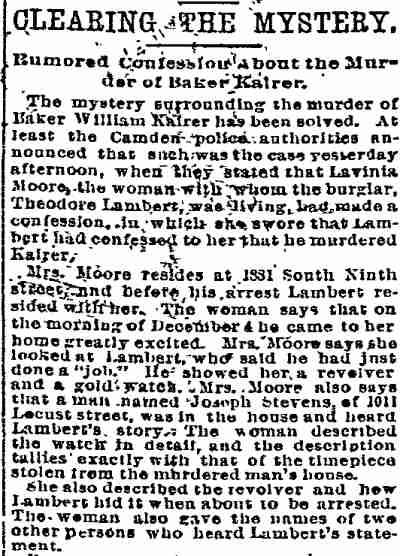
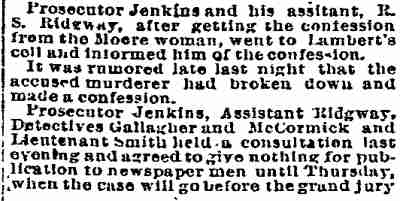
Rumored Confession About the Murder of Baker Kairer.
The mystery surrounding the murder of Baker William Kairer has been solved. At least the Camden police authorities announced that such was the case yesterday afternoon, when they stated that Lavinia Moore, the woman with whom the burglar, Theodore Lambert, was living, had made a confession, in which she swore that Lambert had confessed to her that he murdered Kairer.
Mrs. Moore resides at 1881 South Ninth street, and before his arrest Lambert resided with her. The woman says that on the morning of December 4 he came to her home greatly excited. Mrs. Moore says she looked at Lambert, who said he had just done a “job.” He showed her a revolver and a gold watch. Mrs. Moore also says that a man named Joseph Stevens, of 1011 Locust street, was in the house and heard Lambert’s story. The woman described the watch in detail, and the description tallies exactly with that of the timepiece stolen from the murdered man’s house.
She also described the revolver and how Lambert hid it when about to be arrested. The woman also gave the names of two other persons who heard Lambert’s statement.
Philadelphia Inquirer — February 8, 1894
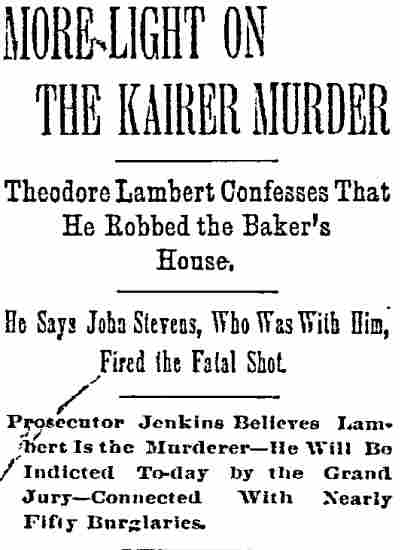
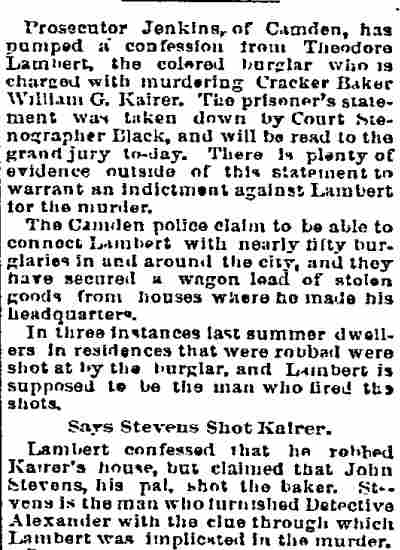
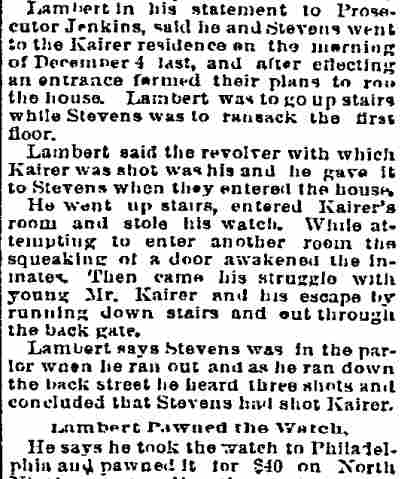
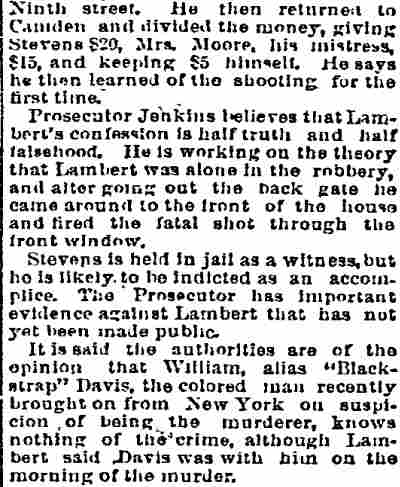
Theodore Lambert Confesses That He Robbed the Baker's House.
He Says John Stevens, Who Was With Him, Fired the Fatal Shot.
Prosecutor Jenkins Believes Lambert Is the Murderer—He Will Be Indicted To-day by the Grand Jury—Connected With Nearly Fifty Burglaries.
Theodore Lambert, accused of murdering Baker William G. Kairer, confessed that he had robbed Kairer's house, but claimed that Josiah Stevens, who was with him, fired the fatal shot. Lambert was indicted by the Camden county grand jury for the murder. He had been connected with nearly fifty burglaries.
Philadelphia Inquirer — February 9, 1894
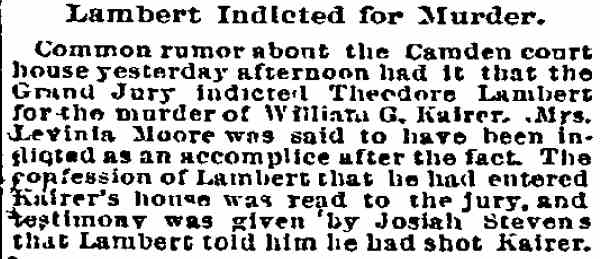
Lambert Indicted for Murder.
Common rumor about the Camden court house yesterday afternoon had it that the Grand Jury indicted Theodore Lambert for the murder of William G. Kairer. Mrs. Levinia Moore was said to have been indicted as an accomplice after the fact. The confession of Lambert that he had entered Kairer's house was read to the jury, and testimony was given by Josiah Stevens that Lambert told him he had shot Kairer.
Philadelphia Inquirer — February 11, 1894
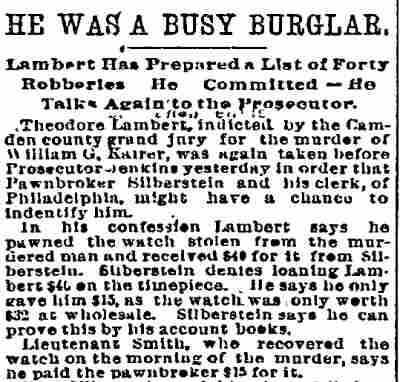
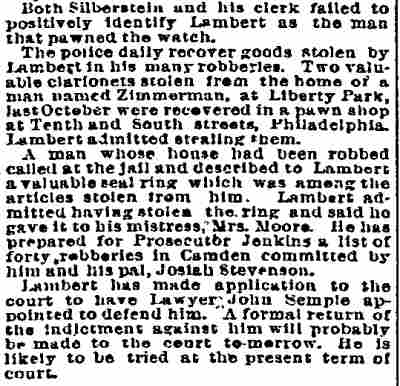
Lambert Has Prepared a List of Forty Robberies He Committed—He Talks Again to the Prosecutor.
Theodore Lambert, indicted by the Camden county grand jury for the murder of William G. Kairer, was again taken before Prosecutor Jenkins yesterday in order that Pawnbroker Silberstein and his clerk, of Philadelphia, might have a chance to identify him.
In his confession Lambert says he pawned the watch stolen from the murdered man and received $40 for it from Silberstein. Silberstein denies loaning Lambert $40 on the timepiece. He says he only gave him $15, as the watch was only worth $32 at wholesale.
Lambert's counsel, Lawyer John L. Semple, was appointed to defend him.
Philadelphia Inquirer — February 18, 1894
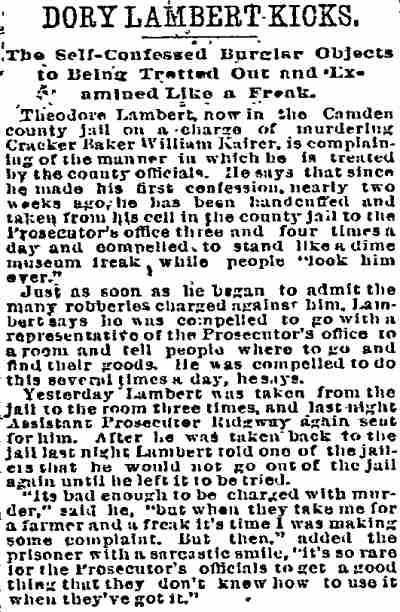
The Self-Confessed Burglar Objects to Being Trotted Out and Examined Like a Freak.
Theodore Lambert, now in the Camden county jail on a charge of murdering Cracker Baker William Kairer, is complaining of the manner in which he is treated by the county officials. He says that since he made his first confession, nearly two weeks ago, he has been handcuffed and taken from his cell in the county jail to the Prosecutor's office three and four times a day and compelled to stand like a dime museum freak, while people “look him over.”
“Its bad enough to be charged with murder,” said he, “but when they take me for a farmer and a freak it's time I was making some complaint. But then, it's so rare for the Prosecutor's officials to get a good thing that they don't know how to use it when they've got it.”
Philadelphia Inquirer — March 1, 1894
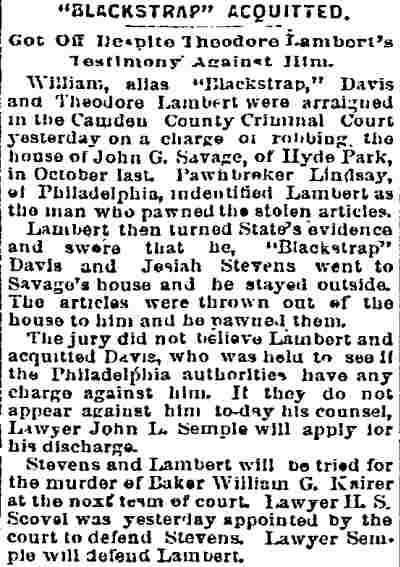
Got Off Despite Theodore Lambert's Testimony Against Him.
William, alias “Blackstrap,” Davis and Theodore Lambert were arraigned in the Camden County Criminal Court yesterday on a charge of robbing the house of John G. Savage, of Hyde Park. Lambert turned State's evidence and swore that he, “Blackstrap” Davis and Josiah Stevens went to Savage's house and he stayed outside. The jury did not believe Lambert and acquitted Davis.
Stevens and Lambert will be tried for the murder of Baker William G. Kairer at the next term of court. Lawyer H. S. Scovel was appointed by the court to defend Stevens. Lawyer Semple will defend Lambert.
Philadelphia Inquirer — June 15, 1894
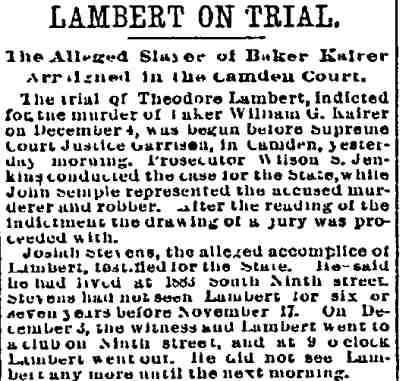
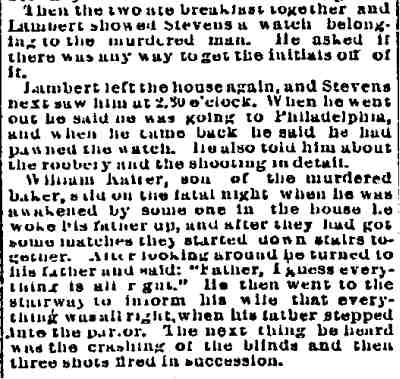
The Alleged Slayer of Baker Kairer Arraigned in the Camden Court.
The trial of Theodore Lambert, indicted for the murder of Baker William G. Kairer on December 4, was begun before Supreme Court Justice Garrison, in Camden, yesterday morning. Prosecutor Wilson S. Jenkins conducted the case for the State, while John Semple represented the accused murderer and robber.
Josiah Stevens, the alleged accomplice of Lambert, testified for the State. He said Lambert had told him he had just done a “job” on the morning of December 4, and had shown him a revolver and a gold watch. The watch was later identified as belonging to the murdered man.
Trenton Evening Times — September 26, 1894
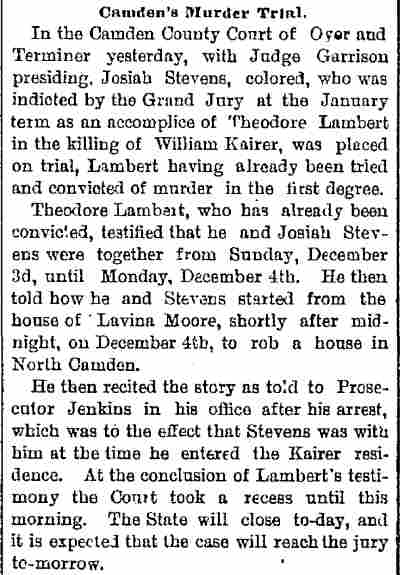
Camden's Murder Trial.
In the Camden County Court of Over and Terminer yesterday, with Judge Garrison presiding, Josiah Stevens, colored, who was indicted as an accomplice of Theodore Lambert in the killing of William Kairer, was placed on trial, Lambert having already been tried and convicted of murder in the first degree.
Theodore Lambert, already convicted, testified that he and Josiah Stevens were together on December 3rd and 4th, and told how they started from the house of Lavina Moore, shortly after midnight, to rob a house in North Camden.
Philadelphia Inquirer — October 24, 1894

Lawyer John L. Semple has been allowed $550 by Judge Garrison for defending Murderers Theodore Lambert and Thomas Delbridge.
Philadelphia Inquirer — November 3, 1894
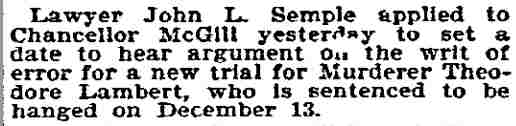
Lawyer John L. Semple applied to Chancellor McGill yesterday to set a date to hear argument on the writ of error for a new trial for Murderer Theodore Lambert, who is sentenced to be hanged on December 13.
Philadelphia Inquirer — November 20, 1894
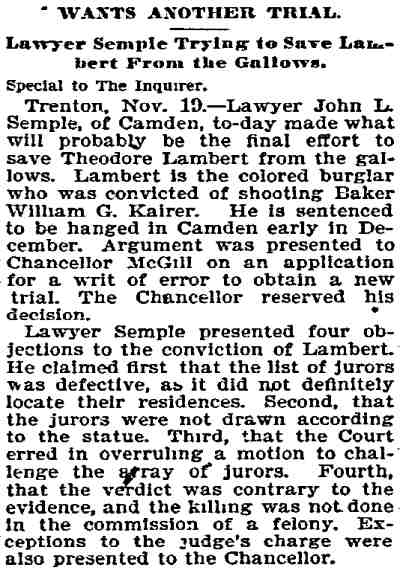
Lawyer Semple Trying to Save Lambert From the Gallows.
Trenton, Nov. 19.—Lawyer John L. Semple, of Camden, to-day made what will probably be the final effort to save Theodore Lambert from the gallows. Lambert is the colored burglar who was convicted of shooting Baker William G. Kairer. He is sentenced to be hanged in Camden early in December. Argument was presented to Chancellor McGill on an application for a writ of error to obtain a new trial. The Chancellor reserved his decision.
Lawyer Semple presented four objections to the conviction of Lambert: that the list of jurors was defective; that the jurors were not drawn according to statute; that the Court erred in overruling a motion to challenge the array of jurors; and that the verdict was contrary to the evidence.
Philadelphia Inquirer — December 14, 1894
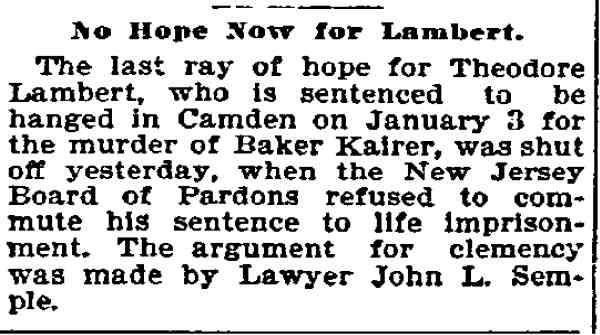
No Hope Now for Lambert.
The last ray of hope for Theodore Lambert, who is sentenced to be hanged in Camden on January 3 for the murder of Baker Kairer, was shut off yesterday, when the New Jersey Board of Pardons refused to commute his sentence to life imprisonment. The argument for clemency was made by Lawyer John L. Semple.
Harrisburg Patriot — December 20, 1894
A LEGAL PECULIARITY.
Lawyer Semple Claims Murderer Lambert Should be Discharged on the Ground That He is Legally Dead.
TO BE ARGUED SATURDAY.
Attorney’s Reasons For His Novel Plea—Bland’s Substitute For the Carlisle Currency Plan—Thinks It Will Solve the Finance Problem—A Vote on It Will be a Fair Test of the Silver Question.
By Telegraph to The Patriot.
Camden, N.J., Dec. 19.—A peculiar legal move was made to-day by Lawyer John L. Semple before Judge Garrison in behalf of Theodore Lambert, who is under sentence to be hanged on January 3. Lambert was to have been hung for murder on December 4 last, but Lawyer Semple obtained a reprieve from the governor until January 3, pending an application to the board of pardons for a commutation of sentence. The board refused to interfere and to-day Mr. Semple went into court and asked for the discharge of his client from prison on the ground that he is legally dead.
Mr. Semple’s contention was that under the constitution the governor had no right to reprieve Lambert and as he was not executed on the day fixed by law he cannot now be hanged legally and should be discharged as the law has no claim on him. Mr. Semple asked for a writ of habeas corpus and Judge Garrison set down next Saturday to hear the argument in the case.
New York Times — December 23, 1894
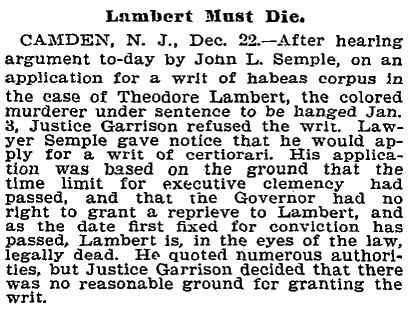
Lambert Must Die.
CAMDEN, N. J., Dec. 22.—After hearing argument to-day by John L. Semple, on an application for a writ of habeas corpus in the case of Theodore Lambert, the colored murderer under sentence to be hanged Jan. 3, Justice Garrison refused the writ. Lawyer Semple based his application on the ground that Lambert is, in the eyes of the law, legally dead, as the date first fixed for conviction has passed. Justice Garrison decided there was no reasonable ground for granting the writ.
Philadelphia Inquirer — January 1, 1895
The religious fervor exhibited by “Dory” Lambert, who is to be hanged on Thursday, is apparently sincere. All day yesterday a number of his friends were with him praying and singing hymns. He was measured yesterday for his coffin.
Philadelphia Inquirer — January 2, 1895
Murderer Lambert's Last Meeting With His Mother.
Theodore Lambert, who is to be hanged to-morrow in Camden for the murder of Baker William G. Kairer, had a farewell visit from his mother yesterday. She spent the day with him until about 7 o'clock last evening. They both shed tears copiously as they parted forever.
Lawyer John L. Semple will present argument to-day before Justice Green, of the United States Circuit Court, in Trenton, on an application for a writ of habeas corpus with a stay of execution. If he is unsuccessful, Lambert will surely be hanged to-morrow.
Jersey Journal — January 2, 1895
He is to Be Hanged To-morrow, Unless Some Escape Can Be Found.
Lawyer Semple, who has been using every possible effort known to the law to save the life of “Dory” Lambert, whose execution is set for to-morrow, started for Trenton early this morning to ask a stay of execution from the United States District Court. Failing in this he will go immediately to Washington and appear before the United States Supreme Court.
His contention is that Lambert having been sentenced to be hanged Dec. 13, and the governor having given Lambert a reprieve until Jan. 3, is a violation of the state constitution, that in the eyes of the law Lambert is legally dead, and that to-morrow's execution would be illegal.
Philadelphia Inquirer — January 4, 1895
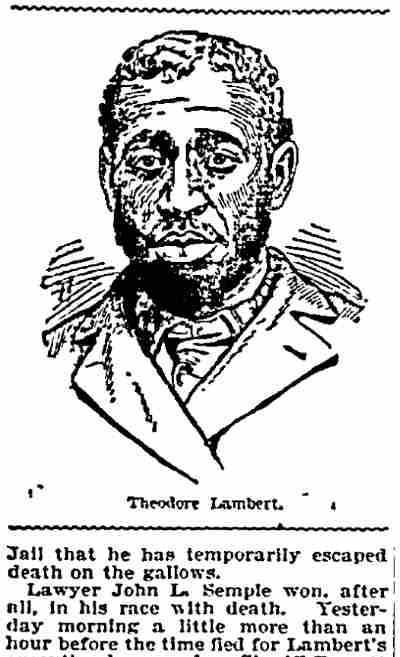
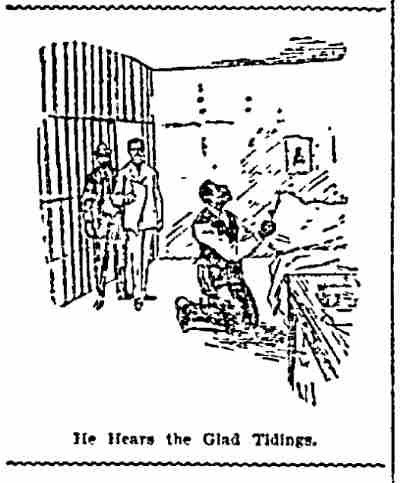

LAWYER SEMPLE GOT A STAY AND THEODORE LAMBERT WAS NOT HANGED.
WILL LIVE A YEAR AT LEAST
United States Supreme Court's Order Served Just Before the Hour Fixed for the Execution—Lambert Wept for Joy—Other Jersey Matters.
A glossy walnut coffin with a lie nailed on its lid; an empty grave and an unused noose tell of a life saved by the law after it had been forfeited to the law. Theodore Lambert, burglar and murderer, rejoices behind the bars of the Camden County jail.
Yesterday it was expected he would be hanged; but, after he had said farewell to all his friends and relatives, and had eaten what he thought was his last meal, his counsel, John L. Semple, served upon Sheriff Barrett a stay of execution, which had been granted by Associate Justice Shiras, of the United States supreme court.
Wilkes-Barre Times — January 4, 1895
A Stay Granted in the Case of Theodore Lambert.
WAS DRESSED READY FOR DEATH.
CAMDEN, N. J., Jan. 4.—The sensational murder case in which Theodore Lambert, the Camden negro, has so long figured as the principal actor, furnished still another sensation yesterday. Yesterday it was expected he would be hanged; but, after he had said farewell to all his friends and relatives, and had eaten what he thought was his last meal, and had written several letters, to be opened after his death, his counsel, John L. Semple, served upon Sheriff Barrett a stay of execution, which had been granted by Associate Justice Shiras, of the United States supreme court.
To say that this caused a surprise is to put it mildly. The case has taken many queer turns.
Jersey Journal — February 11, 1895
Preparing to Set Aside the Writ on Which Lambert Was Saved.
Prosecutor Jenkins, of Camden, will take steps to set aside the writ of error secured by Lawyer John L. Semple by which the execution of Theodore Lambert has been stayed.
The Prosecutor is of the opinion that application will be made immediately to quash the writ on the ground that it was improperly granted.
Dory Lambert Heard From
Jersey Journal —
Dory Lambert Heard From.
New York, Feb. 11.—A Herald special from Camden, N. J., says:
Murderer Dory Lambert, who was recently respited on the day he was to have been hanged, distinguished himself in the county jail yesterday by attempting to save the life of a fellow prisoner bent on suicide.
James McCue, salesman for a Philadelphia wholesale house, was arrested on Feb. 6 during a drunken row, and was given ten days in jail. While several of the men were exercising in the corridor yesterday, McCue secured a case knife and cut his throat. Lambert saw him and ran to him, with the intention of wresting the knife from him. McCue turned upon him, and for a few seconds there was a frightful struggle. Lambert finally knocked McCue down and secured the knife. McCue then put his hand in the gaping wound, and tore it further open.
Jailor Logue sent McCue to the Cooper Hospital, and it is doubtful if he can recover.
New York Times — February 6, 1895
The Record Shows the Document Was Not a “Provisional Writ of Error.”
WASHINGTON, Feb. 5.—The record in the appeal of the case of Theodore Lambert versus George Barrett, Sheriff of the County of Camden, N. J., has been received in the office of the Clerk of the Supreme Court. This was the case which attracted so much attention last month, owing to the efforts of John L. Semple, Lambert's attorney, to prevent his execution under a conviction of murder, which were finally successful only an hour or two before the time set.
The record shows the writ of Justice Shiras to be an order directing the Sheriff to appear in Washington March 4 under Lambert's appeal from the judgment of Circuit Judge Dallas refusing him a writ of habeas corpus. The order directs the stay of the execution until the further order of court.
Philadelphia Inquirer — February 24, 1895
Lawyer Semple Declines to Accept a Notice in the Lambert Case.
Prosecutor Jenkins, of Camden, served notice yesterday on Lawyer John L. Semple that on March 4 he would move to have the appeal before the United States Supreme Court in the case of Murderer Theodore Lambert dismissed on the ground that it was improvidently issued.
Lawyer Semple declined to recognize the notice on the ground that Prosecutor Jenkins is not a practitioner at the bar of the United States Supreme Court.
Philadelphia Inquirer — March 26, 1895
Decision in the Lambert Case Reserved.
The United States Supreme Court at Washington yesterday reserved decision on the application of Prosecutor Jenkins, of Camden, of the habeas corpus proceedings in the case of Theodore Lambert, the condemned murderer. Lawyer Semple, representing the prisoner, was present to answer the application, but the matter was submitted on briefs.
Philadelphia Inquirer — April 16, 1895
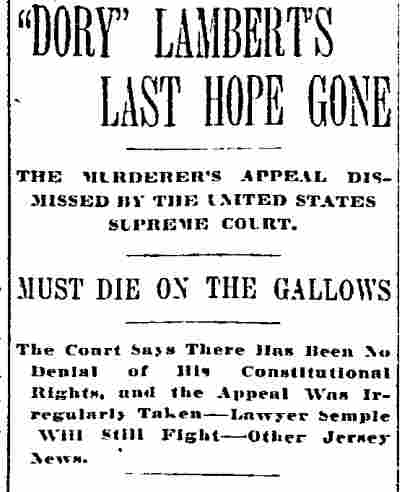
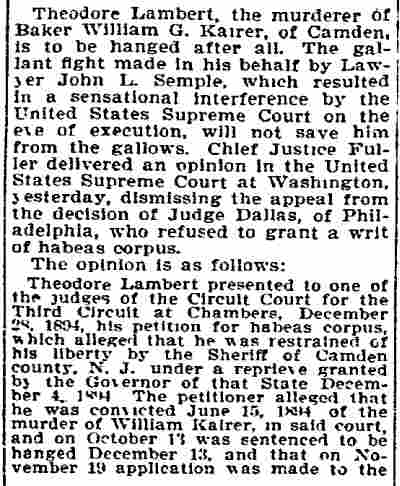
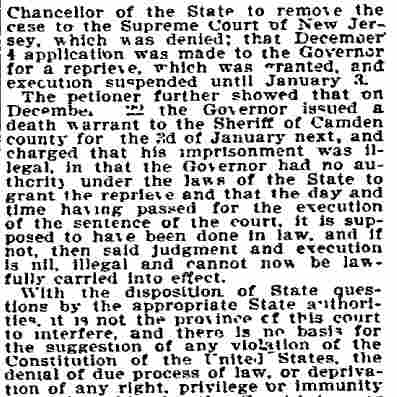
JUDGE GREEN ALLOWS ANOTHER APPEAL TO THE UNITED STATES SUPREME COURT.
COURT RECORD INCOMPLETE
Persistent Lawyer Semple Again Succeeds in Staving Off the Execution of His Client—The Case May Not Be Heard for Several Months.
Theodore Lambert, convicted of murdering Baker William G. Kairer, again won a stay of execution as his counsel appealed to the United States Supreme Court.
Trenton Evening Times — April 16, 1895
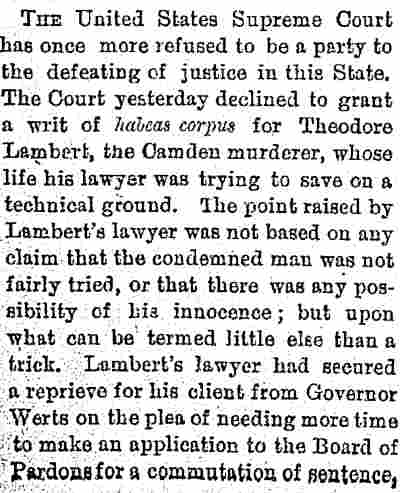
The United States Supreme Court has once more refused to be a party to the defeating of justice in this State. The Court yesterday declined to grant a writ of habeas corpus for Theodore Lambert, the Camden murderer, whose life his lawyer was trying to save on a technical ground. The point raised by Lambert’s lawyer was not based on any claim that the condemned man was not fairly tried, or that there was any possibility of his innocence; but upon what can be termed little else than a trick. Lambert’s lawyer had secured a reprieve from Governor Werts on the plea of needing more time to make an application to the Board of Pardons for a commutation of sentence,
and then when the original date set for the execution had expired he raised the point that the Governor had exceeded his authority in granting the reprieve, and that Lambert was legally dead and could not be resentenced. Lambert’s counsel no doubt felt that it was incumbent upon him to exert every effort and resort to every subterfuge to save his client’s neck, and yet there is a grave question as to the propriety of lawyers resorting to technicalities to defeat a verdict reached after a fair trial. At any rate it is a matter of congratulation that the United States Supreme Court refuses to permit itself to be used as a medium to secure the release of convicted murderers about whose guilt no questions have been raised.
Philadelphia Inquirer — May 23, 1895
The mandate issued by the United States Supreme Court dismissing the appeal of Murderer Theodore Lambert was received yesterday by Prosecutor Jenkins. On Tuesday next the Prosecutor will ask Governor Werts for another death warrant for Lambert.
Philadelphia Inquirer — May 29, 1895
BAKER KAIRER'S MURDERER TO BE HANGED IN CAMDEN ON JUNE 27.
A SECOND DEATH WARRANT
Lawyer Semple Will Again Try to Stop the Execution by Appealing to the Supreme Court. Theodore Lambert, convicted of murdering Baker William G. Kairer, has been given a second death warrant fixing the date of execution as June 27.
Philadelphia Inquirer — June 6, 1895
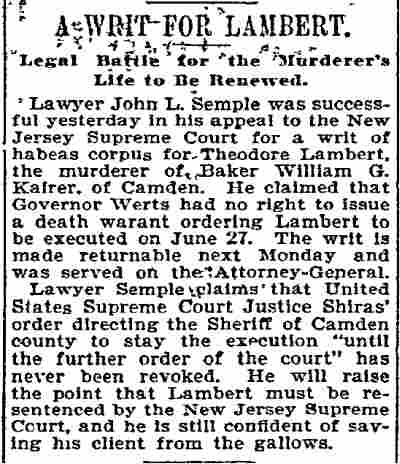
Legal Battle for the Murderer's Life to Be Renewed.
Lawyer John L. Semple was successful yesterday in his appeal to the New Jersey Supreme Court for a writ of habeas corpus for Theodore Lambert, the murderer of Baker William G. Kairer, of Camden. He claimed that Governor Werts had no right to issue a death warrant ordering Lambert to be executed on June 27.
Lawyer Semple claims that United States Supreme Court Justice Shiras' order directing the Sheriff of Camden county to stay the execution “until the further order of the court” has never been revoked. He will raise the point that Lambert must be re-sentenced by the New Jersey Supreme Court.
Philadelphia Inquirer — June 12, 1895
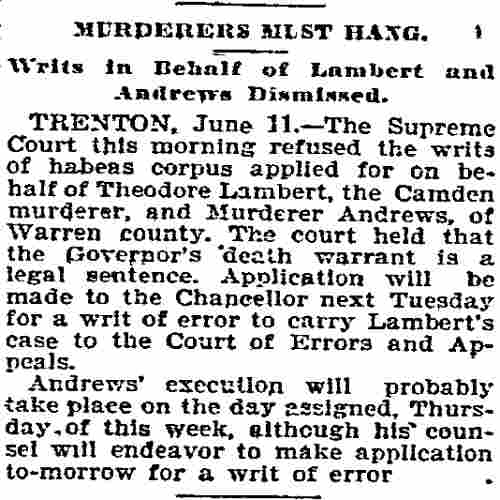
Writs in Behalf of Lambert and Andrews Dismissed.
TRENTON, June 11.—The Supreme Court this morning refused the writs of habeas corpus applied for on behalf of Theodore Lambert, the Camden murderer, and Murderer Andrews, of Warren county. The court held that the Governor's death warrant is a legal sentence.
Application will be made to the Chancellor next Tuesday for a writ of error to carry Lambert's case to the Court of Errors and Appeals. Lawyer Semple represents the prisoner.
Philadelphia Inquirer — June 19, 1895
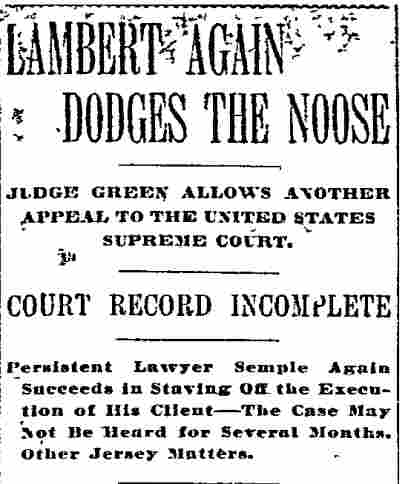
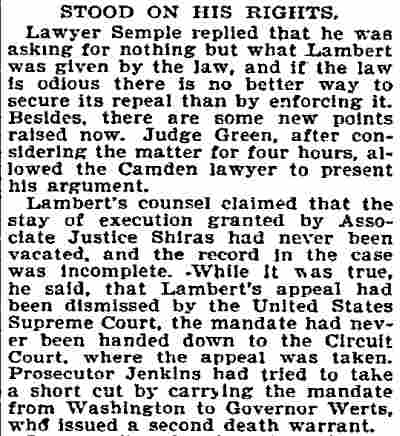
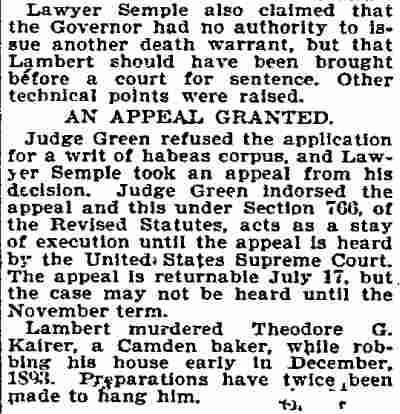
JUDGE GREEN ALLOWS ANOTHER APPEAL TO THE UNITED STATES SUPREME COURT.
COURT RECORD INCOMPLETE
Persistent Lawyer Semple Again Succeeds in Staving Off the Execution of His Client—The Case May Not Be Heard for Several Months.
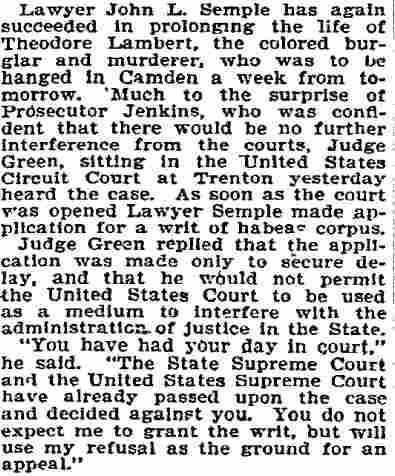
Theodore Lambert, convicted of the murder of Baker William G. Kairer, again won a stay through his persistent counsel, who obtained another appeal to the United States Supreme Court.
Philadelphia Inquirer — June 25, 1895
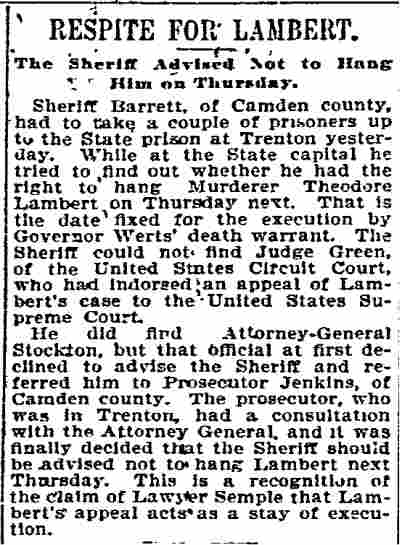
The Sheriff Advised Not to Hang Him on Thursday.
Sheriff Barrett, of Camden county, tried to find out whether he had the right to hang Murderer Theodore Lambert on Thursday next. He could not find Judge Green, who had indorsed an appeal of Lambert's case to the United States Supreme Court.
He found Attorney-General Stockton, and it was finally decided that the Sheriff should be advised not to hang Lambert next Thursday. This is a recognition of the claim of Lawyer Semple that Lambert's appeal acts as a stay of execution.
Philadelphia Inquirer — June 26, 1895
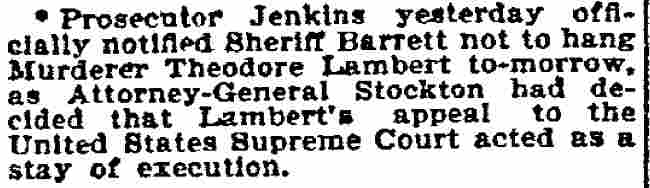
Prosecutor Jenkins yesterday officially notified Sheriff Barrett not to hang Murderer Theodore Lambert to-morrow, as Attorney-General Stockton had decided that Lambert's appeal to the United States Supreme Court acted as a stay of execution.
Philadelphia Inquirer — June 28, 1895
Murderer Theodore Lambert was glad he was alive yesterday. It was the day fixed by Governor Werts for the execution, but his appeal to the United States Supreme Court indefinitely postponed the gruesome event.
Philadelphia Inquirer — October 6, 1895
New Move in the Lambert Case.
When the United States Supreme Court opens, a week from to-morrow, Prosecutor Jenkins, of Camden, will move to have the appeal of Murderer Theodore Lambert advanced on the list. Lawyer John L. Semple, counsel for Lambert, will oppose the motion.
Philadelphia Inquirer — October 22, 1895
Prosecutor Jenkins Before the United States Supreme Court.
Special to The Inquirer.
WASHINGTON, D. C., Oct. 21.—Prosecutor Wilson S. Jenkins, of Camden, N. J., appeared before the United States Supreme Court to-day and made a motion, which was filed, to advance the hearing of the case of Theodore Lambert, convicted of murder. Lambert is under sentence of death for having murdered a Camden baker, and the hanging has been postponed for some months by various legal devices and appeals.
Trenton Evening Times — November 19, 1895
The refusal of the United States Supreme Court to interfere in the case of Theodore Lambert, the Camden murderer, now under sentence of death, is another vindication of the criminal laws of this State, and ought to be an effective lesson to notoriety-seeking lawyers that they can gain no advantage for their clients by these appeals to the United States courts.
Sheriff Barrett had previously been advised not to hang Lambert until all legal remedies were exhausted. Lawyer Semple has now run out of options.
Trenton Evening Times — November 26, 1895
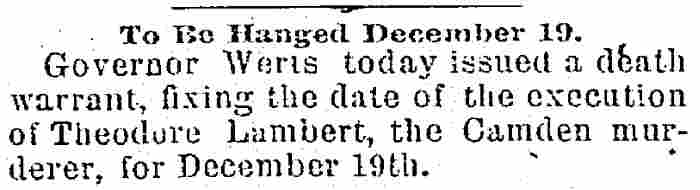
To Be Hanged December 19.
Governor Werts today issued a death warrant, fixing the date of the execution of Theodore Lambert, the Camden murderer, for December 19th.
Philadelphia Inquirer — November 27, 1895
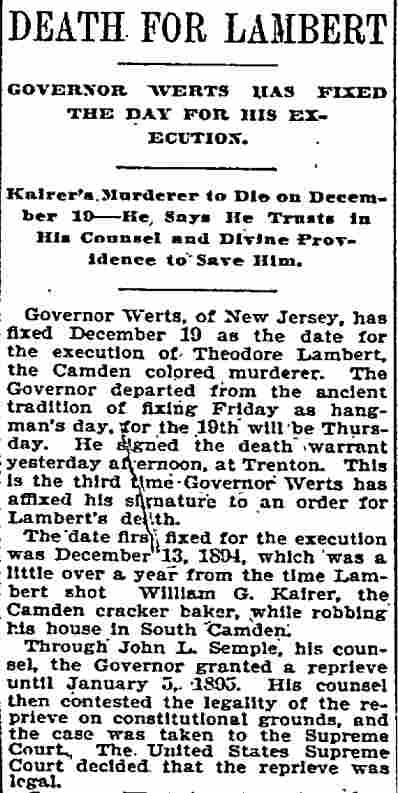
GOVERNOR WERTS HAS FIXED THE DAY FOR HIS EXECUTION.
Kairer's Murderer to Die on December 19—He Says He Trusts in His Counsel and Divine Providence to Save Him.
Governor Werts, of New Jersey, has fixed December 19 as the date for the execution of Theodore Lambert, the Camden colored murderer. This is the third time Governor Werts has affixed his signature to an order for Lambert's death.
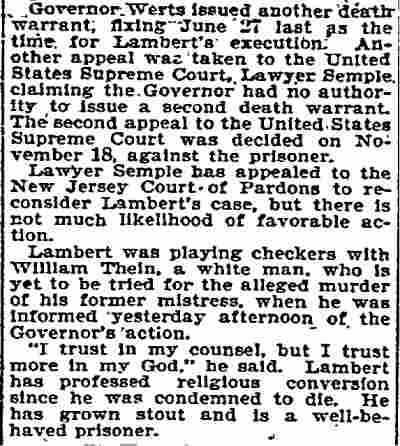
The date first fixed for the execution was December 13, 1894, a little over a year from the time Lambert shot William G. Kairer, the Camden cracker baker, while robbing his house in South Camden. Through John L. Semple, his counsel, the Governor granted a reprieve until January 5, 1895. The United States Supreme Court decided that the reprieve was legal.
Philadelphia Inquirer — December 6, 1895
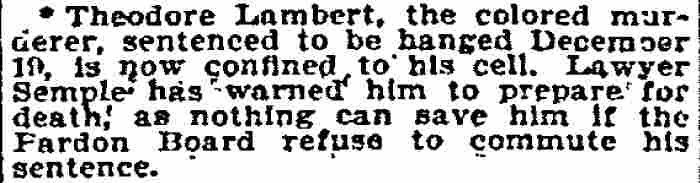
Theodore Lambert, the colored murderer, sentenced to be hanged December 19, is now confined to his cell. Lawyer Semple has warned him to prepare for death; as nothing can save him if the Pardon Board refuse to commute his sentence.
Philadelphia Inquirer — December 17, 1895
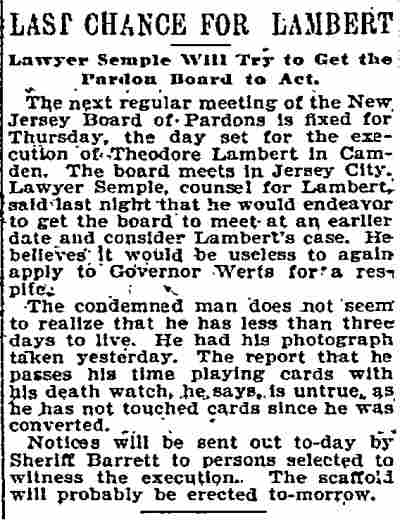
Lawyer Semple Will Try to Get the Pardon Board to Act.
The next regular meeting of the New Jersey Board of Pardons is fixed for Thursday, the day set for the execution of Theodore Lambert in Camden. The board meets in Jersey City. Lawyer Semple, counsel for Lambert, said last night that he would endeavor to get the board to meet at an earlier date and consider Lambert’s case. He believes it would be useless to again apply to Governor Werts for a respite.
The condemned man does not seem to realize that he has less than three days to live. He had his photograph taken yesterday. The report that he passes his time playing cards with his death watch, he says, is untrue, as he has not touched cards since he was converted.
Notices will be sent out to-day by Sheriff Barrett to persons selected to witness the execution. The scaffold will probably be erected to-morrow.
Philadelphia Inquirer — December 18, 1895
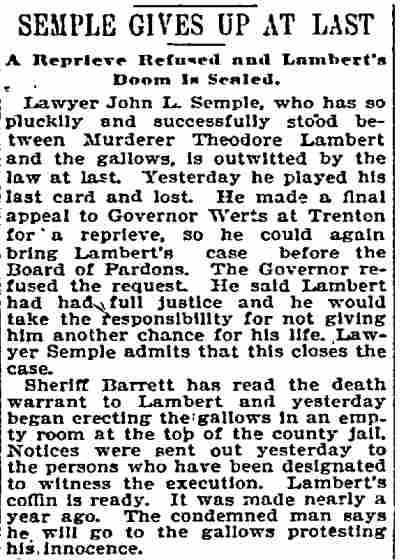
A Reprieve Refused and Lambert's Doom Is Sealed.
Lawyer John L. Semple, who has so pluckily and successfully stood between Murderer Theodore Lambert and the gallows, is outwitted by the law at last. Yesterday he played his last card and lost. He made a final appeal to Governor Werts at Trenton for a reprieve. The Governor refused the request, saying Lambert had had full justice.
Sheriff Barrett has read the death warrant to Lambert and yesterday began erecting the gallows in an empty room at the top of the county jail. Lambert's coffin is ready. It was made nearly a year ago. The condemned man says he will go to the gallows protesting his innocence.
Philadelphia Inquirer — December 19, 1895
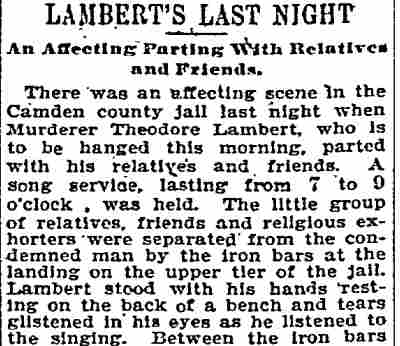
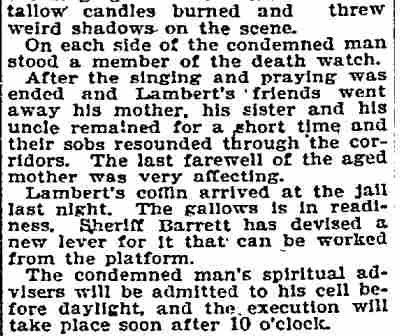
An Affecting Parting With Relatives and Friends.
There was an affecting scene in the Camden county jail last night when Murderer Theodore Lambert, who is to be hanged this morning, parted with his relatives and friends. A song service, lasting from 7 to 9 o'clock, was held. The little group of relatives, friends and religious exhorters were separated from the condemned man by the iron bars at the landing on the upper tier of the jail. Lambert stood with his hands resting on the back of a bench and tears glistened in his eyes as he listened to the singing.
Philadelphia Inquirer — December 20, 1895
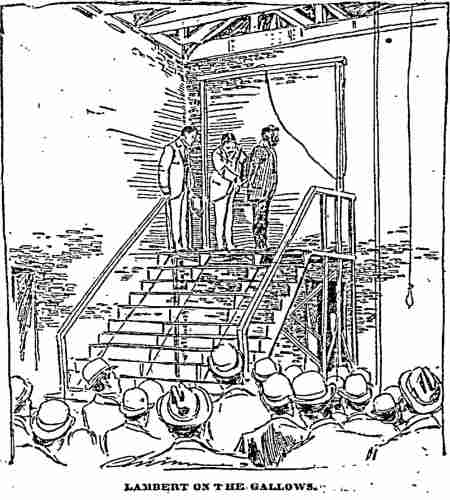
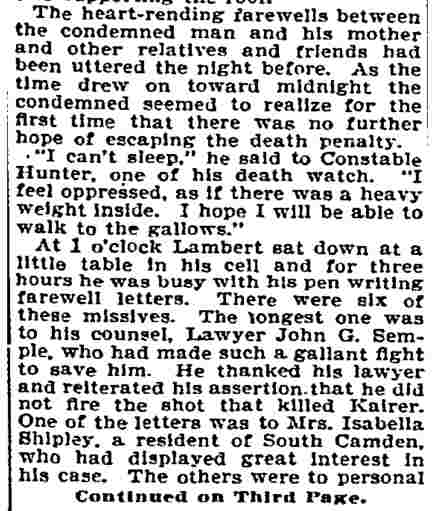
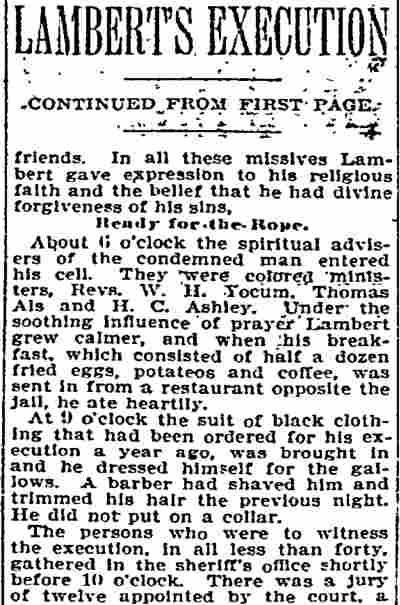
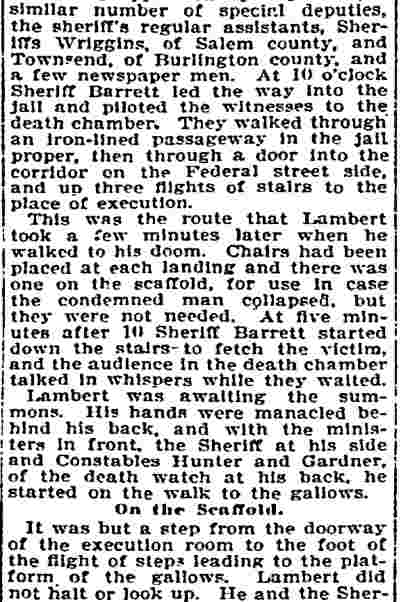
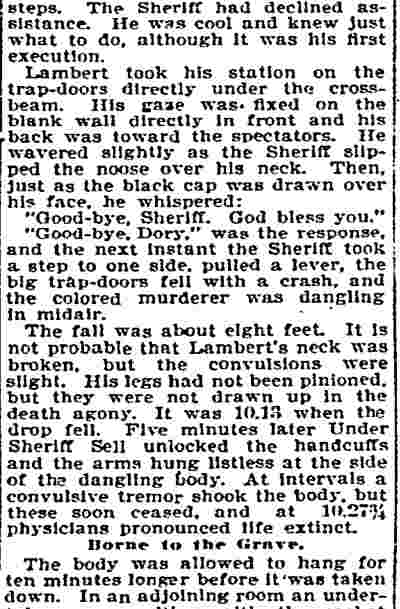
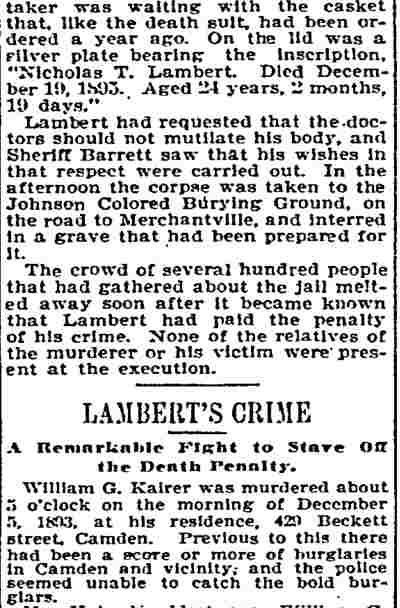
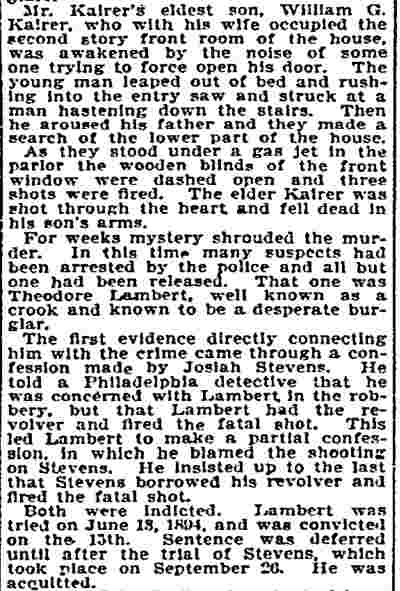
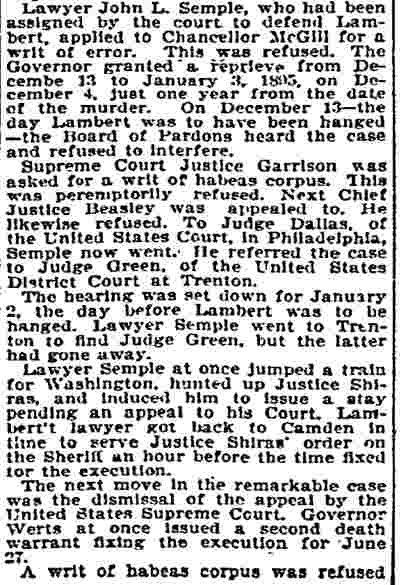
HE SAID STEVENS FIRED THE FATAL SHOT
The Execution Devoid of Sensational Features—Lambert Walked Firmly to the Gallows—History of His Remarkable Case.
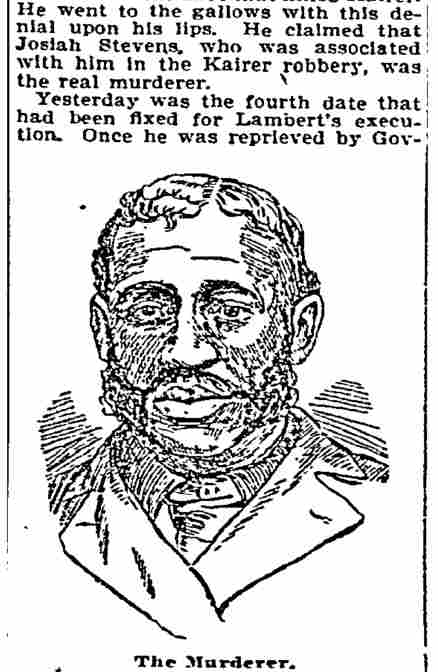
Nicholas Theodore Lambert died on the gallows in the Camden county jail yesterday. He was hanged for the murder of William G. Kairer, a well-to-do cracker baker, of Camden. His death closes a case that was remarkable chiefly for the extraordinary efforts made to save the condemned man from the gallows. Lambert was a bad man. From his youth up he had been a criminal. He had served time in prison for burglary and admitted while awaiting trial for murder that he had robbed a score or more of houses in and around Camden. But he denied that he had fired the shot that killed Kairer.
Lambert walked firmly to the gallows, protesting his innocence to the last. He said Josiah Stevens had fired the fatal shot. Lawyer Semple had fought valiantly to save his client, but the law prevailed.
Lambert was buried in the Johnson Cemetery. William G. Kairer Jr. and other family members were present for the proceedings.
Philadelphia Inquirer — December 23, 1895
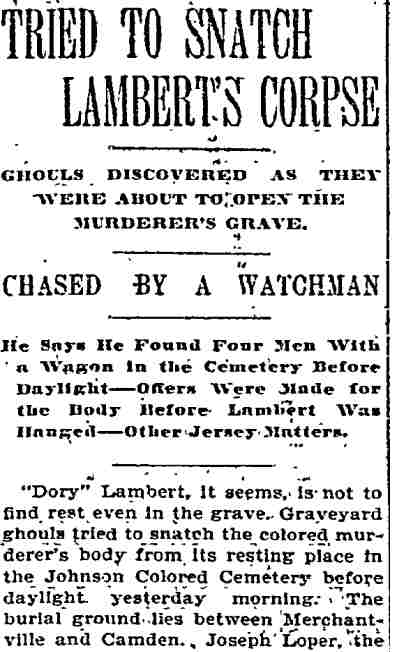
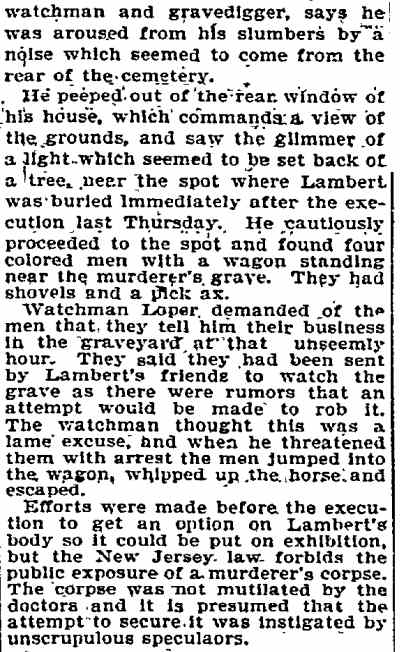
GHOULS DISCOVERED AS THEY WERE ABOUT TO OPEN THE MURDERER'S GRAVE.
CHASED BY A WATCHMAN
He Says He Found Four Men With a Wagon in the Cemetery Before Daylight—Offers Were Made for the Body Before Lambert Was Hanged—Other Jersey Matters.
“Dory” Lambert, it seems, is not to find rest even in the grave. Graveyard ghouls tried to snatch the colored murderer's body from its resting place in the Johnson Colored Cemetery before daylight yesterday morning. The burial ground lies between Merchantville and Camden. Joseph Loper, the superintendent, saw four men with a wagon in the cemetery before daylight and raised the alarm.
Philadelphia Inquirer — December 31, 1895
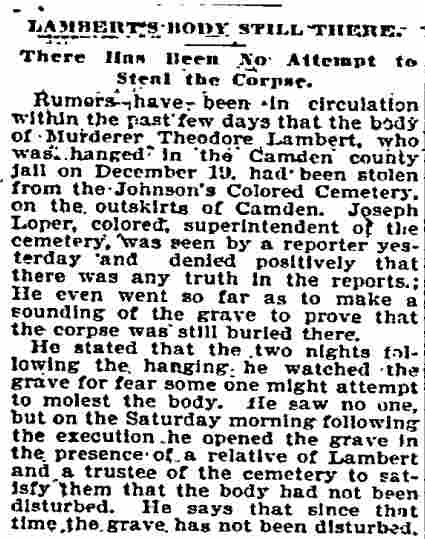
There Has Been No Attempt to Steal the Corpse.
Rumors have been in circulation within the past few days that the body of Murderer Theodore Lambert, who was hanged in the Camden county jail on December 19, had been stolen from the Johnson's Colored Cemetery, on the outskirts of Camden. Joseph Loper, colored, superintendent of the cemetery, was seen by a reporter yesterday and denied positively that there was any truth in the reports.
He stated that the two nights following the hanging he watched the grave for fear some one might attempt to molest the body. He saw no one, but on the Saturday morning following the execution he opened the grave in the presence of a relative of Lambert and a trustee of the cemetery to satisfy them that the body had not been disturbed. He says that since that time the grave has not been disturbed.