S. Conrad Ott
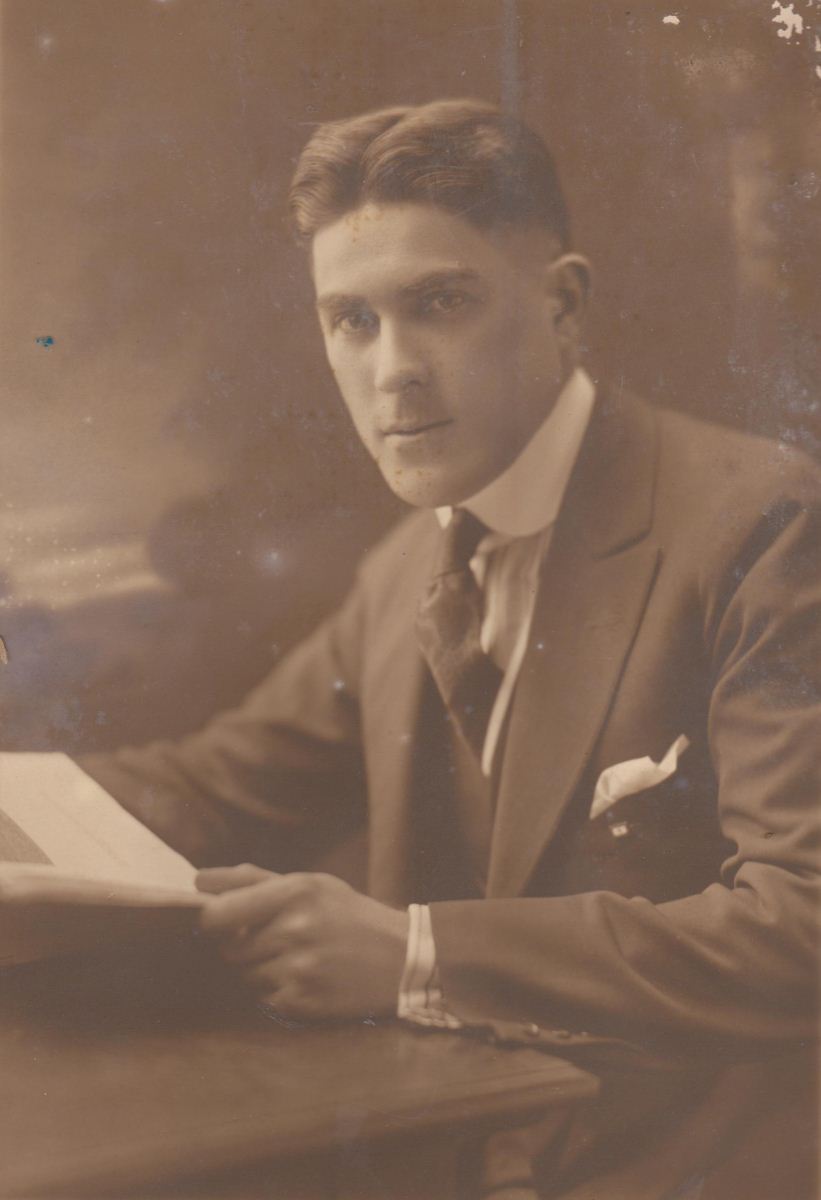
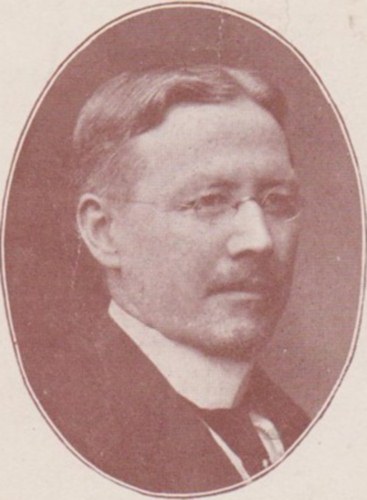
S. Conrad Ott
S. CONRAD OTT was born Sylvius Conrad Ott in Philadelphia, Pennsylvania on July 30, 1868 to Abraham Ott and his wife the former Susannah Maria Musick. He was the sixth of seven children, of which only two others survived childhood, the oldest, Ida Rebecca Ott Field (1857–1938), and the youngest, Frank Charles Ott, who died while serving with the United States Army as a storekeeper aboard the U.S. Army Transport ship Grant in the Philippines on January 31, 1900.
S. Conrad Ott married Mary Anthony in Philadelphia in 1888.
S. Conrad Ott worked as a reporter for the Camden Post, then was hired by the Philadelphia Public Ledger to cover Camden. His ability was recognized by John C. Harper of the Camden Courier, who hired young Ott as a reporter in 1889. By 1891, still in his early twenties, S. Conrad Ott had been promoted to city editor. He also wrote a column under the nom de plume Connaught which was concerned with over the road bicycling, a very popular pastime in the 1890s. He was involved with the Camden chapter of the League of American Wheelmen, a group that promoted bicycling, and was instrumental in getting a bicycle path built on the Mt. Ephraim Pike (present-day Mount Ephraim Avenue and Black Horse Pike).
The 1891 and 1892 Camden City Directories show S. Conrad Ott boarding at 214 South 6th Street in Camden, where he was employed as an editor for the Camden Courier. Directories from 1893 through 1895 give his address as 810 North 6th Street and employment as City Editor. Directories from 1896 through 1900 show that he had moved to 641 State Street and was still employed by the Courier as City Editor.
S. Conrad Ott, in the course of his activities as a reporter, had spent a lot of time in court and gained a good working knowledge of the law. He began studying and in 1899 was admitted to the bar. Directories from 1899 and 1901 show that he had also become a lawyer, with an office at 418 Market Street.
S. Conrad Ott’s career as a lawyer quickly blossomed. He was appointed as a referee in bankruptcy court, was considered for a judgeship, and served as president of the Camden County Bar Association.
The 1900 Census shows S. Conrad and Mary Ott had moved to an apartment at 515 Cooper Street. Also residing in that building was merchant Elmer Ellsworth Long. They stayed there through at least 1903. City Directories from 1904 through 1907 give an address of 517 Cooper Street. In 1906 S. Conrad Ott moved his law office to the Security Trust Building at 301 Market Street. By 1908 the Otts had moved to the Robeson Apartments at 232 Penn Street, where they stayed through 1913. City Directories from 1914 and 1915 show them at the Helene Apartments on Cooper Street.
S. Conrad Ott took on a young lawyer, Joseph H. Carr, as a partner in 1912. Two other men who worked for S. Conrad Ott went on to successful careers in law, Albert Scheffin and Henry M. Evans.
The Otts visited Europe in 1912, and returned home from Copenhagen, Denmark aboard the Oscar II, arriving in New York on September 12, 1912.
In addition to his activities as a journalist and lawyer, S. Conrad Ott was very active as a member of Linden Baptist Church.
By 1916 S. Conrad and Mary Ott had moved to 55 West Maple Avenue in Merchantville, New Jersey. Three doors away at 39 West Maple lived Judge Howard Carrow.
Last a resident of Merchantville, S. Conrad Ott died on July 29, 1922. His wife Mary, who had been quite ill prior to his death, joined him on September 8, 1923. They are buried side by side at Harleigh Cemetery in Camden.
Go to Cape May with the Jehoiadas
Linden Baptist Church handbill —
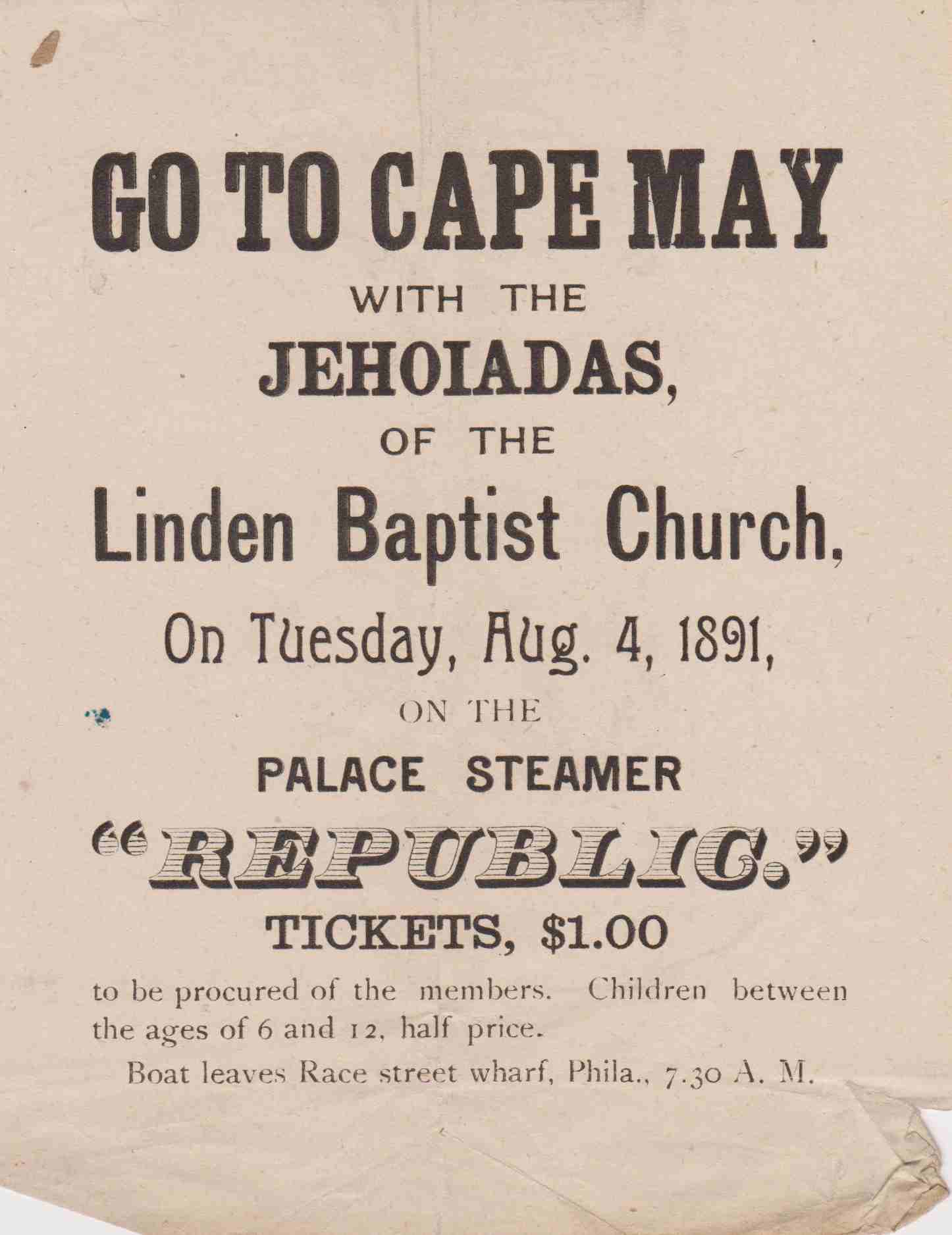
GO TO CAPE MAY WITH THE JEHOIADAS, OF THE Linden Baptist Church, On Tuesday, Aug. 4, 1891, ON THE PALACE STEAMER “REPUBLIC.” TICKETS, $1.00 to be procured of the members. Children between the ages of 6 and 12, half price. Boat leaves Race street wharf, Phila., 7.30 A. M.
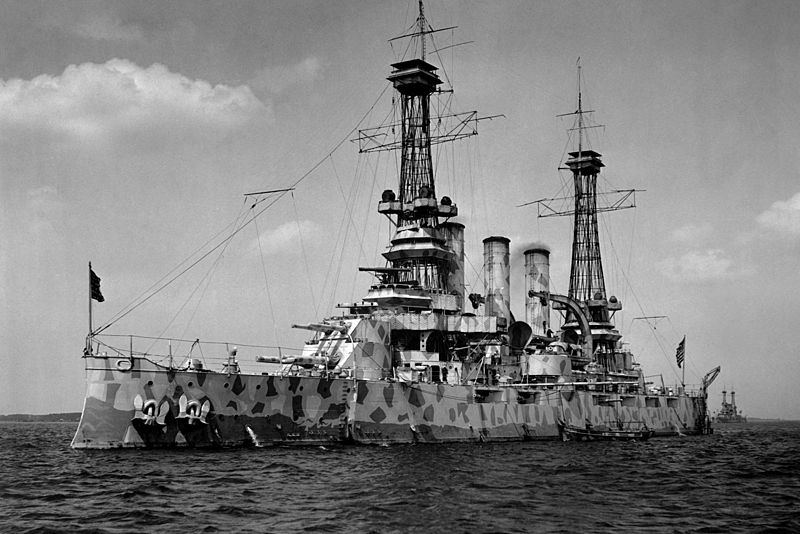
Battleship New Jersey
Jersey Journal —
The School Children to Provide a Silver Service.
Mayor Hoos received a letter to-day from Mr. S. Conrad Ott, of the Camden Courier, asking his co-operation in Mr. Ott’s plan to raise money to buy a silver service for the new battleship New Jersey about to be constructed. The plan is to have the public school children of New Jersey raise the necessary money by nickel contributions.
USS New Jersey BB-16
Lawyer Ott Grand Jury Clerk
Philadelphia Inquirer —
S. Conrad Ott, one of the younger attorneys-at-law in Camden and a well-known newspaper man, was yesterday appointed clerk of the Camden county grand jury by Justice Garrison to succeed John Gaunt, of Gloucester City.
Excisemen Hear License Appeals
Philadelphia Inquirer —
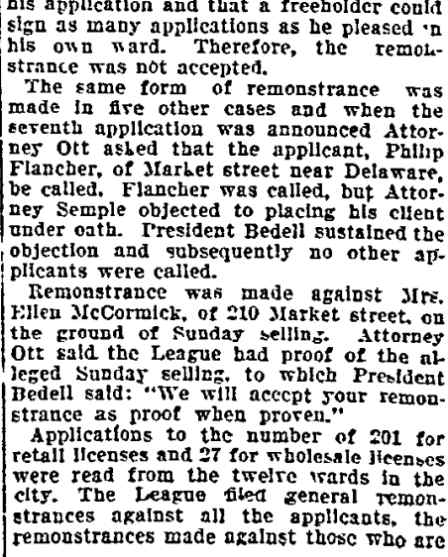
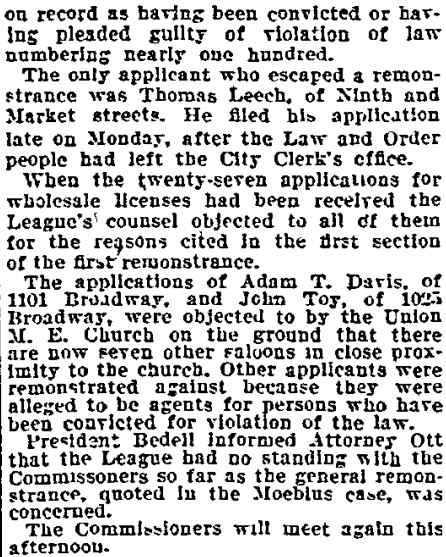
Saloonkeepers Deluged the Camden Commission With Applications Yesterday
The Law and Order League Was in Evidence—Some Remonstrances and What Became of Them
Camden’s City Council chamber was crowded yesterday afternoon with saloonkeepers, temperance advocates and other interested spectators of the proceedings of the Excise Commissioners, who sat to receive applications for liquor licenses and hear remonstrances. The Saloonkeepers’ Association was represented by Attorney John L. Semple, while Attorney S. Conrad Ott appeared for the Law and Order League. Secretary S. H. Hann, of the League, was present with a stenographer, the latter taking a verbatim report of the proceedings.
A remonstrance was made against the first application, that of William Moebius at 110 Market street, on these grounds: “First, that the application does not state, as required by your ordinance, whether the applicant is a native of the United States or a naturalized citizen, and if naturalized the place of birth and when and where naturalized; second, the applicant has not the required number of freeholder signers who have not signed for a license which has not been granted within a year.”
President Bedell ruled that Moebius showed his citizenship when he swore to his application and that a freeholder could sign as many applications as he pleased in his own ward. Therefore, the remonstrance was not accepted.
The same form of remonstrance was made in five other cases and when the seventh application was announced Attorney Ott asked that the applicant, Philip Flancher, of Market street near Delaware, be called. Flancher was called, but Attorney Semple objected to placing his client under oath. President Bedell sustained the objection and subsequently no other applicants were called.
Remonstrance was made against Mrs. Ellen McCormic, of 210 Market street, on the ground of Sunday selling. Attorney Ott said the League had proof of the alleged Sunday selling, to which President Bedell said: “We will accept your remonstrance as proof when proven.”
Applications to the number of 201 for retail licenses and 27 for wholesale licenses were read from the twelve wards in the city. The League filed general remonstrances against all the applicants, the remonstrances made against those who are on record as having been convicted or having pleaded guilty of violation of law numbering nearly one hundred.
The only applicant who escaped a remonstrance was Thomas Leech, of Ninth and Market streets. He filed his application late on Monday, after the Law and Order people had left the City Clerk’s office.
When the twenty-seven applications for wholesale licenses had been received the League’s counsel objected to all of them for the reasons cited in the first section of the first remonstrance.
The applications of Adam T. Davis, of 1101 Broadway, and John Toy, of 1025 Broadway, were objected to by the Union M. E. Church on the ground that there are now seven other saloons in close proximity to the church. Other applicants were remonstrated against because they were alleged to be agents for persons who have been convicted for violation of the law.
President Bedell informed Attorney Ott that the League had no standing with the Commissioners so far as the general remonstrance, quoted in the Moebius case, was concerned.
The Commissioners will meet again this afternoon.
Camden Woman Hurt in Runaway
Philadelphia Inquirer —
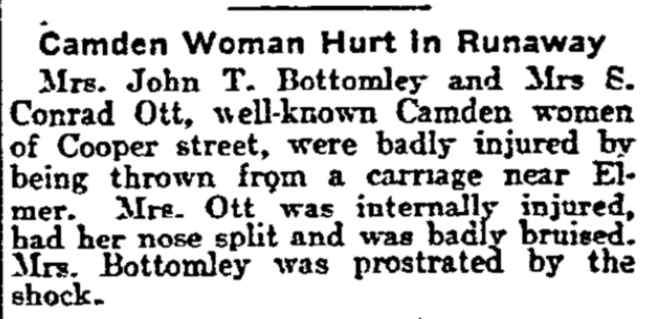
Mrs. John T. Bottomley and Mrs S. Conrad Ott, well-known Camden women of Cooper street, were badly injured by being thrown from a carriage near Elmer. Mrs. Ott was internally injured, had her nose split and was badly bruised. Mrs. Bottomley was prostrated by the shock.
Linden Baptists in Their Handsome New Home
Camden Post-Telegram —
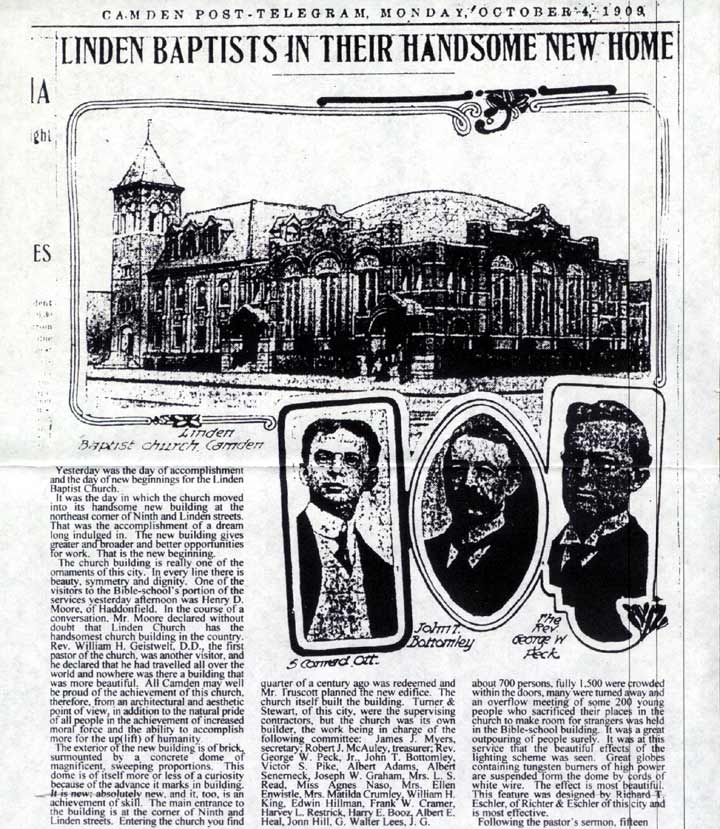
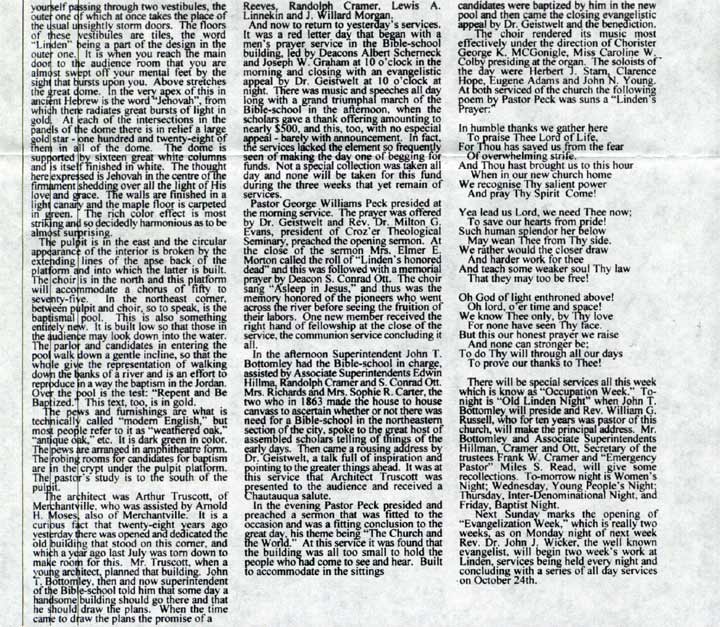
Linden Baptist church, Camden
S. Conrad Ott. John T. Bottomley. The Rev. George W. Peck.
Yesterday was the day of accomplishment and the day of new beginnings for the Linden Baptist Church.
It was the day in which the church moved into its handsome new building at the northeast corner of Ninth and Linden streets. That was the accomplishment of a dream long indulged in. The new building gives greater and broader and better opportunities for work. That is the new beginning.
The church building is really one of the ornaments of this city. In every line there is beauty, symmetry and dignity. One of the visitors to the Bible-school’s portion of the services yesterday afternoon was Henry D. Moore, of Haddonfield. In the course of a conversation, Mr. Moore declared without doubt that Linden Church has the handsomest church building in the country. Rev. William H. Geistwelt, D.D., the first pastor of the church, was another visitor, and he declared that he had travelled all over the world and nowhere was there a building that was more beautiful. All Camden may well be proud of the achievement of this church, therefore, from an architectural and aesthetic point of view, in addition to the natural pride of all people in the achievement of increased moral force and the ability to accomplish more for the up(lift) of humanity.
The exterior of the new building is of brick, surmounted by a concrete dome of magnificent, sweeping proportions. This dome is of itself more or less of a curiosity because of the advance it marks in building. It is new; absolutely new, and it, too, is an achievement of skill. The main entrance to the building is at the corner of Ninth and Linden streets. Entering the church you find yourself passing through two vestibules, the outer one of which at once takes the place of the usual unsightly storm doors. The floors of these vestibules are tiles, the word “Linden” being a part of the design in the outer one. It is when you reach the main door to the audience room that you are almost swept off your mental feet by the sight that bursts upon you. Above stretches the great dome. In the very apex of this in ancient Hebrew is the word “Jehovah”, from which there radiates great bursts of light in gold. At each of the intersections in the panels of the dome there is in relief a large gold star - one hundred and twenty-eight of them in all of the dome. The dome is supported by sixteen great white columns and is itself finished in white. The thought here expressed is Jehovah in the centre of the firmament shedding over all the light of His love and grace. The walls are finished in a light canary and the maple floor is carpeted in green. The rich color effect is most striking and so decidedly harmonious as to be almost surprising.
The pulpit is in the east and the circular appearance of the interior is broken by the extending lines of the apse back of the platform and into which the latter is built. The choir is in the north and this platform will accommodate a chorus of fifty to seventy-five. In the northeast corner, between pulpit and choir, so to speak, is the baptismal pool. This is also something entirely new. It is built low so that those in the audience may look down into the water. The parlor [sic] and candidates in entering the pool walk down a gentle incline, so that the whole give the representation of walking down the banks of a river and is an effort to reproduce in a way the baptism in the Jordan. Over the pool is the test: “Repent and Be Baptized.” This text, too, is in gold.
The pews and furnishings are what is technically called “modern English,” but most people refer to it as “weathered oak,” “antique oak,” etc. It is dark green in color. The pews are arranged in amphitheatre form. The robing rooms for candidates for baptism are in the crypt under the pulpit platform. The pastor’s study is to the south of the pulpit.
The architect was Arthur Truscott, of Merchantville, who was assisted by Arnold H. Moses, also of Merchantville. It is a curious fact that twenty-eight years ago yesterday there was opened and dedicated the old building that stood on this corner, and which a year ago last July was torn down to make room for this. Mr. Truscott, when a young architect, planned that building. John T. Bottomley, then and now superintendent of the Bible-school told him that some day a handsome building should go there and that he should draw the plans. When the time came to draw the plans the promise of a quarter of a century ago was redeemed and Mr. Truscott planned the new edifice. The church itself built the building. Turner & Stewart, of this city, were the supervising contractors, but the church was its own builder, the work being in charge of the following committee: James J. Myers, secretary; Robert J. McAuley, treasurer; Rev. George W. Peck, Jr., John T. Bottomley, Victor S. Pike, Albert Adams, Albert Senemeck, Joseph W. Graham, Mrs. L. S. Read, Miss Agnes Naso, Mrs. Ellen Enwistle, Mrs. Matilda Crumley, William H. King, Edwin Hillman, Frank W. Cramer, Harvey L. Restrick, Harry E. Booz, Albert E. Heal, Jonn Hill [sic], G. Walter Lees, J. G. Reeves, Randolph Cramer, Lewis A. Linnekin and J. Willard Morgan.
And now to return to yesterday’s services. It was a red letter day that began with a men’s prayer service in the Bible-school building, led by Deacons Albert Scherneck and Joseph W. Graham at 10 o’clock in the morning and closing with an evangelistic appeal by Dr. Geistwelt at 10 o’clock at night. There was music and speeches all day long with a grand triumphal march of the Bible-school in the afternoon, when the scholars gave a thank offering amounting to nearly $500, and this, too, with no especial appeal - barely with announcement. In fact, the services lacked the element so frequently seen of making the day one of begging for funds. Not a special collection was taken all day and none will be taken for this fund during the three weeks that yet remain of services.
Pastor George Williams Peck presided at the morning service. The prayer was offered by Dr. Geistwelt and Rev. Dr. Milton G. Evans, president of Croz’er Theological Seminary, preached the opening sermon. At the close of the sermon Mrs. Elmer E. Morton called the roll of “Linden’s honored dead” and this was followed with a memorial prayer by Deacon S. Conrad Ott. The choir sang “Asleep in Jesus,” and thus was the memory honored of the pioneers who went across the river before seeing the fruition of their labors. One new member received the right hand of fellowship at the close of the service, the communion service concluding it all.
In the afternoon Superintendent John T. Bottomley had the Bible-school in charge, assisted by Associate Superintendents Edwin Hillma [sic], Randolph Cramer and S. Conrad Ott. Mrs. Richards and Mrs. Sophie R. Carter, the two who in 1863 made the house to house canvass to ascertain whether or not there was need for a Bible-school in the northeastern section of the city, spoke to the great host of assembled scholars telling of things of the early days. Then came a rousing address by Dr. Geistwelt, a talk full of inspiration and pointing to the greater things ahead. It was at this service that Architect Truscott was presented to the audience and received a Chautauqua salute.
In the evening Pastor Peck presided and preached a sermon that was fitted to the occasion and was a fitting conclusion to the great day, his theme being “The Church and the World.” At this service it was found that the building was all too small to hold the people who had come to see and hear. Built to accommodate in the sittings about 700 persons, fully 1,500 were crowded within the doors, many were turned away and an overflow meeting of some 200 young people who sacrificed their places in the church to make room for strangers was held in the Bible-school building. It was a great outpouring of people surely. It was at this service that the beautiful effects of the lighting scheme was seen. Great globes containing tungsten burners of high power are suspended form [sic] the dome by cords of white wire. The effect is most beautiful. This feature was designed by Richard T. Eschler, of Richter & Eschler of this city and is most effective.
Following the pastor’s sermon, fifteen candidates were baptized by him in the new pool and then came the closing evangelistic appeal by Dr. Geistwelt and the benediction.
The choir rendered its music most effectively under the direction of Chorister George K. McGonigle, Miss Caroline W. Colby presiding at the organ. The soloists of the day were Herbert J. Starn, Clarence Hope, Eugene Adams and John N. Young. At both serviced [sic] of the church the following poem by Pastor Peck was suns [sic] a “Linden’s Prayer:”
In humble thanks we gather here
To praise Thee Lord of Life,
For Thou has [sic] saved us from the fear
Of overwhelming strife.
And Thou hast brought us to this hour
When in our new church home
We recognise Thy salient power
And pray Thy Spirit Come!
Yea lead us Lord, we need Thee now;
To save our hearts from pride!
Such human splendor her [sic] below
May wean Thee from Thy side.
We rather would the closer draw
And harder work for thee
And teach some weaker soul Thy law
That they may too be free!
Oh God of light enthroned above!
Oh lord, o’er time and space!
We know Thee only, by Thy love
For none have seen Thy face.
But this our honest prayer we raise
And none can stronger be;
To do Thy will through all our days
To prove our thanks to Thee!
There will be special services all this week which is know [sic] as “Occupation Week.” To-night is “Old Linden Night” when John T. Bottomley will preside and Rev. William G. Russell, who for ten years was pastor of this church, will make the principal address. Mr. Bottomley and Associate Superintendents Hillman, Cramer and Ott, Secretary of the trustees Frank W. Cramer and “Emergency Pastor” Miles S. Read, will give some recollections. To-morrow night is Women’s Night; Wednesday, Young People’s Night; Thursday, Inter-Denominational Night, and Friday, Baptist Night.
Next Sunday marks the opening of “Evangelization Week,” which is really two weeks, as on Monday night of next week Rev. Dr. John J. Wicker, the well known evangelist, will begin two week’s work at Linden, services being held every night and concluding with a series of all day services on October 24th.
Linden Baptist Bible School
Linden Baptist Bible School
Church to Reach Out for the Men
Philadelphia Inquirer —
Camden Preparing for Vigorous Participation in the Religion Forward Movement
Camden is preparing to take an active part in the Men and Religion Forward Movement which is now occupying the attention of the evangelistical churches all over the country. For several weeks a Committee of One Hundred, of which Lawyer S. Conrad Ott, an associate superintendent in the Linden Baptist Bible School and well known in religious work, is the general chairman, has been planning for the special exercises designed to win men. These meetings in Camden will be held simultaneously with Philadelphia, from January 20 to 28.
This work has been divided into several sub-committees having in charge special lines of effort. Already a thorough church census has been taken, and it is pretty well known where the non-church-goers are located. It is designed to have the churches go after the men so that there will not be an over abundance of women and children. Those in charge are sanguine of accomplishing this.
Beginning with tonight a week of prayer will be held in all the churches. Rev. U. Franklin Smiley, pastor of the Second Presbyterian Church, as chairman of the sub-committee on “The New Evangelism,” has prepared work for four districts, the north side, south side, east side and Rosedale.
On January 21 there will be a general interchange of pulpits. In the afternoon there is to be a big mass meeting for men at the Y. M. C. A. at which Herbert Booth, son of General Booth, of the Salvation Army, and other prominent men identified with the work, will speak. Throughout that week there will be a series of meetings held in various parts of the city. This, in connection with the revivals already in progress, is looked upon as forerunner for a great religious awakening in the city across the river.
Men and Religion Stirring Camden
Philadelphia Inquirer —
Popular “Forward Movement” Campaign Intended to Reach Out All Over the City
Camden yesterday began its eight-day campaign in the interest of the Men and Religion Forward Movement. Already preliminary meetings have been held under the direction of the general committee, of which Lawyer S. Conrad Ott is the chairman, and the Christian workers anticipate a season of great religious awakening.
Several hundred men were addressed yesterday afternoon at the Y. M. C. A. by Ira J. Lansing, whose subject was “A Social Interpretation of the Lord’s Prayer.” Tonight a large number of Camdenites will go to Philadelphia to participate in the dinner and social function to be given at the Scottish Rite Hall. The balance of the week two meetings will be held each night in the First Presbyterian Church for those of North Camden and in the First M. E. Church for those of South Camden. The speakers and their subjects follow:
Tuesday night, First Presbyterian Church, Prof. M. A. Honlina, “Bible Stury;” First M. E. Church, Charles Steizle, “Social Service;” Wednesday night, First Presbyterian Church, John H. Elliott and David Latshaw, “Evangelism and Community Extension;” First M. E. Church, W. E. Pierce, “Bible Stury;” Thursday night, First Presbyterian Church, James A. Whitmore, “Boys’ Work;” First M. E. Church, James R. Smith and Charles R. Drumm, “Evangelism and Community Extension;” Friday night, First Presbyterian Church, Yutaka Minahuchi, “Missions;” First M. E. Church, Clarence G. Robinson, “Boys’ Work.”
On Sunday afternoon there will be a mass meeting for men at the Y. M. C. A., to be addressed by John H. Elliott.
A small army of church people has already taken a complete census of the city. After the close of these meetings active missionary work is to be engaged in to gather the men into the churches.
Yesterday there was a general interchange of pulpits by the local preachers.
Camden at a Glance
Philadelphia Inquirer —
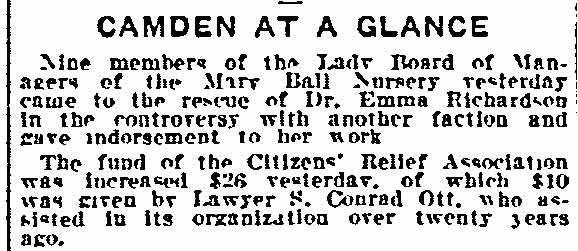
Nine members of the Lady Board of Managers of the Mary Ball Nursery yesterday came to the rescue of Dr. Emma Richardson in the controversy with another faction and gave indorsement to her work.
The fund of the Citizens’ Relief Association was increased $26 yesterday, of which $10 was given by Lawyer S. Conrad Ott, who assisted in its organization over twenty years ago.
Watches Differed, Suit May Result
Philadelphia Inquirer —
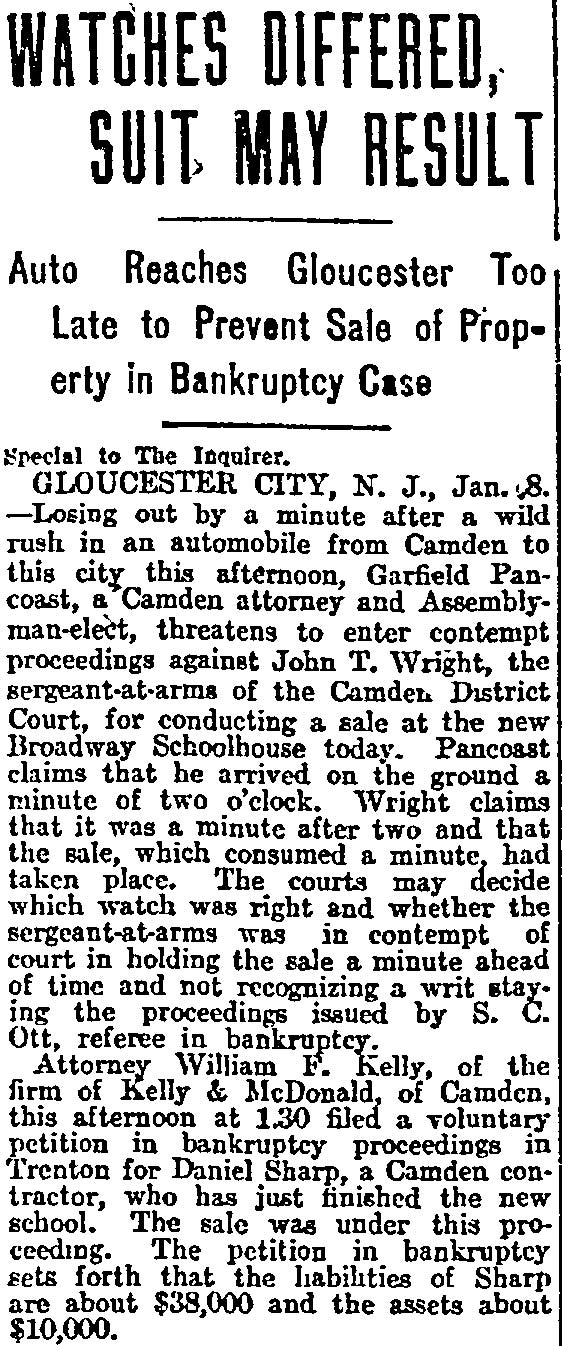
Auto Reaches Gloucester Too Late to Prevent Sale of Property in Bankruptcy Case
Special to The Inquirer.
GLOUCESTER CITY, N. J., Jan. 8.—Losing out by a minute after a wild rush in an automobile from Camden to this city this afternoon, Garfield Pancoast, a Camden attorney and Assemblyman-elect, threatens to enter contempt proceedings against John T. Wright, the sergeant-at-arms of the Camden District Court, for conducting a sale at the new Broadway Schoolhouse today. Pancoast claims that he arrived on the ground a minute of two o’clock. Wright claims that it was a minute after two and that the sale, which consumed a minute, had taken place. The courts may decide which watch was right and whether the sergeant-at-arms was in contempt of court in holding the sale a minute ahead of time and not recognizing a writ staying the proceedings issued by S. C. Ott, referee in bankruptcy.
Attorney William F. Kelly, of the firm of Kelly & McDonald, of Camden, this afternoon at 1.30 filed a voluntary petition in bankruptcy proceedings in Trenton for Daniel Sharp, a Camden contractor, who has just finished the new school. The sale was under this proceeding. The petition in bankruptcy sets forth that the liabilities of Sharp are about $38,000 and the assets about $10,000.
Camden at a Glance
Philadelphia Inquirer —
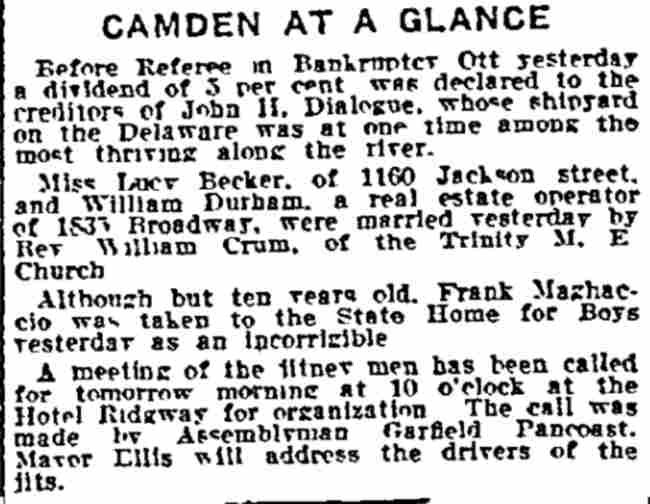
Before Referee in Bankruptcy Ott yesterday a dividend of 5 per cent was declared to the creditors of John H. Dialogue, whose shipyard on the Delaware was at one time among the most thriving along the river.
Miss Lucy Becker, of 1160 Jackson street, and William Durham, a real estate operator of 1837 Broadway, were married yesterday by Rev. William Crum [sic], of the Trinity M. E. Church.
Although but ten years old, Frank Mazhaccio was taken to the State Home for Boys yesterday as an incorrigible.
A meeting of the jitney men has been called for tomorrow morning at 10 o’clock at the Hotel Ridgway for organization. The call was made by Assemblyman Garfield Pancoast. Mayor Ellis will address the drivers of the jits.
Delaware River Shoe Company Creditors
Philadelphia Inquirer —

In the final report of Henry J. West, trustee for the Delaware River Shoe Company, before referee in bankruptcy Ott, it was shown the creditors recived a total of 6 per cent.
Linden Baptist Church School Staff, 1917
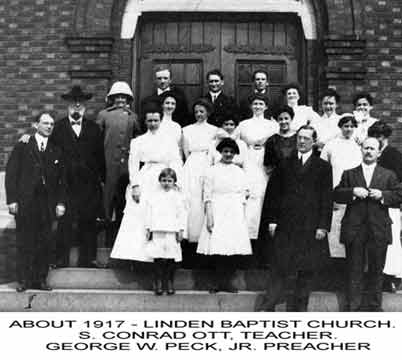
Linden Baptist Church School Staff, 1917
Here and There in Camden
Philadelphia Inquirer —
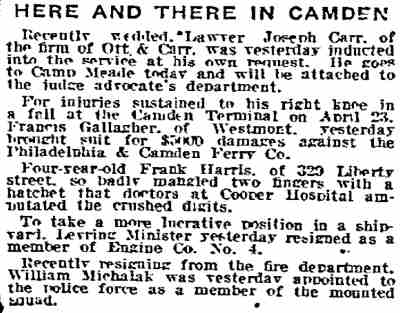
Recently wedded, ‘Lawyer Joseph Carr, of the firm of Ott & Carr, was yesterday inducted into the service at his own request. He goes to Camp Meade today and will be attached to the judge advocate’s department.
For injuries sustained to his right knee in a fall at the Camden Terminal on April 23, Francis Gallagher, of Westmont, yesterday brought suit for $5,000 damages against the Philadelphia & Camden Ferry Co.
Four-year-old Frank Harris, of 329 Liberty street, so badly mangled two fingers with a hatchet that doctors at Cooper Hospital amputated the crushed digits.
To take a more lucrative position in a shipyard, Levering Minister yesterday resigned as a member of Engine Co. No. 4.
Recently resigning from the fire department, William Michalak was yesterday appointed to the police force as a member of the mounted squad.
Ott & Carr Notice to Clients
Ott & Carr, Attorneys — 1917–1918
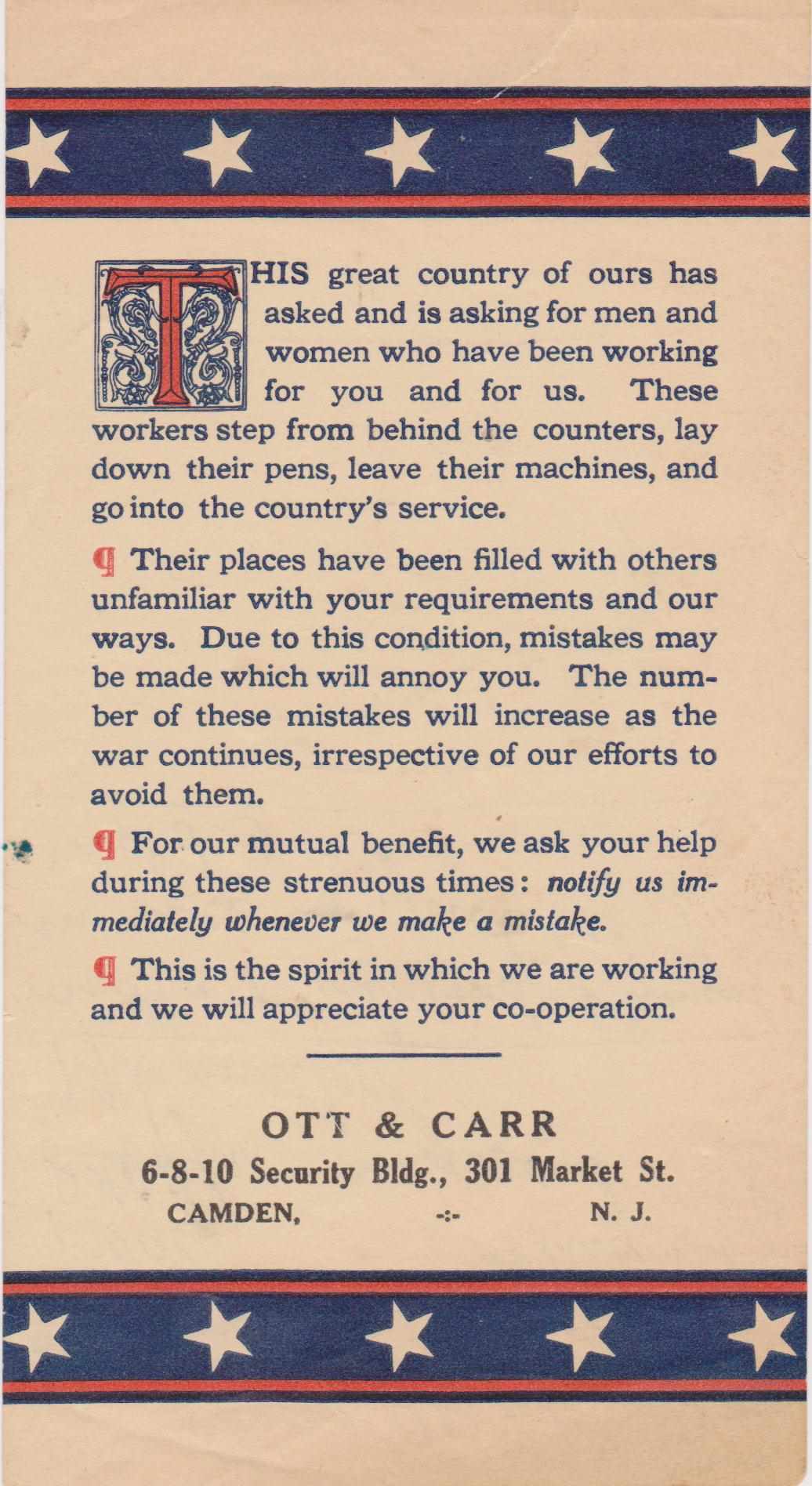
THIS great country of ours has asked and is asking for men and women who have been working for you and for us. These workers step from behind the counters, lay down their pens, leave their machines, and go into the country’s service.
Their places have been filled with others unfamiliar with your requirements and our ways. Due to this condition, mistakes may be made which will annoy you. The number of these mistakes will increase as the war continues, irrespective of our efforts to avoid them.
For our mutual benefit, we ask your help during these strenuous times: notify us immediately whenever we make a mistake.
This is the spirit in which we are working and we will appreciate your co-operation.
OTT & CARR, 6-8-10 Security Bldg., 301 Market St., CAMDEN, N. J.
Mr. Ott Very Ill
Bridgeton Evening News —
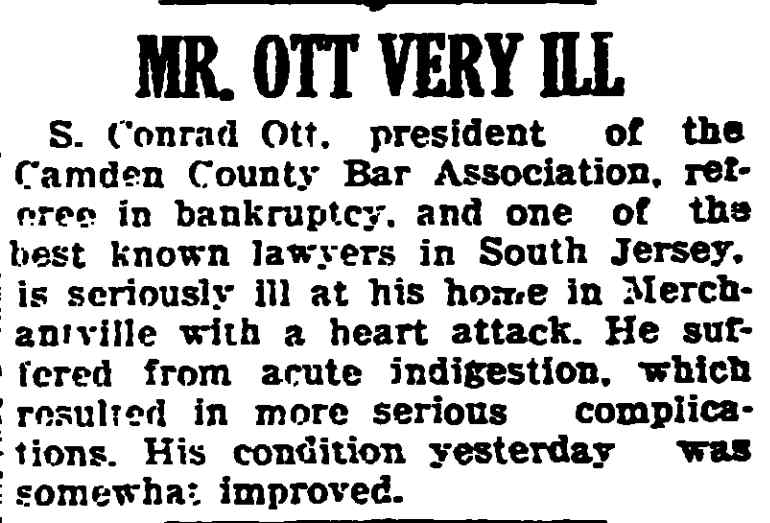
S. Conrad Ott, president of the Camden County Bar Association, referee in bankruptcy, and one of the best known lawyers in South Jersey, is seriously ill at his home in Merchantville with a heart attack. He suffered from acute indigestion, which resulted in more serious complications. His condition yesterday was somewhat improved.
Commissioner of Bankruptcy Dead
Bridgeton Evening News —
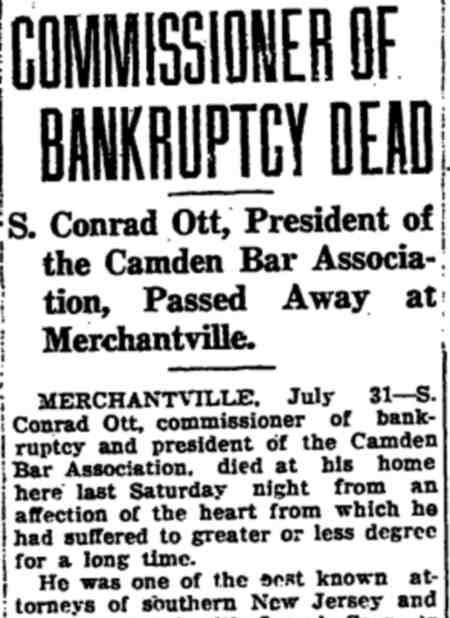
S. Conrad Ott, President of the Camden Bar Association, Passed Away at Merchantville.
MERCHANTVILLE, July 31—S. Conrad Ott, commissioner of bankruptcy and president of the Camden Bar Association, died at his home here last Saturday night from an affection of the heart from which he had suffered to greater or less degree for a long time.
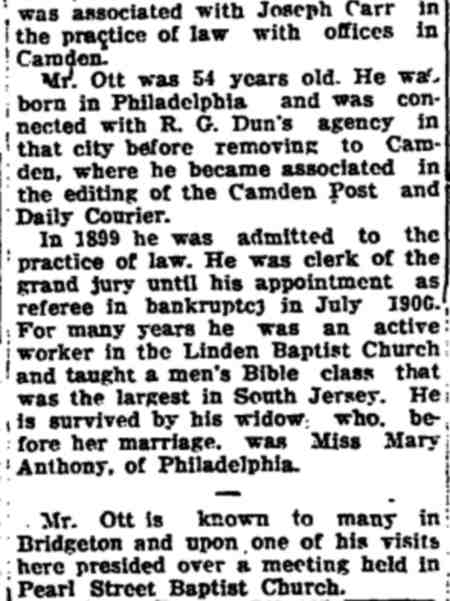
He was one of the best known attorneys of southern New Jersey and was associated with Joseph Carr in the practice of law with offices in Camden.
Mr. Ott was 54 years old. He was born in Philadelphia and was connected with R. G. Dun’s agency in that city before removing to Camden, where he became associated in the editing of the Camden Post and Daily Courier.
In 1899 he was admitted to the practice of law. He was clerk of the grand jury until his appointment as referee in bankruptcy in July 1906. For many years he was an active worker in the Linden Baptist Church and taught a men’s Bible class that was the largest in South Jersey. He is survived by his widow, who, before her marriage, was Miss Mary Anthony, of Philadelphia.
Mr. Ott is known to many in Bridgeton and upon one of his visits here presided over a meeting held in Pearl Street Baptist Church.
Heart Ailment Takes Life of Attorney Ott
Camden Post-Telegram —
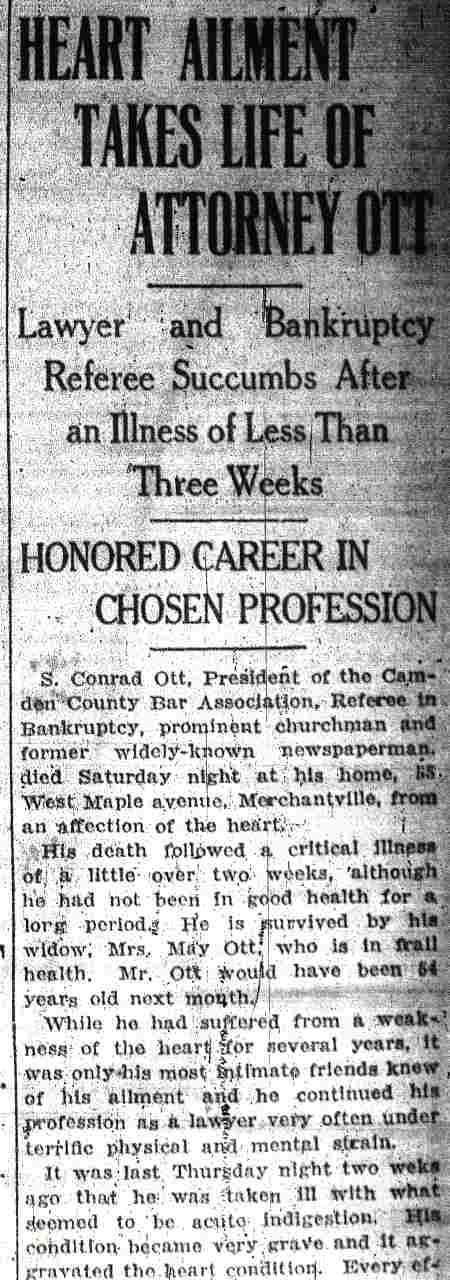
Lawyer and Bankruptcy Referee Succumbs After an Illness of Less Than Three Weeks
HONORED CAREER IN CHOSEN PROFESSION
S. Conrad Ott, President of the Camden County Bar Association, Referee in Bankruptcy, prominent churchman and former widely-known newspaperman, died Saturday night at his home, 55 West Maple avenue, Merchantville, from an affection of the heart.
His death followed a critical illness of a little over two weeks, although he had not been in good health for a long period. He is survived by his widow, Mrs. May Ott, who is in frail health. Mr. Ott would have been 54 years old next month.
While he had suffered from a weakness of the heart for several years, it was only his most intimate friends knew of his ailment and he continued his profession as a lawyer very often under terrific physical and mental strain.
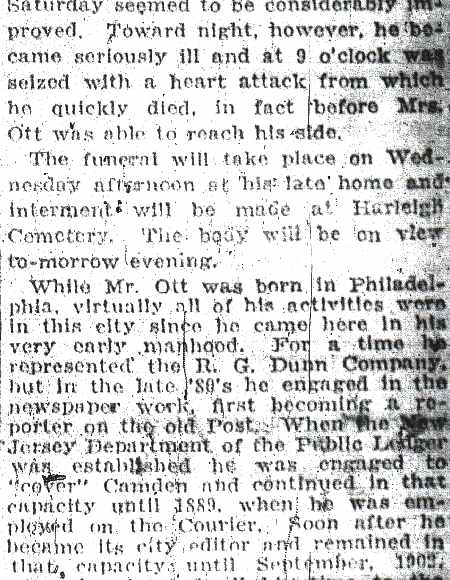
It was last Thursday night two weeks ago that he was taken ill with what seemed to be acute indigestion. His condition became very grave and it aggravated the heart condition. Every effort was made to save him. Saturday seemed to be considerably improved. Toward night, however, he became seriously ill and at 9 o’clock was seized with a heart attack from which he quickly died, in fact before Mrs. Ott was able to reach his side.
The funeral will take place on Wednesday afternoon at his late home and interment will be made at Harleigh Cemetery. The body will be on view to-morrow evening.
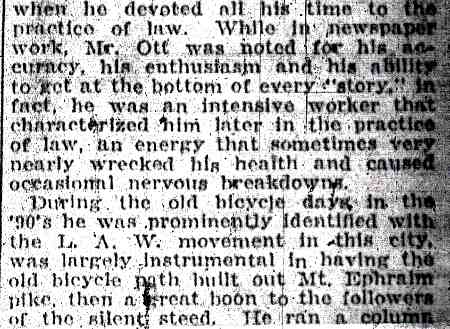
While Mr. Ott was born in Philadelphia, virtually all of his activities were in this city since he came here in his very early manhood. For a time he represented the R. G. Dunn Company, but in the late ’80’s he engaged in the newspaper work, first becoming a reporter on the old Post. When the New Jersey Department of the Public Ledger was established he was engaged to “cover” Camden and continued in that capacity until 1889, when he was employed on the Courier. Soon after he became its city editor and remained in that capacity, until September, 190[?], when he devoted all his time to the practice of law. While in newspaper work, Mr. Ott was noted for his accuracy, his enthusiasm and his ability to get at the bottom of every “story,” in fact, he was an intensive worker that characterized him later in the practice of law, an energy that sometimes very nearly wrecked his health and caused occasional nervous breakdowns.
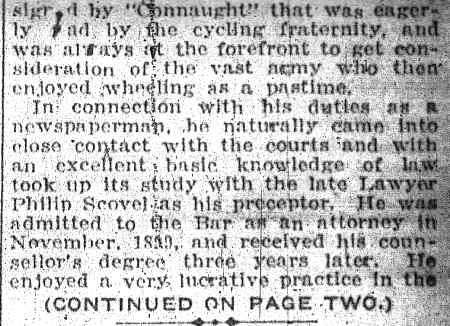
During the old bicycle days, in the ’90’s he was prominently identified with the L. A. W. movement in this city, was largely instrumental in having the old bicycle path built out Mt. Ephraim pike, then a great boon to the followers of the silent steed. He ran a column signed by “Connaught” that was eagerly read by the cycling fraternity, and was always at the forefront to get consideration of the vast army who then enjoyed wheeling as a pastime.
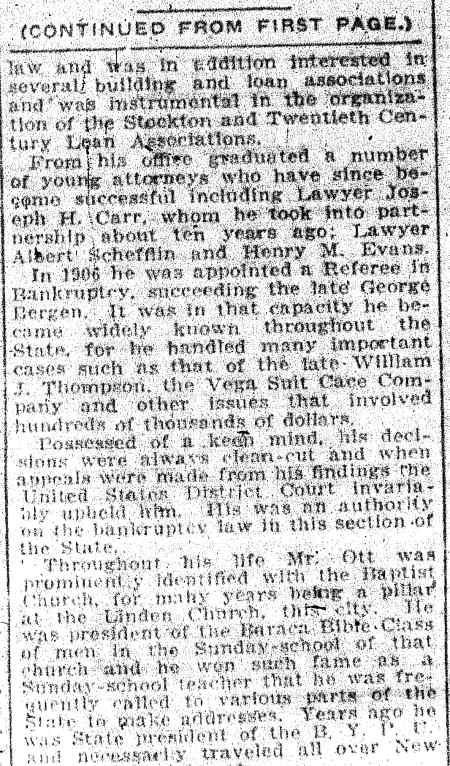
In connection with his duties as a newspaperman, he naturally came into close contact with the courts and with an excellent basic knowledge of law took up its study with the late Lawyer Philip Scovel as his preceptor. He was admitted to the Bar as an attorney in November, 1899, and received his counsellor’s degree three years later. He enjoyed a very lucrative practice in the law and was in addition interested in several building and loan associations and was instrumental in the organization of the Stockton and Twentieth Century Loan Associations.
From his office graduated a number of young attorneys who have since become successful including Lawyer Joseph H. Carr, whom he took into partnership about ten years ago; Lawyer Albert Scheffin and Henry M. Evans.
In 1906 he was appointed a Referee in Bankruptcy, succeeding the late George Bergen. It was in that capacity he became widely known throughout the State, for he handled many important cases such as that of the late William J. Thompson, the Vega Suit Case Company and other issues that involved hundreds of thousands of dollars.
Possessed of a keen mind, his decisions were always clean-cut and when appeals were made from his findings the United States District Court invariably upheld him. He was an authority on the bankruptcy law in this section of the State.
Throughout his life Mr. Ott was prominently identified with the Baptist Church, for many years being a pillar at the Linden Church, this city. He was president of the Baraca Bible Class of men in the Sunday-school of that church and he won such fame as a Sunday-school teacher that he was frequently called to various parts of the State to make addresses. Years ago he was State president of the B. Y. P. U. and necessarily traveled all over New Jersey.
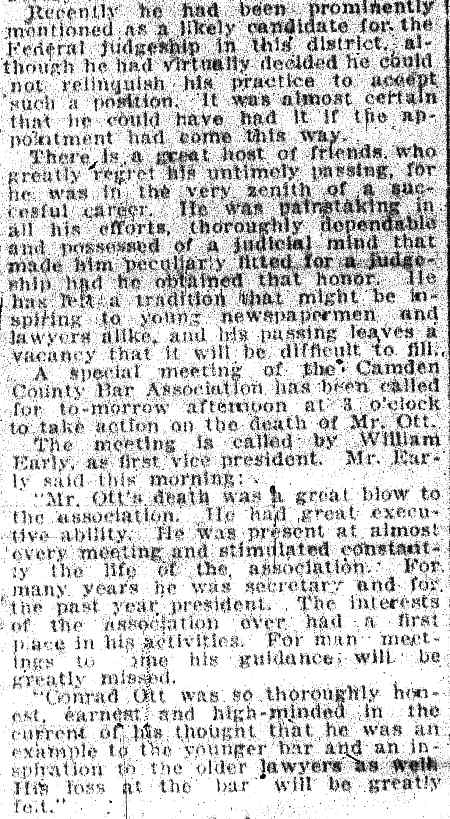
Recently he had been prominently mentioned as a likely candidate for the Federal judgeship in this district, although he had virtually decided he could not relinquish his practice to accept such a position. It was almost certain that he could have had it if the appointment had come this way.
There is a great host of friends, who greatly regret his untimely passing, for he was in the very zenith of a successful career. He was painstaking in all his efforts, thoroughly dependable and possessed of a judicial mind that made him peculiarly fitted for a judgeship had he obtained that honor. He has left a tradition that might be inspiring to young newspapermen and lawyers alike, and his passing leaves a vacancy that it will be difficult to fill.
A special meeting of the Camden County Bar Association has been called for to-morrow afternoon at 3 o’clock to take action on the death of Mr. Ott. The meeting is called by William Early, as first vice president. Mr. Early said this morning:
“Mr. Ott’s death was a great blow to the association. He had great executive ability. He was present at almost every meeting and stimulated constantly the life of the association. For many years he was secretary and for the past year president. The interests of the association over [sic] had a first place in his activities. For man [sic] meetings to [?]ome his guidance will be greatly missed.
“Conrad Ott was so thoroughly honest, earnest and high-minded in the current of his thought that he was an example to the younger bar and an inspiration to the older lawyers as well. His loss at the bar will be greatly felt.”
S. Conrad Ott
Philadelphia Inquirer —
N. J. Commissioner of Bankruptcy Dies in Merchantville
Special to The Inquirer.
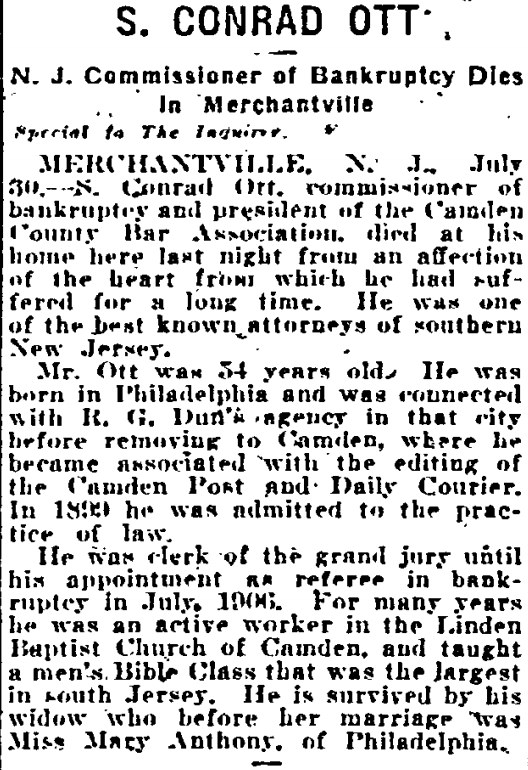
MERCHANTVILLE, N. J., July 30.—S. Conrad Ott, commissioner of bankruptcy and president of the Camden County Bar Association, died at his home here last night from an affection of the heart from which he had suffered for a long time. He was one of the best known attorneys of southern New Jersey.
Mr. Ott was 54 years old. He was born in Philadelphia and was connected with R. G. Dun’s agency in that city before removing to Camden, where he became associated with the editing of the Camden Post and Daily Courier. In 1899 he was admitted to the practice of law.
He was clerk of the grand jury until his appointment as referee in bankruptcy in July, 1906. For many years he was an active worker in the Linden Baptist Church of Camden, and taught a men’s Bible Class that was the largest in south Jersey. He is survived by his widow who before her marriage was Miss Mary Anthony, of Philadelphia.
S. Conrad Ott Dies; Headed Camden Bar
Trenton Evening Times —
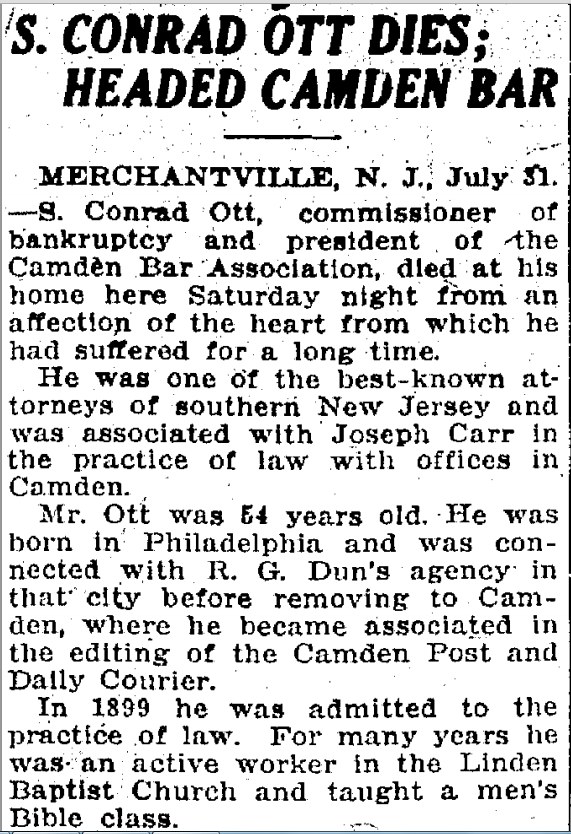
MERCHANTVILLE, N. J., July 31.—S. Conrad Ott, commissioner of bankruptcy and president of the Camden Bar Association, died at his home here Saturday night from an affection of the heart from which he had suffered for a long time.
He was one of the best-known attorneys of southern New Jersey and was associated with Joseph Carr in the practice of law with offices in Camden.
Mr. Ott was 54 years old. He was born in Philadelphia and was connected with R. G. Dun’s agency in that city before removing to Camden, where he became associated in the editing of the Camden Post and Daily Courier.
In 1899 he was admitted to the practice of law. For many years he was an active worker in the Linden Baptist Church and taught a men’s Bible class.
Obituary: S. Conrad Ott
West Jersey Press —
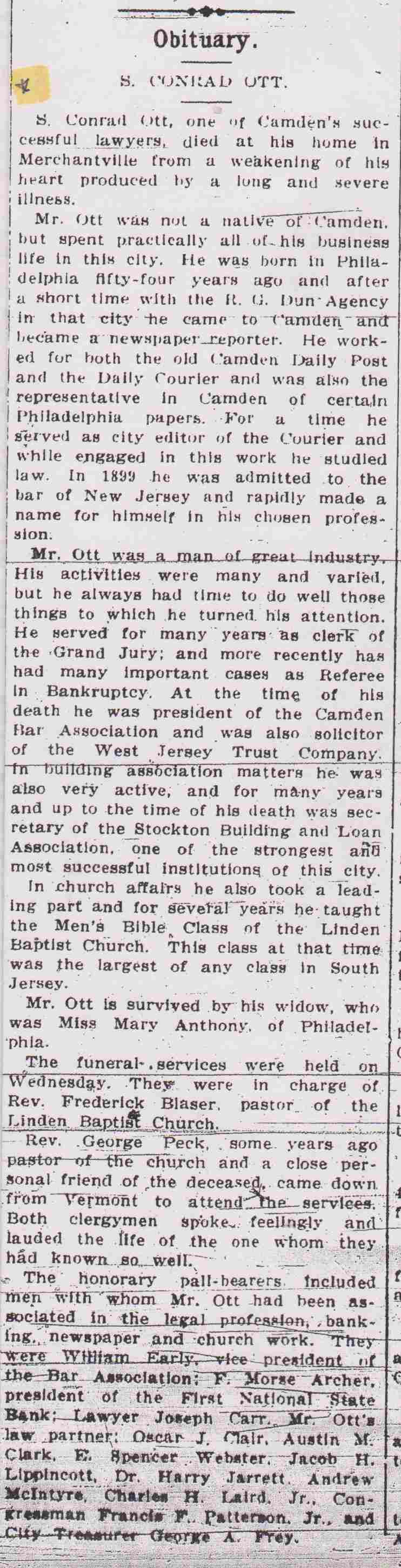
S. Conrad Ott, one of Camden’s successful lawyers, died at his home in Merchantville from a weakening of his heart produced by a long and severe illness.
Mr. Ott was not a native of Camden, but spent practically all of his business life in this city. He was born in Philadelphia fifty-four years ago and after a short time with the R. G. Dun Agency in that city he came to Camden and became a newspaper reporter. He worked for both the old Camden Daily Post and the Daily Courier and was also the representative in Camden of certain Philadelphia papers. For a time he served as city editor of the Courier and while engaged in this work he studied law. In 1899 he was admitted to the bar of New Jersey and rapidly made a name for himself in his chosen profession.
Mr. Ott was a man of great industry. His activities were many and varied, but he always had time to do well those things to which he turned his attention. He served for many years as clerk of the Grand Jury; and more recently has had many important cases as Referee in Bankruptcy. At the time of his death he was president of the Camden Bar Association and was also solicitor of the West Jersey Trust Company. In building association matters he was also very active, and for many years and up to the time of his death was secretary of the Stockton Building and Loan Association, one of the strongest and most successful institutions of this city.
In church affairs he also took a leading part and for several years he taught the Men’s Bible Class of the Linden Baptist Church. This class at that time was the largest of any class in South Jersey.
Mr. Ott is survived by his widow, who was Miss Mary Anthony, of Philadelphia.
The funeral services were held on Wednesday. They were in charge of Rev. Frederick Blaser, pastor of the Linden Baptist Church.
Rev. George Peck, some years ago pastor of the church and a close personal friend of the deceased, came down from Vermont to attend the services. Both clergymen spoke feelingly and lauded the life of the one whom they had known so well.
The honorary pall-bearers included men with whom Mr. Ott had been associated in the legal profession, banking, newspaper and church work. They were William Early, vice president of the Bar Association; F. Morse Archer, president of the First National State Bank; Lawyer Joseph Carr, Mr. Ott’s law partner; Oscar J. Clair, Austin M. Clark, E. Spencer Webster, Jacob H. Lippincott, Dr. Harry Jarrett, Andrew McIntyre, Charles H. Laird, Jr., Congressman Francis F. Patterson, Jr., and City Treasurer George A. Frey.
Death of Widow of Conrad Ott
Camden Post-Telegram —
Passes Away This Morning at Merchantville After a Long Illness
HUSBAND DIED IN JULY OF LAST YEAR
After an extended illness Mrs. Mary A. Ott, widow of Lawyer C. Conrad Ott, died this morning at her home, 55 West Maple avenue, Merchantville. She was 55 years old.
Death was due to heart and kidney ailments from which Mrs. Ott has suffered long prior to the death of Mr. Ott, who passed away July 29 of last year. The death of her husband aggravated the condition of Mrs. Ott, who had been desperately ill for several weeks.
Mrs. Ott lapsed into a state of coma late yesterday and remained in that condition until the end came this morning. Her funeral takes place at 2 p. m. Tuesday from her late home. The body can be viewed on Monday evening.
Prior to moving to Merchantville several years ago, Mrs. Ott was active in Linden Baptist Church, where her husband was for years a teacher of the Men’s Bible Class. She still retained her membership at Linden.
In Merchantville Mrs. Ott was a member of the Woman’s Club and took an active part in welfare work. She was Miss Mary Anthony, of Philadelphia, and is survived by two sisters and several nephews and nieces.
Hurley Based Success in Life and in Business on Square Deal to All
Camden Courier-Post —

By BEN COURTER
Nearly two score years ago an earnest young man called together a handful of employees in a small store at Fifth and Pine streets.
“Boys, see that door?” he said to them.
“Well, if by any chance I should be called upon to resort to unscrupulous methods in the conduct of this business that door will be closed and this enterprise will end. Square dealing is to be the principle on which we will do business, square dealing to everybody.”
That young man was William Leonard Hurley, then but 27 years old and virile, visioning a great business which he purposed to develop. It was the pronouncement of what then was nothing less than an ideal, for it was in a period when there was a tendency to take advantage of the unsuspecting to sell inferior goods at exorbitant prices. Many operated under what was known in the trade as the “borax system,” which resulted in the public looking askance at installment buying for the home.
Based on that determination to cultivate public confidence in his own business, Hurley built slowly but securely, his small enterprise into “the big trustful store,” with branches in half a dozen cities.
It was a determination that made him a kindred spirit, in later years, with Theodore Roosevelt whose guest the Rough Rider was to become in the midst of a political campaign that stirred the country from coast to coast. It was the straight-forward characteristic that likewise prompted his subsequent activities in the interest of Camden, that was to be a factor in throwing off the provincial spirit and entering the civic stride so pronounced in the advent of the Camden bridge and the extension of Broadway. In both these he was a strenuous advocate of civic expansion, scientifically planned.
Hurley Not Born With a ‘Silver Spoon’
When Hurley was born in Chester county, Pa., 65 years ago, it was not with a “silver spoon in his mouth.” His father, William Hurley, was a railroad man, an honest, hard-working father, who, in times which were hard enough for the bread-winner, struggled to keep his family in the necessities of life.
The son, William, obtained the rudiments of education under great difficulties, for schools were scarce and far between in the sparse settlement where his boyhood was spent. It was a school of hard knocks, an environment that evidenced the difficult problem the poorer class had in obtaining the bare necessities of life. It was the experience of those early years that William L. Hurley never forgot, for afterward, when success had come, he never was deaf to an appeal from those “pulling hard against the stream.”
At the age of 12 he obtained his first job on a farm in his native Chester county. Farming in those days was hard, strenuous work, seemingly never ending labor to the boy, even then strong and possessing much of the splendid physique of later years.
“I worked from four in the morning until after dark,” Hurley once said, in a reminiscent way. “The farmer usually woke me in the morning by pounding his cane on the floor.
“My duties? Well, they included milking ten cows, feeding chickens and pigs, cleaning the horses, husking corn and doing odd chores. The farmer paid me $4 a month and board.
“In those days boys worked just as hard as grown folks. It was no cinch and when darkness came I couldn’t run fast enough to the farmhouse and to bed. I was dead tired and the bed brought supreme happiness to me. Sleeping was about the only fun I had.”
So the years went on with the hard work on the farm. The future held no great promise. The railroad was more alluring. Since his father was a railroader, young Hurley decided to try that field.
Railroading in 80’s No ‘Automatic’ Job
Back in the 80’s railroading was a far different proposition than it is now. There was none of the automatic brakes and couplings and numberless other inventions that have made it comparatively a safe job today. The old-fashioned coupling pin, for instance, was the abomination of the brakeman. What it did to Hurley he carried to his dying day in the loss of the end of one of his middle fingers.
Not only did he act as brakeman but also as fireman. As he stoked the pulsing engine he dreamed of the day when he might take the throttle. It seemed a wonderful career then, but fate had other things in store for him. He sensed it when he concluded to better his wage of $1.[?]0 a day and get “something on the side.” That was by selling sewing machines at night, often after he had worked hard on drilling freights or stoking the engine through the day.
But this selling of sewing machines impressed young Hurley that perhaps after all there was something else in life other than guiding a great locomotive over the rails. At any rate he concluded to try it out and this in 1888, the year of the “great Blizzard” in this section, he obtained a job with Edward Gately & Co. in Philadelphia as canvasser. It was not long before he had two assistants who acted as collectors, one of whom, Harry F. Jones, was to become his partner in the Atlantic City store many years later.
Gately was a wealthy man who had made his money mostly in the installment business, one who ever had an eye open for the promising young men in his organization. It was his custom to give them a chance and take them into partnership, opening stores in various cities. Young Hurley was one of these promising young men. In 1890 the business of Gately & Hurley was started. To be exact it was on February 1 of that year that a small store was opened, the corner store under old Wildey Hall at Fifth and Pine streets. It was there that he was inspired to tell his then small force of his square dealing policy.
Worked Long Hours to Make Store Success
Young Hurley worked like a Trojan. None in the ranks put in longer hours than he, sometimes 18 or 20 before he was willing to call it a day.
Not only did he direct his force in garnering business, but he went out on the street, often with rugs across his shoulders, to obtain patronage. Many recall the stalwart, earnest young man and his breezy manner which seldom failed to bring result.
Nor was Hurley, in the flush of subsequent success, averse to recalling those strenuous days, usually with a chuckle and remembrance of old timers who had stood staunch and strong with his organization through the intervening years.
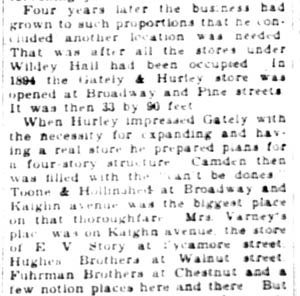
Four years later the business had grown to such proportions that he concluded another location was needed. That was after all the stores under Wildey Hall had been occupied. In 1894 the Gately & Hurley store was opened at Broadway and Pine streets. It was then 33 by 90 feet.
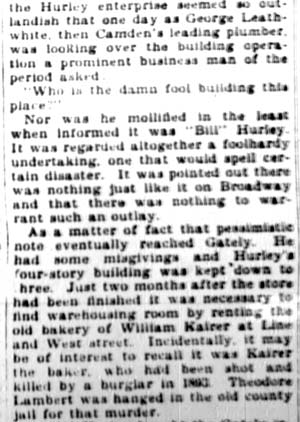
When Hurley impressed Gately with the necessity for expanding and having a real store he prepared plans for a four-story structure. Camden then was filled with the “can’t be dones.” Toone & Hollinshed at Broadway and Kaighn avenue was the biggest place on that thoroughfare. Mrs. Varney’s place was on Kaighn avenue, the store of E. V. Story at Sycamore street, Hughes Brothers at Walnut street, Fuhrman Brothers at Chestnut and a few notion places here and there. But the Hurley enterprise seemed so outlandish that one day as George Leathwhite, then Camden’s leading plumber, was looking over the building operation a prominent business man of the period asked.
“Who is the damn fool building this place?”
Nor was he mollified in the least when informed it was “Bill” Hurley. It was regarded altogether a foolhardy undertaking, one that would spell certain disaster. It was pointed out there was nothing just like it on Broadway and that there was nothing to warrant such an outlay.
As a matter of fact that pessimistic note eventually reached Gately. He had some misgivings and Hurley’s four-story building was kept down to three. Just two months after the store had been finished it was necessary to find warehousing room by renting the old bakery of William Kairer at Line and West street. Incidentally, it may be of interest to recall it was Kairer the baker, who had been shot and killed by a burglar in 1893. Theodore Lambert was hanged in the old county jail for that murder.
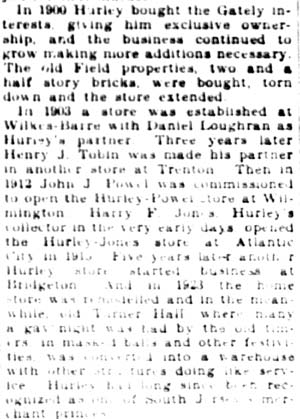
In 1900 Hurley bought the Gately interests, giving him exclusive ownership, and the business continued to grow making more additions necessary. The old Field properties, two and a half story bricks, were bought, torn down and the store extended.
In 1903 a store was established at Wilkes-Barre with Daniel Loughran as Hurley’s partner. Three years later Henry J. Tobin was made his partner in another store at Trenton. Then in 1912 John J. Powell was commissioned to open the Hurley-Powell store at Wilmington. Harry F. Jones, Hurley’s collector in the very early days opened the Hurley-Jones store at Atlantic City in 1915. Five years later another Hurley store started business at Bridgeton. And in 1923 the home store was remodeled and in the meantime, old Turner Hall, where many a gay night was had by the old timers in masked balls and other festivities, was converted into a warehouse with other structures doing like service. Hurley has long since been recognized as one of South Jersey’s merchant princes.
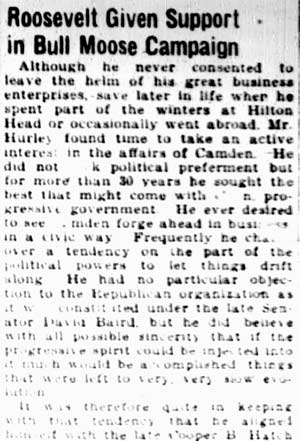
Roosevelt Given Support in Bull Moose Campaign
Although he never consented to leave the helm of his great business enterprises, save later in life when he spent part of the winters at Hilton Head or occasionally went abroad, Mr. Hurley found time to take an active interest in the affairs of Camden. He did not seek political preferment but for more than 30 years he sought the best that might come with [blacked out]n progressive government. He ever desired to see Camden forge ahead in business in a civic way. Frequently he chafed over a tendency on the part of the political powers to let things drift along. He had no particular objection to the Republican organization as it was constituted under the late Senator David Baird, but he did believe with all possible sincerity that if the progressive spirit could be injected into it much would be accomplished, things that were left to very, very slow evolution.
It was therefore quite in keeping with that tendency that he aligned himself with the late Cooper B. Hatch in the late 90’s when the Committee of 100 was born with the Courier then under S. Conrad Ott as city editor being a potent factor in the victory. It was then that Hurley gave financial and moral aid to the movement with Hatch as the leader and with Lewis H. Moorman, [blacked out], C. Kramer and others many of whom have long since gone fostering the cause. [blacked out] its purpose perhaps although within a few years it had passed with the usual disintegration of independent movements.
When Colonel Roosevelt formed the Bull Moose party and became the Presidential candidate in 1912 with William H. Taft and Woodrow Wilson in the field, Mr. Hurley was an earnest active advocate of the Rough Rider. In fact he was one of the delegates to the Bull Moose convention that nominated Roosevelt.
In the midst of that truly hectic campaign when Wilson, Taft and Roosevelt visited Camden, Wilson’s meeting was enthusiastic enough to please any Democrat. Taft’s was a frost and hardly more than a fringe, mostly office holders greeted him, but Roosevelt’s was what the Colonel himself called a “rip snorter.”
Teddy Was Guest at Home of Hurley During Visit Here
Hurley was his host on that occasion, a hot summer night, itself suggestive of the extremely hot campaign. These meetings were held at the Third Regiment armory, no other building then being available. One may yet recall very vividly the entrance of the Colonel, Mr. Hurley and the Camden Bull Moose leaders. The great drill hall was literally jammed, with yelling enthusiasts even hanging from the top girders. Just as he arrived a terrific thunder storm broke loose, the reverberation, the vivid flashes lost in the roar of the crowd.
“Where’s your hat, Teddy?” someone yelled.
And the Colonel tossed his old black slouch hat in the ring while Hurley led the cheer that followed, a cheer that seemingly tested the strength of the expansive roof. Roosevelt had been a guest at the Hurley home at West Collingswood where the leaders, the rank and file of the Bull Moosers met him. It was one gala night and Mr. Hurley was in the zenith of his glory.
None was more disappointed when Colonel Roosevelt failed at the November election, for Mr. Hurley felt that the country needed the hero of San Juan Hill particularly at that time. He sincerely mourned the Colonel’s passing, but to the very last cherished his memory, regarding him as the Great American.
Backed Non-Partisan Move, Aided Opening of Broadway
As has been indicated, Mr. Hurley had no particular feeling against the Republican organization, but he was certain that Camden was on the threshold of big things and that there should be an awakening. There appeared to be no intention of getting out of the rut so far as the political powers were concerned and with the assurance of the bridge he regarded it necessary to be alive to the opportunities certain to come. There had been talk of certain outlets from the bridge which did not meet the situation in his judgment. For one thing, he was impressed with the extension of Broadway.
For more years than one might recall, Broadway had been Camden’s principal street. Many regarded it as the city’s most important business thoroughfare. Mr. Hurley early realized that to extend it to where the bridge plaza would eventually be located was a real civic essential, but the city administration did not consider the financial outlay that would be involved justified in the extension.
That was one of the factors that resulted in the Non-Partisan movement of 1922, of Mr. Hurley’s advocacy of its cause, of his financial and moral support. He was one of the leaders in the civic revolution that first brought the victory for commission form of government and later that ushered the Non-Partisan candidates into office.
It was the realization of a cherished dream when the new administration bought property that assured Broadway’s extension to the bridge plaza. It justified his prediction that it would be like giving a new blood stream to the city, for the Walt Whitman Hotel, the Wilson Building and others rapidly rising about Broadway and Cooper streets prove it beyond all doubt.
Camden Bridge Proposition Given Approval by Hurley
Mr. Hurley not only gave his every influence toward the Camden bridge proposition in the days when it was regarded more or less a joke, but he worked assiduously to crystalize [sic] sentiment so that the century-old dream would be a dream no longer. New Jersey did its part when Walter Edge was governor, but there was plenty of backing and filling on the part of Philadelphia and Pennsylvania. There were many discouraging epochs, even after a joint commission had been created, but Mr. Hurley was among those who refused to give up hope. What was subsequently accomplished was due mainly to men of his faith, of his courage, of his energy.
After its completion the necessity for a second span was impressed upon him. Shortly after the Camden bridge was opened to the public he advocated another from Market street, Gloucester to Pattison avenue, Philadelphia. Since other sites have been suggested. A joint commission has been named to make preliminary surveys but has been at loggerheads over a proposal to build a span from Red Bank to League Island. Mr. Hurley regarded his suggestion as far more feasible and he supported it by arguments that were hard to answer.
Throughout his career Mr. Hurley had been an earnest advocate of co-operation among business interests of the city. For many years there was the Board of Trade rather an innocuous organization, usually attended by half a dozen men and voiceless so far as influence went. He concluded a rejuvenation was necessary, consented to act as president and speeded it up with the late Louis T. Derousse as secretary. Later Charles M. Curry held that position and until the present Chamber of Commerce was formed under a campaign directed by the American City Bureau. Mr. Hurley or his subordinates had given it every possible aid to make it a factor in the community.
Assessment Commissioner Was Only Political Post
Aside from his principal business, Mr. Hurley was associated for many years with the late William J. Lorigan in building homes. Their first extensive operation was the construction of two rows of dwellings in Princeton avenue. Others were constructed in various parts of Camden and the development of the district about Twenty-seventh and Federal streets was largely due to the firm. After the elder Lorigan’s death he was succeeded by his son, William H. Lorigan, who has been associated with Mr. Hurley.
While he sought no political honors, Mr. Hurley did once accept for a few years a position. It was during the Committee of 100 regime when he became a commissioner of assessment. He [?] served for many years as a delegate to the Atlantic Deeper Waterways Convention. He took a keen interest in that organization and in the work of actually having an inland waterway along the eastern seaboard. It is slowly developing with the possibility of becoming an actuality a few years hence, mainly through the effort of men of Mr. Hurley’s caliber.
When he came to Camden Mr. Hurley first resided on Stevens street, then at [?] Pine and from 1894 to 19[?]9 at 7[?]8 Broadway. In the latter year he bought the estate on White Horse pike at West Collingswood that had been used as a sanitarium. The building was virtually reconstructed, the grounds were laid out in beautiful shrubbery and there were already fine nut trees which made it a show place. He called it Dungarvan, after the county in Ireland where his father was born.
It was there at his palatial home, with the beautiful surroundings that Mr. Hurley delighted in acting the role of host, of gathering about him old friends and harking back to the times that were.
Unspoiled Good Will Befriended All in Need
Old friends cherish the memory of one outstanding characteristic of “Bill” Hurley. Increasing fortune never “spoiled” him. He remained democratic until the end, and those who had known him through the years called him “Bill” just as they had done in the days when he was forging ahead in spite of the “can’t-be-dones.”
Nor did he ever forget an old customer. It might be an old, old woman upon whom fortune had consistently refused to shine but who made her little purchases at his store. None was too lowly for him to give his personal attention under such circumstances. There was ever a real grip of the hand that spoke sincerity.
It was quite natural that he enjoyed hunting and fishing. For many years his summer home was at Sea Isle City, where his family went through the vacation period each year. There he never failed to go out to sea or to try his luck off the pier, usually with an old friend. Catching the piscatorial beauties, particularly a channel bass or a drum, was regarded with almost the same satisfaction as putting over a big business deal.
Over a dozen years ago he bought the island at Hilton Head, off the coast of South Carolina and 30 miles from Savannah. While he enjoyed all the comforts of civilization, the surroundings were kept in their primitive simplicity. Nothing delighted him more than taking an old friend along to the island estate and showing the guest the time of his life.
Men like Hurley do much that is unheralded to alleviate the suffering of the world. Creed or color meant nothing to him if aid were needed. What he gave in that respect no one knows. Those long associated with him declare it was sufficient to make happy a small army in adversity.
Aided Worthy Causes Regardless of Creeds
Charitable organizations, religious or otherwise, enjoyed his bounty. No one was aware of such aid unless it happened to be in a “campaign” to raise a specified sum. It was Hurley very often who started things going by way of a liberal contribution. It mattered not whether the cause was for Protestant, Catholic or Jew—just so it was worth while. When the vicious pogroms were sweeping Russia he was one of the most generous contributors to the Camden funds for the sufferers. In the flu epidemic of 1918 he was among the leaders who aided the stricken, who gave many a family a lift over rough places.
During the war he was active in every Liberty Loan drive, in every movement that aided ultimate victory. He was chairman of the Knights of Columbus drive, he was a potent factor in the United War Workers’ campaign, in the Red Cross and kindred movements. He took great interest in the boys who “went over there” for his own son, Jerome, was in the service.
Surely in glancing over Camden’s history in the past two-score years not an instance conducive to the city’s development may be cited without finding William L. Hurley’s name connected with it some way, some how. He was so much a part of its warp and woof that the civic fabric bears indelibly the impress of his personality.