Introduction
William Abels
WILLIAM ABELS was born in Pennsylvania around 1839 to Andrew and Sarah Abels. His family was living in Wilmington in 1850. After leaving Wilmington they moved around the country, residing at times in Camden, Philadelphia, Delaware, and Mobile, Alabama. William Abels began working with volunteer fire companies in around 1853.
When the 1860 Census was taken, his parents had moved to North Camden. William Abels was then working on a farm in Delaware. It does not appear that he served in the Civil War. He married and came to New Jersey in the 1860s, and joined the Weccacoe Fire Company No. 2.
On June 7, 1866 Camden’s City Council enacted an ordinance reorganizing the volunteer fire service to improve efficiency in operations. This ordinance provided for increased compensation to the fire companies (Weccacoe and Independence got $800 per annum to be paid quarterly, the Weccacoe and Shiffler Hose companies and the United States Fire Company received $200 annually). The volunteer fire companies were also directed to select a Chief Fire Marshal and three Assistant Marshals, one from each district. The selections were subject to approval by Council. The new department was called “The Fire Department of the City of Camden.” In protest of this ordinance the New Jersey Fire Company No. 4 withdrew from the new, organized volunteer department.
James W. Ayers of the Weccacoe Engine Company No. 2 was elected Chief Marshal and served until 1868 when he was succeeded by Wesley P. Murray of the Weccacoe Hose Company No. 2. Murray was aided by Assistant Engineers William Abels, First District; Simeon H. Long, Second District; and Charles H. Knox, Third District. Both Ayers and Murray were well organized and popular with the volunteers. For this reason the New Jersey Fire Company No. 4 petitioned City Council to be readmitted to the volunteer department. Although the petition was supported by all the fire companies, it was rejected by the Council which had already sold the New Jersey apparatus on June 13, 1866 for $100.
Late in 1867 three major fires occurred in the city. The first, on the afternoon of Wednesday, November 20 about 3 P.M. destroyed the Third Street Methodist Episcopal Church located above Bridge Avenue. This disastrous blaze was one of the largest fires in the history of the City destroying five dwellings and seriously damaging several others while leaving the church in ruins. A roof fire was discovered on the south side of the church; the cause believed to be a defective flue but some said it was a spark from a passing locomotive. A stiff southwest breeze quickly spread the flames, overwhelming all efforts by the firemen. Chief Ayers summoned assistance from several Philadelphia volunteer companies as Camden’s fire fighters turned their efforts toward saving exposures. These efforts were greatly hampered by an inadequate water supply. The dwellings at 229, 231 and 233 Taylor Avenue burned to the ground while 227 sustained heavy damage to the roof and top floor. Properties at #9 and #11 South Third Street also were damaged as flying embers ignited their roofs. A dwelling at #13 South Third Street was heavily damaged by the flames. Only due to the valiant efforts of the combined fire forces was the conflagration halted late that night. Both Chief Ayers and Captain Wesley P. Murray were commended for their judgment and action while directing firefighting efforts. Citizens felt that if the water supply had been better the efforts of the firemen would have contained the blaze much earlier.
Nearly a month later the second blaze occurred; the Nickel Works, owned by Wharton and Fleightman and located in the block bounded by York, State, Tenth Streets and Cooper’s Creek. The fire started about 6 P.M. on Sunday the 15th, when the dryers in the drying house overheated. A total effort by the Independence and Weccacoe steam engines, the United States ladder company and the hose companies of the department contained the fire to the original 40 by 50 foot building. A good water supply from the creek nearby and a quick response by fire companies contained the spread of fire resulting in only minor damage to several surrounding buildings.
Eight days later, on December 23, 1867 the Camden Rolling Mills Company was severely damaged by fire. The mill was one of the city’s largest industries and stood at the head of Third Street on the Delaware River. The blaze began in the machine shop when a cinder was thrown from one of the puddling furnaces. Flames spread rapidly through the wood frame building that covered almost an acre of ground. A prompt response and assistance from Philadelphia enabled fire fighters to save the other buildings in the complex.
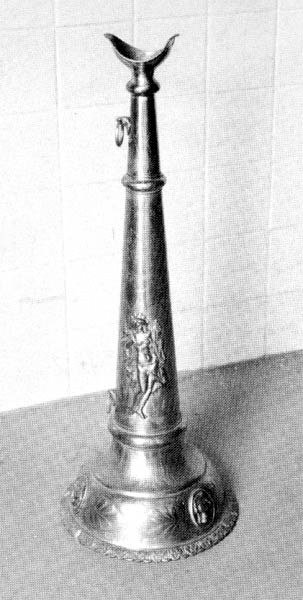
This ornately decorated presentation speaking trumpet is inscribed “Presented to W.P. Murray by the members of the Weccacoe Hose Co. No. 2 of Camden, N.J.” Wesley P. Murray served as Chief Marshal of the Fire Department of the City of Camden (volunteer) during 1868 and 1869. He was a highly regarded member of the Weccacoe Hose Company No. 2 and was most likely presented this fine specimen at that time. Courtesy of the Independent Fire Company, Maple Shade, New Jersey.
The Good Intent Steam Fire Engine Company and the William Penn Hose Company were the first Philadelphia companies to arrive on the scene to aid the Camden fire fighters. Steamers from the Mechanic, Philadelphia and Fame Fire Companies subsequently arrived and were followed by additional hose and hook & ladder companies. Good Intent’s steamer had to pass through a section of the burning building to reach a wharf from which to supply much needed water to combat the blaze. While doing so, it became jammed between a pair of shears. Fire fighters were successful in freeing the apparatus but not before the horses were badly singed.
Lost in the fire were seven puddling furnaces, four heating furnaces, one scrap furnace, twenty-two boilers, six steam powered drive engines, thirty-two nail machines, three trains of bar rollers and other machinery and stock.
After the Nickel Works fire in 1867 another, more destructive blaze occurred at the complex on Sunday night, July 12, 1868. Flames were discovered in the southwest corner of the main building and as firemen arrived, the fire was extending to several nearby occupied dwellings and to the roof of the mill’s power house. Fire fighters placed their apparatus effectively and were able to darken the flames on the power house roof and contain the blaze. The original fire building and the homes were destroyed. Damage was estimated at $30,000 to $40,000, far more than the $10,000 damage estimate of the earlier fire. Firemen had to contend with high temperatures and humidity as well as the heat from the blaze while quelling this mid-summer fire.
Still another destructive fire occurred less than a week later. About 5 P.M. the following Saturday, July 18, flames were discovered coming from the engine room of Goldey & Cohn’s large box factory on Taylor Avenue. Flames spread through the building, feeding on the highly combustible stock. The entire building was soon engulfed in fire as was the late R.H. Middleton’s brick stable. A brisk southwest wind carried the flames across Taylor Avenue to the company’s lumber pile and onward to Middleton’s warerooms at #7 South Second Street and also his two and one-half story frame dwelling at #5 South Second Street.
Chief Engineer Ayers realized that additional help was needed and telegraphed Chief McClusker of Philadelphia for assistance. The blaze was already threatening to consume the most densely populated and most valuable section of the City. Chief McClusker responded with steamers from the Vigilant and Hibernia Fire Companies, the Fairmount, Lafayette, Neptune, America and Diligent Hose Companies and the Empire Hook & Ladder Company.
As the firemen placed the steamers along the Delaware River and laid their hose lines, the fire spread to the Ware & Marshall meat and provision store, a two story brick property at #3 South Second Street and to a two and one-half story brick dwelling at #1 South Second Street (owned by Joab Scull and occupied by Charles Armstrong). These buildings were destroyed as was Joab Scull’s wood frame grocery store on the southwest corner of Second and Federal Streets and an adjacent three story brick dwelling (also owned by Scull but occupied by Mr. Goldey).
The fire continued to spread destroying Mr. Test’s frame drugstore and extending to the home of James M. Cassady, Esquire’s house at 128 Federal Street. Firemen were successful in saving Cassady’s residence from complete destruction. Although the property sustained heavy water damage, only the rear of the building was destroyed. The fire fighters continued their determined stand against the oncoming flames and were able to save the property of the late Samuel McLain which adjoined Cassady’s residence.
Conrad Hoell’s saloon at the corner of Second and Federal Streets and the adjoining building occupied by L.G. Peterson ignited several times, but the flames were quenched by what the West Jersey Press called the “superhuman exertions” of the fire fighters.
Several firemen were overcome by the intense heat, including Captain Wesley P. Murray and Joseph Flanigan of the Weccacoe Hose and Robert S. Bender, Thomas McCowan and Thomas Allibone of the Independence Steam Engine. These men had to be removed from the scene.
Combined losses exceeding $54,000 were reported as a result of this devastating conflagration. Chief Engineer Ayers praised the efforts of his men and the good work done by Chief McClusker and his forces from Philadelphia. The grateful citizens joined in this praise.
On the afternoon of Monday, September 14, 1868 about 2 P.M. Camden’s volunteers along with others from Philadelphia were called to an inferno at the Washington Manufacturing Company in Gloucester City. This huge blaze caused a half million dollars in losses and destroyed hose belonging to the Weccacoe and Shiffler Hose Companies of Camden. Both companies received compensation for the damaged hose from the owners of the manufacturing firm.
The Inception of the Paid Department
Rivalry and frequent insubordination in the volunteer department led to its demise. An example of these problems can be found in an article in the West Jersey Press on September 23, 1868:
The discordant elements belonging to the Independence and Shiffler fire companies have found a common ground of compromise and settled upon it as we learned from Chief Murray. Hereafter, we are to have no more bricks and paving stones flying around loose. Let us have peace, long and enduring.
As a case in point, someone had cut the Independence Fire Company’s hose during the Nickel Works fire and a $50.00 reward had been offered for the identity of the culprit(s).
Still, the citizens supported their volunteers and vehemently opposed the creation of a paid department. The community-at-large was proud of the service rendered to them by the volunteers and leery of the costs involved to create and maintain a paid force. The proposed downsizing of the department to only five pieces of apparatus and forty-one members was another cause for concern. Numerous meetings were held and many articles appeared in newspapers expressing concerns about, and opposition to, the paid department.
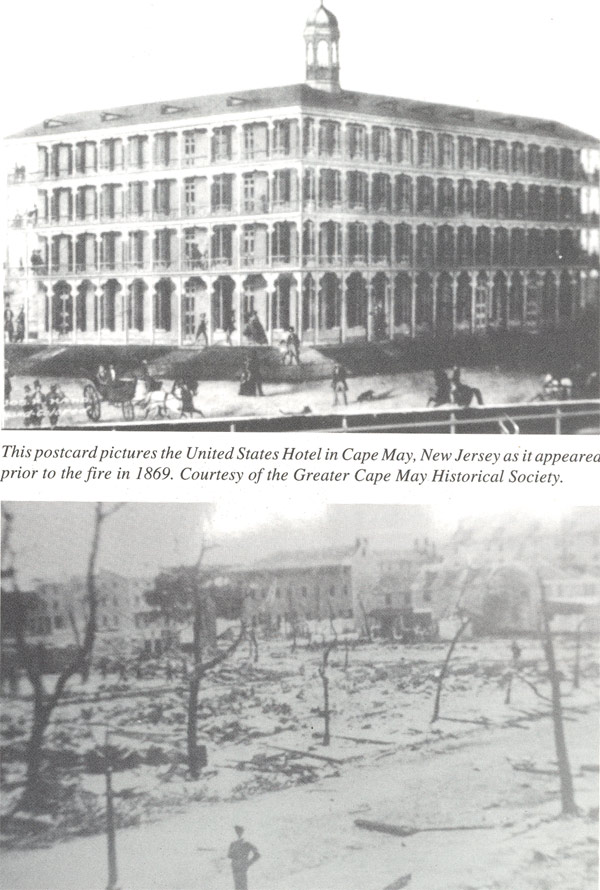
This early photo shows the devastation which resulted from the disastrous blaze at the United States Hotel in Cape May. The fire occurred on 8-31-1869. Courtesy of the Greater Cape May Historical Society.
Had the smaller paid department existed on August 31, 1869, Camden would not have been able to provide the much needed manpower and equipment to Cape May, New Jersey. On that day a conflagration threatened this shore resort at New Jersey’s southern most tip. An urgent call was received from the City of Cape May during the early morning hours.
A huge blaze, involving the famous United States Hotel and many other hotels, businesses and residences was burning out of control. Chief Murray dispatched the Shiffler and Independence steamers with 2000 feet of hose, the hook and ladder from the United States Fire Company, and manpower with apparatus from both the Weccacoe Engine and Hose companies to the Cape May fire. These units from Camden were sent 90 miles by special train where they “rendered gallant and efficient service in extinguishing the raging flames.” Camden’s citizens were proud that they could provide valuable service to neighbors in need, yet maintain adequate fire protection at home. This was something the proposed, much smaller paid department would not have been able to do.
Despite opposition, on September 2, 1869 City Council enacted a municipal ordinance creating a paid fire department. It provided for the annual appointment of five Fire Commissioners, one Chief Marshal (Chief of Department) and two Assistant Marshals. The City was also divided into two fire districts. The boundary line ran east and west, starting at Bridge Avenue and following the tracks of the Camden and Amboy Railroad to the city limits. District 1 was south of this line and District 2 was north. The commissioners also appointed the firemen who were scheduled to work six 24 hour tours per week. William Abels, from the Weccacoe Hose Company No. 2 was appointed Chief Marshal with William W. Mines, from the Independence Fire Company No. 3 as Assistant Marshal for the 1st District, and William H. Shearman as the Assistant Marshal for the 2nd District. Abels had served with the volunteer fire departments of Philadelphia, Mobile, Alabama and Camden for sixteen years prior to his appointment as Chief of the paid force.
The Camden Fire Department’s personnel roster, recorded when the department went into service, states that William Abels then lived at 218 Cooper Street, and that his previous occupation was that of a currier. A currier is a specialist in the leather processing industry. After the tanning process, the currier applies techniques of dressing, finishing and coloring to the tanned hide to make it strong, flexible and waterproof. The leather is stretched and burnished to produce a uniform thickness and suppleness, and dyeing and other chemical finishes give the leather its desired color. After currying, the leather is then ready to pass to the fashioning trades such as saddlery, bridlery, shoemaking and glovemaking.
On the morning of November 9, 1869 a fire destroyed nine frame dwellings at Cooper’s Point. Many of the occupants narrowly escaped death as flames spread rapidly. One resident, Mr. Elliot, was badly burned as were two of his children. His wife and mother were injured while escaping the flames. The steamer of the Weccacoe Hose Company overheated due to lack of water in the boiler and had to shut down. Steamers from the Weccacoe Engine Company and Shiffler supplied the hose streams that battled the blaze. An adjacent lumber yard owned by Perry & Packer was spared due to the efforts of firemen.
On November 10, 1869 City Council purchased the Independence Firehouse, the three-story brick building at 409 Pine Street, for $4500. The building was designated to serve as quarters for Engine Company 1 and the 1st District. On October 29, 1869 City Council authorized construction of a two-story brick building on the northwest corner of Fifth and Arch Streets as quarters for the 2nd District. On November 25th the Fire Commissioners signed a contract with M.N. Dubois in the amount of $3100 to erect this structure. The 2nd District would share these quarters with Engine Company 2 and the Hook & Ladder Company and the facility would also serve as department headquarters for the new paid force. The original contract remains part of the Camden County Historical Society collection.
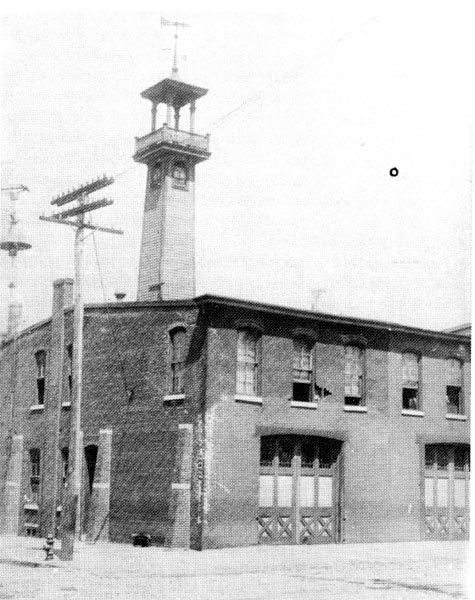
This is the earliest known photo of fire headquarters on the northwest corner of Fifth and Arch Streets. Originally built in 1869, the building shows signs of wear some twenty years later. Note the weathervane shaped like a fireman’s speaking trumpet atop the tower. Also, the fire alarm bell is pictured to the left of the telegraph pole above the rooftop. The bell was removed from the building once the fire alarm telegraph system was expanded and in good working order.
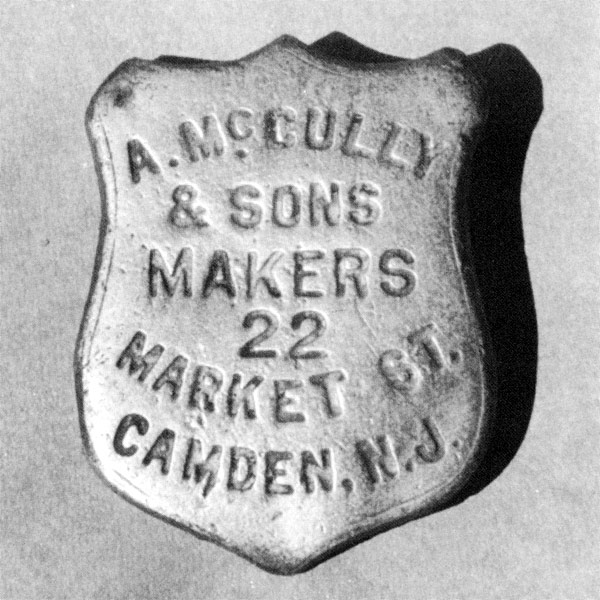
This maker’s plate once was attached to a harness made by A. McCully & Sons, 22 Market Street, Camden, New Jersey. This firm provided the first harnesses for the paid fire department in 1869.
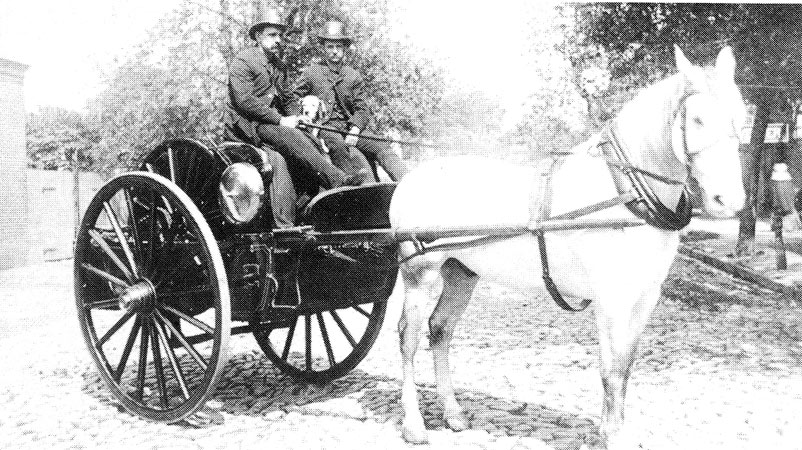
Engine Company 2 with 1869 Silsby Hose Cart. Photo Circa 1890. Note badges upon derby hats worn by Fire Fighters.
Two Amoskeag second class, double pump, straight frame steam engines were purchased at a cost of $4250 each. Two Silsby two wheel hose carts, each of which carried 1000 feet of hose, were another $550 each and the hook & ladder, built by Schanz and Brother of Philadelphia was $900. Each engine company received a steam engine and hose cart. Amoskeag serial #318 went to Engine Company 1, and serial #319 to Engine Company 2. The Fire Commission also secured the services of the Weccacoe and Independence steamers in case of fire prior to delivery of the new apparatus. Alfred McCully of Camden made the harnesses for the horses. Camden’s Twoes & Jones made the overcoats for the new firemen and a Mr. Morley, also of Camden, supplied the caps and belts which were manufactured by the Migeod Company of Philadelphia. The new members were also issued badges.
Badges worn by the marshals, engineers, stokers and engine drivers bore the initial letter of their respective positions and their district number. The tillerman and his driver used the number “3” to accompany their initial letter. The extra men of the 1st District were assigned badges 1–10; 2nd District badges were numbered 11–20 and the extra men of the hook & ladder wore numbers 21–30.
Although the Fire Commission intended to begin operation of the paid department on November 20, 1869, the companies did not actually enter service until December 7th at 6 P.M. because the new apparatus and buildings were not ready. The new apparatus was not tried (tested) until December 9th.
The new members of the paid force were:
Engine Company 1 Roster
Camden Fire Department Engine Company 1, 1869
Officers
| Name ↕ | Position ↕ | Badge ↕ |
|---|---|---|
| G. Rudolf Tenner | Engineer | |
| William H. Clark | Driver | |
| Thomas McLaughlin | Stoker |
Extra Men (Call Members)
| Name ↕ | Position ↕ | Badge ↕ |
|---|---|---|
| Thomas Allibone | Extra Man | 1 |
| William Deith | Extra Man | 2 |
| George Horneff | Extra Man | 3 |
| John J. Brown | Extra Man | 4 |
| William A.H. White | Extra Man | 5 |
| James Sutton | Extra Man | 6 |
| Cornelius M. Brown | Extra Man | 7 |
| Alexander Peacock | Extra Man | 8 |
| Samuel Buzine | Extra Man | 9 |
| Jesse Chew | Extra Man | 10 |
Engine Company 2 Roster
Camden Fire Department Engine Company 2, 1869
Officers
| Name ↕ | Position ↕ | Badge ↕ |
|---|---|---|
| William J. Ross | Engineer | |
| George Liebecke | Driver | |
| William T.G. Young Sr. | Stoker |
Extra Men
| Name ↕ | Position ↕ | Badge ↕ |
|---|---|---|
| Isaac Middleton | Extra Man | 11 |
| Samuel Patton | Extra Man | 12 |
| Elwood Cline | Extra Man | 13 |
| George W. Bates | Extra Man | 14 |
| Robert Pine | Extra Man | 15 |
| Theodore Zimmerman | Extra Man | 16 |
| Benjamin H. Connelly | Extra Man | 17 |
| Richard Houghtaling | Extra Man | 18 |
| Abraham Bradshaw | Extra Man | 19 |
| Richard Githens | Extra Man | |
| John Graham | Extra Man | 20 |
Hook & Ladder Company Roster
Camden Fire Department Hook & Ladder Company, 1869
Officers
| Name ↕ | Position ↕ | Badge ↕ |
|---|---|---|
| Edward J. Dodamead | Tillerman | |
| Frank S. Jones | Driver |
Extra Men
| Name ↕ | Position ↕ | Badge ↕ |
|---|---|---|
| Charles Baldwin | Extra Man | 21 |
| Charles G. Zimmerman | Extra Man | 22 |
| John Durkin | Extra Man | 23 |
| William C. Lee | Extra Man | 24 |
| James M. Lane | Extra Man | 25 |
| James Cassidy | Extra Man | 26 |
| Robert S. Bender | Extra Man | 27 |
| Thomas McCowan | Extra Man | 28 |
| Howard Lee | Extra Man | 29 |
| Abraham Lower | Extra Man | 30 |
Charles G. Zimmerman was the brother-in-law of Chief Abels, married to the Chief’s sister Keturah. Charles G. Zimmerman’s brother Theodore Zimmerman also was a charter member, serving with Engine Company 2.
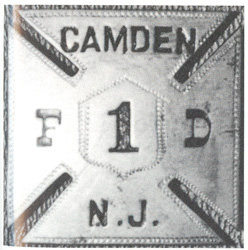
The first style of breast badge worn by members of the career department in the City of Camden. 1869. (Courtesy of the C.C.H.S. Collection).
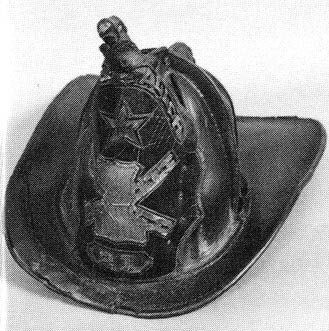
Leather helmet of natural grain believed to have been worn by Fireman Charles Baldwin, Hook & Ladder Company 1 when paid force was organized in 1869. Number 21 at bottom of frontpiece indicates member’s badge number. (Courtesy of the Camden County Historical Society Collection.)
The Board of Fire Commissioners consisted of Rudolphus Bingham, Chairman and Samuel C. Harbert, Richard Perks, Jonathon Kirkbride and Jacob Daubman.
Annual salaries for the members of the paid force were: Chief Marshal, $800; Assistant Marshal, $200; Engineer, $600; Driver, $450; Stoker, $450; Tillerman, $450; Extra Men, $50. All but Extra Men were paid monthly.
Many members of the newly organized paid department were former volunteers and had distinguished themselves as leaders through their dedication and hard work.
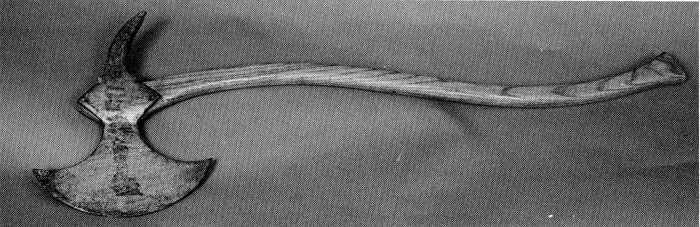
This fireman’s axe, Circa 1870, was removed from the basement of a building in the City of Camden many years ago. With handle missing, a replacement handle was modeled after the original and crafted by Mr. George Homan, a retired wood shop teacher at Collingswood High School.
As for the long reign of the volunteer fire companies, their era had ended. The Shiffler sold its “Blue Dick” in 1869 to Dr. Schenk for service at his laboratory at Schenk’s Station, Pennsylvania (the well known Mandrake Pills were made there). In 1870 Shiffler sold its white hose carriage to a company in Lawrence, Massachusetts. The American Hose Company of Trenton, New Jersey purchased the Shiffler steam engine, had it rebuilt, and the apparatus saw many more years of service. The Shiffler boys traveled to Lancaster, Pennsylvania in November 1870 and presented whatever property remained to their namesakes in that city. The Shiffler Firehouse was sold to Washington Chew who converted it into a tavern. For several years the tavern was a favorite meeting place for the Shiffler boys.
In October 1869, the Independence sold its newer carriage to the City of Rahway, New Jersey for use by its Washington Fire Company. Two months later, Independence sold its first Amoskeag steamer and old hose carriage with 800 feet of hose to Millville, New Jersey. In May 1871, Millville sold the steamer to the Friendship Engine and Hose Company No. 1 of Chambersburg, Pennsylvania. The steamer remained in service until 1911 and was scrapped the following year. The Independence Firehouse had been purchased by the City of Camden as quarters for Engine Company 1 of the new department.
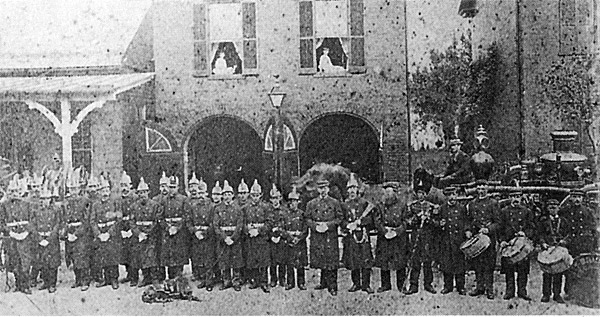
Photo taken 5-20-1871 in front of the Friendship Engine & Hose Company No. 1 of Chambersburg, PA. The steam engine on the right has just arrived after being purchased from Millville, N.J. This apparatus was originally purchased by the Independence Fire Company No. 3 of Camden in June 1864. It was a class two Amoskeag steamer bearing serial No. 92. Independence sold the apparatus to Millville in 1869.
In December 1873 Independence offered to sell its second class Gould steam engine to the City for $1200. The engine had cost $5250 when built in 1869. A short time later City Council accepted the offer. Independence disbanded on October 13, 1874 with a membership of sixty men; Edward Gilbert was President.
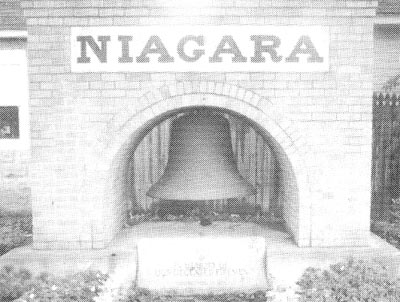
This memorial is dedicated to the deceased members of the Niagara Fire Company of Merchantville, New Jersey. The bell in the center of the memorial once adorned the tower of the Weccacoe Engine Company No. 2 of Camden, New Jersey. The firehouse was located at 517 Plum Street, now Arch Street. The bell has been in the possession of the Niagara Fire Company since 1896 when it was purchased to sound the alarm of fire in Merchantville. Courtesy of the Niagara Fire Company, Merchantville, New Jersey.
The Weccacoe Engine Company sold its Amoskeag to Amsterdam, New York and its firehouse to John Pfeiffer who converted it to a hotel. The company disbanded, as did the United States Fire Company, when the paid department entered service. The bell which hung in the tower of the firehouse was sold to the Niagara Fire Company of Merchantville, New Jersey in 1885. The bell was mounted in that company’s tower and, today, remains the property of the Niagara Fire Company. The cost of the bell was $50.00.
The Weccacoe Hose sold its hose carriage and 500 feet of hose to the Western Hose Company of Wilmington, Delaware on December 4, 1869 at which time the Wilmington company changed its name to Weccacoe Hose Company. Camden’s Weccacoe Hose sold its steam engine to Brinton & Henderson of Philadelphia in 1870. The fire company had planned to payoff the debt on its new steamer through subscriptions but with the advent of the paid department, this plan went awry. Nevertheless, the members were determined to retire this debt and raised funds until final payment of $14.25 was made on September 8, 1883.
In January of 1871 Bordentown, New Jersey purchased a hose cart from the Weccacoe Hose Company No. 2 of Camden and named their newly organized hose company after the Camden Company.
Department records indicate that on Thursday night, December 30, 1869 the paid force responded to its first fire at the R.M. English & Company oil-cloth factory at Cooper’s Point. The plant only recently had begun operation. The paid firemen performed admirably under the direction of Chief Marshal William Abels. Although one of the main buildings was destroyed, the fire fighters were able to limit damage to the other buildings. The blaze, which resulted in a loss of $30,000, was thought to have been caused by a defective flue.
The second major fire to confront the new department occurred on Christmas morning, 1870. Fire destroyed St. John’s Episcopal Church at Broadway and Royden Streets. The church had once been a floating chapel for seamen on the Delaware River. Within an hour the church burned to the ground. Several years later, in 1892, the new church building would also be destroyed by fire.
City Council and contractor Abraham Lower entered into a contract on May 16, 1870 that called for Lower to erect a brick stable adjoining the quarters of Engine Company 1 at 409 Pine Street. The contract amount was $1650. The original contract remains the property of the Camden County Historical Society.
William Abels was politically active, however, he ran into some legal difficulty in January of 1871 involving a dispute over a glass factory purchased by then Sheriff Randall Morgan.
William Abels served as Chief Marshal until his replacement on September 2, 1871. City Council appointed Robert S. Bender as his successor while the Assistant Marshals remained the same.
William Abels was elected to Camden’s City Council in 1878, and was made President of that body in 1880. He served in that capacity for one year. No occupation is given in the 1880 Census records, nor is one given in later City Directory listings. The 1880 Census shows him living at 126 Cooper Street with his wife Sarah and three children—Marie, a teacher, Charles, an artist’s student, and Belle, at school.
By 1884 William Abels had been appointed Postal Inspector. His address was listed at 105 Penn Street in the 1887–1888 and 1888–1889 City Directories. While his mother and father continued to reside in Camden for many years thereafter, William Abels, his wife and children were not listed in the 1890–1891 City Directories and had apparently left the city. He was in the area in November of 1897 when he took part in a Thanksgiving parade in Stockton, the town that was made up of what is today referred to as East Camden and Cramer Hill.
William Abels passed away on June 17, 1899 at Interlaken, New Jersey, near Asbury Park. After services at the home of his son-in-law, Joseph Sweeten, 104 North 6th Street, William Abels was buried at Colestown Cemetery in Delaware Township (present day Cherry Hill), New Jersey.
William Abels’ younger sister, Keturah, was married to innkeeper and original Camden Fire Department member Charles G. Zimmerman.
Indigent and Disabled Firemen.
Philadelphia Inquirer —
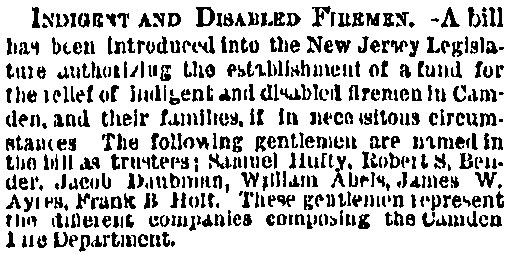
INDIGENT AND DISABLED FIREMEN. —A bill has been introduced into the New Jersey Legislature authorizing the establishment of a fund for the relief of indigent and disabled firemen in Camden, and their families, if in necessitous circumstances. The following gentlemen are named in the bill as trustees: Samuel Hufty, Robert S. Bender, Jacob Daubman, William Abels, James W. Ayers, Frank B. Holt. These gentlemen represent the different companies composing the Camden Fire Department.
Conspiracy.
Philadelphia Inquirer —
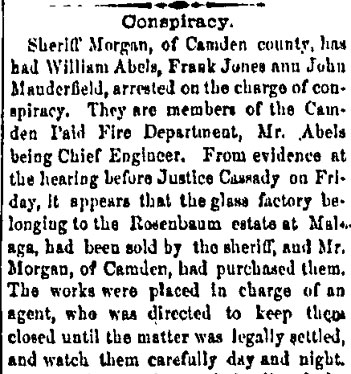
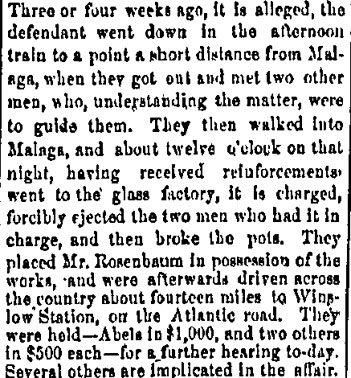
Sheriff Morgan, of Camden county, has had William Abels, Frank Jones and John Manderfield, arrested on the charge of conspiracy. They are members of the Camden Paid Fire Department, Mr. Abels being Chief Engineer. From evidence at the hearing before Justice Cassady on Friday, it appears that the glass factory belonging to the Rosenbaum estate at Malaga, had been sold by the sheriff, and Mr. Morgan, of Camden, had purchased them. The works were placed in charge of an agent, who was directed to keep them closed until the matter was legally settled, and watch them carefully day and night.
Three or four weeks ago, it is alleged, the defendant went down in the afternoon train to a point a short distance from Malaga, when they got out and met two other men, who, understanding the matter, were to guide them. They then walked into Malaga, and about twelve o’clock on that night, having received reinforcements, went to the glass factory, it is charged, forcibly ejected the two men who had it in charge, and then broke the pots. They placed Mr. Rosenbaum in possession of the works, and were afterwards driven across the country about fourteen miles to Winslow Station, on the Atlantic road. They were held—Abels in $1,000, and two others in $500 each—for a further hearing to-day. Several others are implicated in the affair.
Over the River.
Philadelphia Inquirer —
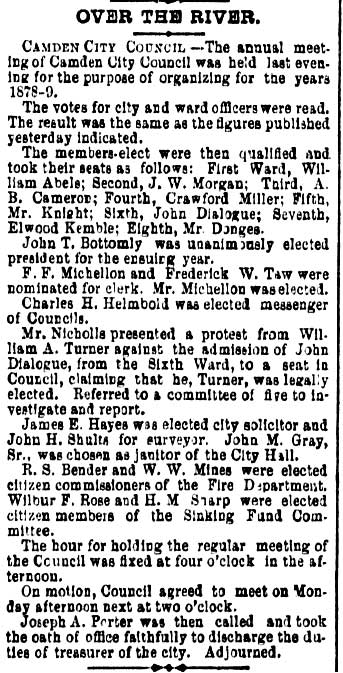
CAMDEN CITY COUNCIL—The annual meeting of Camden City Council was held last evening for the purpose of organizing for the years 1878–9.
The votes for city and ward officers were read. The result was the same as the figures published yesterday indicated.
The members-elect were then qualified and took their seats as follows: First Ward, William Abels; Second, J. W. Morgan; Third, A. B. Cameron; Fourth, Crawford Miller; Fifth, Mr. Knight; Sixth, John Dialogue; Seventh, Elwood Kemble; Eighth, Mr. Donges.
John T. Bottomly was unanimously elected president for the ensuing year.
F. F. Michellon and Frederick W. Taw were nominated for clerk. Mr. Michellon was elected.
Charles H. Helmbold was elected messenger of Councils.
Mr. Nichols presented a protest from William A. Turner against the admission of John Dialogue, from the Sixth Ward, to a seat in Council, claiming that he, Turner, was legally elected. Referred to a committee of five to investigate and report.
James E. Hayes was elected city solicitor and John H. Shultz for surveyor. John M. Gray, Sr., was chosen as janitor of the City Hall.
R. S. Bender and W. W. Mines were elected citizen commissioners of the Fire Department. Wilbur F. Rose and H. M. Sharp were elected citizen members of the Sinking Fund Committee.
The hour for holding the regular meeting of the Council was fixed at four o’clock in the afternoon.
On motion, Council agreed to meet on Monday afternoon next at two o’clock.
Joseph A. Porter was then called and took the oath of office faithfully to discharge the duties of treasurer of the city. Adjourned.
Over the River.
Philadelphia Inquirer —
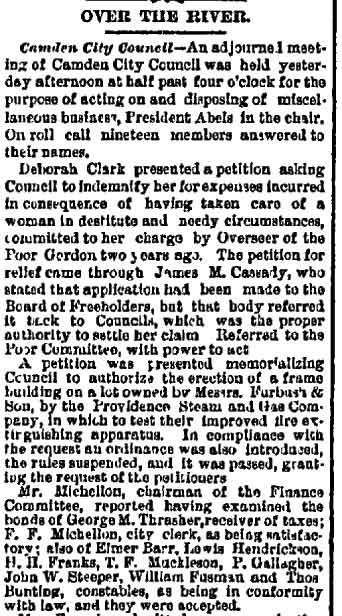
Camden City Council—An adjourned meeting of Camden City Council was held yesterday afternoon at half past four o’clock for the purpose of acting on and disposing of miscellaneous business, President Abels in the chair. On roll call nineteen members answered to their names.
Deborah Clark presented a petition asking Council to indemnify her for expenses incurred in consequence of having taken care of a woman in destitute and needy circumstances, committed to her charge by Overseer of the Poor Gordon two years ago. The petition for relief came through James M. Cassady, who stated that application had been made to the Board of Freeholders, but that body referred it back to Councils, which was the proper authority to settle her claim. Referred to the Poor Committee, with power to act.
A petition was presented memorializing Council to authorize the erection of a frame building on a lot owned by Messrs. Furbush & Son, by the Providence Steam and Gas Company, in which to test their improved fire extinguishing apparatus. In compliance with the request an ordinance was also introduced, the rules suspended, and it was passed, granting the request of the petitioners.
Mr. Michellon, chairman of the Finance Committee, reported having examined the bonds of George M. Thrasher, receiver of taxes; F. F. Michellon, city clerk, as being satisfactory; also of Elmer Barr, Lewis Hendrickson, H. H. Franks, T. F. Muckleson, P. Gallagher, John W. Steeper, William Fosman and Thos Bunting, constables, as being in conformity with law, and they were accepted.
Postal Inspector Hurt.
Philadelphia Inquirer —
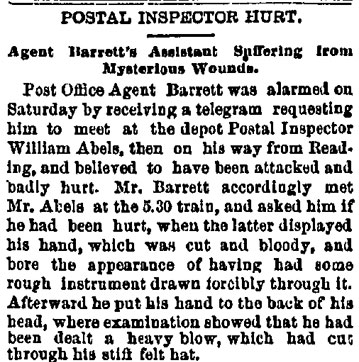
Agent Barrett’s Assistant Suffering from Mysterious Wounds.
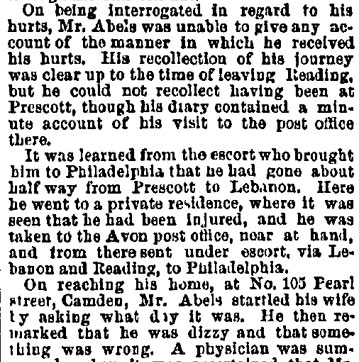
Post Office Agent Barrett was alarmed on Saturday by receiving a telegram requesting him to meet at the depot Postal Inspector William Abels, then on his way from Reading, and believed to have been attacked and badly hurt. Mr. Barrett accordingly met Mr. Abels at the 5.30 train, and asked him if he had been hurt, when the latter displayed his hand, which was cut and bloody, and bore the appearance of having had some rough instrument drawn forcibly through it. Afterward he put his hand to the back of his head, where examination showed that he had been dealt a heavy blow, which had cut through his stiff felt hat.
On being interrogated in regard to his hurts, Mr. Abels was unable to give any account of the manner in which he received his hurts. His recollection of his journey was clear up to the time of leaving Reading, but he could not recollect having been at Prescott, though his diary contained a minute account of his visit to the post office there.
It was learned from the escort who brought him to Philadelphia that he had gone about half way from Prescott to Lebanon. Here he went to a private residence, where it was seen that he had been injured, and he was taken to the Avon post office, near at hand, and from there sent under escort, via Lebanon and Reading, to Philadelphia.
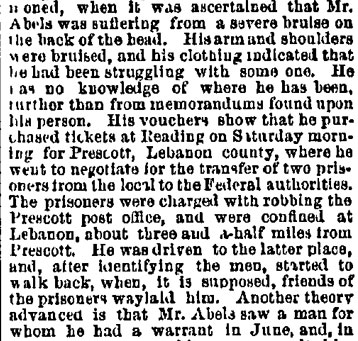
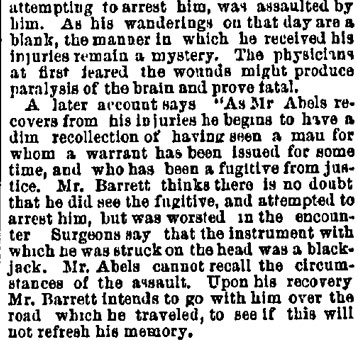
On reaching his home, at No. 105 Pearl street, Camden, Mr. Abels startled his wife by asking what day it was. He then remarked that he was dizzy and that something was wrong. A physician was summoned, when it was ascertained that Mr. Abels was suffering from a severe bruise on the back of the head. His arm and shoulders were bruised, and his clothing indicated that he had been struggling with some one. He had no knowledge of where he has been, further than from memorandums found upon his person. His vouchers show that he purchased tickets at Reading on Saturday morning for Prescott, Lebanon county, where he went to negotiate for the transfer of two prisoners from the local to the Federal authorities. The prisoners were charged with robbing the Prescott post office, and were confined at Lebanon, about three and a-half miles from Prescott. He was driven to the latter place, and, after identifying the men, started to walk back, when, it is supposed, friends of the prisoners waylaid him. Another theory advanced is that Mr. Abels saw a man for whom he had a warrant in June, and, in attempting to arrest him, was assaulted by him. As his wanderings on that day are a blank, the manner in which he received his injuries remain a mystery. The physicians at first feared the wounds might produce paralysis of the brain and prove fatal.
A later account says “As Mr. Abels recovers from his injuries he begins to have a dim recollection of having seen a man for whom a warrant has been issued for some time, and who has been a fugitive from justice. Mr. Barrett thinks there is no doubt that he did see the fugitive, and attempted to arrest him, but was worsted in the encounter. Surgeons say that the instrument with which he was struck on the head was a blackjack. Mr. Abels cannot recall the circumstances of the assault. Upon his recovery Mr. Barrett intends to go with him over the road which he traveled, to see if this will not refresh his memory.”
Firemen Own Stockton.
Philadelphia Inquirer —
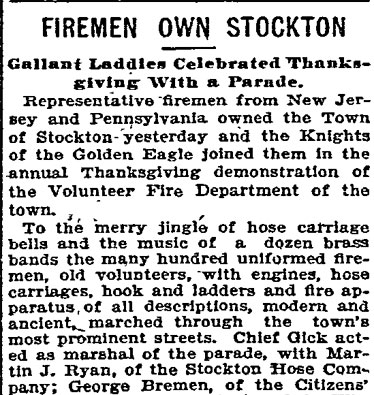
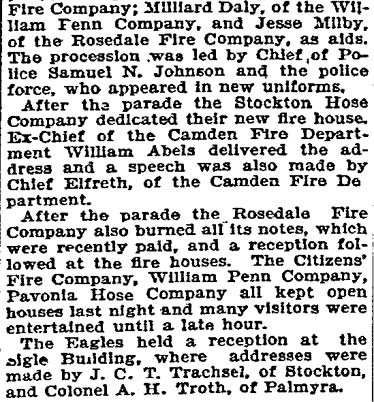
Gallant Laddies Celebrated Thanksgiving With a Parade.
Representative firemen from New Jersey and Pennsylvania owned the Town of Stockton yesterday and the Knights of the Golden Eagle joined them in the annual Thanksgiving demonstration of the Volunteer Fire Department of the town.
To the merry jingle of hose carriage bells and the music of a dozen brass bands the many hundred uniformed firemen, old volunteers, with engines, hose carriages, hook and ladders and fire apparatus of all descriptions, modern and ancient, marched through the town’s most prominent streets. Chief Gick acted as marshal of the parade, with Martin J. Ryan, of the Stockton Hose Company; George Bremen, of the Citizens’ Fire Company; Milliard Daly, of the William Penn Company, and Jesse Milby, of the Rosedale Fire Company, as aids. The procession was led by Chief of Police Samuel N. Johnson and the police force, who appeared in new uniforms.
After the parade the Stockton Hose Company dedicated their new fire house. Ex-Chief of the Camden Fire Department William Abels delivered the address and a speech was also made by Chief Elfreth, of the Camden Fire Department.
After the parade the Rosedale Fire Company also burned all its notes, which were recently paid, and a reception followed at the fire houses. The Citizens’ Fire Company, William Penn Company, Pavonia Hose Company all kept open houses last night and many visitors were entertained until a late hour.
The Eagles held a reception at the Sigle Building, where addresses were made by J. C. T. Trachsel, of Stockton, and Colonel A. H. Troth, of Palmyra.
Death Notice.
Philadelphia Inquirer —
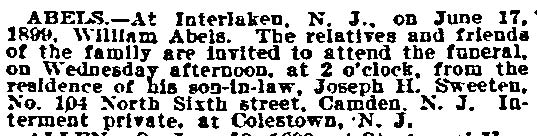
ABELS.—At Interlaken, N. J., on June 17, 1899, William Abels. The relatives and friends of the family are invited to attend the funeral, on Wednesday afternoon, at 2 o’clock, from the residence of his son-in-law, Joseph H. Sweeten, No. 104 North Sixth street, Camden, N. J. Interment private, at Colestown, N. J.