Henry F. Surault
HENRY F. SURAULT served as the third Chief of the Camden Fire Department, taking charge when Robert S. Bender took a leave of absence in September of 1872.
Henry F. Surault was born in Massachusetts in August of 1838 to Francois and Sarah Surault. The family had come to Camden by 1860. The Census shows them living in Camden’s Middle Ward, where Francis Surault, born in France, was a language teacher, and had written and published a number of books on the subject. Henry Surault worked as a silver plater.
On April 25, 1861 Henry F. Surault enlisted in the Union Army as a Corporal. He was assigned to Company G, Fourth Infantry Regiment New Jersey on April 27, 1861.
The Fourth Regiment—Militia, was commanded by Colonel Matthew Miller, Jr., serving under him were Lieutenant Colonel Simpson R. Stroud and Major Robert C. Johnson. This regiment was mustered into the U. S. service at Trenton, April 27, 1861, to serve for three months, and left the state for Washington, D. C., on May 3, with 37 commissioned officers and 743 non-commissioned officers and privates, a total of 777. On the evening of May 5 it reached the capital, and on the 9th it was ordered to go into camp at Meridian hill, where, within a few days the entire brigade was encamped, and where, on the 12th, it was honored by a visit from the president, who warmly complimented the appearance of the troops. On the evening of May 23 it joined the 2nd and 3d regiments and about midnight took up the line of march in silence for the bridge that spanned the Potomac. This bridge was crossed at 2 o’clock on the morning of the 24th, the 2nd was posted at Roach’s spring, and the 3d and 4th about half a mile beyond on the Alexandria road. On July 16, a guard was detailed from the 4th for a section of the Orange & Alexandria railroad, which it was important to hold; one company from the regiment guarded the Long bridge; still another was on duty at Arlington mills; and the remainder of the regiment, together with the 2nd, was ordered to proceed to Alexandria. On July 24, the term of service having expired, the 4th returned to New Jersey and was mustered out at Trenton, July 31, 1861. The total strength of the regiment was 783, and it lost by discharge 6, by promotion 2, by death 2 and by desertion 7, mustered out, 766.
Henry F. Surault was among those who mustered out with Company G, Fourth Infantry Regiment New Jersey on July 31, 1861 at Trenton, NJ.
Several men who served with Company G became members of the Camden Fire Department after it was founded in 1869, including William Mines, J. Kelly Brown, Benjamin Cavanaugh, Edward Mead, William Cox, James M. Lane, and William Gleason. Other Fourth Infantry men who served included Theodore A. Zimmerman, Charles G. Zimmerman, William C. Lee, George B. Anderson, Jesse Chew, William H.H. Clark, Cornelius M. Brown, John J. Brown, Benjamin Connelly, and G. Rudolph Tenner. Several other Fourth Infantry veterans played significant roles in Camden in the ensuing years.
If they hadn’t already been involved, Henry Surault and several of his companions became involved in volunteer firefighting in Camden.
On September 2, 1869 City Council enacted a municipal ordinance creating a paid fire department. It provided for the annual appointment of five Fire Commissioners, one Chief Marshal (Chief of Department) and two Assistant Marshals. The City was also divided into two fire districts. The boundary line ran east and west, starting at Bridge Avenue and following the tracks of the Camden and Amboy Railroad to the city limits. District 1 was south of this line and District 2 was north. The commissioners also appointed the firemen who were scheduled to work six 24 hour tours per week. William Abels, from the Weccacoe Hose Company No. 2 was appointed Chief Marshal with William W. Mines, from the Independence Fire Company No. 3 as Assistant Marshal for the 1st District, and William H. Shearman as the Assistant Marshal for the 2nd District. Abels had served with the volunteer fire departments of Philadelphia, Mobile, Alabama and Camden for sixteen years prior to his appointment as Chief of the paid force.
When the 1870 Census was taken, Henry Surault was working as a salesman. He was married, and his wife Merinda had a son from a previous marriage, William H. Brassell, born in Pennsylvania around 1854. They were living with his parents at 549 South 2nd Street. The Suraults lived next door to Claudius Bradshaw, and three doors away from Abraham Bradshaw. Claudius Bradshaw would serve as the Chief of the Camden Fire Department before the decade ended, and was elected Mayor of Camden twice after that. Abraham Bradshaw was one of the original members of the Camden Fire Department, serving with Engine Company 2.
Chief Abels was replaced by Robert S. Bender as Chief of the Fire Department on September 2, 1871. When Bender took a leave of absence in September of 1872, despite a petition for him to be kept on as chief, Henry F. Surault was elected by city council to lead the department. Patrick Gallagher and Isaac McKinley were appointed Assistant Chiefs, replacing Assistant Chiefs William W. Mines and William H. Shearman. A greater crisis occurred on October 8, 1872 when most of the regular members of Engine Company 2 resigned at once. Replacements were found quickly, although in a few cases the first ones brought in did not work out and another man was needed to replace the original replacement. John J. Olden was also brought in as Assistant Chief of the Second Fire District in November, replacing Patrick Gallagher.
On a positive note, during his time in the Department henry f. surault convinced the Fire Commission to purchase hand extinguishers which he then placed strategically at Mr. Paul Anderson’s, Broadway and Kaighns Point Avenue; J.S. Henry’s office at Eighth and Walnut Streets; William Ross’ store on Central Avenue; and at the Flat Iron Tavern (and Hotel) at Broadway and Ferry Avenue. Each location received one fire extinguisher.
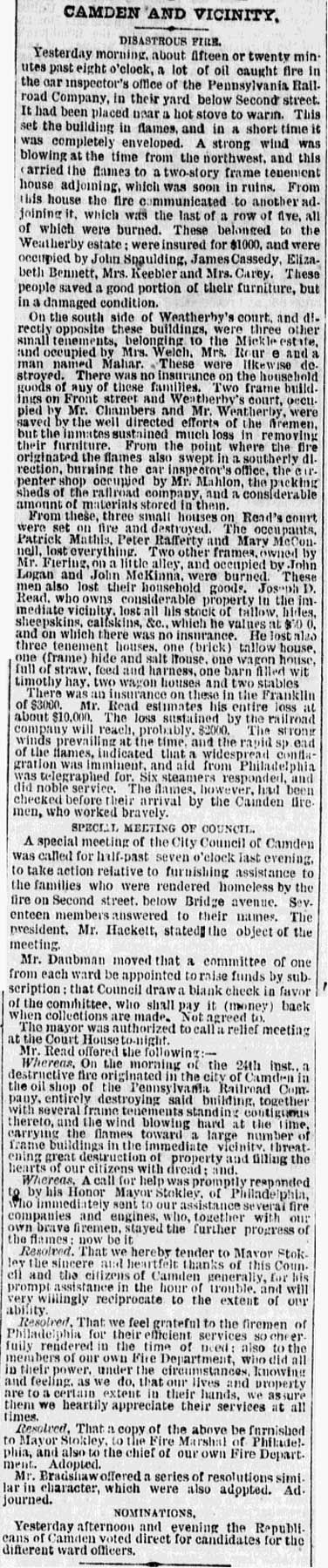
The Camden Fire Department fought a devastating fire which began on the Morning of February 24, 1873 when a railroad employee dropped a match in the inspector’s room of a railway building on South 2nd Street below Bridge Avenue. Within minutes the oil soaked floor ignited and flames engulfed the structure. Strong northwest winds extended the fire to a storage shed filled with freight. Responding fire companies could not stop the rapidly spreading fire. Five frame dwellings on the north side of Weathersby’s Court, some sheds in the railroad car yard, three frame dwellings on Reed’s Court, two additional dwellings and numerous outbuildings became involved. Chief Surault telegraphed to Philadelphia for six engine companies which responded by special ferry. Three apparatus were placed in service while the balance of the manpower was used for fire control.
Robert S. Bender returned to the Camden Fire Department in April of 1873. seven experienced men who had resigned were reappointed on April 8, 1873 — Engineers G. Rudolph Tenner and William S. Davis, Stokers Henry Grosscup and William Gordon, Drivers George Leibecke and Jacob Kellum, and Tillerman Edward Dodamead. Another driver, William Young, also began that day.
The 1878 City Directory shows Henry Surault working as a laborer. The 1879–1880 Directory indicates that he took another career path as he was working aboard ship as a deck hand. He was still living at 549 South 2nd Street when the 1879 Directory was compiled.
1880 Census shows Henry Surault and family at 547 South 2nd Street. He was then working as a laborer. Also at home were his widowed mother Sarah, wife Merinda, step-son William H. Brassell, 16, and a boarder, Thomas McCann, 17.
The 1881–1882 Directory shows Henry Surrault and step-son William, who had taken the Surrault name, as deck hands, living at 412 Mickle Street. Henry Surault was still at 412 Mickle Street in the 1882–1883 Directory. William had moved to 443 South 2nd Street and was working as a laborer. The 1883–1884 Directory has both men living at 412 Mickle Street once again. Henry F. Surault is now listed as a Captain, working for the Pennsylvania Railroad. Later directories indicate that he was the captain of one of the Pennsylvania Rail Road’s tug boats. William Surault left Camden by 1887. Henry Surault was still living at 412 Mickle Street as late as 1888.
The 1890–1891 Directory shows that Henry Surault had moved to 546 South 2nd Street. he was still working as a tugboat captain, and also had a cigar store. The cigar store venture did not pan out, however. By 1892 Henry Surault had moved to 450 South 2nd Street and was working exclusively as a tugboat captain for the Pennsylvania Railroad. He was still at that address into late 1893. The 1897 Directory shows Henry Surault at 301 Stevens Street. The 1898 Directory states that he lived at 754 Federal Street.
The 1900 Census shows Henry Surault still employed as a tugboat pilot. He was by then a widower, and was boarding with James Finnan, a telegraph lineman, and his wife Mary. James Finnan had lived in the same neighborhood as Henry Surault for many years.
By 1906 Henry Surault and the Finnans had left Camden. The Finnans had moved to Fieldsboro, in Burlington County, New Jersey. Henry Surault went with them, and boarded with them. The Census for 1910 lists the Finnans and Henry Surault in Fieldsboro. The 1920 Census shows that James Finnan had passed away. His widow, Mrs. Mary Finnan, and Henry Surault, then 81 years of age, were living in Finnan’s Court in Fieldsboro. Both apparently passed away during the 1920s.
Henry F. Surault was buried at Old Camden Cemetery. His tombstone recognizes his Civil War service, unfortunately, it is undated.
New Jersey Matters
Philadelphia Public Ledger —
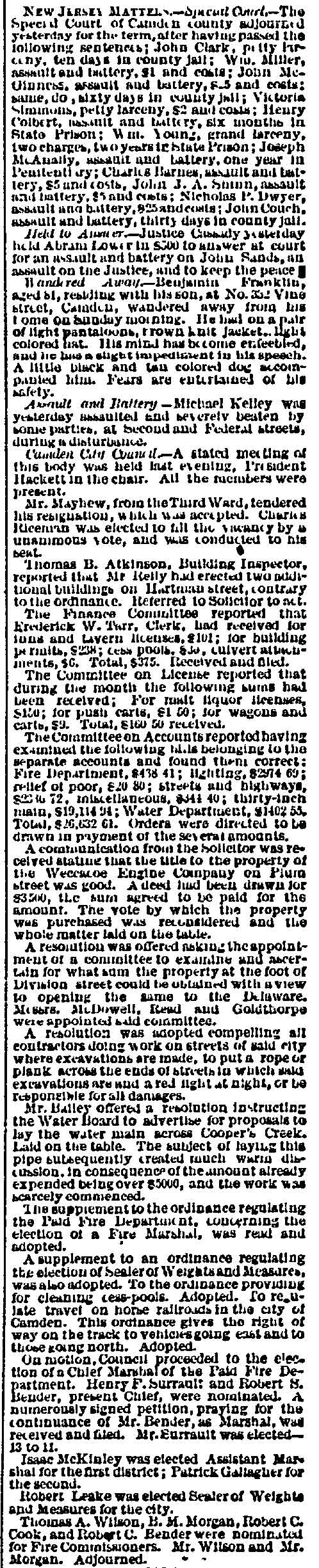
Camden City Council.—A stated meeting of this body was held last evening, President Hackett in the chair. All the members were present.
Mr. Mayhew, from the Third Ward, tendered his resignation, which was accepted. Charles [?]icenman was elected to fill the vacancy by a unanimous vote, and was conducted to his seat.
Thomas B. Atkinson, Building Inspector, reported that Mr. Kelly had erected two additional buildings on Hartman street, contrary to the ordinance. Referred to Solicitor to act.
The Finance Committee reported that Frederick W. Tarr, Clerk, had received for inns and tavern licenses, $101; for building permits, $238; cess pools, $30, culvert abatements, $6. Total, $375. Received and filed.
The Committee on License reported that during the month the following sums had been received; For malt liquor licenses, $150; for push carts, $1.50; for wagons and carts, $9. Total, $160.50 received.
The Committee on Accounts reported having examined the following bills belonging to the separate accounts and found them correct; Fire Department, $438.41; lighting, $2974.69; relief of poor, $[?]20.80; streets and highways, $[?]; miscellaneous, $[?]41.40; thirty-inch main, $19,114.94; Water Department, $3402.55. Total, $26,632.61. Orders were directed to be drawn in payment of the several amounts.
A communication from the Solicitor was received stating that the title to the property of the Weccacoe Engine Company on Plum street was good. A deed had been drawn for $[?]; the sum agreed to be paid for the amount. The vote by which the property was purchased was reconsidered and the whole matter laid on the table.
A resolution was offered asking the appointment of a committee to examine and ascertain for what sum the property at the foot of Division street could be obtained with a view to opening the same to the Delaware. Messrs. McDowell, Read and Goldthorpe were appointed said committee.
A resolution was adopted compelling all contractors doing work on streets of said city where excavations are made, to put a rope or plank across the ends of streets in which said excavations are and a red light at night, or be responsible for all damages.
Mr. Bailey offered a resolution instructing the Water Board to advertise for proposals to lay the water main across Cooper’s Creek. Laid on the table. The subject of laying this pipe subsequently created much warm discussion, in consequence of the amount already expended being over $5000, and the work was scarcely commenced.
The supplement to the ordinance regulating the Paid Fire Department, concerning the election of a Fire Marshal, was read and adopted.
A supplement to an ordinance regulating the election of Sealer of Weights and Measures, was also adopted. To the ordinance providing for cleaning cess-pools. Adopted. To regulate travel on horse railroads in the city of Camden. This ordinance gives the right of way on the track to vehicles going east and to those going north. Adopted.
On motion, Council proceeded to the election of a Chief Marshal of the Paid Fire Department. Henry F. Surrault and Robert S. Bender, present Chief, were nominated. A numerously signed petition, praying for the continuance of Mr. Bender, as Marshal, was received and filed. Mr. Surrault was elected—13 to 11.
Isaac McKinley was elected Assistant Marshal for the first district; Patrick Gallagher for the second.
Robert Leake was elected Sealer of Weights and Measures for the city.
Thomas A. Wilson, B. M. Morgan, Robert C. Cook, and Robert C. Bender were nominated for Fire Commissioners. Mr. Wilson and Mr. Morgan. Adjourned.
From the New Chief of the Camden Fire Department
Philadelphia Inquirer —
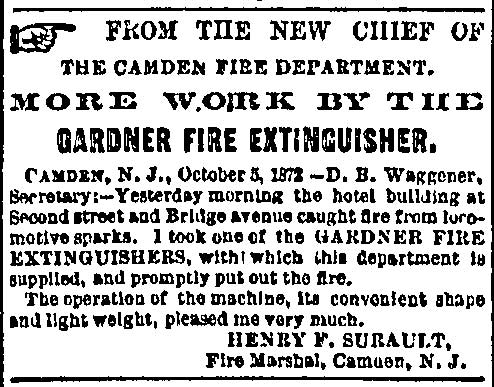
More Work by the Gardner Fire Extinguisher
CAMDEN, N. J., October 5, 1872.—D. B. Waggener, Secretary:—Yesterday morning the hotel building at Second street and Bridge avenue caught fire from locomotive sparks. I took one of the GARDNER FIRE EXTINGUISHERS, with which this department is supplied, and promptly put out the fire.
The operation of the machine, its convenient shape and light weight, pleased me very much.
HENRY F. SURAULT,
Fire Marshal, Camden, N. J.
From the New Chief of the Camden Fire Department
Philadelphia Inquirer —
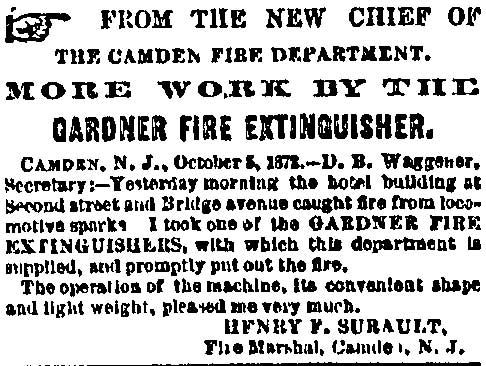
More Work by the Gardner Fire Extinguisher
CAMDEN, N. J., October 8, 1872.—D. B. Waggener, Secretary:—Yesterday morning the hotel building at Second street and Bridge avenue caught fire from locomotive sparks. I took one of the GARDNER FIRE EXTINGUISHERS, with which this department is supplied, and promptly put out the fire.
The operation of the machine, its convenient shape and light weight, pleased me very much.
HENRY F. SURAULT,
Fire Marshal, Camden, N. J.
New Jersey Matters.
Philadelphia Public Ledger —
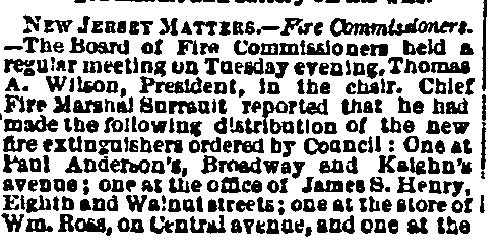
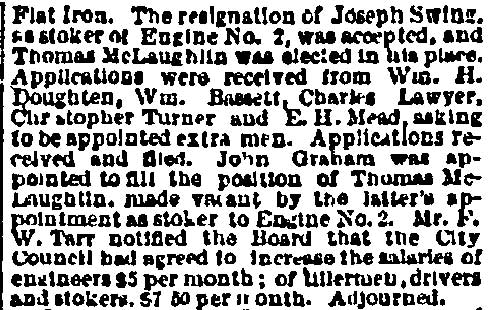
Fire Commissioners.—The Board of Fire Commissioners held a regular meeting on Tuesday evening, Thomas A. Wilson, President, in the chair. Chief Fire Marshal Surrault reported that he had made the following distribution of the new fire extinguishers ordered by Council: One at Paul Anderson’s, Broadway and Kalehn’s [sic] avenue; one at the office of James S. Henry, Eighth and Walnut streets; one at the store of Wm. Ross, on Central avenue, and one at the Flat Iron. The resignation of Joseph Swing, as stoker of Engine No. 2, was accepted, and Thomas McLaughlin was elected in his place. Applications were received from Wm. H. Doughten, Wm. Bassett, Charles Lawyer, Christopher Turner and E. H. Mead, asking to be appointed extra men. Applications received and filed. John Graham was appointed to fill the position of Thomas McLaughlin, made vacant by the latter’s appointment as stoker to Engine No. 2. Mr. F. W. Tarr notified the Board that the City Council had agreed to increase the salaries of engineers $5 per month; of tillermen, drivers and stokers, $7 50 per month. Adjourned.
Disastrous Fire
Philadelphia Inquirer —
Camden and Vicinity.
Yesterday morning, about fifteen or twenty minutes past eight o’clock, a lot of oil caught fire in the car inspector’s office of the Pennsylvania Railroad Company, in their yard below Second street. It had been placed near a hot stove to warm. This set the building in flames, and in a short time it was completely enveloped. A strong wind was blowing at the time from the northwest, and this carried the flames to a two-story frame tenement house adjoining, which was soon in ruins. From this house the fire communicated to another adjoining it, which was the last of a row of five, all of which were burned. These belonged to the Weatherby estate; were insured for $1000, and were occupied by John Spaulding, James Cassedy, Elizabeth Bennett, Mrs. Keebler and Mrs. Carey. These people saved a good portion of their furniture, but in a damaged condition.
On the south side of Weatherby’s court, and directly opposite these buildings, were three other small tenements, belonging to the Mickle estate, and occupied by Mrs. Welch, Mrs. Roure and a man named Mahar. These were likewise destroyed. There was no insurance on the household goods of any of these families. Two frame buildings on Front street and Weatherby’s court, occupied by Mr. Chambers and Mr. Weatherby, were saved by the well directed efforts of the firemen, but the inmates sustained much loss in removing their furniture. From the point where the fire originated the flames also swept in a southerly direction, burning the car inspector’s office, the carpenter shop occupied by Mr. Mahlon, the packing sheds of the railroad company, and a considerable amount of materials stored in them.
From these, three small houses on Read’s court were set on fire and destroyed. The occupants, Patrick Mathis, Peter Rafferty and Mary McConnell, lost everything. Two other frames, owned by Mr. Fiering, on a little alley, and occupied by John Logan and John McKinna, were burned. These men also lost their household goods. Joseph D. Read, who owns considerable property in the immediate vicinity, lost all his stock of tallow, hides, sheepskins, calfskins, &c., which he values at $5,000, and on which there was no insurance. He lost also three tenement houses, one (brick) tallow house, one (frame) hide and salt house, one wagon house, full of straw, feed and harness, one barn filled with timothy hay, two wagon houses and two stables.
There was an insurance on these in the Franklin of $3000. Mr. Read estimates his entire loss at about $10,000. The loss sustained by the railroad company will reach, probably, $2000. The strong winds prevailing at the time, and the rapid spread of the flames, indicated that a widespread conflagration was imminent, and aid from Philadelphia was telegraphed for. Six steamers responded, and did noble service. The flames, however, had been checked before their arrival by the Camden firemen, who worked bravely.
Special Meeting of Council.
A special meeting of the City Council of Camden was called for half-past seven o’clock last evening, to take action relative to furnishing assistance to the families who were rendered homeless by the fire on Second street, below Bridge avenue. Seventeen members answered to their names. The president, Mr. Hackett, stated the object of the meeting.
Mr. Daubman moved that a committee of one from each ward be appointed to raise funds by subscription; that Council draw a blank check in favor of the committee, who shall pay it (money) back when collections are made. Not agreed to.
The mayor was authorized to call a relief meeting at the Court House to-night.
Mr. Read offered the following:—
Whereas, On the morning of the 24th inst., a destructive fire originated in the city of Camden in the oil shop of the Pennsylvania Railroad Company, entirely destroying said building, together with several frame tenements standing contiguous thereto, and the wind blowing hard at the time, carrying the flames toward a large number of frame buildings in the immediate vicinity, threatening great destruction of property and filling the hearts of our citizens with dread; and,
Whereas, A call for help was promptly responded to by his Honor Mayor Stokley, of Philadelphia, who immediately sent to our assistance several fire companies and engines, who, together with our own brave firemen, stayed the further progress of the flames; now be it
Resolved, That we hereby tender to Mayor Stokley the sincere and heartfelt thanks of this Council and the citizens of Camden generally, for his prompt assistance in the hour of trouble, and will very willingly reciprocate to the extent of our ability.
Resolved, That we feel grateful to the firemen of Philadelphia for their efficient services so cheerfully rendered in the time of need; also to the members of our own Fire Department, who did all in their power, under the circumstances, knowing and feeling, as we do, that our lives and property are to a certain extent in their hands, we assure them we heartily appreciate their services at all times.
Resolved, That a copy of the above be furnished to Mayor Stokley, to the Fire Marshal of Philadelphia, and also to the chief of our own Fire Department. Adopted.
Mr. Bradshaw offered a series of resolutions similar in character, which were also adopted. Adjourned.
Camden Council Election
Philadelphia Inquirer —
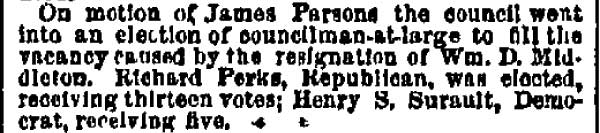
On motion of James Parsons the council went into an election of councilman-at-large to fill the vacancy caused by the resignation of Wm. D. Middleton. Richard Perks, Republican, was elected, receiving thirteen votes; Henry S. Surault, Democrat, receiving five.
Civil War Pension Record
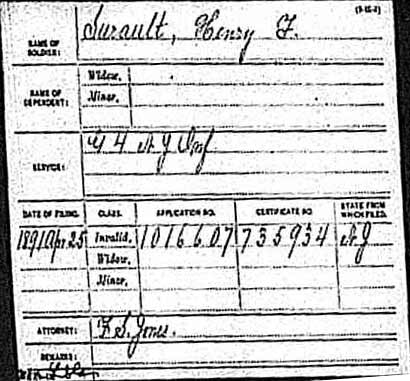
Name of Soldier: Surault, Henry F. Service: 4th N.J. Vols. Date of Filing: 1891 Apr 25 Class: Invalid Application No: 1016607 Certificate No: 755934 State from which filed: N.J. Attorney: F.S. Jones
Camden Justly Proud of Splendid Fire Department
Philadelphia Inquirer —
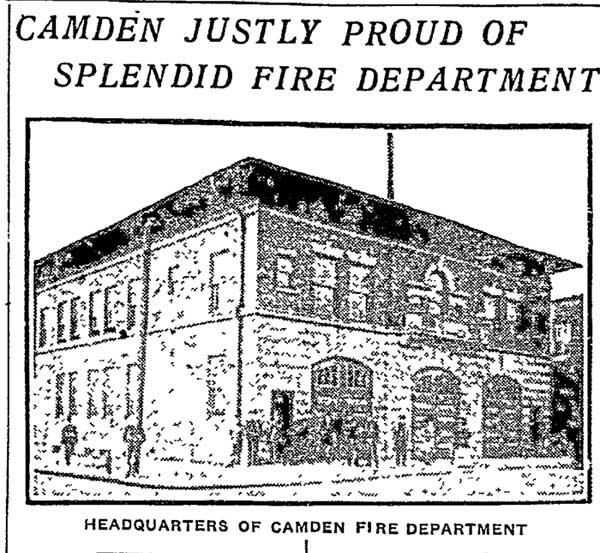
HEADQUARTERS OF CAMDEN FIRE DEPARTMENT
Change From Volunteer to Paid “Laddies” Will Be Appropriately Celebrated Next Wednesday
It is probably unknown to the average citizen that Camden had a paid Fire Department some years before Philadelphia. It is just forty years since the gallant volunteer fire-fighters went out of service. To be exact, it was September 2, 1869, that Camden City Council provided to pay its firemen, and on December 10 of the same year they went into service. This event is to be fittingly celebrated next Wednesday in a demonstration in which the business men of the city, as well as the municipal departments, will participate.
It was not until March 15, 1810, that Camden boasted of even a volunteer fire company, and it was on that date that the Perseverance Fire Company was organized. In 1834 there were two such organizations which had been increased to six by 1851. For the most part these distinct aggregations of fire-fighters did not get along very well together and controversies were frequent.
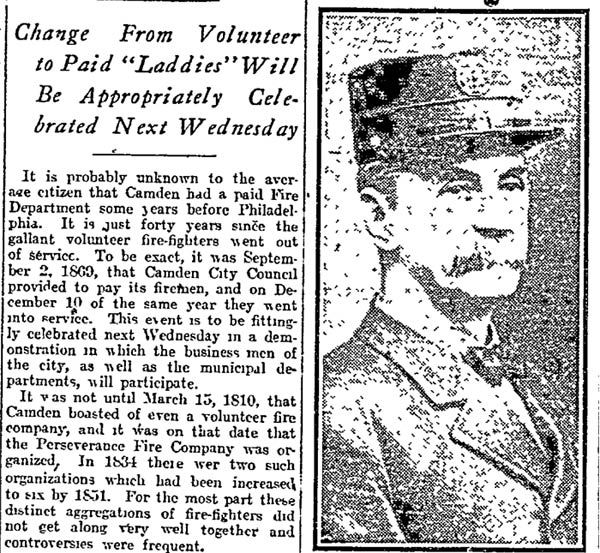
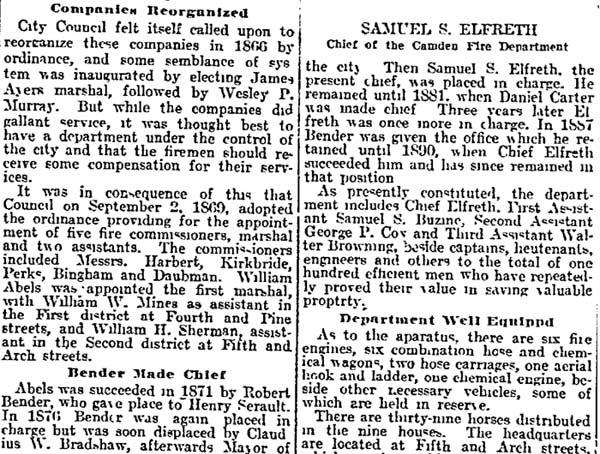
SAMUEL S. ELFRETH
Chief of the Camden Fire Department
Companies Reorganized
City Council felt itself called upon to reorganize these companies in 1866 by ordinance, and some semblance of system was inaugurated by electing James Ayers marshal, followed by Wesley P. Murray. But while the companies did gallant service, it was thought best to have a department under the control of the city and that the firemen should receive some compensation for their services.
It was in consequence of this that Council on September 2, 1869, adopted the ordinance providing for the appointment of five fire commissioners, marshal and two assistants. The commissioners included Messrs. Harbert, Kirkbride, Perks, Bingham and Daubman. William Abels was appointed the first marshal, with William W. Mines as assistant in the First district at Fourth and Pine streets, and William H. Sherman, assistant in the Second district at Fifth and Arch streets.
Bender Made Chief
Abels was succeeded in 1871 by Robert Bender, who gave place to Henry Serault. In 1876 Bender was again placed in charge but was soon displaced by Claudius W. Bradshaw, afterwards Mayor of the city. Then Samuel S. Elfreth, the present chief, was placed in charge. He remained until 1881, when Daniel Carter was made chief. Three years later Elfreth was once more in charge. In 1887 Bender was given the office which he retained until 1890, when Chief Elfreth succeeded him and has since remained in that position.
As presently constituted, the department includes Chief Elfreth, First Assistant Samuel S. Buzine, Second Assistant George P. Cox and Third Assistant Walter Browning, beside captains, lieutenants, engineers and others to the total of one hundred efficient men who have repeatedly proved their value in saving valuable proptrty [sic].
Department Well Equippd [sic]
As to the aparatus [sic], there are six fire engines, six combination hose and chemical wagons, two hose carriages, one aerial hook and ladder, one chemical engine, beside other necessary vehicles, some of which are held in reserve.
There are thirty-nine horses distributed in the nine houses. The headquarters are located at Fifth and Arch streets, which is thoroughly modern in all of its equipments.
Under Chief Elfreth, who has been in the service nearly forty years, the department has been brought to such a high standard of efficiency that the Underwriters’ Association recently paid special attention to it by decreasing insurance rates fifteen per cent. Councils’ Fire Commissioners, of which Councilman Harry R. Read is chairman, has also done much to make the department the success it is at present.
First City Fire House Located at 5th and Arch
Camden Courier-Post —

Hosemen, Tillermen and Laddermen Paid $50 Monthly While Call Men Received $75 a Year; Steam Engine Held for Emergency
This is the fourth installment of a history of fire fighting in Camden from the time of the formation of the first volunteer company in 1810 to 1936. It is the first complete history of the fire department written since 1886 and links the old volunteers with the new paid motorized department. It is being published in conjunction with Fire Prevention Week, which is being sponsored by the Camden County Fire Chiefs Association and the Camden Fire Department. Yesterday’s installment told of the disbanding of volunteer companies and city council creating a paid department in 1869.
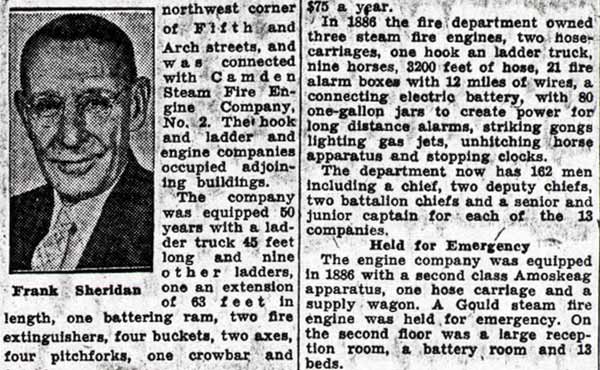
The Camden Hook and Ladder Company, No. 1, was organized in 1869 as a unit of the paid fire department with headquarters at the northwest corner of Fifth and Arch streets, and was connected with Camden Steam Fire Engine Company, No. 2. The hook and ladder and engine companies occupied adjoining buildings.
The company was equipped 50 years with a ladder truck 45 feet long and nine other ladders, one an extension of 63 feet in length, one battering ram, two fire extinguishers, four buckets, two axes, four pitchforks, one crowbar and four lamps.
The members of the Camden Hook and Ladder Company, No. 1, in 1886, when the last history of the department was written, were Amedy Middleton, tillerman; Benjamin L. Kellum, driver; Thomas Walton, and John W. Toy, laddermen; William Doughten, Peter S. Gray, John Gray and Charles A. Todd, callmen.
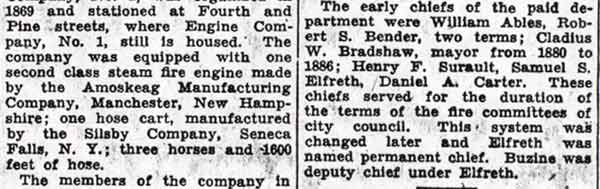
The Camden Steam Fire Engine Company, No. 1, was organized in 1869 and stationed at Fourth and Pine streets, where Engine Company, No. 1, still is housed. The company was equipped with one second class steam fire engine made by the Amoskeag Manufacturing Company, Manchester, New Hampshire; one hose cart, manufactured by the Silsby Company, Seneca Falls, N. Y.; three horses and 1600 feet of hose.
The members of the company in 1886 were John A. Stockton, foreman; G. Rudolph Tenner, engineer; William Deno, driver; William W. Laird, stoker; Wilson Bromley and Jacob F. Nessen, hosemen; William Deith, Andrew Miller, William Bogia and W. Elwood Campbell, callmen.
Stockton became chief of the department in 1914.
Organized in 1869
The Camden Steam Fire Engine Company, No. 2, was organized in 1869 and located at the paid fire headquarters at Fifth and Arch streets. The ground floor had two connections with the hook and ladder company.
In 1886 the department consisted of one chief engineer, an assistant, 18 regular men and 12 call men. The regular men devoted full time to the service while the call men could go about their regular occupations.
Engineers received $60 monthly, hosemen, tillermen and laddermen $50 monthly. The call men received $75 a year.
In 1886 the fire department owned three steam fire engines, two hose-carriages, one hook an [sic] ladder truck, nine horses, 3200 feet of hose, 21 fire alarm boxes with 12 miles of wires, a connecting electric battery, with 80 one-gallon jars to create power for long distance alarms, striking gongs lighting gas jets, unhitching horse apparatus and stopping clocks.
The department now has 162 men including a chief, two deputy chiefs, two battalion chiefs and a senior and junior captain for each of the 13 companies.
Held for Emergency
The engine company was equipped in 1886 with a second class Amoskeag apparatus, one hose carriage and a supply wagon. A Gould steam fire engine was held for emergency. On the second floor was a large reception room, a battery room and 13 beds.
The roster of the company in 1886 included Samuel S. Elfreth, chief engineer; Samuel S. Buzine, assistant chief engineer; Jacob W. Kellum, extra engineer; Harry C. Grossup, foreman; William Morris, engineer; C. B. Harvey, driver of engine; Frank Turner, stoker; Charles Robinson and Isaac Shreves, hosemen; James Carey, Logan Bates, William Lyons and Howard Currie, callmen.
The early chiefs of the paid department were William Ables, Robert S. Bender, two terms; Cladius [sic] W. Bradshaw, mayor from 1880 to 1886; Henry F. Surault, Samuel S. Elfreth, Daniel A. Carter. These chiefs served for the duration of the terms of the fire committees of city council. This system was changed later and Elfreth was named permanent chief. Buzine was deputy chief under Elfreth.
(Tomorrow’s installment will describe a sudden succession of chiefs brought about by the resignation of Elfreth and the death of Charles Worthington, who was fatally injured in a fall from a roof at a fire.)