David Logue
DAVID LOGUE was born in July of 1855 according to the 1900 United States Federal Census. He was a native of Milltown, County Derry, in what is now called Northern Ireland and was a cousin of David Baird Sr.
David Logue came to America in 1874. The 1876 Camden City Directory shows him living with his brother Joseph Logue at 131 Birch Street in North Camden. Over the next ten years he is in and out of Camden City Directories. He and his brother are both listed at 131 Birch Street in 1878.
David Logue and his brother Joseph were both staunch Republicans, as was their cousin, David Baird Sr., the head of the local party who served as Sheriff in the 1880s. David Logue was appointed turnkey at the County Jail on November 19, 1887. Joseph Logue was appointed to the Camden Fire Department on May 29, 1894. He served for almost 26 years, retiring on March 1, 1920.
In 1905 David Logue’s daughter married John H. Andrus. A veteran of the Spanish-American War, John H. Andrus, after mustering out reenlisted in the regular Army in May of 1899 and in time was posted to Havana, Cuba. While in Cuba John H. Andrus assisted Dr. Walter Reed in discovering the cause of yellow fever by voluntarily allowing himself to be infected with the disease in 1901. He undertook a long convalescence, and was discharged from the Army in 1902.
David Logue was made warden of the County Jail in 1906. His time as warden was not uneventful. There were two murders and at least two escapes. The first murder took place in November, 1907, when George Stewart stabbed to death fellow prisoner John Snell. Stewart was tried and convicted and sentenced to be electrocuted during the week of February 8, 1908. He was electrocuted on February 4, being the first man to suffer the death penalty by electrocution.
On July 13, 1910 William T. Brown and Charles Berger, made their escape from jail after sawing the bars on the Federal Street front. They climbed to the roof, descended through a trapdoor, climbed down stairs and walked leisurely through the Court House building and out into the street unnoticed. A waiting car took them away and they escaped to Philadelphia on a North Cramer Hill Ferry boat.
On July 17, 1916 Wilson Ashbridge and George Thompson made their escape. A gun had been smuggled in to Ashbridge, which he used to shoot two guards. Isaac Hibbs, was killed and another, Joseph Ellis was wounded. Both prisoners were recaptured and Hibbs’ murderer, Wilson Ashbridge, was executed.
David Logue served as Warden of the County Jail until suffering a stroke in 1923 which left him paralyzed. His brother, Joseph Logue died at Bellevue Hospital in Camden on April 20, 1927.
David Logue at his home at 8256 Penn Street died on July 24, 1928. He was survived by his wife Anna and five children, Mrs. Mary Crawford, Mrs. Anna Andrus, Mrs. Barbara Hawkins, Miss Sarah Logue, and Mr. James Logue. David Logue was buried at Evergreen Cemetery.
David Logue’s grandson, Dr. David L. Andrus, practiced medicine in Camden. David Logue’s son-in-law, John H. Andrus, was the brother of Chester J. Andrus, a long-time member of the Camden Fire Department.
Struck in the Dark
Camden Post —
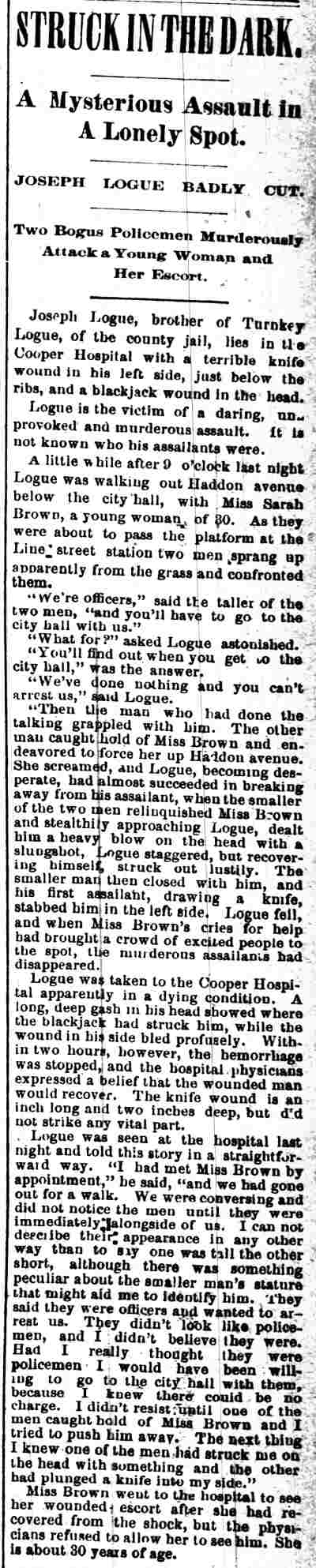
STRUCK IN THE DARK.
A Mysterious Assault in A Lonely Spot.
JOSEPH LOGUE BADLY CUT.
Two Bogus Policemen Murderously Attack a Young Woman and Her Escort.
Joseph Logue, brother of Turnkey Logue, of the county jail, lies in the Cooper Hospital with a terrible knife wound in his left side, just below the ribs, and a blackjack wound in the head.
Logue is the victim of a daring, unprovoked and murderous assault. It is not known who his assailants were.
A little while after 9 o'clock last night Logue was walking out Haddon avenue below the city hall, with Miss Sarah Brown, a young woman of 30. As they were about to pass the platform at the Line street station two men sprang up apparently from the grass and confronted them.
“We’re officers,” said the taller of the two men, “and you’ll have to go to the city hall with us.”
“What for?” asked Logue astonished.
“You’ll find out when you get to the city hall,” was the answer.
“We’ve done nothing, and you can’t arrest us,” said Logue.
Then the man who had done the talking grappled with him. The other man caught hold of Miss Brown and endeavored to force her up Haddon avenue. She screamed, and Logue, becoming desperate, had almost succeeded in breaking away from his assailant, when the smaller of the two men relinquished Miss Brown and stealthily approaching Logue, dealt him a heavy blow on the head with a slungshot. Logue staggered, but recovering himself, struck out lustily. The smaller man then closed with him, and his first assailant, drawing a knife, stabbed him in the left side. Logue fell, and when Miss Brown’s cries for help had brought a crowd of excited people to the spot, the murderous assailants had disappeared.
Logue was taken to the Cooper Hospital apparently in a dying condition. A long, deep gash in his head showed where the blackjack had struck him, while the wound in his side bled profusely. Within two hours, however, the hemorrhage was stopped, and the hospital physicians expressed a belief that the wounded man would recover. The knife wound is an inch long and two inches deep, but did not strike any vital part.
Logue was seen at the hospital last night and told this story in a straightforward way. “I had met Miss Brown by appointment,” he said, “and we had gone out for a walk. We were conversing and did not notice the men until they were immediately alongside of us. I can not describe their appearance in any other way than to say one was tall the other short, although there was something peculiar about the smaller man’s stature that might aid me to identify him. They said they were officers and wanted to arrest us. They didn’t look like policemen, and I didn’t believe they were. Had I really thought they were policemen I would have been willing to go to the city hall with them, because I knew there could be no charge. I didn’t resist until one of the men caught hold of Miss Brown and I tried to push him away. The next thing I knew one of the men had struck me on the head with something and the other had plunged a knife into my side.”
Miss Brown went to the hospital to see her wounded escort after she had recovered from the shock, but the physicians refused to allow her to see him. She is about 30 years of age.
Both Found Guilty
Camden Post —

BOTH FOUND GUILTY
Stratton and Mellon Convicted as Charged.
BARE ESCAPE FROM MURDER.
The Dastardly Assault on Joseph Logue and His Female Companion—The Defendants’ Injurious Admissions.
John H. Stratton and Henry Mellon were last night found guilty of the dastardly attack upon Joseph Logue and his female companion, in which Logue came near being the victim of a murderer. At the close of The Post’s report yesterday afternoon Stratton was on the stand in his own behalf. He denied seeing Logue and the young woman. He denied that he attacked any one. He denied having a black jack or a knife. He denied, in fact, pretty much everything that came his way. He said he had a wife and four children, and was 27 years old yesterday.
Under cross-examination Stratton admitted that he had frequently met Mellon at Starr’s crossing in the evening. On Saturday night previous to the assault they were together on the lots. “When I got there,” he went on, “Mrs. Hyatt, who was there, said to me, ‘You will put a mark on the wall because I had come in so early.’”
“What time did Mellon come there?” asked Mr. Jenkins.
“About half past nine.”
“And you had left him at Broadway and Pine, at about eight fifteen?”
“Yes, sir.”
“What did he come for?”
“I don’t know.”
“Didn’t he ask for you?”
“Yes, sir.”
“What did he say?”
“When he saw that I had my shoes off he said, ‘O, never mind.’”
Mr. Jenkins thought it necessary to indict by Stratton a note sent him by Mellon while the two were in jail, but Stratton refused to look at it.
Mellon, when called, said he was at Starr’s crossing on the night of Sunday, May 6th. He went there merely to take a walk. He told the same story as Stratton, without deviation.
The copy of a note written to Stratton by Mellon, in which the latter tells Stratton how he remembers a note (referring to the sewer watchman) was ten feet away when I handed you the knife, was then declared by the court to be a copy and not the original, and therefore could not be admitted in evidence because it was not properly proved. Mellon denied writing the note.
John Wagner testified that he left the Catholic church at 8:20 on the night of the assault and walked to his house on Going street, ten minutes and that one of the defense witnesses was there at that time.
Mrs. Stratton, the wife of one of the defendants, said on her husband’s behalf that on that Sunday night at about 8:30. “When he went out,” she said, “he said he would not be back long.” He was gone about three hours. Mrs. Hyatt said, “Why, John, it’s only half-past eight; you’re in early,” and she put a mark on the wall.
Hyatt, who jointly occupies the house with Stratton, testified that he came home at 8:20.
“Did you look at the clock?” asked Mr. Jenkins.
“A three dollar and a half clock.”
“Is it an alarm clock?”
“Yes.”
“How often do you set it?”
“Every night.”
“What; every night?”
“Oh, I don’t mean set it; I mean wind it.”
“Has it ever run down?”
“No.”
“What did you do when you moved, let it run on?”
“Yes, sir; it runs laying down or setting up.”
“What a wonderful clock; I think I’ll have to get one.”
This closed the case for the defense and Policeman Jacob Danks was called to rebut a statement by Mellon that he had never worn what looked like a policeman’s star. After some spirited sparring Officer Hone swore that he saw Mellon wear a star in Diamond Cottage Grove last summer.
William Mellon, a brother of Henry Mellon on the lots opposite the city hall, one night last summer about 8:30. “I was taking a walk with a young lady out there. Mellon came up to me and touched me and said he was going to take me to the city hall. He also took hold of the lady.” He was not cross-examined.
Harry Danks, a pimply faced young man, who acts as “runner” about the jail, was called to rebut Mellon, who denied having written a note to Stratton.
“Mellon gave me a note this morning to deliver to Stratton,” said Danks. “I don’t know what it contained.” The note shown by Prosecutor Jenkins was the one in question but it was not in an envelope.
Jailor David Logue, a brother of the injured man, testified that he received the note from Danks, as keeper of the jail. He told to copy it. Swindell testified that the copy shown by Prosecutor Jenkins was the one he had made of it. All of the testimony for the defense was then in.
Argument of counsel were begun at 4:30 and the jury did not retire until after 6. At nine o'clock the jury returned with a verdict of guilty as charged in the indictment.
During the progress of the trial counsel for the defense made a total of a hundred exceptions to Judge Hugg’s rulings and they will probably carry the case to the Supreme Court.
Loyal Orange Institution
Camden Post —
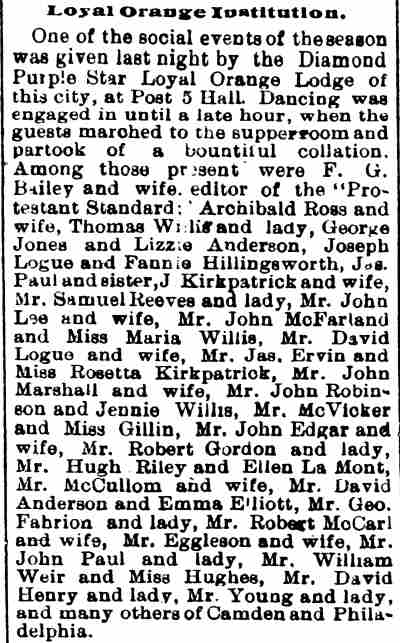
Loyal Orange Institution.
One of the social events of the season was given last night by the Diamond Purple Star Loyal Orange Lodge of this city, at Post 5 Hall. Dancing was engaged in until a late hour, when the guests marched to the supper room and partook of a bountiful collation. Among those present were F. G. Bailey and wife, editor of the “Protestant Standard;” Archibald Ross and wife, Thomas Willis and lady, George Jones and Lizzie Anderson, Joseph Logue and Fannie Hillingsworth, Jas. Paul and sister, J. Kirkpatrick and wife, Mr. Samuel Reeves and lady, Mr. John Lee and wife, Mr. John McFarland and Miss Maria Willis, Mr. David Logue and wife, Mr. Jas. Ervin and Miss Rosetta Kirkpatrick, Mr. John Marshall and wife, Mr. John Robinson and Jennie Willis, Mr. McVicker and Miss Gillin, Mr. John Edgar and wife, Mr. Robert Gordon and lady, Mr. Hugh Riley and Ellen La Mont, Mr. McCullom and wife, Mr. David Anderson and Emma Elliott, Mr. Geo. Fabrion and lady, Mr. Robert McCarl and wife, Mr. Eggleson and wife, Mr. John Paul and lady, Mr. William Weir and Miss Hughes, Mr. David Henry and lady, Mr. Young and lady, and many others of Camden and Philadelphia.
Camden
Philadelphia Inquirer —
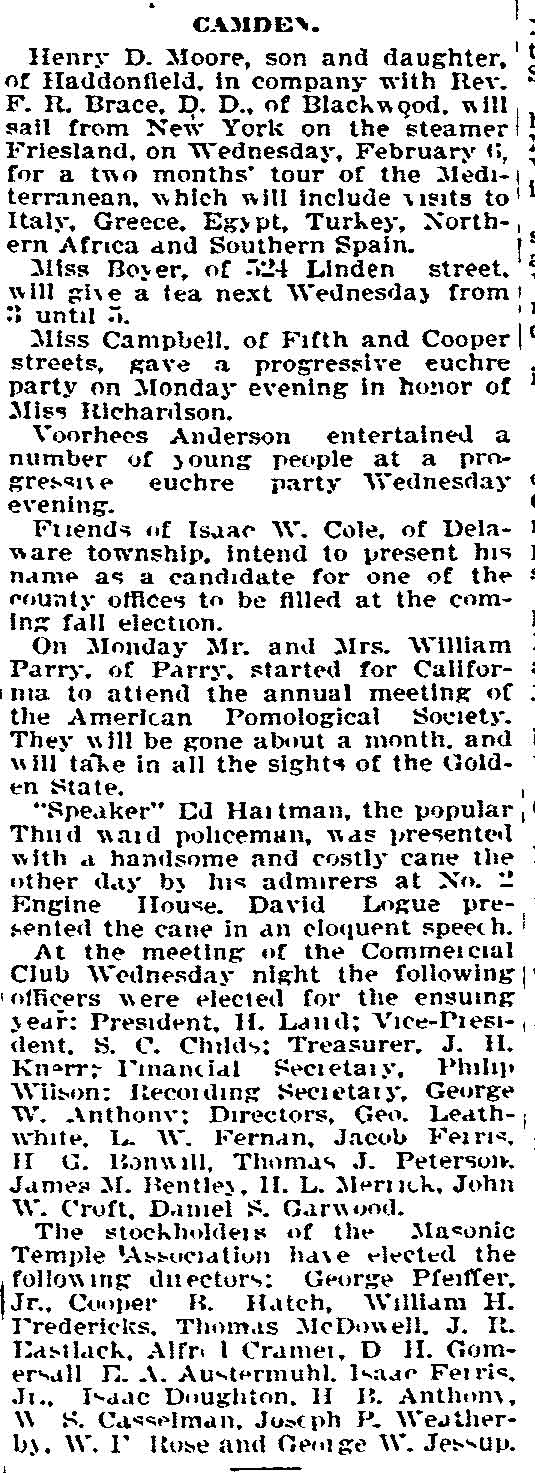
CAMDEN.
Henry D. Moore, son and daughter, of Haddonfield, in company with Rev. F. R. Brace, D. D., of Blackwood, will sail from New York on the steamer Friesland, on Wednesday, February 6, for a two months’ tour of the Mediterranean, which will include visits to Italy, Greece, Egypt and Spain.
Miss Boyer, of 524 Linden street, will give a tea next Wednesday from 3 until 5.
Miss Campbell, of Fifth and Cooper streets, will give a progressive euchre party on Monday evening in honor of Miss Richardson.
Voorhees Anderson entertained a number of young people at a progressive euchre party Wednesday evening.
Friends of Isaac W. Cole, of Delaware township, intend to present his name as a candidate for one of the county offices to be filled at the coming fall election.
On Monday Mr. and Mrs. William Parry, of Parry, started for California to attend the annual meeting of the American Pomological Society. They will be gone about a month, and will take in all the sights of the Golden State.
“Shad” Ed Hartman, the popular Third ward policeman, was presented the other day by his admirers at No. 2 Engine House. David Logue presented the cane in an eloquent speech. At the same time the following officers were elected for the ensuing year: President, H. Laud; Vice-President, S. C. Childs; Treasurer, J. H. Knorr; Financial Secretary, Philip Williams; Secretary, George W. Anthony; Directors, Geo. Leathwhite, L. W. Fernan, Jacob Ferris, H. G. Bonwill, Thomas J. Peterson, James M. Bentley, H. L. Merrick, John W. Croft, Daniel S. Garwood.
The stockholders of the Masonic Temple Association have elected the following directors: George Pfeiffer, Jr., Cooper B. Hatch, William H. Fredericks, Thomas McDowell, J. R. Eastlack, Alfr’d I Cramer, D. H. Gomersall, T. Russell, Isaac Ferris, Jr., Isaac Doughton, H. B. Anthony, W. S. Casselman, Joseph P. Weatherby, W. F. Rose and George W. Jessup.
Dory Lambert Heard From
Jersey Journal, Jersey City, New Jersey —
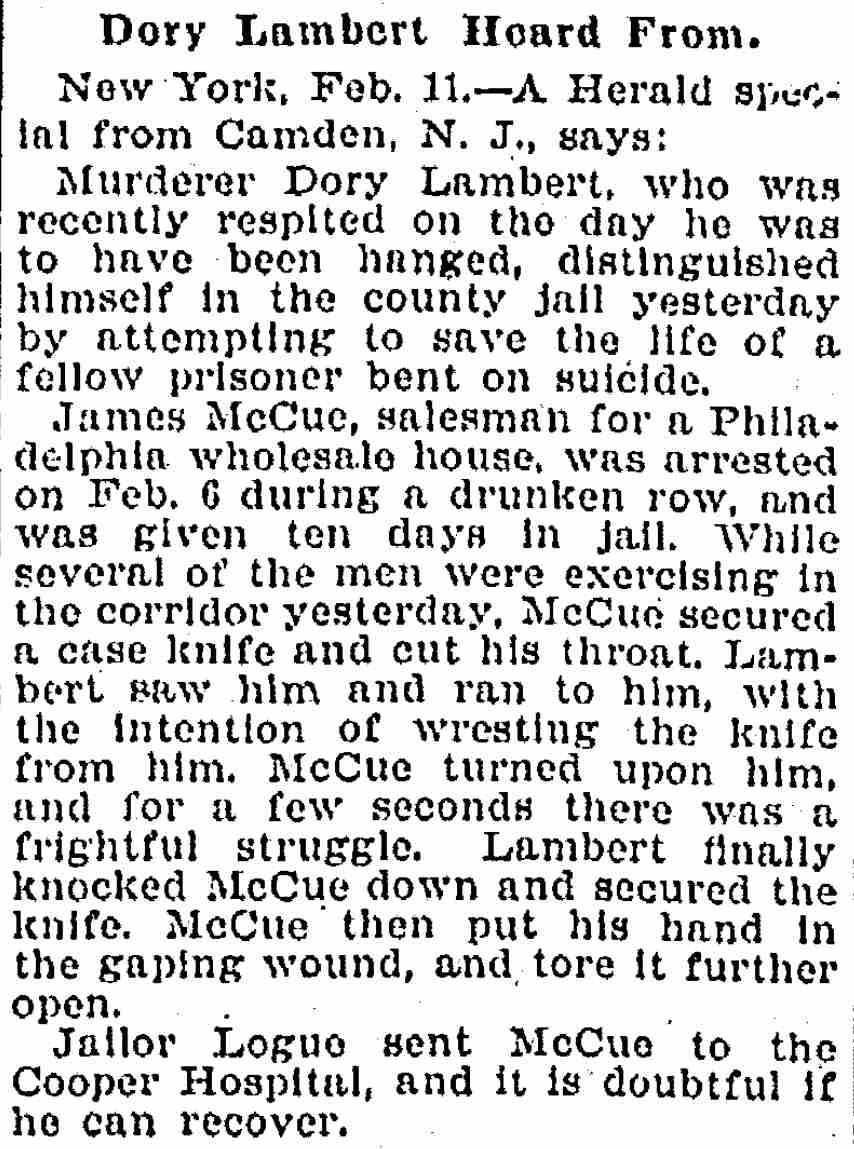
Dory Lambert Heard From.
New York, Feb. 11.—A Herald special from Camden, N. J., says:
Murderer Dory Lambert, who was recently respited on the day he was to have been hanged, distinguished himself in the county jail yesterday by attempting to save the life of a fellow prisoner bent on suicide.
James McCue, salesman for a Philadelphia wholesale house, was arrested on Feb. 6 during a drunken row, and was given ten days in jail. While several of the men were exercising in the corridor yesterday, McCue secured a case knife and cut his throat. Lambert saw him and ran to him, with the intention of wresting the knife from him. McCue turned upon him, and for a few seconds there was a frightful struggle. Lambert finally knocked McCue down and secured the knife. McCue then put his hand in the gaping wound, and tore it further open.
Jailor Logue sent McCue to the Cooper Hospital, and it is doubtful if he can recover.
A Year Each for Policy People
Camden Daily Telegram —

A YEAR EACH FOR POLICY PEOPLE
Mrs. Harriet Smith Fainted When Sentenced.
DETERMINED TO STOP THE GAME
Judge Vroom Says the Court Is Decided About This Matter and in Two Cases Imposes the Full Penalty.
This was the last assize day for the present term of the Quarter Sessions Court. Judges Vroom, McDowell and Burdsall held a consultation in the law library until twenty minutes after ten o’clock when they came into the large court room.
Lulu Robinson was sworn and said that David Fry had cut her with a razor during a quarrel one evening at Eighth and Ann streets. Fry was quarreling with the others and the witness interfered when Fry cut her across the cheek with a razor. Fry has pleaded guilty to the assault.
Mrs. William Still, of Snow Hill, was sworn, and stated that on a Saturday night her husband came home and seemed to be in a bad humor. He quarreled with her all night Saturday and all day Sunday. He asked her if she was going to stop running around and as she did not answer him Still pulled out a revolver and shot her. He fired three more shots at her as she laid on the floor and when she was going out the door he shot her in the head.
“Did this not occur over your running with other men?” asked Lawyer John L. Semple, who is counsel for William Still.
No, sir. I did not go with other men.”
Witness said she knew a man by the name of Grey, but denied that she had ever been intimate with him.
In answer to Judge Vroom Mrs. Still said that she had been shot three times and was in the Cooper Hospital some time. She said her husband had threatened to cut her throat on other occasions. Still was not present and the court ordered that he appear on Monday or his bail would be forfeited and a bench warrant issued.
William Jacobs, who was convicted yesterday of involuntary manslaughter in killing George Whittington, was sentenced to one year in State Prison.
When the convicted policy dealers were arraigned Lawyer H. S. Scovel said he desired to make a few remarks in their behalf. He said that in the case of William Parker the jury failed to agree and he advised Parker afterwards to enter a plea of guilty. Parker had never been accused before of a crime and Lawyer Scovel asked that the Court be lenient. He also said there was no record of Parker having been convicted before. Lawyer Scovel also asked that mercy be shown in the case of Mrs. Harriet Smith, who pleaded guilty. He said there was no question but what she had been convicted before of policy writing but her husband was dead and she had a large family to support. “I do not think the State Prison was ever erected for the imprisonment of a woman unless she had committed some great crime,” said Lawyer Scovel.
The Court said that some of the convicted policy writers had been convicted before of violating the policy laws and the Court had been lenient and imposed fines instead of imprisonment.
“The Court is determined to break up policy playing in this city,” said Judge Vroom. “The sentence of Walter Garwood and Washington Ketline is that they serve one year in the State Prison and pay a fine of $100 each. This is the full penalty of the law. Harriet Smith and William Parker will serve one year in State Prison without a fine.”
As the defendants were being taken out of the court room to the county jail Mrs. Smith swooned away just outside of the entrance to the court room. A cot was secured from the county jail and Constable Jacob Leon and Jailor David Logue placed her on it and carried her over to the county jail.
Lawyer J. J. Crandall asked that Washington Ketline be released on bail as he had secured a writ of error to carry the case to the Supreme Court. Bail was fixed at $1,000 and John Cochran and Joseph Swing appeared to enter the necessary security. They were closely questioned by the Court.
Hill Meets Death Without a Shudder
Philadelphia Inquirer —
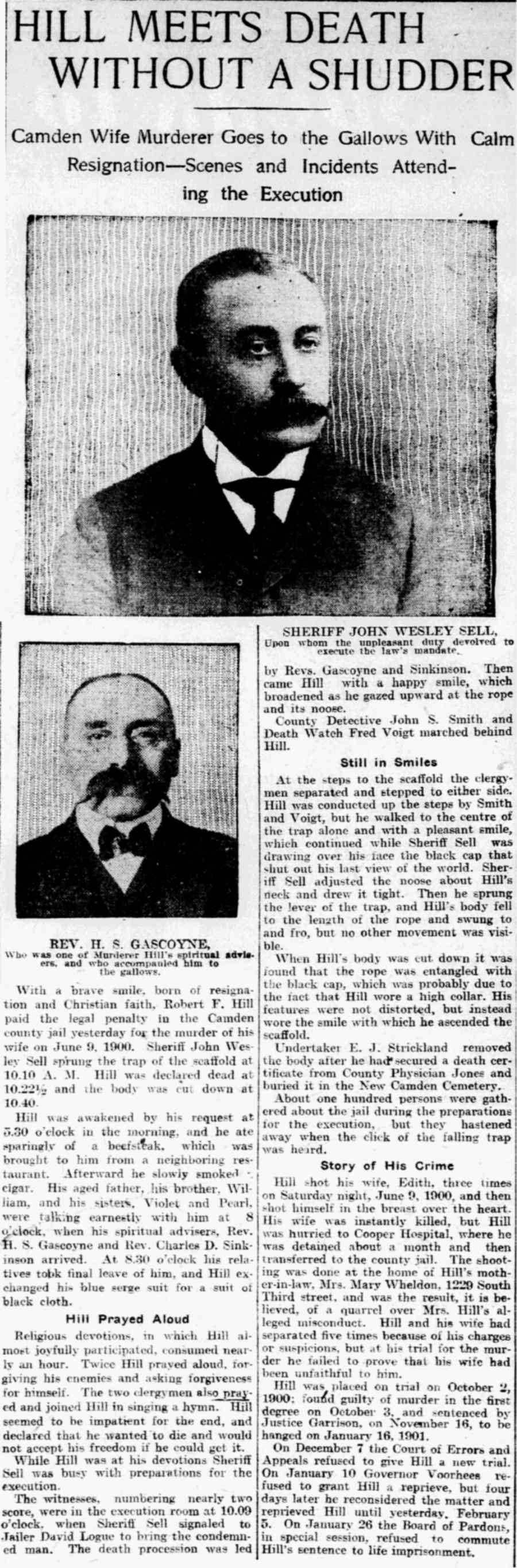
HILL MEETS DEATH WITHOUT A SHUDDER
Camden Wife Murderer Goes to the Gallows With Calm Resignation—Scenes and Incidents Attending the Execution
With a brave smile, born of religious calm and Christian faith, Robert F. Hill, who was convicted last year in Camden county jail yesterday of the murder of his wife, went to the gallows at the county jail yesterday and was hanged at 10:10 A.M. Hill was declared dead at 10:23.
Hill met his end with great composure. He seemed to be impatient for the end, and thanked his spiritual advisors for their attentions. On the scaffold he smiled blandly and in a clear voice said several times “I am innocent.” He prayed earnestly and died in an upright position with comparatively little suffering.
Religious devotions, to which Hill, who was convicted of wife murder last year, devoted the greater part of the hours of his incarceration, continued to the last. He seemed to be impatient for the end, and thanked his two spiritual advisors, Rev. Charles D. Sinkinson and County Detective John S. Smith, who were with him at his devotions, numbering nearly two score of men.
At the steps to the scaffold the clergyman separated and stopped to either side. The Sheriff proceeded between Sell and Voigt, but he walked to the center of the scaffold and with a pleasant smile, which continued while Sheriff Sell was reading out Hill’s record, he opened the lever. Hill adjusted the noose about Hill’s neck and drew the cap. Then he sprung the lever of the trap, and Hill’s body fell in the drop and was caught midway by the rope. The body swayed almost imperceptibly.
When Hill’s body was cut down it was found that the rope was entangled with his wrists. Those who attributed the absence of a death struggle to this entanglement were not deterred, but insisted that justice was done and the gallows were properly adjusted to the weight and height of the condemned man.
Chat Among the Local Firemen
Camden Daily Courier —
CHAT AMONG THE LOCAL FIREMEN
News Among the Men Who Man the Fire Fighting Apparatus.
NEW MEMBER GIVEN INITIATION
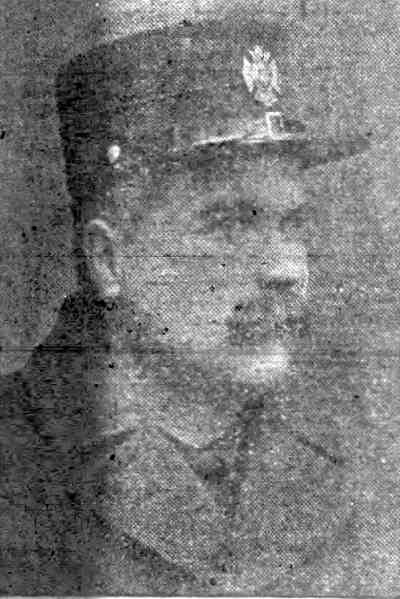
It is the honest and genial physiog of Fireman Joe Logue that confronts the readers of the “Courier” in today’s issue and it is safe to say that of all the surprised men in the town that same man is he, for not the least of his appearance had Joe expected. The sight of his Christmas tree on Christmas morning when he was a mere strip of a lad in old Ireland could not have amazed him more. But there it is and as it shows up in fine style, Joe will no doubt forbear from swatting the Fire Editor of the “Courier” with his trusty Cape Cavan county hose. Joe Logue is about the tallest fireman in the department and as to his being as good, strong, steady and courageous a man, as there is in the city’s service, there is not the least doubt. He was born at Milltown, county Derry, and is therefore an Ulsterite. He is within a few years of 40, but doesn’t look it, and from his rugged, robust form appears good for another half a century at least, for it’s not unusual for the men of Ulster to live even a dozen or twenty years beyond that. He was appointed a fireman in 1894 and has done duty since at two houses, Hook and Ladder Truck No. 1, at headquarters, and Engine Company No. 4, in North Camden. And that he has been ever brave and faithful in the discharge of his allotted tasks, Foreman Elfreth, ex-Foreman Billy Patterson, Assistant Chief Ben Kellum and present Foreman Billy Patterson, of Engine Company No. 4, under all of whom he has served, can and will testify to.
Joe is a married man and has the finest of homes. He is a brother of another good Ulster man, David Logue, the county jail turnkey. Both are members of Star of Bethlehem Lodge No. 12, American Protestant Association and Diamond Purple Star Lodge No. 104, Loyal Orange Legion.
Former Fireman Wright Cox writes to set right. It was Wright who rescued the two men at 322 Stevens street on last Saturday afternoon and had the fire under control when the firemen arrived. Credit had been given to his brother, George Cox, foreman of Hook and Ladder Truck No. 1, who resides on Stevens street above Third, but what’s the difference, isn’t the glory all in the family? Wright lives at 322 Stevens street, George at 334 and the fire was at 306. If Wright hadn’t been right on deck at the time, George would have, so more’s the power to them both. Wright was a good one when he was in the department and there is strong talk of his going back again.
William Miller, of the Eighth ward, became a member of the crew of Chemical Engine No. 2, on Saturday evening, under amusing circumstances. On Sunday evening he went through the customary initiation at the fire house on Kaighn avenue above Sixth street. All the other men were down stairs about eight o’clock when some one struck box eleven. There is no such box on the fire alarm list, but William, who wasn’t very heavy, slid the pole from the second floor just the same. Just as he landed on the rubber mat at the bottom of the pole, one of the men turned a hose on him, while several others bombarded him unmercilessly with boots, brooms, mops, etc. Poor William was a sight when they gave him up to work on him. He was drenched to the skin and covered with dirt. But when he discovered it was all a joke he took his medicine manfully and was duly installed in the new company as a “jolly good fellow.”
Camden County Jail, circa 1910
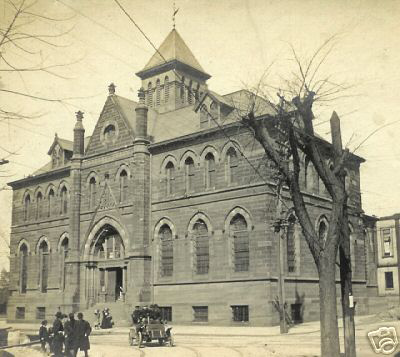
Camden County Jail, circa 1910
Camden County Jail Map, 1885
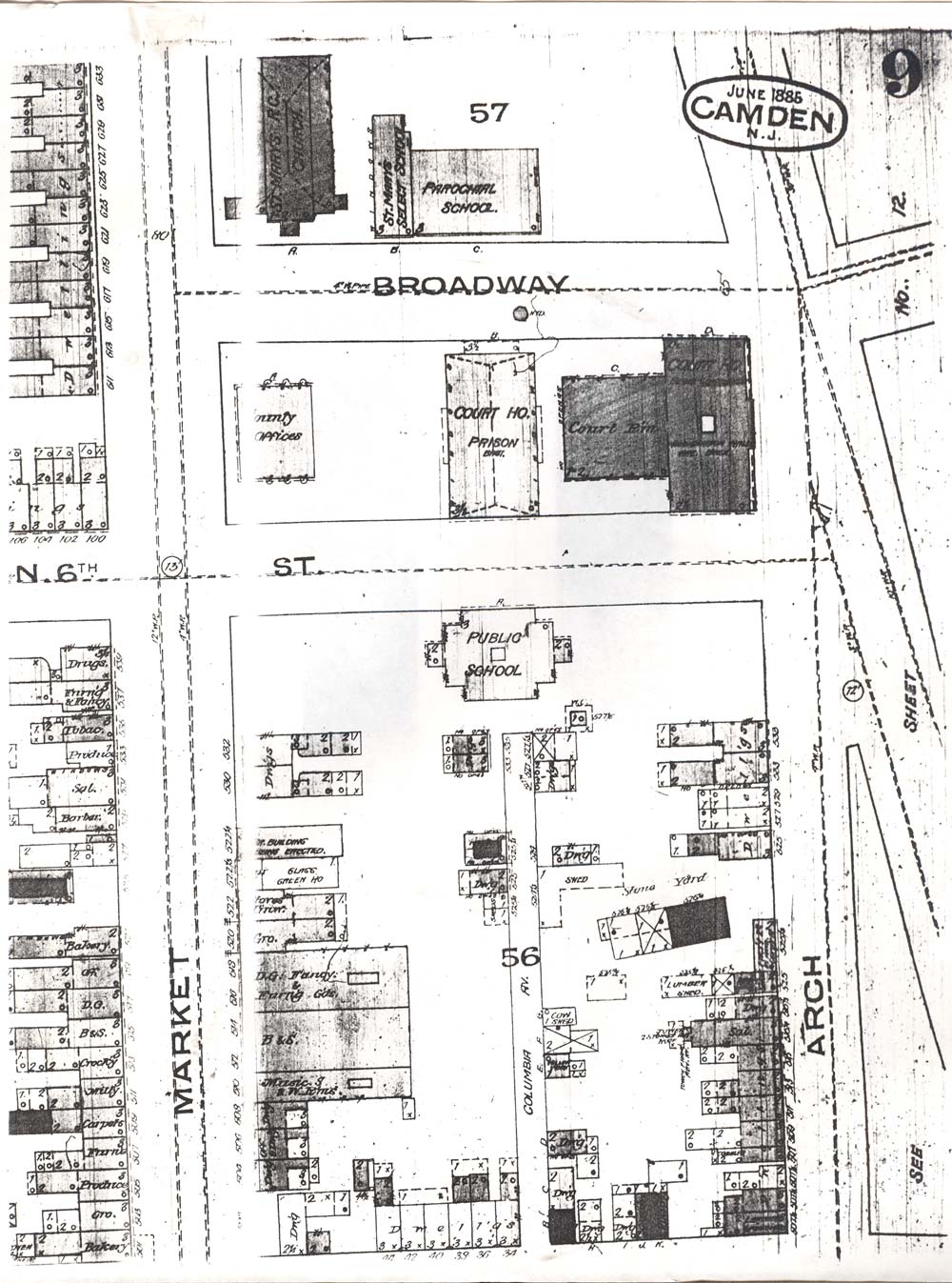
Camden County Jail — Map is from 1885; the jail and county buildings were pretty much the same in 1916
Indict Woman for Shooting Attorney
Philadelphia Inquirer —
INDICT WOMAN FOR SHOOTING ATTORNEY
Victim Was Wounded in Hip—Alleged Slayer of Chorus Girl Charged With Murder
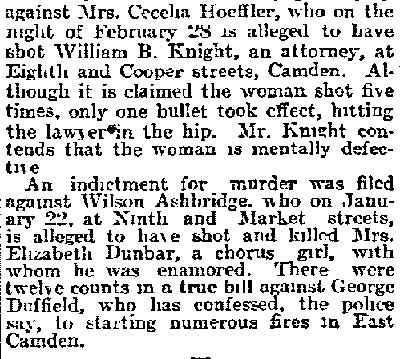
An indictment charging assault and battery with intent to kill was filed yesterday by the Camden county grand jury against Mrs. Cecelia Hoeffler, who on the night of February 28 is alleged to have shot William B. Knight, an attorney, at Eighth and Cooper streets, Camden. Although it is claimed the woman shot five times, only one bullet took effect, hitting the lawyer in the hip. Mr. Knight contends that the woman is mentally defective.
An indictment for murder was filed against Wilson Ashbridge, who on January 22, at Ninth and Market streets, is alleged to have shot and killed Mrs. Elizabeth Dunbar, a chorus girl, with whom he was enamored. There were twelve counts in a true bill against George Duffield, who has confessed, the police say, to starting numerous fires in East Camden.
Murderer and Forger Escape Jail After Shooting Keepers, Killing One
Camden Post-Telegram —
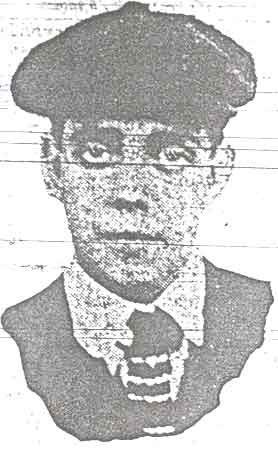
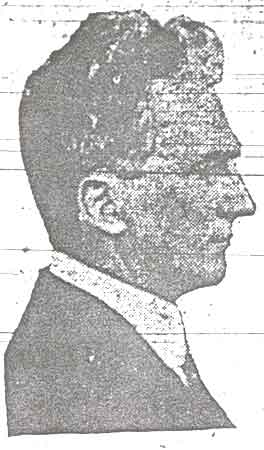
Wilson Ashbridge, Who Shot and Killed Mrs. Elizabeth Dunbar and George E. Thompson, Check Swindler, Trap Jailor Hibbs by a Ruse and After Slaying Him Shoot Joe Ellis Who Intercepted Them in Flight.
Used Revolver Smuggled Into Prison by Confederates and Leave Jail Wide Open in Their Flight, a General Delivery Being Averted by Police Who Were Summoned by the Wounded Men.
Murdering one jailor and wounding another with a revolver that had been smuggled into them by outside confederates, Wilson T. Ashbridge, slayer of Mrs. Elizabeth Dunbar, and Francis Murphy, alias George E. Thompson, a check forger, made their escape from the county jail a few minutes before seven o’clock last night.
Ashbridge with his wife was caught at noon in the Keystone Hotel in Chester PA where they registered at one o’clock this morning.
Thompson is still at liberty but from the confident manner of Prosecutor Kraft his early arrest seems assured.
The murdered jailor was Isaac Hibbs, aged 65 years of 913 South 8th Street. The wounded keeper is Joseph Ellis, aged 45 years, of 416 Carteret Street. Shot twice, he is in Cooper Hospital. His condition today is very satisfactory.
Thompson, who is 41 years old, forged a check for $650 which he gave to V.M. Fulton as part of the purchase price of an automobile. The forgery was discovered before the deal was completed and his arrest followed on June 8. he also passed a forged check for $15 on State Motor Vehicle Agent Kraft. He, too, was awaiting trial. In spite of the positive evidence against him Thompson had spurned all efforts to have him plead guilty and it is now believed that he was sparring for time while hatching a plan to escape. He is no doubt the master mind.
R.L. Hunter, a farmer of Bensalem Township, Bucks County PA, about four miles above Torresdale, reported to the Philadelphia police the morning that he had seen a man answering Ashbridge’s description on the Bucks Road at daylight. The man asked the way to Riegelsville.
According to Hunter, the man was dressed in a dark suit, and had no hat. His clothing was wet. Hunter did not see anything suspicious in his actions, and after giving him directions, they parted.
Upon seeing the paper with a picture of Ashbridge, the farmer was struck by its resemblance to the man with whom he had talked. He hurried to Tacony and notified the police.
The State police, who patrol that section of the county, and who have an office at Langhorne, were immediately notified as were the surrounding towns.
The shootings took place in different parts of the jail. Hibbs was murdered in the exercise room just outside the cell room on the Sixth and Arch corner of the building. Ellis was shot down in the corridor just outside the Market Street end of the building when he heroically grappled with Ashbridge after the latter had pointed a gun at his head. In spite of his wounds Ellis dragged himself to a telephone and after notifying Police Headquarters of what had happened he collapsed.
Only one of the two bullets is still in Ellis. It entered the groin on the right side and is buried in the muscles of the leg, having taken a downward course for seven or eight inches. The other bullet struck Ellis in the right breast and came out in the left breast, traversing the upper fleshy parts of the body.
Hibbs was almost instantaneously killed by a bullet that went within an inch of his heart, producing a hemorrhage. The bullet was extracted this morning from the body early this morning in an autopsy performed at the morgue by County Physician Stem. In spite of the fact that it is pretty well established that three shots were fires in the attack on Hibbs, only one of the bullets took effect.
“But it makes little difference which of the two men handled the gun” said Prosecutor Kraft this morning. “Both are equally guilty of this murder and what we are concerned about now is the recapture of the gunmen.” Mr. Kraft added that it his purpose to examine all of the prisoners in that part of the jail where Hibbs was murdered to determine fully who fired the fatal shot.
The escape had been carefully planned and timed to the minute. Of course the desperate prisoners were aided by confederates on the outside and it is the general belief that a high powered motor car was in waiting for them not far from the jail. They are known to have been in possession of money and openly boasted yesterday that it was their intention to leave the prison last night. These boasts were made to two young ladies connected with a religious organization who called on the two men yesterday to offer spiritual reconciliation. The girls are frequent visitors to the jail and naturally their efforts at evangelization were directed in the main toward Ashbridge, because of the fact that he was accused of murder. These girls, whose identity officials will not disclose, were closeted with Prosecutor Kraft until one o’clock this morning. Both declared that on their visit yesterday they were told by Ashbridge and Thompson that it was the last day they expected to spend in jail.
“We are going to get away from here tonight and we’ve got money to help us after we are out ” said Ashbridge, who further told the girls he had considerable cash sewed up in the waistband of his trousers. The girls begged the prisoners not to do anything that would cause them more trouble and they told the Prosecutor that Ashbridge and Thompson promised them that they would not make any effort to escape. In their talks with the girls neither of the prisoners said a word that would indicate that they would kill if necessary to escape. The full force of their boast did not dawn on the religious workers and for this reason it never occurred to them to inform the Sheriff of what the prisoners had in said.
A general jail delivery of at least all the men confined in what is known as the untried department, where the two were held, was only averted by the prompt arrival of the police on their beat, which was made easy by means of the keys taken from the prostrate body of Hibbs. Ashbridge and Thompson left all of the doors open and the vanguard of the inrushing police found the prisoners swarming all over the corridors on the east side of the prison. In the wild excitement following the double shooting and escape none else thought of freedom and a checking up of the inmates after they had been herded in the exercise room of the untried department accounted for all but the fugitive slayers.
The department, in which the two men were confined is the same one which William Brown and Charles Berger made their sensational escape several years ago by sawing away the bars on the Federal Street front of the jail. Thrilling as it was, the former escape was insignificant in comparison with last night’s tragic event.
With the full force of the keepers out of the way— one dead and the other suffering from gunshot wounds at first supposed to have been fatal— Ashbridge and Thompson had nothing between them and freedom but the door entering from the spiral stairway leading to the narrow entrance of the Sixth and Market Streets end of the Court House. With the keys taken from Hibbs they opened the door and in a few seconds were breathing the free air. It was still daylight when the daring murderers walked from the building and although they were no doubt seen by some of the scores of persons passing it is certain that they managed to control themselves to such an extent as not to arouse any undue suspicion. The exit they used to escape is that used by the general public and therefore persons passing calmly in and out of the door would not in any manner be thought to have been connected with a jail delivery. However the shots which had laid low the keepers had been plainly heard on all four sides of the building and it is strange that no one has yet been found who can give positive information as to what course the fleeing men took and whether they were aided in their flight by an automobile.
While the police and detectives of Camden and all other cities in the East are watching railroad terminals, steamship lines, and all other avenues of travel in response to the general alarm sent out last night, Prosecutor Kraft is bending all his energies to learn who smuggled in the revolver which the fugitives used. Thus far this feature of the case is as complete a mystery as it was last night. Mr. Kraft and Sheriff Haines are satisfied, however, that only one gun was used for both shootings. It was at first thought that each man had a pistol when they left the jail; that one of them armed himself with the gun that Hibbs was supposed to have carried, but it was determined that Hibbs was not armed when he went into the jail last night. There was no occasion for him to come in contact with any of the prisoners and for that reason he left his revolver in his desk in the office. Even had he carried it he would have little chance to use it, so cold-bloodedly was he slain as he unsuspectingly fell into the trap laid for him by the desperate gunmen. There is also some conflict as to how at least one of the fugitives was dressed. Alfred Williams, who witnessed the murder of Hibbs, said that Ashbridge was without coat or hat when he dashed out of the cell-room, and that Thompson carried his coat and hat under his arm. However in a description of the two men given at the Prosecutor’s office it was set forth that Ashbridge wore a blue serge suit and a checkered cap. The coat that he is supposed to have taken bore the mark of “Tull— the Tailor,” of Jacksonville, Florida, and had been borrowed by him from another prisoner. He wore tan shoes. Ashbridge is 27 years old, 5 feet 7-1/2 inches in height and weighs 137 pounds. He has brown hair, smooth face and is of light complexion.
Thompson wore a brown suit and a Panama hat. He is 41 years old 5 feet seven inches in height, and weighs 175 pounds. He has brown bushy hair, is minus one of the fingers on his left hand, and is light complexioned.
The tan shoes worn by Ashbridge were also borrowed from one of the prisoners. He got them on Saturday and remarked that he wanted to look neat.
Keepers Ellis and Hibbs were reading in the prison office last evening when Hibbs glanced up at the clock and noticed that it was a few minutes of seven. “Joe, I’m going back and put the boys in their cells,” he said to Ellis and with his keys in his hand he started for the cell room in the untried department. A thirty foot long corridor runs from the office to the barred and grated door opening into the department in which the cells are situated. This department is about the size of three ordinary school rooms and in the southeastern corner of the jail are the cells, in two tiers.
Around the cells is a three foot corridor into which all the cells doors open and in which all the prisoners are permitted to walk when they are not allowed out in the main room. When the inmates are ordered into their cells and their doors closed the doors are locked from the outside of the steel cage by means of a lever worked by the jailor. Thus every cell door can be made secure without the keepers coming into actual contact with the prisoners. In addition to the bars around the corridor fronting on the double tier of cells there is a fine mesh heavy wire screening.
As Hibbs approached the lever which is operated to shut the cell doors after the prisoners have retired from the corridors, Ashbridge was leaning against the grating of his cell, Number 18. Thompson was lounging a few feet away.
“Daddy, open the door, I want you to see this note,” said Ashbridge to the keeper, at the same time displaying a piece of paper which he had in his hand. Never giving a thought that he was about to perform an act that which was absolutely necessary for the carrying-out of the well laid plot, or that he was going to his doom, or was even in danger, “Daddy,” as the aged keeper was known to all the prisoners, opened the door without hesitation.
As he swung wide the big steel frame, Ashbridge quickly stepped out and the next instant was pressing a gun against the abdomen of the jailor.
“Throw up your hands, you ___ ___ ___” he commanded.
“What are you up to, what’s this mean,” asked the keeper, apparently not realizing he had been trapped.
For reply Thompson jumped out the door, wrenched the gun from Ashbridge’s grasp and with an oath began firing at Hibbs, who sank to the floor at the first shot. Only a few feet away and the only other person in the exercise room, although the shooting could have been seen by any other prisoners who had not retired to their cells, Alfred Williams, trusty, is emphatic in his assertion that Thompson fired the shot that killed Hibbs and that he fired three times.
“It’s a wonder they did not get me,” said Williams. “Ashbridge and I could not hit it and in his desperate mood I am surprised he didn’t kill me, too.” Williams, who has just completed a six months’ sentence for obtaining money from Italian grocers by falsely representing himself as an agent for a wholesale house in Chicago and who is wanted in the Windy City for the same offense, says the whole transaction took less than a minute and that the moves came so fast he and the other prisoners were powerless to aid.
“It was like a flash of lightning” said Williams, “and before I could fully understand what had happened Ashbridge had grabbed Daddy’s keys’ which had fallen to the floor, and was off like a deer for the barred door. Ashbridge had taken the smoking gun from Thompson, who had his hat and coat under his arm and who was right behind the other one.
“As they hurried through the door after Ashbridge had opened it with Daddy’s keys Daddy called to me to raise him. I put my arm under his head and lifted him slightly from the floor. ‘Hold my hands’ he said to me. I took hold of his hands and the next minute he died in my arms. Then I heard two more shots and I knew they got Joe Ellis.”
Startled by the shots, and he is emphatic there were three in rapid succession, Ellis leaped to his feet and without taking the time to arm himself ran from the office and turned into the corridor just as Ashbridge, wild-eyed and gun in his hand, came running toward him. Halting three yards away Ashbridge pointed the revolver at Ellis’ head and ordered him to throw up his hands.
For reply and without fear of himself the keeper dashed at the murderer and the next instant they were locked in each others’ embrace. Working loose the hand which held the gun, Ashbridge pulled the trigger. The bullet struck Ellis in the breast, but the wound was not sufficient to render him helpless. However, before he could grip the pistol arm, Ashbridge fired again and the keeper fell back with a bullet in his groin.
“The second shot got me,” said Ellis to Prosecutor Kraft and Assistant Prosecutor Butler at the hospital. “The first one wasn’t bad but my strength left me when the second bullet struck. Ashbridge was the only one I saw. I did not see Thompson.”
Dragging himself to the office Ellis managed to reach a telephone and called up the police.
“This is Ellis at the county jail; come quick. Ashbridge has shot me” he weakly said over the phone to Captain Hyde. Then the receiver fell from his hand and he dropped to the floor, but after a minute or two managed to climb into chair.
While patrol loads of policemen were being hurried to the Court House from the First and Second District station houses, Reserve Officer Charles Hose, on duty at Broadway and Federal Street, who had heard the shots, ran to the Court House and from the office of Assistant Custodian John Lack phoned up to the jail. Ellis managed to answer and in a few words told what had happened. They ran up to the jail and were admitted by Ellis, who was rapidly growing weaker from loss of blood, the trail of which plainly showed just where the injured keeper had moved.
“I guess Ashbridge got away and the jail is all open, you had better take care of the rest of the prisoners,” said Ellis to Hose and Lack. The fugitive-murderers had left all doors open and the other occupants of the untried department were swarming through the corridors. Their curses and yells and the shrieks and cries of the female prisoners had turned the place into a perfect bedlam. With the aid of other policemen who swarmed into the Court House like bees, the prisoners were soon herded into the exercise room, where Trusty Williams checked them up and accounted for all but Ashbridge and Thompson.
With the faint hope that the missing pair had not risked leaving the building but had secreted themselves in the structure, the courthouse was searched from pit to dome, but no trace of the men were found.
Detective Doran was the first of the Prosecutor’s staff to reach the scene. Mr. Kraft and the balance of the staff soon followed. In the lower end of the county, on official business, Sheriff Haines was reached by phone and Under Sheriff Hewitt was summoned from Pitman and until an early hour this morning the officials were in conference and examining numerous prisoners.
State Detective Walter Le Torneau furnished Prosecutor Kraft with a promising “tip” this morning when he learned that Thompson gave a letter to Freeholder Howard Marshall, of the Eighth Ward, to mail on Sunday. Mr. Marshall states that the letter was addressed to a woman by the name of Mrs. Shelton, in Baltimore MD.
Marshall was attending religious service in the jail when Thompson approached him.
“Put this in your pocket and mail it for me when you go out,” said Thompson to Mr. Marshall, who agreed to carry out the request. Dropping the letter in the mail box Marshall allowed the incident to pass without further notice.
Detective Le Torneau learned this morning that Marshall had spoken to the incident to a friend and the sleuth notified the Prosecutor. The tip will be run down the Prosecutor stated.
Funeral services for Hibbs will be held on Thursday from his late residence. The body will be taken to Langhorne PA where interment will be made in the Friends’ Cemetery under the direction of the Schroeder-Kephart Company. Services will be conducted Wednesday evening by Reverend Henry Bradway, pastor of the Eighth Street Methodist Episcopal Church.
POLICE QUICKLY AT WORK
Although the murderous prisoners made their escape, it was no fault of the local police department, which threw out a “dragnet system” that covered practically every outlet from the city. As soon as the call reached headquarters the red lights were flashing and every officer and detective who could be reached was sent out on the “man hunt” which was pursued with vigor.
Passing automobiles were pressed into service by the detectives and officers and all haste was made for the ferries, railroad yards, terminals, and trolley points. Citizens cooperated with the police in their efforts to run down the escaping prisoners.
Assistant Chief Hyde received the call from Jailor Ellis, who though wounded himself summoned strength enough to reach the phone.
“This is Jailor Ellis. Hibbs and me have been shot by that man Ashbridge and help quick!” was the startling message which came over the phone to Chief Hyde about one minute past seven.
It was just at the time the shifts were going on and off at the local station houses. Chief Hyde lost no time. He called to Machine Operator “Eddie” King to send the message to the station houses and flash the red lights. This was done and as fast as the men could run they covered the various points.
The auto patrols were dispatched with all hands to the Court House and the wounded men hurried to the hospital. Coroner Robert G. Schroeder reached the hospital as Hibbs and Ellis were being admitted and he took charge of the situation and got in touch with Prosecutor Kraft and County Physician Stem.
Detective Captain Schregler was hurriedly summoned, and his men were sent in all directions. Detective Brothers boarded a waiting automobile and a record run was made for the Federal Street ferry. Sergeant Humes was picked up and in four minutes after the call was received from Ellis Detective Brothers had the ferry covered.
Detectives Troncone, Painter and Murry and captain Schregler covered the Kaighn Avenue, Vine Street, and Cramer Hill ferry lines.
Detective Brothers got in touch with the Pennsylvania Railroad officials who put their detective force to work searching freight and passenger cars. The orders were sent out from the railroad office to stop and search every freight train. Dispatches were also sent to Trenton, Mount Holly, and Burlington and it was not long before the news of the atrocious deed had spread throughout the country and many distant places.
Trolley cars were stopped and searched by the police, but not the slightest trace could be found of the escaped prisoners. The police left nothing undone in the “man-hunt.”
When news of the affair spread through the city phone calls began to come in to headquarters. Over fifty persons called up to tell the police that they had seen the two men at various places. The “tips” were all run down but none materialized.
Officers Arthur Colsey and Theodore Guthrie, who were on their vacations, lent their aid to Chief Hyde. Policeman Colsey pressed his automobile into service and carried the police to various parts of the city.
Co-operating closely with Prosecutor Kraft’s detectives the city officials formed a combination which in nine times out of ten would have been successful, but the escaped men cleverly eluded their pursuers.
Assisted by Coroner Schroeder, County Physician Stem held a post mortem examination on Hibbs’ body. The bullet which caused the death was located in the region of the heart, It passed through the victim’s lung, causing a hemorrhage, which resulted in death. Following the examination the body was taken by the Schroeder-Kephart Company at the family’s orders to be prepared for burial.
ASHBRIDGE’S FIRST CRIME
The brutal crime for which Ashbridge stood indicted but untried was committed on the night of January 22 at Ninth and Market Streets. It developed that the murderer had followed his intended victim from the morning hours. He trailed her to the home of her sister, a Mrs. Meredith, of 911 Market Street, and laid in wait in the darkness of a building that fatal Saturday night.
Mrs. Dunbar came out of the house and stood on the northeast corner while waiting for a ferry-bound trolley car. She intended going to Sicklerville that night to visit her relatives. With her at the time was her 7-year-old daughter, Eleanor, and her father, Charles Dunbar. Ashbridge advanced toward the woman, who was startled when she saw him. She called to her father that she “didn’t want anything to do with Ashbridge.”
Before the father could interfere the young murderer whipped out a revolver and covered the father and the woman. He then struck the woman violently in the face with his fist and as she was reeling under the force of the brutal blow Ashbridge fired, the first bullet taking effect in the woman’s chest. The brutal murderer then stood over his prostrate victim and holding the revolver less than five inches from his victim’s body he pumped four more shots into her.
Policeman Howard Smith and Policeman Taylor were a square distant. Smith saw the entire proceedings and screamed at Ashbridge to stop shooting. A crowd quickly gathered and Dr. Maldeis, who lives nearby, came running to the scene to aid the stricken woman.
Officer Taylor espied Ashbridge in the crowd. The murderer made no effort to run, but stood his ground. Detecting the murderer trying to slip something up his sleeve, Taylor pounced upon him and bore him to the ground, at the same time taking the gun away from him and slipping the handcuffs over the murderer’s wrists. Policeman Taylor had to draw his revolver to keep back the large crowd that was threatening. Showing no concern whatever, Ashbridge calmly waited until the police auto arrived. In the meantime the murdered woman’s still warm body was placed in a “jitney” and with Officer Smith and Dr. Maldeis a hurry run was made for Cooper Hospital but when the institution was reached, Mrs. Dunbar was pronounced dead.
Ashbridge was taken to the hospital by Policeman Taylor in the police auto. He asked “how she is.” Informed that he had accomplished his purpose, the young murderer asked to see the woman. When the white sheet covering the still form of the murdered woman was drawn from the face Ashbridge leaned over and kissed the forehead of the woman. He was then taken to the County jail and locked up. Before Recorder Stackhouse on the following Monday Ashbridge pleaded guilty.
Ashbridge was infatuated with the woman, who was a member of the Temple Theater chorus. Because of Ashbridge’s persistent attentions she was compelled to give up her position. Mrs. Dunbar had previously accepted Ashbridge’s attentions, thinking that he was unmarried, but upon learning that he had a wife and child she informed him that it would be best for them not to see each other, but the young man refused to discontinue his attentions.
On the day of the shooting Ashbridge was seen in various places. He is said to have followed the woman to the Federal Street ferry, but lost track of her. Around noon he was seen at Front and Pearl Streets by Policeman Boyd, who ordered him to move on. Boyd was about to arrest him as a suspicious character, but Ashbridge pleaded that he was looking for a friend. All that day Ashbridge followed the woman until night, when he cruelly murdered her.
The murderer came from a respectable family. Dissipation is thought to have caused the young man to lose his sense of reasoning. Rather good-looking, Ashbridge had tender baby-like eyes and his case excited sympathy among the more tender-hearted people.
Sweetmeats, tasty sandwiches, and other small luxuries were said to have been given the young murderer while he languished in his cell. He had many visitors. Recently Ashbridge was taken violently ill after eating some crabs which were given him by a friend. He and Jailor Hibbs were very friendly.
THOMPSON A CLEVER FORGER
Thompson, or Murphy, was a self-styled lawyer and was committed by Recorder Stackhouse in June for forging checks to the amount of $1,055. The worthless checks were “worked” on the McClelland-Fulton Auto Company and Motor Vehicle Agent A.C. Kraft.
When a check for $150 presented to the automobile company by Thompson and drawn to the order of “G.E. Thompson” on the Harrisonburg, Virginia National Bank came back from the home office of the Studebaker Company as worthless, Mr. Fulton called in the police.
Thompson had previously presented a check for $890 as payment on an automobile. This check was drawn on Thompson’s favor on the Coatesville National Bank and was purported to have been signed by Louis L. Gibney, a hotel man of Downington PA. This check was still in the possession of Mr. Fulton when Thompson was arrested after the first check was returned marked “no funds.”
The clever swindler also presented a bad check to Agent Kraft for $15 for which he received the license to operate the automobile which he proposed buying.
Detective Troncone arrested Thompson at Fifth and Market Streets on June 2. The defendant had been living in a room at 220 North Fifth Street.
Giving his home address as Daytona, Florida, Thompson represented himself as a lawyer. Well dressed and wearing nose glasses, Thompson was an intelligent appearing man, he had a bushy pompadour which was streaked with gray and talked in a persuasive manner. His forgeries on Mr. Gibney’s signature were so clever that Gibney himself could not tell the difference.
After Thompson’s arrest Detective Captain Schregler sent out notices to several southern cities. He received responses from Harrisonburg, Norfolk, and Petersburg Virginia and that Thompson was wanted in all three cities for check forgeries.
Bert Hibbs, a city foreman and a son of the slain jailor, was murdered early Sunday morning, December 25, 1910 when his throat was cut by Clement Ridgway, a negro, aged 22 years, of Seventh and Sycamore Streets. It was about 12:20 on Christmas morning that Hibbs while crossing the lots at Seventh and Sycamore was accosted by Ridgeway, who wanted to shake hands with Hibbs. The latter refused, a quarrel ensued and Ridgeway whipped out a razor and slashed Hibbs across the throat with such violence that his head was nearly severed. Hibbs died while on the way to the hospital. Ridgway was arrested after a battle by Detectives Schregler, Painter and Brothers and several officers at his home, 1207 Lilly Row.
Indicted for murder Ridgway pleaded non vult. On April 24, 1911, to a charge of murder in the second degree, he was sentenced to 25 years in state Prison at hard labor.
SECOND MURDER IN JAIL
This is the second murder and second escape from the present jail. The first murder took place in November, 1907, when George Stewart, a young negro, stabbed to death John Snell, who was awaiting trial for carrying in the business of fortune telling. Stewart was in jail on a charge of dealing in opium and cocaine. He had a complete opium layout in his cell. He and Snell had a quarrel and he stabbed Snell to death in his cell. He was tried and convicted and sentenced to be electrocuted during the week of February 8, 1908. He was electrocuted on February 4, being the first man to suffer the death penalty by electrocution.
On July 13, 1910 William T. Brown, alias Gillespie, who had been sentenced to seven years on a charge of forgery, and Charles Berger, who was under sentence for picking pockets, made their escape from jail after sawing the bars on the Federal Street front. They climbed over the balustrade to the roof, descended through a trapdoor, climbed down stairs and walked leisurely through the Court House building and out into the street unnoticed. They entered an automobile and were driven away. They crossed to Philadelphia on a North Cramer Hill Ferry boat.
Several weeks later Brown was arrested in New York City and was sentenced to Auburn Prison on an old charge. His term will expire shortly and he has also applied to the Court of Pardons of this State for a parole. A detainer has been lodged against him at the State prison where he is located and he will be brought back and resentenced. Berger was captured in Chicago and was brought back and served a term at Trenton.
Prisoners Shoot Guards and Escape
New York Times —
PRISONERS SHOOT GUARDS AND ESCAPE
One Turnkey Killed, Another Mortally Wounded at the Camden County Jail.
TWO WOMEN INVOLVED
Supposed to Have Furnished Revolver and Planned Escape of Alleged Murderer.
Special to The New York Times.
CAMDEN, N. J., July 17.—Isaac Hibbs, a turnkey, was murdered and Joseph Ellis, another turnkey, mortally wounded when two prisoners escaped tonight from the Camden County Jail. The shooting was done by Wilson Ashbridge, who was awaiting trial for wife murder, and George E. Thompson, charged with forgery. Both men have so far eluded the police.
Two women, one of whom is a friend of Ashbridge, are believed to have provided the revolver and planned the escape. Neither of them has been found, but the authorities hope to arrest them before many hours.
Supper had been served and the prisoners were being ordered into their cells by Hibbs, who stood outside the locked door of the cage. Ashbridge approached the door of the cage, saying:
“Ike, here is something I want to give you.”
Hibbs apparently thought it was a letter to mail and opened the door. As he did so the paper Ashbridge held over a revolver fell to the floor and the prisoner ordered Hibbs to throw up his hands. At this moment Thompson ran up, calling on Ashbridge to shoot. For a moment Ashbridge hesitated, and Hibbs put his hand to his hip pocket to draw a revolver.
“Shoot quick or the game’s up!” shouted Thompson.
Angered by Ashbridge’s hesitation, Thompson seized the weapon and shot Hibbs in the chest, then in the stomach. By this time Hibbs had drawn his pistol, but before he could shoot he fell dead.
Calling to the other prisoners that the first man who gave an alarm would be shot, Ashbridge and Thompson searched the clothing of the dead turnkey for the keys to the outside door, but failed to find them. Running down the corridor to where Ellis, the second and only other turnkey, was sitting in the jailer’s room, Thompson sailed upon him to open the outside door.
“Kill him!” shouted Ashbridge to Thompson, who had the revolver, but Thompson had received numerous kindnesses at the hands of Ellis, and apparently did not want to injure him.
“If you don’t open the door, I’ll shoot,” Thompson said, but Ellis started to grapple with him. Snatching the pistol from Thompson’s hand, Ashbridge shot three times at Ellis. One bullet entered his shoulder, a second his hip, but still Ellis tussled for possession of the weapon until the third bullet penetrated his stomach and he fell to the floor, calling for help.
Ashbridge and Thompson took the key and escaped, taking the precaution to lock the door to prevent Ellis from following them. This also probably prevented a general jail delivery.
Two Gunmen Kill Jail Keeper and Flee
Gettysburg Times, Gettysburg, Pennsylvania —
TWO GUNMEN KILL JAIL KEEPER AND FLEE
Camden, N. J., Scene of the Tragedy and Escape.
Camden, N. J., July 18.—Two gunmen serving sentences in the jail lured the keeper of the prison to their cell, and when he entered shot him to death and escaped by using his keys to open the iron-barred doors that had barred their progress.
Another keeper tried to stop them, and both convicts fired at him with revolvers which were taken into them by visitors. This keeper is said to be dying.
The dead man is Isaac Hibbs, chief jailor. He was killed almost instantly. Three bullet wounds in the abdomen caused his death. The dying man is Joseph Ellis.
One of the gunmen is Wilson C. Ashbridge, who murdered Mabel Dunbar, a chorus girl, last January. The other is Frank Murphy, alias George E. Thompson, in jail for issuing fraudulent checks.
Word of the shooting was sent to police headquarters by Ellis, who crawled to a telephone, although mortally wounded, and talked to the desk sergeant in charge.
“This is Ellis, keeper at the jail,” he said. “Two prisoners killed Hibbs, and escaped. They shot me, too.”
Alarms were telephoned to all the outlying districts in Camden, and the police of Philadelphia were notified to be on the lookout for any persons who resembled the two escaped convicts.
“Take no chances,” were the orders issued. “Shoot at sight if they make any suspicious moves.”
Policemen in automobiles and others on motorcycles took up the chase after the gunmen, but no clews had been found to their whereabouts. It is believed they are still in the city, however, as the ways of egress were so carefully guarded.
Kill Jailkeeper and Escape
New Oxford Item, New Oxford, Pennsylvania —
KILL JAILKEEPER AND ESCAPE
Two Gunmen Fire on Wardens, Seize Keys and Flee.
Two gunmen serving sentences in the Camden, N. J., jail lured the keeper of the prison to their cell, and when he entered shot him to death and escaped by using his keys to open the iron-barred doors that had barred their progress.
Another keeper tried to stop them, and both convicts fired at him with revolvers which were taken into them by visitors. This keeper is said to be dying.
The dead man is Isaac Hibbs, chief jailor. He was killed almost instantly. Three bullet wounds in the abdomen caused his death. The dying man is Joseph Ellis.
One of the gunmen is Wilson C. Ashbridge, who murdered Mabel Dunbar, a chorus girl, last January. The other is Frank Murphy, alias George Thompson, in jail for issuing fraudulent checks.
Word of the shooting was sent to police headquarters by Ellis, who crawled to a telephone, although mortally wounded, and talked to the desk sergeant in charge.
“This is Ellis, keeper at the jail,” he said. “Two prisoners killed Hibbs, and escaped. They shot me, too.”
Alarms were telephoned to all the outlying districts in Camden, and the police of Philadelphia were notified to be on the lookout for any persons who resembled the two escaped convicts.
“Take no chances,” were the orders issued. “Shoot at sight if they make any suspicious moves.”
Policemen in automobiles and others on motorcycles took up the chase after the gunmen, but no clews had been found to their whereabouts. It is believed they are still in the city, however, as the ways of egress were so carefully guarded.
Diagram Showing How the Desperados Shot the Jailors and Made Their Escape
Camden Daily Courier —
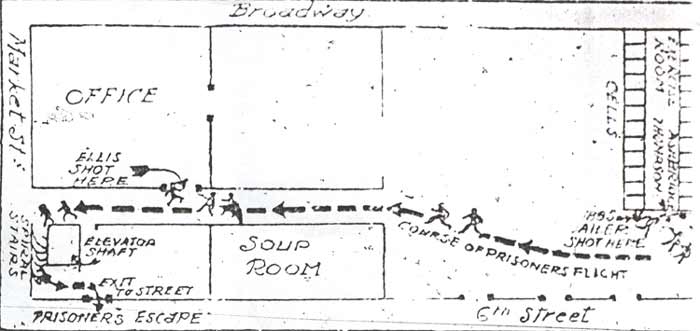
Diagram Showing How the Desperados Shot the Jailors and Made Their Escape
Murderer and His Wife Are Caught at Chester Hotel
Camden Daily Courier —
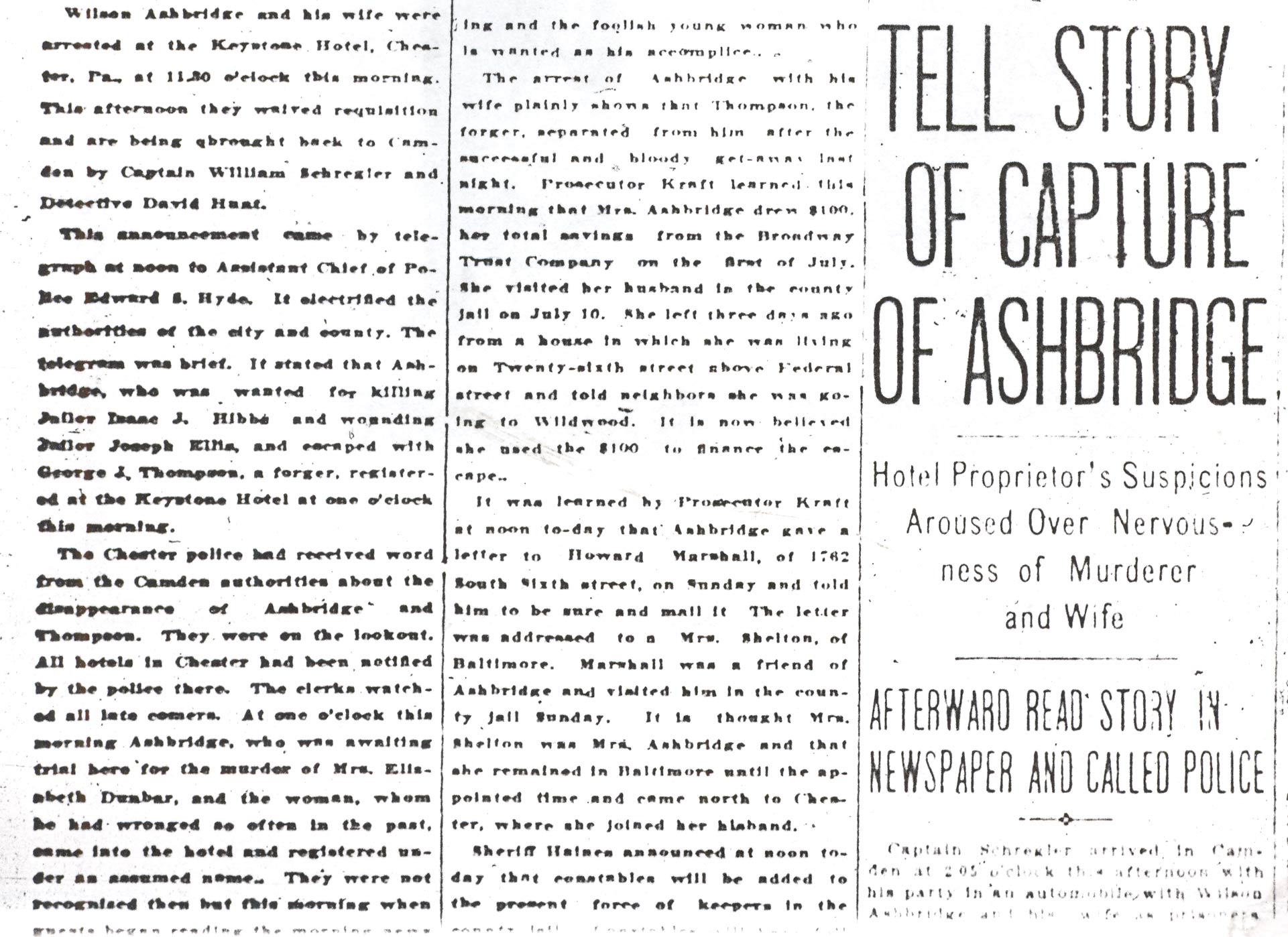
MURDERER AND HIS WIFE ARE CAUGHT AT CHESTER HOTEL WHERE THEY HAD COME IMMEDIATELY AFTER OUTBREAK FROM JAIL
Desperate Man and Spouse Waive Rights and Will Be Brought Back
MRS. ASHBRIDGE DREW $100 FROM HER BANK ACCOUNT
Believed She Was in Conspiracy to Aid Husband in Desperate Escape
CAPT. SCHREGLER CORRALS THEM
Wilson Ashbridge and his wife were arrested at the Keystone Hotel, Chester, Pa., at 11:30 o’clock this morning. As they waited extradition they will be brought back to Camden by Captain William Schregler and Detective David Hunt.
This announcement came by telegraph at noon to Assistant Chief of Police Hyde. The authorities of the city and county. The telegram was brief. It stated that Ashbridge, who was wanted for killing Jailor Isaac J. Hibbs and wounding Jailor Ellis, was captured. That Thompson, the forger, separated from him after the sensational and bloody getaway last night.
Ashbridge Caught in Chester Hotel Along With Wife
Camden Post-Telegram —
Fugitive Murderer Waives Extradition and Detective Schregler Brings Couple to Camden in Motor Car.
PAIR REGISTERED IN EARLY MORNING
Captured at noon with his wife in the Keystone Hotel at Chester PA, Wilson Ashbridge, who escaped from the County Prison last night with George E. Thompson, a forger, after killing Jailor Hibbs and shooting Jailor Ellis, is again in the County Jail.
Ashbridge admits that he shot both men. He said the gun was given to him by Thompson.
The couple were captured in their room at the Keystone Hotel by Captain of Detectives Schregler and Policeman David Hunt, who hurried to Chester in Chief Gravenor’s automobile in receipt of a message that a man answering to the description of the published picture of Ashbridge registered there early this morning with a woman as his wife.
Ashbridge offered no resistance when the officers entered his room. He waived extradition and being handcuffed was placed in the machine with his wife and hurried to this city.
Schregler sat in the rear of the machine between Ashbridge and his wife.
They reached City Hall at 2:10 o’clock this afternoon. Ashbridge was smoking a cigarette and looked sullen.
When the murderer saw a battery of photographers getting ready to take their pictures, Ashbridge shielded his wife’s face with his hat and hid his own face as best he could in his handcuffed condition.
They were taken upstairs to the Chief’s office and later sent to the Prosecutor’s office.
Ashbridge takes blame for the double shooting, but insists that his wife did not give him the gun, saying that Thompson supplied the weapon.
The police knew last night that Mrs. Ashbridge was with her husband or intended to go with him. This information came in a letter turned over to the police by a Mrs. Dick, of East Camden, who was caring for the children. The envelope cautioned her not to open the letter until 7:00 o’clock last night.
Mrs. Ashbridge said in the note that she was going to do a rash act and might not see the children again.
In the cell occupied by Thompson the following note was found by Detective Painter.
Ashbridge has made up his mind to leave this place. I have decided to go with him.
“It may seem like suicide and if anything happens send my body to the University of Pennsylvania
“THOMPSON
Seventeen loaded cartridges were also found in the cell.
The detectives and their prisoners were accompanied to Camden by E.S. Fry, proprietor of the Chester hotel, where the couple were caught.
There is no question but that Mrs. Ashbridge knew all about the plan to escape. Where she met her husband has not been discovered.
A reward of $1,000— $500 for each— was today offered by the Prosecutor.
Murderer's Wife Supplied Revolver, Smuggling It In Covered by Fruit
Camden Post-Telegram —
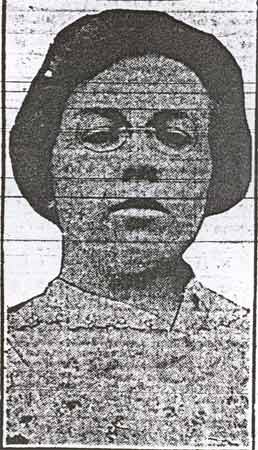
Confessing Supplying Pistol, in Spite of Husband’s Denial That She Was Guiltless, Mrs. Ashbridge Is Held Without Bail on Charge of Conspiracy in Aiding and Abetting Escape From Jail
With Wilson T. Ashbridge under guard in a cell in what was formerly known as Murderer’s Row, the police and county detectives today redoubled their energies towards the capture of George E. Thompson, the forger who escaped with Ashbridge from the County Jail on Monday night after murdering one keeper and wounding another. Stirring the police of all cities in the East to renewed activity, another circular was sent out today by the authorities giving notice of the reward of $500 offered for Thompson’s capture. Attention was strongly directed in the circular due to the fact that one of the fingers of Thompson’s left hand is missing.
The gun with which Ashbridge murdered jailor Isaac Hibbs and wounded Jailor Ellis was smuggled into the jail by Mrs. Ashbridge on Saturday morning. With it went a box of cartridges. The weapon and bullets were passed to Ashbridge in a basket of fruit, being at the bottom of the basket. The jailors were busy at the time she called and as she frequently had brought her husband fruit they did not take precaution to search the basket. Mrs. Ashbridge bought the gun and cartridges on the written request of her husband.
Her confession as to the very grave part she played in the escape and murder was made to the Prosecutor late yesterday afternoon after she had first insisted she had no knowledge of how the gun got into the jail and after her husband had repeatedly declared that the revolver was supplied by Thompson. The revolver, fully loaded, was still carried by Ashbridge when he was captured in the Keystone Hotel…
… by Recorder Stackhouse without bail for conspiracy in aiding and abetting the escape of her husband and George E. Thompson from the County Jail on Monday night.
The court room was packed to suffocation by a morbidly curious crowd, composed primarily of women. A strange silence spread through the court room when the little woman was led into the court room by Captain Schregler. The regular formality of placing prisoners in the dock was dispensed with the woman’s case.
Prosecutor De Unger pointed to the high witness chair and Mrs. Ashbridge sat in it. She evaded the gaze of the crowd, looking intently at the floor and through a window on the Washington Street side. She wore a blue skirt and a white waist. She was without her hat. Her hair was carefully arranged and she wore nose glasses.
Resting her chin on her right hand her arm and hand were seen to tremble slightly. So quiet was the room that a pin dropping could have been heard.
“Mrs. Marian Ashbridge,” called the Recorder.
“Yes, Sir” was the faint reply of the woman, who did not even look up at the call of her name.
“This complaint charges you with delivering to Wilson Ashbridge and George E. Thompson a pistol and aiding and abetting them in escaping from the County Jail, where they had been lawfully committed. Do you plead guilty or not guilty,” said the Recorder as he read the complaint.
The woman said nothing. Detective Schregler was then called as the complainant. He told of the confession made by the woman and produced the revolver which the woman purchased and which Ashbridge used in his daring escape. The gun, Captain Schregler said, was purchased in a pawnshop at Eleventh and Arch Streets, Philadelphia, on Friday of last week and was delivered to Ashbridge on Saturday morning along with a box of cartridges. “Marian, I will hold you without bail,” said the Recorder.
As the woman was being led from the court room by Captain Schregler and Sergeant Reed the crowd made a rush for the door leading from the court room, whereupon orders were given by the police to the crowd and many were prevented from rushing out. Everybody seemed anxious to secure a closer look at the unfortunate woman.
Visitors were denied Mrs. Ashbridge. Not even her children were permitted to be brought before her, although the broken-hearted mother asked for them.
“Oh, God, I don’t know why I did this; why I left the little ones to go with Wilson,” tearfully expostulated Mrs. Ashbridge to the kind-hearted matron, who spent the best part of last night with the distraught woman.
“If I could only see little Marian,” sobbed the woman in the arms of Mrs. Kirkpatrick, who informed her that perhaps she could see them today.
Last evening the only support Mrs. Ashbridge had was a cup of tea. The morning she sipped a portion of a cup of coffee. She told Matron Kirkpatrick that she was not hungry.
“Everybody hounded me, I had no friends, and that’s why I went with my husband, because he was the only friend I had left,” said Mrs. Ashbridge. “He was a good boy, but was easily led.” The wife said even before her marriage that Ashbridge would run around with other girls, but he always returned to her and she forgave him. She said he seemed to have a spell over her and she couldn’t leave him.
“I love my husband, still and will stand by him to the end,” sobbed the little woman to Mrs. Kirkpatrick. She told how her relatives disowned her and how after her father’s death she went to live with strangers. When her husband fostered the plan to escape she willingly consented to aid him. She drew $100 out of the bank and purchased clothes and the gun and bullets. She never faltered in her plan.
“My heart aches for that woman,” said Matron Kirkpatrick this morning to a Post-Telegram reporter. “She’s a good girl, but was easily led into her present predicament. It only goes to show what a woman will do for the man she loves, no matter how base a wretch he may be. Mrs. Ashbridge is more to be pitied than scorned.
Recorder Stackhouse this morning produced a copy of the marriage of the couple, performed by him on July 28, 1914. The marriage was performed at the instance of Assistant Prosecutor Butler after Ashbridge wronged the girl. Constable William E. Headley and William C. Ashbridge, the latter father of the murderer, were witnesses.
As told in yesterday’s Post-Telegram, Ashbridge and his wife and their captors arrived at the City Hall from Chester shortly after 2:00 o’clock. After a brief stay they were taken to the Court House and turned over to Prosecutor Kraft, Ashbridge being taken into the Prosecutor’s private office and Mrs. Ashbridge being placed under guard in the ante room.
Taking full blame for the murder of Hibbs and the wounding of Ellis, Ashbridge declared that none of the shots were fired by Thompson.
“I shot both men,” he declared, “but Thompson gave me the gun. He had it since Saturday.” He repeated this assertion several times in the course of his examination, adding each time that his wife had no part in supplying the firearm. His voluntary insistence in…
… exercise corridor of their cells in response to his request that he wanted to show him a note that had been left for him, he asked the aged keeper to step inside the corridor. Evidently suspecting something was wrong Hibbs refused to enter the corridor. When Ashbridge repeated his request that Hibbs step inside, Thompson, who was immediately behind Ashbridge, said something to the murderer. Ashbridge could not exactly recall what the expression was. At any rate it was then that he fired and Hibbs fell to the floor with his death wound. To take Hibbs’ keys and open the door leading from the exercise room to the corridor was the work of but an instant. It was then that Ellis confronted Ashbridge at the other end of the corridor. He refused to throw up his hands when the murderer so ordered. Instead, the plucky jailor grappled with the slayer, who again brought the gun into play, twice wounding the remaining jailor.
Ashbridge did not say why he wanted Hibbs to step inside the corridor. One surmise is that the pair had planned to get the old man into the corridor, overpower him, take his keys and after gagging him place him in a cell, depending on the gun to awe any prisoners who might make an outcry. But whatever their plan was in this respect it miscarried. Hibbs would not enter the corridor and was shot down where he stood.
Thompson carried both his own and Ashbridge’s coats when they fled. As Ashbridge had decided to do the talking with Hibbs when the jailor came to lock them in their cells it was agreed that it would not be wise for the murderer to be wearing a coat. This might look suspicious to Hibbs and in all likelihood he would refuse to open the door. Hence it was decided that Thompson should take both coats. He also carried Ashbridge’s cap and his own Panama.
The coats and hats were adjusted as they ran down the spiral stairway leading to the street. They walked slowly into Sixth Street; increasing their pace up Sixth Street after crossing Market and after turning into Cooper walked very rapidly. They turned north on Third Street to Main and thence to the Vine Street ferry, where they caught the boat leaving at 7:15 for Philadelphia. Landing on the other side the fugitives exchanged hats. They walked rapidly to Broad Street Station, where Mrs. Ashbridge was in waiting, this arrangement having been made when she smuggled the gun in to her husband on Saturday morning.
Accompanied by Thompson the Ashbridges walked out Market Street to Thirty-second Street. Here Thompson left them and after walking the street for a brief while longer the slayer and his wife boarded a trolley car for Chester, where a few hours later the murderer’s short-lived liberty was so dramatically terminated.
Although jailor Ellis still insists that three shots were fired before he was attacked and in spite of the positive declaration of Alfred Williams, the trusty, that three shots were fired at Hibbs, Ashbridge claims that Hibbs was shot only once and that two bullets were used on Ellis. He said that the three empty shells which the detectives found in his pocket contained the only bullets fired in the jail. The post mortem examination made yesterday by County Physician Stem bears out his contention as to the number of shots fired. Only one bullet was found and that had penetrated the jailor’s heart.
“That’s the truth about the shooting,” declared Ashbridge. “I fired the shots— three of them in all— and the gun was given me by Thompson. My wife had nothing to do with it. Don’t blame her.”
Enroute back to the prison from which he had made his tragic getaway on Monday night, Ashbridge passed through the ante room where his wife was under guard. He stopped, kissed her, gently caressed her cheek, told her not to worry and passed on to the jail, from whence his next exit will be to the electric chair.
Haggard and very weak Mrs. Ashbridge was at once taken before the Prosecutor. With due regard for her condition Mrs. Ashbridge was handled very gently. At first she insisted that she had no part in getting the gun, but under skillful handling she finally broke down and confessed that she had supplied the revolver.
She stated that on Friday night she received a letter from her husband telling her that he planned to escape from the jail on Monday night and that he needed a revolver to make certain that his scheme would not fail. He requested that she procure the pistol and cartridges and personally deliver them on Saturday. Being anxious to aid her husband in every way possible she readily decided to do as he requested.
Accordingly she purchased the needed articles in a Philadelphia pawnshop on Friday afternoon, paying $3.00 for the pistol and 67 cents for the cartridges. She kept them over night and on Saturday safely delivered the weapon and bullets to her husband in the bottom of a basket of fruit. At the same time Ashbridge asked her to go with him and when she agreed to share his fate he told her to meet him in Broad Street Station, Philadelphia, shortly after seven o’clock on Monday night. He further told her that he had carefully studied the situation and did not see how it was possible for his plan to miscarry. On Monday morning she sent her children to the home of Mrs. Anna Dick and later in the day sent the letter to Mrs. Dick telling of her “rash deed” and enclosing $10 for the children.
As Mrs. Ashbridge told her story she spoke in a very low tone. Most of the time her eyes were cast down and as she concluded her brief narrative she sobbed convulsively and was in a state of utter collapse. Reviving somewhat when given cold water Mrs. Ashbridge was turned over to the police and taken back to City Hall to await her hearing this morning.
The prison key stolen by Ashbridge from Hibbs’ murdered body was recovered this morning by Detective Doran in the yard of Dr. Frank, 2025 Chestnut Street, Philadelphia. The recovery of the key was due to information given by Ashbridge, after he had been locked up in jail yesterday afternoon. Ashbridge, when questioned as to the whereabouts of the key, said that Thompson had it and that he had seen him toss it over a wall of a residence near Twenty-third and Chestnut Streets on Monday night while he and his wife and Thompson were walking to Thirty-second Street.
Detective Doran and Constable Voight went to Philadelphia late yesterday afternoon and searched in vain for the key in the vicinity of Twenty-third and Chestnut Streets until darkness came on. Detective Doran renewed the search early this morning. There is a high wall fronting the yard at the home of Dr. Frank, and a search of the grounds resulted in the finding of the key, which was returned to Sheriff Haines.
Ashbridge is confined in a large cell in what is known as Section E. As cellmates he has two persons who are being held as witnesses to the crime. Sheriff Haines has assigned three constables, Gardner, Ford, and Addison. They will work on eight-hour shifts and will see that Ashbridge does not attempt any further escape or try to end his life.
Sergeant Detective Kane of the Chicago Police Department today took to Chicago Alfred Williams, who was an eyewitness to the murder of Hibbs. Williams, an Italian, served six months here on a charge of false pretence in obtaining money from a number of Italian grocers under the pretence that he represented the Roma Grocery Company. After his arrest and sentence here the police of Chicago lodged a detainer against Williams who is wanted in the West for a like crime.
The body of Jailor Hibbs will be exposed to view tonight at his home, 913 South 8th Street. Services will be conducted by Reverend Harry Bradway, pastor of Eighth Street Methodist Episcopal Church. Members of the Seventh Ward Republican Club, Mutual Aid and the Liberty Beneficial Society will attend in a body.
Tomorrow morning the body will be taken to Langhorne, where services will be held in the Friends Meeting House, after which interment will be made in the burial ground by the Schroeder-Kephart Company. Friends may call this evening to pay their respects.
Ashbridge will not be tried until December. On the day he was listed for trial of murdering Mrs. Dunbar his lawyer, Assemblyman Wolverton, was ill. In the interim the entire panel of jurors for the April term of court was discharged following a case of alleged tampering. This makes it necessary that he be held until September for trial unless the Court should otherwise decree, which is hardly likely.
Ashbridge is 22 years old and not 27, as previously stated. His real age was disclosed by the certificate of his marriage. He was 20 when he wedded two years ago.
The Howard Marshall who mailed a letter to a woman in Baltimore is not Freeholder Howard Marshall of the Eighth Ward, as was reported to the Prosecutor yesterday. Mr. Kraft’s investigation disclosed that Freeholder Marshall does not know either Ashbridge or Thompson and that as a matter of fact the Marshall in question is an East Sider and no relative to the freeholder, who was naturally much upset at being mistakenly dragged into the case.
E.S. Fry, proprietor of the Keystone Hotel, Chester, where the couple were caught, told the story of the capture both to the city police and Prosecutor Kraft.
“Late on Monday night I received a call from another hotel, requesting that I take care of a man and his wife for the evening,” said Mr. Fry. “I waited until a little before midnight when the couple arrived. He seemed nervous and registered in a shaky hand, and I was suspicious that there was something wrong.”
“I did not pay much attention to the way he registered until the next morning when I examined the register and saw that he had neglected to register his wife. He signed ‘Mr. Smythe, Washington, D.C.’ I communicated my suspicions to my wife and told her to go observe the couple, too. Then I went out on the porch and picked up a morning newspaper. On the front page were the pictures of the two men who escaped.”
“I instantly recognized Ashbridge, but was not just sure of my identity of the man, so I decided to get a better look at him. At the breakfast table I observed him more closely and feeling sure of my ground I called Captain Schregler, afterward securing the service of two negro policemen, whom I placed on guard outside the hotel, giving them orders not to allow the couple to leave. The officers, William Padgett and William Robinson, took their positions outside the hotel, ready for the signal to enter when I gave it.”
“Ashbridge arose.”
“What’s the matter,” he exclaimed. “You know what’s the matter,” replied Mr. Fry, who brought in Captain Schregler and Detective Hunt. Schregler and Hunt instantly recognized the fugitive.
Before Ashbridge had a chance to move his arms were pinioned by his sides and Policeman Hunt had extracted the murder gun from his right hip pocket. It was fully loaded. In the same pocket were seventeen additional cartridges and in a suitcase in his room, Number 9, was a fresh box of cartridges.
“The little wife was crying bitterly,” said Mr. Fry. “She leaned her head upon his shoulder and the husband tried to console her.”
Captain Schregler sent a telegram to Chiefs Gravenor and Hyde with the startling news that Ashbridge had been caught.
On the way back to Camden Mrs. Ashbridge began to cry. She was sitting beside Captain Schregler, and he tried to console her. Her sobs increased, and Ashbridge called to her to “take it easy.”
This seemed to quiet her a bit, and Schregler spoke to her kindly, saying that she would not be blamed very much for her part in the escape. “That’s not worrying me” she answered. “I am worried about ‘Wil’.”
“Well, you women beat me” was Schregler’s comment. “What did you want to help him escape for, anyhow? He had beaten you, deserted you for another woman and when she turned him down, he killed her. Yet you make up with him, leave your kids and risk everything to help him escape. Seems to me the worse men treat you women, the more you will do for them.”
“Lots of truth in what you say,” remarked Mrs. Ashbridge, with a sigh.
Mr. Fry was the center of attention. Everybody seemed anxious to hear his story.
“I’m not going back until I collect that $500 either,” he was heard to say. The capturer was formerly coroner of Delaware County.
Scenes of excitement were prevalent when the automobile of Chief Gravenor with Detective-chauffer David Hunt at the wheel, Captain Schregler and the prisoners in the rear and Chief Dodd, of the Pennsylvania Railroad police force in the front seat came from the Federal Street Ferry. E.S. Fry, the hotel proprietor who caught the Ashbridges, was also in the car.
Ashbridge and his wife were instantly recognized. The news spread like wildfire and was passed along the route of the machine to police headquarters.
Thinking that the prisoners would be brought to the Prosecutors office, a battery of newspapermen and photographers were camped on the Court House plaza. When someone cried in bellowed tones “There they go,” the scribes and photographers started in hot pursuit behind the automobile.
The officers upon reaching the City Hall had to fight their way through the dense crowd which had gathered outside Police Headquarters. Many stood tiptoed to get a good glance at the prisoners who were abashed at their predicament.
Pulling her black straw hat over her face, Mrs. Ashbridge leaned on her husband’s arm. To hide his face the murderer pulled the Panama hat, which he had secured from Thompson, over his countenance.
Preliminary questioning was done by Captain A.L. James, after which the officers and prisoners were escorted upstairs to the office of Chief Gravenor.
Still clenching the stump of a cheap cigarette in the corner of his mouth, Ashbridge had a pitiful look on his face. He was much thinner than he was when he was arrested for the murder of the Dunbar girl. On his upper lip was a small mustache, which he raised during the last week.
His beautiful and baby-like eyes still retained their piercing stare. The murderer looked wild-eyed at persons in the room. He seemed to take delight in singling out persons in the room and “staring them out.” None seemed courageous enough to return Ashbridge’s strange stare. He looked distressed but the only betraying sign of nervousness was his incessant twitching of his fingers. Seated on the couch in the chief’s room, Ashbridge talked freely.
His wife dried away the tears as they trickled down her reddened face but after regaining her composure she seemed quite calm. She intently watched Captain Schregler and Detective Hunt as they searched through her husband’s clothes.
When the trip for the Court House was being arranged the two prisoners, still handcuffed together, walked in the outer room of the chief’s office. It was then that the wife broke down slightly. She choked back a sob and leaned her head on her husband’s shoulder. Ashbridge did likewise and patted her on the back, at the same time, saying something in a suppressed tone of voice. The only persons in the room at the time were Assistant Chief Hyde and a Post-Telegram reporter. Neither was able to catch the words uttered. Captain Schregler, Chief Gravenor, and Detective Hunt later entered the room and the start for the Court House was made.
The crowd below which was camped about the entrance to the building awaited with patient expectancy, when the news was spread that the prisoners were leaving the building.
Camera men took their positions, ready to snap the couple, but the Ashbridges fooled them. Before the door leading to the street was opened Ashbridge drew his wife to him and with their free hands pulled their hats over their faces, thus eluding the photographers, who resorted to every means to secure a photograph.
Once inside the automobile the prisoners seemed content until the Court House was reached when another large crowd was on hand to greet them. Both repeated the trick of hiding their faces.
After Ashbridge was taken to his cell his wife was ordered taken to the detention department in the City Hall. Captain Schregler and Detective Hunt half-carrying the sobbing and broken-hearted woman, who has aroused some sympathy for her courageousness in taking such a desperate chance for the man she loved, the father of her children and a cruel murderer.
“What other woman would do as much as she has for her husband,” was the query advanced by one of the spectators in the Court House corridor as Mrs. Ashbridge passed through on her way to the waiting automobile.
Joseph Logue Dies, Fireman 22 Years
Camden Courier-Post —
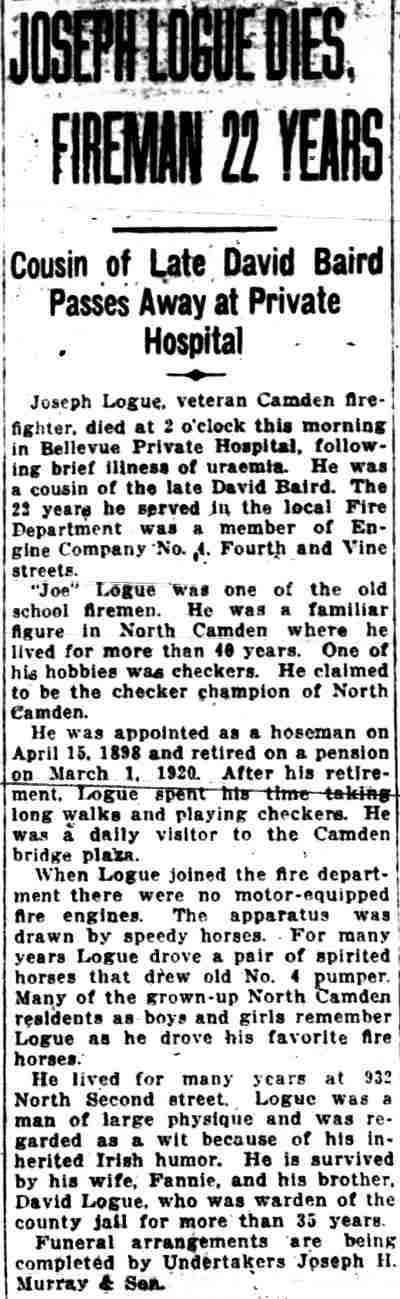
JOSEPH LOGUE DIES, FIREMAN 22 YEARS
Cousin of Late David Baird Passes Away at Private Hospital
Joseph Logue, veteran Camden firefighter, died at 2 o’clock this morning in Bellevue Private Hospital, following brief illness of uraemia. He was a cousin of the late David Baird. The 22 years he served in the local Fire Department was a member of Engine Company No. 4, Fourth and Vine streets.
“Joe” Logue was one of the old school firemen. He was a familiar figure in North Camden where he lived for more than 40 years. One of his hobbies was checkers. He claimed to be the checker champion of North Camden.
He was appointed as a hoseman on April 15, 1898 and retired on a pension on March 1, 1920. After his retirement, Logue spent his time taking long walks and playing checkers. He was a daily visitor to the Camden bridge plaza.
When Logue joined the fire department there were no motor-equipped fire engines. The apparatus was drawn by speedy horses. For many years Logue drove a pair of spirited horses that drew old No. 4 pumper. Many of the grown-up North Camden residents as boys and girls remember Logue as he drove his favorite fire horses.
He lived for many years at 932 North Second street. Logue was a man of large physique and was regarded as a wit because of his inherited Irish humor. He is survived by his wife, Fannie, and his brother, David Logue, who was warden of the county jail for more than 35 years.
Funeral arrangements are being completed by Undertakers Joseph H. Murray & Son.
Joseph Logue
Camden Courier-Post —
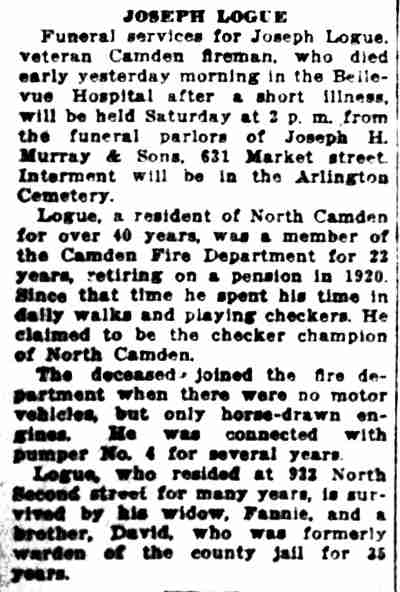
JOSEPH LOGUE
Funeral services for Joseph Logue, veteran Camden fireman, who died early yesterday morning in the Bellevue Hospital after a short illness, will be held Saturday at 2 p. m. from the funeral parlors of Joseph H. Murray & Sons, 631 Market street. Interment will be in the Arlington Cemetery.
Logue, a resident of North Camden for over 40 years, was a member of the Camden Fire Department for 22 years, retiring on a pension in 1920. Since that time he spent his time in daily walks and playing checkers. He claimed to be the checker champion of North Camden.
The deceased joined the fire department when there were no motor vehicles, but only horse-drawn engines. He was connected with pumper No. 4 for several years.
Logue, who resided at 932 North Second street for many years, is survived by his widow, Fannie, and a brother, David, who was formerly warden of the county jail for 25 years.
Logue Leaves Family $11,600
Camden Courier-Post —
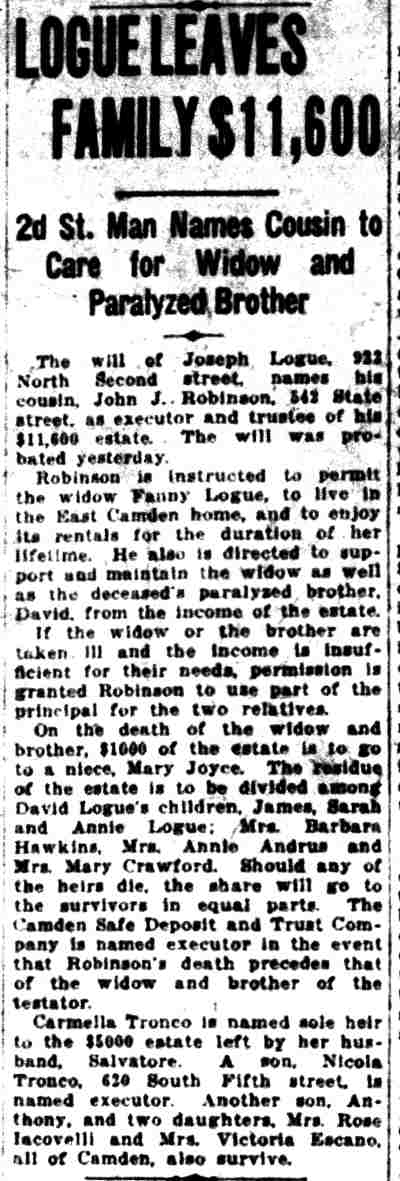
LOGUE LEAVES FAMILY $11,600
2d St. Man Names Cousin to Care for Widow and Paralyzed Brother
The will of Joseph Logue, 922 North Second street, names his cousin, John J. Robinson, 342 State street, as executor and trustee of his $11,600 estate. The will was probated yesterday.
Robinson is instructed to permit the widow Fanny Logue, to live in the East Camden home, and to enjoy its rentals for the duration of her lifetime. He also is directed to support and maintain the widow as well as the deceased’s paralyzed brother, David, from the income of the estate.
If the widow or the brother are taken ill and the income is insufficient for their needs, permission is granted Robinson to use part of the principal for the two relatives.
On the death of the widow and brother, $1000 of the estate is to go to a niece, Mary Joyce. The residue of the estate is to be divided among David Logue’s children, James, Sarah and Annie Logue; Mrs. Barbara Hawkins, Mrs. Annie Andrus and Mrs. Mary Crawford. Should any of the heirs die, the share will go to the survivors in equal parts. The Camden Safe Deposit and Trust Company is named executor in the event that Robinson’s death precedes that of the widow and brother of the testator.
Carmella Tronco is named sole heir to the $5000 estate left by her husband, Salvatore. A son, Nicola Tronco, 620 South Fifth street, is named executor. Another son, Anthony, and two daughters, Mrs. Rose Iacovelli and Mrs. Victoria Escano, all of Camden, also survive.
David Logue Dies, Ex-Warden of Jail
Camden Courier-Post —
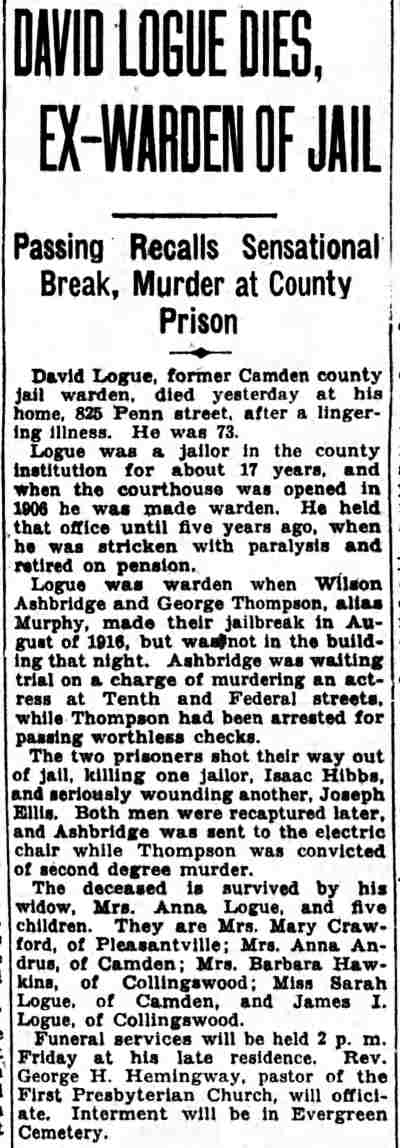
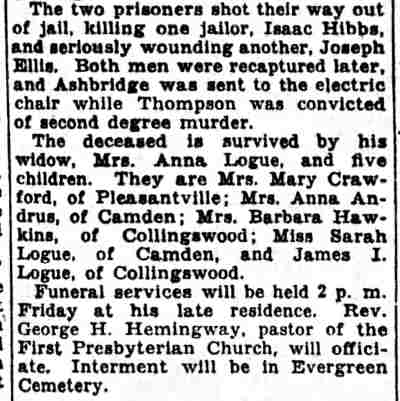
DAVID LOGUE DIES, EX-WARDEN OF JAIL
Passing Recalls Sensational Break, Murder at County Prison
David Logue, former Camden county jail warden, died yesterday at his home, 825 Penn street, after a lingering illness. He was 73.
Logue was a jailor in the county institution for about 17 years, and when the courthouse was opened in 1906 he was made warden. He held that office until five years ago, when he was stricken with paralysis and retired on pension.
Logue was warden when Wilson Ashbridge and George Thompson, alias Murphy, made their jailbreak in August of 1916, but was not in the building that night. Ashbridge was waiting trial on a charge of murdering an actress at Tenth and Federal streets, while Thompson had been arrested for passing worthless checks.
The two prisoners shot their way out of jail, killing one jailor, Isaac Hibbs, and seriously wounding another, Joseph Ellis. Both men were recaptured later, and Ashbridge was sent to the electric chair while Thompson was convicted of second degree murder.
The deceased is survived by his widow, Mrs. Anna Logue, and five children. They are Mrs. Mary Crawford, of Pleasantville; Mrs. Anna Andrus, of Camden; Mrs. Barbara Hawkins, of Collingswood; Miss Sarah Logue, of Camden, and James I. Logue, of Collingswood.
Funeral services will be held 2 p. m. Friday at his late residence. Rev. George H. Hemingway, pastor of the First Presbyterian Church, will officiate. Interment will be in Evergreen Cemetery.