Introduction
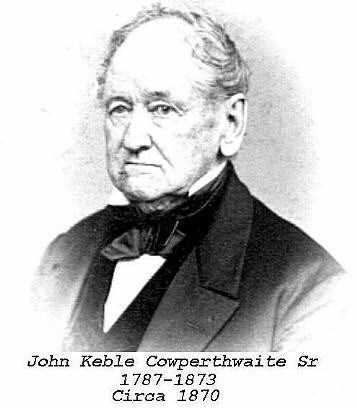
John K. Cowperthwaite.
JOHN K. COWPERTHWAITE was the first of Camden’s mayors to be selected by popular vote of the electorate. Prior mayors had been selected by City Council.
Born on the east side of the Cooper River near the Federal Street bridge in 1787, he moved into Camden in 1820. A lay judge, he served for many years as a judge of the Gloucester and after 1844 Camden County Court. John Cowperthwaite was an active member of the group involved in securing Camden’s city charter in 1828, and served in various posts until the 1844 election, when he was elected Mayor for a one-year term. After leaving office, he returned to the bench, and continued his judicial career until his death on May 6, 1873.
Death of John K. Cowperthwaite, Esq.
Camden Democrat —

LOCAL AFFAIRS.
Death of John K. Cowperthwait [sic], Esq.
AN OLD PATRIARCH GONE HOME.—Our citizens, and especially the older residents, received the sad news of the death of this venerable and venerated patriarch, on Tuesday last. Although not unexpected, the loss of one so widely known, and so sincerely loved and esteemed, could not fail to awaken feelings of regret in every heart. He was no ordinary man. Gifted in many ways for a useful career in life, he improved every talent, and devoted himself to every useful purpose, calculated to benefit mankind. His career has been so marked, and yet so unostentatious and upright in his private and public walks, that we cannot better appropriate our space than by presenting a short biography of his life, although it would require a volume to do him justice.
John Keble Cowperthwaite was born September 2, 1787. He descended from an English family on his father’s and mother’s side. His mother was from the Kebles and Spicer’s. Samuel Spicer long held a commission from the British Crown for the administration of justice in this vicinity, and in honor of him the township of Spicer was named. Early in life he entered upon public duties, and so continued up to a late period of life until disabled by a severe attack of paralysis. The following list of commissions will indicate the honors that came unsought and unbought from the Legislature of New Jersey, which was often composed of men of different political opinions than his own. He began life a Democrat and held on to that faith to the last.
March 24, 1813—Gov. Ogden commissioned him Ensign, 3d Co., 2d Battalion, 2d Regt., Gloucester Brigade Militia. June 2[?], 1816—Elected Captain, commissioned by Gov. Dickerson. Nov. 4, 1819—Council and Assembly of New Jersey made him Major 2d Bat., 2d Regt., Gloucester Brigade. March 1, 1820—Council and Assembly in joint meeting appointed him Justice of the Peace for Gloucester Co. Commissioned by Gov. Williamson. Oct. 2[?], 1824—Reappointed Justice of Peace. March 4, 1828—Legislature of New Jersey appointed him Recorder of city of Camden. November 7, 1829—Reappointed Justice of the Peace. Nov. 17, 1831—Commissioned by Judges of the Supreme Court to take special bail, &c. Feb. 27, 1833—Recommissioned Recorder of the city of Camden. Commissioned by Gov. Seeley. October 31, 1834—Recommissioned Justice of the Peace. Feb. 28, 1838—Reappointed Justice. Commissioned by Gov. Pennington. Feb. 1, 1841—Appointed by Judges of Circuit Court of U. S. to take special bail, &c. Feb. 8, 1842—Appointed by District Court of U. S. Commissioner in Bankruptcy. October 30, 1843—Reappointed Justice of the Peace. Commission signed by Gov. Haines. October 30, 184[?]—Reappointed Judge of Common Pleas. March 13, 1844—Legislature appointed him Alderman of the city of Camden. Commissioned by Gov. Haines. April 1, 1851—Reappointed Judge of Common Pleas of Camden Co. Commissioned by Gov. Fort. April 1, 1857—Reappointed by Senate and General Assembly Judge of Common Pleas of Camden Co. Commissioned by Gov. Newell. April 1, 1862—Recommissioned Judge of Common Pleas. Commissioned by Gov. Olden.
Thus showing a long series of uninterrupted appointments by the highest tribunals of New Jersey.
He was intimately associated with the early history of Camden—one of its oldest residents, was in its first Council after incorporation, and was so well informed as to its lines and boundaries, that in cases of disputed lines, his opinion has often settled cases which otherwise might have caused years of altercation—his advice was often sought, and as freely given, in matters pertaining to our common law. When we consider the amount of labor that his offices imposed, the number of estates put into his hands to settle, the extent of his judicial authority, covering the counties of Camden, Gloucester and Atlantic, his Court days bringing before him intricate matters of law, and the presence of first-class lawyers, we are surprised that so few errors occurred in the administration of justice. It was often a matter of congratulation with him, that in few or none of the cases of appeal from his Court to a higher one, were they reversed. He was gifted with a sound mind, correct judgment and methodical habits—liberal in his opinion, unswerving in his integrity, and fast in his friendship, he won and retained the respect of his fellow-citizens. In 1822 he united with the M. E. Church, and for many years he was a Trustee and Steward in that Society, and during the long years of that membership always felt a lively interest in every enterprise having for its object the welfare of his fellow-men, contributing freely of his means for those objects, and for the extension of the cause of Christ Jesus, in whose faith and love he expired May 6, 1873, in the 86th year of his age.
History of Camden County New Jersey
George Reeser Prowell — 1886
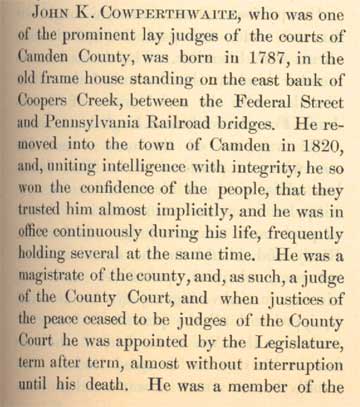

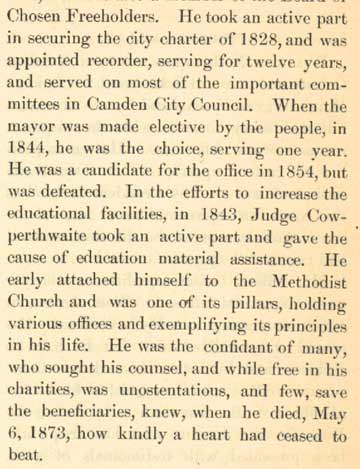
John K. Cowperthwaite, who was one of the prominent lay judges of the courts of Camden County, was born in 1787, in the old frame house standing on the east bank of Coopers Creek, between the Federal Street and Pennsylvania Railroad bridges. He removed into the town of Camden in 1820, and, uniting intelligence with integrity, he so won the confidence of the people, that they trusted him almost implicitly, and he was in office continuously during his life, frequently holding several at the same time. He was a magistrate of the county, and, as such, a judge of the County Court, and when justices of the peace ceased to be judges of the County Court he was appointed by the Legislature, term after term, almost without interruption until his death. He was a member of the township committee of Camden township nearly the entire eighteen years of its existence, and was also a member of the Board of Chosen Freeholders. He took an active part in securing the city charter of 1828, and was appointed recorder, serving for twelve years, and served on most of the important committees in Camden City Council. When the mayor was made elective by the people, in 1844, he was the choice, serving one year. He was a candidate for the office in 1854, but was defeated. In the efforts to increase the educational facilities, in 1843, Judge Cowperthwaite took an active part and gave the cause of education material assistance. He early attached himself to the Methodist Church and was one of its pillars, holding various offices and exemplifying its principles in his life. He was the confidant of many, who sought his counsel, and while free in his charities, was unostentatious, and few, save the beneficiaries, knew, when he died, May 6, 1873, how kindly a heart had ceased to beat.
On Keeping Chimneys Clean
Camden Courier-Post —
ON KEEPING CHIMNEYS CLEAN
First Act of Camden City Council, Over Century Ago, Was to Cut Down Fire Hazard By Way of Ordinance for ‘Sweeps’
Comparing Camden’s fire-fighting equipment of today with what the city had when it was incorporated, 103 years ago, the wonder is that some of the fires did not wipe out the tiny community. With their pumpers, chemicals and water mains, the average suburban town is protected like a metropolis when we consider the methods in vogue a century ago.
Fire ever has been man’s most implacable foe, and eve yet it is merely a matter of degree—from barbarian ancestors and their rude thatched shacks, to modern skyscraper as to the terror it inspires. Camden, in the late 20s of the last century, was merely a clutter of tiny dwellings, only the more prosperous citizenry such as the Coopers and Kaighns having brick domiciles graced with attics.
It was thus in keeping with the times to have thought first for safety from the fire demon when City Council held its first session, April 11, 1828. That was by way, of an ordinance directed against those inclined to be careless and let their chimneys collect through the years, a great mass of soot. There were those who kept their chimneys clean as the proverbial whistle, first, so the fire would draw, and again to remove the fire hazard, But many apparently, took pot luck and let things go with little thought of what might happen until it did— oft-times in the dead of night with long tongues of flames wiping out their humble domicile.
Wood Exclusively Used
Electricity was little more than the mysterious force Ben Franklin had toyed with over the Delaware. Coal still was to be brought from its carboniferous beds in Pennsylvania. It had not even been proposed as “stones that would burn and give heat.” Oil came from whales and such and was used sparingly on new fangled mysteries called machinery. So the thick, clumps of trees here about were hewed down for heat in winter and to cook the meals. It was that constant use of wood that filled the chimneys with soot and soot evidently was most of the cause of fire.
When a fire started in Camden village it was a serious affair. If it wasn’t caught in the nick of time the house burned to the ground. So council passed its first ordinance to help the boys of old Perseverance in keeping down the fire record although in those days there were no records kept, of course. That first company, by the way, was on Second Street above Market, about where the National State Bank first built. The little frame shack was still there in the 70’s when the bank enlarged its building and tore it down, the company meanwhile having taken its quarters to Third Street.
But getting back to the ordinance of council, it required the thorough sweeping of every chimney at least once in three months. If a sweep tried the short cut to earning his money by burning out a chimney he was fined $1 because that method was declared to endanger surrounding property. The sweep was supposed to get into the chimney or at least sweep it in regulation fashion and not “cut corners,” as some persons have a habit of doing whether it’s sweeping chimneys or building a house.
That part of the ordinance is interesting for it provides “that if any person from or after the first day of May next, ensuing, shall burn his, her or their chimney, or suffer the same to burn or blaze out of the top thereof, unless the roof of the house thereof is covered with snow, or during the time of a storm of rain or snow, every such person shall forfeit and pay the sum of one dollar.” If a chimney should take fire the house owner was required to prove that it had been properly swept out within three months.
Further, it was provided if such a chimney burst into flame after it had been swept out the chimney sweep was to forfeit a dollar. That evidently was due to the determination of Laning, Cowperthwaite, Sloan and Lawrence, the city fathers, to make more and better chimney sweeps and to aid the Perseverance boys in staying the ravages of the flaming foe.
Outstanding Fireman
And if any of the boys of the present generation imagine they have the niftiest apparatus hereabouts; with all their compound engines, extension ladders and what not, they have nothing on Samuel D. Elfreth, who “ran” with old Perseverance so soon as he came to Camden, in 1824. Old annals relate, he was always on the spot when “she” was needed, meaning the hand engine, and was regarded as the outstanding fireman of Camden. In 1882 my grandfather wrote in the Courier that Elfreth, although verging on 80, was then still one of the most active volunteer firemen in Camden. He then resided within the shadow of his beloved old company and was filled with reminiscences of the days when he ran with the boys. His son, Samuel (S. Elfreth), then was chief of the paid fire department as he was in later years until his death some 15 years ago. Charles F. Elfreth, a veteran attache of the city’s finance department, is a grandson of the first Elfreth, a nephew of the late chief.
Those old ordinances relative to keeping chimneys clean seem amusing now, but they were vitally important then. They were, in fact, the very beginning of the present day system of keeping down fire losses by way of every possible method in alarms, in equipment, in man efficiency. It is from such humble beginnings that have evolved the methods in battling blazes in skyscrapers, in extensive plants, in keeping tabs on the very last thing in conquering the foe ever ready, and seemingly willing, to raze the works of man.