Introduction
WILSON L. BROMLEY was born in New Jersey around 1853 to Joseph and Ann Eliza Bromley. Joseph Bromley worked as a boilermaker. The Bromley family was living in South Camden when the Census was enumerated in 1860. The 1860 Census list four children at home, Joseph, 10; Wilson, 8; Daniel, 5; and Eliza, 2. All three of the Bromley sons were at one time or another appointed to the Camden Fire Department, only Wilson, however, made a career of it.
Wilson Bromley was working in a brass foundry in 1870. He married in the 1870s. When the Census was taken in 1880 he was living with his wife Hannah and son Joseph at 710 Oak Street in Camden’s Fifth Ward. His next door neighbor was William Morris, both men were appointed to the Camden Fire Department in the spring of 1884.
Oak Street was renamed Locust Street around 1883. Later in the decade, the family moved to 716 Locust Street. He was then working as a boilermaker. By 1886 he had joined the Camden Fire Department.
In 1886 the Camden Steam Fire Engine Company Number 1 was located at 409 Pine Street in a three story 20 by 90 foot brick building (the old Independence Fire Company No. 3 engine house). The company’s apparatus was an Amoskeag second class steamer (maker’s plate 6318) drawn by two horses and one Silsby two wheel hose cart drawn by a single horse. The company was equipped with 1000 feet of good hose, axes, lamps, etc. The company roster included John Stockton, Foreman; G. Rudolph Tenner, Engineer; William Deno, driver; William W. Laird, stoker; Wilson Bromley and jacob f nesson, hosemen. Call men were William Deith, andrew miller and William Bogia. Bromley and Bogia would later suffer line of duty deaths.
Wilson Bromley and his family had moved to 326 Pine Street by 1890, only a few doors away from the firehouse where he was stationed.
Wilson Bromley and Assistant Chief Samuel Buzine were injured on July 29, 1895 when Engine Company 1’s hose cart overturned at South 6th and Royden Streets. They had been responding to a test alarm sent by the Fire Committee of City Council.
Fire fighter Wilson Bromley was injured while responding to a fire at the Farr & Bailey oil cloth plant at South 7th Street and Kaighn Avenue on February 15, 1896. He died as a result of his injuries on February 28, 1896.
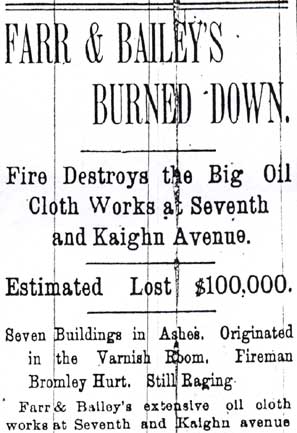
Farr & Bailey's Burned Down.
Camden Post-Telegram —
Fire Destroys the Big Oil Cloth Works at Seventh and Kaighn Avenue.
Estimated Lost $100,000.
Seven Buildings in Ashes. Originated in the Varnish Room. Fireman Bromley Hurt. Still Raging
Fire Destroys the Big Oil Cloth Works at Seventh and Kaighn Avenue.
Estimated Lost $100,000.
Seven Buildings in Ashes. Originated in the Varnish Room. Fireman Bromley Hurt. Still Raging
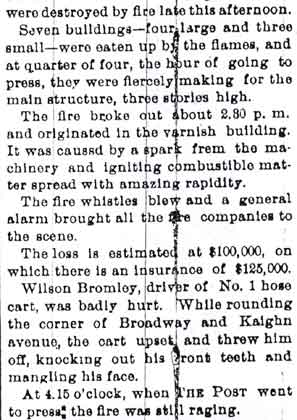
Farr & Bailey’s extensive oil cloth works at Seventh and Kaighn avenue were destroyed by fire late this afternoon.
Seven buildings—four large and three small—were eaten up by the flames, and at quarter of four, the hour of going to press, they were fiercely making for the main structure, three stories high.
The fire broke out about 2:30 p.m. and originated in the varnish building. It was caused by a spark from the machinery and igniting combustible matter spread with amazing rapidity.
The fire whistles blew and a general alarm brought all the fire companies to the scene.
The loss is estimated at $100,000, on which there is an insurance of $125,000.
Wilson Bromley, driver of No. 1 hose cart, was badly hurt. While rounding the corner of Broadway and Kaighn avenue, the cart upset and threw him off, knocking out his front teeth and mangling his face.
At 4:15 o’clock, when THE POST went to press, the fire was still raging.
The Destructive Fire at Farr & Bailey's
Camden Post-Telegram —
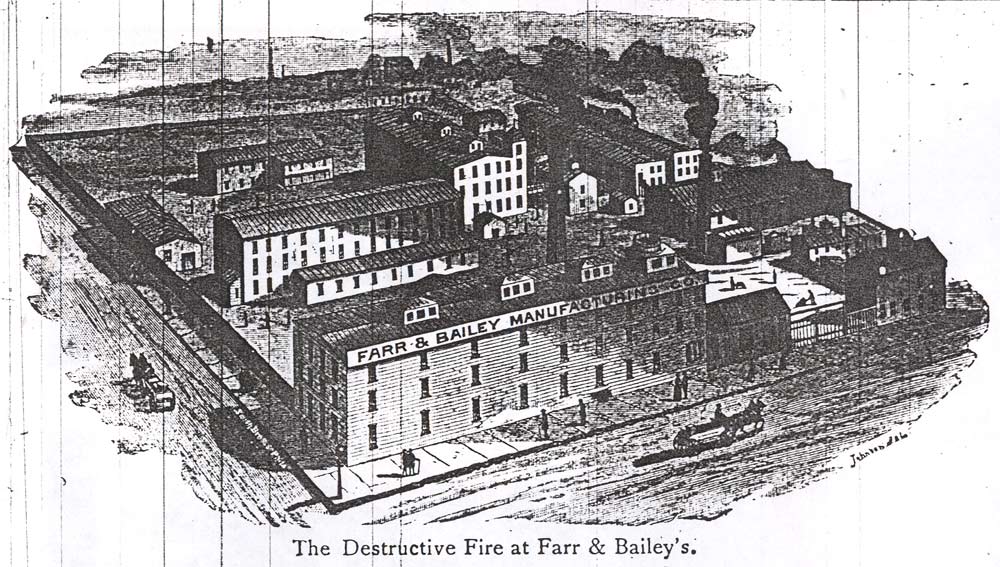
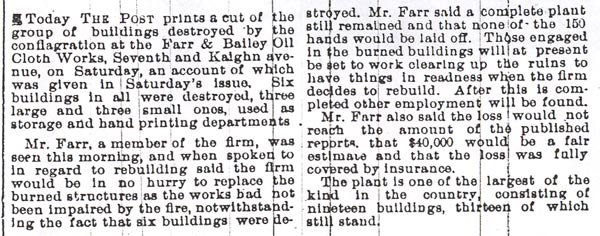
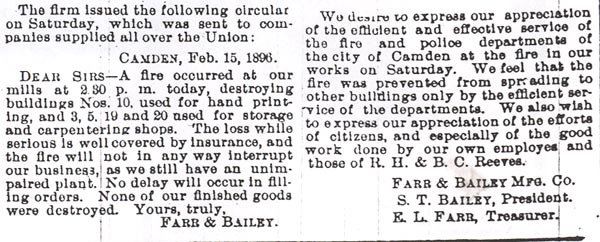
Today THE POST prints a cut of the group of buildings destroyed by the conflagration at the Farr & Bailey Oil Cloth Works, Seventh and Kaighn avenue, on Saturday, an account of which was given in Saturday’s issue. Six buildings in all were destroyed, three large and three small ones, used as storage and hand printing departments.
Mr. Farr, a member of the firm, was seen this morning, and when spoken to in regard to rebuilding said the firm would be in no hurry to replace the burned structures as the works had not been impaired by the fire, notwithstanding the fact that six buildings were destroyed. Mr. Farr said a complete plant still remained and that none of the 150 hands would be laid off. Those engaged in the burned buildings will at present be set to work clearing up the ruins to have things in readiness when the firm decides to rebuild. After this is completed other employment will be found.
Mr. Farr also said the loss would not reach the amount of the published reports, that $40,000 would be a fair estimate and that the loss was fully covered by insurance.
The plant is one of the largest of the kind in the country, consisting of nineteen buildings, thirteen of which still stand.
Fireman Bromley Dead.
Camden Post-Telegram —
He Was Hurt Two Weeks Ago Going to the Farr & Bailey Fire.
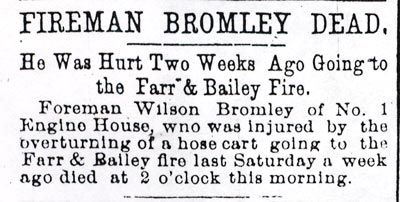
Foreman Wilson Bromley of No. 1 Engine House, who was injured by the overturning of a hose cart going to the Farr & Bailey fire last Saturday a week ago died at 2 o’clock this morning.
To Attend Bromley's Funeral.
Camden Post-Telegram —
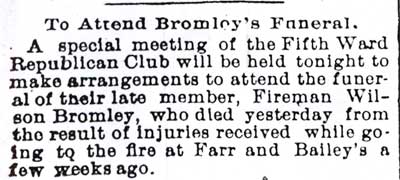
A special meeting of the Fifth Ward Republican Club will be held tonight to make arrangements to attend the funeral of their late member, Fireman Wilson Bromley, who died yesterday from the result of injuries received while going to the fire at Farr and Bailey’s a few weeks ago.
Fireman Wilson Bromley Dies
Philadelphia Inquirer —
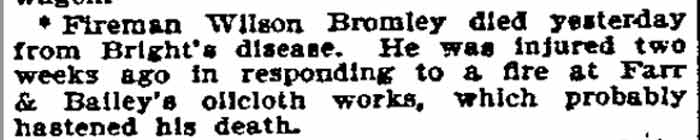
Fireman Wilson Bromley died yesterday from Bright’s disease. He was injured two weeks ago in responding to a fire at Farr & Bailey’s oilcloth works, which probably hastened his death.
Obituary
Philadelphia Inquirer — March 1 & 3, 1896
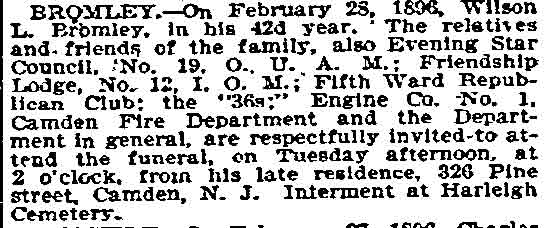
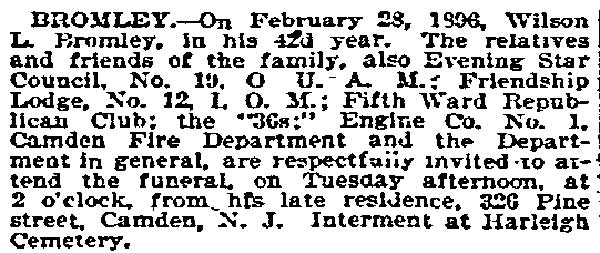
BROMLEY.—On February 28, 1896, Wilson L. Bromley, in his 42d year. The reletives [sic] and friends of the family, also Evening Star Council, No. 19, O. U. A. M.; Friendship Lodge, No. 12, I. O. M.; Fifth Ward Republican Club; the “36s;” Engine Co. No. 1, Camden Fire Department and the Department in general, are respectfully invited to attend the funeral, on Tuesday afternoon, at 2 o’clock, from his late residence, 326 Pine street, Camden, N. J. Interment at Harleigh Cemetery.
First City Fire House Located at 5th and Arch
Camden Courier-Post —

Hosemen, Tillermen and Laddermen Paid $50 Monthly While Call Men Received $75 a Year; Steam Engine Held for Emergency
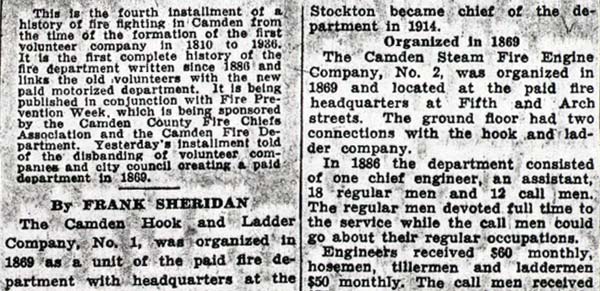
This is the fourth installment of a history of fire fighting in Camden from the time of the formation of the first volunteer company in 1810 to 1936. It is the first complete history of the fire department written since 1886 and links the old volunteers with the new paid motorized department. It is being published in conjunction with Fire Prevention Week, which is being sponsored by the Camden County Fire Chiefs Association and the Camden Fire Department. Yesterday’s installment told of the disbanding of volunteer companies and city council creating a paid department in 1869.
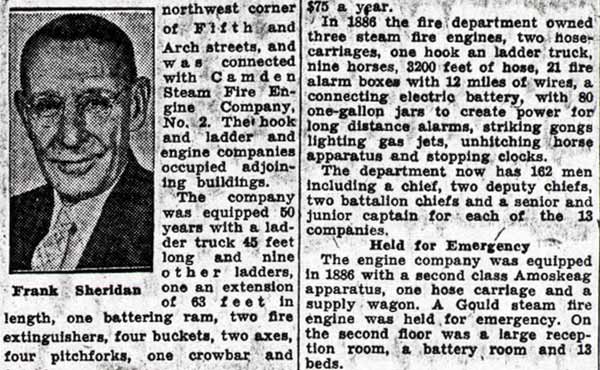
The Camden Hook and Ladder Company, No. 1, was organized in 1869 as a unit of the paid fire department with headquarters at the northwest corner of Fifth and Arch streets, and was connected with Camden Steam Fire Engine Company, No. 2. The hook and ladder and engine companies occupied adjoining buildings.
The company was equipped 50 years with a ladder truck 45 feet long and nine other ladders, one an extension of 63 feet in length, one battering ram, two fire extinguishers, four buckets, two axes, four pitchforks, one crowbar and four lamps.
The members of the Camden Hook and Ladder Company, No. 1, in 1886, when the last history of the department was written, were Amedy Middleton, tillerman; Benjamin L. Kellum, driver; Thomas Walton, and John W. Toy, laddermen; William Doughten, Peter S. Gray, John Gray and Charles A. Todd, callmen.
The Camden Steam Fire Engine Company, No. 1, was organized in 1869 and stationed at Fourth and Pine streets, where Engine Company, No. 1, still is housed. The company was equipped with one second class steam fire engine made by the Amoskeag Manufacturing Company, Manchester, New Hampshire; one hose cart, manufactured by the Silsby Company, Seneca Falls, N. Y.; three horses and 1600 feet of hose.
The members of the company in 1886 were John A. Stockton, foreman; G. Rudolph Tenner, engineer; William Deno, driver; William W. Laird, stoker; Wilson Bromley and Jacob F. Nessen, hosemen; William Deith, Andrew Miller, William Bogia and W. Elwood Campbell, callmen.
Stockton became chief of the department in 1914.
Organized in 1869
The Camden Steam Fire Engine Company, No. 2, was organized in 1869 and located at the paid fire headquarters at Fifth and Arch streets. The ground floor had two connections with the hook and ladder company.
In 1886 the department consisted of one chief engineer, an assistant, 18 regular men and 12 call men. The regular men devoted full time to the service while the call men could go about their regular occupations.
Engineers received $60 monthly, hosemen, tillermen and laddermen $50 monthly. The call men received $75 a year.
In 1886 the fire department owned three steam fire engines, two hose-carriages, one hook an [sic] ladder truck, nine horses, 3200 feet of hose, 21 fire alarm boxes with 12 miles of wires, a connecting electric battery, with 80 one-gallon jars to create power for long distance alarms, striking gongs lighting gas jets, unhitching horse apparatus and stopping clocks.
The department now has 162 men including a chief, two deputy chiefs, two battalion chiefs and a senior and junior captain for each of the 13 companies.
Held for Emergency
The engine company was equipped in 1886 with a second class Amoskeag apparatus, one hose carriage and a supply wagon. A Gould steam fire engine was held for emergency. On the second floor was a large reception room, a battery room and 13 beds.
The roster of the company in 1886 included Samuel S. Elfreth, chief engineer; Samuel S. Buzine, assistant chief engineer; Jacob W. Kellum, extra engineer; Harry C. Grossup, foreman; William Morris, engineer; C. B. Harvey, driver of engine; Frank Turner, stoker; Charles Robinson and Isaac Shreves, hosemen; James Carey, Logan Bates, William Lyons and Howard Currie, callmen.
The early chiefs of the paid department were William Ables, Robert S. Bender, two terms; Cladius [sic] W. Bradshaw, mayor from 1880 to 1886; Henry F. Surault, Samuel S. Elfreth, Daniel A. Carter. These chiefs served for the duration of the terms of the fire committees of city council. This system was changed later and Elfreth was named permanent chief. Buzine was deputy chief under Elfreth.
(Tomorrow’s installment will describe a sudden succession of chiefs brought about by the resignation of Elfreth and the death of Charles Worthington, who was fatally injured in a fall from a roof at a fire.)