William W. Mines
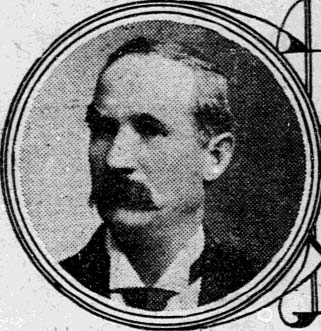
William W. Mines
William W. Mines was one of the original members of the Camden Fire Department, entering service on September 2, 1869 as the Assistant Marshall, a post similar in nature to that of Deputy Chief.
William W. Mines was born in Camden, New Jersey on April 12, 1843 to Christopher J. Mines Sr. and his wife, the former Elizabeth Keen. He was the oldest of eleven children, coming before Christopher Jr., Jesse K., Hannah, Marcus H., Elizabeth, Charles, Rachel, George W., Kate, Elmer E., and Henry W. Mines. Christopher Mines Sr. was active in local politics and civic affairs. A Carpenter by trade, Christopher Mines taught his son William that profession and he followed it into the 1870s.
In the years before the Civil War William W. Mines became active as a volunteer firefighter with Independence Fire Company No. 1. George Reeser Prowell wrote about the two companies in his History of Camden County, New Jersey which was published in 1886.
The Independence Fire Company No. 1, organized with Lambert F. Beatty, president; William S. Frazer, secretary; and Joseph Wagner, treasurer. Among the early members were Jacob Prettyman, David Page, Thomas Stites, Andrew Stilwell, Francis E. Harpel, Restore Cook, John Wallace, Claudius W. Bradshaw, William H. Hawkins, Christopher J. Mines, Henry Bradshaw, William E. Walls, William Howard, Albert Dennis, Elwood Bounds, Samuel H. Stilwell, Albert V. Mills, Robert S. Bender, Lewis Yeager, Thomas McCowan and William W. Mines. The company met in a building at Third Street and Cherry for a year, when it was burned. Lewis Yeager gave the company free use of a lot on Third Street, above Cherry, where an engine-house of slabs, donated by Charles Stockham, was built. In 1853 a lot on Cherry Street, above Third, was purchased and on it a frame house was built. This was used until 1859, when, owing to a defect in the title, the sheriff advertised the property for sale. When he reached the ground on the day of the sale he found the house, with its contents, and a number of the members of the company, on an adjoining lot belonging to James B. Dayton, who permitted the action. The following year, 1860, they bought and built, on the north side of Pine Street, above Fourth, a three-story brick, then the most complete fire-engine house in Camden, and which was sold for four thousand five hundred dollars to the city. The Independence was a hose company until June 4, 1864, when they secured an Amoskeag engine, being the first fire-engine in use by the fire companies of Camden. Early in 1869 they purchased a larger engine and when the volunteer firemen were scattered, in the latter part of that year, they sold the Amoskeag to Millville, and the later purchase was kept until 1874, when it was sold to the city. Lambert F. Beatty, John Wallace, William H. Hawkins, J. Kelly Brown, William W. Mines and Edward Gilbert were presidents of the Independence, while its secretaries have been William L. Frazer, William W. Mines, Mortimer C. Wilson and Thomas McCowan; and the treasurers Joseph Wagner and Robert S. Bender, who, elected in 1854, served until October 13, 1874, when, with a roll of sixty members, they met. President Gilbert in the chair, paid all claims against them and formally disbanded.
On April 25, 1861 William W. Mines enlisted in the Union Army as a First Sergeant. He was assigned to Company G, Fourth Infantry Regiment New Jersey on 27 Apr 1861.
The Fourth Regiment—Militia, was commanded by Colonel Matthew Miller, Jr., serving under him were Lieutenant Colonel Simpson R. Stroud and Major Robert C. Johnson. This regiment was mustered into the U. S. service at Trenton, April 27, 1861, to serve for three months, and left the state for Washington, D. C., on May 3, with 37 commissioned officers and 743 non-commissioned officers and privates, a total of 777. On the evening of May 5 it reached the capital, and on the 9th it was ordered to go into camp at Meridian hill, where, within a few days the entire brigade was encamped, and where, on the 12th, it was honored by a visit from the president, who warmly complimented the appearance of the troops. On the evening of May 23 it joined the 2nd and 3d regiments and about midnight took up the line of march in silence for the bridge that spanned the Potomac. This bridge was crossed at 2 o’clock on the morning of the 24th, the 2nd was posted at Roach’s spring, and the 3d and 4th about half a mile beyond on the Alexandria road. On July 16, a guard was detailed from the 4th for a section of the Orange & Alexandria railroad, which it was important to hold; one company from the regiment guarded the Long bridge; still another was on duty at Arlington mills; and the remainder of the regiment, together with the 2nd, was ordered to proceed to Alexandria. On July 24, the term of service having expired, the 4th returned to New Jersey and was mustered out at Trenton, July 31, 1861. The total strength of the regiment was 783, and it lost by discharge 6, by promotion 2, by death 2 and by desertion 7, mustered out, 766.
William W. Mines was among those who mustered out with Company G, 4th Infantry Regiment New Jersey on July 31, 1861 at Trenton, NJ.
Several men who served with Company G became members of the Camden Fire Department after it was founded in 1869, including Benjamin Cavanaugh, J. Kelly Brown, Henry F. Surault, Edward Mead, William Cox, James Lane, William Gleason, included Theodore Zimmerman, Charles Zimmerman, William Lee, George B. Anderson, Jesse Chew, William H. Clark, Cornelius Brown, John J. Brown, Benjamin Cavanaugh, G. Rudolph Tenner. These veterans played significant roles in Camden in the ensuing years.
William W. Mines married Caroline Helm on February 21, 1862. The marriage produced six children, beginning with William W. Mines Jr. in 1862, and followed by Abraham L., Carolyn, Ella, Dillwyn Pancoast Mines, and Maurice Rogers Mines.
Despite opposition, on September 2, 1869 City Council enacted a municipal ordinance creating a paid fire department. It provided for the annual appointment of five Fire Commissioners, one Chief Marshal (Chief of Department) and two Assistant Marshals. The City was also divided into two fire districts. The boundary line ran east and west, starting at Bridge Avenue and following the tracks of the Camden and Amboy Railroad to the city limits. District 1 was south of this line and District 2 was north. The commissioners also appointed the firemen who were scheduled to work six 24 hour tours per week. William Abels, from the Weccacoe Hose Company No. 2 was appointed Chief Marshal with William W. Mines, from the Independence Fire Company No. 3 as Assistant Marshal for the 1st District, and William H. Shearman as the Assistant Marshal for the 2nd District. Abels had served with the volunteer fire departments of Philadelphia, Mobile, Alabama and Camden for sixteen years prior to his appointment as Chief of the paid force.
When Chief Abels was replaced by Robert S. Bender as Chief of the Fire Department, William W. Mines, who had served as a volunteer with Bender with Independence, and William H. Shearman stayed on in their positions as Assistant Marshals. When Bender took a leave of absence in September of 1872, Mines and Shearman stepped down. They were replaced by Isaac McKinley and Charles M. Olden.
William W. Mines lived at 255 Pine Street when he joined the Fire Department. He was a carpenter by trade. He had moved to 259 Pine Street by the spring of 1872.
Nominated in February, in March of 1873 William W. Mines ran for City Council in Camden as a Republican. He defeated Alonzo Johnson for that post, garnering 430 votes to 348 cast for Johnson.
The Mines family had moved to 236 Pine by the summer of 1880. The family remained at that address as late as 1888. By the latter half of 1890 they had moved to 1021 South 2nd Street. William W. Mines had moved to 328 Mount Vernon Street by the end of 1894.
Returning to public life, by 1885 and as late as 1899 William W. Mines served the City of Camden as chief engineer and superintendent of the city water department.
When the census was taken in 1900 William and Caroline Mines were still living at 328 Mount Vernon Street. He was working as a cashier. Only son Maurice was still at home. By 1906 he had gone back in business as a contractor. He was still living at 328 Mount Vernon Street when the 1906 City Directory was compiled.
The 1910 Census shows that William W. Mines had remarried. He was living in East Camden at 235 North 32nd Street with his wife Mary, 43, and step-daughter Esther Armstrong, 18. William W. Mines was in business as a cement contractor at the time. By 1914 they had moved to 1224 Haddon Avenue in Parkside. William W. Mines suffered from what was described as “mental degeneration” and in 1921 was committed to the Philadelphia Hospital for Mental Diseases at Byberry. He passed away on January 3, 1922.
William W. Mines was a member of the William B. Hatch Post No. 37, Grand Army of the Republic.
William W. Mines’ brother Christopher Mines Jr. was politically active and served as Camden County Sheriff as well as holding other government posts. A nephew, Dr. Marcus H. Mines, practiced medicine in Camden for many years. William W. Mines’ brothers-in-law, Benjamin Cavanaugh and Joseph Cavanaugh, both served as members of the Camden Fire Department in the 1870s and early 1880s.
History of Camden County, N.J. — George Reeser Prowell, 1886
William B. Hatch Post No. 37, of Camden, was instituted and chartered November 25, 1879, with eighty-one members and the following named Post officers: Post Commander, John E. Grubb; Senior Vice-Commander, Richard J. Robinson; Junior Vice-Commander, Daniel J. Fullen; Surgeon, Thomas G. Rowand, M.D.; Chaplain, John Quick; Officer of the Day, John A. Dall; Officer of the Guard, Edmund G. Jackson, Jr.; Quartermaster, Christopher J. Mines, Jr.; Adjutant, Benjamin J. Pierce; Sergeant-Major, William A. Tattern; Quartermaster-Sergeant, William B. E. Miller.
At the first meeting of the Post it was decided by a unanimous vote to name it in honor of the late Colonel William B. Hatch, of the Fourth Regiment. When Mrs. C. Hatch, the mother of the colonel was informed that the post had honored the memory of her son by naming it after him, she sent to the Post the following response:
Camden N. J.,
November 26th, 1879John E. Grubb, Post Commander
Dear Sir,
It will afford me much pleasure to be identified with Post 37, G. A. E., named in honor of my son, William B. Hatch, by allowing me to present to the same its colors. The memory of my son is ever dear to me, and, while at the same moment I may have thought the sacrifice too great an affliction, yet I was consoled by the fact that I gave him up that this Union might be preserved. It was duty and patriotism that called him, and while I mourn him as a mother for a well-beloved son, yet I would not have stayed him, for the love of country and the upholding of this glorious Republic is what every mother should instill into her sons, as the purest and holiest spirit.Yours truly,
C. HatchThe following is a complete roster of this post for 1886: Post Commander, Benjamin H. Connelly; Senior Vice-Commander, Adam C. Smith; Junior Vice-Commander, William Haegele; Surgeon, George Pfau; Chaplain, Samuel Gaul; Officer of the Day, Robert Crawford; Officer of the Guard, John D. Cooper; Quartermaster, Samuel J. Fenner; Adjutant, William B. Summers; Sergeant-Major, Stacy H. Bassett; Quartermaster-Sergeant, Otto K. Lockhart.
Comrades: Philip Achenbach, George L. Allchin, Isaac Albertson, Joseph Applegate, John W. Barclay, Martin M. Barney, Joseph Baxter, William W. Bennett, Charles L. Bennett, Henry Bickering, Abel Biddle, George K. Biddle, John Bieri, Robert M. Bingham, Socrates T. Bittle, George W. Bittle, Benjamin F. Blizzard, Joseph Borton, Frederick Bowers, Benjamin M. Braker, John Breyer, William H. Brians, Wm. J. Broadwater, William Broadwater, John Brown, Harris Brooks, William H. Brooks, Joseph F. Bryan, Joseph Buddew, J. Q. Burniston, George Burton, Frederick Buser, Thomas L. Bush, William Butcher, Isaac B. Buzby, Edward C. Cattell, Joseph Cameron, James H. Carey, William Carey, James Chadwick, James Chafey, George M. Chester, James D. Chester, Lewis L. Chew, Henry S. Chew, John W. Churn, Andrew B. Cline, Charles Clarke, Samuel J. Cook, Levi E. Cole, John J. Collins, John C. Cooper, John W. Cotner, Thomas L. Conly, Harvey M. Cox, Jason S. Cox, Harris Crane, Charles Cress, Joel G. Cross, O. C. Cunningham, John A. Dall, John Dalby, John H. Damon, Westley Dare, John E. Dawson, Adam T. Dawson, James L. Davis, William Davis, Amos R. Dease, Henry Deford, Lewis F. Derousse, Michael Devinney, Glendora Devo, John Digney, Joseph Dilks, William A. Dobbins, George W. Dunlap, Aaron B. Eacritt, John J. Early, Christopher Ebele, Godfrey Eisenhart, John Elberson, Charles Elwell, Charles Eminecker, John Esler, John H. Evans, Charles S. Fackler, James Fanington, James A. Farraday, John H. Farry, John Faughey, Wm. H. Fenlin, George G. Felton, George W. Ferguson, Charles W. Fish, Israel L. Fish, James Finnan, Samuel B. Fisher, Edward L. Fisher, Ephraim B. Fithian, Jacob T. Fisher, Edward Fitzer, Samuel Flock, Leonard Flor, John Fox, John S. Fox, H. H. Franks, Chas. B. Frazer, Thomas J. Francis, Samuel W. Gahan, Chas. H. Gale, James Galbraith, Thomas Garman, Harry Garren, John W. Garwood, Josiah Garrison, John B. Gaskill, Richard Gaunt, Wm. German, Christopher Getsinger, Christopher Gifney, Jacob Giffens, Albert Gilbert, James Gillen, Wm. Giffins, C. C. Greany, Charles Green, W. H. Griffin, Louis Grosskops, William Grindrod, John B. Grubb, Mark H. Guest, John Guice, Alfred Haines, Charles G. Haines, Japhet Haines, George F. Hammond, Charles Hall, Solon B. Hankinson, Samuel P. Hankinson, James Hanson, Charles Hannans, H. A. Hartranft, Mahlon E. Harden, William F. Harper, George W. Hayter, Samuel B. Harbeson, J. T. Hazleton, H. Heinman, James Henderson, William H. Heward, Franklin Hewitt, James T. Hemmingway, Charles Hewitt, Edward K. Hess, Samuel B. Hickman, George Higgens, Ephraim Hillman, C. M. Hoagland, Guadaloupe Holl, William A. Holland, Isaac K. Horner, Count D. G. Hogan, William H. Howard, Baxter Howe, Alien Hubbs, Charles G. Hunsinger, Presmel D. Hughes, I. N. Hugg, Sebastian Hummell, Edward Hutchinson, C. Innes, Alfred Ivins, Benjamin Ivins, E. G. Jackson Sr., E. G. Jackson Jr., Thomas Jameson, George Jauss, William P. Jenkins, James L. Johnson, Alfred Jones, B. F. Jones, William Joline, Charles Joseph, Charles Justice, C. H. Kain, E. E. Kates, Benjamin Kebler, Frank Kebler, Peter Keen, Henry N. Killian, J. W. Kinsey, C. H. Knowlton, Thomas W. Krips, Joseph H. Large, John E. Leake, John Lecroy, Charles Leonhart, George W. Locke, E. J. Long, Charles L. Lukens, J. H. Lupton, Valentine Machemer, Edward Macloskey, Edward A. Martin, William P. Marsh, John Mapes, William Mead, William Metcalf, E. A. Meyer, C. Meyers, George Meilor, C. A. Michener, William B. E. Miller, Jacob Miller, W. D. Miller, Samuel Mills, William W. Mines, Christopher J. Mines, George Molesbury, William Moran, Edward More, Richard Morgan, John F. Moore, S. H. Moyer, Jacob L. Morton, John Muir, John J. Murphy, Isaac Murray, Charles Myers, W. H. McAllister, James McCracken, Edward C. McDowell, Hugh McGrogan, H. M. Mcllvaine, W. F. McKillip, W. J. McNeir, Lewis McPherson, E. McPherson, Jacob Naglee, William Naphas, Antonio Nosardi, Robert O’Keefe, John S. Owens, Robert Owens, Edward H. Pancoast, James Pancoast, Robert B. Patterson, William Patterson, E. W. Pease, John B. Pepper, Joel Perrine, John Peterson, D. E. Peugh, Frederick Phile, Samuel B. Pine, William M. Pine, Adon Powell, John Powell, John Portz, J. B. Prucelle, John Quick, S. E. Radcliffe, Isaac C. Randolph, James A. Regens, Philip Reilly, Charles P. Reynolds, Alexander Rhodes, Benjamin F. Richard, Andrew Ridgway, Benjamin Robbins, Edward C. Roberts, James Roberts, Richard J. Robinson, William B. Robertson, Isaac Rogers, John Rogers, William H. Rogers, Thomas G. Rowand, Sebastian Schaub, Maurice Schmidt, Christian K. Schallers, James Schofield, George W. Scott, John E. Scott, John M. Shemelia, Edward M. Siemers, John Simmons, Benjamin F. Shinn, Thomas Sheeran, James Shield, Charles Smith, George H. Smith, William W. Smith, Charles S. Small, Adolph Snow, W. Souder, Francis Senders, Robert Sparks, David C. Sprowl, Alfred L. Sparks, Abraham Springer, George W. Stewart, William L. Stevenson, Thomas G. Stephenson, Samuel R. Stockton, Thomas Stockton, Thomas H. Stone, Henry Strick, E. J. Strickland, Charles String, George F. Stull, George W. Swaney, Crosby Sweeten, William F. Tarr, William A. Tatem, Thomas S. Tanier, George Rudolph Tenner, Charles L. Test, Leonard Thomas, Benjamin Thomas, Henry C. Thomas, George F. Thorne, Wesley Thorn, Thomas W. Thornley, Alexander W. Titus, Joseph Tompkins, J. E. Troth, Isaac C. Toone, Samuel Tyier, Jacob M. Van Nest, Albert Vansciver, Joseph Wakeman, Theodore F. Walker, Charles Walton, George Walton, Joseph Welsh, David Watson, George W. Wentling, Edward West, Elmer M. West, George Weyman, Wilmer Whillden, James Whittaker, Samuel Wickward, Calvin T. Williams, George W. Williams, William H. Williams, John Williams, Samuel Winner, Amos P. Wilson, D. H. Wilson, G. A. Wilson, Richard Wilson, George Wispert, John W. Wood, Joseph Woodfield, Walter Wolfkill, E. W. Wolverton, Elijah Worthington, C. M. Wright, George B. Wright, Henry S. Wright, Wesley T. Wright, William Zane.
As of 1886, the Hatch Post met every Thursday evening in their own G. A. R. Hall, on Stevens Street, below Fifth Street. This same building had been used in the late 1870s as the original home of the congregation that formed the Tabernacle Baptist Church. The Hatch Post was affiliated with Hatch League No. 2, of the Loyal Ladies League, their auxiliary, which met at the Post Hall.
Over the River.
Philadelphia Inquirer —
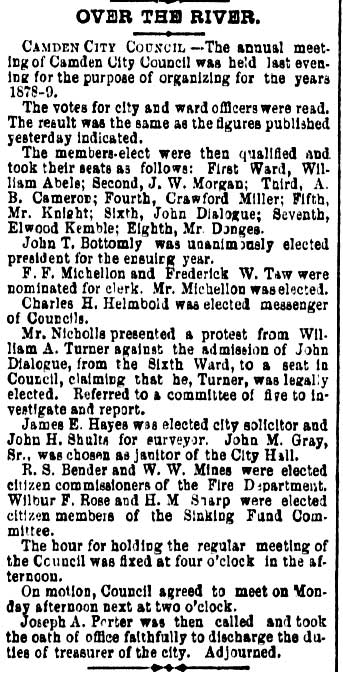
CAMDEN CITY COUNCIL — The annual meeting of Camden City Council was held last evening for the purpose of organizing for the years 1878-9.
The votes for city and ward officers were read. The result was the same as the figures published yesterday indicated.
The members-elect were then qualified and took their seats as follows: First Ward, William Abels; Second, J. W. Morgan; Third, A. B. Cameron; Fourth, Crawford Miller; Fifth, Mr. Knight; Sixth, John Dialogue; Seventh, Elwood Kemble; Eighth, Mr. Donges.
John T. Bottomly was unanimously elected president for the ensuing year.
F. F. Michellon and Frederick W. Taw were nominated for clerk. Mr. Michellon was elected.
Charles H. Helmbold was elected messenger of Councils.
Mr. Nicholls presented a protest from William A. Turner against the admission of John Dialogue, from the Sixth Ward, to a seat in Council, claiming that he, Turner, was legally elected. Referred to a committee of five to investigate and report.
James E. Hayes was elected city solicitor and John H. Shults [sic] for surveyor. John M. Gray, Sr., was chosen as janitor of the City Hall.
R. S. Bender and W. W. Mines were elected citizen commissioners of the Fire Department. Wilbur F. Rose and H. M. Sharp were elected citizen members of the Sinking Fund Committee.
The hour for holding the regular meeting of the Council was fixed at four o’clock in the afternoon.
On motion, Council agreed to meet on Monday afternoon next at two o’clock.
Joseph A. Porter was then called and took the oath of office faithfully to discharge the duties of treasurer of the city. Adjourned.
Camden Council to Fill Offices
Philadelphia Inquirer —
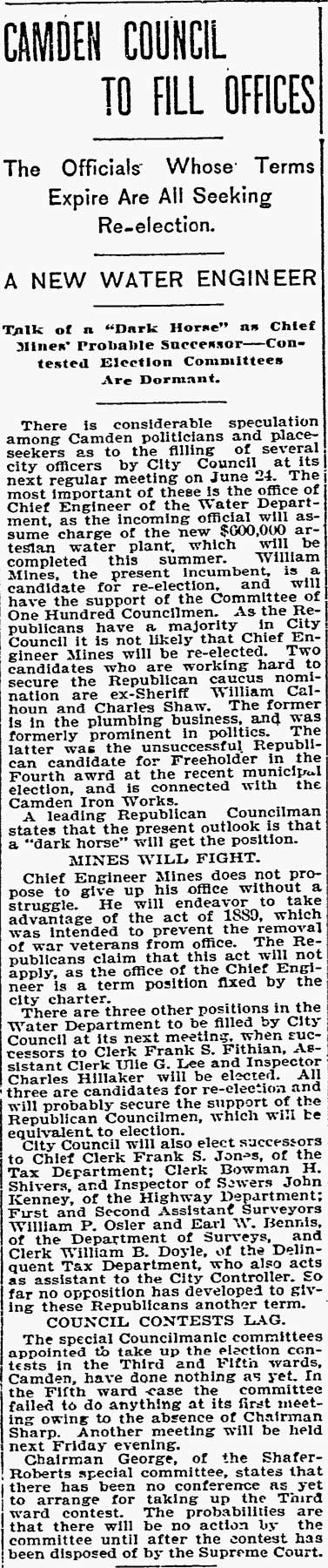
The Officials Whose Terms Expire Are All Seeking Re-election.
A NEW WATER ENGINEER
Talk of a “Dark Horse” as Chief Mines’ Probable Successor—Contested Election Committees Are Dormant.
There is considerable speculation among Camden politicians and place-seekers as to the filling of several city officers by City Council at its next regular meeting on June 24. The most important of these is the office of Chief Engineer of the Water Department, as the incoming official will assume charge of the new $600,000 artesian water plant which will be completed this summer. William Mines, the present incumbent, is a candidate for re-election, and will have the support of the Committee of One Hundred Councilmen. As the Republicans have a majority in City Council it is not likely but that Engineer Mines will be re-elected. Two candidates who are working hard to secure the Republican caucus nomination are ex-Sheriff William Calhoun and Charles Shaw. The former is in the plumbing business, and formerly prominent in politics. The latter was the unsuccessful Republican candidate for Freeholder in the Fourth awrd [sic] at the recent municipal election, and is connected with the Camden Iron Works.
A leading Republican Councilman states that the present outlook is that a “dark horse” will get the position.
MINES WILL FIGHT.
Chief Engineer Mines does not propose to give up his office without a struggle. He will endeavor to take advantage of the act of 1889, which was intended to prevent the removal of war veterans from office. The Republicans claim that this act will not apply, as the office of the Chief Engineer is a term position fixed by the city charter.
There are three other positions in the Water Department to be filled by City Council at its next meeting, when successors to Clerk Frank S. Fithian, Assistant Clerk Ulie G. Lee and Inspector Charles Hillaker will be elected. All three are candidates for re-election and will probably secure the support of the Republican Councilmen, which will be equivalent to election.
City Council will also elect successors to Chief Clerk Frank S. Jones, of the Tax Department; Clerk Bowman H. Shivers, and Inspector of Sewers John Kenney, of the Highway Department; First and Second Assistant Surveyors William P. Osler and Earl W. Bennis, of the Department of Surveys, and Clerk William B. Doyle, of the Delinquent Tax Department, who also acts as assistant to the City Controller. So far no opposition has developed to giving these Republicans another term.
COUNCIL CONTESTS LAG.
The special Councilmanic committees appointed to take up the election contests in the Third and Fifth wards, Camden, have done nothing as yet. In the Fifth ward case the committee failed to do anything at its first meeting owing to the absence of Chairman Sharp. Another meeting will be held next Friday evening.
Chairman George, of the Shafer-Roberts special committee, states that there has been no conference as yet to arrange for taking up the Third ward contest. The probabilities are that there will be no action by the committee until after the contest has been disposed of by the Supreme Court.
Camden Court Opens
Philadelphia Inquirer —
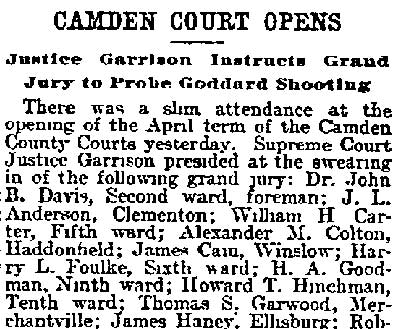
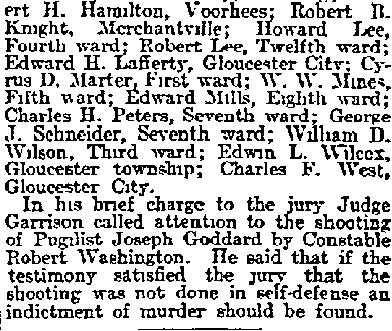
Justice Garrison Instructs Grand Jury to Probe Goddard Shooting
There was a slim attendance at the opening of the April term of the Camden County Courts yesterday. Supreme Court Justice Garrison presided at the swearing in of the following grand jury: Dr. John B. Davis, Second ward, foreman; J. L. Anderson, Clementon; William H. Carter, Fifth ward; Alexander M. Colton, Haddonfield; James Cain, Winslow; Harry L. Foulke, Sixth ward; H. A. Goodman, Ninth ward; Howard T. Hinchman, Tenth ward; Thomas S. Garwood, Merchantville; James Haney, Ellsburg; Robert H. Hamilton, Voorhees; Robert B. Knight, Merchantville; Howard Lee, Fourth ward; Robert Lee, Twelfth ward; Edward H. Lafferty, Gloucester City; Cyrus D. Marter, First ward; W. W. Mines, Fifth ward; Edward Mills, Eighth ward; Charles H. Peters, Seventh ward; George J. Schneider, Seventh ward; William D. Wilson, Third ward; Edwin L. Wilcox, Gloucester township; Charles F. West, Gloucester City.
In his brief charge to the jury Judge Garrison called attention to the shooting of Pugilist Joseph Goddard by Constable Robert Washington. He said that if the testimony satisfied the jury that the shooting was not done in self-defense an indictment of murder should be found.
Death Certificate
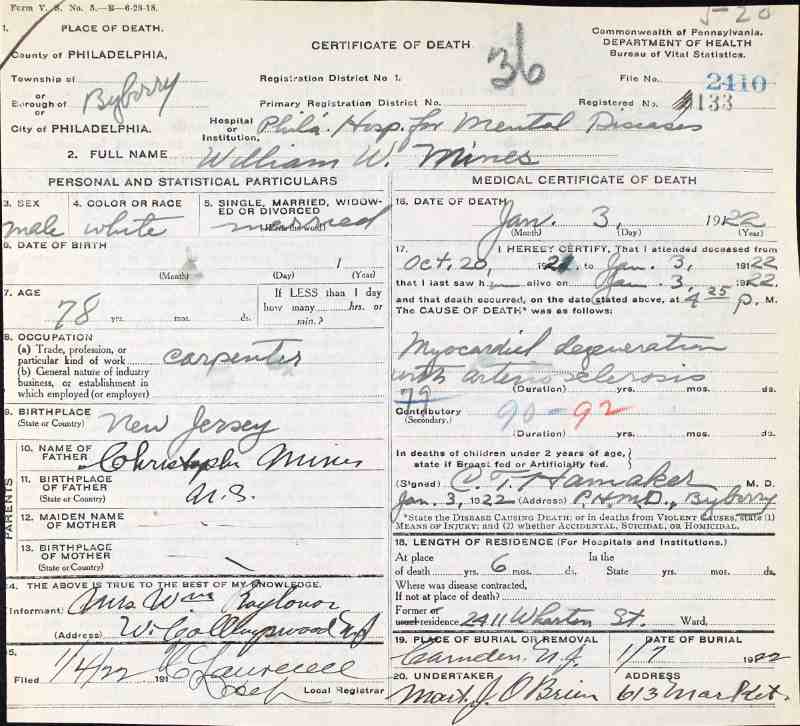
Death Certificate — William W. Mines
Camden Justly Proud of Splendid Fire Department
Philadelphia Inquirer —
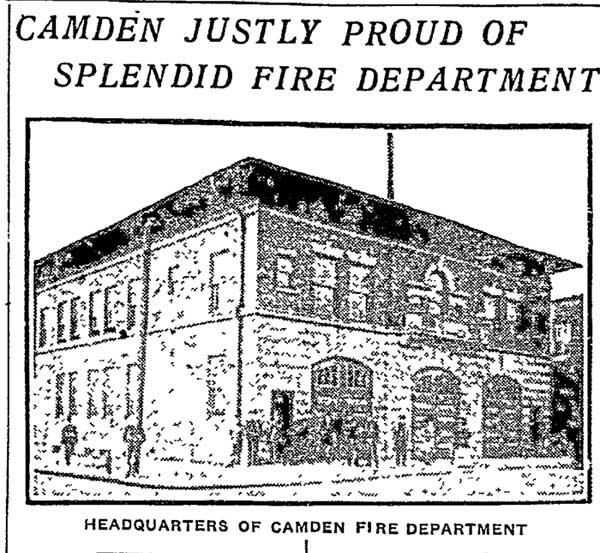
HEADQUARTERS OF CAMDEN FIRE DEPARTMENT
Change From Volunteer to Paid “Laddies” Will Be Appropriately Celebrated Next Wednesday
It is probably unknown to the average citizen that Camden had a paid Fire Department some years before Philadelphia. It is just forty years since the gallant volunteer fire-fighters went out of service. To be exact, it was September 2, 1869, that Camden City Council provided to pay its firemen, and on December 10 of the same year they went into service. This event is to be fittingly celebrated next Wednesday in a demonstration in which the business men of the city, as well as the municipal departments, will participate.
It was not until March 15, 1810, that Camden boasted of even a volunteer fire company, and it was on that date that the Perseverance Fire Company was organized. In 1834 there were two such organizations which had been increased to six by 1851. For the most part these distinct aggregations of fire-fighters did not get along very well together and controversies were frequent.
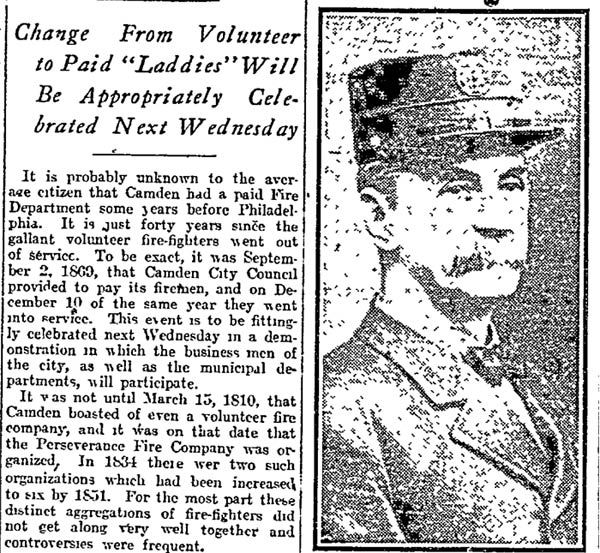
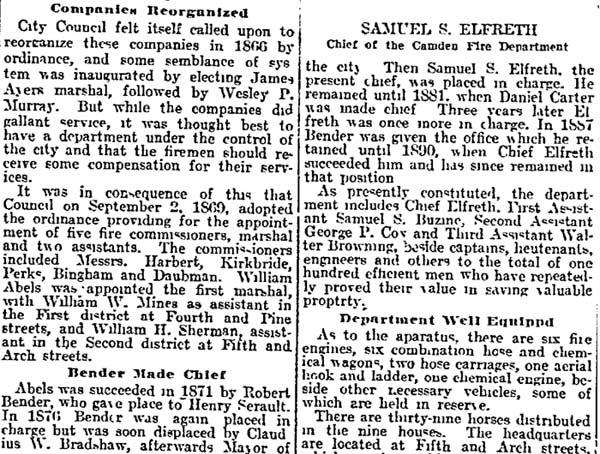
SAMUEL S. ELFRETH
Chief of the Camden Fire Department
Companies Reorganized
City Council felt itself called upon to reorganize these companies in 1866 by ordinance, and some semblance of system was inaugurated by electing James Ayers marshal, followed by Wesley P. Murray. But while the companies did gallant service, it was thought best to have a department under the control of the city and that the firemen should receive some compensation for their services.
It was in consequence of this that Council on September 2, 1869, adopted the ordinance providing for the appointment of five fire commissioners, marshal and two assistants. The commissioners included Messrs. Harbert, Kirkbride, Perks, Bingham and Daubman. William Abels was appointed the first marshal, with William W. Mines as assistant in the First district at Fourth and Pine streets, and William H. Sherman, assistant in the Second district at Fifth and Arch streets.
Bender Made Chief
Abels was succeeded in 1871 by Robert Bender, who gave place to Henry Serault. In 1876 Bender was again placed in charge but was soon displaced by Claudius W. Bradshaw, afterwards Mayor of the city. Then Samuel S. Elfreth, the present chief, was placed in charge. He remained until 1881, when Daniel Carter was made chief. Three years later Elfreth was once more in charge. In 1887 Bender was given the office which he retained until 1890, when Chief Elfreth succeeded him and has since remained in that position.
As presently constituted, the department includes Chief Elfreth, First Assistant Samuel S. Buzine, Second Assistant George P. Cox and Third Assistant Walter Browning, beside captains, lieutenants, engineers and others to the total of one hundred efficient men who have repeatedly proved their value in saving valuable proptrty [sic].
Department Well Equippd [sic]
As to the aparatus [sic], there are six fire engines, six combination hose and chemical wagons, two hose carriages, one aerial hook and ladder, one chemical engine, beside other necessary vehicles, some of which are held in reserve.
There are thirty-nine horses distributed in the nine houses. The headquarters are located at Fifth and Arch streets, which is thoroughly modern in all of its equipments.
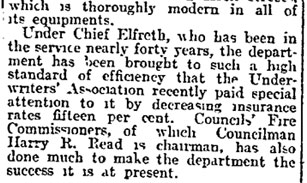
Under Chief Elfreth, who has been in the service nearly forty years, the department has been brought to such a high standard of efficiency that the Underwriters’ Association recently paid special attention to it by decreasing insurance rates fifteen per cent. Councils’ Fire Commissioners, of which Councilman Harry R. Read is chairman, has also done much to make the department the success it is at present.