Introduction
WILLIAM HERTLINE was born in New Jersey around 1871 to John and Annie Hertline. The family name appears to originally have been spelled “Hertlein.” The Hertline family, which included older brother Harry, was living at 123 Arch Street when the census was taken in 1880. John Hertline kept a restaurant, while Harry, then 18, worked as a baker. Harry Hertlein later went to work for the City of Camden’s water and sewer departments, and had a long and distinguished career in that capacity.
William Hertlein is listed in the 1890 Camden City Directory as living at 231 Royden Street, working as a driver for the Knickerbocker Ice Company. The 1894 Camden City Directory shows him living at 584 Carman Street, working as a machinist for the Pennsylvania Railroad.
William Hertline became a member of the Camden Fire Department in March of 1895. He was assigned to Engine Company 2, which was quartered at Fire Headquarters at the northwest corner of North 5th and Arch Streets. In 1894 the personnel were as follows: Foreman Harry C. Grosscup; Engineer, William Morris; Driver, John P. Long; Stoker, Albert Jones; hosemen, George Wade, William Hertline, and David Andrews. He appears to have left briefly but returned to the Fire Department in March of 1895.
When the Town of Stockton merged with Camden in 1899, the volunteer fire companies of Stockton remained active for several months. On June 25, 1899 the Stockton companies rendered assistance to the Camden Fire Department when the Moro Phillips Chemical Company factory at North Twelfth Street at Linden Street was struck by fire, resulting in $60,000 worth of damage and injury to three Camden firefighters, Joseph Maxwell, David Andrews, and William Hertline.
In the early 1900s William Hertline married a young widow, Lydia Tenner Schwartz, who was the daughter of former Camden Fire Department member and former Camden policeman Christian Tenner. Three of Lydia’s uncles were also Camden firefighters at one time or another, James McCracken, G. Rudolph Tenner, and George Adam Tenner. Her aunt, Amelia Tenner Green, was married to Camden Fire Department member Joseph Green.
The 1910 Census shows William and Lydia Hertline, Lydia’s daughter Helen Schwartz, father-in-law Christian Tenner and brother-in-law Benjamin Tenner living at 530 South 8th Street. This arrangement was still in effect as late as 1927. By 1929 he had moved to 542 Newton Avenue.
William Hertline left the Camden Fire Department on March 5, 1913 after being suspended for disobeying an order from the Chief of the Department, Samuel S. Elfreth. He worked as a watchman for a time. By the early 1920s, probably through the offices of his brother Harry, William Hertline went to work for the City of Camden flushing out water and sewer lines. The 1930 Census shows William and Lydia Hertline, their sons Benjamin, 15, and William, 11; and father-in-law Christian Tenner all living at 542 Newton Avenue. William and Lydia were both still living at the Newton Avenue address when the 1940 Camden City Directory was compiled. By 1947 they had moved to 546 Newton Avenue.
William Hertline passed away at some point after 1946. He is not listed in the 1955 New Jersey Bell Telephone Directory.
Fire Commissioners Appoint Hertline
Philadelphia Inquirer —

Samuel Curriden – William Hertline – Engine Company 2
The Fire Commissioners have discharged Samuel Curriden, of Engine Company, No. 2, and appointed William B. Hertline to fill the vacancy.
Acids in Flames
Philadelphia Inquirer —

Moro Phillips’ Chemical Works in Camden Partly Destroyed by Fire
Firemen’s Good Work
Battled Against Heavy Odds, But Saved Most of the Plant—Loss About $60,000
Nearly two acres of buildings forming part of the Moro Phillips Chemical Works, on Cooper’s Creek, Camden, were destroyed by fire yesterday, entailing a loss of about $60,000. It was the most stubborn fire the Camden Fire Department has been called upon to fight for several years. The blaze started shortly before 8 o’clock in the morning, and it was noon before the flames were gotten under control. Three engines played on the ruins until 4 o’clock in the afternoon.
The origin of the fire is a mystery. A blaze was discovered in the phosphate fertilizing building by a watchman at ten minutes of 8 o’clock. Instead of springing the fire alarm, only half a block from the works, he telephoned to No. 2 engine house. The message was received at 7.53, just as the men were about to respond to roll call before going to breakfast. Only the chemical engine and a truck company were sent out as is customary on local alarms. Before they could reach the fire, however, Foreman Harry Grosscup saw the flames shooting high into the heavens, and he dispatched No. 2 Engine Company. The engine was half way to the fire when a regular alarm was turned in.
All the Engines Called
Chief Elfreth, upon arriving on the scene, turned in a general alarm, calling out the entire department. The phosphate fertilizing building was then a mass of flames, and it was apparent that the main portion of the plant was doomed. The works were composed of old frame buildings that burned like tinder. The firemen directed their attention to preventing the flames from spreading.
A westerly breeze fanned the flames and threatened to carry them across a twenty-five-foot areaway to the warehouses, where vast quantities of fertilizers and phosphorus, together with many carboys of vitrol [sic], were stored. The firemen succeeded in keeping these buildings from catching fire. They were warned, however, to be careful not to turn their hose on a small brick building, as the contents were liable to explode through contact with water. An employe of the plant told Foreman Grosscup, of Engine Company No. 2, that if this building should go up it would shake half the city.
Deadly Acid Fumes
The fire spread from the fertilizer building to a building used for the manufacture of Glauber salts, and for a time it looked as if the entire plant would be consumed. This building contained large quantities of muriatic acid. Dense volumes of heavy black smoke rolled out of the doors and windows. Firemen Maxwell, Andrews and Hertline, who went inside with a line of hose, were driven out by the acid fumes. They came stumbling outside for fresh air, and after adjusting sponges over their mouths bravely returned to fight the flames.
All that portion of the works used for the manufacture of phosphate fertilizers was destroyed, while the acid departments were saved. The firemen fought valiantly. Fire Commissioner Walter Edwards, finding that they had not had their breakfast, dispatched a patrol wagon to a restaurant, and served out coffee and rolls to the firefighters. About noon the flames were gotten under control, and only engine companies Nos. 1, 2 and 4 were retained in service.
In speaking of the origin of the fire Superintendent Allen said he was walking through the fertilizer building when he heard some one shout “Fire.” Glancing up he saw flames shooting out from the inside of the roof above him. He could only roughly estimate the loss as being between $50,000 and $75,000.
Insurance Agent Crawford Miller, who carried most of the insurance on the work, stated last evening that he could not tell the amount of insurance, but it was probable that most of the loss was covered.
A Singed Cat
A strange sight met the eyes of the firemen in the ruins of the main building after the flames were under control. On the top of one of the charred uprights which had supported the roof, and at a distance of twenty-five feet from the ground, sat a black and white cat, mewing piteously. How the cat escaped the flames, and gained the top of the smoking upright was a puzzle the firemen could not solve. But the fire laddies were tender-hearted, and a ladder was quickly put up, and pussy was rescued from her perilous position. It was found that her ears were burned, and the hair was singed off her tail, but when she reached the ground the cat showed she had several lives left, for she made a dash for a place of safety.
Chat Among the Local Firemen
Camden Daily Courier —
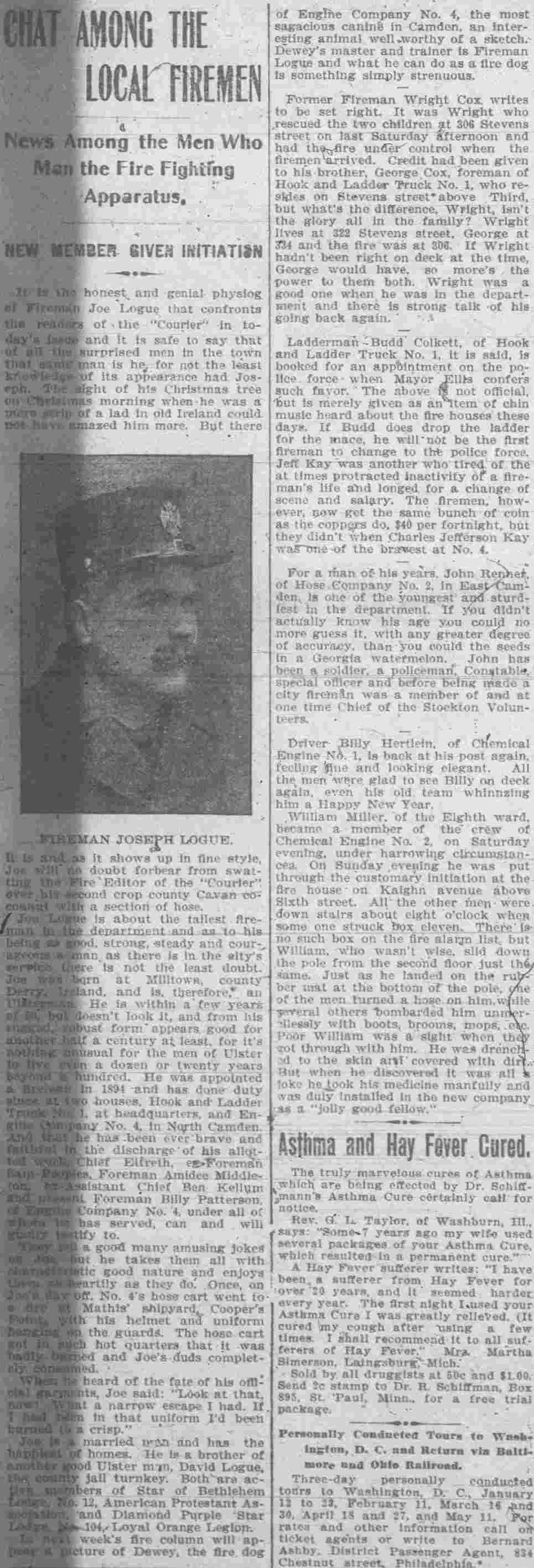
News Among the Men Who Man the Fire Fighting Apparatus.
New Member Given Initiation
Fireman Joseph Logue.
It is the honest and genial physiog of Fireman Joe Logue that confronts the readers of the “Courier” in to-day’s issue and it is safe to say that of all the surprised men in the town that same man is he, for not the least knowledge of its appearance had Joseph. The sight of his Christmas tree on Christmas morning when he was a mere strip of a lad in old Ireland could not have amazed him more. But there it is and as it shows up in fine style, Joe will no doubt forbear from swatting the Fire Editor of the “Courier” over his second crop county Cavan cocoanut with a section of hose.
Joe Logue is about the tallest fireman in the department and as to his being as good, strong, steady and courageous a man as there is in the city’s service there is not the least doubt. Joe was born at Milltown, county Derry, Ireland, and is, therefore, an Ulsterman. He is within a few years of [?], but doesn’t look it, and from his rugged, robust form appears good for another half a century at least, for it’s nothing unusual for the men of Ulster to live even a dozen or twenty years beyond a hundred. He was appointed a fireman in 1894 and has done duty since at two houses, Hook and Ladder Truck No. 1, at headquarters, and Engine Company No. 4, in North Camden. And that he has been ever brave and faithful in the discharge of his allotted work, Chief Elfreth, ex-Foreman [?] Peoples, Foreman Amidee Middleton, ex-Assistant Chief Ben Kellum and present Foreman Billy Patterson, of Engine Company No. 4, under all of whom he has served, can and will gladly testify to.
They tell a good many amusing jokes on Joe, but he takes them all with characteristic good nature and enjoys them as heartily as they do. Once, on Joe’s day off, No. 4’s hose cart went to a fire at Mathis’ shipyard, Cooper’s Point, with his helmet and uniform hanging on the guards. The hose cart got in such hot quarters that it was badly burned and Joe’s duds completely consumed.
When he heard of the fate of his official garments, Joe said: “Look at that, now! What a narrow escape I had. If I had been in that uniform I’d been burned to a crisp.”
Joe is a married man and has the happiest of homes. He is a brother of another good Ulster man, David Logue, the county jail turnkey. Both are active members of Star of Bethlehem Lodge, No. 12, American Protestant Association, and Diamond Purple Star Lodge, No. 104, Loyal Orange Legion.
In next week’s fire column will appear a picture of Dewey, the fire dog of Engine Company No. 4, the most sagacious canine in Camden, an interesting animal well worthy of a sketch. Dewey’s master and trainer is Fireman Logue and what he can do as a fire dog is something simply strenuous.
Former Fireman Wright Cox writes to be set right. It was Wright who rescued the two children at 306 Stevens street on last Saturday afternoon and had the fire under control when the firemen arrived. Credit had been given to his brother, George Cox, foreman of Hook and Ladder Truck No. 1, who resides on Stevens street above Third, but what’s the difference, Wright, isn’t the glory all in the family? Wright lives at 322 Stevens street, George at 334 and the fire was at 306. If Wright hadn’t been right on deck at the time, George would have, so more’s the power to them both. Wright was a good one when he was in the department and there is strong talk of his going back again.
Ladderman Budd Colkett, of Hook and Ladder Truck No. 1, it is said, is booked for an appointment on the police force when Mayor Ellis confers such favor. The above is not official, but is merely given as an item of chin music heard about the fire houses these days. If Budd does drop the ladder for the mace, he will not be the first fireman to change to the police force. Jeff Kay was another who tired of the at times protracted inactivity of a fireman’s life and longed for a change of scene and salary. The firemen, however, now get the same bunch of coin as the coppers do, $40 per fortnight, but they didn’t when Charles Jefferson Kay was one of the bravest at No. 4.
For a man of his years, John Renner, of Hose Company No. 2, in East Camden, is one of the youngest and sturdiest in the department. If you didn’t actually know his age you could no more guess it, with any greater degree of accuracy, than you could the seeds in a Georgia watermelon. John has been a soldier, a policeman, Constable, special officer and before being made a city fireman was a member of and at one time Chief of the Stockton Volunteers.
Driver Billy Hertlein, of Chemical Engine No. 1, is back at his post again, feeling fine and looking elegant. All the men were glad to see Billy on deck again, even his old team whinnying him a Happy New Year.
William Miller, of the Eighth ward, became a member of the crew of Chemical Engine No. 2, on Saturday evening, under harrowing circumstances. On Sunday evening he was put through the customary initiation at the fire house on Kaighn avenue above Sixth street. All the other men were down stairs about eight o’clock when some one struck box eleven. There is no such box on the fire alarm list, but William, who wasn’t wise, slid down the pole from the second floor just the same. Just as he landed on the rubber mat at the bottom of the pole, one of the men turned a hose on him, while several others bombarded him unmercilessly with boots, brooms, mops, etc. Poor William was a sight when they got through with him. He was drenched to the skin and covered with dirt. But when he discovered it was all a joke he took his medicine manfully and was duly installed in the new company as a “jolly good fellow.”
Eighteen New Firemen Named
Camden Post-Telegram —
Sixteen of the Men Will Not Go on Duty Until July Next.
TWO OTHERS TO FILL VACANCIES
City Council’s Fire Committee last night named 18 new firemen. Sixteen of these men will not go on duty until July 1, next, at which time the new fire house will be ready for service, while the other two, who were named to fill vacancies, will begin duty the first of next year.
It must not be inferred that the sixteen new men will all be assigned to the new company. Experienced men from the several houses, with one or two of the new ones, will make up Company No. 5, while the rest of the raw recruits will be apportioned among the several houses.
Rollo Jones, of the First ward, and William Miller, of the Eighth ward, are the men to go on duty January 1. They fill the vacancies caused by the retirement of John Ware and Samuel Peoples.
The others selected are:
First ward—Charles Cook.
Second ward—James White, Harry Anderson.
Third ward—Samuel Sheer, Edward Finley.
Fourth ward—Martin Carrigan.
Fifth ward—Joseph Daly.
Sixth ward—Joseph Ernest.
Seventh ward—Seth Monnell, William Buzine.
Eighth ward—Charles Sturgis.
Ninth ward—S. T. Whitezell.
Tenth ward—Ephraim T. Davis.
Eleventh ward—J. Oscar Till.
Twelfth ward—J. H. Vickers, Frederick Morse.
All the appointees must pass a physical examination which will be made by Dr. W. H. Iszard.
William Hertline, conected [sic] with headquarters, has been suspended pending a trial on a charge made by Chief Elfreth. The case will be heard on Monday night.
Hertline Removed from Fire Department
Philadelphia Inquirer —
After seeing gallant service for nineteen years, William Hertline, lieutenant of the East Side Fire Company, has been removed by the Fire Commissioners of Council on charges of neglect of duty. Sylvester McGrath has been appointed to the service and John H. Lennox to the vacant lieutenancy.
Hertline Suspended
Bridgeton Evening News —
To take the place of William Hertline, who was suspended as a member of the Camden Fire Department for disobeying orders of the chief, Frederick Morse was yesterday appointed lieutenant of No. 1 Hose Company, in the East Side, and John Lennox was made lieutenant of No. 7 Engine Company, Eleventh street and Kaighn avenue. Sylvester McGrath was appointed to fill the vacancy in the department.