Introduction
JOHN ALBERT STOCKTON HUNT was born in Camden, New Jersey to George Sawyer Hunt and his wife, the former Clara Cook. His father had served as member of the Camden Fire Department in the late 1870s and 1880s, initially as the stoker and later as the hose cart driver with Engine Company 1.
George S. Hunt married Clara Cook in the 1870s. There were three children, Walter, born in 1879; David, born in 1881; and John A.S. Hunt, born in May of 1884.
George S. Hunt was working as a laborer and living at 416 Pine Street when he and his brother James H. Hunt were appointed to the Camden Fire Department in April of 1877. The brothers and their families were all living at 416 Pine Street at the times. When reappointed the following year, another fire fighter, Edmund Shaw also was living at that address. The 1880 Census shows George Hunt, wife Clara, and son Walter at 814 South 4th Street. He was working as an oilcloth printer. The 1881 Camden City Directory shows him living at 411 Pine Street.
By March of 1882 George S. Hunt had moved to 441 Pine Street, Edmund Shaw was still living at 411 Pine Street. George S. Hunt moved back to 411 Pine Street by the end of 1882 and lived there as late as 1884. George S. Hunt was not reappointed to the Fire Department in 1882. A newspaper report states that he was reappointed in March of 1884, however, Camden Fire Department records have yet to confirm this. City Directories indicate that he was working as an oilcloth printer at L.D. Farr’s works.
City Directories beginning in 1885 through 1888 show George S. Hunt and his family lived at 508 Pine Street, where he kept a saloon.
The 1890 City Directory show George S. Hunt and family were living at 417 Pine Street, working as a driver for the Camden Police Department. He was still a policeman and living at 417 Pine Street when the 1892–1893 City Directory was compiled. He is not listed in the 1893–1894 or 1894–1895 City Directories. The 1896 City Directory lists his widow, Clara, at 816 South 4th Street. His mother married Alexander Marcy Stone in 1897. A son Charles, was born in 1899. When the Census was taken in June of 1900, the family lived at 740 Pine Street. They subsequently moved to Glassboro, New Jersey. John A.S. Hunt returned to Camden after the 1910 Census was taken.
John A.S. Hunt married around 1913. He was appointed to the Camden Fire Department in 1915. His wife Henrietta bore him a daughter, Ruth, in 1916, son George came two years later.
John A.S. Hunt fought many fires during his career as a Camden firefighter. Camden Fire Department historian Lee Ryan wrote about one in the 125th anniversary book, published in 1994:
Something akin to a miracle occurred on the frigid night of January 11, 1916 at the State Street Methodist Episcopal Church, Sixth and State Streets, North Camden. At 10 P.M., three alarms were transmitted in rapid succession for a serious fire involving the main auditorium of the church. Heavy fire conditions extended to destroy the roof, the organ loft, the altar, Sunday School classrooms, and the entire pew area throughout the auditorium. When the blaze was finally extinguished, all that remained standing were four granite walls. On the south side of the building along State Street, was a magnificent stained glass window of gigantic proportion depicting Christ breaking bread with Martha and Mary, the sisters of Lazarus. The window had inexplicably withstood the flames and heat. The scene from the life of Christ was not blistered, scorched or marred in anyway. It has never been retouched and still stands as a miracle, surviving one of the most disastrous church fires in City history. Chief of Department Peter Carter was injured at this incident when he fell through a passageway between the auditorium and the school building. He was hospitalized for several weeks. Captain Joseph Maxwell and Fireman Steward Bakley of Hook & Ladder Company 1, Fireman John Hunt of Engine Company 3, and Fireman William McCauley of Chemical Company 1 were injured when the church roof collapsed on them. Under heavy smoke conditions and following some difficulty, the members were able to extricate themselves, three of them safely. Captain Maxwell was admitted to the hospital for a brief stay.
John A.S. Hunt and family were living at 1018 South 6th Street when he registered for the draft in September of 1918. The 1920 Census lists John Hunt and his family at 1009 South 6th Street. His mother then lived with him. The Hunts remained at this address as late as April of 1930. By 1929 John A.S. Hunt was promoted to the rank of Captain. He was still working when the Census was taken in April of 1930.
Sadly, Captain John A.S. Hunt suffered a fatal heart attack on May 28, 1930. He was buried at New Camden Cemetery. His brother, David Hunt, was a member of the Camden Police Department from 1909 to 1932, serving as a detective for much of his career.
Two of John A.S. Hunt’s cousins, George H. Hunt and Eli M. Hunt, sons of Uncle James H. Hunt, were also career Camden fire fighters. Another cousin, Theodosia Hunt Conaghy, was matron at the Camden County Jail from 1923 to her retirement in 1950.
Firemen of Long Service Receive Good Promotion
Camden Daily Courier —
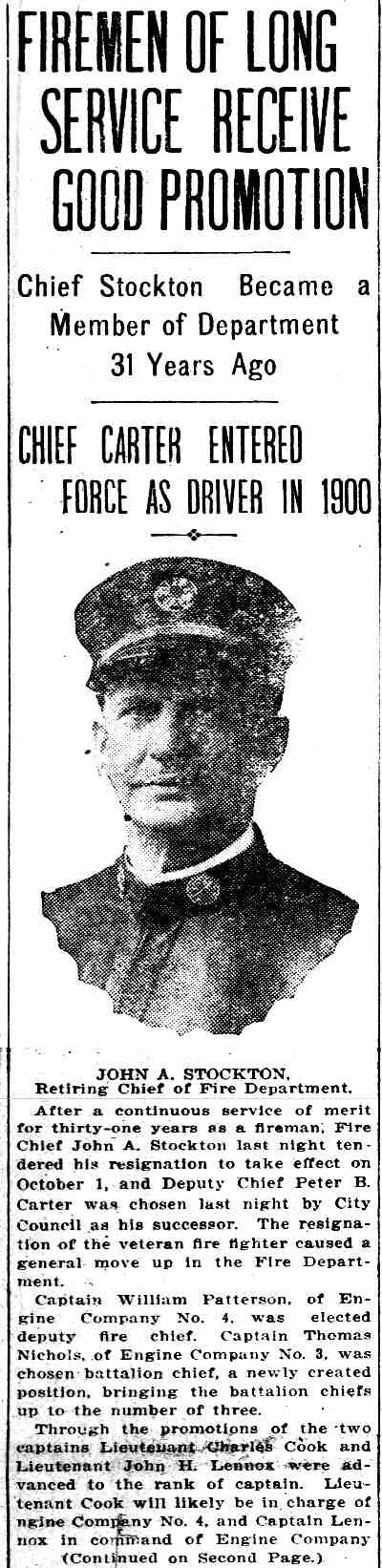
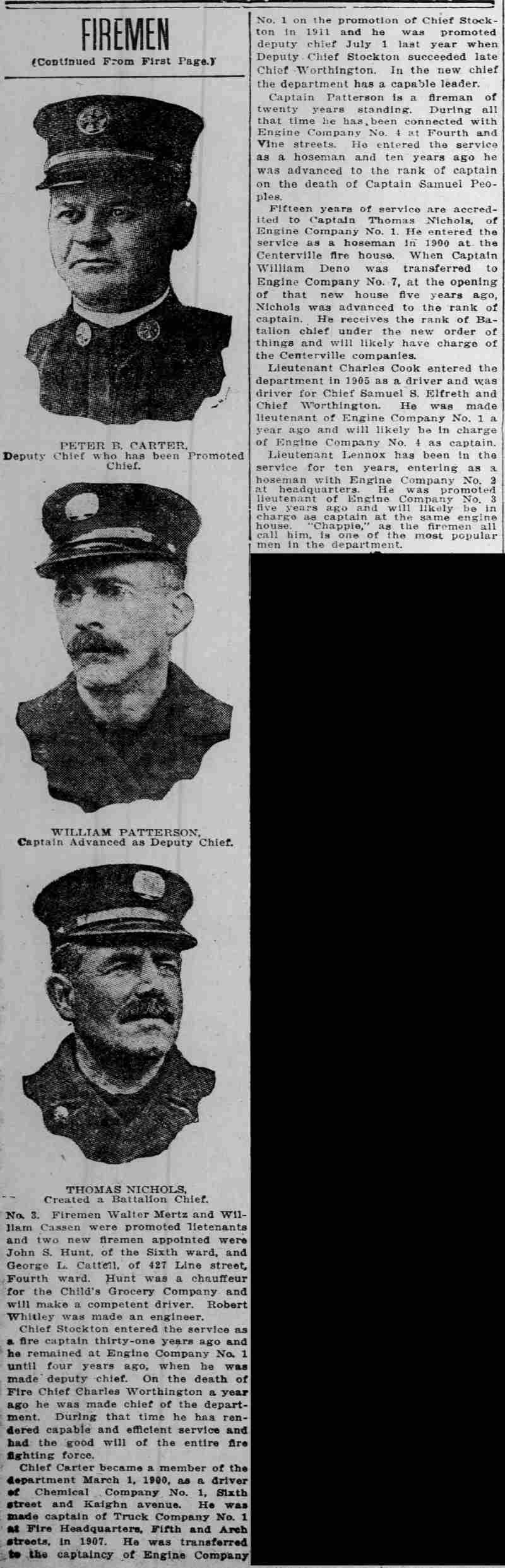
FIREMEN OF LONG SERVICE RECEIVE GOOD PROMOTION
Chief Stockton Became a Member of Department 31 Years Ago
CHIEF CARTER ENTERED FORCE AS DRIVER IN 1900
After a continuous service of merit for thirty-one years as a fireman, Fire Chief John A. Stockton last night tendered his resignation to take effect on October 1, and Deputy Chief Peter B. Carter was chosen last night by City Council as his successor. The resignation of the veteran fire fighter caused a general move up in the Fire Department.
Captain William Patterson, of Engine Company No. 4, was elected deputy fire chief. Captain Thomas Nichols, of Engine Company No. 3, was chosen battalion chief, a newly created position, bringing the battalion chiefs up to the number of three.
Through the promotions of the two captains Lieutenant Charles Cook and Lieutenant John H. Lennox were advanced to the rank of captain. Lieutenant Cook will likely be in charge of Engine Company No. 4, and Captain Lennox in command of Engine Company (Continued on Second Page.)
FIREMEN
(Continued From First Page.)
No. 1 on the promotion of Chief Stockton in 1911 and he was promoted deputy chief July 1 last year when Deputy Chief Stockton succeeded late Chief Worthington. In the new chief the department has a capable leader.
Captain Patterson is a fireman of twenty years standing. During all that time he has been connected with Engine Company No. 4 at Fourth and Vine streets. He entered the service as a hoseman and ten years ago he was advanced to the rank of captain on the death of Captain Samuel Peoples.
Fifteen years of service are accredited to Captain Thomas Nichols, of Engine Company No. 1. He entered the service as a hoseman in 1900 at the Centerville fire house. When Captain William Deno was transferred to Engine Company No. 7, at the opening of that new house five years ago, Nichols was advanced to the rank of captain. He receives the rank of Battalion chief under the new order of things and will likely have charge of the Centerville companies.
Lieutenant Charles Cook entered the department in 1905 as a driver and was driver for Chief Samuel S. Elfreth and Chief Worthington. He was made lieutenant of Engine Company No. 1 a year ago and will likely be in charge of Engine Company No. 4 as captain.
Lieutenant Lennox has been in the service for ten years, entering as a hoseman with Engine Company No. 2 at headquarters. He was promoted lieutenant of Engine Company No. 3 five years ago and will likely be in charge as captain at the same engine house. “Chappie,” as the firemen all call him, is one of the most popular men in the department.
No. 3. Firemen Walter Mertz and William Cassen were promoted lieutenants and two new firemen appointed were John S. Hunt, of the Sixth ward, and George L. Cattell, of 427 Line street, Fourth ward. Hunt was a chauffeur for the Child’s Grocery Company and will make a competent driver. Robert Whitley was made an engineer.
Chief Stockton entered the service as a fire captain thirty-one years ago and he remained at Engine Company No. 1 until four years ago, when he was made deputy chief. On the death of Fire Chief Charles Worthington a year ago he was made chief of the department. During that time he has rendered capable and efficient service and had the good will of the entire fire fighting force.
Chief Carter became a member of the department March 1, 1900, as a driver of Chemical Company No. 1, Sixth street and Kaighn avenue. He was made captain of Truck Company No. 1 at Fire Headquarters, Fifth and Arch streets, in 1907. He was transferred to the captaincy of Engine Company No. 1 on the promotion of Chief Stockton in 1911 and he was promoted deputy chief July 1 last year when Deputy Chief Stockton succeeded late Chief Worthington. In the new chief the department has a capable leader.
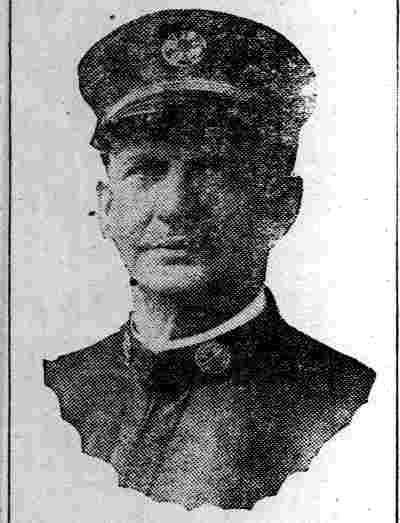
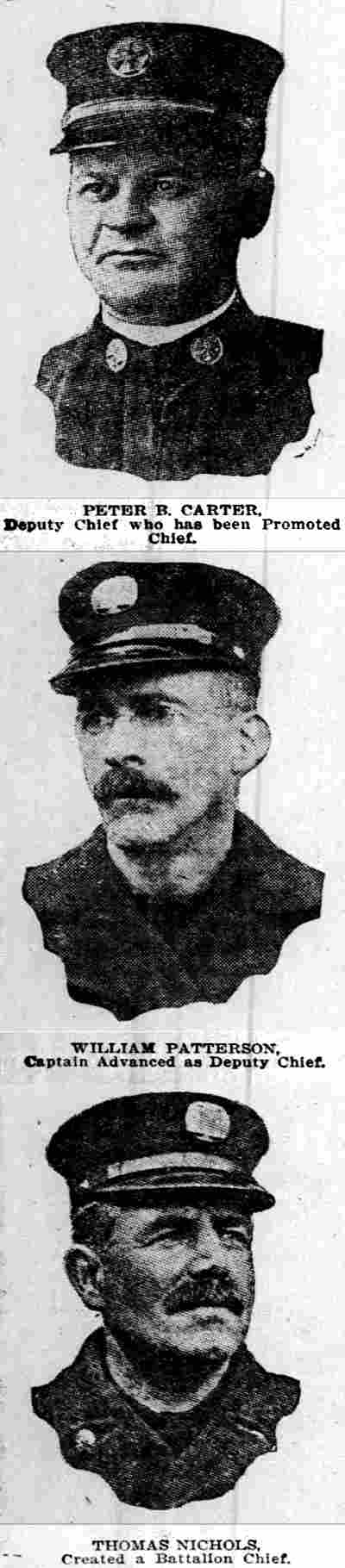
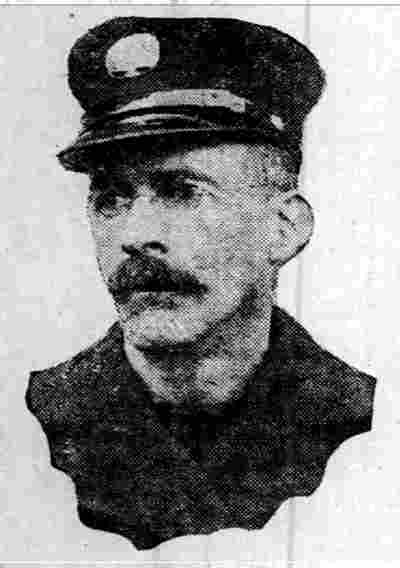
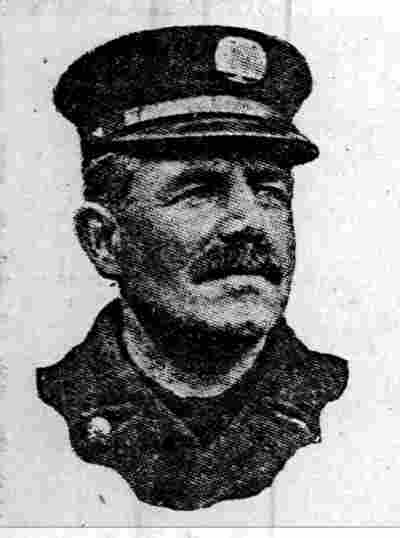
After a continuous service of merit for thirty-one years as a fireman, Fire Chief John A. Stockton last night tendered his resignation to take effect on October 1, and Deputy Chief Peter B. Carter was chosen last night by City Council as his successor. The resignation of the veteran fire fighter caused a general move up in the Fire Department.
Captain William Patterson, of Engine Company No. 4, was elected deputy fire chief. Captain Thomas Nichols, of Engine Company No. 3, was chosen battalion chief, a newly created position, bringing the battalion chiefs up to the number of three.
Through the promotions of the two captains Lieutenant Charles Cook and Lieutenant John H. Lennox were advanced to the rank of captain. Lieutenant Cook will likely be in charge of Engine Company No. 4, and Captain Lennox in command of Engine Company No. 1 on the promotion of Chief Stockton in 1911 and he was promoted deputy chief July 1 last year when Deputy Chief Stockton succeeded late Chief Worthington. In the new chief the department has a capable leader.
Captain Patterson is a fireman of twenty years standing. During all that time he has been connected with Engine Company No. 4 at Fourth and Vine streets. He entered the service as a hoseman and ten years ago he was advanced to the rank of captain on the death of Captain Samuel Peoples.
Fifteen years of service are accredited to Captain Thomas Nichols, of Engine Company No. 1. He entered the service as a hoseman in 1900 at the Centerville fire house. When Captain William Deno was transferred to Engine Company No. 7, at the opening of that new house five years ago, Nichols was advanced to the rank of captain. He receives the rank of Battalion chief under the new order of things and will likely have charge of the Centerville companies.
Lieutenant Charles Cook entered the department in 1905 as a driver and was driver for Chief Samuel S. Elfreth and Chief Worthington. He was made lieutenant of Engine Company No. 1 a year ago and will likely be in charge of Engine Company No. 4 as captain.
Lieutenant Lennox has been in the service for ten years, entering as a hoseman with Engine Company No. 2 at headquarters. He was promoted lieutenant of Engine Company No. 3 five years ago and will likely be in charge as captain at the same engine house. “Chappie,” as the firemen all call him, is one of the most popular men in the department.
No. 3. Firemen Walter Mertz and William Cassen were promoted lieutenants and two new firemen appointed were John S. Hunt, of the Sixth ward, and George L. Cattell, of 427 Line street, Fourth ward. Hunt was a chauffeur for the Child’s Grocery Company and will make a competent driver. Robert Whitley was made an engineer.
Chief Stockton entered the service as a fire captain thirty-one years ago and he remained at Engine Company No. 1 until four years ago, when he was made deputy chief. On the death of Fire Chief Charles Worthington a year ago he was made chief of the department. During that time he has rendered capable and efficient service and had the good will of the entire fire fighting force.
Chief Carter became a member of the department March 1, 1900, as a driver of Chemical Company No. 1, Sixth street and Kaighn avenue. He was made captain of Truck Company No. 1 at Fire Headquarters, Fifth and Arch streets, in 1907. He was transferred to the captaincy of Engine Company No. 1 on the promotion of Chief Stockton in 1911 and he was promoted deputy chief July 1 last year when Deputy Chief Stockton succeeded late Chief Worthington. In the new chief the department has a capable leader.
Carter Chief as Stockton Retires
Camden Post-Telegram —
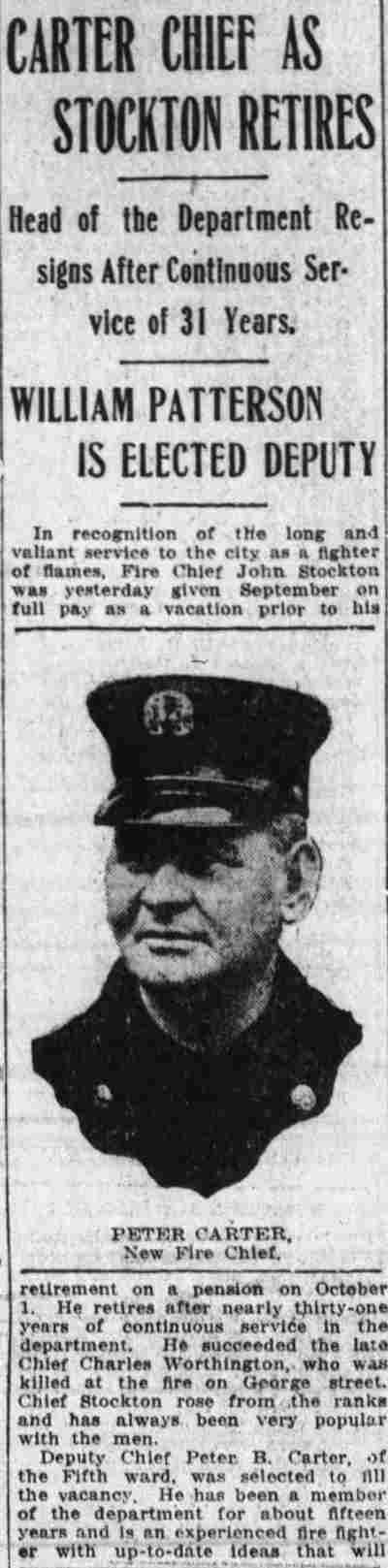
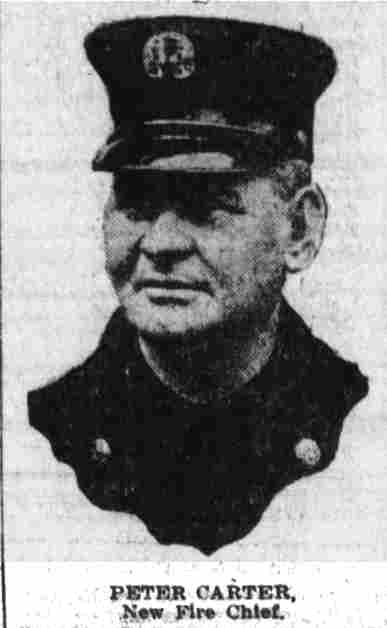
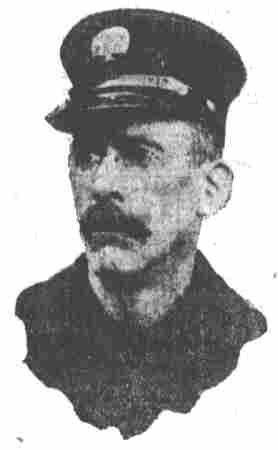
In recognition of the long and valiant service to the city as a fighter of flames, Fire Chief John Stockton was yesterday given September on full pay as a vacation prior to his retirement on a pension on October 1. He retires after nearly thirty-one years of continuous service in the department. He succeeded the late Chief Charles Worthington, who was killed at the fire on George street. Chief Stockton rose from the ranks and has always been very popular with the men.
Deputy Chief Peter B. Carter, of the Fifth ward, was selected to fill the vacancy. He has been a member of the department for about fifteen years and is an experienced fire fighter with up-to-date ideas that will make him popular with the men.
Fire Chief Retired
Philadelphia Inquirer —
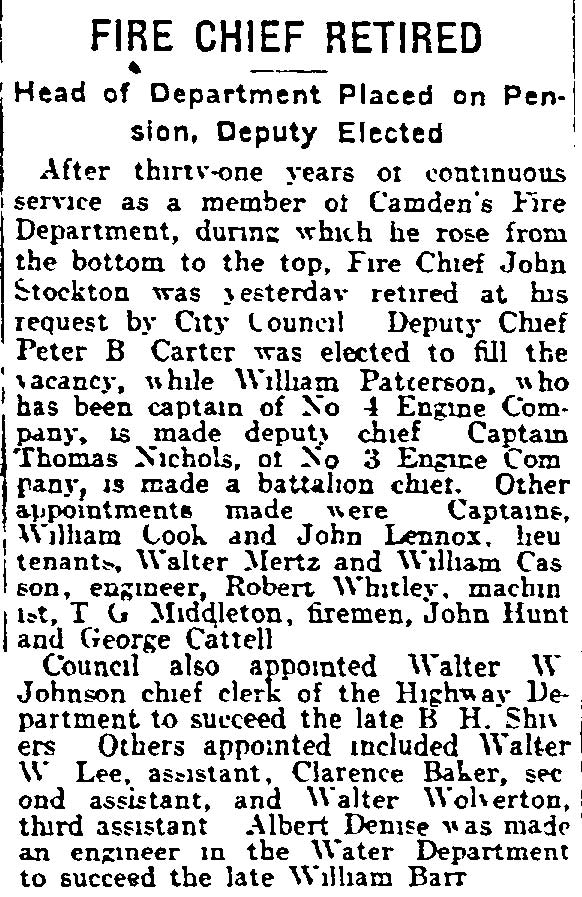
Head of Department Placed on Pension, Deputy Elected
After thirty-one years of continuous service as a member of Camden’s Fire Department, during which he rose from the bottom to the top, Fire Chief John Stockton was yesterday retired at his request by City Council. Deputy Chief Peter B. Carter was elected to fill the vacancy, while William Patterson, who has been captain of No. 4 Engine Company, is made deputy chief. Captain Thomas Nichols, of No. 3 Engine Company, is made a battalion chief. Other appointments made were: Captains, William Cook and John Lennox, lieutenants, Walter Mertz and William Casson, engineer, Robert Whitley, machinist, T. G. Middleton, firemen, John Hunt and George Cattell.
Council also appointed Walter W. Johnson chief clerk of the Highway Department to succeed the late B. H. Shivers. Others appointed included Walter W. Lee, assistant, Clarence Baker, second assistant, and Walter Wolverton, third assistant. Albert Denise was made an engineer in the Water Department to succeed the late William Barr.
No. 3 Fire Company Guests at Banquet
Camden Post-Telegram —
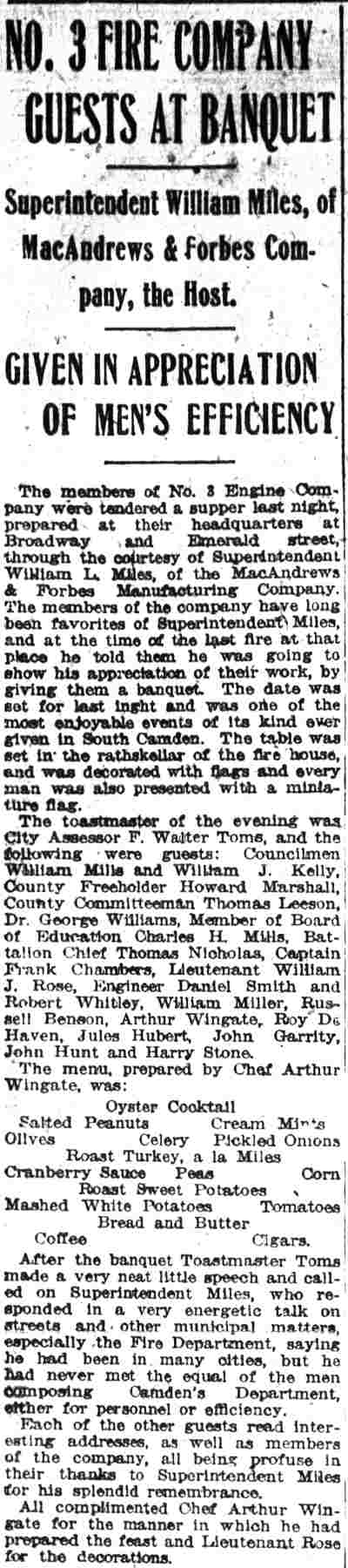
Superintendent William Miles, of MacAndrews & Forbes Company, the Host.
GIVEN IN APPRECIATION OF MEN’S EFFICIENCY
The members of No. 3 Engine Company were tendered a supper last night, prepared at their headquarters at Broadway and Emerald street, through the courtesy of Superintendent William L. Miles, of the MacAndrews & Forbes Manufacturing Company. The members of the company have long been favorites of Superintendent Miles, and at the time of the last fire at that place he told them he was going to show his appreciation of their work, by giving them a banquet. The date was set for last night and was one of the most enjoyable events of its kind ever given in South Camden. The table was set in the rathskellar of the fire house, and was decorated with flags and every man was also presented with a miniature flag.
The toastmaster of the evening was City Assessor F. Walter Toms, and the following were guests: Councilmen William Mills and William J. Kelly, County Freeholder Howard Marshall, County Committeeman Thomas Leeson, Dr. George Williams, Member of Board of Education Charles H. Mills, Battalion Chief Thomas Nicholas, Captain Frank Chambers, Lieutenant William J. Rose, Engineer Daniel Smith and Robert Whitley, William Miller, Russell Benson, Arthur Wingate, Roy De Haven, Jules Hubert, John Garrity, John Hunt and Harry Stone.
The menu, prepared by Chef Arthur Wingate, was:
Oyster Cocktail
Salted Peanuts — Cream Mints
Olives — Celery — Pickled Onions
Roast Turkey, a la Miles
Cranberry Sauce — Peas — Corn
Roast Sweet Potatoes
Mashed White Potatoes — Tomatoes
Bread and Butter
Coffee — Cigars.
After the banquet Toastmaster Toms made a very neat little speech and called on Superintendent Miles, who responded in a very energetic talk on streets and other municipal matters, especially the Fire Department, saying he had been in many cities, but he had never met the equal of the men composing Camden’s Department, either for personnel or efficiency.
Each of the other guests read interesting addresses, as well as members of the company, all being profuse in their thanks to Superintendent Miles for his splendid remembrance.
All complimented Chef Arthur Wingate for the manner in which he had prepared the feast and Lieutenant Rose for the decorations.
World War I Draft Card
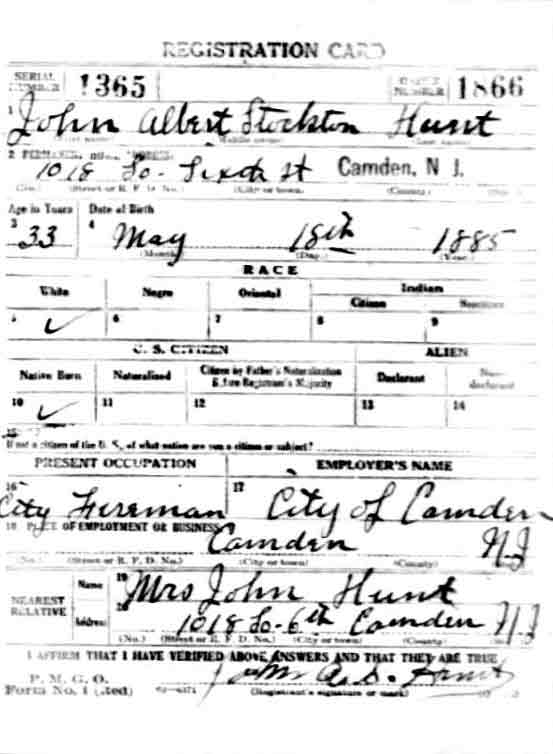
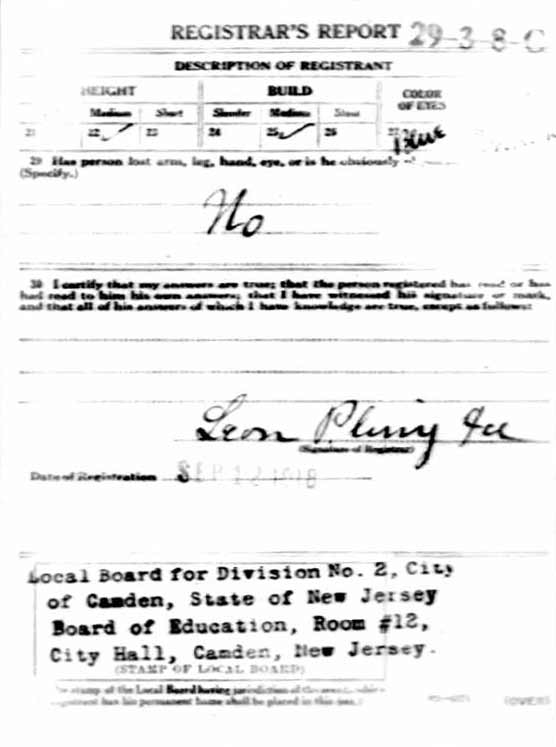
World War I Draft Registration Card, John Albert Stockton Hunt. Address: 1018 So. Sixth St., Camden, N.J. Date of Birth: May 18th, 1885. Occupation: City Fireman, City of Camden.
14 Firemen Win City Promotions
Camden Daily Courier —
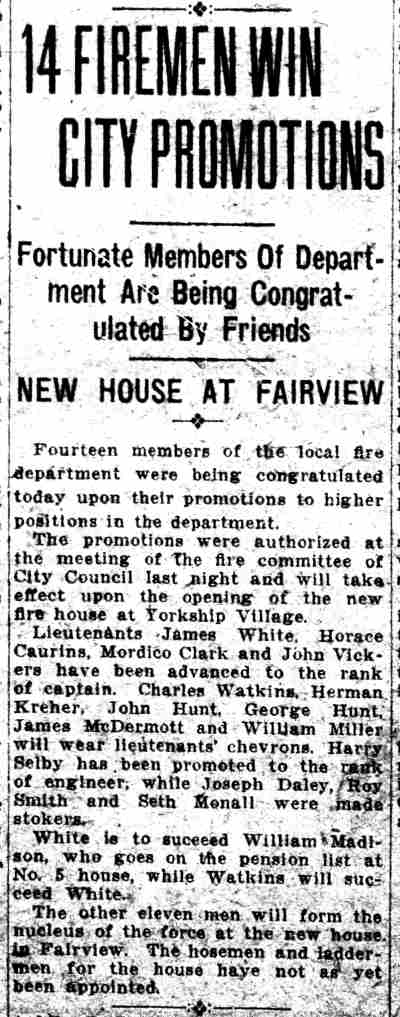
Fourteen members of the local fire department were being congratulated today upon their promotions to higher positions in the department.
The promotions were authorized at the meeting of the fire committee of City Council last night and will take effect upon the opening of the new fire house at Yorkship Village.
Lieutenants James White, Horace Cairns, Mordecai Clark and John Vickers have been advanced to the rank of captain. Charles Watkins, Herman Kreher, John Hunt, George Hunt, James McDermott and William Miller will wear lieutenants’ chevrons. Harry Selby has been promoted to the rank of engineer, while Joseph Daley, Roy Smith and Seth Monall were made stokers.
White is to succeed William Madison, who goes on the pension list at No. 5 house, while Watkins will succeed White.
The other eleven men will form the nucleus of the force at the new house in Fairview. The hosemen and laddermen for the house have not as yet been appointed.
Many Transfers of City Firemen
Camden Daily Courier —
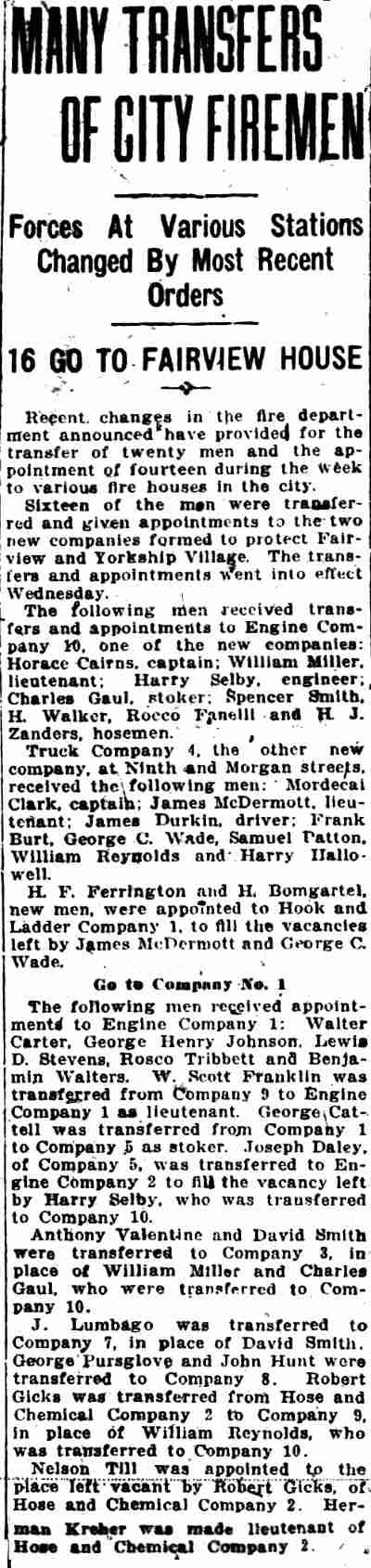
Recent changes in the fire department announced have provided for the transfer of twenty men and the appointment of fourteen during the week to various fire houses in the city.
Sixteen of the men were transferred and given appointments to the two new companies formed to protect Fairview and Yorkship Village. The transfers and appointments went into effect Wednesday.
The following men received transfers and appointments to Engine Company 10, one of the new companies: Horace Calera, captain; William Miller, lieutenant; Harry Selby, engineer; Charles Gaul, stoker; Spencer Smith, H. Walton, Rocco Fanelli and H. Zanders, hosemen.
Truck Company 4, the other new company, at Ninth and Morgan Streets, received the following men: Mordecai Clark, captain; James McDermott, lieutenant; James Durkin, driver; Frank Burt, George C. Wade, Samuel Felton, William Reynolds and Harry Hallo-well.
Farrington and H. Bomgartel, new men, were appointed to Hook and Ladder Company 1, to fill the vacancies left by James McDermott and George C. Wade.
Go to Company No. 1
The following men received appointments to Engine Company 1: Walter Carter, George Henry Johnson, Lewis D. Stevens, Rocco Tribuett and Benjamin Walters. W. Scott Franklin was transferred from Company 5 to Engine Company 1 as lieutenant. George Gall was transferred from Company 1 to Company 5 as stoker. Joseph Daley, of Company 5, was transferred to Engine Company 2 to fill the vacancy left by Harry Selby, who was transferred to Company 10.
Anthony Valentine and David Smith were transferred to Company 3, in place of William Miller and Charles Gaul, who were transferred to Company 10.
J. Lumbago was transferred to Company 7, in place of David Smith. George Puroglove and John Hunt were transferred to Company 8. Robert Glcks was transferred from Hose and Chemical Company 2 to Company 9, in place of William Reynolds, who was transferred to Company 10.
Nelson Till was appointed to the place left vacant by Robert Glcks, of Hose and Chemical Company 2.
man Kreber was made lieutenant of Hose and Chemical Company 2.
Flames Trapped Family
Bridgeton Evening News —
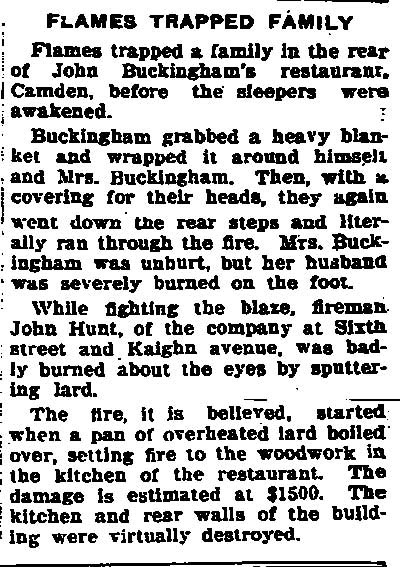
Flames trapped a family in the rear of John Buckingham’s restaurant, Camden, before the sleepers were awakened.
Buckingham grabbed a heavy blanket and wrapped it around himself and Mrs. Buckingham. Then, with a covering for their heads, they again went down the rear steps and literally ran through the fire. Mrs. Buckingham was unhurt, but her husband was severely burned on the foot.
While fighting the blaze, fireman John Hunt, of the company at Sixth street and Kaighn avenue, was badly burned about the eyes by sputtering lard.
The fire, it is believed, started when a pan of overheated lard boiled over, setting fire to the woodwork in the kitchen of the restaurant. The damage is estimated at $1500. The kitchen and rear walls of the building were virtually destroyed.
Personal Notices
Camden Post-Telegram —
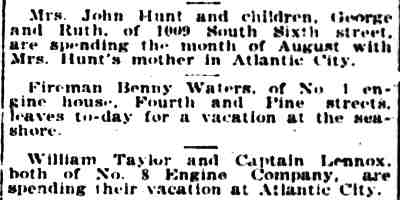
Mrs. John Hunt and children, George and Ruth, of 1009 South Sixth street, are spending the month of August with Mrs. Hunt’s mother in Atlantic City.
Fireman Benny Waters, of No. 1 engine house, Fourth and Pine streets, leaves to-day for a vacation at the seashore.
William Taylor and Captain Lennox, both of No. 8 Engine Company, are spending their vacation at Atlantic City.
Iron Bars Prevent Rescue of Boy Who Dies in Camden Fire
Philadelphia Inquirer —
Six Firemen Injured in Heroic Attempts to Save Little Victim
Doomed Lad Stares Piteously Out Windows as House Is Blazing Furnace
Iron bars built into the window sills when the place was used as a bank prevented the rescue of a boy who perished in a blaze at 1009 Broadway, Camden, last night.
In desperate endeavor to rescue the boy, Harry Armbruster, Jr., 11 years old, six firemen were seriously injured. All are in the Cooper Hospital with various injuries.
The firemen on their ladders could see the boy through the window in his little sleeping room at the rear of the second floor. They tried to wrench out the bars, but, built to resist burglars, the staunch pieces of iron resisted all their efforts.
The front of the house was an inferno of flame and smoke, and entrance to the doomed boy in that way was impossible. No one could have lived in the furnace a moment.
The frenzied firemen, stung to deeds of super-heroism by the sight of the little chap staring white-faced through the iron bars that were to cost him his life, broke into the building on the ground floor and groped their way through the smoke to his room.
Help Comes Too Late
But it was too late. The flames and smoke had licked their way to him, and when the firemen fought their way through he was unconscious. He died on the way to the hospital.
The names of the fire heroes who are in the hospital are:
CAPTAIN WILLIAM PRICE, No. 2 Truck.
FIREMAN JOHN HUNT, No. 8 Engine Company.
FIREMAN IRWIN BISHOP, No. 2 Truck Company.
CAPTAIN CHARLES WATKINS, No. 7 Engine Company.
FIREMAN WILLIAM MERRIGAN, No. 7 Engine Company.
FIREMAN WILLIAM REYNOLDS, No. 2 Truck Company.
The two firemen who carried the boy out were Captain Price and Hoseman Reynolds.
Replete with dramatic details, the story of the rescue will go down in the annals of New Jersey’s fire-fighters’ heroism in golden letters, for the firemen who tried distinguished themselves in their brave attempts.
The building where the fire occurred is owned by Harry Ambruster, the boy’s father. It was formerly occupied by the Broadway Trust Company, but is now a store building.
Ambruster maintains a cleaning establishment in the basement of the building and lives above the store. He is a widower and his son was motherless. Shortly before 11 o’clock, Ambruster, preparatory to closing his cleaning establishment, went into the yard behind the store, and smelling smoke, investigated. He found that the smoke came from the cellar and he knew that his son was asleep in the front room of the second-story.
Because the building was formerly occupied by the banking company, all the windows are protected with heavy iron barrings. Ambruster was torn between two duties. He wanted to run upstairs to get his son safely out of the burning structure and he wanted to turn in an alarm. Shouting “Fire! Fire!” he ran to the front part of the building, and tried to go upstairs.
Staircase Mass of Flames
The staircase was in the midst of a roaring mass of flames, however, and he could not get upstairs. Distraught, the father frantically ran hither and thither outside. The fire engines had been summoned and firemen had raised ladders to the second story window, having been told of the presence of the sleeping boy.
The bars were immovable. Captain Price pried with an iron crowbar, but in vain. In the meantime Firemen Hunt, Bishop and Merrigan and Captain Watkins had tried to make their way through the burning first floor to the staircase and the sleeping boy.
Two Overcome in Building
Bishop and Merrigan were overcome and lay inside the burning building unknown to the firemen on the outside. It looked as though the floor would collapse at any minute.
Captain Price and Reynolds, staggering through the hall with the almost dead boy, passed the unconscious Bishop and Merrigan on the way.
Price Goes It Alone
At the foot of the stairs, Reynolds, overcome by the dense smoke, collapsed. Captain Price continued alone, carrying the boy over his shoulder.
The lad’s father was by this time frantic with excitement. When Price appeared in the doorway framed against a background of rolling flames, he ran forward and seized his son. They were placed in an ambulance and rushed to the Cooper Hospital. There doctors pronounced the boy dead.
Captain Price in the meantime had told of the three unconscious firemen inside the burning building who were in imminent danger of death should the floor fall in.
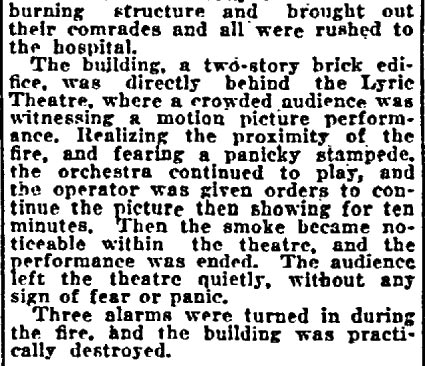
Rescuers immediately dashed into the burning structure and brought out their comrades and all were rushed to the hospital.
The building, a two-story brick edifice, was directly behind the Lyric Theatre, where a crowded audience was witnessing a motion picture performance. Realizing the proximity of the fire, and fearing a panicky stampede, the orchestra continued to play, and the operator was given orders to continue the picture then showing for ten minutes. Then the smoke became noticeable within the theatre, and the performance was ended. The audience left the theatre quietly, without any sign of fear or panic.
Three alarms were turned in during the fire, and the building was practically destroyed.