John F. Renner Sr.
JOHN F. RENNER SR. was born on January 8, 1851 in Pennsylvania to Levi Renner and his wife, the former Mary Ann Rose. He was the oldest of at least seven children. The Renner’s lived in Philadelphia as early as 1850, and were still there in 1880, before coming across the river in the 1880s.
John F. Renner married Cecelia Godfrey in the late 1860s. The family lived in Pennsylvania as late as 1879, when son Levi G. Renner was born. By June of 1880 the Renners had come to the town of Stockton, which was comprised of what is today known as the Cramer Hill and East Camden sections of Camden, New Jersey. The 1880 Census shows four children, Edwin H., 10; Emma, 7; John F. Jr., 4; and Louis, 1. Another son, Levi, was born in the early 1880s. Later in the decade younger brother Enos Renner brought his family and father Levi Renner over to Stockton as well.
In the 1880s and 1890s John F. Renner worked as a butcher. 1887 found him at the corner of 24th and Federal Streets, 1887 on Federal Street near 26th Street. When the 1890 City Directory was compiled, John F. Renner and family were living in a house whose address would become 137 North 28th Street. In those times that section of North 28th Street was called First Street, it was renamed shortly after Stockton was annexed by Camden in 1899. The Renner family lived in this home through the spring of 1910.
Involving himself in local politics, John F. Renner served as a constable from 1891 through 1899. In 1892 John F. Renner helped found the Stockton Hose Company No. 2, a volunteer fire company in Stockton, and briefly served as Chief Engineer of Stockton in the early 1890s. The 1897 Directory shows that he also was in the real estate business with David B. Ristine at 2709 Westfield Avenue. As stated above, in the late spring of 1899 Camden annexed the town of Stockton, and John Renner’s position as a constable disappeared, however, he shortly found a new position with the City of Camden.
On November 27, 1899 John F. Renner Sr. was appointed to the Camden Fire Department, as part of a five company expansion. He remained a member of the Fire Department for the rest of his life.
The Census taken in June of 1900 shows John F. Renner, a Camden fireman, living with his wife Cecelia, daughter Emma, and sons John Jr., Louis, and Levi were living at 137 North 28th Street in East Camden. Five other children including son Edwin had died. Two grandchildren, John F. III and Edwin were also there when the Census was taken. The 1906 City Directory indicates that John F. Renner Sr. and family were living at 137 North 28th Street in East Camden. His son John F. Renner Jr., then employed as a painter, was living with him. Son Levi “Lee” Renner, then a ship joiner, was living at 2927 High Street. Louis Renner had been serving in the United States Army when the 1900 Census was taken, he does not appear in the Directory. He later resided in Pennsauken.
The 1910 Census shows John F. Renner, wife Cecelia, and grandson Edwin living at 137 North 28th Street.
John F. Renner passed away on January 15, 1911 at Somers Point, New Jersey. Funeral services were held at the home of his son Levi Renner, 101 North 24th Street.
He Flourished a Pistol
Philadelphia Inquirer —
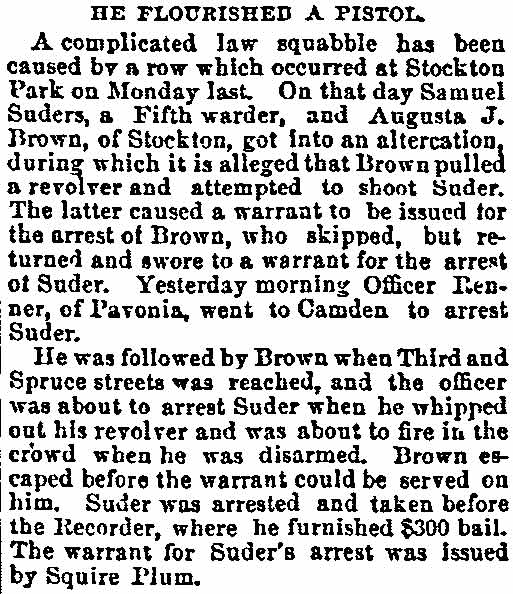
A complicated law squabble has been caused by a row which occurred at Stockton Park on Monday last. On that day Samuel Suders, a Fifth warder, and Augusta J. Brown, of Stockton, got into an altercation, during which it is alleged that Brown pulled a revolver and attempted to shoot Suder. The latter caused a warrant to be issued for the arrest of Brown, who skipped, but returned and swore to a warrant for the arrest of Suder. Yesterday morning Officer Renner, of Pavonia, went to Camden to arrest Suder.
He was followed by Brown when Third and Spruce streets was reached, and the officer was about to arrest Suder when he whipped out his revolver and was about to fire in the crowd when he was disarmed. Brown escaped before the warrant could be served on him. Suder was arrested and taken before the Recorder, where he furnished $300 bail. The warrant for Suder’s arrest was issued by Squire Plum.
But Two Months to Live
Philadelphia Inquirer —
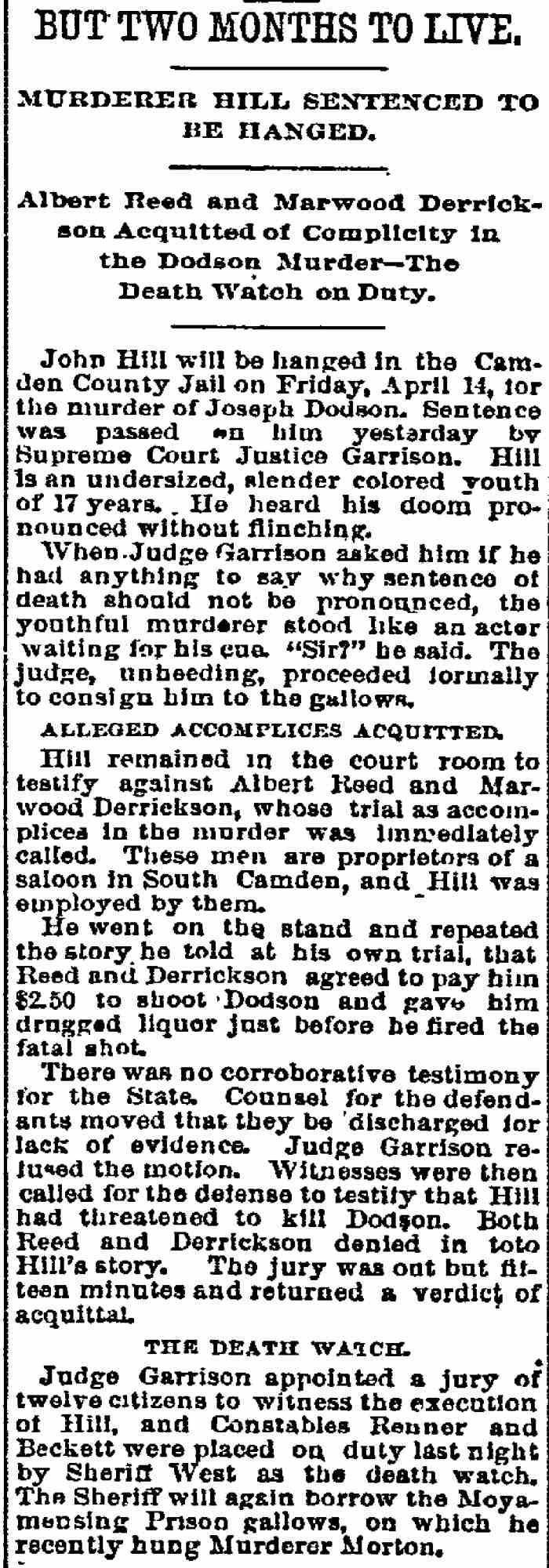
Murderer Hill Sentenced to Be Hanged.
Albert Reed and Marwood Derrickson Acquitted of Complicity in the Dodson Murder—The Death Watch on Duty.
John Hill will be hanged in the Camden County Jail on Friday, April 14, for the murder of Joseph Dodson. Sentence was passed on him yesterday by Supreme Court Justice Garrison. Hill is an undersized, slender colored youth of 17 years. He heard his doom pronounced without flinching.
When Judge Garrison asked him if he had anything to say why sentence of death should not be pronounced, the youthful murderer stood like an actor waiting for his cue. “Sir?” he said. The judge, unheeding, proceeded formally to consign him to the gallows.
Alleged Accomplices Acquitted.
Hill remained in the court room to testify against Albert Reed and Marwood Derrickson, whose trial as accomplices in the murder was immediately called. These men are proprietors of a saloon in South Camden, and Hill was employed by them.
He went on the stand and repeated the story he told at his own trial, that Reed and Derrickson agreed to pay him $2.50 to shoot Dodson and gave him drugged liquor just before he fired the fatal shot.
There was no corroborative testimony for the State. Counsel for the defendants moved that they be discharged for lack of evidence. Judge Garrison refused the motion. Witnesses were then called for the defense to testify that Hill had threatened to kill Dodson. Both Reed and Derrickson denied in toto Hill’s story. The jury was out but fifteen minutes and returned a verdict of acquittal.
The Death Watch.
Judge Garrison appointed a jury of twelve citizens to witness the execution of Hill, and Constables Renner and Beckett were placed on duty last night by Sheriff West as the death watch. The Sheriff will again borrow the Moyamensing Prison gallows, on which he recently hung Murderer Morton.
Hill Faced Death with Firmness
Philadelphia Inquirer —

NEW JERSEY NEWS
The Youthful Colored Murderer Hanged in the Camden Jail.
Religion Braced His Nerves and He Felt No Fear.
A Quiet, Speedy Execution, and Death Was Quick and Apparently Painless—The Murder of Joseph Dodson Avenged Without the Usual Delay in Such Cases.
Camden county’s new gallows scored its first victim to-day when John Hill was hanged for the murder of Joseph Dodson. The execution took place at the County Jail. It was successfully conducted and was devoid of sensational incidents.
The gallows had been erected in a room with a lofty ceiling in the southeast corner of the jail building. Tall windows looked out on Federal street and Broadway, but they were veiled with dark curtains, which gave a sombre hue to the room. The instrument of death had been built on plans furnished by the Sheriff, modeled after the gallows used in the Philadelphia County Prison. There were two trap doors, which fell down when a lever was pulled, allowing the condemned man to fall about seven feet.
John Hill, the murderer, was a small, slender youth, in his 18th year. He had professed conversion after his conviction and walked firmly to the gallows, having overcome the terror of death by his religious faith.
AROUSED FROM HIS LAST SLEEP.
Hill was awakened from a sound slumber at 6.30 o’clock by Constable Renner, one of the death watch. He dressed himself in a new suit of black diagonal striped goods purchased by the Sheriff for the execution.
A gray mist hung like a veil before the jail windows, and Hill said he regretted this for he had hoped to see the sun shine once more before he died.
He displayed no fear of death, and when his lawyer, Frederick A. Rex, came at 8 o’clock to bid him good-bye the condemned lad said:
“I am not afraid to die, for I love Jesus.”
Hill ate sparingly of the breakfast of beefsteak and potatoes sent in from a neighboring restaurant, and satisfied his longing for pie by eating a big piece of the pastry. Then he lit a cigar and paced up and down the corridor until the arrival of his spiritual adviser, Rev. J. H. Scott, a colored Methodist minister. The last hour preceding the execution was spent in prayer and reading the Bible.
WORE A ROSE TO THE GALLOWS.
Before going to the gallows Constable Hunt handed the lad a white rose, which he pinned on his coat. When Hill’s body fell the rose broke from its stem.
At twenty minutes past 10 o’clock, County Clerk Barber called the roll of the Sheriff’s jury in the jailor’s office. They all responded and took the oath to see that the death penalty was carried into effect. Then the spectators were drawn up two by two, in a line at the left of the door from which the prisoner would emerge as he passed from the jail to the place of execution.
It was half-past 10 when these preparations were made and the condemned man sent for.
His hands had been secured behind his back with handcuffs and he walked with unfaltering steps down the iron stairways of the jail, through a dark passage way and into the corridor, where the Sheriff stood, with the black cap in his hand.
The minister walked by Hill’s side. In front were Deputy Sheriff Sell and ex-Deputy Joseph Porter. Constables Hunt and Renner, the death watch, brought up the rear. There was a shuffling of feet in the line of spectators and the procession moved along the corridor and into the dimly-lighted room, where the gallows stood.
FACED DEATH WITHOUT FLINCHING.
Hill looked at the instrument of death without flinching. He constantly repeated, in a whisper, “Jesus, save me.”
With firm tread he mounted the steps to the scaffold. The work of death was quickly done. There was no prayer or final speech. The minister whispered a last word of cheer and stepped back.
It took but a minute for the Sheriff to drop the noose over the lad’s head, for ex-Deputy Porter to pull down the black cap, and then both men stepped back from the drop. Hill did not waver.
The Sheriff reached for the cord attached to the lever under the drop, gave a short, quick pull, and as the doors fell with a crash the murderer’s body dropped, whirled once around, and then hung motionless.
A PAINLESS DEATH.
There were no convulsive movements of the body, although the legs were not pinioned. County Physician Iszard, assisted by Coroner’s Physician Mattern, of Philadelphia, and Drs. Tomlinson, Jones and Levis, of Camden, timed the fleeting spark of life.
In four minutes and fourteen seconds the pulse stopped beating and at the end of six minutes and fifty-seven seconds the action of the heart ceased. The body had been shaken slightly by a few tremors, but there was no death struggle.
After the body had been hanging for twenty minutes the noose was unloosened and the corpse carried into a room adjoining the jailor’s office. The eyes were closed and the face bore no evidence of a violent death.
The silent spectators formed a group around the corpse, while Rev. Mr. Scott read the Methodist service for the dead. Four hours later the physicians made an autopsy and late in the afternoon Coroner Jefferis conveyed the remains in his dead wagon to the New Camden Cemetery where they were interred in a grave paid for by the county.
SWIFT JERSEY JUSTICE.
Jersey justice has not been leaden-heeled in Hill’s case. It is less than six months since he committed the crime for which the law took his life. At 1 o’clock on Sunday morning, October 16, 1892, John Hill, secreted in the bushes near Reed & Derrickson’s saloon, at Seventh and Sycamore streets, fired a bullet into Joseph Dodson’s brain.
The latter was a young colored man who had beaten Hill during a row, a few days previously, in the dance hall attached to the saloon. Hill had threatened to get even with Dodson. He took a revolver from a drawer in the saloon, drank liquor to nerve himself for the deed, and then fired the fatal shot.
At the trial, early in February last, Hill swore that Reed & Derrickson, the proprietors of the saloon, had hired him to kill Dodson. The two men were tried as accessories and acquitted. Three weeks ago Hill confessed that his charge against these two men was false.
Stockton
Philadelphia Inquirer —
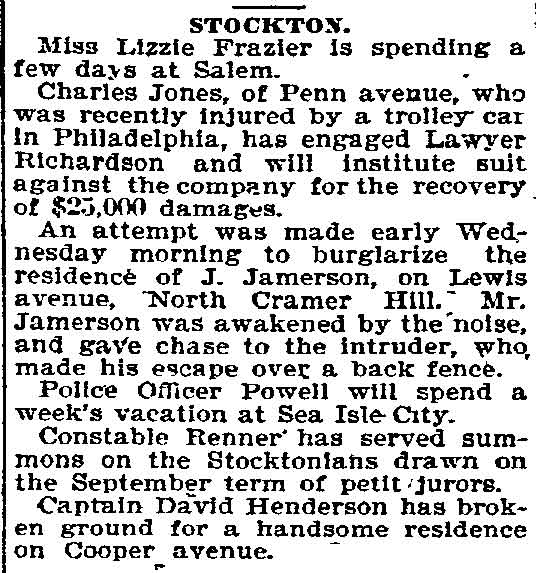
Miss Lizzie Frazier is spending a few days at Salem.
Charles Jones, of Penn avenue, who was recently injured by a trolley car in Philadelphia, has engaged Lawyer Richardson and will institute suit against the company for the recovery of $25,000 damages.
An attempt was made early Wednesday morning to burglarize the residence of J. Jamerson, on Lewis avenue, North Cramer Hill. Mr. Jamerson was awakened by the noise, and gave chase to the intruder, who made his escape over a back fence.
Police Officer Powell will spend a week’s vacation at Sea Isle City.
Constable Renner has served summons on the Stocktonians drawn on the September term of petit jurors.
Captain David Henderson has broken ground for a handsome residence on Cooper avenue.
Firemen in Line Over in Stockton
Philadelphia Inquirer —
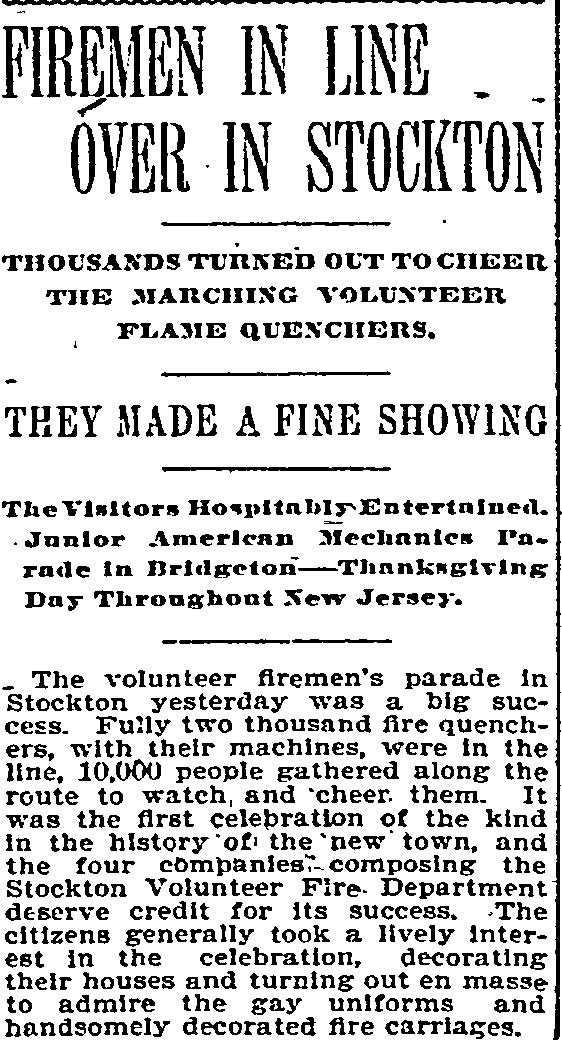
Thousands Turned Out to Cheer the Marching Volunteer Flame Quenchers.
They Made a Fine Showing
The Visitors Hospitably Entertained. Junior American Mechanics Parade in Bridgeton—Thanksgiving Day Throughout New Jersey.
The volunteer firemen’s parade in Stockton yesterday was a big success. Fully two thousand fire quenchers, with their machines, were in the line, 10,000 people gathered along the route to watch and cheer them. It was the first celebration of the kind in the history of the new town, and the four companies composing the Stockton Volunteer Fire Department deserve credit for its success. The citizens generally took a lively interest in the celebration, decorating their houses and turning out en masse to admire the gay uniforms and handsomely decorated fire carriages.
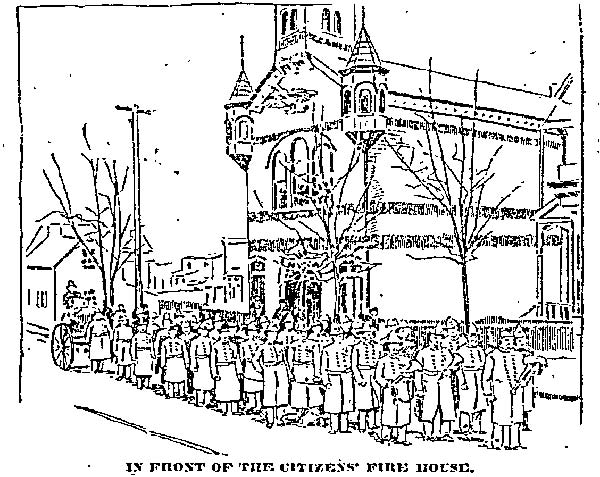
The Citizens’ Fire Company made a handsome display, their pretty fire house on Cooper avenue being decorated from top to bottom. The Penn, Pavonia and Stockton Fire Companies also gave signs of welcome and friendship in a similar manner.
Cheers for the Firemen.
The parade started from Twenty-first and Federal streets, and so great was the crowd that it was with much difficulty that a way was made clear for the firemen. The same condition of affairs existed all along the line. As the firemen tramped through the crowds that lined the streets they were greeted with continuous cheers.
Fire carriages of all kinds, makes, shapes and sizes were in line from the old-time “ordinary” to the “latest improved” with all the new-fangled equipments.
A feature of the turnout was the hose carriage of the William Penn Fire Company, No. 18, of Philadelphia, on which were three lads, representing William Penn between two Indians. An amusing burlesque was arranged by a number of young men with their faces blackened, bearing a transparency reading, “We are firemen for the $500 exemption.”
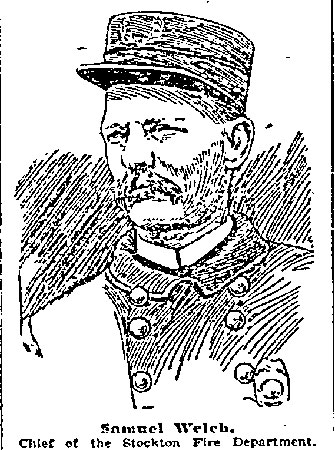
The parade was headed by Chief of Police Zane and the police force mounted on horseback. Then followed members of the Town Council and newspaper men in barouches. The line was divided into four divisions, with Robert Smith as chief marshal, and H. Yerkes, Alexander Dick, C. R. Sigle and William Genther as aids on horseback; Chief Samuel Welch, ex-Chief John F. Renner, of the Stockton Fire Department, and visiting chiefs came next with the Stockton chief’s assistants, Charles Guyn, M. Daly and G. R. Brewen, all of whom carried bouquets of flowers. The marshals of divisions were Charles L. Pauling, Peter Greenwald, Joseph Funfer and Elmer Strong.
Companies in Line.
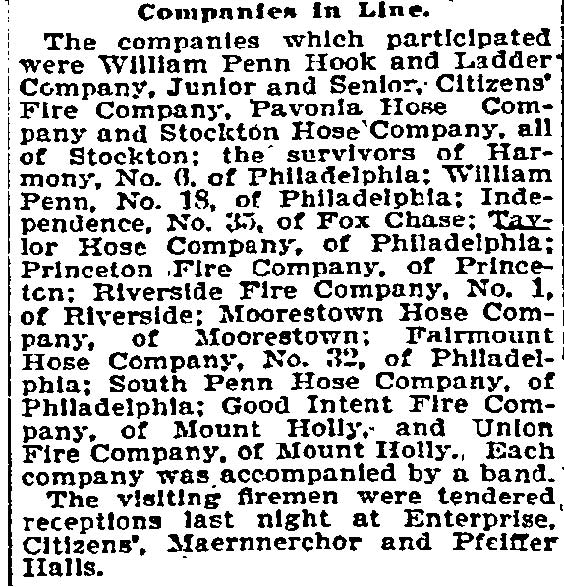
The companies which participated were William Penn Hook and Ladder Company, Junior and Senior Citizens’ Fire Company, Pavonia Hose Company and Stockton Hose Company, all of Stockton; the survivors of Harmony, No. 6, of Philadelphia; William Penn, No. 18, of Philadelphia; Independence, No. 35, of Fox Chase; Taylor Hose Company, of Philadelphia; Princeton Fire Company, of Princeton; Riverside Fire Company, No. 1, of Riverside; Moorestown Hose Company, of Moorestown; Fairmount Hose Company, No. 32, of Philadelphia; South Penn Hose Company, of Philadelphia; Good Intent Fire Company, of Mount Holly, and Union Fire Company, of Mount Holly. Each company was accompanied by a band.
The visiting firemen were tendered receptions last night at Enterprise, Citizens’, Maernnerchor and Pfeiffer Halls.
In Front of the Citizens’ Fire House.
Samuel Welch, Chief of the Stockton Fire Department.
Stockton Social Notice
Philadelphia Inquirer —
Justice Ristine, Constable Renner, George W. Spicks, Charles Kleemann and William Godfrey have been spending the past few days at South Atlantic.
Want to Be Firemen
Philadelphia Inquirer —
There’ll Be Trouble in Finding Places for All Hands
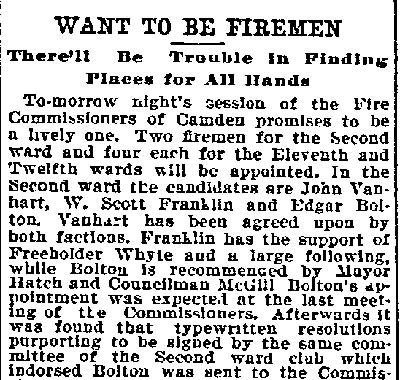
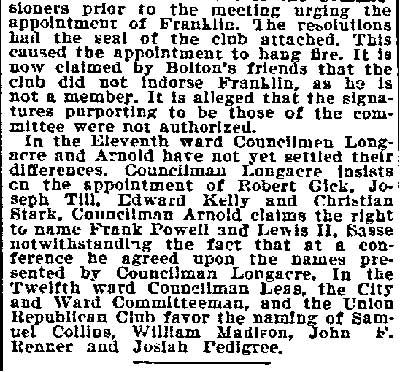
To-morrow night’s session of the Fire Commissioners of Camden promises to be a lively one. Two firemen for the Second ward and four each for the Eleventh and Twelfth wards will be appointed. In the Second ward the candidates are John Vanhart, W. Scott Franklin and Edgar Bolton. Vanhart has been agreed upon by both factions. Franklin has the support of Freeholder Whyte and a large following, while Bolton is recommended by Mayor Hatch and Councilman McGill. Bolton’s appointment was expected at the last meeting of the Commissioners. Afterwards it was found that typewritten resolutions purporting to be signed by the same committee of the Second ward club which indorsed Bolton was sent to the Commissioners prior to the meeting urging the appointment of Franklin. The resolutions had the seal of the club attached. This caused the appointment to hang fire. It is now claimed by Bolton’s friends that the club did not indorse Franklin, as he is not a member. It is alleged that the signatures purporting to be those of the committee were not authorized.
In the Eleventh ward Councilmen Longacre and Arnold have not yet settled their differences. Councilman Longacre insists on the appointment of Robert Gick, Joseph Till, Edward Kelly and Christian Stark. Councilman Arnold claims the right to name Frank Powell and Lewis H. Sasse notwithstanding the fact that at a conference he agreed upon the names presented by Councilman Longacre. In the Twelfth ward Councilman Leas, the City and Ward Committeeman, and the Union Republican Club favor the naming of Samuel Collins, William Madison, John F. Renner and Josiah Pedigree.
Firemen Selected
Philadelphia Inquirer —
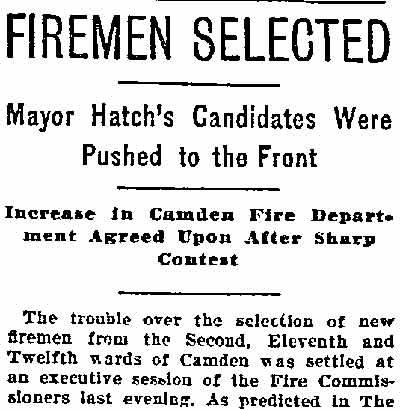
Mayor Hatch’s Candidates Were Pushed to the Front
Increase in Camden Fire Department Agreed Upon After Sharp Contest
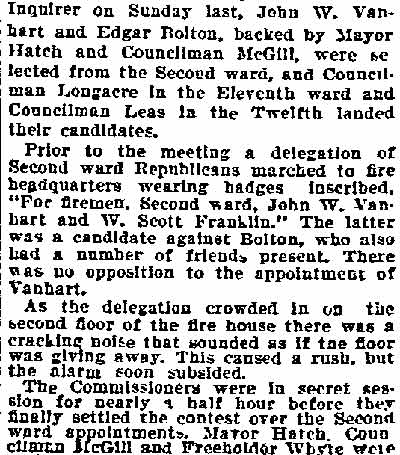
The trouble over the selection of new firemen from the Second, Eleventh and Twelfth wards of Camden was settled at an executive session of the Fire Commissioners last evening. As predicted in The Inquirer on Sunday last, John W. Vanhart and Edgar Bolton, backed by Mayor Hatch and Councilman McGill, were selected from the Second ward, and Councilman Longacre in the Eleventh ward and Councilman Leas in the Twelfth landed their candidates.
Prior to the meeting a delegation of Second ward Republicans marched to fire headquarters wearing badges inscribed, “For firemen, Second ward, John W. Vanhart and W. Scott Franklin.” The latter was a candidate against Bolton, who also had a number of friends present. There was no opposition to the appointment of Vanhart.
As the delegation crowded in on the second floor of the fire house there was a cracking noise that sounded as if the floor was giving away. This caused a rush, but the alarm soon subsided.
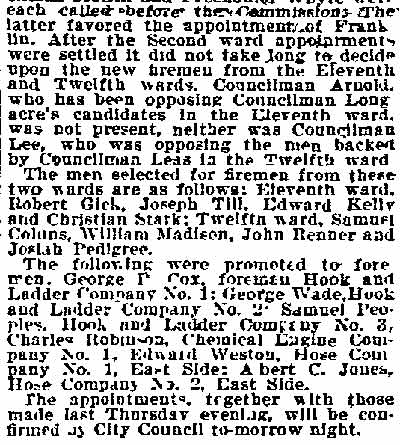
The Commissioners were in secret session for nearly a half hour before they finally settled the contest over the Second ward appointments. Mayor Hatch, Councilman McGill and Freeholder Whyte were each called before the Commissioners. The latter favored the appointment of Franklin. After the Second ward appointments were settled it did not take long to decide upon the new firemen from the Eleventh and Twelfth wards. Councilman Arnold, who has been opposing Councilman Longacre’s candidates in the Eleventh ward, was not present, neither was Councilman Lee, who was opposing the men backed by Councilman Leas in the Twelfth ward.
The men selected for firemen from these two wards are as follows: Eleventh ward, Robert Gick, Joseph Till, Edward Kelly and Christian Stark; Twelfth ward, Samuel Collins, William Madison, John Renner and Josiah Pedigree.
The following were promoted to foremen: George F. Cox, foreman Hook and Ladder Company No. 1; George Wade, Hook and Ladder Company No. 2; Samuel Peoples, Hook and Ladder Company No. 3; Charles Robinson, Chemical Engine Company No. 1; Edward Weston, Hose Company No. 1, East Side; Albert C. Jones, Hose Company No. 2, East Side.
The appointments, together with those made last Thursday evening, will be confirmed by City Council to-morrow night.
Lively Blaze on Camden’s East Side
Philadelphia Inquirer —
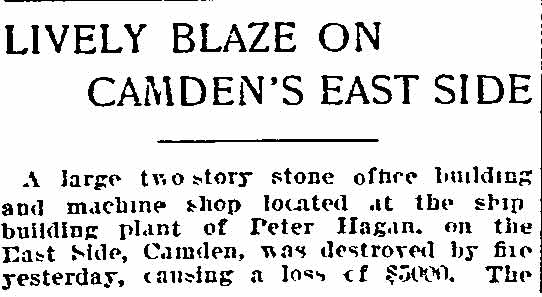
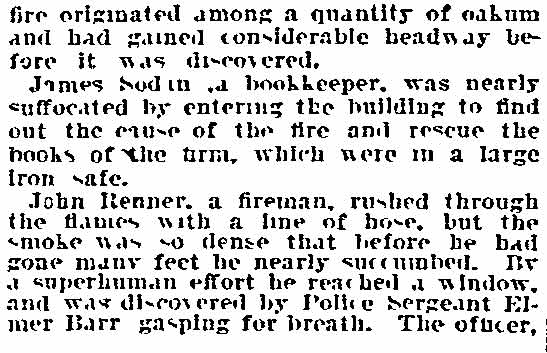
A large two-story stone office building and machine shop located at the ship building plant of Peter Hagan, on the East Side, Camden, was destroyed by fire yesterday, causing a loss of $5000. The fire originated among a quantity of oakum and had gained considerable headway before it was discovered.
James Sodin, a bookkeeper, was nearly suffocated by entering the building to find out the cause of the fire and rescue the books of the firm, which were in a large iron safe.
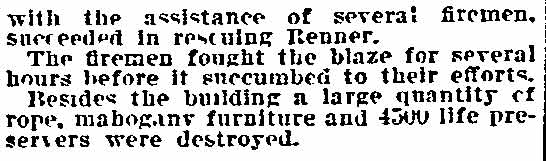
John Renner, a fireman, rushed through the flames with a line of hose, but the smoke was so dense that before he had gone many feet he nearly succumbed. By a superhuman effort he reached a window, and was discovered by Police Sergeant Elmer Barr gasping for breath. The officer, with the assistance of several firemen, succeeded in rescuing Renner.
The firemen fought the blaze for several hours before it succumbed to their efforts. Besides the building a large quantity of rope, mahogany furniture and 4500 life preservers were destroyed.
New Jersey Firemen’s Convention Arrangements
Philadelphia Inquirer —
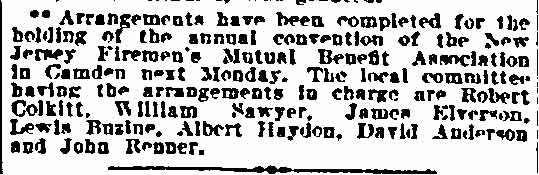
Arrangements have been completed for the holding of the annual convention of the New Jersey Firemen’s Mutual Benefit Association in Camden next Monday. The local committee having the arrangements in charge are Robert Colkitt, William Sawyer, James Elverson, Lewis Buzine, Albert Haydon, David Anderson and John Renner.
East Side Fireman Paralyzed
Philadelphia Inquirer —
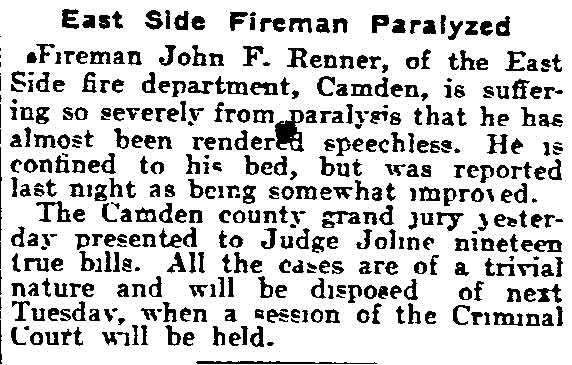
Fireman John F. Renner, of the East Side fire department, Camden, is suffering so severely from paralysis that he has almost been rendered speechless. He is confined to his bed, but was reported last night as being somewhat improved.
The Camden county grand jury yesterday presented to Judge Joline nineteen true bills. All the cases are of a trivial nature and will be disposed of next Tuesday, when a session of the Criminal Court will be held.
Dog Catchers Busy in East Side
Philadelphia Inquirer —
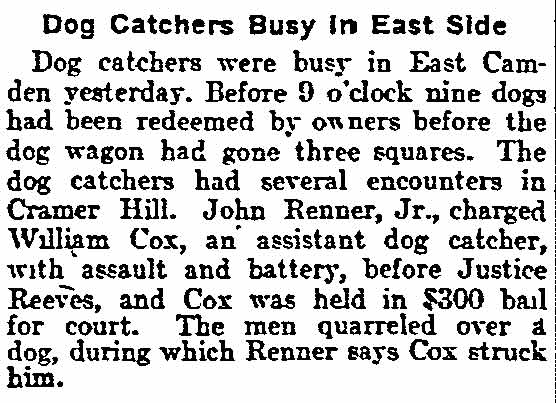
Dog catchers were busy in East Camden yesterday. Before 9 o’clock nine dogs had been redeemed by owners before the dog wagon had gone three squares. The dog catchers had several encounters in Cramer Hill. John Renner, Jr., charged William Cox, an assistant dog catcher, with assault and battery, before Justice Reeves, and Cox was held in $300 bail for court. The men quarreled over a dog, during which Renner says Cox struck him.
Chat Among the Local Firemen
Camden Daily Courier —
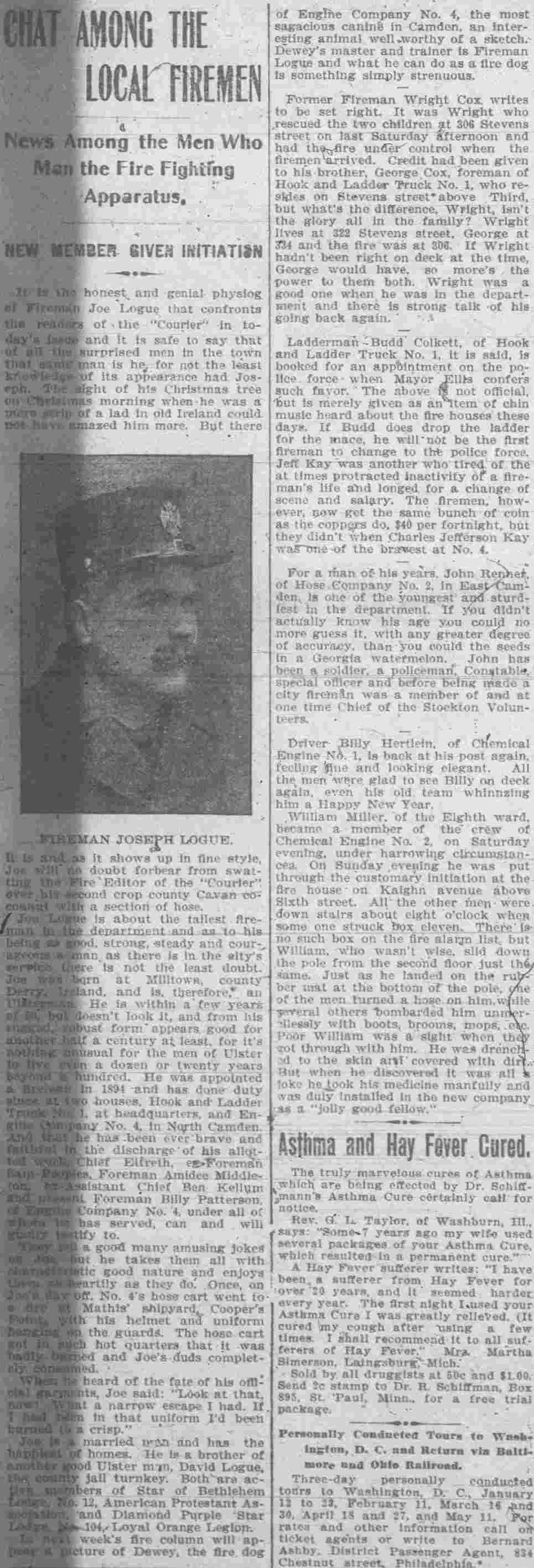
News Among the Men Who Man the Fire Fighting Apparatus.
New Member Given Initiation
Fireman Joseph Logue.
It is the honest and genial physiog of Fireman Joe Logue that confronts the readers of the “Courier” in to-day’s issue and it is safe to say that of all the surprised men in the town that same man is he, for not the least knowledge of its appearance had Joseph. The sight of his Christmas tree on Christmas morning when he was a mere strip of a lad in old Ireland could not have amazed him more. But there it is and as it shows up in fine style, Joe will no doubt forbear from swatting the Fire Editor of the “Courier” over his second crop county Cavan cocoanut with a section of hose.
Joe Logue is about the tallest fireman in the department and as to his being as good, strong, steady and courageous a man as there is in the city’s service there is not the least doubt. Joe was born at Milltown, county Derry, Ireland, and is, therefore, an Ulsterman. He is within a few years of [?], but doesn’t look it, and from his rugged, robust form appears good for another half a century at least, for it’s nothing unusual for the men of Ulster to live even a dozen or twenty years beyond a hundred. He was appointed a fireman in 1894 and has done duty since at two houses, Hook and Ladder Truck No. 1, at headquarters, and Engine Company No. 4, in North Camden. And that he has been ever brave and faithful in the discharge of his allotted work, Chief Elfreth, ex-Foreman [?] Peoples, Foreman Amidee Middleton, ex-Assistant Chief Ben Kellum and present Foreman Billy Patterson, of Engine Company No. 4, under all of whom he has served, can and will gladly testify to.
They tell a good many amusing jokes on Joe, but he takes them all with characteristic good nature and enjoys them as heartily as they do. Once, on Joe’s day off, No. 4’s hose cart went to a fire at Mathis’ shipyard, Cooper’s Point, with his helmet and uniform hanging on the guards. The hose cart got in such hot quarters that it was badly burned and Joe’s duds completely consumed.
When he heard of the fate of his official garments, Joe said: “Look at that, now! What a narrow escape I had. If I had been in that uniform I’d been burned to a crisp.”
Joe is a married man and has the happiest of homes. He is a brother of another good Ulster man, David Logue, the county jail turnkey. Both are active members of Star of Bethlehem Lodge, No. 12, American Protestant Association, and Diamond Purple Star Lodge, No. 104, Loyal Orange Legion.
In next week’s fire column will appear a picture of Dewey, the fire dog of Engine Company No. 4, the most sagacious canine in Camden, an interesting animal well worthy of a sketch. Dewey’s master and trainer is Fireman Logue and what he can do as a fire dog is something simply strenuous.
Former Fireman Wright Cox writes to be set right. It was Wright who rescued the two children at 306 Stevens street on last Saturday afternoon and had the fire under control when the firemen arrived. Credit had been given to his brother, George Cox, foreman of Hook and Ladder Truck No. 1, who resides on Stevens street above Third, but what’s the difference, Wright, isn’t the glory all in the family? Wright lives at 322 Stevens street, George at 334 and the fire was at 306. If Wright hadn’t been right on deck at the time, George would have, so more’s the power to them both. Wright was a good one when he was in the department and there is strong talk of his going back again.
Ladderman Budd Colkett, of Hook and Ladder Truck No. 1, it is said, is booked for an appointment on the police force when Mayor Ellis confers such favor. The above is not official, but is merely given as an item of chin music heard about the fire houses these days. If Budd does drop the ladder for the mace, he will not be the first fireman to change to the police force. Jeff Kay was another who tired of the at times protracted inactivity of a fireman’s life and longed for a change of scene and salary. The firemen, however, now get the same bunch of coin as the coppers do, $40 per fortnight, but they didn’t when Charles Jefferson Kay was one of the bravest at No. 4.
For a man of his years, John Renner, of Hose Company No. 2, in East Camden, is one of the youngest and sturdiest in the department. If you didn’t actually know his age you could no more guess it, with any greater degree of accuracy, than you could the seeds in a Georgia watermelon. John has been a soldier, a policeman, Constable, special officer and before being made a city fireman was a member of and at one time Chief of the Stockton Volunteers.
Driver Billy Hertlein, of Chemical Engine No. 1, is back at his post again, feeling fine and looking elegant. All the men were glad to see Billy on deck again, even his old team whinnying him a Happy New Year.
William Miller, of the Eighth ward, became a member of the crew of Chemical Engine No. 2, on Saturday evening, under harrowing circumstances. On Sunday evening he was put through the customary initiation at the fire house on Kaighn avenue above Sixth street. All the other men were down stairs about eight o’clock when some one struck box eleven. There is no such box on the fire alarm list, but William, who wasn’t wise, slid down the pole from the second floor just the same. Just as he landed on the rubber mat at the bottom of the pole, one of the men turned a hose on him, while several others bombarded him unmercilessly with boots, brooms, mops, etc. Poor William was a sight when they got through with him. He was drenched to the skin and covered with dirt. But when he discovered it was all a joke he took his medicine manfully and was duly installed in the new company as a “jolly good fellow.”
Renner, John F. (obituary)
Philadelphia Inquirer —
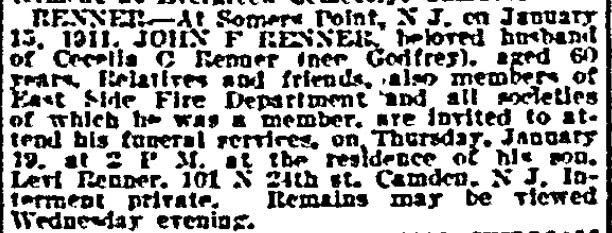
RENNER.—At Somers Point, N. J., on January 15, 1911, JOHN F. RENNER, beloved husband of Cecelia C. Renner (nee Godfrey), aged 60 years. Relatives and friends, also members of East Side Fire Department and all societies of which he was a member, are invited to attend his funeral services, on Thursday, January 19, at 2 P.M., at the residence of his son, Levi Renner, 101 N. 24th st., Camden, N. J. Interment private. Remains may be viewed Wednesday evening.
RENNER.—At Somers Point, N. J., on January 15, 1911, JOHN F. RENNER, beloved husband of Cecelia C. Renner (nee Godfrey), aged 60 years. Relatives and friends, also members of East Side Fire Department and all societies of which he was a member, are invited to attend his funeral services, on Thursday, January 19, at 2 P.M., at the residence of his son, Levi Renner, 101 N. 24th st., Camden, N. J. Interment private. Remains may be viewed Wednesday evening.