Introduction
JAMES W. AYERS was born in New York City on November 24, 1822. He was apprenticed at the age of 10 in the hair cloth and curled hair trade. He became a journeyman in the trade at the age of 18, and in 1841 he moved to Camden, where he found work with Samuel Ross, at Ross’s Haircloth Factory at Fourth and Federal Streets. He remained with the firm after the 1849 fire in which the plant burned down.
A Republican, James W. Ayers was elected to City Council from the Middle Ward in 1859. He was a member of the Camden Police Department in 1861, and again from 1864 to 1874, under Mayors Paul C. Budd, Charles Cox, and Samuel M. Gaul. While not on the force, he worked for the Pennsylvania Railroad in a variety of positions, and was a volunteer fireman. In 1866 he was named Chief Engineer of the Volunteer Fire Department.
On June 7, 1866 Camden’s City Council enacted an ordinance reorganizing the volunteer fire service to improve efficiency in operations. This ordinance provided for increased compensation to the fire companies (Weccacoe and Independence got $800 per annum to be paid quarterly, the Weccacoe and Shiffler Hose companies and the United States Fire Company received $200 annually). The volunteer fire companies were also directed to select a Chief Fire Marshal and three Assistant Marshals, one from each district. The selections were subject to approval by Council. The new department was called “The Fire Department of the City of Camden.” In protest of this ordinance the New Jersey Fire Company No.4 withdrew from the new, organized volunteer department.
James W. Ayers of the Weccacoe Engine Company No. 2 was elected Chief Marshal and served until 1868 when he was succeeded by Wesley P. Murray of the Weccacoe Hose Company No.2. Murray was aided by Assistant Engineers William Abels, First District; Simeon H. Long, Second District; and Charles H. Knox, Third District. Both Ayers and Murray were well organized and popular with the volunteers. For this reason the New Jersey Fire Company No.4 petitioned City Council to be readmitted to the volunteer department. Although the petition was supported by all the fire companies, it was rejected by the Council which had already sold the New Jersey apparatus on June 13, 1866 for $100.
Late in 1867 three major fires occurred in the city. The first, on the afternoon of Wednesday, November 20 about 3 P.M. destroyed the Third Street Methodist Episcopal Church located above Bridge Avenue. This disastrous blaze was one of the largest fires in the history of the City destroying five dwellings and seriously damaging several others while leaving the church in ruins. A roof fire was discovered on the south side of the church; the cause believed to be a defective flue but some said it was a spark from a passing locomotive. A stiff southwest breeze quickly spread the flames, overwhelming all efforts by the firemen. Chief Ayers summoned assistance from several Philadelphia volunteer companies as Camden’s fire fighters turned their efforts toward saving exposures. These efforts were greatly hampered by an inadequate water supply. The dwellings at 229, 231 and 233 Taylor Avenue burned to the ground while 227 sustained heavy damage to the roof and top floor. Properties at #9 and #11 South Third Street also were damaged as flying embers ignited their roofs. A dwelling at #13 South Third Street was heavily damaged by the flames. Only due to the valiant efforts of the combined fire forces was the conflagration halted late that night. Both Chief Ayers and Captain Wesley P. Murray were commended for their judgment and action while directing firefighting efforts. Citizens felt that if the water supply had been better the efforts of the firemen would have contained the blaze much earlier.
Nearly a month later the second blaze occurred; the Nickel Works, owned by Wharton and Fleightman and located in the block bounded by York, State, Tenth Streets and Cooper’s Creek. The fire started about 6 P.M. on Sunday the 15th, when the dryers in the drying house overheated. A total effort by the Independence and Weccacoe steam engines, the United States ladder company and the hose companies of the department contained the fire to the original 40 by 50 foot building. A good water supply from the creek nearby and a quick response by fire companies contained the spread of fire resulting in only minor damage to several surrounding buildings.
Eight days later, on December 23, 1867 the Camden Rolling Mills Company was severely damaged by fire. The mill was one of the city’s largest industries and stood at the head of Third Street on the Delaware River. The blaze began in the machine shop when a cinder was thrown from one of the puddling furnaces. Flames spread rapidly through the wood frame building that covered almost an acre of ground. A prompt response and assistance from Philadelphia enabled fire fighters to save the other buildings in the complex.
After the Nickel Works fire in 1867 another, more destructive blaze occurred at the complex on Sunday night, July 12, 1868. Flames were discovered in the southwest corner of the main building and as firemen arrived, the fire was extending to several nearby occupied dwellings and to the roof of the mill’s power house. Fire fighters placed their apparatus effectively and were able to darken the flames on the power house roof and contain the blaze. The original fire building and the homes were destroyed. Damage was estimated at $30,000 to $40,000, far more than the $10,000 damage estimate of the earlier fire. Firemen had to contend with high temperatures and humidity as well as the heat from the blaze while quelling this mid-summer fire.
Still another destructive fire occurred less than a week later. About 5 P.M. the following Saturday, July 18, flames were discovered coming from the engine room of Goldey & Cohn’s large box factory on Taylor Avenue. Flames spread through the building, feeding on the highly combustible stock. The entire building was soon engulfed in fire as was the late R.H. Middleton’s brick stable. A brisk southwest wind carried the flames across Taylor Avenue to the company’s lumber pile and onward to Middleton’s warerooms at #7 South Second Street and also his two and one-half story frame dwelling at #5 South Second Street.
Chief Engineer Ayers realized that additional help was needed and telegraphed Chief McClusker of Philadelphia for assistance. The blaze was already threatening to consume the most densely populated and most valuable section of the City. Chief McClusker responded with steamers from the Vigilant and Hibernia Fire Companies, the Fairmount, Lafayette, Neptune, America and Diligent Hose Companies and the Empire Hook & Ladder Company.
As the firemen placed the steamers along the Delaware River and laid their hose lines, the fire spread to the Ware & Marshall meat and provision store, a two story brick property at #3 South Second Street and to a two and one-half story brick dwelling at #1 South Second Street (owned by Joab Scull and occupied by Charles Armstrong). These buildings were destroyed as was Joab Scull’s wood frame grocery store on the southwest corner of Second and Federal Streets and an adjacent three story brick dwelling (also owned by Scull but occupied by Mr. Goldey).
The fire continued to spread destroying Mr. Test’s frame drugstore and extending to the home of James M. Cassady, Esquire’s house at 128 Federal Street. Firemen were successful in saving Cassady’s residence from complete destruction. Although the property sustained heavy water damage, only the rear of the building was destroyed. The fire fighters continued their determined stand against the oncoming flames and were able to save the property of the late Samuel McLain which adjoined Cassady’s residence.
Conrad Hoell’s saloon at the corner of Second and Federal Streets and the adjoining building occupied by L.G. Peterson ignited several times, but the flames were quenched by what the West Jersey Press called the “superhuman exertions” of the fire fighters.
Several firemen were overcome by the intense heat, including Captain Wesley P. Murray and Joseph Flanigan of the Weccacoe Hose and Robert S. Bender, Thomas McCowan and Thomas Allibone of the Independence Steam Engine. These men had to be removed from the scene.
Combined losses exceeding $54,000 were reported as a result of this devastating conflagration. Chief Engineer Ayers praised the efforts of his men and the good work done by Chief McClusker and his forces from Philadelphia. The grateful citizens joined in this praise.
Later that year Chief Ayers was succeeded as Chief Engineer by Captain Murray, and turned his attention to police work.
James W. Ayers was elected Mayor in March of 1877, defeating John Morgan, who had been appointed Mayor by City Council upon the death of John H. Jones on October 27, 1876. He served one term, not running for re-election in 1880. He returned to police work with the Pennsylvania Railroad after leaving office. He was succeeded by Claudius W. Bradshaw.
During Mayor Ayers’ term the first telephones were installed in Camden, and the first train ran from Camden to Atlantic City. The city also suffered through a hurricane in October of 1878 which caused great damage.
At the time of the 1880 census, James W. Ayers and wife Priscilla resided at 423 Arch Street in Camden. The family included six children at the time ranging in age from 23 to 11, Mary, Maggie, John, Anne, James W., and Harry R. Ayers. Mayor Ayers died at his home at 423 Arch Street on August 27, 1896.
Photos
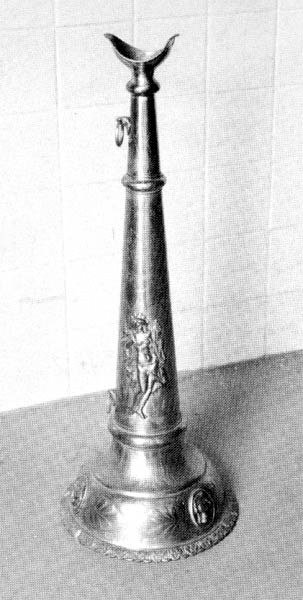
This ornately decorated presentation speaking trumpet is inscribed “Presented to W.P. Murray by the members of the Weccacoe Hose Co. No.2 of Camden, N.J.” Wesley P. Murray served as Chief Marshal of the Fire Department of the City of Camden (volunteer) during 1868 and 1869. He was a highly regarded member of the Weccacoe Hose Company No.2 and was most likely presented this fine specimen at that time. Courtesy of the Independent Fire Company, Maple Shade, New Jersey.
Indigent and Disabled Firemen
Philadelphia Inquirer —
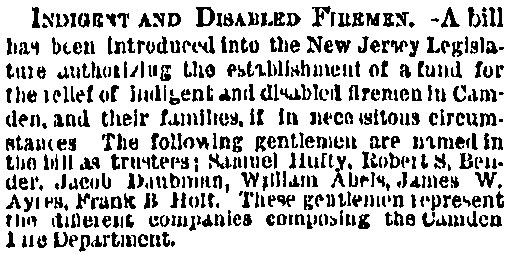
INDIGENT AND DISABLED FIREMEN.—A bill has been introduced into the New Jersey Legislature authorizing the establishment of a fund for the relief of indigent and disabled firemen in Camden, and their families, if in necessitous circumstances. The following gentlemen are named in the bill as trustees: Samuel Hufty, Robert S. Bender, Jacob Daubman, William Abels, James W. Ayers, Frank B. Holt. These gentlemen represent the different companies composing the Camden Fire Department.
The New Police Force
Philadelphia Inquirer —
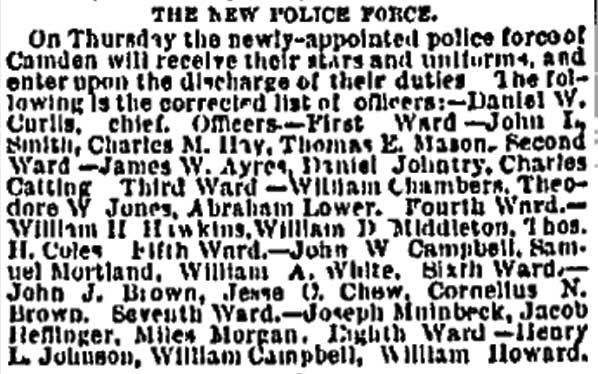
On Thursday the newly-appointed police force of Camden will receive their stars and uniforms, and enter upon the discharge of their duties. The following is the corrected list of officers:—Daniel W. Curlis, chief. Officers—First Ward—John I. Smith, Charles M. Hay, Thomas E. Mason. Second Ward—James W. Ayres, Daniel Johntra, Charles Catting. Third Ward—William Chambers, Theodore W. Jones, Abraham Lower. Fourth Ward—William H. Hawkins, William D. Middleton, Thos. H. Coles. Fifth Ward—John W. Campbell, Samuel Mortland, William A. White. Sixth Ward—John J. Brown, Jesse O. Chew, Cornelius N. Brown. Seventh Ward—Joseph Muinbeck, Jacob Heflinger, Miles Morgan. Eighth Ward—Henry L. Johnson, William Campbell, William Howard.
Organized
Philadelphia Inquirer —
ORGANIZED.
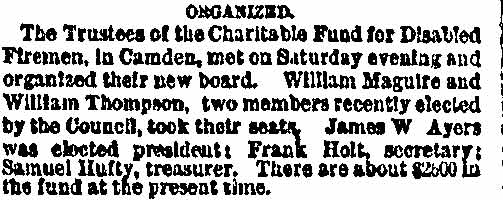
The Trustees of the Charitable Fund for Disabled Firemen, in Camden, met on Saturday evening and organized their new board. William Maguire and William Thompson, two members recently elected by the Council, took their seats. James W. Ayers was elected president; Frank Holt, secretary; Samuel Hufty, treasurer. There are about $2500 in the fund at the present time.
Committed
Philadelphia Inquirer —
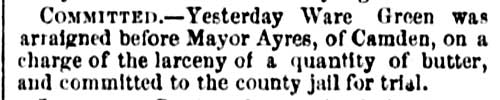
COMMITTED.—Yesterday Ware Green was arraigned before Mayor Ayres, of Camden, on a charge of the larceny of a quantity of butter, and committed to the county jail for trial.
Over the River
Philadelphia Inquirer —
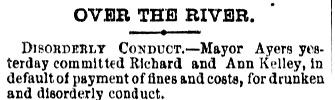
OVER THE RIVER.
DISORDERLY CONDUCT.—Mayor Ayers yesterday committed Richard and Ann Kelley, in default of payment of fines and costs, for drunken and disorderly conduct.
Violating the Game Laws
Philadelphia Inquirer —
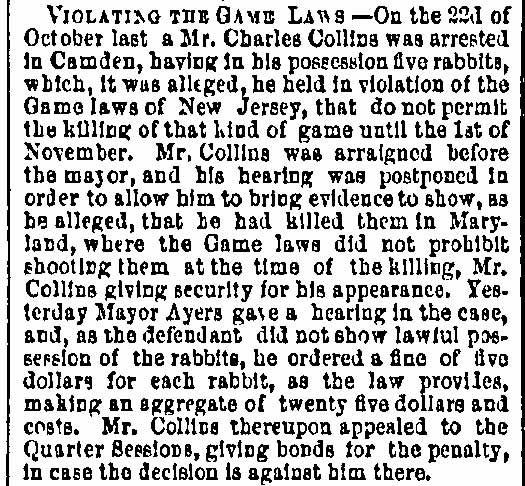
VIOLATING THE GAME LAWS—On the 22d of October last a Mr. Charles Collins was arrested in Camden, having in his possession five rabbits, which, it was alleged, he held in violation of the Game laws of New Jersey, that do not permit the killing of that kind of game until the 1st of November. Mr. Collins was arraigned before the mayor, and his hearing was postponed in order to allow him to bring evidence to show, as he alleged, that he had killed them in Maryland, where the Game laws did not prohibit shooting them at the time of the killing, Mr. Collins giving security for his appearance. Yesterday Mayor Ayers gave a hearing in the case, and, as the defendant did not show lawful possession of the rabbits, he ordered a fine of five dollars for each rabbit, as the law provides, making an aggregate of twenty five dollars and costs. Mr. Collins thereupon appealed to the Quarter Sessions, giving bonds for the penalty, in case the decision is against him there.
Held for Trial
Philadelphia Inquirer —
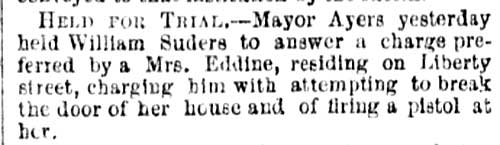
HELD FOR TRIAL.—Mayor Ayers yesterday held William Suders to answer a charge preferred by a Mrs. Eddine, residing on Liberty street, charging him with attempting to break the door of her house and of firing a pistol at her.
Over the River
Philadelphia Inquirer —
OVER THE RIVER.
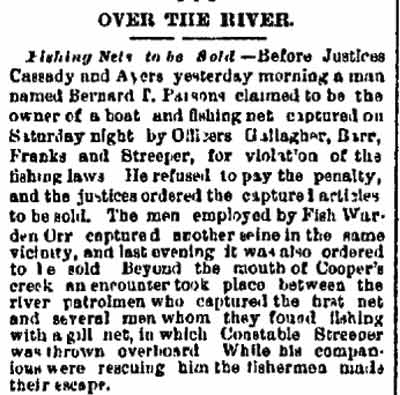
Fishing Nets to be Sold—Before Justices Cassady and Ayers yesterday morning a man named Bernard T. Parsons claimed to be the owner of a boat and fishing net captured on Saturday night by Officers Gallagher, Barr, Franks and Streeper, for violation of the fishing laws. He refused to pay the penalty, and the justices ordered the captured articles to be sold. The men employed by Fish Warden Orr captured another seine in the same vicinity, and last evening it was also ordered to be sold. Beyond the mouth of Cooper’s creek an encounter took place between the river patrolmen who captured the first net and several men whom they found fishing with a gill net, in which Constable Streeper was thrown overboard. While his companions were rescuing him the fishermen made their escape.
James W. Ayers
The History of Camden County New Jersey — George Reeser Prowell, 1886
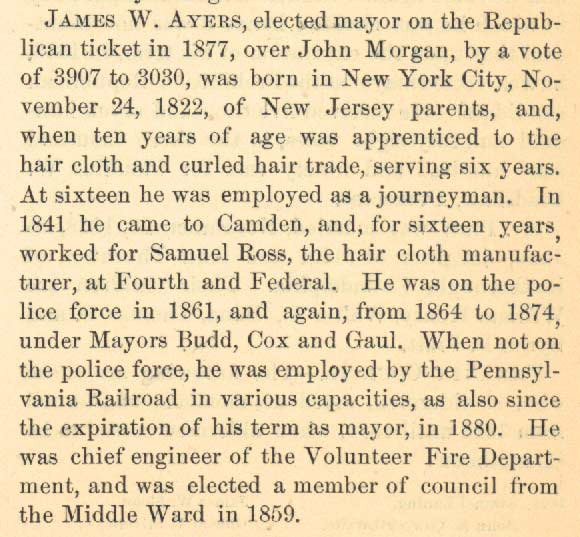
JAMES W. AYERS, elected mayor on the Republican ticket in 1877, over John Morgan, by a vote of 3907 to 3030, was born in New York City, November 24, 1822, of New Jersey parents, and, when ten years of age was apprenticed to the hair cloth and curled hair trade, serving six years. At sixteen he was employed as a journeyman. In 1841 he came to Camden, and, for sixteen years, worked for Samuel Ross, the hair cloth manufacturer, at Fourth and Federal. He was on the police force in 1861, and again, from 1864 to 1874, under Mayors Budd, Cox and Gaul. When not on the police force, he was employed by the Pennsylvania Railroad in various capacities, as also since the expiration of his term as mayor, in 1880. He was chief engineer of the Volunteer Fire Department, and was elected a member of council from the Middle Ward in 1859.
Death of an Ex-Mayor of Camden
New York Herald Tribune —
DEATH OF AN EX-MAYOR OF CAMDEN.
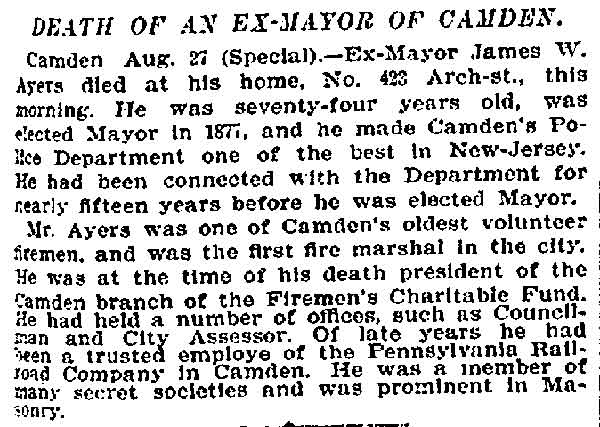
Camden Aug. 27 (Special).—Ex-Mayor James W. Ayers died at his home, No. 423 Arch-st., this morning. He was seventy-four years old, was elected Mayor in 1877, and he made Camden’s Police Department one of the best in New-Jersey. He had been connected with the Department for nearly fifteen years before he was elected Mayor.
Mr. Ayers was one of Camden’s oldest volunteer firemen, and was the first fire marshal in the city. He was at the time of his death president of the Camden branch of the Firemen’s Charitable Fund. He had held a number of offices, such as Councillman and City Assessor. Of late years he had been a trusted employe of the Pennsylvania Railroad Company in Camden. He was a member of many secret societies and was prominent in Masonry.