Harvey G. Watts
HARVEY G. WATTS was born in Massachusetts in, according to the 1900 census, April of 1872. He married Mary Hewitt around 1891. The 1900 Census shows them living with her parents, Lewis and Martha Hewitt, at 412 North 6th Street. Harvey Watts was then working as a clerk for the Pennsylvania Railroad.
Harvey Watts was appointed to the Camden Fire Department in May of 1903 as a replacement for John Van Hart, who had died. He was initially assigned to Engine Company 3, then spent some time with Engine Company 2, and Engine Company 4. On January 2, 1908 he was sent to Ladder Company 1 in exchange for Charles Cook. On January 16, 1909 he was sent to Engine Company 6 and was replaced by William H. Tatem. On September 22, 1909 Harvey Watts was transferred from Engine Company 6 to Ladder Company 1, replacing Samuel Harring, who was in turn sent to Engine Company 6. In 1911 Harvey Watts was transferred to the Electrical Bureau, and in 1914 he was made clerk of the department by then Chief Charles Worthington. That year’s city directory shows that he and his wife were still living at 412 North 6th Street.
The 1918–1919 City Directory and the 1920 Census shows Harvey Watts and his wife Mary at 601 Penn Street. He was then working at Fire Headquarters as the Fire Department’s clerk. In 1923 he was transferred to Ladder Company 1, then on December 25, 1923 he was promoted to Captain and sent to Engine Company 3 at 1815 Broadway. He later was transferred to one of the companies operating out of the East Side firehouse at North 27th and Federal Streets, where he served out the rest of his career.
City Directories from 1924 and 1927 show Harvey Watts living at 1504 Baird Avenue. The 1929 city directory shows him living at 1453 Baird Avenue. When the 1930 Census was taken, Harvey and Mary Watts were still at 1453 Kaighn Avenue, where they were renting. In 1936 Harvey Watts retired from the Camden Fire Department and moved to Pitman, New Jersey. He passed away at some point after April 4, 1940.
Inspection of Camden Firemen
Philadelphia Inquirer —
Last night the Fire Committee of Camden City Council elected Harvey G. Watts, of the Second ward, a fireman, to succeed John Vanhart, who died recently. The committee decided to hold the annual inspection of the Fire Department on June 12.
Flames Wrecked New High School
Philadelphia Inquirer —
Walls Left of Handsome Building Erected at Woodbury Only a Short Time Ago
Believed Blaze Originated in Boiler Room by Joists Taking Fire, Pride of County Seat
WOODBURY, N. J., Dec. 19.—The William Milligan High School, a practically new institution that has been occupied just about a year, and cost, including the lot, about $88,000, was burned early this morning, and the building, with all its handsome furnishings, is a wreck. Only the walls are standing, with a chemical laboratory, and two gymnasiums. In the commercial room were ten new typewriters, and new and up-to-date desks. These were all purchased at the beginning of the school year. In the basement was a new manual training outfit, which arrived only last week, but not unpacked, and some of this will probably be saved.
Woodbury has over a hundred out of town pupils who come here, and when they arrived this morning, all jubilant over the approaching holidays, some of the girls cried.
The Board of Education held a meeting this afternoon and decided to open the four upper rooms in the academy, rent three more in Green’s Block, two in the old Friends’ School, and it is possible that the old Starr homestead on Broad Street will be used.
Prisoners in a Panic
During the fire the prisoners in the county jail, which is within a hundred yards of the school, were thrown into a panic. They were all locked in their cells.
The men, who were under Fire Chief Elfreth, of Camden, and those who did good work in connection with the local firemen, were George Weight, Harvey Watts, William Elverson, Harry Hankins, William Ladd, Chappis [sic] Lennox, Joseph Johnson, Josiah Savage, Augustus Dold and Arthur Wingate. The Gloucester firemen aided in every way possible.
…ing, and it will be necessary to tear the greater portion of these down to rebuild, which will be done at once. There is an insurance of about $60,000 on the buildings and furnishings.
From what can be ascertained the fire originated over the boiler in the engine room, which was on the extreme northwest end of the basement. The first floor joists were in close contact with the chimney, and it is supposed, according to Fire Chief A. W. Cattell, that sparks got on the wood work. It is also believed that the fire had been burning for about three hours, as when the firemen attempted to go in the front doors, the smoke was so thick that they were driven back.
Discovered Flames
Charles M. Garrett, who lives on New street, at the rear of the school house, was awakened by his wife. He saw a bright light in the engine room and knew there was a fire. He telephoned an alarm and firemen responded. Another alarm was sounded, and lines of hose were attached, but the pressure was so light that the stream would not reach far above the second story. Fire Chief Cattell telephoned to Camden, and ten minutes later Fire Chief Elfreth had an engine and Company No. 2 at the Camden terminal. In the meantime several firemen from Gloucester came, but there was little to do except watch the fire. Several firemen attempted to go inside the building, and Foreman Edward Martin was injured by falling material, and Charles Graham, a Gloucester fireman, was knocked down by exploding chemicals in the laboratory.
A. A. Allard, the engineer, left the building last night about 5 o’clock, and is sure there was no smoke in the building at that time.
The school had sixteen rooms, including two recreation and a large assembly room.
Firemen Trapped in Burning Store
Camden Post-Telegram —

Seven Fight Their Way Out After Being Surrounded by Flames.
BLAZING CHILDREN PERIL WHOLE BLOCK
Caught like rats in a trap in a fire that threatened the entire business block on the east side of Broadway between Chestnut street and Kaighn avenue, yesterday morning, seven firemen, back to back, fought their way through flames and smoke escaping with singed hair and eyebrows and slight burns of the face, head and hands.
And while these brave men were battling against great odds, the father and mother of two pretty little girls, aged eighteen and thirty months, were alternately laughing and crying, or praising a plucky little woman who saved their tots from being burned to death.
Six of the firemen—Captain Charles Robinson, Captain Samuel Price, Lieutenant Harry Haines, Morton Clark, James McDermott, John McTaggart—were from the Kaighn avenue house. The other was Roy Smith, of the Chemical Company from House No. 7.
The children who were saved from an awful fate are: Florence Erlick and Martha Erlick, and their rescuer is Mrs. Tillie Sackett, of 1122 Broadway.
Three stores, 1118, 1120, 1122 Broadway, were practically gutted and the upper stories in the rear badly damaged, the whole entailing a loss estimated at $6,500 of which the major portion is covered by insurance. The police arrangements were perfect, the entire block being roped off within a few minutes after the fire alarm was turned in at Broadway and Kaighn avenue by Reserve Policeman Matlack.
Harry Erlick conducts a dry goods, notion and gents’ furnishing store at 1120 Broadway. About 10.45 o’clock he left the front of the store to go to the kitchen, leaving the little girls, Florence, aged 30 months, and Martha, aged 18 months, at play in the store, his wife being out on an errand. Only a short time elapsed when he was startled by the screams of Florence and rushing into the kitchen saw her standing near the coal stove trying to beat out the fire in a paper belt that she had around her body.
As Mr. Erlick entered she ran towards him, the blaze from the belt setting fire to some of the goods on the counter. Thinking only of his children, Mr. Erlick beat out the fire on the little one’s clothing but by this time the flames were rapidly spreading over the rear of the store.
(CONTINUED ON EIGHTH PAGE.)
FIREMEN TRAPPED
(CONTINUED FROM FIRST PAGE.)
Believing that the little ones were all right he took them into the store 1122 occupied by Edward T. Sackett, manager of a branch office of the Singer Sewing Machine Co. Calling to Mrs. Sackett to care for them, he started for the door to turn in an alarm. As Mrs. Sackett rose to go to the little ones she discovered that Martha’s dress was on fire and before she reached the child the dress of Martha was ablaze.
With great presence of mind Mrs. Sackett threw both children to the floor and covered them with a big rug, instantly smothering the flames, and she then tore off the children’s garments to be sure that there was no further danger. In the meantime the firemen had been summoned and by the time the companies from Kaighn Avenue arrived the flames were blazing above the roof of 1120. The children were then taken to the home of friends where it was found they were only slightly burned.
Assistant Chief Cox, of the southern district, immediately ordered a general alarm and it was undoubtedly due to this that the block was saved, for the frame buildings were rapidly going in the rear when powerful streams from nearly every engine in the Camden district checked the rapid spread of the flames and in less than thirty minutes the fire was out.
The seven firemen who had a close call went into the front of Mr. Erlick’s store with hose from two chemical engines to hold the blaze in check until water could be forced by the engines, and although they were fighting fiercely they were making but little progress owing to the inflammable nature of the stock and the fact that the building was frame and very old.
They were there only a few minutes when they were startled by the crashing of glass and in turning they saw the backs of the store ablaze on fire and that a sheet of flame was extending across the front of the building.
“Back to back and fight both ways” shouted Captain Robinson and the men obeyed, two streams being directed against the front of the store and two in the rear. In what seemed like an age, according to a statement made by Captain Robinson, after returning to the house, but in reality only a short space of time, the men had quenched the fire in the front part of the store and then attacked the rear body.
The flames rapidly communicated to the provision store of Mrs. Mary Palosky, 1118 Broadway. Two frame buildings on the north, by this time several of the engines were in service and lines of hose were run to the backs of the three houses where the fire could be fought to better advantage. When it looked as if H. Nurock’s store at 1124 Broadway, would be licked up, ladders were brought into play and extra streams were run in from the upper stories from Broadway, and from that instant all danger of a big conflagration was over.
The insurance on the Palosky’s household goods expired less than a month ago and they decided that they would not take out any more policies until after the first of the year, although a great many of their household goods were saved, their loss on stock and other goods is estimated at $1,000. The property is owned by Samuel Shane. The estimated loss is $500, covered by insurance.
Mr. Erlick places his loss at $2,000, with insurance. The property is probably damaged to the extent of $1,000. It is owned by Joseph Hermann and is fully insured.
No. 1122 is owned by the estate of Harry Pinsky. The property is damaged to the amount of $500. The loss of the Singer Sewing Machine Co. may amount to $1,000, and that of the tenant, Edward T. Sackett, $500, all covered by insurance.
Peter Gray and Harvey Watts, stationed at headquarters, were off duty at the time, but hearing of the fire returned to the house and went to the scene with the supply wagon.
After the fire a chorus of praise went their way though Gray had a rib cracked he remained on duty until the fire was out and when Chief Elfreth wanted to send him to a hospital Gray drove the team back and then went home.
And during the fire Jeweler Nurock’s store was heavily guarded by policemen and when everything was over he not only congratulated the officers but the heads of the Fire Department, stating that too much praise could not be given for the excellent service rendered. This view was shared by many other business men of the neighborhood.
Camden Firemen Have Narrow Escape
Philadelphia Inquirer —
Three Camden firemen had a narrow escape from suffocation yesterday afternoon when they entered the drug store of Edward Fryer, Sixth and Berkley streets, to extinguish a blaze that burned out the cellar. About $500 damage was done to a stock of drugs and chemicals. Assistant Chief John Stockton, William Laird and Harvey Watts went into the place. They lost their way and became penned in a compartment filled with bottles. Fellow firemen cut them out. Stockton and Laird were badly cut by glass and all three were nearly strangled by the smoke. The fire is supposed to have been caused by spontaneous combustion.
Charm Presented to Deputy Chief
Camden Daily Courier —
William Patterson Honored at Dinner Given to Members to No. 4 Engine Company.
BIG TURKEY FEED ENJOYED BY MANY
As a mark of appreciation for their splendid work while he was captain of No. 4 Engine Company, Deputy Fire Chief William Patterson last evening tendered the company members a fine turkey supper at No. 4 Engine House, Vine street near Fourth.
The caterers were Engineer Daniel Grimes, Firemen Robert Brice and Joseph Daly.
At the beginning of the banquet Capt. Charles Cook sprung a surprise when he presented the chief with a handsome watch charm of the Junior Order United American Mechanics. On the back was an inscription expressing the esteem of the members of the engine company. Chief Patterson expressed his appreciation for the gift and in a short address told the men he would always wear and cherish the gift.
Following the banquet addresses were made by Chief Peter B. Carter, Freeholder James M. Walton and Secretary Harvey Watts. Chief Carter spoke of the fellowship in the department at the present time and Freeholder Walton urged the men to be loyal. Lieutenant Joseph Logue, one of the oldest members of the company, spoke feelingly of his former captain. Then each guest was called upon and all expressed their esteem for Chief Patterson and showed their pleasure in his merited advancement.
Only one member of the company was absent, Ephraim Hires, who is ill at his home. Fireman Rollo Jones proposed a toast to former and departed members of the company and it was drunk in silence.
Gathered about the festive board were Deputy Chief William Patterson, Chief Peter B. Carter, Freeholder James M. Walton, Secretary Harvey Watts, Capt. Charles Cook, Firemen Arthur Wingate, Charles Hankins, Si Sage, Joseph Logue, Abraham Kerns, Charles Watkins, Jr., Martin Carrigan, Dollo Jones, Robert Brice, Joseph Daly, Daniel Grimes, John Miller and Frank Sheridan. The menu follows:
Oysters on Half-shell, Biscuits, Roast Turkey, Stewed Tomatoes, Green Peas, Mashed Potatoes, Cranberry Sauce, Cold Slaw, Olives, Coffee, After-dinner Mints, Celery, Layer Cake, Dan Grimes’ Punch, Cigars.
Camden's Fire Department
Philadelphia Inquirer —
The Fire Department of Camden City is under the supervision of a certain number of members of the City Council, appointed annually for that purpose by the President of the Council and known as the Fire Commissioner.
The present Chief Engineer is Peter B. Carter; Harvey G. Watts is the Clerk, and William W. Patterson, the Deputy Chief.
No one need apply for a position in the Fire Department whose age will exceed 35 years at his next birthday anniversary, who is not in a condition to pass the required physical examination, or who is unable to read, write and speak English.
Famous Blazes in Camden Recalled by Old Fire Fighter
Camden Courier-Post —
Harvey Watts, Retired, Remembers Thrill of Driving Horse Equipment; Still Follows Engines, at 70
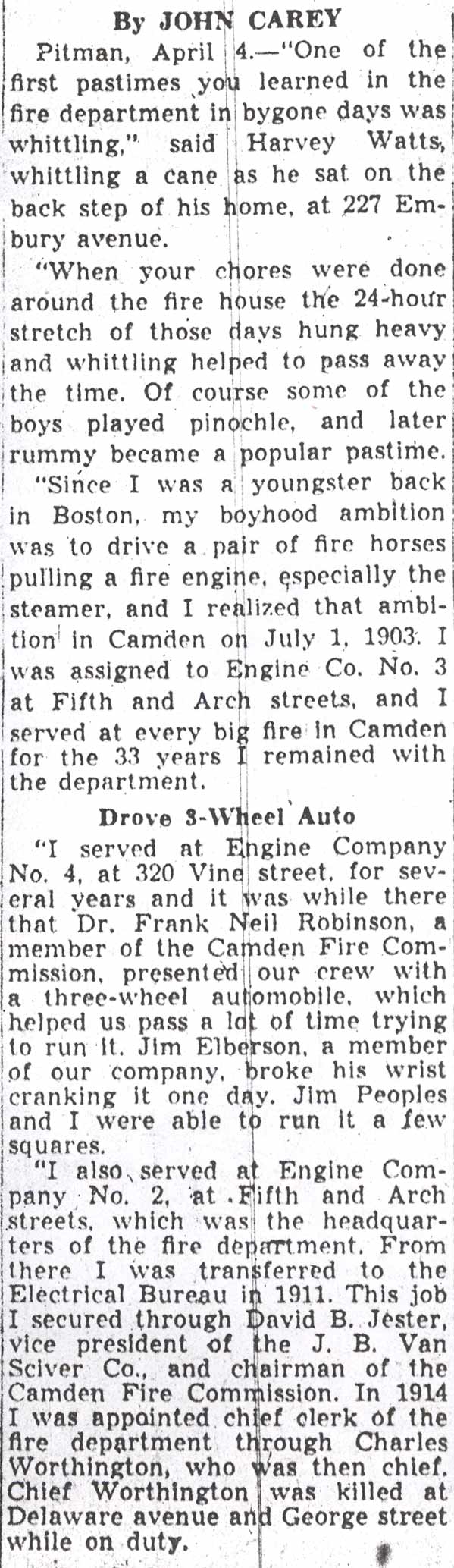
By JOHN CAREY
Pitman, April 4.—“One of the first pastimes you learned in the fire department in bygone days was whittling,” said Harvey Watts, whittling a cane as he sat on the back step of his home, at 227 Embury avenue.
“When your chores were done around the fire house the 24-hour stretch of those days hung heavy and whittling helped to pass away the time. Of course some of the boys played pinochle, and later rummy became a popular pastime.
“Since I was a youngster back in Boston, my boyhood ambition was to drive a pair of fire horses pulling a fire engine, especially the steamer, and I realized that ambition in Camden on July 1, 1903. I was assigned to Engine Co. No. 3 at Fifth and Arch streets, and I served at every big fire in Camden for the 33 years I remained with the department.
Drove 3-Wheel Auto
“I served at Engine Company No. 4, at 320 Vine street, for several years and it was while there that Dr. Frank Neil Robinson, a member of the Camden Fire Commission, presented our crew with a three-wheel automobile, which helped us pass a lot of time trying to run it. Jim Elberson, a member of our company, broke his wrist cranking it one day. Jim Peoples and I were able to run it a few squares.
“I also served at Engine Company No. 2, at Fifth and Arch streets, which was the headquarters of the fire department. From there I was transferred to the Electrical Bureau in 1911. This job I secured through David B. Jester, vice president of the J. B. Van Sciver Co., and chairman of the Camden Fire Commission. In 1914 I was appointed chief clerk of the fire department through Charles Worthington, who was then chief. Chief Worthington was killed at Delaware avenue and George street while on duty.
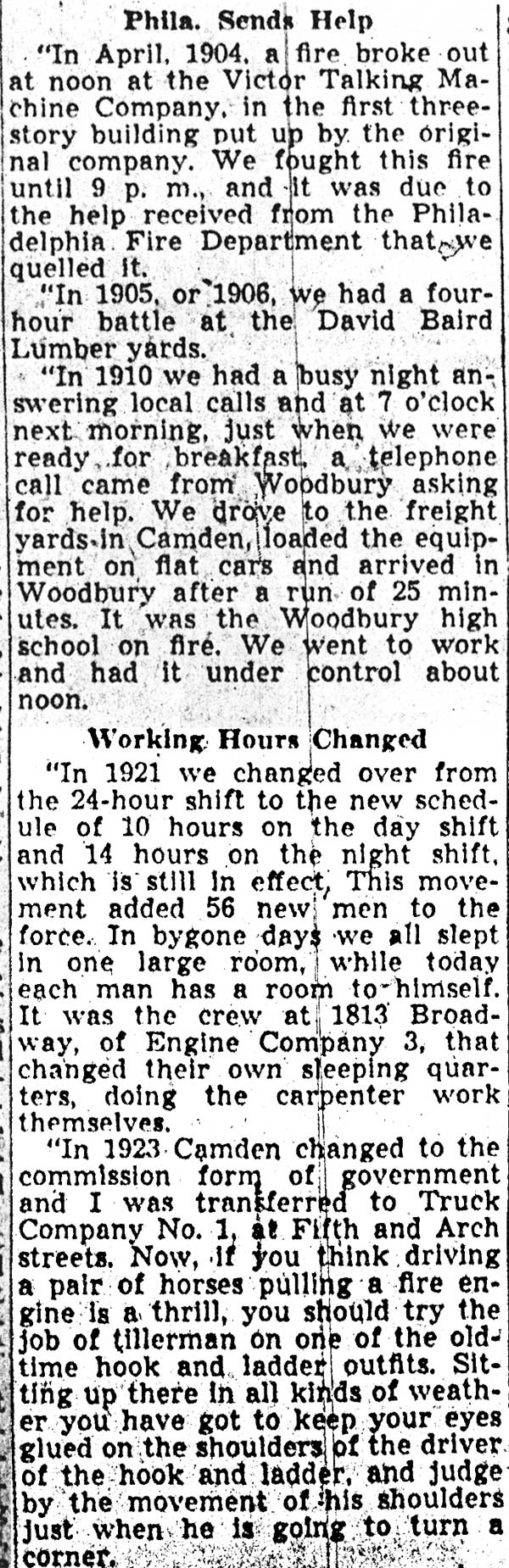
Phila. Sends Help
“In April, 1904, a fire broke out at noon at the Victor Talking Machine Company, in the first three-story building put up by the original company. We fought this fire until 9 p.m., and it was due to the help received from the Philadelphia Fire Department that we quelled it.
“In 1905, or 1906, we had a four-hour battle at the David Baird Lumber yards.
“In 1910 we had a busy night answering local calls and at 7 o’clock next morning, just when we were ready for breakfast, a telephone call came from Woodbury asking for help. We drove to the freight yards in Camden, loaded the equipment on flat cars and arrived in Woodbury after a run of 25 minutes. It was the Woodbury high school on fire. We went to work and had it under control about noon.
Working Hours Changed
“In 1921 we changed over from the 24-hour shift to the new schedule of 10 hours on the day shift and 14 hours on the night shift, which is still in effect. This movement added 56 new men to the force. In bygone days we all slept in one large room, while today each man has a room to himself. It was the crew at 1813 Broadway, of Engine Company 3, that changed their own sleeping quarters, doing the carpenter work themselves.
“In 1923 Camden changed to the commission form of government and I was transferred to Truck Company No. 1, at Fifth and Arch streets. Now, if you think driving a pair of horses pulling a fire engine is a thrill, you should try the job of tillerman on one of the old-time hook and ladder outfits. Sitting up there in all kinds of weather you have got to keep your eyes glued on the shoulders of the driver of the hook and ladder, and judge by the movement of his shoulders just when he is going to turn a corner.
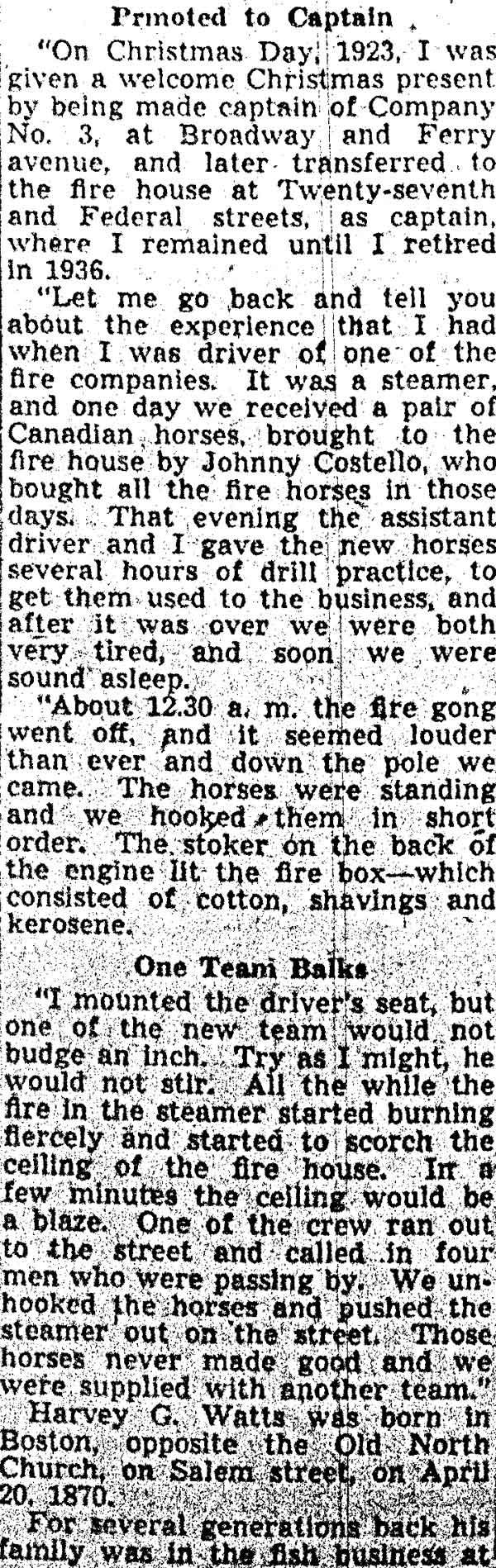
Promoted to Captain
“On Christmas Day, 1923, I was given a promotion, that of recently by being made captain of Company No. 3. I lived on Highland avenue, and later transferred to the fire house at Twenty-seventh and Federal Streets, where I remained until I retired in 1936.
“Let me go back and tell you about the experience that I had when I was turned out to fight the fire companies. It was a steamer. Those days we had three fine Canadian horses, brought to the fire house at North 27th Street. I bought all the fire horses in those days. That evening the assistant driver and I put those horses in several hours of drill practice, to get them in shape. The new team after it was over we were both very tired, and soon we were sound asleep.
“About 12:30 a.m. the fire gong went off. It was louder and clearer than ever and down the pole we came. The horses were standing there all lined up in perfect order. The stoker on the back of the apparatus, the material, which consisted of cotton, shavings and kerosene.
One Team Balks
“I mounted the driver’s seat, but one of the new team would not budge an inch — just planted and would not stir. All the while the fire in the steamer started burning fiercely and smoke filled up the ceiling of the fire house. In a few minutes we had reported for a blaze. One of the crew ran out of the street and called in four men who were standing. We unhooked the horses and pushed the steamer out. The two Canadian horses never made good and we were saddled with another team.”
Harvey, at 70, operates from his home in Boston, opposite the Old North Church in Salem street. Born Sept. 20, 1870.
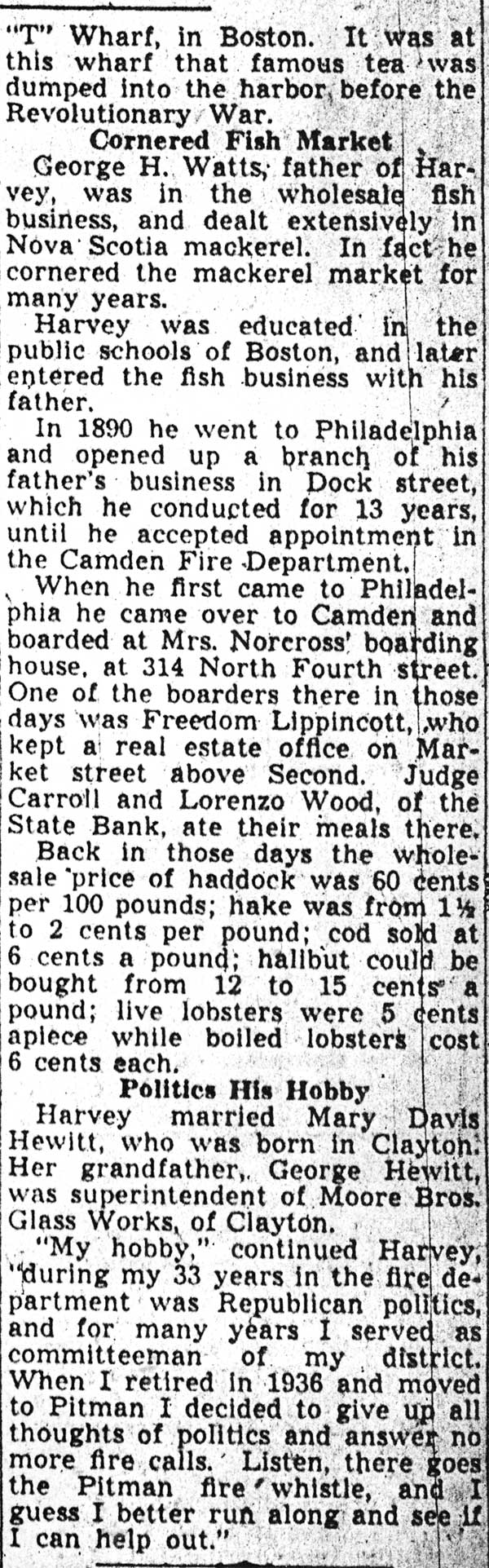
Cornered Fish Market
George H. Watts, father of Harvey, was in the wholesale fish business, and dealt extensively in Nova Scotia mackerel. In fact he cornered the mackerel market for many years.
Harvey was educated in the public schools of Boston, and later entered the fish business with his father.
In 1890 he went to Philadelphia and opened up a branch of his father’s business in Dock street, which he conducted for 13 years, until he accepted appointment in the Camden Fire Department.
When he first came to Philadelphia he came over to Camden and boarded at Mrs. Norcross’ boarding house, at 314 North Fourth street. One of the boarders there in those days was Freedom Lippincott, who kept a real estate office on Market street above Second. Judge Carroll and Lorenzo Wood, of the State Bank, ate their meals there.
Back in those days the wholesale price of haddock was 60 cents per 100 pounds; hake was from 1½ to 2 cents per pound; cod sold at 6 cents a pound; halibut could be bought from 12 to 15 cents a pound; live lobsters were 5 cents apiece while boiled lobsters cost 6 cents each.
Politics His Hobby
Harvey married Mary Davis Hewitt, who was born in Clayton. Her grandfather, George Hewitt, was superintendent of Moore Bros. Glass Works, of Clayton.
“My hobby,” continued Harvey; “during my 33 years in the fire department was Republican politics, and for many years I served as committeeman of my district. When I retired in 1936 and moved to Pitman I decided to give up all thoughts of politics and answer no more fire calls. ‘Listen, there goes the Pitman fire whistle, and I guess I better run along and see if I can help out.’”