Introduction
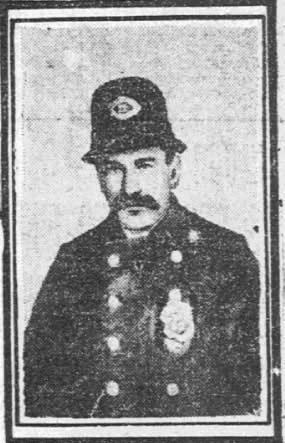
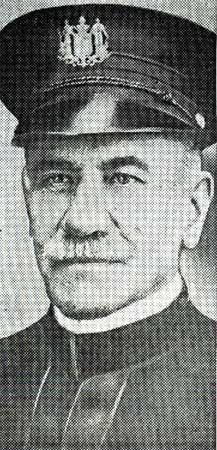
Ferdinand F. Sell
FERDINAND F. SELL was born around 1860 in New Jersey, one of six children born to German immigrant parents, Charles and Rosalie Sell. The Sell family resided at 435 Pine Street. Charles Sell was already living in Camden when the census was taken in 1860 and worked as a machinist. At the time of the 1880 Census, Ferdinand F. Sell’s occupation was listed as cigar maker, while sister Emma Sell worked in shoes. Younger brother J. Wesley Sell, then 15, was working as a bookbinder. Another sister, Anna, was then unemployed.
During the following decade, Ferdinand Sell and his younger brother J. Wesley followed the cigar maker’s trade, working for Frank Hartmann Sr. His father had passed away in 1887, and Ferdinand F. Sell, by now a cobbler, had married Margaret Isard Harris, the daughter of a sparmaker, George J. Harris, and moved, first to a house at 933 Newton Avenue and then to Sherman Avenue in Cramer Hill, then a part of Stockton Township. Brother J. Wesley Sell was still living at 435 Pine Street at the end of the decade, where he lived with his widowed mother, and the 1890–1891 Camden City Directory shows that he had changed his occupation to that of jeweler. Rosalie Sell passed away in 1898, and was buried next to her husband at Evergreen Cemetery.
On December 4, 1890 Ferdinand Sell became the founding vice-president of the North Cramer Hill Citizens Fire Company. Frank Hartmann Sr. was elected president and chief. This organization soon renamed itself Citizens Fire Company No. 1.
Both Ferdinand and J. Wesley Sell in this period also became interested and active in politics, as Republicans. J. Wesley Sell was elected Camden County Sheriff in 1899, and served a three year term, while Ferdinand Sell joined the Camden police force at about the same time. Stockton Township became a part of Camden in this time, and his appointment may have coincided with the merger.
Around 1915 daughter Ella Sell, named after her maternal grandmother Ella Isard, married George A. Wonfor, prominent Camden photographer. He was a widower with two young children; his first wife, the former Alice M. Colsey, was the niece of fellow Camden police officer Arthur Colsey.
At the time of the 1920 Census he was living with his wife Margaret and father-in-law George Harris at 2721 Sherman Avenue in the Cramer Hill section of Camden. Ferdinand Sell retired in 1923, after 24 years of service, with the rank of sergeant.
Margaret Sell died on February 15, 1927 at the age of 64. Ferdinand F. Sell later moved to the home of his daughter Ella and son-in-law George A. Wonfor. Mr. Sell passed away in October of 1936. After funeral services at the Roedel Funeral Home at 804 North 27th Street, a short walk from where he had lived most of his adult life, Ferdinand F. Sell was buried at Evergreen Cemetery in Camden, survived by his daughter and brother.
Bluecoats for East End
Camden Daily Courier —
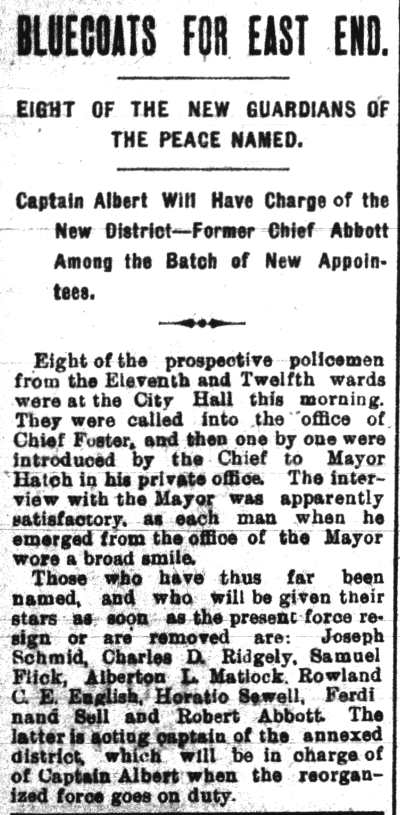
Eight of the New Guardians of the Peace Named.
Captain Albert Will Have Charge of the New District—Former Chief Abbott Among the Batch of New Appointees.
Eight of the prospective policemen from the Eleventh and Twelfth wards were at the City Hall this morning. They were called into the office of Chief Foster, and then one by one were introduced by the Chief to Mayor Hatch in his private office. The interview with the Mayor was apparently satisfactory, as each man when he emerged from the office of the Mayor wore a broad smile.
Those who have thus far been named, and who will be given their stars as soon as the present force resign or are removed are: Joseph Schmid, Charles D. Ridgely, Samuel Flick, Alberton L. Matlock, Rowland C. E. English, Horatio Sewell, Ferdinand Sell and Robert Abbott. The latter is acting captain of the annexed district, which will be in charge of Captain Albert when the reorganized force goes on duty.
Bandits Raid Camden
Philadelphia Inquirer —

ARMED DESPERADOES SWOOP DOWN ON EAST CAMDEN
First Hold Up Bridge Watchman, Compelling Him to Place Mask on Face of One of the Bandits
Battle With Policeman After Blowing Up Safe in Pavonia Station—Shoot at Tower Operator Who Telegraphs for Help
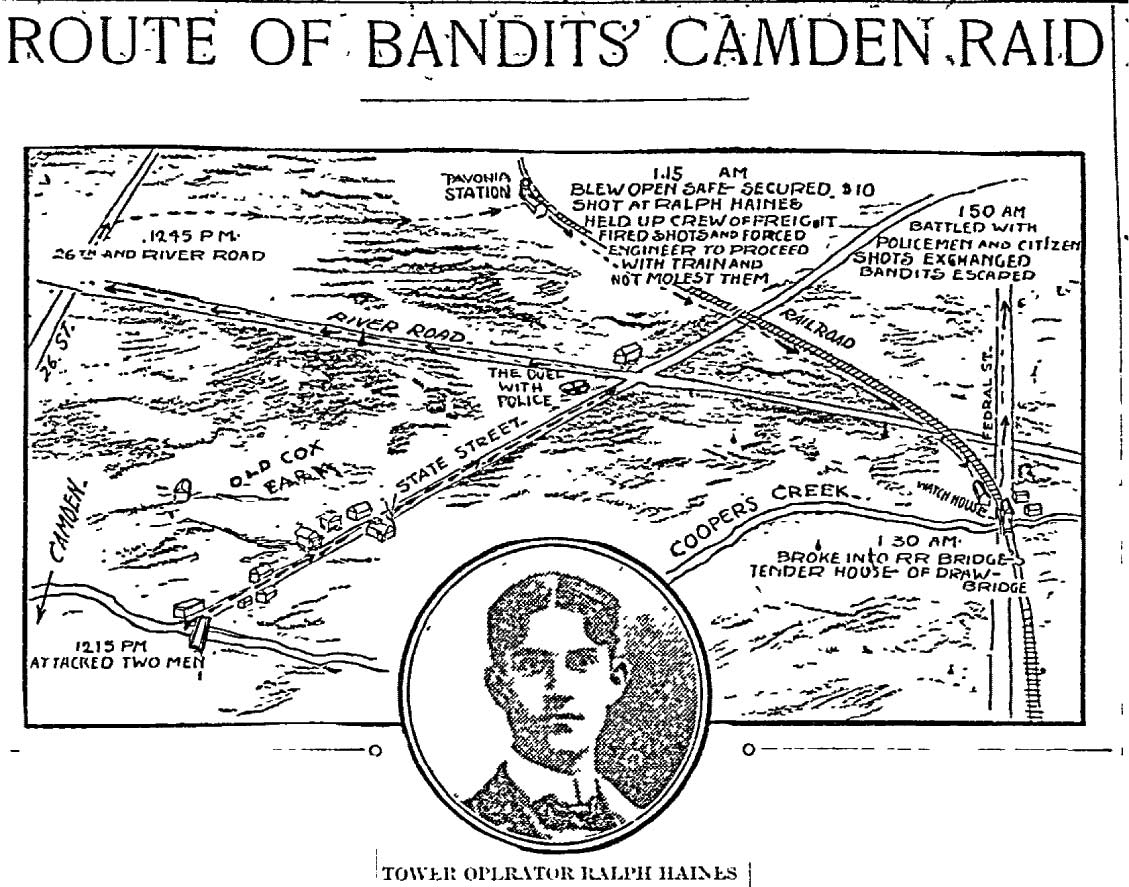
In true Wild West fashion five heavily armed desperadoes swooped down upon East Camden yesterday morning, and within two hours they had emptied their revolvers several times over, held up a bridge tender, cut telephone wires, blew up a safe, ordered a train crew to move on, perforated a tower house with bullets and finally made their escape. It was all done between 12.15 o’clock, when the bandits began operations at the State street bridge over Cooper Creek, and 1.50, when they gave final battle to policemen
and citizens out Federal street, and disappeared in the darkness.
Never in Camden county’s history was there such a bold intrusion. The bandits are supposed to be a part of the gang which murdered Operator Clendenen, near Jersey Shore, Pa., and which has been terrorizing railroad operators and tower men in all parts of Pennsylvania and New Jersey recently.
First Appearance
It was shortly after 12 o’clock when the bandits appeared at the State street bridge at Cooper’s Creek. David Loughead and Oscar Till, bridge tenders, had just prepared to retire for the night. Loughead left Till to go to a boat house nearby. He had been gone but a short time when Till heard voices in the rear of the bridge house.
Bridgeman Till observed several men standing at the end of the bridge, and believing that they anticipated attacking him he locked the doors and laid his revolver on the bunk. Suddenly the door was forced open and in tumbled five men. Four of the bandits were masked. Instantly the frightened bridge tender was looking into the barrels of five revolvers.
“I surrender,” said Till.
“That’s all right, old pal,” replied one of the robbers, “but we want your money. You see we are a little short of funds, and it’s getting along about Christmas time.”
Masked by Their Victim
The men were about to go through Till’s pockets when the unmasked bandit said: “Hold up, I want my face covered and I want Mr. Bridgetender to do it.” Till complied. While a revolver was held at each temple Till took out his handkerchief and attempted to tie it about the robber’s face. He got the handkerchief over the fellow’s eyes. When ordered to try again he adjusted it to the satisfaction of the bandit, who expressed regret that the visit was causing the bridgetender so much trouble. The man Till masked went through his pockets. He failed to find any money, as Till had hidden what bills he had early in the night.
Ordered to Bed
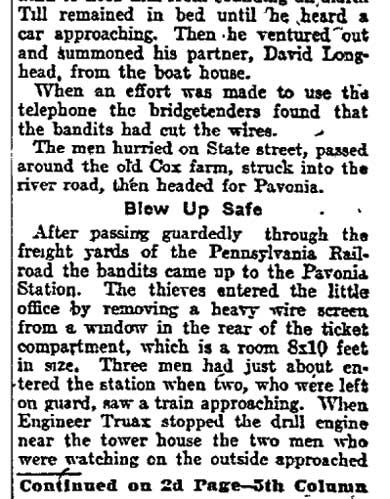
Till was ordered to bed, and after he lay down on his back the bandits covered him over completely and cautioned him not to move under penalty of death. The desperadoes then disappeared. Fearing that one of the gang had remained behind to keep him from sounding an alarm, Till remained in bed until he heard a car approaching. Then he ventured out and summoned his partner, David Loughead, from the boat house.
When an effort was made to use the telephone the bridgetenders found that the bandits had cut the wires.
The men hurried on State street, passed around the old Cox farm, struck into the river road, then headed for Pavonia.
Blew Up Safe
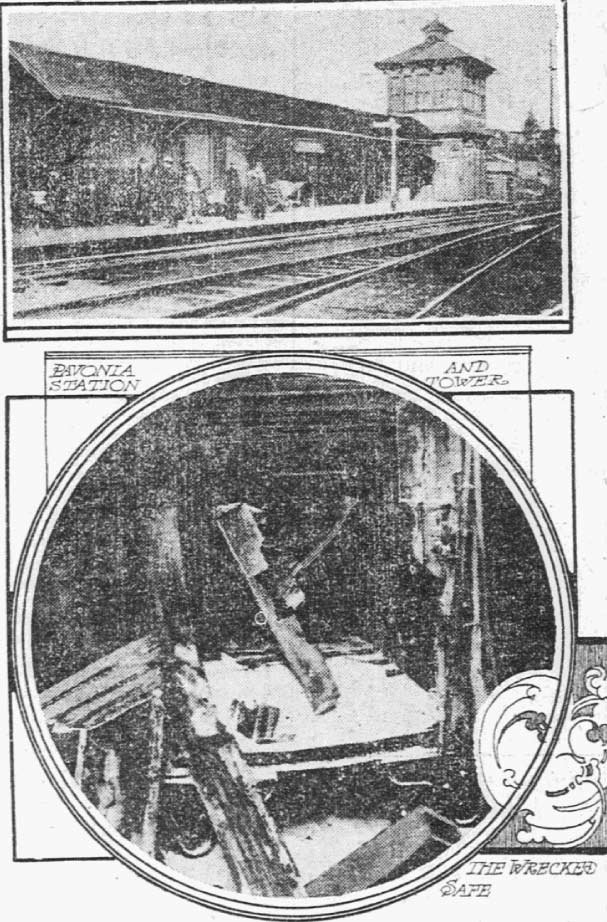
After passing guardedly through the freight yards of the Pennsylvania Railroad the bandits came up to the Pavonia Station. The thieves entered the little office by removing a heavy wire screen from a window in the rear of the ticket compartment, which is a room 8x10 feet in size. Three men had just about entered the station when two, who were left on guard, saw a train approaching. When Engineer Truax stopped the drill engine near the tower house the two men who were watching on the outside approached
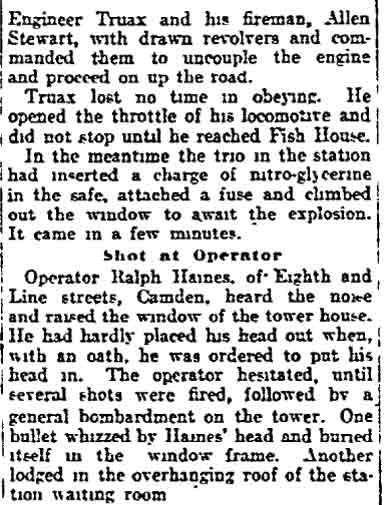
Engineer Truax and his fireman, Allen Stewart, with drawn revolvers and commanded them to uncouple the engine and proceed on up the road.
Truax lost no time in obeying. He opened the throttle of his locomotive and did not stop until he reached Fish House.
In the meantime the trio in the station had inserted a charge of nitro-glycerine in the safe, attached a fuse and climbed out the window to await the explosion. It came in a few minutes.
Shot at Operator
Operator Ralph Haines, of Eighth and Line streets, Camden, heard the noise and raised the window of the tower house. He had hardly placed his head out when, with an oath, he was ordered to put his head in. The operator hesitated, until several shots were fired, followed by a general bombardment on the tower. One bullet whizzed by Haines’ head and buried itself in the window frame. Another lodged in the overhanging roof of the station waiting room.
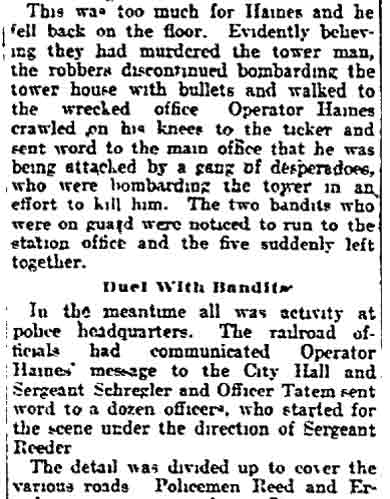
This was too much for Haines and he fell back on the floor. Evidently believing they had murdered the tower man, the robbers discontinued bombarding the tower house with bullets and walked to the wrecked office. Operator Haines crawled on his knees to the ticker and sent word to the main office that he was being attacked by a gang of desperadoes, who were bombarding the tower in an effort to kill him. The two bandits who were on guard were noticed to run to the station office and the five suddenly left together.
Duel With Bandits
In the meantime all was activity at police headquarters. The railroad officials had communicated Operator Haines’ message to the City Hall and Sergeant Schregler and Officer Tatem sent word to a dozen officers, who started for the scene under the direction of Sergeant Reeder.
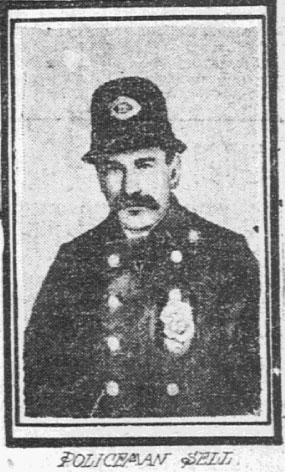
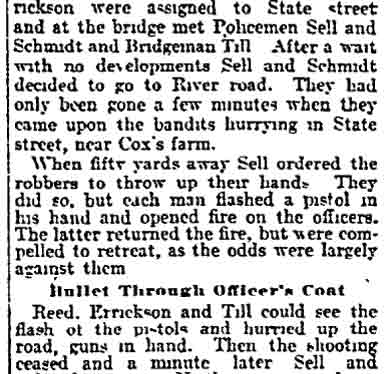
The detail was divided up to cover the various roads. Policemen Thomas Reed and Errickson were assigned to State street and at the bridge met Policemen Sell and Schmidt and Bridgeman Till. After a wait with no developments Sell and Schmidt decided to go to River road. They had only been gone a few minutes when they came upon the bandits hurrying in State street, near Cox’s farm.
When fifty yards away Sell ordered the robbers to throw up their hands. They did so, but each man flashed a pistol in his hand and opened fire on the officers. The latter returned the fire, but were compelled to retreat, as the odds were largely against them.
Bullet Through Officer’s Coat
Reed, Errickson and Till could see the flash of the pistols and hurried up the road, guns in hand. Then the shooting ceased and a minute later Sell and
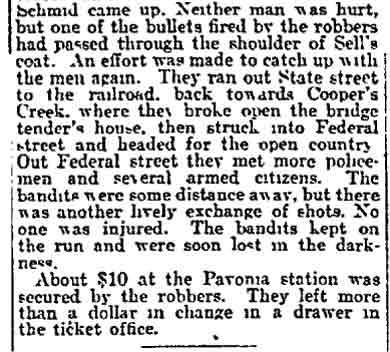
Schmidt came up. Neither man was hurt, but one of the bullets fired by the robbers had passed through the shoulder of Sell’s coat. An effort was made to catch up with the men again. They ran out State street to the railroad, back towards Cooper’s Creek, where they broke open the bridge tender’s house, then struck into Federal street and headed for the open country. Out Federal street they met more policemen and several armed citizens. The bandits were some distance away, but there was another lively exchange of shots. No one was injured. The bandits kept on the run and were soon lost in the darkness.
About $10 at the Pavonia station was secured by the robbers. They left more than a dollar in change in a drawer in the ticket office.
Ferdinand F. Sell
Camden Courier-Post —
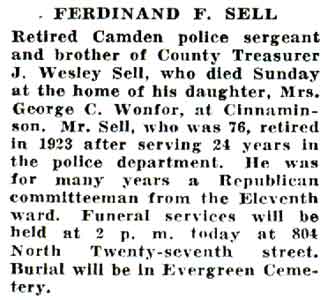
Retired Camden police sergeant and brother of County Treasurer J. Wesley Sell, who died Sunday at the home of his daughter, Mrs. George C. Wonfor, at Cinnaminson. Mr. Sell, who was 76, retired in 1923 after serving 24 years in the police department. He was for many years a Republican committeeman from the Eleventh ward. Funeral services will be held at 2 p. m. today at 804 North Twenty-seventh street. Burial will be in Evergreen Cemetery.