Introduction
Diamond Cottage Park may well have been the first real city park in Camden. The park was the favorite haunt of boys and girls from North and Central Camden from the 1880s until the early 1920s, when the park was paved over to make room for the Delaware River (Ben Franklin) Bridge.
Diamond Cottage Grove
Philadelphia Inquirer —

Temperance.
At three o’clock yesterday afternoon an open-air meeting of temperance workers was held in the grove, at Diamond Cottage, Camden, which was well attended, and several speakers addressed the audience. The usual Sunday morning breakfast was given at the Reformed Men’s Home, Second and Kaighn’s avenue, and an address was delivered by T. C. Newman in the afternoon.
Over in Camden
Philadelphia Inquirer —
The Street Committee of City Council made a tour of the streets yesterday to ascertain what improvements would be necessary during the coming fiscal year.
A strawberry festival will be given in the lawn of the Camden Republican Club headquarters to-morrow evening for the benefit of the Newsboys’ Parlor.
In trying to capture a swarm of bees in a tree at Linden Street, Dr. Warren Reets, of 820 Linden Street, fell thirty feet and was seriously injured.
Frank Albertz, of Fish House, fell from a wagon in Federal Street yesterday and was badly cut about the head. He was taken to Cooper Hospital.
A stranger in jumping from an incoming boat from a Philadelphia steamer yesterday miscalculated the distance and fell between the boat and slip, narrowly escaping being crushed to death.
At annual meeting of the Camden County Homeopathic Medical Society these officers were elected: President, Dr. S. H. Quint; vice-president, Dr. Willis H. Hunt; secretary and treasurer, Dr. A. L. Ironside; reporter, Dr. Wallace McGeorge.
Location
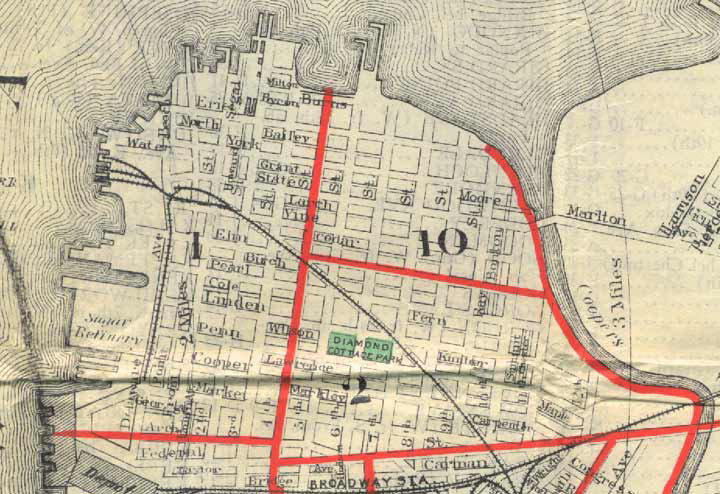
Diamond Cottage Park was located between Broadway and 7th Street and between Penn and Linden Streets. Since 1926, that has been the location of the Bridge Plaza.
Memories of Diamond Cottage Grove
Camden Courier —
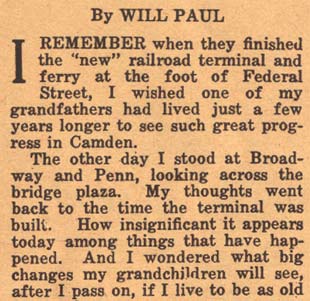
In 1926, Will Paul wrote this article for a special Sesquicentennial Exhibition section published by the Camden Courier on July 5th. Many of the boys who played there and who are mentioned in the article below went on to be leading citizens of Camden, including Volney Bennett, Martin Bergen, and Albert C. Middleton. Other leading citizens of the time mentioned are Dr. E.A.Y. Schellenger Sr., Cooper B. Hatch, and General William Joyce Sewell. Read on for a peek into a bygone era rarely seen or heard of today.

By WILL PAUL
I REMEMBER when they finished the “new” railroad terminal and ferry at the foot of Federal Street, I wished one of my grandfathers had lived just a few years longer to see such great progress in Camden.
The other day I stood at Broadway and Penn, looking across the bridge plaza. My thoughts went back to the time the terminal was built. How insignificant it appears today among things that have happened. And I wondered what big changes my grandchildren will see, after I pass on, if I live to be as old as grandpa.
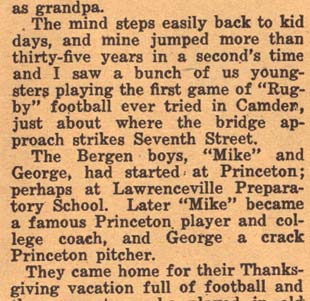
The mind steps easily back to kid days, and mine jumped more than thirty-five years in a second’s time and I saw a bunch of us youngsters playing the first game of “Rugby” football ever tried in Camden, just about where the bridge approach strikes Seventh Street.
The Bergen boys, “Mike” and George, had started at Princeton; perhaps at Lawrenceville Preparatory School. Later “Mike” became a famous Princeton player and college coach, and George a crack Princeton pitcher.
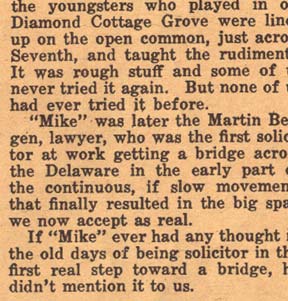
They came home for their Thanksgiving vacation full of football and the youngsters who played in Diamond Cottage Grove were lined up on the open common, just across Seventh, and taught the rudiments. It was rough stuff and some of them never tried it again. But none of us had ever tried it before.
“Mike” was later the Martin Bergen, lawyer, who was the first solicitor at work getting a bridge across the Delaware in the early part of the continuous, if slow movement, that finally resulted in the big span we now accept as real. If “Mike” ever had any thought in the old days of being solicitor in the first real step toward a bridge, he didn’t mention it to us.
Leading Citizens Today
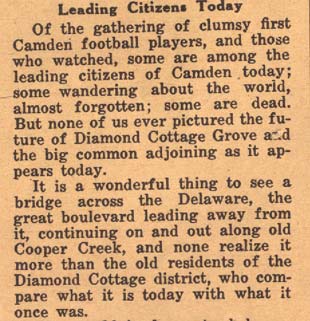
Of the gathering of clumsy first Camden football players, and those who watched, some are among the leading citizens of Camden today; some wandering about the world, almost forgotten; some are dead. But none of us ever pictured the future of Diamond Cottage Grove and the big common adjoining as it appears today.
It is a wonderful thing to see a bridge across the Delaware, the great boulevard leading away from it, continuing on and out along old Cooper Creek, and none realize it more than the old residents of the Diamond Cottage district, who compare what it is today with what it once was.
We wouldn’t have traded our shady grove of old oaks for the bridge and boulevard in those days. It would have meant giving up the ideal playground of the whole city. We wouldn’t have had the old Undine ball club with “Doc” Schellinger, catcher; “Billy” Eyre, pitcher; “Monk” Nicely, Andy Donohue, “Big Dog” Iszard, “Skinny” Avis, the Bergen boys and others I no longer recall, as its players.
Bob Sewell, who rose high in the army, a son of the late general, political leader and railroad official, played out there in the grove with us. Bert Middleton, first partner of Eldridge Johnson in the manufacture of talking machines, was one of our democratic gang.
Certainly Bert never mentioned a dream that included the great collection of buildings now owned and operated by the Victor Talking Machine Company, nor that he anticipated taking a million or more as his share, and retiring from active business life at fifty. Certainly he had no idea of heading the present port commission when he used to skate with us upon the river just above where the bridge crosses.
Volney Bennett’s Curls
Volney Bennett had a flock of freckles in those days and his brother, Al, former mayor of Merchantville, now in China, was a kid with long yellow curls. They say Volney had curls at one time, but I don’t remember them.
Volney hadn’t even heard of anything like the South Jersey Exposition, let alone being its president. If he had mentioned the ambition of being mayor we would have kidded the life out of him, and Bill Fagen would have chased him in his front gate as he often did when any of us younger kids got a little “cockey.”
President and ex-Mayor Bennett, I remember, did aspire to be an officer in a pioneer corps we formed to march in a Republican parade. He lost the chance for a “commission” because someone suspected his father of having a Democratic leaning that year. I didn’t join because my grandfather wouldn’t give me the twenty-five cents initiation fee and he also forbade me to march because he was a dyed-in-the-wool Democrat.
Carl de la Cour’s pony ran about the grove and we all had a ride on its back when “Del” felt generous. We skated in the grove in a hollow that filled with rain water and froze over. We gathered acorns, wonderful big ones and short stubby ones, that fell from the tall oaks.
There were tragedies in the grove as well as pleasures. I recall the day Norman Stewart, the one who broke Captain Barnard’s window with a snowball, tempted me, then nine, to stay from school one pleasant morning. We see-sawed on a plank in the old grove and I fell off into some spoiled fish dumped from a nearby kitchen. I had to hurry home and confess to having “bagged it.”
I remember the day my brand new ball rolled under the fence of the late Cooper B. Hatch — the same fence I chalked, for which I was “pinched” by George Horner, and threatened with a strapping by the late Mayor Hatch before being released. Tommy McGann volunteered to climb over and get the ball. I didn’t see Tommy again for a month and never got the ball.
Some Memorable Fights
Tommy was one of the scrappers who never got licked until Bill Fagen did it one day just to decide who was the best fighter in Diamond Cottage Grove. That fight came off just about the center of the bridge approach at Seventh Street.
With the exception of “Wes” and Harry Orcutt, they were probably the best scrappers of their class, from 15 to 17 years. They proved it one winter when we had a city-wide snow ball battle. One gang went against another until North Camden combined against South Camden, after Middle Camden had battled with Cooper Point. Bricks and clubs succeeded snowballs before the cops stopped the battle.
There was “vice” in the old grove, too. I recall some of the older boys playing euchre for pennies while I watched, my Trinity Baptist Sunday School training telling me all the time I should remain in that tainted atmosphere.
They all threw their clothing in some place under the old boat-house wharves adjoining old Market Street landing, and swam around in the slime at high tide. They all crowded around the corner candy case, and afterward, one supplying the nickel and others acting as if they owned it, one or two were not above “snitching” an extra stick while the druggist was busy at the fountain.
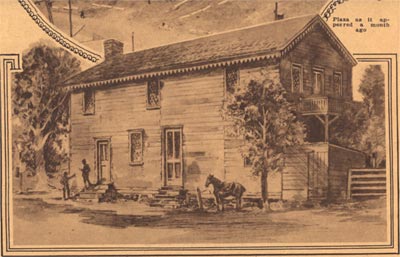
They all went for a job, after the bridge, or a hotel at Broadway and Penn was built; some are today living in an advanced age in which people play on the same lots they played on the lots at Sixth and Penn, before the brickyard was operating there, and “Indian Dick” Heyl could always be found in the old cottage of a Linden Street house.
And before the Presbyterian Church was built, a race track occupied the land all the way to Fourth Street, they heard.
We live in troubled times — we heard much of the past when Diamond Cottage Grove was a beautiful park with beer and merry-go-rounds. We hear nothing like that talked of in our day, but things were never as peaceful as they now are. It was used for gospel services and prohibition talks. Billy Sunday and others talked of the future Prohibition. It didn’t arrive that way.
When Howard M. Cooper had his shooting match, it was an event that marked the beginning of the end of Diamond Cottage Grove as a park and a playground. Our gang was the last to use it as a grove, and these are its took remnants. This article takes back memories for one of the old North Camden boys who looks at the bridge approach today. — Will Paul
Bridge Plaza Construction — c. 1925
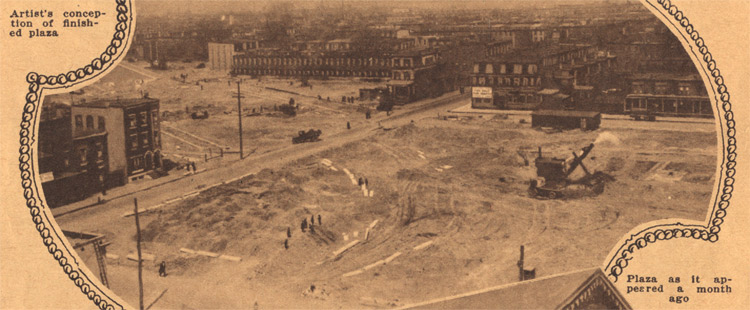
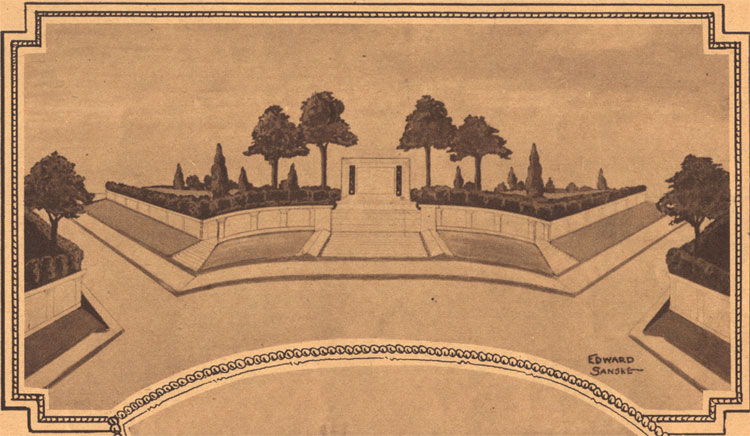
Construction of the Bridge Plaza, about 1925, on the site of the former Diamond Cottage Park. The intersection at top is North 6th & Linden Street. Artist’s conception of the finished plaza (right).