William A. Butcher
William A. Butcher was born around 1844 in Pennsylvania. He was the son of a shoemaker, Samuel C. Butcher and his wife Jane. The family, which included older sister Elizabeth, older brothers Samuel and Joseph, and a younger brother, Francis, had moved to South Jersey and was living in Woolwich Township when the census was taken in 1850.
The Butcher family had moved to South Camden by the time the Census was taken in 1860. Sadly, Francis had passed away. William A. Butcher followed his father and older brothers into the shoe trade. The Samuel Butcher family appears in City Directories at 509 Walnut Street from 1863 through 1869, maintaining a presence in the 500 block of Walnut Street for a few years thereafter.
William A. Butcher was enlisted as a Private into Company F, 4th New Jersey Infantry on February 5, 1864. He mustered out on July 9, 1865. When he joined the 4th New Jersey it was encamped for the winter at Brandy Station. Going into action in May, the 4th New Jersey took part in the Battles of the Wilderness from May 5 to May 7, Spotsylvania from May 8 to May 12, and at Spotsylvania Courthouse from May 12 to May 21, engaging in the assault on the Salient, the “Bloody Angle.” From May 23 to May 26 the 4th New Jersey was at the North Anna River, and was on line of the Pamunkey from May 26 to May 28. The regiment finished the month at Totopotomoy.
June of 1864 saw the 4th New Jersey engaged at Cold Harbor, Petersburg, and on the Jerusalem Plank Road. The regiment was shifted to Washington, D.C. On July 11 and 12, the 4th New Jersey was among the units that repulsed Confederate General Early’s attack on Fort Stevens and the Northern Defenses of Washington, and took part in the pursuit of Early to Snicker’s Gap in mid-July. After a rest and refit, the 4th New Jersey was part of General Sheridan’s command during the Shenandoah Valley Campaign, which lasted from August 7 well into November, engaging at Strasburg, Cedar Creek, Winchester, Charlestown, again at Winchester on September 19, and at Fisher’s Hill afterwards. On October 19, the 4th New Jersey was on hand for the Battle of Cedar Creek. The regiment continued to serve in the Shenandoah Valley into December, before moving to Washington, D.C., then to Petersburg, Va. and the Siege of Petersburg.
While on leave, William A. Butcher married Amanda Hatfield at Tabernacle Methodist Episcopal Church on February 8, 1865.
Going back into service in 1865, the 4th New Jersey Infantry took part in the Appomattox Campaign, and was at Petersburg when it fell on April 2. The next seven days were spent in pursuit of General Lee and his Confederate Army, which surrendered on April 9 at Appomattox Court House. The regiment marched to Danville on April 3 through April 27. On May 18 the unit moved to Richmond, Virginia. The 4th New Jersey took part in the June 8, 1865 Corps Review, then mustered out at Hall’s Hill, Virginia. Private Butcher then returned to Camden.
The 1869 Directory reveals that William Butcher was living at 508 William Street. The 1870 Directory has him at 512 Walnut Street. The 1872 Directory has William A. Butcher at 1117 Broadway. The 1876 City Directory lists William A. Butcher at 1242 South 4th Street. His parents, sister Elizabeth and brother Joseph lived across the street at 1239 South 4th Street, along with a nephew and a niece.
The 1877 Directory shows him at 482 Liberty Street. In that year William A. Butcher established a shoe manufacturing business. The 1878 City Directory shows a residential address of 1323 Broadway. By 1883 William A. Butcher was using 1325 Broadway as a shoe factory and 1323 Broadway as a residence.
City Directories from 1887 through 1891 show home at 1325 Broadway and give a street address of 451 Mechanic Street for the shoe factory. The 1891 Sanborn Map gives an address of 459 Mechanic Street, and does not show the buildings that were later erected on Butcher’s Alley, which ran east from Broadway between Liberty and Mechanic Streets. A large two-story building used for leather storage, shoe fitting, and shoe storage was built on the south side of the alley, on a parcel of land behind 443 to 465 Mechanic Street. A small frame building was built on the north side of the alley, behind 466 & 468 Liberty Street. Two small dwellings were built at the rear of the factory, which later carried the addresses of 465 and 467 Butcher’s Alley.
The 1894 Directory and subsequent editions show the factory at 467 Mechanic Street. William A. Butcher’s shoe factory employed 40 people in 1901, according to the Industrial Directory of New Jersey, published that year.
William A. Butcher died at his home, 1325 Broadway, on February 8, 1915 and was buried at Evergreen Cemetery in Camden. His wife, Amanda Hatfield Butcher, died in Philadelphia on December 23, 1915 and rests next to her husband.
William A. Butcher was a member of the William B. Hatch Post No. 37 of the G.A.R.; the Lenni Lenape Tribe of the Improved Order of Red Men; Ionic Lodge No. 94, Free & Accepted Masons; and other fraternal organizations.
By 1961 all of William A. Butcher’s buildings were gone except for the two dwellings on Butcher’s Alley. In the early 1990s the City of Camden built their new firehouse, Liberty Station, which took the land from 459 to 465 Mechanic Street, 465 and 467 Butcher’s Alley, 450 to 468 Liberty Street, and 1301 to 1325 Broadway. Traces of the foundation of the building on the north side of Butcher’s Alley can still be observed in 2014.
Butcher's Alley — Sanborn Maps
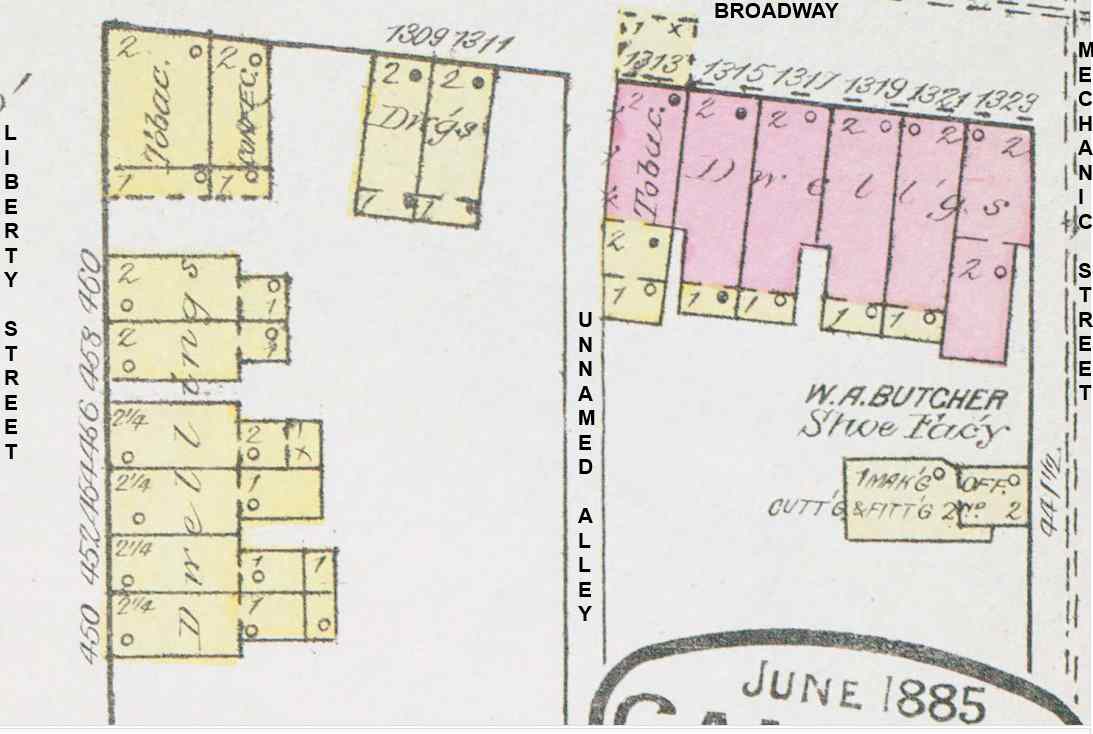
Sanborn Map, 1885
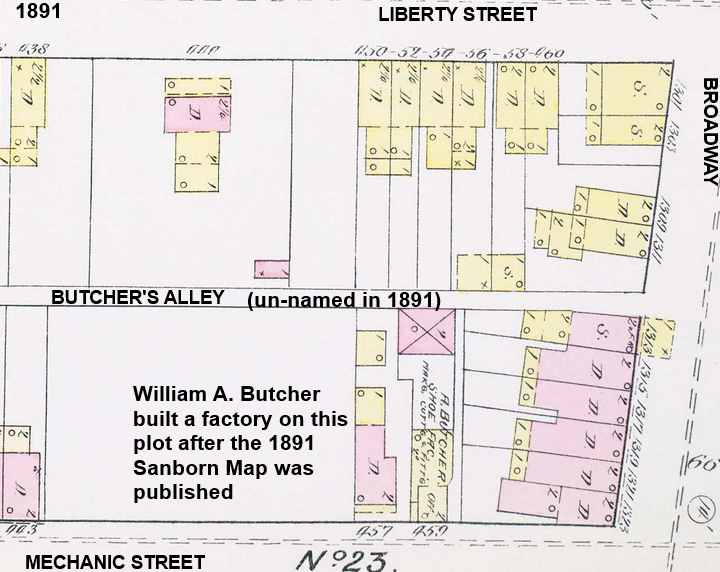
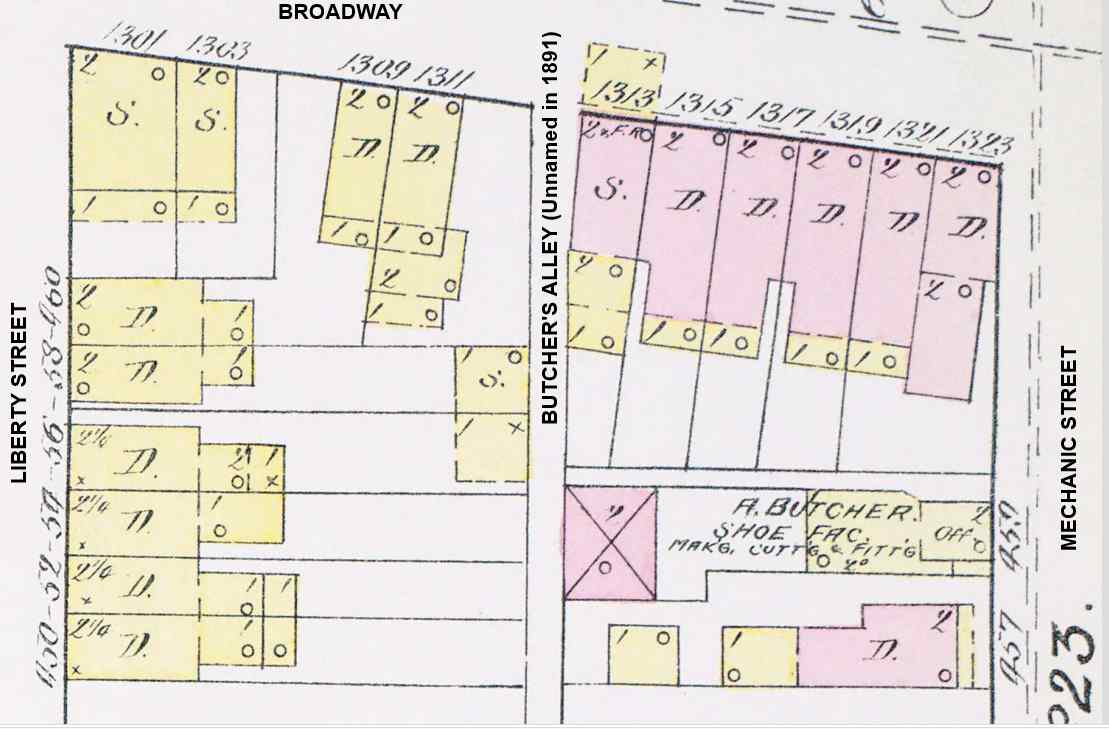
Sanborn Map, 1891
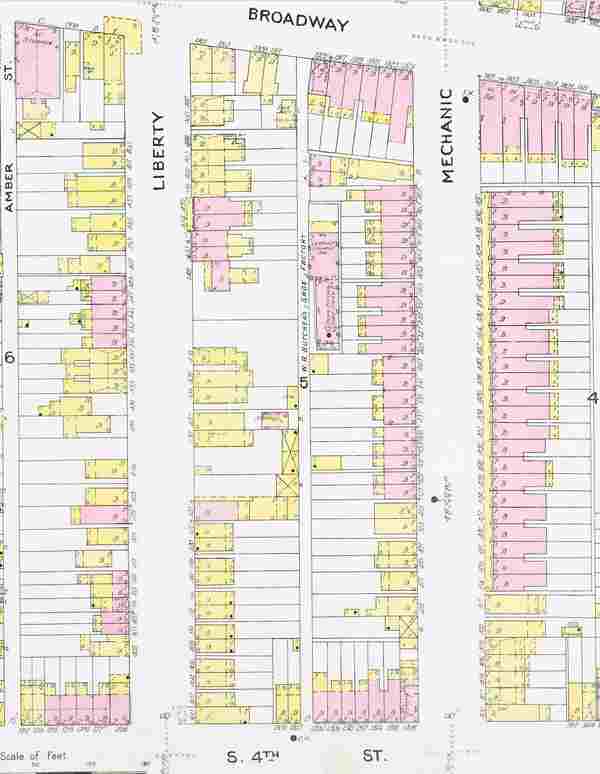
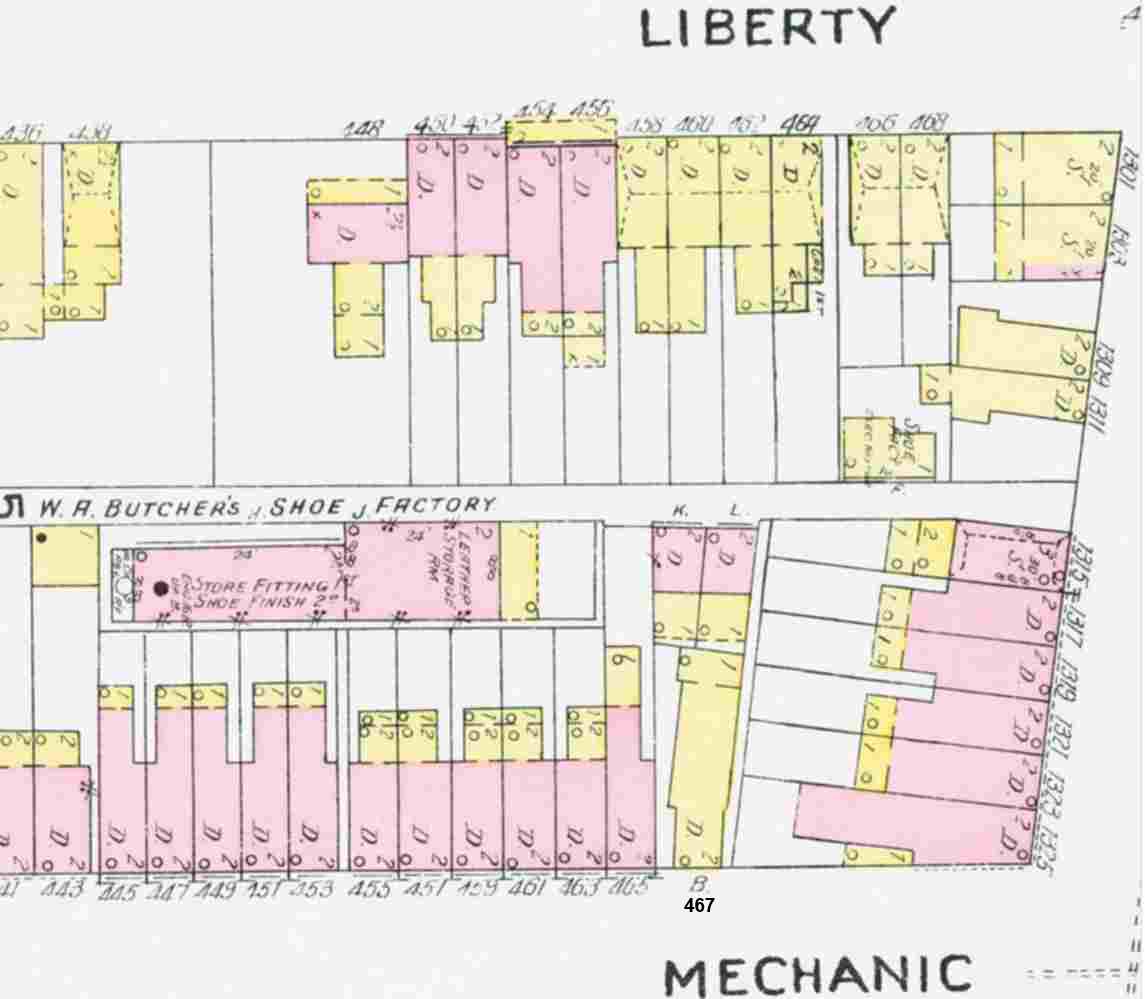
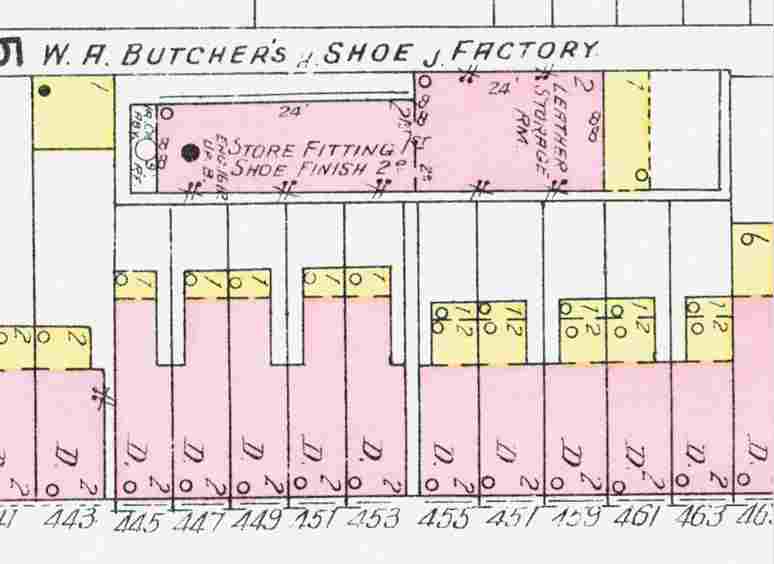
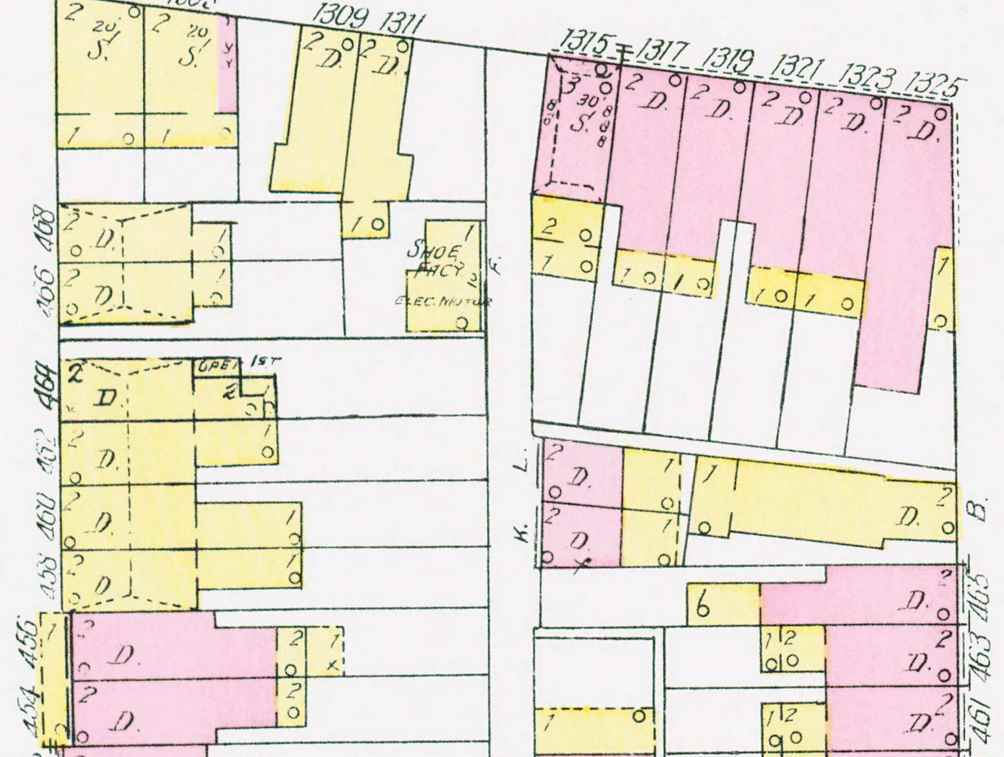
Sanborn Map, 1906. At some point between 1891 and 1906, William A. Butcher built a new factory on Butcher’s Alley and razed and rebuilt his old plant. Homes were built on Mechanic Street and the two lots that had existing structures were renumbered, with 457 becoming 465 and 459 becoming 467 Mechanic Street.
Judge Made This Grand Jury Sit Up
Philadelphia Inquirer —
Tells of What May Be Expected of Violations of Corrupt Practices Act
Of special significance was the charge made yesterday by Supreme Court Justice Garrison to the grand jury summoned in Camden for the September term of court. It was a dilation upon the new corrupt practices act, and in view of the somewhat turbulent state of politics, both with respect to the Republican and Democratic camps, the declarations made by the court were taken as warnings of what may transpire in the event of violations.
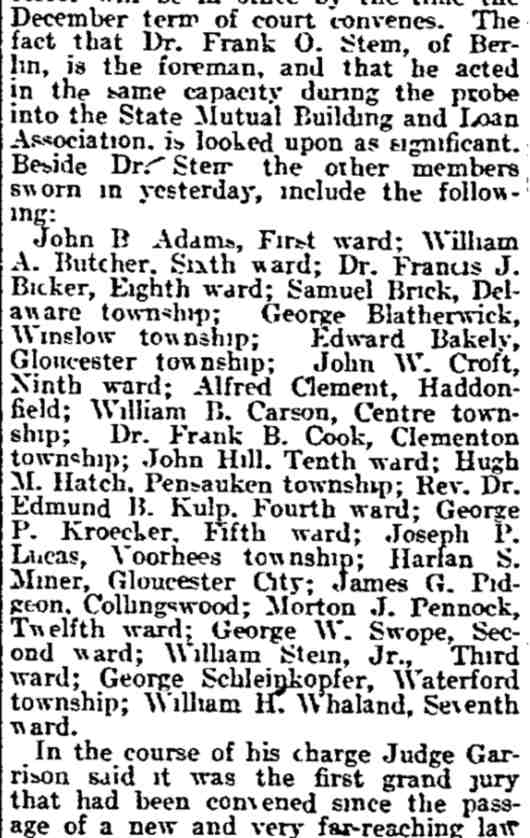
Quite as much interest centred about the personnel of the grand inquisitorial body as with respect to Judge Garrison’s charge. This is the last grand jury Sheriff Hatch will draw, as his successor will be in place by the time the December term of court convenes. The fact that Dr. Frank O. Stem, of Berlin, is the foreman, and that he acted in the same capacity during the probe into the State Mutual Building and Loan Association, is looked upon as significant. Beside Dr. Stem the other members sworn in yesterday, include the following:
John B. Adams, First ward; William A. Butcher, Sixth ward; Dr. Francis J. Bicker, Eighth ward; Samuel Brick, Delaware township; George Blatherwick, Winslow township; Edward Bakely, Gloucester township; John W. Croft, Ninth ward; Alfred Clement, Haddonfield; William B. Carson, Centre township; Dr. Frank B. Cook, Clementon township; John Hill, Tenth ward; Hugh M. Hatch, Pennsauken township; Rev. Dr. Edmund B. Kulp, Fourth ward; George P. Kroecker, Fifth ward; Joseph P. Lucas, Voorhees township; Harlan S. Miner, Gloucester City; James G. Pidgeon, Collingswood; Morton J. Pennock, Twelfth ward; George W. Swope, Second ward; William Stein, Jr., Third ward; George Schleinkopfer, Waterford township; William H. Whaland, Seventh ward.
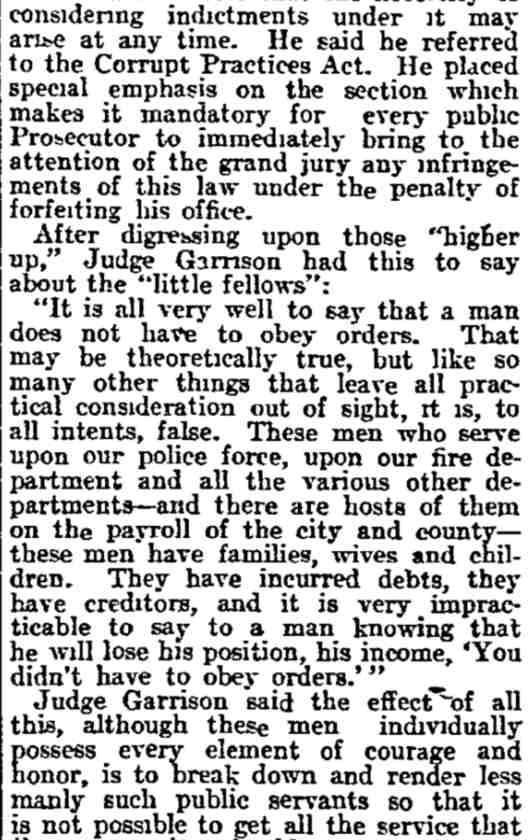
In the course of his charge Judge Garrison said it was the first grand jury that had been convened since the passage of a new and very far-reaching law considering indictments under it may arise at any time. He said he referred to the Corrupt Practices Act. He placed special emphasis on the section which makes it mandatory for every public Prosecutor to immediately bring to the attention of the grand jury any infringements of this law under the penalty of forfeiting his office.
After digressing upon those “higher up,” Judge Garrison had this to say about the “little fellows”:
“It is all very well to say that a man does not have to obey orders. That may be theoretically true, but like so many other things that leave all practical consideration out of sight, it is, to all intents, false. These men who serve upon our police force, upon our fire department and all the various other departments—and there are hosts of them on the payroll of the city and county—these men have families, wives and children. They have incurred debts, they have creditors, and it is very impracticable to say to a man knowing that he will lose his position, his income, ‘You didn’t have to obey orders.’”
Judge Garrison said the effect of all this, although these men individually possess every element of courage and honor, is to break down and render less manly such public servants so that it is not possible to get all the service that [the next line or lines are cut off between crops 03b and 04b]
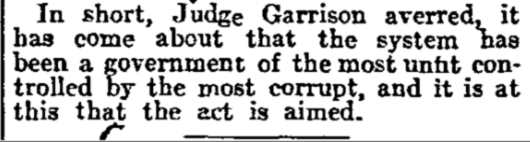
In short, Judge Garrison averred, it has come about that the system has been a government of the most unfit controlled by the most corrupt, and it is at this that the act is aimed.
Death Stops Celebration
Philadelphia Inquirer —
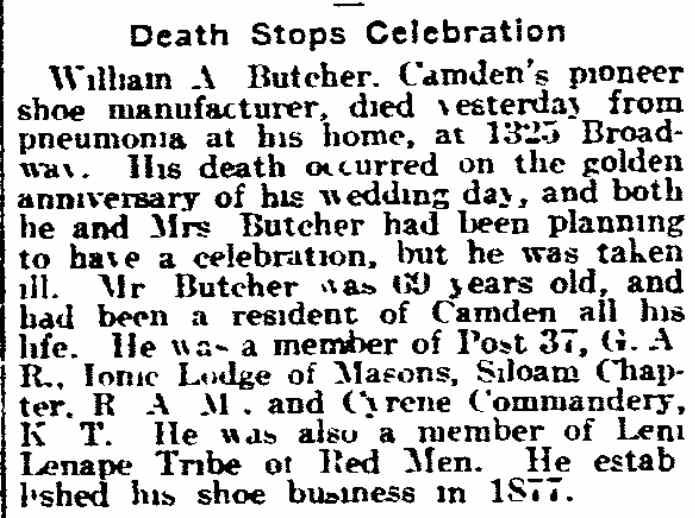
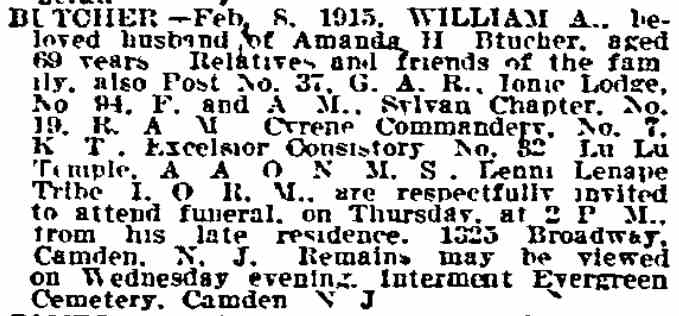
William A. Butcher, Camden’s pioneer shoe manufacturer, died yesterday from pneumonia at his home, at 1325 Broadway. His death occurred on the golden anniversary of his wedding day, and both he and Mrs. Butcher had been planning to have a celebration, but he was taken ill. Mr. Butcher was 69 years old, and had been a resident of Camden all his life. He was a member of Post 37, G. A. R., Ionic Lodge of Masons, Siloam Chapter, R. A. M., and Cyrene Commandery, K. T. He was also a member of Lenni Lenape Tribe of Red Men. He established his shoe business in 1877.
BUTCHER—Feb. 8, 1915. WILLIAM A., beloved husband of Amanda H. Butcher, aged 69 years. Relatives and friends of the family, also Post No. 37, G. A. R., Ionic Lodge, No. 94, F. and A. M., Sylvan Chapter, No. 19, R. A. M., Cyrene Commandery, No. 7, K. T., Excelsior Consistory No. 82, Lu Lu Temple, A. A. O. N. M. S., Lenni Lenape Tribe, I. O. R. M., are respectfully invited to attend funeral, on Thursday, at 2 P. M., from his late residence, 1325 Broadway, Camden, N. J. Remains may be viewed on Wednesday evening. Interment Evergreen Cemetery, Camden N. J.
Butcher — Death Notice
Philadelphia Inquirer —
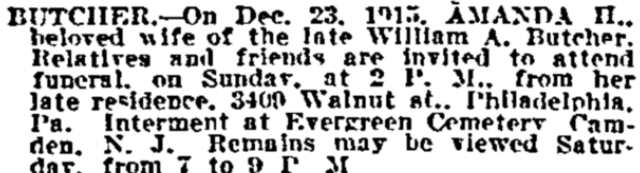
BUTCHER.—On Dec. 23, 1915, AMANDA H., beloved wife of the late William A. Butcher. Relatives and friends are invited to attend funeral, on Sunday, at 2 P. M., from her late residence, 3400 Walnut st., Philadelphia, Pa. Interment at Evergreen Cemetery, Camden, N. J. Remains may be viewed Saturday, from 7 to 9 P. M.
William B. Hatch Post No. 37, G.A.R.
The following is derived from George Reeser Prowell’s History of Camden County, N.J., published in 1886.
WILLIAM B. HATCH POST No. 37, of Camden, was instituted and chartered November 25, 1879, with eighty-one members and the following named Post officers: Post Commander, John E. Grubb; Senior Vice-Commander, Richard J. Robinson; Junior Vice-Commander, Daniel J. Fullen; Surgeon, Thomas G. Rowand, M.D.; Chaplain, John Quick; Officer of the Day, John A. Dall; Officer of the Guard, Edmund G. Jackson, Jr.; Quartermaster, Christopher J. Mines, Jr.; Adjutant, Benjamin J. Pierce; Sergeant-Major, William A. Tattern; Quartermaster-Sergeant, William B. E. Miller.
At the first meeting of the Post it was decided by a unanimous vote to name it in honor of the late Colonel William B. Hatch, of the Fourth Regiment. When Mrs. C. Hatch, the mother of the colonel was informed that the post had honored the memory of her son by naming it after him, she sent to the Post the following response:
Camden N. J., November 26th, 1879
John E. Grubb, Post Commander
Dear Sir,
It will afford me much pleasure to be identified with Post 37, G. A. R., named in honor of my son, William B. Hatch, by allowing me to present to the same its colors. The memory of my son is ever dear to me, and, while at the same moment I may have thought the sacrifice too great an affliction, yet I was consoled by the fact that I gave him up that this Union might be preserved. It was duty and patriotism that called him, and while I mourn him as a mother for a well-beloved son, yet I would not have stayed him, for the love of country and the upholding of this glorious Republic is what every mother should instill into her sons, as the purest and holiest spirit.
Yours truly,
C. Hatch
The following is a complete roster of this post for 1886:
Post Commander, Benjamin H. Connelly; Senior Vice-Commander, Adam C. Smith; Junior Vice-Commander, William Haegele; Surgeon, George Pfau; Chaplain, Samuel Gaul; Officer of the Day, Robert Crawford; Officer of the Guard, John D. Cooper; Quartermaster, Samuel J. Fenner; Adjutant, William B. Summers; Sergeant-Major, Stacy H. Bassett; Quartermaster-Sergeant, Otto K. Lockhart.
Comrades: Philip Achenbach, George L. Allchin, Isaac Albertson, Joseph Applegate, John W. Barclay, Martin M. Barney, Joseph Baxter, William W. Bennett, Charles L. Bennett, Henry Bickering, Abel Biddle, George K. Biddle, John Bieri, Robert M. Bingham, Socrates T. Bittle, George W. Bittle, Benjamin M. Braker, John Breyer, William H. Brians, Wm. J. Broadwater, William Broadwater, John Brown, Harris Brooks, William H. Brooks, Joseph F. Bryan, Joseph Buddew, J. Q. Burniston, George Burton, Frederick Buser, Thomas L. Bush, William Butcher, Isaac B. Buzby, Edward C. Cattell, Joseph Cameron, James H. Carey, William Carey, James Chadwick, James Chafey, George M. Chester, James D. Chester, Lewis L. Chew, Henry S. Chew, John W. Churn, Andrew B. Cline, Charles Clarke, Samuel J. Cook, Levi E. Cole, John J. Collins, John C. Cooper, John W. Cotner, Thomas L. Conly, Harvey M. Cox, Jason S. Cox, Harris Crane, Charles Cress, Joel G. Cross, O. C. Cunningham, John A. Dall, John Dalby, John H. Damon, Westley Dare, John E. Dawson, Adam T. Dawson, James L. Davis, William Davis, Amos R. Dease, Henry Deford, Lewis F. Derousse, Michael Devinney, Glendora Devo, John Digney, Joseph Dilks, William A. Dobbins, George W. Dunlap, Aaron B. Eacritt, John J. Early, Christopher Ebele, Godfrey Eisenhart, John Elberson, Charles Elwell, Charles Eminecker, John Esler, John H. Evans, Charles S. Fackler, James Fanington, James A. Farraday, John H. Farry, John Faughey, Wm. H. Fenlin, George G. Felton, George W. Ferguson, Charles W. Fish, Israel L. Fish, James Finnan, Samuel B. Fisher, Edward L. Fisher, Ephraim B. Fithian, Jacob T. Fisher, Edward Fitzer, Samuel Flock, Leonard Flor, John Fox, John S. Fox, H. H. Franks, Chas. B. Frazer, Thomas J. Francis, Samuel W. Gahan, Chas. H. Gale, James Galbraith, Thomas Garman, Harry Garren, John W. Garwood, Josiah Garrison, John B. Gaskill, Richard Gaunt, Wm. German, Christopher Getsinger, Christopher Gifney, Jacob Giffens, Albert Gilbert, James Gillen, Wm. Giffins, C. C. Greany, Charles Green, W. H. Griffin, Louis Grosskops, William Grindrod, John B. Grubb, Mark H. Guest, John Guice, Alfred Haines, Charles G. Haines, Japhet Haines, George F. Hammond, Charles Hall, Solon B. Hankinson, Samuel P. Hankinson, James Hanson, Charles Hannans, H. A. Hartranft, Mahlon E. Harden, William F. Harper, George W. Hayter, Samuel B. Harbeson, J. T. Hazleton, H. Heinman, James Henderson, William H. Heward, Franklin Hewitt, James T. Hemmingway, Charles Hewitt, Edward K. Hess, Samuel B. Hickman, George Higgens, Ephraim Hillman, C. M. Hoagland, Guadaloupe Holl, William A. Holland, Isaac K. Horner, Count D. G. Hogan, William H. Howard, Baxter Howe, Alien Hubbs, Charles G. Hunsinger, Presmel D. Hughes, I. N. Hugg, Sebastian Hummell, Edward Hutchinson, C. Innes, Alfred Ivins, Benjamin Ivins, E. G. Jackson Sr., E. G. Jackson Jr., Thomas Jameson, George Jauss, William P. Jenkins, James L. Johnson, Alfred Jones, B. F. Jones, William Joline, Charles Joseph, Charles Justice, C. H. Kain, E. E. Kates, Benjamin Kebler, Frank Kebler, Peter Keen, Henry N. Killian, J. W. Kinsey, C. H. Knowlton, Thomas W. Krips, Joseph H. Large, John E. Leake, John Lecroy, Charles Leonhart, George W. Locke, E. J. Long, Charles L. Lukens, J. H. Lupton, Valentine Machemer, Edward Macloskey, Edward A. Martin, William P. Marsh, John Mapes, William Mead, William Metcalf, E. A. Meyer, C. Meyers, George Meilor, C. A. Michener, William B. E. Miller, Jacob Miller, W. D. Miller, Samuel Mills, William W. Mines, Christopher J. Mines, George Molesbury, William Moran, Edward More, Richard Morgan, John F. Moore, S. H. Moyer, Jacob L. Morton, John Muir, John J. Murphy, Isaac Murray, Charles Myers, W. H. McAllister, James McCracken, Edward C. McDowell, Hugh McGrogan, H. M. McIlvaine, W. F. McKillip, W. J. McNeir, Lewis McPherson, E. McPherson, Jacob Naglee, William Naphas, Antonio Nosardi, Robert O’Keefe, John S. Owens, Robert Owens, Edward H. Pancoast, James Pancoast, Robert B. Patterson, William Patterson, E. W. Pease, John B. Pepper, Joel Perrine, John Peterson, D. E. Peugh, Frederick Phile, Samuel B. Pine, William M. Pine, Adon Powell, John Powell, John Portz, J. B. Prucelle, John Quick, S. E. Radcliffe, Isaac C. Randolph, James A. Regens, Philip Reilly, Charles P. Reynolds, Alexander Rhodes, Benjamin F. Richard, Andrew Ridgway, Benjamin Robbins, Edward C. Roberts, James Roberts, Richard J. Robinson, William B. Robertson, Isaac Rogers, John Rogers, William H. Rogers, Thomas G. Rowand, Sebastian Schaub, Maurice Schmidt, Christian K. Schallers, James Schofield, George W. Scott, John E. Scott, John M. Shemelia, Edward M. Siemers, John Simmons, Benjamin F. Shinn, Thomas Sheeran, James Shield, Charles Smith, George H. Smith, William W. Smith, Charles S. Small, Adolph Snow, W. Souder, Francis Senders, Robert Sparks, David C. Sprowl, Alfred L. Sparks, Abraham Springer, George W. Stewart, William L. Stevenson, Thomas G. Stephenson, Samuel R. Stockton, Thomas Stockton, Thomas H. Stone, Henry Strick, E. J. Strickland, Charles String, George F. Stull, George W. Swaney, Crosby Sweeten, William F. Tarr, William A. Tatem, Thomas S. Tanier, George Rudolph Tenner, Charles L. Test, Leonard Thomas, Benjamin Thomas, Henry C. Thomas, George F. Thorne, Wesley Thorn, Thomas W. Thornley, Alexander W. Titus, Joseph Tompkins, J. E. Troth, Isaac C. Toone, Samuel Tyler, Jacob M. Van Nest, Albert Vansciver, Joseph Wakeman, Theodore F. Walker, Charles Walton, George Walton, Joseph Welsh, David Watson, George W. Wentling, Edward West, Elmer M. West, George Weyman, Wilmer Whillden, James Whittaker, Samuel Wickward, Calvin T. Williams, George W. Williams, William H. Williams, John Williams, Samuel Winner, Amos P. Wilson, D. H. Wilson, G. A. Wilson, Richard Wilson, George Wispert, John W. Wood, Joseph Woodfield, Walter Wolfkill, E. W. Wolverton, Elijah Worthington, C. M. Wright, George B. Wright, Henry S. Wright, Wesley T. Wright, William Zane.
As of 1886, the Hatch Post met every Thursday evening in their own G. A. R. Hall, on Stevens Street, below Fifth Street. This same building had been used in the late 1870s as the original home of the congregation that formed the Tabernacle Baptist Church. The Hatch Post was affiliated with Hatch League No. 2, of the Loyal Ladies League, their auxiliary, which met at the Post Hall.