Isaac McKinley
ISAAC McKINLEY served as the Assistant Fire Marshal, in charge of the First Fire District, of the Camden Fire Department, under Chief Fire Marshal Henry F. Surault, who served when Robert S. Bender took a leave of absence. Isaac McKinley was elected to his position by City Council on September 26, 1872.
Isaac McKinley was born in Pennsylvania according to census records, in 1834 or, according to his obituary, around 1838 in New Jersey. In all probability the Census is probably more accurate. Although his obituary states that he was born in Camden and lived his life there, the first time he appears on record is in the 1860 Census.
The 1860 Census shows Isaac McKinley living in Camden’s South Ward with his wife Sophia and six year old son, William McKinley. Also at home was mother-in-law Martha Marks and brother-in-law Samuel Marks, then just a boy of 11. Three more children would follow, Adalaide, Martha, and Harry. Isaac McKinley was then working as a plumber. Isaac McKinley’s next door neighbor was Claudius Bradshaw and his family; in future years Claudius Bradshaw would serve as Camden’s Fire Chief and then as Mayor. Isaac McKinley and Claudius Bradshaw were roughly the same age, 26 and 24, respectively, at the time of the Census. Although they were related by marriage, they differed politically, as Bradshaw was a Democrat and McKinley deeply involved in Republican politics on a local level.
Tax records from 1866 show Isaac McKinley operating a cigar store at 5th and Plum Street. Plum Street was renamed Arch Street several years later.
On September 2, 1869 City Council enacted a municipal ordinance creating a paid fire department. It provided for the annual appointment of five Fire Commissioners, one Chief Marshal (Chief of Department) and two Assistant Marshals. The City was also divided into two fire districts. The boundary line ran east and west, starting at Bridge Avenue and following the tracks of the Camden and Amboy Railroad to the city limits. District 1 was south of this line and District 2 was north. The commissioners also appointed the firemen who were scheduled to work six 24 hour tours per week. William Abels, from the Weccacoe Hose Company No. 2 was appointed Chief Marshal with William W. Mines, from the Independence Fire Company No. 3 as Assistant Marshal for the 1st District, and William H. Shearman as the Assistant Marshal for the 2nd District. Abels had served with the volunteer fire departments of Philadelphia, Mobile, Alabama and Camden for sixteen years prior to his appointment as Chief of the paid force.
Chief Abels was replaced by Robert S. Bender as Chief of the Fire Department on September 2, 1871. When Bender took a leave of absence in September of 1872, despite a petition for him to be kept on as chief, Henry F. Surault was elected by city council to lead the department. Patrick Gallagher and Isaac McKinley were appointed Assistant Chiefs, replacing Assistant Chiefs William W. Mines and William H. Shearman. A greater crisis occurred on October 8, 1872 when most of the regular members of Engine Company 2 resigned at once. Replacements were found quickly, although in a few cases the first ones brought in did not work out and another man was needed to replace the original replacement. John J. Olden was also brought in as Assistant Chief of the Second Fire District in November, replacing Patrick Gallagher. Isaac McKinley was living at 515 Taylor Avenue and working as a railroad car inspector when he was appointed to the Fire Department.
On a positive note, during his time in the Department Henry F. Surault convinced the Fire Commission to purchase hand extinguishers which he then placed strategically at Mr. Paul Anderson’s, Broadway and Kaighns Point Avenue; J.S. Henry’s office at Eighth and Walnut Streets; William Ross’ store on Central Avenue; and at the Flat Iron Tavern (and Hotel) at Broadway and Ferry Avenue. Each location received one fire extinguisher.
The Camden Fire Department fought a devastating fire which began on the Morning of February 24, 1873 when a railroad employee dropped a match in the inspector’s room of a railway building on South 2nd Street below Bridge Avenue. Within minutes the oil soaked floor ignited and flames engulfed the structure. Strong northwest winds extended the fire to a storage shed filled with freight. Responding fire companies could not stop the rapidly spreading fire. Five frame dwellings on the north side of Weathersby’s Court, some sheds in the railroad car yard, three frame dwellings on Reed’s Court, two additional dwellings and numerous outbuildings became involved. Chief Surault telegraphed to Philadelphia for six engine companies which responded by special ferry. Three apparatus were placed in service while the balance of the manpower was used for fire control.
On May 29, 1873 City Council voted to eliminate the two Assistant Chief positions and consolidate the duties with one Assistant Chief. Isaac McKinley and John Olden left the Fire Department and Samuel S. Buzine returned as Assistant Chief on June 4, 1873.
The 1878–1879 City Directory shows Isaac McKinley working as a plumber and living at 324 South 2nd Street. His son William McKinley was at home, working as an engineer. The 1880 Census shows Isaac McKinley living at 318 South 2nd Street with his wife Sophia and two daughters. He was then working as a railroad car shop inspector. Next door at 316 South 2nd Street lived Isaac McKinley’s son, William McKinley, who had served with the Camden Fire Department for one year as a Stoker under Chief Claudius Bradshaw in 1876 and 1877. William McKinley was working as a “fireman,” but not in the field of fire fighting, rather, he was involved in keeping steam engines and equipment fueled. He was by then married to Josephine Hickman.
Through the 1880s Isaac and William McKinley’s movements are as follows. The 1881–1882 Directory show them at the same addresses as in the 1880 census, William McKinley now is an “engineer.” The 1883–1884 Directory shows Isaac at the same address, but now working as a car inspector for the West Jersey Railroad. William McKinley had moved to 314 South 2nd Street, is now a driller for the Pennsylvania Railroad. The 1884–1885 shows Isaac McKinley doing the same work and at the same address. William McKinley was appointed stoker for the Camden Fire Department under Chief Daniel A. Carter in the spring of 1884. He was again let go after one year when Samuel S. Elfreth is re-elected Chief.
In 1885 Isaac McKinley moved to 566 South 3rd Street, where he stayed into 1888. William McKinley was still at 314 South 2nd Street. In 1887 William McKinley went to work as a car inspector for the West Jersey Railroad. He was then living at 213 Bridge Avenue, but moved to 404 Jackson Street by the middle of 1888. William McKinley moved to 209 Berkley Street by 1890 and kept working as a car inspector into 1891.
The 1890 Camden City Directory shows that Isaac McKinley had been appointed to the Camden Police Department. He was then residing at 556 South 3rd Street. He moved to 421 South 3rd Street by the middle of 1891.
Isaac McKinley stayed at 421 South 3rd Street through 1893, and worked as a policeman during this time, reaching the rank of lieutenant. The 1892–1893 City Directory shows that daughters Adelaide and Martha were also at home. William McKinley had moved to 456 South 2nd Street and gone to work as an engineer, and is listed at 307 Line Street, as a engineer for Wilkins & Company in the 1893–1894 Directory.
A shift in political winds saw Isaac McKinley return to work as a car inspector by the time the 1894–1895 City Directory was being compiled. He had by then moved to 429 South 3rd Street. Son William McKinley continued work as an engineer, and was living at 329 Taylor Avenue.
Last a resident of 413 Broadway, Isaac McKinley died on April 6, 1895. His widow, son Harry and daughter Adalaide stayed there into 1897. William McKinley is listed in the 1895 City Directory at 418 William Street, but does not appear in Camden Directories or census sheets after that.
Martha McKinley married Walter Boone around 1898. Sophia McKinley is listed in the 1898 Directory, but not the Directory for 1899. Adelaide and Harry McKinley were living at 413 Broadway in 1899. The 1900 Census shows Adalaide McKinley living with her sister Martha and her family at 722 Berkley Street. Walter and Martha McKinley Boone were still at 722 Berkley Street as late as 1910.
New Jersey Matters — Camden Fire Department
Philadelphia Public Ledger —
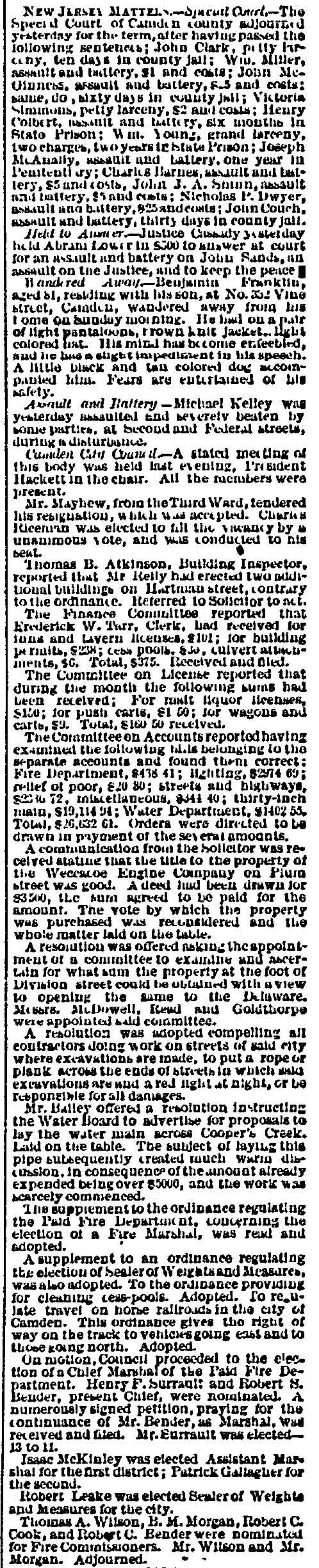
NEW JERSEY MATTERS.
Republican Nominations.
Joseph Day, of the Kensington Engine Company No. 6 from Philadelphia, was made temporary Chief.
A resolution was offered making the appointment of Chief Marshal subject to confirmation.
Isaac McKinley was elected Assistant Marshal of District No. 2.
Thomas A. Wilson, B.M. Morgan, Robert Ackhart were placed on the committee for soliciting subscriptions.
Over the River — Republican Nominations
Philadelphia Inquirer —
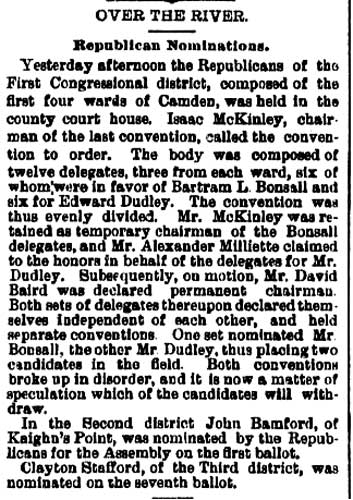
Yesterday afternoon the Republicans of the First Congressional district, composed of the first four wards of Camden, was held in the county court house. Isaac McKinley, chairman of the last convention, called the convention to order. The body was composed of twelve delegates, three from each ward, six of whom were in favor of Bartram L. Bonsall and six for Edward Dudley. The convention was thus evenly divided. Mr. McKinley was retained as temporary chairman of the Bonsall delegates, and Mr. Alexander Milliette claimed to the honors in behalf of the delegates for Mr. Dudley. Subsequently, on motion, Mr. David Baird was declared permanent chairman. Both sets of delegates thereupon declared themselves independent of each other, and held separate conventions. One set nominated Mr. Bonsall, the other Mr. Dudley, thus placing two candidates in the field. Both conventions broke up in disorder, and it is now a matter of speculation which of the candidates will withdraw.
In the Second district John Bamford, of Kaighn’s Point, was nominated by the Republicans for the Assembly on the first ballot.
Clayton Stafford, of the Third district, was nominated on the seventh ballot.
State Politics — Men Nominated Throughout New Jersey
Trenton Evening Times —
STATE POLITICS.
The Men Nominated and to be Nominated Throughout the State.
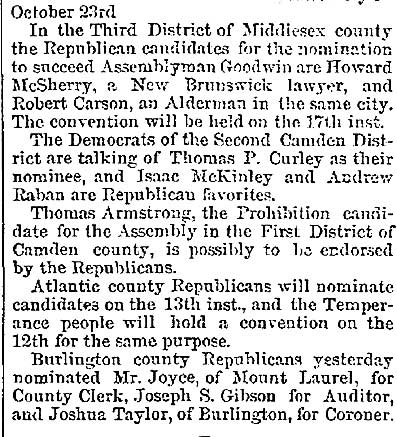
The Democrats of the Second Camden District are talking of Thomas P. Curley as their nominee, and Isaac McKinley and Andrew Raban are Republican favorites.
Camden County Republican Executive Committee
Philadelphia Inquirer —
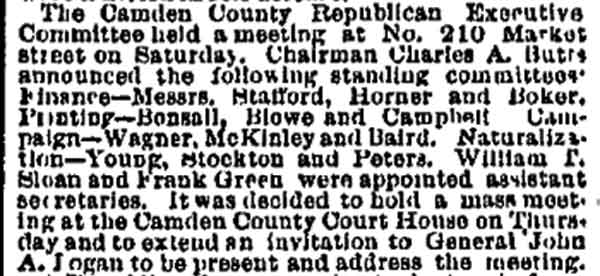
The Camden County Republican Executive Committee held a meeting at No. 210 Market street on Saturday. Chairman Charles A. Butts announced the following standing committees: Finance—Messrs. Stafford, Horner and Baker. Printing—Bonsall, Blowe and Campbell. Campaign—Wagner, McKinley and Baird. Naturalization—Young, Stockton and Peters. William P. Sloan and Frank Green were appointed assistant secretaries. It was decided to hold a mass meeting at the Camden County Court House on Thursday and to extend an invitation to General John A. Logan to be present and address the meeting.
The Camden Primaries
Philadelphia Inquirer —
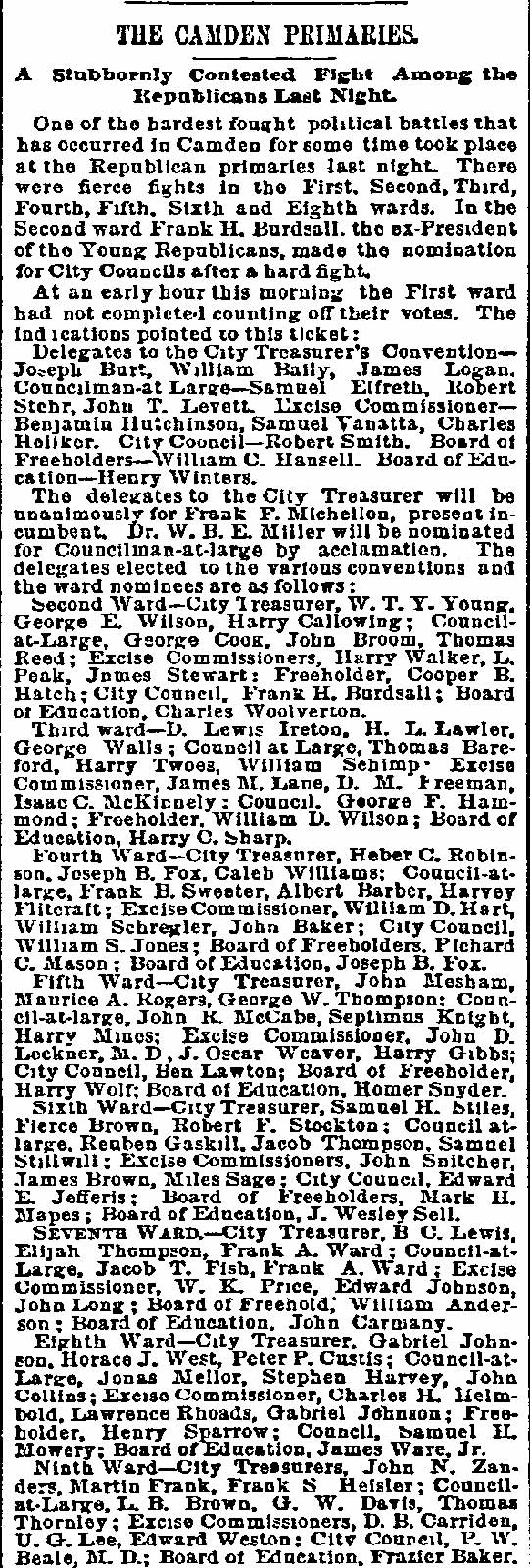
THE CAMDEN PRIMARIES.
A Stubbornly Contested Fight Among the Republicans Last Night.
One of the hardest fought political battles that has occurred in Camden for some time took place at the Republican primaries last night. There were fierce fights in the First, Second, Third, Fourth, Fifth, Sixth and Eighth wards.
Third ward—D. Lewis Iretoo, H. L. Lawler, George Walls; Council at Large, Thomas Barber, Harvey; Council, James Stewart; Excise Commissioner, James M. Lane, D. M. Freeman, Isaac C. McKinney; Council, George F. Hannigan, Frank Michellon, E. D. Wilson; Board of Education, Harry C. Sharp.
Camden’s News Budget
Philadelphia Inquirer —
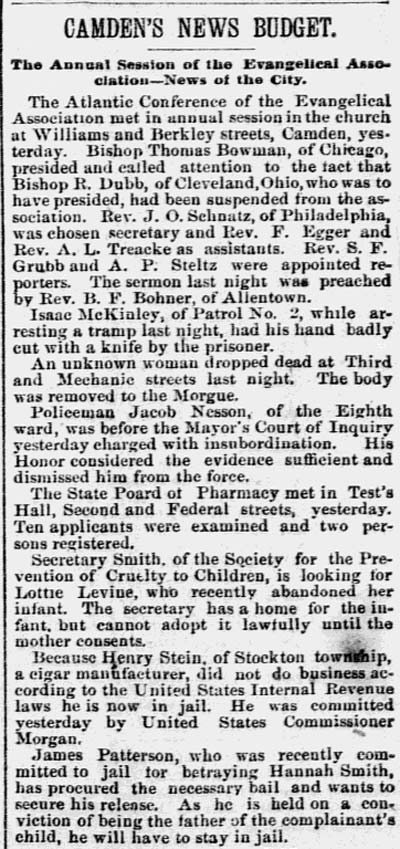
CAMDEN’S NEWS BUDGET.
The Annual Session of the Evangelical Association—News of the City.
The Atlantic Conference of the Evangelical Association met in annual session in the church at Williams and Berkley streets, Camden, yesterday. Bishop Thomas Bowman, of Chicago, presided and called attention to the fact that Bishop R. Dubb, of Cleveland, Ohio, who was to have presided, had been suspended from the association. Rev. J. O. Schnatz, of Philadelphia, was chosen secretary and Rev. F. Egger and Rev. A. L. Treacke as assistants. Rev. S. F. Grubb and A. P. Steltz were appointed reporters. The sermon last night was preached by Rev. B. F. Bohner, of Allentown.
Isaac McKinley, of Patrol No. 2, while arresting a tramp last night, had his hand badly cut with a knife by the prisoner.
An unknown woman dropped dead at Third and Mechanic streets last night. The body was removed to the Morgue.
Policeman Jacob Nesson, of the Eighth ward, was before the Mayor’s Court of Inquiry yesterday charged with insubordination. His Honor considered the evidence sufficient and dismissed him from the force.
Camden’s Fire Laddies Parade
Philadelphia Inquirer —
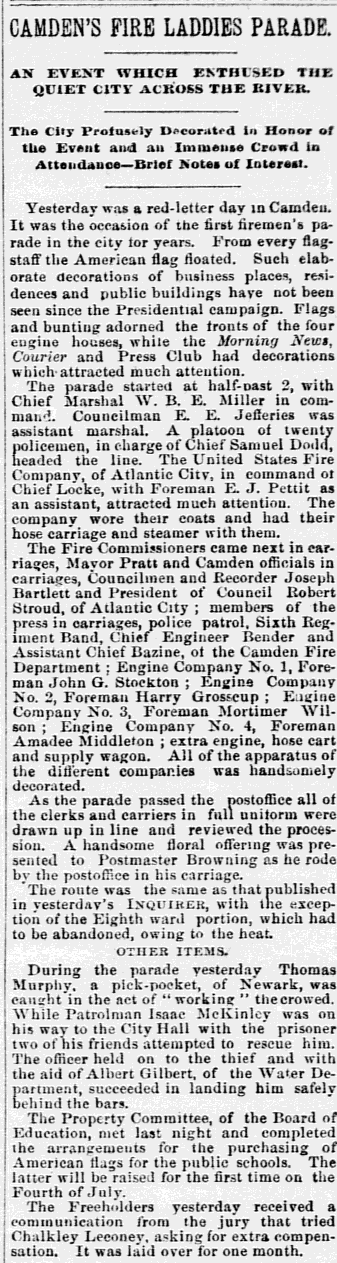
CAMDEN’S FIRE LADDIES PARADE.
AN EVENT WHICH ENTHUSED THE QUIET CITY ACROSS THE RIVER.
The City Profusely Decorated in Honor of the Event and an Immense Crowd in Attendance—Brief Notes of Interest.
Yesterday was a red-letter day in Camden. It was the occasion of the first firemen’s parade in the city for years. From every flagstaff the American flag floated. Such elaborate decorations of business places, residences and public buildings have not been seen since the Presidential campaign. Flags and bunting adorned the fronts of the four engine houses, while the Morning News, Courier and Press Club had decorations which attracted much attention.
The parade started at half-past 2, with Chief Marshal W. B. E. Miller in command. Councilman E. E. Jefferies was assistant marshal. A platoon of twenty policemen, in charge of Chief Samuel Dodd, headed the line. The United States Fire Company, of Atlantic City, in command of Chief Locke, with Foreman E. J. Pettit as an assistant, attracted much attention. The company wore their coats and had their hose carriage and steamer with them.
The Fire Commissioners came next in carriages, Mayor Pratt and Camden officials in carriages, Councilmen and Recorder Joseph Bartlett and President of Council Robert Stroud, of Atlantic City; members of the press in carriages, police patrol, Sixth Regiment Band, Chief Engineer Bender and Assistant Chief Bazine, of the Camden Fire Department; Engine Company No. 1, Foreman John G. Stockton; Engine Company No. 2, Foreman Harry Grosscup; Engine Company No. 3, Foreman Mortimer Wilson; Engine Company No. 4, Foreman Amadee Middleton; extra engine, hose cart and supply wagon. All of the apparatus of the different companies was handsomely decorated.
During the parade yesterday Thomas Murphy, a pick-pocket, of Newark, was caught in the act of “working” the crowd. While Patrolman Isaac McKinley was on his way to the City Hall with the prisoner two of his friends attempted to rescue him. The officer held on to the thief and with the aid of Albert Gilbert, of the Water Department, succeeded in landing him safely behind the bars.
Over in Camden
Philadelphia Inquirer —
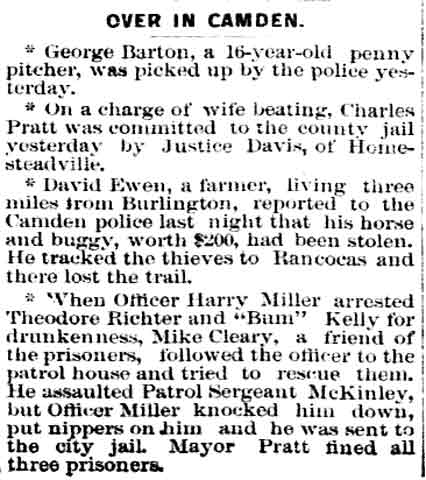
OVER IN CAMDEN.
George Barton, a 16-year-old penny pitcher, was picked up by the police yesterday.
On a charge of wife beating, Charles Pratt was committed to the county jail yesterday by Justice Davis, of Homesteadville.
David Ewen, a farmer, living three miles from Burlington, reported to the Camden police last night that his horse and buggy, worth $200, had been stolen. He tracked the thieves to Rancocas and there lost the trail.
When Officer Harry Miller arrested Theodore Richter and “Bum” Kelly for drunkenness, Mike Cleary, a friend of the prisoners, followed the officer to the patrol house and tried to rescue them. He assaulted Patrol Sergeant McKinley, but Officer Miller knocked him down, put nippers on him and he was sent to the city jail. Mayor Pratt fined all three prisoners.
Camden’s Sunday News
Philadelphia Inquirer —
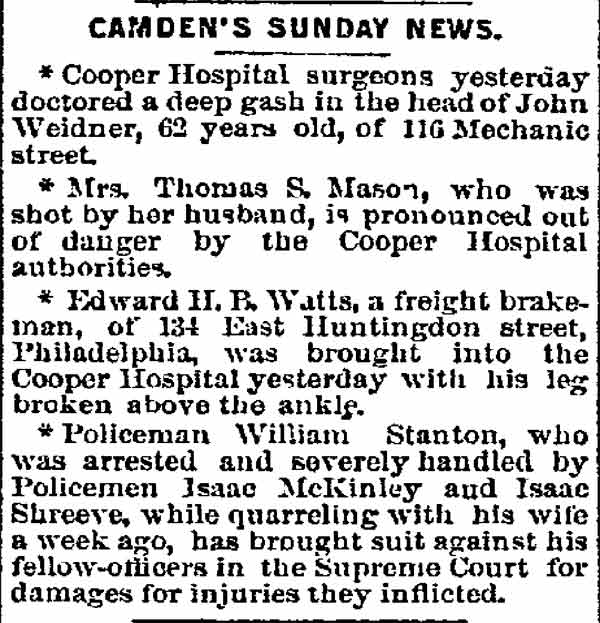
CAMDEN’S SUNDAY NEWS.
Cooper Hospital surgeons yesterday doctored a deep gash in the head of John Weidner, 62 years old, of 116 Mechanic street.
Mrs. Thomas S. Mason, who was shot by her husband, is pronounced out of danger by the Cooper Hospital authorities.
Edward H. B. Watts, a freight brakeman, of 134 East Huntingdon street, Philadelphia, was brought into the Cooper Hospital yesterday with his leg broken above the ankle.
Policeman William Stanton, who was arrested and severely handled by Policemen Isaac McKinley and Isaac Shreeve, while quarreling with his wife a week ago, has brought suit against his fellow-officers in the Supreme Court for damages for injuries they inflicted.
Policemen Shoved Off
Philadelphia Inquirer —
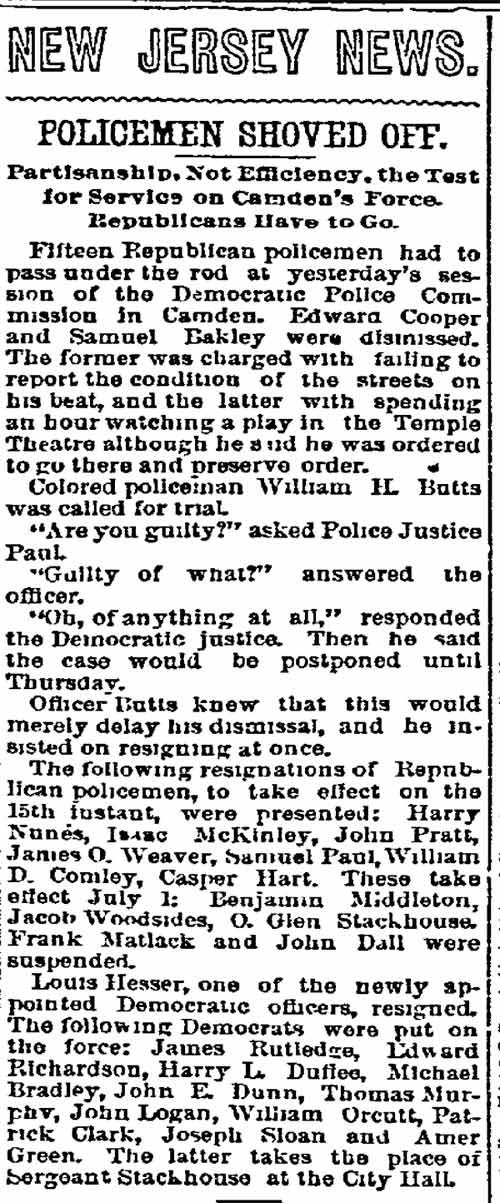
NEW JERSEY NEWS.
POLICEMEN SHOVED OFF.
Partisanship, Not Efficiency, the Test for Service on Camden’s Force. Republicans Have to Go.
Fifteen Republican policemen had to pass under the rod at yesterday’s session of the Democratic Police Commission in Camden. Edward Cooper and Samuel Bakley were dismissed. The former was charged with failing to report the condition of the streets on his beat, and the latter with spending an hour watching a play in the Temple Theatre although he said he was ordered to go there and preserve order.
Colored policeman William H. Butts was called for trial.
“Are you guilty?” asked Police Justice Paul.
“Guilty of what?” answered the officer.
“Oh, of anything at all,” responded the Democratic justice. Then he said the case would be postponed until Thursday.
Officer Butts knew that this would merely delay his dismissal, and he insisted on resigning at once.
The following resignations of Republican policemen, to take effect on the 15th instant, were presented: Harry Nunes, Isaac McKinley, John Pratt, James O. Weaver, Samuel Paul, William D. Comley, Casper Hart. These take effect July 1: Benjamin Middleton, Jacob Woodsides, O. Glen Stackhouse. Frank Matlack and John Dall were suspended.
Louis Hesser, one of the newly appointed Democratic officers, resigned. The following Democrats were put on the force: James Rutledge, Edward Richardson, Harry L. Duffee, Michael Bradley, John E. Dunn, Thomas Murphy, John Logan, William Orcutt, Patrick Clark, Joseph Sloan and Amer Green. The latter takes the place of Sergeant Stackhouse at the City Hall.
Over in Camden
Philadelphia Inquirer —
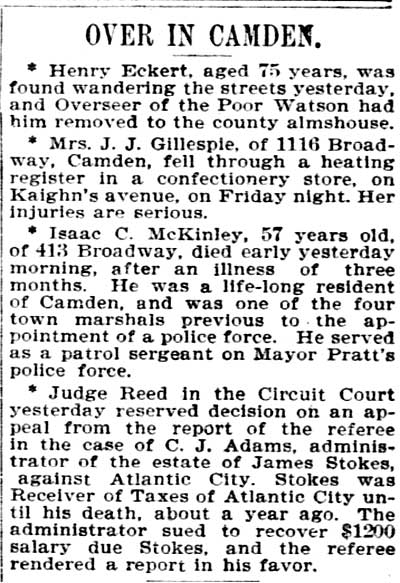
OVER IN CAMDEN.
Henry Eckert, aged 75 years, was found wandering the streets yesterday, and Overseer of the Poor Watson had him removed to the county almshouse.
Mrs. J. J. Gillespie, of 1116 Broadway, Camden, fell through a heating register in a confectionery store, on Kaighn’s avenue, on Friday night. Her injuries are serious.
Isaac C. McKinley, 57 years old, of 413 Broadway, died early yesterday morning, after an illness of three months. He was a life-long resident of Camden, and was one of the four town marshals previous to the appointment of a police force. He served as a patrol sergeant on Mayor Pratt’s police force.